




BITSAT 2026 Question Paper for May 25 Shift 2 is available here. BITS Pilani conducted BITSAT Session 2 exam on May 25, 2026 in Shift 2 from 2 PM to 5 PM. BITSAT exam is held in a CBT Mode at various exam centres in India and abroad for students to apply for Integrated programs at BITS Campuses in Pilani, Goa and Hyderabad.
- BITSAT question paper contains 130 questions divided into 5 sections- Physics and Chemistry with 30 questions each, English Proficiency with 10 questions, Logical Reasoning with 20 questions and Mathematics or Biology with 40 questions.
- Each correct answer gets you 3 marks while incorrect answer has an negative marking of 1.
Candidates can download BITSAT 2026 May 25 Shift 2 Question Paper with answer key and solution PDF from the links provided below.
Also Check: BITSAT 2026 May 25 Slot 2 Expected Marks vs Rank
BITSAT 2026 May 25 Shift 2 Question Paper with Solution PDF (Memory-Based)
| BITSAT 2026 Question Paper May 25 Shift 2 | Download PDF | Check Solutions |


According to Bohr's model of the hydrogen atom, the ratio of the kinetic energy to the total energy of an electron in \(3^{rd}\) excited state is?
View Solution
Concept:
In Bohr's atomic model, an electron revolving around a nucleus of atomic number \(Z\) in an orbit of principal quantum number \(n\) possesses kinetic energy (\(KE\)), potential energy (\(PE\)), and total energy (\(TE\)). These energies are linked by a fundamental proportional identity: \[ KE = -TE = -\frac{PE}{2} \]
Where:
Kinetic energy is always positive (\(KE > 0\)) as it depends on the square of the orbital velocity.
Total energy is negative (\(TE < 0\)), signifying that the electron is bound within the attractive electrostatic field of the nucleus.
Step 1: Analyzing the principal quantum number for the given state.
The problem specifies that the electron is in the **\(3^{rd}\) excited state**.
In atomic energy levels:
Ground state matches \(n = 1\)
\(1^{st}\) excited state matches \(n = 2\)
\(2^{nd}\) excited state matches \(n = 3\)
\(3^{th}\) excited state matches \(n = 4\)
Thus, the principal quantum number for this electron configuration is \(n = 4\).
Step 2: Evaluating the energy ratio.
The standard formula for the total energy of an electron in the \(n^{th}\) orbit of a hydrogen atom (\(Z=1\)) is: \[ TE_n = -\frac{13.6}{n^2} eV \]
For the \(3^{rd}\) excited state (\(n=4\)): \[ TE_4 = -\frac{13.6}{4^2} = -\frac{13.6}{16} = -0.85 eV \]
Since kinetic energy is equal in magnitude but opposite in sign to the total energy (\(KE = -TE\)): \[ KE_4 = -(-0.85 eV) = +0.85 eV \]
Now, computing the required ratio of kinetic energy to total energy: \[ Ratio = \frac{KE_4}{TE_4} = \frac{0.85 eV}{-0.85 eV} = \frac{1}{-1} = 1 : -1 \] Quick Tip: Notice that the question asks for a structural ratio matching specific energy types. Because the proportional relation \(KE = -TE\) is a universal constant rule valid for **any** allowed Bohr orbit, the ratio will always equal \(1 : -1\) regardless of whether the electron sits in the ground state, the \(3^{rd}\) excited state, or the \(100^{th}\) orbit! The state value is extra distracting information.
A radioactive sample has a half-life of 10 days. The fraction of the initial nuclei decayed after 40 days is:
View Solution
Concept:
Radioactive decay follows first-order kinetics. The half-life (\(T_{1/2}\)) is the time required for a radioactive sample to decrease to half of its initial value.
The remaining fraction of active nuclei (\(N/N_0\)) left after \(n\) half-lives is given by the formula: \[ \frac{N}{N_0} = \left(\frac{1}{2}\right)^n \]
Where \(n\) is the total number of half-lives that have elapsed: \[ n = \frac{Total elapsed time (t)}{Half-life (T_{1/2})} \]
Crucially, the question asks for the **fraction of nuclei decayed**, which is the total initial amount minus what remains: \[ Fraction decayed = 1 - \frac{N}{N_0} \]
Step 1: Calculating the number of half-lives (\(n\)) that have elapsed.
From the given information:
Half-life of the sample, \(T_{1/2} = 10 days\)
Total decay time, \(t = 40 days\)
Finding the number of half-life cycles: \[ n = \frac{40}{10} = 4 \]
Step 2: Determining the remaining and decayed fractions.
Calculate the fraction of intact radioactive nuclei remaining after 4 half-lives: \[ \frac{N}{N_0} = \left(\frac{1}{2}\right)^4 = \frac{1}{16} \]
Now, solve for the fraction of the initial nuclei that have decayed over this period: \[ Fraction decayed = 1 - \frac{1}{16} = \frac{16 - 1}{16} = \frac{15}{16} \] Quick Tip: Always read the final line of a radioactivity question with extreme caution. A very common exam trap is to choose option (C) \(1/16\), which is the fraction of active nuclei **undecayed (remaining)**. Always remember: \(Decayed Fraction + Remaining Fraction = 1\).
A block of mass \(M\) attached to a horizontal spring of spring constant \(k\) executes SHM with amplitude \(A\). When the block passes through its mean position, a small piece of mass \(m\) is dropped vertically onto it and sticks to it. The new amplitude of oscillation is:
View Solution
Concept:
This problem involves concepts of Simple Harmonic Motion (SHM) and linear momentum conservation:
At the mean position, the velocity of a mass undergoing SHM is at its maximum, given by \(v_{max} = \omega A\), where \(\omega = \sqrt{\frac{k}{m_{total}}}\).
Since the mass \(m\) is dropped vertically, there is no external horizontal force acting on the system at the instant of collision. Therefore, the **linear momentum in the horizontal direction is conserved**.
After the collision, the total combined mass changes, which alters both the angular frequency of the system and the maximum velocity, consequently establishing a new amplitude \(A'\).
Step 1: Applying conservation of linear momentum at the mean position.
Before the collision, the block of mass \(M\) is passing through its mean position with its initial maximum velocity \(v_0\): \[ v_0 = \omega_1 A = \sqrt{\frac{k}{M}} A \]
The initial horizontal momentum of the system is: \[ P_{initial} = M v_0 \]
When the mass \(m\) lands vertically and sticks to it, let the new common horizontal velocity of the combined mass \((M + m)\) be \(v'\). The final horizontal momentum is: \[ P_{final} = (M + m)v' \]
Conserving horizontal linear momentum (\(P_{initial} = P_{final}\)): \[ M v_0 = (M + m)v' \quad \Rightarrow \quad v' = \left(\frac{M}{M + m}\right) v_0 \quad \cdots (1) \]
Step 2: Relating the new velocity to the new amplitude \(A'\).
The collision occurs precisely at the mean position, meaning the potential energy stored in the spring is zero at this instant, and the new velocity \(v'\) represents the new maximum velocity of the altered SHM system: \[ v' = \omega_2 A' \]
Where \(\omega_2\) is the new angular frequency for the combined mass: \[ \omega_2 = \sqrt{\frac{k}{M + m}} \]
Substitute \(\omega_2\) and the value of \(v_0\) from Step 1 into equation (1): \[ \sqrt{\frac{k}{M + m}} A' = \left(\frac{M}{M + m}\right) \sqrt{\frac{k}{M}} A \]
Squaring both sides to eliminate the radical constraints: \[ \left(\frac{k}{M + m}\right) (A')^2 = \left(\frac{M}{M + m}\right)^2 \left(\frac{k}{M}\right) A^2 \]
Cancel out the common spring constant \(k\) and one factor of \((M + m)\) from both denominators: \[ (A')^2 = \frac{M^2}{(M + m)^2} \cdot \frac{M + m}{M} \cdot A^2 \] \[ (A')^2 = \left(\frac{M}{M + m}\right) A^2 \]
Taking the square root yields the new amplitude: \[ A' = A\sqrt{\frac{M}{M + m}} \] Quick Tip: This problem can also be solved using **Conservation of Energy**. The total mechanical energy of a spring-mass system is completely kinetic at the mean position: \(U_{total} = \frac{1}{2} m_{total} v_{max}^2\). Since \(v' = \frac{M}{M+m}v_0\), the new energy is \(E' = \frac{1}{2}(M+m)(v')^2 = \frac{1}{2}(M+m)\left(\frac{M}{M+m}\right)^2 v_0^2 = \left(\frac{M}{M+m}\right) E\). Because energy is proportional to the square of amplitude (\(E \propto A^2\)), the new amplitude scales matching the square root of the energy fraction!
The dimensions of magnetic flux are identical to the dimensions of:
View Solution
Concept:
Dimensional analysis can be approached either by calculating the fundamental SI base unit dimensions (\(M, L, T, A\)) for each term or, more rapidly, by using fundamental governing physical equations. According to **Faraday's Law of Electromagnetic Induction**, the induced electromotive force (\(EMF\) or \(e\)) in a circuit is directly proportional to the time rate of change of magnetic flux (\(\phi_B\)) linking with it: \[ e = -\frac{d\phi_B}{dt} \]
By rearranging this formula, we can establish a direct relationship between the dimensional units of magnetic flux, electromotive force, and time.
Step 1: Relating magnetic flux to EMF and time via Faraday's Law.
From the differential relation of Faraday's Law, ignoring the negative sign (which represents direction due to Lenz's law), we write the relationship in terms of dimensional quantities: \[ [EMF] = \frac{[Magnetic Flux]}{[Time]} \]
Rearranging the equation to isolate magnetic flux: \[ [Magnetic Flux] = [EMF] \times [Time] \]
This directly matches the combination stated in Option (A).
Step 2: Verifying through fundamental dimensional formulas (Optional confirmation).
Let's find the dimensional formula for both sides to verify:
**Magnetic Flux (\(\phi_B = B \cdot A\)):** Since magnetic force is \(F = qvB \implies B = \frac{F}{qv}\), its dimensions are \(\frac{[MLT^{-2}]}{[AT][LT^{-1}]} = [MT^{-2}A^{-1}]\). Multiplying by area (\(A = [L^2]\)):
\[ [\phi_B] = [ML^2T^{-2}A^{-1}] \]
**EMF \(\times\) Time:** \(EMF\) is work done per unit charge, so its dimensions are \(\frac{[ML^2T^{-2}]}{[AT]} = [ML^2T^{-3}A^{-1}]\). Multiplying this by time (\([T]\)):
\[ [EMF \times Time] = [ML^2T^{-3}A^{-1}] \times [T] = [ML^2T^{-2}A^{-1}] \]
Both methods confirm that the dimensions are completely identical. Quick Tip: Whenever an exam problem asks for dimensional matches, always look for a direct historical law equation before breaking terms down into basic \([M][L][T][A]\) base dimensions. Equations like \(e = \frac{\Delta \phi}{\Delta t}\) (Faraday's Law) or \(V = L\frac{di}{dt}\) let you deduce correct unit combinations in under ten seconds!
If the ionic product of \(Ni(OH)_2\) is \(1.9 \times 10^{-15}\), then the molar solubility of \(Ni(OH)_2\) in \(1.0 M NaOH\) is
View Solution
Concept:
This problem involves calculating solubility in the presence of a **common ion**:
Sodium hydroxide (\(NaOH\)) is a strong electrolyte that dissociates completely in water, producing a high concentration of hydroxyl ions (\(OH^-\)).
Nickel hydroxide (\(Ni(OH)_2\)) is a sparingly soluble salt that sets up a dynamic equilibrium with its constituent ions in solution.
The ionic product of a saturated solution is equal to its solubility product constant (\(K_{sp}\)). Due to Le Chatelier's principle and the common ion effect, the presence of \(OH^-\) ions from \(NaOH\) shifts the equilibrium backward, drastically suppressing the molar solubility (\(s\)) of \(Ni(OH)_2\).
Step 1: Determining total ion concentrations at equilibrium.
First, look at the complete dissociation of the strong base: \[ NaOH(aq) \rightarrow Na^+(aq) + OH^-(aq) \]
Since \([NaOH] = 1.0 M\), it provides \([OH^-] = 1.0 M\).
Next, let the molar solubility of \(Ni(OH)_2\) in this solution be \(s\). The equilibrium dissociation is: \[ \begin{array}{lcccc} \text{Reaction:} & Ni(OH)_2(s) & \rightleftharpoons & Ni^{2+}(aq) & + & 2OH^-(aq) \end{array} \]
Equilibrium (M): & & & s & & 1.0 + 2s \end{array} \]
Because the ionic product (\(K_{sp}\)) is exceptionally small (\(1.9 \times 10^{-15}\)), the value of \(s\) will be negligible. Therefore, we can safely apply the algebraic approximation: \[ 1.0 + 2s \approx 1.0 M \]
Step 2: Solving for the molar solubility (\(s\)) using the solubility product expression.
Write the expression for the solubility product constant (\(K_{sp}\)): \[ K_{sp} = [Ni^{2+}][OH^-]^2 \]
Substitute the equilibrium concentrations and the given value of the ionic product into the formula: \[ 1.9 \times 10^{-15} = (s)(1.0)^2 \] \[ 1.9 \times 10^{-15} = s \times 1.0 \] \[ s = 1.9 \times 10^{-15} M \] Quick Tip: For any sparingly soluble metal hydroxide of the form \(M(OH)_x\) dissolved in a strong base of molarity \(C\), the common ion effect simplifies the solubility calculation to a direct shortcut formula: \( s = \frac{K_{sp}}{C^x} \). In this scenario, substituting the parameters yields \( s = \frac{1.9 \times 10^{-15}}{(1.0)^2} = 1.9 \times 10^{-15} M\).
The solubility of \(Pb(OH)_2\) in water is \(6.7 \times 10^{-6} M\). Its solubility in a buffer solution of \(pH = 8\) would be:
View Solution
Concept:
This problem requires determining the solubility product constant (\(K_{sp}\)) of a sparingly soluble salt in pure water first, then evaluating its modified solubility under a fixed external \(pH\) condition:
For a salt like \(Pb(OH)_2\) with a molar solubility \(s\) in pure water, its dissociation equilibrium yields:
\[ K_{sp} = [Pb^{2+}][OH^-]^2 = (s)(2s)^2 = 4s^3 \]
In a buffer solution, the \(pH\) is maintained at a constant value, fixing the concentration of hydroxyl ions (\([OH^-]\)). The new solubility \(s'\) is determined by satisfying the constant \(K_{sp}\) relationship.
Step 1: Calculating the solubility product constant (\(K_{sp}\)) from solubility in pure water.
The given solubility of \(Pb(OH)_2\) in pure water is \(s = 6.7 \times 10^{-6} M\).
Using the relation for a \(1:2\) electrolyte system: \[ K_{sp} = 4s^3 \] \[ K_{sp} = 4 \times \left(6.7 \times 10^{-6}\right)^3 \] \[ K_{sp} = 4 \times 300.763 \times 10^{-18} \approx 1.2 \times 10^{-15} \]
Step 2: Determining \([OH^-]\) from the buffer solution \(pH\).
The buffer solution maintains a constant environment of \(pH = 8\).
Using the relation between \(pH\) and \(pOH\) at \(25^\circ C\):
Now, computing the concentration of hydroxyl ions from the logarithmic definition: \[ [OH^-] = 10^{-pOH} = 10^{-6} M \]
Step 3: Calculating the new solubility (\(s'\)) in the buffer solution.
Let the new molar solubility of \(Pb(OH)_2\) in the buffer solution be \(s'\). The dissociation equilibrium yields: \[ Pb(OH)_2(s) \rightleftharpoons Pb^{2+}(aq) + 2OH^-(aq) \]
Here, the equilibrium concentrations are \([Pb^{2+}] = s'\) and \([OH^-]\) is fixed entirely by the buffer at \(10^{-6} M\).
Substitute these conditions into the \(K_{sp}\) expression: \[ K_{sp} = [Pb^{2+}][OH^-]^2 \] \[ 1.2 \times 10^{-15} = (s') \times \left(10^{-6}\right)^2 \] \[ 1.2 \times 10^{-15} = s' \times 10^{-12} \]
Isolating for the new solubility variable \(s'\): \[ s' = \frac{1.2 \times 10^{-15}}{10^{-12}} = 1.2 \times 10^{-3} M \] Quick Tip: Always remember that a buffer solution acts as an infinite reservoir for \(H^+\) or \(OH^-\) ions. Therefore, unlike when dissolving a salt in pure water or standard ionic solutions, you completely ignore any extra \(OH^-\) ions produced by the salt dissociation (\(2s'\)) because the buffer dynamically absorbs them to lock the final concentration exactly to \(10^{-pOH}\).
\(0.1 m\) of urea and \(0.05 m\) of \(CaCl_2\) are dissolved separately in equal volumes of water. Which solution will have higher elevation in boiling point?
View Solution
Concept:
Elevation in boiling point (\(\Delta T_b\)) is a **colligative property**, meaning it depends directly on the total number of solute particles present in the solution rather than the identity of the solute.
The mathematical relationship is given by the formula: \[ \Delta T_b = i \cdot K_b \cdot m \]
Where:
\(i\) = van 't Hoff factor (total number of particles formed after dissociation or association)
\(K_b\) = Molal boiling point elevation constant (or ebullioscopic constant of the solvent)
\(m\) = Molality of the solution (\(moles of solute / kg of solvent\))
Since both solutes are dissolved in the same solvent (water), \(K_b\) remains constant. Therefore, the elevation in boiling point is directly proportional to the effective particle concentration: \[ \Delta T_b \propto (i \cdot m) \]
Step 1: Evaluating the effective concentration (\(i \cdot m\)) for Urea solution.
Urea (\(NH_2CONH_2\)) is an organic non-electrolyte compound. It does not dissociate or associate when dissolved in water: \[ i_{urea} = 1 \]
Given molality \(m_{urea} = 0.1 m\).
Calculating the effective particle factor: \[ (i \cdot m)_{urea} = 1 \times 0.1 = 0.1 m \]
Step 2: Evaluating the effective concentration (\(i \cdot m\)) for \(CaCl_2\) solution.
Calcium chloride (\(CaCl_2\)) is an ionic salt that undergoes complete dissociation in aqueous solutions: \[ CaCl_2(aq) \rightarrow Ca^{2+}(aq) + 2Cl^-(aq) \]
Counting the total moles of ions produced per formula unit: 1 calcium ion + 2 chloride ions = 3 ions. \[ i_{CaCl_2} = 3 \]
Given molality \(m_{CaCl_2} = 0.05 m\).
Calculating the effective particle factor: \[ (i \cdot m)_{CaCl_2} = 3 \times 0.05 = 0.15 m \]
Step 3: Comparing the values to find the higher elevation.
Comparing the effective particle concentrations calculated: \[ (i \cdot m)_{CaCl_2} = 0.15 m \quad > \quad (i \cdot m)_{urea} = 0.1 m \]
Since \(0.15 > 0.1\), the \(CaCl_2\) solution contains a higher absolute concentration of solute particles in the solvent, thereby leading to a greater elevation in its boiling point: \[ \Delta T_{b_{CaCl_2}} > \Delta T_{b_{urea}} \] Quick Tip: To prevent an easy miscalculation, always compare the final product of \((i \times m)\) directly instead of looking at the raw molalities. Even though the urea solution has double the starting concentration (\(0.1 m\) vs \(0.05 m\)), the triple ion generation of \(CaCl_2\) completely overtakes it.
A decimolar solution of potassium ferrocyanide is \(50%\) dissociated at \(300K\). The osmotic pressure of the solution is (\(R = 8.314 JK^{-1}mol^{-1}\))
View Solution
Concept:
Osmotic pressure (\(\pi\)) is a colligative property that depends on the total concentration of solute particles in the solution. For electrolytes that dissociate, the relation includes the van 't Hoff factor (\(i\)): \[ \pi = i \cdot C \cdot R \cdot T \]
Where:
\(i\) = van 't Hoff factor \(= 1 + (n - 1)\alpha\) for dissociation
\(n\) = total number of ions produced per formula unit of the electrolyte
\(\alpha\) = degree of dissociation of the solute
\(C\) = molar concentration of the solution (\(mol L^{-1}\) or \(mol m^{-3}\))
\(R\) = universal gas constant
\(T\) = absolute temperature in Kelvin
Step 1: Calculating the van 't Hoff factor (\(i\)) for potassium ferrocyanide.
Potassium ferrocyanide has the chemical formula \(K_4[Fe(CN)_6]\). In an aqueous solution, it dissociates as follows: \[ K_4[Fe(CN)_6](aq) \rightarrow 4K^+(aq) + [Fe(CN)_6]^{4-}(aq) \]
Total number of ions produced per formula unit, \(n = 4 + 1 = 5\).
Given that the solution is \(50%\) dissociated: \[ \alpha = \frac{50}{100} = 0.5 \]
Substitute \(n\) and \(\alpha\) into the van 't Hoff dissociation formula: \[ i = 1 + (5 - 1) \times 0.5 = 1 + 4 \times 0.5 = 1 + 2 = 3 \]
Step 2: Converting concentration and pressure parameters to standard units.
Decimolar solution means the concentration \(C = 0.1 M = 0.1 mol L^{-1}\).
Absolute temperature, \(T = 300 K\).
To obtain the final osmotic pressure in atmospheres directly, it is highly efficient to use the value of gas constant \(R = 0.0821 L atm mol^{-1} K^{-1}\): \[ \pi = i \cdot C \cdot R \cdot T \] \[ \pi = 3 \times 0.1 mol L^{-1} \times 0.0821 L atm mol^{-1} K^{-1} \times 300 K \] \[ \pi = 3 \times 0.1 \times 24.63 = 3 \times 2.463 = 7.389 atm \approx 7.48 atm \] Quick Tip: While the question lists \(R = 8.314 JK^{-1}mol^{-1}\) (SI units), using it directly forces you to convert concentration to \(mol m^{-3}\), which outputs pressure in Pascals (\(N m^{-2}\)). You must then divide by \(1.013 \times 10^5\) to get atmospheres. Remembering that \(R = 0.0821 L atm mol^{-1} K^{-1}\) automatically handles the conversion cleanly when concentration is in molarity!
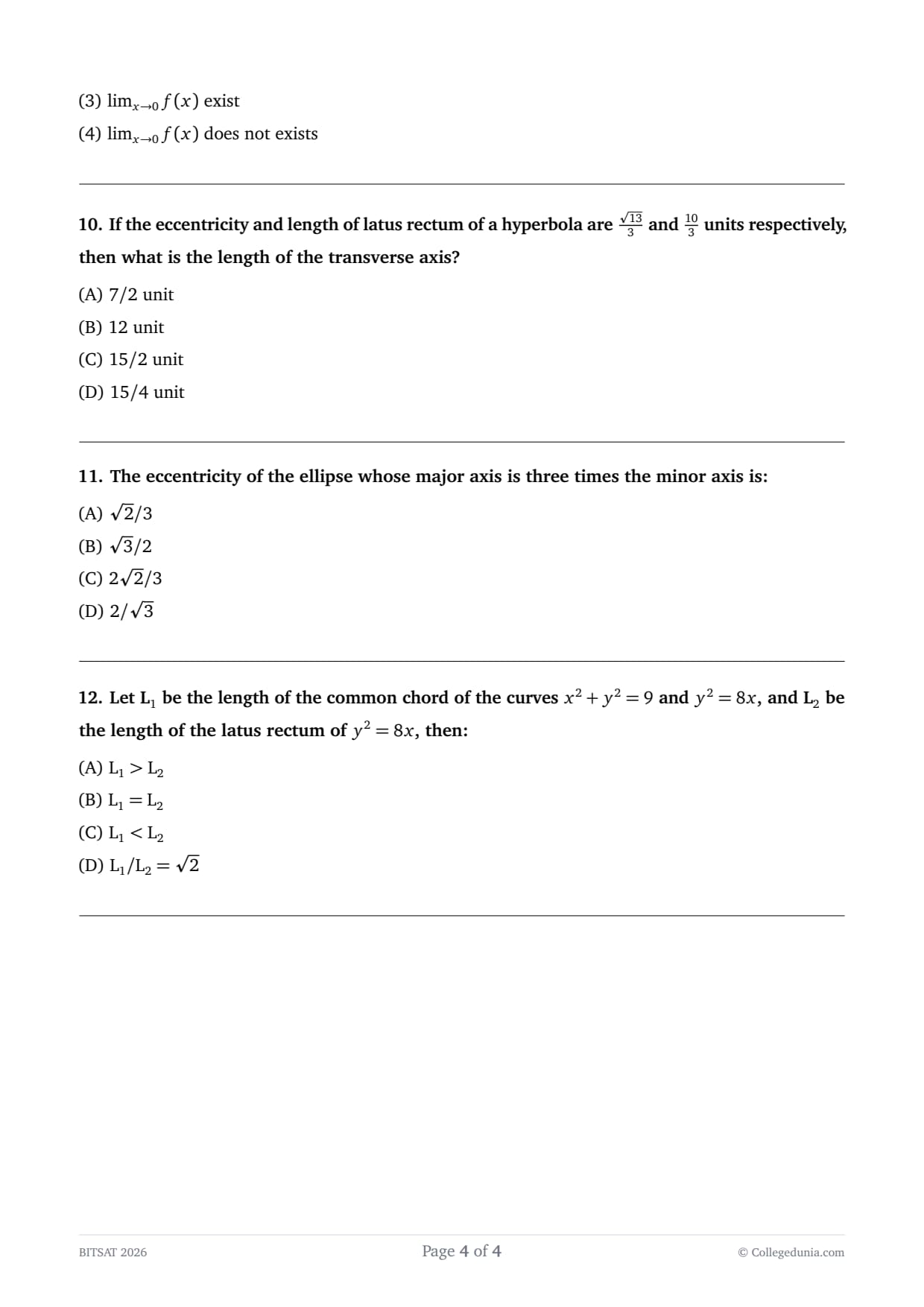
Given a real valued function \(f\) such that \(f(x) = \begin{cases} \frac{\tan^2\{x\}}{x^2 - [x]^2} & for x > 0
1 & for x = 0
\sqrt{\{x\} \cot\{x\}} & for x < 0 \end{cases}\) then
View Solution
Concept:
This problem evaluates calculus limits involving special function properties:
\([x]\) represents the **Greatest Integer Function** (floor function).
\(\{x\}\) represents the **Fractional Part Function**, defined explicitly by the identity:
\[ \{x\} = x - [x] \]
For a limit to exist at a point \(x = a\), the Left-Hand Limit (\(LHL\)) must equal the Right-Hand Limit (\(RHL\)).
Standard trigonometric limit theorem used: \(\lim_{\theta \to 0} \frac{\tan \theta}{\theta} = 1\).
Step 1: Evaluating the Right-Hand Limit (\(RHL\)) at \(x \to 0^+\).
For the right-hand limit, \(x \to 0^+\), which means \(x\) is a tiny positive value (\(0 < x < 1\)).
Under this condition: \[ [x] = 0 \quad and \quad \{x\} = x - [x] = x - 0 = x \]
Substitute these expressions into the matching top branch of the piecewise definition: \[ RHL = \lim_{x \to 0^+} \frac{\tan^2\{x\}}{x^2 - [x]^2} = \lim_{x \to 0^+} \frac{\tan^2 x}{x^2 - 0^2} \] \[ RHL = \lim_{x \to 0^+} \left(\frac{\tan x}{x}\right)^2 = (1)^2 = 1 \]
Step 2: Evaluating the Left-Hand Limit (\(LHL\)) at \(x \to 0^-\).
For the left-hand limit, \(x \to 0^-\), which means \(x\) is a tiny negative value (\(-1 < x < 0\)).
Under this condition: \[ [x] = -1 \quad and \quad \{x\} = x - [x] = x - (-1) = x + 1 \]
Substitute these expressions into the matching bottom branch of the piecewise definition: \[ LHL = \lim_{x \to 0^-} \sqrt{\{x\} \cot\{x\}} = \lim_{x \to 0^-} \sqrt{(x + 1) \cot(x + 1)} \]
Since \(x \to 0\), substitute \(x = 0\) directly into this smooth continuous evaluation expression: \[ LHL = \sqrt{(0 + 1) \cot(0 + 1)} = \sqrt{1 \cdot \cot 1} = \sqrt{\cot 1} \]
Step 3: Comparing \(LHL\) and \(RHL\).
Comparing our calculated values: \[ RHL = 1 \quad and \quad LHL = \sqrt{\cot 1} \]
Since \(LHL \neq RHL\), the two unidirectional pathways fail to meet at a single shared value, which means the overall limit does not exist: \[ \lim_{x \to 0} f(x) \quad does not exist \] Quick Tip: Always analyze the boundaries of \([x]\) and \(\{x\}\) individually based on whether you approach from the positive or negative direction before applying standard algebraic simplifications. A common mistake is assuming \(\{x\} \to 0\) from both sides, which leads to a false conclusion.
If the eccentricity and length of latus rectum of a hyperbola are \(\frac{\sqrt{13}}{3}\) and \(\frac{10}{3}\) units respectively, then what is the length of the transverse axis?
View Solution
Concept:
For a standard hyperbola \(\frac{x^2}{a^2} - \frac{y^2}{b^2} = 1\), the fundamental geometric relationships are defined as follows:
Length of the transverse axis \(= 2a\)
Length of the latus rectum \(= \frac{2b^2}{a}\)
Eccentricity (\(e\)) is related to the semi-axes by the formula:
\[ e^2 = 1 + \frac{b^2}{a^2} \]
Step 1: Expressing given values into standard hyperbola equations.
From the problem statement, we have:
Eccentricity, \(e = \frac{\sqrt{13}}{3}\)
Length of latus rectum \(= \frac{10}{3} \implies \frac{2b^2}{a} = \frac{10}{3} \implies b^2 = \frac{5a}{3} \quad \cdots (1)\)
Step 2: Using the eccentricity formula to find the value of \(a\).
Substitute the eccentricity value into the relation \(e^2 = 1 + \frac{b^2}{a^2}\): \[ \left(\frac{\sqrt{13}}{3}\right)^2 = 1 + \frac{b^2}{a^2} \] \[ \frac{13}{9} = 1 + \frac{b^2}{a^2} \quad \Rightarrow \quad \frac{b^2}{a^2} = \frac{13}{9} - 1 = \frac{4}{9} \quad \cdots (2) \]
Now, substitute the value of \(b^2\) from equation (1) into equation (2): \[ \frac{\left(\frac{5a}{3}\right)}{a^2} = \frac{4}{9} \]
Simplify the left side of the equation: \[ \frac{5}{3a} = \frac{4}{9} \]
Cross-multiplying to solve for \(a\): \[ 12a = 45 \quad \Rightarrow \quad a = \frac{45}{12} = \frac{15}{4} \]
Step 3: Calculating the length of the transverse axis.
The total length of the transverse axis is equal to \(2a\). Substituting our value of \(a\): \[ Length of transverse axis = 2 \times \frac{15}{4} = \frac{15}{2} = 7.5 units \] Quick Tip: Whenever you are given both eccentricity and the latus rectum, you can find the semi-major axis \(a\) rapidly by noticing that \(Latus Rectum = 2a(e^2 - 1)\). Substituting the given values: \(\frac{10}{3} = 2a\left(\frac{13}{9} - 1\right) \implies \frac{10}{3} = 2a\left(\frac{4}{9}\right) \implies a = \frac{15}{4}\). Multiplying by 2 immediately yields \(\frac{15}{2}\).
The eccentricity of the ellipse whose major axis is three times the minor axis is:
View Solution
Concept:
For a standard horizontal ellipse \(\frac{x^2}{a^2} + \frac{y^2}{b^2} = 1\) (where \(a > b\)), the geometric parameters are defined as:
Length of the major axis \(= 2a\)
Length of the minor axis \(= 2b\)
The eccentricity (\(e\)) measures the elongation of the ellipse and is related to its semi-axes by the relationship:
\[ b^2 = a^2(1 - e^2) \quad \implies \quad e = \sqrt{1 - \frac{b^2}{a^2}} \]
Step 1: Establishing the relationship between the semi-axes from the given condition.
The problem states that the major axis is three times the length of the minor axis: \[ Major axis = 3 \times Minor axis \] \[ 2a = 3 \times (2b) \]
Dividing both sides by 2 gives: \[ a = 3b \quad \implies \quad \frac{b}{a} = \frac{1}{3} \]
Step 2: Calculating the eccentricity (\(e\)).
Squaring the semi-axis ratio yields: \[ \frac{b^2}{a^2} = \left(\frac{1}{3}\right)^2 = \frac{1}{9} \]
Substitute this value directly into the standard eccentricity formula: \[ e = \sqrt{1 - \frac{b^2}{a^2}} \] \[ e = \sqrt{1 - \frac{1}{9}} = \sqrt{\frac{9 - 1}{9}} = \sqrt{\frac{8}{9}} \]
Simplifying the radical values separately for the numerator and the denominator: \[ \sqrt{8} = \sqrt{4 \times 2} = 2\sqrt{2} \] \[ \sqrt{9} = 3 \]
Thus, we find the final value for the eccentricity: \[ e = \frac{2\sqrt{2}}{3} \] Quick Tip: To complete this type of problem even faster, remember that the eccentricity formula can be written explicitly using the axis ratio \(k = \frac{Major}{Minor} = \frac{a}{b}\). The shortcut formula is \( e = \frac{\sqrt{k^2 - 1}}{k} \). Substituting \(k = 3\) gives \( e = \frac{\sqrt{3^2 - 1}}{3} = \frac{\sqrt{8}}{3} = \frac{2\sqrt{2}}{3}\).
Let \(L_1\) be the length of the common chord of the curves \(x^2 + y^2 = 9\) and \(y^2 = 8x\), and \(L_2\) be the length of the latus rectum of \(y^2 = 8x\), then:
View Solution
Concept:
To find the length of a common chord between two intersecting conic curves:
Find the points of intersection by solving the system of equations simultaneously.
Identify the corresponding coordinate values at the intersection boundary.
Compute the distance between these intersection points using the distance formula.
For a standard parabola of the form \(y^2 = 4ax\), the length of its latus rectum is directly given by the coefficient constant \(4a\).
Step 1: Finding the length of the latus rectum (\(L_2\)).
Given the equation of the parabola: \[ y^2 = 8x \]
Comparing this with the standard form \(y^2 = 4ax\), we have \(4a = 8\).
Therefore, the length of the latus rectum is: \[ L_2 = 8 \quad \cdots (1) \]
Step 2: Finding the intersection points of the two curves.
The equations of the two curves are: \[ x^2 + y^2 = 9 \quad \cdots (2) \] \[ y^2 = 8x \quad \cdots (3) \]
Substitute the value of \(y^2\) from equation (3) into equation (2): \[ x^2 + 8x = 9 \]
Rearranging into a standard quadratic equation format: \[ x^2 + 8x - 9 = 0 \]
Splitting the middle term to factor the quadratic equation: \[ x^2 + 9x - x - 9 = 0 \] \[ x(x + 9) - 1(x + 9) = 0 \] \[ (x - 1)(x + 9) = 0 \]
This yields two possible values for \(x\): \[ x = 1 \quad or \quad x = -9 \]
Since \(y^2 = 8x\), if \(x = -9\), then \(y^2 = -72\), which gives imaginary values for \(y\). Thus, we discard \(x = -9\).
Taking the valid real value \(x = 1\): \[ y^2 = 8(1) = 8 \quad \implies \quad y = \pm \sqrt{8} = \pm 2\sqrt{2} \]
Hence, the two intersection points are \(P(1, 2\sqrt{2})\) and \(Q(1, -2\sqrt{2})\).
Step 3: Calculating the length of the common chord (\(L_1\)) and comparing values.
The common chord is the straight line segment joining the two intersection points \(P\) and \(Q\). Since both points share the same \(x\)-coordinate (\(x = 1\)), the chord is a vertical line segment, and its length is simply the difference between their \(y\)-coordinates: \[ L_1 = 2\sqrt{2} - (-2\sqrt{2}) = 4\sqrt{2} \]
Approximating the value using \(\sqrt{2} \approx 1.414\): \[ L_1 = 4 \times 1.414 = 5.656 units \]
Now, comparing our calculated values: \[ L_1 = 4\sqrt{2} \approx 5.66 \quad and \quad L_2 = 8 \]
Since \(5.66 < 8\), we conclude that: \[ L_1 < L_2 \] Quick Tip: You can visualize this conceptually without doing the arithmetic distance step. The circle has a radius of \(3\), meaning its absolute maximum span anywhere along the vertical axis is its diameter, which is \(6\). Since the latus rectum length is \(8\), the common chord bounded inside this small circle could never possibly be larger than \(6\), instantly proving \(L_1 < L_2\)!
BITSAT 2026 Chapter-Wise Weightage
Physics
| Chapter | Expected Weightage (%) |
|---|---|
| Laws of Motion | 8–10% |
| Current Electricity | 7–9% |
| Ray Optics & Wave Optics | 6–8% |
| Thermodynamics | 6–7% |
| Electrostatics | 5–7% |
Chemistry
| Chapter | Expected Weightage (%) |
|---|---|
| Chemical Bonding | 8–10% |
| Organic Chemistry (Basics + Reactions) | 10–12% |
| Coordination Compounds | 6–8% |
| Electrochemistry | 5–7% |
| p-Block Elements | 6–8% |
Mathematics
| Chapter | Expected Weightage (%) |
|---|---|
| Calculus (Limits, Integration, Differentiation) | 12–15% |
| Vectors & 3D Geometry | 8–10% |
| Complex Numbers & Quadratic Equations | 6–8% |
| Probability | 6–8% |
| Coordinate Geometry | 7–9% |



Comments