




The BITSAT 2026 iteration process is conducted for admission to BITS Pilani, Goa, and Hyderabad campuses through multiple allotment rounds based on score, preference order and seat availability.
| Direct Link to BITSAT 2026 Admissions Portal (Official Site) |
- BITS Pilani conducts its own iteration-based admission process where candidates submit programme preferences after the declaration of BITSAT 2026 results.
- BITS Pilani offers admissions across three campuses which is Pilani, Goa and Hyderabad.
- Candidates must fill all preferred programmes in a single preference list before the start of Iteration 1.
- Candidates can choose between Accept and Exit, Accept and Upgrade or Decline based on their allotment status in every iteration round.
Related Links:

Key Summary
- Around three to four iteration rounds are conducted before the final admission process closes.
- Seats left vacant after candidates decline admission or exit the process are offered again in the following iteration rounds.
- Candidates must complete the required fee payment within the deadline to confirm and retain the allotted seat.
What is the BITSAT 2026 Iteration Process?
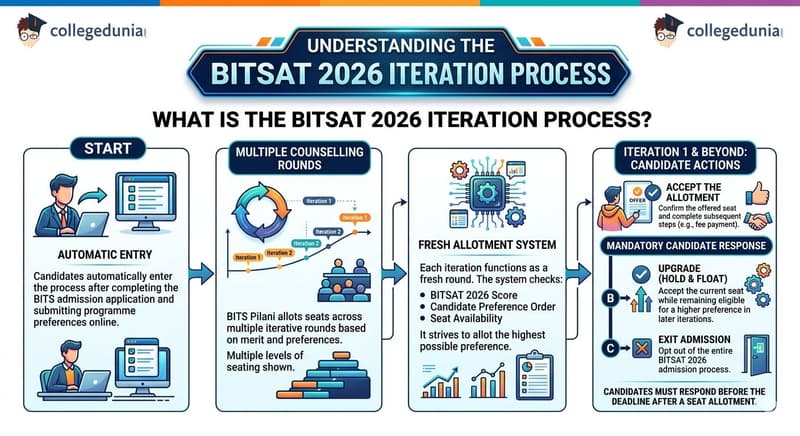
- The BITSAT 2026 iteration process is the admission system through which BITS Pilani allots seats in multiple rounds based on candidate merit and submitted programme preferences.
- Candidates automatically become part of the iteration process after completing the BITS admission application and submitting their preference list online.
- Every iteration works as a fresh allotment round where the system checks BITSAT 2026 score, preference order and seat availability before allotting the highest possible preference.
- Candidates who receive a seat in Iteration 1 must respond before the deadline by choosing whether to accept, upgrade, or exit the admission process.
Ques. How many iteration rounds are conducted in BITSAT 2026 admission process?
Ans. BITS Pilani usually conducts around 5 to 7 iteration rounds during the admission process depending on seat vacancies and withdrawals. Each iteration updates the allotment based on candidate preferences, BITSAT score, and available seats across Pilani, Goa, and Hyderabad campuses.
Ques. Can I get a better branch in later BITSAT 2026 iterations?
Ans. Yes. Candidates who accept their allotted seat and remain in the admission process are automatically considered for branch or campus upgrades in later iterations. Many students get upgraded to higher preferences after seat withdrawals and internal sliding in subsequent rounds.
BITSAT 2026 Iteration Schedule
The official BITSAT 2026 iteration schedule will be released on the BITS admissions portal and based on previous year trends, the expected timeline is given below:
| Event | Expected Timeline (2026) |
|---|---|
| BITSAT 2026 Score Release |
Early June 2026 (Session 2 scorecard out around June 5) |
|
Application for Admissions / Preference Submission |
Ongoing (Edit window: June 9–10) |
|
Iteration 1 Allotment |
June 20, 2026 |
|
Iteration 1 Fee Payment Deadline |
June 26, 2026 |
|
Iteration 2 Allotment |
July 1, 2026 |
|
Iteration 2 Acceptance Deadline |
July 8, 2026 |
|
Withdrawal Window-1 |
July 9–10, 2026 |
|
Iteration 3 Allotment |
July 14, 2026 |
|
Further Iterations (4–7 if needed) |
Mid-to-late July through August 2026 |
|
Classes Begin / Reporting |
Early August 2026 (e.g., August 1–2) |
All dates above are expected and based on 2025 trends. Confirmed dates will be published on bitsadmission.com.
Also Check : BITSAT 2026 Low Score? Top Engineering Alternatives After First Iteration
How the BITSAT 2026 Iteration Process Works: Step by Step
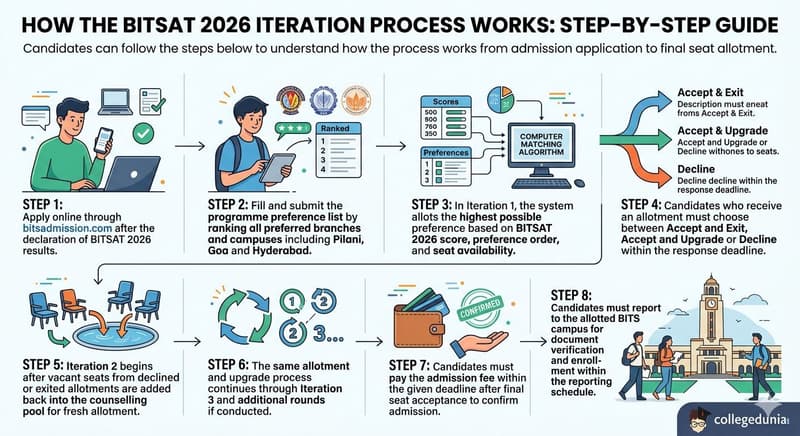
Candidates can follow the steps below to understand how the BITSAT 2026 iteration process works from admission application to final seat allotment.
- Step 1: Apply online through bitsadmission.com after the declaration of BITSAT 2026 results.
- Step 2: Fill and submit the programme preference list by ranking all preferred branches and campuses including Pilani, Goa and Hyderabad.
- Step 3: In Iteration 1, the system allots the highest possible preference based on BITSAT 2026 score, preference order, and seat availability.
- Step 4: Candidates who receive an allotment must choose between Accept and Exit, Accept and Upgrade or Decline within the response deadline.
- Step 5: Iteration 2 begins after vacant seats from declined or exited allotments are added back into the counselling pool for fresh allotment.
- Step 6: The same allotment and upgrade process continues through Iteration 3 and additional rounds if conducted.
- Step 7: Candidates must pay the admission fee within the given deadline after final seat acceptance to confirm admission.
- Step 8: Candidates must report to the allotted BITS campus for document verification and enrollment within the reporting schedule.
Also Check : BITSAT 2026 Iteration 1 Seat Allotment: How to Accept and Report to Campus
Ques. How many iteration rounds are usually conducted in BITSAT counselling?
Ans. BITS Pilani generally conducts 5 to 7 iteration rounds during the BITSAT admission process depending on seat vacancies. Additional rounds may also be conducted if seats remain vacant after the regular counselling schedule. Candidates are advised to regularly check the official BITS admission portal for updated iteration announcements.
Ques. What does “Accept and Upgrade” mean in the BITSAT 2026 iteration process?
Ans. “Accept and Upgrade” means a candidate accepts the currently allotted seat but remains eligible for a higher preferred branch or campus in later iteration rounds. If a better preference becomes available in the next round, the previous allotment is automatically upgraded based on seat availability and BITSAT 2026 score.
BITSAT 2026 Iteration Choices: Accept, Upgrade, or Decline
Candidates who receive a seat allotment in any BITSAT 2026 iteration round must choose one of the available response options within the given deadline.
- If a candidate does not respond within the response window then the allotment is treated as declined and participation in the remaining iteration rounds may be cancelled.
- Candidates allotted a lower preference programme are advised to choose Accept and Upgrade instead of Decline so that the current seat remains secured while remaining eligible for higher preference upgrades in later rounds.
| Choice | What It Means | What Happens Next |
|---|---|---|
| Accept and Exit | You are satisfied with the allotted program and campus | Your seat is locked. You pay the fee and exit all further iterations. |
| Accept and Upgrade (Wait) | You accept the current seat as a safety net but want a higher-preference program | Your current seat is held. In the next iteration, the system tries to move you to a higher preference. If you get an upgrade, your previous allotment is released back to the pool. |
| Decline | You do not want this allotment and prefer to wait for a better option | The seat is released. You remain in the pool for the next iteration but with no guaranteed offer. |
Also Check : BITSAT 2026 Branch-Wise Cutoff: Pilani, Goa and Hyderabad
Ques. Which option is better in BITSAT 2026 counselling: Accept and Upgrade or Decline?
Ans. In most cases, candidates allotted a lower preferred branch or campus are advised to choose “Accept and Upgrade” instead of “Decline.” This keeps the currently allotted seat safe while also allowing eligibility for higher preference upgrades in future BITSAT 2026 iteration rounds based on seat availability.
Ques. What happens if I do not respond to my BITSAT 2026 seat allotment before the deadline?
Ans. If a candidate does not select any response option within the given deadline, the BITSAT 2026 seat allotment is generally treated as declined automatically. In such cases, the allotted seat is released back into the counselling pool and the candidate may lose participation eligibility in further iteration rounds.
BITSAT 2026 Seats by Campus and Program
BITS Pilani offers engineering programmes across Pilani, Goa and Hyderabad campuses with seat intake varying slightly every year based on institute notifications.
- Computer Science Engineering at the Pilani campus generally records the highest BITSAT cutoff among all branches and campuses.
- Based on 2025 admission trends, BITS Pilani CSE closed at around 304 marks out of 390 while Goa and Hyderabad CSE closing scores remained between 274 and 270 marks.
- The final BITSAT 2026 closing scores will depend on factors such as exam difficulty level, number of candidates and seat availability.
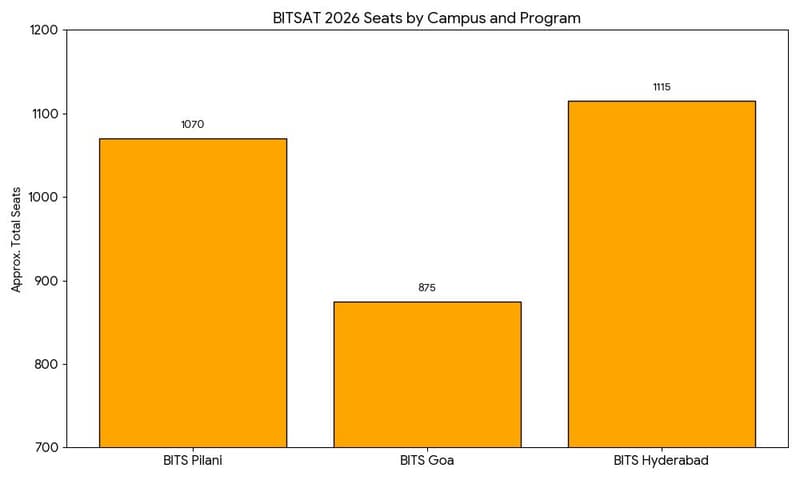
- The table below shows approximate programme wise seat intake based on 2025 data while the official 2026 intake will be released on BITS admissions portal.
| Campus | Key Programs (B.E.) |
Approx. Total Seats (First Degree) |
|---|---|---|
| BITS Pilani (Pilani Campus) |
CS, ECE, Mechanical, Chemical, Civil, EEE, Manufacturing, Electronics & Instrumentation + M.Sc. Dual Degree programs |
~1040 – 1100 |
| BITS Goa (Goa Campus) |
CS, ECE, Mechanical, Chemical, EEE, Electronics & Instrumentation + M.Sc. Dual Degree programs (No Civil) |
~850 – 900 |
| BITS Hyderabad (Hyderabad Campus) |
CS, ECE, Mechanical, Chemical, Civil, EEE, Electronics & Instrumentation, Mathematics & Computing + M.Sc. Dual Degree programs |
~1080 – 1150 |
Also Check : List of Top Colleges in India Accepting BITSAT
Documents Required for BITSAT 2026 Seat Acceptance
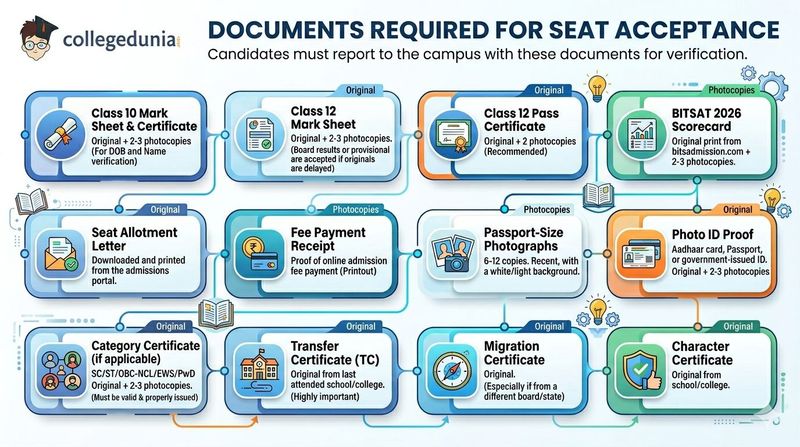
Candidates must report to the campus with the following documents for verification after they accept their allotment and paid the admission fee:
| Document | Details |
|---|---|
| Class 10 Mark Sheet and Certificate |
Original + 2–3 photocopies (for DOB and name verification) |
| Class 12 Mark Sheet |
Original + 2–3 photocopies (Board result / provisional also accepted if originals not yet issued) |
|
Class 12 Pass Certificate |
Original + 2 photocopies (recommended) |
| BITSAT 2026 Scorecard |
Downloaded from bitsadmission.com (Original print + 2–3 photocopies) |
| Seat Allotment Letter |
Downloaded and printed from the admissions portal |
| Fee Payment Receipt |
Proof of online admission fee payment (printout) |
| Passport-Size Photographs |
Recent (white/light background), 6–12 copies (most sources recommend 8–10) |
| Photo ID Proof |
Aadhaar card, Passport, or any government-issued ID (Original + 2–3 photocopies) |
| Category Certificate (if applicable) |
SC/ST/OBC-NCL/EWS/PwD – Original + 2–3 photocopies (must be valid & properly issued) |
|
Transfer Certificate (TC) |
Original from last attended school/college (highly important) |
|
Migration Certificate |
Original (especially if from a different board/state) |
|
Character Certificate |
Original from school/college |
Also Check : BITSAT 2026 Low Score: Top Engineering Admission Alternatives
Ques. Is the Transfer Certificate mandatory for BITSAT 2026 admission reporting?
Ans. Yes. The Transfer Certificate (TC) is considered one of the most important documents during BITSAT 2026 admission reporting and campus enrollment. Candidates are generally required to submit the original TC issued by their last attended school or college at the time of document verification.
Ques. Can I report for BITSAT 2026 admission if my original Class 12 marksheet is not yet issued?
Ans. Yes. Candidates can usually report with the provisional Class 12 result or provisional marksheet if the original board marksheet has not yet been issued. However, candidates may later be required to submit the original document once released by their board.
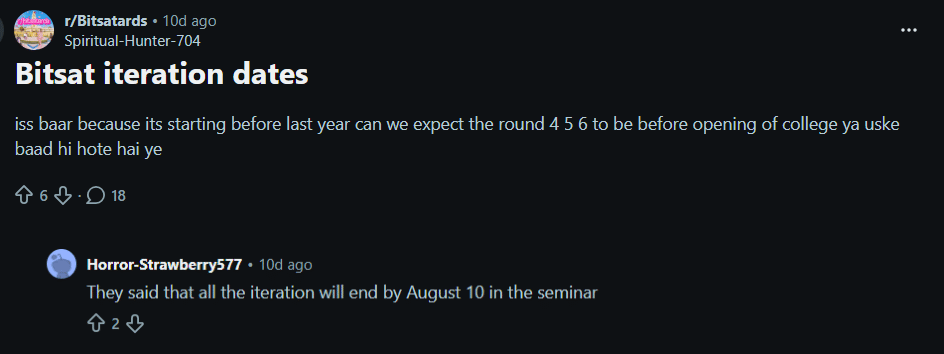
BITSAT 2026 Iteration Process : Reddit Discussion
- The discussion focused on the BITSAT counselling iteration schedule, with students wondering whether the later rounds such as Iteration 4, 5, and 6 would conclude before the commencement of college classes since the admission process has started earlier this year.
- Another Reddit user mentioned that, according to information shared during a seminar, all BITSAT counselling iterations are expected to conclude by August 10, suggesting that the process may finish before regular academic sessions begin.
BITSAT 2026 Iteration Process FAQs
Ques. How many iterations does BITS Pilani conduct for seat allotment?
Ans. BITS Pilani typically conducts four to seven iterations for seat allotment. The exact number of iterations for BITSAT 2026 will be announced on bitsadmission.com closer to the admissions cycle.
Ques. Can I change my preference list after submitting it?
Ans. No. Once the preference list submission window closes, it is frozen and used for all subsequent iterations without changes. Review your preferences carefully before the deadline.
Ques. What happens if I choose Accept and Upgrade but no upgrade is available?
Ans. If no higher-preference seat becomes available in subsequent iterations, your current allotment remains intact. You keep the seat you originally accepted and must pay the fee by the final deadline to confirm it.
Ques. What if I do not receive any allotment in Iteration 1?
Ans. If you do not receive an allotment in Iteration 1, you automatically remain in the pool for Iteration 2 and beyond. Seats released by other students who exit or decline may open up a match for your preferences in later iterations.
Ques. Does BITS Pilani publish a separate waitlist for admissions?
Ans. BITS Pilani does not publish a separate waitlist. The iteration process itself functions as a rolling waitlist — students without allotments continue to be considered in each new iteration as seats become available from exits and declines.
Ques. What happens if I miss the response deadline in an iteration?
Ans. Missing the response deadline within an iteration is treated as a Decline. Your allotment for that iteration is cancelled and the seat is released. Always respond within the stated window to keep your participation active in subsequent iterations.



Comments