




BITSAT 2026 Question Paper for April 19 Shift 1 is available here. BITS Pilani conducted BITSAT Session 1 absentee slot exam on April 19, 2026 in Shift 1 from 9 AM to 12 PM. BITSAT exam is held in a CBT Mode at various exam centres in India and abroad for students to apply for Integrated programs at BITS Campuses in Pilani, Goa and Hyderabad.
- BITSAT question paper contains 130 questions divided into 5 sections- Physics and Chemistry with 30 questions each, English Proficiency with 10 questions, Logical Reasoning with 20 questions and Mathematics or Biology with 40 questions.
- Each correct answer gets you 3 marks while incorrect answer has an negative marking of 1.
Candidates can download BITSAT 2026 April 19 Shift 1 Question Paper with answer key and solution PDF from the links provided below.
BITSAT 2026 April 19 Shift 1 Question Paper with Solution PDF (Memory-Based)
| BITSAT 2026 Question Paper April 19 Shift 1 | Download PDF | Check Solutions |

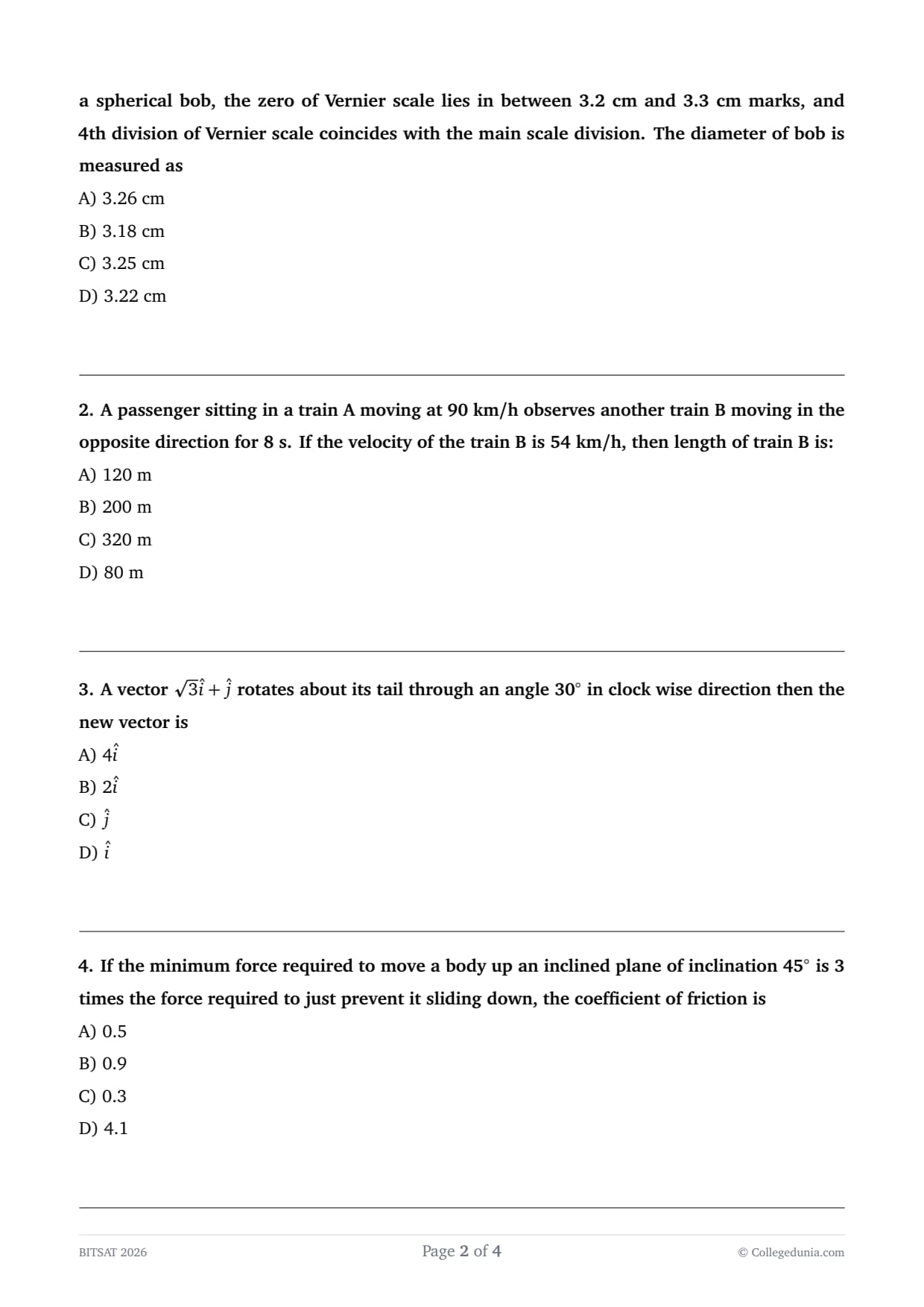

In an experiment with Vernier calipers of least count 0.1 mm, when two jaws are joined together the zero of Vernier scale lies right to the zero of the main scale and 6th division of Vernier scale coincides with the main scale division. While measuring the diameter of a spherical bob, the zero of Vernier scale lies in between 3.2 cm and 3.3 cm marks, and 4th division of Vernier scale coincides with the main scale division. The diameter of bob is measured as
A passenger sitting in a train A moving at 90 km/h observes another train B moving in the opposite direction for 8 s. If the velocity of the train B is 54 km/h, then length of train B is:
A vector \(\sqrt{3}\hat{i} + \hat{j}\) rotates about its tail through an angle 30\(^\circ\) in clock wise direction then the new vector is
If the minimum force required to move a body up an inclined plane of inclination 45\(^\circ\) is 3 times the force required to just prevent it sliding down, the coefficient of friction is
The screening effect of d-electrons is
Chloride ion and potassium ion are isoelectronic. Then
For the reaction CO(g) + \(\frac{1}{2}\) O\(_2\)(g) \(\rightarrow\) CO\(_2\)(g) Which one of the statement is correct at constant T and P?
View Solution
Step 1: Understanding the Question:
The question asks for the relationship between enthalpy change (\(\Delta H\)) and internal energy change (\(\Delta E\) or \(\Delta U\)) for a given gaseous reaction.
Step 2: Key Formula or Approach:
The relationship between enthalpy and internal energy for a reaction involving ideal gases is:
\[ \Delta H = \Delta E + \Delta n_g RT \]
where \(\Delta n_g\) is the change in the number of moles of gaseous products and reactants.
Step 3: Detailed Explanation:
Calculate \(\Delta n_g\) for the reaction: CO(g) + \(\frac{1}{2}\) O\(_2\)(g) \(\rightarrow\) CO\(_2\)(g)
Moles of gaseous products (\(n_p\)) = 1
Moles of gaseous reactants (\(n_r\)) = 1 + 0.5 = 1.5
\[ \Delta n_g = n_p - n_r = 1 - 1.5 = -0.5 \]
Since \(\Delta n_g\) is negative:
\[ \Delta H = \Delta E - 0.5 RT \]
Because \(R\) and \(T\) are positive, subtracting a positive value from \(\Delta E\) makes \(\Delta H\) smaller than \(\Delta E\).
Therefore, ΔH < ΔE.
Step 4: Final Answer:
The correct relationship is ΔH < ΔE.
Quick Tip: Just count the moles of gases!
If products have fewer moles of gas (Δng < 0), then ΔH < ΔE.
If products have more moles of gas (Δng > 0), then ΔH > ΔE.
If \(|z_1| = 2, |z_2| = 3, |z_3| = 4\) and \(|2z_1 + 3z_2 + 4z_3| = 4\), then absolute value of \(8z_2z_3 + 27z_3z_1 + 64z_1z_2\) equals
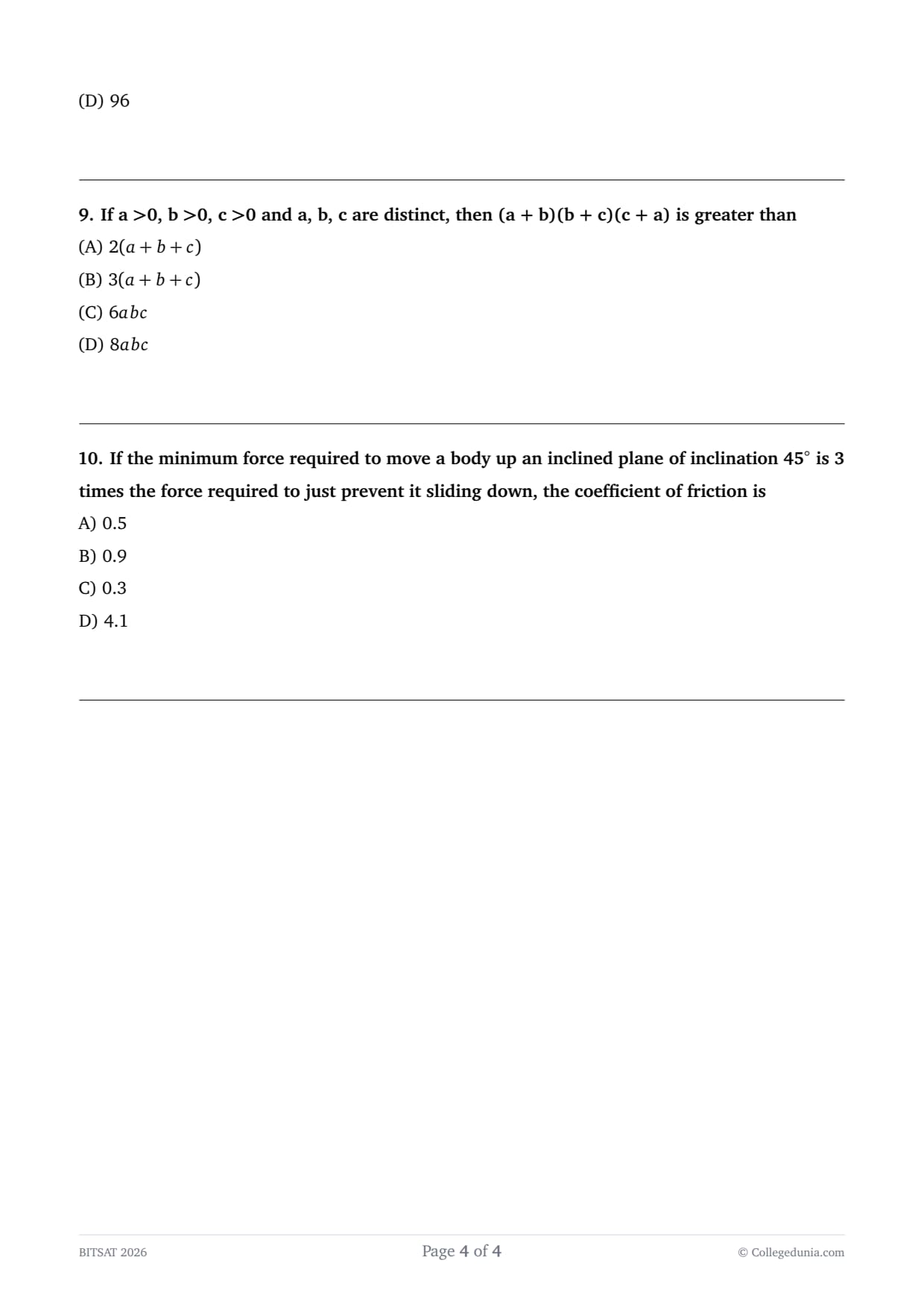
If a > 0, b > 0, c > 0 and a, b, c are distinct, then (a + b)(b + c)(c + a) is greater than
If the minimum force required to move a body up an inclined plane of inclination 45\(^\circ\) is 3 times the force required to just prevent it sliding down, the coefficient of friction is
BITSAT 2026 Chapter-Wise Weightage
The BITSAT syllabus includes NCERT Class 11 and 12 topics, but some chapters tend to hold more significance due to their conceptual knowledge.
Physics
| Chapter | Expected Weightage (%) |
|---|---|
| Laws of Motion | 8–10% |
| Current Electricity | 7–9% |
| Ray Optics & Wave Optics | 6–8% |
| Thermodynamics | 6–7% |
| Electrostatics | 5–7% |
Chemistry
| Chapter | Expected Weightage (%) |
|---|---|
| Chemical Bonding | 8–10% |
| Organic Chemistry (Basics + Reactions) | 10–12% |
| Coordination Compounds | 6–8% |
| Electrochemistry | 5–7% |
| p-Block Elements | 6–8% |
Mathematics
| Chapter | Expected Weightage (%) |
|---|---|
| Calculus (Limits, Integration, Differentiation) | 12–15% |
| Vectors & 3D Geometry | 8–10% |
| Complex Numbers & Quadratic Equations | 6–8% |
| Probability | 6–8% |
| Coordinate Geometry | 7–9% |



Comments