




BITSAT 2026 Question Paper for April 15 Shift 2 is available here. BITS Pilani conducted BITSAT Session 1 exam on April 15, 2026 in Shift 2 from 2 PM to 5 PM. BITSAT exam is held in a CBT Mode at various exam centres in India and abroad for students to apply for Integrated programs at BITS Campuses in Pilani, Goa and Hyderabad.
Also, Check- BITSAT 2026 Expected Marks Vs Rank for April 15 Shift 2
- BITSAT question paper contains 130 questions divided into 5 sections- Physics and Chemistry with 30 questions each, English Proficiency with 10 questions, Logical Reasoning with 20 questions and Mathematics or Biology with 40 questions.
- Each correct answer gets you 3 marks while incorrect answer has an negative marking of 1.
The BITSAT 2026 April 15 Shift 2 Question Paper with answer key and solution PDF is available here. According to initial student reaction, BITSAT 2026 April 15 Shift 2 was of easy to moderate level.
BITSAT 2026 April 15 Shift 2 Question Paper with Solution PDF (Memory-Based)
| BITSAT 2026 Question Paper April 15 Shift 2 | Download PDF | Check Solutions |
An ideal spring with spring-constant \(k\) is hung from the ceiling and a mass \(M\) is attached to its lower end. The mass is released with the spring initially unstretched. Then the maximum extension in the spring is
In a mixture of gases, the average number of degrees of freedom per molecule is 6. The rms speed of the molecule of the gas is \(c\), then the velocity of sound in the gas is
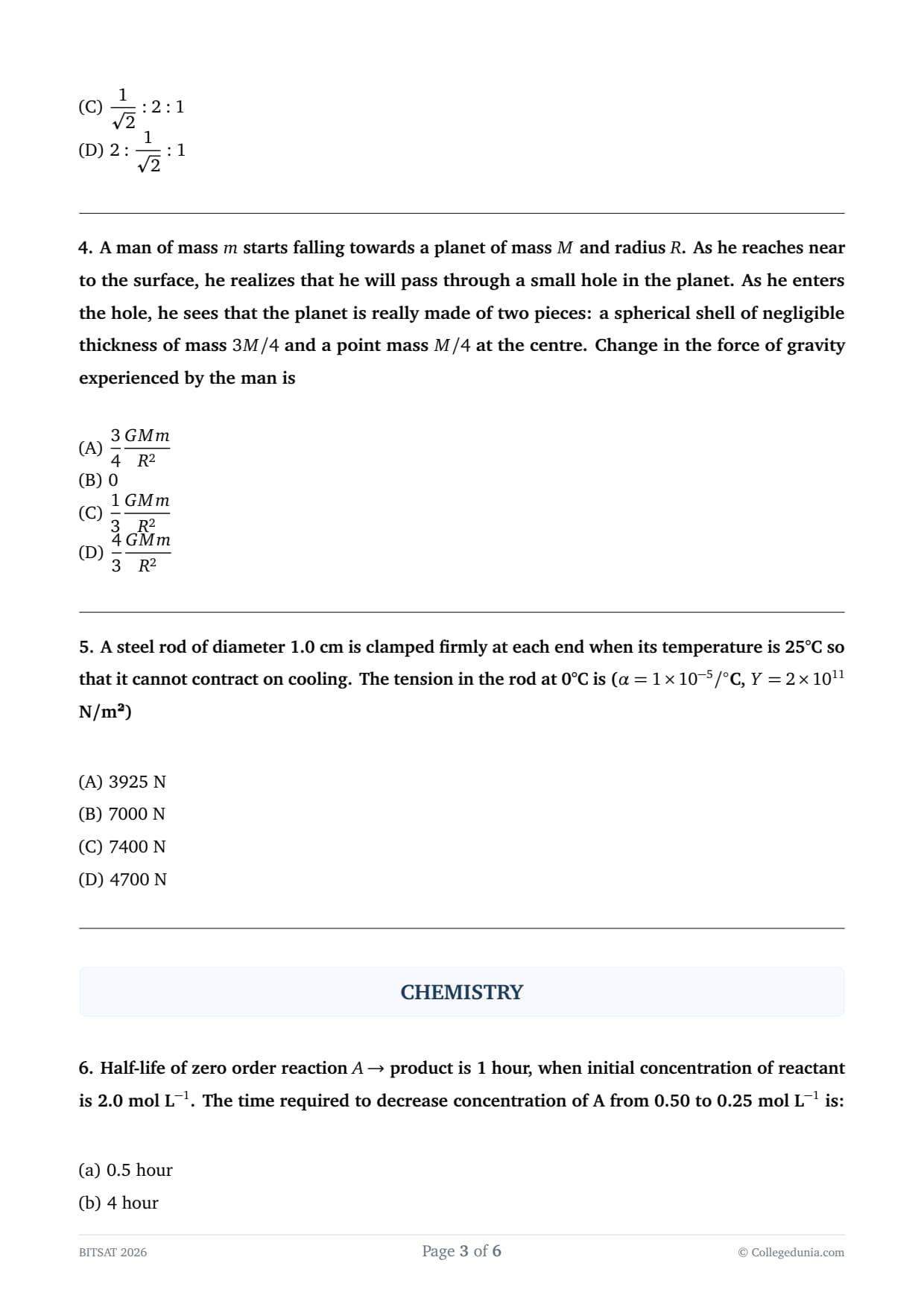
Five identical springs are used in the three configurations as shown in figure. The time periods of vertical oscillations in configurations (a), (b) and (c) are in the ratio.

A man of mass \(m\) starts falling towards a planet of mass \(M\) and radius \(R\). As he reaches near to the surface, he realizes that he will pass through a small hole in the planet. As he enters the hole, he sees that the planet is really made of two pieces: a spherical shell of negligible thickness of mass \(3M/4\) and a point mass \(M/4\) at the centre. Change in the force of gravity experienced by the man is
A steel rod of diameter 1.0 cm is clamped firmly at each end when its temperature is 25°C so that it cannot contract on cooling. The tension in the rod at 0°C is (\(\alpha = 1 \times 10^{-5} /^\circ\)C, \(Y = 2 \times 10^{11}\) N/m²)
View Solution
Step 1: Understanding the Concept:
When a rod is clamped and cooled, it tries to contract. Since the clamps prevent this, a thermal stress is developed within the rod, which manifests as tension.
Step 2: Key Formula or Approach:
1. Thermal Stress: \(\sigma = Y \alpha \Delta T\)
2. Tension (Force): \(F = Stress \times Area = Y \alpha \Delta T A\)
3. Area (\(A\)): \(\pi r^2 = \pi (d/2)^2\)
Step 3: Detailed Explanation:
Given: \(d = 1.0 cm = 10^{-2} m \implies r = 0.5 \times 10^{-2} m\). \(\Delta T = 25^\circC - 0^\circC = 25^\circC\). \(Y = 2 \times 10^{11} N/m^2\), \(\alpha = 1 \times 10^{-5} /^\circC\).
1. Calculate Area (\(A\)): \[ A = \pi (0.5 \times 10^{-2})^2 = \pi (0.25 \times 10^{-4}) \approx 3.14 \times 0.25 \times 10^{-4} m^2 \] \[ A \approx 0.785 \times 10^{-4} m^2 \]
2. Calculate Tension (\(F\)): \[ F = (2 \times 10^{11}) \times (1 \times 10^{-5}) \times 25 \times (0.785 \times 10^{-4}) \] \[ F = 2 \times 25 \times 0.785 \times (10^{11} \times 10^{-5} \times 10^{-4}) \] \[ F = 50 \times 0.785 \times 10^2 = 50 \times 78.5 \] \[ F = 3925 N \]
Step 4: Final Answer
The tension in the rod is 3925 N. Quick Tip: Thermal force is independent of the length of the rod! It only depends on the material properties (\(Y, \alpha\)), the temperature change, and the cross-sectional area.
Half-life of zero order reaction \( A \to \) product is 1 hour, when initial concentration of reactant is 2.0 mol L\(^{-1}\). The time required to decrease concentration of A from 0.50 to 0.25 mol L\(^{-1}\) is:
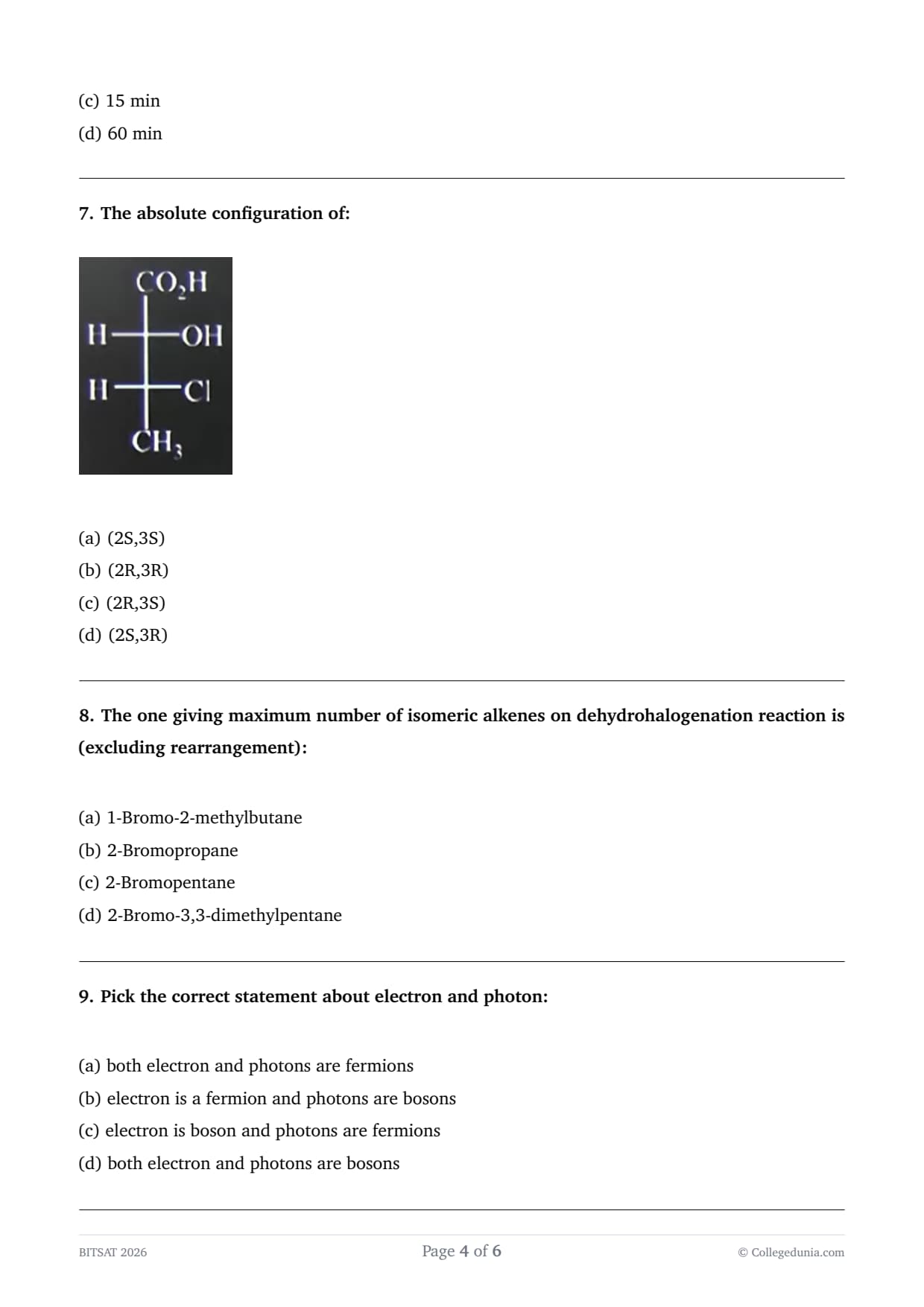
The absolute configuration of:

The one giving maximum number of isomeric alkenes on dehydrohalogenation reaction is (excluding rearrangement):
Pick the correct statement about electron and photon:
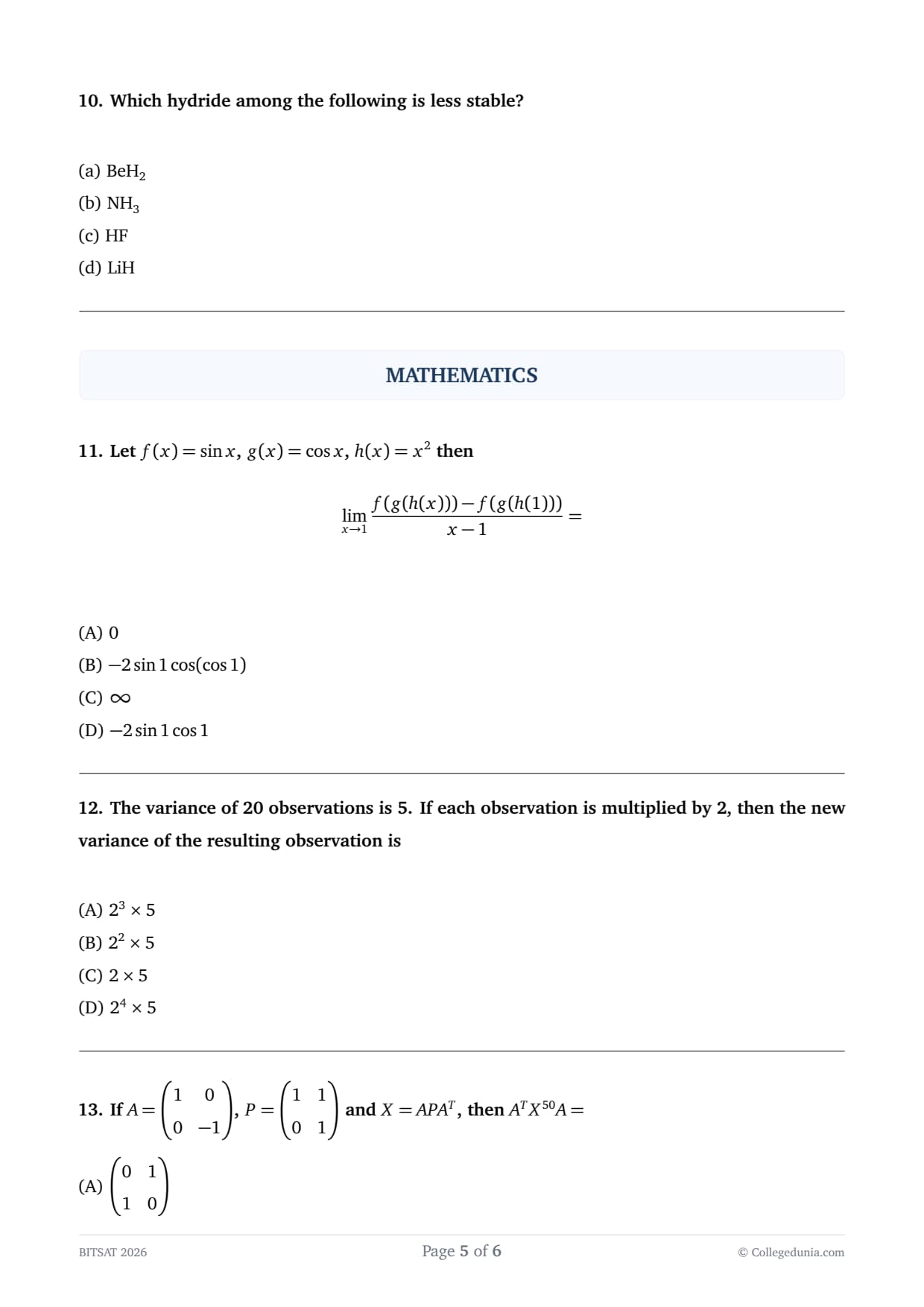
Which hydride among the following is less stable?
Let \( f(x) = \sin x \), \( g(x) = \cos x \), \( h(x) = x^2 \) then
\[ \lim_{x \to 1} \frac{f(g(h(x))) - f(g(h(1)))}{x - 1} = \]
The variance of 20 observations is 5. If each observation is multiplied by 2, then the new variance of the resulting observation is
If \( A = \begin{pmatrix} 1 & 0
0 & -1 \end{pmatrix} \), \( P = \begin{pmatrix} 1 & 1
0 & 1 \end{pmatrix} \) and \( X = A P A^T \), then \( A^T X^{50} A = \)
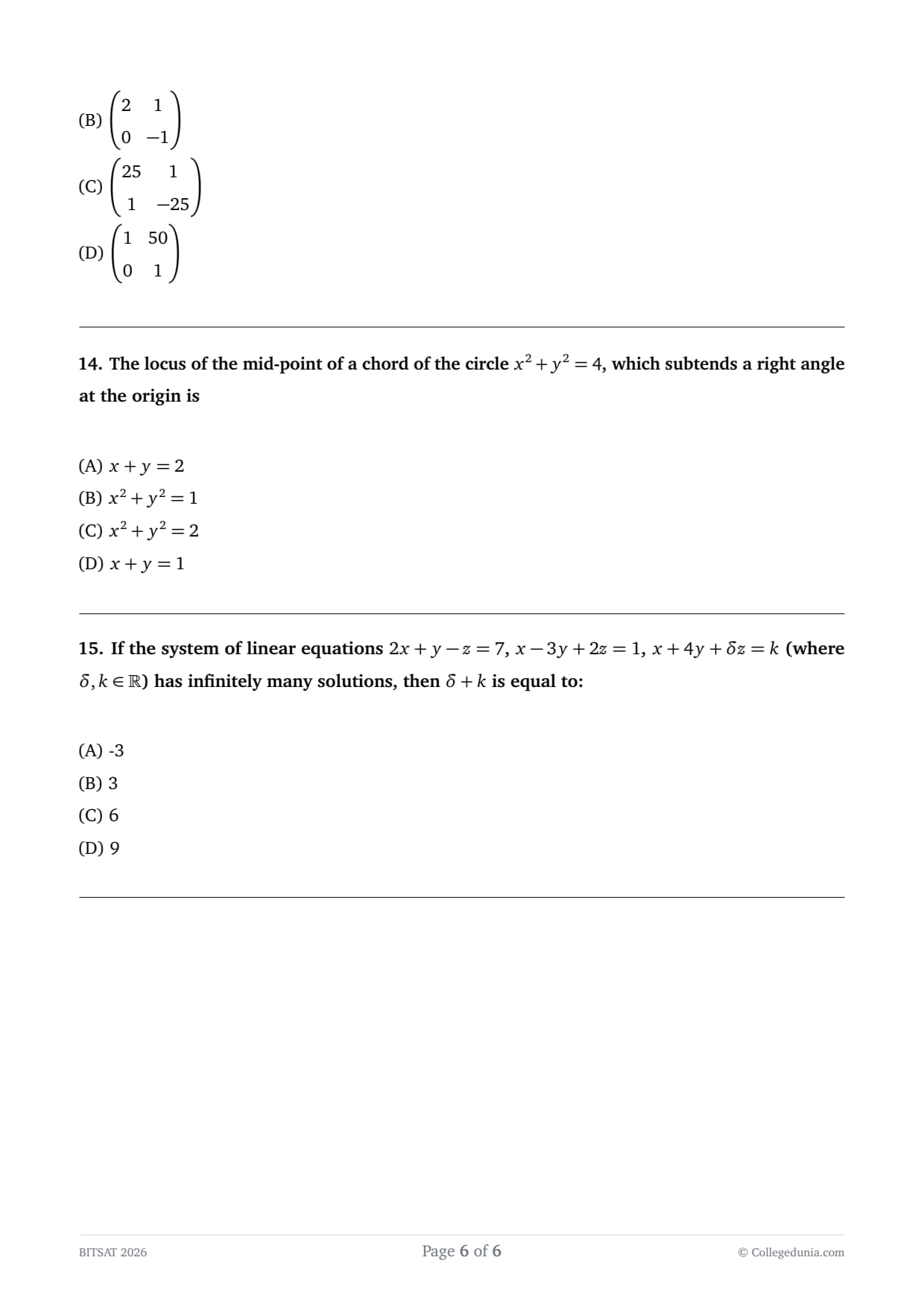
0 & 1 \end{pmatrix}\)
View Solution
Step 1: Understanding the Concept:
We are dealing with matrix powers and transformations. Note that for matrix \( A \), \( A^T = A \) and \( A^2 = I \) (the identity matrix), because \( A \) is an involuntary matrix.
Step 2: Key Formula or Approach:
If \( X = APA^T \), then \( X^n = (APA^T)(APA^T)\dots(APA^T) \).
Since \( A^T A = I \), the inner terms cancel out. \[ X^n = A P^n A^T \]
Step 3: Detailed Explanation:
1. We need to find \( A^T X^{50} A \).
2. Substitute \( X^{50} = A P^{50} A^T \): \[ A^T (A P^{50} A^T) A = (A^T A) P^{50} (A^T A) \]
3. Since \( A = \begin{pmatrix} 1 & 0
0 & -1 \end{pmatrix} \), we have \( A^T A = \begin{pmatrix} 1 & 0
0 & 1 \end{pmatrix} = I \). \[ I \cdot P^{50} \cdot I = P^{50} \]
4. For \( P = \begin{pmatrix} 1 & 1
0 & 1 \end{pmatrix} \), the power \( P^n \) follows the pattern: \[ P^n = \begin{pmatrix} 1 & n
0 & 1 \end{pmatrix} \]
5. Therefore, \( P^{50} = \begin{pmatrix} 1 & 50
0 & 1 \end{pmatrix} \).
Step 4: Final Answer
The result is \(\begin{pmatrix} 1 & 50
0 & 1 \end{pmatrix}\). Quick Tip: For any matrix of the form \(\begin{pmatrix} 1 & a
0 & 1 \end{pmatrix}\), the \(n^{th}\) power is simply \(\begin{pmatrix} 1 & na
0 & 1 \end{pmatrix}\). This is a very common shortcut in matrix algebra!
The locus of the mid-point of a chord of the circle \( x^2 + y^2 = 4 \), which subtends a right angle at the origin is
If the system of linear equations \( 2x + y - z = 7 \), \( x - 3y + 2z = 1 \), \( x + 4y + \delta z = k \) (where \(\delta, k \in \mathbb{R}\)) has infinitely many solutions, then \(\delta + k\) is equal to:
BITSAT 2026 Chapter-Wise Weightage
The BITSAT syllabus includes NCERT Class 11 and 12 topics, but some chapters tend to hold more significance due to their conceptual knowledge.
Physics
| Chapter | Expected Weightage (%) |
|---|---|
| Laws of Motion | 8–10% |
| Current Electricity | 7–9% |
| Ray Optics & Wave Optics | 6–8% |
| Thermodynamics | 6–7% |
| Electrostatics | 5–7% |
Chemistry
| Chapter | Expected Weightage (%) |
|---|---|
| Chemical Bonding | 8–10% |
| Organic Chemistry (Basics + Reactions) | 10–12% |
| Coordination Compounds | 6–8% |
| Electrochemistry | 5–7% |
| p-Block Elements | 6–8% |
Mathematics
| Chapter | Expected Weightage (%) |
|---|---|
| Calculus (Limits, Integration, Differentiation) | 12–15% |
| Vectors & 3D Geometry | 8–10% |
| Complex Numbers & Quadratic Equations | 6–8% |
| Probability | 6–8% |
| Coordinate Geometry | 7–9% |



Comments