

![Delhi University - [DU]](https://img.collegedunia.com/public/college_data/images/logos/1491817267UniversityofDelhi.png?h=71.7&w=71.7&mode=stretch)
.png?h=18&w=18&mode=stretch)
Delhi University (DU) ECA and Sports quota admissions 2026 have moved to the Round-I allocation stage, with the University declaring the first-round ECA and Sports allocations on August 10, 2026, under CSAS (UG) 2026-27. Candidates who have been allotted seats are required to accept their allocation within the prescribed deadline, followed by verification by the concerned department, centre or college.
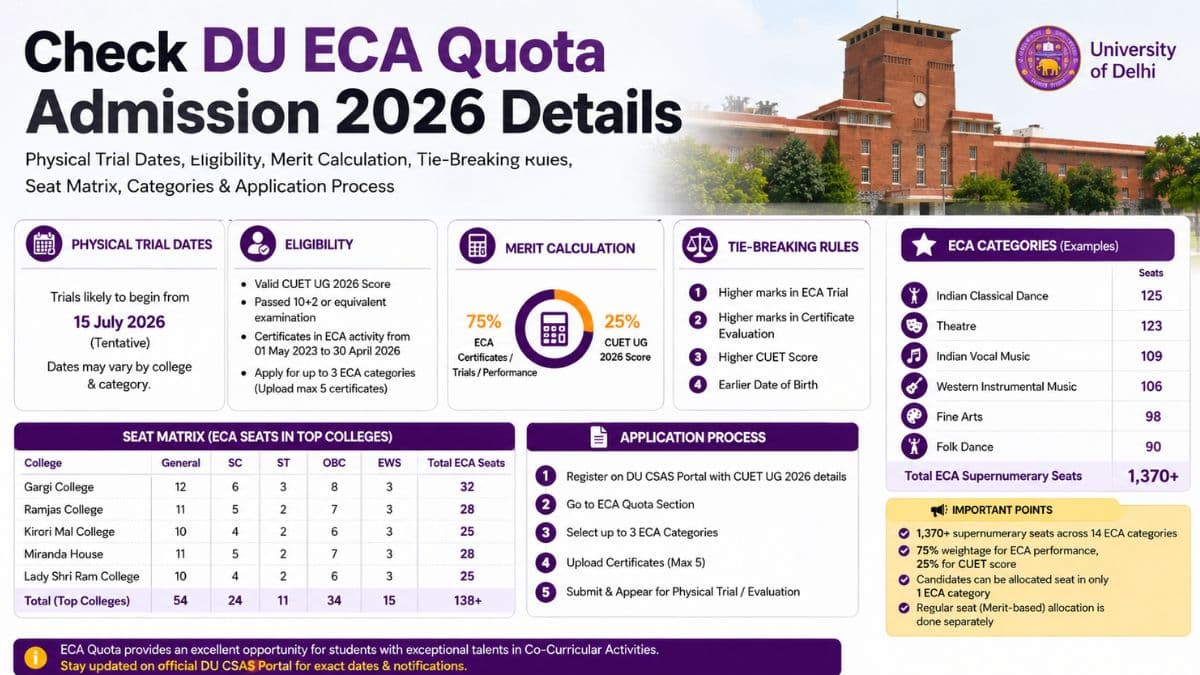
ECA Quota: DU has allocated 1,370 supernumerary seats across 14 ECA categories for ECA admissions in the 2026–27 academic session. The seats are distributed across participating colleges and various ECA categories, including Dance, Debate, Music, Theatre, Fine Arts, Digital Media, Quiz, NCC, NSS and Yoga, as listed in the official ECA seat matrix.
Sports Quota: DU has allocated 2,153 supernumerary Sports seats for the 2026–27 academic session, including 1,119 seats for men and 1,034 seats for women. The seats are distributed across different sports and participating colleges according to the official Sports seat matrix.
Check: DU ECA & Sports Revised Schedule 2026
Check:
DU ECA Admission Dates 2026
Check the application, trial, Round-I allocation, seat acceptance and fee-payment deadlines for the 2026-27 admission cycle.
DU ECA and Sports Round-I Allocation 2026: Revised Schedule
| Admission Activity | Date / Deadline |
| Declaration of Round-I ECA and Sports Allocation | August 10, 2026 |
| Candidates to Accept the Allocated Seat | August 10 to August 13, 2026, till 4:59 PM |
| Department/Centre/College Verification and Approval of Online Applications | August 10 to August 14, 2026, till 4:59 PM |
| Last Date for Online Fee Payment by Candidates | August 15, 2026, till 4:59 PM |

DU ECA and Sports 2026: Key Admission Dates
| Event | Date / Timeline |
|---|---|
| CSAS (UG) 2026 Registration, including ECA/Sports application | 27 June to 6 July 2026 |
| Correction Window Closed | 11 July 2026 (11:59 PM) |
| Tentative Trial Dates | 15 July 2026 onwards (category-wise) |
| Detailed Candidate-wise Trial Schedule | 14 July 2026 (Expected) |
| Trial Duration | July 16–25 July 2026 |
Read: Delhi University Courses and Fees 2026
What is ECA Quota in DU?
ECA stands for Extracurricular Activities. Under this supernumerary quota, eligible students can compete for additional seats available in notified ECA categories and sub-categories.
These seats are separate from the regular seat matrix. If an ECA supernumerary seat remains vacant, DU states that it will not automatically be converted into another category.
Download / View ECA Physical Trials Instructions PDF
DU ECA Quota Admission 2026: Eligibility, Application, Seats, Fees & Selection Criteria
Candidates seeking ECA quota admission to eligible DU UG programmes must appear for CUET UG 2026 and register through the DU CSAS UG 2026 portal. Final selection gives 75% weightage to ECA certificates, trials or performance and 25% to the CUET score.
- Candidates can apply for up to 3 ECA categories. For each category, they can upload up to five best self-attested certificates issued between May 1, 2023, and April 30, 2026.
- Among the ECA categories, Indian Classical Dance has the highest seat allocation with 125 seats. It is followed by Theatre with 123 seats and Indian Vocal Music with 109 seats.
- Seats are also available in Indian Folk Dance, Debate, Fine Arts, NCC, NSS, Photography, and other activities.
- The total application fee is INR 350 for UR/OBC-NCL/EWS candidates and INR 200 for SC/ST/PwBD candidates. This includes the additional INR 100 ECA quota fee.
Final seat allocation depends on the CUET score, ECA assessment, programme eligibility, college preferences, and seat availability.
Note: The DU ECA physical trials 2026–27 began on July 15, 2026. Candidates had to follow the notified schedule and report to their allotted trial centre.
ECA and Sports are separate supernumerary quotas in DU. However, 5% of a college's total sanctioned seats are collectively earmarked for ECA and Sports, and colleges can split this allocation between the two quotas from 1% to 4%, subject to the combined 5% limit
DU ECA Physical Trial Schedule and Trial Centres 2026
- DU has advised outstation ECA candidates to book their travel and plan accommodation near the allotted trial venue in advance.
- No separate communication regarding trial dates will be sent to candidates.
- If the allotted trial date clashes with a confirmed travel itinerary, candidates may email eca@admission.du.ac.in to request rescheduling, subject to feasibility within the notified trial period.
Delhi University released the form number-wise detailed schedule for DU ECA Physical Trials 2026 on July 14, 2026. Candidates can check their form number in the schedule to confirm the trial date, reporting time and allotted venue.
|
Category |
Sub-Category |
Trial Dates |
Trial Centre |
|---|---|---|---|
|
Creative Writing |
Hindi |
21 July 2026 |
Hansraj College |
|
Creative Writing |
English |
21 July 2026 |
|
|
Dance |
Indian Classical |
16 – 21 July 2026 |
Bharati College |
|
Dance |
Indian Folk |
22 – 23 July 2026 |
|
|
Dance |
Western |
24 July 2026 |
|
|
Dance |
Choreography |
25 July 2026 |
|
|
Debate |
Hindi |
16 – 17 July 2026 |
Ramjas College |
|
Debate |
English |
17 – 25 July 2026 |
|
|
Digital Media |
Photography |
21 July 2026 |
Maharaja Agrasen College |
|
Digital Media |
Film Making |
22 July 2026 |
|
|
Digital Media |
Animation |
23 July 2026 |
|
|
Fine Arts |
Sketching & Painting |
20 – 24 July 2026 |
Atma Ram Sanatan Dharma College |
|
Fine Arts |
Sculpture |
24 July 2026 |
|
|
Music (Vocal) |
Indian (Classical & Light) |
16 – 22 July 2026 |
Mata Sundri College for Women |
|
Music (Vocal) |
Western (Classical & Light) |
23 – 24 July 2026 |
|
|
Music (Instrumental Indian) |
Tabla, Mridangam, Dholak, etc. |
21 – 22 July 2026 |
Sri Aurobindo College (Day) |
|
Music (Instrumental Western) |
Drums, Guitar, Flute, etc. |
23 – 24 July 2026 |
|
|
Theatre |
Theatre |
16 – 25 July 2026 |
Miranda House |
|
Quiz |
Quiz |
20 July 2026 |
Zakir Husain Delhi College (Evening) |
|
Divinity |
Divinity |
21 – 22 July 2026 |
Rajdhani College |
|
Yoga |
Yoga |
17 – 20 July 2026 |
PGDAV (Evening) College |
Check: DU ECA Physical Trial 2026 Form Number-Wise Detailed Schedule PDF
DU ECA Certificate Eligibility 2026
Candidates applying under the ECA Supernumerary Quota must follow these certificate rules:
- For each selected ECA category, up to five best self-attested certificates can be uploaded.
- Certificates must be from the preceding three years.
- Candidates should check the college-wise ECA seat matrix before selecting categories.
- Uploaded certificates must be genuine, clear, and readable.
- Candidates are responsible for the authenticity and accuracy of all uploaded documents.
Note: Simply uploading five certificates does not guarantee full certificate marks. Marks are awarded according to DU’s certificate evaluation criteria and the level of achievement or participation.
DU ECA Physical Trials 2026
- DU ECA Physical Trials are in-person skill and performance assessments for ECA quota applicants.
- Candidates must report to the allotted ECA trial centre as per the official schedule.
- There is no prescribed syllabus for the physical trials.
- Candidates are assessed on their proficiency in the selected ECA category.
- Trial formats may include dance, music, debate, creative writing, fine arts, theatre, quiz, digital media, divinity, and yoga.
- Candidates must carry their CUET scorecards and original ECA certificates uploaded during registration.
- Candidates must bring their own instruments, costumes, props, stationery, mats, equipment, and other required materials.
- The Assessment Committee’s decision is final and binding.
- No second opportunity is provided once the notified trial dates for the category are over.
List of 14 ECA Categories and Sub-Categories
DU has notified ECA categories covering different areas of talent. Your article can present the 14 categories from the official 2026 ECA table, with their relevant sub-categories.
Based on the material already being used in your article, these include areas such as:
- Creative Writing
- Dance
- Debate
- Digital Media
- Fine Arts
- Music Vocal
- Music Instrumental
- Theatre
- Quiz
- NCC
- NSS
Editorial note: For the final article, I recommend reproducing the exact full list of all 14 categories and sub-categories from the official 2026 CSAS table rather than expanding this list from memory.
DU ECA Trial 2026: Category-Wise Guidelines
Physical trials are mandatory for all applicable DU ECA categories, except NCC and NSS. No physical trials will be held for NCC and NSS; their marks are expected to be uploaded on the DU admission website around July 25–26, 2026, followed by a 2–3 day grievance window.
Creative Writing
Candidates appearing for the Creative Writing ECA Trial must follow these instructions:
- The topic will be given on the spot by the Assessment Committee.
- Candidates will be judged on originality, quality of content, language skills, grammar, and spelling.
- No accompanist is allowed.
- Writing sheets will be provided at the Trial Centre.
- Candidates must bring their own pens and other required stationery.
- The trial duration will be decided by the Assessment Committee and will not exceed two hours.
Dance
Candidates appearing for the Dance ECA Trial must follow these instructions:
- Prepare a dance performance of your choice lasting 3 to 5 minutes.
- The performance should be age-appropriate and must not include offensive, objectionable, or insensitive content.
- Candidates may use a self-composed or commercially available music track.
- Before starting, briefly introduce the dance form and selected composition.
- DU will not provide any musical instruments or audio equipment.
- For recorded music, bring a working and virus-free pen drive with the track in a ready-to-play format.
- No accompanist is allowed.
- Candidates are advised to wear a costume and suitable make-up according to the dance form. Casual clothes are also allowed but will be assessed accordingly.
- Props are permitted during the performance.
- The performance must not exceed 5 minutes.
- Assessment will be based on technique, rhythm, expression (abhinaya), stage presentation, and overall artistic quality.
Debate
Candidates appearing for the Debate ECA Trial must follow these instructions:
- The debate topic will be announced on the spot.
- Candidates can speak for or against the motion, based on their choice.
- Reading from prepared notes or written material is not allowed.
- No accompanist is permitted.
- The speaking time must not exceed 4 minutes.
Digital Media
Candidates appearing for the Digital Media ECA Trial must follow these instructions:
- The topic and required output will be announced on the spot.
- Candidates must bring all equipment needed for their chosen sub-category.
- The memory card or storage device must be fully formatted and may be checked by the Assessment Committee.
- Mixing, compositing, morphing, or image manipulation is not allowed.
- Use of image-editing software, filters, AI tools, or similar enhancement methods is strictly prohibited.
- No accompanist is allowed.
- Candidates must bring one electronic copy of their previous work for review by the Assessment Committee.
- The trial duration will be announced at the venue.
Fine Arts
Candidates appearing for the Fine Arts ECA Trial must follow these instructions:
- The topic will be announced on the spot.
- Candidates must bring all required drawing, painting, sculpture, modelling, or other art materials.
- Only the drawing sheet or paper will be provided at the Trial Centre.
- Painting can be done using oil, water, poster, or pastel colours.
- No accompanist is allowed.
- The trial duration will be decided and announced by the Assessment Committee.
Music Vocal
Candidates appearing for the Music Vocal ECA Trial must follow these instructions:
- Prepare a vocal performance of your choice lasting 3 to 5 minutes.
- The composition can be self-composed or selected from the work of any artist.
- A maximum of one accompanist is allowed.
- The accompanist cannot perform as a co-vocalist or take part in a duet.
- If there is no accompanist, candidates may use electronic instrumental accompaniment, including mobile apps.
- Karaoke tracks or apps containing vocals are not allowed.
- For Indian Vocal, the composition can be in any Indian language.
- For Western Vocal, the composition must be in English only.
- The total performance time must not exceed 5 minutes.
DU ECA Merit Calculation 2026
For most ECA categories, certificate marks are awarded during the physical trial in the candidate's presence and cannot be challenged later. For NCC and NSS, certificate-related grievances are reviewed by the University's Grievance Redressal Committee, whose decision is final.
DU ECA Quota Marking System 2026
For most ECA categories, candidates are assessed out of a total of 75 marks.
- The physical trial carries 60 marks, while the certificate evaluation carries 15 marks.
- Candidates must score at least 30 out of 75 marks in the ECA assessment to be considered for seat allocation.
- The Combined ECA Merit (CEM) is calculated by giving 25% weightage to the Programme-Specific CUET percentage score and 75% weightage to the ECA score.
- The 60 marks for the trial and 15 marks for certificate evaluation rule does not apply to NCC and NSS.
DU Sports Quota Marking System 2026
DU divides Sports Quota candidates into Categories A, B, C and D based on the level of their sports achievements.
Category A: Admission Without Sports Trial
- Category A candidates are given preference in Sports Quota seat allocation.
- Candidates under Category A do not have to appear for a Sports Trial.
- This category covers candidates who have represented India in specified major international competitions recognised and funded by the Ministry of Youth Affairs and Sports (MYAS).
- Seat allocation is based on sports certificate verification, programme eligibility, Programme + College preferences and the availability of a seat for the specific sport at the selected college.
Categories B, C and D: Admission Through Sports Trial
Candidates under Categories B, C and D must appear for the Sports Trial and are considered on the basis of their Combined Sports Merit (CSM).
- Sports certificates are evaluated for a maximum of 200 marks and carry 25% weightage in the CSM.
- Candidates must score at least 20 marks in sports certificate evaluation to be eligible for Sports Trial and CSM consideration.
- The Sports Trial is conducted for a maximum of 400 marks and carries 50% weightage in the CSM.
- Candidates must score at least 200 marks in the Sports Trial to be considered for the Combined Sports Merit.
- The final CSM is calculated by giving 25% weightage to the CUET percentage score, 25% to sports certificate evaluation and 50% to Sports Trial performance.
Note:
- Category A candidates get priority and do not need to appear for a Sports Trial. Candidates in Categories B, C and D must qualify through sports certificate evaluation, the Sports Trial and their final CSM ranking.
Important Preference Rule:
Candidates must select Programme + College combinations where their ECA category is offered.
DU ECA Tie-Breaking Rules 2026
If two or more candidates have the same Combined ECA Merit (CEM) score, the tie is resolved in the following order:
- The candidate with higher marks in the ECA Trial gets preference.
- If the tie continues, higher marks in Certificate Evaluation are considered.
- If the tie still remains, the candidate with the higher CUET UG 2026 score gets preference.
- If the scores are still equal, the candidate with the earlier date of birth is given preference.
Note: The final ECA merit score is calculated using 25% weightage for CUET UG 2026 and 75% weightage for ECA assessment, including certificates and trials.
DU Seat Matrix 2026 for ECA Category
Several Delhi University colleges are participating in the ECA admission process. The table below lists 20 popular DU colleges along with their total ECA seat intake for the 2026–27 academic session.
| College | Total ECA Seats |
|---|---|
| Gargi College | 41 |
| Ramjas College | 34 |
| Kirori Mal College | 30 |
| Miranda House | 26 |
| Lady Shri Ram College for Women | 24 |
| Hansraj College | 20 |
| Jesus & Mary College | 20 |
| Hindu College | 15 |
| Atma Ram Sanatan Dharma College | 30 |
| Dyal Singh College | 41 |
| Daulat Ram College | 29 |
| Indraprastha College for Women | 21 |
| Kamala Nehru College | 22 |
| Shaheed Bhagat Singh College | 20 |
| Deen Dayal Upadhyaya College | 19 |
| College of Vocational Studies | 25 |
| Janki Devi Memorial College | 25 |
| Maitreyi College | 23 |
| Ramanujan College | 32 |
| Shaheed Sukhdev College of Business Studies | 10 |
For the complete category-wise and college-wise ECA seat distribution, candidates can check the official DU ECA Seat Matrix 2026–27 PDF given below.
Download DU ECA Seat Matrix 2026–27 PDF
How to Apply for DU ECA Admission 2026?
Candidates seeking admission under the ECA (Extra-Curricular Activities) Supernumerary Quota must apply online through the DU CSAS UG 2026 portal.
- Visit the DU CSAS UG 2026 Registration Portal.
- Register using the required CUET UG 2026 application details and complete the CSAS UG application form.
- Go to the Extra-Curricular Activities (ECA) section in the application form.
- Select the ECA category or categories for which you want to apply. A candidate can apply for a maximum of three ECA categories.
- Upload up to five best self-attested ECA certificates for each selected category. For 2026–27, eligible certificates must be from the preceding three years and issued between 1 May 2023 and 30 April 2026.
- Check the college-wise and category-wise ECA seat matrix before finalising choices.
- Review all details and uploaded certificates carefully.
- Complete the required application process and submit the form within the notified deadline.
- Appear for the physical ECA trial, where applicable, according to the schedule announced by DU.
- Regularly check the CSAS dashboard and DU admission website for trial dates, allocation results, and admission updates.
Appearing in CUET UG does not guarantee admission; applying through CSAS UG is mandatory.
Documents Required for DU ECA Admission
Applicants should keep the following documents ready, as applicable:
- Recent photograph
- Signature
- Class 10 certificate
- Class 12 marksheet/certificate
- CUET UG 2026 details or scorecard
- ECA certificates
- Category certificate, if applicable
- PwBD certificate, if applicable
- Other supporting documents required under CSAS
Candidates appearing for physical trials should also carry the original ECA certificates uploaded during registration and their CUET scorecard, according to the physical-trial instructions you provided.
Read More:
DU ECA Seat Reservation 2026 policy
Here's a simple explanation of the DU ECA Seat Reservation 2026 policy:
- According to the DU CSAS 2026 guidelines, 5% of a college's total approved seats are reserved collectively for ECA (Extra-Curricular Activities) and Sports admissions.
- Each college can decide how to divide these seats between ECA and Sports, but the allocation for each quota must be between 1% and 4%. Together, they cannot exceed 5% of the total intake.
- Additionally, no more than 20% of the seats reserved under a quota (ECA or Sports) can be allotted to any one programme. This ensures that reserved seats are distributed across different courses instead of being concentrated in a single programme.
DU Sports Quota 2026
Sports Quota covers recognised team games, dual and combat sports, and individual sports.
Sports considered for trials include baseball, basketball, cricket, football, handball, hockey, kabaddi, kho-kho, netball, softball and volleyball; badminton, boxing, fencing, judo, squash, table tennis, taekwondo, tennis and wrestling; and archery, athletics, chess, diving, gymnastics, shooting, swimming and weightlifting.
Candidates must apply separately for ECA and/or Sports Quota during Phase I of CSAS UG 2026 and pay an additional INR 100 non-refundable fee for each quota applied for
- Candidates can apply for a maximum of 3 games or sports through CSAS UG 2026.
- Category A candidates are given preference and do not have to appear for a Sports Trial, while Categories B, C and D must appear for the trial.
- Only sports certificates issued between May 1, 2023 and April 30, 2026 are considered.
- Candidates must select Programme + College combinations where their specific game or sport is offered.
- Sports Quota seats are allotted based on merit ranking, preference order and sport-specific seat availability in the selected college.
- Candidates admitted under Sports Quota must choose Upgrade to be considered for a higher preference in subsequent rounds; those choosing Freeze are not considered for upgradation.
- Admitted candidates must agree to practise and participate for their college and represent DU in sports competitions if selected.
Frequently Asked Questions
Ques. How does DU evaluate ECA certificates for admission in 2026?
Ans. Candidates can upload up to five certificates for each ECA category in the CSAS UG 2026 application form. For most ECA categories, DU considers the best three certificates, while all five certificates are evaluated for NCC and NSS. Only certificates related to the selected ECA category or sub-category are accepted. The same event cannot be counted more than once, and for multiple rounds of the same event, the highest-scoring applicable certificate is considered, except for NCC and NSS. Candidates appearing for an applicable physical trial must carry their original uploaded certificates and CUET scorecard. No new certificates can be added at the trial stage. Undated, unsigned, cut or overwritten certificates are not accepted, and unclear certificates may be marked at the lowest applicable level and treated as a group activity.
Ques. Can candidates challenge ECA certificate marks, and what happens if a certificate is fake?
Ans. For most ECA categories, certificate marks are awarded in the candidate's presence and counter-signed by the candidate, so later grievances about certificate marking are not accepted. For NCC and NSS, complaints are handled by DU's ECA (NCC and NSS) Grievance Redressal Committee, and its decision is final. DU may conduct a forensic examination of ECA certificates after admission. If a candidate submits a fake or false certificate, admission can be cancelled, the candidate can be barred from admission to any DU college for three years, and legal action may be taken.
Ques. Can a candidate get a second chance for the DU ECA trial?
Ans. No. Once the notified trial dates for a category are over, candidates are generally not given a second opportunity to appear for the trial.
Ques. Can the DU ECA trial date be changed?
Ans. Outstation candidates may request a date change in limited circumstances, such as non-availability of travel tickets, and only within the notified trial period. Candidates facing a clash between multiple ECA trials may also contact the admission authorities.
Ques. Can I apply for DU ECA quota if I have no national-level certificate?
Ans. Yes. A national-level certificate is not always mandatory for applying under the ECA quota. However, certificate evaluation depends on DU’s notified criteria, level of achievement, and validity of the submitted documents.
Ques. What happens if two DU ECA trial dates clash?
Ans. Candidates facing a clash between notified ECA trial schedules should contact the DU admission authorities within the prescribed period. They should not assume that a missed trial will automatically be rescheduled.
Ques. Will a school-level ECA certificate be accepted by DU?
Ans. A school-level certificate may be considered only if it satisfies DU’s prescribed certificate evaluation rules, eligible period, issuing-authority requirements, and other conditions. Acceptance does not automatically guarantee certificate marks.
Ques. Can I use the same certificate for two different ECA categories?
Ans. The same certificate should not be assumed to be valid across different ECA categories. Its relevance depends on the activity, sub-category, achievement, and DU’s certificate evaluation rules.
Ques. Are NCC and NSS included under the DU ECA Quota 2026?
Ans. Yes. NCC (National Cadet Corps) and NSS (National Service Scheme) are separate categories under the DU ECA Supernumerary Quota. Unlike most ECA categories, the regular 60-mark physical trial and 15-mark certificate evaluation system does not apply to NCC and NSS. DU considers all five uploaded certificates for NCC and NSS, and certificate-marking grievances are handled by the University's ECA (NCC and NSS) Grievance Redressal Committee.


.png?h=132&w=263&mode=stretch)





Comments