




CBSE Class 10 Science Question Paper 2026 Set-3 (Code: 31/1/3) is now available for download. CBSE conducted the Class 10 Science examination on Feb 25, 2026, from 10:30 AM to 1:30 PM. The question paper consists of 35 questions carrying a total of 80 marks. Part A is compulsory for all candidates. Part B has two options. Candidates have to attempt only one of the given options. Option I: Physics and Option II: Chemistry. The Science question paper 2026 was rated moderately easy by the students.
CBSE Class 10 Science Question Paper 2026 (Set 3 - 31/1/3) with Answer Key
Candidates can use the link below to download the CBSE Class 10 Science 2026 Set 3 Question Paper with detailed solutions.
| CBSE Class 10 2026 Science Question Paper Set 3 with Answer Key | Download PDF | Check Solution |
Identify the correct statement for spirogyra, leishmania and hydra:
View Solution
\textcolor{red{Step 1: Understand the organisms.
Spirogyra: A filamentous green algae found in freshwater. It is multicellular and reproduces both sexually (conjugation) and asexually (fragmentation).
Leishmania: A unicellular protozoan parasite that causes leishmaniasis. It reproduces asexually by binary fission.
Hydra: A multicellular freshwater organism belonging to phylum Cnidaria. It reproduces both sexually (during unfavorable conditions) and asexually (by budding).
\textcolor{red{Step 2: Analyze each option.
(A) they reproduce sexually: Incorrect. While Spirogyra and Hydra can reproduce sexually, Leishmania reproduces only asexually.
(B) they are unicellular: Incorrect. Spirogyra and Hydra are multicellular; only Leishmania is unicellular.
(C) they are multicellular: Incorrect. Leishmania is unicellular, not multicellular.
(D) they reproduce asexually: \textcolor{red{Correct. All three organisms can reproduce asexually: Spirogyra by fragmentation, Leishmania by binary fission, and Hydra by budding.
\textcolor{red{ Final Answer: (D) they reproduce asexually. Quick Tip: Asexual reproduction methods: Spirogyra \(\Rightarrow\) Fragmentation Leishmania \(\Rightarrow\) Binary fission Hydra \(\Rightarrow\) Budding
Which structure in a leaf is mainly responsible for gaseous exchange?
View Solution
\textcolor{red{Step 1: Understand the function of each structure.
Xylem: Vascular tissue responsible for transport of water and minerals from roots to other parts of the plant.
Stomata: Tiny pores present on the surface of leaves that allow gaseous exchange (oxygen and carbon dioxide) and transpiration.
Phloem: Vascular tissue responsible for transport of food (sugars) from leaves to other parts of the plant.
Cuticle: Waxy layer on the leaf surface that prevents water loss but also limits gaseous exchange.
\textcolor{red{Step 2: Identify the structure for gaseous exchange.
Stomata are the specialized structures that open and close to regulate the exchange of gases (CO₂ and O₂) between the leaf and the atmosphere.
\textcolor{red{ Final Answer: (B) Stomata Quick Tip: Stomata = Gaseous exchange + Transpiration
Xylem = Water transport
Phloem = Food transport
Cuticle = Protection + Waterproofing
Pancreas secretes pancreatic juice which contain enzyme that helps in digestion of food. Choose the correct option from the following:
View Solution
\textcolor{red{Step 1: Understand pancreatic enzymes.
Pancreatic juice contains several digestive enzymes including:
Trypsin: A protease that digests proteins into peptides.
Lipase: An enzyme that digests emulsified fats into fatty acids and glycerol.
Amylase: An enzyme that digests starch into maltose.
\textcolor{red{Step 2: Analyze each option.
(A) Trypsin digests emulsified fats and lipase digests proteins: Incorrect. This reverses the functions of trypsin and lipase.
(B) Trypsin digests proteins and lipase digests emulsified fats: \textcolor{red{Correct. This correctly states the functions.
(C) Trypsin and lipase both digests fats: Incorrect. Trypsin digests proteins, not fats.
(D) Trypsin digests proteins and lipase digests carbohydrates: Incorrect. Lipase digests fats, not carbohydrates. Carbohydrates are digested by amylase.
\textcolor{red{ Final Answer: (B) Trypsin digests proteins and lipase digests emulsified fats. Quick Tip: Pancreatic enzymes: Trypsin \(\Rightarrow\) Proteins \(\Rightarrow\) Peptides Lipase \(\Rightarrow\) Emulsified fats \(\Rightarrow\) Fatty acids + Glycerol Amylase \(\Rightarrow\) Starch \(\Rightarrow\) Maltose
From the given situations, identify 'Chemotropic' and 'Geotropic' movements in parts of plants, respectively:
(i) Growth of pollen tube towards ovule.
(ii) Movement of sunflower towards sunlight.
(iii) Movement of root towards Earth/Gravity.
(iv) Movement of leaves due to breeze.
View Solution
\textcolor{red{Step 1: Understand the types of plant movements.
Chemotropism: Growth or movement of a plant part in response to a chemical stimulus.
Geotropism (Gravitropism): Growth or movement of a plant part in response to gravity.
Phototropism: Growth or movement in response to light.
Thigmotropism: Growth or movement in response to touch or contact.
\textcolor{red{Step 2: Analyze each given situation.
(i) Growth of pollen tube towards ovule: This is \textcolor{red{Chemotropism because the pollen tube grows in response to chemical signals (sugars, calcium) released by the ovule.
(ii) Movement of sunflower towards sunlight: This is \textcolor{red{Phototropism (response to light), not chemotropism or geotropism.
(iii) Movement of root towards Earth/Gravity: This is \textcolor{red{Geotropism (positive geotropism as roots grow downward in response to gravity).
(iv) Movement of leaves due to breeze: This is a physical movement (hygroscopic or mechanical), not a tropic movement. It is not a growth movement.
\textcolor{red{Step 3: Identify chemotropic and geotropic movements.
Chemotropic movement: (i) Growth of pollen tube towards ovule
Geotropic movement: (iii) Movement of root towards Earth/Gravity
\textcolor{red{Step 4: Match with options.
Option (A) says (i) and (iii) respectively, which correctly identifies chemotropic and geotropic movements in that order.
\textcolor{red{ Final Answer: (A) (i) and (iii) respectively Quick Tip: Tropic movements in plants: Chemotropism \(\Rightarrow\) Chemical stimulus (e.g., pollen tube growth) Geotropism \(\Rightarrow\) Gravity (roots +, shoots -) Phototropism \(\Rightarrow\) Light (shoots +, roots -) Thigmotropism \(\Rightarrow\) Touch (tendrils)
Which of the following group is not 'biodegradable'?
View Solution
\textcolor{red{Step 1: Understand biodegradable and non-biodegradable materials.
Biodegradable: Materials that can be broken down by microorganisms (bacteria, fungi) into simpler, harmless substances. Examples: plant waste, animal waste, paper, food scraps.
Non-biodegradable: Materials that cannot be broken down by microorganisms and persist in the environment for long periods. Examples: plastics, synthetic materials, metals, glass.
\textcolor{red{Step 2: Analyze each group.
(A) Vegetable peels, dead leaves, paper: \textcolor{red{All are biodegradable. These are organic materials that decompose naturally.
(B) Cow dung, leather bag, water: \textcolor{red{Cow dung and leather are biodegradable; water is not a waste material in this context. Leather is animal hide and can decompose over time.
(C) Polythene bag, rubber band, ball pen: \textcolor{red{All are non-biodegradable. Polythene is plastic, rubber bands are synthetic, and ball pens contain plastic and metal components that do not decompose easily.
(D) Paper, fruits, bones: \textcolor{red{All are biodegradable. Paper decomposes, fruits rot, and bones eventually decompose (though slowly).
\textcolor{red{Step 3: Identify the non-biodegradable group.
Option (C) contains only non-biodegradable items.
\textcolor{red{ Final Answer: (C) Polythene bag, rubber band, ball pen Quick Tip: Biodegradable: Organic materials from plants/animals (paper, wood, food waste, cotton).
Non-biodegradable: Synthetic materials (plastics, polyester, rubber, metals, glass).
Choose eco-friendly biodegradable products to reduce pollution!
Study the given diagram of the heart, with blood vessels marked '1' and '2'.
From the following statements, establish the relationship between heart and/or the two blood vessels:
(i) Blood vessel 1 - It carries carbon dioxide rich blood to the lungs.
(ii) Blood vessel 2 - It carries oxygen rich blood from the lungs.
(iii) Blood vessel 2 - Left atrium relaxes as it receives blood from this blood vessel.
(iv) Blood vessel 1 - Right atrium has thick wall as it has to pump blood to this vessel.

The option with correct statements is:
View Solution
\textcolor{red{Step 1: Identify the blood vessels based on their functions.
Based on the descriptions:
Blood vessel 1: Carries carbon dioxide rich blood to the lungs \(\Rightarrow\) This is the pulmonary artery.
Blood vessel 2: Carries oxygen rich blood from the lungs \(\Rightarrow\) This is the pulmonary vein.
\textcolor{red{Step 2: Analyze each statement.
(i) Blood vessel 1 - It carries carbon dioxide rich blood to the lungs: \textcolor{red{Correct. Pulmonary artery carries deoxygenated blood from right ventricle to lungs.
(ii) Blood vessel 2 - It carries oxygen rich blood from the lungs: \textcolor{red{Correct. Pulmonary vein carries oxygenated blood from lungs to left atrium.
(iii) Blood vessel 2 - Left atrium relaxes as it receives blood from this blood vessel: \textcolor{red{Correct. During atrial diastole, left atrium relaxes and receives blood from pulmonary veins.
(iv) Blood vessel 1 - Right atrium has thick wall as it has to pump blood to this vessel: \textcolor{red{Incorrect.
Right atrium does NOT have a thick wall; it is a thin-walled chamber.
Right atrium receives blood from venae cavae, not pumps blood to pulmonary artery.
It is the right ventricle that pumps blood into the pulmonary artery, and it has a thick muscular wall.
\textcolor{red{Step 3: Identify the correct combination.
Statements (i), (ii), and (iii) are correct.
Statement (iv) is incorrect.
Therefore, the correct option is (i), (ii) and (iii).
\textcolor{red{ Final Answer: (D) (i), (ii) and (iii) Quick Tip: Heart anatomy facts: Pulmonary artery: Carries deoxygenated blood \textbf{to} lungs (exception: artery carries deoxygenated blood) Pulmonary vein: Carries oxygenated blood \textbf{from} lungs (exception: vein carries oxygenated blood) Atria are thin-walled receiving chambers Ventricles are thick-walled pumping chambers
Plants use variety of techniques to get rid of their waste materials. Some are mentioned below. Identify the incorrect one:
View Solution
\textcolor{red{Step 1: Understand waste disposal mechanisms in plants.
Plants do not have specialized excretory organs like animals. They use various methods to remove or store waste products:
Transpiration: Excess water is removed through stomata as water vapor.
Storage: Some waste products like gums, resins, tannins, and latex are stored in dead cells, bark, leaves, or other parts that eventually fall off.
Secretion: Some wastes are secreted through roots into the soil.
Shedding: Plants shed leaves, bark, and fruits containing accumulated wastes.
\textcolor{red{Step 2: Analyze each statement.
(A) Excess water is given out by transpiration: \textcolor{red{Correct. Transpiration is the process by which plants lose excess water vapor through stomata.
(B) Gums and Resins are wastes that are stored: \textcolor{red{Correct. Plants store waste products like gums, resins, tannins, and alkaloids in various parts such as bark, leaves, or specialized cells.
(C) Roots secrete some wastes into the soil: \textcolor{red{Correct. Some plants secrete metabolic wastes through their roots into the surrounding soil.
(D) Flowers can store some waste products: \textcolor{red{Incorrect. Flowers are reproductive structures and are generally not used for waste storage. Waste products are typically stored in non-essential parts like bark, old leaves, or fruits that will be shed. Flowers are delicate structures involved in reproduction and pollination, not waste accumulation.
\textcolor{red{Step 3: Conclusion.
Statement (D) is incorrect because flowers are not used for storing waste products. Waste storage occurs in older leaves, bark, resins, gums, and other non-essential parts.
\textcolor{red{ Final Answer: (D) Flowers can store some waste products. Quick Tip: Plant waste disposal methods: Transpiration \(\Rightarrow\) Excess water Storage in bark/leaves \(\Rightarrow\) Gums, resins, tannins Root secretion \(\Rightarrow\) Some metabolic wastes Shedding of leaves/bark \(\Rightarrow\) Removes accumulated wastes Flowers are reproductive organs, not waste storage sites!
Assertion (A): Reflex actions do not involve thinking.
Reason (R): Most reflex actions are controlled by the spinal cord.
View Solution
\textcolor{red{Step 1: Analyze Assertion (A).
Assertion (A): "Reflex actions do not involve thinking."
Reflex actions are automatic, rapid, and involuntary responses to stimuli.
They occur without conscious thought or decision-making.
Example: Pulling hand away from a hot object happens instantly without thinking.
\textcolor{red{Therefore, Assertion (A) is TRUE.
\textcolor{red{Step 2: Analyze Reason (R).
Reason (R): "Most reflex actions are controlled by the spinal cord."
Reflex arcs involve sensory neurons, motor neurons, and often interneurons in the spinal cord.
The spinal cord processes the reflex action without involving the brain.
Examples: Knee jerk reflex, withdrawal reflex are controlled by spinal cord.
\textcolor{red{Therefore, Reason (R) is TRUE.
\textcolor{red{Step 3: Check if Reason (R) correctly explains Assertion (A).
Reflex actions do not involve thinking BECAUSE they are controlled by the spinal cord.
Since the spinal cord handles the response, signals do not need to travel to the brain for conscious processing.
This direct spinal cord involvement bypasses the thinking centers of the brain.
\textcolor{red{Thus, Reason (R) is the correct explanation of Assertion (A).
\textcolor{red{ Final Answer: (A) Both Assertion (A) and Reason (R) are true and Reason (R) is the correct explanation of the Assertion (A). Quick Tip: Reflex arc pathway: Stimulus \(\Rightarrow\) Receptor \(\Rightarrow\) Sensory neuron \(\Rightarrow\) Spinal cord (interneuron) \(\Rightarrow\) Motor neuron \(\Rightarrow\) Effector \(\Rightarrow\) Response.
Brain is not involved, so no thinking required!
Assertion (A): Ozone at higher levels of atmosphere is a product of UV radiation acting on oxygen molecule.
Reason (R): The higher energy of UV splits apart some molecular \( O_2 \).
View Solution
\textcolor{red{Step 1: Analyze Assertion (A).
Assertion (A): "Ozone at higher levels of atmosphere is a product of UV radiation acting on oxygen molecule."
Ozone (\(O_3\)) is formed in the stratosphere through a series of reactions involving UV radiation and oxygen molecules (\(O_2\)).
This is a well-established scientific fact about the ozone layer.
\textcolor{red{Therefore, Assertion (A) is TRUE.
\textcolor{red{Step 2: Analyze Reason (R).
Reason (R): "The higher energy of UV splits apart some molecular \(O_2\)."
UV radiation (particularly UV-C) has high energy that can break the bond between oxygen atoms in an \(O_2\) molecule.
This process is called photodissociation: \(O_2 \xrightarrow{UV} O + O\)
\textcolor{red{Therefore, Reason (R) is TRUE.
\textcolor{red{Step 3: Check if Reason (R) correctly explains Assertion (A).
The formation of ozone involves two steps:
1. UV radiation splits oxygen molecules into oxygen atoms (Reason R):
\[ O_2 \xrightarrow{UV} O + O \]
2. These oxygen atoms combine with other oxygen molecules to form ozone:
\[ O + O_2 \rightarrow O_3 \]
Thus, the splitting of \(O_2\) by UV radiation (Reason R) is the first and essential step in the formation of ozone (Assertion A).
\textcolor{red{Therefore, Reason (R) is the correct explanation of Assertion (A).
\textcolor{red{ Final Answer: (A) Both Assertion (A) and Reason (R) are true and Reason (R) is the correct explanation of the Assertion (A). Quick Tip: Ozone formation in stratosphere: \[ O_2 \xrightarrow{UV} 2O \] \[ O + O_2 \rightarrow O_3 \] UV radiation is essential for both splitting oxygen and forming ozone!
(a) Why is bile juice considered to be very important for digestion, even though it doesn't contain any digestive enzymes?
(b) Name some substances present in initial filtrate and subsequently selectively reabsorbed in the tubules of nephron.
View Solution
\textcolor{red{Part (a): Importance of Bile Juice in Digestion
\textcolor{red{Step 1: Composition of bile juice.
Bile juice is a greenish-yellow fluid produced by the liver and stored in the gallbladder. It does not contain any digestive enzymes, but it contains bile salts, bile pigments (bilirubin and biliverdin), cholesterol, and inorganic salts.
\textcolor{red{Step 2: Role of bile in fat emulsification.
The primary importance of bile juice lies in its ability to emulsify fats. Bile salts (sodium glycocholate and sodium taurocholate) break down large fat globules into smaller, microscopic droplets. This process is called emulsification.
\textcolor{red{Step 3: Mechanism of emulsification.
Bile salts reduce the surface tension of fat droplets, causing them to break into smaller droplets. This increases the surface area of fats available for the action of lipase enzymes.
\textcolor{red{Step 4: Activation of lipase.
Bile juice also activates lipase enzymes (pancreatic lipase) and provides an alkaline medium (pH 7.7) required for their optimal activity.
\textcolor{red{Step 5: Absorption of fats and fat-soluble vitamins.
Bile salts help in the absorption of fatty acids, glycerol, and fat-soluble vitamins (A, D, E, K) by forming micelles. These micelles transport digested fats to the intestinal wall for absorption.
\textcolor{red{Step 6: Other functions.
Bile juice also:
Neutralizes the acidic chyme coming from the stomach
Provides alkaline medium for intestinal and pancreatic enzymes
Helps in excretion of waste products like bilirubin and cholesterol
Thus, despite lacking enzymes, bile juice is essential for digestion, particularly of fats.
\textcolor{red{Part (b): Substances Present in Initial Filtrate and Selectively Reabsorbed
\textcolor{red{Step 1: Understanding initial filtrate.
The initial filtrate (glomerular filtrate) is formed in the Bowman's capsule of the nephron. It is essentially blood plasma without proteins and blood cells. It contains:
Water
Glucose
Amino acids
Urea
Uric acid
Electrolytes (Na⁺, K⁺, Cl⁻, HCO₃⁻, Ca²⁺, PO₄³⁻)
Vitamins
Hormones
\textcolor{red{Step 2: Selective reabsorption in tubules.
As the filtrate passes through the renal tubules (proximal convoluted tubule, loop of Henle, distal convoluted tubule, and collecting duct), certain substances are selectively reabsorbed back into the blood to maintain homeostasis.
\textcolor{red{Step 3: Substances reabsorbed in proximal convoluted tubule (PCT).
The PCT is the major site of reabsorption:
Glucose: Completely reabsorbed by active transport
Amino acids: Completely reabsorbed
Sodium ions (Na⁺): 65-70% reabsorbed actively
Water: 65-70% reabsorbed passively by osmosis
Chloride ions (Cl⁻): Reabsorbed passively
Bicarbonate ions (HCO₃⁻): Reabsorbed
Potassium ions (K⁺): Reabsorbed
Calcium ions (Ca²⁺): Reabsorbed
Phosphate ions (PO₄³⁻): Reabsorbed
Urea: Partially reabsorbed
Uric acid: Partially reabsorbed
Vitamins: Reabsorbed
\textcolor{red{Step 4: Substances reabsorbed in loop of Henle.
Water: Reabsorbed in descending limb
Sodium and chloride ions: Reabsorbed in ascending limb
\textcolor{red{Step 5: Substances reabsorbed in distal convoluted tubule (DCT).
Sodium ions: Reabsorbed under aldosterone influence
Water: Reabsorbed under ADH influence
Calcium ions: Reabsorbed under parathyroid hormone influence
Bicarbonate ions: Reabsorbed
\textcolor{red{Step 6: Final answer.
\[ \boxed{Glucose, amino acids, Na⁺, water, Cl⁻, HCO₃⁻, K⁺, Ca²⁺, vitamins, etc.} \] Quick Tip: Bile emulsifies fats (no enzymes needed). PCT reabsorbs essential nutrients (glucose, amino acids, ions, water). DCT and collecting duct fine-tune reabsorption under hormonal control.
Draw a neat diagram to show germination of pollen on the female reproductive part of the flower. Name and label only the following parts:
(a) The part that receives the pollen grain.
(b) The structure that carries the male germ cell to reach the female germ cell.
View Solution
\textcolor{red{Step 1: Understand the process of pollen germination.
When a pollen grain lands on the stigma (the female reproductive part of a flower), it absorbs moisture and nutrients. It then germinates by producing a pollen tube that grows down through the style to reach the ovary, where fertilization occurs.
\textcolor{red{Step 2: Identify the parts to be labeled.
Part (a): "The part that receives the pollen grain" is the Stigma.
Part (b): "The structure that carries the male germ cell to reach the female germ cell" is the Pollen Tube.
\textcolor{red{Step 3: Draw the diagram.
Below is a neat labeled diagram showing pollen germination on the female reproductive part of a flower:
\begin{tikzpicture[scale=1.2]
% Draw the pistil (female reproductive part)
% Ovary
\draw[thick] (0,0) ellipse (1.2 and 0.8);
\node at (0,-0.5) {Ovary;
% Style
\draw[thick] (0,0.8) -- (0,3);
\draw[thick] (-0.2,0.8) -- (-0.2,3);
\draw[thick] (0.2,0.8) -- (0.2,3);
\node at (0.5,2) {Style;
% Stigma
\draw[thick] (-0.4,3) -- (0,3.5) -- (0.4,3) -- cycle;
\draw[thick] (0,3.5) -- (0,3.8);
\node at (0.8,3.5) {Stigma (a);
% Pollen grain on stigma
\draw[thick] (0.3,3.6) circle (0.2);
\node at (0.6,3.9) {Pollen grain;
% Pollen tube growing through style
\draw[thick, ->] (0.3,3.4) -- (0.3,2.5) -- (0.3,1.5) -- (0.3,0.8);
\draw[thick] (0.3,0.8) -- (0.3,0.4);
\node at (1.0,2.0) {Pollen tube (b);
% Ovule inside ovary
\draw[thick] (0.2,0) ellipse (0.3 and 0.5);
\node at (0.5,0) {Ovule;
% Label for female germ cell (not required but helpful)
\node at (1.0,-0.2) {Female germ cell (inside ovule);
\end{tikzpicture
\textcolor{red{Step 4: Description of the diagram.
The diagram shows:
The stigma (a) at the top, which receives the pollen grain.
A pollen grain landed on the stigma, germinating and producing a pollen tube (b).
The pollen tube grows down through the style towards the ovary.
The pollen tube carries the male germ cells (sperm cells) to reach the female germ cell (egg cell) inside the ovule for fertilization.
\textcolor{red{Step 5: Final answer with labeling.
\[ \boxed{(a) Stigma, (b) Pollen tube} \] Quick Tip: In pollen germination: Stigma receives pollen; pollen tube carries male gametes through style to ovule. Remember: Stigma \(\rightarrow\) Style \(\rightarrow\) Ovary (contains ovule with egg cell).
State two differences between the act of chewing food and salivation on sight of food.
View Solution
\textcolor{red{Step 1: Understand the two processes.
Chewing food and salivation on sight of food are both related to digestion, but they are fundamentally different in nature.
\textcolor{red{Step 2: Identify the nature of each act.
Chewing food: This is a mechanical process of breaking down food into smaller pieces using teeth. It is a voluntary action performed consciously.
Salivation on sight of food: This is a physiological response where salivary glands secrete saliva upon seeing, smelling, or even thinking about food. It is an involuntary reflex action.
\textcolor{red{Step 3: Difference 1 - Type of action.
Chewing is a voluntary action controlled by the somatic nervous system, while salivation on sight of food is an involuntary reflex action controlled by the autonomic nervous system.
\textcolor{red{Step 4: Difference 2 - Stimulus and response.
Chewing is a response to the presence of food in the mouth and involves mechanical breakdown. Salivation on sight of food is a conditioned reflex (Pavlov's reflex) triggered by visual, olfactory, or thought stimuli, even without food in the mouth.
\textcolor{red{Step 5: Tabulate the differences for clarity.
\[ \begin{array}{|p{9cm}|p{9cm}|} \hline \textbf{Chewing Food} & \textbf{Salivation on Sight of Food}
\hline Voluntary action & Involuntary reflex action
\hline Involves mechanical breakdown of food & Involves secretion of saliva
\hline Controlled by somatic nervous system & Controlled by autonomic nervous system
\hline Occurs only when food is in mouth & Can occur without food (sight, smell, thought)
\hline \end{array} \] Quick Tip: Voluntary actions (chewing) are conscious and controlled by the brain. Involuntary reflex actions (salivation on sight) are automatic and controlled by the autonomic nervous system.
State two differences between pollination and fertilization.
View Solution
\textcolor{red{Step 1: Define pollination and fertilization.
Pollination: The transfer of pollen grains from the anther (male part) to the stigma (female part) of a flower.
Fertilization: The fusion of male gamete (from pollen grain) with the female gamete (egg cell) inside the ovule to form a zygote.
\textcolor{red{Step 2: Difference 1 - Nature of process.
Pollination is a physical process involving the transfer of pollen grains by agents like wind, water, insects, or animals. Fertilization is a biological process involving the fusion of male and female gametes.
\textcolor{red{Step 3: Difference 2 - Location of occurrence.
Pollination occurs on the stigma (external part of the flower). Fertilization occurs inside the ovule (internal part of the ovary).
\textcolor{red{Step 4: Additional differences (for reference).
Pollination can occur between flowers of the same plant or different plants; fertilization occurs within the same flower.
Pollination is necessary for fertilization to occur (except in some artificial methods).
Pollination involves pollen grains; fertilization involves gametes.
\textcolor{red{Step 5: Tabulate the differences for clarity.
\[ \begin{array}{|p{8cm}|p{8cm}|} \hline \textbf{Pollination} & \textbf{Fertilization}
\hline Physical transfer of pollen grains & Fusion of male and female gametes
\hline Occurs on the stigma & Occurs inside the ovule
\hline External process & Internal process
\hline Can be cross or self-pollination & Always within the same flower
\hline Precedes fertilization & Follows pollination
\hline \end{array} \] Quick Tip: Pollination \(\rightarrow\) transfer of pollen grains (external). Fertilization \(\rightarrow\) fusion of gametes (internal). Pollination must occur before fertilization can take place.
Give differences between the following :
(a) Nephron and neuron
(b) Sensory nerve and motor nerve
(c) Consumers and decomposers
View Solution
\textcolor{red{Part (a): Differences between Nephron and Neuron
\textcolor{red{Step 1: Define both structures.
Nephron: The structural and functional unit of the kidney responsible for filtration, reabsorption, and secretion to form urine.
Neuron: The structural and functional unit of the nervous system responsible for transmitting nerve impulses.
\textcolor{red{Step 2: Difference 1 - Location.
Nephrons are located in the kidneys of the excretory system. Neurons are located throughout the body but mainly in the brain, spinal cord, and nerves of the nervous system.
\textcolor{red{Step 3: Difference 2 - Function.
Nephrons function in urine formation (filtration, reabsorption, secretion) to maintain homeostasis. Neurons function in transmission of nerve impulses for communication and control.
\textcolor{red{Step 4: Difference 3 - Structure.
Nephron consists of Bowman's capsule, glomerulus, proximal convoluted tubule, loop of Henle, distal convoluted tubule, and collecting duct. Neuron consists of cell body (cyton), dendrites, and axon.
\textcolor{red{Step 5: Tabulate the differences for clarity.
\[ \begin{array}{|p{8cm}|p{8cm}|} \hline \textbf{Nephron} & \textbf{Neuron}
\hline Functional unit of kidney & Functional unit of nervous system
\hline Located in kidneys & Located in brain, spinal cord, and nerves
\hline Involved in urine formation & Involved in nerve impulse transmission
\hline Components: Bowman's capsule, tubules & Components: Cell body, dendrites, axon
\hline Part of excretory system & Part of nervous system
\hline \end{array} \]
\textcolor{red{Step 6: Final answer.
Two main differences: (1) Nephron is in kidney (excretion); Neuron is in nervous system (impulse transmission). (2) Nephron has Bowman's capsule and tubules; Neuron has cell body, dendrites, and axon. Quick Tip: Nephron = kidney unit for filtration. Neuron = nerve cell for impulse transmission. Both are structural and functional units of their respective systems.
Given below is a pyramid showing various trophic levels in an ecosystem:
(a) From the organisms listed below, identify which one is to be placed at which trophic level:
Deer, Grass, Lion, Snake, Rabbit
(b) Discuss the reason why primary consumers will have more energy as compared to secondary consumers?
(c) Why is the base of the pyramid broad?

View Solution
\textcolor{red{Part (a): Placing organisms at correct trophic levels
\textcolor{red{Step 1: Understand the trophic levels.
Producers (Trophic level 1): Autotrophs that produce their own food through photosynthesis (green plants).
Primary consumers (Trophic level 2): Herbivores that eat producers.
Secondary consumers (Trophic level 3): Carnivores that eat primary consumers.
Tertiary consumers (Trophic level 4): Top carnivores that eat secondary consumers.
\textcolor{red{Step 2: Identify each organism's role.
Grass: Green plant, produces food by photosynthesis \(\Rightarrow\) Producer
Deer: Herbivore that eats grass \(\Rightarrow\) Primary consumer
Rabbit: Herbivore that eats grass/plants \(\Rightarrow\) Primary consumer
Snake: Carnivore that eats primary consumers (rabbits, rats) \(\Rightarrow\) Secondary consumer
Lion: Top carnivore that eats secondary consumers (snakes) and other animals \(\Rightarrow\) Tertiary consumer
\textcolor{red{Step 3: Arrange in pyramid form.
\[ \begin{array}{c} Tertiary consumers: Lion
Secondary consumers: Snake
Primary consumers: Deer, Rabbit
Producers: Grass
\end{array} \]
\textcolor{red{Part (b): Why primary consumers have more energy than secondary consumers
\textcolor{red{Step 1: Recall the 10% law of energy transfer.
According to the 10% law given by Lindeman, only about 10% of the energy from one trophic level is transferred to the next trophic level. The remaining 90% is lost in various processes.
\textcolor{red{Step 2: Energy loss at each trophic level.
Energy is lost at each trophic level through:
Metabolic activities (respiration, digestion)
Heat loss (according to second law of thermodynamics)
Undigested material (excretion)
Movement and other life processes
\textcolor{red{Step 3: Compare primary and secondary consumers.
Primary consumers obtain energy directly from producers. They receive about 10% of the energy fixed by producers.
Secondary consumers obtain energy by eating primary consumers. They receive only about 10% of the energy present in primary consumers.
Therefore: \[ Energy in secondary consumers = \frac{10}{100} \times Energy in primary consumers \] \[ Energy in secondary consumers = 0.1 \times Energy in primary consumers \]
\textcolor{red{Step 4: Numerical example.
If producers have 10,000 J of energy:
Primary consumers receive: \(10,000 \times 10% = 1,000\) J
Secondary consumers receive: \(1,000 \times 10% = 100\) J
Thus, primary consumers have 10 times more energy than secondary consumers.
\textcolor{red{Step 5: Final answer for part (b).
\[ \boxed{Primary consumers have more energy than secondary consumers because only 10% of energy is transferred from one trophic level to the next (10% law). The rest is lost in respiration, heat, and other metabolic activities.} \]
Part (c): Why the base of the pyramid is broad
\textcolor{red{Step 1: Understand the ecological pyramid.
An ecological pyramid is a graphical representation of the relationship between organisms at different trophic levels. The base represents producers, and the apex represents top consumers.
\textcolor{red{Step 2: Reason for broad base - Energy availability.
Producers (plants) capture solar energy through photosynthesis and convert it into chemical energy. They have the maximum amount of energy in an ecosystem.
\textcolor{red{Step 3: Reason for broad base - Biomass and numbers.
Biomass: Producers have the highest biomass in an ecosystem to support the energy needs of all consumers above them.
Numbers: A large number of producers are required to support a smaller number of primary consumers, which in turn support an even smaller number of secondary consumers, and so on.
\textcolor{red{Step 4: Energy flow principle.
Since energy decreases at each successive trophic level (10% law), a large base of producers is necessary to sustain the energy requirements of higher trophic levels.
\textcolor{red{Step 5: Final answer for part (c).
The base of the pyramid is broad because producers have the maximum energy, biomass, and numbers to support the energy needs of all higher trophic levels. As energy decreases at each trophic level (10% law), a broad base is essential for ecosystem stability. Quick Tip: Ecological pyramid: Broad base (producers) \(\Rightarrow\) narrow top (tertiary consumers). Reason: 10% energy transfer law. Primary consumers \(>\) secondary consumers in energy because energy decreases at each trophic level.
Why only tall pea plants were observed in \( F_1 \) progeny?
View Solution
\textcolor{red{Step 1: Recall Mendel's experiment on height in pea plants.
Mendel crossed a purebred (homozygous) tall pea plant (TT) with a purebred (homozygous) short pea plant (tt). Tallness is dominant over shortness.
\textcolor{red{Step 2: Understand the terms dominant and recessive.
Dominant trait: The trait that expresses itself in the \( F_1 \) generation and masks the expression of the other trait. Here, tallness (T) is dominant.
Recessive trait: The trait that remains hidden or suppressed in the \( F_1 \) generation but reappears in later generations. Here, shortness (t) is recessive.
\textcolor{red{Step 3: Show the cross using Punnett square.
Parental generation:
Tall plant (TT) × Short plant (tt)
Gametes from tall plant: T, T
Gametes from short plant: t, t
\[ \begin{array}{c|cc} & T & T
\hline t & Tt & Tt
t & Tt & Tt
\end{array} \]
\textcolor{red{Step 4: Analyze the \( F_1 \) generation.
All \( F_1 \) progeny have the genotype Tt (heterozygous). Since T (tall) is dominant over t (short), all plants express the tall phenotype.
\textcolor{red{Step 5: Reason for only tall plants in \( F_1 \).
Only tall plants were observed in \( F_1 \) progeny because:
The allele for tallness (T) is dominant over the allele for shortness (t).
All \( F_1 \) plants inherit one dominant allele (T) from the tall parent and one recessive allele (t) from the short parent.
The dominant allele masks the expression of the recessive allele, resulting in all plants being tall.
\textcolor{red{Step 6: Final answer.
Only tall plants appeared in \( F_1 \) because tallness (T) is dominant over shortness (t). All \( F_1 \) plants are heterozygous (Tt) and express the dominant trait. Quick Tip: Dominant trait (tall) appears in \( F_1 \) when pure tall (TT) is crossed with pure short (tt). Recessive trait (short) remains hidden in \( F_1 \).
By which method did Mendel obtain \( F_2 \) progeny?
View Solution
\textcolor{red{Step 1: Recall the method used by Mendel.
After obtaining the \( F_1 \) generation (all tall plants), Mendel wanted to study the inheritance pattern further. He allowed the \( F_1 \) plants to undergo self-pollination (or self-fertilization).
\textcolor{red{Step 2: Explain self-pollination.
Pea plants are naturally self-pollinating. Mendel allowed the \( F_1 \) hybrid plants (Tt) to self-pollinate, meaning the pollen from a flower fertilizes the same flower or another flower on the same plant.
\textcolor{red{Step 3: Show the cross for \( F_2 \) generation.
\( F_1 \) generation: Tt (tall) × Tt (tall) through self-pollination
Gametes from each \( F_1 \) plant: T and t
\[ \begin{array}{c|cc} & T & t
\hline T & TT & Tt
t & Tt & tt
\end{array} \]
\textcolor{red{Step 4: Result of \( F_2 \) generation.
The \( F_2 \) progeny showed:
Genotypic ratio: 1 TT : 2 Tt : 1 tt
Phenotypic ratio: 3 tall : 1 short
The recessive trait (short) reappeared in \( F_2 \) generation.
\textcolor{red{Step 5: Final answer.
\[ \boxed{Mendel obtained \( F_2 \) progeny by allowing the \( F_1 \) hybrid plants to undergo self-pollination.} \] Quick Tip: \( F_2 \) obtained by self-pollination of \( F_1 \) plants \(\Rightarrow\) gives 3:1 phenotypic ratio (monohybrid cross). The recessive trait reappears in \( F_2 \).
Write one difference between dominant and recessive trait.
View Solution
\textcolor{red{Step 1: Define dominant and recessive traits.
Dominant trait: The trait that expresses itself in the \( F_1 \) generation and masks the expression of the other trait in a heterozygous condition.
Recessive trait: The trait that remains hidden or suppressed in the \( F_1 \) generation but reappears in later generations when present in homozygous condition.
\textcolor{red{Step 2: Identify one key difference.
The main difference between dominant and recessive traits is:
A dominant trait is expressed in both homozygous (TT) and heterozygous (Tt) conditions, while a recessive trait is expressed only in homozygous condition (tt).
\textcolor{red{Step 3: Explain with example.
In Mendel's experiment on pea plant height:
Tallness (T) is dominant \(\Rightarrow\) expressed in TT and Tt plants
Shortness (t) is recessive \(\Rightarrow\) expressed only in tt plants
In \( F_1 \) generation (Tt), only tall trait is expressed because the dominant allele masks the recessive allele.
\textcolor{red{Step 4: Additional differences (for reference).
Other differences include:
Dominant trait appears in \( F_1 \) generation; recessive trait does not appear in \( F_1 \).
Dominant trait requires only one allele for expression; recessive trait requires two alleles for expression.
Dominant trait is represented by capital letter (T); recessive trait is represented by small letter (t). Quick Tip: Dominant: expressed in heterozygous condition (Tt). Recessive: expressed only in homozygous condition (tt). Remember: Dominant masks recessive.
Write two observations made by Mendel about \( F_1 \) progeny.
View Solution
\textcolor{red{Step 1: Recall Mendel's experiments with pea plants.
Mendel conducted monohybrid crosses (crossing two plants differing in one trait, e.g., tall × short) and made careful observations about the \( F_1 \) (first filial) generation.
\textcolor{red{Step 2: Observation 1 - Uniformity in \( F_1 \) progeny.
All \( F_1 \) progeny plants showed the same trait (were uniform). In the cross between tall and short pea plants, all \( F_1 \) plants were tall. No intermediate height or short plants appeared.
Observation 1: All \( F_1 \) progeny exhibited only one of the parental traits (the dominant trait) and were uniform.
\textcolor{red{Step 3: Observation 2 - Absence of the other parental trait.
The trait of the other parent (recessive trait) completely disappeared or remained hidden in the \( F_1 \) generation. In the tall × short cross, the short trait was not seen in any \( F_1 \) plant.
\[ \boxed{Observation 2: The recessive parental trait did not appear in any \( F_1 \) plant; it was completely masked.} \]
\textcolor{red{Step 4: Additional observations (for reference).
Other observations made by Mendel about \( F_1 \) progeny include:
All \( F_1 \) plants were hybrids (heterozygous).
The \( F_1 \) plants showed the dominant trait regardless of whether the dominant allele came from the male or female parent (reciprocal crosses gave same result).
When \( F_1 \) plants were self-pollinated, the recessive trait reappeared in \( F_2 \) generation in a definite ratio (3:1).
\textcolor{red{Step 5: Final answer with both observations.
Two observations: (1) All \( F_1 \) progeny showed only the dominant trait and were uniform. (2) The recessive trait completely disappeared in \( F_1 \) generation. Quick Tip: Mendel's \( F_1 \) observations: (1) Uniformity - all plants show same trait. (2) Dominance - only dominant trait appears; recessive trait hidden.
(a) Given below are certain situations. Analyse each and describe its possible impact:
(i) A population of bacteria living in temperate waters whose temperature increased by global warming.
(ii) The sperm encounters the egg when it reaches the oviduct in human females.
(iii) Self pollination does not occur in a flower that contains only pistil.
(iv) Egg does not get fertilised in a human female.
(v) When the seed is placed under appropriate condition of water and air in the soil?
View Solution
\textcolor{red{Part (i): Impact of increased temperature on bacteria in temperate waters
\textcolor{red{Step 1: Understand the situation.
Bacteria living in temperate waters are adapted to a specific temperature range. Global warming increases the water temperature.
\textcolor{red{Step 2: Possible impacts on bacteria.
Increased metabolic rate: Bacterial enzymes work faster at higher temperatures (up to an optimum), leading to faster growth and reproduction.
Population explosion: Faster reproduction may lead to rapid increase in bacterial population.
Death if temperature exceeds tolerance: If temperature rises beyond the optimum range, enzymes may denature, leading to bacterial death.
Species composition change: Heat-sensitive bacteria may die, while heat-tolerant bacteria may thrive, altering the bacterial community.
Increased decomposition rate: Bacteria decompose organic matter faster, affecting nutrient cycling.
Potential for pathogenic bacteria: Harmful bacteria may multiply, increasing disease risk.
\textcolor{red{Step 3: Final answer.
Increased temperature may initially increase bacterial growth and reproduction, but excessive heat can kill them. It may also alter species composition and increase decomposition rate.
\textcolor{red{Part (ii): Impact when sperm encounters egg in oviduct
\textcolor{red{Step 1: Understand the situation.
In human females, fertilization occurs in the ampulla of the oviduct (fallopian tube) when a sperm meets the egg.
\textcolor{red{Step 2: Possible impacts.
Fertilization: The sperm penetrates the egg, leading to fusion of male and female gametes.
Zygote formation: A diploid zygote is formed, which begins cell division (cleavage).
Pregnancy initiation: The zygote travels to the uterus for implantation, leading to pregnancy.
Prevention of additional sperm entry: Cortical reaction prevents polyspermy (entry of multiple sperms).
Activation of egg: Metabolic changes occur in the egg to begin embryonic development.
\textcolor{red{Step 3: Final answer.
Fertilization occurs, forming a zygote. The zygote undergoes cleavage and implants in uterus, initiating pregnancy.
\textcolor{red{Part (iii): Impact when self pollination does not occur in a pistil-only flower
\textcolor{red{Step 1: Understand the situation.
A flower containing only pistil (female reproductive part) is a unisexual female flower. It lacks stamens (male parts), so self pollination cannot occur.
\textcolor{red{Step 2: Possible impacts.
Cross pollination required: The flower must receive pollen from another flower (of the same species) through agents like wind, water, insects, or animals.
Dependency on external agents: If pollinators are absent, pollination may fail.
Genetic diversity: Cross pollination leads to greater genetic variation in offspring.
No fruit/seed formation if pollination fails: Without pollination, the ovule will not fertilize, and no seeds or fruits will develop.
Evolutionary advantage: Prevents inbreeding depression and promotes hybrid vigor.
\textcolor{red{Step 3: Final answer.
The flower must rely on cross pollination. If pollination occurs, seeds form with genetic diversity; if not, no seed formation occurs.
\textcolor{red{Part (iv): Impact when egg does not get fertilised in human female
\textcolor{red{Step 1: Understand the situation.
In human females, if the egg released during ovulation is not fertilized by a sperm within 24 hours, it degenerates.
\textcolor{red{Step 2: Possible impacts.
Menstruation: The thickened uterine lining (endometrium) breaks down and is shed along with the unfertilized egg, resulting in menstrual bleeding.
No pregnancy: Fertilization and implantation do not occur, so pregnancy does not begin.
Hormonal changes: Progesterone and estrogen levels drop, triggering menstruation.
New cycle begins: The menstrual cycle restarts with the follicular phase.
Egg degeneration: The unfertilized egg disintegrates and is absorbed or expelled.
\textcolor{red{Step 3: Final answer.
Menstruation occurs as the uterine lining sheds. No pregnancy results, and a new menstrual cycle begins.
Part (v): Impact when seed is placed under appropriate conditions of water and air in soil
\textcolor{red{Step 1: Understand the situation.
A seed requires specific conditions (water, air, suitable temperature) to germinate. When placed in soil with adequate water and air:
\textcolor{red{Step 2: Possible impacts.
Seed germination: The seed absorbs water (imbibition), activating enzymes.
Metabolic activation: Respiration increases, providing energy for growth.
Radicle emergence: The radicle (embryonic root) grows downward into the soil.
Plumule emergence: The plumule (embryonic shoot) grows upward toward light.
Seedling development: The seed develops into a seedling and eventually a mature plant.
Photosynthesis begins: Once green leaves appear, the plant becomes autotrophic.
\textcolor{red{Step 3: Final answer.
The seed germinates, producing a radicle and plumule, and develops into a seedling and eventually a mature plant. Quick Tip: Each biological situation has specific impacts: (i) Temperature affects bacterial growth; (ii) Sperm-egg encounter leads to fertilization; (iii) Pistil-only flowers need cross pollination; (iv) Unfertilized egg causes menstruation; (v) Suitable conditions trigger seed germination.
(b) Given below are certain situations. Analyse and describe what would happen when:
(i) Spores are liberated from blob-like structures of the bread mould?
(ii) Leaves of bryophyllum fall on wet soil?
(iii) A pollen from different species land on the stigma of totally unrelated species?
(iv) Copper-T is placed in the uterus of a human female?
(v) Spirogyra breaks into smaller fragments upon maturation?
View Solution
\textcolor{red{Part (i): Spores liberated from blob-like structures of bread mould
\textcolor{red{Step 1: Understand the structure.
Bread mould (Rhizopus) reproduces asexually by forming spores in blob-like structures called sporangia (singular: sporangium). These sporangia are borne on specialized hyphae called sporangiophores.
\textcolor{red{Step 2: Process of spore liberation.
When mature, the sporangium ruptures or bursts open, releasing thousands of tiny, lightweight spores into the air.
\textcolor{red{Step 3: What happens after liberation.
Dispersal: Spores are carried away by air currents, water, or other agents to new locations.
Germination: When spores land on a suitable substrate (moist bread, food, organic matter) with adequate moisture and nutrients, they germinate.
New mycelium formation: Each spore produces a germ tube that develops into a new hypha, eventually forming a new mycelium (colony) of bread mould.
Rapid colonization: Since thousands of spores are released, bread mould can quickly colonize new food sources.
\textcolor{red{Step 4: Final answer.
\[ \boxed{Spores are dispersed by air and germinate on suitable substrates to form new bread mould colonies.} \]
\textcolor{red{Part (ii): Leaves of Bryophyllum fall on wet soil
\textcolor{red{Step 1: Understand Bryophyllum reproduction.
Bryophyllum (also called Kalanchoe) is a plant that reproduces asexually through vegetative propagation. Its leaves have special structures called epiphyllous buds or adventitious buds along the leaf margins.
\textcolor{red{Step 2: Process when leaves fall on wet soil.
Rooting: When a mature leaf falls on moist soil, the buds along the leaf margins come in contact with soil.
Germination of buds: Each bud develops into a new plantlet, producing roots that go into the soil and shoots that grow upward.
Independent plants: Each plantlet eventually becomes an independent new plant, using nutrients from the parent leaf initially.
Clonal propagation: All new plants are genetically identical to the parent plant (clones).
\textcolor{red{Step 3: Final answer.
Adventitious buds on leaf margins germinate, producing multiple new plantlets that grow into independent Bryophyllum plants.
\textcolor{red{Part (iii): Pollen from different species lands on stigma of totally unrelated species
\textcolor{red{Step 1: Understand pollen-stigma interaction.
For successful pollination and fertilization, the pollen grain must be compatible with the stigma. Plants have mechanisms to recognize and accept or reject pollen.
\textcolor{red{Step 2: What happens in this situation.
Pollen rejection: The stigma recognizes the pollen as foreign (from a different/unrelated species) through chemical signals.
No germination: The pollen grain either fails to germinate or the pollen tube fails to grow.
No fertilization: Since the pollen tube cannot reach the ovule, fertilization does not occur.
No seed formation: No seeds or fruits are produced from this pollination event.
Reproductive isolation: This mechanism maintains species boundaries and prevents hybridization between unrelated species.
\textcolor{red{Step 3: Exception (rare cases).
In very rare cases, if the species are closely related, hybridization might occur, but for totally unrelated species, it is impossible.
\textcolor{red{Step 4: Final answer.
The pollen grain is rejected by the stigma due to incompatibility. It does not germinate, and no fertilization occurs.
\textcolor{red{Part (iv): Copper-T is placed in the uterus of a human female
\textcolor{red{Step 1: Understand Copper-T.
Copper-T (Intrauterine Device - IUD) is a small T-shaped contraceptive device made of plastic and copper, inserted into the uterus by a healthcare provider.
\textcolor{red{Step 2: Mechanism of action.
Spermicidal effect: Copper ions released by the device are toxic to sperm, reducing their motility and ability to fertilize the egg.
Inhibition of sperm movement: Copper alters the uterine and tubal fluid, making it unfavorable for sperm survival and movement.
Prevention of implantation: It causes changes in the endometrium (uterine lining), making it unsuitable for implantation of a fertilized egg.
Inflammatory response: It induces a mild sterile inflammatory reaction in the uterus, which is hostile to sperm and zygote.
\textcolor{red{Step 3: Result of placement.
Effective contraception (pregnancy prevention)
Long-term protection (5-10 years depending on type)
Reversible fertility (fertility returns after removal)
May cause heavier menstrual bleeding or cramps in some women
\textcolor{red{Step 4: Final answer.
Copper-T prevents pregnancy by releasing copper ions that kill sperm and prevent implantation. It provides long-term, reversible contraception.
\textcolor{red{Part (v): Spirogyra breaks into smaller fragments upon maturation
\textcolor{red{Step 1: Understand Spirogyra reproduction.
Spirogyra is a filamentous green alga that reproduces asexually by fragmentation, as well as sexually by conjugation.
\textcolor{red{Step 2: Process of fragmentation.
Natural fragmentation: Upon maturation, the filament of Spirogyra breaks into smaller pieces or fragments due to mechanical injury, aging, or environmental factors.
Each fragment grows: Each fragment contains one or more cells and is capable of independent growth.
Cell division: Cells in the fragment undergo division and elongation, forming new filaments.
New individuals: Each fragment develops into a complete, independent Spirogyra filament.
\textcolor{red{Step 3: Advantages of fragmentation.
Rapid multiplication (asexual reproduction)
All offspring are genetically identical (clones)
Helps in colonizing new areas quickly
\textcolor{red{Step 4: Final answer.
Each fragment grows into a new independent Spirogyra filament through cell division, leading to asexual reproduction and population increase. Quick Tip: (i) Bread mould spores \(\Rightarrow\) dispersal and new colonies. (ii) Bryophyllum leaves \(\Rightarrow\) plantlets from marginal buds. (iii) Unrelated pollen \(\Rightarrow\) rejection by stigma. (iv) Copper-T \(\Rightarrow\) contraception via spermicidal action. (v) Spirogyra fragments \(\Rightarrow\) each grows into new filament.
The gases evolved on heating lead (II) nitrate crystals are :
View Solution
\textcolor{red{Step 1: Recall the thermal decomposition of lead nitrate.
When lead nitrate [Pb(NO\(_3\))\(_2\)] is heated, it undergoes thermal decomposition to produce lead oxide, nitrogen dioxide, and oxygen.
\textcolor{red{Step 2: Write the balanced chemical equation.
\[ 2Pb(NO_3)_2(s) \xrightarrow{\Delta} 2PbO(s) + 4NO_2(g) + O_2(g) \]
\textcolor{red{Step 3: Identify the gases evolved.
From the equation:
Nitrogen dioxide (\(NO_2\)) - brown fumes
Oxygen (\(O_2\)) - colorless and supports combustion
\textcolor{red{Step 4: Observations during the reaction.
On heating lead nitrate crystals, brown fumes of nitrogen dioxide (\(NO_2\)) are evolved.
Oxygen gas (\(O_2\)) is also produced.
A yellow residue of lead oxide (PbO) remains in the test tube.
\textcolor{red{Step 5: Analysis of options.
(A) NO and \( O_2 \): Incorrect. NO is not produced in this reaction.
(B) \( N_2 \) and \( NO_2 \): Incorrect. Nitrogen gas (\(N_2\)) is not produced.
(C) \( NO_2 \) and \( H_2 \): Incorrect. Hydrogen gas (\(H_2\)) is not produced.
(D) \( NO_2 \) and \( O_2 \): \textcolor{red{Correct. Both gases are produced as shown in the balanced equation.
\textcolor{red{ Final Answer: (D) \( NO_2 \) and \( O_2 \) Quick Tip: Thermal decomposition of metal nitrates: Most metal nitrates decompose to give metal oxide + \(NO_2\) + \(O_2\) Exception: Sodium and potassium nitrates give metal nitrite + \(O_2\) Lead nitrate gives brown fumes of \(NO_2\) and glowing splint test confirms \(O_2\)
(i) \( AgNO_3 + NaCl \rightarrow NaNO_3 + AgCl \)
(ii) \( K_2SO_4 + BaCl_2 \rightarrow BaSO_4 + 2KCl \)
Which of the following options clearly describes both the reactions?
View Solution
\textcolor{red{Step 1: Understand the types of reactions.
Double displacement reaction: A reaction where two compounds exchange their ions to form two new compounds. General form: \(AB + CD \rightarrow AD + CB\)
Precipitation reaction: A reaction in which an insoluble solid (precipitate) is formed when two solutions are mixed.
Displacement reaction: A reaction where a more reactive element displaces a less reactive element from its compound. General form: \(A + BC \rightarrow AC + B\)
\textcolor{red{Step 2: Analyze reaction (i).
\[ AgNO_3 + NaCl \rightarrow NaNO_3 + AgCl \]
Ions exchange: \( Ag^+ \) combines with \( Cl^- \) to form AgCl, and \( Na^+ \) combines with \( NO_3^- \) to form NaNO\(_3\).
This is a \textcolor{red{double displacement reaction.
AgCl is insoluble in water and forms a white precipitate.
This is also a \textcolor{red{precipitation reaction.
\textcolor{red{Step 3: Analyze reaction (ii).
\[ K_2SO_4 + BaCl_2 \rightarrow BaSO_4 + 2KCl \]
Ions exchange: \( Ba^{2+} \) combines with \( SO_4^{2-} \) to form BaSO\(_4\), and \( K^+ \) combines with \( Cl^- \) to form KCl.
This is a \textcolor{red{double displacement reaction.
BaSO\(_4\) is insoluble in water and forms a white precipitate.
This is also a \textcolor{red{precipitation reaction.
\textcolor{red{Step 4: Evaluate each option.
(A) (i) is double displacement, (ii) is displacement reaction: \textcolor{red{Incorrect. Both are double displacement, and (ii) is not a displacement reaction.
(B) Both are displacement reactions and precipitation reactions: \textcolor{red{Incorrect. They are double displacement, not simple displacement reactions.
(C) Both are double displacement reactions and precipitation reactions: \textcolor{red{Correct. Both reactions involve exchange of ions and formation of precipitate.
(D) (i) is displacement, (ii) is double displacement reaction: \textcolor{red{Incorrect. (i) is double displacement, not displacement.
\textcolor{red{ Final Answer: (C) Both, (i) and (ii) are double displacement reactions and precipitation reactions. Quick Tip: Double displacement reactions often result in precipitate formation when one product is insoluble.
Common precipitates: AgCl (white), BaSO\(_4\) (white), PbI\(_2\) (yellow), etc.
Which one of the following can be used as an acid-base indicator by a visually impaired (blind) student?
View Solution
\textcolor{red{Step 1: Understand the requirement for visually impaired students.
A visually impaired student cannot rely on color change to identify acids and bases. Therefore, an indicator that produces a change detectable by other senses (like smell) is needed.
\textcolor{red{Step 2: Analyze each option.
(A) Turmeric: \textcolor{red{Not suitable. Turmeric changes from yellow to red in bases, but this is a color change only, not detectable by blind students.
(B) Vanilla essence: \textcolor{red{Suitable. Vanilla essence has a characteristic smell. In acids, it retains its smell, but in bases, it loses its smell. This olfactory indicator is perfect for visually impaired students.
(C) Methyl orange: \textcolor{red{Not suitable. Methyl orange changes from red to yellow, which is a color change only.
(D) Litmus: \textcolor{red{Not suitable. Litmus changes from blue to red (acid) or red to blue (base), which is a color change only.
\textcolor{red{Step 3: Identify olfactory indicators.
Olfactory indicators are substances whose smell changes in acidic or basic environments. Examples include:
Vanilla essence (smell disappears in bases)
Onion (smell is destroyed in bases)
Clove oil
\textcolor{red{ Final Answer: (B) Vanilla essence Quick Tip: Olfactory indicators (smell-based) for visually impaired: Vanilla essence \(\Rightarrow\) Smell disappears in base Onion \(\Rightarrow\) Smell destroyed in base Clove oil \(\Rightarrow\) Smell changes in acid/base These are safer and more accessible alternatives to visual indicators.
The hydrocarbons with general formula \( C_nH_{2n} \) represents:
View Solution
\textcolor{red{Step 1: Recall general formulas for hydrocarbons.
Alkanes: \( C_nH_{2n+2} \) (saturated hydrocarbons with single bonds)
Alkenes: \( C_nH_{2n} \) (unsaturated hydrocarbons with one double bond)
Alkynes: \( C_nH_{2n-2} \) (unsaturated hydrocarbons with one triple bond)
Cycloalkanes: \( C_nH_{2n} \) (cyclic saturated hydrocarbons)
\textcolor{red{Step 2: Analyze the given formula \( C_nH_{2n} \).
The formula \( C_nH_{2n} \) can represent:
Alkenes (open chain with one double bond)
Cycloalkanes (cyclic alkanes)
\textcolor{red{Step 3: Check the options.
(A) alkane: Incorrect. Alkanes have formula \( C_nH_{2n+2} \).
(B) alkene: \textcolor{red{Correct. Alkenes have the general formula \( C_nH_{2n} \).
(C) alkyne: Incorrect. Alkynes have formula \( C_nH_{2n-2} \).
(D) cyclic compounds: While cycloalkanes also have formula \( C_nH_{2n} \), the general formula \( C_nH_{2n} \) primarily represents alkenes. Cyclic compounds are a specific category, but the question asks for the general class represented by this formula, which is alkenes.
\textcolor{red{Step 4: Conclusion.
The general formula \( C_nH_{2n} \) is characteristic of alkenes (unsaturated hydrocarbons with one double bond).
\textcolor{red{ Final Answer: (B) alkene Quick Tip: Hydrocarbon formulas: Alkanes: \( C_nH_{2n+2} \) (single bonds) Alkenes: \( C_nH_{2n} \) (one double bond) Alkynes: \( C_nH_{2n-2} \) (one triple bond) Cycloalkanes: \( C_nH_{2n} \) (cyclic)
When an element 'X' reacts with water, it starts floating. Identify the element 'X':
View Solution
\textcolor{red{Step 1: Understand reaction of metals with water.
Different metals react with water with varying degrees of vigor:
Potassium (K): Reacts violently with water, catches fire, and floats.
Sodium (Na): Reacts vigorously, melts into a silvery ball, and floats.
Calcium (Ca): Reacts less violently, bubbles of hydrogen are formed, and it starts floating due to bubbles sticking to its surface.
Iron (Fe): Does not react with cold water; reacts with steam.
\textcolor{red{Step 2: Identify the key characteristic - "starts floating".
The question specifically mentions that the element "starts floating" when it reacts with water.
Sodium and potassium float because they are less dense than water and immediately float.
Calcium starts floating because bubbles of hydrogen gas stick to its surface, making it buoyant.
\textcolor{red{Step 3: Analyze each option.
(A) Potassium: Reacts violently, floats immediately due to low density.
(B) Calcium: \textcolor{red{Correct. Calcium reacts with water to form calcium hydroxide and hydrogen gas. The hydrogen bubbles stick to the surface of calcium, causing it to float.
(C) Sodium: Reacts vigorously, floats immediately due to low density.
(D) Iron: Does not react with cold water; no floating observed.
\textcolor{red{Step 4: Why Calcium is the best answer.
While both sodium and potassium float, they do so primarily because of their low density. Calcium specifically "starts floating" due to hydrogen bubbles adhering to its surface, which is a distinctive characteristic mentioned in many textbooks.
\textcolor{red{ Final Answer: (B) Calcium Quick Tip: Reaction of metals with water: K, Na: Violent, float (low density), catches fire Ca: Less violent, floats due to H₂ bubbles Mg: Reacts with hot water Fe, Al: React with steam
Which of the following is a poor conductor of electricity?
View Solution
\textcolor{red{Step 1: Understand electrical conductivity of metals.
All metals conduct electricity, but their conductivity varies:
Silver (Ag): Best conductor of electricity
Copper (Cu): Second best conductor, widely used in electrical wiring
Aluminum (Al): Good conductor, lightweight, used in power lines
Lead (Pb): Poor conductor compared to other metals
\textcolor{red{Step 2: Compare conductivity.
Conductivity order (best to worst): \[ Ag > Cu > Al > Pb \]
\textcolor{red{Step 3: Analyze each option.
(A) Pb (Lead): \textcolor{red{Poor conductor. Lead has high resistance and is not used for electrical wiring.
(B) Cu (Copper): Excellent conductor, used in wires.
(C) Ag (Silver): Best conductor, but expensive.
(D) Al (Aluminum): Good conductor, used in transmission lines.
\textcolor{red{ Final Answer: (A) Pb Quick Tip: Electrical conductivity order: Ag > Cu > Au > Al > Mg > Zn > Fe > Pb.
Lead is a poor conductor, hence used in batteries (not for wiring).
The natural sources of oxalic acid, lactic acid and methanoic acid respectively are:
View Solution
\textcolor{red{Step 1: Recall natural sources of common acids.
Oxalic acid: Found in tomatoes, spinach, rhubarb, and wood sorrel.
Lactic acid: Found in sour milk, curd, yogurt, and fermented products.
Methanoic acid (Formic acid): Found in ant sting, nettle sting, and bee sting.
\textcolor{red{Step 2: Match each acid with its correct source.
Oxalic acid \(\Rightarrow\) Tomato
Lactic acid \(\Rightarrow\) Curd (sour milk)
Methanoic acid \(\Rightarrow\) Ant-sting
\textcolor{red{Step 3: Analyze each option.
(A) tomato, curd, ant-sting: \textcolor{red{Correct. Matches all three correctly.
(B) tomato, orange, nettle-sting: Incorrect. Lactic acid is not found in orange; orange contains citric acid.
(C) orange, milk, ant-sting: Incorrect. Oxalic acid is not found in orange; orange contains citric acid.
(D) orange, sour milk, nettle-sting: Incorrect. Oxalic acid is not found in orange.
\textcolor{red{ Final Answer: (A) tomato, curd, ant-sting Quick Tip: Natural sources of common acids: Oxalic acid: Tomato, spinach Lactic acid: Curd, sour milk Methanoic acid: Ant sting, nettle sting Citric acid: Citrus fruits (orange, lemon) Tartaric acid: Tamarind, grapes
Assertion (A): Carbon shares its valence electrons with other atoms of carbon or with atoms of other elements.
Reason (R): The shared electrons belong to the outermost shells of both the atoms and lead to both atoms attaining the noble gas configuration.
View Solution
\textcolor{red{Step 1: Analyze Assertion (A).
Assertion (A): "Carbon shares its valence electrons with other atoms of carbon or with atoms of other elements."
Carbon has 4 valence electrons (electronic configuration: 2,4).
It cannot lose 4 electrons to form C⁴⁺ (requires too much energy).
It cannot gain 4 electrons to form C⁴⁻ (difficult for nucleus to hold 10 electrons).
Therefore, carbon achieves stability by sharing its valence electrons through covalent bonding.
Carbon forms covalent bonds with other carbon atoms (e.g., in diamond, graphite, hydrocarbons) and with atoms of other elements (e.g., H, O, N, Cl).
\textcolor{red{Assertion (A) is TRUE.
\textcolor{red{Step 2: Analyze Reason (R).
Reason (R): "The shared electrons belong to the outermost shells of both the atoms and lead to both atoms attaining the noble gas configuration."
In covalent bonding, atoms share pairs of electrons.
Each shared electron pair contributes to the outermost shell of both atoms.
By sharing electrons, each atom effectively completes its octet (or duplet for hydrogen) and attains the stable electron configuration of the nearest noble gas.
Example: In CH₄, carbon shares electrons with four hydrogen atoms, achieving 8 electrons in its valence shell (neon configuration).
\textcolor{red{Reason (R) is TRUE.
\textcolor{red{Step 3: Check if Reason (R) correctly explains Assertion (A).
Carbon shares its valence electrons BECAUSE by doing so, both atoms (carbon and the other atom) achieve noble gas configuration.
The driving force for sharing electrons is precisely to attain stability through noble gas configuration.
\textcolor{red{Thus, Reason (R) is the correct explanation of Assertion (A).
\textcolor{red{ Final Answer: (A) Both Assertion (A) and Reason (R) are true and Reason (R) is the correct explanation of the Assertion (A). Quick Tip: Covalent bonding in carbon: Carbon shares electrons (not transfers) due to its 4 valence electrons. Sharing allows both atoms to achieve noble gas configuration (octet rule). This explains why carbon forms millions of compounds (catenation and tetravalency).
Why does one feels pain and irritation when stung by honey-bee?
Rubbing of baking soda on the stung area gives relief. How?
View Solution
\textcolor{red{Part 1: Why pain and irritation occurs when stung by honey-bee
\textcolor{red{Step 1: Understand what honey-bee injects.
When a honey-bee stings, it injects a liquid through its stinger into the skin. This liquid is called venom.
\textcolor{red{Step 2: Chemical nature of honey-bee venom.
Honey-bee venom contains a substance called melittin (a peptide) along with other compounds. Most importantly, it contains formic acid and other acidic components. The sting is acidic in nature.
\textcolor{red{Step 3: Reason for pain and irritation.
The acidic venom causes irritation and pain because acids can刺激 (stimulate) pain receptors in the skin.
The body's immune response to the foreign substance also causes inflammation, redness, swelling, and itching.
Histamine released by the body contributes to the allergic reaction and discomfort.
\textcolor{red{Step 4: Final answer for first part.
Pain and irritation occur because honey-bee injects acidic venom (containing formic acid) into the skin, which stimulates pain receptors and triggers an inflammatory response.
\textcolor{red{Part 2: How baking soda gives relief
\textcolor{red{Step 1: Identify the nature of baking soda.
Baking soda is chemically sodium hydrogen carbonate (NaHCO₃). It is basic in nature (alkaline).
\textcolor{red{Step 2: Principle of neutralization.
When an acid and a base react, they undergo a neutralization reaction to form salt and water. This reaction reduces the effect of both the acid and the base.
\textcolor{red{Step 3: What happens when baking soda is applied.
The basic baking soda reacts with the acidic venom present on the skin.
The acid (formic acid) and base (sodium hydrogen carbonate) neutralize each other.
This neutralization reduces the acidity, thereby reducing pain, irritation, and inflammation.
\textcolor{red{Step 4: Balanced chemical equation (for understanding).
\[ HCOOH (aq) + NaHCO_3 (s) \(\Rightarrow\) HCOONa (aq) + H_2O (l) + CO_2 (g) \]
(Formic acid + Sodium bicarbonate \(\Rightarrow\) Sodium formate + Water + Carbon dioxide)
\textcolor{red{Step 5: Final answer for second part.
Baking soda (basic) neutralizes the acidic venom, reducing pain and irritation through neutralization reaction. Quick Tip: Honey-bee sting \(\Rightarrow\) acidic (formic acid). Baking soda \(\Rightarrow\) basic (NaHCO₃). Base neutralizes acid \(\Rightarrow\) relief. Remember: Bee sting = acid, Ant sting = acid, Wasp sting = alkaline (different treatment).
What happens when :
(a) An iron nail is dipped in copper (II) sulphate solution ?
(b) Potassium iodide solution is mixed with lead nitrate solution ?
(c) Silver chloride is exposed to sunlight ?
Write balanced chemical equations to support your answer.
View Solution
\textcolor{red{Part (a): Iron nail dipped in copper (II) sulphate solution
\textcolor{red{Step 1: Identify the type of reaction.
This is a displacement reaction (also called single displacement reaction). Iron is more reactive than copper according to the reactivity series of metals.
\textcolor{red{Step 2: Observation.
The blue colour of copper sulphate solution gradually fades and becomes light green.
A reddish-brown coating of copper metal is deposited on the iron nail.
\textcolor{red{Step 3: Explanation.
Iron displaces copper from copper sulphate solution because iron is more reactive than copper. Iron loses electrons to form \( Fe^{2+} \) ions (which are light green), while copper ions gain electrons to form copper metal.
\textcolor{red{Step 4: Balanced chemical equation.
\[ \boxed{Fe (s) + CuSO_4 (aq) \(\Rightarrow\) FeSO_4 (aq) + Cu (s)} \]
Ionic equation: \[ Fe (s) + Cu^{2+} (aq) \(\Rightarrow\) Fe^{2+} (aq) + Cu (s) \]
\textcolor{red{Step 5: Final answer for part (a).
\[ \boxed{The blue colour fades, and a reddish-brown coating of copper deposits on the nail.} \]
\textcolor{red{Part (b): Potassium iodide solution mixed with lead nitrate solution
\textcolor{red{Step 1: Identify the type of reaction.
This is a precipitation reaction (double displacement reaction) where two soluble salts react to form an insoluble salt (precipitate).
\textcolor{red{Step 2: Observation.
A bright yellow precipitate is formed immediately.
The precipitate is lead iodide (PbI₂).
\textcolor{red{Step 3: Explanation.
Potassium iodide (KI) and lead nitrate (Pb(NO₃)₂) exchange ions. Lead ions (Pb²⁺) combine with iodide ions (I⁻) to form insoluble lead iodide (PbI₂), which is yellow. Potassium ions (K⁺) and nitrate ions (NO₃⁻) remain in solution as potassium nitrate.
\textcolor{red{Step 4: Balanced chemical equation.
\[ \boxed{Pb(NO_3)_2 (aq) + 2KI (aq) \(\Rightarrow\) PbI_2 (s) + 2KNO_3 (aq)} \]
\textcolor{red{Step 5: Final answer for part (b).
\[ \boxed{A bright yellow precipitate of lead iodide is formed.} \]
\textcolor{red{Part (c): Silver chloride exposed to sunlight
\textcolor{red{Step 1: Identify the type of reaction.
This is a photochemical decomposition reaction (photolysis). Light energy causes the decomposition of silver chloride.
\textcolor{red{Step 2: Observation.
White silver chloride (AgCl) turns grey or darkens.
The grey colour is due to the formation of silver metal.
\textcolor{red{Step 3: Explanation.
When exposed to sunlight, silver chloride decomposes into silver metal and chlorine gas. This reaction is used in black and white photography.
\textcolor{red{Step 4: Balanced chemical equation.
\[ \boxed{2AgCl (s) \xrightarrow{sunlight} 2Ag (s) + Cl_2 (g)} \]
\textcolor{red{Step 5: Final answer for part (c).
\[ \boxed{White silver chloride turns grey due to decomposition into silver metal and chlorine gas.} \] Quick Tip: (a) Displacement: Fe + CuSO₄ \(\Rightarrow\) FeSO₄ + Cu (blue to green, red-brown coating) (b) Precipitation: Pb(NO₃)₂ + 2KI \(\Rightarrow\) PbI₂↓ (yellow) + 2KNO₃ (c) Photodecomposition: 2AgCl \(\Rightarrow\) 2Ag + Cl₂ (white to grey in sunlight)
Explain chlor-alkali process with chemical equation. Name the products formed at anode and cathode.
View Solution
\textcolor{red{Step 1: Definition of Chlor-alkali process.
The chlor-alkali process is an industrial process for the electrolysis of brine (sodium chloride solution) to produce three important chemicals: chlorine, sodium hydroxide (caustic soda), and hydrogen. The name "chlor-alkali" comes from the products "chlor" (chlorine) and "alkali" (sodium hydroxide).
\textcolor{red{Step 2: Electrolysis of brine.
When electricity is passed through an aqueous solution of sodium chloride (brine), it decomposes to form sodium hydroxide, chlorine gas, and hydrogen gas.
\textcolor{red{Step 3: Chemical equation for the process.
\[ \boxed{2NaCl (aq) + 2H_2O (l) \xrightarrow{electricity} 2NaOH (aq) + Cl_2 (g) + H_2 (g)} \]
\textcolor{red{Step 4: Reactions at electrodes.
At anode (positive electrode): Oxidation occurs. Chloride ions (\(Cl^-\)) lose electrons to form chlorine gas.
\[ 2Cl^- (aq) \rightarrow Cl_2 (g) + 2e^- \]
At cathode (negative electrode): Reduction occurs. Water molecules gain electrons to form hydrogen gas and hydroxide ions.
\[ 2H_2O (l) + 2e^- \rightarrow H_2 (g) + 2OH^- (aq) \]
\textcolor{red{Step 5: Products formed at each electrode.
\[ \boxed{At anode: Chlorine gas (Cl_2)}
\boxed{At cathode: Hydrogen gas (H_2)} \]
Sodium hydroxide (NaOH) is formed in the solution (cathode compartment) due to the accumulation of \(OH^-\) ions.
\textcolor{red{Step 6: Uses of products.
Chlorine: Used in water purification, PVC production, bleaching powder, disinfectants.
Hydrogen: Used as fuel, in ammonia synthesis (Haber process), hydrogenation of oils.
Sodium hydroxide: Used in soap and detergent manufacturing, paper industry, textile processing, drain cleaners.
\textcolor{red{Step 7: Additional information (for reference).
The chlor-alkali process is typically carried out using different cell technologies:
Mercury cell process (older method)
Diaphragm cell process
Membrane cell process (modern, environmentally friendly)
The membrane cell process uses a selective membrane that allows sodium ions to pass through while preventing chloride ions and hydroxide ions from mixing, producing high-purity NaOH. Quick Tip: Chlor-alkali process: Electrolysis of brine \(\Rightarrow\) NaOH + Cl₂ + H₂. Anode (+): Cl⁻ oxidized to Cl₂ gas. Cathode (-): H₂O reduced to H₂ gas and OH⁻ (forms NaOH). Products: Chlorine (anode), Hydrogen (cathode), Sodium hydroxide (in solution).
Read the following passage and answer the questions given below:
Most of metals occur in combined state in form of ores. Carbonate ores are converted into oxides by calcination and sulphide ores by roasting. Oxides are reduced with suitable reducing agent like carbon to get free metal. Highly reactive metals like – Al, Mg are also used as reducing agents to obtain metal from their oxides. Most reactive metals are obtained by electrolytic reduction of their molten ores. Alloying is a very good method of improving the properties of a metal. We can get desired properties by this method. The electrical conductivity and melting point of an alloy is less than that of pure metals.
(a) Why carbonate or sulphide ores are converted to oxides before extraction of metal from it?
View Solution
\textcolor{red{Step 1: Understand the nature of carbonate and sulphide ores.
Carbonate ores (e.g., limestone CaCO₃, magnesite MgCO₃) and sulphide ores (e.g., galena PbS, zinc blende ZnS) are naturally occurring compounds of metals. To extract the metal, we need to reduce the ore to obtain the free metal.
\textcolor{red{Step 2: Difficulty in direct reduction of carbonate and sulphide ores.
Carbonate and sulphide ores cannot be directly reduced by common reducing agents like carbon because:
Carbonates decompose at high temperatures rather than getting reduced directly.
Sulphides form undesirable byproducts if reduced directly (like metal sulphides instead of metal).
\textcolor{red{Step 3: Reason for converting to oxides.
Oxides are more suitable for reduction because:
Oxides can be easily reduced using carbon (smelting) or other reducing agents.
The reduction of oxides is thermodynamically more feasible and gives pure metal.
The Gibbs free energy change for oxide reduction is more favorable.
\textcolor{red{Step 4: Specific reasons for each type.
For carbonate ores:
Carbonates decompose on heating to give oxides (calcination):
\[ CaCO_3 \xrightarrow{\Delta} CaO + CO_2 \]
The oxide formed can then be easily reduced.
For sulphide ores:
Sulphides are heated in presence of excess air (roasting) to convert them to oxides:
\[ 2ZnS + 3O_2 \xrightarrow{\Delta} 2ZnO + 2SO_2 \]
Roasting also removes impurities like sulphur and arsenic as volatile oxides.
Direct reduction of sulphides would produce toxic SO₂ and less pure metal.
\textcolor{red{Step 5: Advantages of oxide reduction.
Oxides can be reduced with common reducing agents like carbon (coke), CO, or more reactive metals.
The process is economical and yields pure metal.
Gangue can be easily separated during oxide reduction.
\textcolor{red{Step 6: Final answer.
Carbonate and sulphide ores are converted to oxides because oxides are easier to reduce with common reducing agents like carbon. Carbonates decompose to oxides on heating (calcination), and sulphides are oxidized to oxides by heating in air (roasting). Direct reduction of carbonates or sulphides is not feasible. Quick Tip: Calcination (carbonates) and roasting (sulphides) convert ores to oxides because:
- Oxides are more stable and easier to reduce
- Direct reduction of carbonates/sulphides is difficult
- Impurities are removed during these processes
Write a reaction in which Aluminium is used as a reducing agent to obtain metal from its oxide.
View Solution
\textcolor{red{Step 1: Understand the process.
Aluminium is a highly reactive metal and acts as a powerful reducing agent. It has a strong affinity for oxygen. When aluminium is mixed with the oxide of a less reactive metal and heated, it displaces the metal from its oxide. This process is called the Goldschmidt process or thermite process.
\textcolor{red{Step 2: Example reaction.
A common example is the reduction of iron(III) oxide (Fe₂O₃) with aluminium to obtain iron metal:
\[ \boxed{Fe_2O_3 (s) + 2Al (s) \(\Rightarrow\) 2Fe (s) + Al_2O_3 (s)} \]
\textcolor{red{Step 3: Observations in this reaction.
The reaction is highly exothermic (releases a large amount of heat).
The heat generated melts the iron produced, which can be used for welding railway tracks (thermite welding).
Aluminium oxide (Al₂O₃) is formed as a byproduct.
\textcolor{red{Step 4: Another example.
Aluminium can also reduce chromium(III) oxide to obtain chromium metal: \[ Cr_2O_3 + 2Al \(\Rightarrow\) 2Cr + Al_2O_3 \]
\textcolor{red{Step 5: Final answer.
\[ \boxed{Fe_2O_3 + 2Al \(\Rightarrow\) 2Fe + Al_2O_3} \] Quick Tip: Aluminium as reducing agent (thermite process): Fe₂O₃ + 2Al \(\Rightarrow\) 2Fe + Al₂O₃. Highly exothermic reaction used in welding.
How is copper obtained from its ore (Cu₂S) ? Give equations of the reactions.
View Solution
\textcolor{red{Step 1: Identify the ore.
Copper(I) sulphide (Cu₂S) is an important ore of copper, commonly found as chalcocite (copper glance).
\textcolor{red{Step 2: Overview of extraction process.
Copper from Cu₂S is extracted through a series of steps:
Concentration of ore (by froth flotation)
Roasting (partial)
Smelting in a reverberatory furnace
Bessemerization (conversion)
Refining (electrolytic)
\textcolor{red{Step 3: Step 1 - Roasting.
The concentrated ore is roasted in a limited supply of air. Part of Cu₂S is oxidized to Cu₂O: \[ 2Cu_2S + 3O_2 \xrightarrow{\Delta} 2Cu_2O + 2SO_2 \]
\textcolor{red{Step 4: Step 2 - Smelting.
The roasted ore is mixed with silica (sand, SiO₂) and smelted in a reverberatory furnace. The FeS present in the ore reacts with silica to form slag (FeSiO₃), which is removed: \[ FeS + SiO_2 \rightarrow FeSiO_3 (slag) \]
\textcolor{red{Step 5: Step 3 - Bessemerization (Auto-reduction).
The mixture of Cu₂S and Cu₂O is heated in a Bessemer converter. They react to form copper metal and SO₂: \[ \boxed{2Cu_2O + Cu_2S \xrightarrow{\Delta} 6Cu + SO_2} \]
This is called auto-reduction because no external reducing agent is needed.
\textcolor{red{Step 6: Step 4 - Refining.
The blister copper obtained (about 98% pure) is refined electrolytically to get 99.98% pure copper.
\textcolor{red{Step 7: Summary of key reactions.
The main reaction for obtaining copper from Cu₂S is: \[ \boxed{2Cu_2O + Cu_2S \rightarrow 6Cu + SO_2} \]
\textcolor{red{Step 8: Final answer.
\[ \boxed{Copper is obtained from Cu₂S by roasting followed by auto-reduction: 2Cu_2O + Cu_2S \rightarrow 6Cu + SO_2} \] Quick Tip: Copper from Cu₂S: 2Cu₂O + Cu₂S \(\Rightarrow\) 6Cu + SO₂ (auto-reduction in Bessemer converter). No external reducing agent needed.
Why highly reactive metals cannot be obtained from their oxides by using carbon as a reducing agent?
View Solution
\textcolor{red{Step 1: Recall the reactivity series of metals.
Metals are arranged in the reactivity series based on their tendency to lose electrons and form positive ions. Highly reactive metals like sodium, potassium, calcium, magnesium, and aluminum are at the top of the reactivity series.
\textcolor{red{Step 2: Principle of reduction using carbon.
Carbon can reduce metal oxides only if carbon is more reactive than the metal. In other words, carbon can displace a metal from its oxide only if the metal is below carbon in the reactivity series.
\textcolor{red{Step 3: Position of carbon in reactivity series.
Carbon is placed between aluminum and zinc in the reactivity series. It can reduce oxides of metals that are below it (like zinc, iron, lead, copper) but cannot reduce oxides of metals above it (like sodium, potassium, calcium, magnesium, aluminum).
\textcolor{red{Step 4: Thermodynamic reason.
The reduction of a metal oxide by carbon involves the reaction: \[ MO + C \rightarrow M + CO \]
For this reaction to be spontaneous, the Gibbs free energy change (\(\Delta G\)) must be negative. The \(\Delta G\) for formation of oxides of highly reactive metals is very high (highly negative), meaning these oxides are very stable. Carbon cannot provide enough energy to break these stable oxides.
\textcolor{red{Step 5: Ellingham diagram explanation.
According to Ellingham diagram, the \(\Delta G\) vs temperature curves for oxides of highly reactive metals (like Al₂O₃, MgO, CaO) lie below the curve for CO formation. This means that carbon cannot reduce these oxides at any practical temperature because the reaction would have positive \(\Delta G\).
\textcolor{red{Step 6: Example.
For magnesium oxide: \[ 2MgO + C \rightarrow 2Mg + CO_2 \]
This reaction is not feasible because Mg is more reactive than carbon and MgO is very stable.
\textcolor{red{Step 7: Final answer.
Highly reactive metals cannot be obtained from their oxides using carbon because these metals are more reactive than carbon. Their oxides are very stable and carbon cannot reduce them due to unfavorable thermodynamics (positive \Delta G\text{). Quick Tip: Carbon can reduce oxides of metals below it in reactivity series (Zn, Fe, Pb, Cu). For metals above carbon (Na, K, Ca, Mg, Al), electrolytic reduction is used because carbon cannot displace them.
Why solder, an alloy of lead and tin, is used for welding electrical wires together?
View Solution
\textcolor{red{Step 1: Understand what solder is.
Solder is an alloy of lead (Pb) and tin (Sn). The most common composition is 60% tin and 40% lead (60-40 solder), though other ratios exist. It is a fusible alloy used for joining metal surfaces.
\textcolor{red{Step 2: Property 1 - Low melting point.
The melting point of solder is much lower than that of its constituent metals:
Pure lead melts at 327°C
Pure tin melts at 232°C
Solder (60% Sn, 40% Pb) melts at about 183-190°C (eutectic temperature)
This low melting point allows soldering without damaging the electrical wires or components.
\textcolor{red{Step 3: Property 2 - Good electrical conductivity.
Solder provides good electrical conductivity, ensuring proper electrical connection between wires. Though not as conductive as pure copper, it is sufficient for electrical joints.
\textcolor{red{Step 4: Property 3 - Good wetting and adhesion.
When molten, solder flows easily and "wets" the surfaces of copper wires, forming a strong metallic bond upon solidification. This ensures a mechanically strong and electrically reliable joint.
\textcolor{red{Step 5: Property 4 - Corrosion resistance.
Solder is resistant to corrosion, which helps maintain the integrity of the electrical connection over time.
\textcolor{red{Step 6: Property 5 - Workability.
Solder is easy to work with using a soldering iron. It solidifies quickly, allowing efficient assembly of electrical circuits.
\textcolor{red{Step 7: Final answer.
\text{Solder is used for welding electrical wires because it has a low melting point (does not damage wires), provides good electrical conductivity, adheres well to copper, and is corrosion-resistant. Quick Tip: Solder (Pb + Sn) properties: Low melting point (183°C), good conductivity, excellent wetting, corrosion resistance. Ideal for electrical connections without damaging components.
Give reasons for the following:
(I) Covalent compounds are poor conductor of electricity.
(II) Soap does not form lather in hard water.
(III) Carbon shows catenation but silicon does not.
View Solution
\textcolor{red{Part (I): Covalent compounds are poor conductor of electricity
\textcolor{red{Step 1: Understand electrical conductivity.
For a substance to conduct electricity, it must have free-moving charged particles (electrons or ions).
\textcolor{red{Step 2: Nature of covalent compounds.
Covalent compounds are formed by sharing of electrons between atoms. They consist of neutral molecules.
\textcolor{red{Step 3: Absence of free electrons or ions.
In covalent compounds, all electrons are involved in bonding and are not free to move.
They do not dissociate into ions (except in some cases like polar covalent compounds in water, but even then conductivity is low).
No free electrons or ions are available to carry electric current.
\textcolor{red{Step 4: Exception.
Some covalent compounds like graphite conduct electricity due to delocalized electrons, but generally covalent compounds are insulators.
\textcolor{red{Step 5: Final answer.
Covalent compounds are poor conductors because they do not have free electrons or ions to carry electric current. They consist of neutral molecules with all electrons involved in bonding.
\textcolor{red{Part (II): Soap does not form lather in hard water
\textcolor{red{Step 1: Understand soap and hard water.
Soap is sodium or potassium salt of long-chain fatty acids (e.g., sodium stearate, C₁₇H₃₅COONa). Hard water contains dissolved calcium (Ca²⁺) and magnesium (Mg²⁺) ions.
\textcolor{red{Step 2: Reaction of soap with hard water.
When soap is added to hard water, the calcium and magnesium ions react with soap to form insoluble precipitates called scum (calcium or magnesium salts of fatty acids).
\[ 2C_{17}H_{35}COONa + Ca^{2+} \rightarrow (C_{17}H_{35}COO)_2Ca \downarrow + 2Na^+ \]
(Sodium stearate) + (Calcium ions) \(\Rightarrow\) (Calcium stearate - insoluble scum) + (Sodium ions)
\textcolor{red{Step 3: Result of this reaction.
The insoluble scum precipitates out instead of forming lather.
Soap is wasted in reacting with Ca²⁺ and Mg²⁺ ions.
No lather is formed until all hardness ions are precipitated.
\textcolor{red{Step 4: Final answer.
Soap does not form lather in hard water because calcium and magnesium ions in hard water react with soap to form insoluble scum (precipitate), preventing lather formation.
\textcolor{red{Part (III): Carbon shows catenation but silicon does not
\textcolor{red{Step 1: Define catenation.
Catenation is the property of an element to form long chains, rings, or branched structures by bonding with atoms of the same element. This is most commonly seen in carbon compounds.
\textcolor{red{Step 2: Reason for carbon's catenation.
Carbon shows extensive catenation due to:
Strong C-C bond: The carbon-carbon bond is very strong (bond energy ~348 kJ/mol) due to small size and effective overlapping of orbitals.
Tetravalency: Carbon has four valence electrons, allowing it to form four stable covalent bonds.
No lone pairs: Carbon has no unshared electron pairs, so it does not repel other atoms.
Ability to form multiple bonds: Carbon can form single, double, and triple bonds with itself.
\textcolor{red{Step 3: Reason why silicon does not show catenation.
Silicon does not show significant catenation because:
Weak Si-Si bond: The silicon-silicon bond is much weaker (bond energy ~222 kJ/mol) due to larger atomic size and less effective orbital overlap.
Larger atomic size: Silicon atoms are larger, so the orbitals do not overlap effectively to form strong bonds.
Presence of d-orbitals: Silicon has empty d-orbitals, making it more reactive and prone to attack by other atoms.
Tendency to form multiple bonds with oxygen: Silicon prefers to form strong Si-O bonds rather than Si-Si bonds (as seen in silicates and silica).
\textcolor{red{Step 4: Comparison.
Carbon can form long chains (up to thousands of atoms) like in hydrocarbons, while silicon can only form very short chains (up to 6-7 atoms) under special conditions.
\textcolor{red{Step 5: Final answer.
Carbon shows catenation due to strong C-C bonds, small size, and tetravalency. Silicon does not show catenation because Si-Si bonds are weak due to larger atomic size and poor orbital overlap. Quick Tip: (I) Covalent compounds: no free electrons/ions \(\Rightarrow\) no conductivity. (II) Hard water: Ca²⁺/Mg²⁺ react with soap \(\Rightarrow\) insoluble scum \(\Rightarrow\) no lather. (III) Catenation: C-C strong (small size); Si-Si weak (large size).
Write chemical equations for the following :
(I) Oxidation of ethanol by acidified K₂Cr₂O₇.
(II) Hydrogenation of ethene.
View Solution
\textcolor{red{Part (I): Oxidation of ethanol by acidified K₂Cr₂O₇
\textcolor{red{Step 1: Identify the oxidizing agent.
Acidified potassium dichromate (K₂Cr₂O₇ / H⁺) is a strong oxidizing agent. It contains dichromate ions (Cr₂O₇²⁻) which get reduced to chromium(III) ions (Cr³⁺) during the reaction.
\textcolor{red{Step 2: Oxidation product of ethanol.
Ethanol (C₂H₅OH) is a primary alcohol. On oxidation, it first forms acetaldehyde (ethanal, CH₃CHO) and then further oxidized to acetic acid (ethanoic acid, CH₃COOH) under controlled conditions.
\textcolor{red{Step 3: Observation during reaction.
The orange color of dichromate solution turns green due to formation of Cr³⁺ ions.
The pungent smell of acetaldehyde is observed initially, followed by the vinegar-like smell of acetic acid.
\textcolor{red{Step 4: Balanced chemical equation.
The overall reaction for complete oxidation of ethanol to acetic acid is:
\[ \boxed{3CH_3CH_2OH + 2K_2Cr_2O_7 + 8H_2SO_4 \rightarrow 3CH_3COOH + 2Cr_2(SO_4)_3 + 2K_2SO_4 + 11H_2O} \]
\textcolor{red{Step 5: Simpler ionic equation.
The ionic equation can be written as: \[ 3CH_3CH_2OH + 2Cr_2O_7^{2-} + 16H^+ \rightarrow 3CH_3COOH + 4Cr^{3+} + 11H_2O \]
\textcolor{red{Step 6: Stepwise oxidation (for reference).
Step 1: Ethanol \(\Rightarrow\) Ethanal \[ CH_3CH_2OH + [O] \rightarrow CH_3CHO + H_2O \]
Step 2: Ethanal \(\Rightarrow\) Ethanoic acid \[ CH_3CHO + [O] \rightarrow CH_3COOH \]
\textcolor{red{Part (II): Hydrogenation of ethene
\textcolor{red{Step 1: Identify the reactants.
Ethene (C₂H₄) is an unsaturated hydrocarbon containing a carbon-carbon double bond. Hydrogenation means addition of hydrogen (H₂) across the double bond.
\textcolor{red{Step 2: Conditions for hydrogenation.
The reaction requires:
A catalyst (usually nickel, platinum, or palladium)
Moderate temperature (about 200-300°C with Ni catalyst)
\textcolor{red{Step 3: Product formed.
Hydrogenation of ethene produces ethane (C₂H₆), which is a saturated hydrocarbon.
\textcolor{red{Step 4: Balanced chemical equation.
\[ \boxed{CH_2=CH_2 + H_2 \xrightarrow{Ni catalyst} CH_3-CH_3} \]
\textcolor{red{Step 5: Explanation.
The double bond breaks, and one hydrogen atom adds to each carbon atom, converting the double bond into a single bond. This reaction is an example of addition reaction.
\textcolor{red{Step 6: Importance.
Hydrogenation is used industrially to convert unsaturated oils into saturated fats (e.g., vegetable oils into vanaspati ghee). Quick Tip: (I) Ethanol oxidation by acidified K₂Cr₂O₇: Orange to green; ethanol \(\Rightarrow\) ethanal \(\Rightarrow\) ethanoic acid. (II) Ethene hydrogenation: CH₂=CH₂ + H₂ (Ni catalyst) \(\Rightarrow\) CH₃-CH₃ (ethane).
Mohan heated ethanol with a compound 'X' in the presence of a few drops of conc. \( H_2SO_4 \) and observed a sweet smelling compound 'Y' is formed. When 'Y' is treated with sodium hydroxide it gives back ethanol and a compound 'Z'.
(i) Identify 'X', 'Y' and 'Z'.
(ii) Write the role of conc. \( H_2SO_4 \) in the reaction.
(iii) Write the chemical equations involved and name the reactions.
View Solution
\textcolor{red{Part (i): Identification of X, Y and Z
\textcolor{red{Step 1: Analyze the first reaction.
Ethanol is heated with compound X in presence of conc. H₂SO₄ to form a sweet-smelling compound Y. Sweet-smelling organic compounds are typically esters. This indicates that Y is an ester.
\textcolor{red{Step 2: Formation of ester.
Esters are formed by the reaction of a carboxylic acid with an alcohol in presence of conc. H₂SO₄ (esterification reaction). Therefore, X must be a carboxylic acid.
Since ethanol is the alcohol, the ester Y will be ethyl something. The most common carboxylic acid used is ethanoic acid (acetic acid, CH₃COOH). Then Y would be ethyl ethanoate (CH₃COOC₂H₅).
\[ X = Ethanoic acid (CH₃COOH) \] \[ Y = Ethyl ethanoate (CH₃COOC₂H₅) \]
\textcolor{red{Step 3: Analyze the second reaction.
When Y (ester) is treated with sodium hydroxide (NaOH), it gives back ethanol and compound Z. This is saponification (alkaline hydrolysis of ester). Esters hydrolyze to give back alcohol and salt of carboxylic acid.
\[ Ester (Y) + NaOH \(\Rightarrow\) Alcohol (ethanol) + Sodium salt of carboxylic acid (Z) \]
Therefore, Z is the sodium salt of the carboxylic acid X. Since X is ethanoic acid, Z is sodium ethanoate (sodium acetate, CH₃COONa).
\[ Z = Sodium ethanoate (CH₃COONa) \]
\textcolor{red{Step 4: Final identification.
\[ \boxed{X = Ethanoic acid (CH₃COOH)}
\boxed{Y = Ethyl ethanoate (CH₃COOC₂H₅)}
\boxed{Z = Sodium ethanoate (CH₃COONa)} \]
\textcolor{red{Part (ii): Role of conc. H₂SO₄ in the reaction
\textcolor{red{Step 1: Understand the reaction.
The reaction between ethanol and ethanoic acid to form ester is reversible and slow.
\textcolor{red{Step 2: Functions of conc. H₂SO₄.
Concentrated sulphuric acid plays multiple roles:
Dehydrating agent: It removes water formed during esterification, shifting the equilibrium towards product formation (Le Chatelier's principle).
Catalyst: It speeds up the reaction by protonating the carboxylic acid, making it more susceptible to nucleophilic attack by alcohol.
Absorbs water: It absorbs the water produced, preventing the reverse reaction (hydrolysis of ester).
\textcolor{red{Step 3: Final answer.
Conc. H₂SO₄ acts as a dehydrating agent and catalyst. It removes water and speeds up the esterification reaction.
\textcolor{red{Part (iii): Chemical equations and naming of reactions
\textcolor{red{Step 1: First reaction - Esterification.
Ethanol reacts with ethanoic acid in presence of conc. H₂SO₄ to form ethyl ethanoate (ester) and water.
\[ \boxed{CH_3COOH + C_2H_5OH \xrightarrow{conc. H_2SO_4} CH_3COOC_2H_5 + H_2O} \]
Reaction name: Esterification or \textit{Fischer esterification
\textcolor{red{Step 2: Second reaction - Saponification (Alkaline hydrolysis).
Ethyl ethanoate reacts with sodium hydroxide to give back ethanol and sodium ethanoate.
\[ \boxed{CH_3COOC_2H_5 + NaOH \xrightarrow{\Delta CH_3COONa + C_2H_5OH} \]
Reaction name: Saponification or \textit{Alkaline hydrolysis of ester Quick Tip: Esterification: Alcohol + Carboxylic acid \(\xrightarrow{conc. H_2SO_4\) Ester + Water (sweet smell) Saponification: Ester + NaOH \(\Rightarrow\) Alcohol + Sodium salt of carboxylic acid Conc. H₂SO₄ acts as catalyst and dehydrating agent.
A convex lens of focal length 15 cm, is forming a real image. If the size of image is same as the size of object, then position of object and position of image will be, respectively :
(C) \(-30 \, \text{cm and} +30 \, \text{cm from lens}\)
View Solution
\textcolor{red{Step 1: Recall sign conventions for convex lens.
Using Cartesian sign convention (New Cartesian Sign Convention):
Object distance (u) is negative (object placed to the left of lens)
For real image, image distance (v) is positive (image formed on the right side)
Focal length (f) of convex lens is positive
Given: \(f = +15 \, cm\)
\textcolor{red{Step 2: Condition for same size image.
For a convex lens, when the image size equals the object size, the magnification \(m = -1\) (negative sign indicates real and inverted image).
\[ m = \frac{v}{u} = -1 \] \[ v = -u \]
\textcolor{red{Step 3: Apply lens formula.
Lens formula: \(\frac{1}{f} = \frac{1}{v} - \frac{1}{u}\)
Substitute \(v = -u\) and \(f = +15 \, cm\):
\[ \frac{1}{15} = \frac{1}{-u} - \frac{1}{u} \]
\textcolor{red{Step 4: Simplify the equation.
\[ \frac{1}{15} = -\frac{1}{u} - \frac{1}{u} \] \[ \frac{1}{15} = -\frac{2}{u} \]
\textcolor{red{Step 5: Solve for u.
\[ -\frac{2}{u} = \frac{1}{15} \] \[ -2 \times 15 = u \] \[ u = -30 \, cm \]
\textcolor{red{Step 6: Find v.
Since \(v = -u\): \[ v = -(-30) = +30 \, cm \]
\textcolor{red{Step 7: Interpret the result.
Object is placed at \(-30 \, cm\) (30 cm to the left of the lens)
Image is formed at \(+30 \, cm\) (30 cm to the right of the lens)
This corresponds to the object being at \(2f\) (center of curvature)
\textcolor{red{Step 8: Analysis of options.
(A) \(-15\) and \(-15\): Incorrect. Image distance cannot be negative for real image.
(B) \(-15\) and \(+15\): Incorrect. This is at focus, would give infinite magnification.
(C) \(-30\) and \(+30\): \textcolor{red{Correct. Matches our calculation.
(D) \(-30\) and \(-30\): Incorrect. Image distance cannot be negative for real image.
\textcolor{red{ Final Answer: (C) \(-30 \, cm and +30 \, cm from lens\) Quick Tip: For convex lens: Object at \(2f\) (\(u = -2f\)) \(\Rightarrow\) Image at \(2f\) (\(v = +2f\)), same size, real and inverted Object at \(f\) \(\Rightarrow\) Image at infinity Object between \(f\) and \(2f\) \(\Rightarrow\) Image beyond \(2f\), enlarged
When you look at an object very close to your eyes, the:
View Solution
\textcolor{red{Step 1: Understand the process of accommodation in human eye.
The human eye has the ability to adjust its focal length to see objects at different distances clearly. This ability is called accommodation.
\textcolor{red{Step 2: Role of ciliary muscles and eye lens.
The eye lens is a flexible, transparent structure whose curvature can be changed.
The ciliary muscles are attached to the lens by suspensory ligaments.
When the ciliary muscles contract or relax, they change the tension on the lens, altering its shape and focal length.
\textcolor{red{Step 3: Mechanism for viewing nearby objects.
When looking at objects very close to the eye:
The ciliary muscles \textcolor{red{contract.
This reduces the tension on the suspensory ligaments.
The lens becomes more rounded or \textcolor{red{thick (increased curvature).
Increased curvature decreases the focal length, allowing the eye to focus the diverging rays from nearby objects onto the retina.
\textcolor{red{Step 4: Mechanism for viewing distant objects.
For comparison, when looking at distant objects:
The ciliary muscles \textcolor{red{relax.
This increases tension on the suspensory ligaments.
The lens becomes \textcolor{red{thin (flattened, decreased curvature).
Decreased curvature increases focal length for parallel rays from distant objects.
\textcolor{red{Step 5: Analysis of options.
(A) Ciliary muscles contract and lens becomes thick: \textcolor{red{Correct. This is exactly what happens for near vision.
(B) Ciliary muscles relax and lens becomes thick: Incorrect. Relaxation makes lens thin.
(C) Ciliary muscles contract and lens becomes thin: Incorrect. Contraction makes lens thick.
(D) Ciliary muscles relax and lens becomes thin: Incorrect. This happens for distant vision, not near vision.
\textcolor{red{ Final Answer: (A) Ciliary muscles of your eye contract and the eye lens becomes thick. Quick Tip: Accommodation: \textbf{Near object:} Ciliary muscles contract \(\Rightarrow\) Lens thick \(\Rightarrow\) Focal length decreases \textbf{Distant object:} Ciliary muscles relax \(\Rightarrow\) Lens thin \(\Rightarrow\) Focal length increases This ability decreases with age (presbyopia).
Assertion (A): When rays of white light pass through a prism, on emerging they give spectrum of seven colours.
Reason (R): It is due to the scattering of light that red light bends minimum and violet light bends the maximum.
View Solution
\textcolor{red{Step 1: Analyze Assertion (A).
Assertion (A): "When rays of white light pass through a prism, on emerging they give spectrum of seven colours."
White light is composed of seven colours: Violet, Indigo, Blue, Green, Yellow, Orange, Red (VIBGYOR).
When white light passes through a prism, it splits into its constituent colours due to dispersion.
This phenomenon was demonstrated by Isaac Newton.
\textcolor{red{Therefore, Assertion (A) is TRUE.
\textcolor{red{Step 2: Analyze Reason (R).
Reason (R): "It is due to the scattering of light that red light bends minimum and violet light bends the maximum."
The splitting of white light into its constituent colours is called dispersion, not scattering.
Scattering of light is a different phenomenon (e.g., Tyndall effect, blue colour of sky) where light is redirected in different directions by particles.
The correct reason for dispersion is that different colours of light have different wavelengths and travel at different speeds through the prism material, causing different angles of refraction (bending).
Red light has the longest wavelength and bends the least, while violet light has the shortest wavelength and bends the most - this is due to refraction and dispersion, not scattering.
\textcolor{red{Therefore, Reason (R) is FALSE because it incorrectly attributes the phenomenon to scattering.
\textcolor{red{Step 3: Check the relationship.
Assertion (A) is true.
Reason (R) is false (incorrect terminology - scattering instead of dispersion/refraction).
Since Reason is false, options (A) and (B) are eliminated.
Option (C) states "Assertion (A) is true, but Reason (R) is false" which matches our analysis.
\textcolor{red{ Final Answer: (C) Assertion (A) is true, but Reason (R) is false. Quick Tip: Key differences: \textbf{Dispersion:} Splitting of white light into colours due to different bending (refraction) of different wavelengths. \textbf{Scattering:} Redirection of light by particles (e.g., blue sky, red sunset). In a prism, it's dispersion, not scattering!
Draw the ray diagram for the image formation by a lens which shows a magnification of +2.
View Solution
\textcolor{red{Step 1: Interpret the given magnification.
Magnification \( m = +2 \) means:
The positive sign indicates that the image is virtual and erect (for a lens, positive magnification means virtual image on the same side as the object).
The magnitude \( |m| = 2 \) means the image is twice the size of the object (enlarged).
\textcolor{red{Step 2: Determine which lens produces such an image.
A convex lens can produce a virtual, erect, and enlarged image when the object is placed between the optical centre (O) and the focus (F).
A concave lens always produces a virtual, erect, but diminished image (|m| < 1), so it cannot give magnification 2.
Therefore, the lens must be a convex lens with the object placed between F and O.
\textcolor{red{Step 3: Ray diagram construction.
\begin{tikzpicture[scale=1.2]
% Draw the principal axis
\draw[thick,->] (-5,0) -- (5,0) node[right] {Principal axis;
% Draw the convex lens (double convex)
\draw[thick] (-0.8,2) .. controls (0,2.2) and (0,2.2) .. (0.8,2);
\draw[thick] (-0.8,-2) .. controls (0,-2.2) and (0,-2.2) .. (0.8,-2);
\draw[thick] (-0.8,2) -- (-0.8,-2);
\draw[thick] (0.8,2) -- (0.8,-2);
\node at (0,-2.5) {Convex lens;
% Mark optical centre
\filldraw (0,0) circle (1.5pt);
\node at (0.2,0.3) {O;
% Mark focal points (F and 2F on both sides)
\filldraw (-2,0) circle (1.5pt) node[above] {F;
\filldraw (2,0) circle (1.5pt) node[above] {F;
\filldraw (-4,0) circle (1.5pt) node[above] {2F;
\filldraw (4,0) circle (1.5pt) node[above] {2F;
% Place object (between F and O)
\draw[thick,->] (-1.2,0) -- (-1.2,1) node[midway, left] {Object;
\filldraw (-1.2,1) circle (1.5pt);
% Ray 1: Parallel to principal axis, passes through F on other side
\draw[thick, dashed, ->] (-1.2,1) -- (0,1);
\draw[thick, ->] (0,1) -- (3,1);
\draw[thick, ->] (3,1) -- (4.5,1);
\node at (1.5,1.3) {Ray 1;
% Ray 2: Through optical centre (undeviated)
\draw[thick, dashed, ->] (-1.2,1) -- (0,0);
\draw[thick, ->] (0,0) -- (2.5,-0.8);
\draw[thick, ->] (2.5,-0.8) -- (4.5,-1.5);
\node at (1.5,-0.5) {Ray 2;
% Extend rays backward to locate virtual image
\draw[thick, dashed] (3,1) -- (-3,1);
\draw[thick, dashed] (4.5,-1.5) -- (-1.5,1);
% Mark image location (virtual, erect, enlarged)
\draw[thick,->,red] (-2.4,0) -- (-2.4,2) node[midway, left] {Image;
\filldraw[red] (-2.4,2) circle (1.5pt);
\node[red] at (-2.4,2.3) {Virtual image;
% Label object distance and image distance
\draw[<->] (-1.2,-0.3) -- (0,-0.3) node[midway, below] {u < f;
\draw[<->] (0,-0.5) -- (-2.4,-0.5) node[midway, below] {v (virtual);
\end{tikzpicture
\textcolor{red{Step 4: Description of the ray diagram.
The object (upright arrow) is placed between the optical centre (O) and the focus (F) on the left side of the convex lens.
Ray 1: A ray parallel to the principal axis passes through the lens and appears to diverge from the focus on the same side as the object (virtual focus).
Ray 2: A ray passing through the optical centre goes straight without deviation.
The two rays diverge after refraction and do not actually meet. When extended backwards (dashed lines), they appear to meet at a point on the same side as the object.
The image formed is virtual, erect, and enlarged (twice the size of object, i.e., magnification +2).
The image is located on the same side as the object, beyond 2F.
\textcolor{red{Step 5: Verification of magnification.
In this position (object between F and O):
Image distance > object distance (|v| > |u|)
Image height > object height (enlarged)
Image is virtual and erect \(\Rightarrow\) positive magnification
For m = +2, the image distance is twice the object distance (approximately)
\textcolor{red{Step 6: Final answer.
The ray diagram shows a convex lens with object between F and O, forming a virtual, erect, and enlarged image (m = +2) on the same side as the object. Quick Tip: Magnification +2 means virtual, erect, enlarged image. Only convex lens can produce this when object is between F and O. Image is formed on same side, beyond 2F (virtual).
(a) The resistance of a wire of 0.01 cm radius and 1.0 cm length is \( 7 \, \Omega \).
Calculate its resistivity.
OR
(b) An electric heater is rated 220 V; 11 A. Calculate the power consumed if the heater is operated at 200 V.
View Solution
\textcolor{red{Part (a): Calculation of resistivity
\textcolor{red{Step 1: Write down the given data.
Resistance of wire, \( R = 7 \, \Omega \)
Radius of wire, \( r = 0.01 \, cm = 0.01 \times 10^{-2} \, m = 10^{-4} \, m \)
Length of wire, \( l = 1.0 \, cm = 1.0 \times 10^{-2} \, m = 10^{-2} \, m \)
\textcolor{red{Step 2: Recall the formula for resistance.
The resistance of a wire is given by: \[ R = \rho \frac{l}{A} \]
where \( \rho \) is the resistivity, \( l \) is the length, and \( A \) is the cross-sectional area.
\textcolor{red{Step 3: Calculate the cross-sectional area.
The wire has circular cross-section, so: \[ A = \pi r^2 = \pi (10^{-4})^2 = \pi \times 10^{-8} \, m^2 \]
\textcolor{red{Step 4: Rearrange the formula to find resistivity.
\[ \rho = R \times \frac{A}{l} \]
\textcolor{red{Step 5: Substitute the values.
\[ \rho = 7 \times \frac{\pi \times 10^{-8}}{10^{-2}} \] \[ \rho = 7 \times \pi \times 10^{-8} \times 10^{2} \] \[ \rho = 7 \times \pi \times 10^{-6} \, \Omega -m \]
\textcolor{red{Step 6: Calculate numerical value.
Using \( \pi \approx 3.14 \): \[ \rho = 7 \times 3.14 \times 10^{-6} = 21.98 \times 10^{-6} \, \Omega -m \] \[ \rho \approx 2.20 \times 10^{-5} \, \Omega -m \]
\textcolor{red{Step 7: Final answer.
\[ \boxed{\rho = 7\pi \times 10^{-6} \, \Omega -m \approx 2.20 \times 10^{-5} \, \Omega -m} \]
\textcolor{red{Part (b): Power consumed at different voltage
\textcolor{red{Step 1: Write down the given data.
Rated voltage, \( V_1 = 220 \, V \)
Rated current, \( I_1 = 11 \, A \)
Operating voltage, \( V_2 = 200 \, V \)
\textcolor{red{Step 2: Calculate the resistance of the heater.
Using Ohm's law, the resistance of the heater is constant and can be found from rated values: \[ R = \frac{V_1}{I_1} = \frac{220}{11} = 20 \, \Omega \]
\textcolor{red{Step 3: Calculate power at rated voltage (for verification).
Rated power: \[ P_1 = V_1 \times I_1 = 220 \times 11 = 2420 \, W \]
\textcolor{red{Step 4: Calculate power at operating voltage.
Since resistance is constant, power at voltage \( V_2 \) is: \[ P_2 = \frac{V_2^2}{R} = \frac{(200)^2}{20} \] \[ P_2 = \frac{40000}{20} = 2000 \, W \]
\textcolor{red{Step 5: Alternative method using ratio.
\[ \frac{P_2}{P_1} = \left( \frac{V_2}{V_1} \right)^2 = \left( \frac{200}{220} \right)^2 = \left( \frac{10}{11} \right)^2 = \frac{100}{121} \] \[ P_2 = P_1 \times \frac{100}{121} = 2420 \times \frac{100}{121} = 2420 \times 0.8264 \approx 2000 \, W \]
\textcolor{red{Step 6: Final answer.
\[ \boxed{P = 2000 \, W} \] Quick Tip: (a) Resistivity formula: \( \rho = \frac{R \times A}{l} \). Remember to convert units to meters. (b) For constant resistance, power \( \propto V^2 \). \( P_2 = P_1 \times \left( \frac{V_2}{V_1} \right)^2 \).
The pattern of magnetic field due to a current carrying wire depends upon the shape made by that wire. Justify.
View Solution
\textcolor{red{Step 1: Recall the Biot-Savart law.
According to Biot-Savart law, the magnetic field \( dB \) due to a small current element \( Id\vec{l} \) at a point is given by: \[ dB = \frac{\mu_0}{4\pi} \frac{I \, dl \sin\theta}{r^2} \]
where \( r \) is the distance from the element to the point, and \( \theta \) is the angle between the current element and the position vector.
\textcolor{red{Step 2: Dependence on shape.
The total magnetic field at a point is obtained by integrating contributions from all current elements along the wire. The shape of the wire determines:
The direction of each current element \( d\vec{l} \)
The distance \( r \) from each element to the point
The angle \( \theta \) for each element
\textcolor{red{Step 3: Examples of different shapes.
Straight wire: Magnetic field lines are concentric circles around the wire. Field strength decreases with distance.
Circular loop: Field lines are concentrated at the center, producing a uniform field at the center. Field pattern resembles that of a bar magnet.
Solenoid: Produces a nearly uniform magnetic field inside and field pattern similar to a bar magnet outside.
Helical wire: Complex field pattern with both axial and circular components.
\textcolor{red{Step 4: Final justification.
The magnetic field pattern depends on the wire's shape because the direction and magnitude of the field at any point is the vector sum of contributions from all current elements, whose positions and orientations are determined by the wire's geometry. Quick Tip: Biot-Savart law: Field depends on distance, angle, and current element direction. Different shapes \(\Rightarrow\) different distributions of elements \(\Rightarrow\) different field patterns.
A current carrying straight wire AB is shown in the given diagram. Out of X, Y and Z on which point will the strength of magnetic field be maximum and why?

View Solution
\textcolor{red{Step 1: Recall the formula for magnetic field due to a straight current-carrying wire.
For a straight wire of finite length, the magnetic field at a point at perpendicular distance \( r \) from the wire is given by: \[ B = \frac{\mu_0 I}{4\pi r} (\sin\theta_1 + \sin\theta_2) \]
where \( \theta_1 \) and \( \theta_2 \) are the angles subtended by the wire at the point.
\textcolor{red{Step 2: For a point near the center of the wire.
When the point is opposite the center of the wire (perpendicular bisector), the angles are equal and maximum for a given distance.
\textcolor{red{Step 3: Analyze points X, Y, Z.
Point Y is located directly above the center of wire AB (perpendicular bisector).
Points X and Z are located above the ends of the wire (near A and B respectively).
All three points are at the same perpendicular distance from the wire (same vertical height).
\textcolor{red{Step 4: Compare the angles.
For point Y (center): The wire subtends maximum angles \( \theta_1 \) and \( \theta_2 \) (almost 90° each if wire is long).
For points X and Z (near ends): The angles subtended are smaller because the point is not symmetrically placed with respect to the wire.
\textcolor{red{Step 5: Mathematical comparison.
For a wire of length \( L \), at perpendicular distance \( d \):
At center: \( \sin\theta_1 + \sin\theta_2 = \frac{2 \times (L/2)}{\sqrt{(L/2)^2 + d^2}} = \frac{L}{\sqrt{(L/2)^2 + d^2}} \)
At end: \( \sin\theta_1 + \sin\theta_2 = 0 + \frac{L}{\sqrt{L^2 + d^2}} = \frac{L}{\sqrt{L^2 + d^2}} \)
Since \( \sqrt{(L/2)^2 + d^2} < \sqrt{L^2 + d^2} \), the value at center is larger.
\textcolor{red{Step 6: Conclusion.
The magnetic field strength will be maximum at point Y because:
It lies on the perpendicular bisector of the wire where the angles subtended by the wire are maximum.
For the same perpendicular distance, the field is strongest at points opposite the center of the wire.
\textcolor{red{Step 7: Final answer.
The magnetic field strength will be maximum at point Y because it lies on the perpendicular bisector of the wire where the angles subtended by the wire are maximum. Quick Tip: For a straight wire, magnetic field is maximum at points on the perpendicular bisector (same distance from both ends). Field strength decreases as we move toward the ends.
Describe an activity to show that a current carrying conductor, placed in an external magnetic field experiences a force.
View Solution
\textcolor{red{Step 1: Materials required.
A strong horseshoe magnet
A straight aluminum rod (or copper rod)
A battery (6V or 12V)
Connecting wires
A switch
A stand to hold the rod
\textcolor{red{Step 2: Setup of the activity.
Place the horseshoe magnet on a table such that the poles are vertical (north pole above, south pole below, or vice versa).
Suspend the aluminum rod horizontally using the stand so that it hangs freely between the poles of the magnet, perpendicular to the magnetic field.
Connect the rod in series with the battery, switch, and connecting wires.
\textcolor{red{Step 3: Procedure.
Keep the switch open initially (no current).
Observe the position of the rod.
Close the switch to allow current to flow through the rod.
Observe what happens to the rod.
Reverse the direction of current by interchanging battery connections and observe again.
Reverse the direction of magnetic field (flip the magnet poles) and observe.
\textcolor{red{Step 4: Observations.
When current flows, the rod gets displaced (moves) from its original position.
The direction of displacement depends on the direction of current and the direction of magnetic field.
If current or magnetic field direction is reversed, the direction of force (displacement) also reverses.
If both current and magnetic field are reversed simultaneously, the direction of force remains the same.
\textcolor{red{Step 5: Conclusion.
A current-carrying conductor placed in a magnetic field experiences a force.
The force is maximum when the conductor is perpendicular to the magnetic field.
The direction of force is given by Fleming's Left Hand Rule.
\textcolor{red{Step 6: Fleming's Left Hand Rule.
Stretch the thumb, forefinger, and middle finger of your left hand mutually perpendicular to each other. If the forefinger points in the direction of magnetic field and the middle finger points in the direction of current, then the thumb points in the direction of force (motion).
\textcolor{red{Step 7: Final answer.
The activity demonstrates that a current-carrying conductor in a magnetic field experiences a force, whose direction is given by Fleming's Left Hand Rule. Quick Tip: Use aluminum rod, horseshoe magnet, battery. Current-carrying rod in magnetic field moves. Reverse current or magnetic field \(\Rightarrow\) reverse force direction. Fleming's Left Hand Rule gives force direction.
Imagine that you are sitting in a chamber with your back to one wall. An electron beam, moving horizontally towards the front wall from the back wall, is deflected by a strong magnetic field to your right side. Find the direction of the magnetic field.
View Solution
\textcolor{red{Step 1: Understand the given situation.
You are sitting in a chamber with your back to one wall.
An electron beam is moving horizontally from the back wall towards the front wall (i.e., from behind you to in front of you).
The beam is deflected to your right side.
We need to find the direction of the magnetic field.
\textcolor{red{Step 2: Establish coordinate system.
Let's define directions from your perspective:
Front wall = direction you are facing
Back wall = behind you
Right side = your right hand side
Left side = your left hand side
So:
Electron beam direction: from back to front = forward direction (let's call this +x direction)
Deflection direction: to your right = +y direction
\textcolor{red{Step 3: Important note about electron beam.
Electrons are negatively charged. The direction of conventional current is opposite to the direction of electron flow.
Electron flow = forward (+x direction)
Therefore, conventional current direction = backward (-x direction)
\textcolor{red{Step 4: Apply Fleming's Left Hand Rule.
Fleming's Left Hand Rule is used for the direction of force on a current-carrying conductor in a magnetic field. It states:
Forefinger \(\Rightarrow\) direction of magnetic field (B)
Middle finger \(\Rightarrow\) direction of current (I)
Thumb \(\Rightarrow\) direction of force (F)
\textcolor{red{Step 5: Determine known directions.
Force (deflection) direction = right side (+y direction)
Current direction = opposite to electron flow = backward (-x direction)
\textcolor{red{Step 6: Find magnetic field direction.
Using Fleming's Left Hand Rule:
Point your middle finger in the direction of current (backward, i.e., away from front wall)
Point your thumb in the direction of force (right side)
Your forefinger will then point in the direction of magnetic field
When you do this, your forefinger points upward (towards the ceiling).
\textcolor{red{Step 7: Verify with right-hand rule for negative charges.
For electrons (negative charges), we can also use Fleming's Right Hand Rule or the Left Hand Rule with reversed current. The result is the same: magnetic field is upward.
\textcolor{red{Step 8: Final answer.
\[ \boxed{The magnetic field direction is vertically upward (towards the ceiling).} \] Quick Tip: For electron beam: Current direction is opposite to electron flow. Use Fleming's Left Hand Rule with current direction = opposite to electron motion. Force on electron = to right \(\Rightarrow\) magnetic field upward.
(a) What is hypermetropia?
(b) Write any one cause of hypermetropia.
(c) With the help of a suitable ray diagram, explain how hypermetropia is corrected?
View Solution
\textcolor{red{Part (a): What is hypermetropia?
\textcolor{red{Step 1: Definition.
Hypermetropia, also known as far-sightedness or long-sightedness, is a common refractive error of the eye in which a person can see distant objects clearly but nearby objects appear blurred.
\textcolor{red{Step 2: Reason for blurred near vision.
In hypermetropia, the image of a nearby object is formed behind the retina instead of directly on it. This happens because the eye lens cannot focus the light rays properly.
\textcolor{red{Step 3: Final answer for part (a).
Hypermetropia is a vision defect where nearby objects appear blurred while distant objects are seen clearly.
\textcolor{red{Part (b): Any one cause of hypermetropia.
\textcolor{red{Step 1: List possible causes.
Hypermetropia can be caused by:
Too short eyeball (axial hypermetropia) - the distance between lens and retina is too small
Too flat cornea (refractive hypermetropia)
Weak ciliary muscles
Decreased curvature of the eye lens
Aging (presbyopia is different but similar)
\textcolor{red{Step 2: Select one cause.
The most common cause is:
\[ \boxed{The eyeball is too short (too small in diameter from front to back).} \]
\textcolor{red{Step 3: Explanation.
When the eyeball is too short, the distance between the lens and the retina is reduced. Therefore, the image of nearby objects is formed behind the retina because the lens cannot converge the rays sufficiently to focus on the retina.
\textcolor{red{Part (c): Correction of hypermetropia with ray diagram
\textcolor{red{Step 1: Principle of correction.
Hypermetropia is corrected by using a convex lens (converging lens) of appropriate power. The convex lens converges the incoming light rays before they enter the eye, so that after refraction by the eye lens, they focus exactly on the retina.
\textcolor{red{Step 2: Ray diagram - Hypermetropic eye (without correction).
\begin{tikzpicture[scale=1.2]
% Draw the eye (simplified)
\draw[thick] (0,0) circle (1.5cm);
% Lens
\draw[thick] (-0.3,-1) -- (-0.3,1);
\node at (-0.8,0.8) {Lens;
% Retina (back of eye)
\draw[thick, red] (1.3,-1) -- (1.3,1);
\node[red] at (1.7,0.8) {Retina;
% Near object (arrow)
\draw[thick, ->] (-3,0.5) -- (-3,1.5) node[midway, left] {Object;
\filldraw (-3,1.5) circle (1.5pt);
% Rays from object
\draw[thick, dashed] (-3,1.5) -- (0,0.5);
\draw[thick, dashed] (-3,1.5) -- (0,-0.5);
% Image formation (behind retina)
\draw[thick, ->, blue] (1.8,0.5) -- (1.8,1.2) node[midway, right] {Image;
\filldraw[blue] (1.8,1.2) circle (1.5pt);
\node[blue] at (2.2,0.8) {(behind retina);
% Label
\node at (0,-2) {Hypermetropic eye (without correction);
\node at (0,-2.5) {Image forms behind retina;
\end{tikzpicture
\textcolor{red{Step 3: Ray diagram - Correction using convex lens.
\begin{tikzpicture[scale=1.2]
% Draw the eye (simplified)
\draw[thick] (2,0) circle (1.5cm);
% Lens of eye
\draw[thick] (1.7,-1) -- (1.7,1);
% Retina (back of eye)
\draw[thick, red] (3.3,-1) -- (3.3,1);
\node[red] at (3.7,0.8) {Retina;
% Corrective convex lens
\draw[thick] (-1.5,-1) -- (-1.5,1);
\node at (-1.8,0.8) {Convex lens;
% Near object (arrow)
\draw[thick, ->] (-4,0.5) -- (-4,1.5) node[midway, left] {Object;
\filldraw (-4,1.5) circle (1.5pt);
% Rays from object through convex lens
\draw[thick] (-4,1.5) -- (-1.5,0.8);
\draw[thick] (-4,1.5) -- (-1.5,0.2);
% Rays through eye lens to retina
\draw[thick] (-1.5,0.8) -- (2,0.8) -- (3.3,0.6);
\draw[thick] (-1.5,0.2) -- (2,0.2) -- (3.3,0.4);
% Image formation (on retina)
\draw[thick, ->, blue] (3.3,0.5) -- (3.3,1.2) node[midway, right] {Image;
\filldraw[blue] (3.3,1.2) circle (1.5pt);
\node[blue] at (3.8,0.8) {(on retina);
% Label
\node at (0,-2) {Correction using convex lens;
\node at (0,-2.5) {Image forms exactly on retina;
\end{tikzpicture
\textcolor{red{Step 4: Explanation of correction.
A convex lens is placed in front of the hypermetropic eye.
The convex lens converges the incoming light rays from a nearby object before they enter the eye.
These slightly converged rays are then further converged by the eye lens to focus exactly on the retina.
Thus, the person can see nearby objects clearly.
\textcolor{red{Step 5: Power of lens.
The power of the convex lens required depends on the degree of hypermetropia. It is usually measured in diopters.
\textcolor{red{Step 6: Final answer for part (c).
Hypermetropia is corrected by using a convex lens of appropriate power, which converges the light rays before they enter the eye so that the image forms on the retina. Quick Tip: Hypermetropia = far-sightedness (near objects blurry). Cause: short eyeball or weak lens. Correction: convex lens (converges rays to focus on retina).
Read the following passage and answer the questions given below:
Lenses can form different types of images depending upon their focal length and position of object. A convex lens can create real, inverted or virtual, erect images, while a concave lens forms only virtual and diminished images. The focal length determines the power of lens. Convex lenses have positive focal length while concave lenses have negative focal length by convention. When lenses are placed together, their combined power is determined by the sum of their individual powers. Ray diagrams help to visualize how light converges or diverges through lens to form an image.
(a) A convex lens of focal length 20 cm is used to form an image. If an object is placed at 40 cm from the lens, what will be the position and nature of image?
View Solution
\textcolor{red{Step 1: Write down the given data.
Focal length of convex lens, \( f = +20 \, cm \) (positive for convex lens)
Object distance, \( u = -40 \, cm \) (negative as per sign convention - object on left side of lens)
\textcolor{red{Step 2: Recall the lens formula.
The lens formula is: \[ \frac{1}{f} = \frac{1}{v} - \frac{1}{u} \]
where \( v \) is the image distance, \( u \) is the object distance, and \( f \) is the focal length.
\textcolor{red{Step 3: Substitute the values into the lens formula.
\[ \frac{1}{20} = \frac{1}{v} - \frac{1}{(-40)} \] \[ \frac{1}{20} = \frac{1}{v} + \frac{1}{40} \]
\textcolor{red{Step 4: Solve for \( \frac{1}{v} \).
\[ \frac{1}{v} = \frac{1}{20} - \frac{1}{40} \] \[ \frac{1}{v} = \frac{2 - 1}{40} = \frac{1}{40} \]
\textcolor{red{Step 5: Find the image distance \( v \).
\[ v = 40 \, cm \]
The positive sign indicates that the image is formed on the opposite side of the lens from the object (right side for convex lens), meaning it is a real image.
\textcolor{red{Step 6: Determine the nature of the image.
Since \( v \) is positive, the image is real and inverted.
Object distance \( u = -40 \, cm \) and focal length \( f = 20 \, cm \).
Here, \( u = 2f \) (object at 2F).
When object is at 2F, image is also at 2F on the other side, and the image size is equal to the object size.
\textcolor{red{Step 7: Calculate magnification.
\[ m = \frac{v}{u} = \frac{40}{-40} = -1 \]
The negative sign confirms that the image is inverted, and \( |m| = 1 \) means the image is same size as the object.
\textcolor{red{Step 8: Final answer.
\[ \boxed{Image position: 40 \, cm on the opposite side of the lens}
\boxed{Nature of image: Real, inverted, and same size as the object} \] Quick Tip: For convex lens: \( u = 2f \) \(\Rightarrow\) image at \( 2f \) on other side, real, inverted, same size. Use lens formula \( \frac{1}{f} = \frac{1}{v} - \frac{1}{u} \) with sign convention (u negative, f positive for convex).
Illustrate the formation of image with the help of ray diagram, when the object is placed between the optical centre and principal focus of concave lens.
View Solution
\textcolor{red{Step 1: Recall the properties of a concave lens.
A concave lens is a diverging lens. It always forms a virtual, erect, and diminished image regardless of the position of the object. The image is always formed on the same side as the object.
\textcolor{red{Step 2: Object position specified.
Here, the object is placed between the optical centre (O) and the principal focus (F) of the concave lens. This means the object is closer to the lens than the focal point.
\textcolor{red{Step 3: Ray diagram construction.
\begin{tikzpicture[scale=1.2]
% Draw the principal axis
\draw[thick,->] (-6,0) -- (4,0) node[right] {Principal axis;
% Draw the concave lens (biconcave)
\draw[thick] (-0.8,2) .. controls (0,1.5) and (0,1.5) .. (0.8,2);
\draw[thick] (-0.8,-2) .. controls (0,-1.5) and (0,-1.5) .. (0.8,-2);
\draw[thick] (-0.8,2) -- (-0.8,-2);
\draw[thick] (0.8,2) -- (0.8,-2);
\node at (0,-2.5) {Concave lens;
% Mark optical centre
\filldraw (0,0) circle (1.5pt);
\node at (0.3,0.3) {O;
% Mark focal points (F on both sides)
\filldraw (-2,0) circle (1.5pt) node[above] {F;
\filldraw (2,0) circle (1.5pt) node[above] {F;
% Mark 2F points (for reference)
\filldraw (-4,0) circle (1.5pt) node[above] {2F;
\filldraw (4,0) circle (1.5pt) node[above] {2F;
% Place object (between O and F on left side)
\draw[thick,->] (-1.2,0) -- (-1.2,1.5) node[midway, left] {Object;
\filldraw (-1.2,1.5) circle (1.5pt);
% Ray 1: Parallel to principal axis, appears to come from F on same side
\draw[thick, dashed, ->] (-1.2,1.5) -- (0,1.5);
\draw[thick, ->] (0,1.5) -- (3,1.2);
\draw[thick, dashed] (3,1.2) -- (4,1.1);
\node at (1.5,1.8) {Ray 1;
\draw[thick, dashed] (0,1.5) -- (-2,0); % Appears to come from F
% Ray 2: Through optical centre (undeviated)
\draw[thick, dashed, ->] (-1.2,1.5) -- (0,0);
\draw[thick, ->] (0,0) -- (3,-0.5);
\draw[thick, dashed] (3,-0.5) -- (4,-0.7);
\node at (1.5,-0.8) {Ray 2;
% Extend rays backward to locate virtual image
\draw[thick, dashed] (0,1.5) -- (-2.5,2.2);
\draw[thick, dashed] (0,0) -- (-2.5,0.8);
% Mark image location (virtual, erect, diminished)
\draw[thick,->,red] (-2.2,0) -- (-2.2,1.0) node[midway, left] {Image;
\filldraw[red] (-2.2,1.0) circle (1.5pt);
\node[red] at (-2.2,1.3) {Virtual image;
% Labels for object and image distances
\draw[<->] (-1.2,-0.3) -- (0,-0.3) node[midway, below] {u < f;
\draw[<->] (0,-0.5) -- (-2.2,-0.5) node[midway, below] {v < u;
\end{tikzpicture
\textcolor{red{Step 4: Description of the ray diagram.
The object (upright arrow) is placed between the optical centre (O) and the focus (F) on the left side of the concave lens.
Ray 1: A ray parallel to the principal axis, after refraction through the concave lens, appears to diverge from the focus (F) on the same side as the object. The emergent ray is extended backward (dashed line) to meet the virtual focus.
Ray 2: A ray passing through the optical centre goes straight without any deviation.
The two refracted rays diverge and do not actually meet on the right side. When extended backwards (dashed lines), they appear to meet at a point on the same side as the object.
This point of intersection gives the position of the virtual image.
\textcolor{red{Step 5: Characteristics of the image.
Position: Between the optical centre and the focus (F) on the same side as the object, but closer to the lens than the object.
Nature: Virtual and erect (cannot be obtained on a screen).
Size: Diminished (smaller than the object).
Magnification: |m| < 1.
\textcolor{red{Step 6: Verification using lens formula.
For a concave lens, \( f \) is negative. Let \( f = -20 \, cm \) (example) and object distance \( u = -10 \, cm \) (between O and F). Using lens formula: \[ \frac{1}{f} = \frac{1}{v} - \frac{1}{u} \] \[ \frac{1}{-20} = \frac{1}{v} - \frac{1}{-10} \] \[ -\frac{1}{20} = \frac{1}{v} + \frac{1}{10} \] \[ \frac{1}{v} = -\frac{1}{20} - \frac{1}{10} = -\frac{1}{20} - \frac{2}{20} = -\frac{3}{20} \] \[ v = -\frac{20}{3} \approx -6.67 \, cm \]
Negative sign confirms image is on same side as object, and |v| < |u| confirms diminished image.
\textcolor{red{Step 7: Final answer.
When object is placed between O and F of a concave lens, the image formed is virtual, erect, diminished, and located between O and F on the same side as the object. Quick Tip: Concave lens always forms virtual, erect, diminished image on same side as object. Object between O and F \(\Rightarrow\) image between O and F, closer to lens than object.
A lens combination consists of a convex lens of focal length 30 cm and a concave lens of focal length 15 cm placed together. Find the equivalent focal length and power of this lens combination.
View Solution
\textcolor{red{Step 1: Write down the given data.
Focal length of convex lens, \( f_1 = +30 \, cm \) (positive for convex lens)
Focal length of concave lens, \( f_2 = -15 \, cm \) (negative for concave lens)
\textcolor{red{Step 2: Convert focal lengths to meters for power calculation (optional, but recommended).
\[ f_1 = 30 \, cm = 0.3 \, m \] \[ f_2 = -15 \, cm = -0.15 \, m \]
\textcolor{red{Step 3: Recall the formula for equivalent focal length of lenses placed in contact.
When two lenses are placed in contact, the equivalent focal length \( F \) is given by: \[ \frac{1}{F} = \frac{1}{f_1} + \frac{1}{f_2} \]
\textcolor{red{Step 4: Substitute the values.
\[ \frac{1}{F} = \frac{1}{30} + \frac{1}{(-15)} \] \[ \frac{1}{F} = \frac{1}{30} - \frac{1}{15} \]
\textcolor{red{Step 5: Simplify the expression.
\[ \frac{1}{F} = \frac{1 - 2}{30} = \frac{-1}{30} \]
\textcolor{red{Step 6: Find the equivalent focal length.
\[ F = -30 \, cm \]
The negative sign indicates that the combination behaves as a concave lens (diverging lens).
\textcolor{red{Step 7: Calculate the power of the combination.
Power of a lens (in diopters) is given by: \[ P = \frac{1}{f \, (in meters)} \]
First, convert \( F \) to meters: \[ F = -30 \, cm = -0.3 \, m \]
\[ P = \frac{1}{-0.3} = -\frac{1}{0.3} = -\frac{10}{3} = -3.33 \, D \]
\textcolor{red{Step 8: Alternative method - Add individual powers.
Power of convex lens: \[ P_1 = \frac{1}{f_1 \, (m)} = \frac{1}{0.3} = \frac{10}{3} \approx +3.33 \, D \]
Power of concave lens: \[ P_2 = \frac{1}{f_2 \, (m)} = \frac{1}{-0.15} = -\frac{1}{0.15} = -\frac{20}{3} \approx -6.67 \, D \]
Equivalent power: \[ P = P_1 + P_2 = \frac{10}{3} + \left(-\frac{20}{3}\right) = -\frac{10}{3} = -3.33 \, D \]
This matches our previous calculation.
\textcolor{red{Step 9: Final answer.
\[ \boxed{Equivalent focal length F = -30 \, cm}
\boxed{Equivalent power P = -\frac{10}{3} \, D \approx -3.33 \, D} \] Quick Tip: For lenses in contact: \( \frac{1}{F} = \frac{1}{f_1} + \frac{1}{f_2} \). Power \( P = P_1 + P_2 \). Convex: \( f \) positive, Concave: \( f \) negative. Here, \( f_1 = +30 \) cm, \( f_2 = -15 \) cm \(\Rightarrow\) \( F = -30 \) cm (diverging).
Two lenses are placed in contact. One is a concave lens with focal length 2 m and the other is a convex lens with focal length 1.5 m. What type of lens will the combination behave as (convex or concave)? Give reason.
View Solution
\textcolor{red{Step 1: Write down the given data.
Focal length of concave lens, \( f_1 = -2 \, m \) (negative for concave lens)
Focal length of convex lens, \( f_2 = +1.5 \, m \) (positive for convex lens)
\textcolor{red{Step 2: Recall the formula for equivalent focal length of lenses placed in contact.
When two lenses are placed in contact, the equivalent focal length \( F \) is given by: \[ \frac{1}{F} = \frac{1}{f_1} + \frac{1}{f_2} \]
\textcolor{red{Step 3: Substitute the values.
\[ \frac{1}{F} = \frac{1}{(-2)} + \frac{1}{1.5} \] \[ \frac{1}{F} = -\frac{1}{2} + \frac{1}{1.5} \]
\textcolor{red{Step 4: Convert to common denominator.
\[ \frac{1}{1.5} = \frac{2}{3} \approx 0.6667 \] \[ -\frac{1}{2} = -0.5 \]
\[ \frac{1}{F} = -0.5 + 0.6667 = 0.1667 \]
\textcolor{red{Step 5: Calculate exactly using fractions.
\[ \frac{1}{F} = -\frac{1}{2} + \frac{2}{3} = -\frac{3}{6} + \frac{4}{6} = \frac{1}{6} \]
\textcolor{red{Step 6: Find the equivalent focal length.
\[ F = +6 \, m \]
The positive sign indicates that the combination behaves as a convex lens (converging lens).
\textcolor{red{Step 7: Calculate using power method to verify.
Power of concave lens: \[ P_1 = \frac{1}{f_1} = \frac{1}{-2} = -0.5 \, D \]
Power of convex lens: \[ P_2 = \frac{1}{f_2} = \frac{1}{1.5} = \frac{2}{3} \approx 0.6667 \, D \]
Equivalent power: \[ P = P_1 + P_2 = -0.5 + 0.6667 = +0.1667 \, D \]
Positive power confirms that the combination behaves as a convex lens.
\textcolor{red{Step 8: Reason for the behavior.
The combination behaves as a convex lens because the converging power of the convex lens (\( \frac{1}{1.5} = 0.6667 \, D \)) is greater than the diverging power of the concave lens (\( \frac{1}{2} = 0.5 \, D \)). Since \( P_2 > |P_1| \), the net power is positive, resulting in a converging combination.
\textcolor{red{Step 9: Final answer.
The combination behaves as a convex lens because the power of the convex lens \left(\frac{1{1.5\right) \text{ is greater than the magnitude of power of the concave lens \left(\frac{1{2\right), \text{ giving a net positive power Quick Tip: For lens combinations: Net power \( P = P_1 + P_2 \). If \( P > 0 \), combination behaves as convex (converging). If \( P < 0 \), behaves as concave (diverging). Here \( P = -0.5 + 0.667 = +0.167 > 0 \) \(\Rightarrow\) convex.
(a) Study the given electric circuit in which 2 A electric current is flowing between points X and Y.
(i) Using the battery, key, voltmeter and ammeter in this given electric circuit, redraw a circuit diagram in which 2 \(\Omega\) and 4 \(\Omega\) resistors are connected between X and Y in parallel combination.
(ii) Circuit drawn by you, in which resistors are connected in parallel combination, calculate the electric current flowing through 4 \(\Omega\) resistor.

View Solution
\textcolor{red{Part (i): Redrawing the circuit diagram with parallel combination
\textcolor{red{Step 1: Understand the requirements.
We need to draw a circuit diagram that includes:
A battery (source of EMF)
A key (switch)
A voltmeter (to measure voltage)
An ammeter (to measure current)
Two resistors: 2 \(\Omega\) and 4 \(\Omega\) connected in parallel between points X and Y
The total current flowing between X and Y is 2 A (as given)
\textcolor{red{Step 2: Draw the circuit diagram.
\begin{tikzpicture[scale=1.2]
% Draw battery
\draw[thick] (0,0) -- (0,1);
\draw[thick] (0.5,0) -- (0.5,1);
\draw[thick] (0,0.25) -- (0.5,0.25);
\draw[thick] (0,0.75) -- (0.5,0.75);
\node at (0.25,-0.3) {Battery;
\node at (0.25,1.2) {+;
\node at (0.25,-0.2) {-;
% Draw key (switch)
\draw[thick] (0.5,0.5) -- (2,0.5);
\draw[thick] (2,0.5) -- (2.5,0.8) -- (2.5,0.2) -- cycle;
\node at (2.5,1.1) {Key;
% Draw ammeter
\draw[thick] (2.5,0.5) -- (3.5,0.5);
\draw[thick] (3.5,0.5) circle (0.4);
\node at (3.5,0.5) {A;
\node at (3.5,1.0) {Ammeter;
% Draw point X
\draw[thick] (3.9,0.5) -- (4.5,0.5);
\node at (4.5,0.8) {X;
\filldraw (4.5,0.5) circle (2pt);
% Parallel combination of resistors between X and Y
% Upper branch with 2Ω resistor
\draw[thick] (4.5,0.5) -- (5.5,1.5);
\draw[thick] (5.5,1.5) -- (6.5,1.5);
\draw[thick] (6.5,1.5) -- (7.5,0.5);
\draw[thick] (5.8,1.5) rectangle (6.2,1.5);
\node at (6.0,1.8) {\(2\Omega\);
% Lower branch with 4Ω resistor
\draw[thick] (4.5,0.5) -- (5.5,-0.5);
\draw[thick] (5.5,-0.5) -- (6.5,-0.5);
\draw[thick] (6.5,-0.5) -- (7.5,0.5);
\draw[thick] (5.8,-0.5) rectangle (6.2,-0.5);
\node at (6.0,-0.8) {\(4\Omega\);
% Point Y
\filldraw (7.5,0.5) circle (2pt);
\node at (7.5,0.8) {Y;
% Connect back to battery
\draw[thick] (7.5,0.5) -- (8.5,0.5);
\draw[thick] (8.5,0.5) -- (8.5,-1);
\draw[thick] (8.5,-1) -- (0,-1);
\draw[thick] (0,-1) -- (0,0);
% Voltmeter connected across X and Y
\draw[thick] (5,0.5) -- (5,2);
\draw[thick] (7,0.5) -- (7,2);
\draw[thick] (5,2) -- (7,2);
\node at (6,2.3) {Voltmeter;
\node at (6,2) {V;
% Label total current
\node at (2,1.5) {Total current = 2A;
\end{tikzpicture
\textcolor{red{Step 3: Description of the circuit.
The battery provides the EMF for the circuit.
The key controls the flow of current (open/closed).
The ammeter is connected in series to measure the total current (2 A) flowing from the battery.
The 2 \(\Omega\) and 4 \(\Omega\) resistors are connected in parallel between points X and Y.
The voltmeter is connected in parallel across X and Y to measure the potential difference across the parallel combination.
\textcolor{red{Part (ii): Calculate the current flowing through 4 \(\Omega\) resistor
\textcolor{red{Step 1: Understand the circuit.
In the parallel combination, the voltage across both resistors is the same. The total current entering the parallel combination is 2 A (given).
\textcolor{red{Step 2: Calculate the equivalent resistance of the parallel combination.
\[ \frac{1}{R_p} = \frac{1}{R_1} + \frac{1}{R_2} = \frac{1}{2} + \frac{1}{4} = \frac{2+1}{4} = \frac{3}{4} \] \[ R_p = \frac{4}{3} \, \Omega \approx 1.333 \, \Omega \]
\textcolor{red{Step 3: Calculate the voltage across the parallel combination.
Using Ohm's law: \[ V = I \times R_p = 2 \times \frac{4}{3} = \frac{8}{3} \, V \approx 2.667 \, V \]
\textcolor{red{Step 4: Calculate current through the 4 \(\Omega\) resistor.
Since voltage across each resistor in parallel is the same (\(V = \frac{8}{3}\) V): \[ I_{4\Omega} = \frac{V}{R} = \frac{8/3}{4} = \frac{8}{3} \times \frac{1}{4} = \frac{8}{12} = \frac{2}{3} \, A \]
\textcolor{red{Step 5: Alternative method using current division rule.
In parallel combination, current divides in inverse ratio of resistances: \[ I_{4\Omega} = I \times \frac{R_2}{R_1 + R_2} \]
Wait, careful: For two resistors in parallel, current through one branch is: \[ I_1 = I \times \frac{R_2}{R_1 + R_2} \]
Here, we want current through 4\(\Omega\) resistor (R₂ = 4\(\Omega\), R₁ = 2\(\Omega\)): \[ I_{4\Omega} = 2 \times \frac{2}{2 + 4} = 2 \times \frac{2}{6} = 2 \times \frac{1}{3} = \frac{2}{3} \, A \]
This matches our previous calculation.
\textcolor{red{Step 6: Final answer.
\[ \boxed{The current flowing through the 4 \Omega resistor is \frac{2}{3} \, A (or approximately 0.667 A).} \] Quick Tip: In parallel circuits: Voltage same across all branches. Current divides in inverse ratio of resistances. \( I_1 = I \times \frac{R_2}{R_1 + R_2} \). Here \( I_{4\Omega} = 2 \times \frac{2}{2+4} = \frac{2}{3} \) A.
Two lamps 'A' and 'B' of rating 50 W; 220 V and 100 W, 220 V are connected in series combination. Find out the ratio of the resistances (\(R_A : R_B\)) of these lamps.
View Solution
\textcolor{red{Step 1: Write down the given data.
Lamp A: Power \( P_A = 50 \, W \), Voltage rating \( V_A = 220 \, V \)
Lamp B: Power \( P_B = 100 \, W \), Voltage rating \( V_B = 220 \, V \)
\textcolor{red{Step 2: Recall the formula relating power, voltage, and resistance.
For an electrical device, the power is given by: \[ P = \frac{V^2}{R} \]
where \( V \) is the voltage rating and \( R \) is the resistance of the device.
\textcolor{red{Step 3: Calculate the resistance of each lamp.
From \( P = \frac{V^2}{R} \), we get: \[ R = \frac{V^2}{P} \]
For lamp A: \[ R_A = \frac{V_A^2}{P_A} = \frac{(220)^2}{50} \]
For lamp B: \[ R_B = \frac{V_B^2}{P_B} = \frac{(220)^2}{100} \]
\textcolor{red{Step 4: Find the ratio \( R_A : R_B \).
\[ \frac{R_A}{R_B} = \frac{\frac{(220)^2}{50}}{\frac{(220)^2}{100}} = \frac{(220)^2}{50} \times \frac{100}{(220)^2} \]
The \( (220)^2 \) cancels out: \[ \frac{R_A}{R_B} = \frac{100}{50} = \frac{2}{1} \]
\textcolor{red{Step 5: Simplify the ratio.
\[ R_A : R_B = 2 : 1 \]
\textcolor{red{Step 6: Interpretation.
Lamp A (50 W) has twice the resistance of lamp B (100 W). This makes sense because for the same voltage rating, a lower power lamp has higher resistance.
\textcolor{red{Step 7: Final answer.
\[ \boxed{R_A : R_B = 2 : 1} \] Quick Tip: For devices with same voltage rating, resistance is inversely proportional to power: \( R \propto \frac{1}{P} \). So \( \frac{R_A}{R_B} = \frac{P_B}{P_A} = \frac{100}{50} = 2 : 1 \).
Derive the expression for the equivalent resistance of three resistors \( R_1 \), \( R_2 \) and \( R_3 \) connected in parallel combination.
View Solution
\textcolor{red{Step 1: Understand parallel combination.
In a parallel combination, all resistors are connected between the same two points. Therefore, the voltage across each resistor is the same, but the current divides among them.
\textcolor{red{Step 2: Draw a diagram for reference.
\begin{tikzpicture[scale=1.0]
% Draw the parallel combination
\draw[thick] (0,0) -- (4,0);
\draw[thick] (0,2) -- (4,2);
% Resistor R1
\draw[thick] (0.5,0) -- (0.5,2);
\draw[thick] (1.0,0.5) rectangle (1.8,1.5);
\node at (1.4,1.0) {\(R_1\);
\draw[thick] (1.8,1) -- (2,1);
% Resistor R2
\draw[thick] (2.0,0) -- (2.0,2);
\draw[thick] (2.2,0.5) rectangle (3.0,1.5);
\node at (2.6,1.0) {\(R_2\);
\draw[thick] (3.0,1) -- (3.2,1);
% Resistor R3
\draw[thick] (3.2,0) -- (3.2,2);
\draw[thick] (3.4,0.5) rectangle (4.2,1.5);
\node at (3.8,1.0) {\(R_3\);
% Label points
\node at (-0.3,0) {A;
\node at (4.3,0) {B;
% Voltage source indication
\node at (2,-0.5) {Voltage V applied across A and B;
\end{tikzpicture
\textcolor{red{Step 3: Let the total current and voltage.
Let a voltage \( V \) be applied across the parallel combination (between points A and B). Let the total current entering the combination be \( I \).
\textcolor{red{Step 4: Current divides among resistors.
The current \( I \) divides into three parts: \( I_1 \) through \( R_1 \), \( I_2 \) through \( R_2 \), and \( I_3 \) through \( R_3 \). By Kirchhoff's Current Law (KCL): \[ I = I_1 + I_2 + I_3 \]
\textcolor{red{Step 5: Apply Ohm's law to each resistor.
Since the voltage across each resistor is the same \( V \): \[ I_1 = \frac{V}{R_1}, \quad I_2 = \frac{V}{R_2}, \quad I_3 = \frac{V}{R_3} \]
\textcolor{red{Step 6: Substitute into the current equation.
\[ I = \frac{V}{R_1} + \frac{V}{R_2} + \frac{V}{R_3} \] \[ I = V \left( \frac{1}{R_1} + \frac{1}{R_2} + \frac{1}{R_3} \right) \]
\textcolor{red{Step 7: Define equivalent resistance.
Let \( R_p \) be the equivalent resistance of the parallel combination. By Ohm's law, the total current \( I \) is also given by: \[ I = \frac{V}{R_p} \]
\textcolor{red{Step 8: Equate the two expressions for \( I \).
\[ \frac{V}{R_p} = V \left( \frac{1}{R_1} + \frac{1}{R_2} + \frac{1}{R_3} \right) \]
Cancel \( V \) (since \( V \neq 0 \)): \[ \frac{1}{R_p} = \frac{1}{R_1} + \frac{1}{R_2} + \frac{1}{R_3} \]
\textcolor{red{Step 9: Final expression.
\[ \boxed{\frac{1}{R_p} = \frac{1}{R_1} + \frac{1}{R_2} + \frac{1}{R_3}} \]
Where \( R_p \) is the equivalent resistance of the three resistors connected in parallel.
\textcolor{red{Step 10: Special case for two resistors.
For two resistors in parallel, the formula simplifies to: \[ R_p = \frac{R_1 R_2}{R_1 + R_2} \]
For three resistors, we can also write: \[ R_p = \frac{1}{\frac{1}{R_1} + \frac{1}{R_2} + \frac{1}{R_3}} \] Quick Tip: In parallel combination: Voltage same across all resistors. Current divides. Equivalent resistance: \( \frac{1}{R_p} = \frac{1}{R_1} + \frac{1}{R_2} + \frac{1}{R_3} \). For n equal resistors \( R \), \( R_p = R/n \).
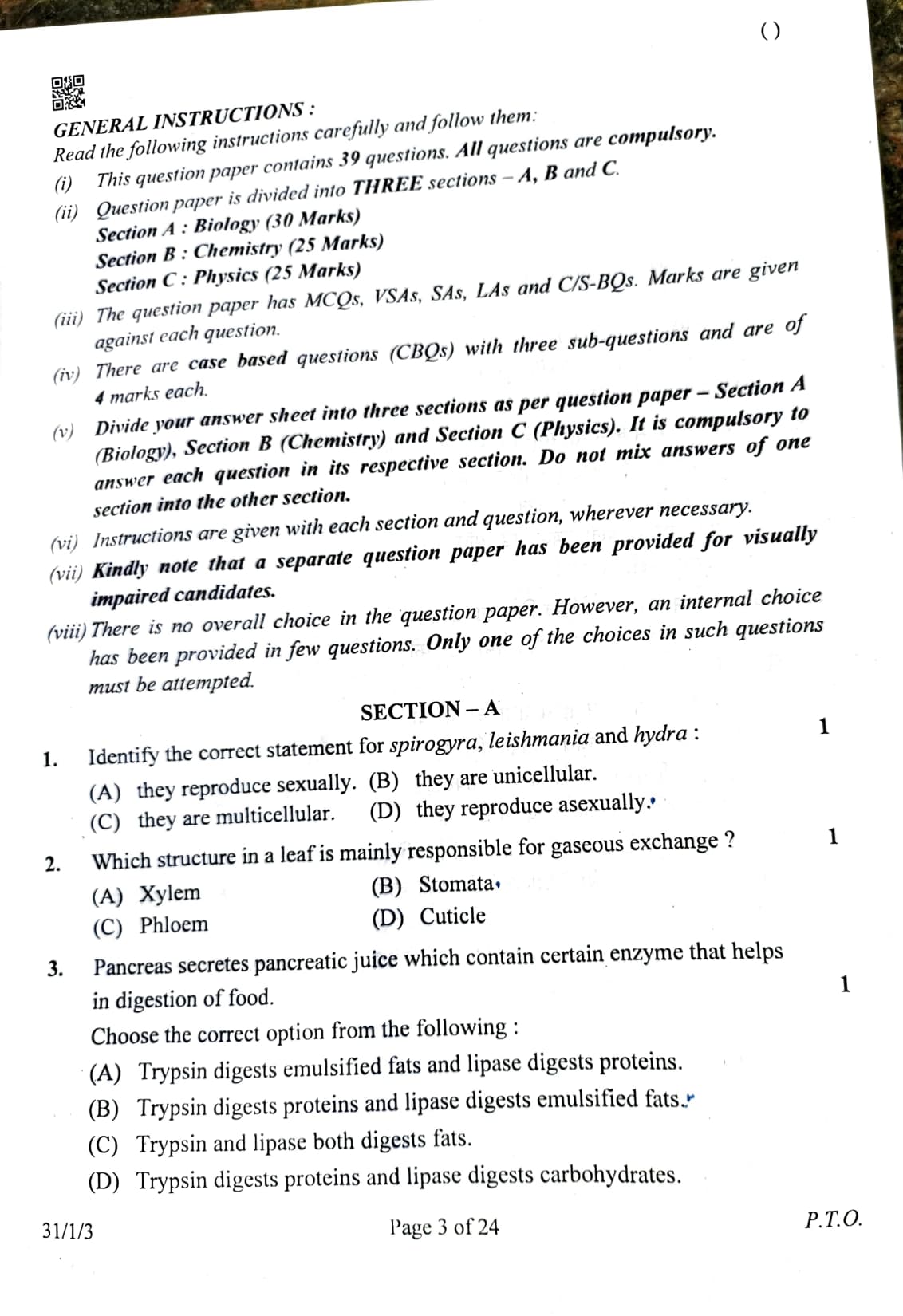
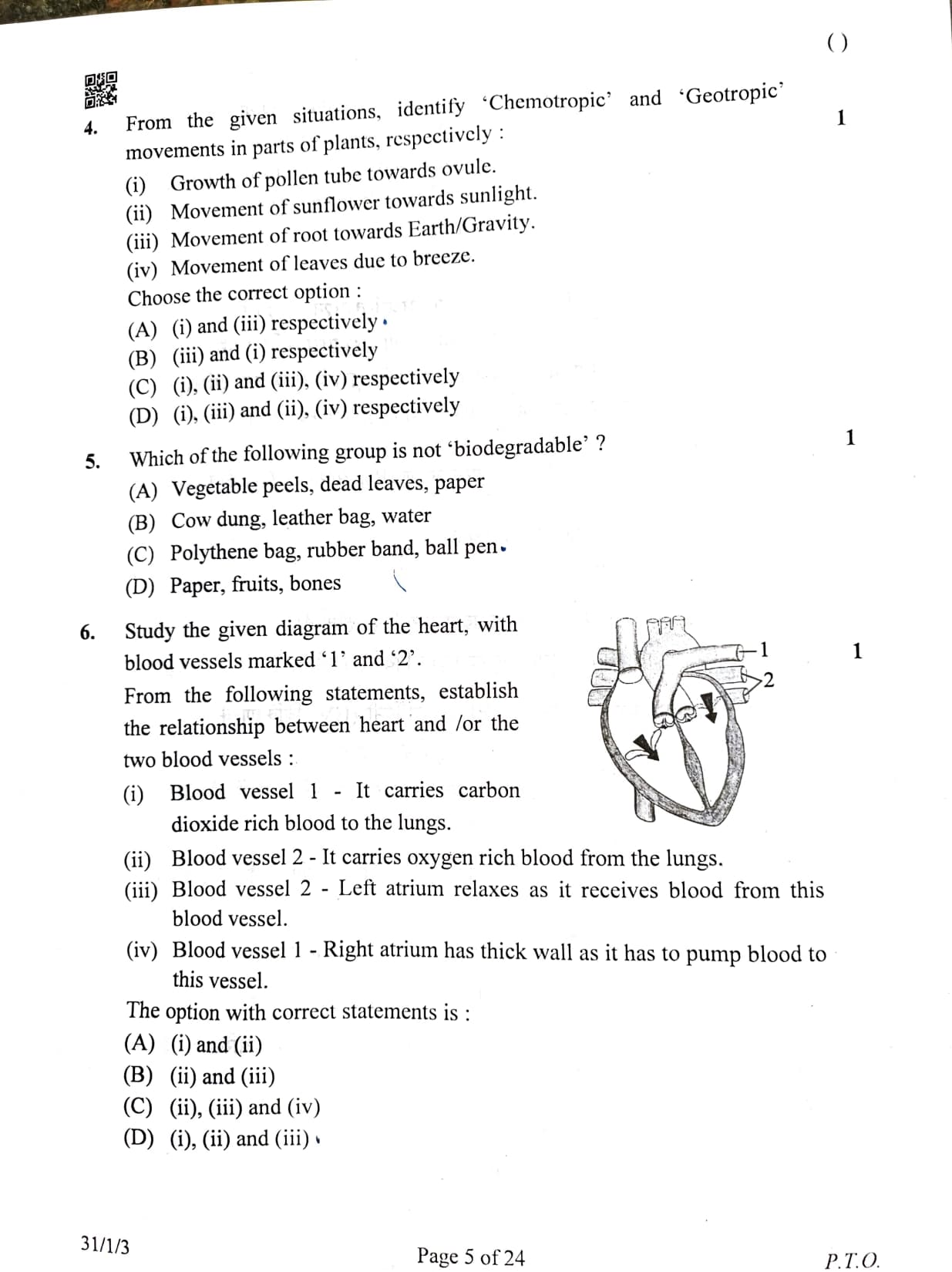
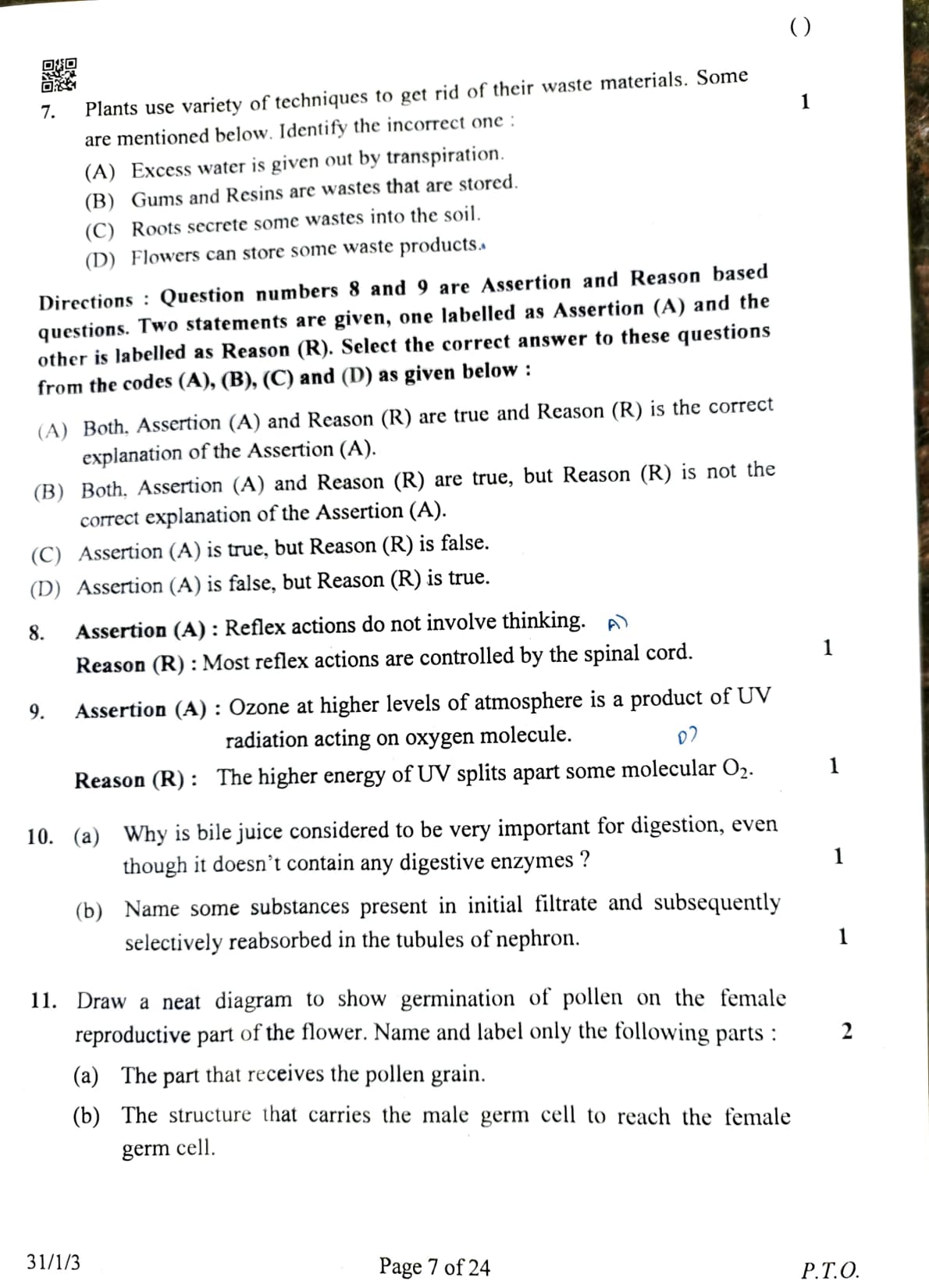
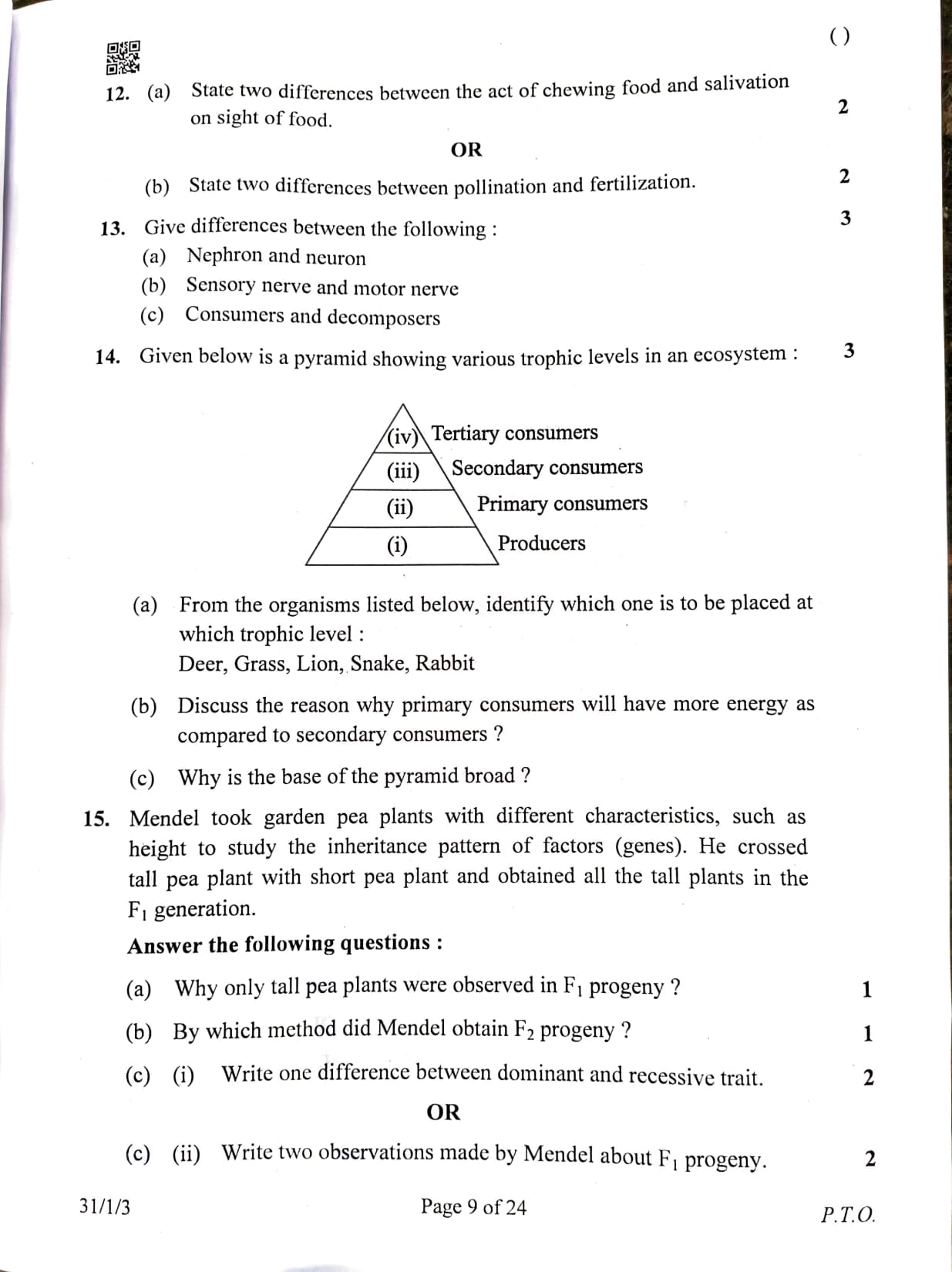
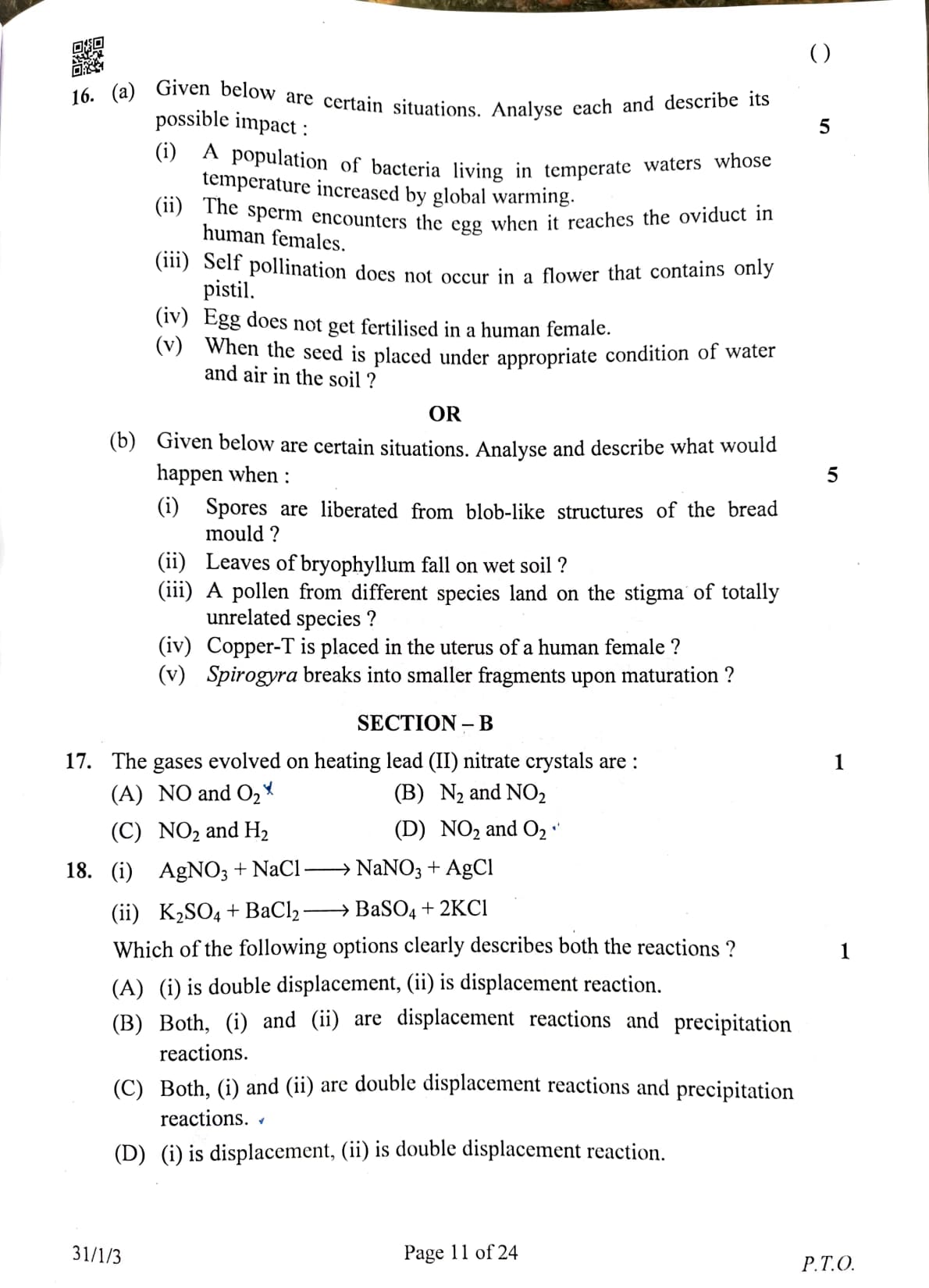
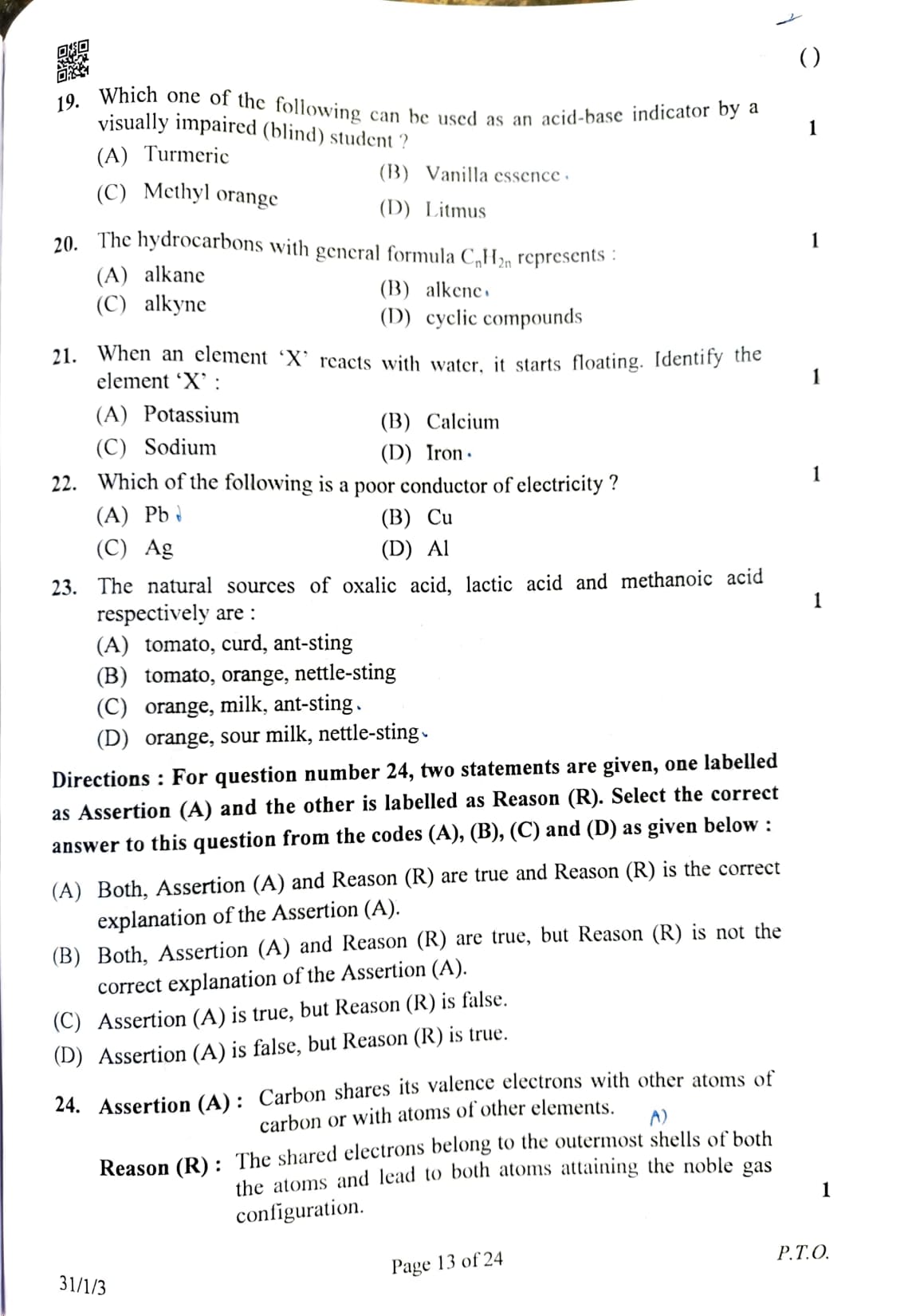
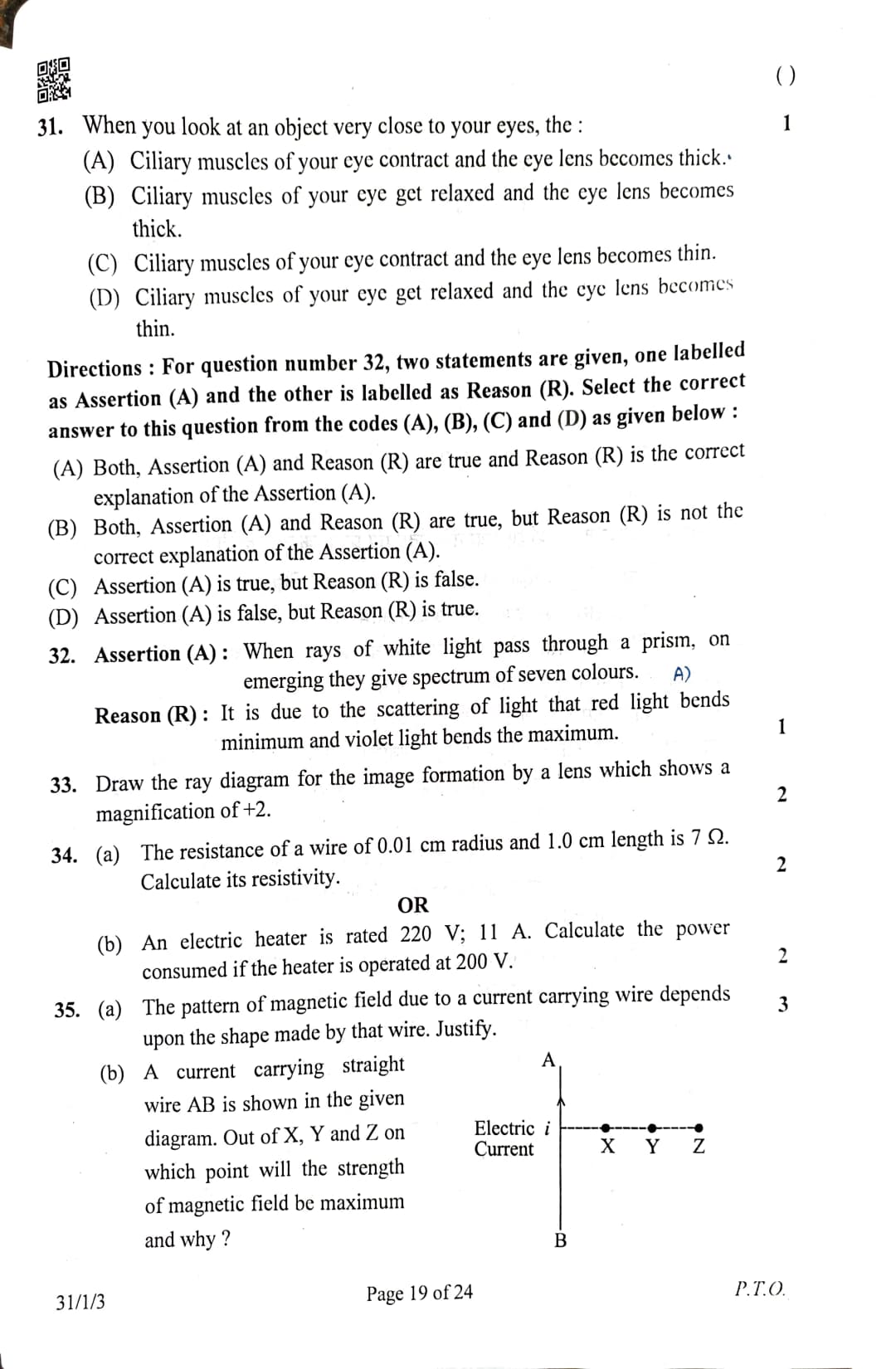
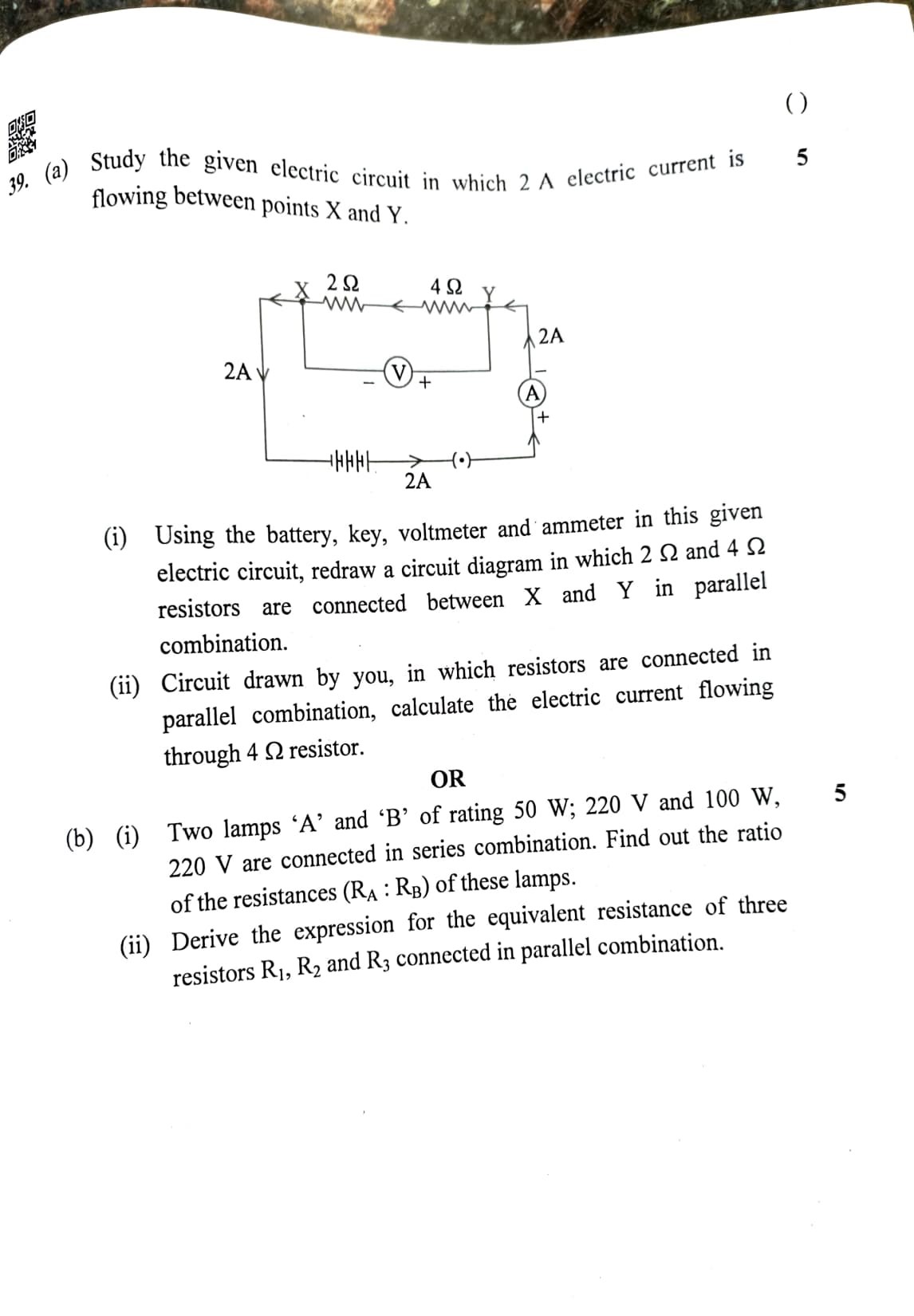




Comments