

.png?h=56&w=56&mode=stretch)


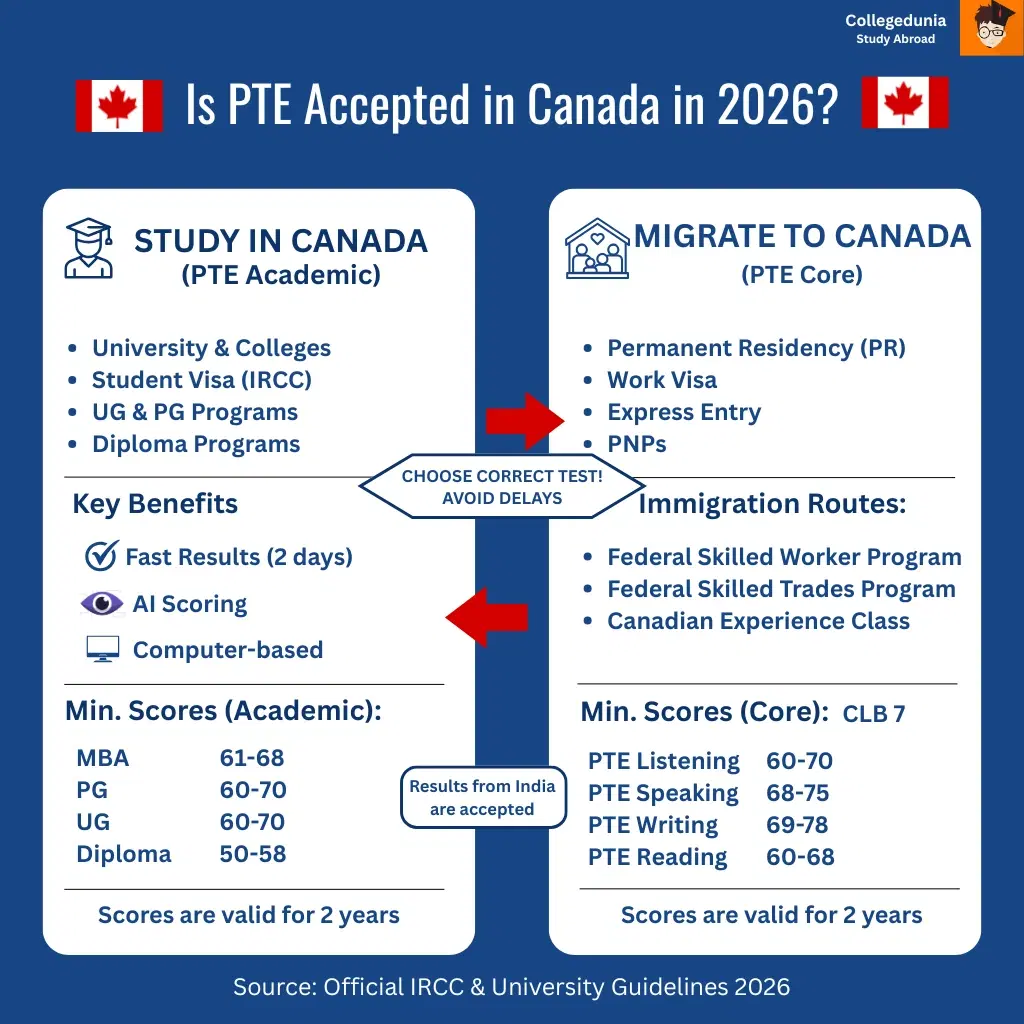
Yes, PTE is accepted in Canada in 2026. However, the type of PTE test you need depends on why you are applying.
- PTE Academic: Accepted by Canadian universities and colleges. It is also accepted by Immigration, Refugees and Citizenship Canada (IRCC) for student visa applications.
- PTE Core: Accepted by IRCC for immigration purposes, including permanent residency (PR) and work visas. However, PTE Core is not accepted for university admission or student visas.
Since Canada accepts different PTE tests for different purposes, it is important to choose the correct one and meet the required score. Choosing the wrong test can cause delays or rejection of your application.
This article explains how PTE works for Canada in 2026, where each test is accepted, and the required PTE score for Canada for different applications.
If you are planning to move to Canada in 2026, check the latest news: Canada PR 2026: IRCC keeps tech, healthcare in Express Entry focus
Is PTE Accepted for Study in Canada in 2026?
PTE Academic is fully accepted to study in Canada in 2026. Most public universities, community colleges, and private institutions recognize PTE Academic as proof of English proficiency for undergraduate, postgraduate, and diploma-level programs. Along with admissions, PTE Academic is also accepted for student visas, which means you can use the same score report for both university admission and visa applications.
Read about top Canadian universities and their entrance exam requirements.
PTE for MBA in Canada 2026
Here are the PTE score requirements by some of the top MBA colleges in Canada:
| Canadian University | QS Global MBA Ranking 2026 | PTE Score Requirement |
|---|---|---|
| University of Alberta School of Business | #151-200 | 61 overall, 60 in each section |
| Beedie School of Business | #201-250 | 65 overall, 60 in each section |
| Sauder School of Business | #111-120 | 70 overall |
| Smith School of Business | Not ranked | 60 overall |
| Asper School of Business | #301+ | 61 overall |
| John Molson School of Business | #151-200 | 61 overall, 46 each in Speaking and Writing |
| Ted Rogers School of Management | #301+ | 60 overall |
PTE for MS in Canada 2026
Here is a partial list of top Canadian universities accepting PTE scores for their MS programs in 2026:
| University | QS World University Rank 2026 | Minimum PTE Score |
|---|---|---|
| McMaster University | #173 | 60 overall, 60 each in Speaking and Writing |
| University of Alberta | #94 | 61 overall, 60 in each section |
| The University of British Columbia | #40 | 65 overall, 60 in each section |
| University of Manitoba | #643 | 61 overall |
| University of Waterloo | #119 | 63 overall, 65 each in Speaking and Writing |
| Simon Fraser University | #308 | 65 overall, 60 in each section |
| Dalhousie University | #283 | 65 overall, 54 in each section |
| University of Guelph | #504 | 60 overall, 60 in each section |
| York University | #333 | 61 overall, 55 in each section |
PTE for UG in Canada 2026
If you plan to study in Canada after 12th grade, you must submit a PTE Academic score that meets the university’s requirements. Most universities specify a minimum overall score and may also set section-wise minimum scores, as shown in the table below.
| University | QS World University Rank 2026 | Minimum PTE Score Required |
|---|---|---|
| University of Toronto | #29 | 65 overall, 60 in each section |
| McGill University | #27 | 65 overall, 60 in each section |
| University of Montreal | #168 | 61 overall, 60 in each section |
| Queen’s University | #191 | 65 overall |
| University of Calgary | #211 | 58 overall, 56 in each section |
| University of Ottawa | #219 | 61 overall, 53 in each section |
Is PTE Accepted in Canada for a Student Visa?
The Canadian immigration authority (IRCC) does not require a separate PTE score for a student visa (or, study permit as it is called in Canada). You only need to meet the score requirements of the university or college you are applying to. If you are accepted, you will receive a Letter of Acceptance (LOA), which needs to be submitted as part of your Canadian study permit application.
The typical PTE Academic score required by Canadian universities and colleges is given in the table below:
| Study Level | Minimum PTE Score Required |
|---|---|
| Diploma | 50 - 58 |
| Bachelor’s | 55 - 65 |
| Master’s | 60 - 70 |
| MBA Programs | 61 - 68 |
Note: PTE scores can be sent electronically to universities and IRCC, and there is no limit to the number of institutions you can share your score with.
Is PTE Accepted for Canada PR?
Yes, PTE Core is accepted for Canada PR. Skilled Indian immigrants can easily get a Canada PR through its Express Entry system. Express Entry is an online system that the Canadian government uses to select and invite skilled immigrants for PR.
There are 3 economic routes through which you can obtain a Canada PR:
- Federal Skilled Worker Program
- Federal Skilled Trades Program
- Canadian Experience Class
Each of these routes has specific CLB (Canadian Language Benchmark) levels, which are then mapped to PTE band scores as minimum requirements.
The CLB level and the corresponding PTE score are mentioned in the table below.
| Program | Minimum CLP Level | PTE Listening | PTE Reading | PTE Speaking | PTE Writing |
|---|---|---|---|---|---|
| Federal Skilled Worker Program | 7 | 60 - 70 | 60 - 68 | 68 - 75 | 69 - 78 |
| Federal Skilled Trades Program | 4 | 28 - 38 | 33 - 41 | 42 - 50 | 41 - 50 |
| Canadian Experience Class | 5 | 39 - 49 | 42 - 50 | 51 - 58 | 51 - 59 |
Note:
- IRCC evaluates PTE Core scores based on individual section scores mapped to CLB levels, and not the overall score.
- The easiest way for Indians to apply for Canada PR is through the Federal Skilled Worker Program (FSWP). This program lets people with work experience apply for PR, even if they don’t have a job in Canada or any prior connection to the country.
- For PR, your PTE Core result must still be valid at the time you submit your final application after receiving an Invitation to Apply (ITA).
Important Note: CLB vs CRS
- Meeting the minimum CLB requirement does not guarantee that you will receive an invitation through Express Entry.
- Candidates in the Express Entry pool are ranked using the Comprehensive Ranking System (CRS), an official points-based system used by Immigration, Refugees and Citizenship Canada.
- Your CRS score is calculated based on factors such as age, education, work experience, and language test results. In each draw, only candidates with CRS scores above the cut-off receive an Invitation to Apply (ITA) for permanent residency.
- Since the CRS cut-off changes in every draw depending on competition and immigration targets, meeting the minimum CLB language requirement alone does not guarantee an invitation.
If you are planning to move to Canada for work purposes in 2026, check out the article below:
Canada Work Permit: Types, Eligibility, RequirementsPTE is accepted for both studying and immigrating to Canada in 2026. Use PTE Academic for university or college admissions and study-permit applications, and PTE Core for PR or work-based immigration. Always check the specific score requirements of your target institution or immigration program, plan your test accordingly, and ensure your scores meet the minimum benchmarks to avoid delays in admission or visa processing.
Key Summary
- PTE is accepted in Canada in 2026; the test type depends on the purpose.
- PTE Academic is accepted by universities, colleges, and Immigration, Refugees and Citizenship Canada for student visa applications.
- PTE Core is accepted by IRCC for immigration, permanent residency (PR), and work visas; not accepted for academic admission.
- Canadian universities and colleges set minimum PTE scores by program; scores can be sent electronically to multiple institutions.
- For PR, PTE Core scores are evaluated by individual sections mapped to CLB levels; the overall score is not considered.
- Candidates are ranked using the CRS (Comprehensive Ranking System), which considers age, education, work experience, and language scores.
- Meeting the minimum CLB does not guarantee an Express Entry invitation.
- PTE Core results must be valid at the time of final PR application submission.
- PTE scores are valid for 2 years and can be retaken; the best scores can be used for multiple applications.
- PTE Academic is accepted for online or hybrid programs.
- Some universities may waive the English test if prior education was in English. Examples include Coventry University.
- Use PTE Academic for study and PTE Core for immigration; always check score requirements to avoid delays or rejections.
FAQs
Ques. How long is a PTE score valid for Canada applications?
Ans. PTE scores are valid for 2 years from the test date for both study and immigration purposes.
Ques. Can I improve my PTE score and reuse it for multiple applications?
Ans. Yes, you can retake PTE any number of times. You can submit the best score for multiple universities or visa applications.
Ques. How quickly are PTE results released?
Ans. Results for PTE Academic are usually released within 2 business days, allowing faster submission for admissions or visa applications.
Ques. Is PTE accepted for online or distance learning programs in Canada?
Ans. Yes, most Canadian institutions accept PTE Academic for online or hybrid programs if English proficiency proof is required.
Ques. Can PTE be taken in India for Canadian applications?
Ans. Yes, PTE Academic and PTE Core are both available at authorized test centers across India, making it convenient for applicants.
Ques. Are there any exemptions from taking PTE for Canada?
Ans. Some universities may waive the English test if you have completed prior education in English or hold a degree from an English-speaking country.



Comments