MHT CET 2024 2 May Shift 1 Question Paper (Available): Download PCM Question Paper with Answers PDF

Collegedunia Team's profile photo

Collegedunia Team

Content Curator | Updated 3+ months ago

MHT CET 2024 2 May Shift 1 question paper is available for download here. MHT CET 2024 question paper comprises 150 MCQs carrying a total weightage of 200 marks.

MHT CET 2024 2 May Shift 1 Question Paper for PCM is divided into three subjects- Physics, Chemistry and Mathematics with 50 questions for each section (10 questions from Class 11 and 40 questions from Class 12th syllabus).

MHT CET 2024 2 May Shift 1 Question Paper PDF Download

MHT CET 2024 2 May Shift 1 Question Paper with Answer key  download iconDownload Check Solutions

MHT CET 2024 2 May Shift 1 Question Paper Solution

Question 1:

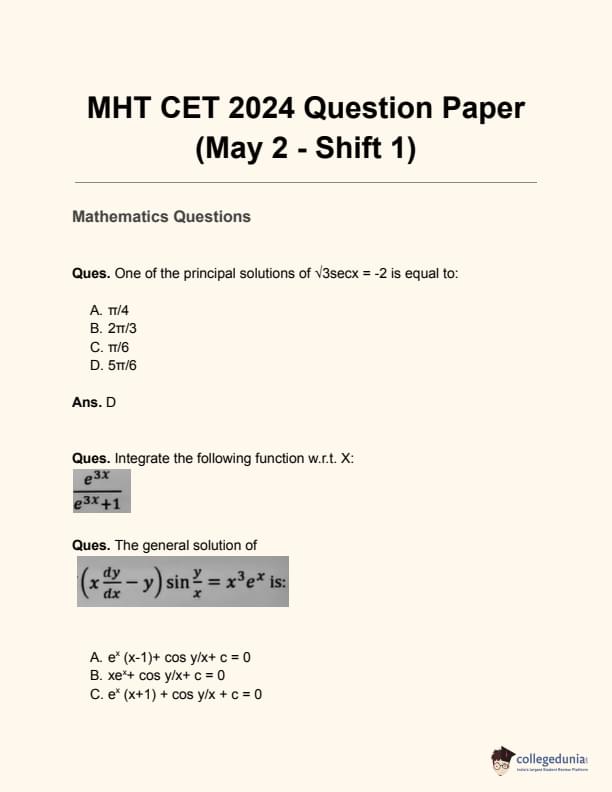
One of the principal solutions of √3 sec(x) = -2 is equal to:

  1. π/4
  2. 2π/3
  3. π/6
  4. 5π/6
Correct Answer: (4) 5π/6
View Solution

We are given the equation:

√3 sec(x) = -2

First, solve for sec(x):

sec(x) = -2/√3 = -2√3/3

Next, recall that sec(x) = 1/cos(x), which gives:

cos(x) = -√3/2

Now, determine the principal solutions for cos(x) = -√3/2, which occurs at:

x = 5π/6, 7π/6

From the available options, 5π/6 is the correct solution.


Question 2:

Integrate the following function with respect to x:

∫ e^(3x) / (e^(3x) + 1) dx

  1. (1/3) ln(e^(3x) + 1) + C
  2. (1/3) ln(e^(3x) - 1) + C
  3. (1/3) ln(e^(3x) + e^x) + C
  4. (1/2) ln(e^(3x) + 1) + C
Correct Answer: (1) (1/3) ln(e^(3x) + 1) + C
View Solution

First, observe the structure of the integral and apply substitution. Let:

u = e^(3x) + 1 → du = 3e^(3x) dx

Thus, the integral becomes:

(e^(3x) / (e^(3x) + 1)) dx = (1/3) * (du / u)

Now, the integral simplifies to:

∫ (1/3) * (du / u) = (1/3) ln|u| + C

Substitute back u = e^(3x) + 1:

(1/3) ln|e^(3x) + 1| + C

Thus, the final answer is:

(1/3) ln(e^(3x) + 1) + C


Question 3:

The general solution of:

(x dy/dx - y) sin(y/x) = x³ e^x is:

  1. e^x (x - 1) + cos(y/x) + c = 0
  2. x e^x + cos(y/x) + c = 0
  3. e^x (x + 1) + cos(y/x) + c = 0
  4. e^x x - cos(y/x) + c = 0
Correct Answer: (1) e^x (x - 1) + cos(y/x) + c = 0.
View Solution

We are given the differential equation:

(x dy/dx - y) sin(y/x) = x³ e^x.

To simplify, let v = y/x, so y = vx. Differentiate y = vx to get:

dy/dx = v + x dv/dx.

Substitute y = vx and dy/dx = v + x dv/dx into the equation:

x(v + x dv/dx) - vx = x³ e^x sin(v).

Simplify the terms:

x² dv/dx = x³ e^x sin(v).

Separate variables:

dv/sin(v) = x e^x dx.

Integrate both sides:

∫ dv/sin(v) = ∫ x e^x dx.

The integral of the left-hand side is ln|tan(v/2)|, and the right-hand side is computed as:

∫ x e^x dx = e^x (x - 1) + c.

Substitute back v = y/x to get the solution:

e^x (x - 1) + cos(y/x) + c = 0.


Question 4:

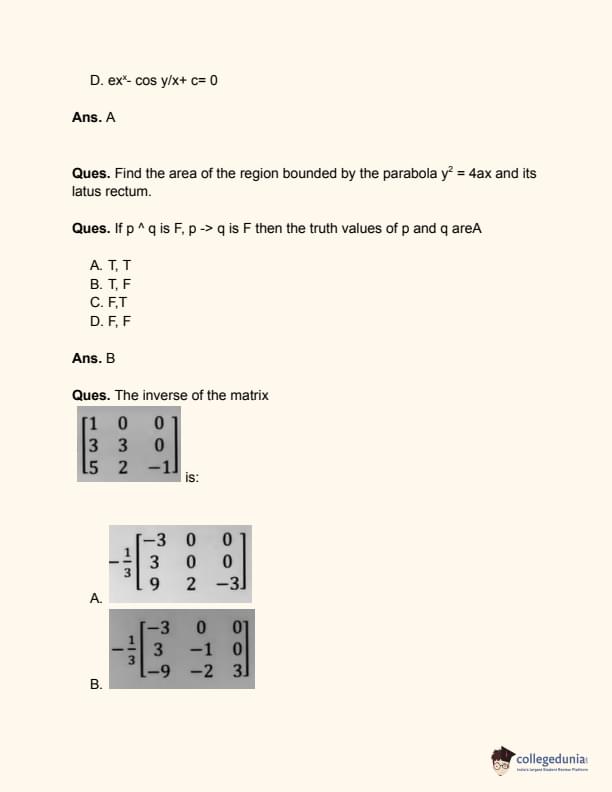
Find the area of the region bounded by the parabola:

y² = 4ax and its latus rectum.

  1. a²/2
  2. a²/4
  3. 8a²/3
Correct Answer: (4) 8a²/3.
View Solution

The equation of the parabola is:

y² = 4ax,

which represents a standard parabola opening to the right. Its vertex is at (0, 0), and the latus rectum is the vertical line x = a.

The area under the parabola from x = 0 to x = a is given by:

Area = 2 ∫₀ᵃ √(4ax) dx,

where the factor of 2 accounts for the symmetry of the parabola.

Substitute y = √(4ax):

Area = 2 ∫₀ᵃ √(4a) √(x) dx = 2 √(4a) ∫₀ᵃ √(x) dx.

Evaluate the integral:

∫₀ᵃ √(x) dx = ∫₀ᵃ x^(1/2) dx = (2/3)x^(3/2) |₀ᵃ = (2/3)a^(3/2).

Substitute back:

Area = 2 √(4a) × (2/3)a^(3/2) = (8/3)a².


Question 5:

If p ∧ q is False and p → q is False, then the truth values of p and q are:

  1. True, True
  2. True, False
  3. False, True
  4. False, False
Correct Answer: (2) True, False.
View Solution

We are given the following logical conditions:

1. p ∧ q = False: At least one of p or q must be False.

2. p → q = False: This occurs only when p is True and q is False.

From condition 2, we conclude:

p = True and q = False.

Thus, the truth values of p and q are True and False, respectively.


Question 6:

The inverse of the matrix:

    [
        [1, 0, 0],
        [3, 3, 0],
        [5, 2, -1]
    ]
    

is:

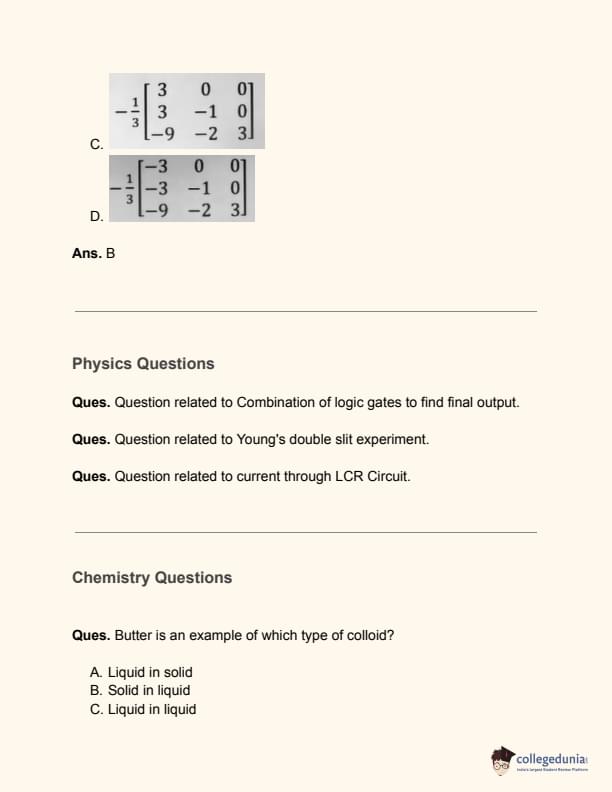
  1.             (-1/3) * [
                    [-3, 0, 0],
                    [3, 0, 0],
                    [9, 2, -3]
                ]
                
  2.             (-1/3) * [
                    [-3, 0, 0],
                    [3, -1, 0],
                    [-9, -2, 3]
                ]
                
  3.             (-1/3) * [
                    [3, 0, 0],
                    [3, -1, 0],
                    [-9, -2, 3]
                ]
                
  4.             (-1/3) * [
                    [-3, 0, 0],
                    [-3, -1, 0],
                    [-9, -2, 3]
                ]
                
Correct Answer: (2)
        (-1/3) * [
            [-3, 0, 0],
            [3, -1, 0],
            [-9, -2, 3]
        ]
        
View Solution

To find the inverse of the given matrix:

            [
                [1, 0, 0],
                [3, 3, 0],
                [5, 2, -1]
            ]
            

First, calculate the determinant:

det(A) = -3.

Next, compute the adjoint matrix:

            adj(A) = [
                [-3, 0, 0],
                [3, -1, 0],
                [-9, -2, 3]
            ]
            

Finally, divide the adjoint by the determinant:

            A⁻¹ = (-1/3) * adj(A)
            

Question 7:

What is the equivalent logic gate when the output of an AND gate is passed through a NOT gate?

  1. OR gate
  2. NOR gate
  3. NAND gate
  4. XOR gate
Correct Answer: (3) NAND gate.
View Solution

Passing the output of an AND gate through a NOT gate inverts the AND operation:

            Output = NOT(A AND B) = NAND(A, B)
            

Thus, the circuit behaves as a NAND gate.


Question 8:

In Young's double-slit experiment, if the distance between the slits is doubled while keeping the wavelength and the distance to the screen constant, the fringe spacing will:

  1. Double
  2. Halve
  3. Remain the same
  4. Quadruple
Correct Answer: (2) Halve.
View Solution

The fringe spacing (β) in Young's double-slit experiment is given by:

            β = (λ * L) / d
            

where:

  • λ = wavelength of light
  • L = distance to the screen
  • d = distance between the slits

If d is doubled, β becomes:

            β' = (λ * L) / (2d) = β / 2
            

Thus, the fringe spacing is halved.


Question 9:

In a series LCR circuit connected to an AC source, at resonance, the current is maximum because:

  1. The inductive reactance is maximum
  2. The capacitive reactance cancels the inductive reactance
  3. The resistance is zero
  4. The reactances add up
Correct Answer: (2) The capacitive reactance cancels the inductive reactance.
View Solution

At resonance in a series LCR circuit, the total impedance (Z) is given by:

Z = sqrt(R² + (X_L - X_C)²)

where:

  • R is the resistance,
  • X_L = ωL is the inductive reactance,
  • X_C = 1/(ωC) is the capacitive reactance.

At resonance, the inductive reactance (X_L) and the capacitive reactance (X_C) are equal, so their effects cancel each other out:

Z = sqrt(R² + (X_L - X_C)²) = sqrt(R²) = R

This results in the minimum impedance, which allows the maximum current to flow according to Ohm's law:

I = V / Z

Thus, the current is maximum because the inductive and capacitive reactances cancel each other out.


Question 10:

Butter is an example of which type of colloid?

  1. Liquid in solid
  2. Solid in liquid
  3. Liquid in liquid
  4. Gas in liquid
Correct Answer: (1) Liquid in solid.
View Solution

Butter is an example of a colloidal system in which liquid (typically water or milk) is dispersed within a solid matrix (fat). This type of colloid is referred to as "liquid in solid." In butter, the fat acts as the continuous phase, with water droplets dispersed within it.

Thus, butter is a colloid where the liquid phase is dispersed in a solid phase.


Question 11:

Which of the following techniques is most suitable for determining the size and morphology of nanoparticles?

  1. UV-Vis Spectroscopy
  2. Transmission Electron Microscopy (TEM)
  3. Fourier Transform Infrared Spectroscopy (FTIR)
  4. Atomic Absorption Spectroscopy (AAS)
Correct Answer: (2) Transmission Electron Microscopy (TEM).
View Solution

Transmission Electron Microscopy (TEM) is a highly effective technique for analyzing the size, shape, and morphology of nanoparticles at the nanometer scale. Unlike UV-Vis Spectroscopy, FTIR, and AAS, which provide information about optical properties, molecular vibrations, and elemental composition, respectively, TEM directly images nanoparticles, providing precise measurements of their size and structure.

Thus, TEM is the most suitable technique for determining the size and morphology of nanoparticles.


Question 12:

What is the pH of a 0.01 M hydrochloric acid (HCl) solution?

  1. 2
  2. 4
  3. 7
  4. 12
Correct Answer: (1) 2.
View Solution

Hydrochloric acid (HCl) is a strong acid that dissociates completely in water:

HCl → H⁺ + Cl⁻

Since HCl dissociates fully, the concentration of hydrogen ions [H⁺] is equal to the concentration of HCl, which is 0.01 M.

To calculate the pH, we use the formula:

pH = -log [H⁺]

Substituting the values:

pH = -log (0.01) = 2

Thus, the pH of the solution is 2.


Fees Structure

Structure based on different categories

CategoriesState
General800
Women800
sc600
pwd600
Others600

In case of any inaccuracy, Notify Us! 

Comments


No Comments To Show