MHT CET 2024 29 April Shift 1 Question Paper (Available): Download PCB Question Paper with Answers PDF

Collegedunia Team's profile photo

Collegedunia Team

Content Curator | Updated 3+ months ago

MHT CET 2024 29 April Shift 1 question paper is available for download here. MHT CET 2024 question paper comprises 150 MCQs carrying a total weightage of 300 marks. MHT CET 2024 29 April Shift 1 Question Paper for PCB is divided into three subjects- Physics, Chemistry and Biology. The Physics and Chemistry section of MHT CET 2024 29 April Shift 1 question paper consists of 50 questions (10 questions from Class 11 and 40 questions from Class 12th syllabus). Meanwhile, the Biology paper of MHT CET 2024 29 April Shift 1 question paper consists of 100 questions (20 questions from Class 11th and 80 questions from Class 12th syllabus).

MHT CET 2024 29 April Shift 1 Question Paper PDF Download

MHT CET 2024 29 April Shift 1​ Question Paper 2024 with Answer Key download iconDownload Check Solutions

MHT CET 2024 29 April Shift 1 Questions with Solutions

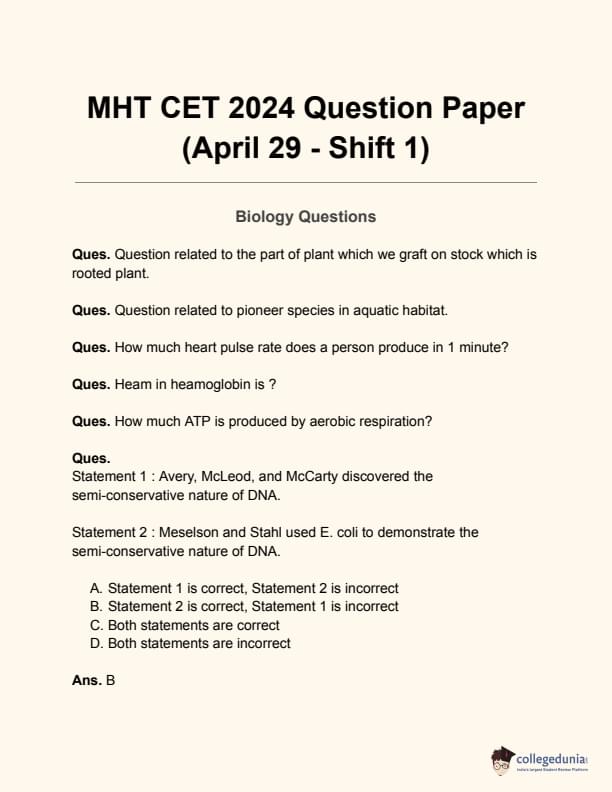
Question 1:

Which part of a plant is grafted onto a stock that is rooted?

  1. Root
  2. Scion
  3. Stem
  4. Leaf
Correct Answer: (B) Scion.
View Solution

Detailed Solution:

Grafting is a horticultural technique where parts of two plants are joined to grow as one. The rooted plant, known as the stock, provides the root system, while the detached part to be grafted, the scion, forms the shoot system. In this context:

  1. Root: The root is the underground part of the plant and provides anchorage and absorbs nutrients. It is not grafted onto the stock; rather, it is part of the stock itself.
  2. Scion: The scion is a detached shoot or bud that is grafted onto the stock. It develops into the upper part of the plant, including stems, leaves, flowers, and fruits.
  3. Stem: While stems can be part of a graft, the question asks specifically about the part "grafted onto" a stock. The stem itself isn't the standard part grafted; the scion includes the stem.
  4. Leaf: A leaf cannot be grafted directly onto a stock. Grafting involves joining tissues capable of forming vascular connections, which leaves do not have on their own.

Therefore, the part of a plant that is grafted onto a stock is the scion.

Final Answer: Scion

Question 2:

Which are the pioneer species in aquatic habitats?

  1. Fungi
  2. Algae
  3. Bryophytes
  4. Lichens
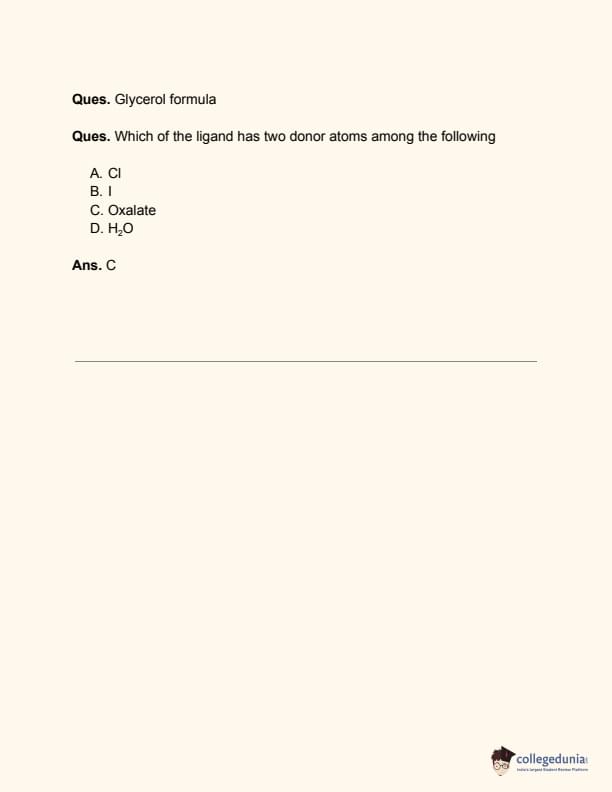
Correct Answer: (B) Algae.
View Solution

Detailed Solution:

Pioneer species are the first organisms to colonize a barren or disturbed environment. In aquatic ecosystems, these initial colonizers play a crucial role in establishing life and preparing the habitat for other organisms.

  1. Fungi: Fungi are typically decomposers in terrestrial ecosystems. While some may exist in aquatic environments, they are not considered primary colonizers.
  2. Algae: Algae, especially cyanobacteria, are crucial primary producers in aquatic habitats. They perform photosynthesis, generating energy and organic matter while surviving harsh conditions. They are capable of colonizing nutrient-poor environments and creating a base for more complex food webs.
  3. Bryophytes: Bryophytes include mosses and liverworts and are predominantly terrestrial plants. They require moist environments and are not typically the first colonizers in aquatic habitats.
  4. Lichens: Lichens are symbiotic associations of fungi and algae or cyanobacteria. They are mainly found in terrestrial environments and are not common pioneers in aquatic settings.

Therefore, the pioneer species in aquatic habitats are Algae.

Final Answer: Algae

Question 3:

How many heartbeats does a person have in 1 minute on average?

  1. 50
  2. 72
  3. 100
  4. 120
Correct Answer: (B) 72.
View Solution

Detailed Solution:

The average heart rate is the number of times the heart beats per minute. This rate is not constant and can vary due to different factors.

  1. Average Resting Heart Rate: For a healthy adult, the average resting heart rate is about 72 beats per minute. However, this can range from 60 to 100 beats per minute.
  2. Factors Affecting Heart Rate:
    • Physical Activity: Exercise or stress can increase heart rate.
    • Age: Infants and young children have higher heart rates than adults.
    • Health Status: Conditions like bradycardia (slow heart rate) or tachycardia (fast heart rate) can cause significant deviations from the normal range.
  3. Average Heart Rate Calculation: The given options represent a range. However, 72 is the typically accepted average heart rate for adults.

Therefore, a person has an average of 72 heartbeats per minute.

Final Answer: 72 beats per minute

Question 4:

What is the role of heme in hemoglobin?

  1. Transport of oxygen
  2. Transport of carbon dioxide
  3. Structural stability
  4. Enzyme activity
Correct Answer: (A) Transport of oxygen.
View Solution

Detailed Solution:

Heme is a prosthetic group present in hemoglobin, a protein in red blood cells responsible for oxygen transport. Its role is critical for efficient oxygen delivery to tissues.

  1. Heme Composition: Heme is made of an iron atom bound to a porphyrin ring. The iron atom is the site where oxygen binds.
  2. Oxygen Binding:
    • When red blood cells pass through the lungs, the iron in the heme group binds to oxygen.
    • The oxygenated hemoglobin carries oxygen through the bloodstream.
  3. Oxygen Release: In tissues where oxygen is needed for cellular respiration, the oxygen detaches from hemoglobin and is used by cells for energy production.
  4. Other Options:
    • While hemoglobin also binds carbon dioxide, the binding is not specifically due to the heme group, and its main function remains oxygen transport.
    • Heme contributes to the overall structure of hemoglobin but is not the only component involved in its stability.
    • Heme doesn't act as an enzyme; rather it is a prosthetic group within the functional protein hemoglobin.

Therefore, the primary role of heme in hemoglobin is the transport of oxygen.

Final Answer: Transport of oxygen

Question 5:

How much ATP is produced by aerobic respiration?

  1. 2 ATP
  2. 32 ATP
  3. 36 ATP
  4. 38 ATP
Correct Answer: (C) 36 ATP.
View Solution

Detailed Solution:

Aerobic respiration is the process by which cells break down glucose in the presence of oxygen to produce energy in the form of ATP. It is the most efficient form of energy production.

  1. Stages of Aerobic Respiration: Aerobic respiration comprises three main stages:
    • Glycolysis: This initial stage occurs in the cytoplasm and breaks down glucose into pyruvate, generating 2 ATP molecules.
    • Krebs Cycle (Citric Acid Cycle): This cycle occurs in the mitochondria and further oxidizes pyruvate, generating 2 ATP molecules.
    • Electron Transport Chain (Oxidative Phosphorylation): This final stage, also in mitochondria, uses the products of the previous stages to produce the bulk of ATP. It generates approximately 32 ATP molecules.
  2. Total ATP Production: The total ATP yield from aerobic respiration can be calculated by summing up the ATP produced in each stage:

    Total ATP = ATP (Glycolysis) + ATP (Krebs Cycle) + ATP (Electron Transport Chain)

    Total ATP = 2 + 2 + 32 = 36 ATP

Therefore, the total amount of ATP produced in aerobic respiration is 36 ATP.

Final Answer: 36 ATP

Question 6:

Statement 1: Avery, McLeod, and McCarty discovered the semi-conservative nature of DNA.

Statement 2: Meselson and Stahl used E. coli to demonstrate the semi-conservative na- ture of DNA.

  1. Statement 1 is correct, Statement 2 is incorrect
  2. Statement 2 is correct, Statement 1 is incorrect
  3. Both statements are correct
  4. Both statements are incorrect
Correct Answer: (B) Statement 2 is correct, Statement 1 is incorrect.
View Solution

Detailed Solution:

This question requires distinguishing between two groups of scientists and their contributions to the understanding of DNA.

  1. Avery, McLeod, and McCarty:
    • These scientists conducted experiments in the 1940s to prove that DNA is the genetic material, not proteins.
    • They did this using bacterial transformation experiments where they isolated and purified DNA which could cause transformation.
    • They established that the DNA carries the genetic information in cells. However, they did not determine how DNA replicates.
  2. Meselson and Stahl:
    • These scientists in the 1950s used density gradient centrifugation to determine how DNA is replicated.
    • They used E. coli bacteria, grown in different forms of Nitrogen, to track the incorporation of this heavy nitrogen in successive generations of bacteria, and thus concluded that DNA replication is semi-conservative
    • This semi-conservative model revealed that each new DNA double helix contains one old (parental) strand and one new strand.
  3. Analyzing Statements:
    • Statement 1 is incorrect because Avery, McLeod, and McCarty discovered DNA as the genetic material but did not determine its replication method.
    • Statement 2 is correct because Meselson and Stahl provided the evidence for the semi-conservative nature of DNA replication.

Therefore, statement 2 is correct while statement 1 is incorrect.

Final Answer: Statement 2 is correct, Statement 1 is incorrect

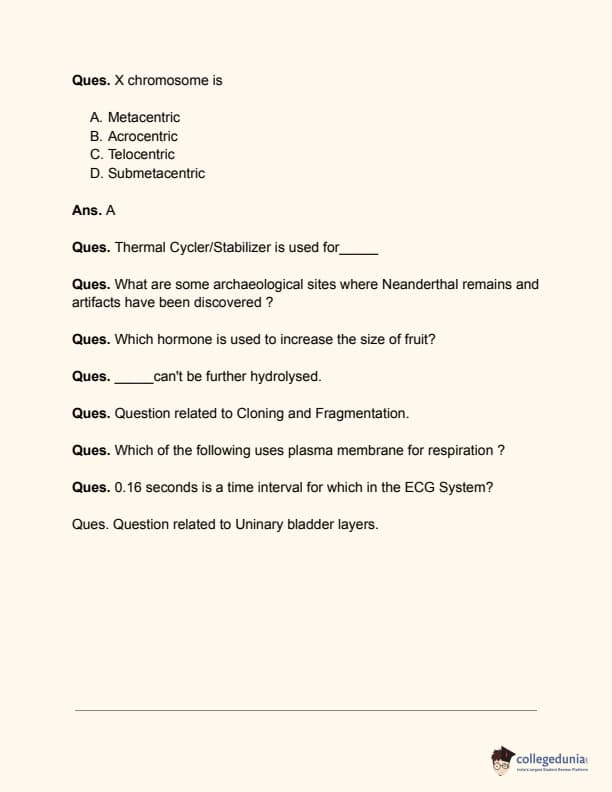
Question 7:

A Thermal Cycler/Stabilizer is used for ____?

  1. Maintaining temperature
  2. DNA amplification (PCR)
  3. Protein synthesis
  4. RNA transcription
Correct Answer: (B) DNA amplification (PCR).
View Solution

Detailed Solution:

A thermal cycler, or PCR machine, is an instrument used in molecular biology for the controlled heating and cooling of samples, enabling DNA amplification through the Polymerase Chain Reaction (PCR).

  1. Thermal Cycler Function: The thermal cycler precisely controls the temperature of samples over time, following a specific cycle of heating and cooling.
  2. PCR and its Steps: PCR involves the following steps:
    • Denaturation: The DNA sample is heated to 94 - 96°C, breaking the hydrogen bonds and separating the double strands.
    • Annealing: The temperature is lowered (typically to 50 - 65°C), allowing primers to bind to specific DNA sequences.
    • Extension: The temperature is increased to 72°C, the optimal temperature for DNA polymerase to synthesize new DNA strands using the primers.
  3. Other Options:
    • While temperature control is a vital function, the main purpose of the cycler is to achieve cycling which is essential for PCR.
    • Protein synthesis and RNA transcription require different processes and instruments.

Therefore, a thermal cycler/stabilizer is primarily used for DNA amplification (PCR).

Final Answer: DNA amplification (PCR)

Question 8:

What are some archaeological sites where Neanderthal remains and artifacts have been discovered?

  1. Lascaux Cave, France
  2. Altamira Cave, Spain
  3. Shanidar Cave, Iraq
  4. All of the above
Correct Answer: (D) All of the above.
View Solution

Detailed Solution:

Neanderthals were an extinct species of archaic humans who lived in Europe and parts of Asia. The archaeological record provides important insights into their culture and lifestyle.

  1. Lascaux Cave, France:
    • While primarily famous for its Paleolithic cave paintings, there is some debate about the presence of Neanderthal artifacts within this location. However, its significance in understanding the broader Paleolithic landscape is crucial.
  2. Altamira Cave, Spain:
    • Altamira is well known for its prehistoric art, and associated artifacts. While debated if the makers were Neanderthals, its relation to ancient cultures in the area is important.
  3. Shanidar Cave, Iraq:
    • This site is important for discovering Neanderthal skeletal remains and evidence of intentional burial practices. The evidence of rituals provides important understanding of their behavior.

Therefore, Neanderthal remains and artifacts have been found at all of the above sites.

Final Answer: All of the above

Question 9:

Which hormone is used to increase the size of fruit?

  1. Auxin
  2. Gibberellin
  3. Cytokinin
  4. Ethylene
Correct Answer: (B) Gibberellin.
View Solution

Detailed Solution:

Plant hormones play vital roles in regulating plant growth and development, including fruit size.

  1. Auxin: Auxins promote cell elongation and are involved in plant growth, but they are not the primary hormone used to enhance fruit size.
  2. Gibberellin:
    • Gibberellins are a group of hormones that promote cell elongation and cell division.
    • They enhance fruit size by increasing the cell size, leading to larger fruits.
    • They are widely used in horticulture for increasing the size of fruits like grapes and apples and promoting stem elongation and seed germination.
  3. Cytokinin: Cytokinins are involved in cell division, shoot development, and overall plant growth. They are not the main hormones in fruit size enhancement.
  4. Ethylene: Ethylene is a gaseous hormone involved in fruit ripening, senescence, and stress responses. It does not play a role in fruit size enhancement.

Therefore, Gibberellin is the hormone primarily used for increasing the size of fruit.

Final Answer: Gibberellin

Question 10:

____ can't be further hydrolyzed.

  1. Polysaccharides
  2. Disaccharides
  3. Monosaccharides
  4. Oligosaccharides
Correct Answer: (C) Monosaccharides.
View Solution

Detailed Solution:

Hydrolysis is the process of breaking down large molecules into smaller ones by adding water. Carbohydrates are classified based on their complexity.

  1. Polysaccharides: Polysaccharides are complex carbohydrates formed from many monosaccharide units linked together. They can be hydrolyzed into disaccharides and monosaccharides.
  2. Disaccharides: Disaccharides are composed of two monosaccharide units linked by glycosidic bonds. They can be hydrolyzed into their constituent monosaccharides.
  3. Monosaccharides:
    • Monosaccharides are simple sugars that cannot be further broken down by hydrolysis.
    • They are the smallest carbohydrate units, such as glucose, fructose, and galactose.
  4. Oligosaccharides: Oligosaccharides consist of a few monosaccharide units. They can be hydrolyzed into their constituent monosaccharides.

Therefore, Monosaccharides cannot be further hydrolyzed.

Final Answer: Monosaccharides

Question 11:

Which of the following uses plasma membrane for respiration?

  1. Prokaryotes
  2. Eukaryotes
  3. Viruses
  4. Fungi
Correct Answer: (A) Prokaryotes.
View Solution

Detailed Solution:

Respiration, the process of generating ATP, has different mechanisms across organisms depending on their cellular structure and organelles.

  1. Prokaryotes:
    • Prokaryotic cells, such as bacteria, lack membrane-bound organelles like mitochondria.
    • Instead, they utilize their plasma membrane for respiratory processes.
    • The plasma membrane in prokaryotes hosts enzymes for the electron transport chain and for oxidative phosphorylation.
  2. Eukaryotes: Eukaryotic cells have mitochondria, which are the primary sites for ATP production via cellular respiration. The plasma membrane does not perform significant respiratory roles.
  3. Viruses: Viruses are not cellular organisms and lack metabolic machinery. They are completely dependent on host cells for energy production.
  4. Fungi: Fungi are eukaryotic organisms, and cellular respiration occurs in mitochondria.

Therefore, Prokaryotes utilize the plasma membrane for respiration.

Final Answer: Prokaryotes

Question 12:

0.16 seconds is a time interval for which event in the ECG system?

  1. P wave
  2. QRS complex
  3. PR interval
  4. T wave
Correct Answer: (C) PR interval.
View Solution

Detailed Solution:

An electrocardiogram (ECG) records the electrical activity of the heart. Specific intervals on the ECG tracing correspond to different physiological events.

  1. P wave: The P wave represents atrial depolarization. Its duration is shorter than the PR interval.
  2. QRS complex: The QRS complex represents ventricular depolarization and is much shorter in duration.
  3. PR Interval:
    • The PR interval represents the time it takes for an electrical impulse to travel from the sinoatrial (SA) node through the atria, AV node, and into the ventricles.
    • The typical duration of the PR interval is 0.12 – 0.20 seconds, making 0.16 seconds is within this normal range.
    • It reflects conduction through the AV node and the delay that allows the ventricles to fill with blood.
  4. T wave: The T wave represents ventricular repolarization and has its own distinct duration.

Therefore, 0.16 seconds corresponds to the duration of the PR interval.

Final Answer: PR interval

Question 13:

Which hormone is used to increase the size of fruit?

  1. Auxin
  2. Gibberellin
  3. Cytokinin
  4. Ethylene
Correct Answer: (B) Gibberellin.
View Solution

Detailed Solution:

Plant hormones are key regulators of plant growth and development, including fruit size and yield.

  1. Auxin: Auxin promotes cell elongation and is involved in plant growth, but it is not the primary hormone for fruit size enhancement.
  2. Gibberellin:
    • Gibberellins are plant hormones that promote cell elongation and division.
    • They enhance fruit size by increasing the size of the cells within the fruit.
    • They are used in agriculture to improve fruit quality and yield by promoting fruit enlargement.
  3. Cytokinin: Cytokinins promote cell division and are important for shoot development. They do not have as significant impact on fruit size.
  4. Ethylene: Ethylene is involved in fruit ripening and senescence. It does not significantly increase fruit size.

Therefore, Gibberellin is used to increase the size of fruit.

Final Answer: Gibberellin

Question 14:

Question related to urinary bladder layers.

View Solution

Detailed Solution:

The urinary bladder is a muscular organ that stores urine and has a layered structure. Understanding these layers is crucial for studying its function and related disorders.

  1. Mucosa:
    • This is the innermost layer, comprised of transitional epithelium and lamina propria.
    • Transitional epithelium allows the bladder to stretch and accommodate varying urine volumes.
    • The lamina propria, a layer of connective tissue, supports the epithelium.
  2. Submucosa:
    • The submucosa consists of connective tissue and provides structural support to the bladder.
    • It contains blood vessels and nerves.
  3. Muscularis:
    • The muscularis is composed of the detrusor muscle, responsible for bladder contraction and relaxation.
    • It enables the bladder to store and expel urine.
  4. Serosa/Adventitia:
    • This is the outermost layer of the bladder.
    • It provides protection to the bladder and connects it with surrounding tissues.

Therefore, the urinary bladder layers are: Mucosa, Submucosa, Muscularis, and Serosa/Adventitia.

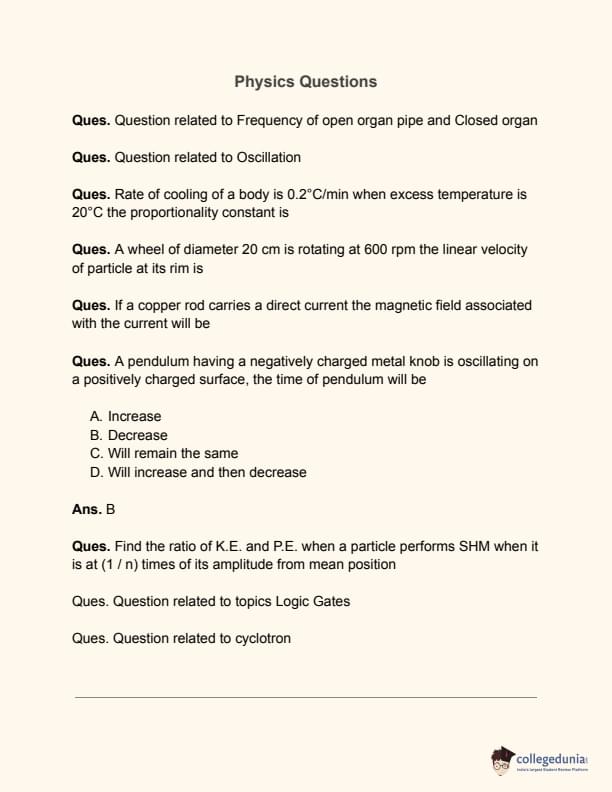
Question 15:

What is the fundamental frequency of an open organ pipe with length L and speed of sound v?

  1. V/2L
  2. V/L
  3. 2V/L
  4. V/L/2
Correct Answer: (A) V/2L.
View Solution

Detailed Solution:

The fundamental frequency is the lowest frequency of a vibrating object or system.

  1. Fundamental Frequency Formula: The fundamental frequency f for an open organ pipe is given by the formula:

    f = v / λ

    where:
    • v is the speed of sound in the medium
    • λ is the wavelength of the fundamental mode
  2. Wavelength for Open Pipe: For an open pipe, the fundamental mode corresponds to a wave where there are antinodes at both ends of the pipe and a node in the middle. This leads to the length of the pipe L being half the wavelength. Therefore:

    λ = 2L

  3. Substituting Wavelength: Substituting the value of λ in the fundamental frequency formula:

    f = v / (2L)

Therefore, the fundamental frequency of an open organ pipe is v/2L.

Final Answer: v/2L

Question 16:

What is the angular frequency w of a simple harmonic oscillator with mass m and spring constant k?

  1. √(k/m)
  2. √(m/k)
  3. k/m
  4. m/k
Correct Answer: (A) √(k/m).
View Solution

Detailed Solution:

The angular frequency describes how fast a system is oscillating. It relates to the period of oscillation.

  1. Restoring Force in SHM: The restoring force in a simple harmonic oscillator (SHM), like a spring-mass system, is given by:

    F = -kx

    where:
    • F is the restoring force
    • k is the spring constant
    • x is the displacement from equilibrium.
  2. Using Newton's Second Law: According to Newton's second law, F = ma, where a is the acceleration. Since acceleration is the second derivative of displacement, a = d²x/dt² = ẍ. Combining this we get:

    m ẍ + kx = 0

  3. Angular Frequency Formula: This differential equation describes simple harmonic motion and the solution is of the form: x = Acos(ωt + ϕ), where angular frequency ω is:

    ω = √(k/m)

Therefore, the angular frequency of a simple harmonic oscillator is √(k/m).

Final Answer: √(k/m)

Question 17:

Rate of cooling of a body is 0.2°C/min when excess temperature is 20°C. The propor- tionality constant k is:

  1. 0.005 min-1
  2. 0.01 min -1
  3. 0.05 min-1
  4. 0.2 min-1
Correct Answer: (B) 0.01 min⁻¹.
View Solution

Detailed Solution:

Newton's Law of Cooling describes the rate at which a body's temperature changes with time.

  1. Newton's Law of Cooling: This law states that the rate of cooling is proportional to the temperature difference between the body and its surroundings.

    Rate of cooling = k (∆T)

    where:
    • Rate of cooling is the rate of change in temperature,
    • k is the proportionality constant,
    • ∆T is the temperature difference (excess temperature).
  2. Given Values: We are given the following:
    • Rate of cooling = 0.2 °C/min
    • ∆T = 20 °C
  3. Solving for k: Substituting the given values into the equation:

    0.2 °C/min = k (20 °C)

    k = 0.2 °C/min / 20 °C

    k = 0.01 min⁻¹

Therefore, the proportionality constant k is 0.01 min⁻¹.

Final Answer: 0.01 min⁻¹

Question 18:

A wheel of diameter 20 cm is rotating at 600 rpm. The linear velocity of a particle at its rim is:

  1. 6.28 m/s
  2. 12.56 m/s
  3. 18.84 m/s
  4. 3.14 m/s
Correct Answer: (A) 6.28 m/s.
View Solution

Detailed Solution:

The linear velocity of a rotating object is the speed at which a point on the rim of the object is moving.

  1. Linear Velocity Formula:

    v = rω

    where:
    • v is linear velocity,
    • r is the radius of the circle,
    • ω is the angular velocity.
  2. Radius Calculation: The diameter of the wheel is given as 20 cm. The radius (r) is half the diameter:

    r = diameter / 2 = 20 cm / 2 = 10 cm = 0.1 m

  3. Angular Velocity Calculation: The wheel is rotating at 600 revolutions per minute (rpm). To convert rpm to radians per second:

    ω = 2πf = 2π (rpm / 60)

    ω = 2π (600/60) = 2π (10) = 20π rad/s

  4. Substituting Values: Substituting the values of r and ω into the linear velocity formula:

    v = rω = 0.1 m * 20π rad/s

    v ≈ 0.1 * 20 * 3.14 = 6.28 m/s

Therefore, the linear velocity of the particle at the rim is approximately 6.28 m/s.

Final Answer: 6.28 m/s

Question 19:

If a copper rod carries a direct current, the magnetic field associated with the current will be?

  1. Parallel to the rod
  2. Perpendicular to the rod
  3. Circular around the rod
  4. No magnetic field
Correct Answer: (C) Circular around the rod.
View Solution

Detailed Solution:

When a current flows through a conductor, it produces a magnetic field around it.

  1. Ampere's Circuital Law: According to Ampere's Circuital Law, the magnetic field around a current-carrying conductor is given by:

    ∮ B · dl = μ₀I

    where:
    • ∮ B · dl is the line integral of the magnetic field around a closed loop,
    • μ₀ is the permeability of free space,
    • I is the current flowing through the conductor.
  2. Magnetic Field Configuration: The magnetic field lines around a straight current-carrying conductor form concentric circles centered on the conductor. The direction of the field lines is determined by the right-hand rule.
  3. Right-Hand Rule: To determine the direction of the magnetic field:
    • Point the thumb of your right hand in the direction of the current.
    • The curl of your fingers represents the direction of the magnetic field.
  4. Options Analysis:
    • The magnetic field is not parallel or perpendicular to the rod; instead, it forms circles around it.
    • A magnetic field will be formed around any current-carrying conductor.

Therefore, the magnetic field is circular around the rod.

Final Answer: Circular around the rod

Question 20:

A pendulum having a negatively charged metal knob is oscillating on a positively charged surface. The time of the pendulum will be:

  1. Increase
  2. Decrease
  3. Will remain the same
  4. Will increase and then decrease
Correct Answer: (B) Decrease.
View Solution

Detailed Solution:

The time period of a pendulum is determined by its length and the acceleration due to gravity. However, external forces can alter this time period.

  1. Time Period of a Pendulum:

    T = 2π √(l/g)

    where:
    • T is the time period,
    • l is the length of the pendulum,
    • g is the acceleration due to gravity.
  2. Effect of Charge: The question states that a negatively charged metal knob is oscillating over a positively charged surface. This will cause an attractive force between the pendulum knob and the surface. This leads to an increase in the effective restoring force on the pendulum.
  3. Effective Restoring Force: The restoring force on a pendulum is normally due to gravity. However, the electrostatic force between the charged pendulum and the surface increases this force. The force increases the angular frequency ω (ω = √(g/l)), according to the formula:

    ω = √(effective restoring force / moment of inertia)

  4. Relationship between Time Period and Angular Frequency: The time period (T) of oscillation is inversely proportional to the angular frequency (ω).

    T = 2π/ω

  5. Conclusion: Since the restoring force increases, the angular frequency increases, resulting in a decrease in the time period (T).

Therefore, the time period will decrease.

Final Answer: Decrease

Question 21:

Find the ratio of K.E. and P.E. when a particle performs SHM and is at 1/n times its amplitude from the mean position.

  1. n² - 1 : 1
  2. 1 : n² - 1
  3. 1 : n
  4. n : 1
Correct Answer: (A) n² - 1 : 1.
View Solution

Detailed Solution:

In Simple Harmonic Motion (SHM), kinetic energy (K.E.) and potential energy (P.E.) change continuously as the particle oscillates.

  1. Total Energy in SHM: The total energy (E) in SHM is constant and can be represented as:

    E = K.E. + P.E.

  2. Potential Energy Formula: The potential energy (P.E.) at displacement 'x' is:

    P.E. = 1/2 * kx²

  3. Kinetic Energy Formula:

    K.E. = 1/2 * k (A² - x²)

    where:
    • k is the spring constant,
    • A is the amplitude of SHM,
    • x is the displacement from the mean position.
  4. Displacement Given: In this case, we are given that the displacement x = A/n .
  5. Potential Energy Calculation: Substituting the given value of displacement in the P.E. formula:

    P.E. = 1/2 * k * (A/n)² = 1/2 * k * A² / n²

  6. Kinetic Energy Calculation: Substituting the value of x in K.E. formula:

    K.E. = 1/2 * k (A² - (A/n)²) = 1/2 * k * (A² - A²/n²)

    K.E. = 1/2 * k * A² (1 - 1/n²)

  7. Ratio of K.E. to P.E.: Dividing the K.E. by P.E.:

    K.E. / P.E. = (1/2 * k * A² * (1 - 1/n²)) / (1/2 * k * A² / n²)

    K.E. / P.E. = (1 - 1/n²) / (1/n²)

    K.E. / P.E. = (n² - 1) / 1

Therefore, the ratio of K.E. to P.E. is n² - 1 : 1.

Final Answer: n² - 1 : 1

Question 22:

Which of the following correctly represents the AND logic gate?

  1. Output = 1 if at least one input is 1
  2. Output = 1 only if all inputs are 1
  3. Output = 0 if all inputs are 0
  4. Output = 1 if all inputs are 0
Correct Answer: (B) Output = 1 only if all inputs are 1.
View Solution

Detailed Solution:

An AND logic gate is a fundamental building block in digital electronics. It is a type of logic gate where the output is high only if all the inputs are high.

  1. AND Gate Function: An AND gate performs a logical multiplication. The output Y of an AND gate with inputs A and B is given by:

    Y = A · B

  2. Truth Table: The truth table for a two-input AND gate is:
    A B Y
    0 0 0
    0 1 0
    1 0 0
    1 1 1
  3. Analysis of Options:
    • Option 1: This is incorrect, it represents an OR gate's function.
    • Option 2: This is correct, the output is 1 only if all inputs are 1.
    • Option 3: This is incorrect, it describes a property that AND gate has but is not specific enough for a definition.
    • Option 4: This is incorrect, AND gate output is 0 when inputs are 0.

Therefore, the AND logic gate is correctly represented by Output = 1 only if all inputs are 1.

Final Answer: Output = 1 only if all inputs are 1

Question 23:

What is the working principle of a cyclotron?

  1. Conservation of energy
  2. Lorentz force
  3. Electromagnetic induction
  4. Coulomb's law
Correct Answer: (B) Lorentz force.
View Solution

Detailed Solution:

A cyclotron is a particle accelerator that uses magnetic and electric fields to accelerate charged particles to high speeds.

  1. Lorentz Force: The primary working principle of the cyclotron is based on the Lorentz force, given by the formula:

    F = q(v × B)

    where:
    • F is the Lorentz force,
    • q is the charge of the particle,
    • v is the velocity of the particle,
    • B is the magnetic field.
  2. Cyclotron Operation:
    • The charged particles move in a circular path due to the Lorentz force caused by the magnetic field.
    • An electric field is applied at the gap between the "dees" (D-shaped electrodes), which accelerates the particles each time they cross the gap.
    • The combination of magnetic and electric fields increases the energy of the particles.
  3. Analysis of Other Options:
    • The Law of Conservation of energy is a general principle, it is not the central force behind the operation.
    • Electromagnetic induction is used to generate magnetic and electric fields in the cyclotron but is not the driving force in accelerating charged particles.
    • Coulomb's law describes the electrostatic force between charged particles but is not the force that directly accelerates particles in the cyclotron.

Therefore, the working principle of a cyclotron is the Lorentz force.

Final Answer: Lorentz force

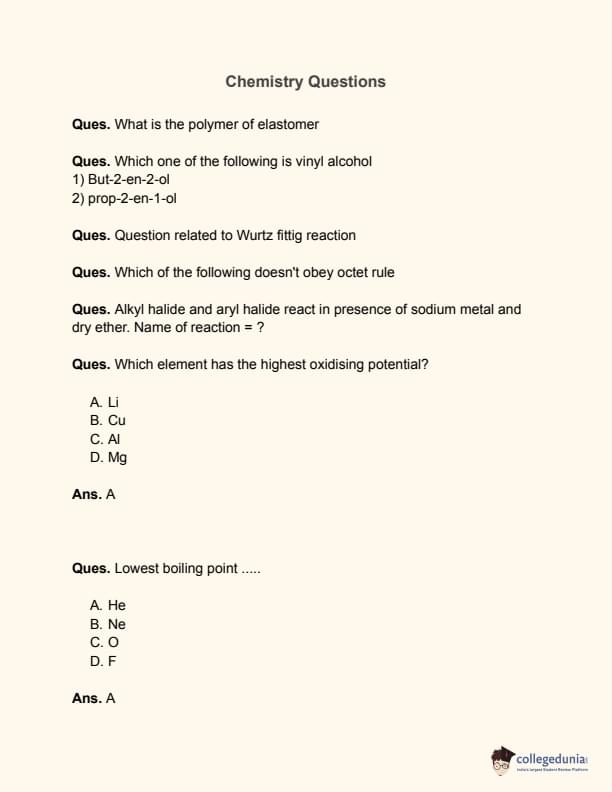
Question 24:

What is the polymer of elastomer?

  1. Neoprene
  2. Polyvinyl chloride
  3. Nylon-6
  4. Teflon
Correct Answer: (A) Neoprene.
View Solution

Detailed Solution:

Elastomers are polymers with elastic properties that can be stretched and returned to their original shape.

  1. Neoprene:
    • Neoprene is a synthetic rubber which is a type of elastomer.
    • It is formed by the polymerization of chloroprene.
    • Neoprene has good elasticity and resistance to weathering and ozone.
  2. Polyvinyl chloride (PVC): PVC is a thermoplastic polymer known for its rigidity. It is not an elastomer.
  3. Nylon-6: Nylon-6 is a polyamide and is a type of fiber. It is also not an elastomer.
  4. Teflon: Teflon, also known as polytetrafluoroethylene (PTFE), is a fluoropolymer known for its chemical resistance and low friction. It is also not an elastomer.

Therefore, the polymer of an elastomer is Neoprene.

Final Answer: Neoprene

Question 25:

Which one of the following is vinyl alcohol?

  1. But-2-en-2-ol
  2. Prop-2-en-1-ol
  3. Ethanol
  4. Methanol
Correct Answer: (B) Prop-2-en-1-ol.
View Solution

Detailed Solution:

Vinyl alcohol is an unstable enol, and its chemical structure and nomenclature are important in organic chemistry.

  1. Vinyl Alcohol Structure: Vinyl alcohol is an unsaturated alcohol with the formula CH₂=CH-OH. This is also called ethenol.
  2. Tautomerization: Vinyl alcohol is an unstable tautomer of acetaldehyde. It spontaneously isomerizes to acetaldehyde.
  3. IUPAC Nomenclature:
    • The IUPAC name of vinyl alcohol is prop-2-en-1-ol. The name indicates the position of the double bond as well as the -OH group
    • In contrast, But-2-en-2-ol does not have a vinyl group.
    • Ethanol and methanol are saturated alcohols and are not isomers of vinyl alcohol.

Therefore, Prop-2-en-1-ol is vinyl alcohol.

Final Answer: Prop-2-en-1-ol

Question 26:

Which of the following does not obey the octet rule?

  1. SF6
  2. H2O
  3. CO2
  4. CH4
Correct Answer: (A) SF6.
View Solution

Detailed Solution:

The octet rule states that atoms tend to gain, lose, or share electrons to achieve a full valence shell of eight electrons.

  1. Octet Rule Basics:
    • Atoms are the most stable when they have a full valence shell which is mostly 8.
    • Atoms in compounds often follow the octet rule.
  2. SF6: In sulfur hexafluoride, sulfur forms six bonds with six fluorine atoms. This gives a total of 12 electrons around the sulfur atom, thus violating the octet rule.

    S = 6 + 6(1) = 12 valence electrons

  3. H2O: In water, oxygen forms two bonds with two hydrogen atoms and has two lone pairs, making a total of 8 valence electrons around oxygen which obeys octet rule.
  4. CO2: In carbon dioxide, carbon forms two double bonds, each with an oxygen atom, resulting in a total of 8 valence electrons around carbon which obeys octet rule.
  5. CH4: In methane, carbon forms four single bonds with four hydrogen atoms, resulting in a total of 8 valence electrons around carbon which obeys the octet rule.

Therefore, SF6 does not obey the octet rule.

Final Answer: SF6

Question 27:

Alkyl halide and aryl halide react in the presence of sodium metal and dry ether. The name of the reaction is?

  1. Wurtz Reaction
  2. Wurtz-Fittig Reaction
  3. Fittig Reaction
  4. Williamson Ether Synthesis
Correct Answer: (B) Wurtz-Fittig Reaction.
View Solution

Detailed Solution:

This question pertains to important named reactions in organic chemistry.

  1. Wurtz Reaction:
    • The Wurtz reaction involves the reaction of two alkyl halides with sodium metal in dry ether to form an alkane.
    • This reaction is limited to the combination of alkyl halides only.
  2. Wurtz-Fittig Reaction:
    • The Wurtz-Fittig reaction involves the reaction of an alkyl halide and an aryl halide with sodium metal in dry ether to form an alkyl aryl compound.
    • The general equation for this is:

      C6H5Cl + CH3Cl + 2Na → C6H5CH3 + 2NaCl

  3. Fittig Reaction: The Fittig reaction involves the reaction of two aryl halides with sodium metal in dry ether to form a biaryl compound. It uses aryl halides only.
  4. Williamson Ether Synthesis: This reaction involves the reaction of an alkoxide and a halide to form an ether; It does not match the reagents of the reaction described here.

Therefore, the name of the reaction is the Wurtz-Fittig Reaction.

Final Answer: Wurtz-Fittig Reaction

Question 28:

Which element has the highest oxidizing potential?

  1. Li
  2. Cu
  3. Al
  4. Mg
Correct Answer: (A) Li.
View Solution

Detailed Solution:

The oxidizing potential of an element refers to its ability to accept electrons. A higher oxidizing potential corresponds to a stronger oxidizing agent.

  1. Reduction Potential: The strength of an oxidizing agent is indicated by its standard reduction potential.
  2. Lithium (Li):
    • Lithium has the highest (most negative) standard reduction potential of the options at approximately -3.04 V.
    • This means it is the strongest reducing agent and the most reactive alkali metal. In the oxidation direction, it loses electrons readily and so it has a high oxidizing potential
  3. Other Elements:
    • Copper (Cu), Aluminum (Al), and Magnesium (Mg) have lower (less negative) standard reduction potentials than lithium.
    • This means that they are not as effective at oxidizing (and are less reactive) compared to lithium.

Therefore, Lithium (Li) has the highest oxidizing potential among the given elements.

Final Answer: Li

Question 29:

Which of the following has the lowest boiling point?

  1. He
  2. Ne
  3. O
  4. F
Correct Answer: (A) He.
View Solution

Detailed Solution:

Boiling point is the temperature at which a substance transitions from liquid to gas. The lowest boiling point typically corresponds to the substance with the weakest intermolecular forces.

  1. Helium (He):
    • Helium is a noble gas with very weak London dispersion forces.
    • It is very light and has very low boiling point at approximately -269°C (4 K).
  2. Neon (Ne): Neon is also a noble gas with weaker London dispersion forces, but it is larger than helium. It has a higher boiling point than Helium.
  3. Oxygen (O): Oxygen is a diatomic molecule with stronger London dispersion forces than helium and neon. It has a considerably higher boiling point than the noble gasses.
  4. Fluorine (F): Fluorine is a diatomic molecule with stronger London dispersion forces than helium and neon, as well as higher boiling point than oxygen.

Therefore, Helium (He) has the lowest boiling point.

Final Answer: He

Question 30:

What is the chemical formula of glycerol?

  1. C3H8O3
  2. C2H6O2
  3. C3H6O2
  4. C4H10O3
Correct Answer: (A) C3H8O3.
View Solution

Detailed Solution:

Glycerol, also known as glycerine, is a simple polyol compound commonly used in various applications.

  1. Glycerol Composition:
    • Glycerol has a three-carbon backbone.
    • Each carbon atom has a hydroxyl (-OH) group, making it a triol (a molecule with three OH groups).
  2. Chemical Formula: The chemical formula is determined by the number of carbon, hydrogen, and oxygen atoms. Glycerol has:
    • Three carbon atoms: C3
    • Eight hydrogen atoms: H8
    • Three oxygen atoms: O3

Therefore, the chemical formula of glycerol is C3H8O3.

Final Answer: C3H8O3

Question 31:

Which of the following ligands has two donor atoms?

  1. Cl-
  2. I-
  3. Oxalate (C2O42-)
  4. H2O
Correct Answer: (C) Oxalate (C2O42-).
View Solution

Detailed Solution:

A ligand is an ion or molecule that binds to a central metal atom to form a coordination complex. Ligands are classified by the number of donor atoms they possess.

  1. Monodentate Ligands:
    • Monodentate ligands have one donor atom that can bind to a metal ion.
    • Cl- (Chloride ion) and I- (Iodide ion) are monodentate ligands.
    • H2O (Water) is also a monodentate ligand.
  2. Bidentate Ligands:
    • Bidentate ligands have two donor atoms that can simultaneously coordinate with a metal ion.
    • The oxalate ion (C2O42-) is a bidentate ligand.
    • The donor atoms in oxalate are the oxygen atoms in the carboxylate groups (-COO).
  3. Oxalate Structure: Oxalate has two carboxylate (-COO) groups, each with two oxygen atoms. Therefore, the bidentate structure is:

    [O-C=O]–[O-C=O]

Therefore, Oxalate (C2O42-) has two donor atoms.

Final Answer: Oxalate (C2O42-)


Also Check:

MHT CET Previous Year Question Papers

Also Check:

Fees Structure

Structure based on different categories

CategoriesState
General800
Women800
sc600
pwd600
Others600

In case of any inaccuracy, Notify Us! 

Comments


No Comments To Show