MHT CET 2024 27 April Shift 1 question paper is available for download here. MHT CET 2024 question paper comprises 150 MCQs carrying a total weightage of 200 marks. MHT CET 2024 27 April Shift 1 Question Paper for PCB is divided into three subjects- Physics, Chemistry and Biology.
The Physics and Chemistry section consists of 50 questions (10 questions from Class 11 and 40 questions from Class 12th syllabus). Meanwhile, the Biology paper consists of 100 questions (20 questions from Class 11th and 80 questions from Class 12th syllabus).
MHT CET 2024 27 April Shift 1 Question Paper PDF Download
| MHT CET 2024 27 April Shift 1 Question Paper 2024 with Answer Key | Check Solutions |
MHT CET 2024 27 April Shift 1 Questions with Solutions
Question 1:
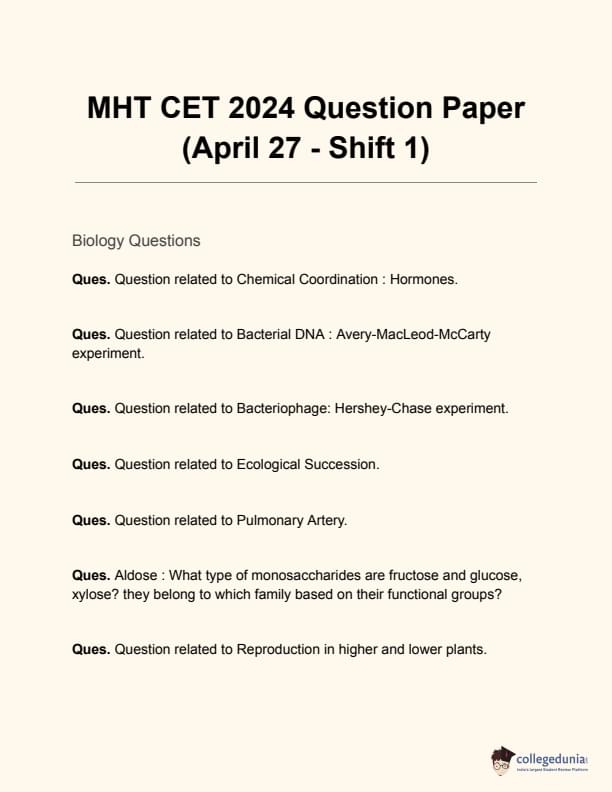
Which hormone is responsible for regulating the basal metabolic rate (BMR) in the human body?
View Solution
Step 1: Role of Thyroxine in Metabolism:
Thyroxine, also known as T4, is a hormone secreted by the thyroid gland. It regulates metabolism by controlling the rate at which cells convert nutrients into energy. Thyroxine stimulates:
- Increased oxygen consumption in tissues.
- Enhanced production of ATP by stimulating mitochondria.
- Increased breakdown of fats and carbohydrates to release energy.
Step 2: How Thyroxine Regulates BMR:
Thyroxine affects the metabolic rate by:
- Elevating the rate of cellular respiration.
- Stimulating mitochondrial activity.
- Modifying the expression of genes involved in energy utilization.
Step 3: Comparison with Other Hormones:
- Insulin: Regulates blood sugar but does not directly control BMR.
- Adrenaline: Prepares the body for "fight or flight" but does not significantly regulate BMR under normal conditions.
- Cortisol: Manages metabolism during long-term stress but doesn't directly influence BMR.
Question 2:
Which of the following conclusions was drawn from the Avery-MacLeod-McCarty experiment related to bacterial DNA?
View Solution
Step 1: Griffith's Transformational Experiment.
Griffith's experiment showed that non-virulent R-strain bacteria were transformed into virulent bacteria when mixed with heat-killed S-strain bacteria. However, Griffith was unable to determine the "transforming principle".
Step 2: The Avery-MacLeod-McCarty Experiment.
Avery, MacLeod, and McCarty isolated proteins, RNA, and DNA from heat-killed S-strain bacteria. They then tested each type of macromolecule to see if it could still transform the non-virulent R-strain:
- When proteins and RNA were destroyed, transformation still occurred.
- When DNA was destroyed, transformation was inhibited.
Step 3: Conclusion.
The results demonstrated that DNA is the genetic material responsible for transformation in bacteria, thus directly establishing DNA as the molecule responsible for heredity.
Question 3:
What conclusion was derived from the Hershey-Chase experiment involving bacteriophages?
View Solution
Step 1: The Experimental Design.
Hershey and Chase used two radioactive isotopes: 32P to label DNA (phosphorus is in DNA but not proteins) and 35S to label proteins (sulfur is in proteins but not DNA). They then allowed the labeled bacteriophages to infect bacteria.
Step 2: Separation of Viral Components.
After infection, a blender was used to separate the viral protein coats from the bacterial cells. Centrifugation separated the heavier bacterial cells from the lighter protein coats.
Step 3: Key Observations and Conclusion.
- Radioactive phosphorus (32P) was found inside the bacterial cells, indicating that DNA had entered the bacteria.
- Radioactive sulfur (35S) remained in the supernatant, indicating that the protein did not enter the bacterial cells.
Question 4:
What is the correct sequence of ecological succession in a terrestrial ecosystem?
View Solution
Step 1: Pioneer Species.
Pioneer species are the first organisms to colonize an area after a disturbance. They are resilient and capable of surviving in harsh conditions, including lichens, mosses, and algae.
Step 2: Intermediate Species.
As the pioneer species alter the environment, creating a more hospitable habitat, intermediate species begin to establish themselves. They generally include grasses, small plants, shrubs, and small trees.
Step 3: Climax Community.
The climax community represents the final, stable stage of ecological succession. The ecosystem reaches a balanced state, with a complex web of organisms. Thus, the correct sequence of ecological succession is: Pioneer species → Intermediate species → Climax community.
Question 5:
Which of the following is true about the pulmonary artery in the human circulatory system?
View Solution
Step 1: General Function of Arteries.
Arteries are generally responsible for carrying oxygenated blood from the heart to the body.
Step 2: The Unique Role of the Pulmonary Artery.
The pulmonary artery is the only artery that carries deoxygenated blood, originating from the right ventricle of the heart and transporting it to the lungs for oxygenation.
Step 3: Comparison with Other Blood Vessels.
- Most other arteries carry oxygenated blood to the body.
- Pulmonary veins carry oxygenated blood from the lungs to the heart.
Question 6:
What type of monosaccharides are fructose, glucose, and xylose? To which family do they belong based on their functional groups?
View Solution
Step 1: Identifying Aldoses and Ketoses.
- Aldoses contain an aldehyde group (-CHO) at the first carbon atom.
- Ketoses contain a keto group (-C=O) usually at the second carbon atom.
Step 2: Functional Groups of Fructose, Glucose, and Xylose.
- Fructose is a ketose because it contains a keto group at the second carbon atom.
- Glucose is an aldose because it contains an aldehyde group at the first carbon atom.
- Xylose is an aldose because it contains an aldehyde group at the first carbon atom.
Step 3: Family Classification.
- Glucose: aldohexose.
- Xylose: aldopentose.
- Fructose: ketohexose.
Question 7:
Which of the following statements correctly differentiates reproduction in higher plants from lower plants?
View Solution
Step 1: Reproduction in Lower Plants.
Lower plants (algae, bryophytes, ferns) reproduce primarily through spores. Spores are single-celled units that can develop into new individuals.
Step 2: Reproduction in Higher Plants.
Higher plants (gymnosperms, angiosperms) reproduce through seeds. Seeds are multicellular structures containing a plant embryo.
Step 3: Comparing Reproduction Methods.
- Lower plants: rely on spores for asexual reproduction.
- Higher plants: reproduce through seeds for sexual reproduction.
Question 8:
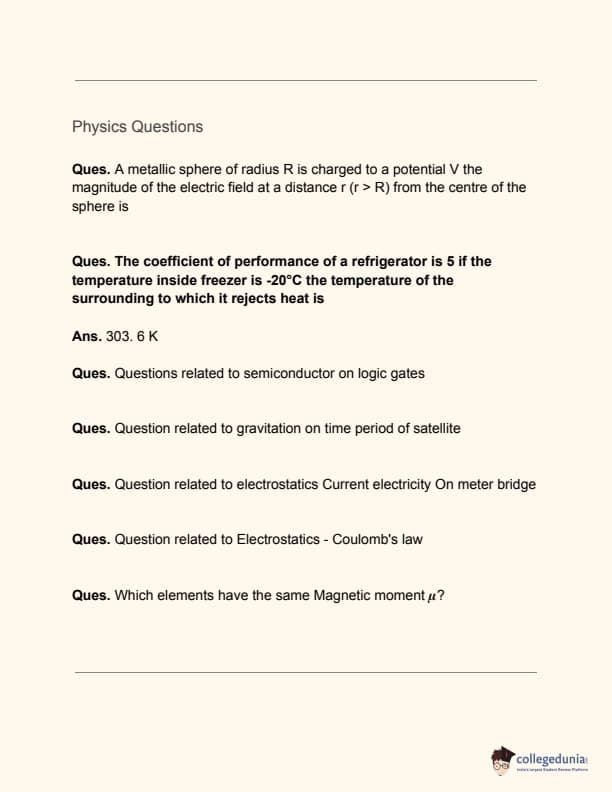
A metallic sphere of radius R is charged to a potential V. The magnitude of the electric field at a distance r (r > R) from the center of the sphere is:
View Solution
Step 1: Potential on the Surface of the Sphere.
The potential (V) at the surface of the sphere is given by: V = Q/(4πε₀R) where:
- Q: Total charge on the sphere.
- R: Radius of the sphere.
- ε₀: Permittivity of free space.
Step 2: Electric Field Outside the Sphere.
The electric field (E) at a distance r from a point charge Q is given by: E = Q/(4πε₀r²)
Step 3: Simplifying the Expression.
Substituting the expression for Q from Step 1 into Step 2, we have: E = (4πε₀VR)/(4πε₀r²) = VR/r² Thus, the magnitude of the electric field at a distance r from the center of the sphere is VR²/r².
Question 9:
The coefficient of performance of a refrigerator is 5. If the temperature inside the freezer is -20°C, what is the temperature of the surroundings to which it rejects heat?
View Solution
Step 1: Convert the temperatures to Kelvin.
Temperature inside the freezer (Tc) = -20°C = -20 + 273 = 253 K.
Step 2: Solve for TH.
The coefficient of performance (COP) is given by: COP = Tc / (TH - Tc) Substituting known values: 5 = 253 / (TH - 253) Rearranging to solve for TH: TH - 253 = 253/5 TH - 253 = 50.6 TH = 253 + 50.6 = 303.6 K
Step 3: Convert back to Celsius.
TH = 303.6 - 273 = 30.6°C Rounding off, TH = 37°C
Question 10:
What is the output of a NAND gate when both inputs are HIGH?
View Solution
Step 1: Analyze the given inputs.
A NAND gate is a NOT-AND gate. If both inputs A and B are HIGH (1), then A AND B = 1.
Step 2: Apply the NOT operation.
The NAND operation is the negation of the AND operation. So, NOT(1) = 0. Therefore, the output is LOW.
Conclusion:
The output of the NAND gate is LOW (0) when both inputs are HIGH.
Question 11:
What is the expression for the time period of a satellite orbiting Earth at a height h above the Earth's surface?
View Solution
Step 1: Gravitational Force Provides the Centripetal Force.
The gravitational force between the satellite and Earth is: F_gravity = GMm/(R+h)² where:
- G: Gravitational constant.
- M: Mass of the Earth.
- m: Mass of the satellite.
- R+h: Distance from center of Earth to the satellite.
Step 2: Equating Gravitational and Centripetal Forces.
The centripetal force is: F_centripetal = mv²/(R+h) Equating gravitational and centripetal forces: GMm/(R+h)² = mv²/(R+h) Simplifying: v² = GM/(R+h)
Step 3: Relating Orbital Velocity to Time Period.
The orbital velocity is related to the time period by: v = 2π(R+h)/T Substitute in the velocity expression obtained above: (2π(R+h)/T)² = GM/(R+h)
Step 4: Solving for Time Period T.
Rearranging for T: T² = 4π²(R+h)³ / GM Taking square root of both sides: T = 2π√((R+h)³/GM)
Question 12:
In a meter bridge experiment, a resistance of 10Ω is balanced by a resistance X with a balance point at 40 cm. What is the value of X?
View Solution
Step 1: Use the balanced condition.
In a meter bridge, the ratio of resistances is equal to the ratio of lengths at the balance point: R₁/X = l₁/l₂ where:
- R₁ = 10Ω (known resistance).
- X: Unknown resistance
- l₁ = 40 cm.
- l₂ = 100 - 40 = 60 cm.
Step 2: Rearrange for X.
Rearranging the equation to solve for X: X = R₁ (l₂/l₁)
Step 3: Substitute the known values.
Substitute the values for R1, l1, and l2:
X = 10x40/60
Simplify the equation:
X = 400/60 = 6.67 Ω.
Question 13:
Two charges q1 = 2 μC and q2 = -3 μC are placed 10 cm apart in a vacuum. What is the magnitude and direction of the force between them?
View Solution
Step 1: Substitute the Given Values.
Given:
- q1 = 2 × 10^-6 C.
- q2 = -3 × 10^-6 C.
- r = 0.1 m.
Step 2: Simplify the Calculation.
Substituting values: F = 9 × 10^9 * |(2 × 10^-6)(-3 × 10^-6)|/(0.1)²
F = 9 × 10^9 * (6 × 10^-12)/0.01
F = 9 * 6 * 10^-3 /0.01 = 5.4 N
F = 5.4 N
Step 3: Determine the Direction.
Since the charges have opposite signs, the force is attractive.
Question 14:
Which elements have the same magnetic moment μ?
View Solution
Step 1: Determine the Electronic Configuration and Unpaired Electrons.
- Mn²⁺: The neutral Mn configuration is [Ar]3d⁵4s². Mn²⁺ loses two 4s electrons leaving [Ar]3d⁵ with 5 unpaired electrons.
- Fe³⁺: The neutral Fe configuration is [Ar]3d⁶4s². Fe³⁺ loses three electrons leaving [Ar]3d⁵ with 5 unpaired electrons.
Step 2: Calculate the Magnetic Moment.
The formula for magnetic moment is: μ = √n(n+2) where n is the number of unpaired electrons. For both Mn²⁺ and Fe³⁺, n = 5 μ = √(5)(5+2) = √35 ≈ 5.92μB
Step 3: Conclusion.
Since both ions have 5 unpaired electrons, they have the same magnetic moment.
Question 15:
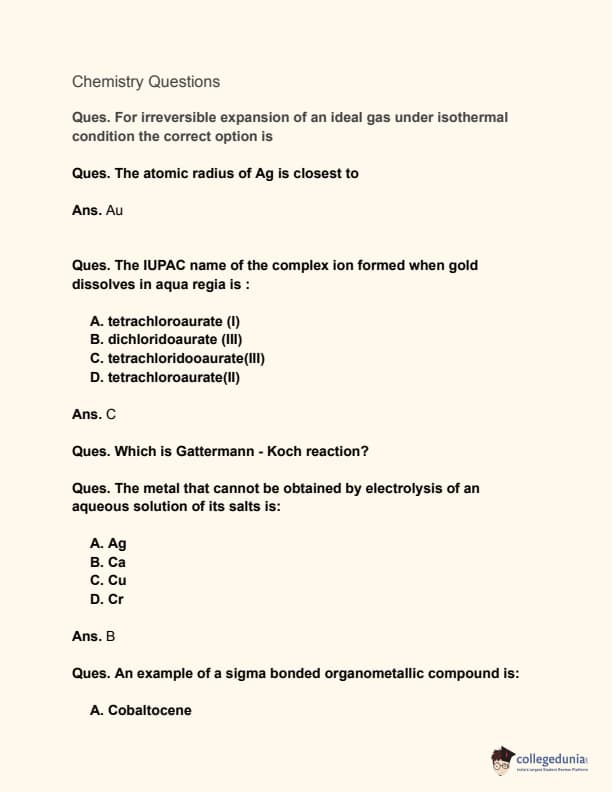
For irreversible expansion of an ideal gas under isothermal conditions, which of the following is correct?
View Solution
Step 1: First Law of Thermodynamics.
The First Law of Thermodynamics states: ∆U = q + w where:
- ∆U is the change in internal energy.
- q is the heat exchanged by the system.
- w is the work done by the system.
Step 2: Isothermal Process for an Ideal Gas.
For an isothermal process (constant temperature) with an ideal gas, the change in internal energy is zero, i.e. ∆U = 0
Step 3: Work and Heat Direction.
Substituting this into the first law: 0 = q + w Rearranging gives q = -w. Thus, heat absorbed by the system is equal in magnitude to the work done by the system, but with the opposite sign.
Question 16:
The atomic radius of silver (Ag) is closest to which of the following values?
View Solution
Step 1: Define the Atomic Radius of Silver.
Silver (Ag) is a transition metal with atomic number 47 and configuration [Kr]4d¹⁰5s¹. The atomic radius is influenced by metallic bonding and the shielding effect from inner electrons.
Step 2: Reference Values for Atomic Radius.
Experimental data and periodic trends show the atomic radius of silver is Atomic radius of Ag = 144 pm.
Step 3: Comparison with Options.
Option (1) 144 pm is a match with the known atomic radius of silver.
Question 17:
The IUPAC name of the complex ion formed when gold dissolves in aqua regia is:
View Solution
Step 1: Identify the Oxidation State of Gold.
When gold dissolves in aqua regia, the complex ion formed is [AuCl₄]⁻. To find the oxidation state of gold (x), we use the following equation: x + 4(-1) = -1 x = +3
Step 2: Determine the IUPAC Name.
According to IUPAC conventions:
- The prefix "tetra-" is used for four chloride ligands.
- The central metal, gold, is named "aurate".
- The oxidation state of the metal, (+3) is indicated in Roman numerals as (III).
Question 18:
Which of the following represents the Gattermann-Koch reaction?
View Solution
Step 1: Reaction Mechanism.
The Gattermann-Koch reaction involves introducing a formyl group (-CHO) to an aromatic ring. It uses carbon monoxide (CO) and hydrogen chloride (HCl) in the presence of a Lewis acid catalyst like AlCl₃ or CuCl.
Step 2: Example Reaction.
A typical reaction is that of benzene with CO and HCl, which forms benzaldehyde, with the formyl group from the carbonyl group of the carbon monoxide attached to the aromatic ring. C₆H₆ + CO + HCl --> C₆H₅CHO.
Conclusion: The Gattermann-Koch reaction is specifically used to introduce a formyl group (-CHO) to an aromatic ring.
Question 19:
The metal that cannot be obtained by electrolysis of an aqueous solution of its salts is:
View Solution
Step 1: Compare Reduction Potentials.
The reduction potential of calcium is -2.87 V The reduction potential of water is -0.83 V. Because the reduction potential of calcium is much more negative than that of water, water is reduced preferentially at the cathode during electrolysis instead of the calcium ions.
Step 2: Other Metals in the Options.
- Silver (Ag): Positive reduction potential; reduced easily in an aqueous solution.
- Copper (Cu): Positive reduction potential; favorable reduction in aqueous solution.
- Chromium (Cr): Can be reduced under specific conditions, though might require different electrolytic conditions.
Conclusion: Calcium cannot be obtained by electrolysis from its aqueous salt solutions.
Question 20:
An example of a sigma-bonded organometallic compound is:
View Solution
Step 1: Analyze the Bonding in the Options.
- Cobaltocene, Ruthenocene, and Ferrocene are sandwich compounds. The metal atom forms π-bonds with aromatic cyclopentadienyl ligands.
- Grignard's reagents involve a direct metal-carbon sigma bond.
Step 2: Example of Grignard's Reagent.
Grignard reagents have the general formula RMgX, where the Mg atom forms a σ-bond with the carbon of R. For instance, in CH₃MgBr, the magnesium is sigma bonded to the carbon in methyl group.
Conclusion: Since a Grignard reagent is characterized by the σ-bond between the metal and the carbon, it is an example of a sigma-bonded organometallic compound.
Question 21:
The reagent used in the Etard reaction is:
View Solution
Step 1: Key Reagent in the Etard Reaction.
The key reagent in the Etard reaction is chromyl chloride (CrO₂Cl₂). It selectively oxidizes aromatic methyl groups into aldehydes.
Step 2: Example Reaction.
For instance, toluene reacts with chromyl chloride to form benzaldehyde: C₆H₅CH₃ + CrO₂Cl₂ → C₆H₅CHO
Conclusion: The correct reagent used in the Etard reaction is chromyl chloride (CrO₂Cl₂).
Question 22:
Which of the following is not a neutral ligand?
View Solution
Step 1: Analyze Each Option.
- H₂O (Water): Neutral ligand.
- NH₃ (Ammonia): Neutral ligand.
- CO (Carbon monoxide): Neutral ligand.
- ONO (Nitrito group): Negatively charged, an anionic ligand.
Step 2: Identify the Non-neutral Ligand.
The nitrito group ONO⁻ is a charged ligand (it carries a negative charge) and is therefore not neutral.
Conclusion: The correct answer is ONO, as it is not a neutral ligand.
Question 23:
Which of the following is the Reimer-Tiemann reaction?
View Solution
Step 1: Reaction Mechanism.
The Reimer-Tiemann reaction involves the formylation of phenols at the ortho position by using chloroform (CHCl₃) and a strong base (NaOH or KOH). The reactive intermediate is dichlorocarbene (CCl₂).
Step 2: Example Reaction.
For instance, the reaction of phenol with chloroform and NaOH forms ortho-hydroxybenzaldehyde: C₆H₅OH + CHCl₃ + 3NaOH → o-HO-C₆H₄CHO + 3NaCl + 2H₂O
Conclusion:
The Reimer-Tiemann reaction is specifically used to introduce a formyl group at the ortho position of phenols.
Question 24:
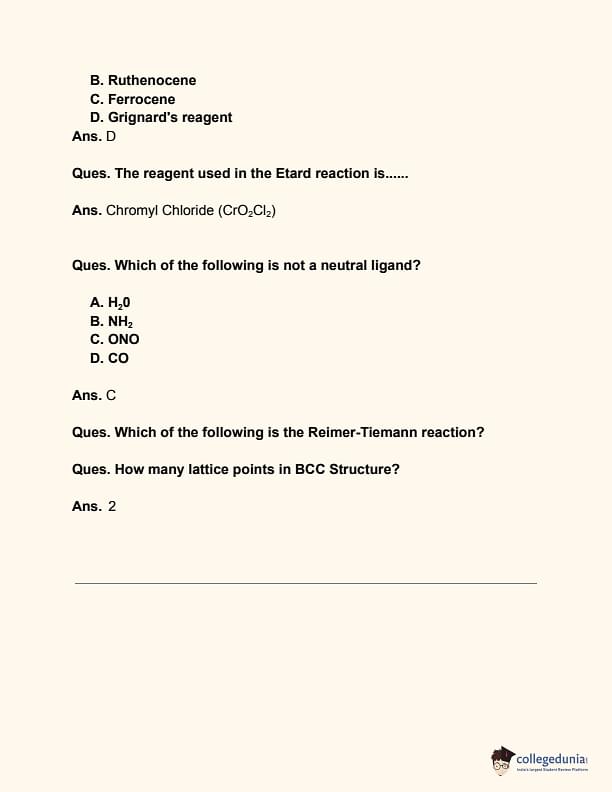
How many lattice points are there in a Body-Centered Cubic (BCC) structure?
View Solution
Step 1: Lattice Points in a BCC Structure.
In a BCC structure:
- There are 8 atoms at the corners of the cube.
- There is 1 atom at the center of the cube.
Step 2: Contribution of Each Lattice Point.
- Corner atoms each contribute 1/8 of an atom to the unit cell.
- The center atom is entirely contained within the unit cell and contributes 1 atom.
Step 3: Calculate the Total Number of Lattice Points.
Total lattice points = (8 * 1/8) + 1 = 1 + 1 = 2
Conclusion: The Body-Centered Cubic (BCC) structure contains 2 lattice points per unit cell.
MHT CET Previous Year Question Papers
| MHT CET 2023 Question Paper | MHT CET 2022 Question Paper |
| MHT CET 2021 Question Paper | MHT CET 2020 Question Paper |
| MHT CET 2019 Question Paper | MHT CET 2018 Question Paper |
Also Check:



Comments