MHT CET 2024 24 April Shift 1 Question Paper (Available): Download PCB Question Paper with Answers PDF

Collegedunia Team's profile photo

Collegedunia Team

Content Curator | Updated 3+ months ago

MHT CET 2024 24 April Shift 1 question paper is available for download here. MHT CET 2024 question paper comprises 150 MCQs carrying a total weightage of 200 marks.

MHT CET 2024 24 April Shift 1 Question Paper for PCB is divided into three subjects- Physics, Chemistry and Biology. The Physics and Chemistry section consists of 50 questions (10 questions from Class 11 and 40 questions from Class 12th syllabus). Meanwhile, the Biology Question Paper consists of 100 questions (20 questions from Class 11th and 80 questions from Class 12th syllabus).

MHT CET 2024 24 April Shift 1 Question Paper PDF Download

MHT CET 2024 24 April Shift 1​ Question Paper 2024 with Answer Key download iconDownload Check Solutions

MHT CET 2024 24 April Shift 1 Questions with Solutions

Okay, I understand. I will extract the questions from the provided PDF and present them in the requested format, ensuring that the solutions are detailed and follow the stepwise approach demonstrated in the document. Let's begin!

Question 1:

The potential energy of a particle performing linear S.H.M is 0.1π²x² joules. If the mass of the particle is 20 g, find the frequency of S.H.M:

  1. 0.4 Hz
  2. 0.6 Hz
  3. 1.581 Hz
  4. 2.0 Hz
Correct Answer: (3) 1.581 Hz
View Solution

Step 1: Use the formula for potential energy in S.H.M.
The potential energy PE is given by:
PE = 1/2 mw²x²,
where:
m = 20 g = 0.02 kg,
w is the angular frequency,
x is the displacement.
From the question:
PE = 0.1π²x².
Equating:
1/2 mw²x² = 0.1π²x².
Cancel x² from both sides:
1/2 mw² = 0.1π².
Substitute m = 0.02 kg:
1/2(0.02)w² = 0.1π².
Simplify:
0.01w² = 0.1π².
w² = 10π².
Step 2: Calculate angular frequency and frequency.
Solve for w:
w = √10π² = π√10.
The frequency *f* is:
f = w/2π
Substitute w = π√10:
f = π√10/2π = √10/2.
Using √10 ≈ 3.162:
f = 3.162/2 = 1.581 Hz.
Thus, the frequency is 1.581 Hz.


Question 2:

A star 'A' has radiant power equal to 3 times that of the Sun. The temperature of star 'A' is 6000 K and that of the Sun is 2000 K. What is the ratio of their radii?

  1. 1 : 5
  2. 8 : 1
  3. 9 : 1
  4. 1 : 7
Correct Answer: (1) 1 : 5
View Solution

Solution:
The radiant power E emitted by a star is given by the Stefan-Boltzmann law:
E = σAT⁴,
where:
σ is the Stefan-Boltzmann constant,
A is the surface area of the star (A α R², where R is the radius),
T is the temperature of the star.
Step 1: Relate the radiant power ratio.
For two stars, the ratio of radiant powers is:
E1/E2 = R1²T1⁴/R2²T2⁴
Given:
E1/E2 = 3, T1 = 6000 K, T2 = 2000 K.
Substitute these into the equation:
3 = R1²(6000)⁴ / R2²(2000)⁴
3 = R1²(3)⁴/R2²
Step 2: Simplify the temperature ratio.
The ratio of temperatures is:
T1/T2 = 6000/2000 = 3
Raise to the power of 4:
(T1/T2)⁴ = 3⁴ = 81.
Substitute back:
3 = R1²/R2² * 81
Simplify:
R1²/R2² = 3/81 = 1/27
Step 3: Solve for the radius ratio.
Take the square root:
R1/R2 = √1/27 = 1/√27 ≈ 1/5
Thus, the ratio of their radii is:
R1 : R2 = 1 : 5.


Question 3:

The speed of a wave is 30 m/s. If the distance between 11 crests is 1 m, what is the frequency (in Hz)?

  1. 300 Hz
  2. 330 Hz
  3. 350 Hz
  4. 360 Hz
Correct Answer: (1) 300 Hz
View Solution

Solution:
The wavelength (λ) of a wave is the distance between two consecutive crests. Since the distance between 11 crests is 1 m, this corresponds to 10 wavelengths:
10λ = 1 m.
Thus, the wavelength is:
λ = 1/10 = 0.1 m.
The frequency (f) of a wave is given by:
f = υ/λ,
where:
υ = 30 m/s (speed of the wave),
λ = 0.1 m (wavelength).
Substitute the values:
f = 30/0.1 = 300 Hz.
Thus, the frequency of the wave is 300 Hz.


Question 4:

The fundamental frequency of a closed organ pipe of length 20 cm is equal to the second overtone of an organ pipe open at both ends. What is the length of the organ pipe open at both ends?

  1. 1.0 m
  2. 1.2 m
  3. 1.4 m
  4. 1.6 m
Correct Answer: (2) 1.2 m
View Solution

Solution:
Step 1: Fundamental frequency of a closed organ pipe.
The fundamental frequency of a closed organ pipe is:
fclosed = υ/4Lclosed
where:
υ is the speed of sound in air,
Lclosed = 20 cm = 0.2 m.
Substitute Lclosed:
fclosed = υ/(4*0.2) = υ/0.8
Step 2: Frequency of the second overtone of an open pipe.
For an open organ pipe, the second overtone (third harmonic) is:
fopen, overtone = 3υ/(2Lopen)
where Lopen is the length of the open pipe.
Step 3: Equate the frequencies.
Given:
fclosed = fopen, overtone.
Substitute the expressions for the frequencies:
υ/0.8 = 3υ/(2Lopen)
Cancel υ from both sides:
1/0.8 = 3/(2Lopen)
Solve for Lopen:
Lopen = (3*0.8)/2 = 1.2 m.
Thus, the length of the open organ pipe is 1.2 m.


Question 5:

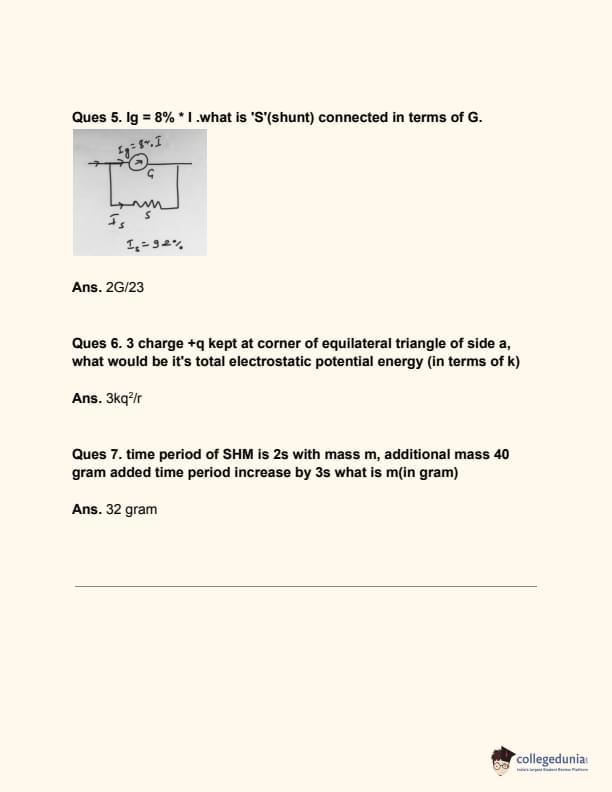
Ig = 8% × I. What is S (shunt) connected in terms of G?

  1. G/11
  2. 2G/23
  3. 3G/25
  4. 4G/29
Correct Answer: (2) 2G/23
View Solution

Solution:
The shunt resistance S is connected in parallel with the galvanometer resistance G to extend its range. The total current I splits as:
Ig = 8% × I = 0.08I (through the galvanometer),
Is = I − Ig = 0.92I (through the shunt).
Step 1: Relationship between S and G.
The potential difference across S and G is equal:
Is · S = Ig · G.
Substitute Is = 0.92I and Ig = 0.08I:
0.92I · S = 0.08I · G.
Cancel I:
0.92S = 0.08G.
Step 2: Solve for S.
S = 0.08G/0.92
Simplify:
S = 8G/92 = 2G/23
Thus, the shunt resistance is:
S = 2G/23


Question 6:

Three charges +q are placed at the corners of an equilateral triangle of side a. What would be the total electrostatic potential energy (in terms of k)?

  1. kq²/a
  2. 2kq²/a
  3. 3kq²/a
  4. 4kq²/a
Correct Answer: (3) 3kq²/a
View Solution

Solution:
The electrostatic potential energy of a system of charges is given by:
U = Σ kqi*qj/rij (i where:
*k* is the Coulomb constant,
*q*i and *q*j are the interacting charges,
*r*ij is the distance between the charges.
Step 1: Calculate the energy for one charge pair.
For two charges +q separated by a distance a, the potential energy is:
Upair = kq²/a
Step 2: Count the number of pairs.
In an equilateral triangle with three charges, the pairs of charges are:
1. Between charges at vertices 1 and 2,
2. Between charges at vertices 2 and 3,
3. Between charges at vertices 3 and 1.
The total potential energy is the sum of the energies for all three pairs:
Utotal = 3 · Upair = 3 * kq²/a
Step 3: Write the total potential energy.
Utotal= 3kq²/a
Thus, the total electrostatic potential energy of the system is:
3kq²/a


Question 7:

The time period of SHM is 2 s with mass m. If an additional mass of 40 g is added, the time period increases by 3 s. What is m (in grams)?

  1. 7.64 g
  2. 40 g
  3. 50 g
  4. 60 g
Correct Answer: (1) 7.64 g
View Solution

Solution:
The time period of simple harmonic motion (SHM) is given by:
T = 2π√(m/k),
where:
*T* is the time period,
*m* is the mass,
*k* is the spring constant.
Step 1: Initial time period.
The time period with mass m is:
T1 = 2 = 2π√(m/k)
Squaring both sides:
T1²=4π²m/k
Rearranging for m:
m = kT1²/4π²
Step 2: New time period with added mass.
With an additional mass 0.04 kg, the total mass becomes m + 0.04, and the new time period is:
T2 = 5 s.
Substitute T2 into the formula:
T2² = 4π²(m + 0.04)/k
Rearranging:
m+ 0.04 = kT2²/4π²
Step 3: Subtract initial from new equation.
From the two equations:
kT2²/4π² - kT1²/4π² = 0.04.
Factorize:
k/4π²(T2² - T1²) = 0.04.
Substitute T1 = 2 s and T2 = 5 s:
k/4π²(5²-2²) = 0.04.
Simplify:
k/4π² * 21 = 0.04.
Solve for k/4π²:
k/4π² = 0.04/21
Step 4: Substitute back to find m.
Using the expression for m:
m = k/4π² * T1²
Substitute T1 = 2 s:
m = (0.04/21) * 4.
Simplify:
m = 0.04 * 4 / 21 = 0.00764 kg.
Convert to grams:
m = 7.64 g.
Thus, the mass is 7.64 g.


Question 8:

Who coined the term 'root pressure theory'?

  1. Charles Darwin
  2. Stephen Hales
  3. J. Priestley
  4. Julius von Sachs
Correct Answer: (3) J. Priestley
View Solution

Solution:
The term 'root pressure theory' was introduced by J. Priestley. This theory describes the pressure generated in the roots due to osmotic uptake of water, which pushes water upward through the xylem vessels. Root pressure results from:
* Active transport of ions into the root xylem.
* Osmosis, drawing water into the roots.
Key Points:
* Root pressure is effective during the night or in conditions of low transpiration.
* It is responsible for phenomena like guttation but cannot account for water transport in tall trees.


Question 9:

How many of the following genotypes possibly represent normal wings in *Drosophila*?

(i) Vg⁺Vg⁺
(ii) Vg⁺Vgⁿⁱ
(iii) Vg⁺Vgⁿº
(iv) Vg⁺Vgˢᵗ
(v) Vg⁺Vg

  1. (i), (ii), and(iii) only
  2. (i) and(ii) only
  3. Only (i)
  4. (i), (ii), (iii), (iv), and(v)
Correct Answer: (4) (i), (ii), (iii), (iv), and(v)
View Solution

Solution:
In *Drosophila*, the normal wing phenotype requires at least one dominant Vg⁺ allele. Recessive alleles (Vgⁿⁱ, Vgⁿº, Vgˢᵗ, Vg, etc.) cause abnormal wings only when in homozygous recessive combinations.
Step 1: Evaluate each genotype.
1. Vg⁺Vg⁺: Both alleles are wild type, so wings are normal.
2. Vg⁺Vgⁿⁱ: One dominant Vg⁺ allele is present. Wings are normal.
3. Vg⁺Vgⁿº: One dominant Vg⁺ allele is present. Wings are normal.
4. Vg⁺Vgˢᵗ: One dominant Vg⁺ allele is present. Wings are normal.
5. Vg⁺Vg: One dominant Vg⁺ allele is present. Wings are normal.
Step 2: Count the genotypes. All five genotypes contain at least one dominant Vg⁺ allele, resulting in normal wings.
Genotypes representing normal wings = (i), (ii), (iii), (iv), (v).
Thus, the correct answer is:
(D) (i), (ii), (iii), (iv), and(v).


Question 10:

Given below are two statements:
Statement I: Cell wall is freely permeable.
Statement II: Plasma membrane is selectively permeable.
Choose the correct answer from the options given below with reference to the structure of root hair:

  1. Statement I is incorrect but Statement II is correct
  2. Both Statement I and Statement II are correct
  3. Both Statement I and Statement II are incorrect
  4. Statement I is correct but Statement II is incorrect
Correct Answer: (2) Both Statement I and Statement II are correct
View Solution

Solution:
Statement I: Cell wall is freely permeable.
The cell wall in plants is freely permeable to water and solutes, allowing substances to move through the apoplast pathway without restriction. This feature supports the transport of nutrients and water across root hairs. Hence, Statement I is correct.
Statement II: Plasma membrane is selectively permeable.
The plasma membrane regulates the movement of substances into and out of the cell. Its selective permeability ensures that essential nutrients and ions are transported while harmful substances are excluded. Hence, Statement II is correct.
Conclusion:
Both statements are correct with reference to the structure and function of root hairs.
Correct Answer : (B) Both Statement I and Statement II are correct.


Question 11:

Who discovered DNA?

  1. Watson and Crick
  2. F. Miescher
  3. Rosalind Franklin
  4. Griffith
Correct Answer: (2) F. Miescher
View Solution

Solution:
Friedrich Miescher was the first scientist to discover DNA in 1869. He isolated a substance from the nuclei of pus cells, which he named *nuclein*. This substance was later identified as DNA. While Miescher did not recognize its genetic significance, his work laid the foundation for understanding DNA's role in heredity.
Key Points:
* Watson and Crick discovered the double-helix structure of DNA in 1953.
* Rosalind Franklin's X-ray diffraction images were crucial for elucidating DNA's structure.
* Griffith's experiments in 1928 established the principle of transformation, highlighting DNA as the genetic material.
Thus, the discovery of DNA itself is credited to F. Miescher.


Question 12:

Which of the following is not present in RNA?

  1. Adenine
  2. Guanine
  3. Thymine
  4. Uracil
Correct Answer: (3) Thymine
View Solution

Solution:
RNA (Ribonucleic Acid) is composed of the following nitrogenous bases:
* Adenine (A),
* Guanine (G),
* Cytosine (C),
* Uracil (U).
Unlike DNA, RNA does not contain Thymine (T). Instead, Uracil (U) pairs with Adenine during the process of transcription.
Key Points:
* Thymine is exclusive to DNA.
* Uracil replaces Thymine in RNA and is chemically similar, differing by the absence of a methyl group.
Thus, the correct answer is Thymine (T).


Question 13:

Which of the following has a non-zero dipole moment?

  1. CCl₄
  2. CO₂
  3. BF₃
  4. None of these
Correct Answer: (4) None of these
View Solution

Solution:
The dipole moment of a molecule depends on its geometry and the vector sum of individual bond dipole moments.
Analysis of each option:
1. CCl₄: The molecule has a tetrahedral structure and is symmetric. The bond dipoles cancel out, resulting in a net dipole moment of zero.
2. CO₂: The molecule is linear and symmetric. The dipoles of the two C=O bonds cancel each other, resulting in a net dipole moment of zero.
3. BF₃: The molecule has a trigonal planar structure and is symmetric. The bond dipoles cancel out, resulting in a net dipole moment of zero.
Since all the given molecules are symmetric and their bond dipoles cancel out, the net dipole moment for each is zero. Therefore, the correct answer is:
None of these.


Question 14:

How many moles of electrons are required for the reduction of 1 mole of Cr³⁺ to Cr⁰(s)?

  1. 1 mole of e⁻
  2. 2 moles of e⁻
  3. 3 moles of e⁻
  4. None of these
Correct Answer: (3) 3 moles of e⁻
View Solution

Solution:
Reduction involves the gain of electrons. The reaction for the reduction of Cr³⁺ to Cr⁰ is:
Cr³⁺ + 3e⁻ → Cr⁰.
Step 1: Understand the electron requirement.
* Each Cr³⁺ ion requires 3 electrons (3e⁻) to be reduced to Cr⁰.
* For 1 mole of Cr³⁺, 3 moles of electrons are needed.
Key Points:
* The oxidation state of chromium decreases from +3 in Cr³⁺ to 0 in Cr⁰.
* The number of electrons required equals the magnitude of the change in oxidation state.
Thus, the answer is:
3 moles of e⁻.


Question 15:

What are the monomers of Bakelite?
  1. Phenol and urea
  2. Phenol and formaldehyde
  3. Urea and formaldehyde
  4. Phenol and acetaldehyde
Correct Answer: (2) Phenol and formaldehyde
View Solution

Solution:
Bakelite is a thermosetting polymer and one of the earliest synthetic plastics. It is synthesized through a condensation reaction involving the following monomers:
* Phenol (C₆H₅OH), and
* Formaldehyde (HCHO).
The reaction between phenol and formaldehyde results in a rigid, cross-linked polymer network, making Bakelite hard and durable.
Key Points:
* Bakelite is widely used in electrical insulators, handles, and household items due to its high mechanical strength and heat resistance.
* The condensation reaction involves the elimination of water molecules, forming a strong cross-linked structure.
Thus, the monomers of Bakelite are Phenol and Formaldehyde.


Also Check:

MHT CET Previous Year Question Papers

Also Check:

Fees Structure

Structure based on different categories

CategoriesState
General800
Women800
sc600
pwd600
Others600

In case of any inaccuracy, Notify Us! 

Comments


No Comments To Show