MHT CET 2024 23 April Shift 2 question paper is available for download here. MHT CET 2024 question paper comprises 150 MCQs carrying a total weightage of 200 marks. MHT CET 2024 23 April Shift 2 Question Paper for PCB is divided into three subjects- Physics, Chemistry and Biology. The Physics and Chemistry section of MHT CET 2024 23 April Shift 2 question paper consists of 50 questions (10 questions from Class 11 and 40 questions from Class 12th syllabus). Meanwhile, the Biology paper of MHT CET 2024 23 April Shift 2 question paper consists of 100 questions (20 questions from Class 11th and 80 questions from Class 12th syllabus).
MHT CET 2024 23 April Shift 2 Question Paper PDF Download
| MHT CET 2024 23 April Shift 2 Question Paper 2024 with Answer Key | Check Solutions |
MHT CET 2024 23 April Shift 2 Questions with Solutions.
Question 1:
Let the six numbers a1, a2, a3, a4, a5, a6 be in A.P., and a1 + a3 = 10. If the mean of these six numbers is 19/2 and their variance is σ2, then 8σ2 is equal to:
View Solution
Step 1: Represent the A.P. terms using the first term a1 and common difference d.
The general terms of the arithmetic progression are: a1, a1 + d, a1 + 2d, a1 + 3d, a1 + 4d, a1 + 5d.
Step 2: Using the condition a1 + a3 = 10:
a1 + (a1 + 2d) = 10
2a1 + 2d = 10
a1 + d = 5 ...... (1)
Step 3: Using the mean condition to find a1:
Mean = (a1 + (a1 + d) + (a1 + 2d) + (a1 + 3d) + (a1 + 4d) + (a1 + 5d)) / 6 = 19/2
(6a1 + 15d) / 6 = 19/2
6a1 + 15d = 57 ...... (2)
Step 4: Solving equations (1) and (2):
From (1), d = 5 - a1
Substituting into (2):
6a1 + 15(5 - a1) = 57
6a1 + 75 - 15a1 = 57
-9a1 + 75 = 57
-9a1 = -18
a1 = 2.
Substituting into (1): d = 5 - 2 = 3.
Step 5: Calculating the variance σ2:
The terms of the A.P. are: 2, 5, 8, 11, 14, 17.
Mean = (2 + 5 + 8 + 11 + 14 + 17) / 6 = 19/2.
Variance formula: σ2 = (Sum of squares / Number of terms) - (Square of mean).
Sum of squares = 22 + 52 + 82 + 112 + 142 + 172 = 699.
σ2 = (699 / 6) - (19/2)2 = 116.5 - 90.25 = 26.25.
Step 6: Calculating 8σ2:
8σ2 = 8 × 26.25 = 210.
Question 2:
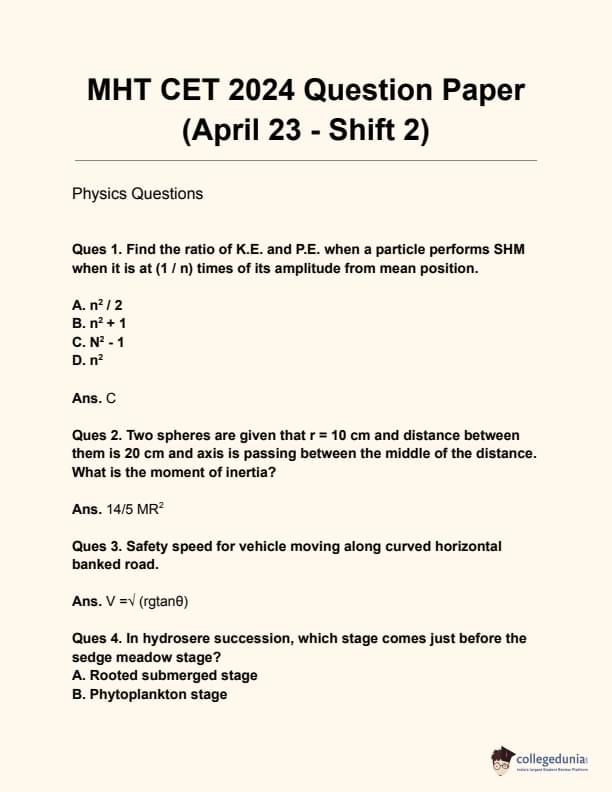
Two spheres are given with radius *r* = 10 cm, and the distance between them is 20 cm. The axis passes through the midpoint of the distance between the two spheres. What is the moment of inertia of the system?
View Solution
Moment of Inertia for a Solid Sphere. The moment of inertia of a solid sphere of mass *M* and radius *R* about its diameter is: Isphere(diameter) = 2/5MR².
Moment of Inertia about the Given Axis (Parallel Axis Theorem). Using the Parallel Axis Theorem, the moment of inertia about an axis parallel to the diameter and at a distance *d* from the center is: Iparallel = Icenter + Md².
Here: - d = 10 cm = 0.1 m (distance from the center of each sphere to the axis). For each sphere, the moment of inertia about the given axis is: Isphere (axis)= 2/5MR² + Md².
Substitute R = 0.1 m and d = 0.1 m: Isphere (axis)= 2/5M(0.1)² + M(0.1)²
Isphere (axis)= 2/5M(0.01) + M(0.01) = 7/5M(0.01)
Isphere (axis)= 7/5M(0.01).
Total Moment of Inertia for Two Spheres. Since there are two spheres and the axis passes symmetrically through the midpoint, the total moment of inertia is:
Question 3:
What is the safety speed for a vehicle moving along a curved horizontal banked road?
View Solution
Forces acting on the vehicle. For a vehicle moving on a banked curve, the forces acting are:
- Gravitational force (mg).
- Normal reaction force (N).
- Frictional force (f).
Resolving forces. The component of the normal reaction along the radius provides the centripetal force:
Frictionless case (Safety speed). For the safety speed, assume friction is negligible. The normal force's component balances the centripetal force:
Solve for *v*:
Question 4:
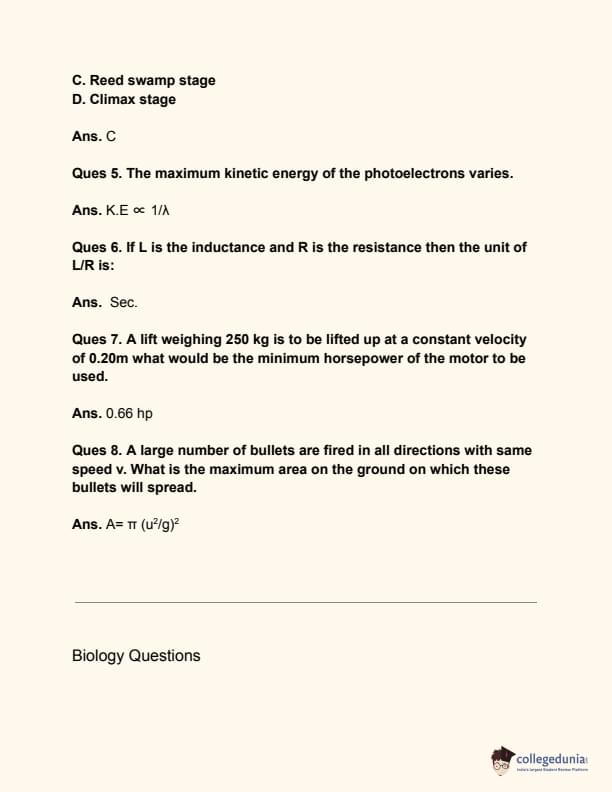
In hydrosere succession, which stage comes just before the sedge meadow stage?
View Solution
Understanding hydrosere succession. Hydrosere is a type of ecological succession that begins in aquatic environments and progresses towards a climax terrestrial stage. Each stage represents a shift in dominant vegetation and habitat conditions.
Identifying the stages of hydrosere succession. The typical stages in hydrosere succession are:
- Phytoplankton stage (initial stage in water)
- Submerged stage (rooted submerged plants)
- Floating stage (rooted floating plants)
- Reed swamp stage (emergent vegetation)
- Sedge meadow stage (herbaceous plants in shallow water or wet soil)
- Woodland stage (woody plants)
- Climax stage (terrestrial vegetation like forest or grassland)
Preceding stage to sedge meadow stage. The sedge meadow stage, characterized by sedges and other herbaceous plants, is preceded by the reed swamp stage, which is dominated by emergent vegetation like reeds and cattails.
Question 5:
The maximum kinetic energy of the photoelectrons varies.
View Solution
Relation between kinetic energy and frequency. The photoelectric equation is given by:
Frequency and wavelength relation. The frequency *v* is related to the wavelength *λ* by:
Substituting in the equation. Substituting *v* = *c/λ* into the photoelectric equation:
Thus, the maximum kinetic energy of the photoelectrons is inversely proportional to the wavelength λ.
Question 6:
If L is the inductance and R is the resistance, then the unit of L/R is:
View Solution
Units of Inductance and Resistance. The inductance L is measured in henries (H), and the resistance R is measured in ohms (Ω). The henry (H) is defined as: 1 H = 1 ohm-second (Ω · s).
Derive the Unit of L/R. The expression *L/R* has the unit:
Final Answer. The unit of *L/R* is: seconds (s).
Question 7:
A lift weighing 250 kg is to be lifted up at a constant velocity of 0.20 m/s. What would be the minimum horsepower of the motor to be used?
View Solution
Calculate power required to lift the lift. The force required to lift the lift is equal to its weight:
The power required is given by:
Convert to horsepower. Since 1 hp = 746 W, the required horsepower is:
Question 8:
A large number of bullets are fired in all directions with the same speed *v*. What is the maximum area on the ground on which these bullets will spread?
View Solution
Horizontal range of a projectile. The horizontal range *R* of a projectile is given by:
Maximum horizontal range. The maximum horizontal range occurs when sin 2θ = 1, i.e., θ = 45°. Then:
Area of spread. Assuming bullets are fired in all directions, the spread forms a circle with radius Rmax. The area A is:
Question 9:
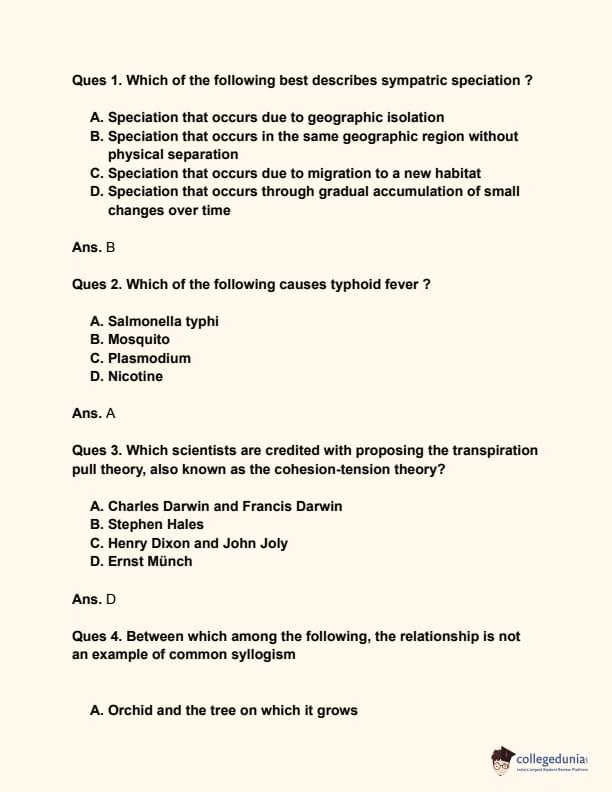
Which of the following best describes sympatric speciation?
View Solution
Definition of sympatric speciation. Sympatric speciation is the process by which new species arise from a single ancestral species while living in the same geographic area. In contrast to allopatric speciation, there is no physical barrier that separates the populations.
Mechanisms of sympatric speciation. Sympatric speciation can occur through mechanisms like:
- Behavioral isolation (e.g., different mating rituals)
- Ecological isolation (e.g., different habitat preferences within the same area)
- Polyploidy in plants
- Genetic divergence in the absence of physical barriers
Eliminating incorrect options.
- (A) Incorrect: Geographic isolation leads to allopatric speciation.
- (C) Incorrect: Migration to a new habitat leads to allopatric speciation, not sympatric.
- (D) Incorrect: Gradual accumulation of changes over time is part of speciation, but does not specifically define sympatric speciation.
Question 10:
Which of the following causes typhoid fever?
View Solution
Causative organism of typhoid fever. Typhoid fever is caused by the bacterium Salmonella typhi, which is transmitted through contaminated food and water.
Symptoms of typhoid fever. Common symptoms include:
- High fever
- Weakness
- Abdominal pain
- Headaches
- Constipation or diarrhea
Eliminating incorrect options.
- (B) Incorrect: Mosquitoes are vectors for diseases like malaria and dengue, not typhoid.
- (C) Incorrect: Plasmodium causes malaria, not typhoid.
- (D) Incorrect: Nicotine is a chemical compound, not a pathogen.
Question 11:
Which scientists are credited with proposing the transpiration pull theory, also known as the cohesion-tension theory?
View Solution
Understanding the transpiration pull theory. The transpiration pull theory, or cohesion-tension theory, explains how water moves from roots to leaves in tall plants. It is driven by:
- Cohesion of water molecules (water molecules sticking together)
- Adhesion of water molecules to xylem walls
- Negative pressure (tension) created by transpiration from leaves
Contribution of Ernst Münch. Ernst Münch is credited with proposing the cohesion-tension theory. He emphasized the role of transpiration in generating a pulling force and the cohesive nature of water molecules, which aids in the upward flow of water.
Eliminating incorrect options.
- (A) Incorrect: Charles Darwin and Francis Darwin are known for their work on evolution, not the cohesion-tension theory.
- (B) Incorrect: Stephen Hales contributed to plant physiology but did not propose this theory.
- (C) Incorrect: Henry Dixon and John Joly are recognized for early work in water transport but not the cohesion-tension theory.
Question 12:
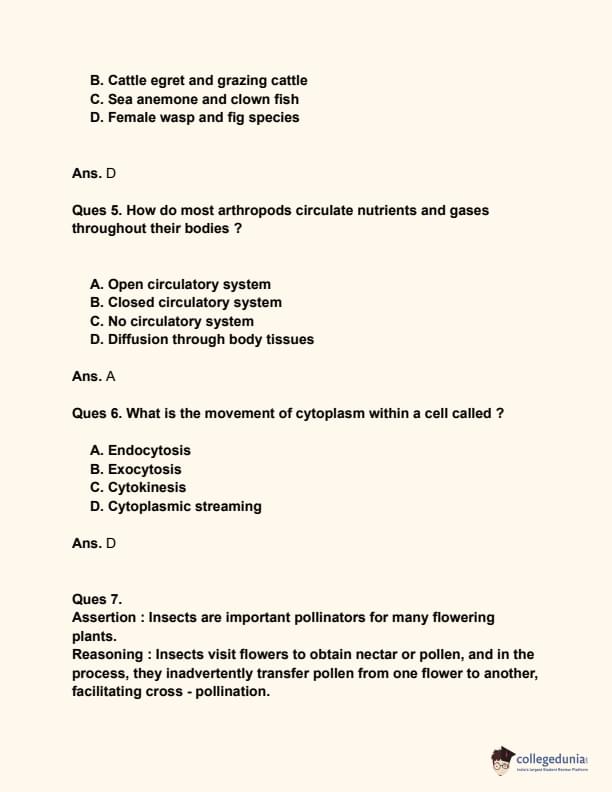
Between which among the following, the relationship is not an example of common symbiosis?
View Solution
Understanding symbiosis and its examples. Symbiosis refers to a long-term relationship between two different species, which can be mutualistic, commensalistic, or parasitic. The question asks for a relationship that is not typically a form of symbiosis.
- Option (A): *Orchid and the tree on which it grows* represent commensalism, where the orchid benefits from sunlight without harming the tree.
- Option (B): *Cattle egret and grazing cattle* is mutualistic, where the cattle egret feeds on insects stirred up by the cattle.
- Option (C): *Sea anemone and clownfish* is a mutualistic relationship, with clownfish receiving protection and the anemone benefiting from nutrients in the fish's waste.
- Option (D): *Female wasp and fig species* represents a specialized mutualistic relationship specifically for pollination, not a general form of symbiosis.
Conclusion. Option (D) is a highly specialized interaction not fitting the general definition of symbiosis, hence the correct answer.
Question 13:
How do most arthropods circulate nutrients and gases throughout their bodies?
View Solution
Understanding circulatory systems. Arthropods, including insects, crustaceans, and arachnids, have an open circulatory system. In this system, the blood (or hemolymph) is not confined to blood vessels but flows freely through an internal body cavity, the hemocoel, bathing the organs directly.
Explanation of other options.
- (B) *Closed circulatory system*: Found in vertebrates and some invertebrates like earthworms, where blood circulates through a network of vessels.
- (C) *No circulatory system*: Some organisms, like flatworms, rely on diffusion for nutrient and gas exchange.
- (D) *Diffusion through body tissues*: While diffusion is essential in small organisms, arthropods utilize an open circulatory system for nutrient transport.
Conclusion. Arthropods rely on an open circulatory system, which is less efficient than a closed system but sufficient for their metabolic needs.
Question 14:
What is the movement of cytoplasm within a cell called?
View Solution
Understanding cytoplasmic streaming. Cytoplasmic streaming, or cyclosis, is the process where the cytoplasm moves within a cell to help distribute nutrients, organelles, and other substances. It is driven by the cytoskeleton, including actin filaments and motor proteins like myosin.
Explanation of other options.
- (A) *Endocytosis*: This process involves cells engulfing substances into vesicles from their outer membrane.
- (B) *Exocytosis*: This is the process of expelling substances from the cell via vesicles.
- (C) *Cytokinesis*: Refers to the division of the cytoplasm during cell division, not the movement of cytoplasm.
Conclusion. Cytoplasmic streaming is essential for intracellular transport, particularly in large cells such as those in plants.
Question 15:
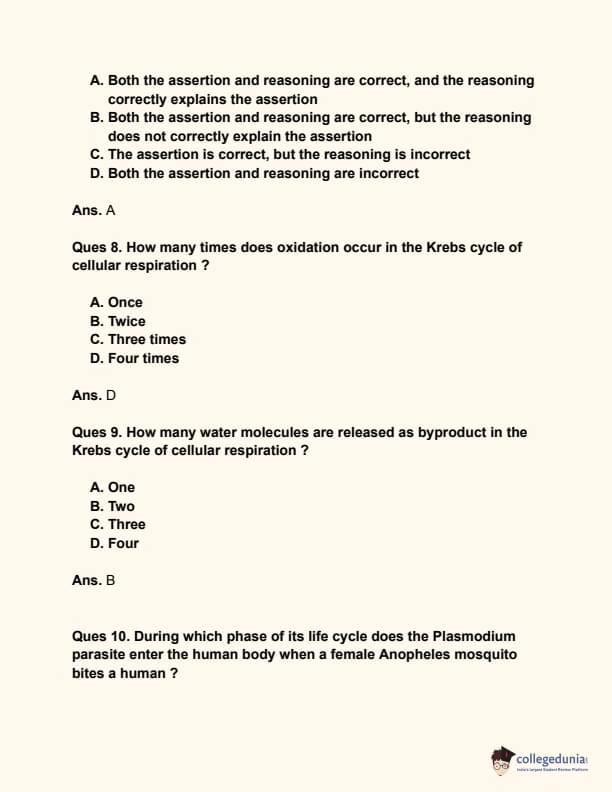
Assertion: Insects are important pollinators for many flowering plants. Reasoning: Insects visit flowers to obtain nectar or pollen, and in the process, they inadvertently transfer pollen from one flower to another, facilitating cross-pollination.
View Solution
Analyze the assertion. The assertion is correct, as many plants rely on insects, such as bees and butterflies, for pollination, which is crucial for reproduction.
Analyze the reasoning. The reasoning correctly explains how insects transfer pollen as they collect nectar or pollen, facilitating cross-pollination between flowers.
Conclusion. Both the assertion and reasoning are accurate, and the reasoning fully supports the assertion.
Question 16:
How many times does oxidation occur in the Krebs cycle of cellular respiration?
View Solution
Overview of the Krebs cycle. The Krebs cycle, also known as the citric acid cycle, is a key metabolic pathway in cellular respiration. It takes place in the mitochondrial matrix and plays a critical role in oxidizing acetyl-CoA to carbon dioxide while reducing NAD+ and FAD to NADH and FADH2, which are used in the electron transport chain to generate ATP.
Oxidation events in the Krebs cycle. Oxidation occurs in the following steps of the Krebs cycle:
- Isocitrate is oxidized to α-ketoglutarate, reducing NAD+ to NADH.
- α-ketoglutarate is oxidized to succinyl-CoA, reducing NAD+ to NADH.
- Succinate is oxidized to fumarate, reducing FAD to FADH2.
- Malate is oxidized to oxaloacetate, reducing NAD+ to NADH.
Question 17:
How many water molecules are released as byproducts in the Krebs cycle of cellular respiration?
View Solution
Role of water in the Krebs cycle. Water molecules are involved in two specific reactions in the Krebs cycle:
- Fumarate is converted to malate through hydration, which involves the consumption of one water molecule.
- Citrate is formed from acetyl-CoA and oxaloacetate with the help of water molecules.
Confirming the count of released water molecules. One water molecule is released during the conversion of succinyl-CoA to succinate, adding up to a total of two water molecules released.
Question 18:
During which phase of its life cycle does the *Plasmodium* parasite enter the human body when a female *Anopheles* mosquito bites a human?
View Solution
Understanding the life cycle of *Plasmodium*. When a female *Anopheles* mosquito bites a human, it injects the sporozoites into the bloodstream. Sporozoites are the infective stage of the *Plasmodium* parasite.
Role of sporozoites. The sporozoites travel to the liver, where they multiply asexually and form merozoites. This marks the initial step in the parasite's lifecycle within the human host.
Key Point. The sporozoite phase is when the parasite first enters the human body, making it the correct answer.
Question 19:
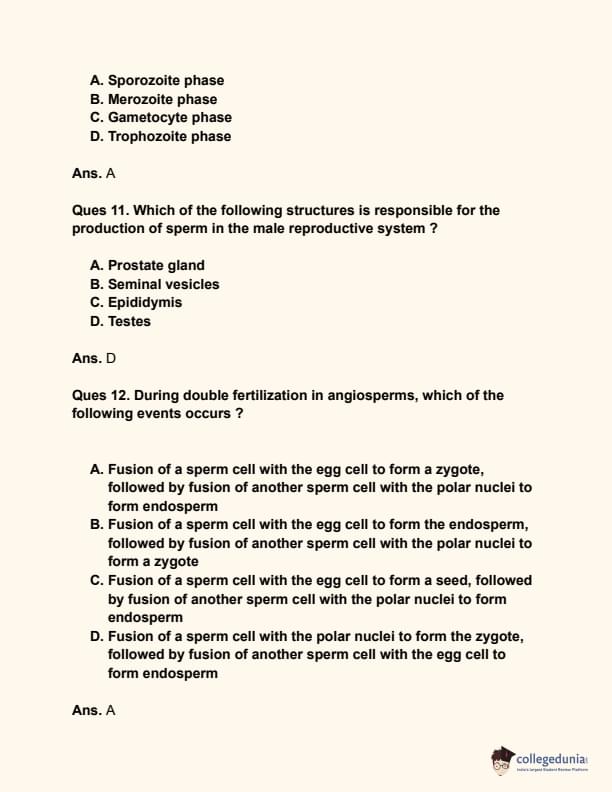
Which of the following structures is responsible for the production of sperm in the male reproductive system?
View Solution
Understanding the male reproductive system. The male reproductive system is responsible for producing sperm and male hormones like testosterone. The testes are the primary organs where spermatogenesis (the production of sperm) occurs.
Spermatogenesis in the testes. Spermatogenesis takes place in the seminiferous tubules of the testes. Sertoli cells within these tubules aid in sperm maturation.
Explanation of other options.
- (A) *Prostate gland*: Produces seminal fluid that nourishes sperm.
- (B) *Seminal vesicles*: Contribute to seminal fluid production.
- (C) *Epididymis*: Stores and matures sperm but does not produce it.
Question 20:
During double fertilization in angiosperms, which of the following events occurs?
View Solution
Understanding double fertilization. Double fertilization is a process unique to angiosperms where two fertilization events happen simultaneously.
The two events in double fertilization.
- One sperm cell fuses with the egg cell to form a zygote, which develops into the embryo.
- The second sperm cell fuses with the two polar nuclei to form the triploid endosperm, which provides nourishment to the developing embryo.
Explanation of other options.
- (B) Incorrect: The endosperm is formed from the polar nuclei, not the egg cell.
- (C) Incorrect: Seed formation involves the zygote and maternal tissue, not directly from sperm cells.
- (D) Incorrect: The polar nuclei form the endosperm, not the zygote.
Question 21:
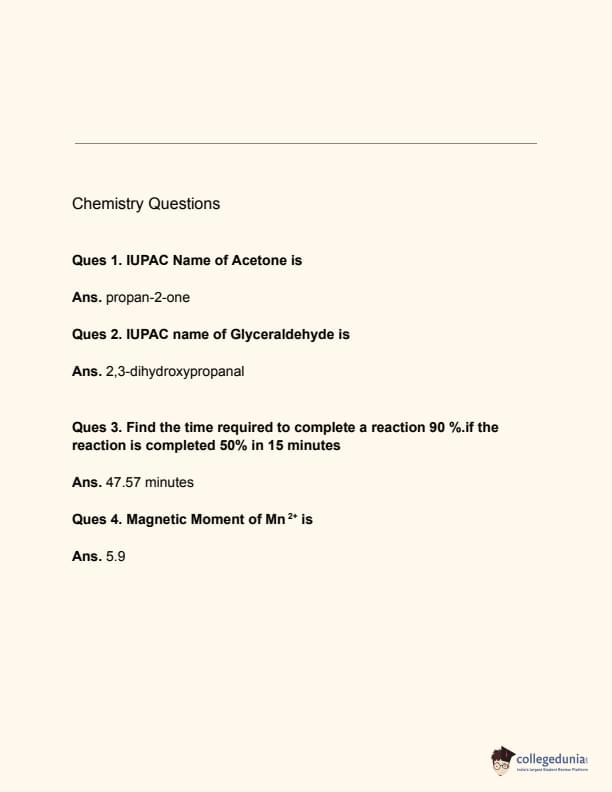
IUPAC Name of Acetone is:
View Solution
Acetone's IUPAC name is derived from its structure:
- Acetone has the molecular formula C3H6O.
- It contains a ketone functional group (C = O) attached to the second carbon atom.
Question 22:
IUPAC Name of Glyceraldehyde is:
View Solution
The IUPAC name of glyceraldehyde is based on its structure:
- Glyceraldehyde has the molecular formula C3H6O3 and contains two hydroxyl groups (-OH) at the second and third carbon atoms.
- The aldehyde group (-CHO) is located at the first carbon atom.
Question 23:
Find the time required to complete a reaction 90% if the reaction is completed 50% in 15 minutes.
View Solution
Determine the order of reaction. The problem involves percentages of completion and time, suggesting a first-order reaction.
The formula for the time required to achieve a certain completion in a first-order reaction is:
where: - *t* is the time, - *k* is the rate constant, - [*A*]0 is the initial concentration, - [*A*] is the concentration at time *t*.
Calculate the rate constant *k*. For 50% completion, [A]0/[A] = 2. Substituting *t* = 15 minutes:
Calculate the time for 90% completion. For 90% completion, [A]0/[A] = 10. Substituting into the formula:
Final Answer. The time required to complete 90% of the reaction is: 49.44 minutes
Question 24:
Magnetic Moment of Mn2+ is:
View Solution
Determine the number of unpaired electrons. The electronic configuration of Mn2+ is:
Use the formula for magnetic moment. The magnetic moment *μ* is given by:
Also Check:
MHT CET Previous Year Question Papers
| MHT CET 2023 Question Paper | MHT CET 2022 Question Paper |
| MHT CET 2021 Question Paper | MHT CET 2020 Question Paper |
| MHT CET 2019 Question Paper | MHT CET 2018 Question Paper |
Also Check:



Comments