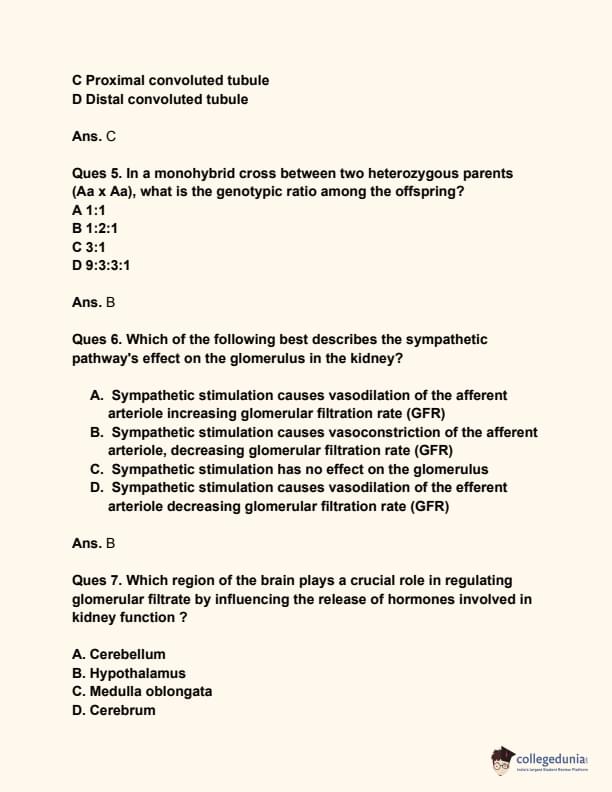
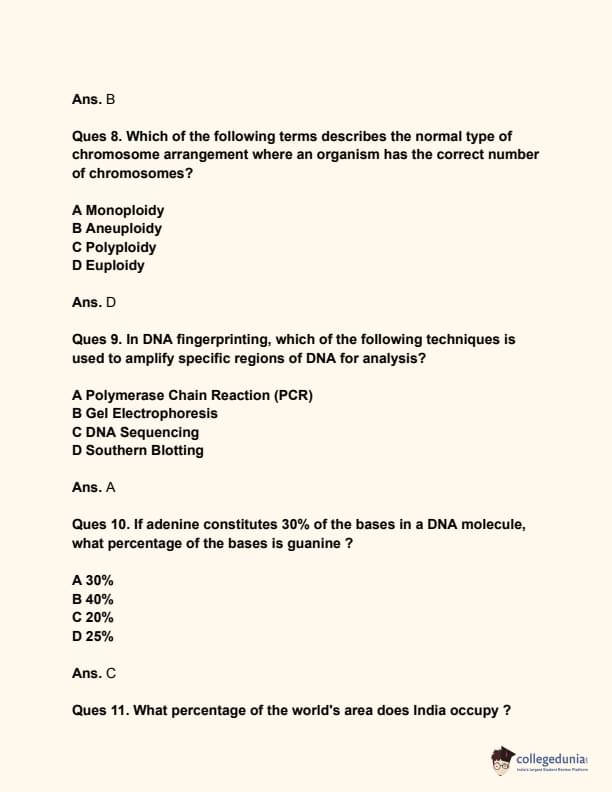
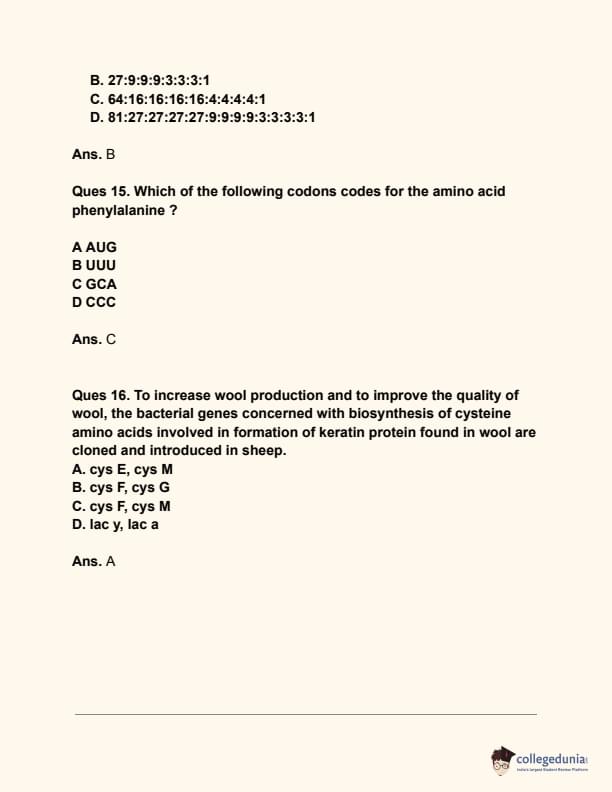
MHT CET 2024 23 April Shift 1 question paper is available for download here. MHT CET 2024 question paper comprises 150 MCQs carrying a total weightage of 200 marks. MHT CET 2024 23 April Shift 1 Question Paper for PCB is divided into three subjects- Physics, Chemistry and Biology. The Physics and Chemistry section of MHT CET 2024 23 April Shift 1 question paper consists of 50 questions (10 questions from Class 11 and 40 questions from Class 12th syllabus). Meanwhile, the Biology paper of MHT CET 2024 23 April Shift 1 question paper consists of 100 questions (20 questions from Class 11th and 80 questions from Class 12th syllabus).
MHT CET 2024 23 April Shift 1 Question Paper PDF Download
| MHT CET 2024 23 April Shift 1 Question Paper 2024 with Answer Key | Check Solutions |
MHT CET 2024 23 April Shift 1 Questions with Solutions
Question 1:
What is the approximate size range of lymphocytes, a type of white blood cell?
View Solution
Overview of lymphocytes. Lymphocytes are a category of white blood cells that are vital for the immune system. They include T-cells, B-cells, and natural killer (NK) cells, which are involved in adaptive immunity and innate immune responses.
Lymphocyte size range. The typical size of lymphocytes ranges from 10 to 15 micrometers. Larger lymphocytes are generally activated or immature, while smaller ones are usually in a resting state.
Explanation of options.
- Option (A): Incorrect. Lymphocytes are usually larger than 5-10 micrometers.
- Option (B): Correct. The common size range for lymphocytes is 10-15 micrometers.
- Option (C): Incorrect. Lymphocytes do not typically exceed 15 micrometers in size.
- Option (D): Incorrect. The size of lymphocytes rarely reaches 20-25 micrometers.
Question 2:
Which of the following hormones plays a key role in kidney osmoregulation by promoting water reabsorption in the collecting ducts?
View Solution
Role of ADH in osmoregulation. Antidiuretic hormone (ADH), also known as vasopressin, is released by the posterior pituitary gland. It facilitates water reabsorption in the collecting ducts by increasing their permeability to water.
Explanation of other hormones.
- Insulin (Option A): Incorrect. Insulin regulates glucose metabolism and does not influence kidney function related to water balance.
- Glucagon (Option B): Incorrect. Glucagon primarily regulates blood glucose levels and does not affect water reabsorption.
- Aldosterone (Option D): Incorrect. Aldosterone regulates sodium reabsorption, indirectly affecting water balance, but it is not the main hormone for osmoregulation.
The key hormone for water reabsorption in the collecting ducts is: Antidiuretic hormone (ADH).
Question 3:
Which of the following structures in the kidney is primarily responsible for the reabsorption of water and solutes from the filtrate?
View Solution
Function of the proximal convoluted tubule (PCT). The proximal convoluted tubule is the first section of the nephron where significant reabsorption occurs. Around 65-70% of filtered water and solutes are reabsorbed here.
Explanation of other options.
- Option (A): Glomerulus. Incorrect. The glomerulus filters blood but does not directly reabsorb substances.
- Option (B): Bowman's capsule. Incorrect. The Bowman's capsule collects the filtrate but does not participate in reabsorption.
- Option (D): Distal convoluted tubule. Incorrect. The distal convoluted tubule is involved in fine-tuning solute reabsorption and secretion but does not account for the majority of reabsorption.
Conclusion. The primary site for the reabsorption of water and solutes in the kidney is the proximal convoluted tubule.
Question 4:
In a monohybrid cross between two heterozygous parents (Aa × Aa), what is the genotypic ratio among the offspring?
View Solution
Punnett square analysis. For the cross Aa × Aa, we construct a Punnett square as follows:
| A | a | |
| A | AA | Aa |
| a | Aa | aa |
Genotypic ratio. The offspring genotypes are:
- *AA*: 1 individual.
- *Aa*: 2 individuals.
- *aa*: 1 individual.
Explanation of options.
- Option (A): Incorrect. This ratio is not possible for a monohybrid cross with two heterozygous parents.
- Option (B): Correct. The genotypic ratio for this cross is 1 : 2 : 1.
- Option (C): Incorrect. This is the phenotypic ratio for a different type of cross.
- Option (D): Incorrect. This ratio is associated with a dihybrid cross.
Question 5:
Which of the following best describes the sympathetic pathway's effect on the glomerulus in the kidney?
View Solution
Sympathetic response in kidney function. The sympathetic nervous system, activated during stress, causes vasoconstriction of the afferent arteriole, which reduces blood flow to the glomerulus and decreases the glomerular filtration rate (GFR).
Explanation of other options.
- Option (A): Incorrect. Vasodilation of the afferent arteriole would increase GFR, not decrease it.
- Option (B): Correct. Sympathetic stimulation causes vasoconstriction of the afferent arteriole, reducing GFR.
- Option (C): Incorrect. Sympathetic stimulation significantly impacts kidney function.
- Option (D): Incorrect. Sympathetic stimulation affects the afferent arteriole, not the efferent arteriole.
Question 6:
Which region of the brain plays a crucial role in regulating glomerular filtrate by influencing the release of hormones involved in kidney function?
View Solution
Role of the hypothalamus in kidney function. The hypothalamus plays a key role in maintaining homeostasis, including fluid and electrolyte balance. It regulates kidney function by influencing the release of antidiuretic hormone (ADH) from the posterior pituitary gland, which in turn promotes water reabsorption in the kidneys.
Explanation of other options.
- Option (A): Cerebellum. Incorrect. The cerebellum is primarily responsible for motor coordination and balance, not kidney function.
- Option (C): Medulla oblongata. Incorrect. While it controls vital functions such as heart rate, it does not directly regulate kidney hormones.
- Option (D): Cerebrum. Incorrect. The cerebrum is responsible for higher cognitive functions and does not regulate kidney function.
Conclusion. The hypothalamus is the primary brain region responsible for regulating hormones like ADH, which are crucial for kidney function.
Question 7:
Which of the following terms describes the normal type of chromosome arrangement where an organism has the correct number of chromosomes?
View Solution
Understanding chromosome arrangements. The term "euploidy" refers to the normal chromosome arrangement in an organism, where the number of chromosomes is balanced and appropriate for the species. In humans, this means having two complete sets of chromosomes (diploid, 2n).
Explanation of terms.
- Monoploidy (Option A): Refers to cells with a single set of chromosomes (e.g., n), which is rare in diploid organisms.
- Aneuploidy (Option B): Refers to an abnormal number of chromosomes due to the gain or loss of specific chromosomes (e.g., trisomy, monosomy).
- Polyploidy (Option C): Refers to organisms having more than two complete sets of chromosomes (e.g., 3n, 4n), which is common in plants but abnormal in humans.
- Euploidy (Option D): Refers to the normal condition in which an organism has a complete set of chromosomes, either haploid or diploid depending on the species.
Conclusion. The correct term for a normal chromosome arrangement is euploidy.
Question 8:
In DNA fingerprinting, which of the following techniques is used to amplify specific regions of DNA for analysis?
View Solution
Role of PCR in DNA fingerprinting. Polymerase Chain Reaction (PCR) is a technique used to selectively amplify specific regions of DNA, enabling the creation of multiple copies of a target DNA sequence for analysis. This is a crucial step in DNA fingerprinting to identify genetic markers.
Explanation of other techniques.
- Gel Electrophoresis (Option B): This technique is used to separate DNA fragments by size but does not amplify DNA.
- DNA Sequencing (Option C): DNA sequencing identifies the exact sequence of nucleotides, but it is not used for amplification in fingerprinting.
- Southern Blotting (Option D): This technique detects specific DNA sequences but does not involve amplification of the DNA.
Conclusion. PCR is the technique used to amplify specific regions of DNA for analysis in DNA fingerprinting.
Question 9:
If adenine constitutes 30% of the bases in a DNA molecule, what percentage of the bases is guanine?
View Solution
Understanding Chargaff's rule. According to Chargaff's rule, in a double-stranded DNA molecule, adenine (A) pairs with thymine (T), and guanine (G) pairs with cytosine (C). Therefore, A = T and G = C. This means the sum of adenine and thymine equals the sum of guanine and cytosine: A + T + G + C = 100%.
Calculating the percentage of guanine. If adenine makes up 30% of the bases, thymine must also make up 30%. This gives: A + T = 30% + 30% = 60%. Thus, guanine and cytosine together must account for 40%: G + C = 100% - 60% = 40%. Since guanine and cytosine are present in equal amounts, G = C = 40% / 2 = 20%.
Conclusion. The percentage of guanine in the DNA molecule is 20%.
Question 10:
What percentage of the world's area does India occupy?
View Solution
Overview of India's land area. India spans approximately 3.28 million square kilometers, accounting for around 2.4% of the total global land area, which is estimated to be 148.94 million square kilometers.
Calculating the percentage. The percentage occupied by India is calculated by dividing its area by the total world land area:
Clarification of the other options.
- Option (A): Incorrect. 4.4% is too large compared to India's actual share of the world's land area.
- Option (B): Incorrect. 6.1% is far higher than the actual percentage.
- Option (D): Incorrect. 9.8% is significantly overestimated for India's land area.
Conclusion. India occupies approximately 2.4% of the world's land area.
Question 11:
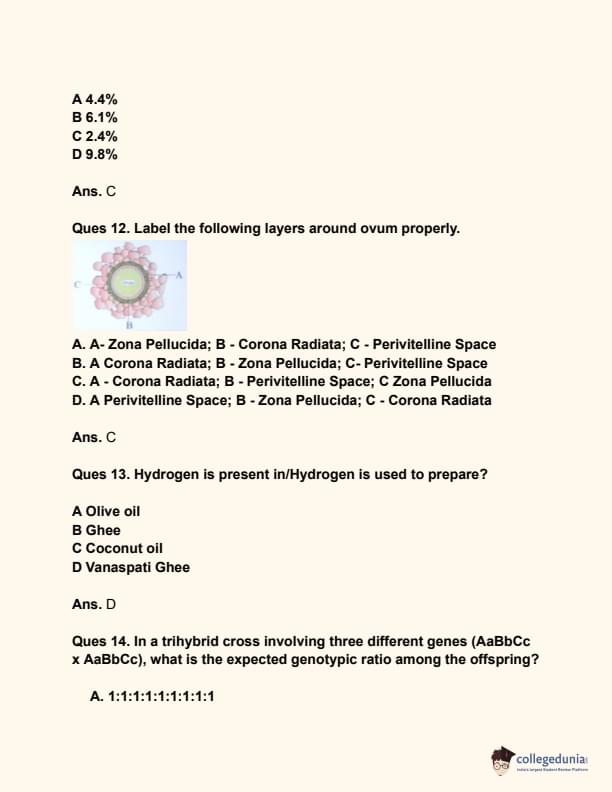
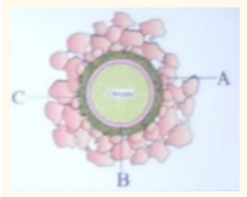
Label the following layers around ovum properly.
View Solution
Understanding the ovum layers. The ovum is surrounded by three distinct layers:
- Corona Radiata: The outermost layer of cells that nourishes and protects the ovum.
- Perivitelline Space: A fluid-filled area between the zona pellucida and the ovum's cell membrane.
- Zona Pellucida: The glycoprotein-rich layer around the ovum, which facilitates sperm binding during fertilization.
Labeling the layers. From the image:
- A: This corresponds to the outermost layer, which is the corona radiata.
- B: This represents the space between the zona pellucida and the ovum, known as the perivitelline space.
- C: This is the zona pellucida, the glycoprotein layer surrounding the ovum.
Conclusion. The correct labeling is: A – Corona Radiata, B – Perivitelline Space, C – Zona Pellucida.
Question 12:
Hydrogen is used to prepare?
View Solution
Hydrogenation process for Vanaspati Ghee. Vanaspati Ghee is produced by hydrogenating liquid vegetable oils. In this process, hydrogen gas is added to unsaturated fatty acids in the oil in the presence of a catalyst, typically nickel, converting them into saturated fatty acids, resulting in a solidified product.
Explanation of other options.
- Option (A): Incorrect. Olive oil remains liquid and is not hydrogenated.
- Option (B): Incorrect. Ghee is made from animal fats and does not require hydrogenation.
- Option (C): Incorrect. Coconut oil is naturally saturated and does not require hydrogenation.
Conclusion. Hydrogenation is used in the preparation of Vanaspati Ghee.
Question 13:
In a trihybrid cross involving three different genes (AaBbCc × AaBbCc), what is the expected genotypic ratio among the offspring?
View Solution
Understanding the trihybrid cross. This cross involves three genes (A, B, C) that assort independently, as per Mendel's law. The parents are both heterozygous for all three traits (AaBbCc).
Calculating the phenotypic ratio. For a trihybrid cross, the total number of possible phenotypes can be calculated using the formula: (3+1)(3+1)(3+1) = 64 phenotypes. The resulting phenotypic ratio is: 27:9:9:9:3:3:3:1.
Explanation of the ratio.
- 27: Organisms with all dominant traits.
- 9: Organisms with two dominant traits and one recessive.
- 3: Organisms with one dominant and two recessive traits.
- 1: Organisms with all recessive traits.
Question 14:
Which of the following codons codes for the amino acid phenylalanine?
View Solution
Overview of the genetic code. The genetic code consists of codons, sequences of three nucleotides, each of which codes for a specific amino acid.
Codon for phenylalanine. The codons that code for the amino acid phenylalanine (Phe) are: UUU and UUC.
Explanation of other options.
- Option (A): Incorrect. AUG is the start codon and codes for methionine.
- Option (B): Correct. UUU is the codon for phenylalanine.
- Option (C): Incorrect. GCA codes for alanine.
- Option (D): Incorrect. CCC codes for proline.
Conclusion. The codon UUU codes for phenylalanine.
Question 15:
To increase wool production and to improve the quality of wool, the bacterial genes concerned with biosynthesis of cysteine amino acids involved in formation of keratin protein found in wool are cloned and introduced in sheep.
View Solution
Understanding the role of cysteine in wool production. Cysteine is a sulfur-containing amino acid crucial for forming disulfide bonds in keratin, which enhances the strength and quality of wool. Genes involved in the biosynthesis of cysteine are targeted for genetic modification.
Key bacterial genes. The bacterial genes cysE and cysM are responsible for the biosynthesis of cysteine. These genes are cloned and introduced into sheep to enhance wool quality and production.
Explanation of other options.
- Option (A): Correct. These are the genes involved in cysteine biosynthesis.
- Option (B): Incorrect. These genes are not involved in cysteine biosynthesis.
- Option (C): Incorrect. Only *cysM* is relevant; *cysF* is not involved.
- Option (D): Incorrect. These are lactose metabolism genes and are unrelated to wool production.
Conclusion. The genes *cysE* and *cysM* are critical for improving wool quality.
Question 16:
What are the 4 types of hydrocarbons?
View Solution
Understanding hydrocarbons. Hydrocarbons are organic compounds made up exclusively of carbon and hydrogen atoms. They are categorized into four main types based on their structure and bonding patterns.
Types of hydrocarbons. The four types of hydrocarbons are:
- Alkanes: These are saturated hydrocarbons, meaning they have only single bonds between carbon atoms. An example is methane (CH4).
- Alkenes: These are unsaturated hydrocarbons containing at least one double bond between carbon atoms. An example is ethene (C2H4).
- Alkynes: These hydrocarbons are also unsaturated but contain at least one triple bond between carbon atoms. An example is ethyne (C2H2).
- Aromatic hydrocarbons: These include cyclic compounds with alternating single and double bonds, forming a conjugated π-electron system. An example is benzene (C6H6).
Conclusion: The four types of hydrocarbons are alkanes, alkenes, alkynes, and aromatic hydrocarbons.
Question 17:
The number of π-bonds present in benzoic acid is:
View Solution
Structure of benzoic acid. Benzoic acid (C6H5COOH) consists of a benzene ring with alternating double bonds (three π-bonds) and a carboxylic acid group (-COOH) attached to the benzene ring. The carboxylic group has one π-bond in the C=O bond.
Total number of π-bonds.
- Benzene ring: 3π-bonds.
- Carboxyl group: 1π-bond in C=O.
Conclusion. The total number of π-bonds in benzoic acid is 5.
Question 18:
Water is flowing through a horizontal pipe in streamline flow. At the narrowest part of the pipe:
View Solution
Understanding Bernoulli's principle. Bernoulli's principle states that for an incompressible, non-viscous fluid in streamline flow:
- *P*: Pressure of the fluid,
- *ρ*: Density of the fluid,
- *v*: Velocity of the fluid,
- *h*: Height of the fluid.
Application to a horizontal pipe. For a horizontal pipe (h is constant), the equation simplifies to:
Narrowest part of the pipe. At the narrowest part of the pipe:
- The cross-sectional area is minimum.
- By the equation of continuity (A1v1 = A2v2), the velocity is maximum.
- By Bernoulli's principle, the pressure is minimum.
Conclusion. At the narrowest part of the pipe, the velocity is maximum, and the pressure is minimum.
Question 19:
If an electron jumps from the 3rd orbit to the 2nd orbit, its wavelength is λ. Then the wavelength of the electron when it jumps from the 4th orbit to the 3rd orbit in terms of λ is:
View Solution
Using the Rydberg formula for wavelength. The wavelength λ of the photon emitted during an electronic transition is given by the Rydberg formula:
- R: Rydberg constant,
- n1: Final orbit number,
- n2: Initial orbit number (n2 > n1).
For the transition from the 3rd orbit (n2 = 3) to the 2nd orbit (n1 = 2). The wavelength is given as λ. Substituting into the Rydberg formula:
For the transition from the 4th orbit (n2 = 4) to the 3rd orbit (n1 = 3). The wavelength for this transition, say λ', is:
Relating λ' to λ. Divide the two equations:
Conclusion. The wavelength of the electron when it jumps from the 4th orbit to the 3rd orbit is: 20/7λ
Question 20:
The height from Earth's surface at which acceleration due to gravity becomes *g*/4 is __? (Where *g* is the acceleration due to gravity on the surface of the Earth and *R* is the radius of the Earth.)
View Solution
Formula for acceleration due to gravity at a height h from Earth's surface. The acceleration due to gravity at a height *h* is given by:
- *gh*: Acceleration due to gravity at height *h*,
- *g*: Acceleration due to gravity on the surface of the Earth,
- *R*: Radius of the Earth.
Setting gh = g/4. Substitute gh = g/4 into the equation:
Simplifying the equation. Cancel *g* from both sides:
Solve for h. h = 2R - R = R.
Conclusion. The height from Earth's surface at which acceleration due to gravity becomes g/4 is: R
.
Also Check:
MHT CET Previous Year Question Papers
| MHT CET 2023 Question Paper | MHT CET 2022 Question Paper |
| MHT CET 2021 Question Paper | MHT CET 2020 Question Paper |
| MHT CET 2019 Question Paper | MHT CET 2018 Question Paper |
Also Check:



Comments