MHT CET 2024 22 April Shift 1 question paper is available here. MHT CET 2024 question paper comprises 150 MCQs carrying a total weightage of 200 marks. MHT CET 2024 22 April Shift 1 Question Paper for PCB is divided into three subjects- Physics, Chemistry and Biology. The Physics and Chemistry section of MHT CET 2024 22 April Shift 1 question paper consists of 50 questions (10 questions from Class 11 and 40 questions from Class 12th syllabus). Meanwhile, the Biology paper of MHT CET 2024 22 April Shift 1 question paper will include 100 questions (20 questions from Class 11th and 80 questions from Class 12th syllabus).
MHT CET 2024 22 April Shift 1 Question Paper PDF Download
| MHT CET 2024 22 April Shift 1 Question Paper 2024 with Answer Key | Check Solutions |
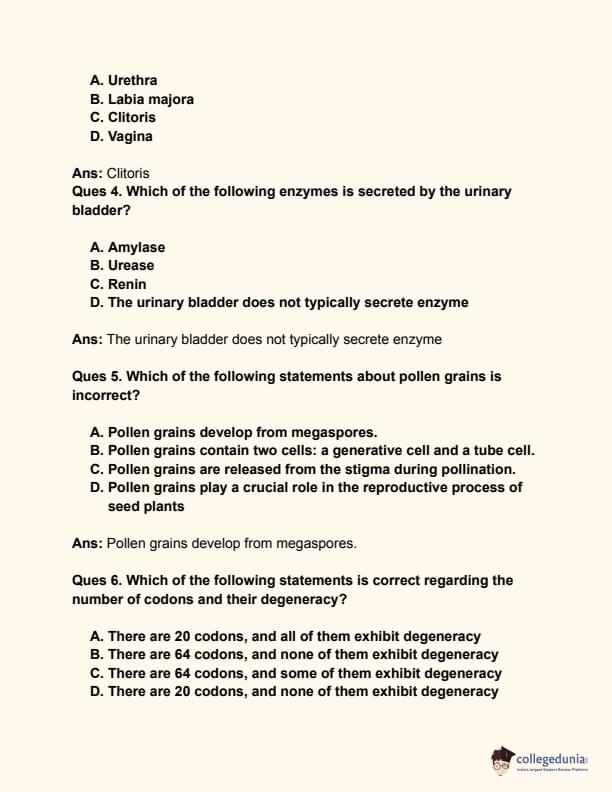
MHT CET 2024 22 April Shift 1 Questions with Solutions
Question 1:
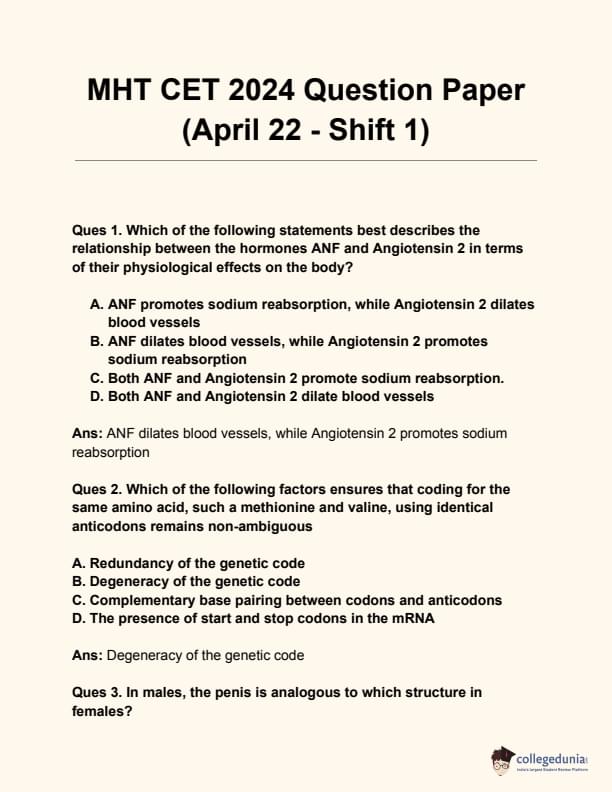
Which of the following statements best describes the relationship between the hormones ANF and Angiotensin 2 in terms of their physiological effects on the body?
View Solution
Understanding ANF and Angiotensin II:
ANF (Atrial Natriuretic Factor): A hormone secreted by the heart in response to increased blood volume or pressure. It acts to reduce blood pressure and volume.
Angiotensin II: A hormone involved in the renin-angiotensin-aldosterone system (RAAS), which helps regulate blood pressure.
Step-by-step Explanation:
1. ANF Effects:
Vasodilation: ANF dilates blood vessels, which decreases blood pressure.
Sodium Excretion: ANF increases sodium excretion, decreasing blood volume and pressure.
2. Angiotensin II Effects:
Vasoconstriction: Angiotensin II causes blood vessels to constrict, increasing blood pressure.
Sodium Reabsorption: Angiotensin II promotes sodium reabsorption in the kidneys, which increases blood volume and pressure.
3. Comparing the Actions: ANF and Angiotensin II have opposing actions. ANF promotes vasodilation and sodium excretion. Angiotensin II promotes vasoconstriction and sodium reabsorption
Conclusion: The statement that best describes the relationship is: ANF dilates blood vessels, while Angiotensin 2 promotes sodium reabsorption.
Question 2:
Which of the following factors ensures that coding for the same amino acid, such as methionine and valine, using identical anticodons remains non-ambiguous?
View Solution
Understanding Genetic Code and Degeneracy:
Genetic Code: The set of rules by which information encoded in genetic material (DNA or RNA sequences) is translated into proteins by living cells.
Codon: A sequence of three nucleotides that forms a unit of the genetic code in a DNA or RNA molecule.
Anticodon: A sequence of three nucleotides located at one end of transfer RNA (tRNA) molecules, that is complementary to the corresponding codon on a mRNA molecule. Degeneracy: The property of the genetic code where multiple codons can code for the same amino acid.
Step-by-step Explanation:
1. Analyzing the Options:
Option 1 (Incorrect): Redundancy refers to multiple codons for the same amino acid, but does not ensure clarity.
Option 2 (Correct): Degeneracy ensures that even if there are multiple codons for a single amino acid, a unique anticodon corresponds to one codon.
Option 3 (Incorrect): Complementary base pairing ensures the tRNA correctly recognizes the mRNA during translation but does not explain lack of ambiguity with identical anticodons.
Option 4 (Incorrect): The start and stop codons mark the beginning and end of translation but do not ensure non-ambiguous coding by multiple codons.
Conclusion: The factor that ensures the same amino acid coding remains non-ambiguous using identical anticodons is the degeneracy of the genetic code.
Question 3:
In males, the penis is analogous to which structure in females?
View Solution
Understanding Anatomical Analogies:
Analogous structures are those that have similar function and structure but have evolved from similar embryonic tissue.
Analyzing the Options:
1. Development of Sexual Organs: Both the penis and clitoris develop from the same embryonic structure: the genital tubercle. Hormonal influences determine their further development. Testosterone leads to the formation of the penis, and absence of significant testosterone leads to clitoris formation.
2. Comparison:
Urethra: While both penis and urethra is used for micturition, the urethra in females is not analogous to penis.
Labia Majora: Labia majora is analogous to the scrotum.
Clitoris: The clitoris and penis are similar in the types of tissues they contain (erectile tissue, sensory nerve endings), and they develop from the same embryonic tissue, thus are homologous and analogous organs.
Vagina: The vagina is the female reproductive tract and has no analogue in males.
Conclusion:
The penis is analogous to the clitoris in females.
Question 4:
Which of the following enzymes is secreted by the urinary bladder?
View Solution
Understanding the Function of the Urinary Bladder:
The urinary bladder is primarily a storage organ for urine and does not participate in the production of enzymes.
Analyzing the Options:
1. Review the locations and function of enzymes:
Amylase: Amylase is secreted by the pancreas and salivary glands involved in digestion.
Urease: Urease is found in some bacteria and fungi, not produced by the urinary bladder.
Renin: Renin is secreted by the kidneys and is involved in blood pressure regulation.
Urinary Bladder: The urinary bladder stores and expels urine and does not secrete enzymes.
Conclusion:
The correct statement is that the urinary bladder does not typically secrete enzymes.
Question 5:
Which of the following statements about pollen grains is incorrect?
View Solution
Understanding Pollen Grain Development:
Pollen grains are the male gametophytes of seed plants. They carry the male gametes. They are formed from specific cells that undergo meiosis and mitosis.
Analyzing the Options:
1. Review the stages of pollen grain development:
Option 1 (Incorrect): Pollen grains are developed from microspores, in the male part of the plant, which are developed through meiosis. Megaspores are involved in the formation of the female gametophyte.
Option 2 (Correct): Pollen grains contain a generative cell (which develops into two sperm cells) and a tube cell that forms a pollen tube.
Option 3 (Incorrect): Pollen grains are released from anthers during pollination, not from the stigma.
Option 4 (Correct): Pollen grains are essential for carrying the male gametes that are required for sexual reproduction in seed plants.
Conclusion:
The incorrect statement is: Pollen grains develop from megaspores.
Question 6:
Which of the following statements is correct regarding the number of codons and their degeneracy?
View Solution
Understanding Codons and Degeneracy:
Codons are triplet sequences of nucleotides in mRNA that specify an amino acid during protein synthesis. Degeneracy refers to the presence of multiple codons that code for the same amino acid.
Analyzing the Options:
1. Genetic Code: The genetic code has 64 codons (4 bases in 3 different combinations = 43 = 64). These 64 codons specify 20 amino acids and have start and stop codons for protein synthesis.
2. Degeneracy: Not all codons are unique, and some amino acids are coded by multiple codons (degeneracy). Some amino acids, like methionine, are coded for by a single codon. Other amino acids, like leucine, are coded for by multiple codons.
Conclusion:
The correct statement is: There are 64 codons, and some of them exhibit degeneracy.
Question 7:
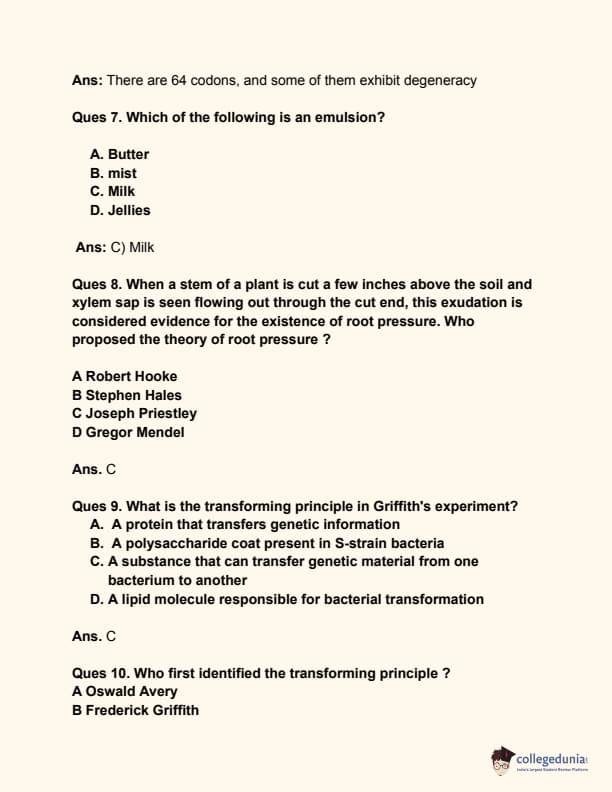
Which of the following is an emulsion?
View Solution
Understanding Emulsions:
An emulsion is a colloid of two or more immiscible liquids, where one is dispersed in the other in the form of droplets.
Analyzing the Options:
1. Classification:
Butter: Butter is a water-in-fat dispersion, not a fat-in-water emulsion. It is therefore, not an emulsion.
Mist: Mist is an aerosol where a liquid is dispersed in a gas (air), not an emulsion.
Milk: Milk is a fat-in-water emulsion where fat globules are dispersed in water.
Jellies: Jellies are gels, where a solid forms a network within a liquid.
Conclusion:
The correct example of an emulsion from the given options is Milk.
Question 8:
When a stem of a plant is cut a few inches above the soil and xylem sap is seen flowing out through the cut end, this exudation is considered evidence for the existence of root pressure. Who proposed the theory of root pressure?
View Solution
Understanding Root Pressure:
Root pressure is the pressure generated within the roots as they actively absorb water and minerals from the soil. This pressure helps drive water transport up the plant.
Historical Contributions:
1. Review the contributions:
Robert Hooke: Known for his contributions to cell theory.
Stephen Hales: A pioneer in plant physiology research, but did not propose the theory of root pressure.
Joseph Priestley: Proposed and studied the theory of root pressure.
Gregor Mendel: Known for his work on genetics.
Conclusion:
The scientist who proposed and studied the theory of root pressure is Joseph Priestley.
Question 9:
What is the transforming principle in Griffith's experiment?
View Solution
Understanding Griffith's Experiment:
Griffith's experiment demonstrated the concept of bacterial transformation, which is the transfer of genetic material from one bacterium to another.
Step-by-step Explanation:
1. Griffith's Experiment: Griffith used two strains of *Streptococcus pneumoniae: S-strain (virulent) R-strain (non-virulent)
2. Key Findings: Heat-killed S-strain could not cause the disease. Live R-strain could not cause the disease. However, a mixture of heat-killed S-strain and live R-strain could cause the disease in mice.
3. Transforming Principle: A substance from the heat-killed S-strain was transforming the live R-strain into the virulent S-strain. This substance was called the transforming principle, which was later shown to be DNA.
4. Analyzing the Options: Proteins, lipids, and polysaccharides are incorrect. It is the genetic material that is the cause.
Conclusion:
The transforming principle was a substance that can transfer genetic material from one bacterium to another, later found to be DNA.
Question 10:
Who first identified the transforming principle?
View Solution
Understanding the Discovery of the Transforming Principle:
We need to identify who was the first to propose the existence of the transforming principle, though they did not identify it.
Historical Context:
1. Key Experiments and Scientists: * Frederick Griffith performed the experiment that indicated a "transforming principle". * Oswald Avery was the first to *identify* the transforming principle as DNA. * James Watson and Francis Crick were key in uncovering the structure of DNA. * Rosalind Franklin contributed to the understanding of DNA structure with X-ray crystallography
Conclusion:
The scientist who first indicated the existence of the transforming principle is Frederick Griffith.
Also Check:
MHT CET Previous Year Question Papers
| MHT CET 2023 Question Paper | MHT CET 2022 Question Paper |
| MHT CET 2021 Question Paper | MHT CET 2020 Question Paper |
| MHT CET 2019 Question Paper | MHT CET 2018 Question Paper |
Also Check:



Comments