




Wave Optics is an important topic in the Physics section in WBJEE exam. Practising this topic will increase your score overall and make your conceptual grip on WBJEE exam stronger.
This article gives you a full set of WBJEE PYQs for Wave Optics with explanations for effective preparation. Practice of WBJEE Physics PYQs including Wave Optics questions regularly will improve accuracy, speed, and confidence in the WBJEE 2026 exam.
Also Read
WBJEE PYQs for Wave Optics with Solutions
1.
X-rays of wavelength λ get reflected from parallel planes of atoms in a crystal with spacing d between two planes as shown in the figure. If the two reflected beams interfare constructively,Then the condition for maxima will be(n is the order of interference fringe)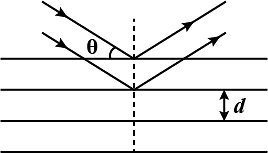
- d tanθ=nλ
- d sinθ=nλ
- 2d cosθ=nλ
- 2d sinθ=nλ
2.
Three identical thin bar magnets, each of moment M, are placed along three adjacent sides of a regular hexagon as shown in the figure. The resultant magnetic moment of the system is
- (A) M
- (B) M√3
- (C) M√2
- (D) 2M
3.
If Young?s double slit experiment is done with white light, which of the following statements will be true ?- All the bright fringes wil be coloured
- All the bright fringes will be white
- The central fringe will be white
- No stable interference pattern will be visible
4.
Light of wavelength \(6000 \, \text{Å}\) is incident on a thin glass plate of refractive index \(1.5\) such that the angle of refraction into the plate is \(60^\circ\). Calculate the smallest thickness of the plate which will make a dark fringe by reflected beam interference.- \(1.5 \times 10^{-7} \, \text{m}\)
- \(2 \times 10^{-7} \, \text{m}\)
- \(3.5 \times 10^{-7} \, \text{m}\)
- \(4 \times 10^{-7} \, \text{m}\)
5.
In a single-slit diffraction experiment, the slit is illuminated by light of two wavelengths \(\lambda_1\) and \(\lambda_2\). It is observed that the 2nd order diffraction minimum for \(\lambda_1\) coincides with the 3rd diffraction minimum for \(\lambda_2\). Then:- \(\frac{\lambda_1}{\lambda_2} = \frac{2}{3}\)
- \(\frac{\lambda_1}{\lambda_2} = \frac{5}{7}\)
- \(\frac{\lambda_1}{\lambda_2} = \frac{3}{2}\)
- \(\frac{\lambda_1}{\lambda_2} = \frac{7}{5}\)
6.
In Young�s double slit experiment, the fringe width is $\beta$. If the entire arrangement is placed in a liquid of refractive index $n$, the fringe width becomes :- $n\beta$
- $\frac{\beta}{n+1}$
- $\frac{\beta}{n-1}$
- $\frac{\beta}{n}$



Comments