




The TS EAMCET Exam Pattern 2027 is expected to have a 3 hour computer based test with 160 questions for 160 marks. The TS EAMCET Exam pattern 2027 will differ by stream, with MPC for Engineering and BiPC for Agriculture and Pharmacy candidates.
- The TS EAMCET Total Marks 2027 is 160 marks with 1 mark awarded for every correct answer and no negative marking.
- The exam is now referred to as TG EAPCET in Telangana's official admission ecosystem, although TS EAMCET remains a widely used name for the examination.
- The TS EAMCET MPC paper is expected to have 80 questions from Mathematics, 40 from Physics and 40 from Chemistry.
- The TS EAMCET Exam pattern for Agriculture and Pharmacy (BiPC) paper is expected to have 40 questions each from Botany, Zoology, Physics and Chemistry.
- Candidates can expect the question paper in English, Telugu and Urdu according to the stated exam pattern.
- With 160 questions in 180 minutes, candidates get an average of about 67.5 seconds per question during the examination.
- Since there is no negative marking, candidates can attempt unanswered questions without losing marks for incorrect responses.
Related Links:
- TS EAMCET Syllabus 2027: Subject Wise Topics, Chapter Wise Weightage and PDF Download
- TS EAMCET Paper Analysis: Difficulty Level, Past Year Analysis, Marks vs Rank & Good Score
- TS EAMCET Question Paper: Check Previous Year Question Paper with Solution PDF (2024-2015)
Key Summary
- TS EAMCET Exam Pattern 2027 is expected to remain unchanged from recent years with 3 hours allotted for the CBT.
- The exam is expected to be held in multiple sessions with normalisation used to account for differences in paper difficulty.
- The 2020 change removed the 25% Intermediate board marks weightage making the entrance score the basis for ranking.
- TG EAPCET was introduced as the exam name in 2024 while the 160 question format and marking scheme remained unchanged.
- In the estimated TS EAMCET chapter-wise trends Functions, Products of Vectors, Probability, Circle and Complex Numbers are among the higher weightage Maths areas.
TS EAMCET Exam Pattern 2027 Overview
The TS EAMCET exam 2027 also known as TG EAPCET is expected to remain the same as recent years based on the structure followed in 2025-26.
| Particulars | Details |
|---|---|
| Exam Mode | Computer-Based Test (CBT / Online) |
| Duration | 3 hours (180 minutes) |
| Medium of Exam | English, Telugu & Urdu |
| Question Type | Multiple Choice Questions (MCQs) |
| Total Questions | 160 |
| Total Marks | 160 |
| Number of Questions |
|
| Marking Scheme | +1 mark for every correct answer |
| Negative Marking | None |
| Conducting Body | JNTUH on behalf of TSCHE |
Also Check:
- TS EAMCET Mock Test: Attempt Online Free Mock Test Chapter-wise
- TS EAMCET Chapter-Wise Weightage: Subject-wise weightage, Important Topic & Syllabus
Ques. Is there any negative marking in EAMCET 2027?
Ans. No. TG EAPCET 2027 is expected to follow the recent pattern with no negative marking. The engineering paper has 160 questions for 160 marks, with 80 Mathematics, 40 Physics and 40 Chemistry questions.
TS EAMCET Exam Pattern 2027 Year-Wise Changes
TS EAMCET Exam Pattern 2027 Year-Wise Changes has retained the 160 question format, 3 hour duration, and zero negative marking despite other exam changes.
- The 25% weightage for Intermediate board marks was removed in 2020 making the entrance exam score the basis for ranking.
- After the 2014 bifurcation, the exam moved fully to computer based testing changing the mode without altering the core paper structure.
- The exam was renamed TG EAPCET in 2024 while the question count and marking scheme remained unchanged.
| TS EAMCET Year | Total Questions | Duration | Negative Marking | Notable Change |
|---|---|---|---|---|
| Pre-2014 | 160 | 3 hours | None | Offline (OMR) mode; combined AP & TS; Medical stream included |
| 2014–2019 | 160 | 3 hours | None | Shifted to CBT; separate TS EAMCET after bifurcation; Medical stream removed |
| 2020–2023 | 160 | 3 hours | None | Intermediate marks weightage removed; 100% entrance score ranking |
| 2024–2026 | 160 | 3 hours | None | Renamed to TG EAPCET; multi-shift with normalisation |
| 2027 (Expected) | 160 | 3 hours | None | No change in core pattern expected |
Also Check:
| TS EAMCET Question Paper 2025 | TS EAMCET Question Paper 2024 |
| TS EAMCET Question Paper 2023 | TS EAMCET Question Paper 2022 |
| TS EAMCET Question Paper 2021 | TS EAMCET Question Paper 2020 |
Ques. Which shift was the toughest for the TG EAMCET 2026?
Ans. May 10 Shift 1 was considered the toughest shift of TG EAMCET 2026, with Mathematics being particularly difficult and lengthy. May 9 Shift 2 was also among the toughest shifts.
TS EAMCET Exam Pattern 2027 Stream-Wise
TS EAMCET Exam Pattern 2027 Stream-Wise is expected to have 160 MCQs for 160 marks in both MPC and BiPC with no negative marking.
- Engineering stream candidates get 80 Mathematics questions making Maths worth half of the total 160 marks.
- Physics and Chemistry carry 40 questions each in the TS EAMCET 2027 Engineering paper, giving 80 questions together.
- The BiPC paper includes 40 Botany and 40 Zoology questions together carrying 80 marks.
- TS EAMCET 2027 is expected to give BiPC candidates equal weightage to Botany and Zoology while MPC gives the highest weightage to Mathematics.
TS EAMCET 2027 Exam Pattern For Engineering Stream (MPC)
| Subject | Number of Questions | Marks |
|---|---|---|
| Mathematics | 80 | 80 |
| Physics | 40 | 40 |
| Chemistry | 40 | 40 |
| Total | 160 | 160 |
TS EAMCET 2027 Exam Pattern For Agriculture & Pharmacy / Medical Stream (BiPC)
| Subject | Number of Questions | Marks |
|---|---|---|
| Biology (Botany + Zoology) | 80 (40 + 40) | 80 |
| Physics | 40 | 40 |
| Chemistry | 40 | 40 |
| Total | 160 | 160 |
Also Check:
| TS EAMCET Question Paper 2019 | TS EAMCET Question Paper 2018 |
| TS EAMCET Question Paper 2017 | TS EAMCET Question Paper 2016 |
Ques. What rank is 40 marks in EAMCET?
Ans. In TG EAPCET Engineering, 40 marks out of 160 corresponded to a rank range of around 82,344 to 1,35,462 based on the 2025 marks-versus-rank data. The actual rank can vary each year.
TS EAMCET Exam Pattern 2027 Subject-Wise Weightage
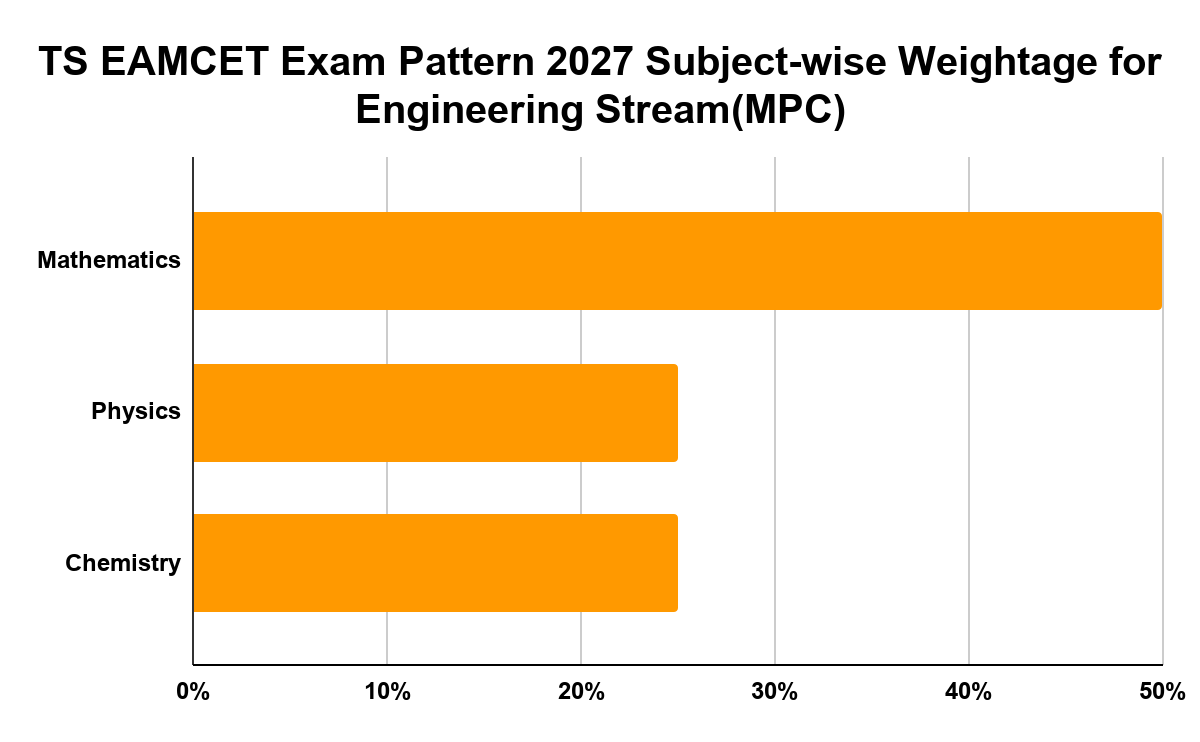
In TS EAMCET Exam Pattern 2027 Subject-Wise Weightage, Mathematics has 80 questions in the Engineering paper which is 50% of the total marks.
- Physics and Chemistry carry 40 questions each with each subject contributing 25% to the Engineering paper in TS EAMCET exam pattern 2027.
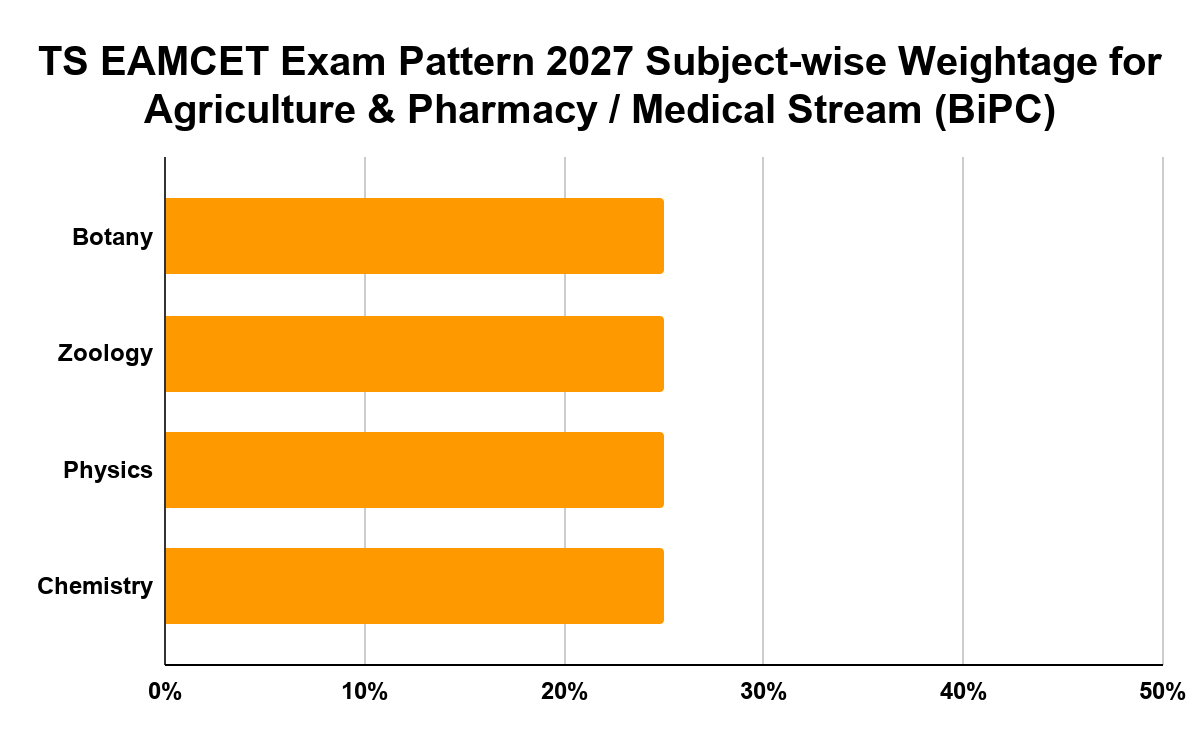
- For BiPC candidates, Biology includes 40 Botany and 40 Zoology questions and together that is 50% of the TS EAMCET exam 2027 paper.
- Physics and Chemistry each contribute 25% weightage in the BiPC stream with 40 questions from each subject in TS EAMCET Exam pattern 2027.
- The 80 mark core subject is Mathematics for Engineering and Biology for BiPC making it the largest subject wise share in TS EAMCET Exam pattern 2027.
Subject-wise Weightage for Engineering Stream(MPC)
| Subject | Number of Questions | Marks | Weightage (%) |
|---|---|---|---|
| Mathematics | 80 | 80 | 50% |
| Physics | 40 | 40 | 25% |
| Chemistry | 40 | 40 | 25% |
| Total | 160 | 160 | 100% |
Subject-wise Weightage for Agriculture & Pharmacy / Medical Stream (BiPC)
| Subject | Number of Questions | Marks | Weightage (%) |
|---|---|---|---|
| Biology (Botany + Zoology) | 80 (40+40) | 80 | 50% |
| Physics | 40 | 40 | 25% |
| Chemistry | 40 | 40 | 25% |
| Total | 160 | 160 | 100% |
Also Check:
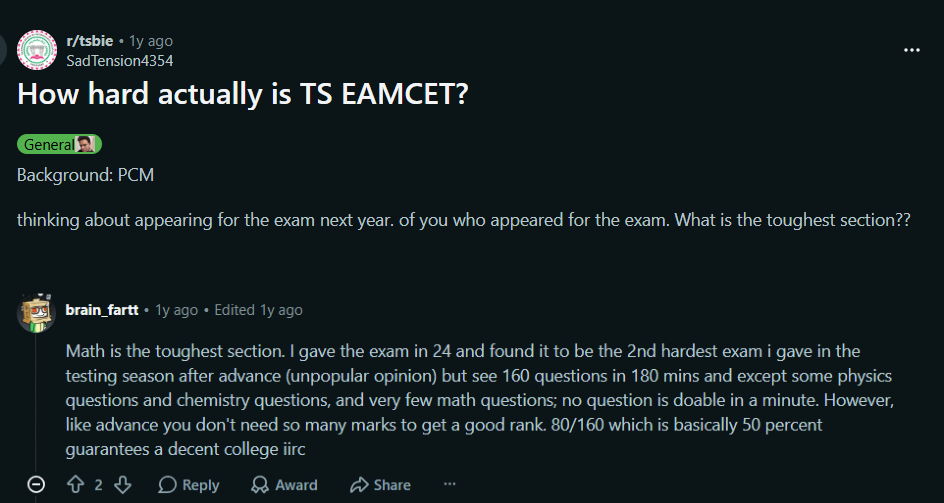
According to a Reddit discussion, TS EAMCET candidates found Mathematics to be the toughest section with the exam described as time-intensive. The discussion noted that 160 questions in 180 minutes made several questions difficult to solve within a minute while around 80/160 marks was considered enough for a decent college.
Source: Reddit
TS EAMCET Exam Pattern 2027 Chapter-Wise Weightage
The TS EAMCET Exam Pattern 2027 Chapter-Wise Weightage covers the expected number of questions from different chapters in Mathematics, Physics, Chemistry, Botany and Zoology.
- Mathematics has higher question trends from Calculus, Coordinate Geometry and Algebra, making these important areas to practise for the TS EAMCET 2027 paper.
- In Physics, candidates should prioritise Mechanics, Current Electricity, Optics and Modern Physics for TS EAMCET 2027 exam.
- Chemistry consists of Organic Chemistry, Physical Chemistry, Chemical Bonding, p-Block Elements & Coordination Compounds for the TS EAMCET exam
- Biology candidates should prioritise Human Physiology, Plant Physiology, Genetics and Biotechnology based on previous year question trends.
TS EAMCET 2027 Chapter-Wise Weightage: Maths
TS EAMCET 2027 Chapter-Wise Weightage: Physics
TS EAMCET 2027 Chapter-Wise Weightage: Chemistry
| Chapter Name | No. of Questions/ Marks |
|---|---|
| Organic Compounds Containing C,H & O | 3 |
| Atomic Structure | 2 |
| States of Matter (Gases & Liquids) | 2 |
| Thermodynamics (Physical) | 2 |
| Chemical Equilibrium, Acids & Bases | 2 |
| Solutions | 2 |
| Surface Chemistry | 2 |
| Chemical Bonding & Molecular Structure | 2 |
| P-block Elements (Grp 13 & 14) | 2 |
| D & F Block & Coordination Compounds | 2 |
| Organic Chemistry: Basic Principles & Hydrocarbons | 2 |
| Biomolecules | 2 |
| Haloalkanes & Haloarenes | 2 |
| Stoichiometry | 1 |
| Electrochemistry | 1 |
| Chemical Kinetics | 1 |
| Solid State | 1 |
| Classification of Elements & Periodicity | 1 |
| S-Block Elements | 1 |
| Hydrogen & its Compounds | 1 |
| Environmental Chemistry | 1 |
| General Principles of Metallurgy | 1 |
| P-block Elements (Grp 15-18) | 1 |
| Chemistry in Everyday Life | 1 |
| Polymers | 1 |
| Organic Compounds containing Nitrogen | 1 |
Source: YouTube
TS EAMCET 2027 Chapter-Wise Weightage: Botany
| Chapter Name | No. of Questions/ Marks |
|---|---|
| Plant Physiology | 5 - 6 |
| Reproduction in Plants | 2 - 3 |
| Cell Structure and Function | 4 - 5 |
| Plant Systematics | 2 - 3 |
| Structural Organization in Plants | 3 - 4 |
| Internal Organization of Plants | 2 - 3 |
| Molecular Biology | 3 - 4 |
| Genetics | 2 - 3 |
| Diversity in Living World | 3 - 4 |
| Biotechnology | 2 - 3 |
| Plant Ecology | 3 - 4 |
| Microbes in Human Welfare | 1 - 2 |
TS EAMCET Exam Pattern 2027 Chapter-Wise Weightage: Zoology
| Chapter Name | No. of Questions/ Marks |
|---|---|
| Human Anatomy and Physiology | 15 - 16 |
| Evolution | 1 - 2 |
| Animal Diversity | 4 - 5 |
| Applied Biology | 1 - 2 |
| Human Reproduction | 3 - 4 |
| Locomotions and Reproduction in Protozoa | 1 - 2 |
| Type Study of Periplaneta Americana | 3 - 4 |
| Structural Organization in Animals | 1 - 2 |
| Diversity in Living World | 2 - 3 |
| Genetics | 1 - 2 |
| Biology in Human Welfare | 3 - 4 |
Source: YouTube
Also Check:
Ques. Which chapters are considered high weightage for the EAMCET 2026 exam?
Ans. In TG EAMCET 2026, Calculus, Coordinate Geometry, Algebra, Mechanics, Electricity, Organic Chemistry, and Physical Chemistry are among the high-weightage areas. Mathematics has the highest overall weightage with 80 questions, while Physics and Chemistry have 40 questions each.
TS EAMCET Marking Scheme 2027
TS EAMCET Marking Scheme 2027 is expected to award +1 mark for every correct answer across the 160 question paper.
- As per the TS EAMCET Marking Scheme 2027, there are no negative marks for wrong answers hence, an incorrect answer will not deduct from the overall score.
- The unattempted questions are also 0 marks with no deduction from the final score in TS EAMCET 2027.
- The MPC and BiPC streams are expected to follow the same marking scheme in TS EAMCET 2027.
| Question Type | Correct Answer | Incorrect Answer | Unattempted |
|---|---|---|---|
| MCQ(All Subjects) | +1 mark | 0 marks | 0 marks |
How to Calculate Your TS EAMCET 2027 Score:
| TS EAMCET 2027 Score = Number of Correct Answers x 1 |
Step 1: Count the number of questions answered correctly.
Step 2: Multiply the number of correct answers by 1.
Step 3: Do not deduct marks for incorrect or unattempted questions, as there is no negative marking.
Step 4: The final number is the TS EAMCET Score 2027 out of 160 marks.
For example,
Suppose a candidate attempts 150 MCQs, out of which 125 answers are correct and 25 answers are incorrect, while 10 questions are unattempted.
- Correct answers: 125 × 1 = 125
- Incorrect answers: 25 × 0 = 0
- Unattempted questions: 10 × 0 = 0
- Final Score: 125 + 0 - 0 = 125 marks
So, the candidate's TS EAMCET Score is 125 out of 160 marks.
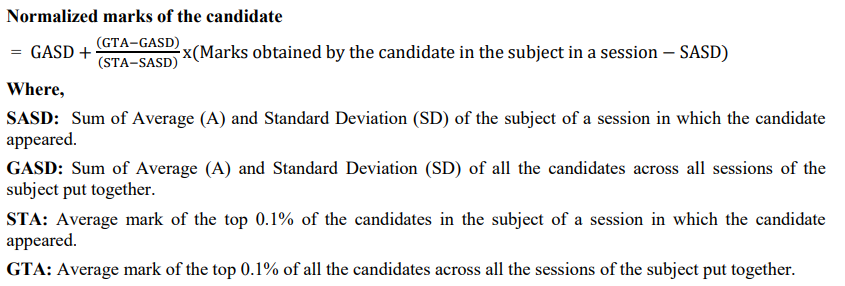
TS EAMCET 2027 Normalisation of Scores
- TS EAMCET 2027 is expected to be conducted in multiple sessions, where the difficulty level of question papers may vary.
- Normalization is used to adjust the variation in difficulty and ensure a fair comparison of candidates across sessions.
- Candidates from a difficult session may see a marginal increase in marks, while candidates from an easier session may see a marginal decrease.
- The final TS EAMCET 2027 normalization process will be confirmed in the official 2027 Information Booklet.
- As per the TG EAPCET 2026 Information Booklet, the normalization formula is:
Source: TS EAMCET Notification
Key Insights for TS EAMCET Exam Candidates:
- Question selection can be more flexible in TS EAMCET 2027 because candidates are not penalized for making an incorrect attempt.
- Candidates can use the final minutes of the exam to revisit questions left unanswered instead of losing potential marks.
- Time management remains important because all 160 questions have to be handled within the fixed examination duration.
- Candidates should compare their raw score with the normalized score before estimating the TS EAMCET 2027 rank as session wise normalization may affect the final score.
Also Check:
| TG EAPCET Mathematics Syllabus | TS EAMCET Physics Syllabus |
| TS EAMCET Chemistry Syllabus | TS EAMCET 2026 May 10 Shift 2 Engineering Question Paper with Solution PDF |
Ques. Is there negative marking in EAMCET 2027?
Ans. No. TG EAPCET 2027 is expected to continue the recent pattern of no negative marking. Candidates are awarded 1 mark for every correct answer, with no marks deducted for incorrect or unattempted questions. The final 2027 notification should be checked for confirmation.
Also Check:
TS EAMCET vs AP EAPCET vs KCET vs MHT CET Exam Pattern Comparison
Exam Pattern Comparison shows that TS EAMCET and AP EAPCET use a 160 question CBT format.
- TS EAMCET gives 80 marks to Mathematics while KCET follows a 60 mark paper for each major subject.
- MHT CET awards 2 marks per Mathematics question whereas TS EAMCET gives 1 mark per question.
- TS EAMCET, AP EAPCET, KCET and MHT CET follow zero negative marking allowing candidates to attempt questions without mark deductions.
- The exams differ mainly in question weightage, exam mode and total marks despite having the same no-negative-marking feature.
| Exam | Mode | Total Questions | Total Marks | Duration | Marking Scheme | Negative Marking | Subject Split (Engineering) |
|---|---|---|---|---|---|---|---|
| TS EAMCET (TG EAPCET) | CBT | 160 | 160 | 3 hours | +1 per correct | None | Maths 80, Physics 40, Chemistry 40 |
| AP EAPCET | CBT | 160 | 160 | 3 hours | +1 per correct | None | Maths 80, Physics 40, Chemistry 40 |
| KCET | Offline | 180 | 180 | 80 min/subject (total ~4 hrs) | +1 per correct | None | Maths 60, Physics 60, Chemistry 60 |
| MHT CET (PCM) | CBT | 150 | 200 | 3 hours | Physics/Chem +1, Maths +2 | None | Maths 50, Physics 50, Chemistry 50 |
Also Check:
| TS EAMCET 2025 May 2 Shift 2 Question Paper | TS EAMCET 2025 May 2 Shift 1 Question Paper |
| TS EAMCET PYQs for Tangents and Normals with Solutions | TS EAMCET PYQs for Alcohols with Solutions |
Ques. Is TS EAMCET harder than AP EAMCET?
Ans. Both exams are generally moderate in difficulty, so neither can be called consistently tougher. In 2026, TS EAMCET had some tough Mathematics shifts, while AP EAMCET also had moderate-to-difficult shifts with lengthy Mathematics.
TS EAMCET Exam Pattern 2027: Frequently Asked Questions (FAQs)
Ques. Is 70 marks good in EAMCET?
Ans. 70/160 is a moderate score in TG EAPCET. Admission chances depend on the rank, category, branch and college preference, so 70 marks alone cannot determine the admission outcome.
Ques. What is the syllabus for the Telangana EAMCET 2027 exam?
Ans. The TG EAPCET 2027 syllabus is expected to cover Mathematics, Physics and Chemistry for the Engineering stream. Mathematics carries the highest weightage with 80 marks, while Physics and Chemistry carry 40 marks each.
Ques. What is the chapter-wise weightage for TS EAMCET 2027?
Ans. The official chapter-wise weightage is not released by TG EAPCET. Based on previous-year trends, Calculus, Coordinate Geometry and Algebra carry high weightage in Mathematics, while Mechanics, Electricity and Modern Physics are important in Physics. In Chemistry, Organic Chemistry, Physical Chemistry and Inorganic Chemistry contribute significantly.
For Mathematics, one analysis estimates around 25–30 questions from Calculus, 12–15 from Coordinate Geometry, 10–13 from Algebra and 7–9 from Trigonometry.
Ques. What are the subjects on the TS EAMCET syllabus for 2027?
Ans. The TS EAMCET 2027 Engineering syllabus is expected to include Mathematics, Physics and Chemistry. Mathematics carries the highest weightage with 80 questions, while Physics and Chemistry have 40 questions each.
Ques. Which is more difficult, MHT CET or KCET?
Ans. MHT CET is generally considered slightly tougher than KCET, mainly because of its more competitive paper and time pressure. The difficulty can vary across years and shifts.



Comments
Found 1 Comment
The important TS EAMCET Zoology topics are Body Fluids and Circulation, Human Reproductive System, Diversity of the Living World, Digestion and Absorption, Breathing and Respiration, Muscular and Skeletal System, etc. While the important topics of Reproduction of Plants, Morphology of Flowering Plants, Diversity in the Living World, Molecular Biology, Biotechnology and its applications, etc.