

NCERT Solutions for Class 10 Maths Chapter 8 Introduction to Trigonometry Exercise 8.1

Jasmine Grover logo

Jasmine Grover

Education Journalist | Study Abroad Strategy Lead

NCERT Solutions for Class 10 Maths Chapter 8 Introduction to Trigonometry Exercise 8.1 is provided in this article. Class 10 Maths Chapter 8 Introduction to Trigonometry covers important concepts like trigonometric ratios, trigonometry table, trigonometric identities and formulas. Chapter 8 exercise 8.1 includes questions based on trigonometric ratios.

Download PDF: NCERT Solutions for Class 10 Maths Chapter 8 Introduction to Trigonometry Exercise 8.1


Check below the pdf of NCERT Solutions for Class 10 Maths Chapter 8 Exercise 8.1
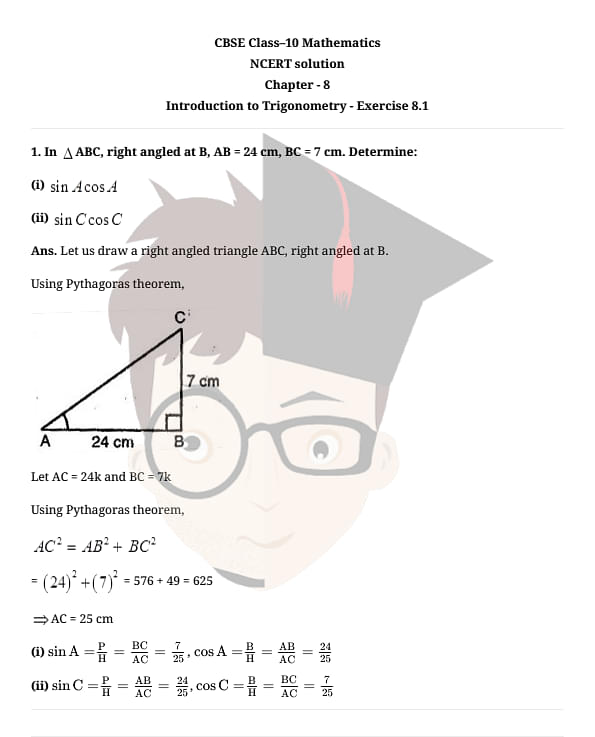
Read Also: NCERT Solutions for Class 10 Maths Chapter 8 Introduction to Trigonometry

Check out NCERT solutions of other exercises of class 10 maths chapter 8 Introduction to Trigonometry:


Class 10 Chapter 8 Introduction to Trigonometry Related Links:

CBSE Class 10 Maths Study Guides:

CBSE X Related Questions

  • 1.
    Find the H.C.F. and L.C.M. of 408 and 312.


      • 2.
        Find the missing frequencies p and q in the following frequency distribution, when sum of frequencies is 40 and mean is 19 :


          • 3.
            There are many varieties of mushrooms available in the world. One such mushroom ‘Amanita muscaria’ has a upper part which is like red cap (hemispherical) and lower part is like white stem (cylindrical). The hemispherical cap’s radius = 3 cm and cylindrical stem is 2 cm high with diameter 1.4 cm. Considering mushroom a solid object, answer the following questions:

            36(i) What is the total height of a mushroom ?


              • 4.
                If \( 2 \sin A = 1 \), then the value of \( \tan A + \cot A \) is :

                  • \( \sqrt{3} \)
                  • \( \frac{4}{\sqrt{3}} \)
                  • \( \frac{\sqrt{3}}{2} \)
                  • \( 1 \)

                • 5.
                  PQ is tangent to the circle with centre O such that OP = 2OQ. m\(\angle\)OPQ is

                    • 15\(^\circ\)
                    • 60\(^\circ\)
                    • 45\(^\circ\)
                    • 30\(^\circ\)

                  • 6.
                    In the given figure, two triangles ABC and PQR are shown such that \(\angle A = \angle P\) and \(\angle C = \angle R\). If \(AD \perp BC\) and \(PS \perp QR\), then prove that (i) \(\Delta ADB \sim \Delta PSQ\) (ii) \(AD \times QS = BD \times PS\).

                      Comments


                      No Comments To Show


