


NCERT Solutions for Class 10 Maths Chapter 3 Exercise 3.1

Jasmine Grover logo

Jasmine Grover

Education Journalist | Study Abroad Strategy Lead

NCERT Solutions for Class 10 Maths Chapter 3 Pair of Linear Equations in Two Variables Exercise 3.1 is provided in this article. Class 10 Maths Chapter 3 Exercise 3.1 has 3 questions regarding the representation of the given form of equations algebraically or graph of the linear equations.

Download PDF: NCERT Solutions for Class 10 Maths Chapter 3 Exercise 3.1

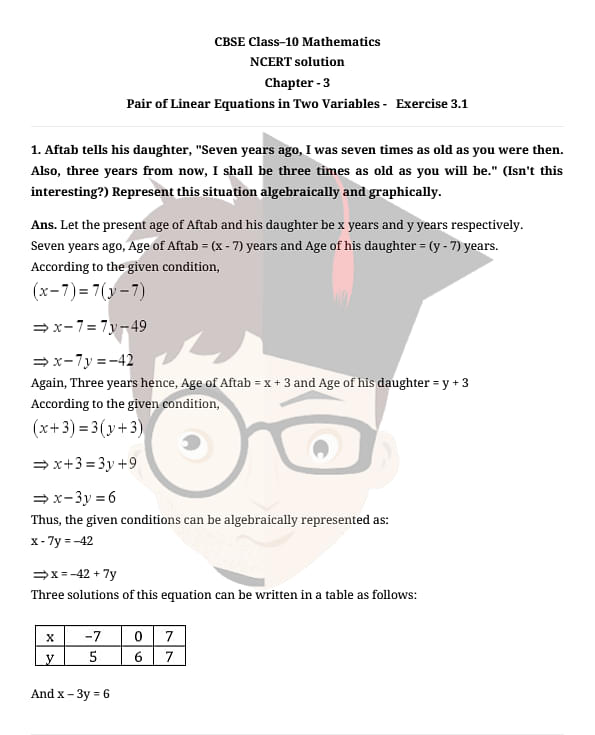
Check out the solutions of Class 10 Maths NCERT solutions chapter 3 Pair of Linear Equations in Two Variables Exercise 3.1
Read More: NCERT Solutions For Class 10 Maths Pair of Linear Equations in Two Variables

Check out other exercise solutions of Class 10 Maths Chapter 3

Class 10 Chapter 3 Topics:

CBSE Class 10 Maths Study Guides:

CBSE X Related Questions

  • 1.
    The HCF of 960 and 432 is :

      • 48
      • 54
      • 72
      • 36

    • 2.
      Assertion (A) : H.C.F. \((36 m^{2}, 18 m) = 18 m\), where \(m\) is a prime number.
      Reason (R) : H.C.F. of two numbers is always less than or equal to the smaller number.

        • Both Assertion (A) and Reason (R) are true and Reason (R) is the correct explanation of the Assertion (A).
        • Both Assertion (A) and Reason (R) are true, but Reason (R) is not the correct explanation of the Assertion (A).
        • Assertion (A) is true, but Reason (R) is false.
        • Assertion (A) is false, but Reason (R) is true.

      • 3.
        The graph of \(y = f(x)\) is given. The number of zeroes of \(f(x)\) is :

          • 0
          • 1
          • 3
          • 2

        • 4.

          Which of the following sequence is \(\textit{not }\)an A.P. ?
           

            • \( 2, \frac{5}{2}, 3, \frac{7}{2}, \dots \)
            • \( -1.2, -3.2, -5.2, -7.2, \dots \)
            • \( \sqrt{2}, \sqrt{8}, \sqrt{18}, \dots \)
            • \( 1^2, 3^2, 5^2, 7^2, \dots \)

          • 5.
            In the given figure, \(TP\) and \(TQ\) are tangents to a circle with centre \(M\), touching another circle with centre \(N\) at \(A\) and \(B\) respectively. It is given that \(MQ = 13 \text{ cm}\), \(NB = 8 \text{ cm}\), \(BQ = 35 \text{ cm}\) and \(TP = 80 \text{ cm}\).
            (i) Name the quadrilateral MQBN. (1)
            (ii) Is MN parallel to PA? Justify your answer. (1)
            (iii) Find length TB. (1)
            (iv) Find length MN. (2)


              • 6.
                In the given figure, \( \triangle AHK \sim \triangle ABC \). If \( AK = 10 \text{ cm} \), \( BC = 3.5 \text{ cm} \) and \( HK = 7 \text{ cm} \), find the length of \( AC \).

                  Comments


                  No Comments To Show
