


NCERT Solutions for Class 10 Maths Chapter 13 Exercise 13.5 Solutions

Collegedunia Team logo

Collegedunia Team

Content Curator

NCERT Solutions for Class 10 Maths Chapter 13 Surface Areas and Volume Exercise 13.5 Solutions are based on all the topics covered in the chapter, surface areas and volumes. 

Download PDF NCERT Solutions for Class 10 Maths Chapter 13 Exercise 13.5 Solutions

Check out the solutions of NCERT Solutions for Class 10 Maths Chapter 13 Exercise 13.5 Solutions
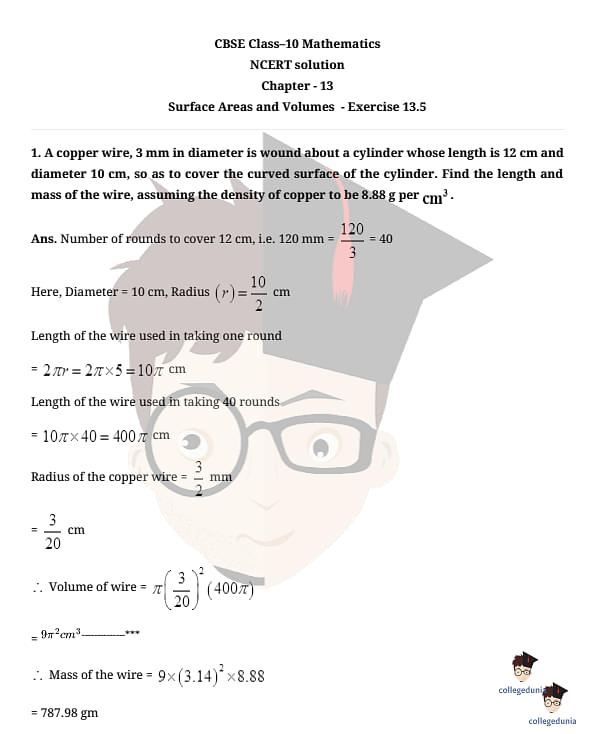
Read More: NCERT Solutions For Class 10 Maths Chapter 13 Surface Areas and Volume

Exercise Solutions of Class 10 Maths Chapter 13 Surface Areas and Volume

Also check other Exercise Solutions of Class 10 Maths Chapter 13 Surface Areas and Volume

Also Check:

Also check:

CBSE X Related Questions

  • 1.
    The graph of \(y = f(x)\) is given. The number of zeroes of \(f(x)\) is :

      • 0
      • 1
      • 3
      • 2

    • 2.
      Assertion (A) : H.C.F. \((36 m^{2}, 18 m) = 18 m\), where \(m\) is a prime number.
      Reason (R) : H.C.F. of two numbers is always less than or equal to the smaller number.

        • Both Assertion (A) and Reason (R) are true and Reason (R) is the correct explanation of the Assertion (A).
        • Both Assertion (A) and Reason (R) are true, but Reason (R) is not the correct explanation of the Assertion (A).
        • Assertion (A) is true, but Reason (R) is false.
        • Assertion (A) is false, but Reason (R) is true.

      • 3.
        Verify that roots of the quadratic equation \((p - q)x^2 + (q - r)x + (r - p) = 0\) are equal when \(q + r = 2p\).


          • 4.
            In the adjoining figure, the slant height of the conical part is :

              • 4 cm
              • 7 cm
              • 5 cm
              • 25 cm

            • 5.
              PQ and PR are two tangents to a circle with centre O and radius 5 cm. AB is another tangent to the circle at C which lies on OP. If \(OP = 13\) cm, then find the length AB and PA.


                • 6.

                  Which of the following sequence is \(\textit{not }\)an A.P. ?
                   

                    • \( 2, \frac{5}{2}, 3, \frac{7}{2}, \dots \)
                    • \( -1.2, -3.2, -5.2, -7.2, \dots \)
                    • \( \sqrt{2}, \sqrt{8}, \sqrt{18}, \dots \)
                    • \( 1^2, 3^2, 5^2, 7^2, \dots \)

                  Comments


                  No Comments To Show
