NCERT Solutions for Class 10 Maths Chapter 1 Real Numbers Exercise 1.4

Jasmine Grover logo

Jasmine Grover

Education Journalist | Study Abroad Lead

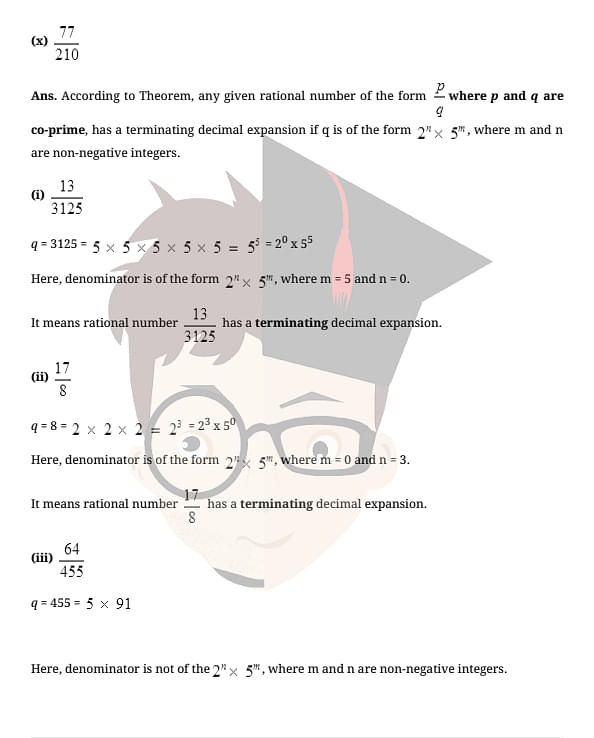
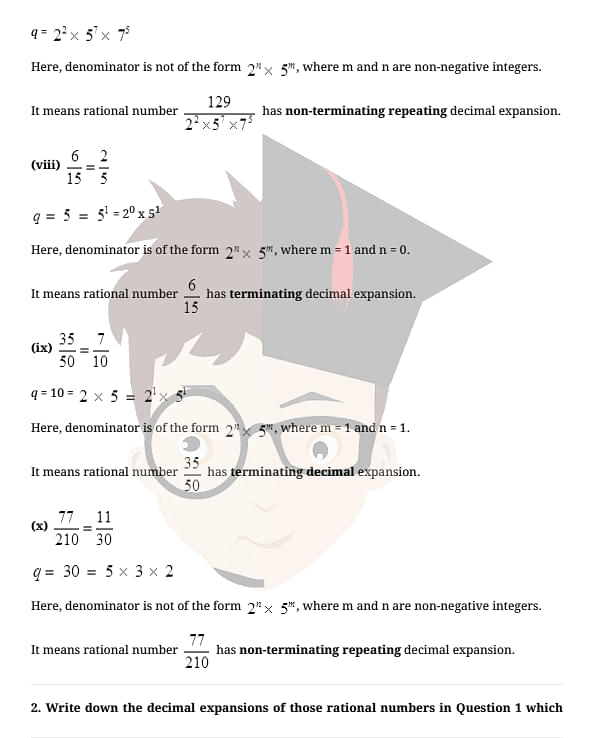
NCERT Solutions for Class 10 Maths Chapter 1 Real Numbers Exercise 1.4 deals with the concepts of rational numbers and their decimal expansions. The exercise has 3 short questions of the exercise discussing when the decimal expansion of a rational number is terminating and when it is non-terminating.

Download PDF: NCERT Solutions for Class 10 Maths Chapter 1 Exercise 1.4

Check out the solutions of Class 10 Maths NCERT solutions chapter 1 Real Numbers Exercise 1.4

Read More: NCERT Solutions For Class 10 Maths Real Numbers

Check out other exercise solutions of Class 10 Maths Chapter 1 Real Numbers

Also Read:

Also Read:

CBSE X Related Questions

  • 1.
    In an A.P., if $a_{14} - a_8 = 24$, then the common difference of the A.P. is

      • $6$
      • $4$
      • $\pm 4$
      • $3$

    • 2.
      In the given figure, $PQ$ is tangent to the circle with centre $O$. $S$ is a point on the circle such that $\angle SQT = 55^\circ$. The $m\angle QPS$ is

        • $55^\circ$
        • $20^\circ$
        • $35^\circ$
        • $70^\circ$

      • 3.
        Arc \(PQ\) subtends an angle \(\theta\) at the centre of the circle with radius \(6.3 \text{ cm}\). If \(\text{Arc } PQ = 11 \text{ cm}\), then the value of \(\theta\) is

          • \(10^{\circ}\)
          • \(60^{\circ}\)
          • \(45^{\circ}\)
          • \(100^{\circ}\)

        • 4.
          It is given that \(\triangle ABC \sim \triangle EDF\). Which of the following is not true?

            • \(\frac{\text{Perimeter of } \triangle ABC}{\text{Perimeter of } \triangle EDF} = \frac{AB}{ED}\)
            • \(\frac{AB}{ED} = \frac{AC}{EF}\)
            • \(\angle A = \angle D, \angle C = \angle F\)
            • \(\frac{AB + BC}{AC} = \frac{ED + DF}{EF}\)

          • 5.
            The graph of a quadratic polynomial f(x) passes through (5,0), (0, -1) and (-2, 0). The two factors of the polynomial are

              • \((x + 2), (x - 5)\)
              • \((x + 5), (x - 2)\)
              • \((x + 1), (x - 5)\)
              • \((x - 1), (x + 2)\)

            • 6.
              Assertion (A) : H.C.F. \((36 m^{2}, 18 m) = 18 m\), where \(m\) is a prime number.
              Reason (R) : H.C.F. of two numbers is always less than or equal to the smaller number.

                • Both Assertion (A) and Reason (R) are true and Reason (R) is the correct explanation of the Assertion (A).
                • Both Assertion (A) and Reason (R) are true, but Reason (R) is not the correct explanation of the Assertion (A).
                • Assertion (A) is true, but Reason (R) is false.
                • Assertion (A) is false, but Reason (R) is true.

              Comments


              No Comments To Show