




IIT Kharagpur has published the IIT JAM 2027 exam pattern on the official website at jam.iitkgp.ac.in. IIT JAM 2027 exam pattern was published in the official brochure on 31 August 2026. The exam pattern of IIT JAM 2027 features 60 questions for a total of 100 marks.
| Direct Link: Official IIT JAM 2027 Exam Pattern PDF |
- IIT JAM consists of three sections: Section A (MCQs), Section B (MSQs), and Section C (NAT questions), with negative marking applicable only to Section A.
- Each question carries 1-2 marks, with -1/3 marks deducted for each incorrect 1 mark question and 2/3 marks deducted for each 2 mark incorrect answer.
- Candidates can appear for a maximum of two test papers in the same exam cycle, provided the papers are scheduled in different sessions.
- Each paper is conducted for 3 hours and evaluates conceptual understanding, numerical accuracy, and application-based problem-solving skills.
- The 7 IIT JAM papers include Biotechnology (BT), Chemistry (CY), Economics (EN), Geology (GG), Mathematics (MA), Mathematical Statistics (MS), and Physics (PH).
- Important topics in IIT JAM Mathematics include Real Analysis (21%), Single-variable Calculus (18%), Integral Calculus (15%), Linear Algebra (14%), etc.
- Important topics in IIT JAM Chemistry include Reaction Mechanism, Named Reactions and Rearrangements, Electrochemistry, Atomic and Molecular Structure, Transition Metals, etc.
- Important topics in IIT JAM Physics are Electricity and Magnetism (10), Solid State Physics, Devices, and Electronics (10), Classical Mechanics (9), Mathematical Physics (9), Modern Physics (8), etc.
Related Links:
- IIT JAM 2027 Syllabus, Subject-Wise Topics, Topic-wise Weightage and PDF Download
- IIT JAM Question Paper Analysis
Key Summary
- IIT JAM 2027 exam consists of 60 questions for 100 marks, divided into MCQ, MSQ, and NAT sections.
- Negative marking applies only to Section A. Wrong answers in MCQs carry penalties, while MSQ and NAT sections have no negative marking.
- Different question types require different strategies. MCQs need careful selection, MSQs require option-wise analysis, and NAT questions demand calculation accuracy.
- The exam allows two papers per candidate. Students can appear for a maximum of two test papers, provided the selected papers are scheduled in different sessions.IIT
JAM Exam Pattern 2027: Overview
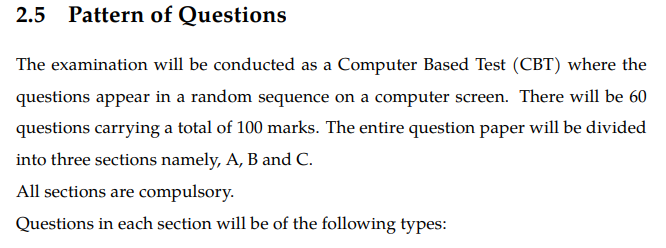
IIT JAM 2027 follows a computer-based test (CBT) format across all seven test papers.
- Each paper is 3 hours long, carries 100 marks across 60 questions, and is divided into three compulsory sections with different question types.
| Parameter | Details |
|---|---|
| Exam Mode | Computer-Based Test (CBT) |
| Total Test Papers | 7 (BT, CY, EN, GG, MA, MS, PH) |
| Duration per Paper | 3 Hours (180 Minutes) with no sectional time limit |
| Total Questions per Paper | 60 |
| Total Marks per Paper | 100 |
| Sections per Paper | 3 sections: A (MCQ), B (MSQ), and C (NAT) |
| Medium | English only |
| Negative Marking | In Section A (MCQs) only; Sections B and C carry no negative marking |
| Virtual Calculator | Provided on screen; no physical calculator allowed at the center |
| Scribe Facility | Available for eligible students as per PwD norms |
| Maximum Papers per Student | 2 (in different sessions on exam day) |
Source: Information Brochure IIT JAM 2027
Ques. Is there negative marking in IIT JAM 2027?
Ans. Yes, negative marking applies to Section A (MCQ) only. A wrong 1-mark MCQ deducts 1/3 mark, and a wrong 2-mark MCQ deducts 2/3 mark. Section B (MSQ) and Section C (NAT) carry no negative marking- you should attempt all questions in these two sections.
Read More: IIT JAM Preparation 2027: Check Last Month Strategy, Mock Tests, Previous Papers
IIT JAM Exam Pattern 2027: What’s New?
The pattern has remained consistent since 2018, and no structural changes have been announced for the 2027 cycle. The official 2027 brochure confirmed the IIT JAM exam pattern with no significant changes made by IIT Kharagpur.
- The IIT JAM Exam Pattern 2027 is the same as in previous years.
- The topic-wise weightage varies slightly across units. But the Marking Scheme and question types remain consistent.
IIT JAM 2027 Exam Pattern
Each IIT JAM 2027 paper is divided into three compulsory sections with distinct question types, marking rules, and difficulty focuses. There is no sectional time limit.
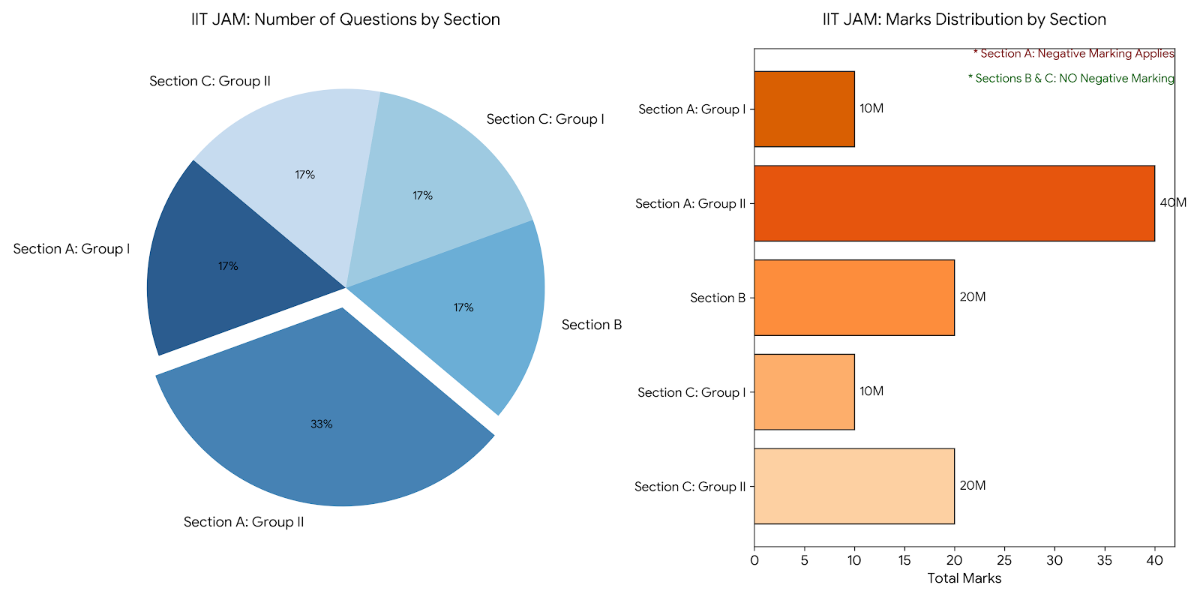
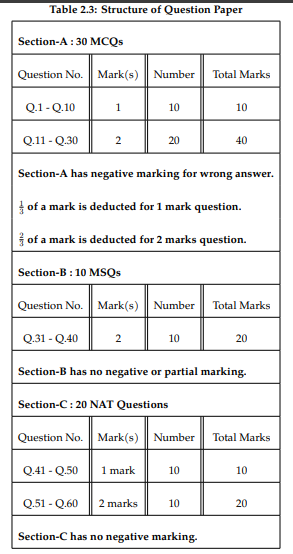
- Section A is split into two groups: the first 10 MCQs carry 1 mark each and the next 20 carry 2 marks each. Section A consists of negative marking for each incorrect answer.
- Section C is similarly divided into 10 one-mark NATs followed by 10 two-mark NATs.
- There is no negative marking for MSQ (Section B) and NAT (Section C) questions.
| Section | Question Type | No. of Questions | Marks per Question | Total Marks | Negative Marking |
|---|---|---|---|---|---|
| Section A: Group I | MCQ (Single Correct) | 10 | 1 mark each | 10 | −1/3 mark per wrong answer |
| Section A: Group II | MCQ (Single Correct) | 20 | 2 marks each | 40 | −2/3 mark per wrong answer |
| Section B | MSQ (One or More Correct) | 10 | 2 marks each | 20 | No negative marking |
| Section C: Group I | NAT (Numerical Answer Type) | 10 | 1 mark each | 10 | No negative marking |
| Section C: Group II | NAT (Numerical Answer Type) | 10 | 2 marks each | 20 | No negative marking |
| Total | 60 | - | 100 marks | Section A only | |
Source: Information Brochure IIT JAM 2027
Also Check:
Ques. How many questions are asked in IIT JAM 2027?
Ans. Each IIT JAM 2027 paper has 60 questions- 30 MCQs in Section A, 10 MSQs in Section B, and 20 NAT questions in Section C. The question count is the same across all seven test papers (BT, CY, EN, GG, MA, MS, PH).
IIT JAM Previous Year Papers (2026) with Solutions
| Subject | QuestIon Paper PDF | Solution PDF |
|---|---|---|
| Chemistry (CY) | Download PDF | View Solution |
| Geology (GG) | Download PDF | View Solution |
| Mathematics (MA) | Download PDF | View Solution |
| Biotechnology (BT) | Download PDF | View Solution |
| Economics (EN) | Download PDF | View Solution |
| Mathematical Statistics (MS) | Download PDF | View Solution |
| Physics (PH) | Download PDF | View Solution |
Read More:
IIT JAM Marking Scheme 2027
IIT JAM 2027 applies a differential marking scheme where negative marking is restricted to Section A (MCQs) only.
- The penalty is proportional to question value: 1/3 mark deducted for each wrong 1-mark MCQ and 2/3 mark for each wrong 2-mark MCQ.
- For MSQ (Section B) questions, you earn +2 marks only if every correct option is selected and no incorrect option is chosen.
- Sections B and C carry zero penalty for wrong or unattempted answers, making them the safest sections to maximise your score.
| Section | Question Type | Question Value | Correct Answer | Wrong Answer | Unattempted |
|---|---|---|---|---|---|
| Section A (Q1–Q10) | MCQ — Single Correct | 1 mark | +1 | −1/3 | 0 |
| Section A (Q11–Q30) | MCQ — Single Correct | 2 marks | +2 | −2/3 | 0 |
| Section B (Q1–Q10) | MSQ — One or More Correct | 2 marks | +2 (all correct options selected) | 0 | 0 |
| Section C (Q1–Q10) | NAT — Numerical Entry | 1 mark | +1 | 0 | 0 |
| Section C (Q11–Q20) | NAT — Numerical Entry | 2 marks | +2 | 0 | 0 |
Source: Information Brochure IIT JAM 2027
Ques. Can I appear in two papers in IIT JAM 2027?
Ans. Yes, you can appear in a maximum of two papers in IIT JAM 2027, provided the papers you choose are offered in different sessions on exam day. The two sessions run on the same day- confirm session timings from the official 2027 brochure once released.
Check Out: IIT JAM Books 2027: Biotechnology, Mathematics, Physics, Preparation Tips
IIT JAM Question Types 2027
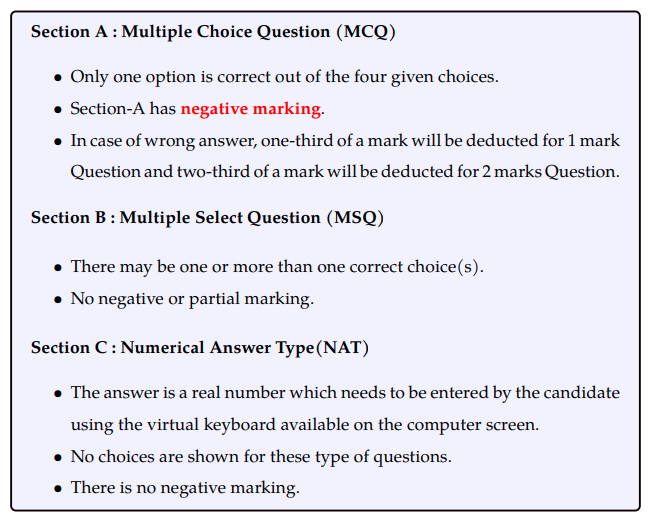
IIT JAM 2027 uses three types of questions across the three sections of every paper:
- MCQs present four options (A, B, C, D) with exactly one correct answer.
- Section A contributes 50 marks to the total, with negative marking applied.
- Section B has 10 MSQ questions, each worth 2 marks, contributing 20 marks, with no negative marking.
- No answer options are provided in Section C
- Candidates must calculate the value and enter the answer directly using the virtual numeric keypad. Answers can be positive, negative, or decimal numbers.
| Section | Question Type | Questions | Total Marks | Negative Marking | Options Given |
|---|---|---|---|---|---|
| Section A | MCQ (Single Correct) | 30 | 50 | Yes (−1/3 or −2/3) | Yes (4 options) |
| Section B | MSQ (One or More Correct) | 10 | 20 | No | Yes (4 options; multiple correct) |
| Section C | NAT (Numerical Entry) | 20 | 30 | No | No (type the numerical value) |
Ques. What is the duration of the IIT JAM 2027 exam?
Ans. IIT JAM 2027 is a 3-hour (180-minute) exam per paper. There is no separate time limit for individual sections- you manage all three sections within the single 3-hour window according to your own strategy.
Ques. How many NAT questions are asked in Mechanics vs Modern Physics?
Ans. As per the analysis of previous years’ papers, the number of NAT questions asked from the Mechanics topic in Physics is around 3-5. However, from Modern Physics, you can expect around 4-6 questions in the IIT JAM Physics question paper.
Difficulty Level and Type of Questions Asked in IIT JAM 2027 Physics
“PW IITJAM” expert shared an analysis of the question types and their difficulty level in IIT JAM Physics. As per the expert, the IIT JAM Physics question paper includes Conceptual-Based, Application-Based, Graph / Diagram Based, Multi-Concept-Based, and Computation / Derivation Based questions.
- Concept-based questions are generally easy and test fundamental understanding of the concepts.
- Application-based questions involve direct application of formulae and principles to solve numericals.
- Graph / Diagram Based questions involve careful analysis of graphs, diagrams, plots, energy band diagrams, crystal planes, circuits, etc.
- Multi-Concept Based questions require application of two or more concepts to solve questions.
- Computation / Derivation Based questions require step-by-step derivation, mathematical manipulation, or long calculations.
| Type of Question | Description | Example (with year) |
|---|---|---|
| Conceptual Based | Tests fundamental understanding, theory, definitions, principles, and physical intuition. | Fermi–Dirac distribution, Carnot cycle, Compressibility, Electromagnetic wave boundary conditions (2019) |
| Application Based | Direct application of formulae and principles to solve numerical or fact-based problems. | Mirror focal length in medium, RC circuit, Relativistic energy, Diffraction grating (2019) |
| Graph / Diagram Based | Interpretation of graphs, diagrams, plots, energy band diagrams, crystal planes, circuits, etc. | Potential energy vs r, Fission fragment distribution, Energy band diagrams, Miller indices, Displacement vs time (2009 & 2019) |
| Multi-Concept Based | Combination of two or more concepts from different subtopics or chapters. | EM waves + Lorentz force, Wave function + Time evolution + Expectation values, Thermodynamics + Statistical physics (2009) |
| Computation / Derivation Based | Requires step-by-step derivation, mathematical manipulation, or long calculations. | Diffraction resolution, Particle motion, Van der Waals thermodynamics, drag force on a sphere (2009) |
Also Read
IIT JAM Biotechnology Subject-Wise Weightage
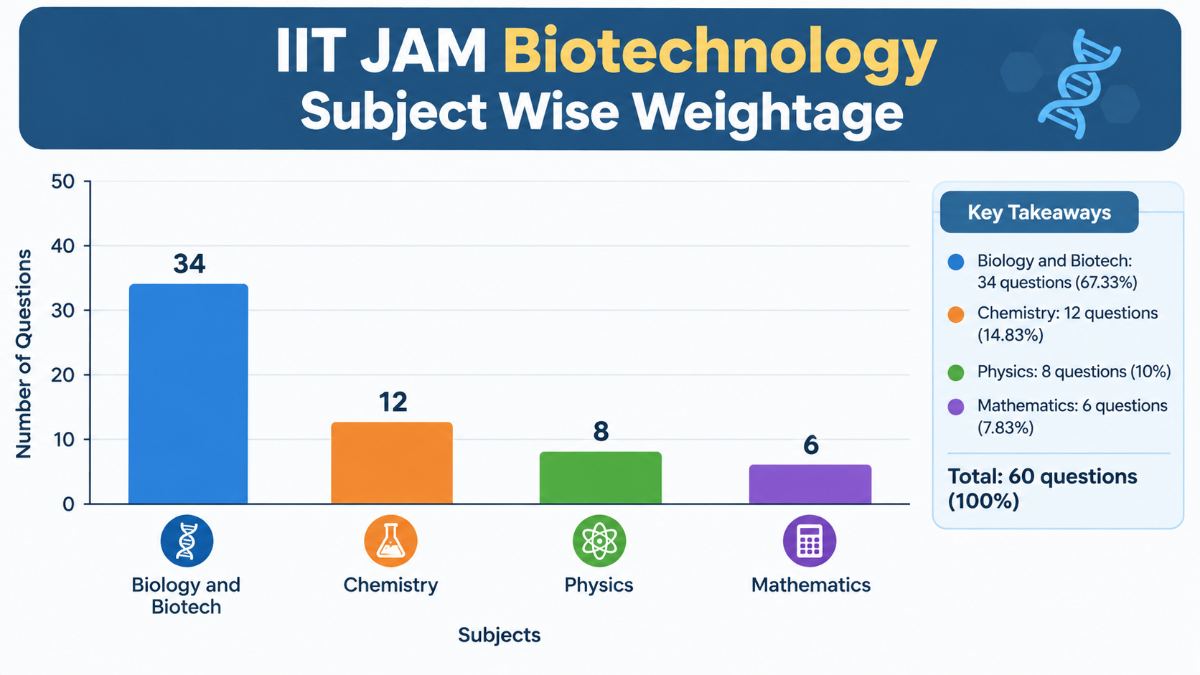
“Bansal Biology” on YouTube shared the last 6 years' analysis of IIT JAM Biotechnology subject-wise weightage.
- Biology and Biotech carried a weightage of around 67.33%, the highest among all subjects.
- Chemistry carried around 14.8% weightage in the IIT JAM question paper.
- Physics and Mathematics carried around 10% and 7.83% weightage each.
| Subject | IIT JAM 2021 (Questions) | IIT JAM 2022 (Questions) | IIT JAM 2023 (Questions) | IIT JAM 2024 (Questions) | IIT JAM 2025 (Questions) | IIT JAM 2026 (Questions) | Average Weightage |
|---|---|---|---|---|---|---|---|
| Biology and Biotech | 34 | 45 | 41 | 42 | 41 | 33 | 67.33% |
| Chemistry | 12 | 6 | 9 | 8 | 7 | 12 | 14.83% |
| Physics | 8 | 5 | 5 | 6 | 5 | 7 | 10% |
| Mathematics | 6 | 4 | 5 | 4 | 5 | 8 | 7.83% |
| Total | 60 | 60 | 60 | 60 | 60 | 60 | 100% |
Also Read:
IIT JAM High Weightage Topics
Each paper of IIT JAM 2027 includes topics that carry the highest weightage consistently over the years. You should prioritize these topics while preparing for the IIT JAM 2027 examination.
IIT JAM Chemistry High Weightage Topics
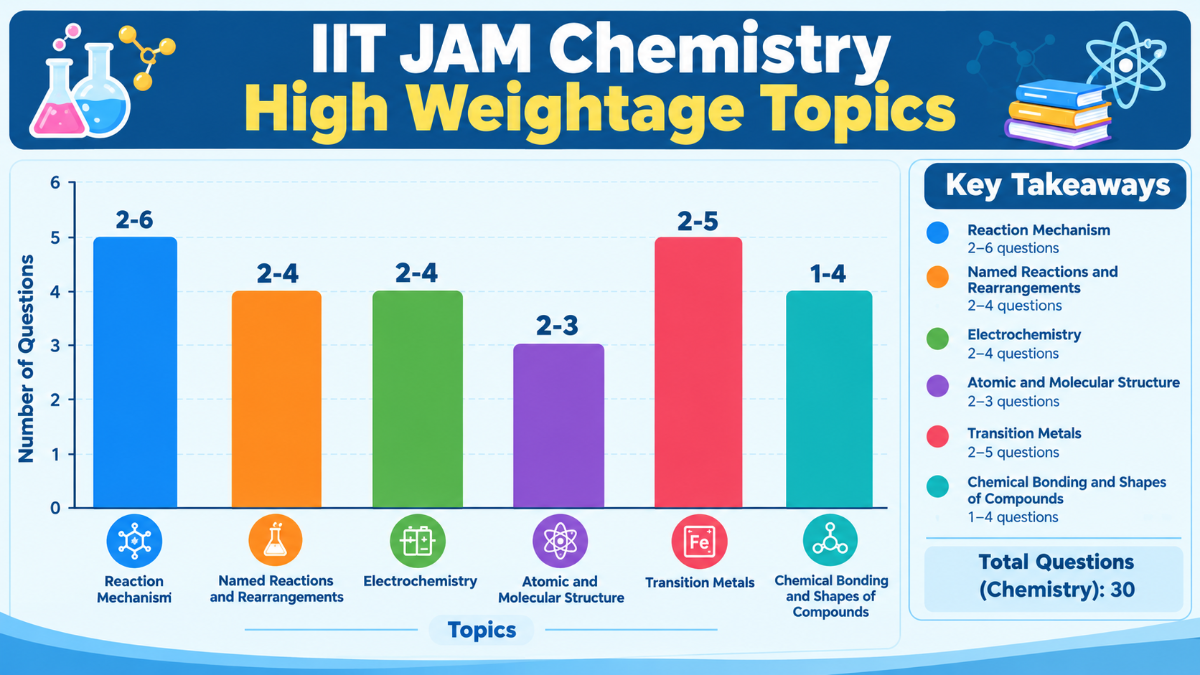
In IIT JAM Chemistry, high weightage topics include Reaction Mechanism, Named Reactions and Rearrangements, Electrochemistry, Atomic and Molecular Structure, Transition Metals, etc. Each of these topics carry around 2-6 questions in IIT JAM Chemistry question paper.
| Chapter/Topic | Weightage |
|---|---|
| Reaction Mechanism | 2-6 |
| Named Reactions and Rearrangements | 2-4 |
| Electrochemistry | 2-4 |
| Atomic and Molecular Structure | 2-3 |
| Transition Metals | 2-5 |
| Chemical Bonding and Shapes of Compounds | 1-4 |
IIT JAM Physics High Weightage Topics
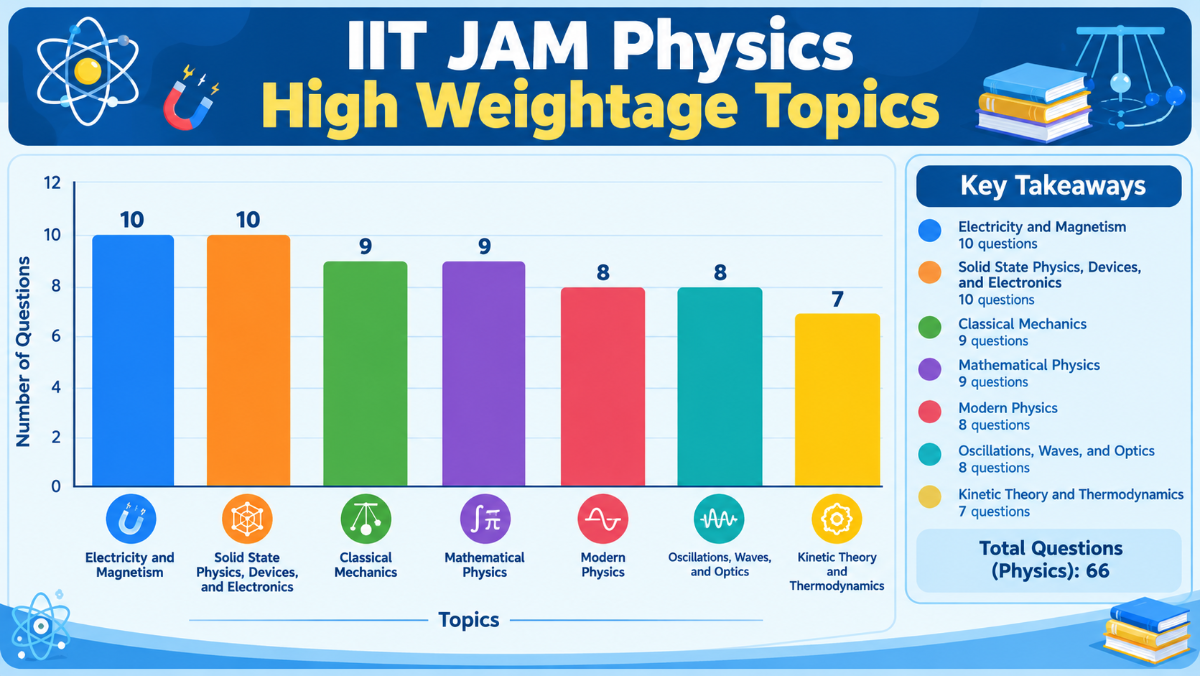
High weightage topics in IIT JAM Physics include Electricity and Magnetism (10), Solid State Physics, Devices, and Electronics (10), Classical Mechanics (9), Mathematical Physics (9), Modern Physics (8), etc.
| Chapter/Topic | Weightage |
|---|---|
| Electricity and Magnetism | 10 |
| Solid State Physics, Devices, and Electronics | 10 |
| Classical Mechanics | 9 |
| Mathematical Physics | 9 |
| Modern Physics | 8 |
| Oscillations, Waves, and Optics | 8 |
| Kinetic Theory and Thermodynamics | 7 |
IIT JAM Mathematics High Weightage Topics
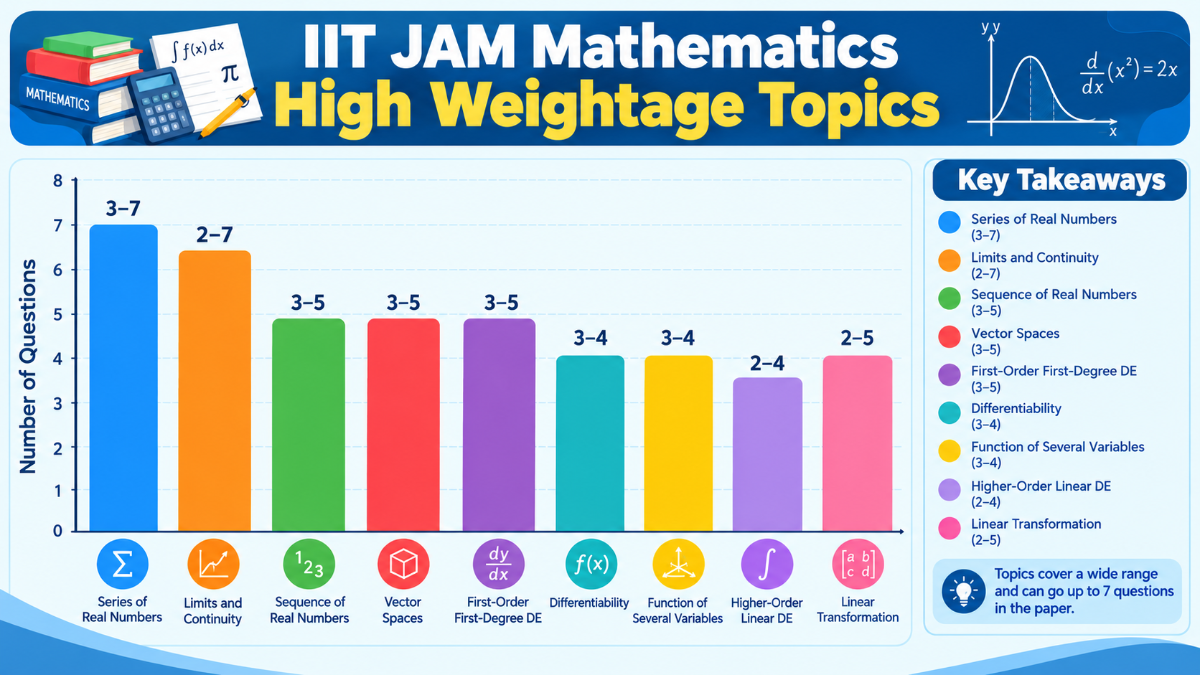
Topics carrying high weightage in IIT JAM Mathematics are Series of Real Numbers, Limits and Continuity, Sequence of Real Numbers, Vector Spaces, First-Order First-Degree DE, Differentiability, Function of Several Variables. Each chapter carries around 2-3 minimum questions and can go up to 7 questions in IIT JAM Maths paper.
| Chapter/Topic | Weightage |
|---|---|
| Series of Real Numbers | 3-7 |
| Limits and Continuity | 2-7 |
| Sequence of Real Numbers | 3-5 |
| Vector Spaces | 3-5 |
| First-Order First-Degree DE | 3-5 |
| Differentiability | 3-4 |
| Function of Several Variables | 3-4 |
| Higher-Order Linear DE | 2-5 |
| Linear Transformation | 2-5 |
IIT JAM Biotechnology High Weightage Topics
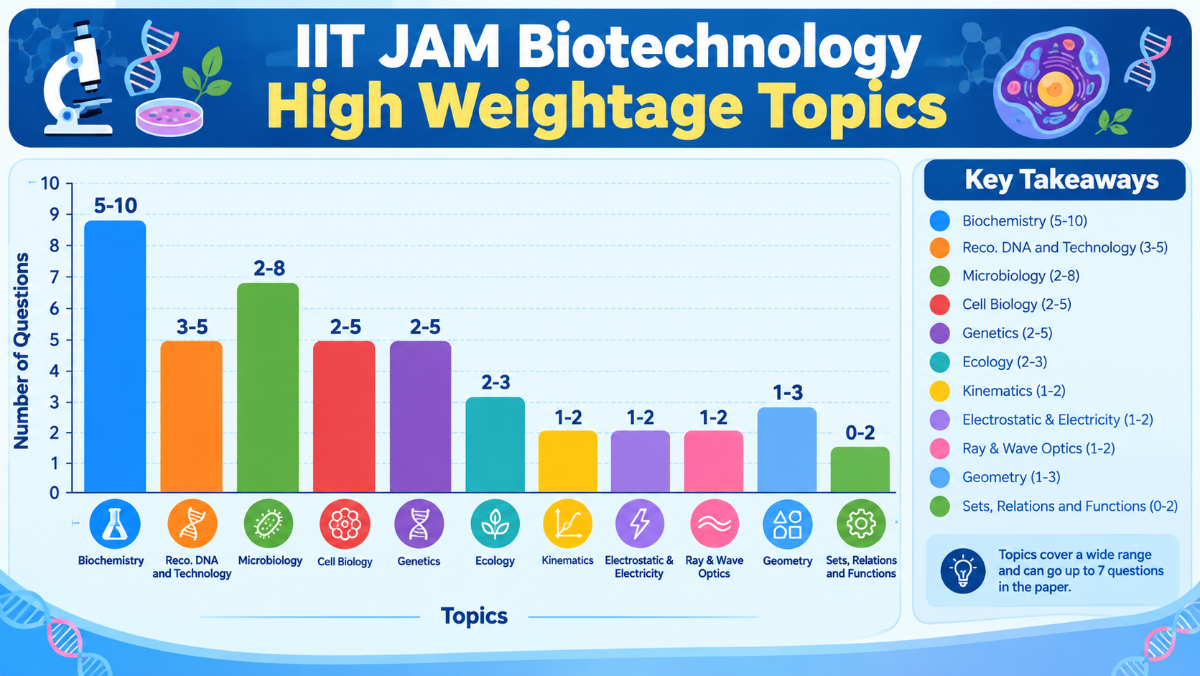
Topics with the highest weightage in IIT JAM Biotechnology syllabus include Biochemistry (5-10), Reco. DNA and Technology (3-5), Microbiology (2-8), Cell Biology (2-5), etc.
| Chapter/Topic | Weightage |
|---|---|
| Biochemistry | 5-10 |
| Reco. DNA and Technology | 3-5 |
| Microbiology | 2-8 |
| Cell Biology | 2-5 |
| Genetics | 2-5 |
| Ecology | 2-3 |
| Kinematics | 1-2 |
| Electrostatic & Electricity | 1-2 |
| Ray & Wave Optics | 1-2 |
| Geometry | 1-3 |
| Sets, Relations and Functions | 0-2 |
Timing of IIT JAM 2027 Question Papers
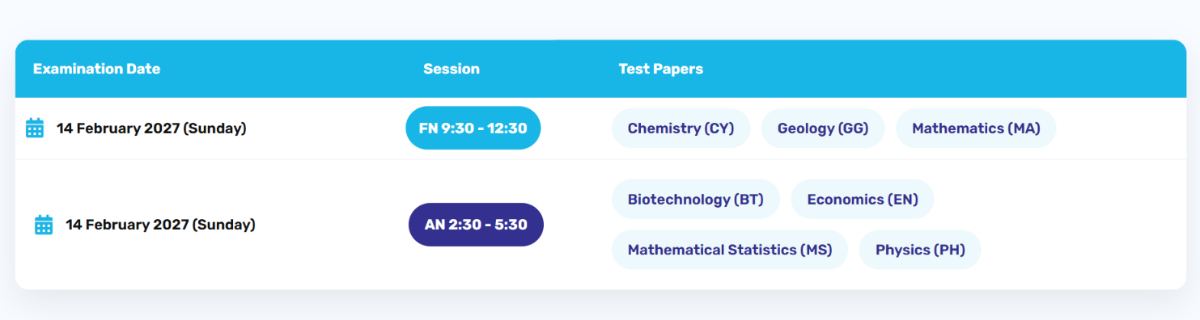
IIT JAM will be conducted in 2 sessions on 14 February 2027. Timing will be different for different sessions, and students are allowed to appear for the 2nd paper if it is conducted at a different time than the one chosen first.
- Two sessions of IIT JAM 2027 include the Forenoon Session (FN), with timing 9:30 AM to 12:30 PM, and the Afternoon Session (AN), with timing 2:30 PM to 5:30 PM.
- Papers like Chemistry, Geology, and Mathematics will be conducted in the Forenoon Session from 9:30 AM to 12:30 PM.
- Papers like Biotechnology, Economics, Mathematical Statistics, and Physics will be conducted in the Afternoon Session (AN) from 2:30 PM to 5:30 PM.
| Session | Timings | Papers |
|---|---|---|
| Forenoon Session | 9:30 AM to 12:30 PM | Chemistry (CY), Geology (GG), Mathematics (MA) |
| Afternoon Session | 2:30 PM to 5:30 PM | Biotechnology (BT), Economics (EN), Mathematical Statistics (MS), Physics (PH) |
Source: Official Website
Ques. Can I choose to appear for Chemistry and Physics papers in IIT JAM 2027?
Ans. Yes, you can choose to appear for Chemistry and Physics papers in IIT JAM as both papers are conducted in separate sessions. Chemistry will be conducted in the forenoon session, and Physics will be conducted in the afternoon session.
Ques. Can I appear for both Chemistry and Mathematics in IIT JAM 2027?
Ans. No, you can not appear for Chemistry and Mathematics papers in IIT JAM 2027 as both the papers are conducted in same session. Both Chemistry and Maths papers of IIT JAM 2027 will be conducted in the forenoon session.
IIT JAM 2027 Question Attempt Strategy
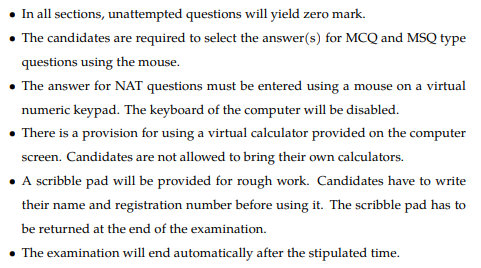
Before attempting each section of IIT JAM 2027, students should follow a section-specific approach because the marking rules and question formats differ significantly.
- Since Section A has negative marking, focus on eliminating options, checking calculations, and attempting only questions where confidence is high.
- MSQs require evaluating every option individually, while NAT questions require accurate calculations and familiarity with the virtual calculator to avoid input errors.
| Section | Execution Tactics | What to Avoid |
|---|---|---|
| Section A (MCQ) |
|
|
| Section B (MSQ) |
|
|
| Section C (NAT) |
|
|
Source:Information Brochure IIT JAM
Ques. Is a calculator allowed in IIT JAM 2027?
Ans. You cannot bring a physical calculator to the IIT JAM 2027 exam center. A virtual scientific calculator is provided on the screen during the CBT for all calculations. Practice with an online scientific calculator during your preparation so the interface feels familiar on exam day.
Also Check: IIT JAM 2027 Preparation Tips
IIT JAM 2027 Exam Pattern vs Other MSc Entrance Exams
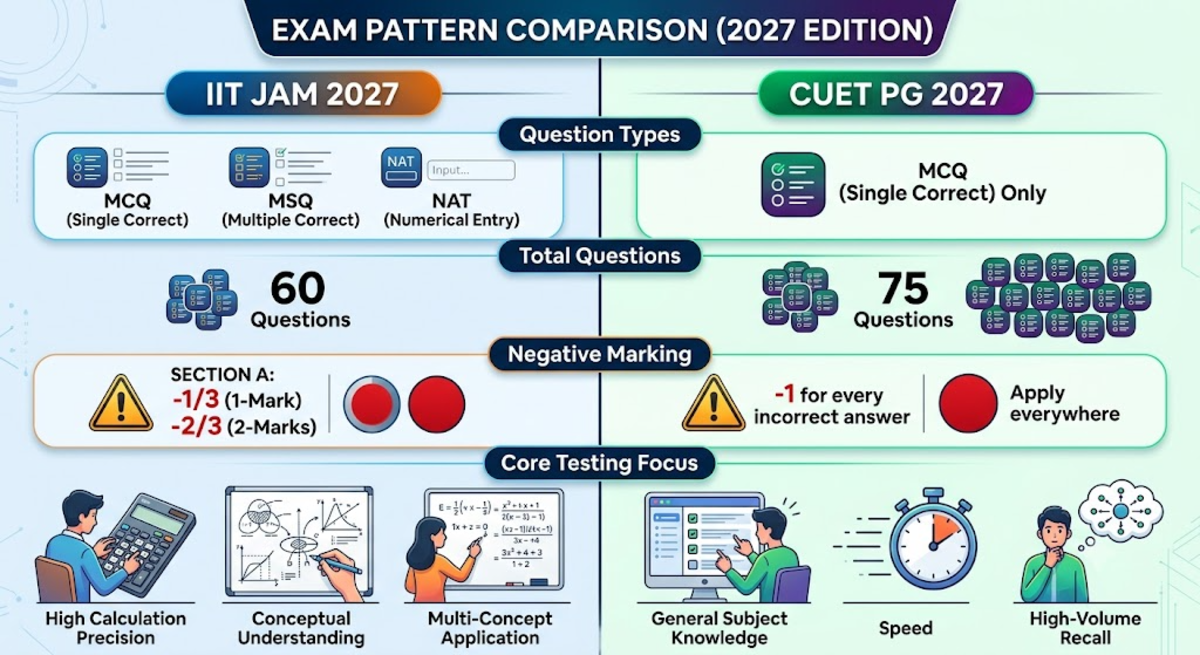
IIT JAM tests conceptual depth with multiple question formats. Unlike exams with only MCQs, IIT JAM includes MCQ, MSQ, and NAT sections, requiring different solving approaches.
- CUET PG relies completely on standard 4-option MCQs. IIT JAM requires switching mindsets between standard elimination and pure calculated inputs without options.
- CUET PG gives you less than 2 minutes per question, prioritizing fast recall across the holistic syllabus. IIT JAM gives you an average of 3 minutes per question.
| Parameter | IIT JAM 2027 | CUET PG 2027 | GAT-B 2027 (Biotech) |
|---|---|---|---|
| Question Types |
| MCQ (Single Correct) Only | MCQ (Single Correct) Only |
| Total Questions | 60 Questions | 75 Questions | 160 Questions (Attempt 100) |
| Negative Marking | Section A only:
| −1 for every incorrect answer |
|
| Core Testing Focus | High calculation precision, conceptual understanding, and multi-concept application | General subject knowledge, speed, and high-volume recall | Foundational science concepts and subject understanding |
Ques. Which IIT will conduct IIT JAM 2027?
Ans. IIT Kharagpur will conduct the IIT JAM 2027 examination. IIT JAM is conducted by a different IIT each year on a rotational basis; IIT Bombay organized JAM 2026.
Also Check:
How to Prepare Based on IIT JAM Exam Pattern?
Below are some preparation strategies for the IIT JAM exam based on the exam pattern:
- Maximise Sections B and C: Attempt all MSQ and NAT questions as they carry no negative marking, but ensure MSQ option selection is precise.
- Practise with the virtual calculator: Build familiarity with the CBT calculator interface to improve NAT accuracy and speed.
- Follow a timed exam strategy: Allocate time across sections and keep the last few minutes for reviewing marked questions and NAT entries.
- Use PYQs and full-length mocks: Practise previous 5–7 years of papers to understand difficulty, topic trends, and improve exam strategy.
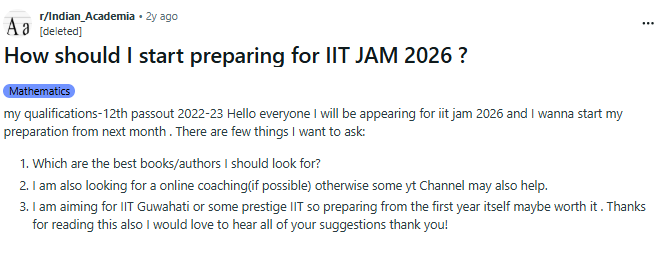
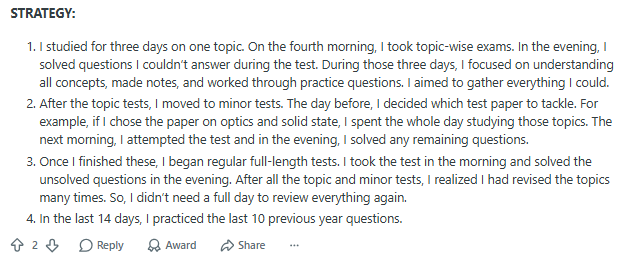
Students on Reddit threads discuss the following strategies for effective IIT JAM preparation:
- Practice Smart: Study one topic thoroughly, take a topic-wise test, and analyze every mistake before moving to the next topic.
- Mock & PYQ Strategy: Progress from topic tests to full-length mocks and solve 10–14 years of previous papers for effective revision and exam familiarity.
Source: Reddit
Also Read:
IIT JAM Exam Pattern FAQs
Ques. What is the exam pattern of IIT JAM 2027?
Ans. IIT JAM 2027 is a computer-based test with 60 questions for 100 marks per paper, held over 3 hours. Each paper has three sections: Section A (30 MCQs, 50 marks), Section B (10 MSQs, 20 marks), and Section C (20 NAT questions, 30 marks).
Ques. What is the total marks for IIT JAM 2027?
Ans. IIT JAM 2027 carries 100 marks per paper. Section A contributes 50 marks (10 one-mark + 20 two-mark MCQs), Section B contributes 20 marks (10 two-mark MSQs), and Section C contributes 30 marks (10 one-mark + 10 two-mark NATs).
Ques. How many test papers are offered in IIT JAM 2027?
Ans. IIT JAM 2027 offers seven test papers: Biotechnology (BT), Chemistry (CY), Economics (EN), Geology (GG), Mathematics (MA), Mathematical Statistics (MS), and Physics (PH). You choose your paper based on your undergraduate subject and the postgraduate programme you are targeting at IITs or IISc.
Ques. When is the IIT JAM 2027 exam date?
Ans. The IIT JAM 2027 exam date has not been officially announced yet. Based on the previous year’s schedule (IIT JAM 2026 was held on February 15, 2026 by IIT Bombay), the 2027 exam is expected in February 2027. The confirmed date will be published in the official brochure in August–September 2026.



Comments