



Education Journalist | Study Abroad Lead
Chromosomes are hereditary vehicles for storing, replicating, and transcribing the coded information they contain. DNA and protein complexes can be oval, rod-shaped, or thread-shaped. They have genes, which are hereditary units. The term chromosomes refer to colorful material with the ability to absorb stain easily for microscopic studies. The chromatin fibers condense and coil during cell division to generate these short, thick, and rod-like organelles. The chromosomes in humans and other creatures are divided into two types: allosomes and autosomes.
| Table of Content |
Key Terms: Autosomes, Allosomes, Chromosomes, Sex Chromosomes, Heredity, DNA, Organelles, Cell Division, Genes, Inheritance
What are Autosomes?
[Click Here for Sample Questions]
Autosomes are chromosomes that lack any genes that determine an individual's sex. According to a typical sort order based on size, shape, and other qualities, autosomes are referred to numerically, e.g. chromosome 1, chromosome 2. Sex chromosomes, which make up the 23rd pair of chromosomes in all normal human cells and occur in two types, X and Y, differ from autosomes. Except for sex-linked features, which are governed by sex chromosomes, autosomes control the inheritance of an organism's characteristics.

Autosomes
Each body cell in a human has 46 chromosomes, 44 of which are Autosomes. Your mother gives you one set of 22 autosomes, and your father gives you another set of 22 autosomes. Even though humans have 44 autosomes, it is generally easier to think of them in pairs.
Also Read: Heredity
What are Allosomes?
[Click Here for Sample Questions]
A sex chromosome is a type of chromosome that plays a role in determining a person's gender. Females have two X chromosomes in their cells, whereas males have both X and Y chromosomes. Humans and most other mammals have two sex chromosomes, X and Y. The X chromosome has a long and short arm, similar to a large autosomal chromosome. One long arm and a very short second arm make up the Y chromosome. The X chromosome is found in all egg cells, while the X or Y chromosome is found in sperm.
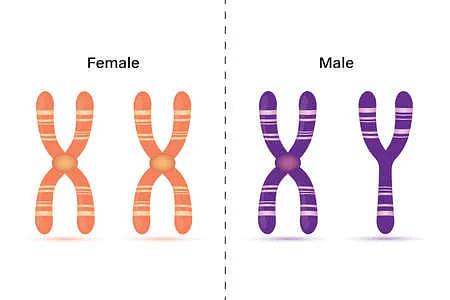
The male XY sex-chromosome pair divides during meiosis and passes on an X or a Y to distinct gametes, resulting in one-half of the gametes (sperm) containing the X chromosome and the other half containing the Y chromosome. The female has two X chromosomes, and all-female egg cells have a single X chromosome. Females (XX) are born from eggs fertilized with X-bearing sperm, while boys are born from eggs fertilized with Y-bearing sperm (XY). This system means that when fertilization occurs, the male selects the sex of the offspring.
Read more: Genes
Similarities Between Autosomes and Allosomes
[Click Here for Sample Questions]
The similarities between Autosomes and Allosomes are as follows:
- Chromosomes include autosomes and allosomes.
- They are found in an organism's genome.
- DNA and proteins are found in both.
- They contain information about a person's ancestors.
- They both have genes.
- They are found in pairs.
- Different genetic illnesses are caused by abnormalities.
Also Read: Sex Determination
Difference Between Autosomes and Allosomes
[Click Here for Sample Questions]
The difference between Autosomes and Allosomes are as follows:
| Basis of Comparison | Autosomes | Allosomes |
|---|---|---|
| Description | Autosomes are chromosomes that lack any genes that determine an individual's sex. | Sex-determining genes are carried by allosomes (but may also carry many other genes that have nothing to do with sex). |
| Number | Autosomes are the remaining chromosomes (22 pairs in humans). | In mammals, there is just one set of sex chromosomes (X&Y). |
| Similarity | Autosomes are identical in both males and females. | They differ in size, form, and behavior between males and females. |
| Labeling | Numbers ranging from 1 to 22 are assigned to autosomes. | XY, ZW, XO, and ZO are the letters assigned to the XY, ZW, XO, and ZO chromosomes, respectively. |
| Position Of Centromere | The centromere location is the same because Autosomes are homomorphic. | The centromere position differs between male and female chromosomes due to heteromorphic sex chromosomes. The centromere in male and female chromosomes is in the same place. |
| Number Of Genes | The number of genes on autosomes ranges from 200 to 2000. In humans, the largest chromosome, chromosome 1, has roughly 2800 genes. | X chromosomes have over 300 genes, however, Y chromosomes have only a few genes due to their small size. |
| Nature | In humans, the 22 pairs of Autosomes are homologous. | Female chromosomes (XX) are homologous (homomorphic), but male chromosomes (XY) are heterologous (non-homologous) (heteromorphic). |
| Majority Chromosomes | Autosomes make up the majority of chromosomes in a genotype. | Sex chromosomes make up a small percentage of a genotype's chromosomes. |
| Mendelian Inheritance | Mendelian inheritance is shown in autosomal-linked illnesses. | Sex-linked disorders show Non-Mendelian inheritance. |
Things to Remember
- Autosomes are chromosomes that lack any genes that determine an individual's sex.
- The centromere location is the same because Autosomes are homomorphic.
- The number of genes on autosomes ranges from 200 to 2000. In humans, the largest chromosome, chromosome 1, has roughly 2800 genes.
- Autosomes make up the majority of chromosomes in a genotype.
- Sex-determining genes are found on chromosomes for men and women (but may also carry many other genes that have nothing to do with sex).
- The centromere position differs between male and female chromosomes due to heteromorphic sex chromosomes. The centromere in male and female chromosomes is in the same place.
Also Read:
Sample Questions
Ques. What are the allosomes and autosomes? (2 Marks)
Ans. Autosomes are all chromosomes that serve a purpose other than determining a person's gender. Allosomes are genes that have a role in determining sex. Humans contain 23 pairs of chromosomes, 22 of which are autosomes and one allosome (sex chromosome) with the chromosomes XX (for female) and XY (for male) (for male).
Ques. What are the Types of Chromosomes? (4 Marks)
Ans. In the human body, there are two different types of chromosomes. Autosomes and sex-chromosomes, sometimes known as allosomes, are two types of chromosomes. The chromosomes that are not sex chromosomes are called autosomes. The sex chromosomes are important in the development of biological sex, which is a genetic combination generated from the chromosomes of both parents. In a male and a female, the sex chromosomes are different and are usually identified as a combination of the X chromosome with the pairing of either the X or Y chromosome. In either instance, a male and a female have separate sex chromosomal pairs. The autosomes, on the other hand, are those that are shared by both sexes and may be found in both men and women. Apart from overall genetic variety, there is no distinction between the chromosomes, except in the case of diseases. However, the function of the genes contained in chromosomes does not always identify certain sex, even though they may exert regulatory control over those genes that are important in defining sexual characteristics.
Ques. What is the Role of Autosomal Chromosomes? (3 Marks)
Ans. The contrast between autosomes and sex chromosomes is crucial. Except for sex determination, the autosomal chromosome's main function is related to diverse processes of metabolism in any cell. Autosomes are single-stranded chromosomes that are found in somatic cells and gametes. As a result, the autosomal chromosomes are primarily responsible for carrying out and determining the body's activities. The autosomal chromosomes can regulate the genes involved in determining a person's sex or any of the sexual traits. Autosomal chromosomes' function is thus more in the sense of daily functions shared by both males and females of a species.
Ques. Do Females Have 46 Autosomes? (3 Marks)
Ans. A normal human cell contains 23 pairs of chromosomes for a total of 46 chromosomes. The autosomes do not play a part in determining a person's sex out of these 22 pairings. The remaining pair of chromosomes, known as the sex chromosomes, determine sex in both males and females and is different in both. As a result, a female has 22 pairs of autosomal chromosomes or 44 total. Because these autosomal chromosomes are required for proper physical and cellular activities, they are equally vital for both males and females and are found in both sexes. Only in rare cases of illnesses can the number of autosomal chromosomes differ from that of a generally normal human being.
Ques. Where do autosomes replicate? (1 Mark)
Ans. The direction of replication in human embryonic stem cells is coordinated at the whole chromosome level and can cross the centromere, demonstrating the presence of autosome-pair non-equivalence.
Ques. How are autosomes inherited? (2 Marks)
Ans. The 22 autosomes are numbered according to their size, with chromosome 1 being the largest. In a normal diploid cell, these 22 chromosomes are found in homologous pairs, with one pair inherited from each parent. The sex chromosome in the male gamete determines an individual's gender.
Ques. Does crossing over occur in autosomes? (2 Marks)
Ans. An obligatory exchange occurs in male meiosis, resulting in the existence of a chiasma that physically connects the sex chromosomes. Female meiosis has higher recombination rates than male meiosis, with at least one crossover and exchange between all autosomal homologs and the two X chromosomes.
Ques. How far back does autosomal DNA testing go? (2 Marks)
Ans. The autosomal DNA test looks for "ethnic" matches on all chromosomes that firms have determined are the best. As a result, this test tracks both maternal and paternal DNA. This test, however, can only go back 5-6 generations.
Ques. Do autosomes undergo meiosis? (2 Marks)
Ans. In meiosis I, the heterologous sex chromosomes undergo equational division. They behave similarly to mitotic chromosomes in that sister chromatids split during anaphase, but heterologous sex chromosomes do not. In meiosis, on the other hand, the autosomes appear to undergo reductional division.
For Latest Updates on Upcoming Board Exams, Click Here:https://t.me/class_10_12_board_updates
Check-Out:



Comments