



Content Curator
Chromatin and Chromosomes are different based on the order of DNA. The lower order of DNA organization is chromatin, while the higher order of DNA organization is chromosomes. The DNA in the nucleus is protected by a group of proteins known as histones. This aids in the development of the chromatin complex. The chromosome is formed by additional condensation of the chromatin. There are 23 pairs of chromosomes in the human body.
The number of chromosome pairs present in an organism is used to determine its genetic content. The nucleosomes, a compound of DNA and proteins known as histones, make up the structure of chromatin. The chromatin fibre has a diameter of 10 nm. Chromosomes are a higher level of DNA organization in which DNA has been condensed 10,000 times onto itself.
Read More: Chromosomal Theory of Inheritance
| Table of Content |
Key Terms: Chromatin, Chromosomes, DNA, RNA, Histones, Nucleoprotein, Eukaryotic Cells, Euchromatin, Heterochromatin, Genetic, Nucleosome
Chromatin: Definition & Structure
[Click Here for Sample Questions]
Chromatin is a DNA and protein complex that creates chromosomes in eukaryotic cells nuclei. Nuclear DNA is not found in loose strands; instead, it is heavily compressed and wrapped around nuclear proteins to fit inside the nucleus.
Chromatin is classified as follows:
- Euchromatin: Euchromatin is a less compacted type of chromatin that can be transcribed.
- Heterochromatin: Heterochromatin is severely compressed and rarely transcribed.

Chromatin
Structure of Chromatin
- Nucleosomes are beads on a string like structural entity that makes up chromatin with approximately 10nm in diameter.
- DNA has a 50-fold overlap with nucleoproteins called histones in each nucleosome.
- Additional histone proteins assist the chromatin structure by wrapping the nucleosomes into a 30 nm spiral termed a solenoid.
- The structure of chromatin and chromosomes may be seen under a light microscope during cell division, and they change form as the DNA is duplicated and split into two cells.
- Chromatin is also involved in chromosomal development.
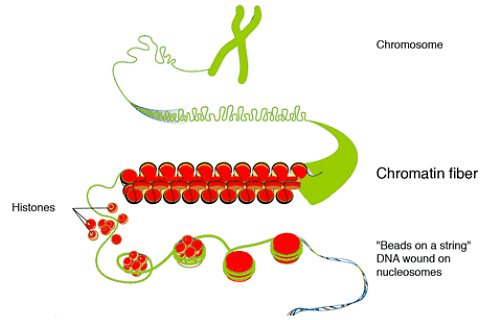
Structure of Chromatin
Read More: Euchromatin Vs Heterochromatin
Chromosomes: Definition & Structure
[Click Here for Sample Questions]
Chromosomes are thread-like structures found within the nucleus of both animal and plant cells. Protein and a single molecule of deoxyribonucleic acid make up each chromosome (DNA). DNA is passed along from parents to children and carries the precise instructions that distinguish each living thing.
The word "chromosome" is derived from the Greek terms "chroma" and "body" (soma). As chromosomes are cell structures, or bodies, that are heavily stained by several bright dyes employed in the study, scientists gave them this moniker.

Chromosomes
Structure of Chromosomes
- In mitotic metaphase, each chromosome has two symmetrical structures called chromatids or sister chromatids.
- The Size ranges from 1 to >20 m (approx).
- The centromere connects sister chromatids.
- Chromosomes have secondary constrictions in addition to the centromere.
- A telomere is the terminal portion of a chromosome.
- A chromosome with an extended segment at the secondary constriction is known as a satellite.

Structure of Chromosomes
Read More: Mitosis and Meiosis
Difference between Chromatin & Chromosome
[Click Here for Sample Questions]
The key differences between Chromatin and Chromosomes are tabulated below:
| Chromatin | Chromosome |
|---|---|
| DNA is a collection of unique proteins. Histones are the name for these proteins. It aids in the chromatin-building process. | In the nucleus of cells, the chromosome is a compact structure of nucleic acids and proteins. |
| It can be present all the time through the cell cycle. | It appears as extremely condensed structures during cell division and is easily visible. |
| An electron microscope is used to visualize chromatin. | A light microscope is used to visualize the chromosome. |
| In the nucleus, it is long and narrow. | It is small, thick, and ribbon-like in appearance. During cell division, it is discovered. |
| It is unpaired. | It is paired. |
| Chromatin allows DNA replications. | Such metabolic activity does not occur in the chromosome. Its purpose is to disseminate genetic information. |
| It can be seen in the nucleus of the interphase. | It can be seen during the M-phase, which is also known as nuclear division. |
| Uncondensed part of nucleoprotein | Condensed part of nucleoprotein. |

Differences between Chromosomes and Chromatin
Read More: Packaging of DNA
Metabolic Activities
[Click Here for Sample Questions]
Let us understand the metabolic activities of chromatin and chromosomes.
Chromatin
- The process by which genetic material is transmitted from the parent cell to the daughter cells is known as DNA replication. When a cell grows, it must copy its DNA to pass on its genetic information, which is accomplished by reproducing the DNA.

DNA Replication
- RNA Synthesis: RNA synthesis, also known as transcription, is the process of copying gene codons into RNA polymerase. It results in the synthesis of mRNA, tRNA, and other RNA copies of the genes for usage by the cells.
Chromosomes
Chromosomes do not have any metabolic functions. The structure of the chromosomes is the explanation behind this. The ability of chromosome to undertake metabolism becomes uncontrollable because they are tightly coiled.
Read More: Molecular basis of Inheritance
Things to Remember
[Click Here for Sample Questions]
- Deoxyribonucleic Acid (DNA) and proteins combine to generate chromatin fibers.
- When a cell divides, chromatin fibres condense into long threads and form chromosomes, which are rod-like structures.
- Metabolic activity does not occur in the chromosome. Its purpose is to disseminate genetic information.
- DNA replication transfers information from paarent cells to daughter cells.
- Chromosomes, like chromatin, contain DNA, which is essential for protein synthesis.
- DNA, the hereditary material, carries all of the genetic information that will be passed down to the future generation.
Also Read:
Sample Questions
Ques. How much chromatin is in a cell? (2 marks)
Ans. OD260 is used to calculate chromatin DNA content, and we commonly see 125–250 g/ml with diverse cell and tissue types.
Ques. Why is chromatin important? (2 marks)
Ans. The material that makes up a chromosome, which is made up of DNA and protein, is called chromatin. Histones are the most important proteins in chromatin. They serve as DNA packaging components. The importance of chromatin stems from the fact that it's a pretty good packing method for getting all of the DNA inside a cell.
Ques. How does chromatin affect gene expression? (2 marks)
Ans. By providing DNA accessibility to transcriptional machinery and transcription factors, chromatin shape plays an important function in controlling gene expression.
Ques. What are the two types of chromatin? (2 marks)
Ans. There are two types of chromatin. Euchromatin is a less compacted type of chromatin that can be transcribed. The second type, known as heterochromatin, is severely compressed and rarely transcribed. Chromatin appears like beads on a string under the microscope in its expanded form.
Ques. How does chromatin become a chromosome? (2 marks)
Ans. Chromatin condenses to produce chromosomes during cell division. Chromosomes are single-stranded condensed chromatin groups. Chromosomes replicate throughout the mitosis and meiosis cell division processes to guarantee that each new daughter cell receives the correct number of chromosomes.
Ques. Why chromatin is found only in eukaryotes? (2 marks)
Ans. Prokaryotic cells have a distinct arrangement of their genetic material called a genophore - a chromosome that does not contain chromatin - than eukaryotic cells, which have a chromosome that does not contain chromatin.
Ques. Explain the Relationship Between Chromatins and Chromosomes. (2 marks)
Ans. Deoxyribonucleic Acid (DNA) and proteins combine to generate chromatin fibres. When a cell divides, the chromatin fibres condense into long threads and form chromosomes, which are rod-like structures. The chromosomes, like the chromatin, contain DNA, which is essential for protein synthesis. DNA, the hereditary material, carries all of the genetic information that will be passed down to the future generation.
Ques. What are the functions of a chromosome? (2 marks)
Ans. Chromosomes are the greatest level of DNA and protein organization. Chromosomes' primary job is to transport DNA and genetic information from parents to offspring. During cell division, chromosomes play a vital role. They keep DNA from becoming twisted or damaged.
Ques. What is the structural unit of a chromosome? (2 marks)
Ans. The nucleosome, which is made up of DNA wrapped around histone proteins, is the most fundamental structural unit of chromosomes. The nucleosomes that are joined form chromatin fibres, which are then condensed into a chromosome.
Ques. What are the Salient Features of the Double-helix Structure of DNA? (5 marks)
Ans. The features of double-helix structure of DNA are as follows:
(i) DNA is a long polymer of deoxyribonucleotides. It is made up of two polynucleotide chains, where the backbone is constituted by sugar-phosphate and the bases project inside.
(ii) The two chains have anti-parallel polarity, i.e. 5′ > 3′ for one, 3′ > 5′ for another.
(iii) The bases in two strands are paired through hydrogen bonds (H—bonds) forming base pairs (bp). Adenine forms two hydrogen bonds with thymine from the opposite strand and vice-versa. Guanine bonds with cytosine by three H—bonds. Due to this, purine always comes opposite to pyrimidine. This forms a uniform distance between the two strands.
(iv) The two chains are coiled in a right-handed fashion. The pitch of the helix is 3.4 nm and there is roughly 10 bp in each turn. Due to this, the distance between a base pair in a helix is about 0.34 nm.
(v) The plane of one base pair stacks over the other in a double helix. This confers stability to the helical structure in addition to H—bonds.
Ques. Explain the biochemical nature of the Transforming Principle. (5 marks)
Ans. The biochemical nature can be summarized as follows:
(i) Oswald Avery, Colin MacLeod and Maclyn McCarty worked to determine the biochemical nature of transforming principle in Griffith’s experiment.
(ii) They purified biochemicals (proteins, RNA and DNA, etc) from heat-killed S-cells and discovered that DNA alone from S-bacteria caused R-bacteria to be transformed.
(iii) They also discovered that protease (protein-digesting enzyme) and RNAases (RNA-digesting enzymes) did not affect transformation.
(iv) Digestion with DNAse did inhibit transformation, indicating that DNA caused the transformation.
(v) They concluded that DNA is the hereditary material. But still, all the biologists were not convinced.
Previous Year Questions
- Lampbrush chromosomes occur during ________. [NEET 1996]
- In salivary gland chromosome/ polytene chromosomes, pairing is __________. [NEET 1993]
- The point, at which polytene chromosome appear to be attached together, is called________. [NEET 1995]
- The polytene chromosomes were discovered for j the first time in___________. [NEET 1995]
- A duplicated chromosome has how many chromatids ? [JEE Advanced 2016]
For Latest Updates on Upcoming Board Exams, Click Here: https://t.me/class_10_12_board_updates
Check-Out:



Comments