




AP EAPCET 2026 Engineering Question Paper for May 14 Shift 1 is available for download here. JNTUK on behalf of APSCHE conducted AP EAPCET 2026 Engineering exam on May 14 in Shift 1 from 9 AM to 12 PM. AP EAPCET 2026 Engineering consists of 160 questions for a total of 160 marks to be attempted in 3 hours.
- AP EAPCET 2026 Engineering is divided into 3 sections- Mathematics with 80 questions and Physics and Chemistry with 40 questions each.
- Each correct answer carries 1 mark and there is no negative marking for incorrect answer.
AP EAPCET 2026 Engineering Question Paper PDF for May 14 Shift 1
| AP EAPCET 2026 Engineering Question Paper May 14 Shift 1 | Download PDF | Check Solutions |













If a real valued function \(f : A \to B\) defined by \(f(x)=|x|-[x]\) is a bijection, then \(A\) and \(B\) are respectively:
If \(f:(-\infty,0)\to \mathbb{R}\) is defined by \[ f(x)=\frac{[x]}{|x|} \]
then \(f(x):x\in(-\infty,0)\) is:
For \(n\in\mathbb{N}\), \[ 1^2+2^2+3^2+\cdots+n^2 > \]
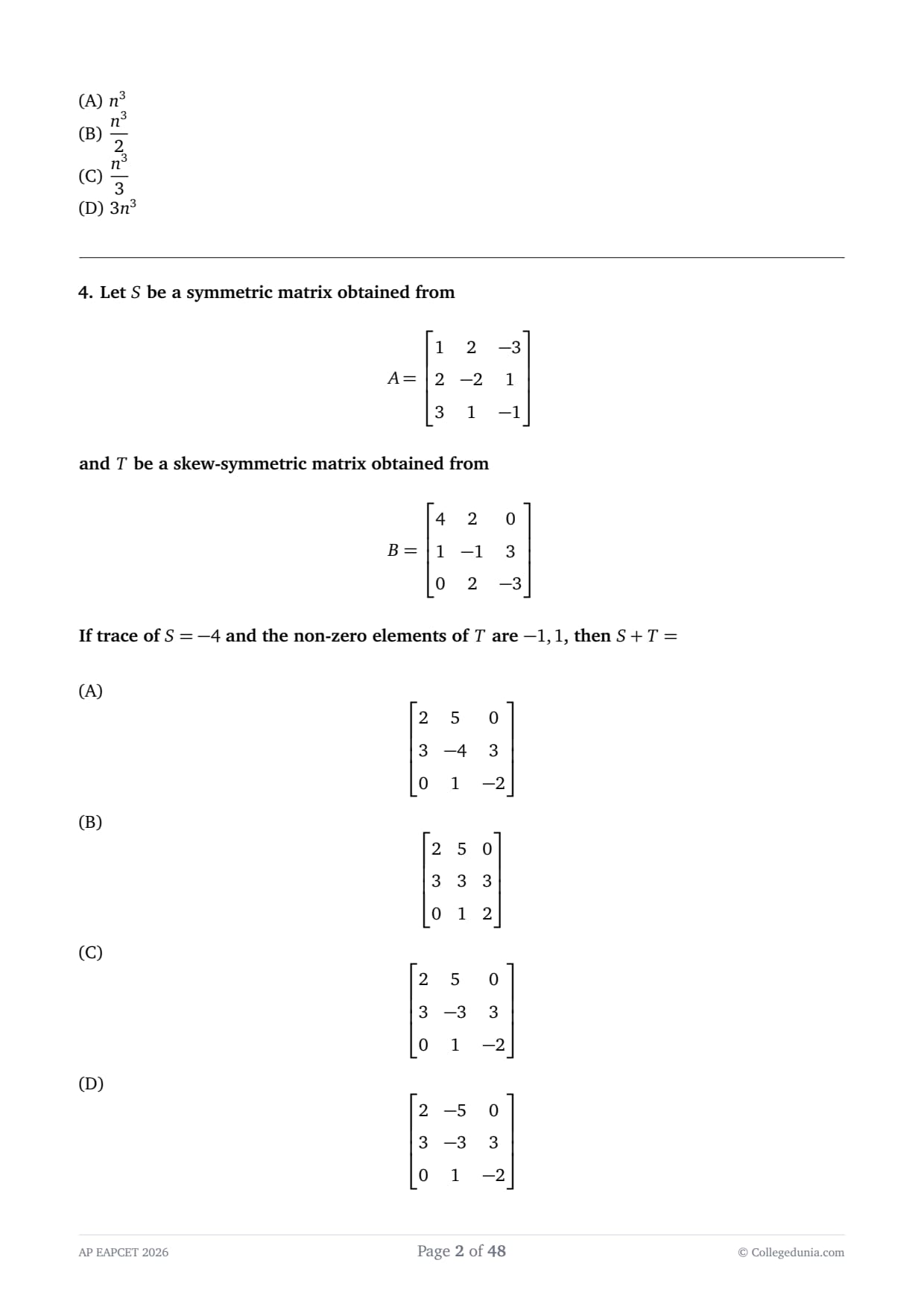
Let \(S\) be a symmetric matrix obtained from \[ A= \begin{bmatrix} 1 & 2 & -3
2 & -2 & 1
3 & 1 & -1 \end{bmatrix} \]
and \(T\) be a skew-symmetric matrix obtained from \[ B= \begin{bmatrix} 4 & 2 & 0
1 & -1 & 3
0 & 2 & -3 \end{bmatrix} \]
If trace of \(S=-4\) and the non-zero elements of \(T\) are \(-1,1\), then \(S+T=\)
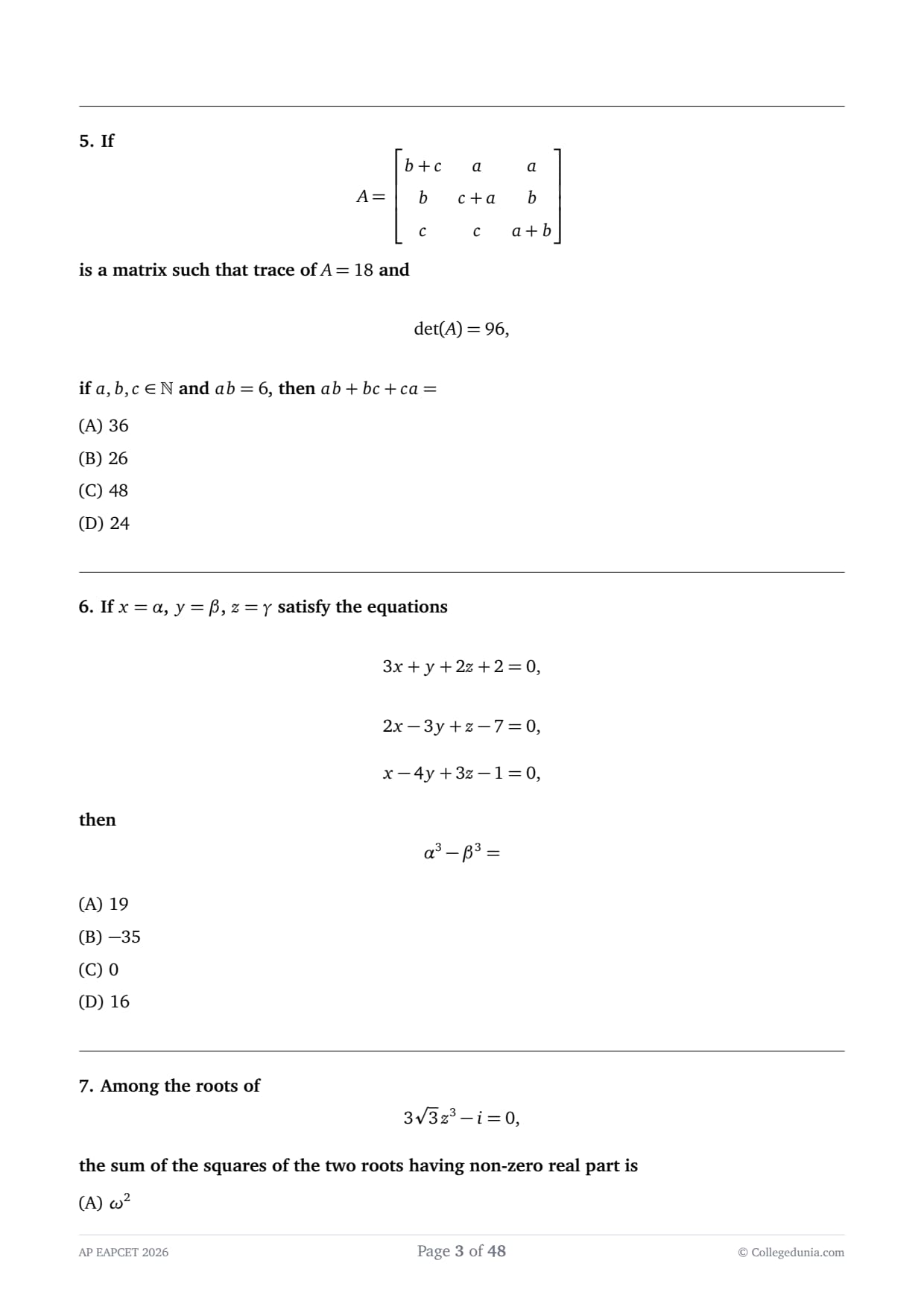
If \[ A= \begin{bmatrix} b+c & a & a
b & c+a & b
c & c & a+b \end{bmatrix} \]
is a matrix such that trace of \(A=18\) and \[ \det(A)=96, \]
if \(a,b,c\in \mathbb{N}\) and \(ab=6\), then \(ab+bc+ca=\)
If \(x=\alpha\), \(y=\beta\), \(z=\gamma\) satisfy the equations \[ 3x+y+2z+2=0, \] \[ 2x-3y+z-7=0, \] \[ x-4y+3z-1=0, \]
then \[ \alpha^3-\beta^3= \]
Among the roots of \[ 3\sqrt{3}\,z^3-i=0, \]
the sum of the squares of the two roots having non-zero real part is
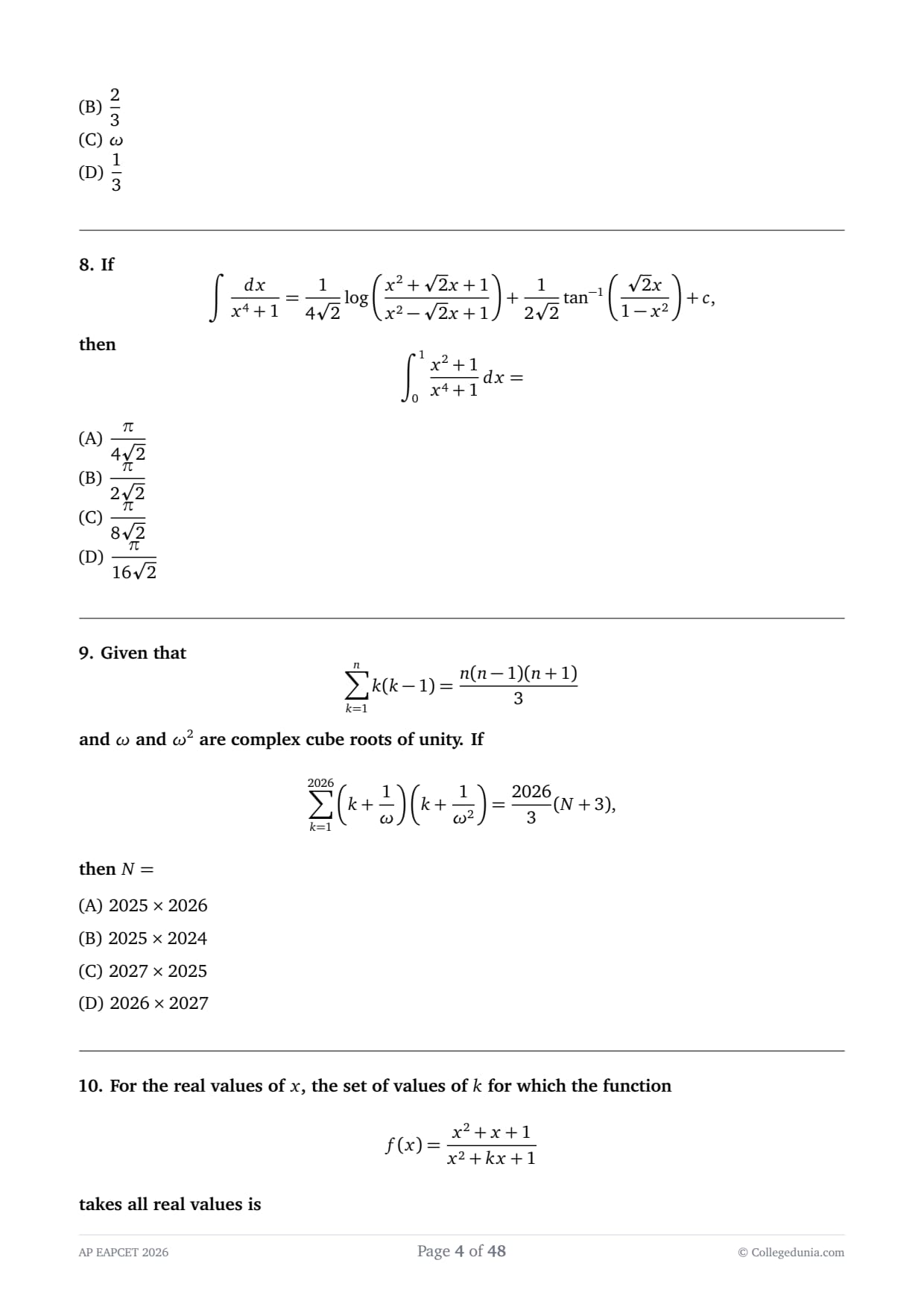
If \[ \int \frac{dx}{x^4+1} = \frac{1}{4\sqrt{2}} \log \left( \frac{x^2+\sqrt{2}x+1}{x^2-\sqrt{2}x+1} \right) + \frac{1}{2\sqrt{2}} \tan^{-1} \left( \frac{\sqrt{2}x}{1-x^2} \right) +c, \]
then \[ \int_{0}^{1}\frac{x^2+1}{x^4+1}\,dx = \]
Given that \[ \sum_{k=1}^{n} k(k-1)=\frac{n(n-1)(n+1)}{3} \]
and \(\omega\) and \(\omega^2\) are complex cube roots of unity. If \[ \sum_{k=1}^{2026} \left( k+\frac{1}{\omega} \right) \left( k+\frac{1}{\omega^2} \right) = \frac{2026}{3}(N+3), \]
then \(N=\)
For the real values of \(x\), the set of values of \(k\) for which the function \[ f(x)=\frac{x^2+x+1}{x^2+kx+1} \]
takes all real values is
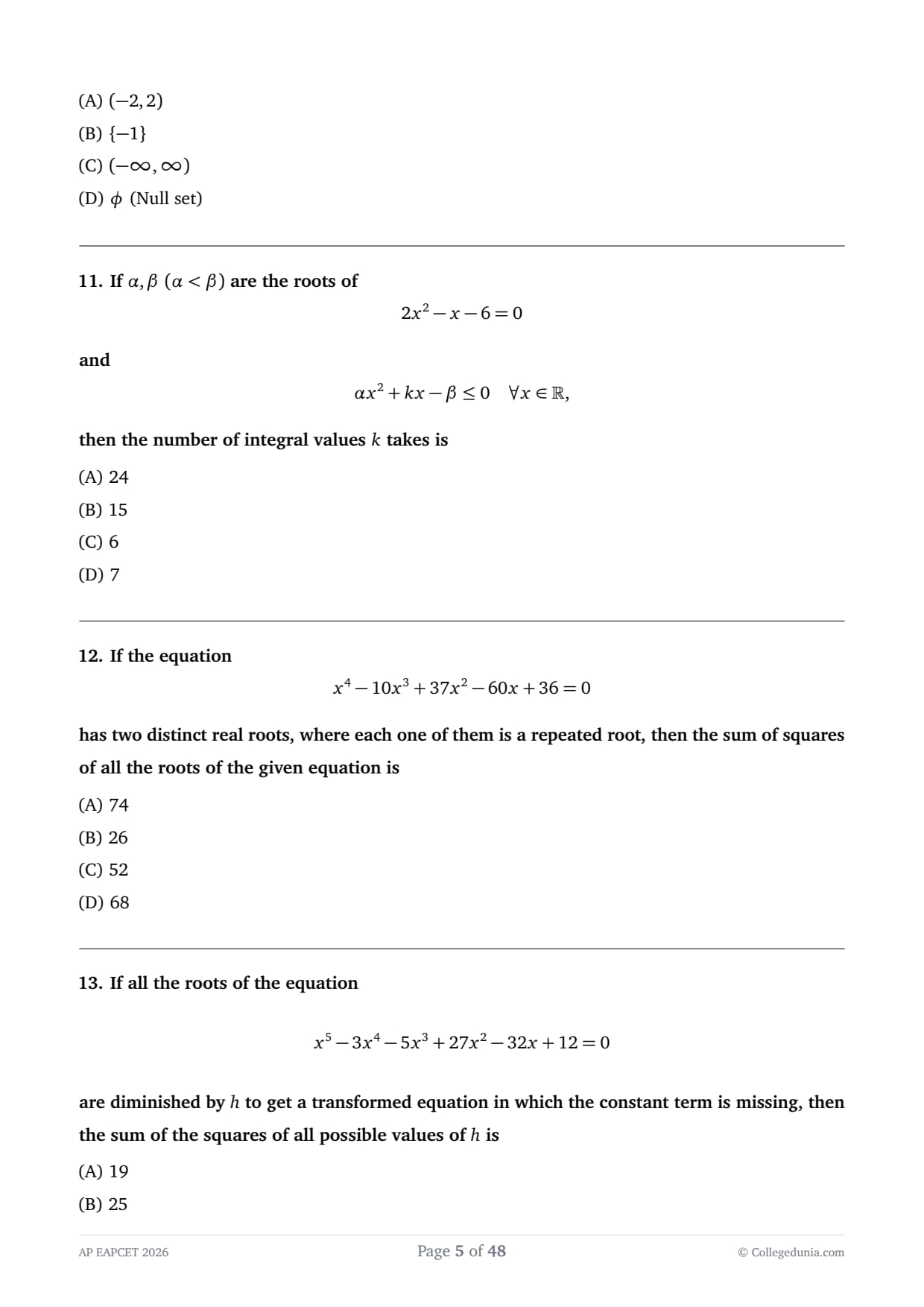
If \(\alpha,\beta\) \((\alpha<\beta)\) are the roots of \[ 2x^2-x-6=0 \]
and \[ \alpha x^2+kx-\beta\leq0 \quad \forall x\in\mathbb{R}, \]
then the number of integral values \(k\) takes is
If the equation \[ x^4-10x^3+37x^2-60x+36=0 \]
has two distinct real roots, where each one of them is a repeated root, then the sum of squares of all the roots of the given equation is
If all the roots of the equation \[ x^5-3x^4-5x^3+27x^2-32x+12=0 \]
are diminished by \(h\) to get a transformed equation in which the constant term is missing, then the sum of the squares of all possible values of \(h\) is
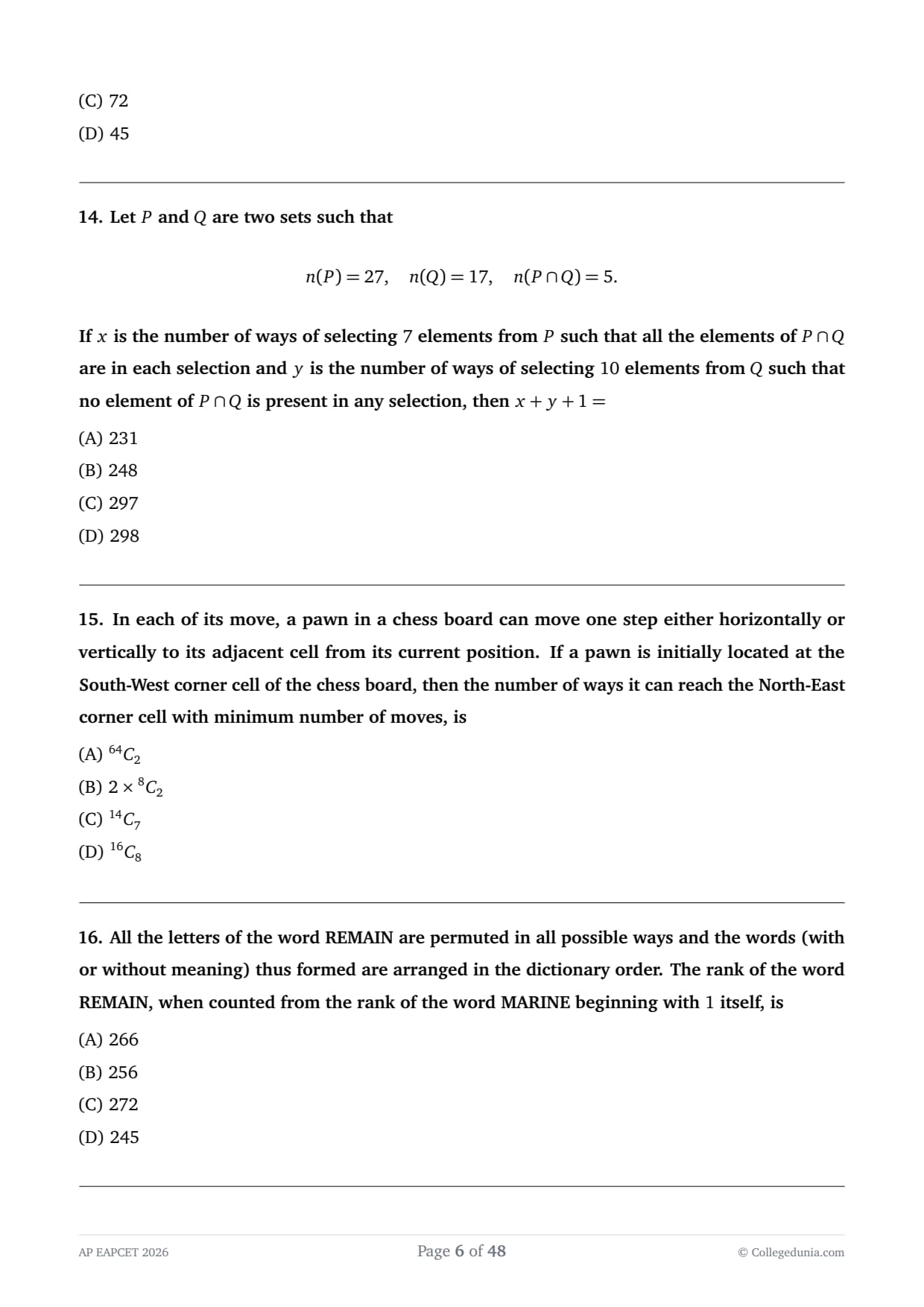
Let \(P\) and \(Q\) are two sets such that \[ n(P)=27,\quad n(Q)=17,\quad n(P\cap Q)=5. \]
If \(x\) is the number of ways of selecting \(7\) elements from \(P\) such that all the elements of \(P\cap Q\) are in each selection and \(y\) is the number of ways of selecting \(10\) elements from \(Q\) such that no element of \(P\cap Q\) is present in any selection, then \(x+y+1=\)
In each of its move, a pawn in a chess board can move one step either horizontally or vertically to its adjacent cell from its current position. If a pawn is initially located at the South-West corner cell of the chess board, then the number of ways it can reach the North-East corner cell with minimum number of moves, is
All the letters of the word REMAIN are permuted in all possible ways and the words (with or without meaning) thus formed are arranged in the dictionary order. The rank of the word REMAIN, when counted from the rank of the word MARINE beginning with \(1\) itself, is
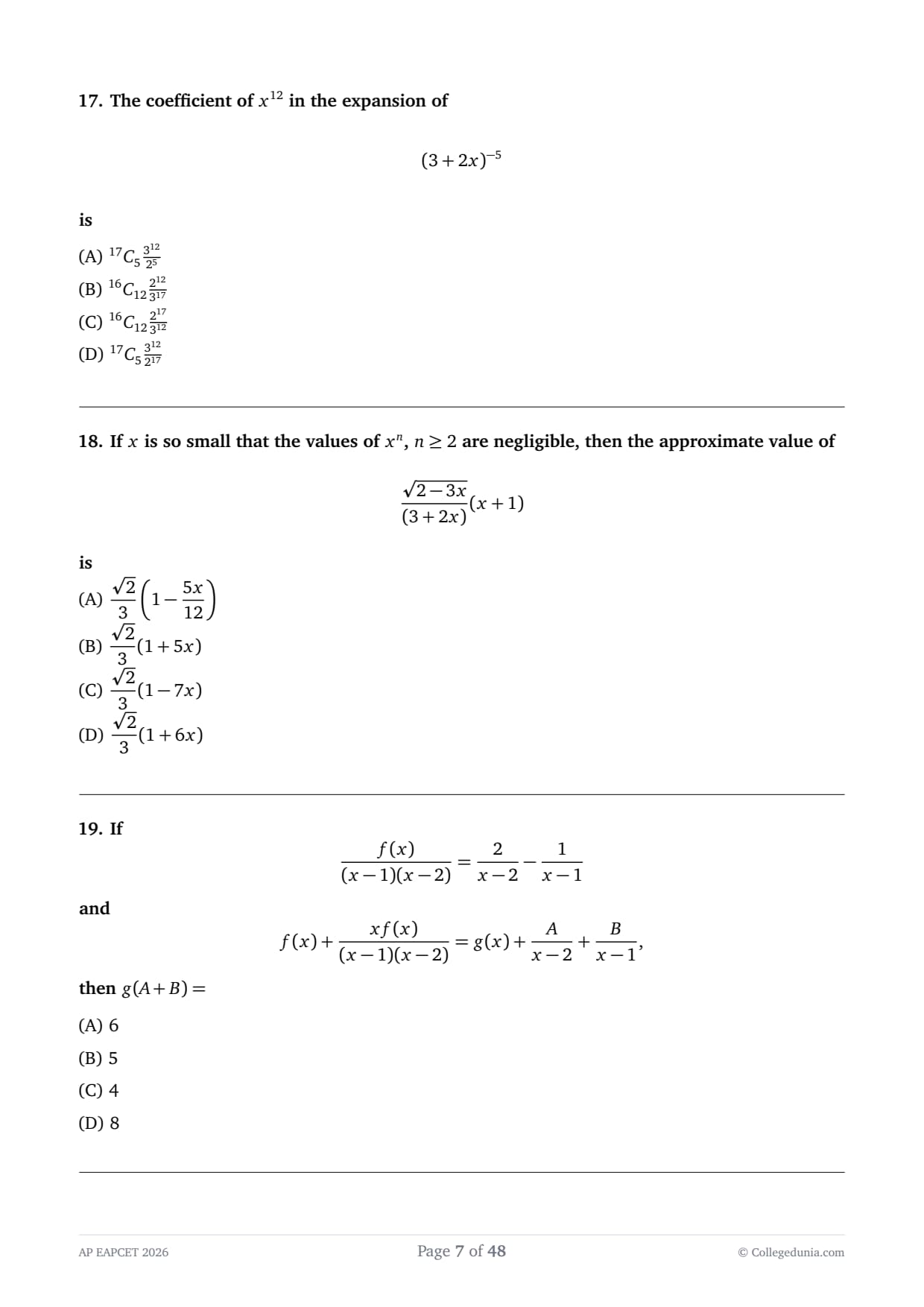
The coefficient of \(x^{12}\) in the expansion of \[ (3+2x)^{-5} \]
is
If \(x\) is so small that the values of \(x^n\), \(n\geq2\) are negligible, then the approximate value of \[ \frac{\sqrt{2-3x}}{(3+2x)}(x+1) \]
is
If \[ \frac{f(x)}{(x-1)(x-2)} = \frac{2}{x-2} - \frac{1}{x-1} \]
and \[ f(x)+\frac{xf(x)}{(x-1)(x-2)} = g(x)+\frac{A}{x-2}+\frac{B}{x-1}, \]
then \(g(A+B)=\)
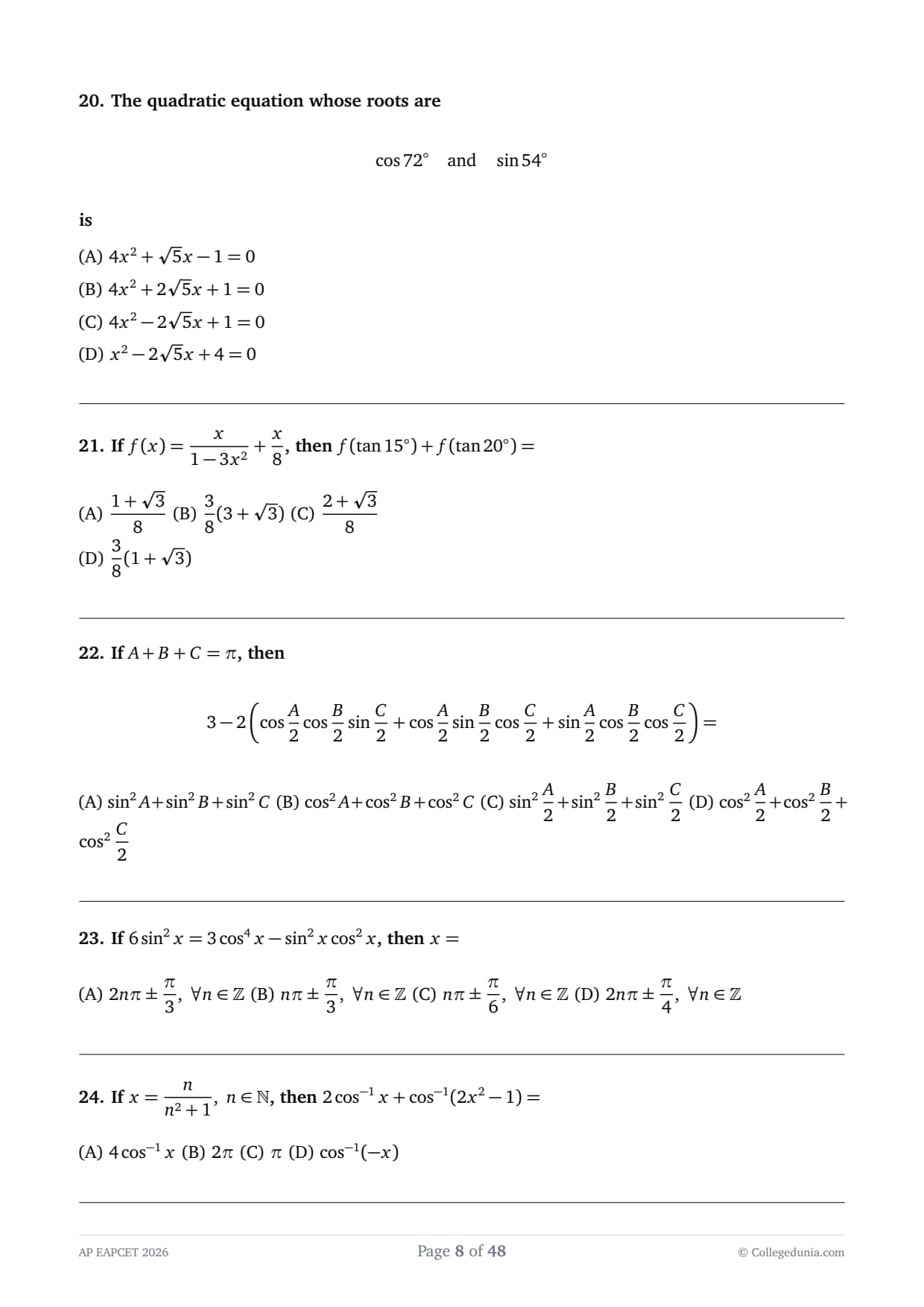
The quadratic equation whose roots are \[ \cos72^\circ \quad and \quad \sin54^\circ \]
is
If \(f(x)=\dfrac{x}{1-3x^2}+\dfrac{x}{8}\), then \(f(\tan15^\circ)+f(\tan20^\circ)=\)
If \(A+B+C=\pi\), then
\[ 3-2\left( \cos\frac{A}{2}\cos\frac{B}{2}\sin\frac{C}{2} +\cos\frac{A}{2}\sin\frac{B}{2}\cos\frac{C}{2} +\sin\frac{A}{2}\cos\frac{B}{2}\cos\frac{C}{2} \right)= \]
If \(6\sin^2x=3\cos^4x-\sin^2x\cos^2x\), then \(x=\)
If \(x=\dfrac{n}{n^2+1},\ n\in\mathbb{N}\), then \(2\cos^{-1}x+\cos^{-1}(2x^2-1)=\)
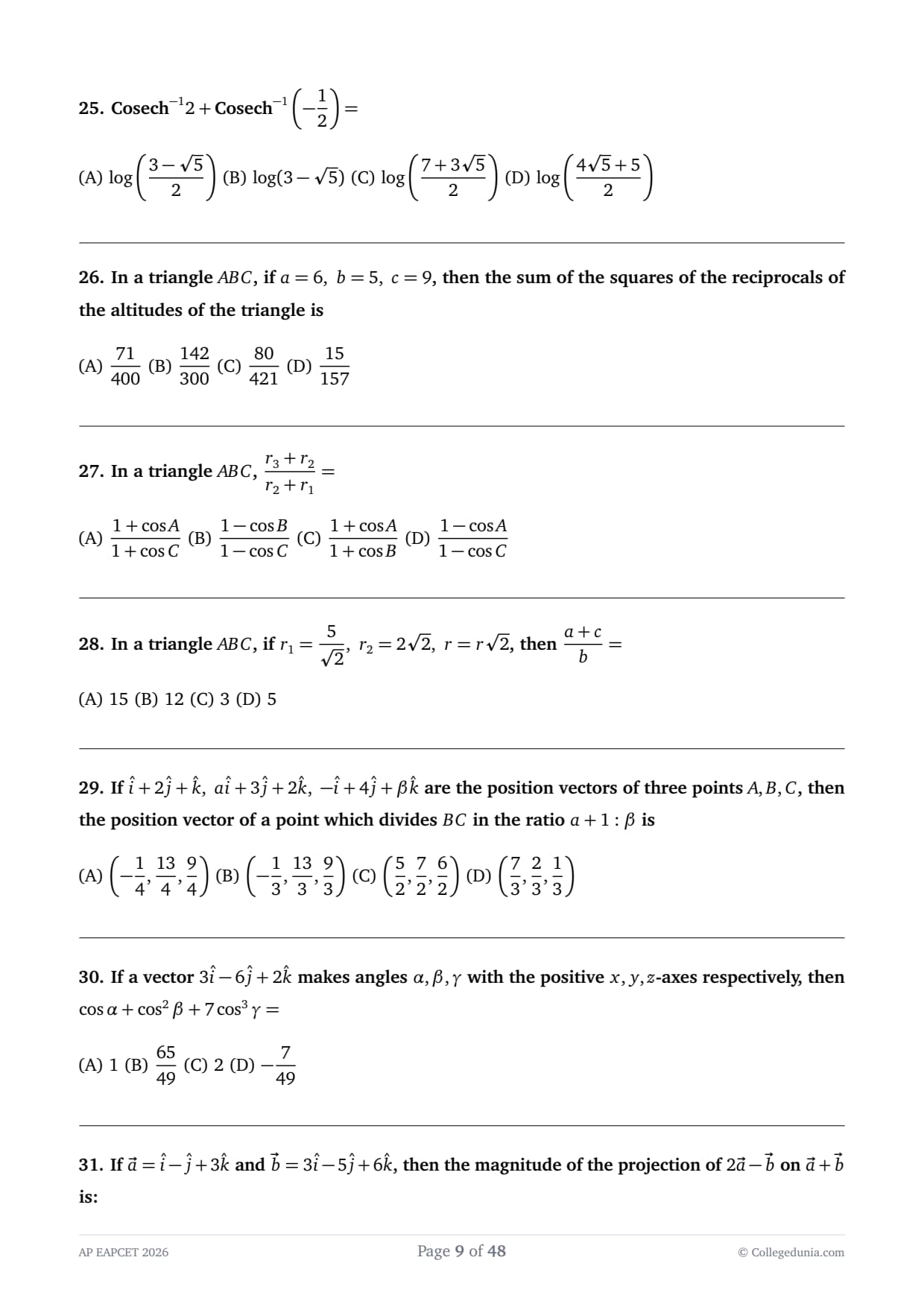
\(Cosech^{-1}2+Cosech^{-1}\left(-\dfrac12\right)=\)
In a triangle \(ABC\), if \(a=6,\ b=5,\ c=9\), then the sum of the squares of the reciprocals of the altitudes of the triangle is
In a triangle \(ABC\), \(\dfrac{r_3+r_2}{r_2+r_1}=\)
In a triangle \(ABC\), if \(r_1=\dfrac{5}{\sqrt2},\ r_2=2\sqrt2,\ r=r\sqrt2\), then \(\dfrac{a+c}{b}=\)
If \(\hat i+2\hat j+\hat k,\ a\hat i+3\hat j+2\hat k,\ -\hat i+4\hat j+\beta\hat k\) are the position vectors of three points \(A,B,C\), then the position vector of a point which divides \(BC\) in the ratio \(a+1:\beta\) is
If a vector \(3\hat i-6\hat j+2\hat k\) makes angles \(\alpha,\beta,\gamma\) with the positive \(x,y,z\)-axes respectively, then \(\cos\alpha+\cos^2\beta+7\cos^3\gamma=\)
If \( \vec{a} = \hat{i} - \hat{j} + 3\hat{k} \) and \( \vec{b} = 3\hat{i} - 5\hat{j} + 6\hat{k} \), then the magnitude of the projection of \( 2\vec{a} - \vec{b} \) on \( \vec{a} + \vec{b} \) is:
If \( \vec{a} = \hat{i}+\hat{j}+\hat{k} \), \( \vec{b} = \hat{i}-\hat{j}+\hat{k} \) and \( \vec{c} = \hat{i}+\hat{j}-\hat{k} \)
Let \( \vec{a} = 3\hat{i} - \hat{j} - \hat{k}, \vec{b} = \hat{i} + \hat{j} - 2\hat{k} \) and \( \vec{c} = 2\hat{i} + 2\hat{j} + \hat{k} \). Let \( \vec{d} \) be a vector such that \( |\vec{d}| = \sqrt{2} \) units. If the vector \( \vec{d} \) is coplanar with \( \vec{a}, \vec{b} \) and perpendicular to \( \vec{c} \), then \( \vec{d} = \)
If the mean of the set of values \( (3,6,9,10,n) \) is \( 9 \), then the variance of the given set of values is:
If \(E_1\) and \(E_2\) are two events of a sample space such that \(P(E_1)=0.8\), \(P(E_2)=0.7\) and \(P(E_1\cap E_2)\geq c\), then \(c=\)
In a bolt factory, machines \(A\), \(B\), and \(C\) manufacture \(25%\), \(35%\), and \(40%\) of the total output respectively. There is a chance of having \(5%\), \(4%\), and \(2%\) defective bolts manufactured by \(A\), \(B\), and \(C\) respectively. If a bolt is drawn at random from the output, then the probability that it is defective is:
If \( b \) and \( c \) are numbers chosen at random from the set \( \{1,2,3,\ldots,10\} \) with replacement, then the probability that the quadratic equation \[ x^2 + bx + c = 0 \]
has real roots is:
{Let \( E_1, E_2 \) and \( E_3 \) be mutually independent events.
Statement I: \( E_1 \) and \( E_2 \cup E_3 \) are independent.
Statement II: \( E_1 \) and \( E_2 \cap E_3 \) are independent.
Which one of the following options is correct?
A pair of dice is thrown independently \(3\) times. The probability of getting a total score of at least \(9\) twice, is:
The following table gives the probability distribution of a random variable \(X\):
x_i & 0 & 1 & 2 & 3
P(X=x_i) & 0.1 & 0.3 & 0.5 & 0.1
The standard deviation of \(X\) is:
If \(O\) is the origin and \(P\) is a point moving on the straight line \(lx + my + n = 0 \; (n \neq 0)\). If \(Q\) is a point on the segment \(OP\) such that \(OP \cdot OQ = k^2\), where \(k \neq 0\), then the locus of \(Q\) is
If the axes are rotated about the origin in positive direction through an angle of \(30^\circ\), then the transformed equation of \[ x^2+2\sqrt{3}xy-y^2=2a^2 \]
is
If a non-horizontal line \(L\) passes through the point \((4,-2)\) and the distance of \(L\) from the origin is \(2\) units, then the equation of the line \(L\) is
If the equation of the line passing through the orthocentre and circumcentre of triangle \(ABC\), whose vertices are \(A(3,1)\), \(B(3,3)\), \(C(6,1)\), is \(2x+by+c=0\), then \(b+c=\)
The equations of the pairs of opposite sides of a parallelogram are \[ x^2-5x+6=0 \]
and \[ y^2-6y+5=0. \]
Then the equations of its diagonals are
The circumcenter of a triangle lies at the origin and its centroid is the midpoint of the line segment joining the points \((a^2+1,a^2+1)\) and \((2a,-2a)\), where \(a\neq0\). Then the equation of the parabola passing through the orthocentre is
If the chord \(y=mx+1\) of the circle \(x^2+y^2=1\) subtends an angle \(45^\circ\) at the major segment of the circle, then the value of \(m\) is:
Equation of the circle with origin as centre and passing through the vertices of an equilateral triangle whose median is of length \(3\) is:
The tangent to the circle \(C_1:x^2+y^2-2x-1=0\) at the point \((2,1)\) cuts off a chord of length \(4\) units from a circle \(C_2\) whose centre is \((3,-2)\). The radius of circle \(C_2\) is:
If the radical axis of the circles \(x^2+y^2+2gx+2fy+c=0\) and \(2x^2+2y^2+3x+8y+2c=0\) touches the circle \(x^2+y^2+2x+2y+1=0\), then:
The radical axis of two orthogonal circles is \(x+1=0\). If one of those circles is \(x^2+y^2=4\), then the equation of the other circle is:
A chord is drawn through the focus of the parabola \(y^2=6x\) such that its perpendicular distance from the vertex is \(\frac{\sqrt5}{2}\). Then its slope can be:
A perpendicular is drawn through the vertex \(O\) of the parabola \(y^2=8x\) to any non-vertical tangent meeting the parabola at \(P\). Then \(OP.OQ=\)
The tangents drawn at the points \(P_1\) and \(P_2\) lying on the ellipse \(\frac{x^2}{4}+y^2=1\) are parallel to the chord joining the points \((0,1)\) and \((2,0)\), then the distance between \(P_1\) and \(P_2\) is:
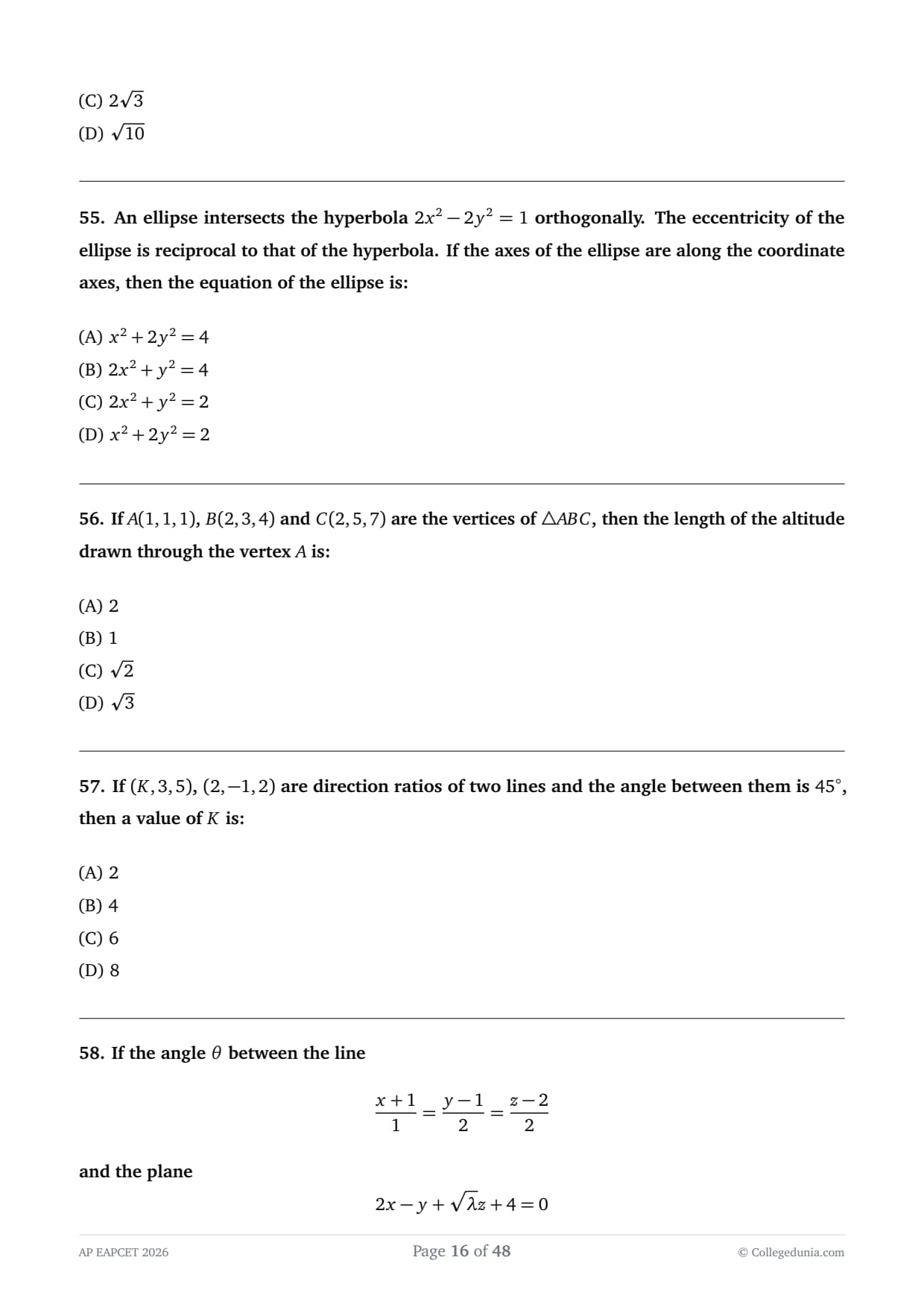
An ellipse intersects the hyperbola \(2x^2-2y^2=1\) orthogonally. The eccentricity of the ellipse is reciprocal to that of the hyperbola. If the axes of the ellipse are along the coordinate axes, then the equation of the ellipse is:
If \(A(1,1,1)\), \(B(2,3,4)\) and \(C(2,5,7)\) are the vertices of \(\triangle ABC\), then the length of the altitude drawn through the vertex \(A\) is:
If \((K,3,5)\), \((2,-1,2)\) are direction ratios of two lines and the angle between them is \(45^\circ\), then a value of \(K\) is:
If the angle \(\theta\) between the line \[ \frac{x+1}{1}=\frac{y-1}{2}=\frac{z-2}{2} \]
and the plane \[ 2x-y+\sqrt{\lambda}z+4=0 \]
is such that \(\sin\theta=\frac13\), then the value of \(\lambda\) is:
Evaluate: \[ \lim_{x\to e}\frac{\log x-1}{x-e} \]
Evaluate: \[ \lim_{x\to \frac{\pi}{3}} \frac{\tan^3x-3\tan x} {\cos\left(x+\frac{\pi}{6}\right)} \]
If \[ f(x)= \begin{cases} \dfrac{\sqrt{2+\cos x}-1}{(\pi-x)^2}, & x\neq \pi
k, & x=\pi \end{cases} \]
is continuous at \(x=\pi\), then \(k=\)
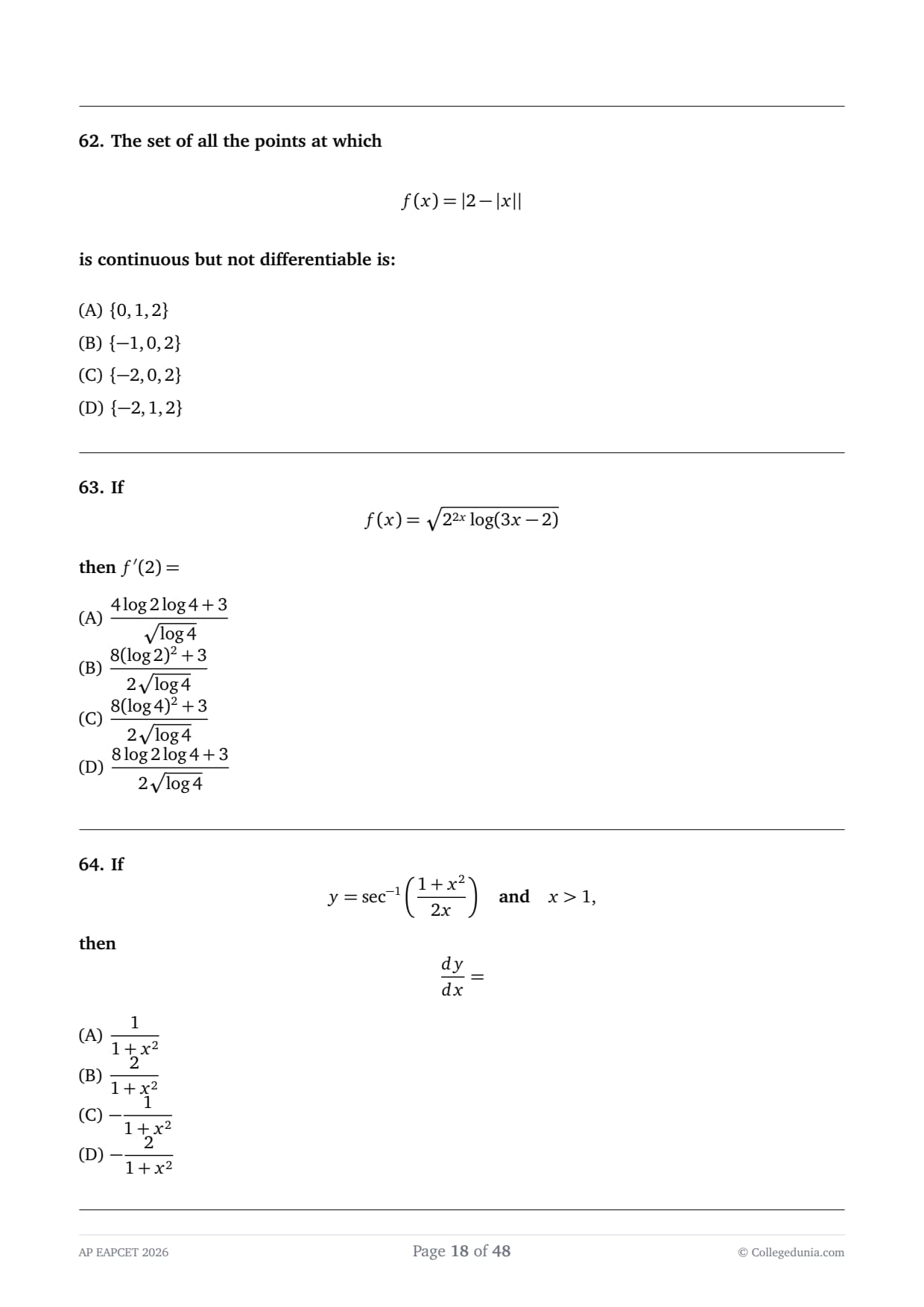
The set of all the points at which \[ f(x)=|2-|x|| \]
is continuous but not differentiable is:
If \[ f(x)=\sqrt{2^{2x}\log(3x-2)} \]
then \(f'(2)=\)
If \[ y=\sec^{-1}\left(\frac{1+x^2}{2x}\right) \quad and \quad x>1, \]
then \[ \frac{dy}{dx}= \]
The cubic equation \[ 2x^3-3x^2+6x+2=0 \]
If the vertical angle of a cone is \(60^\circ\) and the rate of change of its total surface area is \(2\sqrt{3}\,cm^2/sec\), then the rate of change of its volume (in \(cm^3/sec\)) when its radius is \(5\) cm is:
The surface area of a sphere is \(49\pi\) sq.cm. If it is increased by \(0.016\) sq.cm., then the approximate increase in its volume (in c.c.) is:
If the normal drawn to the curve \(y^4=16x^3\) at the point of intersection of this curve and the line \(y=2\) meets the \(X\)- and \(Y\)-axes at \(A\) and \(B\) respectively, then \(OA+3OB=\)
Evaluate: \[ \int \frac{dx}{(x^5+1)^{6/5}} \]
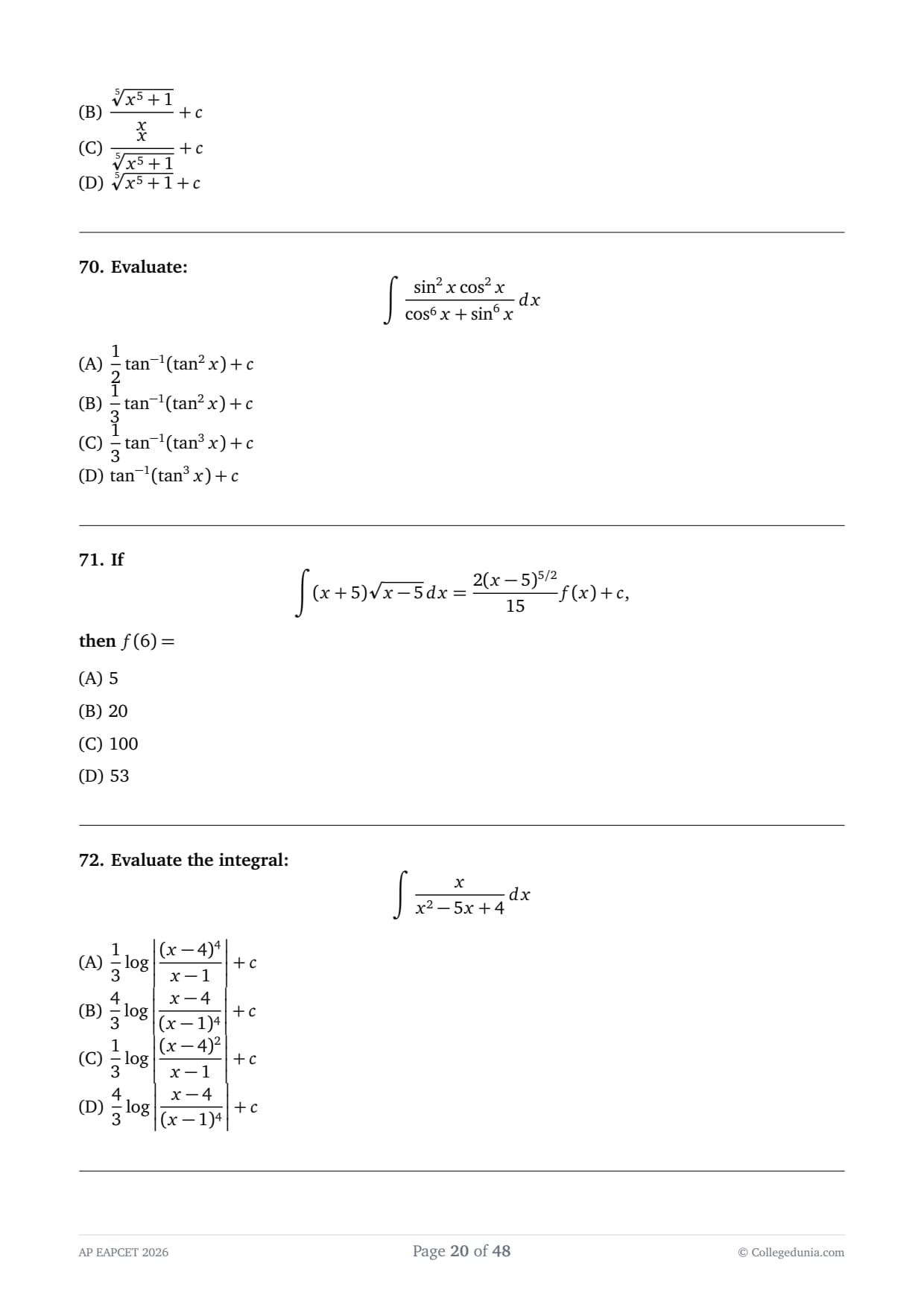
Evaluate: \[ \int \frac{\sin^2 x \cos^2 x}{\cos^6 x+\sin^6 x}\,dx \]
If \[ \int (x+5)\sqrt{x-5}\,dx = \frac{2(x-5)^{5/2}}{15}f(x)+c, \]
then \(f(6)=\)
Evaluate the integral: \[ \int \frac{x}{x^2-5x+4}\,dx \]
Evaluate: \[ \int \frac{e^{2x}-1}{e^{2x}+e^x+1}\,dx \]
Evaluate: \[ \lim_{n\to\infty}\sum_{r=n}^{2n}\left(\frac{n^3+r^3}{n^4}\right) \]
Evaluate: \[ \int_{\pi/2}^{4051\pi/2}\frac{\cos^22x}{1+\sin2x}\,dx \]
Evaluate: \[ \int_{-2\pi}^{2\pi}(1+\cos x)^3(1-\cos x)^4\,dx \]
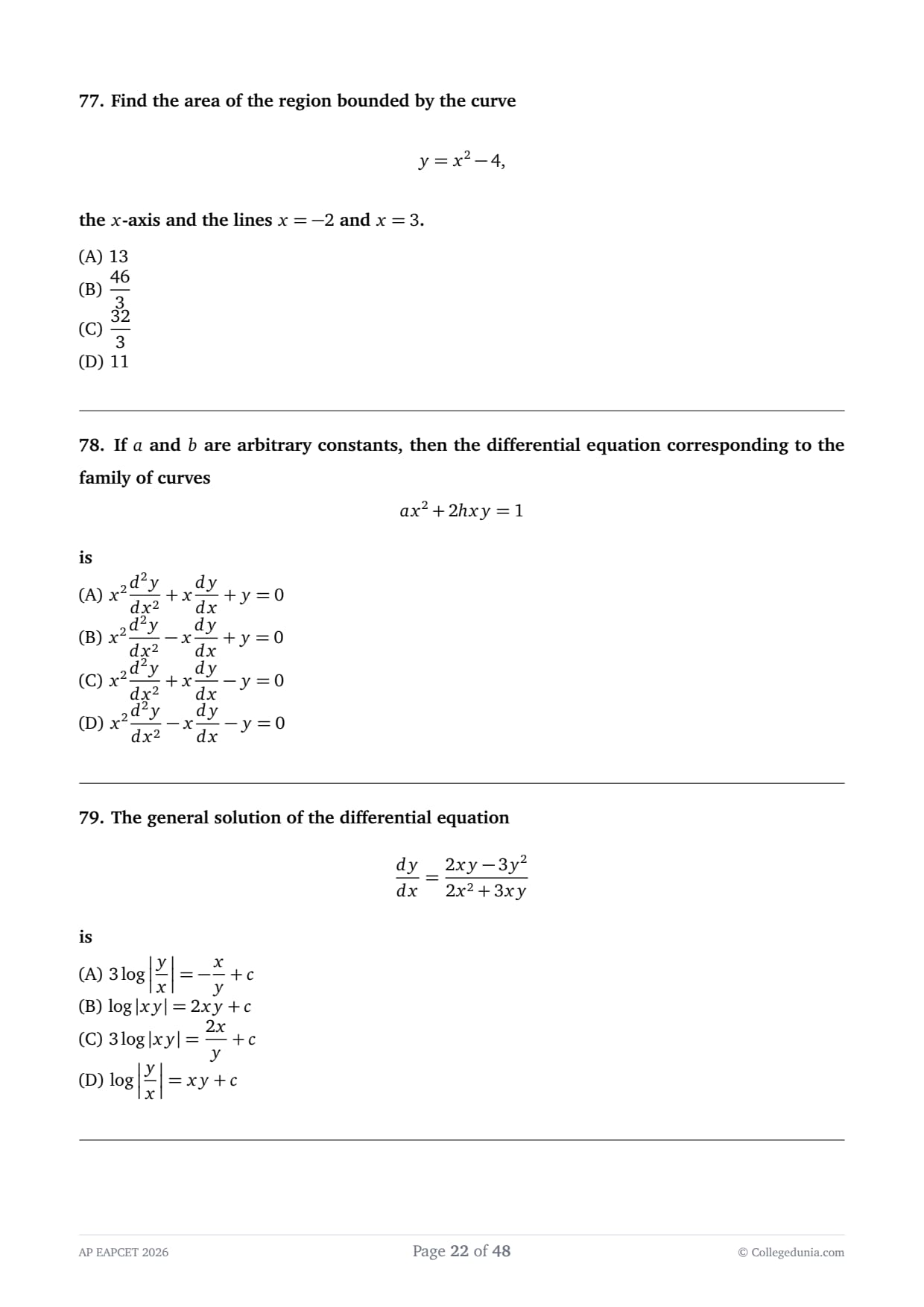
Find the area of the region bounded by the curve \[ y=x^2-4, \]
the \(x\)-axis and the lines \(x=-2\) and \(x=3\).
If \(a\) and \(b\) are arbitrary constants, then the differential equation corresponding to the family of curves \[ ax^2+2hxy=1 \]
is
The general solution of the differential equation \[ \frac{dy}{dx}=\frac{2xy-3y^2}{2x^2+3xy} \]
is
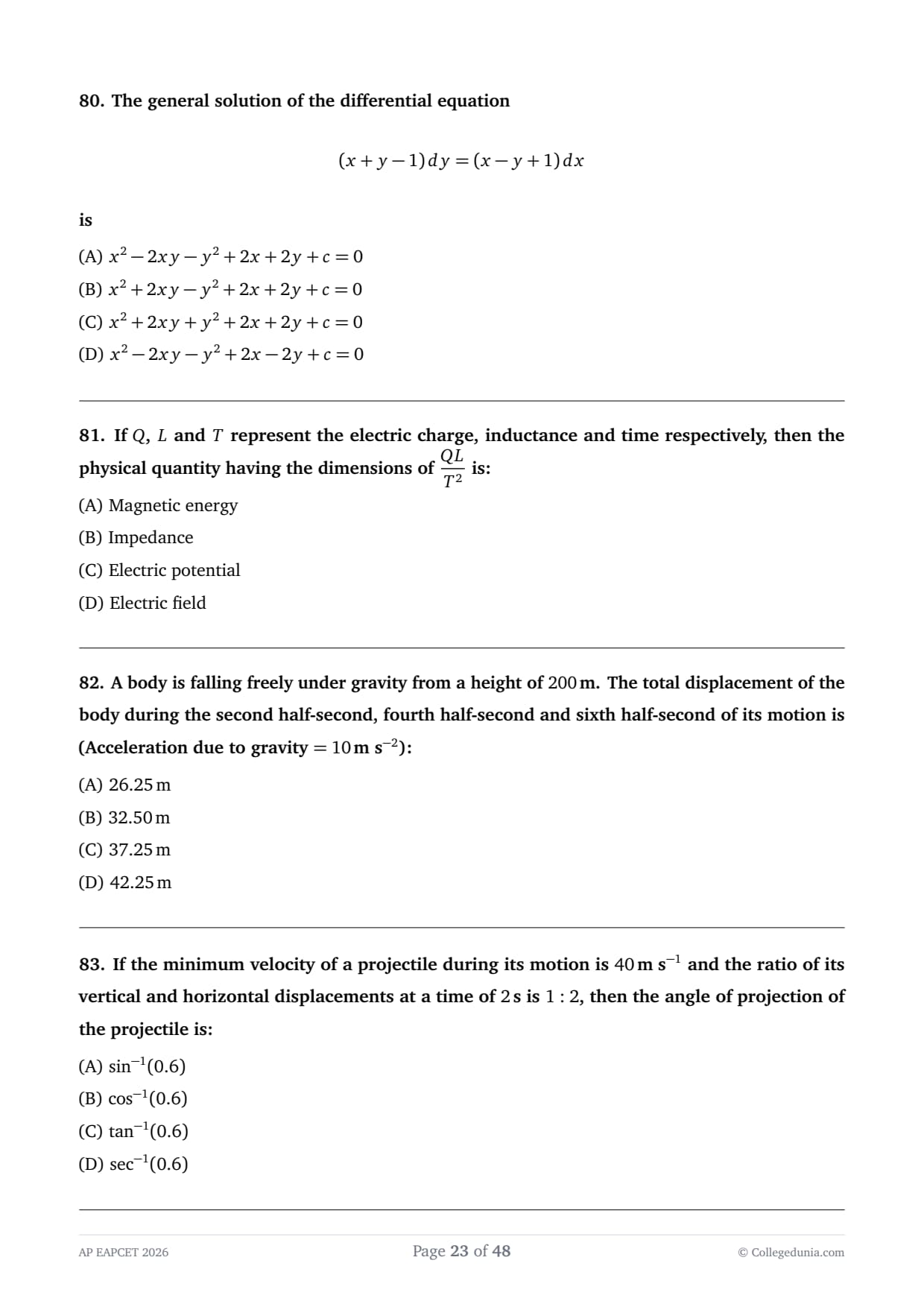
The general solution of the differential equation \[ (x+y-1)\,dy=(x-y+1)\,dx \]
is
If \(Q\), \(L\) and \(T\) represent the electric charge, inductance and time respectively, then the physical quantity having the dimensions of \( \dfrac{QL}{T^2} \) is:
A body is falling freely under gravity from a height of \(200\,m\). The total displacement of the body during the second half-second, fourth half-second and sixth half-second of its motion is (Acceleration due to gravity \(=10\,m s^{-2}\)):
If the minimum velocity of a projectile during its motion is \(40\,m s^{-1}\) and the ratio of its vertical and horizontal displacements at a time of \(2\,s\) is \(1:2\), then the angle of projection of the projectile is:
A body is projected with a velocity of \(15\sqrt3\,m s^{-1}\) at an angle of \(60^\circ\) with the horizontal and another body is projected simultaneously from the same point in the same vertical plane with a velocity of \(40\,m s^{-1}\) at an angle of \(30^\circ\) with the horizontal. The time at which the velocity vectors of the two bodies will be in the same direction is:
A small bead is placed on a thin circular loop of radius \(25\,cm\) which is rotating about its vertical diameter with a constant velocity of \(10\,rad s^{-1}\). The angle made by the radius vector joining the center of the loop to the bead with the vertically downward direction is (Neglect friction and take \(g=10\,m s^{-2}\)):
A body is placed at the top of an inclined plane of angle of inclination \( \tan^{-1}\left(\frac{9}{16}\right) \). If the plane is smooth, the body reaches the bottom in time \(T\) and if the plane is rough, it takes time \(3T\) to reach the bottom of the plane, then the coefficient of kinetic friction between the body and the rough inclined plane is:
A \(5\,kg\) block pushed by \(100\,N\) over \(10\,m\) on a plane. If the coefficient of friction between the block and plane is \(0.2\), then the final kinetic energy of the block is _____ (\(g=10\,m s^{-2}\)):
A force \(F=4x\) is applied to move an object from \(x=0\) to \(x=2\,m\), then the work done is:
A thin wire of length \(L\) and uniform linear mass density \(\rho\) is bent into a circular loop with centre at \(O\) as shown. The moment of inertia of the loop about the axis \(XX'\) is:

On imparting an initial velocity \(v_0\), a ball begins to move in horizontal circle of radius \(R\) on horizontal plane. If the coefficient of friction between the ball and plane is \(\mu\), then the time required by ball to come to rest is:

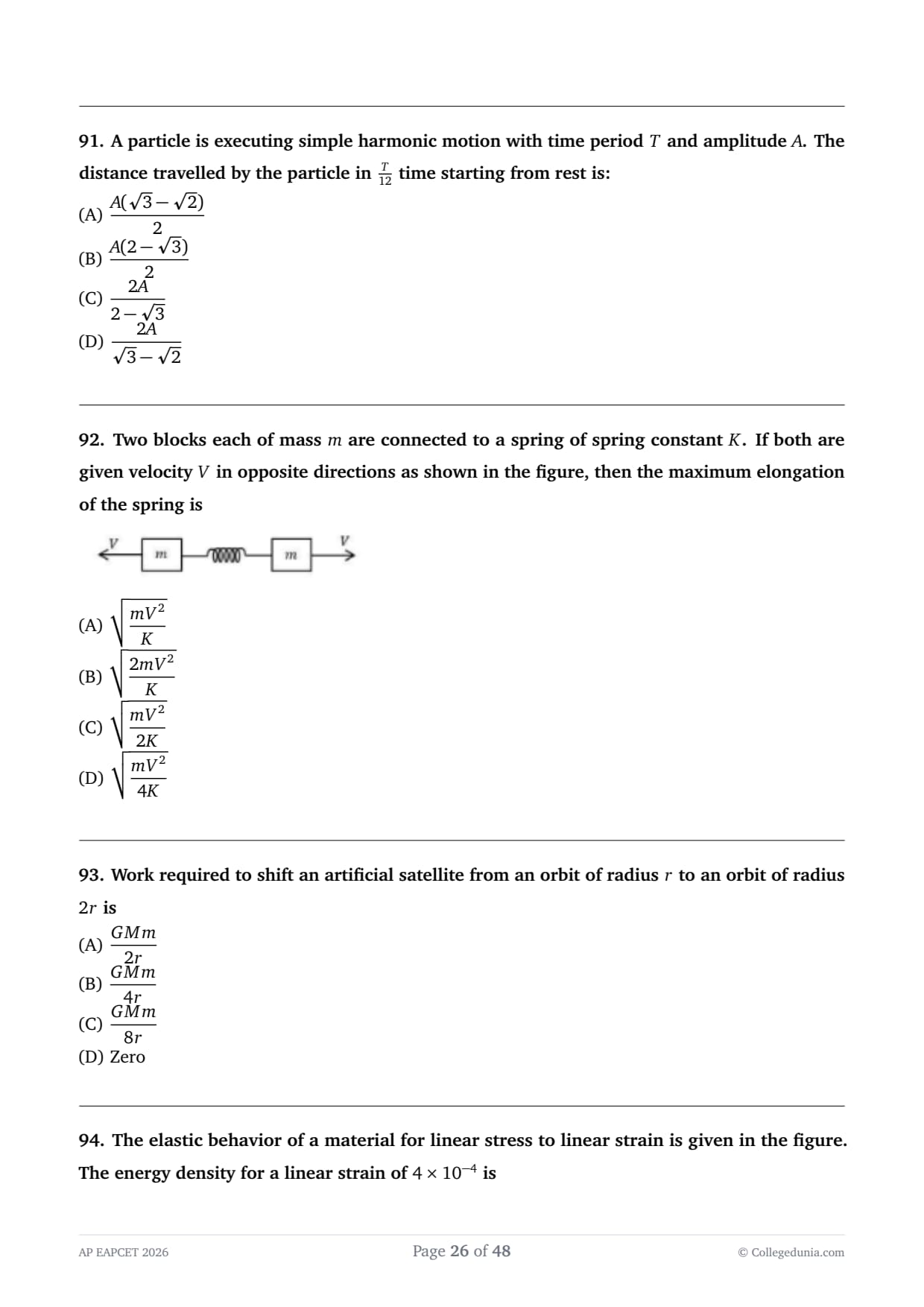
A particle is executing simple harmonic motion with time period \(T\) and amplitude \(A\). The distance travelled by the particle in \(\frac{T}{12}\) time starting from rest is:
Two blocks each of mass \(m\) are connected to a spring of spring constant \(K\). If both are given velocity \(V\) in opposite directions as shown in the figure, then the maximum elongation of the spring is

Work required to shift an artificial satellite from an orbit of radius \(r\) to an orbit of radius \(2r\) is
The elastic behavior of a material for linear stress to linear strain is given in the figure. The energy density for a linear strain of \(4\times10^{-4}\) is

A large tank filled with water to a height \(h\) is to be emptied through a small hole at the bottom. The ratio of times taken for the level of water to fall from \(h\) to \(\frac{h}{2}\) and from \(\frac{h}{2}\) to zero is
Heat energy released by water of mass \(3\,kg\) when it is cooled by \(20^\circ C\) is \((specific heat capacity of water=4200\,J kg^{-1}K^{-1})\)
Three rods made of the same material and having the same cross-section have been joined as shown in figure. Each rod is of same length. The left and right ends are kept at \(0^\circ C\) and \(90^\circ C\) respectively. The temperature of the junction will be

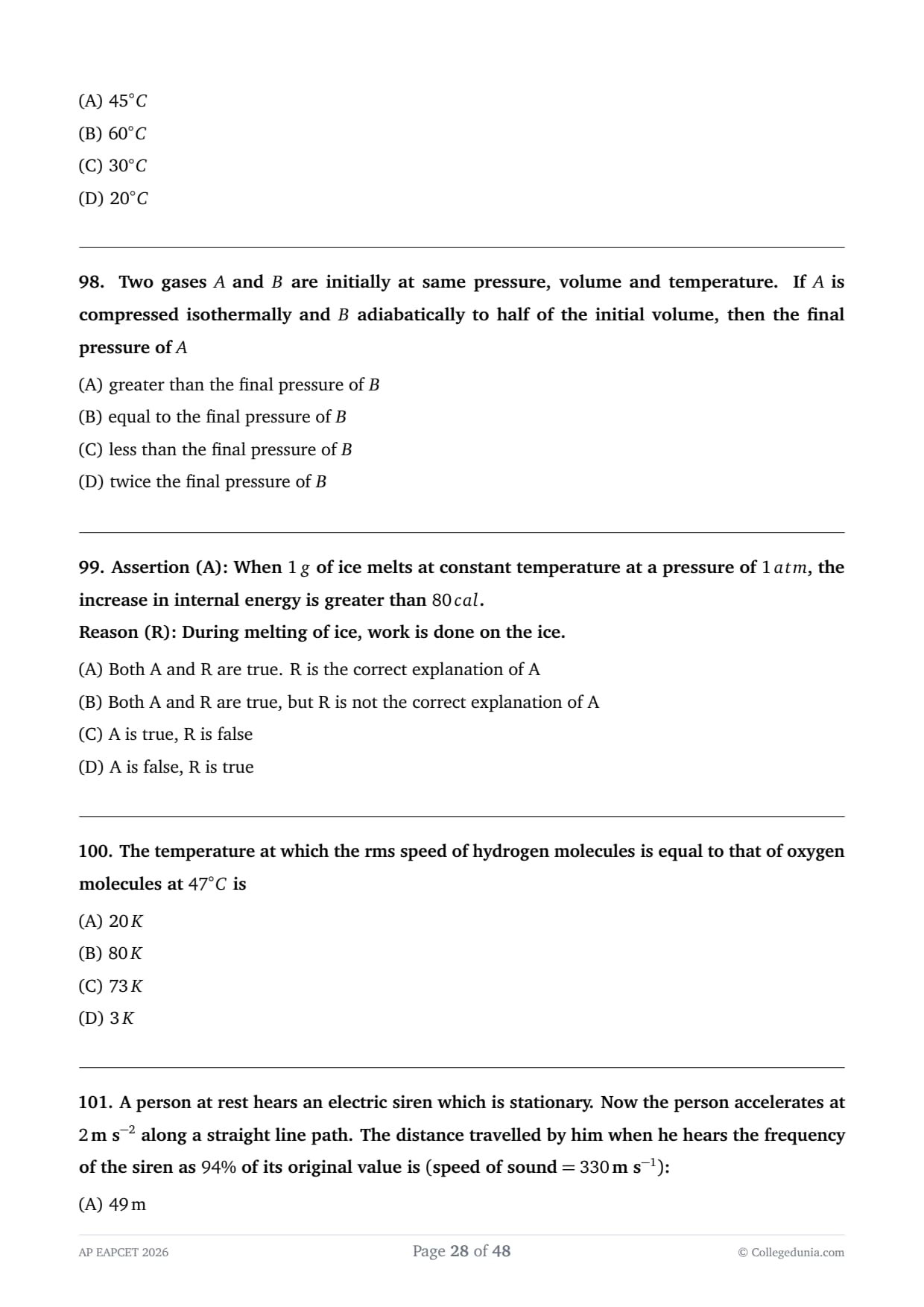
Two gases \(A\) and \(B\) are initially at same pressure, volume and temperature. If \(A\) is compressed isothermally and \(B\) adiabatically to half of the initial volume, then the final pressure of \(A\)
Assertion (A): When \(1\,g\) of ice melts at constant temperature at a pressure of \(1\,atm\), the increase in internal energy is greater than \(80\,cal\).
Reason (R): During melting of ice, work is done on the ice.
The temperature at which the rms speed of hydrogen molecules is equal to that of oxygen molecules at \(47^\circ C\) is
A person at rest hears an electric siren which is stationary. Now the person accelerates at \(2\,m s^{-2}\) along a straight line path. The distance travelled by him when he hears the frequency of the siren as \(94%\) of its original value is \((speed of sound = 330\,m s^{-1})\):
An object is placed at a distance of \(15\,cm\) from a convex lens of focal length \(10\,cm\). On the other side of the lens, at its focus, a convex mirror is placed such that final image formed coincides with the object. The focal length of convex mirror is:
For a prism of angle \(5^\circ\), the angle of minimum deviation \((\delta)\) varies with refractive index \((\mu)\) as shown in the graph. The slope of the graph is:
In Young’s double slit experiment, the ratio of intensities of maxima and minima is \(25:9\). The ratio of intensities of two slits is:
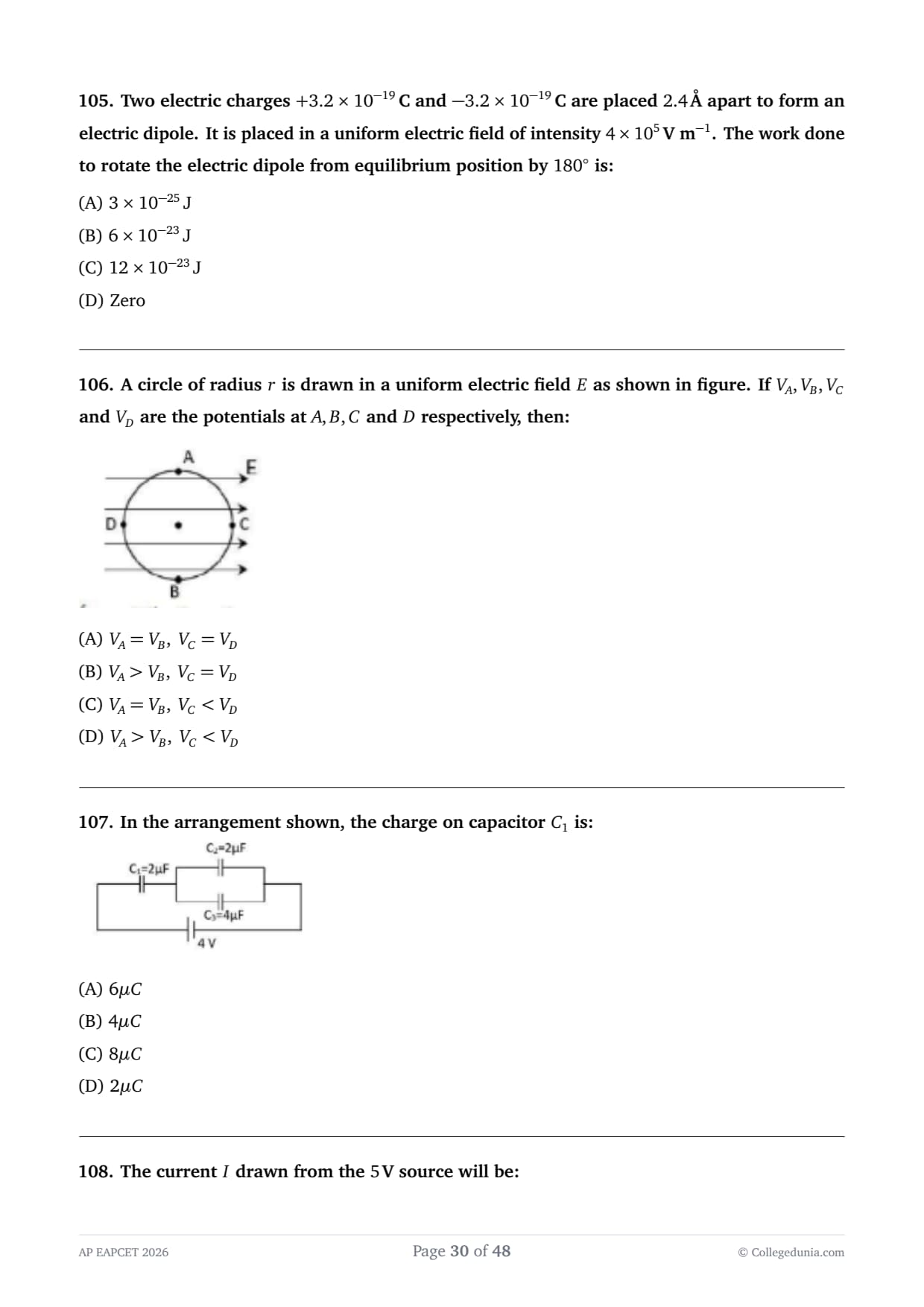
Two electric charges \(+3.2\times10^{-19}\,C\) and \(-3.2\times10^{-19}\,C\) are placed \(2.4\,\) apart to form an electric dipole. It is placed in a uniform electric field of intensity \(4\times10^5\,V m^{-1}\). The work done to rotate the electric dipole from equilibrium position by \(180^\circ\) is:
A circle of radius \(r\) is drawn in a uniform electric field \(E\) as shown in figure. If \(V_A, V_B, V_C\) and \(V_D\) are the potentials at \(A,B,C\) and \(D\) respectively, then:
In the arrangement shown, the charge on capacitor \(C_1\) is:
The current \(I\) drawn from the \(5\,V\) source will be:
In the circuit given below, each of three resistors of \(4\Omega\) can have a maximum power of \(20\,W\) otherwise, it will melt. The maximum power which the whole circuit can take is:
If a current is passing in a spring, it
Magnetic moment of an electron moving in a circular orbit of radius \(r\) with a speed \(v\) is
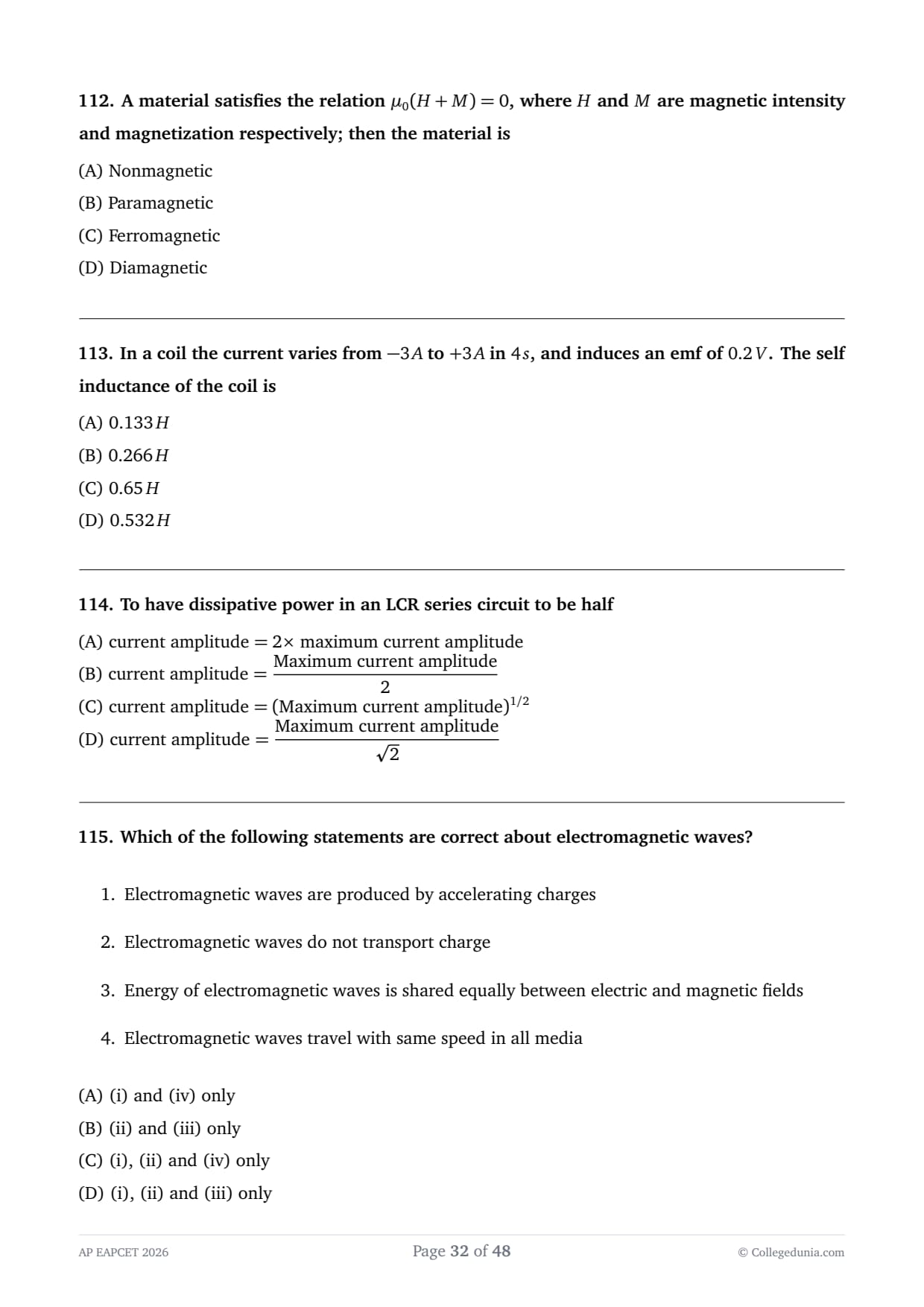
A material satisfies the relation \(\mu_0(H+M)=0\), where \(H\) and \(M\) are magnetic intensity and magnetization respectively; then the material is
In a coil the current varies from \(-3\,A\) to \(+3\,A\) in \(4\,s\), and induces an emf of \(0.2\,V\). The self inductance of the coil is
To have dissipative power in an LCR series circuit to be half
Which of the following statements are correct about electromagnetic waves?
Electromagnetic waves are produced by accelerating charges
Electromagnetic waves do not transport charge
Energy of electromagnetic waves is shared equally between electric and magnetic fields
Electromagnetic waves travel with same speed in all media
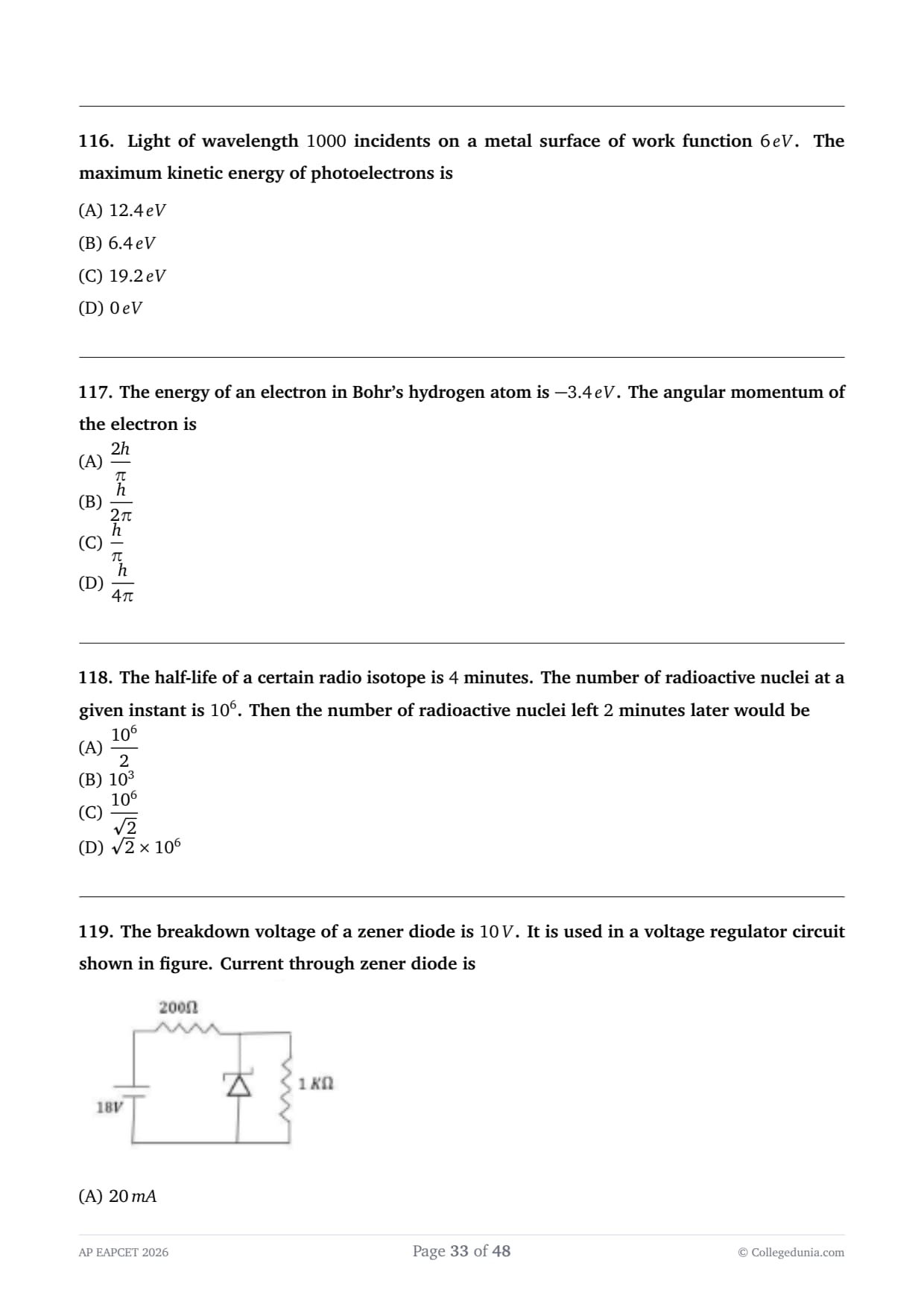
Light of wavelength \(1000\) incidents on a metal surface of work function \(6\,eV\). The maximum kinetic energy of photoelectrons is
The energy of an electron in Bohr's hydrogen atom is \(-3.4\,eV\). The angular momentum of the electron is
The half-life of a certain radio isotope is \(4\) minutes. The number of radioactive nuclei at a given instant is \(10^6\). Then the number of radioactive nuclei left \(2\) minutes later would be
The breakdown voltage of a zener diode is \(10\,V\). It is used in a voltage regulator circuit shown in figure. Current through zener diode is
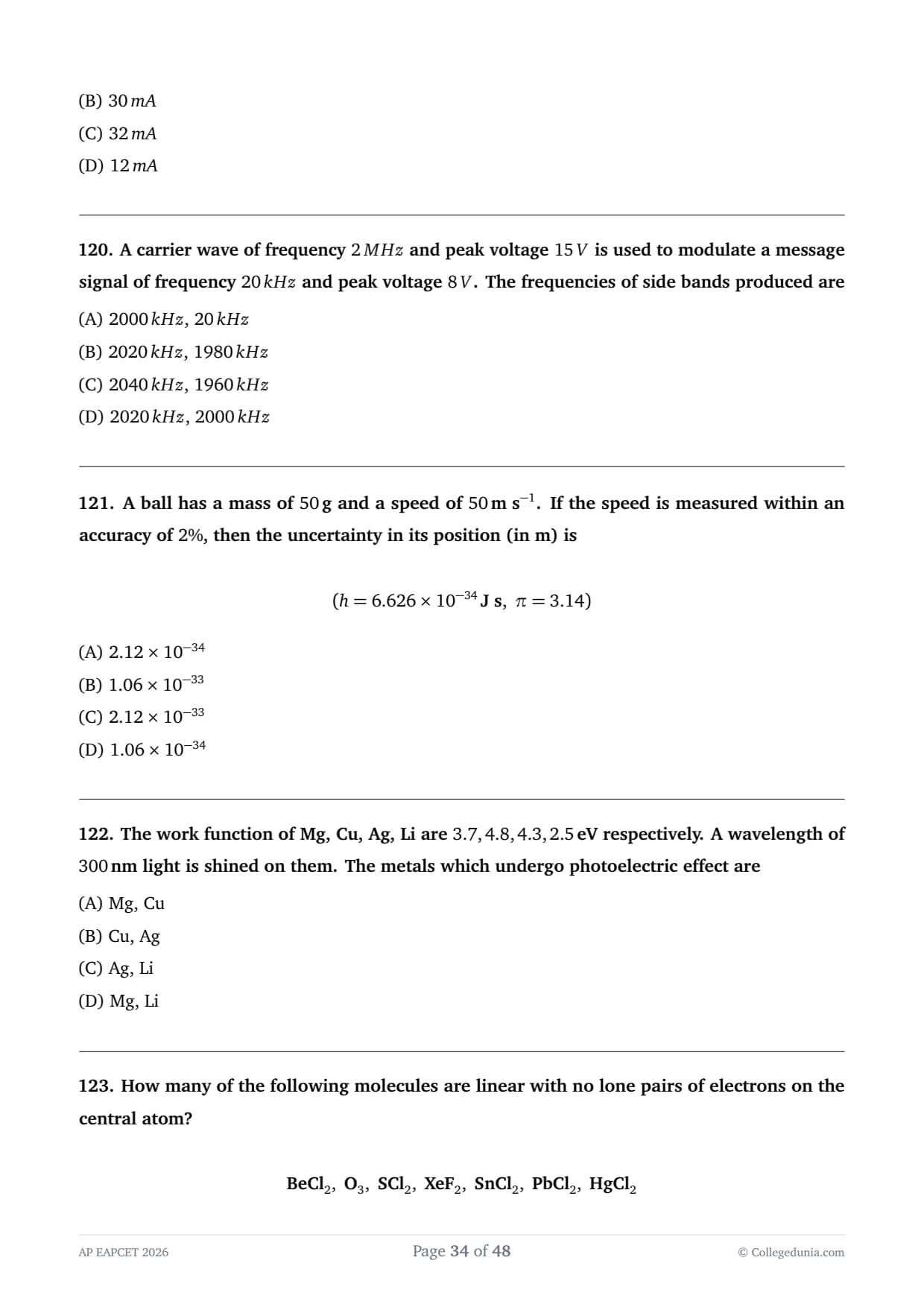
A carrier wave of frequency \(2\,MHz\) and peak voltage \(15\,V\) is used to modulate a message signal of frequency \(20\,kHz\) and peak voltage \(8\,V\). The frequencies of side bands produced are
A ball has a mass of \(50\,g\) and a speed of \(50\,m s^{-1}\). If the speed is measured within an accuracy of \(2%\), then the uncertainty in its position (in m) is
\[ (h = 6.626 \times 10^{-34}\,J s, \ \pi = 3.14) \]
The work function of Mg, Cu, Ag, Li are \(3.7, 4.8, 4.3, 2.5\,eV\) respectively. A wavelength of \(300\,nm\) light is shined on them. The metals which undergo photoelectric effect are
How many of the following molecules are linear with no lone pairs of electrons on the central atom?
\[ BeCl_2,\ O_3,\ SCl_2,\ XeF_2,\ SnCl_2,\ PbCl_2,\ HgCl_2 \]
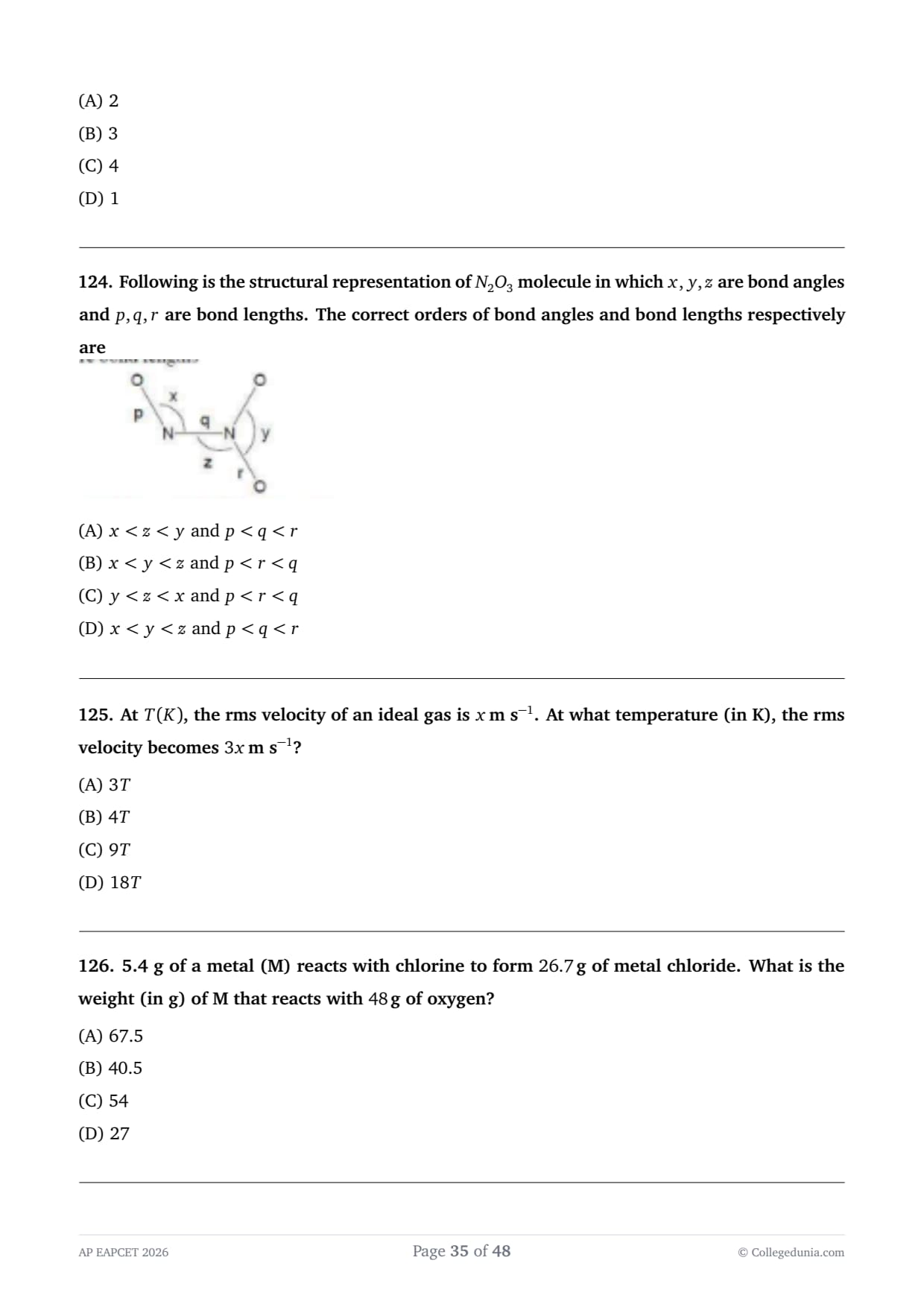
Following is the structural representation of \(N_2O_3\) molecule in which \(x, y, z\) are bond angles and \(p, q, r\) are bond lengths. The correct orders of bond angles and bond lengths respectively are

At \(T(K)\), the rms velocity of an ideal gas is \(x\,m s^{-1}\). At what temperature (in K), the rms velocity becomes \(3x\,m s^{-1}\)?
5.4 g of a metal (M) reacts with chlorine to form \(26.7\,g\) of metal chloride. What is the weight (in g) of M that reacts with \(48\,g\) of oxygen?
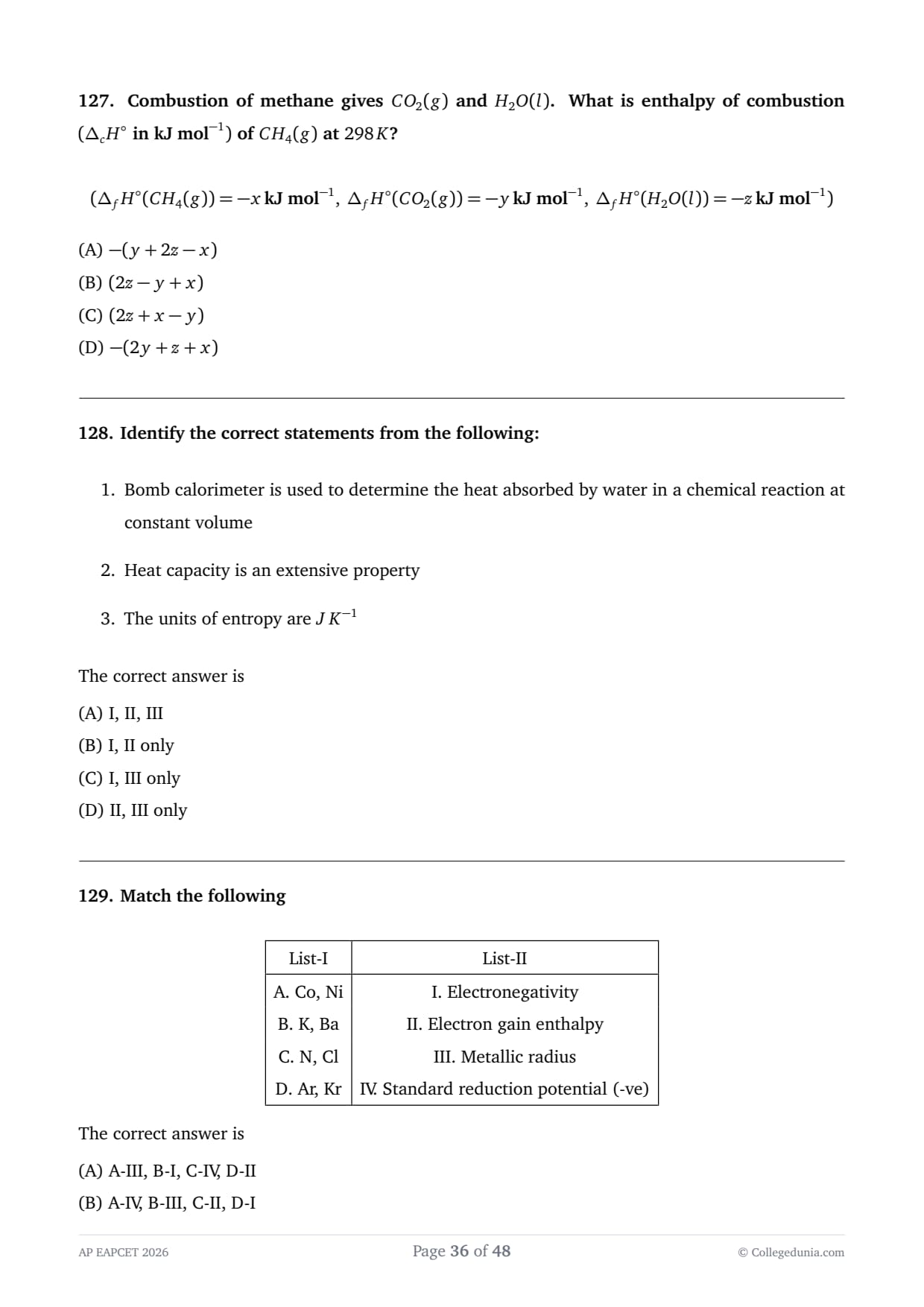
Combustion of methane gives \(CO_2(g)\) and \(H_2O(l)\). What is enthalpy of combustion \((\Delta_c H^\circ in kJ mol^{-1})\) of \(CH_4(g)\) at \(298\,K\)?
\[ (\Delta_f H^\circ(CH_4(g)) = -x\,kJ mol^{-1},\; \Delta_f H^\circ(CO_2(g)) = -y\,kJ mol^{-1},\; \Delta_f H^\circ(H_2O(l)) = -z\,kJ mol^{-1}) \]
Identify the correct statements from the following:
Bomb calorimeter is used to determine the heat absorbed by water in a chemical reaction at constant volume
Heat capacity is an extensive property
The units of entropy are \(J\,K^{-1}\)
The correct answer is
Match the following
A. Co, Ni I. Electronegativity
B. K, Ba II. Electron gain enthalpy
C. N, Cl III. Metallic radius
D. Ar, Kr IV. Standard reduction potential (-ve)
The correct answer is
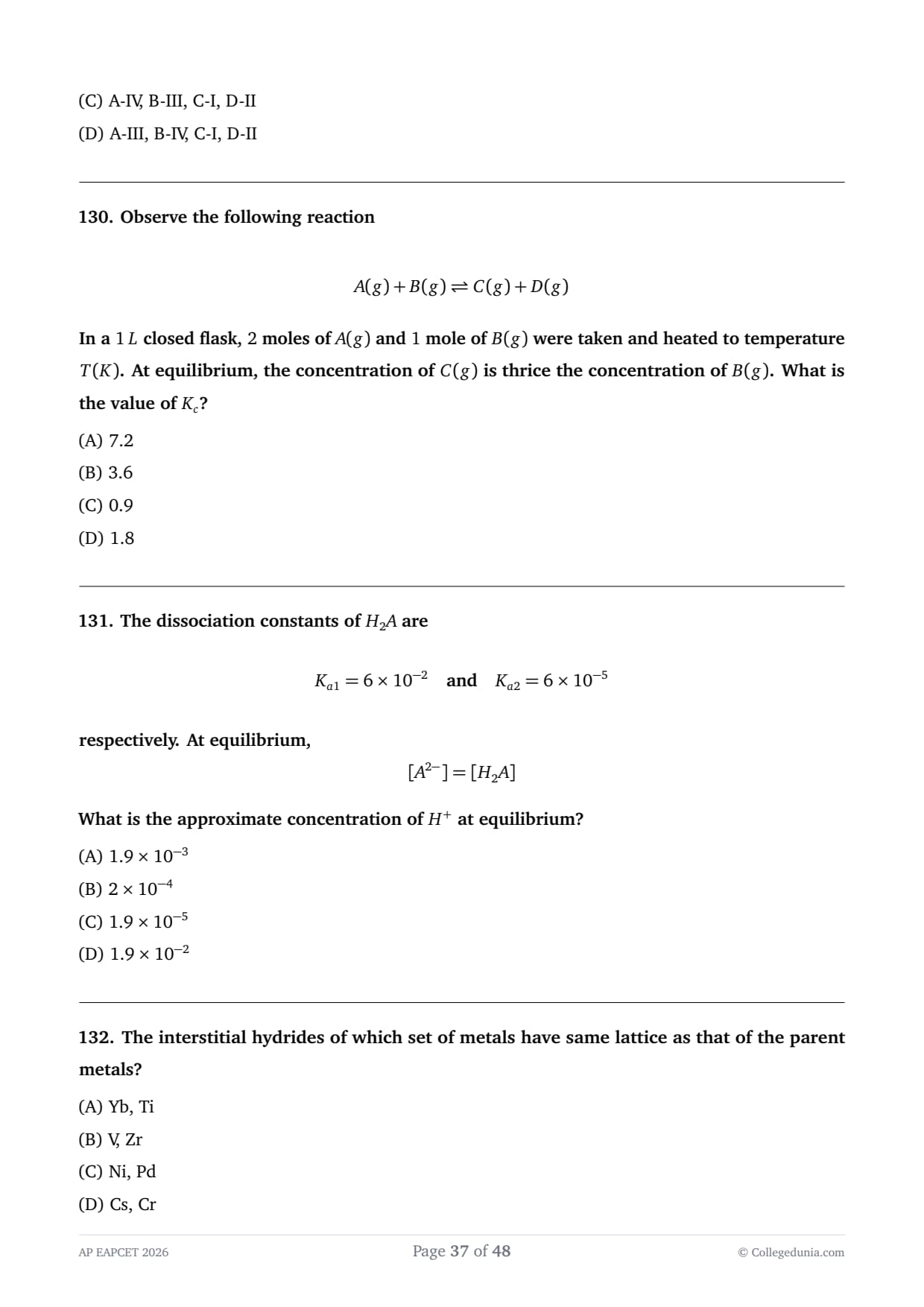
Observe the following reaction
\[ A(g) + B(g) \rightleftharpoons C(g) + D(g) \]
In a \(1\,L\) closed flask, \(2\) moles of \(A(g)\) and \(1\) mole of \(B(g)\) were taken and heated to temperature \(T(K)\). At equilibrium, the concentration of \(C(g)\) is thrice the concentration of \(B(g)\). What is the value of \(K_c\)?
The dissociation constants of \(H_2A\) are \[ K_{a1}=6\times10^{-2} \quad and \quad K_{a2}=6\times10^{-5} \]
respectively. At equilibrium, \[ [A^{2-}] = [H_2A] \]
What is the approximate concentration of \(H^+\) at equilibrium?
The interstitial hydrides of which set of metals have same lattice as that of the parent metals?
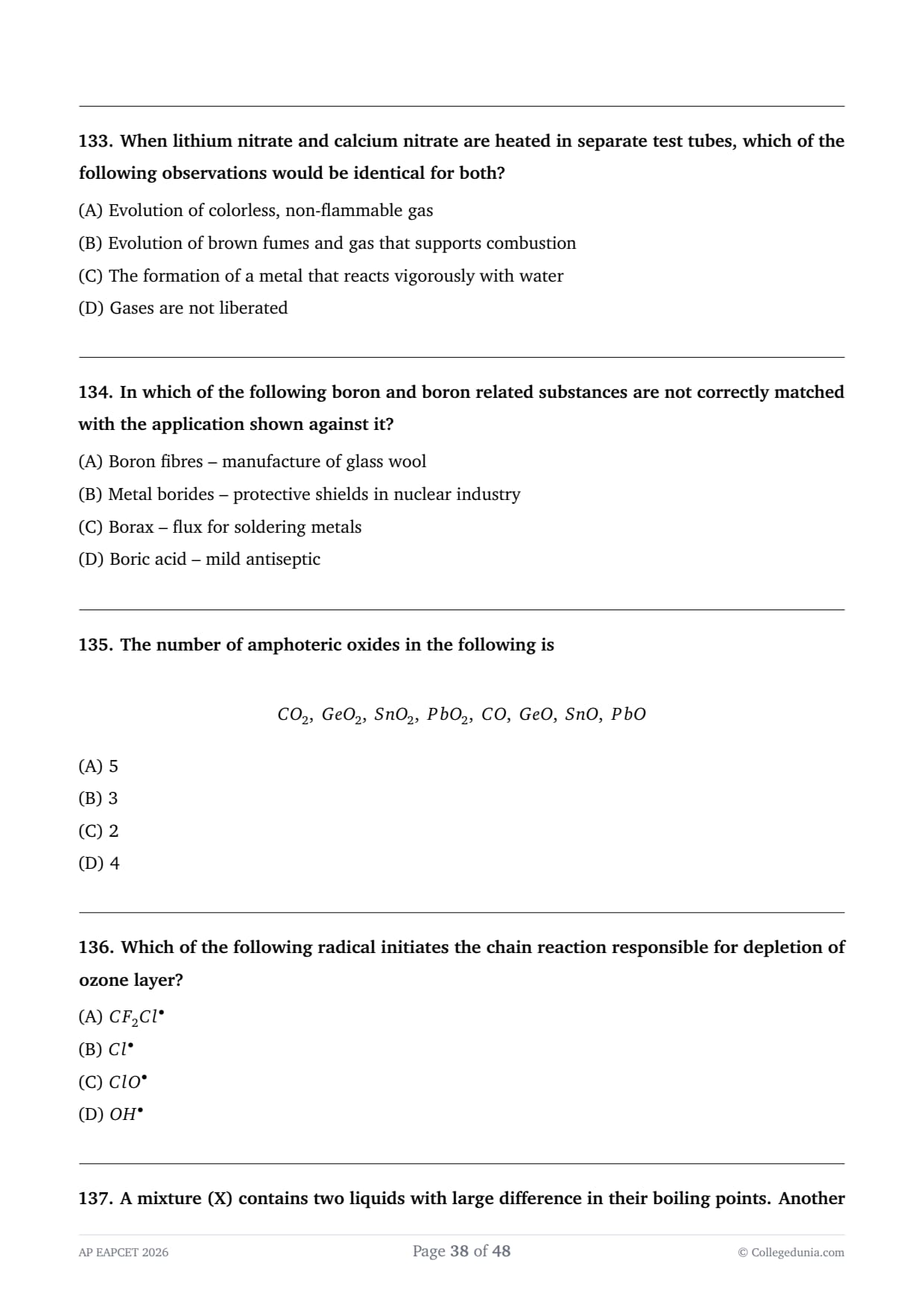
When lithium nitrate and calcium nitrate are heated in separate test tubes, which of the following observations would be identical for both?
In which of the following boron and boron related substances are not correctly matched with the application shown against it?
The number of amphoteric oxides in the following is
\[ CO_2,\ GeO_2,\ SnO_2,\ PbO_2,\ CO,\ GeO,\ SnO,\ PbO \]
Which of the following radical initiates the chain reaction responsible for depletion of ozone layer?
A mixture (X) contains two liquids with large difference in their boiling points. Another mixture (Y) contains two liquids with not much difference in their boiling points. Mixtures X and Y can be separated respectively by the methods
What are X and Y in the following set of reactions respectively?
\[ I.\quad 2-Methylpropene \xrightarrow[\ ]{H_2O/H^+} X \]
\[ II.\quad 2-Methylpropene \xrightarrow[\ ]{KMnO_4} Y \]
The correct IUPAC names of the compounds X and Y given below are respectively
Atoms of element B form hcp lattice and atoms of element A occupy \(\frac{2}{3}\) of tetrahedral voids. The formula of the compound formed by the elements A and B is
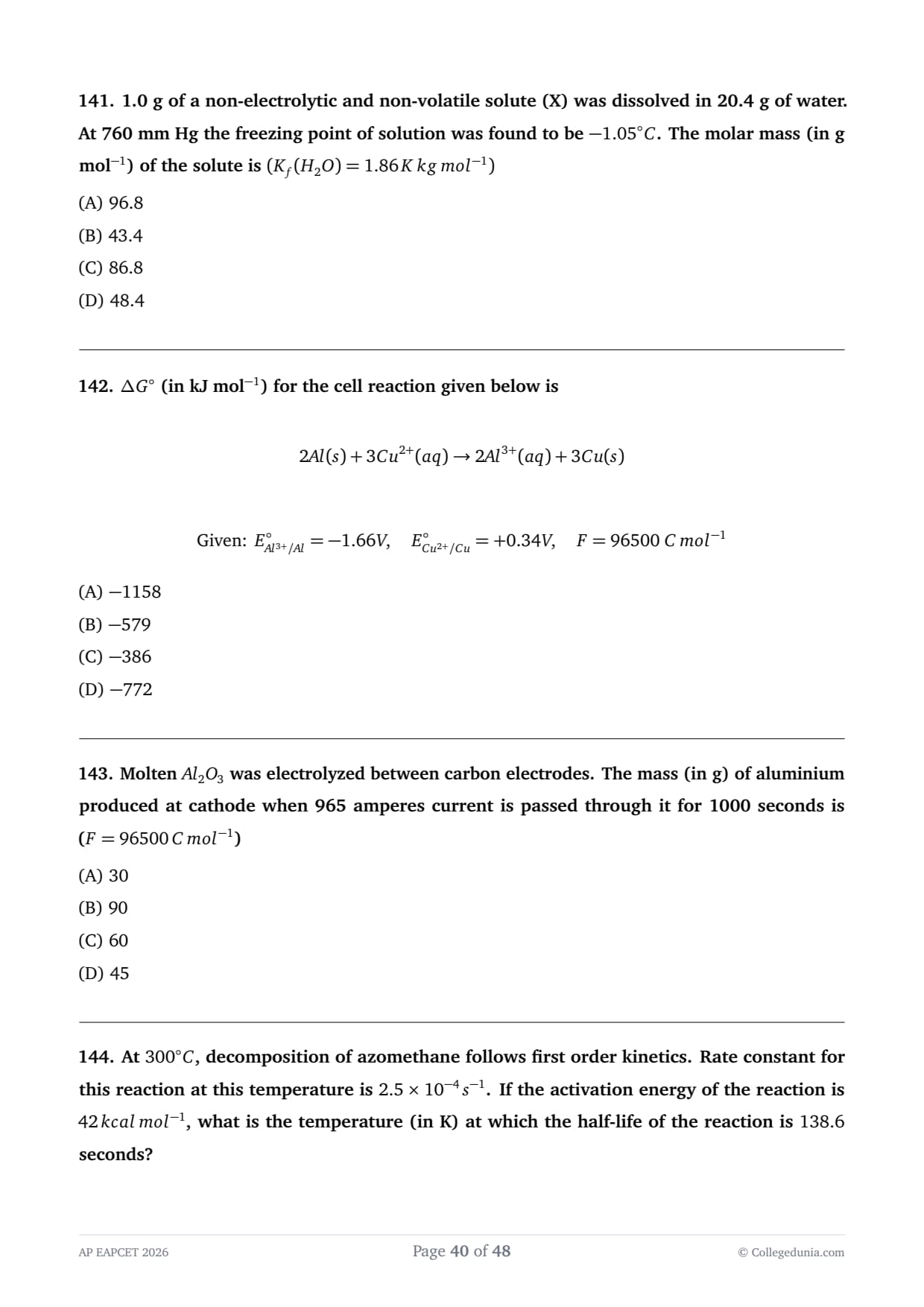
1.0 g of a non-electrolytic and non-volatile solute (X) was dissolved in 20.4 g of water. At 760 mm Hg the freezing point of solution was found to be \(-1.05^\circ C\). The molar mass (in g mol\(^{-1}\)) of the solute is \((K_f(H_2O)=1.86\,K\,kg\,mol^{-1})\)
\(\Delta G^\circ\) (in kJ mol\(^{-1}\)) for the cell reaction given below is
\[ 2Al(s)+3Cu^{2+}(aq)\rightarrow 2Al^{3+}(aq)+3Cu(s) \]
\[ Given: E^\circ_{Al^{3+}/Al}=-1.66V,\quad E^\circ_{Cu^{2+}/Cu}=+0.34V,\quad F=96500\;C\,mol^{-1} \]
Molten \(Al_2O_3\) was electrolyzed between carbon electrodes. The mass (in g) of aluminium produced at cathode when 965 amperes current is passed through it for 1000 seconds is (\(F=96500\,C\,mol^{-1}\))
At \(300^\circ C\), decomposition of azomethane follows first order kinetics. Rate constant for this reaction at this temperature is \(2.5\times10^{-4}\,s^{-1}\). If the activation energy of the reaction is \(42\,kcal\,mol^{-1}\), what is the temperature (in K) at which the half-life of the reaction is \(138.6\) seconds?
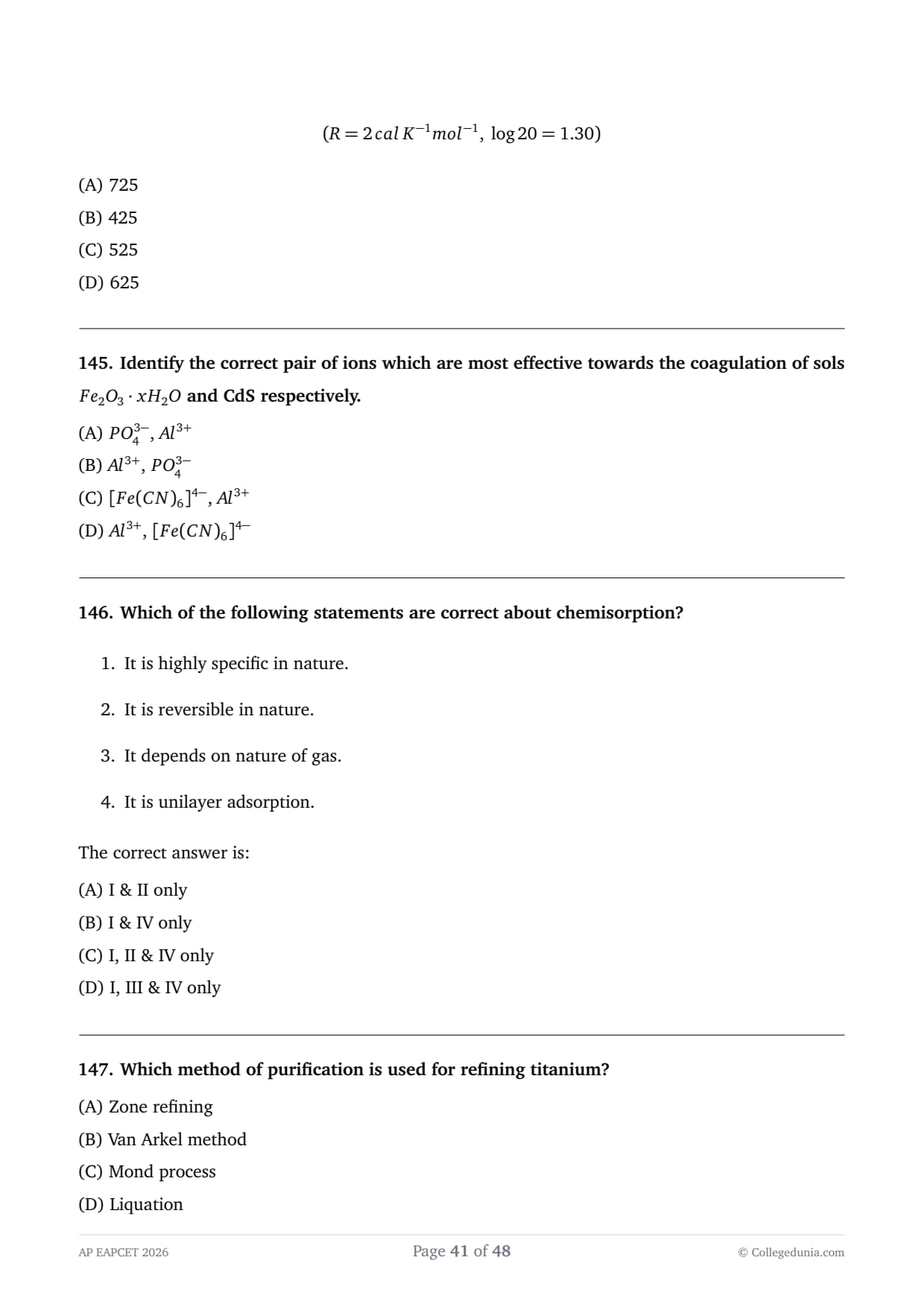
\[ (R=2\,cal\,K^{-1}mol^{-1},\; \log20=1.30) \]
Identify the correct pair of ions which are most effective towards the coagulation of sols \(Fe_2O_3\cdot xH_2O\) and CdS respectively.
Which of the following statements are correct about chemisorption?
It is highly specific in nature.
It is reversible in nature.
It depends on nature of gas.
It is unilayer adsorption.
The correct answer is:
Which method of purification is used for refining titanium?
Which of the following oxoacid is formed when phosphoric acid is made to react with \(PCl_5\)?
Which of the following statement is not correct about the structures of ozone and sulphur dioxide?
The spin only magnetic moment of the element having highest third ionization enthalpy among Ti, V, Cr, Mn and Fe in its \(+3\) state is (BM):
Identify the correct set containing only ambidentate ligands.
Which one of the polymers does not contain \(-COO-\) linkage in its structure?
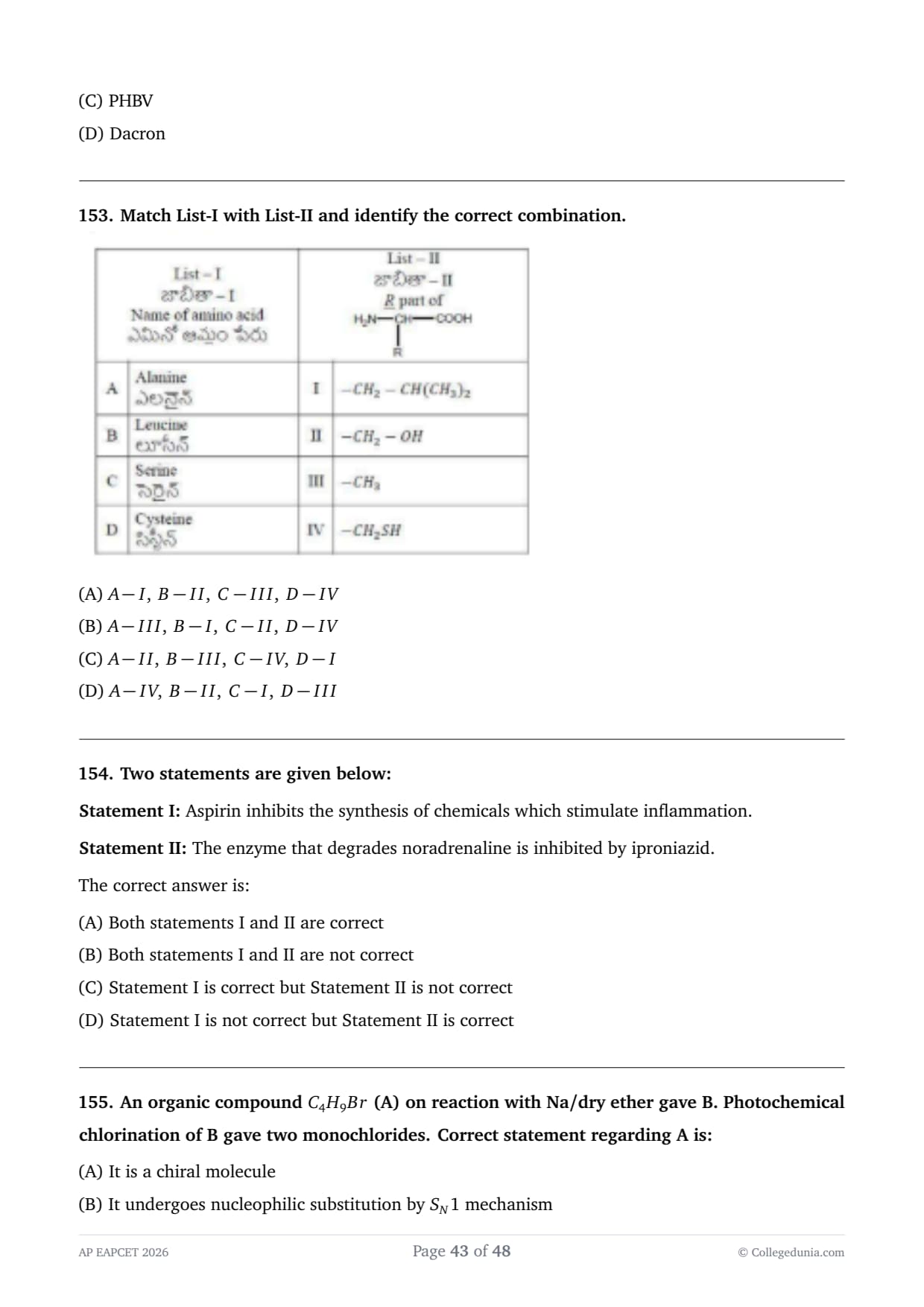
Match List-I with List-II and identify the correct combination.

Two statements are given below:
Statement I: Aspirin inhibits the synthesis of chemicals which stimulate inflammation.
Statement II: The enzyme that degrades noradrenaline is inhibited by iproniazid.
The correct answer is:
An organic compound \(C_4H_9Br\) (A) on reaction with Na/dry ether gave B. Photochemical chlorination of B gave two monochlorides. Correct statement regarding A is:
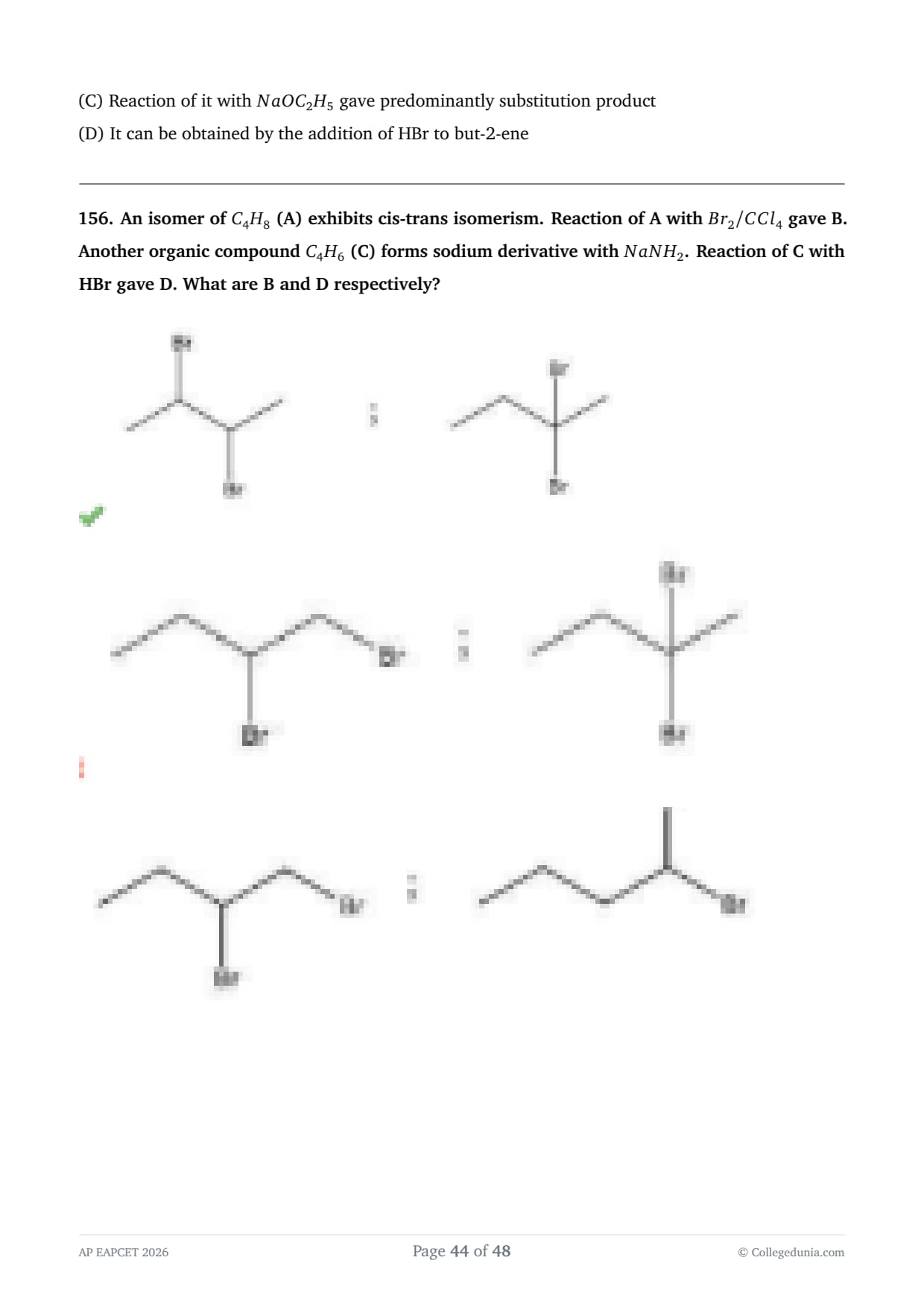
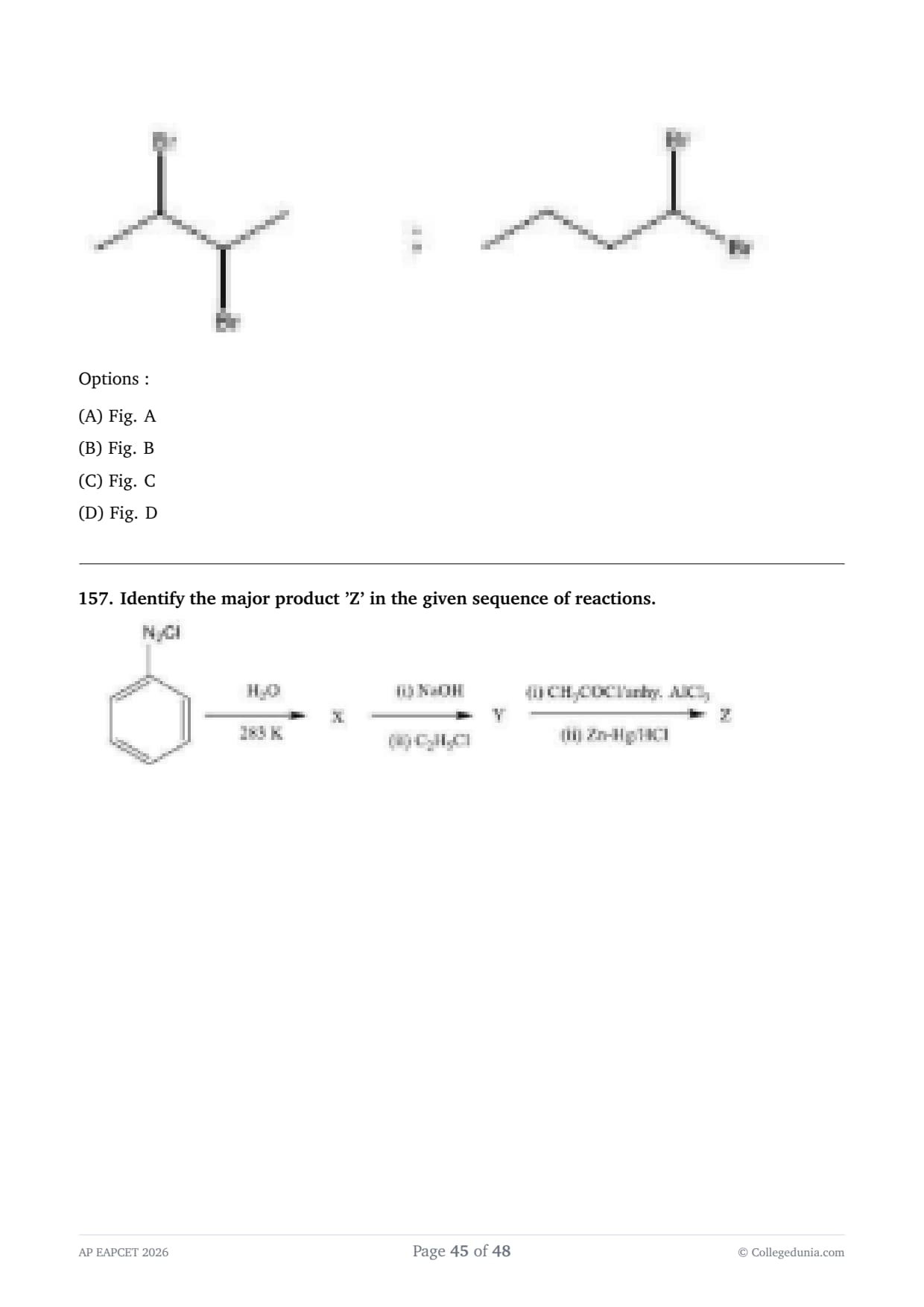
An isomer of \(C_4H_8\) (A) exhibits cis-trans isomerism. Reaction of A with \(Br_2/CCl_4\) gave B. Another organic compound \(C_4H_6\) (C) forms sodium derivative with \(NaNH_2\). Reaction of C with HBr gave D. What are B and D respectively?


Options :
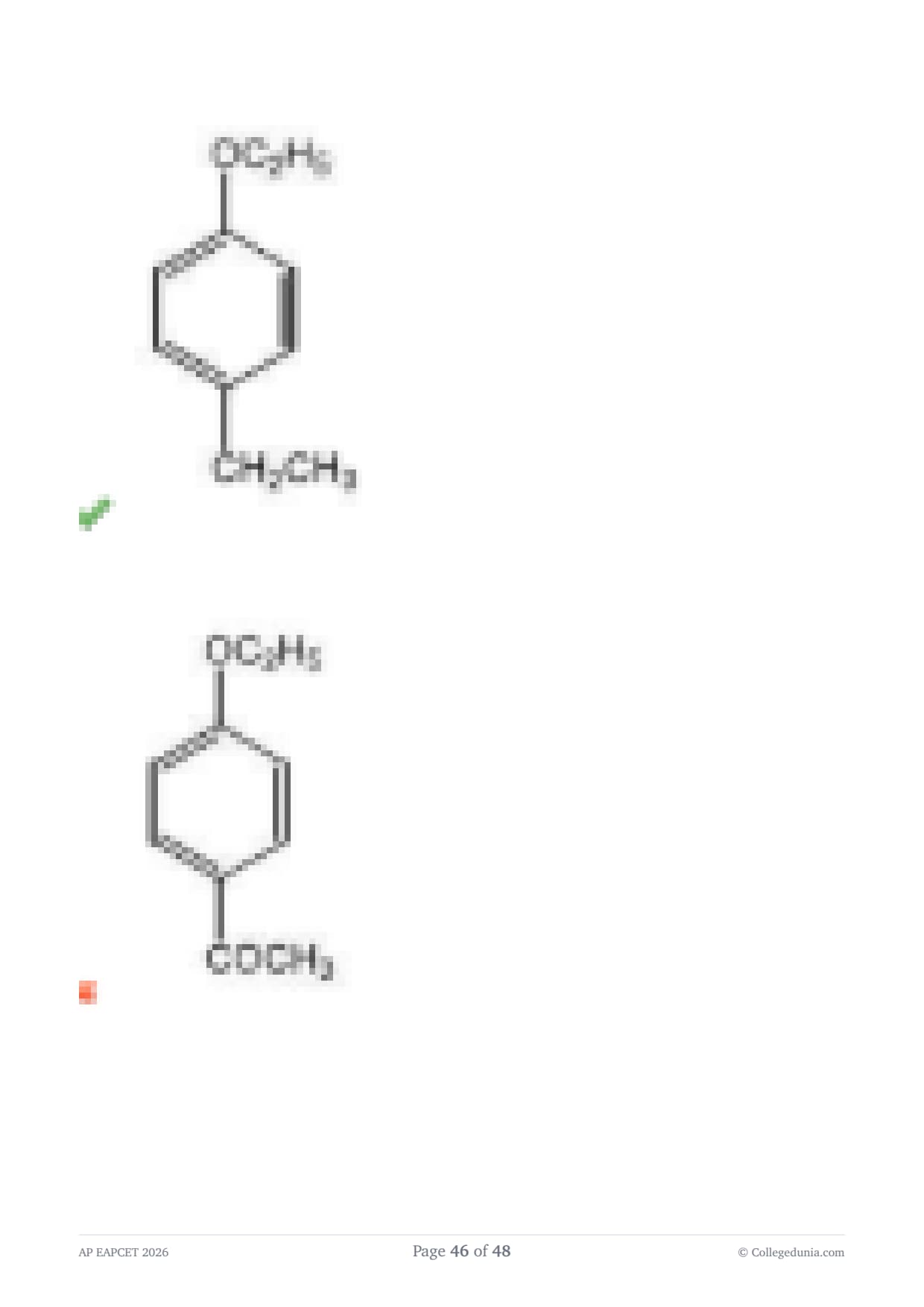
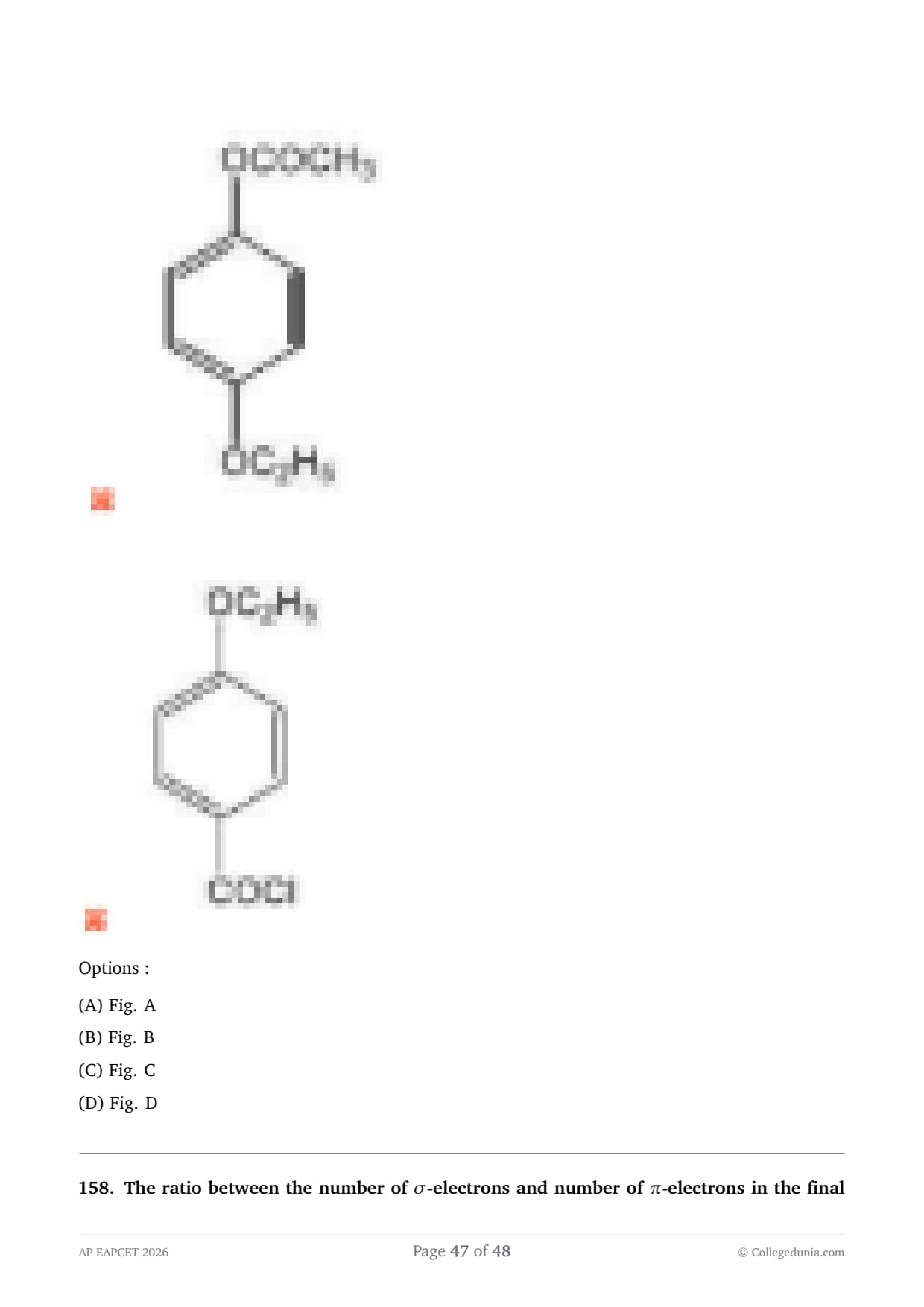
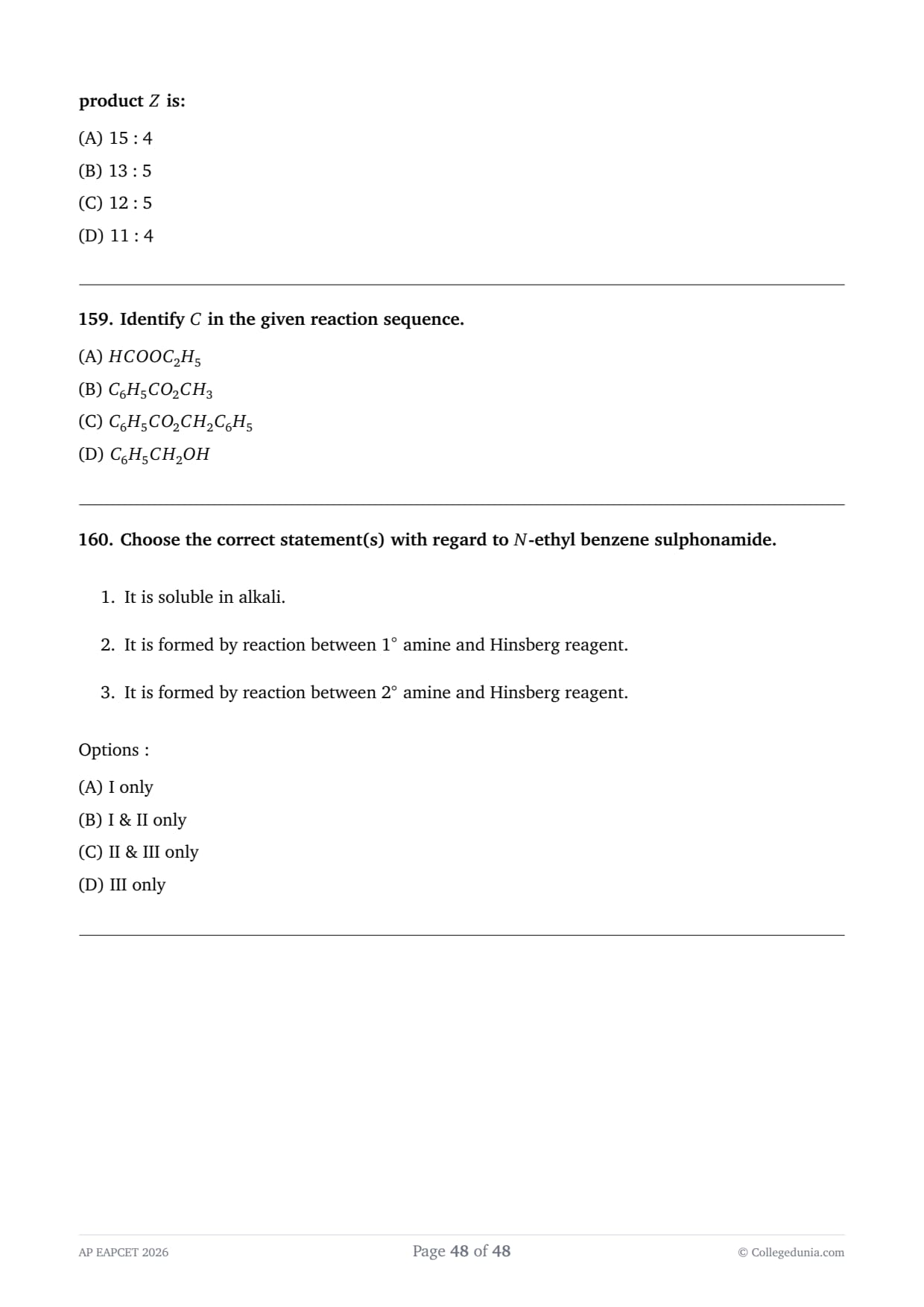
Identify the major product 'Z' in the given sequence of reactions.


Options :
View Solution
Concept:
The reaction sequence involves diazonium salt chemistry, nucleophilic substitution, Williamson ether synthesis, Friedel–Crafts acylation, and finally Clemmensen reduction.
To determine the final product \(Z\), each transformation must be analyzed carefully.
Step 1: Formation of phenol (X).
The starting compound is benzenediazonium chloride.
On hydrolysis with water at about \(283\,K\),
\[ C_6H_5N_2^+Cl^- \xrightarrow{H_2O} C_6H_5OH +N_2 +HCl \]
Thus,
\[ X=Phenol \]
Step 2: Conversion of phenol into anisole (Y).
Phenol reacts with sodium hydroxide to form sodium phenoxide.
\[ C_6H_5OH + NaOH \rightarrow C_6H_5ONa + H_2O \]
Sodium phenoxide then reacts with ethyl chloride through Williamson ether synthesis.
\[ C_6H_5ONa + C_2H_5Cl \rightarrow C_6H_5OC_2H_5 + NaCl \]
Hence,
\[ Y=Ethoxybenzene (Phenetole) \]
Step 3: Friedel–Crafts acylation of phenetole.
Ethoxy group \((-OC_2H_5)\) is an activating group and directs incoming electrophiles predominantly to the ortho and para positions.
Treatment with acetyl chloride in presence of anhydrous \(AlCl_3\) generates the acylium ion.
\[ CH_3COCl \xrightarrow{AlCl_3} CH_3CO^+ \]
Electrophilic substitution occurs mainly at the para position due to steric considerations.
Therefore,
\[ Y \xrightarrow{CH_3COCl/AlCl_3} p-Ethoxyacetophenone \]
Step 4: Clemmensen reduction.
The carbonyl group of the acetyl substituent is reduced by
\[ Zn-Hg/HCl \]
According to Clemmensen reduction:
\[ -ArCOCH_3 \longrightarrow -ArCH_2CH_3 \]
Thus,
\[ p-Ethoxyacetophenone \xrightarrow{Zn-Hg/HCl} p-Ethoxyethylbenzene \]
Step 5: Identification of Z.
The final product contains:
an ethoxy group \((-OC_2H_5)\)
an ethyl group \((-CH_2CH_3)\)
both groups situated para to each other
Among the given figures, this corresponds to Fig. D.
\[ \boxed{Z=p-Ethoxyethylbenzene} \]
Hence, the correct answer is
\[ \boxed{(D) Fig. D} \] Quick Tip: Important sequence to remember: \[ ArN_2^+ \rightarrow ArOH \rightarrow ArOR \] Friedel–Crafts acylation: \[ ArH \xrightarrow{RCOCl/AlCl_3} ArCOR \] Clemmensen reduction: \[ ArCOR \xrightarrow{Zn(Hg)/HCl} ArCH_2R \] Aryl ethers are strong ortho-para directing groups, with para product generally predominating due to lower steric hindrance.
The ratio between the number of \(\sigma\)-electrons and number of \(\pi\)-electrons in the final product \(Z\) is:
View Solution
Concept:
The sequence involves reduction of glucose, oxidation, acetylation and finally oxidative cleavage of vicinal diols.
The final product must first be identified before counting the \(\sigma\)- and \(\pi\)-electrons.
Step 1: Formation of X
The starting compound is glucose.
Reduction with HI and heat converts all oxygen-containing groups into hydrogen atoms.
\[ Glucose \xrightarrow[\Delta]{HI} n-hexane \]
Thus,
\[ X=n-hexane \]
Step 2: Formation of Y
Catalytic oxidation with \(V_2O_5\) at \(773\,K\) converts n-hexane into benzene.
\[ C_6H_{14} \xrightarrow[V_2O_5]{773K} C_6H_6 \]
Therefore,
\[ Y=benzene \]
Step 3: Formation of Z
Benzene undergoes Friedel-Crafts acylation with acetyl chloride.
\[ C_6H_6 \xrightarrow{CH_3COCl/AlCl_3} C_6H_5COCH_3 \]
Acetophenone is formed.
Oxidation with alkaline \(KMnO_4\) followed by acidification converts the methyl ketone side chain into carboxylic acid.
\[ C_6H_5COCH_3 \xrightarrow{KMnO_4/OH^-} C_6H_5COOH \]
Thus,
\[ Z=Benzoic acid \]
Step 4: Counting \(\sigma\)-electrons
Benzoic acid:
\[ C_6H_5COOH \]
Total \(\sigma\)-bonds:
Benzene ring C-C : \(6\)
Ring C-H : \(5\)
Ring-C(=O) : \(1\)
C=O contains one \(\sigma\)-bond : \(1\)
C-O : \(1\)
O-H : \(1\)
Total:
\[ 6+5+1+1+1+1=15 \]
Hence,
\[ 15 \sigma-bonds \]
Each \(\sigma\)-bond contains two electrons.
\[ \sigma-electrons=15\times2=30 \]
Step 5: Counting \(\pi\)-electrons
Benzoic acid contains:
Benzene ring \(=3\pi\)-bonds
Carbonyl group \(=1\pi\)-bond
Total:
\[ 4\pi-bonds \]
Hence
\[ \pi-electrons=4\times2=8 \]
Step 6: Finding the ratio
\[ \frac{\sigma-electrons}{\pi-electrons} = \frac{30}{8} = \frac{15}{4} \]
Therefore,
\[ \boxed{15:4} \]
Hence the correct answer is
\[ \boxed{(A)\ 15:4} \] Quick Tip: For counting electrons: \[ \sigma-electrons=2\times(number of \sigma-bonds) \] \[ \pi-electrons=2\times(number of \pi-bonds) \] Always identify the final product first before counting.
Identify \(C\) in the given reaction sequence.
Choose the correct statement(s) with regard to \(N\)-ethyl benzene sulphonamide.
It is soluble in alkali.
It is formed by reaction between \(1^\circ\) amine and Hinsberg reagent.
It is formed by reaction between \(2^\circ\) amine and Hinsberg reagent.
Options :
View Solution
Concept:
This question is based on the Hinsberg test used to distinguish primary, secondary and tertiary amines.
The reagent used is benzenesulphonyl chloride.
Step 1: Understanding \(N\)-ethyl benzenesulphonamide
The structure is:
\[ C_6H_5SO_2NHC_2H_5 \]
The nitrogen atom is attached to:
Ethyl group
Sulphonyl group
Such compounds are formed when a secondary amine reacts with Hinsberg reagent.
Step 2: Checking Statement I
Sulphonamides obtained from secondary amines do not possess acidic hydrogen capable of forming soluble salts with alkali.
Therefore they are:
\[ insoluble in alkali \]
Hence Statement I is false.
Step 3: Checking Statement II
Primary amines produce sulphonamides that contain acidic N-H hydrogen.
These dissolve in alkali.
Therefore \(N\)-ethyl benzenesulphonamide is not the product of a primary amine.
Statement II is false.
Step 4: Checking Statement III
Secondary amines react with benzenesulphonyl chloride to form neutral sulphonamides.
These are insoluble in alkali.
Thus \(N\)-ethyl benzenesulphonamide is formed from a secondary amine.
Hence Statement III is correct.
Step 5: Final conclusion
Only Statement III is correct.
\[ \boxed{III only} \]
Hence the correct answer is
\[ \boxed{(D)\ III only} \] Quick Tip: Hinsberg Test: \[ 1^\circ amine \rightarrow Sulphonamide soluble in alkali \] \[ 2^\circ amine \rightarrow Sulphonamide insoluble in alkali \] \[ 3^\circ amine \rightarrow No sulphonamide formation \] This is a favorite exam concept.
AP EAPCET 2026 Paper Pattern – Engineering
| Section | Number of Questions | Marks per Question | Weightage | Total Marks |
|---|---|---|---|---|
| Mathematics | 80 | 1 | 80 | 80 |
| Physics | 40 | 1 | 40 | 40 |
| Chemistry | 40 | 1 | 40 | 40 |
| Total | 160 | 1 | 160 | 160 |



Comments