




AP EAPCET 2026 Engineering Question Paper for May 12 Shift 1 is available for download here. JNTUK on behalf of APSCHE conducted AP EAPCET 2026 Engineering exam on May 12 in Shift 1 from 9 AM to 12 PM. AP EAPCET 2026 Engineering consists of 160 questions for a total of 160 marks to be attempted in 3 hours.
- AP EAPCET 2026 Engineering is divided into 3 sections- Mathematics with 80 questions and Physics and Chemistry with 40 questions each.
- Each correct answer carries 1 mark and there is no negative marking for incorrect answer.
Also Check: AP EAPCET 2026 Engineering Question Paper May 13 Shift 1
AP EAPCET 2026 Engineering Question Paper PDF for May 12 Shift 1
| AP EAPCET 2026 Engineering Question Paper May 12 Shift 1 | Download PDF | Check Solutions |

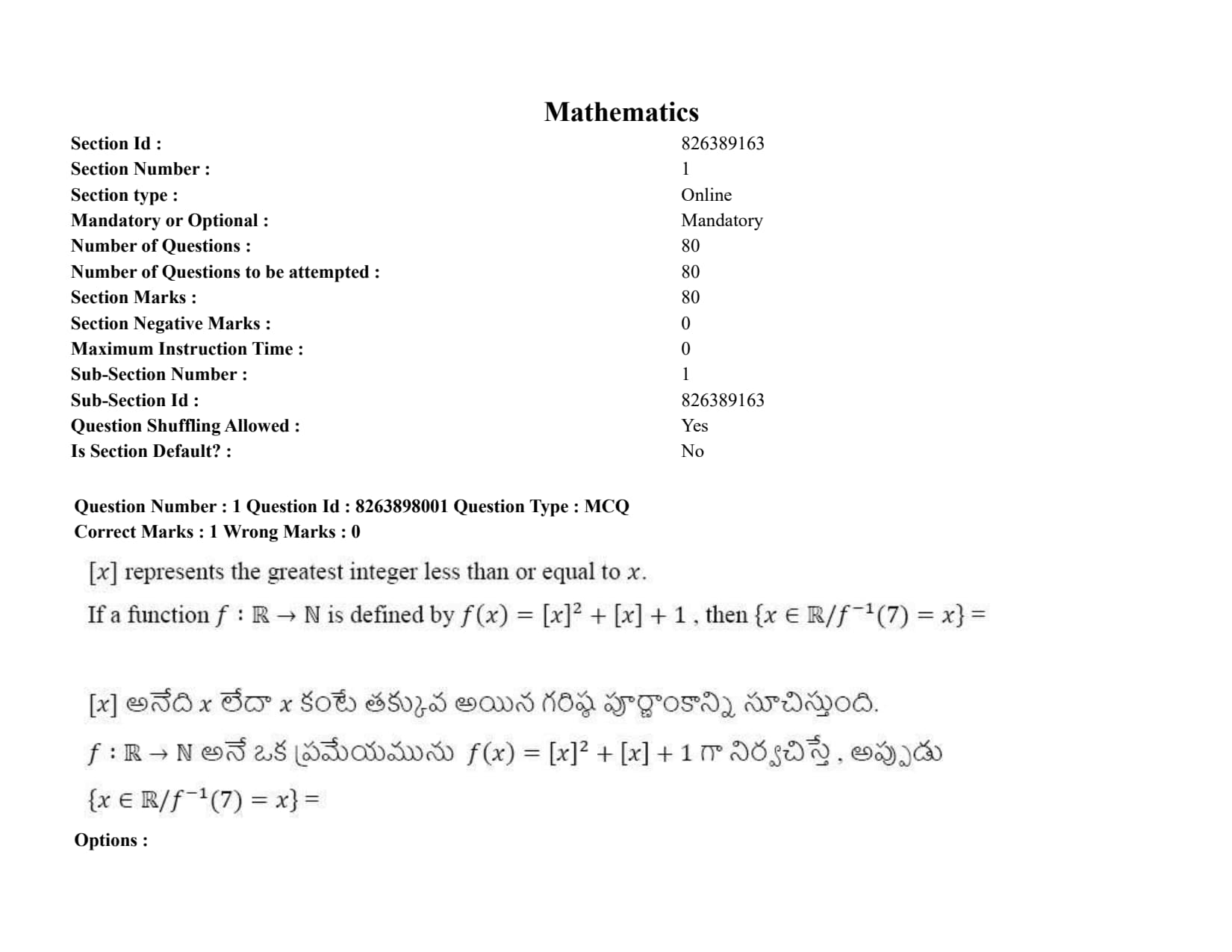
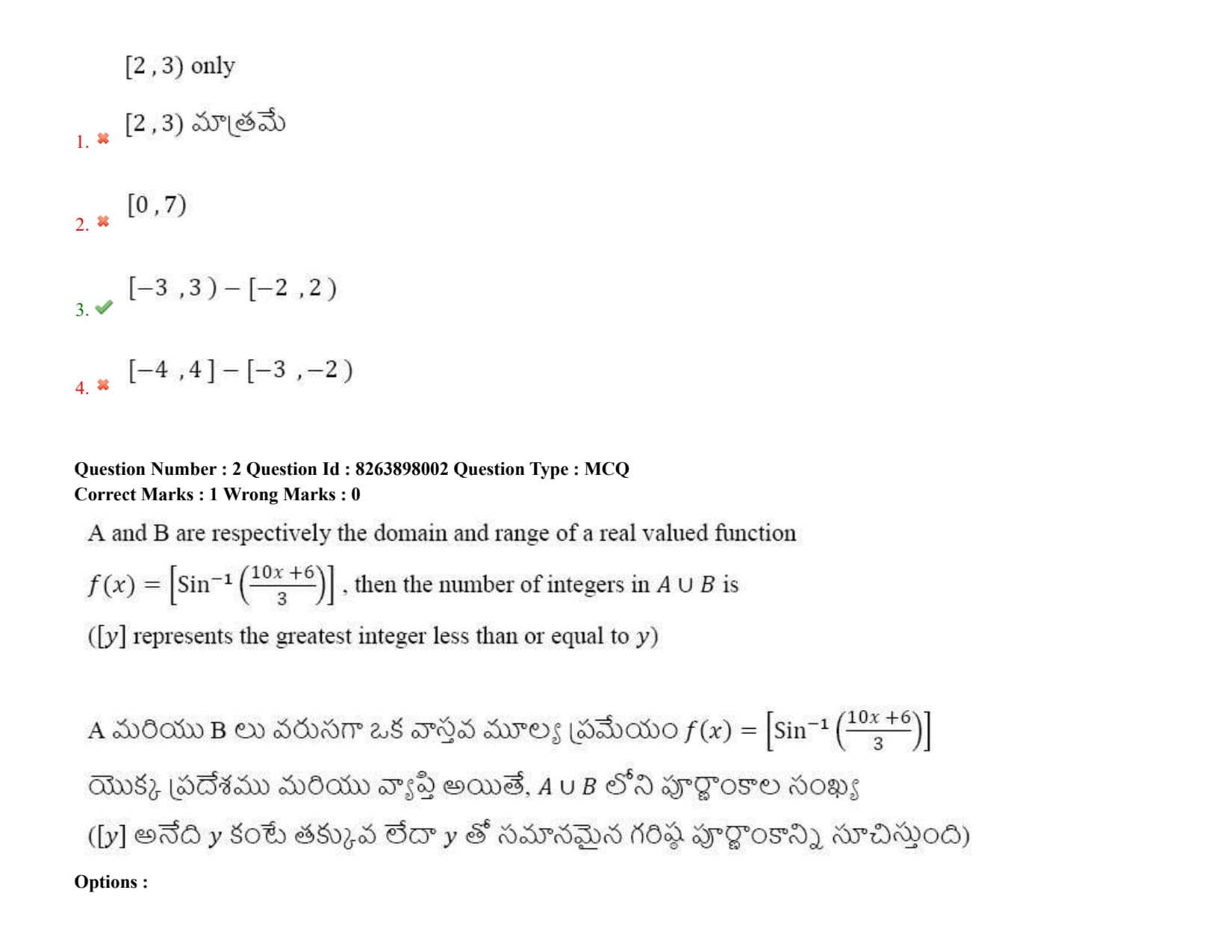
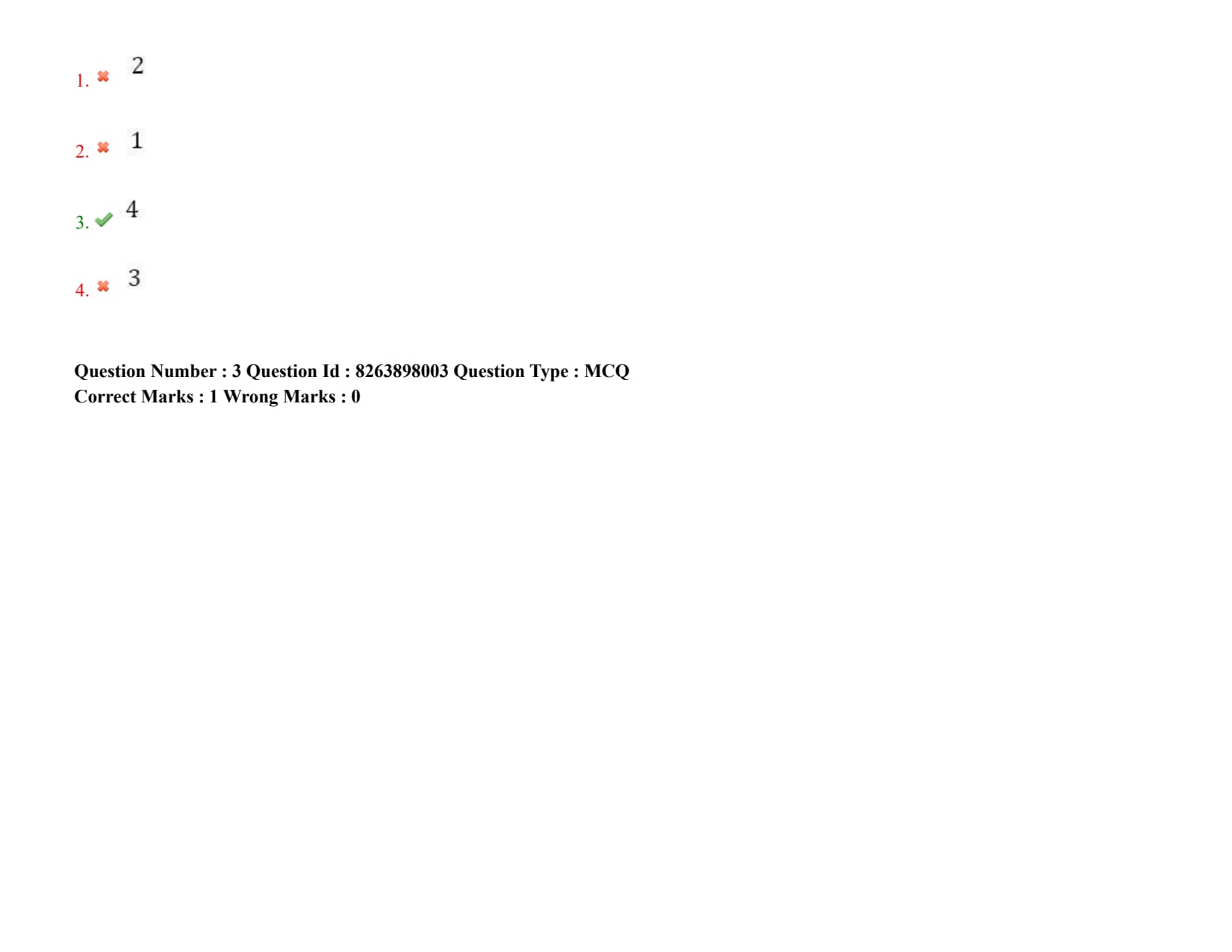
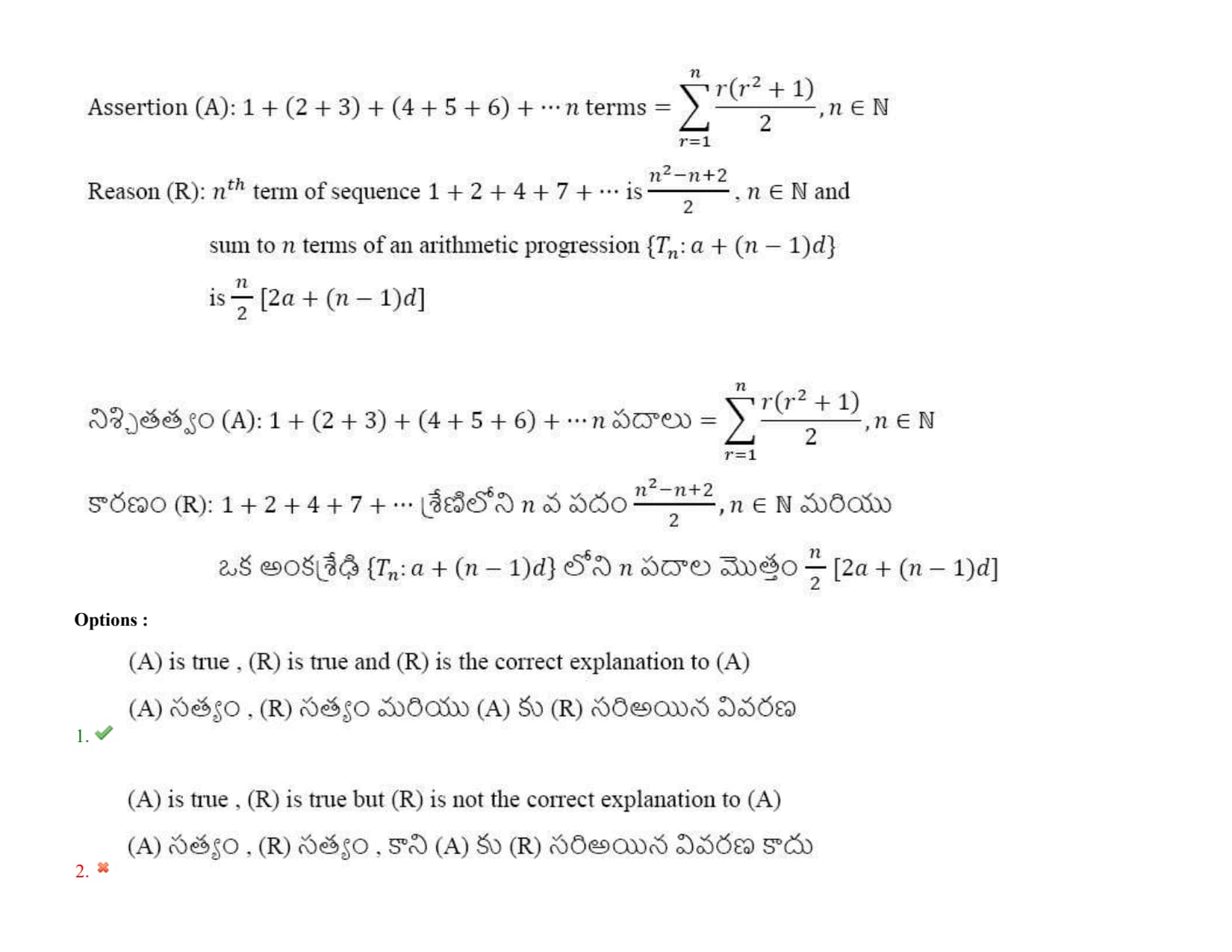

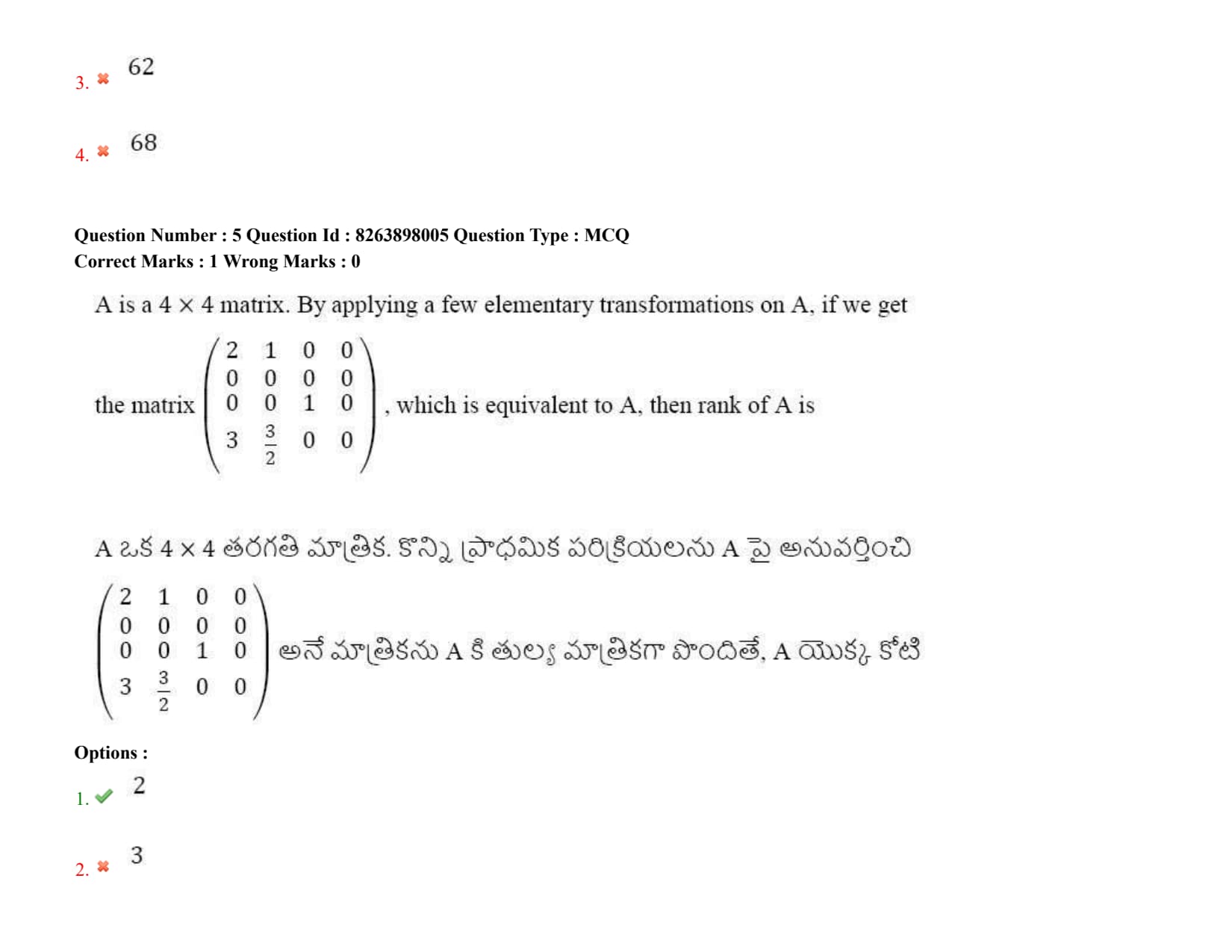
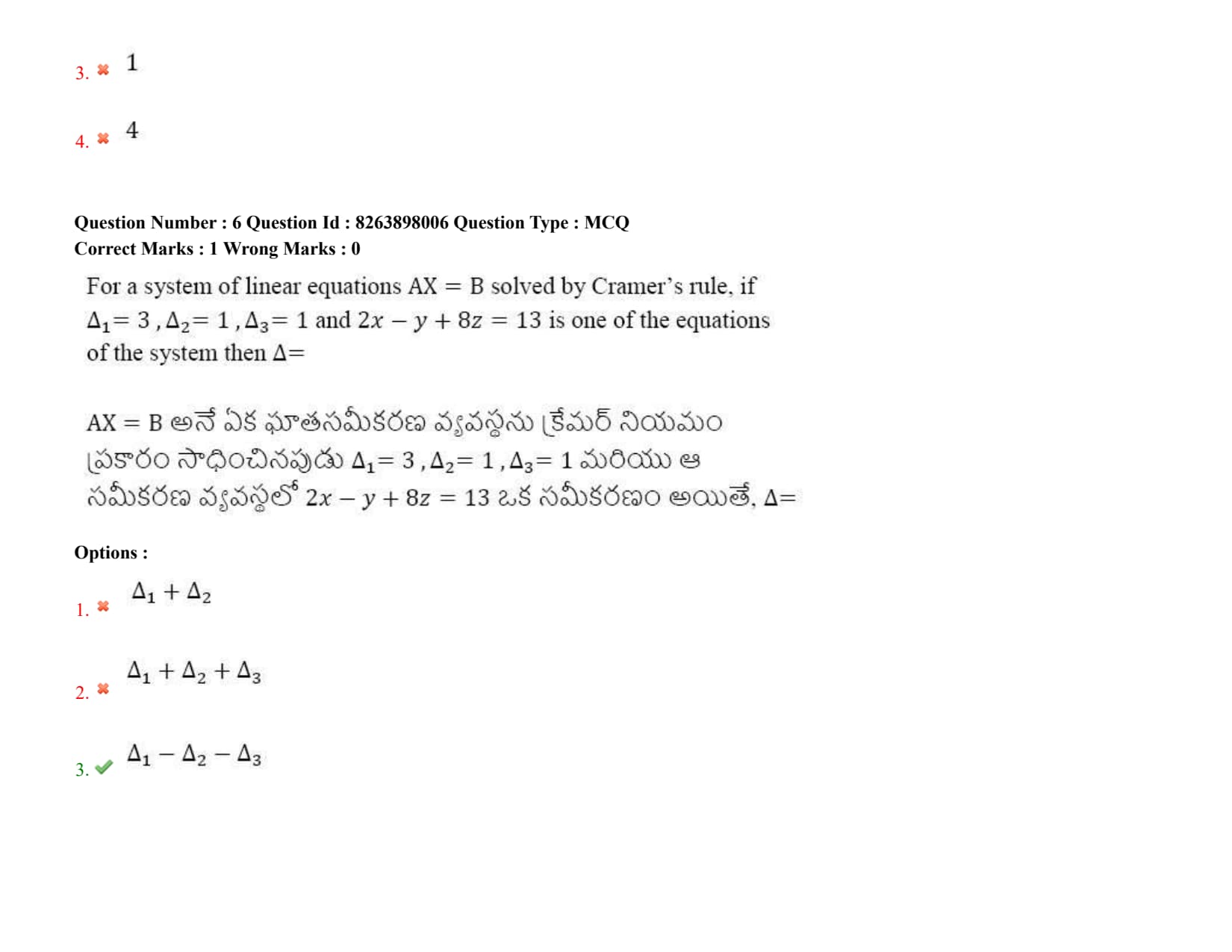
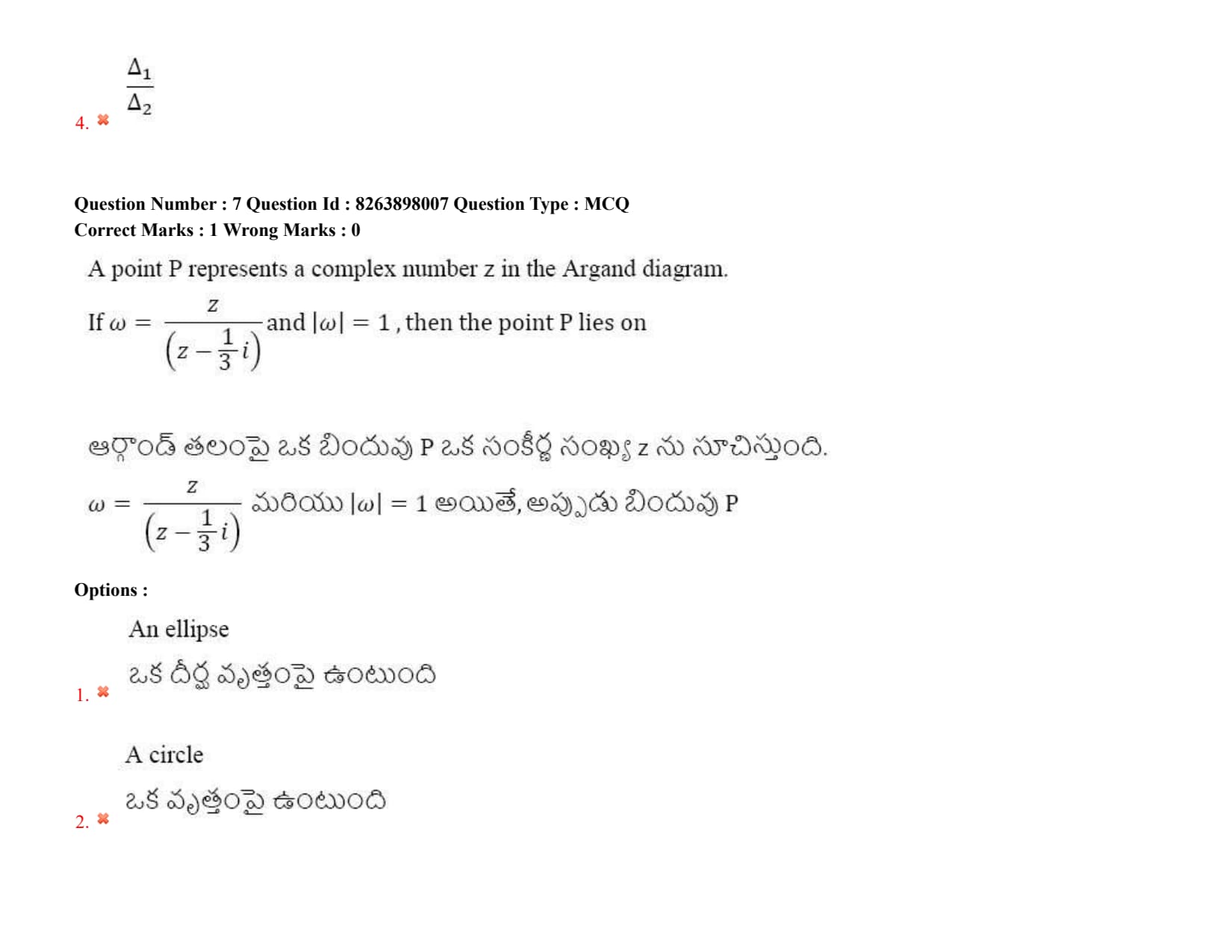
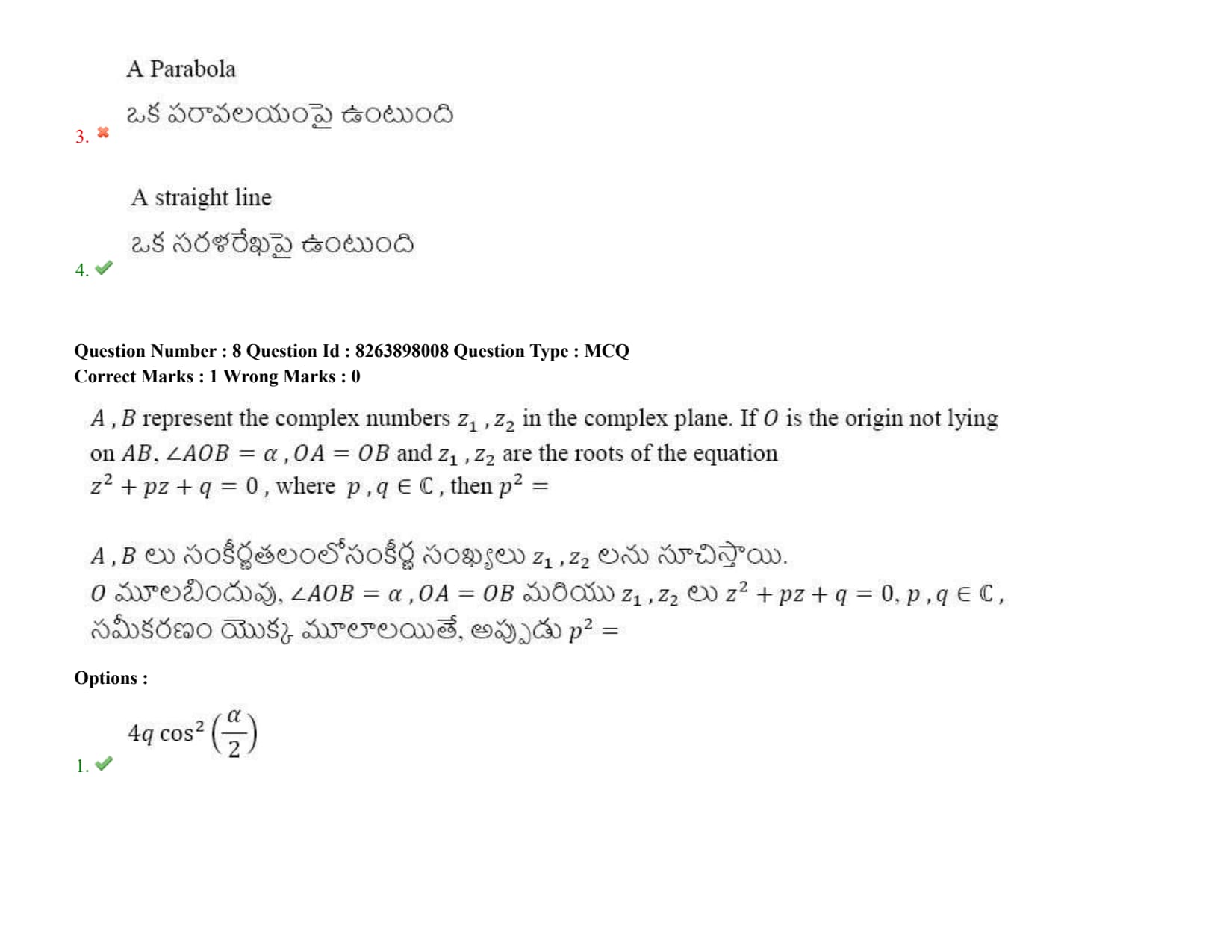

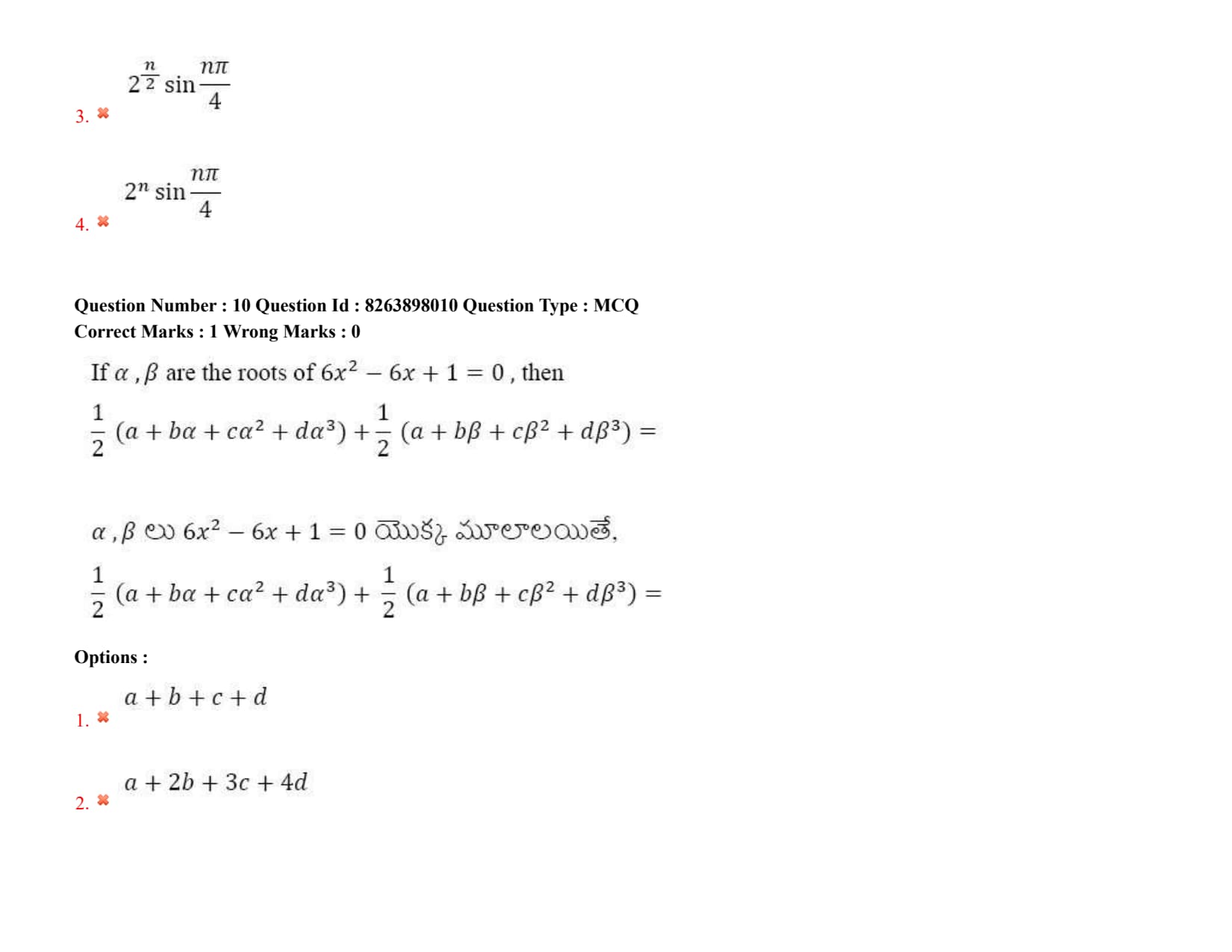
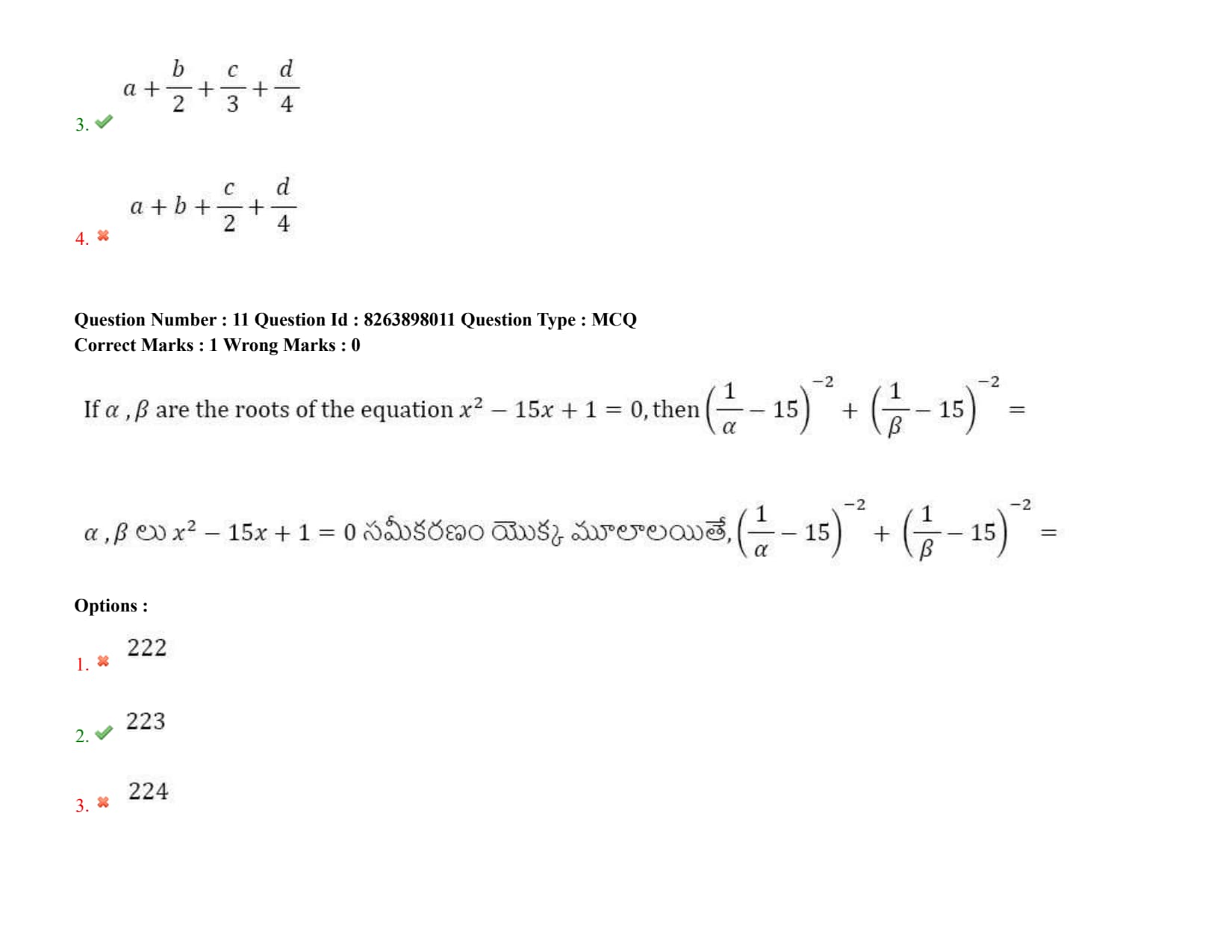
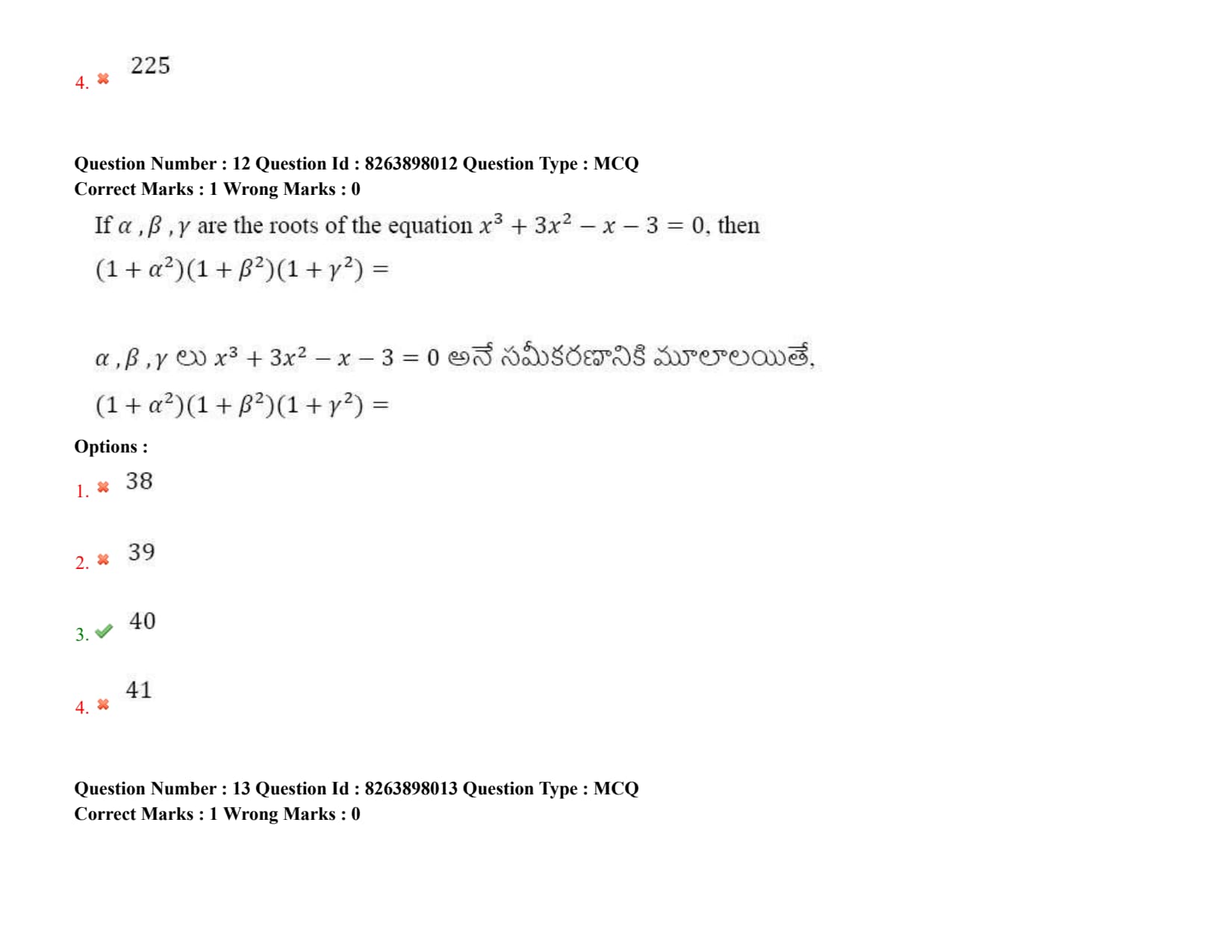
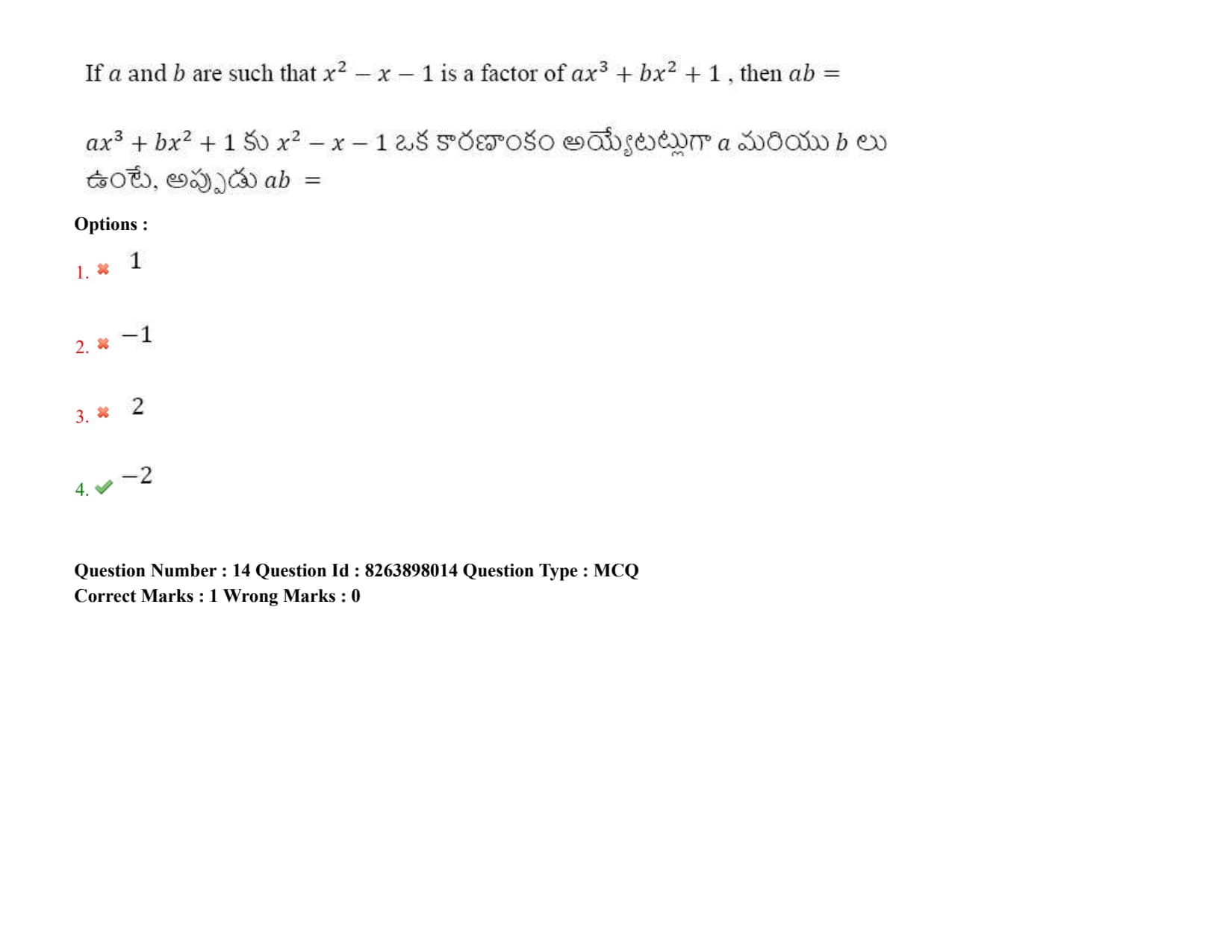

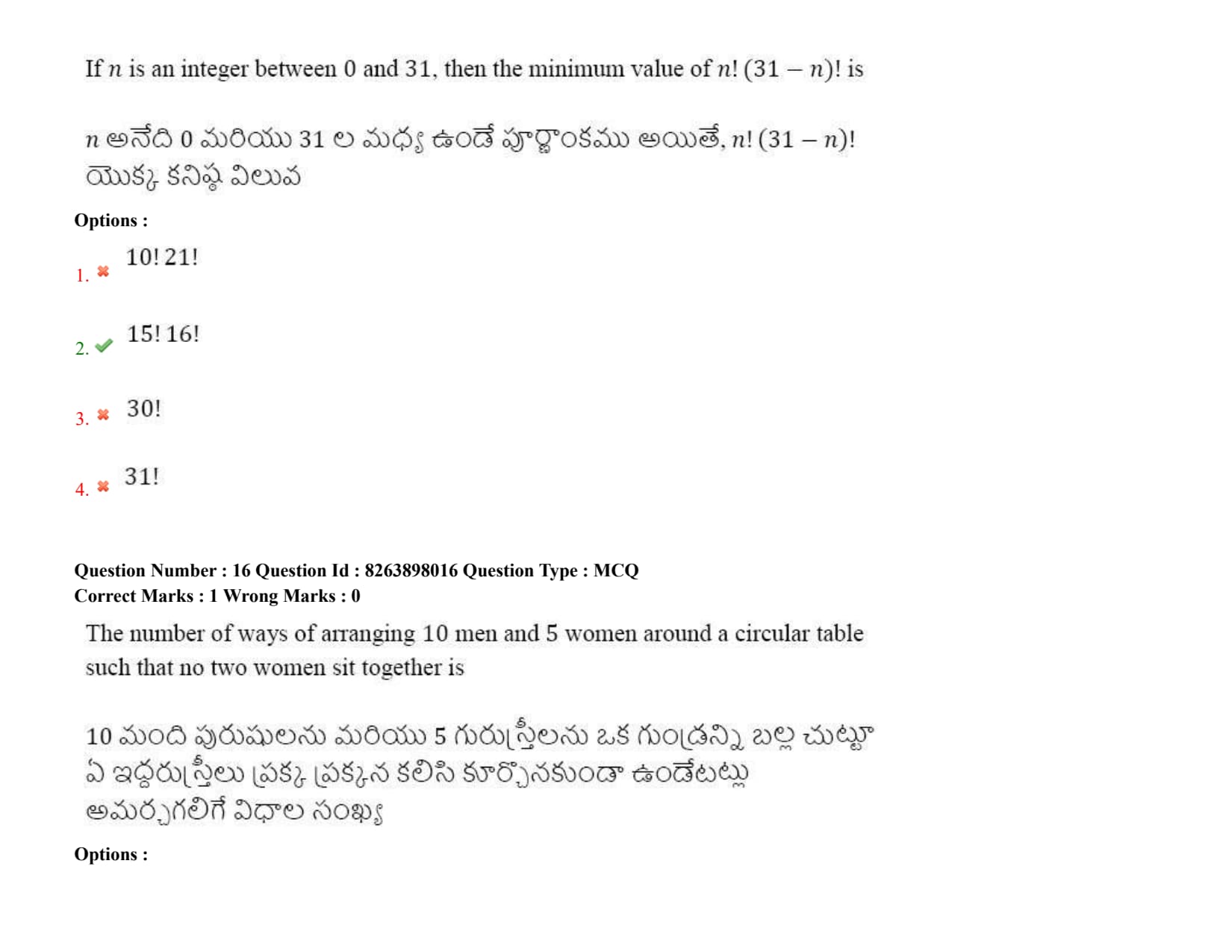


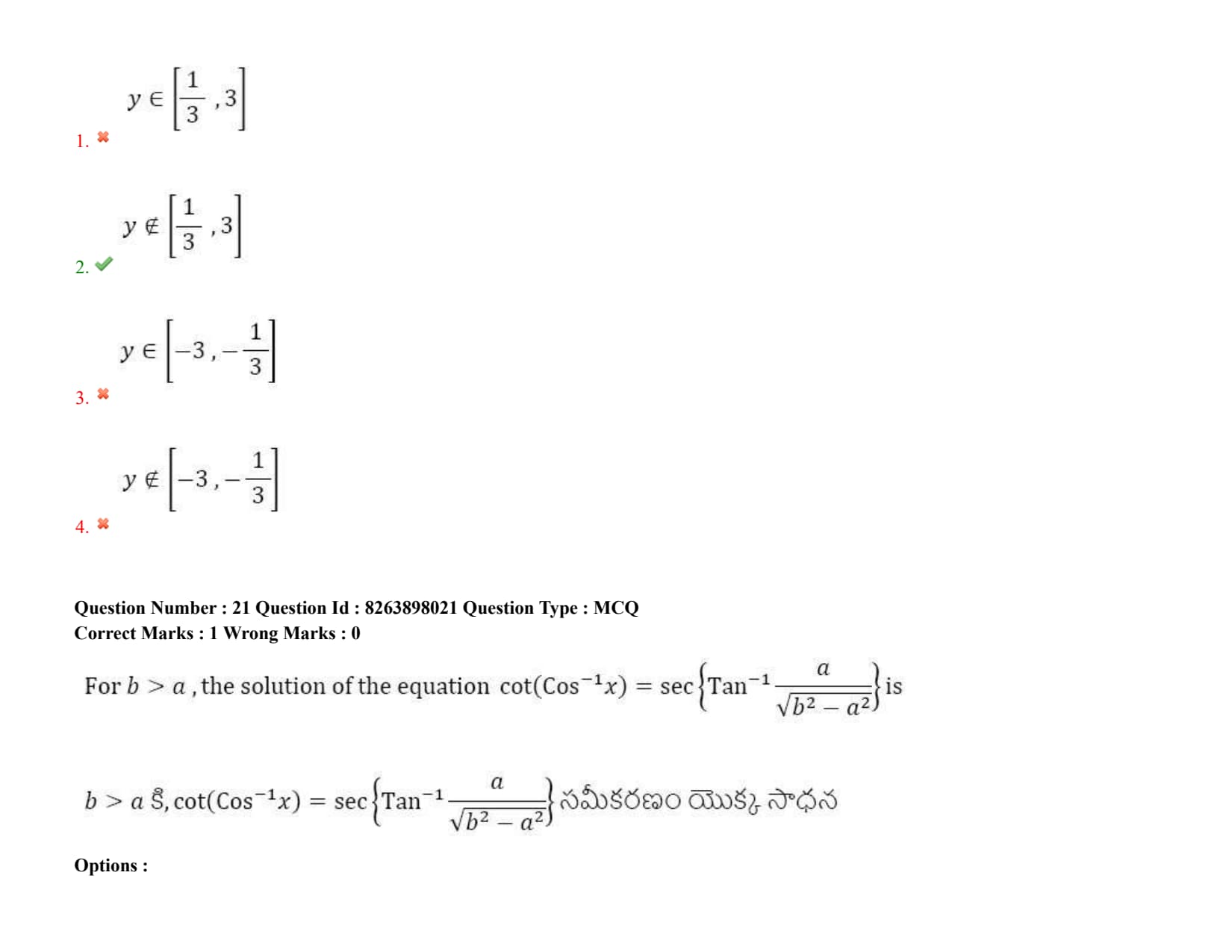
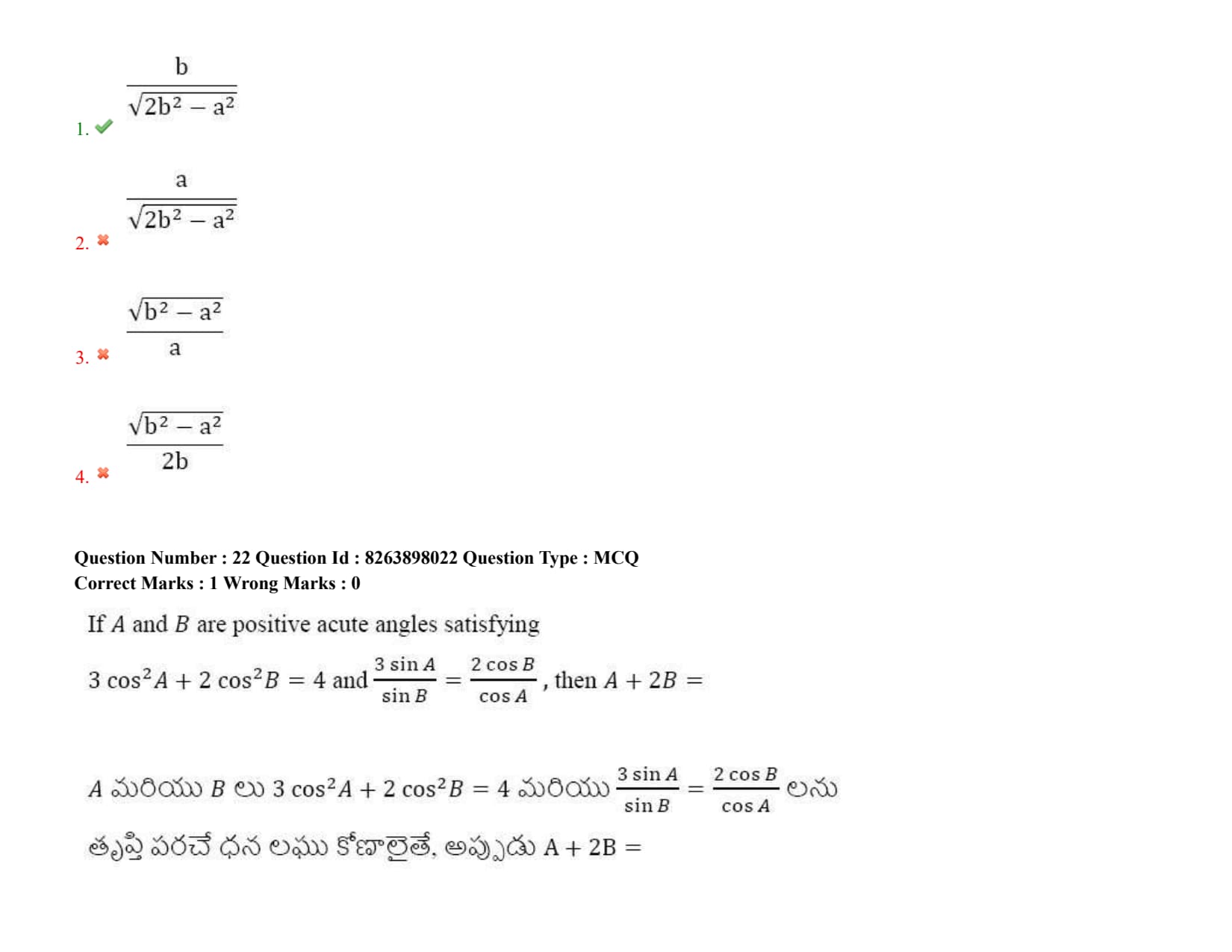
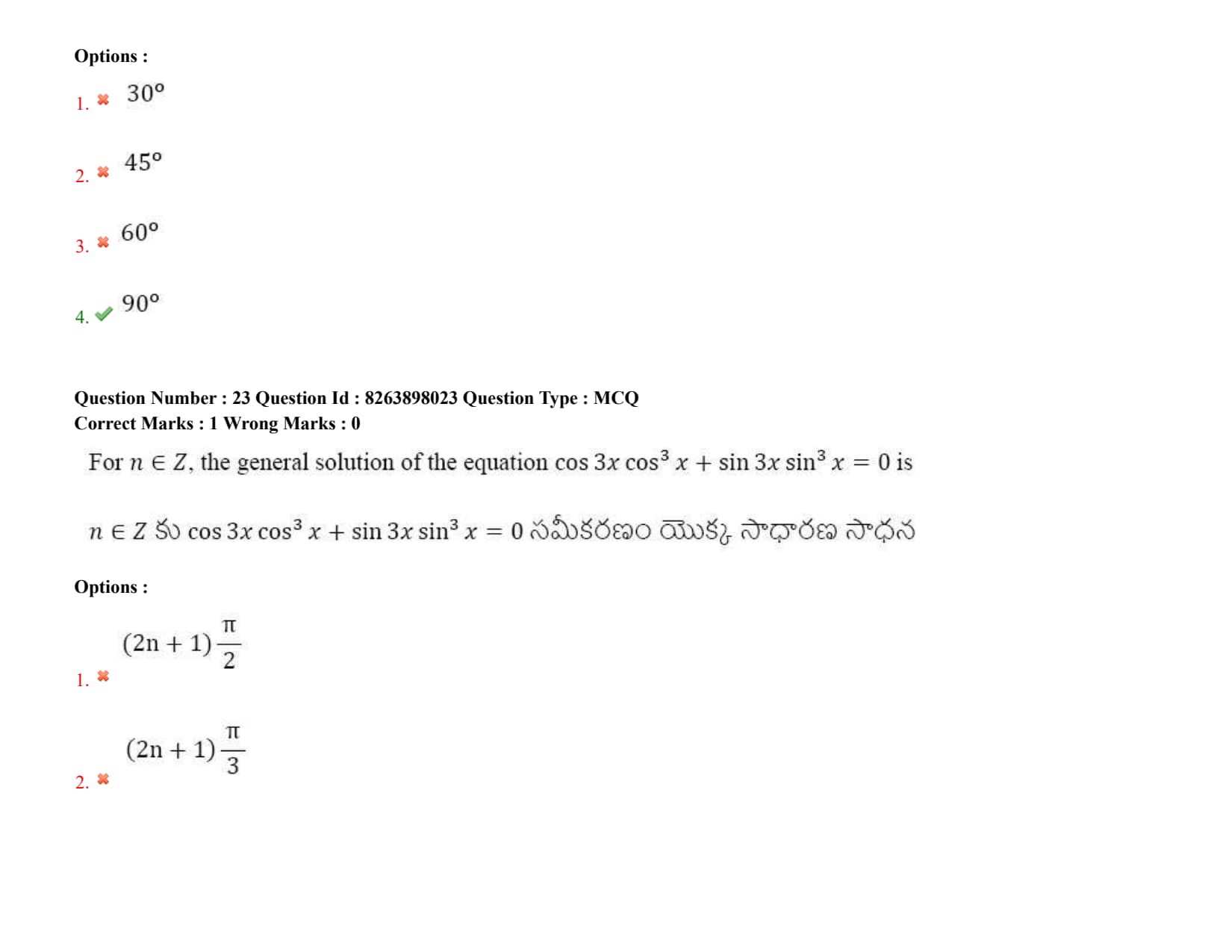














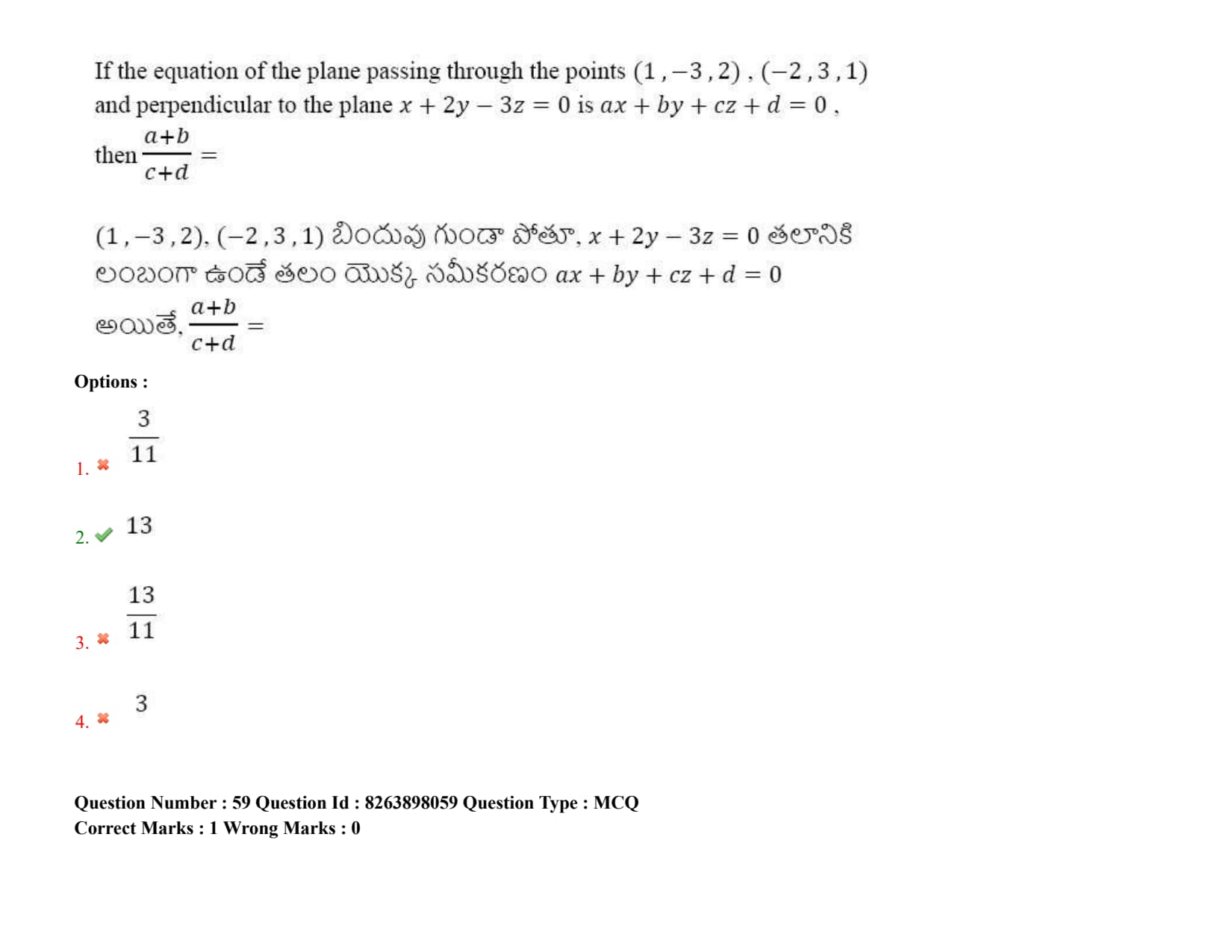
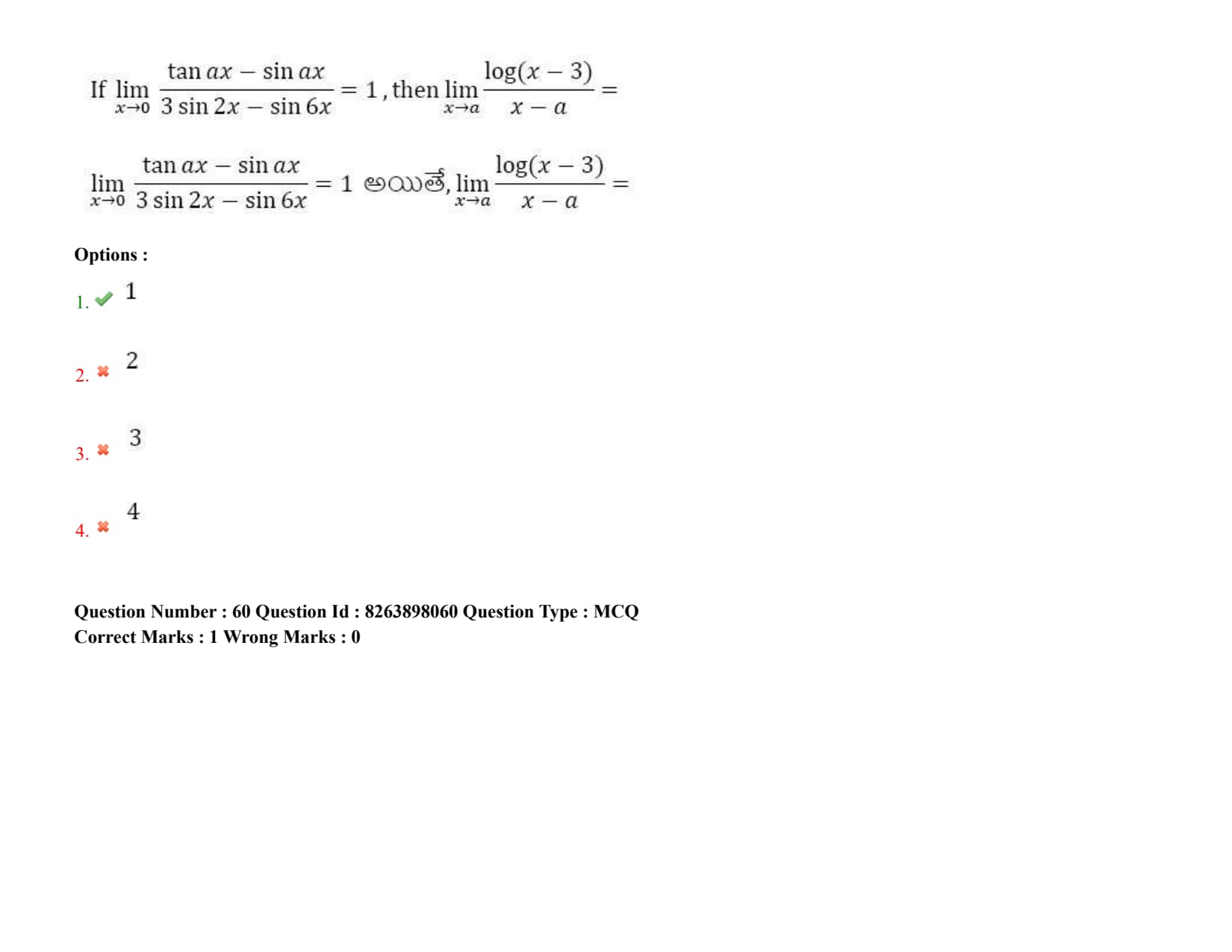

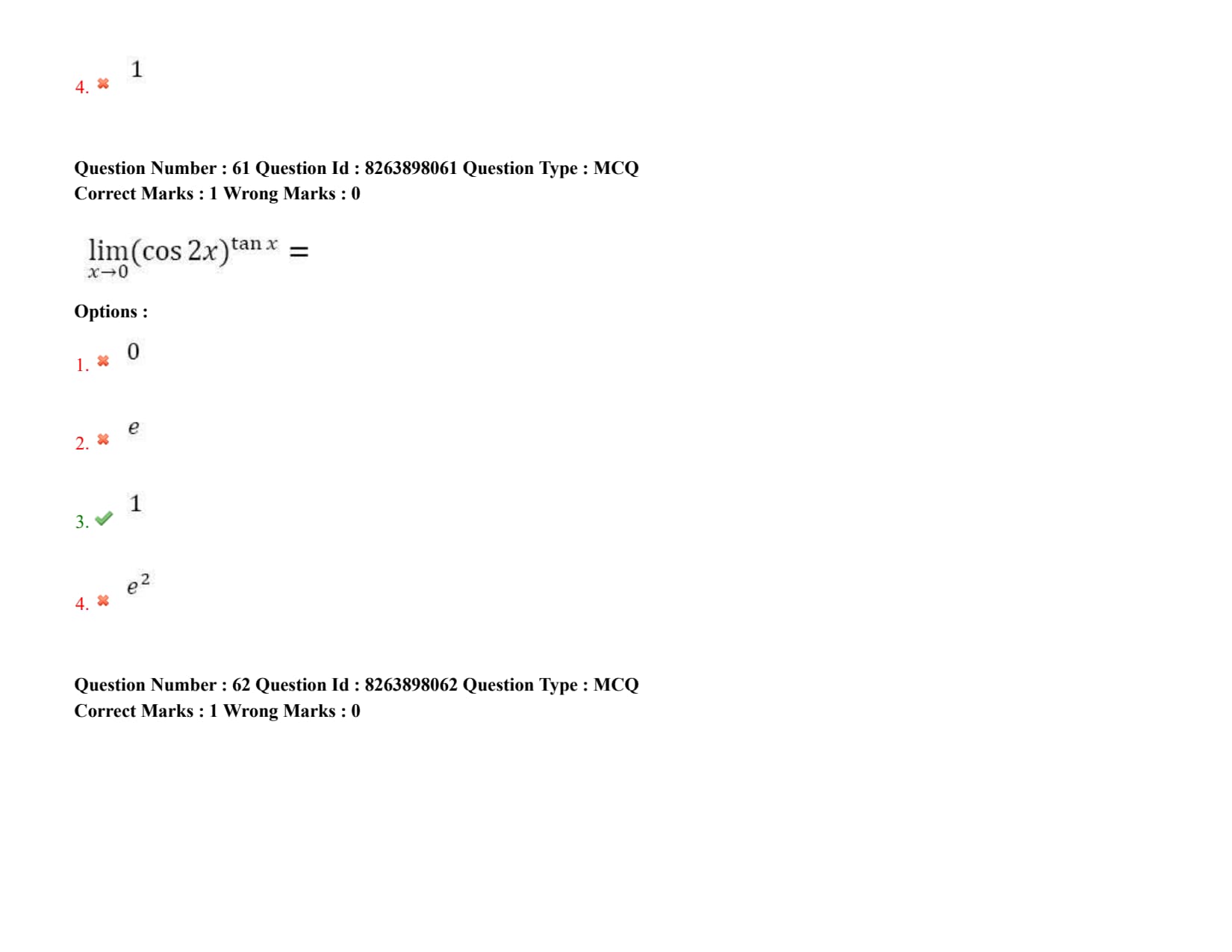
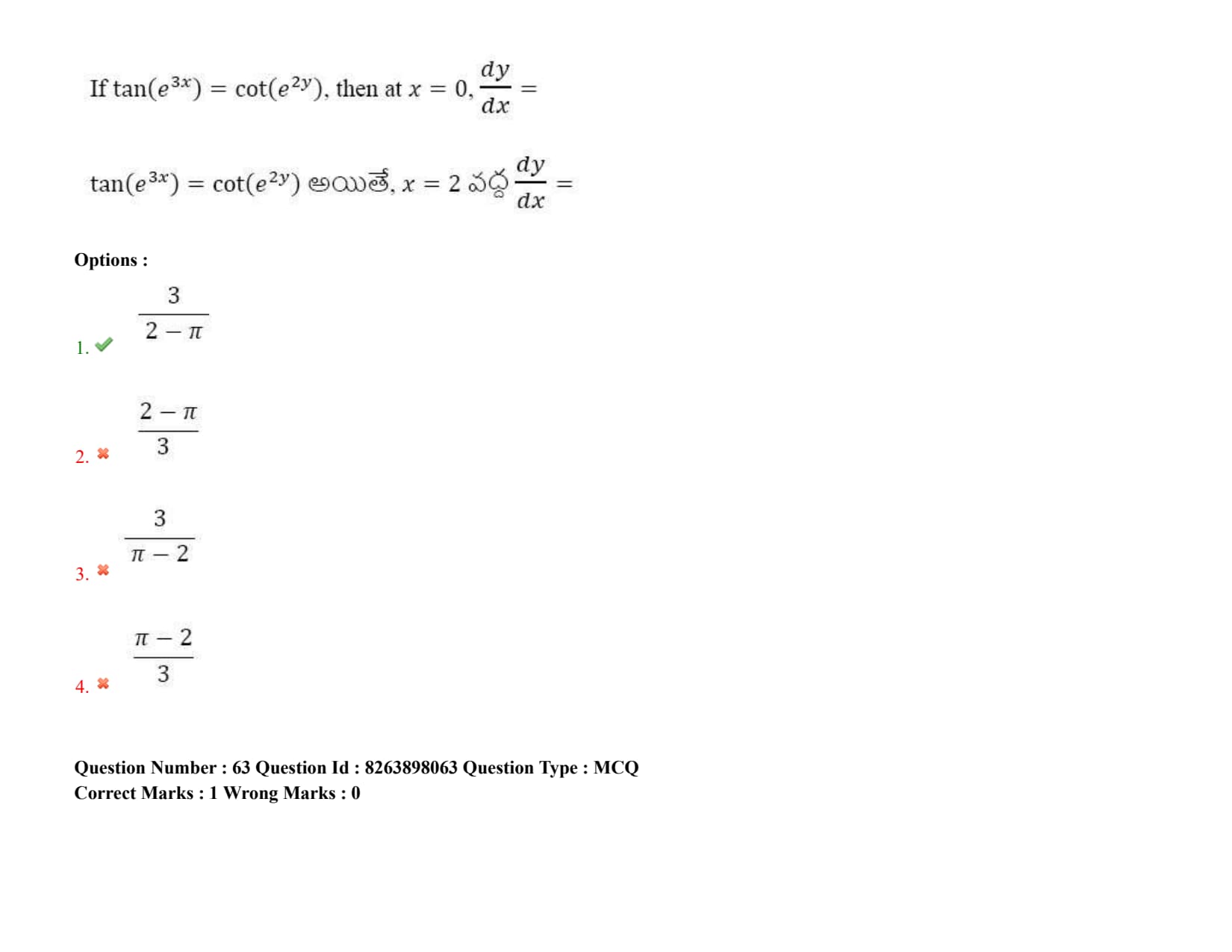
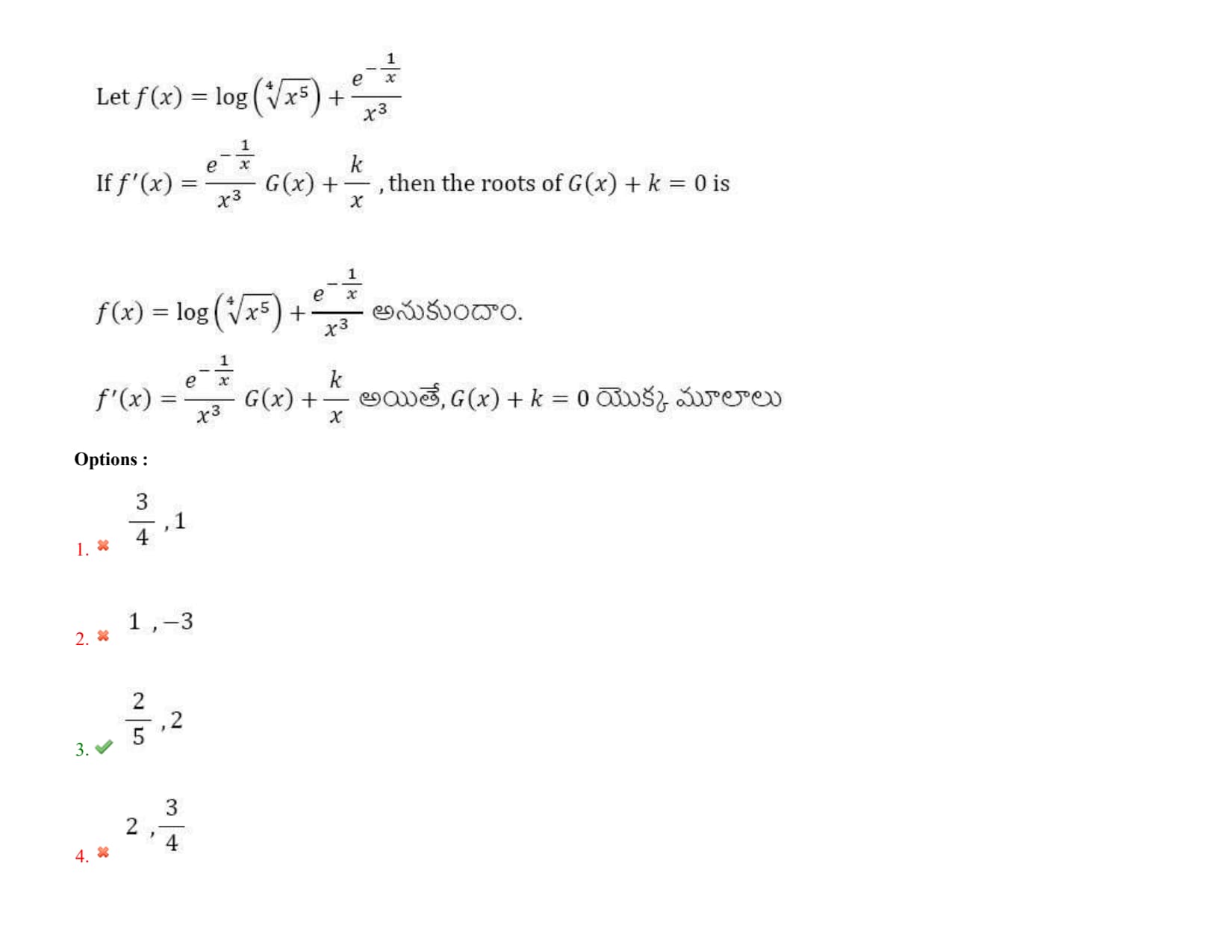


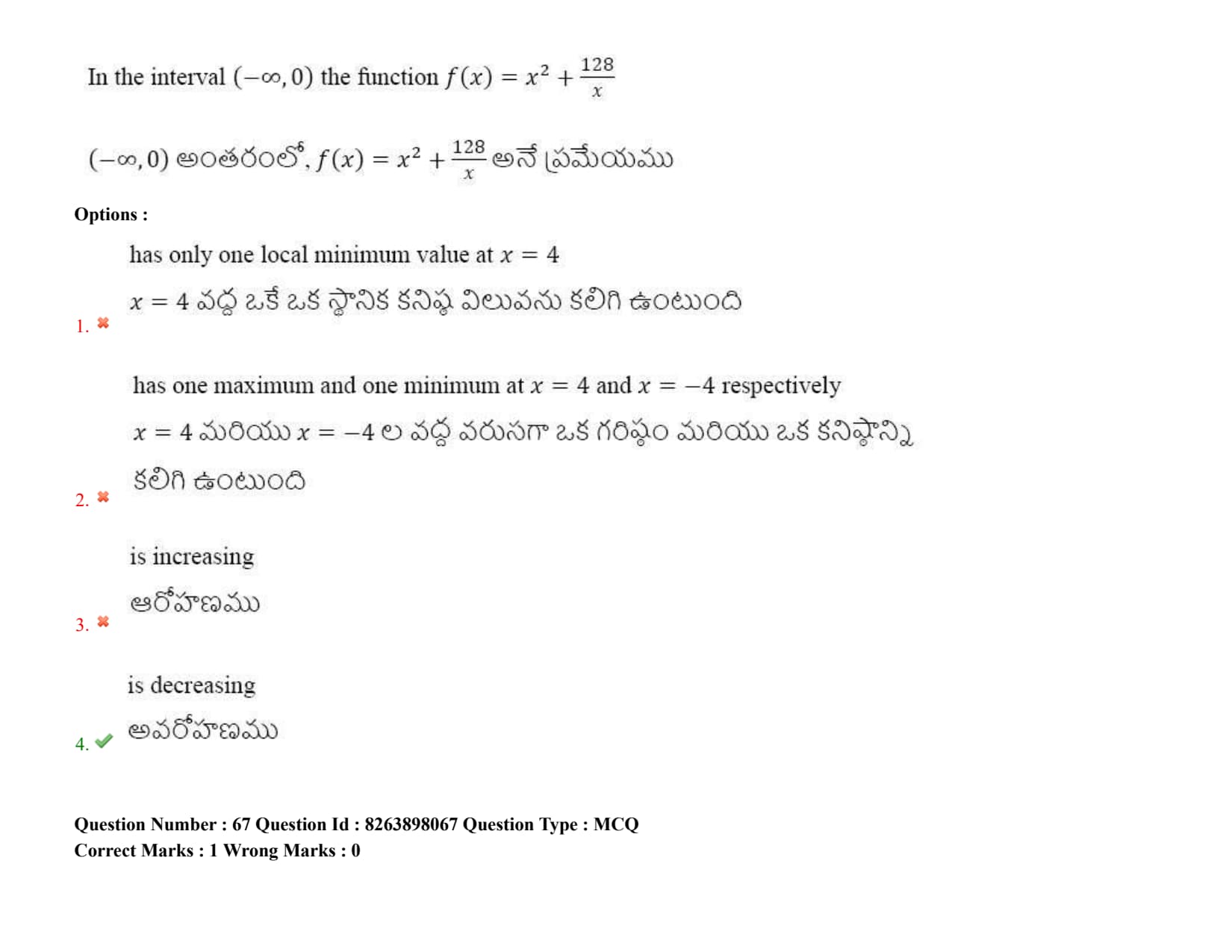

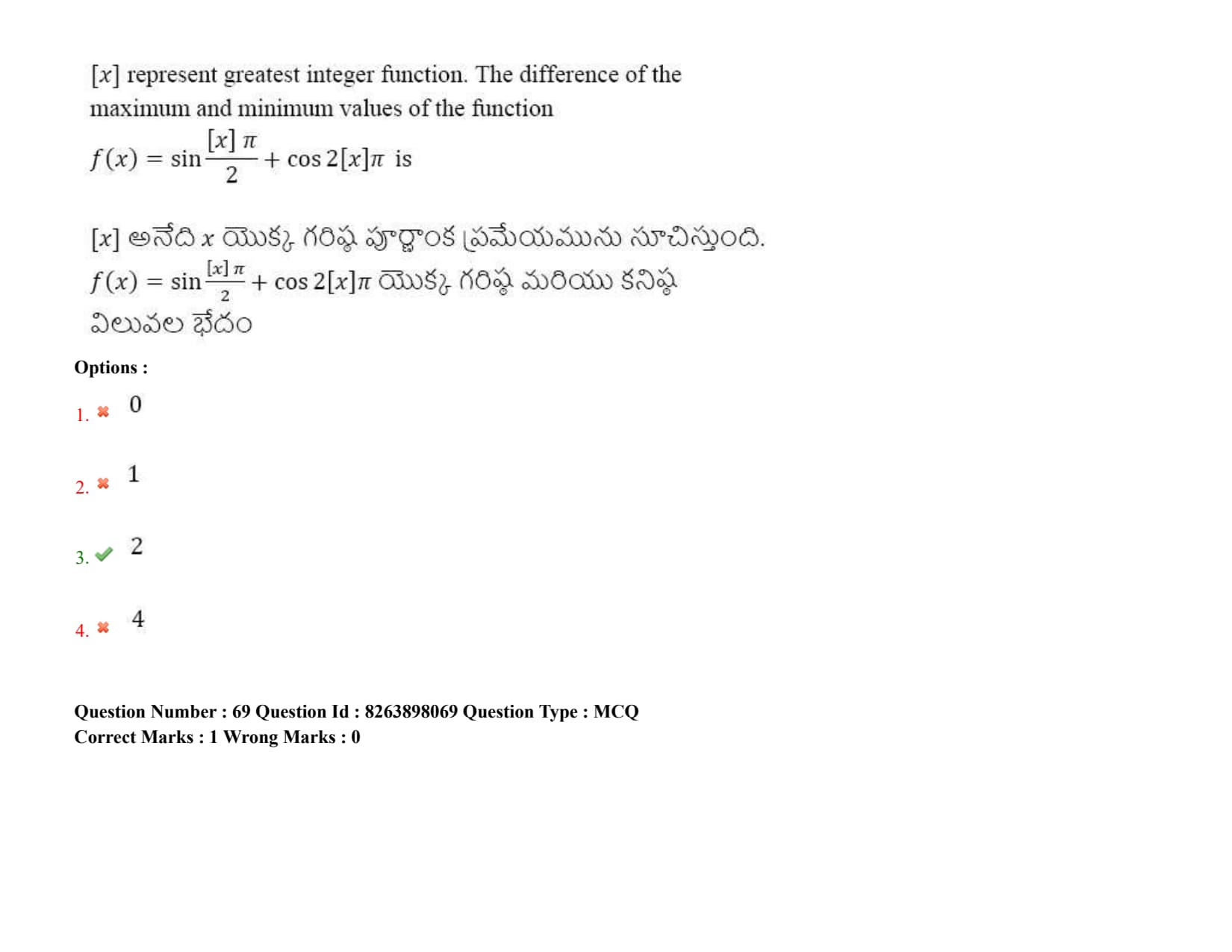


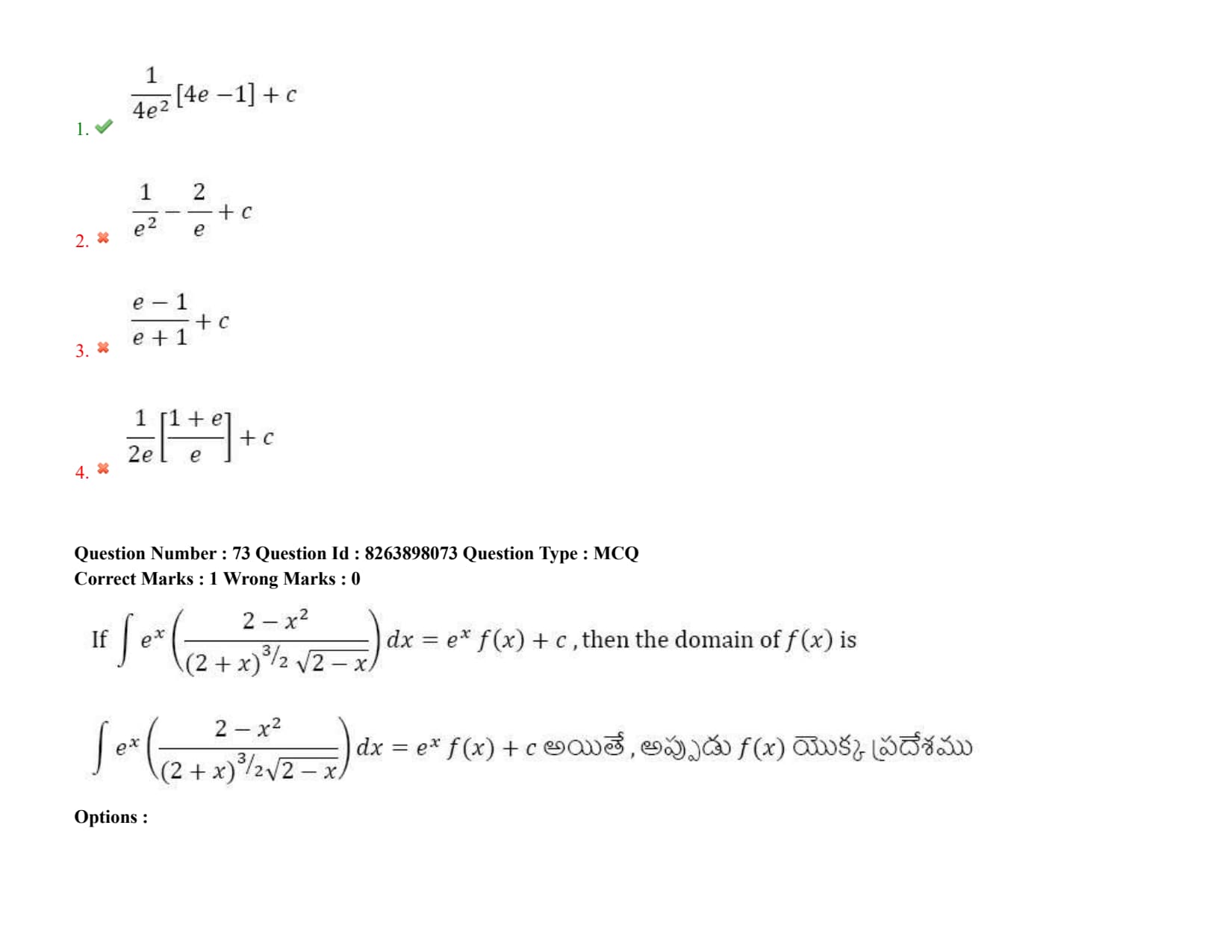




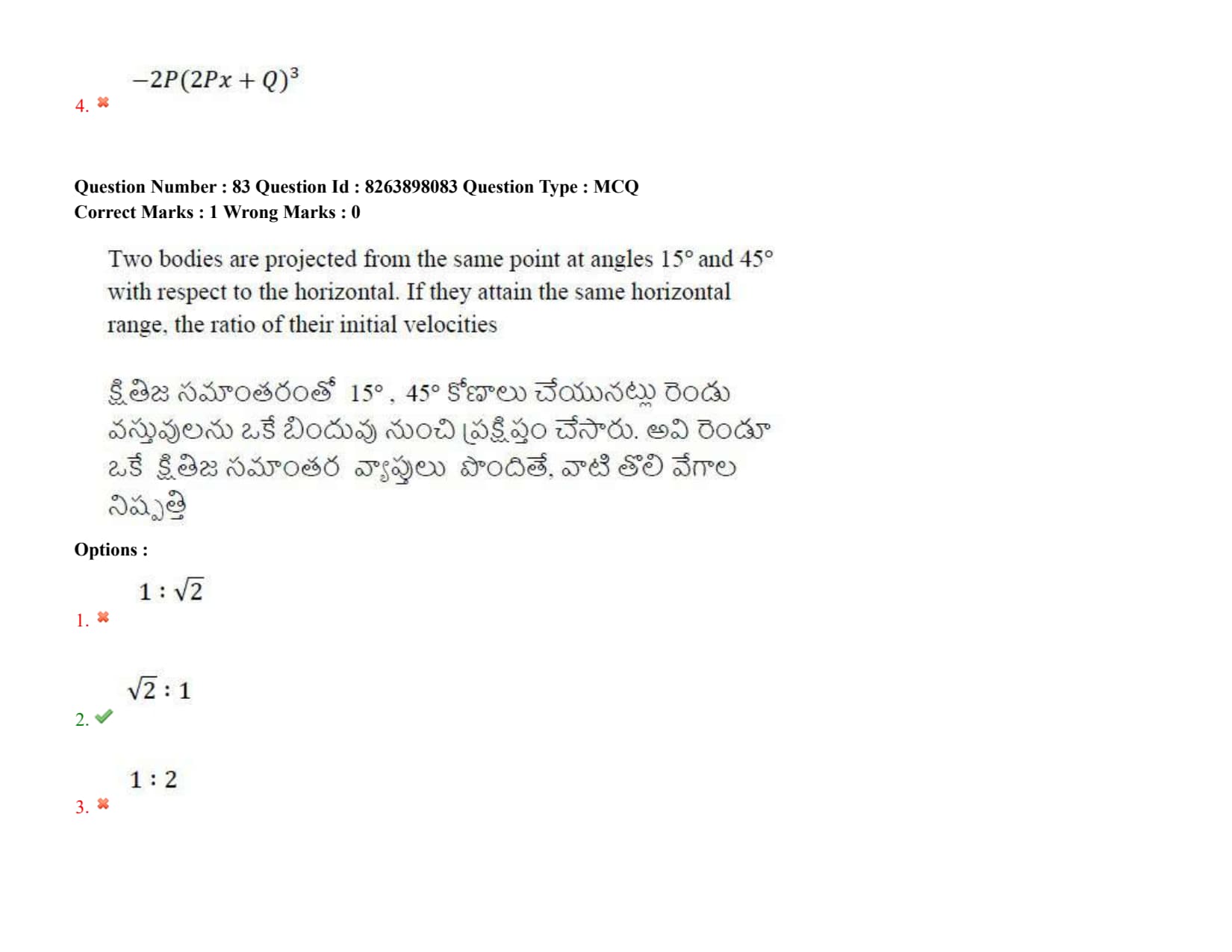

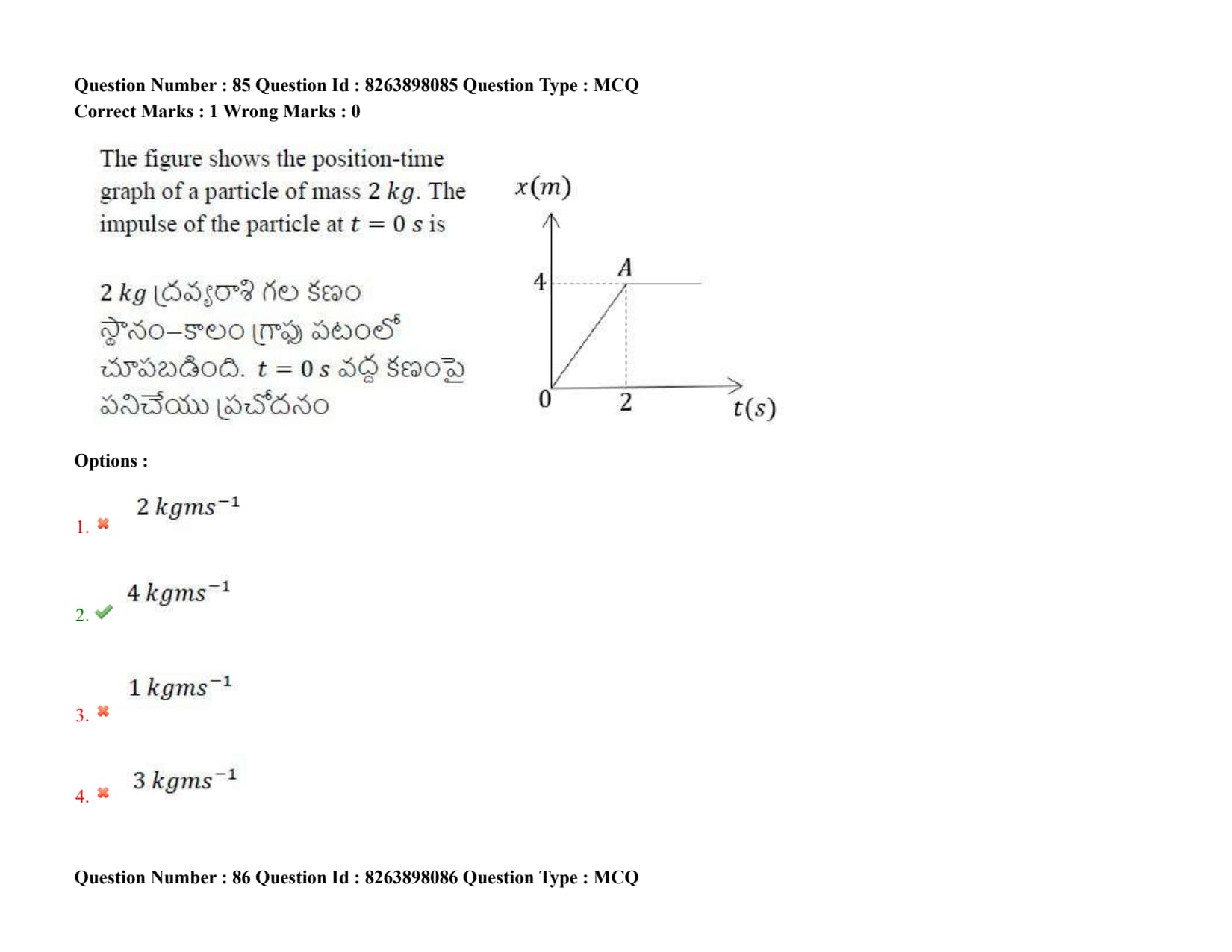

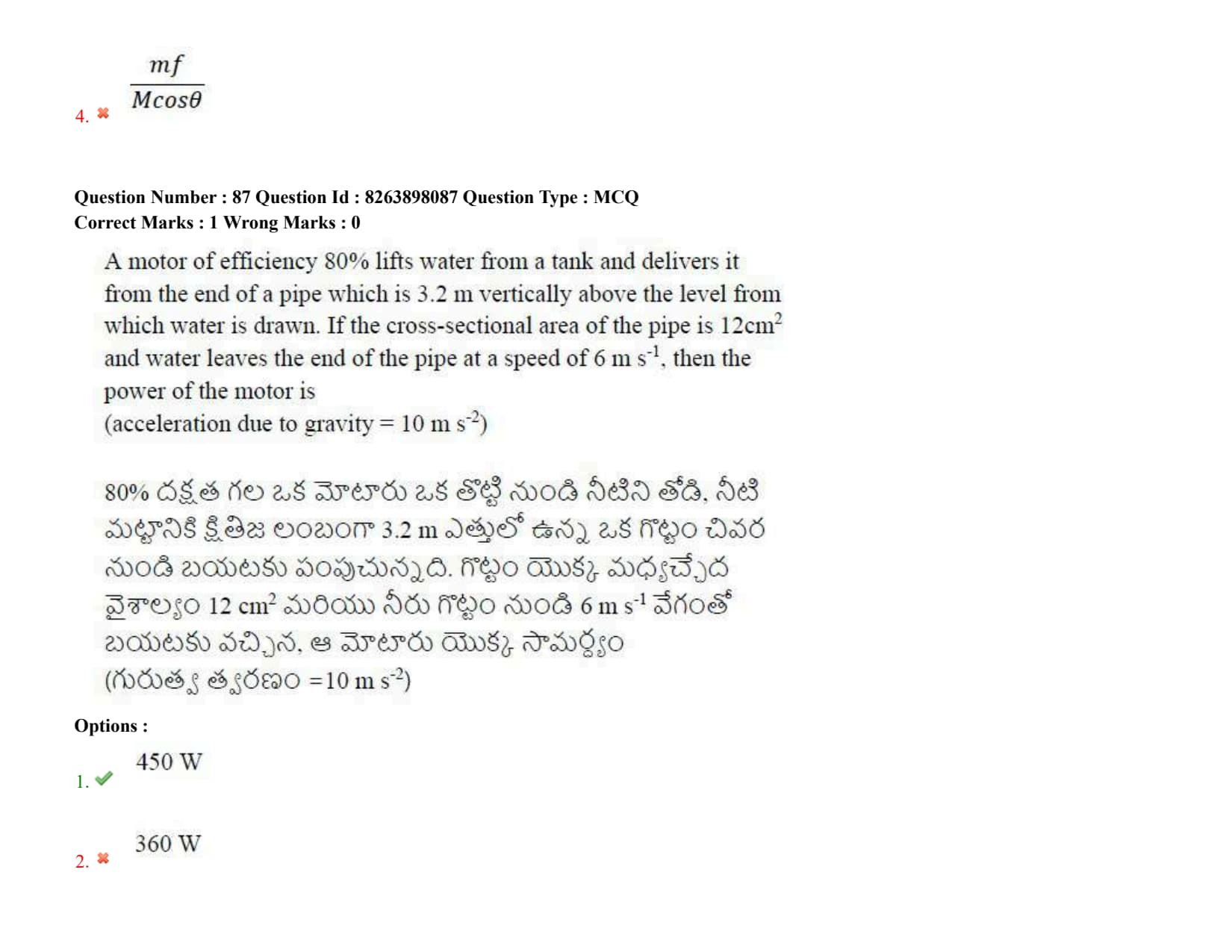


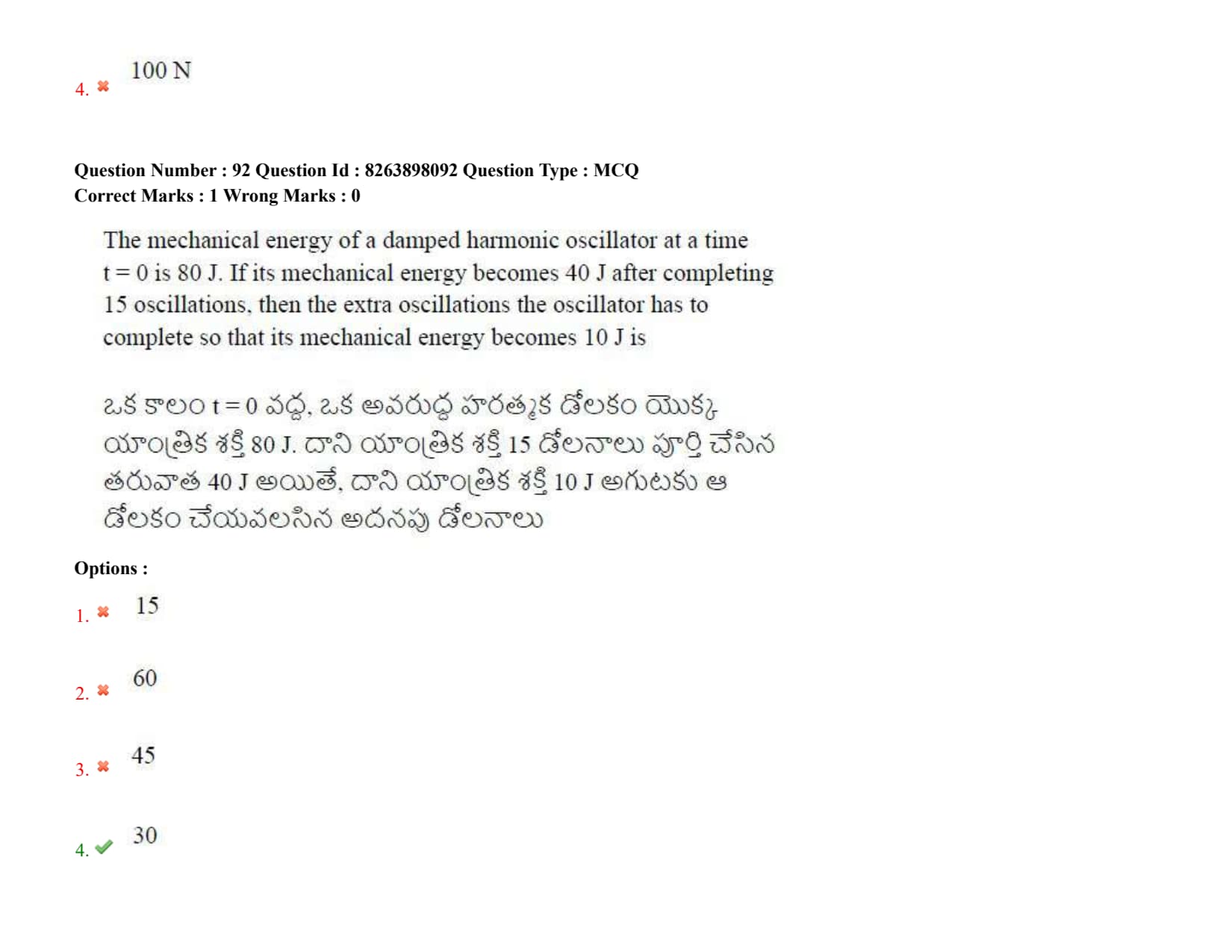


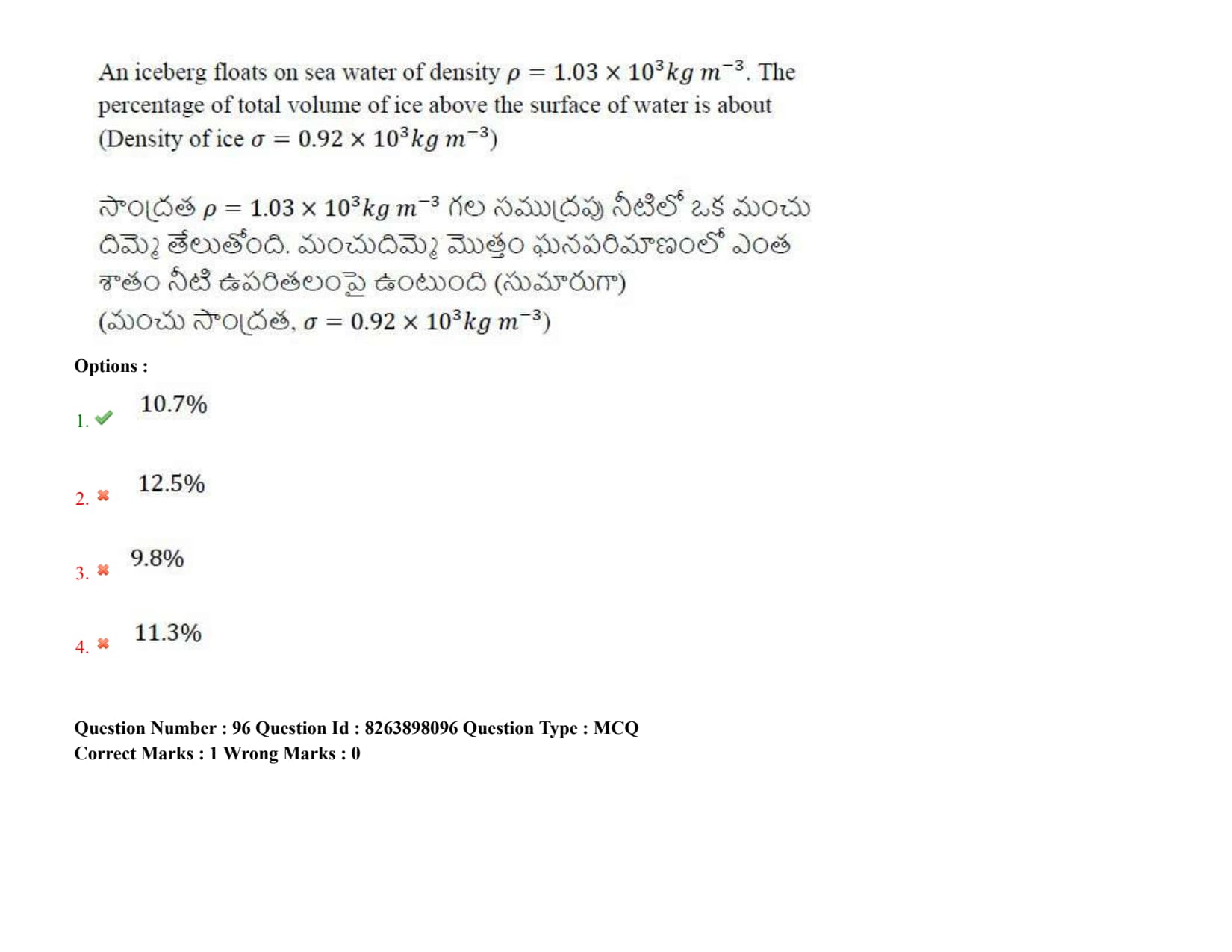
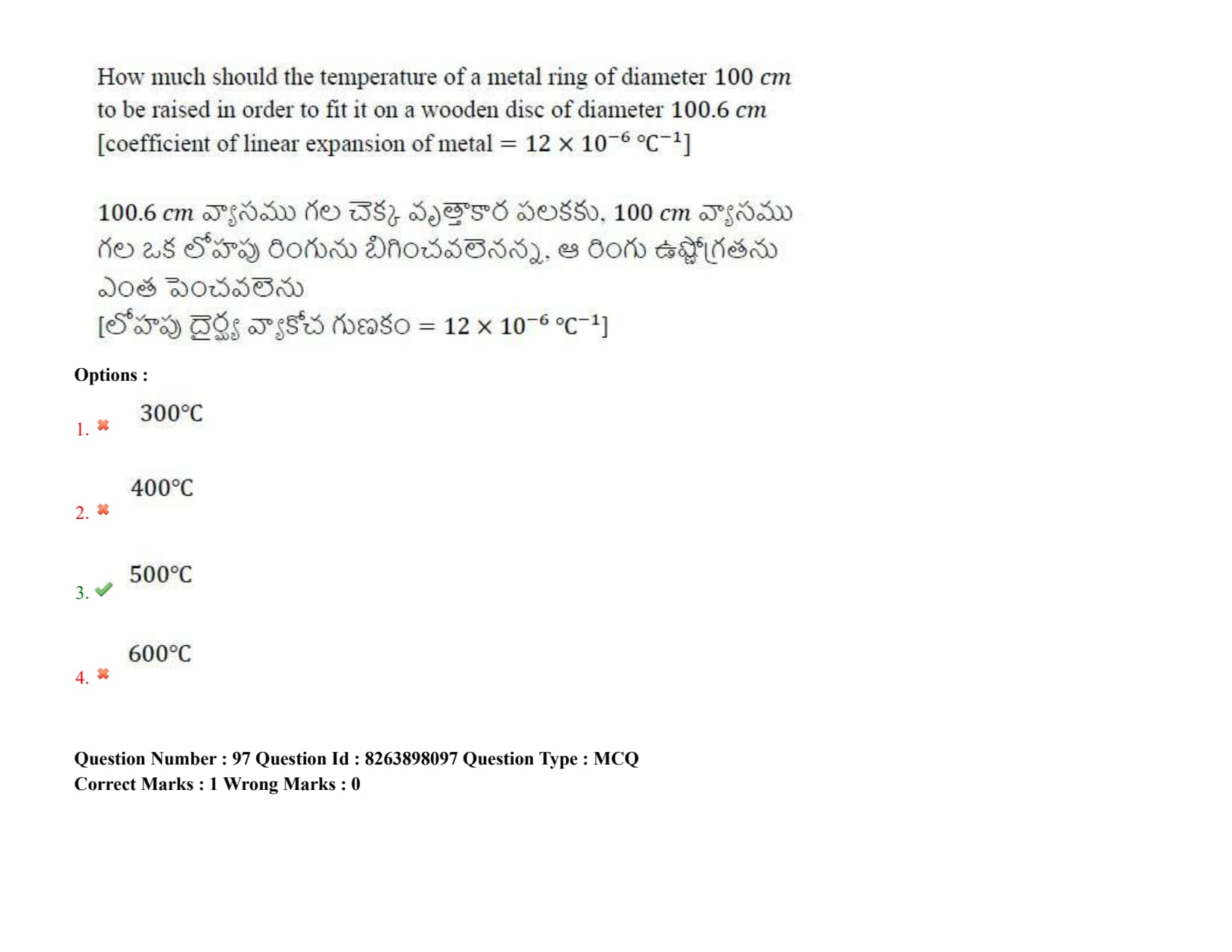


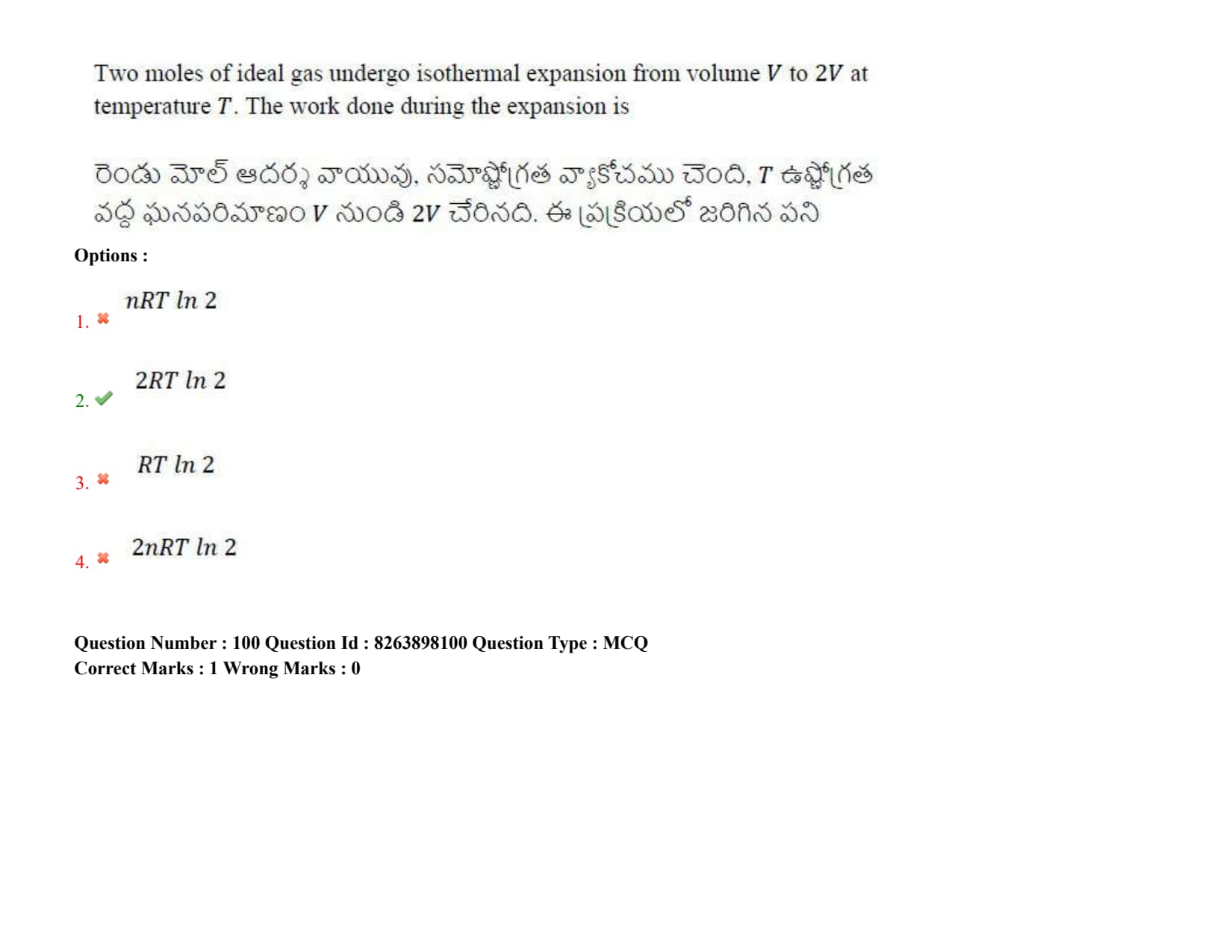
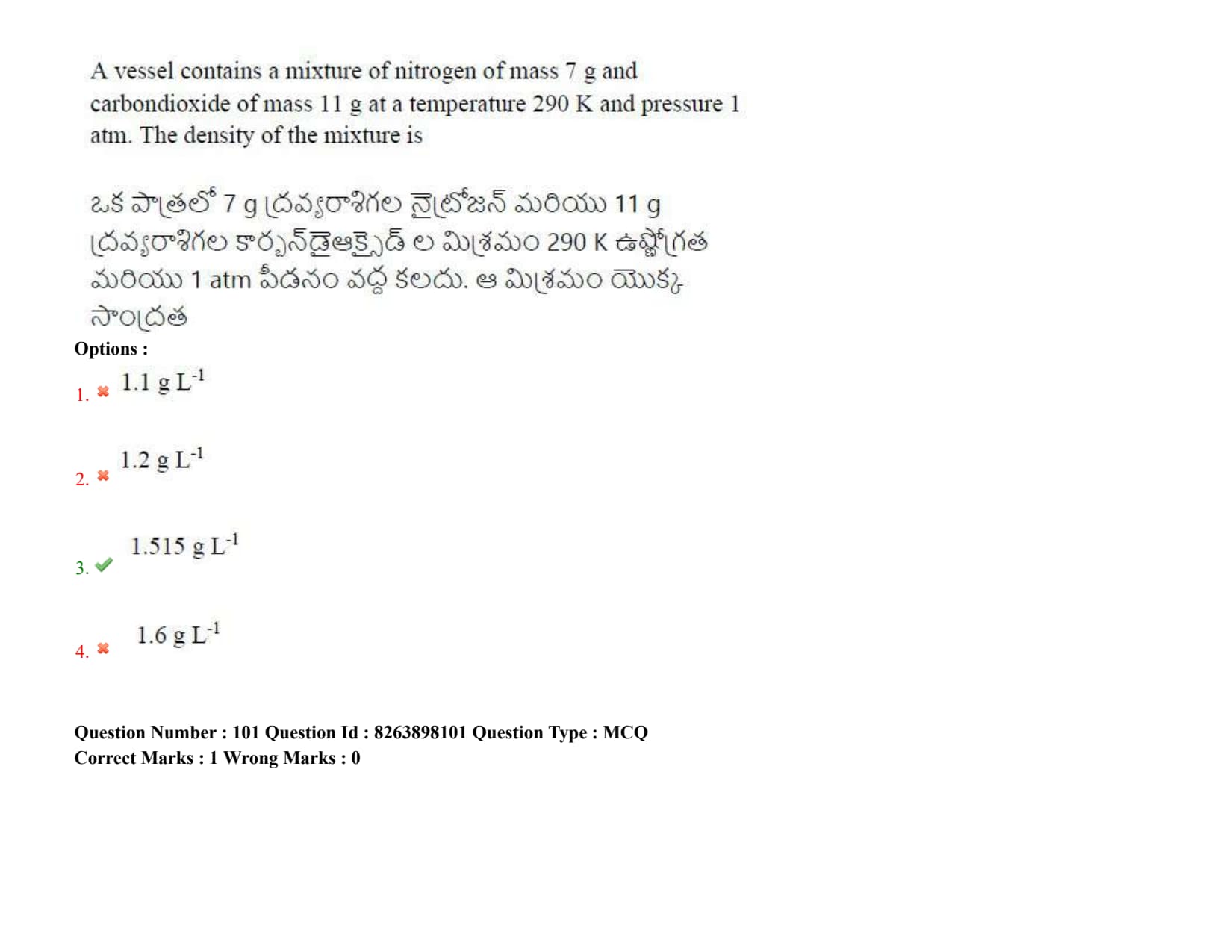

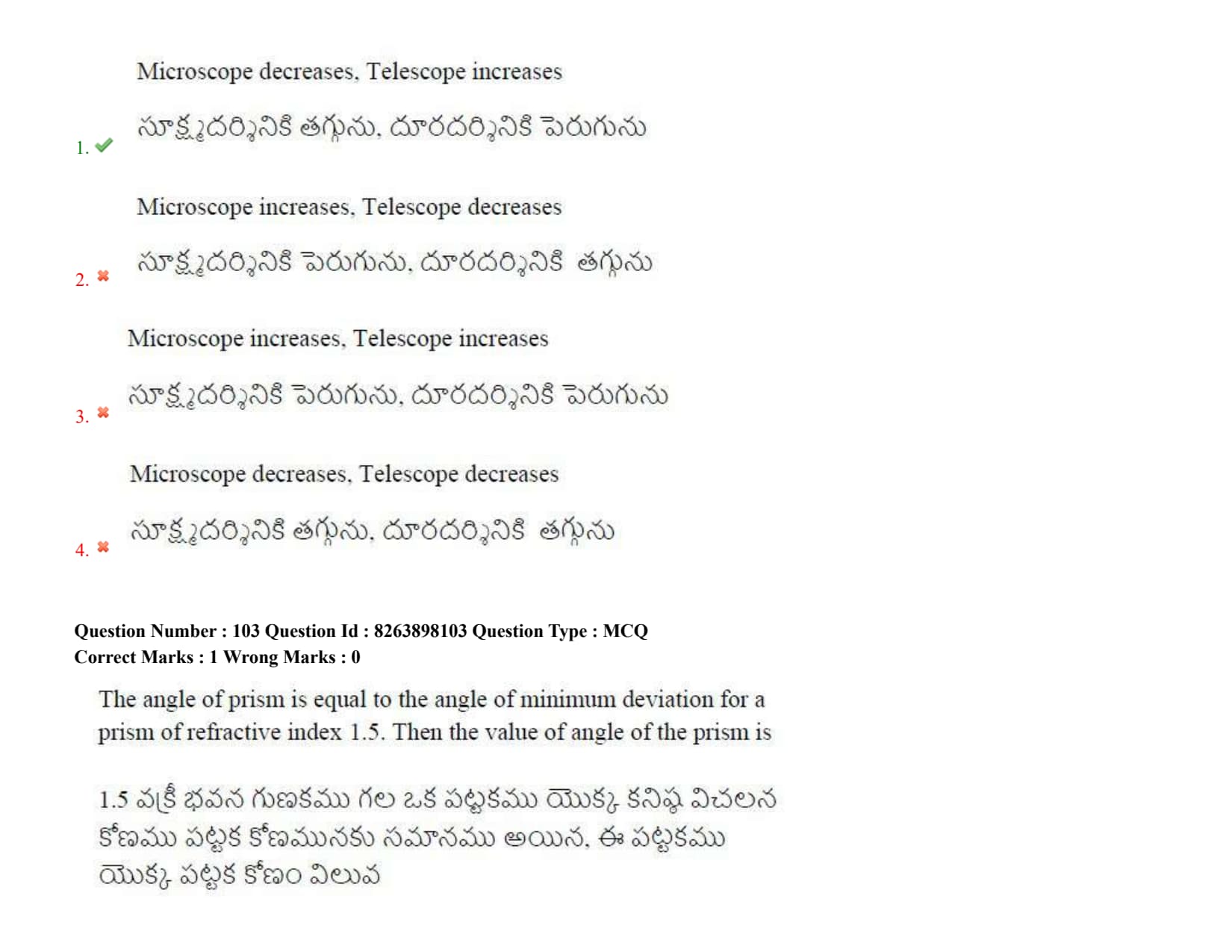


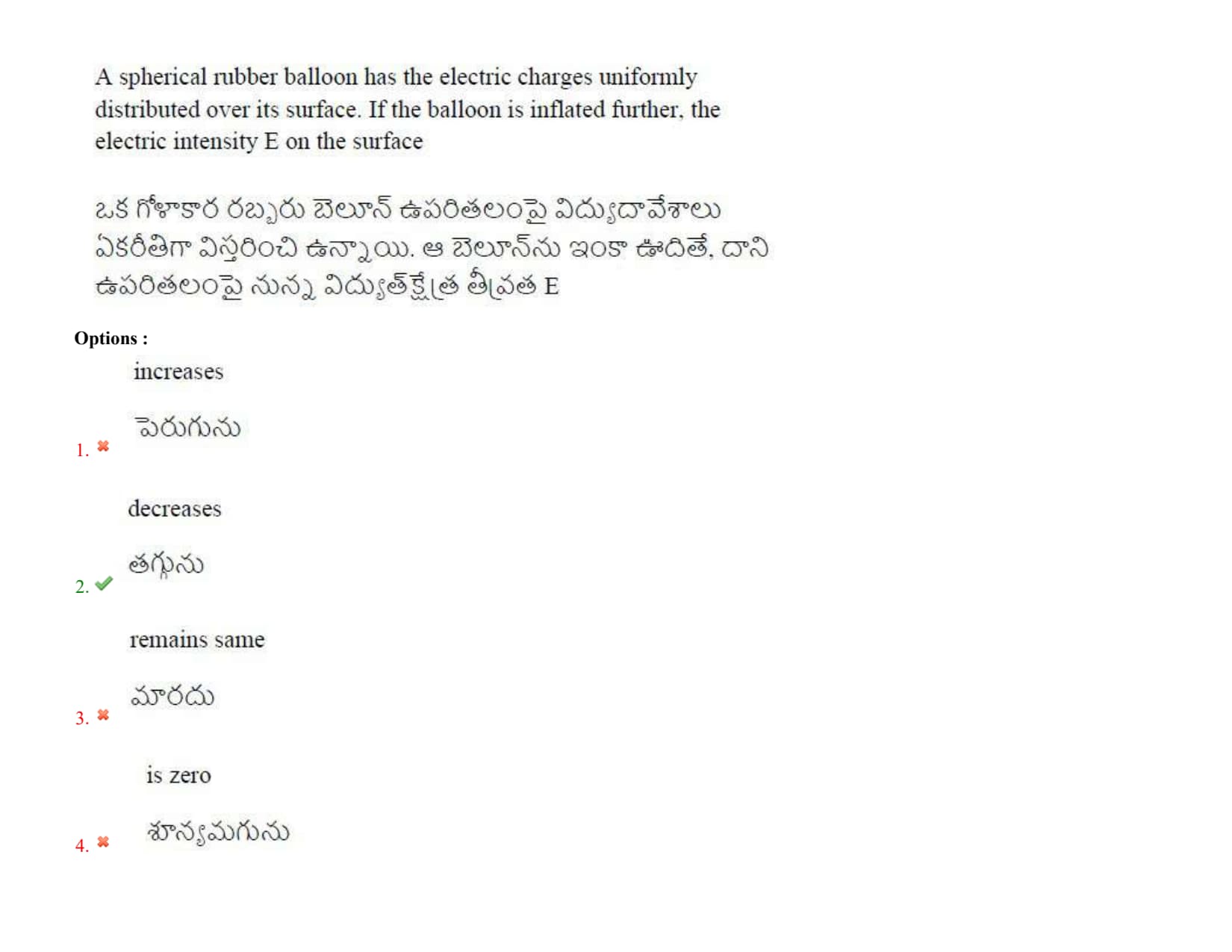
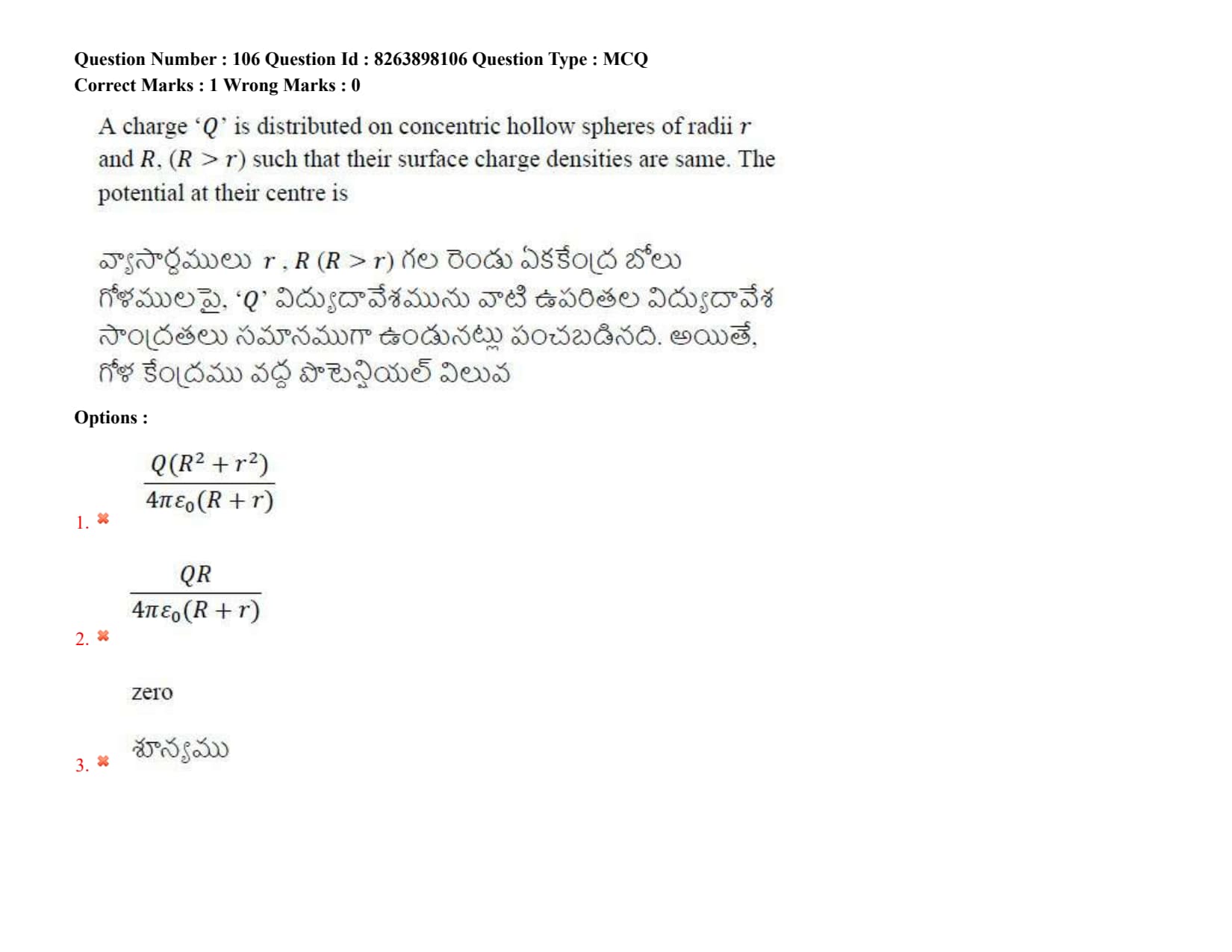
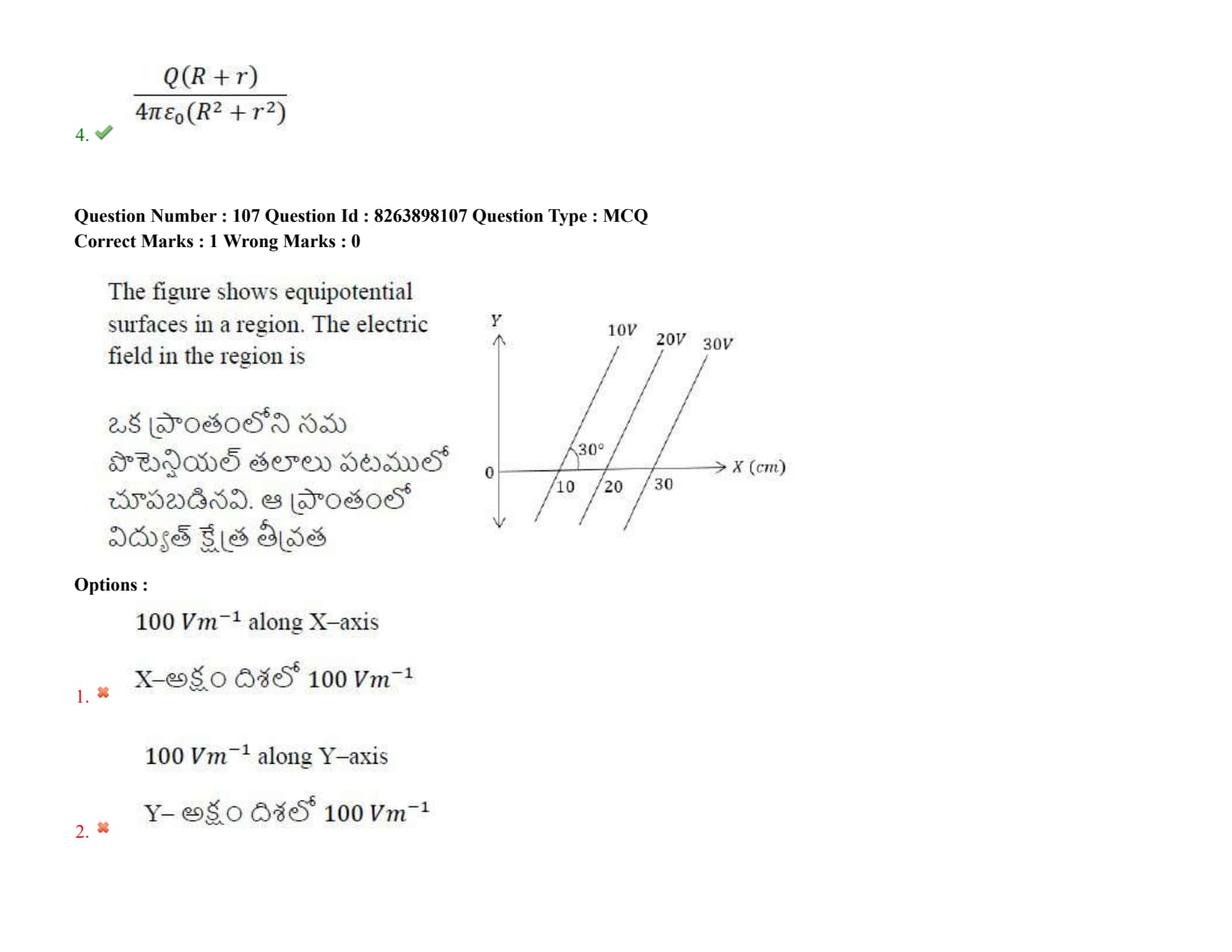



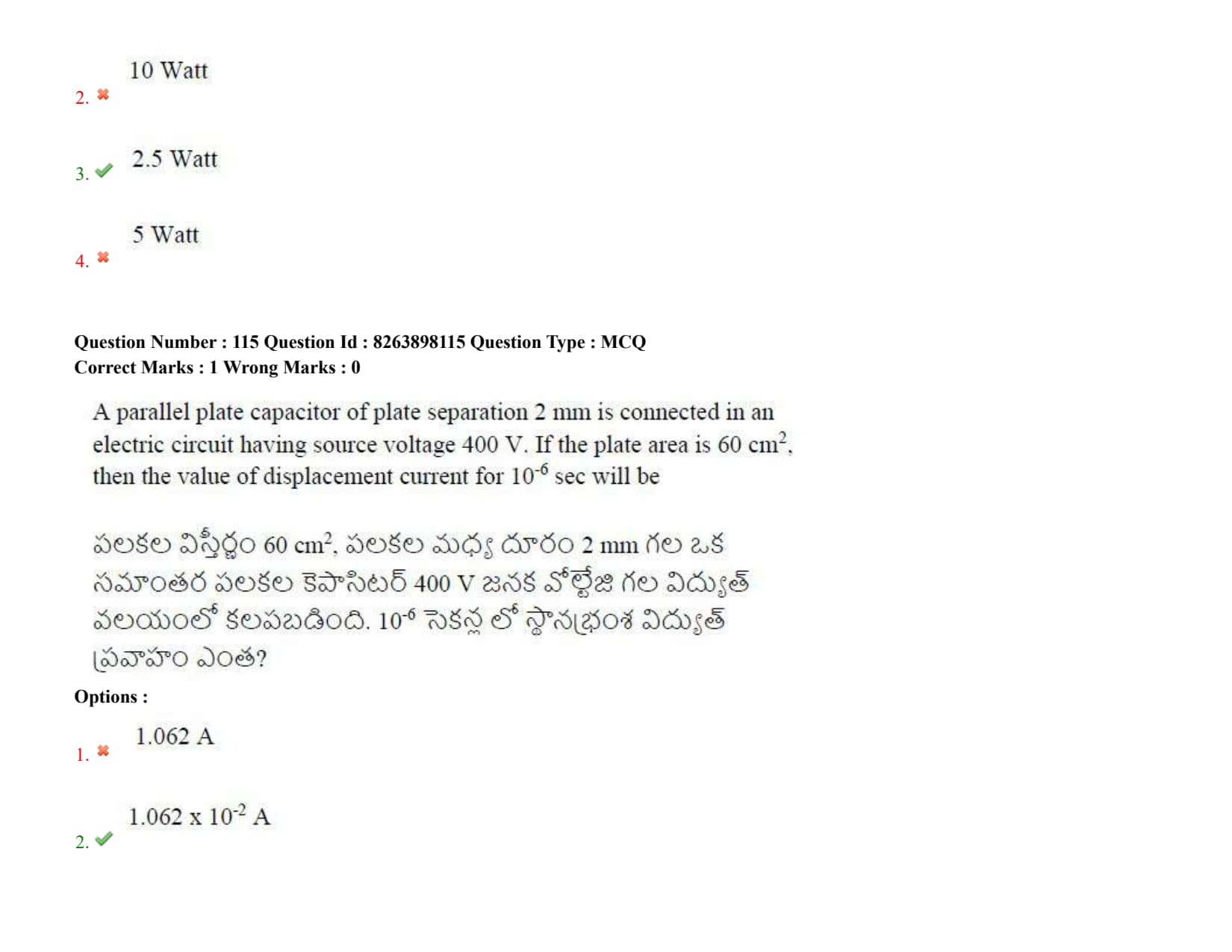

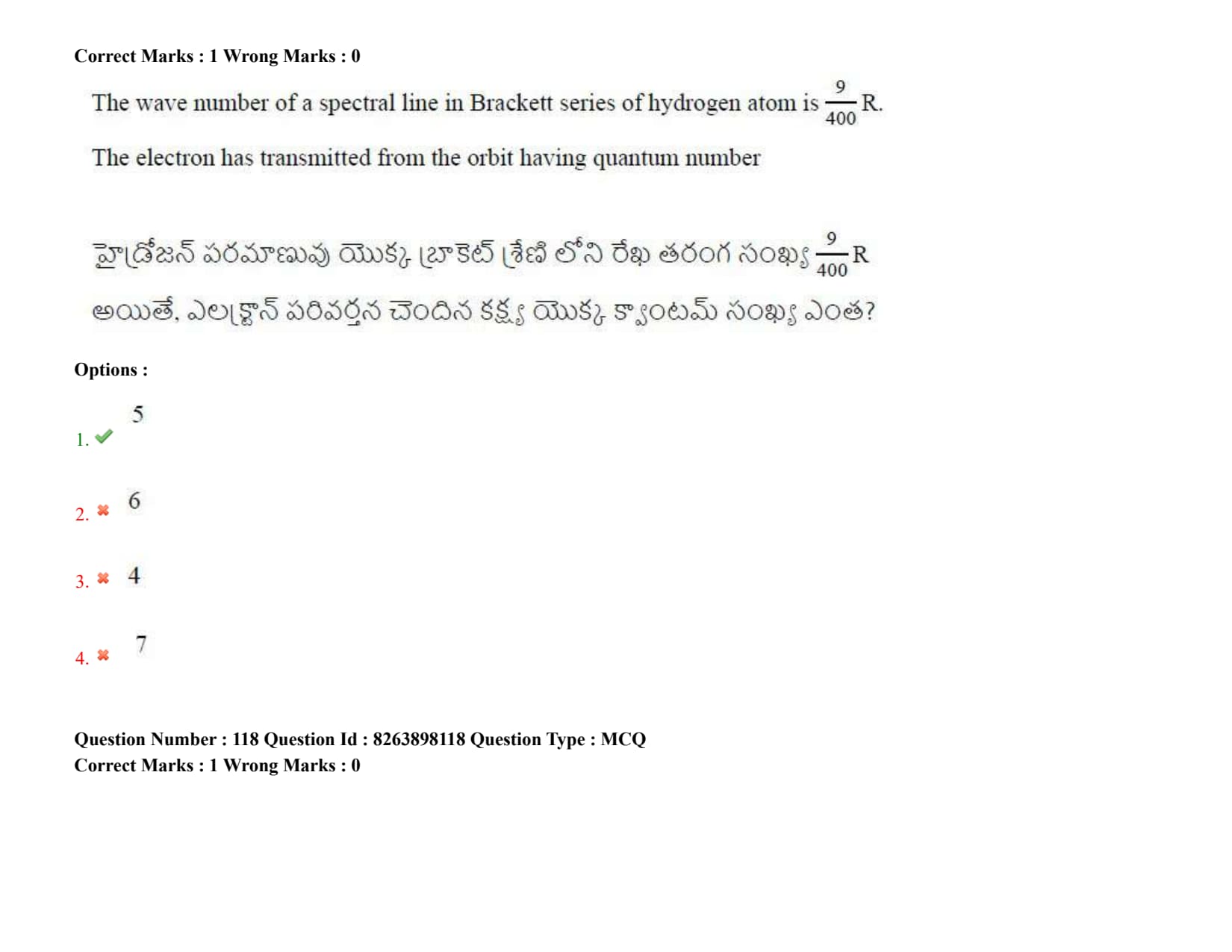
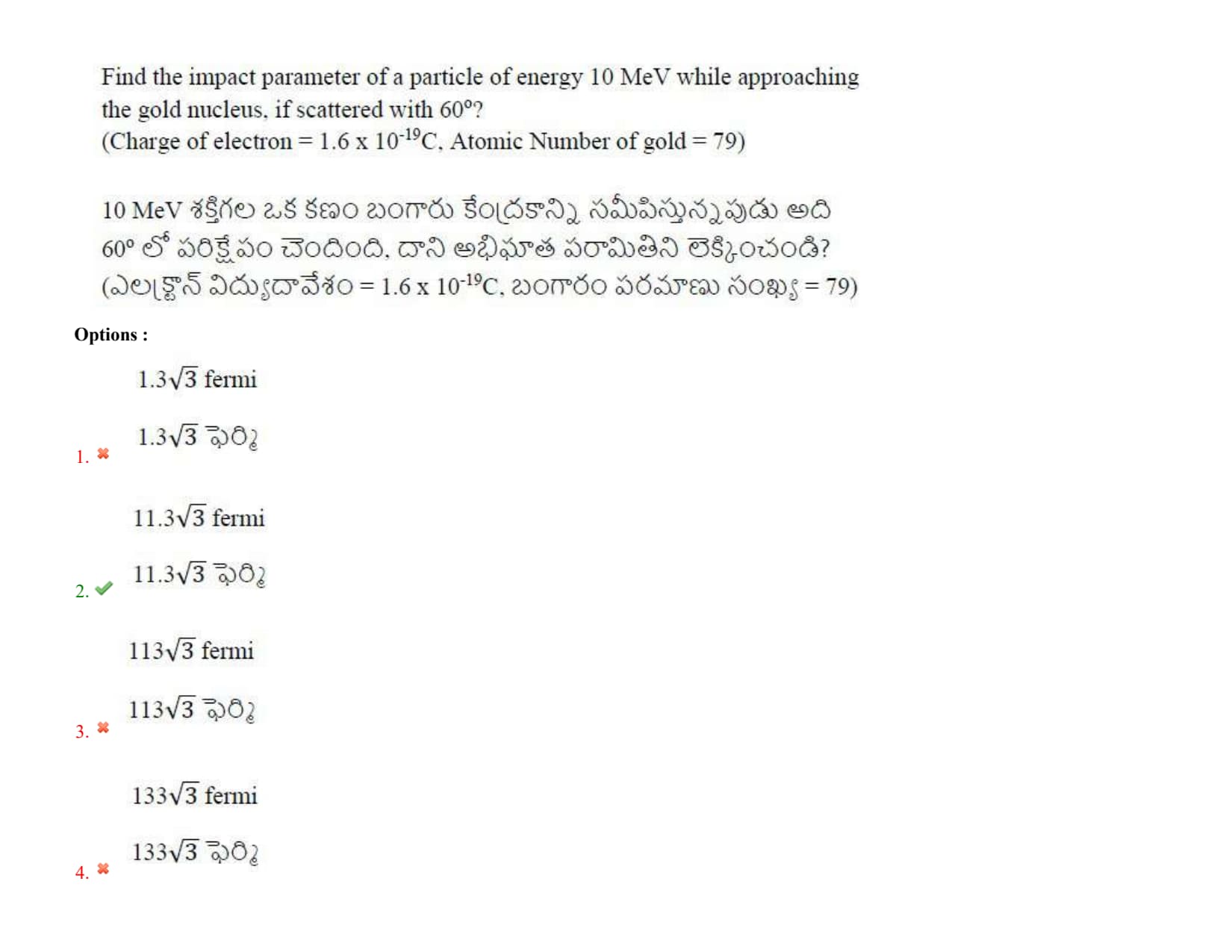


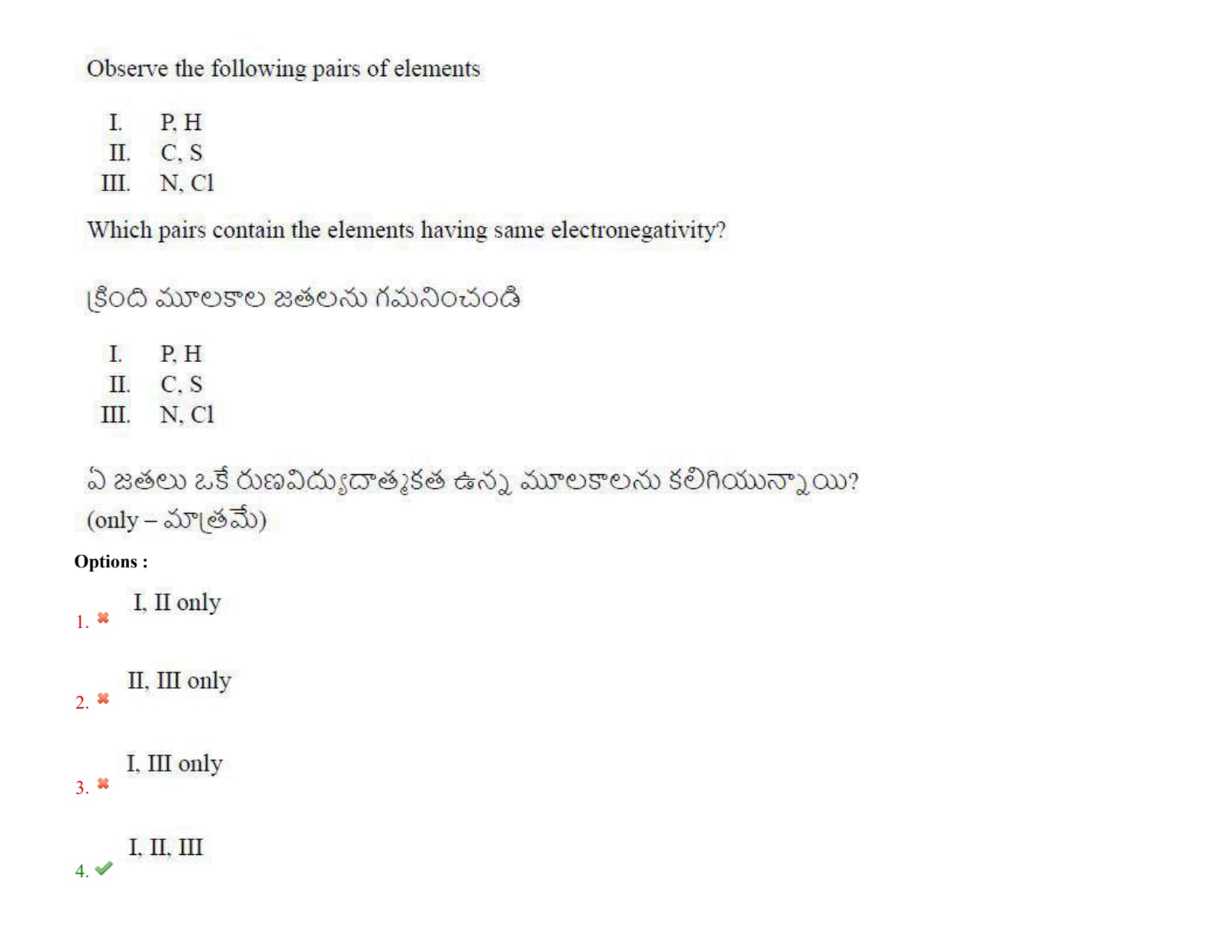









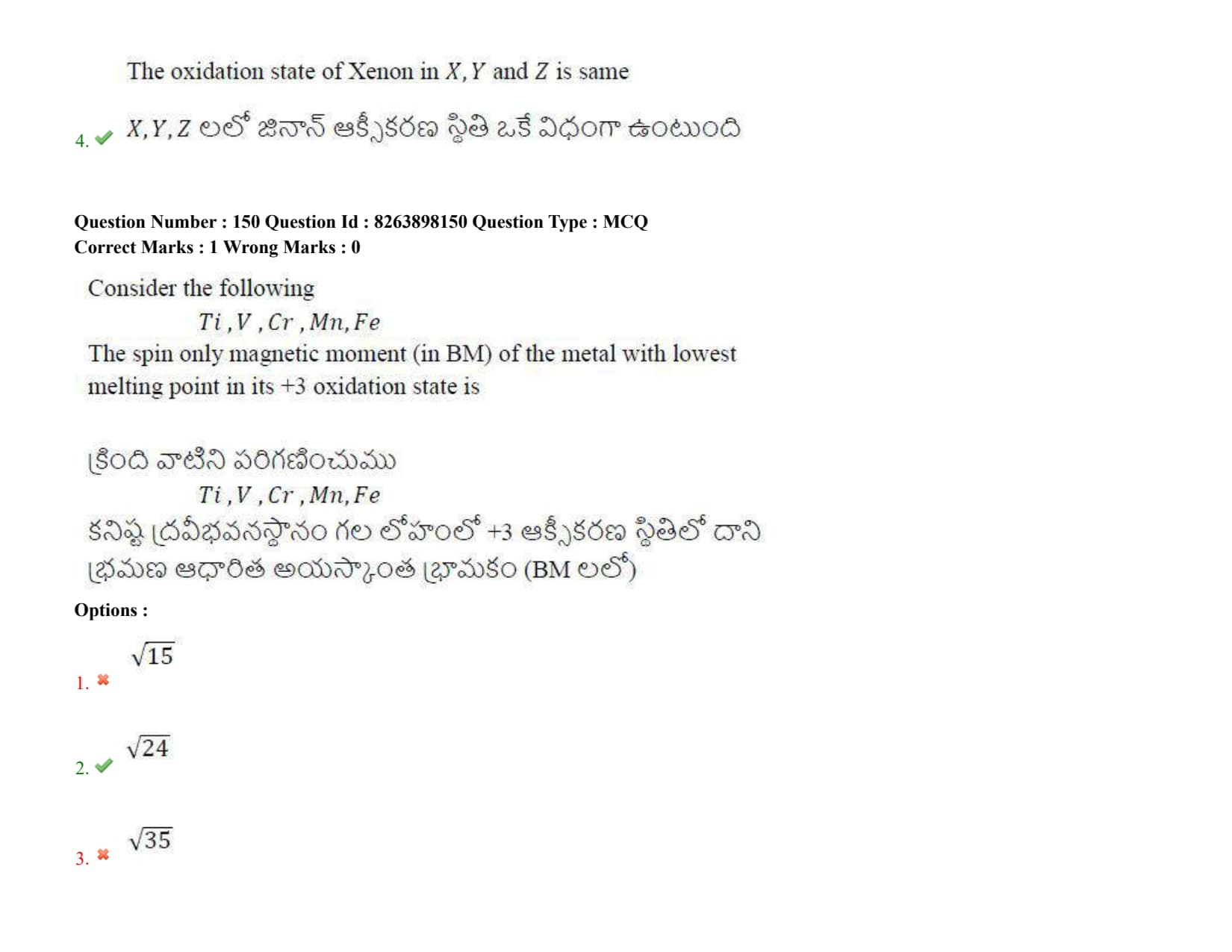

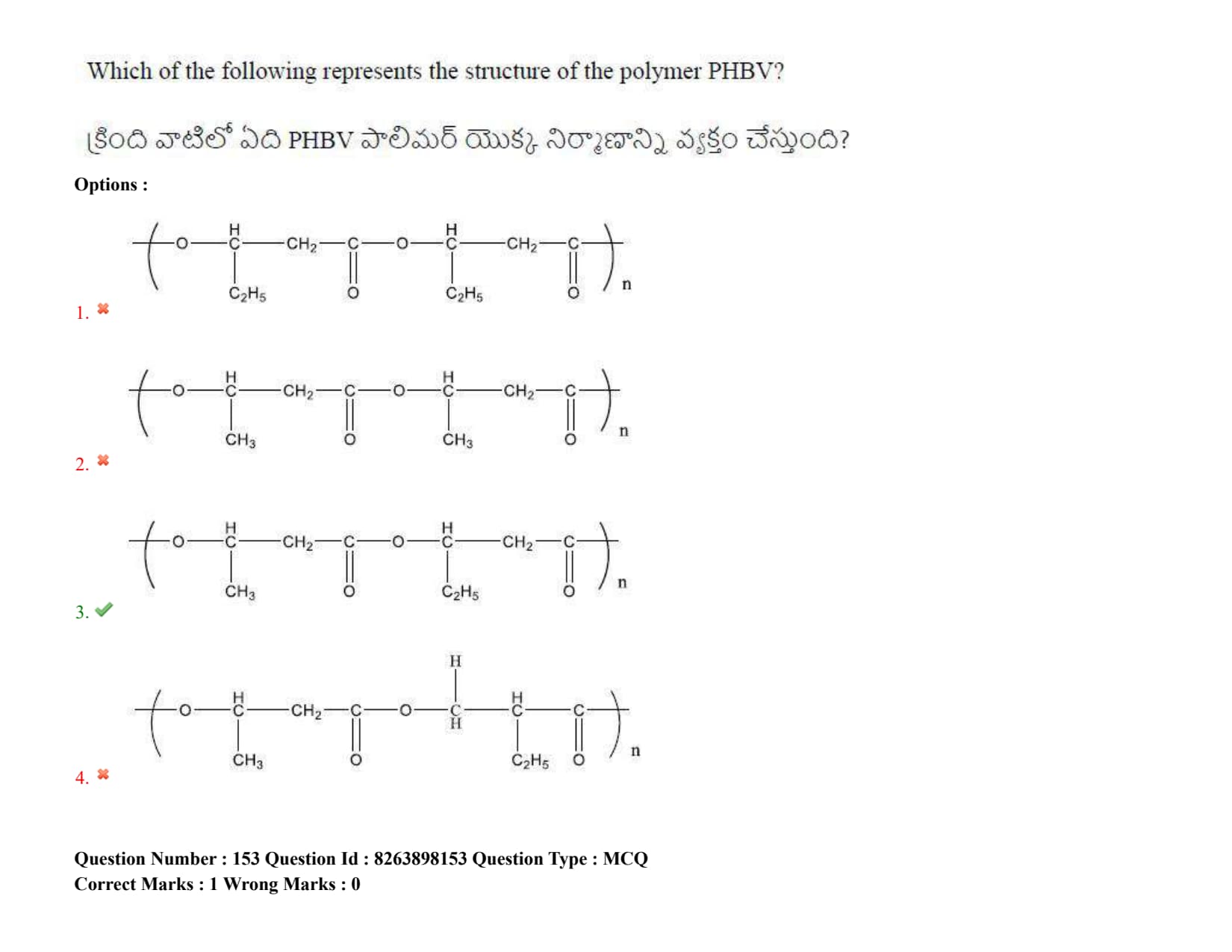


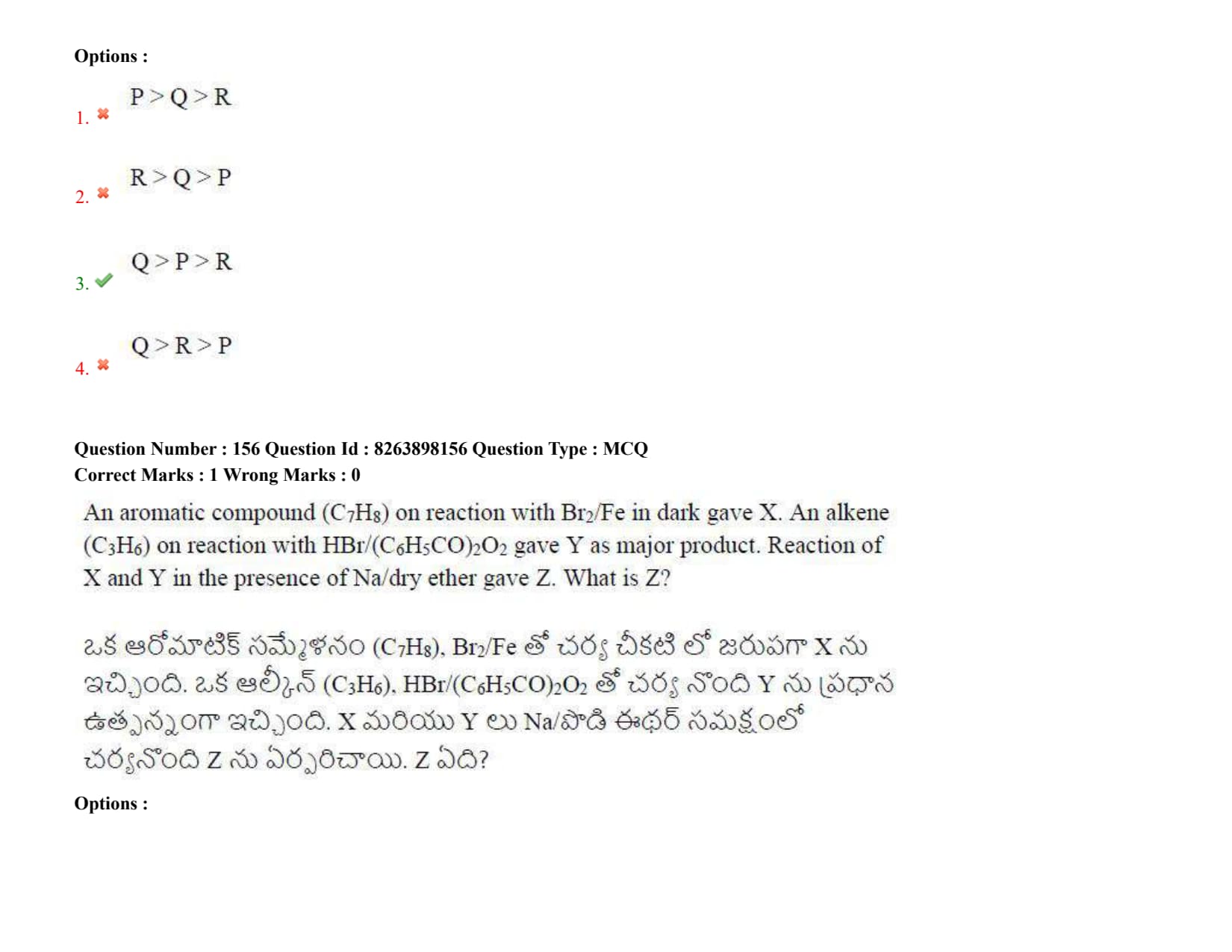

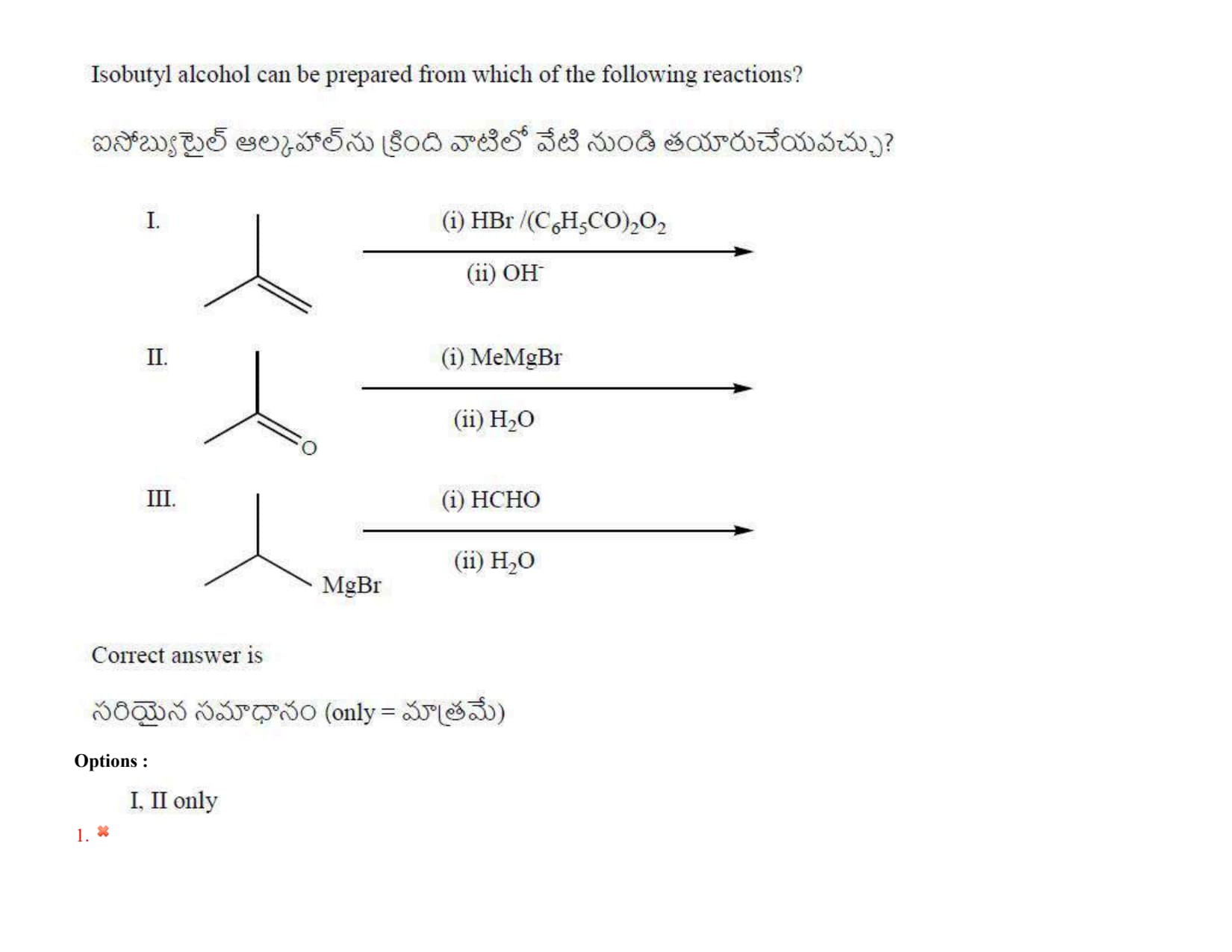


If \(f : [1, \infty) \to [1, \infty)\) is defined by \(f(x) = 2^{x(x-1)}\), then \(f^{-1}(x) =\)
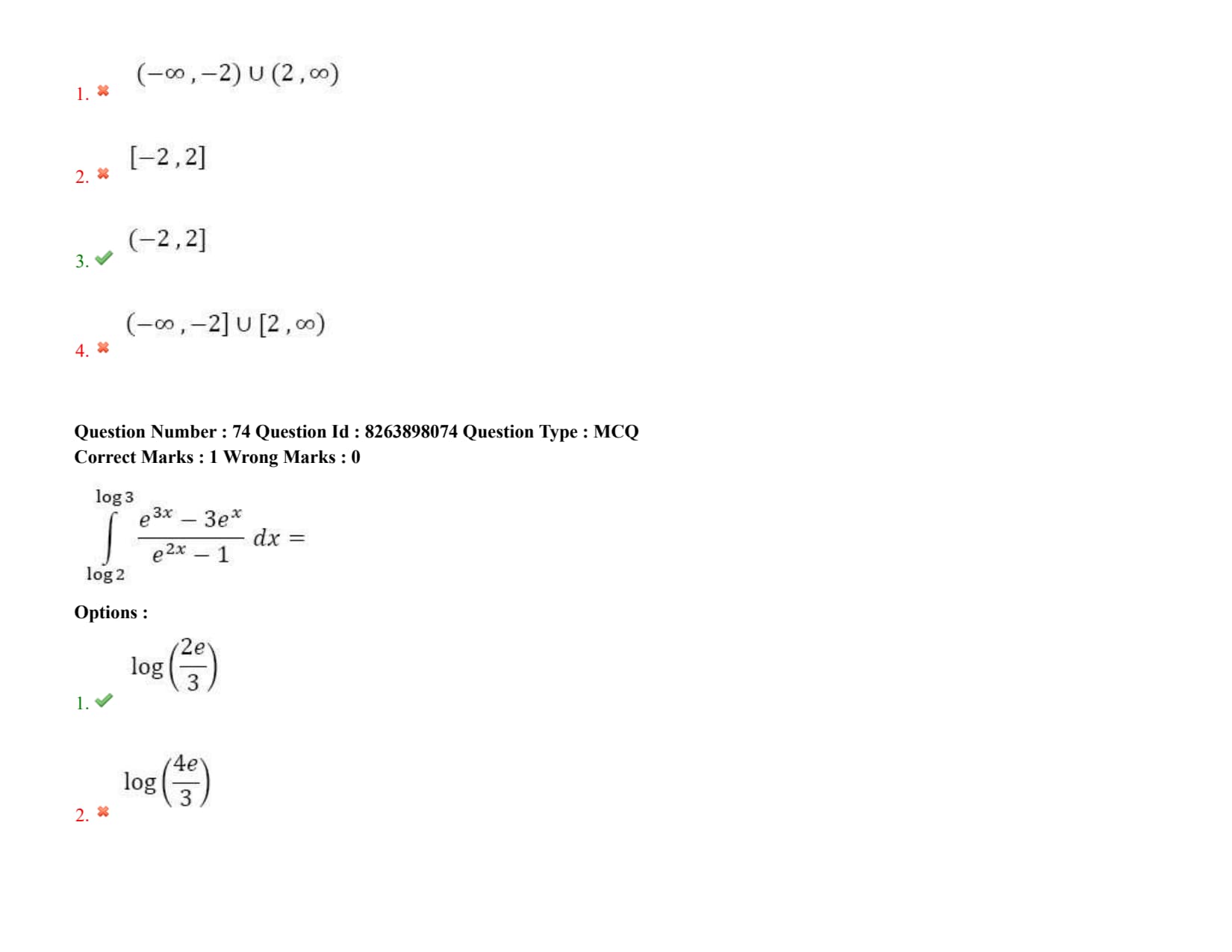
The domain of the function \(f(x) = \sqrt{\log_{10} \left(\frac{5x - x^2}{4}\right)}\) is:
If \(a_n = \sum_{r=0}^n \frac{1}{^{n}C_r}\) and \(b_n = \sum_{r=0}^n \frac{r}{^{n}C_r}\), then \(\frac{b_n}{a_n} =\)
If \([x]\) denotes the greatest integer less than or equal to \(x\), then the value of \(\sum_{r=1}^{100} \left[ \frac{r}{5} \right]\) is:
If the system of linear equations \(x + y + z = 1\), \(x + 2y + 4z = \eta\), \(x + 4y + 10z = \eta^2\) has a solution, then the value of \(\eta\) is:
If \(A = \begin{pmatrix} 1 & 2
3 & 4 \end{pmatrix}\), then \(A^2 - 5A - 2I =\)
If the conjugate of a complex number \(z\) is \(\frac{1}{z - i}\), then \(z\) can be:
If \(z = \frac{\sqrt{3} + i}{2}\), then \(z^{101} + z^{103} =\)
If the roots of the quadratic equation \(x^2 - 2px + q^2 = 0\) are real and distinct, then:
If \(\alpha, \beta\) are the roots of the quadratic equation \(x^2 - 2x + 4 = 0\), then the value of \(\alpha^n + \beta^n\) is:
If the roots of the equation \(x^3 - 7x^2 + 14x - 8 = 0\) are in geometric progression, then the common ratio can be:
If the number of permutations of \(n\) different things taken all at a time is \(5040\), then \(n =\)
If \(^{n}C_{12} = ^{n}C_{8}\), then \(^{n}C_{17} =\)
The number of terms in the expansion of \((x + y + z)^{10}\) is:
If \(\frac{3x + 4}{(x-1)(x-2)^2} = \frac{A}{x-1} + \frac{B}{x-2} + \frac{C}{(x-2)^2}\), then \(A + B + C =\)
If \(\sin \theta + \cos \theta = \sqrt{2} \cos \theta\), then \(\cos \theta - \sin \theta =\)
The maximum value of \(3 \sin x + 4 \cos x + 5\) is:
If \(\tan^{-1}(x) + \tan^{-1}(y) + \tan^{-1}(z) = \frac{\pi}{2}\), then \(xy + yz + zx =\)
If \(\sinh x = \frac{3}{4}\), then \(\cosh 2x =\)
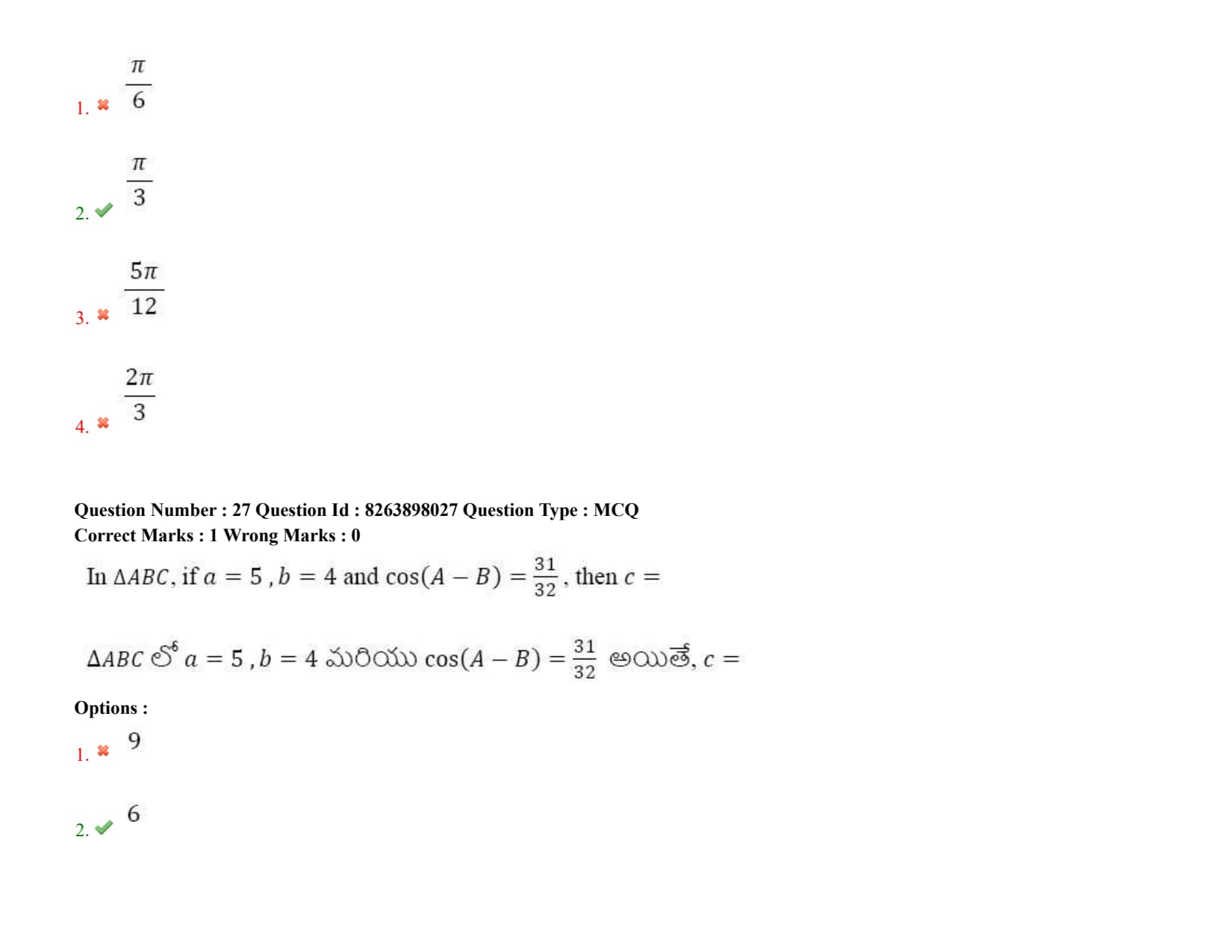
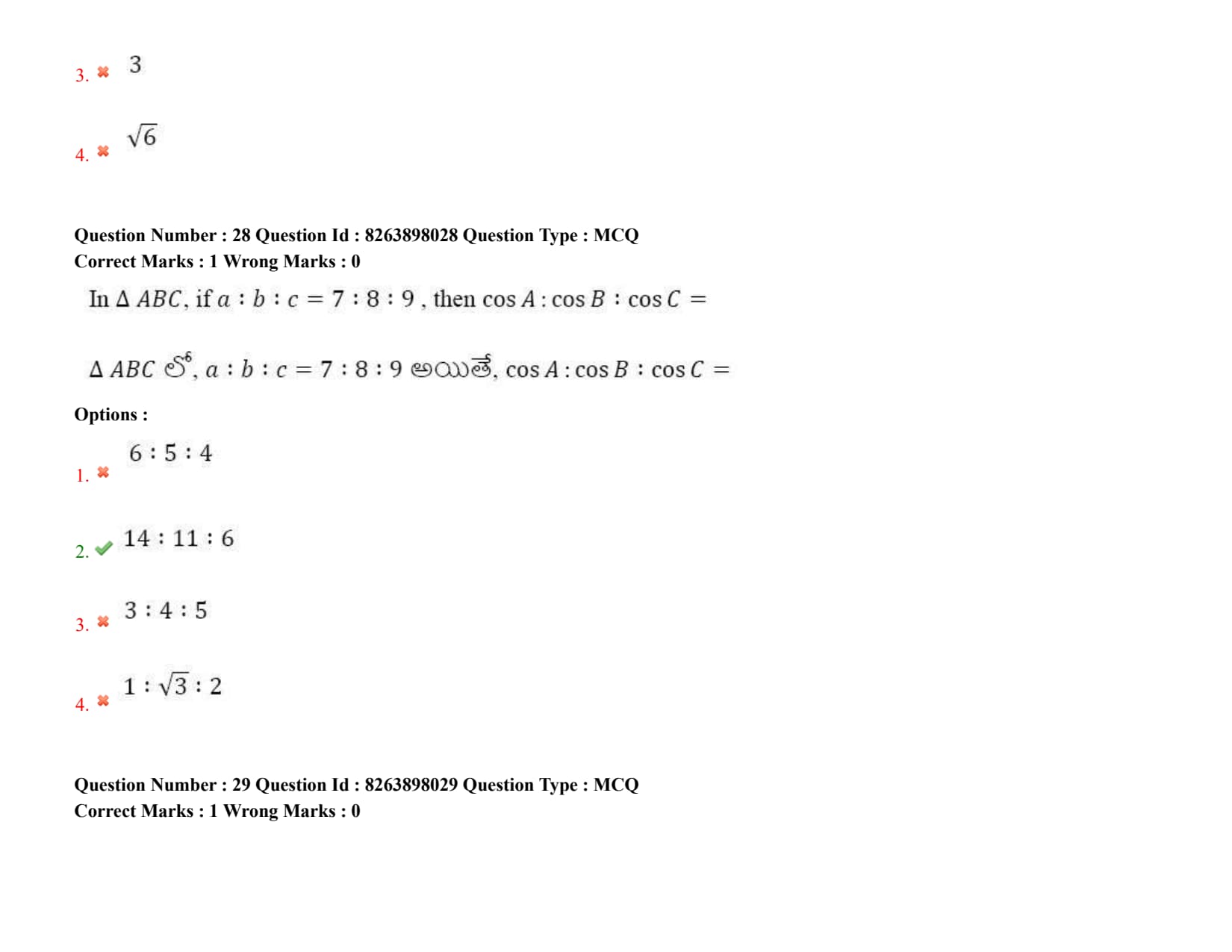
In a triangle \(ABC\), if \(a = 13\), \(b = 14\), \(c = 15\), then the area of the triangle is:
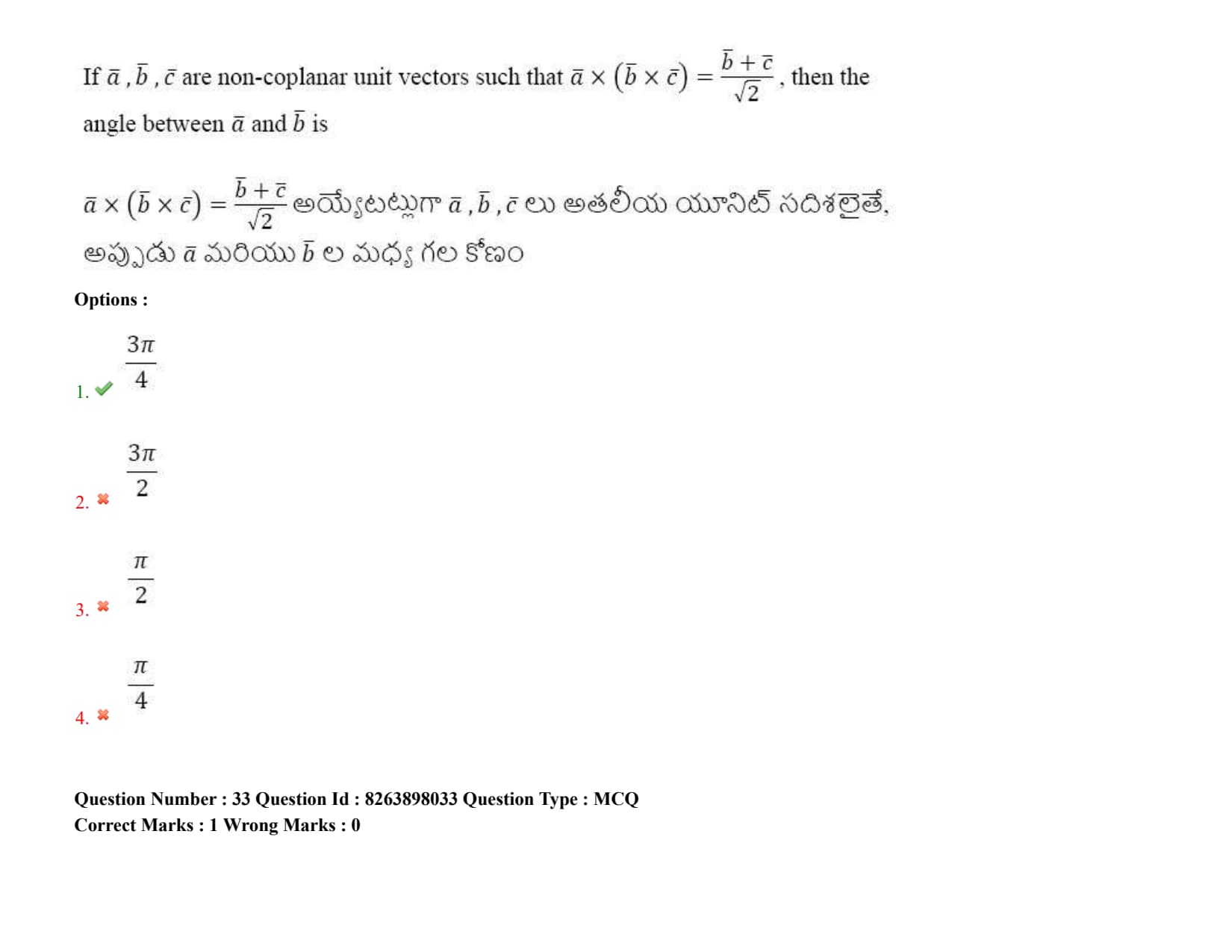
If \(\vec{a} = 2\vec{i} + 3\vec{j} - \vec{k}\), \(\vec{b} = -\vec{i} + 2\vec{j} - 4\vec{k}\) and \(\vec{c} = \vec{i} + \vec{j} + \vec{k}\), then \((\vec{a} \times \vec{b}) \cdot (\vec{a} \times \vec{c}) =\)
Let \(\vec{a}\) and \(\vec{b}\) be two unit vectors. If the angle between them is \(\theta\), then \(\cos(\theta/2) =\)
If \(\vec{a} = \vec{i} + \vec{j} + \vec{k}\), \(\vec{b} = 4\vec{i} + 3\vec{j} + 4\vec{k}\) and \(\vec{c} = \vec{i} + \alpha\vec{j} + \beta\vec{k}\) are linearly dependent vectors and \(|\vec{c}| = \sqrt{3}\), then:
The variance of the first \(n\) even natural numbers is:
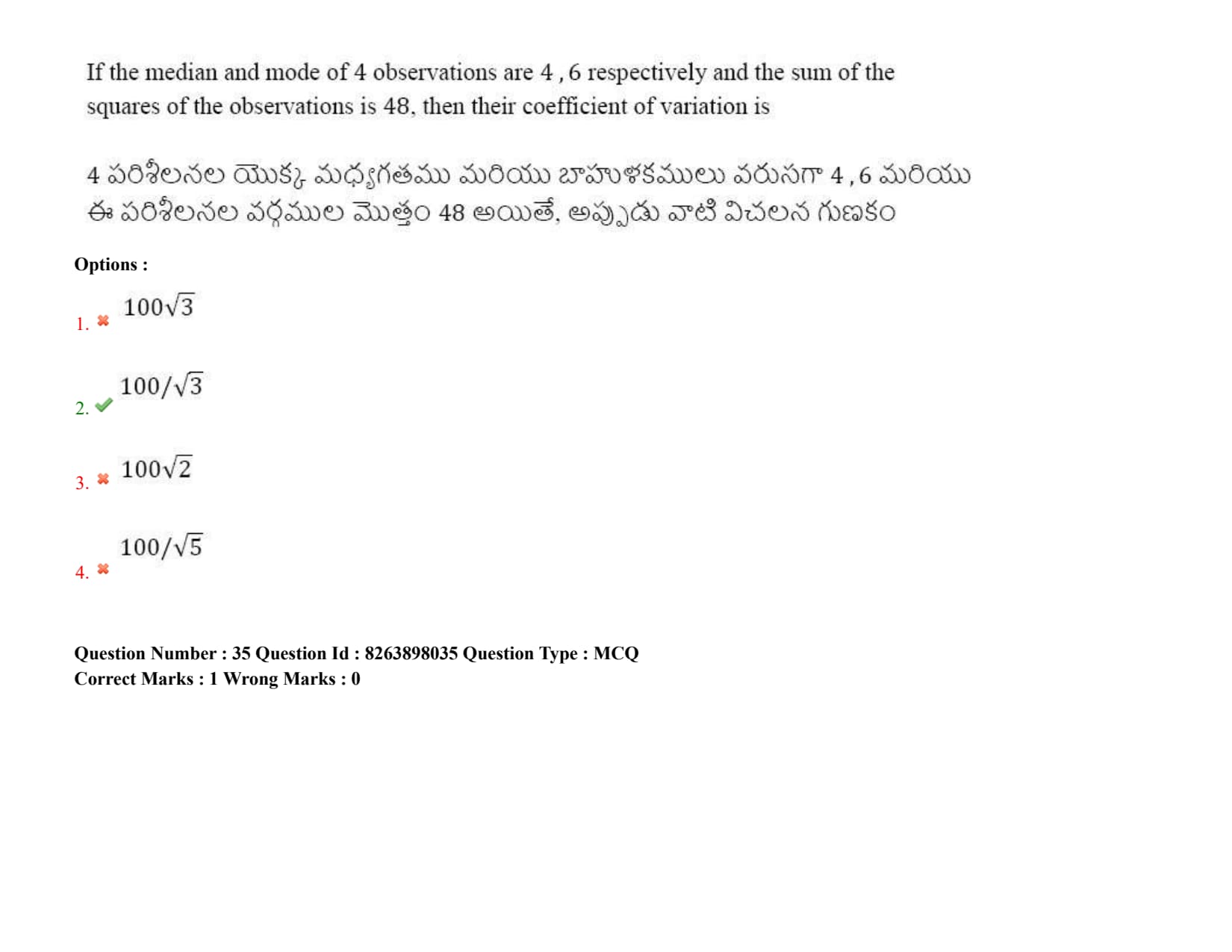
If the mean deviation of the numbers \(1, 1+d, 1+2d, \dots, 1+100d\) from their mean is 255, then \(d =\)
A bag contains 5 red and 4 black balls. Three balls are drawn at random from the bag. The probability that two of them are red and one is black is:
If \(A\) and \(B\) are two events such that \(P(A) = 0.4\), \(P(B) = 0.8\) and \(P(B|A) = 0.6\), then \(P(\bar{A} \cap B) =\)
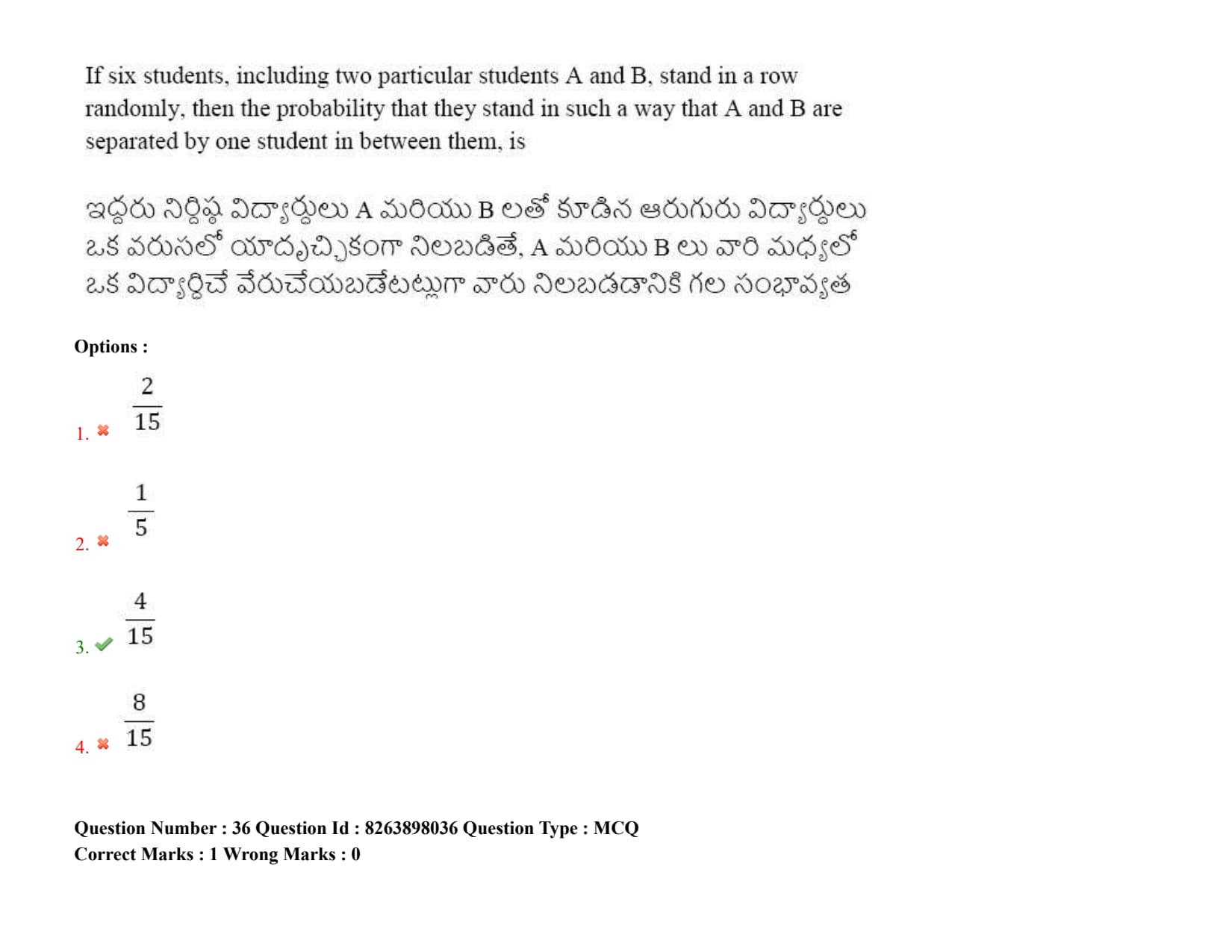
Three houses are available in a locality. Three persons apply for the houses. Each applies for one house without consulting others. The probability that all three apply for the same house is:
A random variable \(X\) has the following probability distribution:
\(X = x\): 0, 1, 2, 3, 4, 5
\(P(X=x)\): \(k\), \(3k\), \(5k\), \(7k\), \(9k\), \(11k\)
Then the value of \(k\) is:
In a binomial distribution, the mean is 4 and the variance is 3. Then the number of trials \(n\) is:
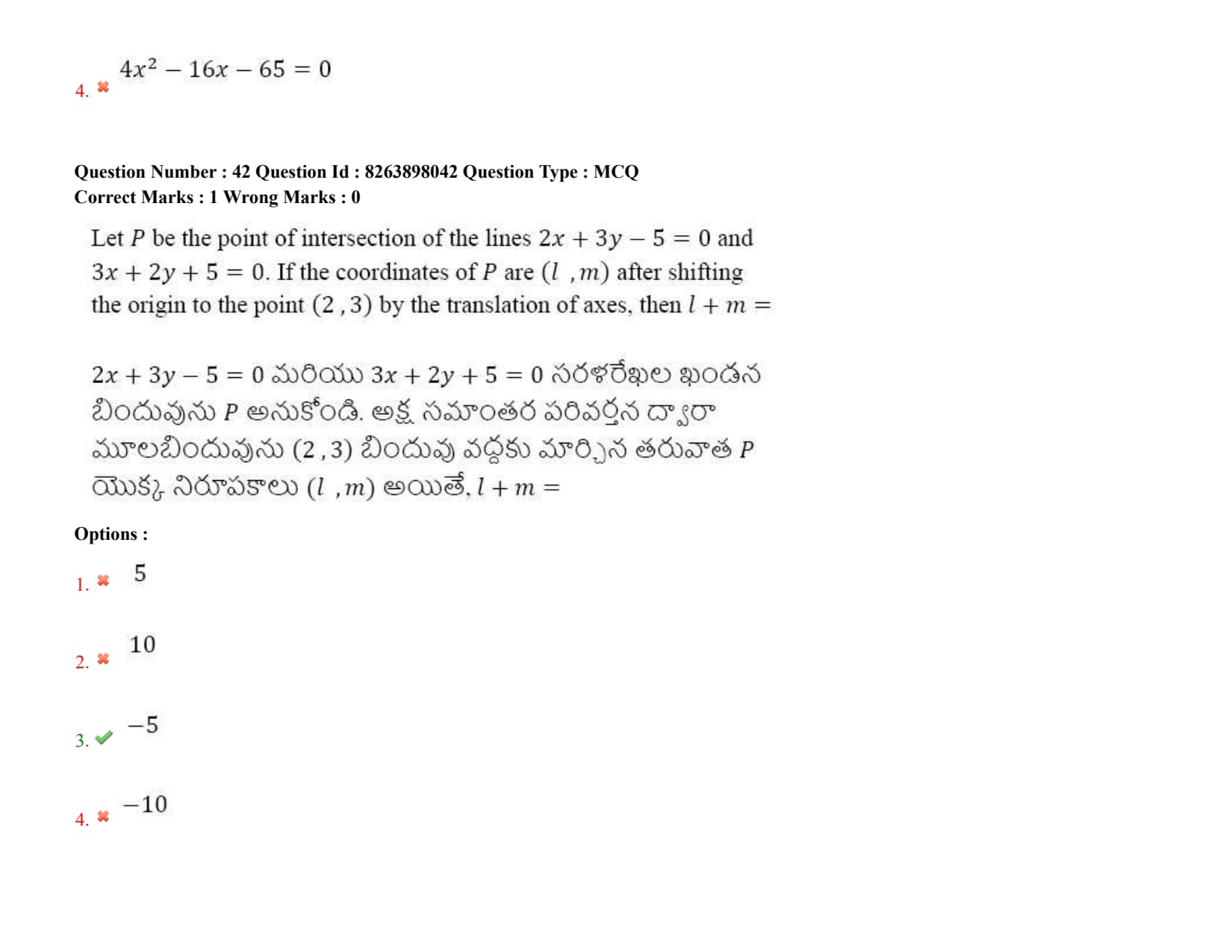
When the origin is shifted to \((2, 3)\) by translation of axes, the coordinates of a point \(P\) become \((1, -2)\). The original coordinates of \(P\) are:
If the straight lines \(x + 2y - 9 = 0\), \(3x + 5y - 5 = 0\) and \(ax + by - 1 = 0\) are concurrent, then the straight line \(22x - 35y = 1\) passes through the point:
The distance between the parallel lines \(5x + 12y - 3 = 0\) and \(5x + 12y + 10 = 0\) is:
If the angle between the pair of lines \(x^2 - 2cxy - 7y^2 = 0\) is \(\frac{\pi}{3}\), then the value of \(c^2\) is:
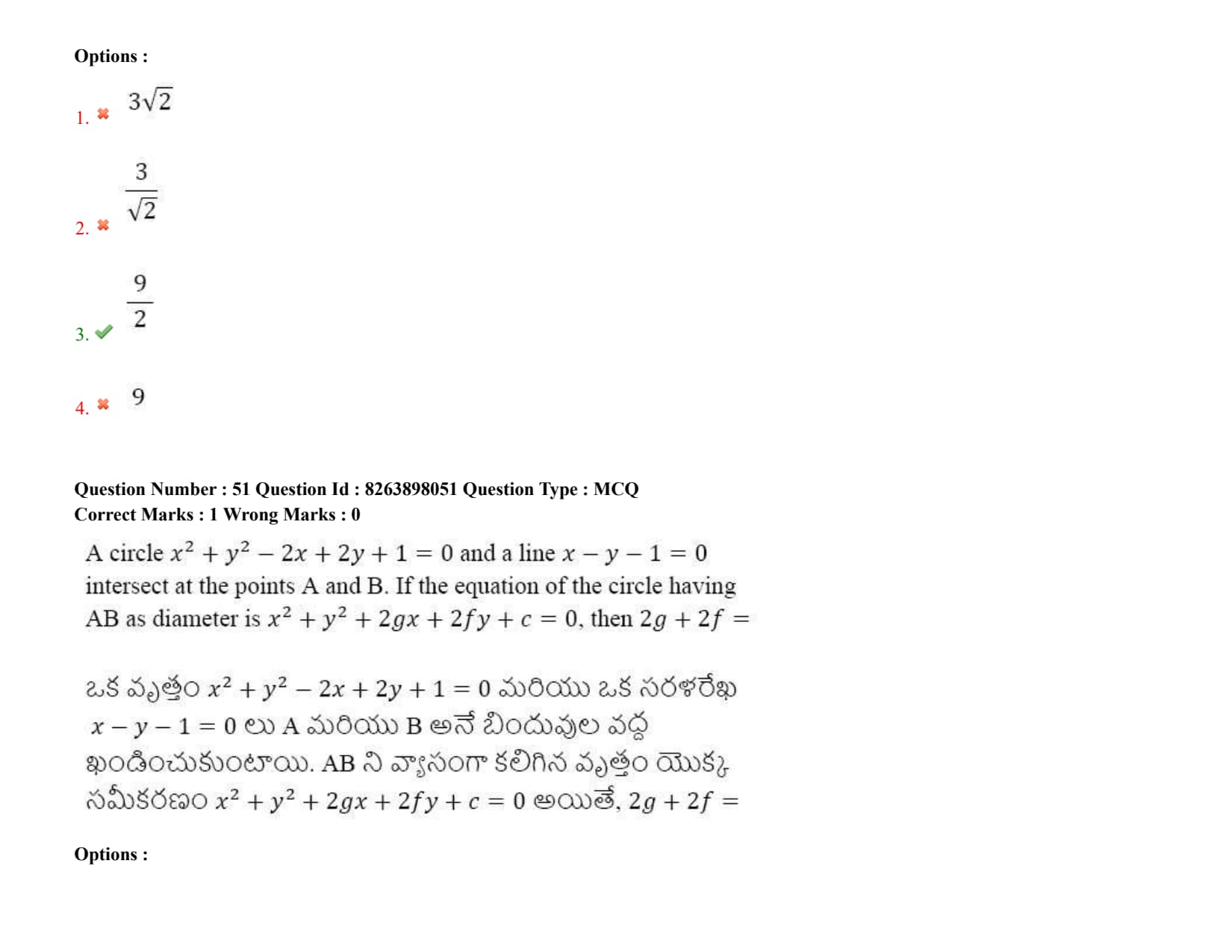
If the lines joining the origin to the points of intersection of the line \(y = mx + 1\) and the circle \(x^2 + y^2 = 1\) are perpendicular to each other, then the value of \(m^2\) is:
If the circle \(x^2 + y^2 + 2gx + 2fy + c = 0\) passes through the origin, has radius 3, and its center lies on the line \(x + y = 4\), then \(g + f =\)
If the circle \(x^2 + y^2 - 4x - 6y + \lambda = 0\) touches the x-axis, then the value of \(\lambda\) is:
The equation of the common chord of the circles \(x^2 + y^2 - 4x - 4y = 0\) and \(x^2 + y^2 - 6x - 8y + 10 = 0\) is:
If the circle \(x^2 + y^2 + 2x - 2y + c = 0\) cuts the circle \(x^2 + y^2 - 4x - 6y + 11 = 0\) orthogonally, then the value of \(c\) is:
The equation of the parabola with focus at \((3, 0)\) and directrix \(x + 3 = 0\) is:
If the distance between the foci of an ellipse is 6 and the distance between its directrices is 12, then the length of its latus rectum is:
The line \(y = mx + c\) touches the ellipse \(9x^2 + 16y^2 = 144\) if the value of \(c^2\) is:
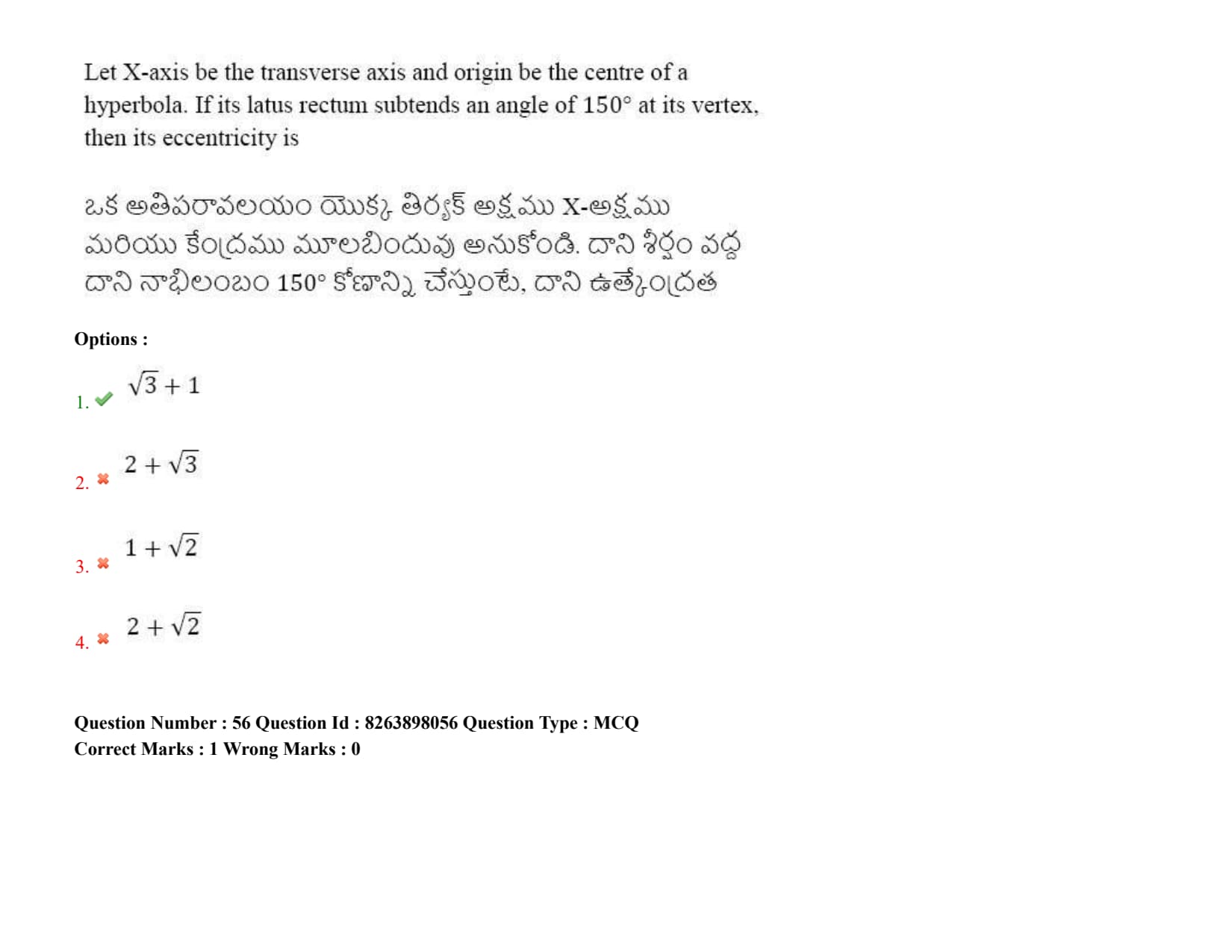
If the eccentricity of a hyperbola is \(\sqrt{3}\), then the eccentricity of its conjugate hyperbola is:
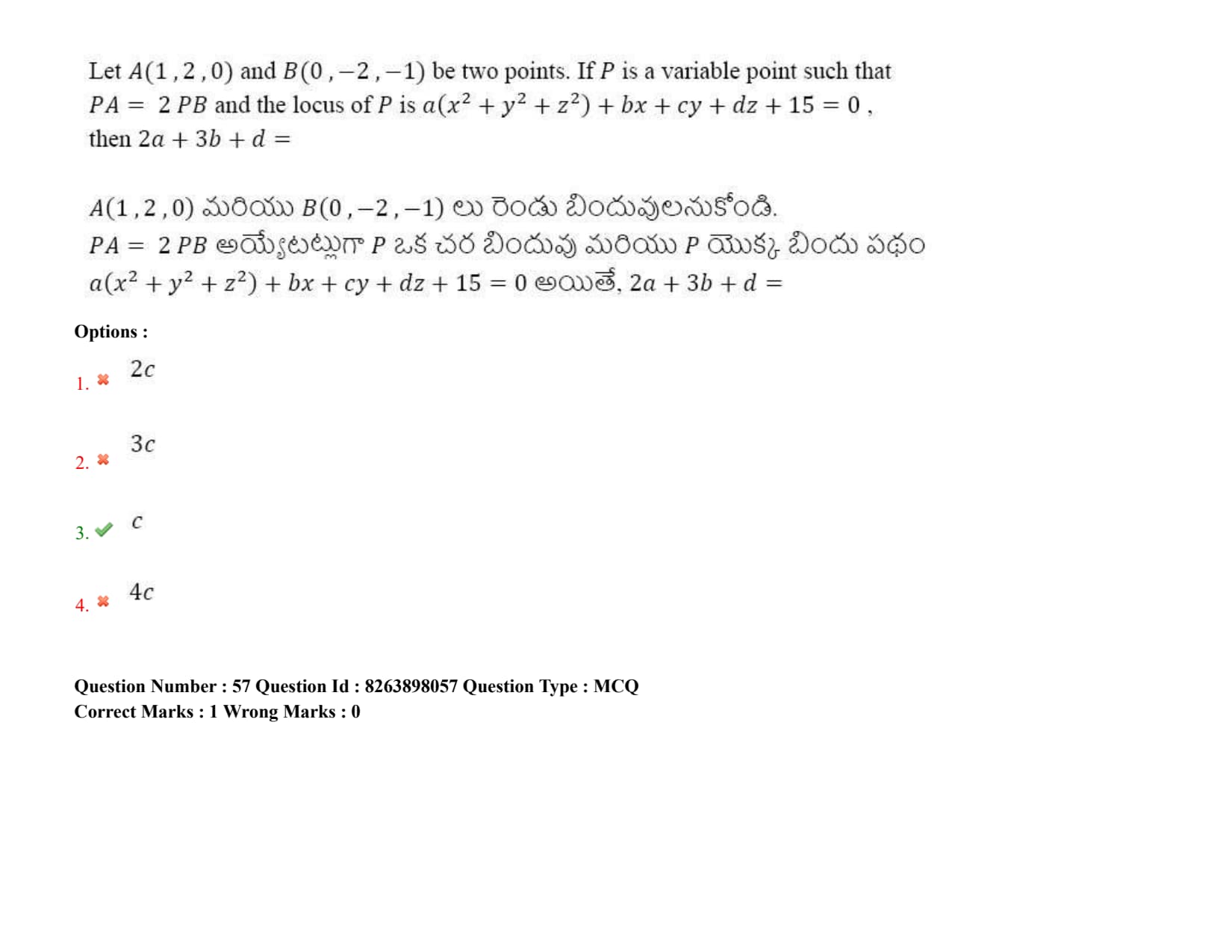
The ratio in which the \(xy\)-plane divides the line segment joining the points \((2, 4, 5)\) and \((3, 5, -4)\) is:
If a line makes angles \(45^\circ\) and \(60^\circ\) with the positive \(x\) and \(y\) axes respectively, then the acute angle it makes with the \(z\)-axis is:
The acute angle between the planes \(2x - y + z = 6\) and \(x + y + 2z = 3\) is:
The value of \(\lim_{x \to \infty} \left(\frac{x+6}{x+1}\right)^{x+4}\) is:
If \(f(x) = \frac{k \cos x}{\pi - 2x}\) for \(x \neq \frac{\pi}{2}\) and \(f\left(\frac{\pi}{2}\right) = 3\) is continuous at \(x = \frac{\pi}{2}\), then the value of \(k\) is:
If \(y = \tan^{-1}\left(\frac{\sin x + \cos x}{\cos x - \sin x}\right)\), then \(\frac{dy}{dx} = \)
If \(x = a \cos^3 t\) and \(y = a \sin^3 t\), then the value of \(\frac{dy}{dx}\) at \(t = \frac{\pi}{4}\) is:
If \(y = e^{a \sin^{-1} x}\), then \((1 - x^2) y_2 - x y_1 =\)
The slope of the normal to the curve \(y = 2x^2 + 3\sin x\) at \(x = 0\) is:
A balloon, which always remains spherical, has a variable radius. The rate at which its volume is increasing with respect to its radius \(r\) when \(r = 5\) cm is:
The minimum value of the function \(f(x) = x^2 + \frac{250}{x}\) for \(x > 0\) is:
The integral \(\int \frac{1}{\cos^2 x (1 - \tan x)^2} \, dx =\)
The integral \(\int \frac{e^x (1 + x)}{\cos^2(x e^x)} \, dx =\)
The value of the definite integral \(\int_0^{\pi/2} \frac{\sin^{3/2} x}{\sin^{3/2} x + \cos^{3/2} x} \, dx\) is:
The value of the definite integral \(\int_{-\pi/2}^{\pi/2} (x^3 + x\cos x + \tan^5 x + 1) \, dx\) is:
The area (in square units) of the region bounded by the parabola \(y^2 = 4x\) and the line \(y = 2x\) is:
The order and degree of the differential equation \(\left[1 + \left(\frac{dy}{dx}\right)^2\right]^{3/2} = \frac{d^2y}{dx^2}\) are respectively:
The general solution of the differential equation \(\frac{dy}{dx} + y \cot x = 2 \cos x\) is:
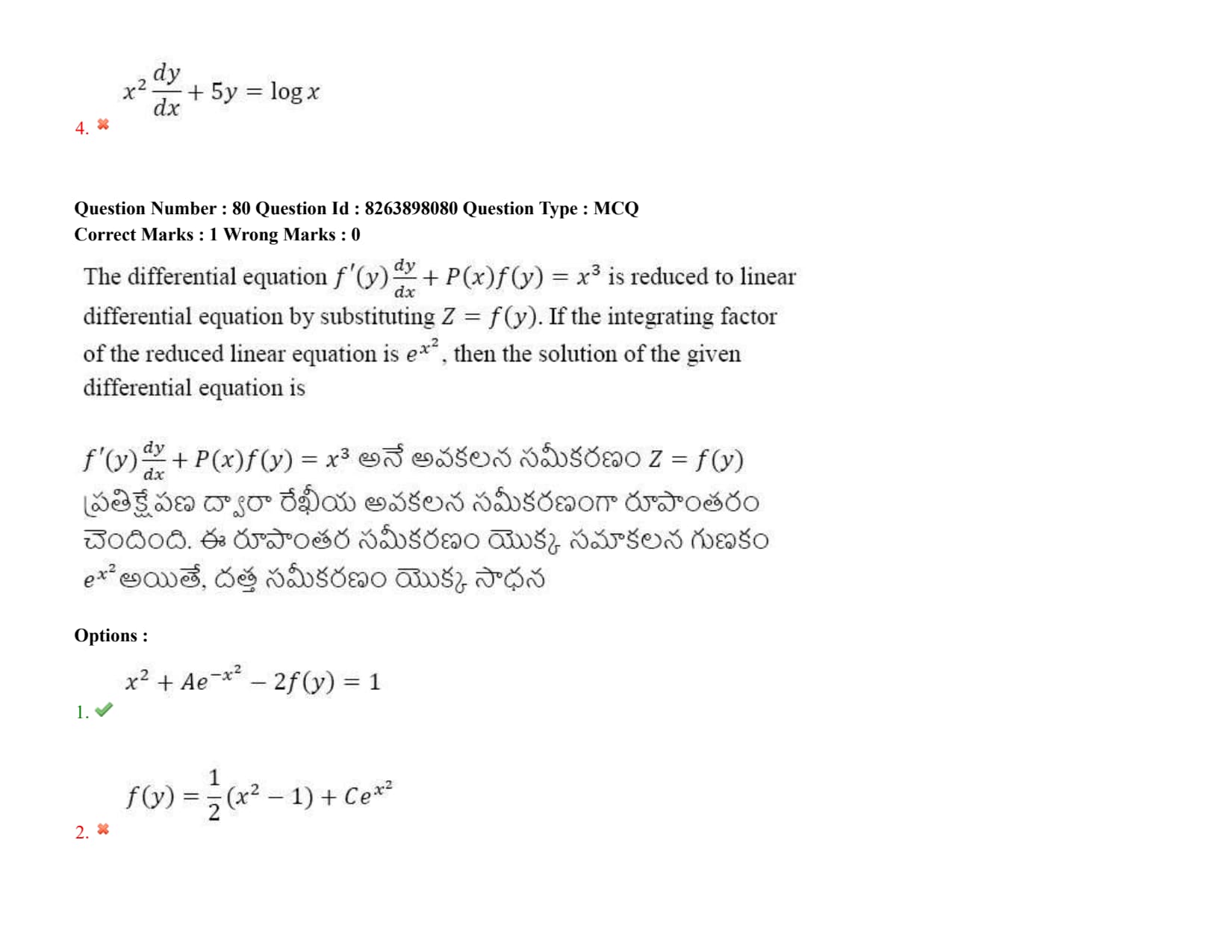
The integrating factor of the differential equation \((1 + x^2) \frac{dy}{dx} + 2xy = \cos x\) is:
The foot of the perpendicular from the point \((1, 3)\) to the line \(x + y - 2 = 0\) is:
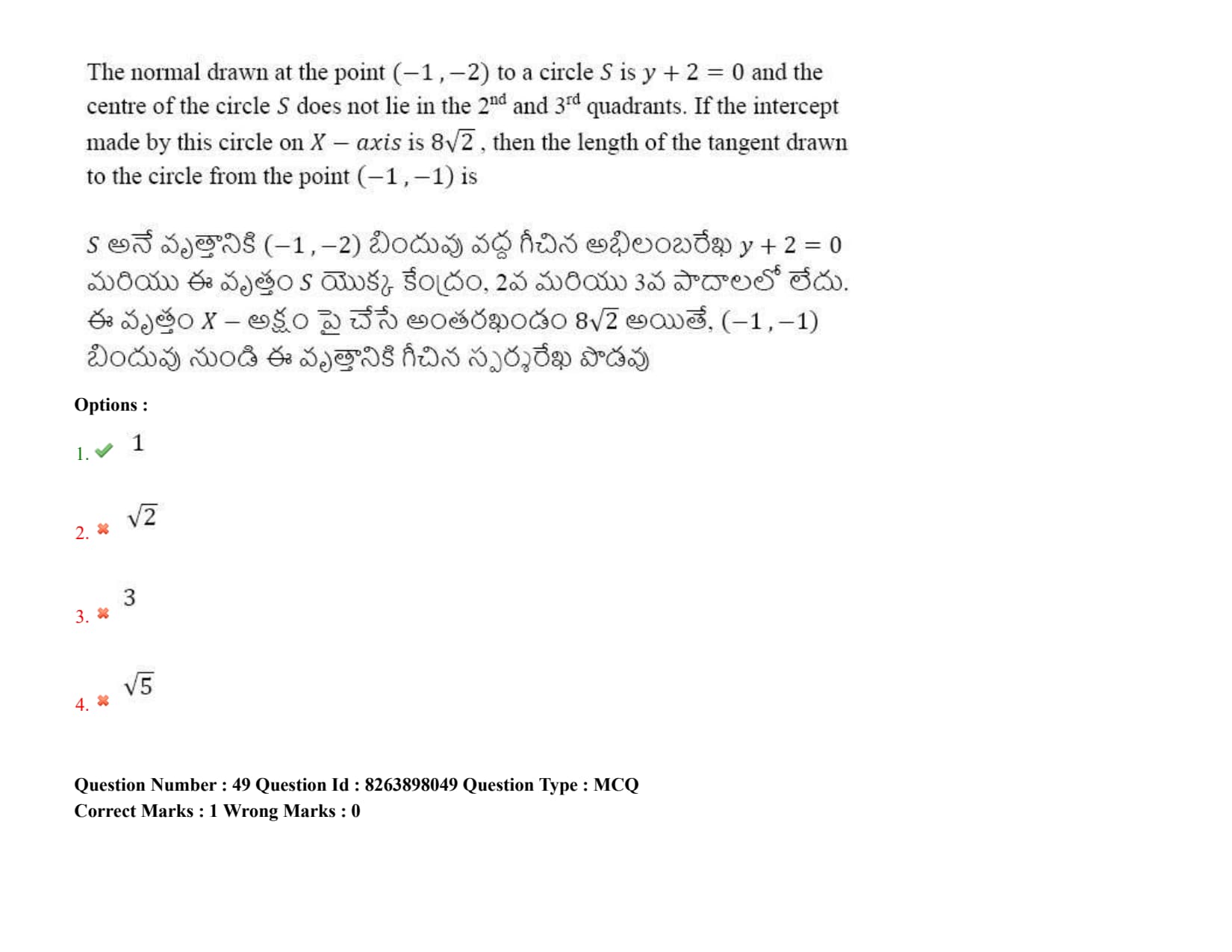
The length of the tangent from the point \((3, 4)\) to the circle \(x^2 + y^2 - 2x - 4y + 1 = 0\) is:
The number of solutions of the trigonometric equation \(\sin^2 x - \sin x - 2 = 0\) in the interval \([0, 2\pi]\) is:
If \(\vec{a}\), \(\vec{b}\), and \(\vec{c}\) are three unit vectors such that \(\vec{a} + \vec{b} + \vec{c} = \vec{0}\), then the value of \(\vec{a} \cdot \vec{b} + \vec{b} \cdot \vec{c} + \vec{c} \cdot \vec{a}\) is:
If the sum of two roots of the cubic equation \(x^3 - 5x^2 - 2x + 24 = 0\) is \(2\), then the roots of the equation are:
If \(A = \begin{pmatrix} 1 & 2
3 & 4 \end{pmatrix}\), then \(A^{-1} =\)
The number of ways of arranging the letters of the word "EAPCET" is:
If \(\omega\) is a complex cube root of unity, then \((1 - \omega + \omega^2)^5 + (1 + \omega - \omega^2)^5 =\)
If the probability that a person suffers a bad reaction from an injection is \(0.001\), then the probability that out of \(2000\) individuals, exactly \(3\) will suffer a bad reaction is:
The distance of the point \((1, 2)\) from the line \(3x + 4y - 32 = 0\) measured parallel to the line \(x - y = 0\) is:
The length of the intercept made by the circle \(x^2 + y^2 - 10x + 4y + 9 = 0\) on the x-axis is:
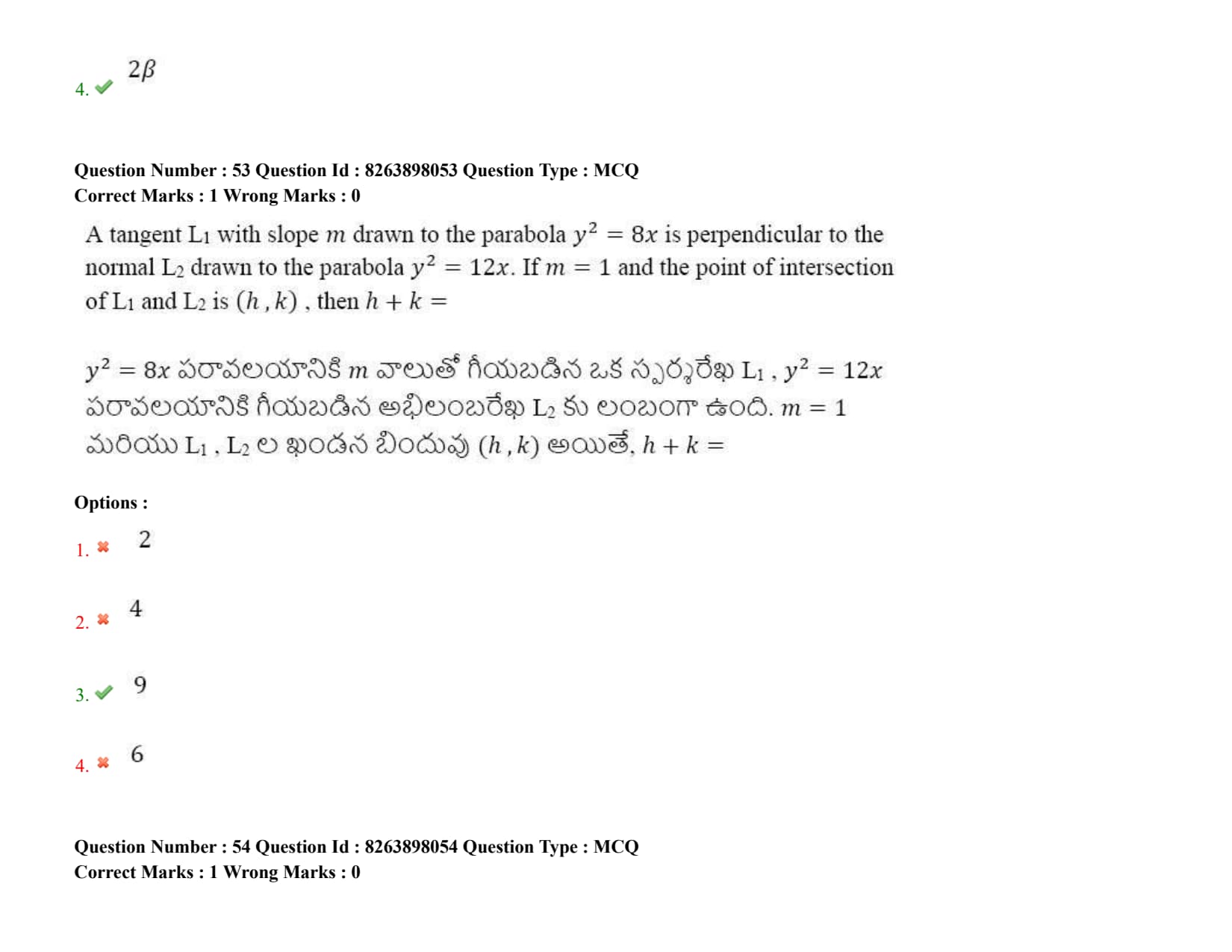
The equation of the tangent to the parabola \(y^2 = 8x\) which is parallel to the line \(2x - y + 5 = 0\) is:
The value of the limit \(\lim_{x \to 0} \frac{e^{3x} - e^{-2x}}{\sin 4x}\) is:
If \(y = \sqrt{\tan x + \sqrt{\tan x + \sqrt{\tan x + \dots \infty}}}\), then \((2y - 1)\frac{dy}{dx} =\)
The integral \(\int \frac{dx}{x(x^4 + 1)} =\)
The value of the definite integral \(\int_0^{\pi/2} \ln(\tan x) \, dx\) is:
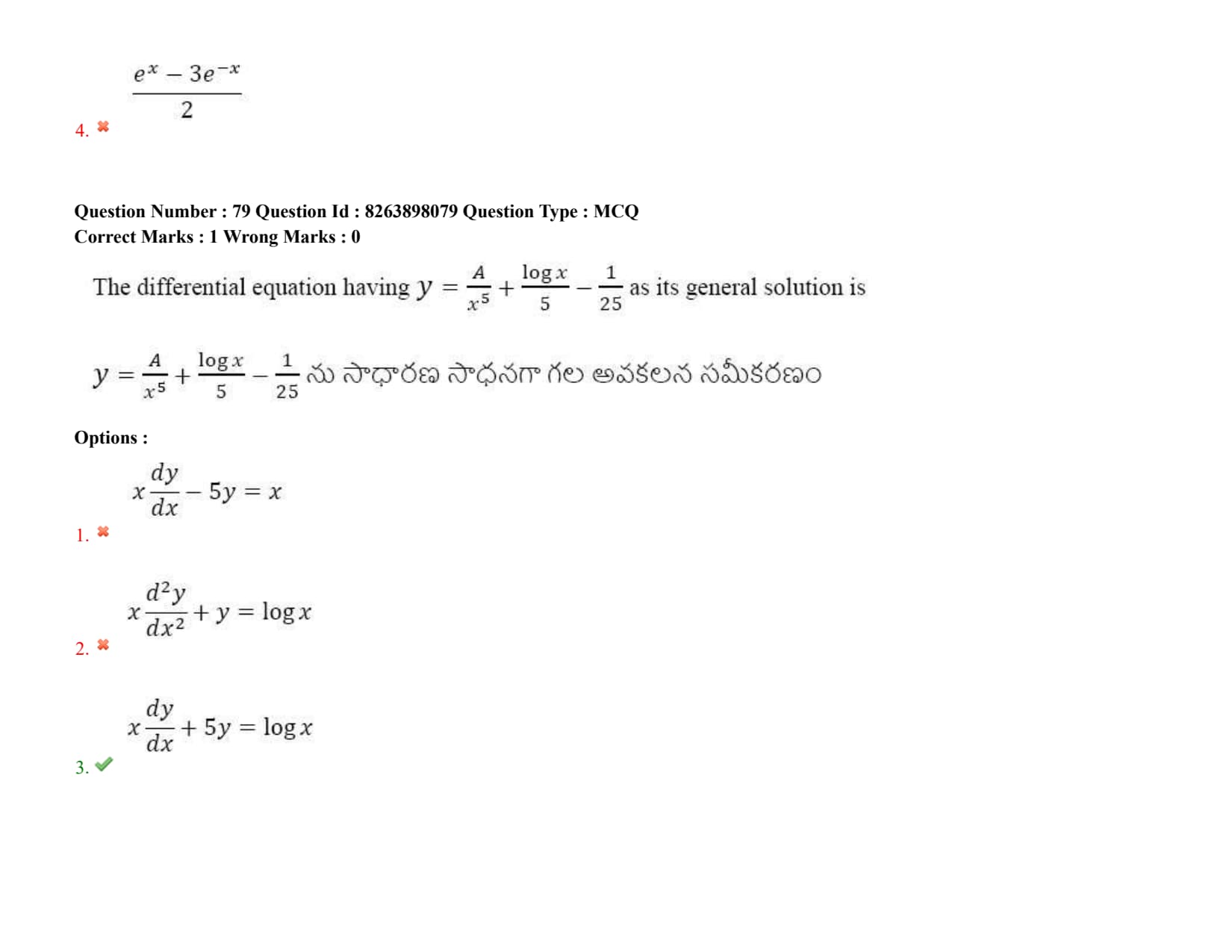
The solution of the differential equation \(x \frac{dy}{dx} + 2y = x^2\) is:
If the dimensional formula of a physical quantity is \([M^1 L^2 T^{-2}]\), then the quantity is:

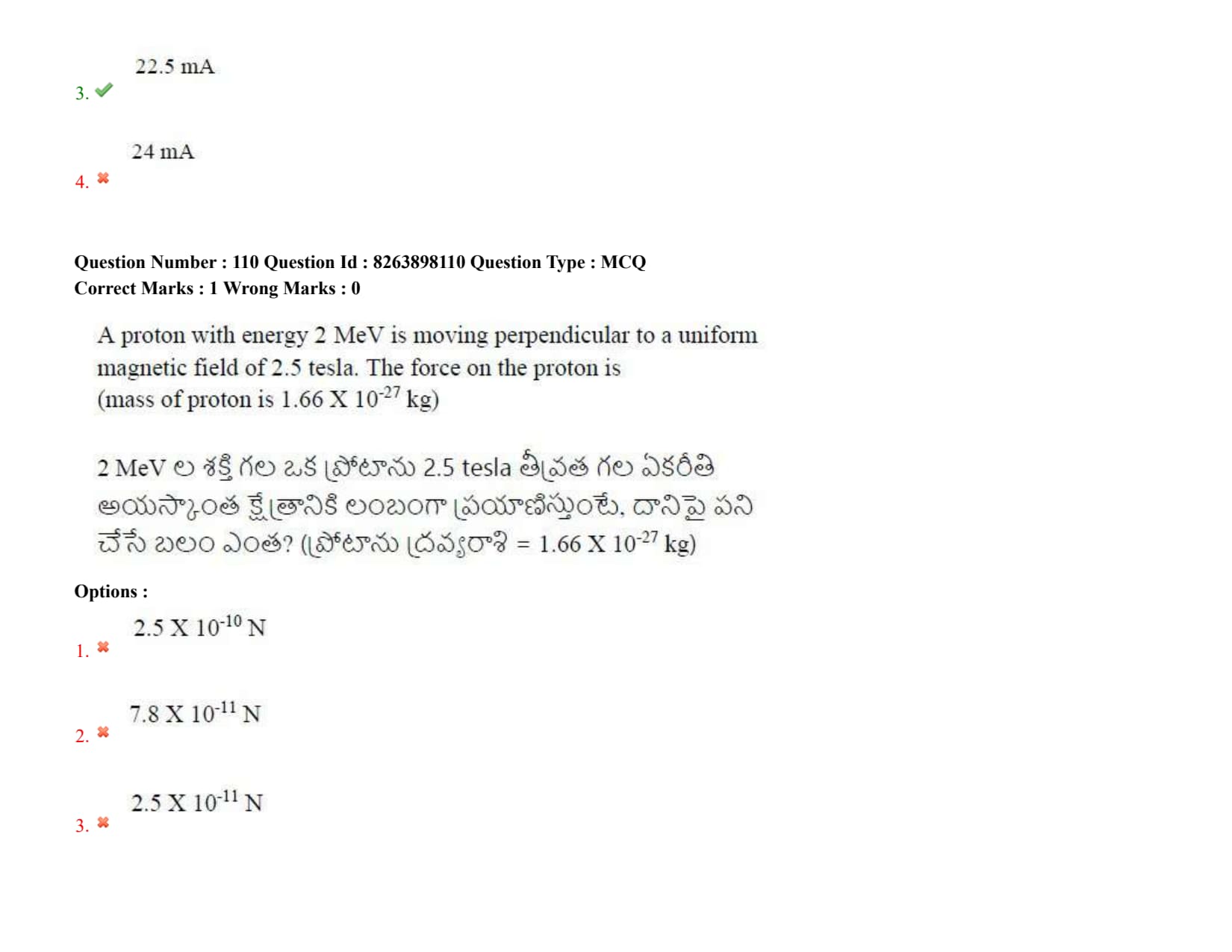
A projectile is launched from the ground with an initial velocity \(v\) at an angle \(\theta\) to the horizontal. If its horizontal range is equal to its maximum height, then the value of \(\tan \theta\) is:
A lift of mass \(M\) is accelerating upwards with an acceleration \(a\). If the tension in the supporting cable is \(T_1\) during upward acceleration and \(T_2\) when it accelerates downwards with the same acceleration \(a\), then the ratio \(T_1 / T_2\) is:
An engine pumps water continuously through a hose pipe. If the water leaves the pipe with velocity \(v\) and \(m\) is the mass per unit length of the water in the pipe, then the rate at which kinetic energy is imparted to the water is:
A thin circular ring of mass \(M\) and radius \(R\) is rotating about its central axis with a constant angular velocity \(\omega\). Two objects, each of mass \(m\), are gently attached to the opposite ends of a diameter of the ring. The new angular velocity of the ring is:

The time period of a simple pendulum is \(T\) in air. When the bob is completely immersed in a non-viscous liquid of density \(\rho / 10\) (where \(\rho\) is the density of the bob), the new time period of oscillation is:

The acceleration due to gravity at a height \(h\) above the Earth's surface is the same as that at a depth \(d\) below the surface. If both \(h\) and \(d\) are much smaller than the radius of Earth \(R\), then the relation between \(h\) and \(d\) is:
Two copper wires of length \(L\) and \(2L\) have radii \(r\) and \(2r\) respectively. If they are subjected to the same tension force, the ratio of their extension (\(\Delta L_1 / \Delta L_2\)) is:
A Carnot engine operates between a heat source at \(T_1 = 600 K\) and a sink at \(T_2 = 300 K\). If the engine absorbs \(1000 J\) of heat from the source per cycle, the work done per cycle is:
At what temperature is the root mean square (rms) speed of oxygen molecules (\(O_2\)) equal to that of helium molecules (\(He\)) at (27)? (Given molar mass of (O_2 = 32 g/mol), \(He = 4 g/mol\))
The ratio of the stress to the strain within the elastic limit is called
A liquid rises to a height of \(4 cm\) in a capillary tube of radius \(r\). If another capillary tube of radius \(r/2\) is dipped in the same liquid, the height of liquid rise will be
The rate of flow of a liquid through a capillary tube of radius \(r\) and length \(l\) under a pressure difference \(P\) is proportional to
A copper rod and an iron rod of the same length have their temperature raised by the same amount. If the coefficient of linear expansion of copper is greater than that of iron, then
The specific heat capacity of a gas at constant pressure (\(C_p\)) and at constant volume (\(C_v\)) are related as
In an isothermal process, which of the following remains constant?
The efficiency of a Carnot engine working between temperatures \(127\) and \(27\) is
The mean free path of a gas molecule is inversely proportional to
The time period of a simple pendulum of length \(l\) is \(T\). If its length is increased to \(4l\), its new time period will be
A transverse wave is represented by \(y = A \sin(kx - \omega t)\). The maximum particle velocity is
An open organ pipe of length \(L\) resonates at its fundamental frequency. The wavelength of the sound wave produced is
The apparent frequency of a siren increases as the source approaches a stationary observer. This phenomenon is known as
The electrostatic force between two charges \(q_1\) and \(q_2\) separated by a distance \(r\) in vacuum is \(F\). If a dielectric medium of dielectric constant \(K\) is introduced between them, the new force is
The electric potential at a distance \(r\) from a point charge \(q\) is proportional to
Three capacitors of capacitances \(3\ \), \(3\ \) and \(3\ \) are connected in series. The equivalent capacitance is
According to Ohm's law, the relation between the electric current \(I\) and the potential difference \(V\) across a conductor is
A wire of resistance \(R\) is stretched to double its original length. Its new resistance will be

In a Wheatstone bridge, the bridge is balanced when the ratio of the resistances in the four arms satisfies

The magnetic field at the centre of a circular coil of radius \(r\) carrying a current \(I\) is proportional to
The force experienced by a charge \(q\) moving with velocity \(v\) in a magnetic field \(B\) is maximum when the angle between \(v\) and \(B\) is
The magnetic susceptibility is negative for:
The self-inductance of a solenoid of length \(l\), area of cross-section \(A\) and number of turns \(N\) is proportional to
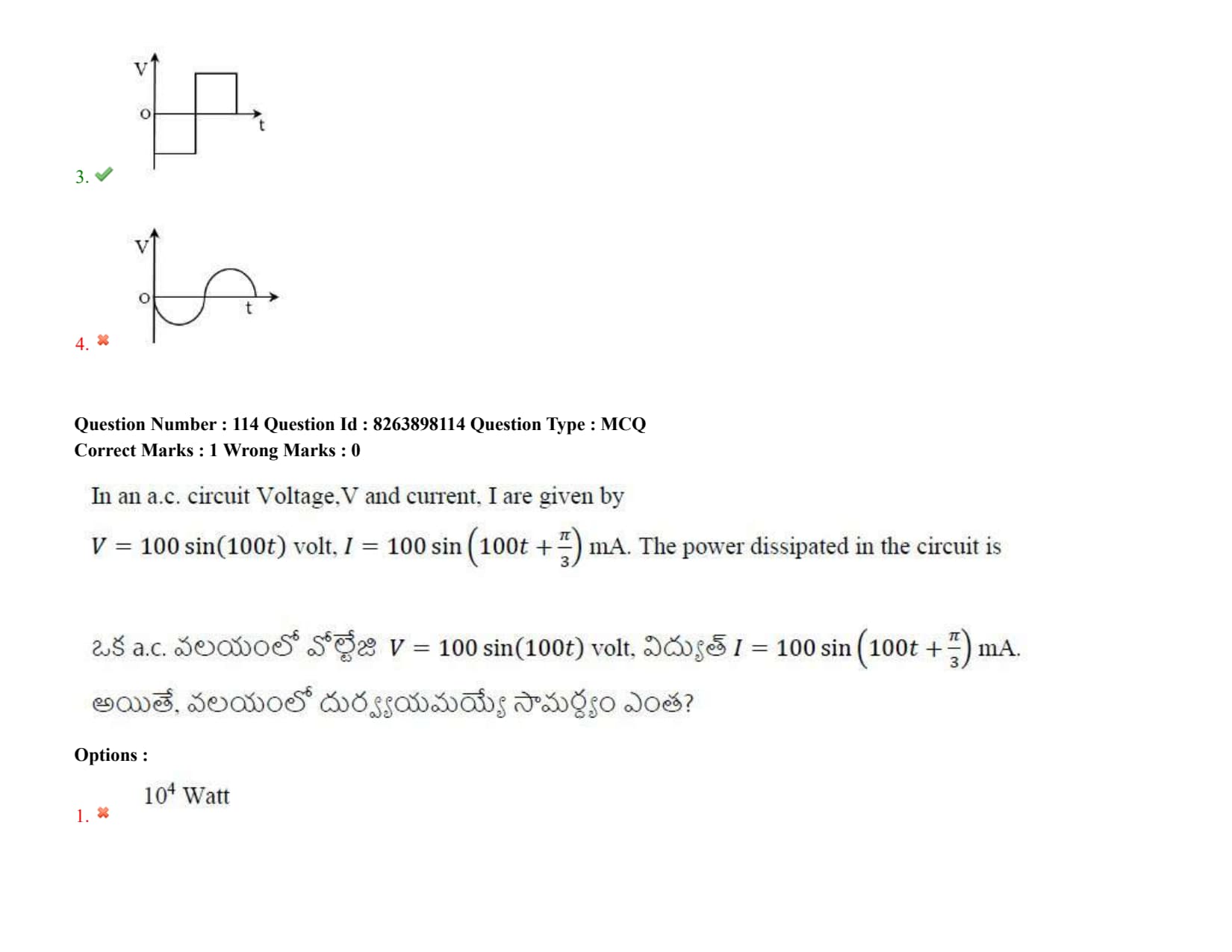
In an AC circuit containing only an inductor, the current

- (A)
![]()
- (B)
![]()
- (C)
![]()
- (D)
![]()


The velocity of electromagnetic waves in vacuum is given by
A convex lens of focal length \(20 cm\) is placed in contact with a concave lens of focal length \(40 cm\). The power of the combination is
In Young's double-slit experiment, the fringe width is proportional to
The work function of a metal depends on
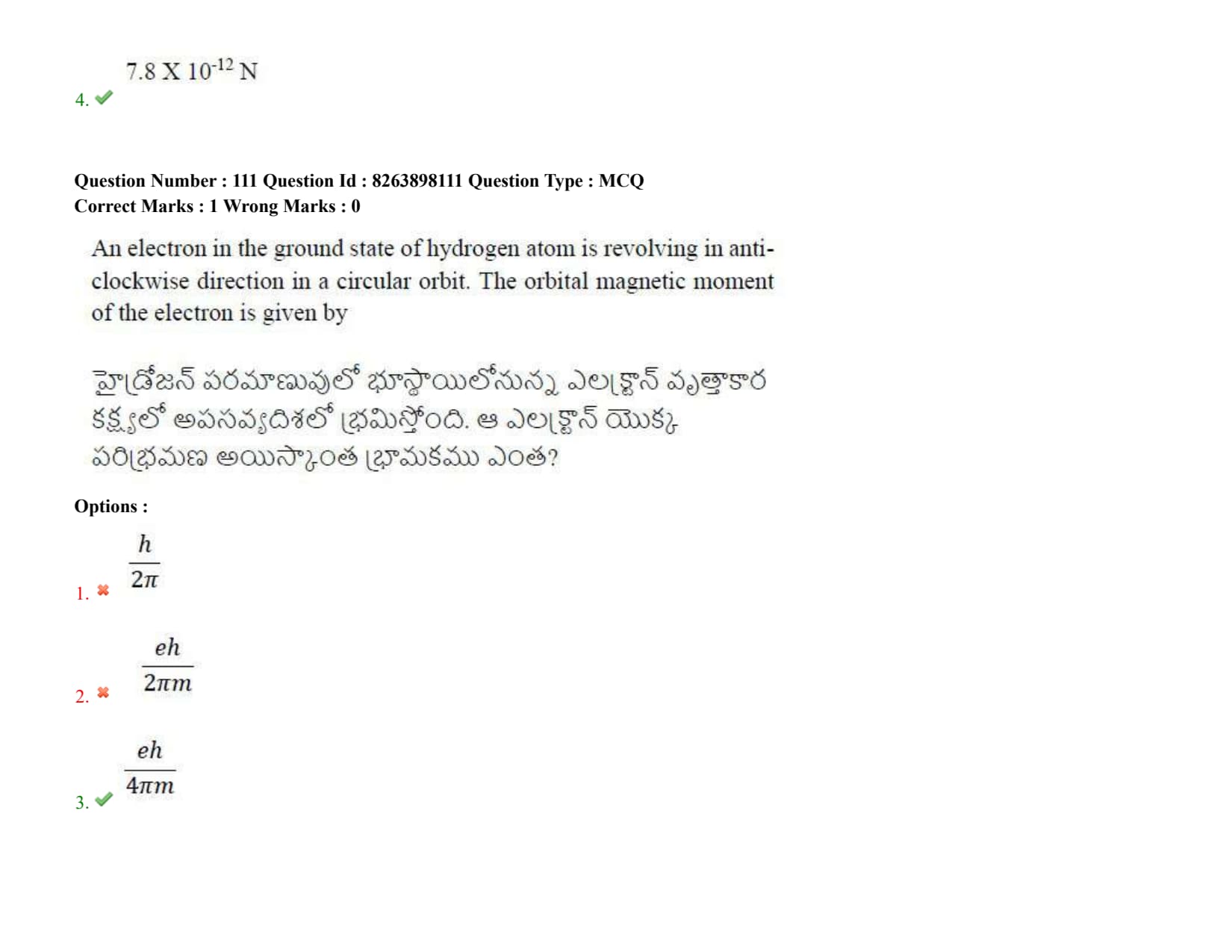
According to Bohr's model, the angular momentum of an electron in a stable orbit is an integral multiple of
The half-life of a radioactive substance is 10 days. The decay constant is
A p-n junction diode acts as a closed switch when it is
The de Broglie wavelength of a particle of mass \(m\) moving with a velocity \(v\) is given by
Which of the following quantum numbers determines the shape of an orbital?
The elements with atomic numbers 9, 17, 35, 53 belong to the family of
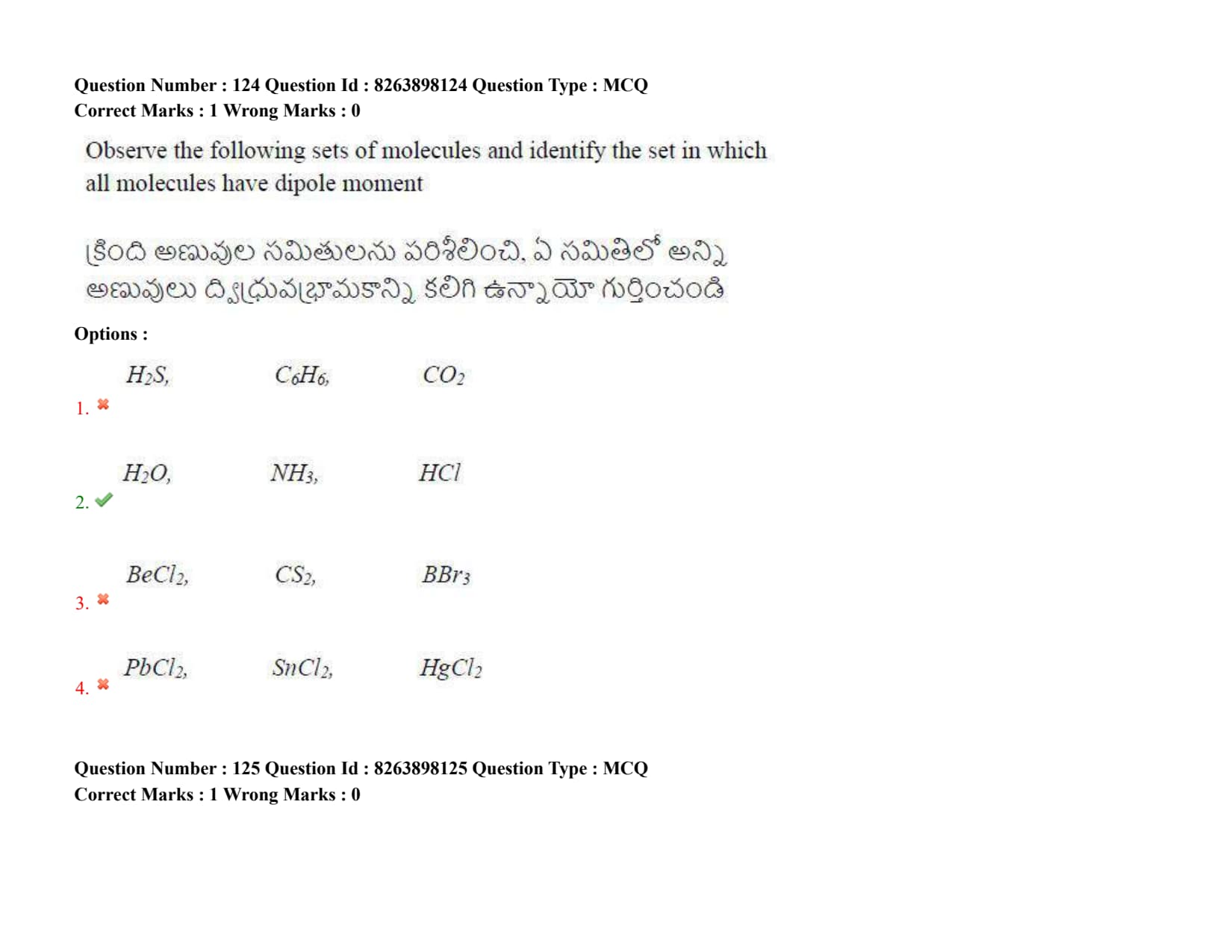
Which of the following molecules has a linear shape?
The hybridization of carbon in methane (\(CH_4\)) is
According to the kinetic theory of gases, the absolute temperature of a gas is directly proportional to
The value of the gas constant \(R\) in \(J K^{-1} mol^{-1}\) is
For a spontaneous process at constant temperature and pressure, the change in Gibbs free energy (\(\Delta G\)) is
For the reaction \(N_2(g) + 3H_2(g) \rightleftharpoons 2NH_3(g)\), the relation between \(K_p\) and \(K_c\) is
Which of the following is a conjugate acid-base pair?
The pH of a \(0.01 M NaOH\) solution is
The oxidation number of sulphur in \(H_2SO_4\) is
Temporary hardness of water is due to the presence of
Which of the following alkali metals has the lowest melting point?
In diborane (\(B_2H_6\)), the number of bridge hydrogens is
Which allotrope of carbon is thermodynamically most stable?
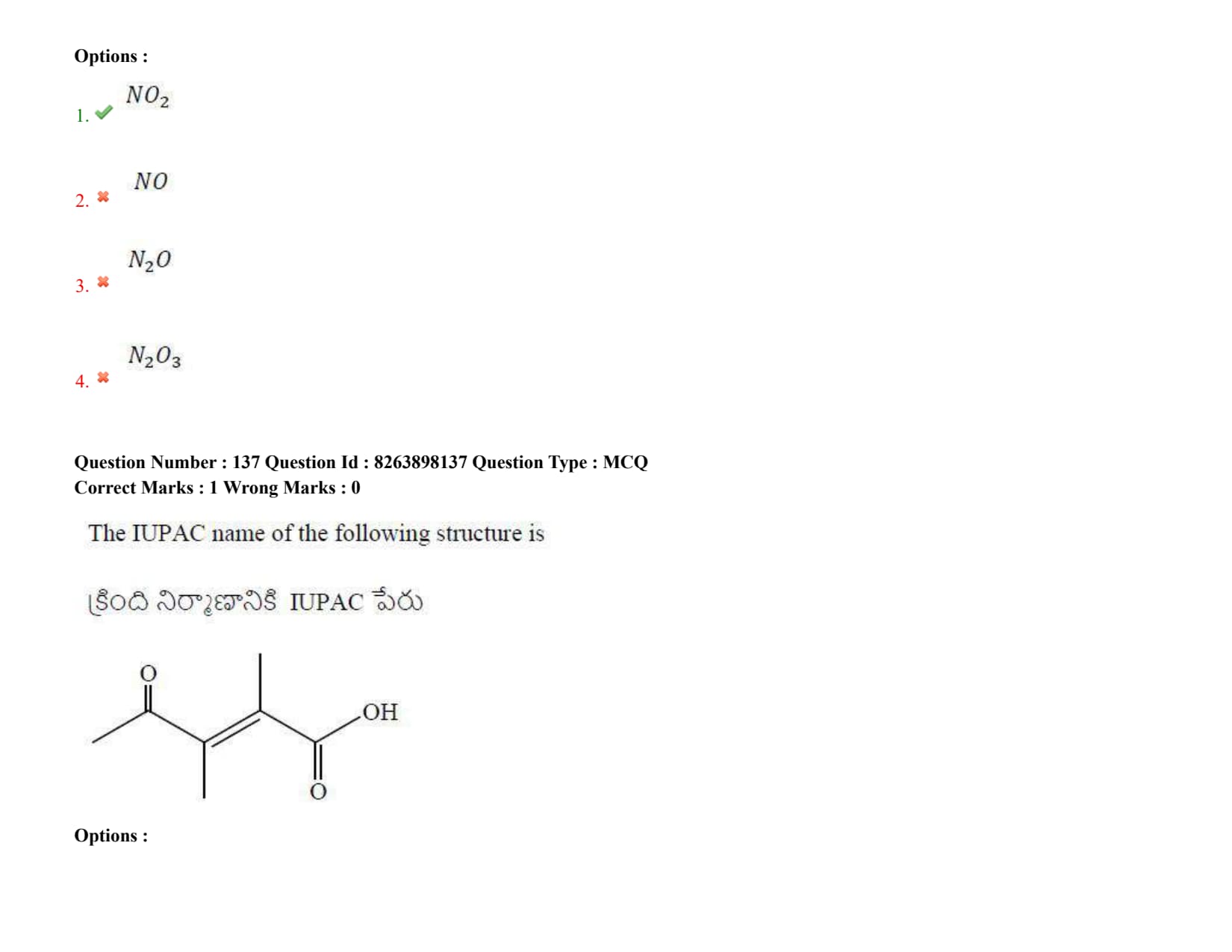
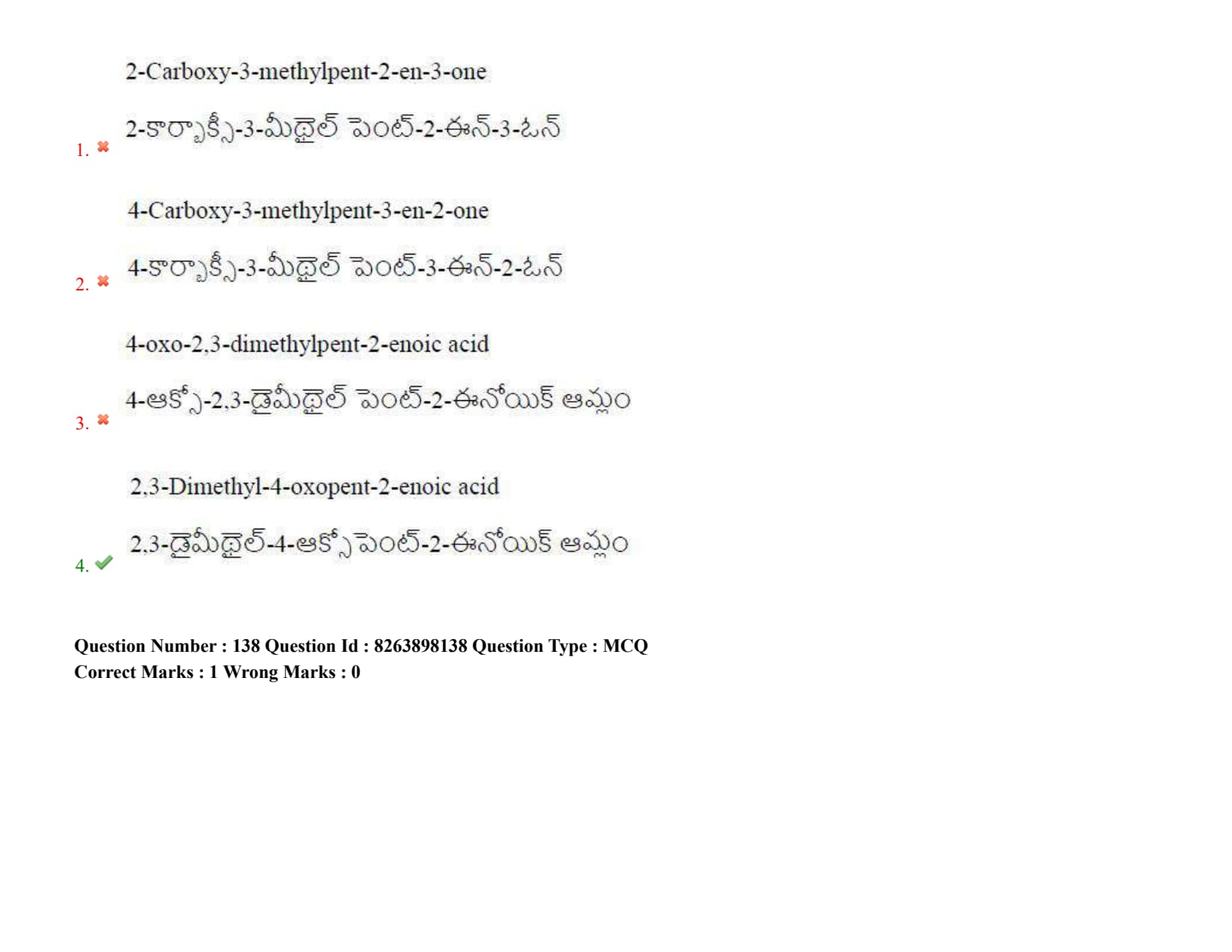
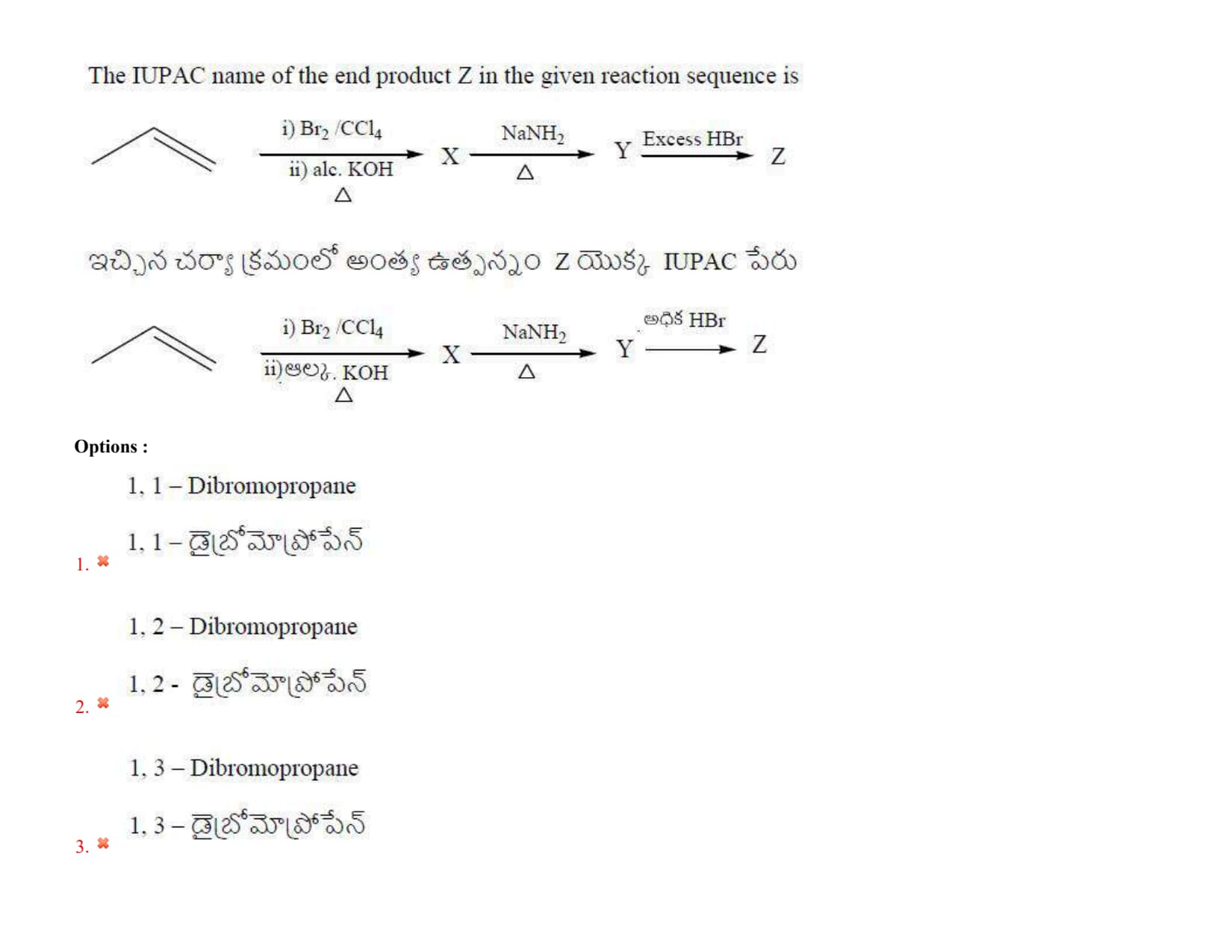
The IUPAC name of \(CH_3-CH_2-CH(CH_3)-CH_3\) is
Which of the following exhibits geometrical isomerism?
The reaction of benzene with methyl chloride in the presence of anhydrous \(AlCl_3\) is called
Which of the following gases causes greenhouse effect?
In a face-centered cubic (fcc) lattice, the number of atoms per unit cell is
The osmotic pressure of a solution is given by the relation
The unit of rate constant for a first-order reaction is
According to Faraday's first law of electrolysis, the mass of substance deposited (\(w\)) is proportional to
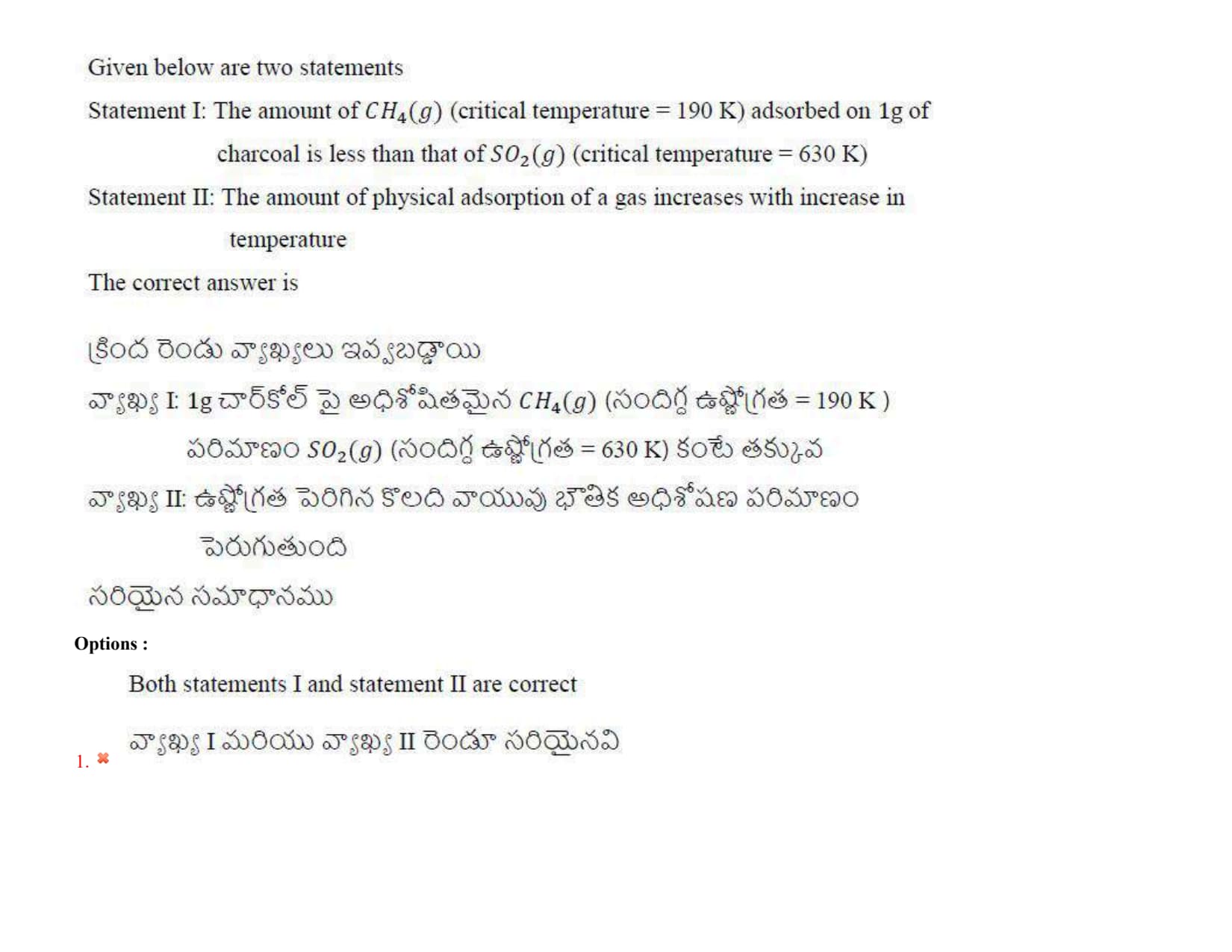
The process of adsorption is always
The principal ore of aluminium is
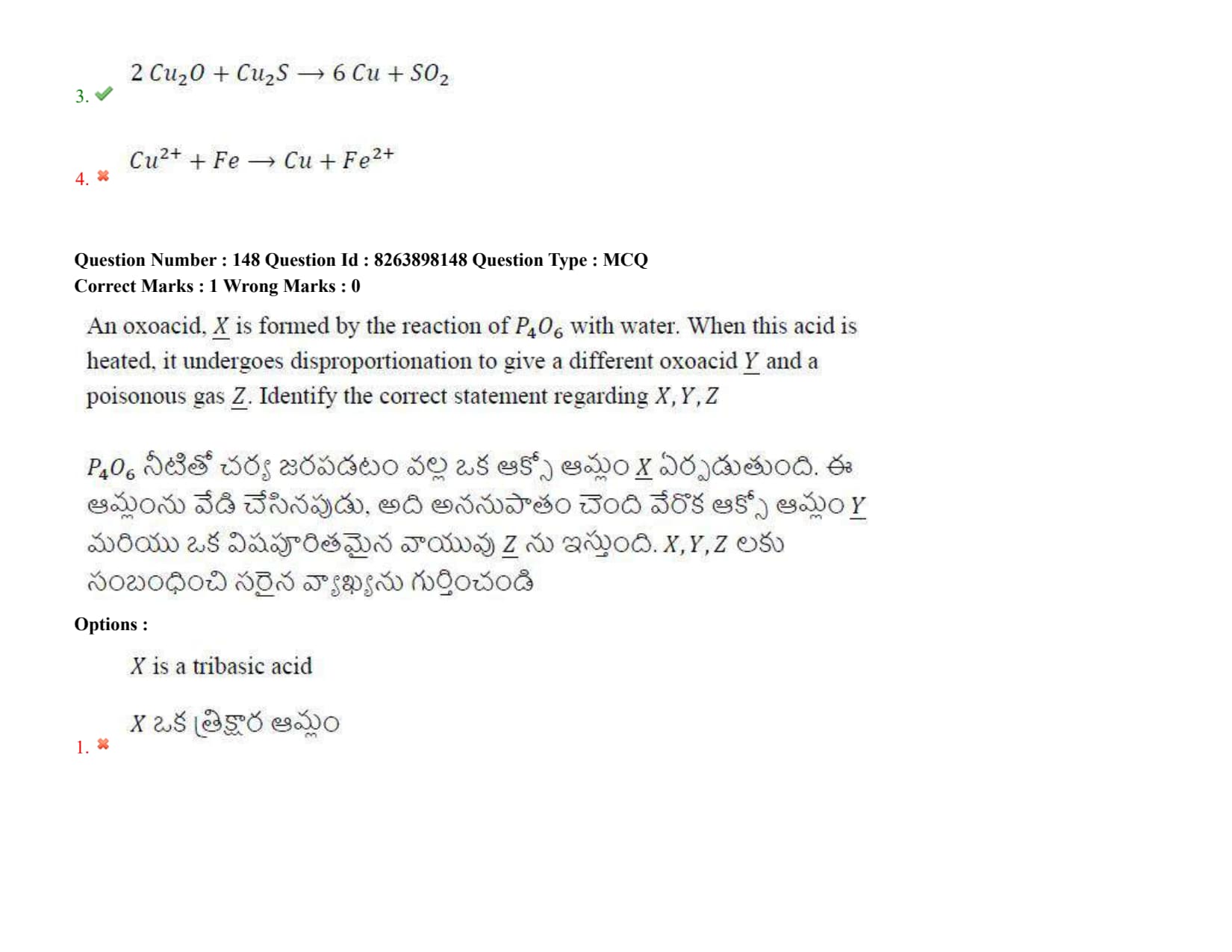
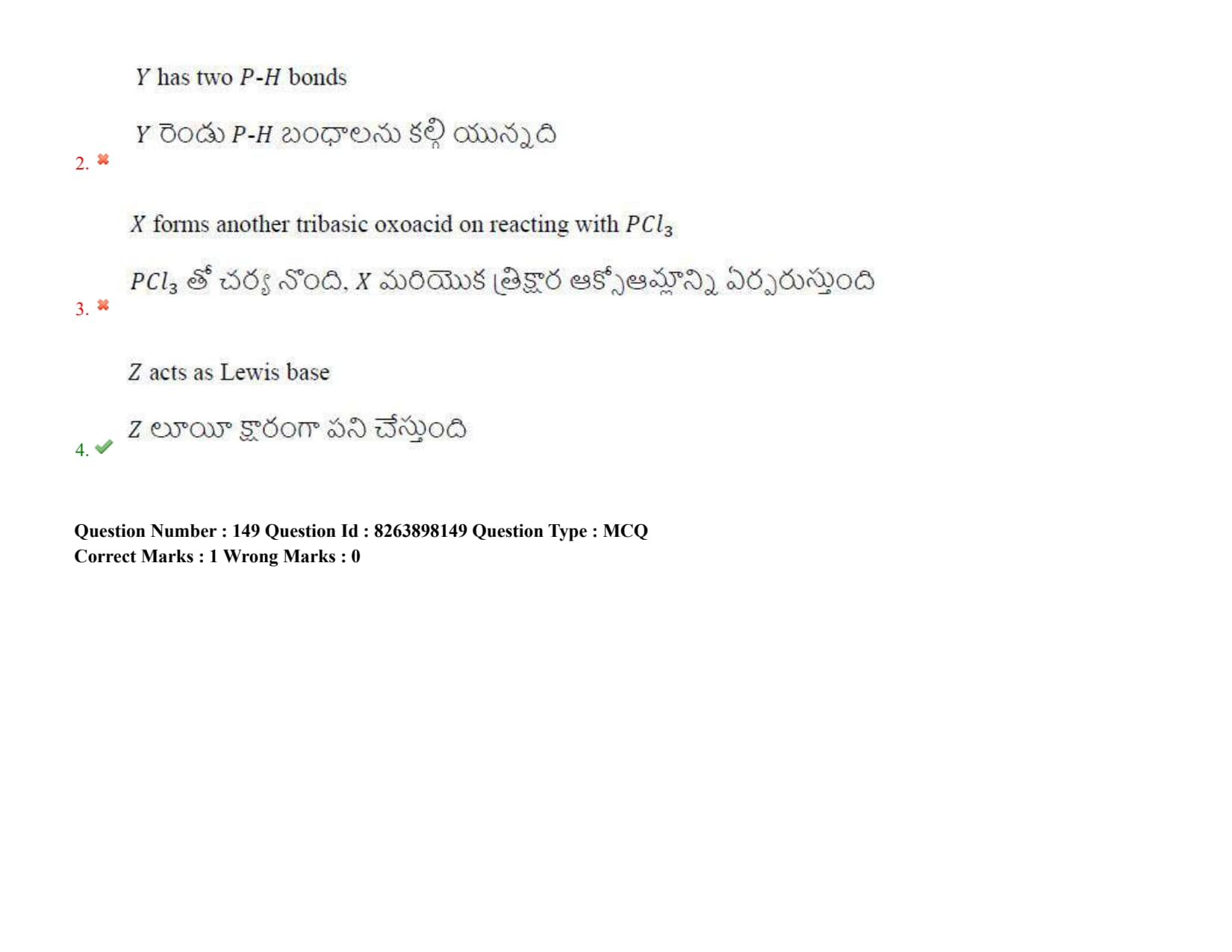
The formula of phosphine gas is
Which of the following transition elements exhibits the highest oxidation state?
According to Werner's theory of coordination compounds, the secondary valency represents
The coordination number of cobalt in \([Co(NH_3)_6]^{3+}\) is
The monomers of Nylon-6,6 are
Which of the following is a natural polymer?
Glucose on reduction with \(HI\) and red phosphorus gives
Which of the following vitamins is water-soluble?
Aspirin is chemically known as
The main constituent of dettol is
The conversion of alkyl halide to alcohol by aqueous \(KOH\) is an example of
Which of the following organic compounds will give Lucas test immediately?
The reaction of an aldehyde with Tollens' reagent gives
Which of the following is the strongest base in aqueous solution?
AP EAPCET 2026 Paper Pattern – Engineering
| Section | Number of Questions | Marks per Question | Weightage | Total Marks |
|---|---|---|---|---|
| Mathematics | 80 | 1 | 80 | 80 |
| Physics | 40 | 1 | 40 | 40 |
| Chemistry | 40 | 1 | 40 | 40 |
| Total | 160 | 1 | 160 | 160 |



Comments