




CBSE Class 10 Science Question Paper 2026 Set 2 - (31/1/2) is now available for download. CBSE conducted the Class 10 Science examination on Feb 25, 2026, from 10:30 AM to 1:30 PM.
The question paper consists of 35 questions carrying a total of 80 marks. Part A is compulsory for all candidates. Part B has two options. Candidates have to attempt only one of the given options. Option I: Physics and Option II: Chemistry. The Science question paper 2026 was rated moderately easy by the students.
Candidates can use the link below to download the CBSE Class 10 Science 2026 Set 2 - (31/1/2) Question Paper with detailed solutions.
CBSE Class 10 Science Set 2 - (31/1/2) Question Paper 2026 with Solution PDF
| CBSE Class 10 Science Set 2 - (31/1/2) Question Paper 2026 | Download PDF | Check Solution |


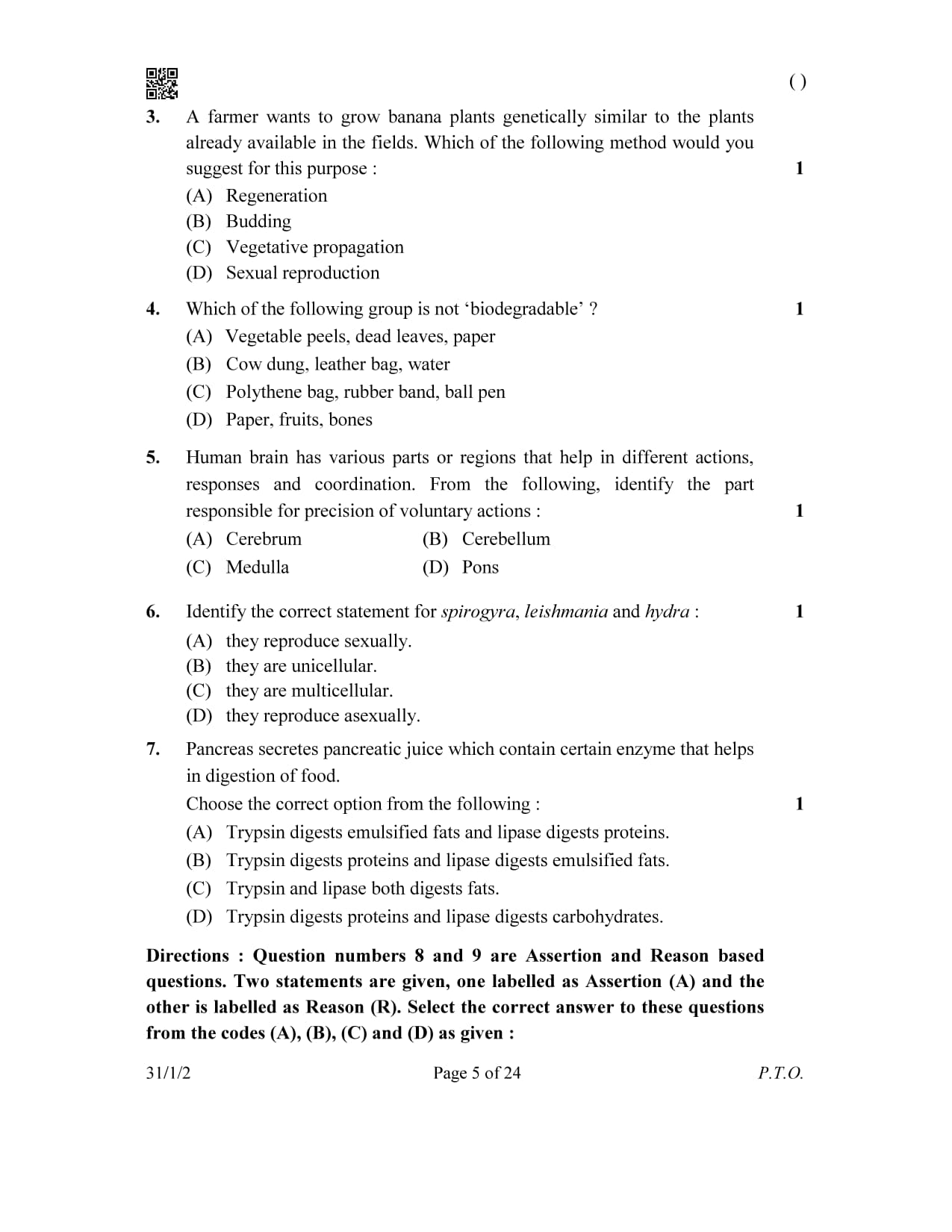




Choose the correct statements with reference to chromosomes :
(i) carry hereditary information from parents to next generation.
(ii) are thread-like structures located inside the nucleus of an animal cell.
(iii) always exist in pairs in human gametes.
(iv) are involved in the process of cell division.
Options :
View Solution
Step 1: Understanding the Question:
The question asks to evaluate four biological statements regarding the structural characteristics, cellular location, genetic role, and ploidy distribution of chromosomes, and to select the option listing all correct statements.
Chromosomes are nuclear nucleoprotein structures consisting of highly condensed deoxyribonucleic acid (DNA) molecules bound tightly with basic histone proteins.
They serve as the physical carriers of genes that transmit phenotypic traits from parents to their progeny during reproduction.
Step 2: Key Formulas and Approach:
Analyze each of the four statements individually based on principles of genetics and cell biology:
1. Genetic role: DNA segments called genes reside along chromosomes and encode functional polypeptides, storing hereditary blueprints.
2. Cellular localization: In eukaryotic organisms, including animal cells, chromatin condenses into distinct thread-like chromosomes inside the membrane-bound nucleus.
3. Ploidy comparison: Distinguish between somatic (body) cells (\(2n = 46\), diploid with \(23\) pairs of homologous chromosomes) and gametes/germ cells (\(n = 23\), haploid with single, unpaired chromosomes resulting from meiosis).
4. Cell division dynamics: During mitosis and meiosis, chromosomes condense, align along the metaphase plate, attach to spindle fibers, and segregate into daughter nuclei.
Step 3: Detailed Explanation:
- Analysis of Statement (i):
Chromosomes are composed of DNA, which contains specific nucleotide sequences called genes.
Genes provide the biochemical instructions necessary for synthesizing proteins that determine anatomical and physiological traits.
During sexual reproduction, chromosomes are duplicated and faithfully transmitted from parents to offspring via gametes, carrying hereditary information across generations.
Therefore, statement (i) is completely correct. - Analysis of Statement (ii):
In eukaryotic cells, including animal cells, chromatin fibers condense during the early stages of cell division into visible, thread-like structures known as chromosomes.
These chromosomes are housed exclusively within the membrane-bound nucleus of the cell.
Therefore, statement (ii) is completely correct. - Analysis of Statement (iii):
In human somatic (vegetative) cells, there are \(46\) chromosomes organized into \(23\) homologous pairs (diploid condition, \(2n\)).
However, gametes (sperms and ova) are produced through the process of meiosis (reductional division).
Meiosis halves the chromosome number so that human gametes contain only \(23\) individual, unpaired chromosomes (haploid condition, \(n\)).
When fertilization occurs, the fusion of two haploid gametes restores the diploid paired state (\(2n = 46\)) in the zygote.
Because chromosomes exist as single unpaired entities in gametes rather than in pairs, statement (iii) is incorrect. - Analysis of Statement (iv):
During both mitotic and meiotic cell divisions, chromosomes play a central active role.
They replicate during the S-phase of interphase, condense during prophase, align at the equatorial plate during metaphase, and have their sister chromatids pulled apart to opposite cellular poles by spindle apparatus microtubules during anaphase.
This organized movement guarantees the equal and precise partitioning of genetic material into the newly forming daughter cells.
Therefore, statement (iv) is completely correct. - Combining the individual evaluations confirms that statements (i), (ii), and (iv) are true, whereas statement (iii) is false.
Step 4: Final Answer:
Statements (i), (ii), and (iv) are correct regarding chromosomes, while statement (iii) is false because gametes are haploid and contain unpaired chromosomes, corresponding to option (C).
Somatic cells (body cells) \(\rightarrow\) Diploid (\(2n = 46\) in humans) \(\rightarrow\) Chromosomes exist in \(23\) PAIRS.
Gametes (sperm and egg) \(\rightarrow\) Haploid (\(n = 23\) in humans) \(\rightarrow\) Chromosomes are UNPAIRED single copies.
Always remember: Meiosis halves the chromosome number to maintain species constancy after fertilization!
Which structure in a leaf is mainly responsible for gaseous exchange ?
View Solution
Step 1: Understanding the Question:
The question asks to identify the specialized anatomical structure present on the surface of a plant leaf that serves as the principal site for the exchange of respiratory and photosynthetic gases with the external atmosphere.
Plants require continuous intake and release of carbon dioxide (\(\text{CO}_2\)) and oxygen (\(\text{O}_2\)) to sustain autotrophic photosynthesis and aerobic cellular respiration.
Step 2: Key Formulas and Approach:
Examine the physiological roles of the four leaf structures provided in the options:
1. Xylem: Vascular conducting tissue responsible for the unidirectional transport of water and dissolved mineral nutrients from roots to leaves.
2. Stomata: Microscopic epidermal apertures bounded by specialized guard cells that actively regulate diffusion of gases (\(\text{CO}_2\), \(\text{O}_2\)) and water vapor.
3. Phloem: Vascular conducting tissue responsible for the bidirectional translocation of soluble organic photosynthates (sucrose) and amino acids from photosynthetic sources to metabolic sinks.
4. Cuticle: A waxy, non-cellular hydrophobic layer of cutin coating the outer epidermal walls to minimize desiccation and cuticular transpiration.
Identify the specialized pore structure dedicated to facilitating gas diffusion.
Step 3: Detailed Explanation:
- Structure and Function of Stomata:
Stomata (singular: stoma) are microscopic pores found abundantly in the epidermis of green leaves and young herbaceous stems.
Each stomatal pore is flanked by a pair of specialized, kidney-shaped (in dicots) or dumb-bell shaped (in monocots) cells known as guard cells.
The guard cells possess chloroplasts and feature differentially thickened cell walls: a thick, inelastic inner wall bordering the pore and a thin, elastic outer wall. - Mechanism of Gaseous Exchange:
During daytime, guard cells actively accumulate potassium ions (\(\text{K}^+\)) and endosmose water from adjacent epidermal cells, becoming swollen and turgid.
This turgor pressure forces the outer thin walls to stretch outward, pulling the inner thick walls apart and opening the stomatal aperture.
Through these open stomatal pores, carbon dioxide (\(\text{CO}_2\)) from the atmosphere diffuses into the substomatal cavities and spongy mesophyll cells for the Calvin cycle of photosynthesis.
Simultaneously, oxygen (\(\text{O}_2\)) generated during the photolysis of water in the light reactions diffuses outward into the environment.
During respiration, stomata likewise permit oxygen uptake and carbon dioxide release. - Elimination of Incorrect Options:
*(A) Xylem:* Xylem consists of non-living tracheary elements (vessels and tracheids) that conduct sap (water and inorganic salts) upward under root pressure and transpirational pull; it plays no role in gaseous diffusion.
*(C) Phloem:* Phloem consists of sieve tubes, companion cells, phloem parenchyma, and phloem fibers that translocate organic nutrients utilizing ATP energy; it does not exchange atmospheric gases.
*(D) Cuticle:* The waxy cuticle is hydrophobic and largely impermeable to gases; its primary evolutionary function is to form a protective barrier that reduces excessive water loss and resists microbial pathogen attack. - Therefore, stomata represent the specialized microscopic structures primarily responsible for facilitating gaseous exchange in leaves.
Step 4: Final Answer:
The structure in a leaf mainly responsible for gaseous exchange is Stomata, corresponding to option (B).
Stomata \(\rightarrow\) Primary site for gaseous exchange (\(\text{CO}_2\) and \(\text{O}_2\)) and transpiration, actively regulated by turgor pressure of guard cells.
Guard cells: Swell (turgid) \(\rightarrow\) Stoma OPENS; Shrink (flaccid) \(\rightarrow\) Stoma CLOSES.
Xylem \(\rightarrow\) Water and mineral transport.
Phloem \(\rightarrow\) Translocation of food/sucrose.
Cuticle \(\rightarrow\) Waxy protective layer preventing water loss.
A farmer wants to grow banana plants genetically similar to the plants already available in the fields. Which of the following method would you suggest for this purpose :
View Solution
Step 1: Understanding the Question:
The question asks to recommend the most appropriate biological propagation method for a farmer who desires to cultivate new banana plants that are genetically identical to the existing parent crop in the field.
Growing offspring that possess exact genetic similarity to the parent generation requires producing genetic clones through asexual modes of reproduction, avoiding the genetic mixing inherent to sexual processes.
Step 2: Key Formulas and Approach:
Analyze the fundamental difference between sexual and asexual modes of reproduction in terms of genetic fidelity:
1. Sexual reproduction: Involves the formation of haploid gametes through meiosis, genetic recombination (crossing over), and the random union of gametes during fertilization, which introduces significant genetic variation among offspring.
2. Asexual reproduction (Vegetative propagation): Involves mitotic cell division exclusively, wherein new plantlets develop directly from vegetative structures (such as rhizomes, suckers, or stems), resulting in offspring that are genetically identical clones of the parent plant.
Evaluate the feasibility of the given biological methods for commercial agricultural propagation of banana plants.
Step 3: Detailed Explanation:
- Commercial varieties of banana plants are typically triploid (\(3n\)) and seedless due to parthenocarpy, which renders them incapable of producing viable seeds through normal sexual reproduction.
- Sexual reproduction relies on the fusion of male and female gametes derived from meiotic division, a process that inherently scrambles alleles through independent assortment and crossing over, creating genetic variations that would dilute desirable parental traits.
- Vegetative propagation is an asexual mode of plant reproduction in which new daughter plants develop directly from vegetative parts such as rhizomes, suckers, runners, or specialized tissue explants (micropropagation).
- Because the development of new plants during vegetative propagation proceeds strictly via mitosis, no reduction division or genetic crossing-over takes place.
- As a direct biological consequence, all daughter banana plants generated via vegetative propagation inherit the complete and unaltered genetic complement of the parent plant, making them true genetic clones.
- This ensures that all elite agronomic characteristics—such as high fruit yield, sweet taste, uniform bunch size, rapid maturation, and natural disease resistance—are perfectly preserved across generations.
- Regarding the other options:
*(A) Regeneration* is a repair and replacement mechanism observed in simpler organisms like *Planaria* or *Hydra*, and cannot be utilized for field-scale commercial farming of crops.
*(B) Budding* is an asexual mechanism typical of unicellular organisms like yeast and lower invertebrates like *Hydra*, not suitable for cultivating flowering higher plants.
*(D) Sexual reproduction* introduces genetic variations and is not possible in cultivated seedless banana varieties. - Therefore, vegetative propagation via underground suckers, rhizomes, or tissue culture is the ideal agricultural technique.
Step 4: Final Answer:
The farmer should use Vegetative propagation because it relies on mitotic cell division to produce plants that are genetically identical clones of the parent, maintaining all desired traits, corresponding to option (C).
1. Produces genetically identical progeny (clones) \(\rightarrow\) Retains parental purity and desirable traits.
2. Essential for seedless plants (Banana, Orange, Rose, Jasmine, Seedless Grapes).
3. Plants raised vegetatively flower and bear fruit much earlier than those raised from seeds!
Which of the following group is not ‘biodegradable’ ?
View Solution
Step 1: Understanding the Question:
The question asks to identify which among the given groups consists entirely of substances that are non-biodegradable.
Substances introduced into the environment are classified as either biodegradable or non-biodegradable depending on whether natural biological decomposers can metabolically break them down.
Step 2: Key Formulas and Approach:
Recall the definitions and criteria for environmental degradability:
1. Biodegradable substances: Organic materials of plant or animal origin that can be broken down and decomposed into simpler, non-toxic inorganic substances by the natural biochemical and enzymatic actions of saprophytic microorganisms (bacteria and fungi).
2. Non-biodegradable substances: Synthetic, man-made substances that resist microbial enzymatic degradation because natural decomposers lack the specific enzymes required to cleave their synthetic covalent polymer bonds, causing them to persist in nature for decades or centuries.
Evaluate the constituent items of each option to detect the group made entirely of non-biodegradable items.
Step 3: Detailed Explanation:
- Analysis of Group (C): Polythene bag, rubber band, ball pen:
*(i) Polythene bag:* Polythene (polyethylene) is a high-molecular-mass synthetic polymer composed of long, repeating chains of ethylene monomers linked by resilient carbon-carbon bonds. Soil microorganisms possess no biological enzymes capable of cleaving these synthetic bonds, making polythene highly persistent and non-biodegradable.
*(ii) Rubber band:* Most commercially manufactured rubber bands are fabricated from synthetic elastomer rubbers (such as styrene-butadiene) vulcanized with sulfur bridges. This cross-linked polymer network prevents enzymatic digestion by natural decomposers.
*(iii) Ball pen:* The outer body, cap, and inner refill of a ballpoint pen are made from non-biodegradable thermoplastics (like polypropylene or polystyrene), while the pen tip is constructed from brass or tungsten carbide metal. Neither plastics nor metals can be broken down by saprophytic organisms.
Because all three items in this group resist microbial decomposition, group (C) is strictly non-biodegradable. - Analysis of Other Groups:
*(A) Vegetable peels, dead leaves, paper:* Vegetable peels and dead leaves are natural plant biomass rich in cellulose and starch, while paper is processed wood pulp (cellulose). All three are readily degraded by saprophytic bacteria and fungi into humus.
*(B) Cow dung, leather bag, water:* Cow dung is organic cattle waste, and leather is processed animal hide (protein collagen); both are organic materials readily broken down by bacterial decomposers. Water is an inorganic natural compound that forms part of biological cycles.
*(D) Paper, fruits, bones:* Paper and fruits are organic plant matter, while bones are animal skeletal tissues consisting of organic collagen protein and calcium phosphate minerals that decomposers and soil microorganisms gradually decompose.
Step 4: Final Answer:
The group consisting entirely of non-biodegradable materials is Polythene bag, rubber band, ball pen, corresponding to option (C).
Biodegradable \(\rightarrow\) Natural plant and animal products (peels, wood, cotton, paper, cow dung, leather, bones) cleaved by microbial enzymes.
Non-biodegradable \(\rightarrow\) Synthetic polymers, plastics, nylon, polythene, synthetic rubber, glass, and heavy metals that persist in the biosphere!
Human brain has various parts or regions that help in different actions, responses and coordination. From the following, identify the part responsible for precision of voluntary actions :
View Solution
Step 1: Understanding the Question:
The question asks to identify the specific anatomical region of the human brain that is primarily responsible for ensuring the fine precision, smooth execution, and motor coordination of voluntary muscular movements.
The human central nervous system coordinates bodily actions through distinct functional divisions located across the forebrain, midbrain, and hindbrain.
Step 2: Key Formulas and Approach:
Review the specialized functional localization within the principal anatomical regions of the human brain:
1. Forebrain (Cerebrum): Controls sensory perception, intelligence, conscious thought, memory, reasoning, and the initiation of voluntary motor impulses.
2. Hindbrain: Comprises three functional regions:
- Cerebellum: Coordinates motor activity, fine-tunes the precision of voluntary actions, and maintains physical balance, equilibrium, and posture.
- Medulla Oblongata: Regulates autonomic involuntary reflexes including heart rate, blood pressure, salivation, and peristalsis.
- Pons: Acts as a neural bridge between brain regions and regulates the respiratory rhythm (pneumotaxic center).
Step 3: Detailed Explanation:
- The human brain is divided into three primary subdivisions: the forebrain, midbrain, and hindbrain.
- The hindbrain consists of the pons, medulla oblongata, and the cerebellum.
- The cerebellum, situated at the dorsal aspect of the brainstem below the occipital lobes of the cerebrum, serves as the main motor-coordinating center of the central nervous system.
- While the conscious intent to perform a voluntary action originates in the motor cortex of the cerebrum, the cerebrum itself cannot fine-tune the minute timing, muscle tension, and precision of the movement.
- The cerebellum continuously receives real-time sensory feedback regarding muscle position, joint angles, and head equilibrium from proprioceptors and the semicircular canals of the inner ear.
- It computes and integrates these inputs to modulate motor commands, ensuring that voluntary movements are executed with exquisite accuracy, smoothness, and precision rather than jerky tremors.
- Classic examples of voluntary actions requiring cerebellar precision include walking in a straight line, riding a bicycle, threading a needle, playing a musical instrument, and picking up an object with fingers.
- In addition to precision, the cerebellum is responsible for maintaining the general posture, muscle tone, and dynamic equilibrium of the body.
- In contrast, the *Cerebrum* plans and initiates voluntary movements but does not modulate their fine mechanical precision; the *Medulla* controls involuntary visceral reflexes (vomiting, swallowing, heartbeat); and the *Pons* assists in respiratory regulation and sleep-wake cycles.
Step 4: Final Answer:
The part of the human brain responsible for the precision of voluntary actions and maintenance of body posture and balance is the Cerebellum, corresponding to option (B).
Cerebrum \(\rightarrow\) Thinking, memory, sensory interpretation, voluntary motor initiation.
Cerebellum \(\rightarrow\) Precision of voluntary actions, coordination, posture, and balance.
Medulla \(\rightarrow\) Involuntary visceral functions (blood pressure, salivation, vomiting, heartbeat).
Pons \(\rightarrow\) Respiratory rhythm regulation and relaying signals.
Identify the correct statement for spirogyra, leishmania and hydra :
View Solution
Step 1: Understanding the Question:
The question asks to identify the single common biological characteristic that holds universally true for three distinct representative organisms: *Spirogyra*, *Leishmania*, and *Hydra*.
We need to examine their cellular organization (unicellular vs. multicellular) and their characteristic reproductive strategies to find the accurate unifying statement.
Step 2: Key Formulas and Approach:
Analyze the biological profile of each of the three named organisms:
1. Spirogyra: A filamentous, multicellular green alga that reproduces asexually via fragmentation under favorable conditions.
2. Leishmania: A microscopic, unicellular protozoan parasite (the causative agent of Kala-azar) that possesses a whip-like flagellum and reproduces asexually by longitudinal binary fission.
3. Hydra: A simple, diploblastic multicellular freshwater coelenterate (cnidarian) that reproduces asexually through budding and regeneration.
Evaluate the provided options against these established biological facts.
Step 3: Detailed Explanation:
- Analysis of Reproductive Strategies:
- In *Spirogyra*, upon attaining maturity, the multicellular filament breaks simply into smaller pieces or fragments; each fragment subsequently undergoes mitotic divisions to develop into an independent individual (asexual reproduction via fragmentation).
- In *Leishmania*, asexual reproduction occurs by binary fission oriented along a definite longitudinal plane with respect to its whip-like flagellar structure at one end.
- In *Hydra*, specialized regenerative cells divide rapidly at a specific site on the body column, developing an outgrowth called a bud; this bud grows, develops a mouth and tentacles, and eventually detaches from the parent body to become a self-sufficient individual (asexual reproduction via budding).
- Therefore, all three organisms share the common biological property that they reproduce asexually. - Evaluation and Elimination of Incorrect Statements:
- *(A) They reproduce sexually:* While some organisms can undergo sexual conjugation under severe ecological stress, sexual reproduction is not the definitive common trait emphasized in this comparative context; their primary, standard reproductive mode is asexual.
- *(B) They are unicellular:* This statement is false because *Spirogyra* (a multicellular filamentous alga) and *Hydra* (a multicellular tissue-grade animal) are multicellular; only *Leishmania* is a unicellular protozoan.
- *(C) They are multicellular:* This statement is false because *Leishmania* is strictly a unicellular organism consisting of a single eukaryotic cell.
- *(D) They reproduce asexually:* This statement is entirely true for all three organisms, uniting their varied asexual mechanisms (fragmentation, binary fission, and budding).
Step 4: Final Answer:
The correct unifying statement for *Spirogyra*, *Leishmania*, and *Hydra* is that they reproduce asexually, corresponding to option (D).
Amoeba \(\rightarrow\) Simple Binary Fission (any plane).
Leishmania \(\rightarrow\) Binary Fission (longitudinal plane, flagellated end).
Plasmodium \(\rightarrow\) Multiple Fission.
Spirogyra \(\rightarrow\) Fragmentation (multicellular filamentous alga).
Planaria \(\rightarrow\) True Regeneration.
Hydra \(\rightarrow\) Budding and Regeneration.
Rhizopus \(\rightarrow\) Spore Formation.
Pancreas secretes pancreatic juice which contain certain enzyme that helps in digestion of food.
Choose the correct option from the following :
View Solution
Step 1: Understanding the Question:
The question asks to match the specific digestive enzymes present in pancreatic juice—namely, trypsin and lipase—with their respective biological substrates and digestive functions in the human alimentary canal.
The pancreas is an essential accessory digestive organ that secretes alkaline pancreatic juice into the duodenum to carry out enzymatic breakdown of macromolecules.
Step 2: Key Formulas and Approach:
Recall the major enzymatic constituents of pancreatic juice and their catalytic targets in the small intestine:
1. Trypsin (Proteolytic enzyme): Synthesized and secreted as inactive trypsinogen; activated by enterokinase in the duodenum; catalyzes the hydrolysis of complex proteins, peptones, and proteoses into smaller peptides and amino acids.
2. Pancreatic Lipase (Lipolytic enzyme): Catalyzes the chemical hydrolysis of emulsified dietary triglycerides and lipids into fatty acids and glycerol.
3. Pancreatic Amylase (Carbohydrase): Hydrolyzes starch and complex polysaccharides into maltose disaccharides.
Match the enzymes trypsin and lipase with their correct substrate breakdown reactions.
Step 3: Detailed Explanation:
- When acidic chyme leaves the stomach and enters the duodenum of the small intestine, it is neutralized by alkaline bile juice secreted by the liver and alkaline pancreatic juice secreted by the pancreas.
- Bile salts perform the vital process of emulsification, breaking large insoluble fat globules down into fine droplets, which drastically expands the available surface area for enzyme action.
- Pancreatic juice contains potent digestive enzymes designed to act on all three major dietary macromolecules in this alkaline medium:
- Role of Trypsin:
Trypsin is a proteolytic enzyme (protease) that targets proteins.
It breaks down intact protein molecules as well as partially digested proteins (proteoses and peptones) resulting from stomach pepsin digestion into smaller peptides:
\[ \text{Proteins / Peptones} \xrightarrow{\text{Trypsin}} \text{Peptides} \] - Role of Lipase:
Pancreatic lipase (steapsin) is a lipolytic enzyme specialized for lipid digestion.
Because fats are insoluble in water, lipase cannot efficiently act on large lipid globules until they have been mechanically emulsified by bile salts.
Lipase hydrolyzes these emulsified fat droplets into absorbable free fatty acids and glycerol molecules:
\[ \text{Emulsified Fats} \xrightarrow{\text{Lipase}} \text{Fatty Acids} + \text{Glycerol} \] - Evaluating the Options:
- *(A)* Reverses the functions by incorrectly assigning fat digestion to trypsin and protein digestion to lipase.
- *(B)* Accurately states that trypsin digests proteins and lipase digests emulsified fats.
- *(C)* Incorrectly claims that both enzymes digest fats.
- *(D)* Incorrectly states that lipase digests carbohydrates (carbohydrates are digested by amylase, not lipase).
Step 4: Final Answer:
In pancreatic juice, trypsin digests proteins and lipase digests emulsified fats, corresponding to option (B).
Pancreatic Amylase \(\rightarrow\) Starch to Maltose (Carbohydrates).
Trypsin \(\rightarrow\) Proteins and Peptones to Peptides (Proteins).
Lipase \(\rightarrow\) Emulsified Fats to Fatty Acids and Glycerol (Lipids).
Bile Juice \(\rightarrow\) No enzymes! Only emulsifies fats and makes the acidic food alkaline for pancreatic enzymes to function.
Assertion (A) : In human beings, the respiratory pigment is haemoglobin present in red blood cells.
Reason (R) : Haemoglobin has a very high affinity for carbon dioxide.
View Solution
Step 1: Understanding the Question:
The question presents an Assertion regarding the nature and cellular location of the human respiratory pigment, and a Reason stating that this pigment possesses a very high chemical affinity for carbon dioxide.
We need to independently verify the scientific accuracy of both statements and determine whether the Reason is an appropriate justification for the Assertion.
Step 2: Key Formulas and Approach:
Recall the physiological mechanism of gas transport in the human circulatory system:
1. In multicellular organisms with large body volumes, simple diffusion cannot deliver oxygen from the alveolar surfaces to deep metabolically active tissues.
2. An iron-containing conjugated metalloprotein called haemoglobin serves as the respiratory pigment packaged within erythrocytes (red blood cells, RBCs).
3. Examine the relative chemical affinities of haemoglobin for oxygen (\(\text{O}_2\)) versus carbon dioxide (\(\text{CO}_2\)), and review how carbon dioxide is predominantly transported in blood.
Step 3: Detailed Explanation:
- Evaluation of Assertion (A):
Due to the large size and high metabolic activity of human beings, the diffusion pressure of oxygen is grossly inadequate to transport oxygen across the body.
To overcome this diffusion limitation, red blood cells (erythrocytes) contain a specialized, iron-bearing respiratory pigment known as haemoglobin.
Each haemoglobin molecule contains four iron-porphyrin (heme) groups, enabling it to bind reversibly with up to four molecules of molecular oxygen to form oxyhaemoglobin:
\[ \text{Hb} + 4\text{O}_2 \rightleftharpoons \text{Hb(O}_2)_4 \]
This oxyhaemoglobin circulates through systemic capillaries and dissociates in tissues where oxygen partial pressure is low, providing oxygen for cellular respiration.
Therefore, Assertion (A) is scientifically true. - Evaluation of Reason (R):
Haemoglobin has an exceptionally high chemical binding affinity for oxygen, not for carbon dioxide.
Carbon dioxide (\(\text{CO}_2\)) is roughly \(20\) to \(25\) times more soluble in aqueous biological fluids than oxygen.
Because of its high water solubility, the vast majority of carbon dioxide produced during cellular metabolism is transported in dissolved form in the blood plasma, primarily as bicarbonate ions (\(\text{HCO}_3^-\)) which account for about \(70\%\) of total \(\text{CO}_2\) transport.
Only about \(20\%\) to \(25\%\) of carbon dioxide binds loosely with the amino groups of haemoglobin to form carbaminohaemoglobin (\(\text{HbCO}_2\)), while approximately \(7\%\) is dissolved directly in plasma.
The statement that haemoglobin has a "very high affinity for carbon dioxide" is fundamentally false; its high affinity is specifically tailored for oxygen. - Therefore, Assertion (A) is true, but Reason (R) is false.
Step 4: Final Answer:
Assertion (A) is true because haemoglobin in red blood cells is the primary respiratory pigment for oxygen transport, but Reason (R) is false because haemoglobin has a high affinity for oxygen, not carbon dioxide, corresponding to option (C).
Oxygen (\(\text{O}_2\)) \(\rightarrow\) Poorly soluble in plasma (\(3\%\)); \(97\%\) transported bound to haemoglobin (Oxyhaemoglobin) due to high affinity.
Carbon dioxide (\(\text{CO}_2\)) \(\rightarrow\) Highly soluble in water; \(70\%\) transported as bicarbonate ions (\(\text{HCO}_3^-\)) in plasma, \(23\%\) as carbaminohaemoglobin, \(7\%\) dissolved.
Remember: Carbon monoxide (\(\text{CO}\)) has \(\sim 200\times\) higher affinity for haemoglobin than \(\text{O}_2\) (forming toxic carboxyhaemoglobin)!
Assertion (A) : Plants have hormones that do not control directional growth.
Reason (R) : Abscisic acid inhibits growth.
View Solution
Step 1: Understanding the Question:
The question presents an Assertion regarding the existence of plant phytohormones that mediate functions unrelated to directional (tropic) growth, and a Reason citing abscisic acid as an example of a growth-inhibiting hormone.
We need to determine whether both statements are scientifically correct and if the Reason correctly explains the Assertion.
Step 2: Key Formulas and Approach:
Recall the classification of plant hormones (phytohormones) based on their physiological functions:
1. Growth Promoters / Tropic Mediators: Auxins, gibberellins, and cytokinins stimulate cell division, elongation, and directional tropic movements (e.g., phototropism and gravitropism caused by asymmetric auxin redistribution).
2. Growth Inhibitors / Non-Directional Hormones: Hormones such as abscisic acid (ABA) and ethylene do not direct directional growth toward or away from an environmental stimulus; instead, they arrest cell metabolic activity, promote dormancy, regulate stomatal closure, and trigger organ abscission.
Evaluate if abscisic acid validates the Assertion.
Step 3: Detailed Explanation:
- Plant movements are broadly categorized into tropic movements (directional growth movements stimulated by external environmental cues like light, gravity, or touch) and non-directional responses.
- While certain phytohormones like auxins regulate directional curvature by accumulating on one side of a shoot or root, plants also produce hormones whose physiological actions do not involve controlling directional growth.
- Therefore, Assertion (A) is completely true.
- In plants, growth cannot continue indefinitely; it must be arrested or suppressed under unfavorable ecological conditions (such as drought, salinity, or cold) to conserve vital resources.
- Abscisic acid (ABA) is a classical plant growth inhibitor, often referred to as the stress hormone.
- Rather than promoting directional cell elongation, abscisic acid actively inhibits cellular growth, induces dormancy in seeds and buds, triggers the closing of stomatal pores to prevent transpirational water loss, and promotes the senescence and abscission (wilting and dropping) of mature leaves and fruits.
- These inhibitory actions are systemic and non-directional; they do not guide the plant toward or away from a directional stimulus.
- Therefore, Reason (R) is completely true.
- Furthermore, Reason (R) provides the exact functional demonstration of Assertion (A): the fact that abscisic acid inhibits growth rather than mediating directional expansion directly explains why plants possess hormones that do not control directional growth.
- Thus, both Assertion (A) and Reason (R) are true, and Reason (R) is the correct explanation of Assertion (A).
Step 4: Final Answer:
Both Assertion (A) and Reason (R) are true, and Reason (R) correctly explains Assertion (A) because abscisic acid acts as a non-directional growth inhibitor that regulates senescence and stress responses rather than directional growth, corresponding to option (A).
Auxins \(\rightarrow\) Cell elongation, apical dominance, mediates DIRECTIONAL tropic movements (phototropism/geotropism).
Gibberellins \(\rightarrow\) Stem elongation, breaking seed dormancy.
Cytokinins \(\rightarrow\) Rapid cell division (found in seeds/fruits), delays senescence.
Abscisic Acid (ABA) \(\rightarrow\) Growth INHIBITOR, stomatal closure under stress, wilting of leaves (NON-DIRECTIONAL).
Ethylene \(\rightarrow\) Gaseous hormone for fruit ripening.
State two differences between the act of chewing food and salivation on sight of food.
View Solution
Step 1: Understanding the Question:
The question asks to state two distinct physiological differences between two activities associated with the digestive process: the mechanical act of chewing food (mastication) and the secretion of saliva triggered by simply seeing appetizing food (cephalic phase of salivary secretion).
These two processes operate under fundamentally different neurological pathways, muscle systems, and control mechanisms in the human body.
Step 2: Key Formulas and Approach:
Compare both processes across essential physiological parameters:
1. Nature of Action: Voluntary (conscious somatic control) versus Involuntary (automatic reflex response).
2. Nervous System Control: Cerebral cortex of the somatic nervous system versus medulla oblongata of the autonomic nervous system.
3. Effector Organ Involved: Skeletal muscles of mastication versus exocrine salivary glands.
4. Trigger / Stimulus: Physical mechanical presence of food in the oral cavity versus sensory visual perception and memory/conditioning.
Step 3: Detailed Explanation:
- The two actions differ fundamentally in their neurological pathways, effector tissues, and conscious regulation:
- Difference 1: Nature of Control (Voluntary vs. Involuntary Reflex):
- *Chewing of food* is a voluntary action initiated and modulated under the conscious control of the motor cortex of the cerebrum.
An individual can consciously decide when to start chewing, when to stop chewing, how vigorously to masticate, and when to swallow, utilizing conscious somatic feedback.
- *Salivation on sight of food* is an involuntary conditioned reflex action mediated automatically without any conscious intent or effort.
It is governed involuntarily by the salivary center located in the medulla oblongata of the brainstem through the autonomic parasympathetic nervous system.
An individual cannot willfully prevent their salivary glands from secreting saliva when observing appetizing food. - Difference 2: Effector Organs Involved (Skeletal Muscles vs. Exocrine Glands):
- The act of *chewing food* involves the rhythmic contraction and relaxation of skeletal muscles (voluntary muscles), primarily the muscles of mastication (masseter, temporalis, and pterygoid muscles) that actuate the mandible (lower jaw) to mechanically crush food with the teeth.
- *Salivation on sight of food* involves glandular effectors—specifically, the three pairs of exocrine salivary glands (parotid, submandibular, and sublingual glands).
These glands respond to autonomic cholinergic impulses by synthesizing and secreting watery saliva rich in salivary amylase (ptyalin) directly into the buccal cavity through their ducts. - Difference 3: Nature of Stimulus:
- Chewing requires the physical, mechanical presence of a solid food bolus inside the oral cavity to stimulate tactile and pressure receptors.
- Salivation on sight of food is an associative psychic/cephalic reflex elicited purely by visual stimuli received by retinal photoreceptors and interpreted by association centers of the brain based on past gastronomic memory.
Step 4: Final Answer:
Two key differences are:
1. Control Mechanism: Chewing food is a voluntary action under conscious cerebral control, whereas salivation on the sight of food is an involuntary reflex action controlled automatically by the autonomic nervous system (medulla oblongata).
2. Effector Organ: Chewing is performed by skeletal muscles (voluntary jaw muscles), whereas salivation is performed by exocrine salivary glands releasing glandular secretion.
Feature \(\rightarrow\) Chewing Food vs. Salivation on Sight of Food
Nature \(\rightarrow\) Voluntary action vs. Involuntary conditioned reflex.
Control Center \(\rightarrow\) Cerebral motor cortex vs. Medulla oblongata (brainstem).
Effectors \(\rightarrow\) Skeletal muscles of the jaw vs. Epithelial cells of salivary glands.
State two differences between pollination and fertilization.
View Solution
Step 1: Understanding the Question:
The question asks to state two major biological differences between pollination and fertilization in the sexual reproductive cycle of flowering plants (angiosperms).
Pollination and fertilization are two sequential, interdependent reproductive events: pollination is the mechanical transfer of male gametophytes, whereas fertilization is the actual cellular fusion of gametes.
Step 2: Key Formulas and Approach:
Contrast pollination and fertilization using fundamental criteria:
1. Definition / Biological Event: Physical transfer of pollen grains versus biological fusion of haploid male and female gametic nuclei.
2. Site of Occurrence: External surface of the flower (stigma) versus internal microenvironment of the ovule (embryo sac within the ovary).
3. Requirement of External Agents: Dependent on abiotic/biotic agents (wind, water, insects) versus independent of external agents once pollen tube germinates.
4. End Result: Deposition of pollen grains versus formation of a diploid zygote and triploid endosperm nucleus (double fertilization).
Step 3: Detailed Explanation:
- In angiosperms, reproduction progresses through a coordinated sequence of pre-fertilization and fertilization events:
- Difference 1: Nature of Process and Cellular Mechanism:
- Pollination is an external, physical process that involves the mechanical transfer of pollen grains (microspores containing the immature male gametophyte) from the open anther of a stamen onto the receptive, sticky stigma of a carpel (pistil).
It does not involve any fusion of nuclei; its role is solely to transport the non-motile male gametophyte to the vicinity of the female reproductive organ.
- Fertilization is a microscopic, internal biochemical and genetic process in which the haploid nucleus of a male gamete fuses completely with the haploid nucleus of a female gamete (egg cell / ovum) inside the embryo sac to form a single-celled diploid zygote (\(2n\)).
In angiosperms, double fertilization also occurs, wherein a second male gamete fuses with the diploid secondary nucleus to form the triploid endosperm nucleus (\(3n\)). - Difference 2: Site of Occurrence:
- Pollination takes place externally on the exposed surface of the stigma of the flower.
- Fertilization takes place internally deep inside the embryo sac of the ovule, which is completely enclosed within the ovary of the flower. - Difference 3: Requirement of External Agents:
- Pollination usually requires the assistance of external pollinating agents, which may be abiotic (such as wind or water currents) or biotic (such as bees, butterflies, moths, birds, or bats) to carry pollen across flowers.
- Fertilization does not require external environmental agents; once the pollen tube grows chemotropically through the style and enters the micropyle of the ovule, the gametes are delivered directly into the embryo sac by siphonogamy. - Difference 4: Chronological Sequence:
- Pollination is a prerequisite event that occurs prior to fertilization.
- Fertilization occurs exclusively after successful pollination, pollen recognition, and pollen tube germination.
Step 4: Final Answer:
Two major differences between pollination and fertilization are:
1. Definition: Pollination is the physical transfer of pollen grains from anther to stigma, whereas fertilization is the fusion of male and female gametes to form a diploid zygote.
2. Site of Occurrence: Pollination occurs externally on the stigma, whereas fertilization occurs internally inside the embryo sac within the ovule.
Pollination \(\rightarrow\) Pre-fertilization physical transfer; on stigma; requires pollinating agents (wind, insects); produces no new cell.
Fertilization \(\rightarrow\) Genetic fusion of gametes; inside ovule (embryo sac); mediated by pollen tube; forms zygote (\(2n\)) and endosperm (\(3n\)).
Remember: Pollination can occur without fertilization (incompatibility), but fertilization NEVER occurs without pollination!
A squirrel in a scary situation requires its body to prepare for either ‘fight or flight’ to save itself. State the immediate changes that will take place in its body so that it can face the situation.
View Solution
Step 1: Understanding the Question:
The question asks to identify and explain the physiological and biochemical emergency adjustments that occur immediately within the body of an animal (a squirrel) encountering an acute threat or predator, preparing it for the survival response known as the "fight or flight" reaction.
In vertebrates, acute danger activates an integrated neuroendocrine reflex that mobilizes oxygen, glucose, and muscular performance instantly.
Step 2: Key Formulas and Approach:
Identify the endocrine gland and hormone responsible for the emergency reaction:
1. Stimulus: Threat or frightening stimulus perceived by the brain (sensory cortex and amygdala/hypothalamus).
2. Effector gland: Adrenal glands (located on the cranial pole of each kidney), specifically the adrenal medulla.
3. Secreted hormone: Adrenaline (epinephrine), known as the "emergency hormone" or "fight-or-flight hormone".
4. Systemic target organs: Heart, blood vessels, respiratory tract, diaphragm, liver, and skeletal muscles.
Detail the specific physiological alterations triggered by adrenaline.
Step 3: Detailed Explanation:
- When a squirrel perceives a frightening stimulus (such as a predator approaching), sensory impulses are processed by the brain, which triggers the sympathetic nervous system to stimulate the adrenal glands.
- The adrenal medulla immediately secretes large quantities of the hormone adrenaline directly into the circulatory bloodstream.
- Adrenaline circulates rapidly to diverse target tissues throughout the squirrel’s body, eliciting the following immediate physiological adaptations:
- 1. Accelerated Heart Rate:
Adrenaline binds to \(\beta\)-adrenergic receptors on cardiac muscle cells, causing the heart to beat faster and with greater contractile force.
This pumps a significantly larger volume of oxygenated blood per minute into systemic circulation, supplying more oxygen and nutrients to the active skeletal muscles. - 2. Selective Vasoconstriction and Blood Shunting:
Smooth muscles lining the arterioles leading to non-essential visceral organs—such as the digestive tract, intestines, and skin—contract (vasoconstriction).
This selective constriction drastically reduces blood flow to the digestive and cutaneous systems, shunting and diverting the bulk of the blood volume directly to the skeletal muscles of the limbs. - 3. Increased Respiration Rate:
The contractions of the diaphragm and intercostal rib muscles accelerate significantly, while the bronchial passages in the lungs dilate.
This rapid, deep breathing increases the intake of atmospheric oxygen and speeds up the elimination of carbon dioxide, elevating arterial oxygen levels to meet explosive muscular energy demands. - 4. Rapid Hepatic Glycogenolysis (Glucose Surge):
Adrenaline stimulates liver cells to rapidly break down stored glycogen into free glucose (glycogenolysis), surging blood sugar concentrations to fuel cellular respiration and rapid ATP synthesis. - 5. Pupillary Dilation and Heightened Alertness:
The pupils of the eyes dilate to permit maximal light entry, enhancing peripheral vision and situational awareness to detect escape routes. - All these coordinated physiological responses prime the squirrel’s muscular apparatus, enabling it either to fight the adversary or run away rapidly to climb a tree and escape the threat.
Step 4: Final Answer:
The immediate changes triggered by the secretion of adrenaline from the adrenal glands are:
1. Heart rate increases, pumping more oxygenated blood to skeletal muscles.
2. Blood flow to the digestive system and skin is reduced, diverting extra blood to running muscles.
3. Breathing rate accelerates due to faster contractions of the diaphragm and rib muscles, increasing oxygen intake.
4. Blood glucose levels rise from glycogen breakdown in the liver to supply immediate energy for running or fighting.
Threat \(\rightarrow\) Adrenal medulla secretes Adrenaline \(\rightarrow\) Target responses:
- Heart beats faster \(\rightarrow\) More oxygen to muscles.
- Breathing rate increases \(\rightarrow\) More \(\text{O}_2\) intake.
- Blood diverted from digestive system/skin to skeletal muscles.
- Liver releases glucose \(\rightarrow\) Instant ATP energy.
- Body prepared for "Fight or Flight".
Give differences between the following :
Sensory nerve and motor nerve
View Solution
Step 1: Understanding the Question:
The question asks to differentiate between sensory nerves and motor nerves, which are two distinct classes of peripheral nerves that transmit bioelectric nerve impulses in opposite anatomical directions within the human nervous system.
Nerves are cylindrical bundles of axons enclosed within connective tissue sheaths that link the Central Nervous System with the rest of the body.
Step 2: Key Formulas and Approach:
Differentiate sensory and motor nerves using core neurological parameters:
1. Direction of Impulse Conduction: From receptors toward the CNS (afferent) versus from the CNS toward effectors (efferent).
2. Constituent Neurons: Bundles of sensory neuron axons versus bundles of motor neuron axons.
3. Receptive / Target Sites: Linked to peripheral sensory receptors (eyes, ears, skin) versus linked to muscular and glandular effectors.
4. Functional Role in Reflex Arcs: Sensory input limb versus motor output response limb.
Step 3: Detailed Explanation:
- In the Peripheral Nervous System (PNS), nerves are classified according to the functional direction in which they conduct electrochemical action potentials:
- Difference 1: Direction of Nerve Impulse Conduction (Afferent vs. Efferent):
- A sensory nerve (also termed an afferent nerve) conducts nerve impulses exclusively in a centripetal direction: from peripheral sensory receptors (located in sense organs such as the eyes, ears, nose, tongue, and skin) toward the Central Nervous System (the brain and spinal cord).
- A motor nerve (also termed an efferent nerve) conducts nerve impulses exclusively in a centrifugal direction: from the Central Nervous System outward toward peripheral effector organs (such as skeletal muscles, cardiac muscles, smooth muscles, and endocrine/exocrine glands). - Difference 2: Structural Composition (Neuronal Type):
- Sensory nerves are composed predominantly of long axonal fibers of sensory (afferent) neurons, whose cell bodies typically reside outside the spinal cord in the dorsal root ganglia.
- Motor nerves are composed of long axonal fibers of motor (efferent) neurons, whose nucleated cell bodies lie within the grey matter of the anterior (ventral) horns of the spinal cord or motor nuclei of the brainstem. - Difference 3: Functional Role in the Body:
- Sensory nerves function as the input data channels that detect internal and external environmental stimuli (e.g., pain, temperature, pressure, light, sound) and relay this sensory information to the brain and spinal cord for processing and integration.
- Motor nerves function as the executive output command channels that carry processed motor instructions from the CNS to execute responses, causing muscles to contract (movement) or glands to secrete hormones and enzymes. - In a standard reflex arc, the sensory nerve forms the afferent pathway carrying the stimulus from the receptor to the spinal cord, while the motor nerve forms the efferent pathway carrying the command from the spinal cord to the muscle.
Step 4: Final Answer:
Two major differences are:
1. Direction of Impulse: Sensory nerves carry impulses from receptors to the Central Nervous System (CNS), whereas motor nerves carry impulses from the CNS to effector organs (muscles and glands).
2. Function: Sensory nerves relay sensory input (such as pain, touch, temperature, or vision) to the brain/spinal cord, whereas motor nerves transmit motor commands instructing muscles to contract or glands to secrete.
SA \(\rightarrow\) Sensory = Afferent (towards CNS from receptors).
ME \(\rightarrow\) Motor = Efferent (away from CNS to effectors).
DA \(\rightarrow\) Dorsal root = Afferent (Sensory).
VE \(\rightarrow\) Ventral root = Efferent (Motor).
Give differences between the following :
Consumers and decomposers
View Solution
Step 1: Understanding the Question:
The question asks to differentiate between consumers and decomposers, which represent two fundamental heterotrophic functional groups that occupy distinct ecological niches in an ecosystem’s food web and nutrient cycle.
While both groups are incapable of synthesizing their own food via photosynthesis and depend on organic carbon, their modes of nutrition and ecological roles differ radically.
Step 2: Key Formulas and Approach:
Contrast consumers and decomposers using core ecological and physiological criteria:
1. Source of Food / Substrate: Ingestion of living or freshly killed biomass versus degradation of dead, decaying organic matter and detritus.
2. Mode of Nutrition: Holozoic nutrition (internal ingestion and digestion) versus Saprophytic nutrition (external enzymatic breakdown and osmotrophic absorption).
3. Trophic Positioning in Food Chains: Occupy fixed successive trophic levels (\(T_2, T_3, T_4\)) versus operating across all trophic levels by recycling organic remains.
4. Ecological Role in Nutrient Cycling: Biomass transfer and energy flow dissipation versus mineral replenishment and biochemical recycling to the soil/air.
Step 3: Detailed Explanation:
- Difference 1: Mode of Nutrition and Digestion Mechanism:
- Consumers exhibit holozoic nutrition; they ingest whole food (plants, animals, or parts thereof) into their digestive tracts, where digestion, chemical breakdown, and absorption occur internally within specialized organs.
- Decomposers (also called saprotrophs or reducers) exhibit saprophytic / osmotrophic nutrition; they do not ingest solid food internally.
Instead, they secrete hydrolytic digestive enzymes directly onto dead and decaying organic matter in their surroundings, digest the complex macromolecules extracellularly into simple soluble compounds, and subsequently absorb the dissolved nutrients through their cell membranes. - Difference 2: Nature of Nutritional Source:
- Consumers feed directly on living or freshly killed organic matter (herbivores consume living autotrophs, carnivores prey upon living or killed herbivores, and omnivores consume both).
- Decomposers feed exclusively on dead, decaying remains of plants, animal carcasses, fallen leaves, and metabolic wastes (feces), converting complex detritus into simple humus. - Difference 3: Role in Ecosystem Nutrient Cycling:
- Consumers transfer energy and organic nutrients from one trophic level to the next in grazing food chains, dissipating energy as metabolic heat according to Lindeman’s \(10\%\) law, but they cannot restore inorganic minerals back to the physical environment on their own.
- Decomposers act as the essential mineral recyclers of the biosphere; by breaking down organic matter completely into simple inorganic elements (such as carbon dioxide, nitrates, phosphates, sulfates, and water), they replenish the nutrient pool of soil, water, and atmosphere, making them available once again for autotrophic absorption by producers. - Examples:
- Consumers include animals such as deer, rabbits, lions, hawks, and humans.
- Decomposers include saprophytic microorganisms such as bacteria, actinomycetes, and fungi (moulds, mushrooms).
Step 4: Final Answer:
Two major differences between consumers and decomposers are:
1. Mode of Nutrition: Consumers feed by internal ingestion and digestion (holozoic nutrition) of living or freshly killed organisms, whereas decomposers feed by external digestion (saprophytic nutrition), secreting enzymes onto dead organic matter and absorbing the liquefied nutrients.
2. Ecological Function: Consumers transfer biomass across trophic levels in food chains, whereas decomposers recycle essential inorganic nutrients from dead remains back into the soil and atmosphere for reuse by producers.
Producers (Autotrophs) \(\rightarrow\) Synthesize organic food from inorganic raw materials using sunlight.
Consumers (Heterotrophs/Phagotrophs) \(\rightarrow\) Ingest organic food internally (Herbivores, Carnivores, Omnivores).
Decomposers (Saprotrophs/Reducers) \(\rightarrow\) Extracellular digestion of dead organic matter; vital for nutrient cycling (Bacteria and Fungi).
Without decomposers, dead matter would accumulate and the nutrient pool of the planet would be exhausted!
A couple are parents to 4 daughters in a sequence, and do not have any son. Does this indicate that the husband does not produced Y-chromosome bearing sperms ? Explain.
View Solution
Step 1: Understanding the Question:
The question asks whether the consecutive birth of four female children (daughters) and no male child (son) proves that the father is physiologically incapable of producing \(Y\)-chromosome bearing sperms, and requires a scientific explanation based on the principles of genetic sex determination in humans.
Human sexual inheritance is an example of an \(XX\)-\(XY\) heterogametic sex determination system governed by statistical probability during gametogenesis and fertilization.
Step 2: Key Formulas and Approach:
Recall the chromosomal basis of sex determination in human beings:
1. Human somatic cells have \(46\) chromosomes (\(22\) pairs of autosomes and \(1\) pair of sex chromosomes).
2. Females are homogametic (\(44 + XX\)) and produce only one type of ovum (\(22 + X\)).
3. Males are heterogametic (\(44 + XY\)) and produce two types of sperms in equal numerical proportions (\(1:1\) ratio):
- \(50\%\) are \(X\)-bearing sperms (\(22 + X\)).
- \(50\%\) are \(Y\)-bearing sperms (\(22 + Y\)).
4. The fusion of gametes during each conception is an independent random event with probability \(P(\text{girl}) = 0.5\) and \(P(\text{boy}) = 0.5\).
Evaluate the probability of four consecutive daughters using the multiplication rule of independent probabilities:
\[ P(4\text{ daughters}) = \left(\frac{1}{2}\right)^4 = \frac{1}{16} = 6.25\% \]
Step 3: Detailed Explanation:
- Direct Answer:
No, having four daughters in sequence does not indicate that the husband fails to produce \(Y\)-chromosome bearing sperms. - Chromosomal and Biological Explanation:
In human males, spermatogenesis undergoes normal meiotic division to generate two genetically distinct classes of spermatozoa in exactly equal numbers (\(50\%\) each):
- One half carries the \(X\)-chromosome (\(22 + X\)).
- The other half carries the \(Y\)-chromosome (\(22 + Y\)).
Therefore, the father produces millions of both \(X\)-bearing and \(Y\)-bearing sperms with equal physiological viability and motility during every ejaculation. - The mother is homogametic (\(XX\)) and produces exclusively \(X\)-bearing ova (\(22 + X\)).
- When a sperm carrying an \(X\)-chromosome fertilizes the ovum, an \(XX\) zygote develops into a female child (daughter).
- When a sperm carrying a \(Y\)-chromosome fertilizes the ovum, an \(XY\) zygote develops into a male child (son).
- Statistical Basis of Fertilization:
Fertilization is an entirely random event. Which specific sperm out of millions successfully penetrates the ovum’s zona pellucida is purely a matter of statistical chance.
In every individual pregnancy, the probability of an \(X\)-bearing sperm fertilizing the ovum is precisely \(50\%\) (\(\frac{1}{2}\)), and the probability of a \(Y\)-bearing sperm fertilizing the ovum is likewise \(50\%\) (\(\frac{1}{2}\)). - Each pregnancy is a completely independent event; the outcome of a previous pregnancy has zero biological or statistical bearing on subsequent conceptions.
- The mathematical probability of a couple having four daughters in a row by sheer chance is:
\[ P(4\text{ consecutive daughters}) = \frac{1}{2} \times \frac{1}{2} \times \frac{1}{2} \times \frac{1}{2} = \left(\frac{1}{2}\right)^4 = \frac{1}{16} = 0.0625 \text{ (or } 6.25\% \text{)} \] - A probability of \(6.25\%\) (one out of every sixteen couples with four children) is a common statistical occurrence in human populations and does not suggest any genetic defect, chromosomal abnormality, or absence of \(Y\)-bearing sperms in the father.
Step 4: Final Answer:
No, it does not indicate that the husband does not produce Y-chromosome bearing sperms. The husband produces equal proportions (\(50\%\)) of X and Y sperms; having four consecutive daughters is purely a matter of random chance, with an expected statistical probability of \(\left(\frac{1}{2}\right)^4 = \frac{1}{16}\) (\(6.25\%\)), where each conception is an independent event.
1. Sex is determined entirely by the male gamete (father’s sperm), because the female produces only X-bearing eggs.
2. In EVERY pregnancy, the probability of having a boy or a girl is ALWAYS \(1:1\) (\(50\%\)).
3. Previous child births have ZERO influence on the gender of the next child!
What are the chances of this couple bearing yet another daughter ? Show with the help of a cross.
View Solution
Step 1: Understanding the Question:
The question asks to determine the exact probability that the couple’s next (fifth) child will also be a female child (daughter), and to demonstrate this genetic inheritance pattern using a standard genetic cross / Punnett square.
A crucial principle of probability in genetics is that each fertilization event is an independent event with its own constant probability distribution.
Step 2: Key Formulas and Approach:
Write out the parental genotypes, gamete types, and the resulting zygotic combinations:
Father’s genotype: \(44\text{A} + XY\) (produces two types of sperms in equal ratio: \(22\text{A} + X\) and \(22\text{A} + Y\)).
Mother’s genotype: \(44\text{A} + XX\) (produces only one type of ovum: \(22\text{A} + X\)).
Construct a Punnett square to determine the phenotypic and genotypic ratio of the progeny:

Probability of a daughter: \(P(\text{female}) = \frac{\text{Number of } XX \text{ outcomes}}{\text{Total outcomes}} = \frac{1}{2} = 50\%\).
Probability of a son: \(P(\text{male}) = \frac{\text{Number of } XY \text{ outcomes}}{\text{Total outcomes}} = \frac{1}{2} = 50\%\).
Step 3: Detailed Explanation:
- The human reproductive system possesses no physiological memory of past births.
- Regardless of whether a couple already has zero, four, or ten daughters, the genetic mechanism of sex determination resets completely with every new conception.
- In the upcoming pregnancy, the father will once again release ejaculated semen containing approximately equal numbers (\(50\%\) each) of \(X\)-chromosome bearing sperms and \(Y\)-chromosome bearing sperms.
- The mother will release an ovum that invariably carries an \(X\)-chromosome.
- Genetic Cross for Sex Determination:
Parents: Male (Father) \(\times\) Female (Mother)
Genotype: \(44 + XY \quad \times \quad 44 + XX\)
Gametes:
Father produces: \(50\%\) \((22 + X)\) and \(50\%\) \((22 + Y)\)
Mother produces: \(100\%\) \((22 + X)\) - Analysis of the Progeny Outcomes:
- Number of female zygotes (\(44 + XX\)) = \(2\) out of \(4\) (or \(1\) out of \(2\)).
- Number of male zygotes (\(44 + XY\)) = \(2\) out of \(4\) (or \(1\) out of \(2\)).
- Theoretical ratio of Female to Male = \(1 : 1\).
- Therefore, the chance of the fifth child being a daughter is:
\[ P(\text{daughter}) = \frac{1}{2} = 50\% \]
- Correspondingly, the chance of bearing a son is also exactly \(50\%\) (\(\frac{1}{2}\)).
Step 4: Final Answer:
The chances of the couple bearing yet another daughter are \(50\%\) (or \(\frac{1}{2}\)). As demonstrated by the genetic cross, human sex determination gives a constant \(1:1\) probability (\(50\%\) daughter, \(50\%\) son) during every individual conception, completely independent of previous births.
Fertilization has no memory! Whether a couple has 4 sons, 4 daughters, or 10 daughters:
Chances of the next child being a boy = \(50\%\) (\(\frac{1}{2}\)).
Chances of the next child being a girl = \(50\%\) (\(\frac{1}{2}\)).
Always show the \(XY \times XX\) Punnett square to secure full marks in board exams!
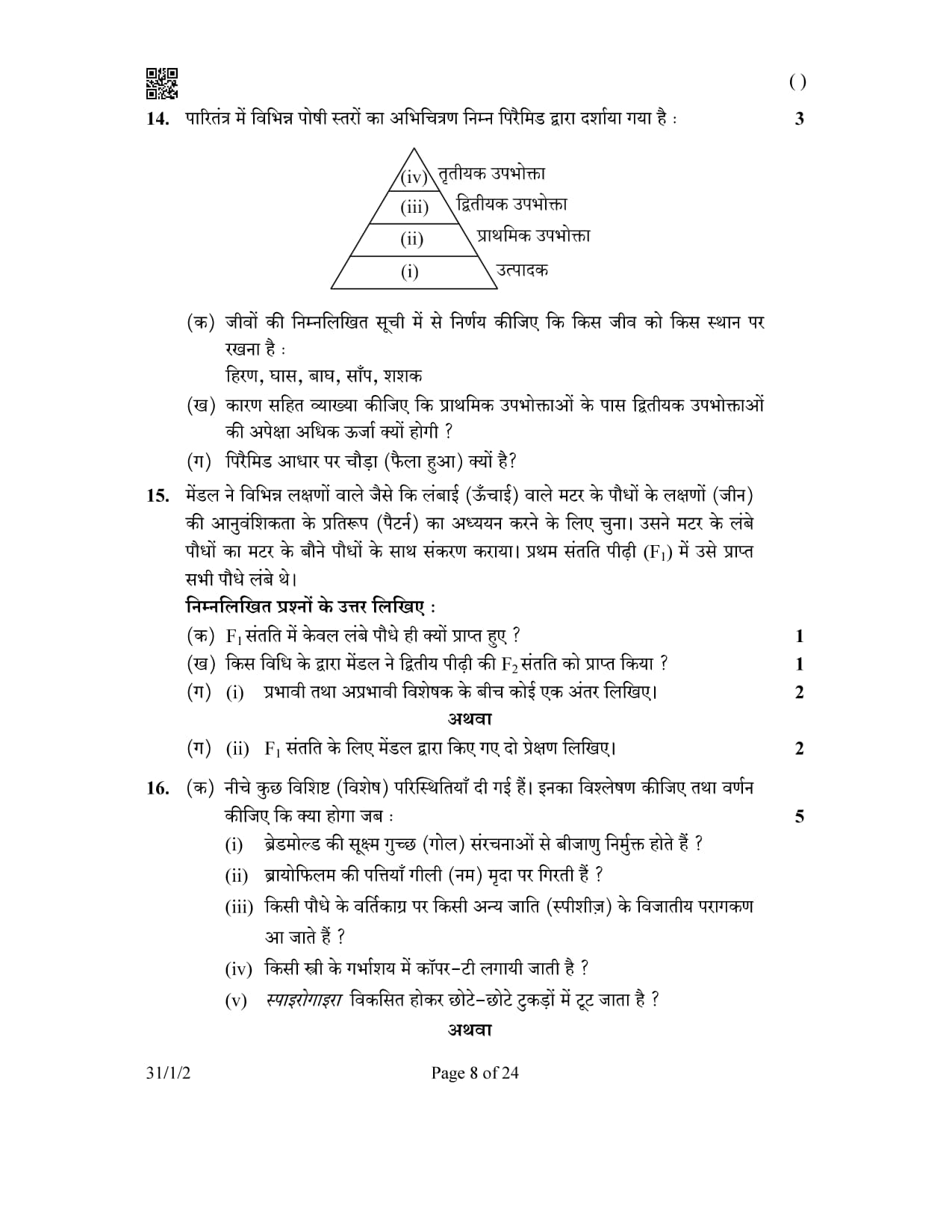
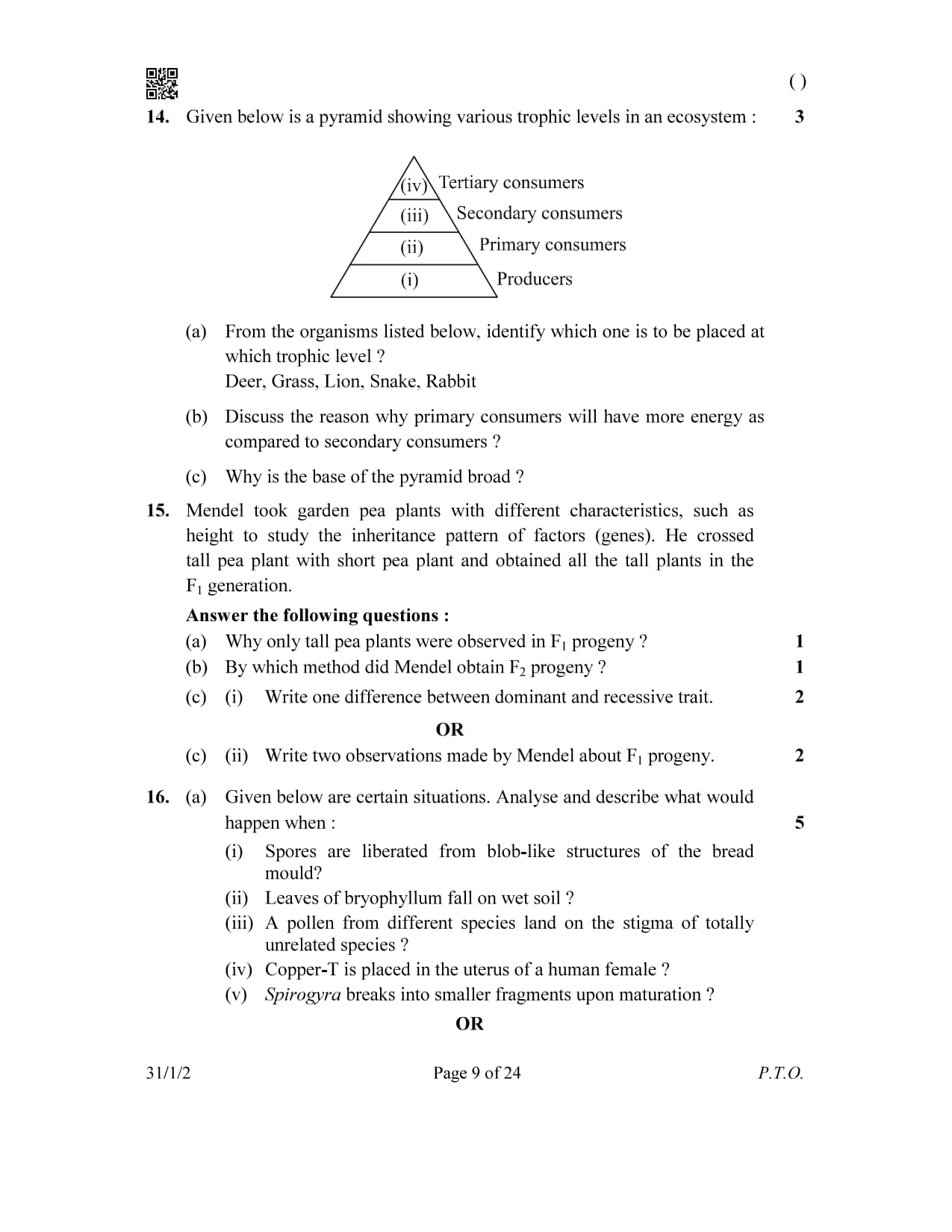
Given below is a pyramid showing various trophic levels in an ecosystem :

From the organisms listed below, identify which one is to be placed at which trophic level ?
Deer, Grass, Lion, Snake, Rabbit
View Solution
Step 1: Understanding the Question:
The question asks to assign five specific living organisms—Deer, Grass, Lion, Snake, and Rabbit—to their respective ecological trophic levels within a terrestrial ecological pyramid.
Trophic levels represent the successive nutritional feeding stages that organisms occupy in a grazing food chain, based on their source of nourishment.
Step 2: Key Formulas and Approach:
Identify the feeding niche and trophic status of each organism:
1. Trophic level (i) - Producers (\(T_1\)): Autotrophic photosynthetic plants capable of converting solar radiant energy into chemical energy.
2. Trophic level (ii) - Primary consumers (\(T_2\)): Herbivorous animals that feed directly on producers.
3. Trophic level (iii) - Secondary consumers (\(T_3\)): Primary carnivores that prey upon herbivores.
4. Trophic level (iv) - Tertiary consumers (\(T_4\)): Apex predators and top carnivores that prey upon smaller carnivores.
Match each given organism to its appropriate tier.
Step 3: Detailed Explanation:
- Level (i) Producers:
Grass is a chlorophyllous, autotrophic green plant that performs photosynthesis using sunlight, carbon dioxide, and water to synthesize glucose.
It occupies the first trophic level (\(T_1\)) at the broad base of the ecosystem pyramid. - Level (ii) Primary Consumers (Herbivores):
Deer and Rabbit are strictly herbivorous mammals whose diet consists entirely of vegetation, grasses, and shrubs.
They feed directly on the primary producers to obtain organic nutrients and occupy the second trophic level (\(T_2\)). - Level (iii) Secondary Consumers (Small Carnivores):
The Snake is a carnivorous predator that feeds on primary consumers (such as rodents, frogs, and small rabbits).
It occupies the third trophic level (\(T_3\)) as a secondary consumer. - Level (iv) Tertiary Consumers (Top Carnivores):
The Lion is a large apex predator occupying the highest trophic level (\(T_4\)) at the apex of the ecological pyramid.
Lions feed on herbivores (like deer) as well as other smaller carnivores, having no natural predators in the ecosystem.
Step 4: Final Answer:
The trophic placement of the given organisms is:
- Level (i) Producers: Grass
- Level (ii) Primary consumers: Deer and Rabbit
- Level (iii) Secondary consumers: Snake
- Level (iv) Tertiary consumers: Lion
\(T_1\) (Producers) \(\rightarrow\) Green plants, Phytoplankton, Grass.
\(T_2\) (Primary consumers) \(\rightarrow\) Herbivores (Deer, Rabbit, Grasshopper, Zooplankton).
\(T_3\) (Secondary consumers) \(\rightarrow\) Small carnivores (Snake, Frog, Fox, Small fish).
\(T_4\) (Tertiary consumers) \(\rightarrow\) Top carnivores / Apex predators (Lion, Tiger, Eagle, Shark).
Given below is a pyramid showing various trophic levels in an ecosystem :
Discuss the reason why primary consumers will have more energy as compared to secondary consumers ?
View Solution
Step 1: Understanding the Question:
The question asks to explain the thermodynamic and ecological reasons why the total amount of usable biological energy present at the primary consumer level is significantly greater than that available at the secondary consumer level.
Energy transfer between consecutive feeding tiers in an ecosystem is fundamentally governed by the laws of thermodynamics and the ten percent law of energy flow.
Step 2: Key Formulas and Approach:
State and apply Lindeman’s 10% Law of Energy Transfer:
According to Lindeman’s law, only approximately \(10\%\) of the energy entering any given trophic level is converted into organic biomass and made available to the next higher trophic level:
\[ E_{n+1} \approx 0.10 \times E_n \]
The remaining \(90\%\) of energy is dissipated through metabolic respiration, heat release, digestion, movement, excretion, and unconsumed biomass.
Contrast the energy received by primary consumers (\(T_2\)) from producers (\(T_1\)) with that received by secondary consumers (\(T_3\)) from primary consumers.
Step 3: Detailed Explanation:
- Solar radiant energy trapped by autotrophs (producers) represents the initial energy pool entering the biological community.
- When primary consumers (herbivores) ingest producer biomass, only about \(10\%\) of the energy stored in the consumed plants is transformed into herbivore body tissue.
- The remaining \(90\%\) of the ingested energy is lost from the food chain in several inevitable physiological pathways:
(i) Cellular respiration to generate ATP for bodily metabolic maintenance.
(ii) Dissipation into the surrounding environment as low-grade metabolic heat.
(iii) Energy lost in undigested fibrous materials discharged through excretory feces. - When secondary consumers (carnivores) feed upon primary consumers, they can only access the energy stored in the living tissue of the herbivores (which is already just \(10\%\) of the producer energy).
- Applying the \(10\%\) rule again, secondary consumers capture only about \(10\%\) of the herbivore energy for their own growth and storage (\(10\% \times 10\% = 1\%\) of original producer energy):
\[ E_{\text{secondary}} = 0.10 \times E_{\text{primary}} \implies E_{\text{primary}} = 10 \times E_{\text{secondary}} \] - For example, if green plants possess \(10,000\text{ J}\) of energy, primary consumers obtain \(1,000\text{ J}\), whereas secondary consumers receive only \(100\text{ J}\).
- Therefore, primary consumers possess approximately ten times more energy than secondary consumers because nine-tenths of the energy is lost at each trophic transition.
Step 4: Final Answer:
Primary consumers have more energy than secondary consumers because, according to Lindeman’s 10% Law, only \(10\%\) of the energy available at one trophic level is transferred to the next higher level, while \(90\%\) is lost to the environment as metabolic heat and life-process expenditure.
Producers (\(10,000\text{ J}\)) \(\rightarrow\) Primary Consumers (\(1,000\text{ J}\)) \(\rightarrow\) Secondary Consumers (\(100\text{ J}\)) \(\rightarrow\) Tertiary Consumers (\(10\text{ J}\)).
Energy flow is strictly UNIDIRECTIONAL and non-cyclic; it decreases progressively with every trophic level!
Given below is a pyramid showing various trophic levels in an ecosystem :
Why is the base of the pyramid broad ?
View Solution
Step 1: Understanding the Question:
The question asks to provide the ecological justification for why the foundational base tier of an ecological pyramid (representing producers) is depicted as broad and wide compared to the progressively narrowing upper tiers.
An ecological pyramid graphically depicts the quantitative parameters—such as numbers, biomass, or energy—distributed across the successive trophic levels of an ecosystem.
Step 2: Key Formulas and Approach:
Recall the foundational role of autotrophs (producers) in ecological energetics:
1. Solar Energy Trapping: Producers are the exclusive gateway for external solar energy to enter the living biological world via photosynthetic fixation.
2. Pyramid of Energy: Always strictly upright in all natural ecosystems because energy diminishes progressively at each ascending trophic level (\(E_1 > E_2 > E_3 > E_4\)).
3. Pyramid of Biomass: In terrestrial ecosystems, the standing crop of producer biomass vastly exceeds the biomass of all consumer levels combined.
Explain why a large base is ecologically necessary to sustain the trophic tiers above it.
Step 3: Detailed Explanation:
- The base of an ecological pyramid corresponds to the first trophic level (\(T_1\)), which is occupied by autotrophic producers (such as green plants, trees, grasses, and algae).
- The base is drawn broad due to the following fundamental ecological factors:
- 1. Maximum Energy Content:
Producers directly harness solar electromagnetic radiation and synthesize the totality of organic chemical energy that supports the entire ecosystem.
Because energy is dissipated irreversibly at each successive trophic transfer (\(90\%\) loss per step), the producer tier contains the absolute maximum energy of any level in the ecosystem. - 2. Maximum Biomass and Population Support:
In terrestrial ecosystems, the total dry weight (standing biomass) and physical abundance of green plants are vastly greater than those of herbivores and carnivores.
Because \(10\text{ kg}\) of plant matter is typically required to produce just \(1\text{ kg}\) of herbivore biomass, a vast base of vegetation is indispensable to support even a small population of primary consumers. - 3. Upright Pyramid Geometry:
As energy and biomass diminish sharply from producers to primary consumers, secondary consumers, and top carnivores, the rectangular blocks representing these quantities become progressively smaller.
This produces a tapering geometric structure with a wide, stable base and a narrow pointed apex.
Step 4: Final Answer:
The base of the pyramid is broad because it represents the producers, which possess the maximum biomass and maximum energy in the ecosystem. Since \(90\%\) of energy is lost at each subsequent trophic level, a massive foundation of producers is necessary to sustain the higher trophic levels.
1. Pyramid of Energy is ALWAYS upright—it can NEVER be inverted in any ecosystem (due to the Second Law of Thermodynamics).
2. Pyramid of Biomass is upright in terrestrial ecosystems (forests, grasslands), but inverted in aquatic ecosystems (oceans/ponds) where small phytoplankton support larger zooplankton/fish.
Mendel took garden pea plants with different characteristics, such as height to study the inheritance pattern of factors (genes). He crossed tall pea plant with short pea plant and obtained all the tall plants in the \(F_1\) generation. \ Answer the following questions :
Why only tall pea plants were observed in \(F_1\) progeny ?
View Solution
Step 1: Understanding the Question:
The question asks to explain the genetic principle why crossing a pure-breeding tall garden pea plant with a pure-breeding short (dwarf) garden pea plant yields an \(F_1\) (first filial) generation consisting exclusively of tall plants, with no dwarf or intermediate-height progeny.
This observation led Gregor Johann Mendel to formulate the fundamental Law of Dominance in genetics.
Step 2: Key Formulas and Approach:
Analyze the parental genotypes and gametes for this monohybrid cross:
Pure-breeding tall parent: Genotype \(TT\), produces gametes carrying allele \(T\).
Pure-breeding dwarf parent: Genotype \(tt\), produces gametes carrying allele \(t\).
\(F_1\) progeny genotype: Heterozygous \(Tt\) (formed by the combination of gametes \(T\) and \(t\)).
Apply Mendel’s Law of Dominance to explain why allele \(T\) masks allele \(t\) in the heterozygous condition.
Step 3: Detailed Explanation:
- In garden pea plants (*Pisum sativum*), stem height is a monogenic trait controlled by a single gene existing in two contrasting allelic forms:
- The allele for tallness, denoted by the uppercase letter \(T\).
- The allele for dwarfness (shortness), denoted by the lowercase letter \(t\). - When a true-breeding homozygous tall plant (\(TT\)) is crossed with a true-breeding homozygous short plant (\(tt\)):
- The tall parent segregates gametes, all carrying the dominant allele \(T\).
- The dwarf parent segregates gametes, all carrying the recessive allele \(t\). - Fertilization between these gametes produces an \(F_1\) generation with the uniform heterozygous genotype \(Tt\).
- According to Mendel’s Law of Dominance:
When two contrasting alleles for a particular character are brought together in a hybrid individual, only one allele expresses itself phenotypically, while the other allele remains completely unexpressed.
- The allele that expresses itself in the presence of the other is called the dominant allele (\(T\)).
- The allele that remains masked or unexpressed in the hybrid is called the recessive allele (\(t\)). - Because the allele for tall height (\(T\)) is completely dominant over the allele for short height (\(t\)), a single copy of \(T\) is sufficient to direct the synthesis of functional plant growth hormones (gibberellins) that produce normal stem elongation.
- Consequently, all \(F_1\) heterozygous plants (\(Tt\)) display the tall phenotype, completely masking the recessive dwarf trait.
Step 4: Final Answer:
Only tall pea plants were observed in the \(F_1\) progeny because the allele for tallness (\(T\)) is dominant over the allele for dwarfness (\(t\)). In the heterozygous \(F_1\) hybrid (\(Tt\)), the dominant allele completely expresses itself and masks the expression of the recessive dwarf allele, in accordance with Mendel’s Law of Dominance.
Characters are controlled by discrete units called factors (genes) that occur in pairs.
In a dissimilar pair of factors (\(Tt\)), one member of the pair dominates (dominant trait: Tall) and the other is dominated (recessive trait: Dwarf).
Phenotype of \(Tt\) is identical to \(TT\)!
By which method did Mendel obtain \(F_2\) progeny ?
View Solution
Step 1: Understanding the Question:
The question asks to identify the specific reproductive breeding technique utilized by Gregor Mendel to generate the second filial (\(F_2\)) generation from the first filial (\(F_1\)) hybrid plants.
Mendel needed to determine whether the dwarf trait had been permanently blended and destroyed in the \(F_1\) generation or remained latent.
Step 2: Key Formulas and Approach:
Recall the botanical mechanism used to breed pea plants across generations:
1. Generation of \(F_1\): Achieved by cross-pollination (artificial hybridization involving emasculation and manual pollen transfer between distinct homozygous lines).
2. Generation of \(F_2\): Achieved by self-pollination (allowing \(F_1\) flowers to naturally pollinate within themselves without external intervention).
Trace the genetic outcome of selfing heterozygous \(F_1\) plants (\(Tt \times Tt\)).
Step 3: Detailed Explanation:
- Mendel obtained the \(F_2\) generation by allowing the heterozygous tall plants of the \(F_1\) generation to undergo self-pollination (also termed selfing).
- Garden pea flowers are naturally cleistogamous and hermaphrodite (bisexual), having both stamens and carpels tightly enclosed within protective petal keels, which makes self-pollination their natural mode of reproduction.
- Mendel did not cross the \(F_1\) plants with external parent strains; instead, he simply allowed the \(F_1\) hybrid plants (\(Tt\)) to self-fertilize naturally:
\[ \text{Cross: } Tt\text{ (Tall)} \times Tt\text{ (Tall)} \] - During gamete formation in these \(F_1\) plants, the paired alleles \(T\) and \(t\) segregate cleanly from each other into different haploid gametes (Mendel’s Law of Segregation):
- \(50\%\) of male and female gametes carry the allele \(T\).
- \(50\%\) of male and female gametes carry the allele \(t\). - Random fertilization between these gametes produces four genotypic combinations in the \(F_2\) progeny:
- \(1\) out of \(4\) is homozygous dominant (\(TT\)) \(\rightarrow\) Tall.
- \(2\) out of \(4\) are heterozygous dominant (\(Tt\)) \(\rightarrow\) Tall.
- \(1\) out of \(4\) is homozygous recessive (\(tt\)) \(\rightarrow\) Dwarf. - This self-pollination yielded the famous \(F_2\) phenotypic ratio of \(3\text{ Tall} : 1\text{ Dwarf}\) (\(75\%\) tall, \(25\%\) dwarf), demonstrating that the recessive trait was preserved intact.
Step 4: Final Answer:
Mendel obtained the \(F_2\) progeny by self-pollination (or selfing) of the heterozygous \(F_1\) tall pea plants (\(Tt \times Tt\)).
Parent Generation (\(P\)) \(\rightarrow\) Cross-pollination between pure-line parents (\(TT \times tt\)) \(\rightarrow\) Yields \(F_1\) generation.
\(F_1\) Generation \(\rightarrow\) Self-pollination of hybrids (\(Tt \times Tt\)) \(\rightarrow\) Yields \(F_2\) generation (\(3:1\) phenotypic ratio).
Write one difference between dominant and recessive trait.
View Solution
Step 1: Understanding the Question:
The question asks to provide one clear, fundamental biological distinction between a dominant genetic trait and a recessive genetic trait in Mendelian inheritance.
Alleles express traits depending on whether they can produce functional phenotypic outcomes in single or double copy doses.
Step 2: Key Formulas and Approach:
Define both genetic traits on the basis of allelic dosage and phenotypic expression:
1. Dominant Trait: Manifests phenotypically in both homozygous condition (e.g., \(TT\)) and heterozygous condition (e.g., \(Tt\)).

2. Recessive Trait: Manifests phenotypically only in the homozygous condition (e.g., \(tt\)); its expression is suppressed when paired with an alternative dominant allele.
Step 3: Detailed Explanation:
- Definition and Expression of Dominant Trait:
A dominant trait is an inherited characteristic that is expressed in the phenotype of the organism even when only a single copy of its determining allele is present in the genotype.
It expresses itself equally in both the homozygous dominant state (such as \(TT\) for tall pea plants) and the heterozygous state (such as \(Tt\)).
A dominant allele produces a sufficient amount of functional protein or enzyme to elicit the full physical characteristic, masking the effect of any alternative partner allele. - Definition and Expression of Recessive Trait:
A recessive trait is an inherited characteristic that fails to express itself phenotypically in the presence of a dominant allele.
It can express its phenotype only when the organism is homozygous recessive for that gene (such as \(tt\) for dwarf pea plants), having received the recessive allele from both parents.
In the heterozygous state (\(Tt\)), the recessive trait remains dormant, concealed, and unexpressed. - Example in Pea Plants:
Tall stem height, purple flowers, and round yellow seeds are dominant traits, whereas dwarf stem height, white flowers, and wrinkled green seeds are recessive traits.
Step 4: Final Answer:
A dominant trait is expressed in both homozygous and heterozygous conditions (e.g., \(TT\) and \(Tt\)), whereas a recessive trait is expressed only in the homozygous condition (e.g., \(tt\)) and remains masked in the heterozygous state.
Dominant trait: Needs only ONE allele to show up (expressed in \(TT\) and \(Tt\)).
Recessive trait: Needs TWO copies of the allele to show up (expressed ONLY in \(tt\)).
Write two observations made by Mendel about \(F_1\) progeny.
View Solution
Step 1: Understanding the Question:
The question asks to state two major scientific observations recorded by Gregor Mendel concerning the phenotypic and genotypic characteristics of the first filial (\(F_1\)) generation resulting from crosses between contrasting pure-breeding parental pea plants.
These initial observations established that inheritance does not proceed through fluid blending of parental traits.
Step 2: Key Formulas and Approach:
Review Mendel’s foundational observations on monohybrid \(F_1\) crosses:
1. Phenotypic Uniformity and Dominance: All \(F_1\) individuals exclusively displayed the phenotype of one parent, with zero individuals exhibiting the alternative parental trait.
2. Absence of Blending / Intermediate Forms: No blending or intermediate intermediate-grade phenotypes (such as medium-height plants from tall \(\times\) short crosses) were produced.
3. Retention of Latent Information: Although the alternative parental trait was invisible in the \(F_1\) generation, it was not permanently destroyed or altered, as evidenced by its complete resurgence in the \(F_2\) generation.
Step 3: Detailed Explanation:
- When Mendel conducted reciprocal crosses between parental pea plants with contrasting pairs of traits (such as tall \(\times\) short plants, round \(\times\) wrinkled seeds, or purple \(\times\) white flowers), he recorded two vital observations regarding the \(F_1\) generation:
- Observation 1: Complete Expression of Only One Parental Trait (Dominance):
Mendel observed that all offspring in the \(F_1\) generation were completely identical to one of the parents for the character under study.
In the cross between a tall plant and a short plant, \(100\%\) of the \(F_1\) progeny were tall.
Not a single plant in the \(F_1\) generation displayed the short (dwarf) phenotype, showing that one parental factor was universally dominant over the other. - Observation 2: Complete Absence of Blending or Intermediate Phenotypes:
Prior to Mendel, the prevailing scientific belief was the "blending theory of inheritance," which predicted that crossing tall and dwarf plants would produce offspring of intermediate (medium) height.
Mendel observed that there was absolutely no blending of traits; none of the \(F_1\) plants were of medium height.
Furthermore, though the dwarf trait seemed to have disappeared entirely in the \(F_1\) generation, it was not destroyed or modified, because upon selfing these \(F_1\) plants, the dwarf trait reappeared completely intact in \(25\%\) of the \(F_2\) progeny.
Step 4: Final Answer:
Two observations made by Mendel about \(F_1\) progeny are:
1. Only one parental trait was expressed: All \(F_1\) plants exhibited the trait of only one parent (e.g., all were tall; no dwarf plants appeared).
2. No blending of traits: There were no intermediate or mixed characteristics (no medium-height plants), proving that traits are inherited as discrete, particulate units rather than blended fluids.
1. Phenotype of \(F_1\) = \(100\%\) dominant trait (Tall).
2. Genotype of \(F_1\) = \(100\%\) heterozygous (\(Tt\)).
3. Proved that hereditary factors (genes) are particulate and do not blend or dilute!
Given below are certain situations. Analyse and describe what would happen when :
Spores are liberated from blob-like structures of the bread mould?
View Solution
Step 1: Understanding the Question:
The question asks to analyze and describe the biological sequence of events that occurs when reproductive spores are released into the surrounding environment from the specialized spherical sporangia (blob-like structures) of the bread mould fungus (*Rhizopus*).
Spore formation is a prevalent asexual reproductive adaptation in fungi that facilitates survival and aerial dispersal across ecological niches.
Step 2: Key Formulas and Approach:
Recall the anatomical structure and life cycle of *Rhizopus*:
1. The non-reproductive vegetative body consists of fine, thread-like structures called hyphae.
2. Erect reproductive hyphae (sporangiophores) terminate in spherical, knob-like swellings called sporangia.
3. Inside each sporangium, repeated mitotic divisions package hundreds of minute, single-celled haploid spores surrounded by thick, durable protective walls.
Describe the events of dehiscence, dispersal, landing, and germination.
Step 3: Detailed Explanation:
- In the common bread mould *Rhizopus*, asexual reproduction is mediated by spore formation.
- The tiny, blob-like structures standing atop erect aerial hyphae are called sporangia.
- Within each mature sporangium, numerous microscopic, light-weight asexual spores are produced.
- When the sporangium reaches full maturity, its outer wall ruptures (dehiscence), liberating hundreds of microscopic spores into the surrounding air.
- Each individual spore is encapsulated within a thick, resilient, protective cell wall that shields its inner protoplasm against harsh environmental conditions, such as extreme temperatures, dry air, and lack of moisture.
- Because the liberated spores are extremely light and minute, air currents disperse them easily over considerable geographical distances.
- When these airborne spores happen to land on a suitable moist, warm, and nutrient-rich organic substrate—such as a slice of moist bread, decaying fruit, or damp organic matter—the protective outer wall absorbs water and breaks open.
- The spore germinates by sending out a tiny germ tube that rapidly elongates into a new network of white, branching fungal hyphae (mycelium).
- These hyphae secrete digestive enzymes onto the bread, absorb nutrients, and rapidly develop into a mature fungal colony, producing new sporangia to repeat the life cycle.
Step 4: Final Answer:
When spores are liberated from the sporangia, they are dispersed through the air. Protected by thick cell walls against unfavorable conditions, when they land on a moist, nutrient-rich surface (such as damp bread), they germinate and grow into new hyphae, establishing new bread mould colonies.
Hyphae \(\rightarrow\) Thread-like non-reproductive vegetative structures.
Sporangia \(\rightarrow\) Blob-like/knob-like reproductive structures atop sporangiophores.
Spores \(\rightarrow\) Thick-walled, light-weight reproductive units that disperse through air and germinate upon landing on moist organic matter.
Given below are certain situations. Analyse and describe what would happen when :
Leaves of bryophyllum fall on wet soil ?
View Solution
Step 1: Understanding the Question:
The question asks to analyze the biological consequence when detached leaves of the plant *Bryophyllum* fall onto moist, fertile soil.
*Bryophyllum* is a classic botanical example of natural vegetative propagation through modified leaves bearing adventitious foliar buds.
Step 2: Key Formulas and Approach:
Recall the specialized reproductive morphology of *Bryophyllum*:
1. The margins of *Bryophyllum* leaves have crenate notches containing dormant adventitious buds.
2. Soil moisture, favorable ambient temperature, and mineral nutrients act as environmental triggers that activate these dormant meristematic tissues.
3. Describe the growth of adventitious roots and shoots from the leaf notches to form independent plantlets.
Step 3: Detailed Explanation:
- *Bryophyllum* (commonly known as the air plant or miracle leaf) reproduces asexually through specialized vegetative propagation via its leaves.
- The margins of a *Bryophyllum* leaf are distinctly notched or serrated.
- In the crevices of these marginal notches lie clusters of dormant, meristematic cells known as epiphyllous (adventitious) foliar buds.
- Under normal conditions while attached to the parent stem, apical dominance and hormonal balances keep these marginal buds dormant.
- When a mature leaf detaches from the plant and falls onto moist, damp soil, the contact with moisture and soil nutrients breaks the dormancy of these buds.
- The cells of the adventitious buds undergo rapid mitotic cell division and differentiation:
- They sprout downward to produce tiny adventitious roots that anchor into the damp soil and absorb water and minerals.
- They sprout upward to produce miniature green shoot stems bearing small juvenile leaves. - As these small plantlets grow, the original parent leaf gradually decays and provides organic nutrients to the developing root systems.
- Each little plantlet eventually establishes its own root-shoot axis, developing into an entirely independent, mature, genetically identical *Bryophyllum* plant.
Step 4: Final Answer:
When leaves of *Bryophyllum* fall on wet soil, the adventitious buds present in the marginal notches sprout, developing adventitious roots and shoot stems. These develop into independent, genetically identical new plantlets through natural vegetative propagation.
Leaves \(\rightarrow\) Bryophyllum and Begonia (adventitious buds in leaf notches).
Stem \(\rightarrow\) Potato (eyes/buds on tuber), Ginger (buds on rhizome), Onion (bulb).
Roots \(\rightarrow\) Sweet potato, Dahlia.
Given below are certain situations. Analyse and describe what would happen when :
A pollen from different species land on the stigma of totally unrelated species ?
View Solution
Step 1: Understanding the Question:
The question asks to analyze and describe the botanical and physiological outcome when a pollen grain from one plant species is transferred and lands on the stigma of a flower belonging to a totally unrelated plant species.
Angiosperm flowers have evolved biochemical recognition systems (pollen-pistil interaction) that prevent interspecific fertilization to preserve species genetic integrity.
Step 2: Key Formulas and Approach:
Recall the mechanism of pollen-pistil interaction in flowering plants:
1. Pollination is merely the physical transfer of pollen and does not guarantee that fertilization will occur.
2. The pistil (specifically the stigma and style) possesses the specialized ability to recognize whether pollen is compatible (of the same species) or incompatible (foreign or self-incompatible).
3. This recognition is mediated by complex chemical dialogues involving signaling proteins and glycoproteins present on the pollen wall and the stigmatic surface.
Step 3: Detailed Explanation:
- When airborne or insect-borne pollen grains land on the sticky surface of a flower’s stigma, the stigma initiates a biochemical screening dialogue called pollen-pistil interaction.
- If the landing pollen belongs to a totally unrelated species, the chemical compounds present on the pollen exine and pollen coat do not match the specific receptor proteins on the stigmatic surface.
- The pistil immediately identifies the pollen as incompatible foreign pollen.
- Consequently, the stigma actively rejects the pollen through physiological barrier mechanisms:
(i) The stigma withholds the secretion of water and sugar solution, preventing the pollen grain from hydrating and germinating.
(ii) Even if initial hydration occurs, the emergence of a pollen tube through the germ pore is completely blocked and inhibited.
(iii) In rare cases where a rudimentary pollen tube begins to emerge, specialized callous plugs or cytotoxic style enzymes arrest its growth inside the style tissue, preventing it from ever reaching the ovary. - Because no functional pollen tube reaches the ovule, the male gametes cannot be delivered to the female embryo sac.
- Therefore, fertilization does not occur, and no seed or fruit is formed.
- This natural incompatibility mechanism is of paramount evolutionary significance, as it prevents cross-species hybridization and preserves the distinct genetic identity of each plant species.
Step 4: Final Answer:
When pollen from an unrelated species lands on a stigma, the pistil recognizes it as incompatible through biochemical pollen-pistil interaction and rejects it. The pollen fails to germinate and cannot produce a pollen tube; thus, fertilization does not take place, preventing interspecific hybridization.
1. Compatible pollen (same species) \(\rightarrow\) Stigma secretes moisture/sugars \(\rightarrow\) Pollen tube germinates \(\rightarrow\) Fertilization occurs.
2. Incompatible pollen (different species) \(\rightarrow\) Chemical rejection \(\rightarrow\) Pollen tube does not germinate \(\rightarrow\) Fertilization prevented.
Ensures genetic isolation of plant species!
Given below are certain situations. Analyse and describe what would happen when :
Copper-T is placed in the uterus of a human female ?
View Solution
Step 1: Understanding the Question:
The question asks to explain the biological mechanism of action and the physiological contraceptive consequences when a Copper-T device is clinically inserted into the uterus of a human female.
A Copper-T is a widely utilized intrauterine contraceptive device (IUCD) designed for long-term reversible birth control.
Step 2: Key Formulas and Approach:
Recall the mode of operation of Intrauterine Contraceptive Devices (IUCDs):
1. Mechanical action: Acts as a localized foreign body inside the uterine cavity.
2. Biochemical action: The device contains copper wire wound around a T-shaped plastic frame that steadily elutes copper ions (\(\text{Cu}^{2+}\)) into the uterine fluid.
3. Target processes: Affects sperm motility, sperm viability, fertilization capacity, and changes the endometrial lining to prevent blastocyst implantation.
Step 3: Detailed Explanation:
- A Copper-T is an intrauterine device (IUD) inserted by a medical professional through the cervix into the uterine cavity of a female.
- Once placed in the uterus, it functions as an effective contraceptive through multiple coordinated biochemical and cellular actions:
- 1. Continuous Release of Copper Ions (\(\text{Cu}^{2+}\)):
The copper wire wound around the frame slowly and continuously releases trace amounts of free copper ions into the uterine fluid and cervical mucus. - 2. Suppression of Sperm Motility and Viability:
Copper ions are toxic to spermatozoa; they alter the flagellar movement of sperms, drastically suppressing their motility and swimming speed.
As a result, sperms are rendered incapable of ascending through the uterine cavity to reach the fallopian tubes (oviducts) where the ovum resides. - 3. Reduction in Sperm Fertilizing Capacity:
Copper ions alter the acrosomal membrane and enzymatic cap of sperms, preventing the acrosome reaction required to penetrate the protective layers of the ovum. - 4. Local Inflammatory Response and Prevention of Implantation:
The physical presence of the foreign device inside the uterine lumen induces a harmless, non-infectious cellular inflammatory response, increasing phagocytosis of sperms by macrophages.
It also induces structural and biochemical alterations in the endometrium, making the uterine wall hostile and unreceptive to the implantation of a blastocyst if fertilization were ever to occur. - Note: While a Copper-T effectively prevents pregnancy, it does not provide any protection against sexually transmitted infections (STIs), such as HIV/AIDS or syphilis.
Step 4: Final Answer:
When a Copper-T is placed in the uterus, it releases copper ions that suppress sperm motility and reduce their fertilizing capacity, preventing sperms from reaching the egg. It also alters the uterine lining to prevent implantation, thereby effectively preventing pregnancy.
Barrier methods (Condoms) \(\rightarrow\) Block sperm entry physically; ALSO protect against STIs!
Chemical methods (Oral pills) \(\rightarrow\) Alter hormonal balance to stop ovulation.
IUCDs (Copper-T) \(\rightarrow\) Inserted in uterus; releases \(\text{Cu}^{2+}\) to suppress sperm motility and prevent implantation; DOES NOT protect against STIs.
Surgical methods (Vasectomy/Tubectomy) \(\rightarrow\) Permanent sterilization.
Given below are certain situations. Analyse and describe what would happen when :
Spirogyra breaks into smaller fragments upon maturation ?
View Solution
Step 1: Understanding the Question:
The question asks to analyze and describe the biological event that follows when a mature multicellular filamentous green alga, *Spirogyra*, undergoes natural fragmentation into smaller pieces.
Fragmentation is an asexual reproductive strategy exhibited by multicellular organisms that possess simple, unspecialized body organizations.
Step 2: Key Formulas and Approach:
Recall the structural and reproductive biology of *Spirogyra*:
1. *Spirogyra* is a multicellular, unbranched filamentous green alga with ribbon-like spiral chloroplasts.
2. Its body organization is relatively simple, consisting of a linear chain of identical cylindrical cells placed end-to-end without organ differentiation or specialized tissues.
3. Every individual vegetative cell contains a nucleus, cytoplasm, and chloroplast, retaining the full capacity for mitotic division and autonomous survival.
Step 3: Detailed Explanation:
- *Spirogyra* thrives in freshwater ponds and slow-moving streams, forming free-floating green slimy mats.
- It reproduces asexually through the process of fragmentation.
- When a *Spirogyra* filament reaches full growth and maturity, the middle lamellae between adjacent cells may soften, or external mechanical agitation (such as water currents or contact with aquatic animals) causes the long filament to break apart into two or more smaller fragments.
- Because *Spirogyra* possesses a simple body plan where all cells along the filament are virtually identical and functionally autonomous, each separated fragment contains viable, living vegetative cells.
- None of the fragments die; instead, the cells within each piece immediately begin active metabolic activity.
- The cells undergo repeated transverse mitotic divisions and subsequent cellular elongation along the longitudinal axis.
- As cell division and expansion continue, each broken fragment grows into an independent, full-length, mature *Spirogyra* filament capable of reproducing again upon maturity.
- This process allows *Spirogyra* to multiply rapidly and colonize large freshwater aquatic habitats in a very short period under favorable light and nutrient conditions.
Step 4: Final Answer:
When *Spirogyra* breaks into smaller fragments upon maturation, each individual fragment survives, undergoes repeated mitotic cell divisions, and grows into a complete, independent, new *Spirogyra* filament through fragmentation.
Spirogyra has a simple multicellular body where every cell is identical and capable of independent division.
Complex multicellular organisms (like humans or birds) have specialized organ systems, so fragmented body parts cannot regenerate an entire organism!
Given below are certain situations. Analyse each and describe its possible impact :
A population of bacteria living in temperate waters whose temperature increased by global warming.
View Solution
Step 1: Understanding the Question:
The question asks to analyze the biological consequence and ecological impact on a bacterial population adapted to temperate (moderate) aquatic habitats when ambient water temperatures rise significantly due to global warming.
This scenario illustrates the evolutionary significance of genetic variation and natural selection in ensuring the survival of a species during environmental shifts.
Step 2: Key Formulas and Approach:
Recall the relationship between genetic variation, natural selection, and environmental adaptation:
1. Asexual bacterial populations replicate their DNA during binary fission; minor biochemical inaccuracies introduce subtle genetic variations within the population.
2. In a stable temperate aquatic niche, most bacteria are adapted to cooler temperatures.
3. An environmental shock (thermal stress via global warming) creates intense selective pressure.
Distinguish between the fate of the temperature-sensitive majority and the rare heat-resistant variants.
Step 3: Detailed Explanation:
- Bacteria reproduce rapidly via asexual binary fission, during which small copying errors in DNA introduce subtle genetic variations among individual bacterial cells.
- In a population of bacteria living in temperate waters, the vast majority of individuals are physiologically adapted to moderate, cool water temperatures.
- When global warming causes a substantial increase in ambient water temperatures, the physicochemical environment becomes hostile and stressful for the species:
- The vast majority of the bacteria are temperature-sensitive; the elevated heat denatures their metabolic enzymes, destabilizes their cellular membranes, and disrupts vital physiological functions.
- Consequently, most of the bacterial population will perish due to thermal shock. - However, due to pre-existing genetic variations, a small subset of bacterial variants within the population possess alleles that confer heat resistance (e.g., heat-shock proteins or heat-tolerant cell membranes).
- These rare heat-resistant bacterial variants are able to survive the high-temperature water.
- Free from competition from the deceased majority, the surviving heat-tolerant bacteria multiply rapidly through binary fission, passing their adaptive traits to their offspring.
- Over successive generations, the entire bacterial population becomes adapted to the warmer aquatic environment.
- Therefore, genetic variation acts as an evolutionary buffer that prevents the complete extinction of the bacterial species in that ecological niche.
Step 4: Final Answer:
Most of the temperature-sensitive bacteria in the population will die due to thermal stress and enzyme denaturation. However, a few heat-resistant variants will survive and multiply, ensuring the survival and adaptation of the bacterial species in the warmed environment.
Variation is beneficial to the SPECIES rather than the individual.
If a niche changes drastically (e.g., global warming heating temperate waters), pre-existing variants survive, preventing complete extinction of the species!
Given below are certain situations. Analyse each and describe its possible impact :
The sperm encounters the egg when it reaches the oviduct in human females.
View Solution
Step 1: Understanding the Question:
The question asks to describe the physiological and reproductive events that occur when a motile sperm encounters a viable secondary oocyte (egg) inside the oviduct (fallopian tube) of a human female.
The oviduct, specifically the ampullary-isthmic junction, is the natural anatomical site where fertilization and syngamy occur in the human reproductive system.
Step 2: Key Formulas and Approach:
Trace the biological sequence of fertilization and early embryogenesis:
1. Sperm capacitation and penetration through the outer cellular layers of the ovum (corona radiata and zona pellucida).
2. Acrosome reaction and the cortical reaction to establish a block to polyspermy.
3. Syngamy: Fusion of the haploid sperm nucleus (\(n = 23\)) with the haploid egg nucleus (\(n = 23\)) to form a single diploid cell, the zygote (\(2n = 46\)).
4. Subsequent mitotic cleavage divisions leading to blastocyst formation and uterine implantation.
Step 3: Detailed Explanation:
- In human reproduction, following ovulation, the secondary oocyte is swept into the infundibulum and conveyed along the oviduct (fallopian tube) toward the ampulla.
- When viable sperms introduced via insemination swim through the cervix and uterus and reach the oviduct simultaneously, an encounter between sperm and egg takes place.
- Fertilization Process:
(i) The sperm binds to the outer protective glycoprotein coat of the egg called the zona pellucida.
(ii) The acrosome at the head of the sperm releases hydrolytic enzymes (such as hyaluronidase and acrosin) that dissolve the follicular cells of the corona radiata and digest a microscopic pathway through the zona pellucida.
(iii) As soon as the first sperm touches the egg’s plasma membrane, a rapid depolarization of the membrane and release of cortical granules occur (cortical reaction), instantly rendering the zona pellucida impermeable to any additional sperms, preventing polyspermy.
(iv) The haploid nucleus of the successful sperm enters the cytoplasm of the ovum, stimulating the egg to complete its second meiotic division.
(v) The haploid pronucleus of the sperm fuses completely with the haploid pronucleus of the ovum (syngamy), combining maternal and paternal chromosomes to establish a diploid zygote (\(2n = 46\)). - Subsequent Developmental Impact:
The resulting single-celled zygote immediately begins a rapid succession of mitotic cleavage divisions as it travels along the oviduct toward the uterus, developing from a morula into a hollow ball of cells called a blastocyst.
Approximately 6 to 7 days after fertilization, the blastocyst embeds into the thickened endometrial lining of the uterus (implantation), successfully initiating pregnancy (gestation).
Step 4: Final Answer:
When the sperm encounters the egg in the oviduct, fertilization occurs. The fusion of their haploid nuclei forms a single-celled diploid zygote, which undergoes mitotic cleavage divisions to form a blastocyst that implants into the uterine wall, establishing pregnancy.
Site of fertilization \(\rightarrow\) Oviduct (Fallopian tube, specifically ampulla).
Site of implantation \(\rightarrow\) Endometrium of the Uterus.
Result of fertilization \(\rightarrow\) Restores diploid chromosome number (\(2n = 46\)) and initiates pregnancy!
Given below are certain situations. Analyse each and describe its possible impact :
Self pollination does not occur in a flower that contains only pistil.
View Solution
Step 1: Understanding the Question:
The question asks to explain why self-pollination cannot take place in a unisexual flower that possesses only a pistil (female organ) and to describe the biological consequences of this reproductive condition.
Flowers may be bisexual (containing both stamens and carpels) or unisexual (possessing only one of the two reproductive whorls).
Step 2: Key Formulas and Approach:
Recall the definition and anatomical prerequisites of pollination types:
1. Self-pollination (Autogamy): The transfer of pollen grains from the anther of a stamen to the stigma of the *same* individual flower.
2. Pistillate (Female) Flower: An imperfect unisexual flower possessing only the gynoecium (pistil/carpel) and completely lacking the androecium (stamens/anthers).
Analyze the physical impossibility of autogamy in such a flower and deduce its reliance on cross-pollination.
Step 3: Detailed Explanation:
- A flower that contains only a pistil and completely lacks stamens is anatomically classified as an incomplete, unisexual female flower, termed a pistillate flower (examples include papaya, watermelon, and cucumber).
- By biological definition, self-pollination (autogamy) requires the transfer of pollen grains from the anther of a flower directly to the stigma of the *very same flower*.
- Because a pistillate flower contains only the female reproductive organ (gynoecium: stigma, style, and ovary) and possesses no stamens or anthers whatsoever, it produces zero pollen grains within its floral structure.
- Therefore, it is physically, mechanically, and anatomically impossible for self-pollination to occur in this flower.
- Impact and Evolutionary Consequence:
(i) To achieve fertilization and produce seeds and fruits, the flower must depend entirely on cross-pollination (allogamy / xenogamy).
(ii) It requires external biotic or abiotic pollinating agents—such as honeybees, butterflies, beetles, or wind currents—to transport compatible pollen grains from a separate staminate (male) or bisexual flower of the same species to its receptive stigma.
(iii) If suitable pollinators are absent or fail to visit the flower, pollination will not occur, the unfertilized ovules will wither, and the flower will fail to set fruit and drop from the plant.
(iv) From an evolutionary standpoint, the unisexual condition strictly promotes cross-pollination, which combines genetic material from two distinct parent plants, generating vital genetic variations and preventing inbreeding depression.
Step 4: Final Answer:
Self-pollination cannot occur because the flower contains only a pistil and completely lacks stamens to produce pollen. Consequently, the flower must rely entirely on cross-pollination by external agents (insects, wind) to receive pollen from another flower to achieve fertilization and fruit development.
Bisexual flower (Hibiscus, Mustard) \(\rightarrow\) Can undergo both Self-pollination and Cross-pollination.
Unisexual flower (Papaya, Watermelon) \(\rightarrow\) Pistillate (female) flowers CANNOT self-pollinate; they strictly undergo CROSS-POLLINATION!
Cross-pollination introduces genetic diversity and evolutionary vigor.
Given below are certain situations. Analyse each and describe its possible impact :
Egg does not get fertilised in a human female.
View Solution
Step 1: Understanding the Question:
The question asks to analyze and describe the sequence of physiological and hormonal events that takes place in the human female reproductive system when an ovulated egg (secondary oocyte) fails to be fertilized by a sperm.
The female reproductive cycle is characterized by rhythmic monthly modifications in the ovaries and the uterine lining, coordinated to support potential pregnancy.
Step 2: Key Formulas and Approach:
Recall the phases and hormonal regulation of the human menstrual cycle:
1. In preparation for a possible pregnancy, the endometrium of the uterus thickens, becomes soft, and develops a rich network of blood capillaries under the influence of progesterone and estrogen.
2. An unfertilized ovum has a limited lifespan of approximately \(24\) hours following ovulation.
3. In the absence of fertilization, the corpus luteum in the ovary degenerates into the inactive corpus albicans.
4. Progesterone levels fall precipitously, causing the breakdown and sloughing off of the endometrial lining, culminating in menstruation.
Step 3: Detailed Explanation:
- Every month, one ovary in a sexually mature human female releases an egg (secondary oocyte) during ovulation, which moves into the fallopian tube.
- Simultaneously, in anticipation of receiving a fertilized zygote, the uterine lining (endometrium) thickens, becomes highly spongy, and develops dense networks of blood vessels and glands under the influence of estrogen and progesterone secreted by the corpus luteum.
- The released ovum survives in the fallopian tube for approximately \(24\) hours.
- If fertilization does not take place because sperms are absent or fail to fuse with the egg, the unfertilized egg degenerates.
- Hormonal and Uterine Breakdown:
(i) In the absence of pregnancy, the empty ovarian follicle (corpus luteum) degenerates and ceases its secretion of the hormone progesterone.
(ii) As progesterone and estrogen blood concentrations drop sharply, the thickened endometrial lining of the uterus can no longer be maintained.
(iii) The spiral arterioles of the endometrium constrict, cutting off blood supply, which causes the mucosal tissue to break down and slough off.
(iv) The shed epithelial lining, ruptured blood vessels, mucus, and degenerated ovum are discharged out through the cervix and vagina in the form of menstrual flow. - This process is called menstruation, which typically lasts between \(3\) to \(5\) days.
- Following menstruation, the pituitary gland secretes follicle-stimulating hormone (FSH) to initiate the growth of a new ovarian follicle, resetting the menstrual cycle for the subsequent month.
Step 4: Final Answer:
If the egg is not fertilized, the unfertilized ovum degenerates, and the corpus luteum ceases progesterone secretion. Deprived of progesterone, the thickened, spongy uterine lining breaks down, and blood and tissue are discharged through the vagina as menstruation (menstrual flow), after which a new cycle begins.
Ovulation \(\rightarrow\) Egg lives \(\sim 24\text{ hours}\) unfertilized \(\rightarrow\) Corpus luteum degenerates \(\rightarrow\) Progesterone plunges \(\rightarrow\) Uterine lining (endometrium) breaks down \(\rightarrow\) Menstruation occurs (lasts 3 to 5 days).
Given below are certain situations. Analyse each and describe its possible impact :
When the seed is placed under appropriate condition of water and air in the soil ?
View Solution
Step 1: Understanding the Question:
The question asks to analyze and describe the physiological and anatomical transformation that occurs when a mature, dormant plant seed is provided with suitable environmental conditions—specifically adequate water (moisture), air (oxygen), and warmth in the soil.
This process of transition from metabolic dormancy to active embryonic growth is defined as seed germination.
Step 2: Key Formulas and Approach:
Identify the core components of a seed and their roles during germination:
1. Seed Coat (Testa): Tough protective outer layer containing a micropyle pore.
2. Cotyledons / Endosperm: Food storage reservoirs containing starch, proteins, and lipids.
3. Embryo: Contains the embryonic root (radicle) and embryonic shoot (plumule).
Trace the biochemical and physical steps: Imbibition \(\rightarrow\) Enzyme activation \(\rightarrow\) Emergence of radicle and plumule \(\rightarrow\) Seedling establishment.
Step 3: Detailed Explanation:
- A dry, mature seed contains an embryo in a metabolically inactive state of dormancy, protected by a hard outer seed coat (testa).
- When the seed is placed in soil under appropriate conditions of moisture (water), oxygen (air), and suitable temperature, seed germination is initiated:
- 1. Imbibition and Rupture of Seed Coat:
The seed rapidly absorbs water from the soil through a microscopic opening called the micropyle.
This physical absorption (imbibition) causes the seed to swell, softening the seed coat and eventually rupturing it, allowing the embryo inside to expand. - 2. Enzymatic Activation and Food Mobilization:
The absorbed water activates hydrolytic enzymes (such as amylases and proteases) within the seed tissues.
These enzymes digest and convert insoluble stored starch and proteins in the cotyledons or endosperm into soluble glucose and amino acids. - 3. Cellular Respiration Using Atmospheric Air:
Oxygen present in the soil air is utilized by the embryo for aerobic cellular respiration, generating substantial quantities of ATP energy to fuel rapid cell division and elongation. - 4. Growth of the Embryonic Axis:
- The radicle (embryonic root) is the first structure to emerge through the ruptured seed coat; it grows geotropically downward into the soil to form the primary root system that anchors the plant and absorbs water.
- Subsequently, the plumule (embryonic shoot) emerges and grows phototropically upward toward the soil surface, developing into the primary stem and unfolding the first green photosynthetic leaves. - Once green leaves emerge and begin autotrophic photosynthesis, the young seedling becomes an independent, self-sustaining plant.
Step 4: Final Answer:
When a seed is placed in soil with adequate water and air, it undergoes germination. Water softens the seed coat and activates enzymes that mobilize stored food, while oxygen fuels cellular respiration; the radicle grows downward to form roots, and the plumule grows upward to form the shoot, establishing a new green seedling.
Water \(\rightarrow\) Swells seed, softens coat, activates digestive enzymes.
Oxygen (Air) \(\rightarrow\) Enables cellular respiration to generate ATP for growth.
Radicle \(\rightarrow\) Develops into ROOT (grows downwards).
Plumule \(\rightarrow\) Develops into SHOOT (grows upwards).
Cotyledons \(\rightarrow\) Store food for the developing embryo until green leaves form!
When an element ‘X’ reacts with water, it starts floating. Identify the element ‘X’ :
View Solution
Step 1: Understanding the Question:
The question asks to identify a chemical element ‘X’ that undergoes a reaction with cold water such that it begins to float upon the surface of the water during the process.
Metals exhibit varying degrees of reactivity when exposed to water, depending on their position in the electrochemical reactivity series and the thermodynamics of their oxidation.
Step 2: Key Formulas and Approach:
Examine the chemical reactions of the metals listed in the options with water:
1. Potassium (\(\text{K}\)) and Sodium (\(\text{Na}\)): React violently and highly exothermically with cold water; the evolved hydrogen gas catches fire immediately.
2. Calcium (\(\text{Ca}\)): Reacts less violently with water; the heat evolved is insufficient for hydrogen to catch fire, and the liberated gas bubbles adhere to the metal surface.
3. Iron (\(\text{Fe}\)): Does not react with cold or hot water; reacts only with steam.
Write and balance the chemical equation for the reaction of calcium with water:
\[ \text{Ca (s)} + 2\text{H}_2\text{O (l)} \longrightarrow \text{Ca(OH)}_2\text{ (aq)} + \text{H}_2\text{ (g)} \]
Step 3: Detailed Explanation:
- When alkali metals like Sodium (\(\text{Na}\)) and Potassium (\(\text{K}\)) are dropped into water, they react instantaneously and with explosive violence.
The reaction is intensely exothermic, generating sufficient heat to ignite the liberated hydrogen gas immediately, causing potassium to burn with a characteristic lilac flame and sodium with a golden-yellow flame.
Although sodium and potassium are less dense than water and melt into silvery globes that dart across the surface while burning, their primary characteristic is violent ignition rather than quiet buoyant flotation. - When Calcium (\(\text{Ca}\)) is placed in water, the reaction proceeds at a moderate, controlled pace:
\[ \text{Ca (s)} + 2\text{H}_2\text{O (l)} \longrightarrow \text{Ca(OH)}_2\text{ (aq)} + \text{H}_2\text{ (g)} \] - The enthalpy of this reaction is comparatively low, so the heat evolved is not enough to ignite the escaping hydrogen gas.
- Instead, fine bubbles of hydrogen gas (\(\text{H}_2\)) form continuously on the submerged solid surfaces of the calcium pieces.
- These gas bubbles stick firmly to the surface of the calcium metal granules.
- The adhered hydrogen bubbles act as miniature buoyancy floats, lowering the effective overall density of the metal-bubble composite below that of liquid water.
- As a direct mechanical result, the calcium metal rises upward and floats on the surface of the water while continuing to react and forming a cloudy suspension of calcium hydroxide (slaked lime).
- Iron (\(\text{Fe}\)) does not react with cold water at all; it reacts only with steam at high temperatures (\(3\text{Fe} + 4\text{H}_2\text{O(g)} \rightarrow \text{Fe}_3\text{O}_4 + 4\text{H}_2\)), and being dense, it sinks immediately to the bottom.
- Therefore, element ‘X’ is definitively identified as Calcium.
Step 4: Final Answer:
The element ‘X’ is Calcium, because it reacts with water to produce hydrogen gas bubbles that stick to its surface, causing it to float, corresponding to option (B).
\(\text{K}\) and \(\text{Na} \rightarrow\) React violently with cold water; \(\text{H}_2\) catches fire immediately.
\(\text{Ca} \rightarrow\) Reacts less violently; \(\text{H}_2\) does NOT catch fire; floats because \(\text{H}_2\) bubbles stick to it!
\(\text{Mg} \rightarrow\) Reacts with hot water; ALSO floats because \(\text{H}_2\) bubbles stick to it!
\(\text{Al}\), \(\text{Fe}\), \(\text{Zn} \rightarrow\) React only with steam.
\(\text{Pb}\), \(\text{Cu}\), \(\text{Ag}\), \(\text{Au} \rightarrow\) Do not react with water or steam at all.
The natural sources of oxalic acid, lactic acid and methanoic acid respectively are :
View Solution
Step 1: Understanding the Question:
The question asks to identify the correct sequential combination of natural biological sources that contain three specific organic carboxylic acids: oxalic acid, lactic acid, and methanoic acid (formic acid).
Naturally occurring organic acids are synthesized by various plants and animals for metabolic functions or defense mechanisms.
Step 2: Key Formulas and Approach:
Identify the natural botanical and zoological sources of the three given organic acids:
1. Oxalic acid (\(\text{H}_2\text{C}_2\text{O}_4\) or \(\text{(COOH)}_2\)): Abundantly present in tomatoes and spinach.
2. Lactic acid (\(\text{CH}_3\text{CH(OH)COOH}\)): Formed by the bacterial fermentation of milk sugar (lactose) by *Lactobacillus*, naturally found in curd and sour milk.
3. Methanoic acid (Formic acid, \(\text{HCOOH}\)): Injected as a defensive chemical irritant in ant stings and nettle leaf hair stings.
Match the three natural sources in the exact sequential order requested.
Step 3: Detailed Explanation:
- 1. Source of Oxalic Acid:
Oxalic acid is a dicarboxylic acid naturally found in significant concentrations in tomatoes (as well as in spinach, rhubarb, and wood sorrel).
It imparts a mild characteristic tang to tomatoes.
In contrast, citrus fruits like oranges and lemons contain citric acid and ascorbic acid (vitamin C), not oxalic acid.
This eliminates options (C) and (D) where orange is listed as the source of oxalic acid. - 2. Source of Lactic Acid:
Lactic acid (2-hydroxypropanoic acid) is produced during the fermentation of lactose by lactic acid bacteria (*Lactobacillus* species).
It is the characteristic organic acid responsible for the sour taste and curdling of curd and sour milk.
Fresh sweet milk contains negligible amounts of free lactic acid, while orange contains citric acid.
This eliminates option (B) where orange is erroneously paired with lactic acid. - 3. Source of Methanoic Acid:
Methanoic acid, commonly referred to by its trivial name formic acid (\(\text{HCOOH}\)), is the simplest carboxylic acid.
It is secreted as a chemical deterrent by red ants in their ant-sting and by the stinging hairs of nettle leaves (*Urtica dioica*).
When an ant bites, it injects methanoic acid into the skin, causing acute burning pain, inflammation, and localized redness, which can be neutralized by applying a mild base such as baking soda (\(\text{NaHCO}_3\)) or calamine solution. - Examining the order in Option (A):
- Oxalic acid \(\rightarrow\) Tomato
- Lactic acid \(\rightarrow\) Curd
- Methanoic acid \(\rightarrow\) Ant-sting
This corresponds precisely to the requested sequence.
Step 4: Final Answer:
The natural sources of oxalic acid, lactic acid, and methanoic acid respectively are tomato, curd, and ant-sting, corresponding to option (A).
Vinegar \(\rightarrow\) Acetic acid (Ethanoic acid).
Orange / Lemon \(\rightarrow\) Citric acid.
Tamarind / Unripe Grapes \(\rightarrow\) Tartaric acid.
Tomato \(\rightarrow\) Oxalic acid.
Sour milk / Curd \(\rightarrow\) Lactic acid.
Ant sting / Nettle sting \(\rightarrow\) Methanoic acid (Formic acid).
Which of the following is a poor conductor of electricity ?
View Solution
Step 1: Understanding the Question:
The question asks to identify which of the four given metallic elements—Lead (\(\text{Pb}\)), Copper (\(\text{Cu}\)), Silver (\(\text{Ag}\)), or Aluminium (\(\text{Al}\))—exhibits comparatively poor electrical conductivity.
Electrical conductivity in metals depends on the availability, drift velocity, and mean free path of delocalized conduction electrons within the metallic crystal lattice.
Step 2: Key Formulas and Approach:
Recall that electrical conductivity (\(\sigma\)) is the reciprocal of electrical resistivity (\(\rho\)):
\[ \sigma = \frac{1}{\rho} \]
Compare the electrical resistivities (\(\rho\) in \(\Omega\cdot\text{m}\) at \(20^\circ\text{C}\)) of the given metals:
- Silver (\(\text{Ag}\)): \(\rho \approx 1.60 \times 10^{-8}\ \Omega\cdot\text{m}\) (best electrical conductor among all metals).
- Copper (\(\text{Cu}\)): \(\rho \approx 1.62 \times 10^{-8}\ \Omega\cdot\text{m}\) (second best conductor, widely used for domestic wiring).
- Aluminium (\(\text{Al}\)): \(\rho \approx 2.63 \times 10^{-8}\ \Omega\cdot\text{m}\) (excellent lightweight conductor for overhead power cables).
- Lead (\(\text{Pb}\)): \(\rho \approx 22.0 \times 10^{-8}\ \Omega\cdot\text{m}\) (comparatively high resistivity, making it a poor conductor).
Step 3: Detailed Explanation:
- Most metals are characterized by high electrical conductivity because their outermost valence electrons are loosely held, forming a sea of free electrons that drift easily under an applied potential difference.
- However, the degree of electrical conductivity varies widely among different metals depending on their atomic structure and electronic scattering mechanisms:
- Silver (\(\text{Ag}\)): Possesses the lowest electrical resistivity of all elements (\(1.60 \times 10^{-8}\ \Omega\cdot\text{m}\)) and is universally recognized as the best metallic conductor of electricity and heat.
- Copper (\(\text{Cu}\)): Exhibits the second-highest electrical conductivity (\(1.62 \times 10^{-8}\ \Omega\cdot\text{m}\)), offering nearly identical conductivity to silver at a vastly lower commercial cost, making it the premier material for electrical cables.
- Aluminium (\(\text{Al}\)): Has very low resistivity (\(2.63 \times 10^{-8}\ \Omega\cdot\text{m}\)) and low mass density, making it an excellent electrical conductor for long-distance overhead transmission lines.
- Lead (\(\text{Pb}\)): In sharp contrast, lead has an electrical resistivity of approximately \(22.0 \times 10^{-8}\ \Omega\cdot\text{m}\), which is more than \(13\) times higher than that of silver and copper.
- The heavy atomic nucleus, complex electronic configuration, and significant electron-phonon scattering in lead severely impede the drift mobility of charge carriers.
- Consequently, along with mercury (\(\text{Hg}\)), lead is classified in standard chemistry textbooks as a comparatively poor conductor of heat and electricity among metals.
Step 4: Final Answer:
Among the given metals, Lead (\(\text{Pb}\)) is a poor conductor of electricity, corresponding to option (A).
Best conductors of heat and electricity \(\rightarrow\) Silver (\(\text{Ag}\)) followed by Copper (\(\text{Cu}\)).
Poor conductors of heat and electricity \(\rightarrow\) Lead (\(\text{Pb}\)) and Mercury (\(\text{Hg}\)).
Remember: While all metals conduct, \(\text{Pb}\) and \(\text{Hg}\) have the highest resistivities among common elemental metals!
Which of the following functional group is for carboxylic acid ?
View Solution
Step 1: Understanding the Question:
The question asks to identify the correct structural chemical representation of the functional group characteristic of carboxylic acids among the provided structural options.
A functional group is an atom or a specific group of atoms bonded together within an organic molecule that dictates the characteristic chemical properties and reactivity of that homologous series.
Step 2: Key Formulas and Approach:
Review the standard structural formulae of the major organic functional groups studied in Class 10 chemistry:
1. Alcohol group: A hydroxyl group (\(-\text{OH}\)) bonded directly to a carbon atom.
2. Carboxylic acid group (Carboxyl group): A carbon atom bonded simultaneously to a carbonyl oxygen via a double bond and a hydroxyl group via a single bond: \(-\text{COOH}\) or \(-\text{C}(=\text{O})-\text{OH}\).
3. Ketone group: A carbonyl carbon atom bonded to an oxygen atom via a double bond and flanked by two alkyl carbon chains: \(>\text{C}=\text{O}\).
4. Aldehyde group: A carbonyl carbon bonded to at least one hydrogen atom at the chain terminus: \(-\text{CHO}\) or \(-\text{C}(=\text{O})-\text{H}\).
Step 3: Detailed Explanation:
- A carboxylic acid is an organic compound containing the carboxyl functional group, represented in condensed notation as \(-\text{COOH}\).
- The term *carboxyl* is derived from the fusion of the names of its two constituent structural components: a carbonyl group (\(>\text{C}=\text{O}\)) and a hydroxyl group (\(-\text{OH}\)).
- In a carboxyl group, the central carbon atom forms:
(i) A double covalent bond (\(=\)) with an oxygen atom (the carbonyl oxygen).
(ii) A single covalent bond (\(-\)) with an oxygen atom of the hydroxyl group (\(-\text{OH}\)).
(iii) A single open bond available to link to a hydrogen atom or an alkyl radical (\(R-\)). - Therefore, the structural formula is represented as \(-\text{C}(=\text{O})-\text{OH}\), which matches Option (B).
- Evaluation of Other Options:
- *(A) \(-\text{OH}\):* Represents the alcohol (hydroxyl) functional group (e.g., ethanol, \(\text{CH}_3\text{CH}_2\text{OH}\)).
- *(C) \(-\text{C}(=\text{O})-\):* Represents the ketone (carbonyl) functional group, which must be bonded to two carbon atoms within an alkyl chain (e.g., propanone, \(\text{CH}_3\text{COCH}_3\)).
- *(D) \(-\text{C}(=\text{O})-\text{H}\):* Represents the aldehyde (formyl) functional group (\(-\text{CHO}\)), where the carbonyl carbon is bonded to a terminal hydrogen atom (e.g., ethanal, \(\text{CH}_3\text{CHO}\)). - Thus, Option (B) correctly and uniquely represents the carboxylic acid functional group.
Step 4: Final Answer:
The functional group for a carboxylic acid is the carboxyl group, represented structurally as \(-\text{C}(=\text{O})-\text{OH}\) (or \(-\text{COOH}\)), corresponding to option (B).
Halo group \(\rightarrow\) \(-\text{Cl}\), \(-\text{Br}\) (Halogen).
Alcohol group \(\rightarrow\) \(-\text{OH}\) (Suffix: -ol).
Aldehyde group \(\rightarrow\) \(-\text{CHO}\) or \(-\text{C}(=\text{O})-\text{H}\) (Suffix: -al).
Ketone group \(\rightarrow\) \(>\text{C}=\text{O}\) (Suffix: -one).
Carboxylic acid group \(\rightarrow\) \(-\text{COOH}\) or \(-\text{C}(=\text{O})-\text{OH}\) (Suffix: -oic acid).
The gases evolved on heating lead (II) nitrate crystals are :
View Solution
Step 1: Understanding the Question:
The question asks to identify the specific gaseous products released during the thermal decomposition of solid lead(II) nitrate crystals when heated strongly in a dry boiling tube.
Lead(II) nitrate is an inorganic salt that undergoes endothermic chemical decomposition upon strong heating, breaking down into a solid metallic oxide and two distinct gaseous products.
Step 2: Key Formulas and Approach:
Write and balance the stoichiometric chemical equation for the thermal decomposition of lead(II) nitrate:
\[ 2\text{Pb(NO}_3)_2\text{ (s)} \xrightarrow{\Delta} 2\text{PbO (s)} + 4\text{NO}_2\text{ (g)} + \text{O}_2\text{ (g)} \]
Analyze the physical states, observable colors, odors, and chemical identities of the resultant products:
1. Solid residue: Lead(II) oxide (\(\text{PbO}\)).
2. Evolved gas 1: Nitrogen dioxide (\(\text{NO}_2\)).
3. Evolved gas 2: Oxygen (\(\text{O}_2\)).
Step 3: Detailed Explanation:
- Pure lead(II) nitrate, \(\text{Pb(NO}_3)_2\), exists as a white, anhydrous crystalline solid at room temperature.
- When dry lead(II) nitrate crystals are strongly heated in a dry test tube over a burner flame, the salt decrepitates (produces a distinct crackling sound) and undergoes thermal decomposition.
- The balanced chemical equation representing this thermal breakdown is:
\[ 2\text{Pb(NO}_3)_2\text{ (s)} \xrightarrow{\Delta} 2\text{PbO (s)} + 4\text{NO}_2\text{ (g)} + \text{O}_2\text{ (g)} \] - The solid product remaining in the test tube is lead(II) oxide (\(\text{PbO}\)), commonly known as litharge.
This residue appears dark reddish-brown when hot, but turns distinct canary yellow upon cooling to room temperature. - During this decomposition, two different gases are copiously liberated:
- Nitrogen dioxide (\(\text{NO}_2\)): A dense, reddish-brown, acidic gas possessing an irritating and choking pungent odor.
- Oxygen (\(\text{O}_2\)): A colorless, odorless, neutral gas that supports combustion, which can be readily detected because it rekindles a glowing wooden splint held near the mouth of the test tube. - No nitric oxide (\(\text{NO}\)), nitrogen gas (\(\text{N}_2\)), or hydrogen gas (\(\text{H}_2\)) is formed during this reaction.
- Therefore, the two gases evolved on heating lead(II) nitrate crystals are nitrogen dioxide and oxygen (\(\text{NO}_2\) and \(\text{O}_2\)).
Step 4: Final Answer:
The gases evolved on heating lead(II) nitrate crystals are \(\text{NO}_2\) and \(\text{O}_2\) (nitrogen dioxide and oxygen), corresponding to option (D).
Equation: \(2\text{Pb(NO}_3)_2 \xrightarrow{\Delta} 2\text{PbO} + 4\text{NO}_2 \uparrow + \text{O}_2 \uparrow\).
Brown fumes evolved \(\rightarrow\) Nitrogen dioxide (\(\text{NO}_2\)).
Gas rekindles glowing splint \(\rightarrow\) Oxygen (\(\text{O}_2\)).
Residue left behind \(\rightarrow\) Lead(II) oxide (\(\text{PbO}\)), reddish-brown when hot, yellow when cold!
Which one of the following can be used as an acid-base indicator by a visually impaired (blind) student ?
View Solution
Step 1: Understanding the Question:
The question asks to select an acid-base indicator that can be effectively utilized by a visually impaired student who cannot perceive optical color transitions to differentiate between acidic and basic solutions.
Indicators are substances that demonstrate distinguishable sensory changes when added to acidic or alkaline media.
Step 2: Key Formulas and Approach:
Classify indicators based on the sensory mechanism through which they operate:
1. Visual Indicators: Substances that signal changes in \(\text{pH}\) via visible optical color shifts (e.g., Litmus, Turmeric, Methyl orange, Phenolphthalein).
2. Olfactory Indicators: Substances whose characteristic smell or odor changes depending on whether they are introduced into an acidic or a basic medium.
Evaluate which of the given substances functions as an olfactory indicator.
Step 3: Detailed Explanation:
- Standard acid-base indicators function through color changes:
- *Litmus* turns red in acidic medium and blue in basic medium.
- *Methyl orange* turns reddish-pink in acidic medium and yellow in basic medium.
- *Turmeric* remains yellow in acidic or neutral solutions and turns deep reddish-brown in basic solutions.
Because litmus, methyl orange, and turmeric depend strictly on visual color perception, a visually impaired student cannot detect their chemical transitions. - Substances whose characteristic odor or smell alters in acidic or basic media are defined as olfactory indicators.
Common natural examples of olfactory indicators include vanilla essence, clove oil, and onion extract. - Vanilla essence contains an aromatic organic compound called vanillin, which possesses a pleasant and potent characteristic aroma.
- When vanilla essence is mixed with an acidic solution (such as dilute hydrochloric acid, \(\text{HCl}\)), its characteristic pleasant scent is completely retained and remains easily detectable.
- However, when treated with a basic solution (such as sodium hydroxide, \(\text{NaOH}\)), a chemical reaction neutralizes and alters the volatile vanillin molecule, destroying its characteristic odor so that no smell can be detected.
- Because a visually impaired student can rely accurately on the olfactory sense of smell rather than sight, vanilla essence serves as an accessible and ideal indicator.
Step 4: Final Answer:
Vanilla essence can be used by a visually impaired student because it is an olfactory indicator whose characteristic odor persists in acidic medium but is destroyed in basic medium, corresponding to option (B).
Visual Indicators (Rely on Color) \(\rightarrow\) Litmus, Turmeric, Methyl orange, Phenolphthalein (Unsuitable for blind students).
Olfactory Indicators (Rely on Smell) \(\rightarrow\) Vanilla essence, Onion extract, Clove oil (Ideal for visually impaired students).
Olfactory Rule: Characteristic odor is RETAINED in acid, but DESTROYED/LOST in base!
Which of the following options clearly describes both the reactions ?
View Solution
Step 1: Understanding the Question:
The question asks to accurately classify two inorganic aqueous chemical reactions on the basis of their reaction mechanisms and the physical nature of the products formed.
We need to determine whether exchange of ionic partners occurs and whether an insoluble solid phase (precipitate) is generated in each reaction.
Step 2: Key Formulas and Approach:
Review the chemical criteria for classifying inorganic reactions:
1. Double Displacement Reaction: A chemical reaction in which two ionic compounds in aqueous solution react by exchanging their positive cations and negative anions to form two entirely new compounds:
\[ \text{AB} + \text{CD} \longrightarrow \text{AD} + \text{CB} \]
2. Precipitation Reaction: Any chemical reaction occurring in aqueous solution that results in the formation of an insoluble solid product (called a precipitate) that separates out from the liquid solution.
Examine each given reaction against both definitions.
Step 3: Detailed Explanation:
- Analysis of Reaction (i):
\[ \text{AgNO}_3\text{ (aq)} + \text{NaCl}\text{ (aq)} \longrightarrow \text{NaNO}_3\text{ (aq)} + \text{AgCl}\text{ (s)}\downarrow \]
- In this reaction, silver nitrate and sodium chloride exchange their respective ions: the silver cation (\(\text{Ag}^+\)) pairs with the chloride anion (\(\text{Cl}^-\)) to form silver chloride, while the sodium cation (\(\text{Na}^+\)) pairs with the nitrate anion (\(\text{NO}_3^-\)) to form sodium nitrate.
Because there is a mutual exchange of ions between the two reacting compounds, reaction (i) is a double displacement reaction.
- Silver chloride (\(\text{AgCl}\)) is an insoluble salt that immediately separates out of the aqueous medium as a white, curdy precipitate.
Therefore, reaction (i) is also a precipitation reaction. - Analysis of Reaction (ii):
\[ \text{K}_2\text{SO}_4\text{ (aq)} + \text{BaCl}_2\text{ (aq)} \longrightarrow \text{BaSO}_4\text{ (s)}\downarrow + 2\text{KCl}\text{ (aq)} \]
- In this reaction, potassium sulfate and barium chloride mutually exchange their ionic constituents: the barium cation (\(\text{Ba}^{2+}\)) pairs with the sulfate anion (\(\text{SO}_4^{2-}\)) to form barium sulfate, and potassium cations (\(\text{K}^+\)) pair with chloride anions (\(\text{Cl}^-\)) to form potassium chloride.
Because an exchange of ions occurs between the reactants, reaction (ii) is a double displacement reaction.
- Barium sulfate (\(\text{BaSO}_4\)) is completely insoluble in water and forms an insoluble white precipitate that settles out of solution.
Therefore, reaction (ii) is also a precipitation reaction. - Neither reaction is a single displacement reaction, because neither involves a free elemental metal displacing another metal from its salt solution.
- Hence, both reactions (i) and (ii) are double displacement reactions and precipitation reactions.
Step 4: Final Answer:
Both reactions (i) and (ii) involve mutual exchange of ions and result in the formation of insoluble white precipitates (\(\text{AgCl}\) and \(\text{BaSO}_4\) respectively); hence, both (i) and (ii) are double displacement reactions and precipitation reactions, corresponding to option (C).
Single Displacement \(\rightarrow\) An element displaces another from a compound (\(\text{A} + \text{BC} \rightarrow \text{AC} + \text{B}\)).
Double Displacement \(\rightarrow\) Mutual exchange of ions between two aqueous compounds (\(\text{AB} + \text{CD} \rightarrow \text{AD} + \text{CB}\)).
Almost all aqueous double displacement reactions that yield an insoluble solid are ALSO Precipitation reactions!
Assertion (A) : Carbon shares its valence electrons with other atoms of carbon or with atoms of other elements.
Reason (R) : The shared electrons belong to the outermost shells of both the atoms and lead to both atoms attaining the noble gas configuration.
View Solution
Step 1: Understanding the Question:
The question provides an Assertion statement stating that carbon forms chemical bonds by sharing its valence electrons with other carbon atoms or other non-metallic elements, and a Reason statement explaining that shared electron pairs belong jointly to the outermost shells of both bonded atoms to achieve stable noble gas electronic configurations.
We need to independently verify the truth of both statements and establish whether the Reason correctly explains the Assertion.
Step 2: Key Formulas and Approach:
Analyze the atomic structure and valence energetics of carbon:
Atomic number of carbon: \(Z = 6\).
Electronic configuration: \(K=2, L=4\).
Valence electrons: \(4\) (carbon is tetravalent).
Evaluate why carbon cannot form ionic bonds by gaining four electrons (\(\text{C}^{4-}\)) or losing four electrons (\(\text{C}^{4+}\)).
Deduce why mutual sharing of electron pairs (covalent bonding) enables carbon and its bonding partners to attain stable noble gas octets.
Step 3: Detailed Explanation:
- Carbon has four electrons in its outermost valence shell and requires four additional electrons to complete its octet and achieve the stable noble gas configuration of neon (\(2, 8\)).
- If carbon were to gain four electrons to form a \(\text{C}^{4-}\) carbide anion, the resulting ion would possess \(10\) electrons held by a tiny nucleus containing only \(6\) protons, which is electrostatically unstable due to severe inter-electronic repulsions.
- If carbon were to lose its four valence electrons to form a \(\text{C}^{4+}\) cation, it would require a prohibitive amount of ionization energy to overcome nuclear attraction and remove four successive electrons, leaving a tiny cation with \(6\) protons holding just \(2\) electrons.
- To overcome this energetic barrier, carbon resolves the problem by sharing its four valence electrons with other carbon atoms or with atoms of other elements (such as hydrogen, oxygen, nitrogen, sulfur, and chlorine).
- Therefore, Assertion (A) is completely true.
- In a covalent bond, the mutually shared electron pairs belong jointly to the outermost valence shells of both participating bonded atoms.
- By sharing electrons, both atoms achieve completely filled, energetically stable noble gas valence shell configurations (an octet of \(8\) electrons, or a duplet of \(2\) electrons in the case of hydrogen).
- Therefore, Reason (R) is also completely true.
- Furthermore, attaining a stable noble gas octet via electron sharing is precisely the fundamental reason why carbon chooses to share its valence electrons rather than forming ionic bonds.
- Thus, Reason (R) provides the exact scientific explanation for Assertion (A).
Step 4: Final Answer:
Both Assertion (A) and Reason (R) are true, and Reason (R) is the correct explanation of Assertion (A), corresponding to option (A).
Cannot gain \(4e^-\) \(\rightarrow\) 6 protons cannot hold 10 electrons (\(\text{C}^{4-}\) unstable).
Cannot lose \(4e^-\) \(\rightarrow\) Requires excessive ionization energy to remove \(4e^-\) (\(\text{C}^{4+}\) unstable).
Solution \(\rightarrow\) Shares electrons to achieve stable noble gas octet via covalent bonds!
How is tooth decay related to pH ? How can it be prevented ?
View Solution
Step 1: Understanding the Question:
The question asks to explain the biochemical mechanism through which changes in the oral \(\text{pH}\) lead to the degradation and demineralization of tooth enamel (tooth decay), and to outline practical hygienic measures to prevent this dental condition.
Tooth decay (dental caries) is an acid-induced breakdown of the hard mineralized tissues of teeth.
Step 2: Key Formulas and Approach:
Recall the chemical composition of tooth enamel and the critical \(\text{pH}\) threshold for demineralization:
1. Composition: Tooth enamel is composed of calcium hydroxyapatite, a crystalline form of calcium phosphate: \([\text{Ca}_{10}(\text{PO}_4)_6(\text{OH})_2]\) or \(\text{Ca}_3(\text{PO}_4)_2\).
2. Critical \(\text{pH}\) value: Tooth enamel begins to corrode and dissolve when the oral \(\text{pH}\) falls below \(5.5\).
3. Source of acid: Bacterial degradation of residual carbohydrates and sugars left in the mouth.
4. Preventive measures: Neutralization of oral acidity using alkaline toothpastes and regular oral hygiene.
Step 3: Detailed Explanation:
- Relationship Between Tooth Decay and pH:
Tooth enamel is the hardest biological substance in the human body, covering the crown of each tooth.
It is composed of calcium hydroxyapatite (a crystalline mineral of calcium phosphate), which does not dissolve in neutral water (\(\text{pH} \approx 7\)).
When we consume sweet, sugary foods or carbohydrate-rich meals, small food particles and sugars remain trapped between teeth and along the gumline.
Bacteria naturally present in the oral cavity metabolize and ferment these residual sugars, producing organic acids (primarily lactic acid) as metabolic by-products.
As these acids accumulate in the dental plaque on tooth surfaces, the \(\text{pH}\) inside the mouth drops significantly.
When the oral \(\text{pH}\) falls below the critical threshold of \(5.5\), the local environment becomes sufficiently acidic to chemically attack and corrode the calcium phosphate enamel:
The hydrogen ions (\(\text{H}^+\)) react with phosphate and hydroxide ions in the hydroxyapatite crystal lattice, leaching calcium ions into solution (demineralization).
Over time, persistent acid attack weakens the enamel, creating microscopic pits that enlarge into cavities, leading to tooth decay, pain, and bacterial infection of the underlying dentin and pulp. - Methods to Prevent Tooth Decay:
Tooth decay can be prevented by adopting the following oral hygiene practices:
(i) Brushing with Alkaline Toothpastes: Commercially formulated toothpastes contain mildly basic substances (such as calcium carbonate, magnesium hydroxide, and sodium bicarbonate). Brushing teeth thoroughly after meals neutralizes the excess bacterial acids, restoring the oral \(\text{pH}\) above \(5.5\) and arresting enamel corrosion.
(ii) Rinsing the Mouth After Meals: Thoroughly rinsing the mouth with clean water after eating washes away residual food debris and dissolved sugars, depriving oral bacteria of fermentable substrate.
(iii) Limiting Sugary Foods: Reducing the consumption of sticky candies, refined sweets, chocolates, and carbonated soft drinks prevents frequent drops in oral \(\text{pH}\).
(iv) Dental Flossing: Flossing removes trapped food particles from interdental spaces that cannot be accessed by normal toothbrush bristles.
Step 4: Final Answer:
Tooth decay occurs when bacteria in the mouth ferment residual sugars to produce acids, causing the oral \(\text{pH}\) to drop below \(5.5\), which corrodes and dissolves the calcium phosphate (calcium hydroxyapatite) enamel. It can be prevented by cleaning teeth regularly with basic/alkaline toothpastes to neutralize the acids, and by rinsing the mouth thoroughly after meals to remove sugary residues.
Critical pH threshold \(\rightarrow\) Enamel decay starts when \(\text{pH} < 5.5\).
Tooth enamel mineral \(\rightarrow\) Calcium hydroxyapatite (crystalline calcium phosphate), the hardest substance in the human body.
Remedy \(\rightarrow\) Toothpastes are BASIC in nature to neutralize bacterial acid!
Explain chlor-alkali process with chemical equation. Name the products formed at anode and cathode.
View Solution
Step 1: Understanding the Question:
The question asks to describe the industrial chlor-alkali process, provide the balanced chemical equation for the electrolysis involved, and specifically name the chemical substances generated at the positive anode and negative cathode electrodes.
The chlor-alkali process is the primary industrial electrolytic method used for the commercial synthesis of sodium hydroxide, chlorine gas, and hydrogen gas.
Step 2: Key Formulas and Approach:
Recall the raw materials and reaction conditions of the chlor-alkali process:
1. Raw material: A concentrated aqueous solution of sodium chloride (\(\text{NaCl}\)), commercially termed brine.
2. Electrolytic decomposition: Electric current is passed through brine, causing ions to migrate to oppositely charged electrodes.
3. Electrode reactions:
- Anode (positive electrode): Oxidation of chloride ions (\(\text{Cl}^-\)) to form chlorine gas (\(\text{Cl}_2\)).
- Cathode (negative electrode): Reduction of hydrogen ions (\(\text{H}^+\) from water) to form hydrogen gas (\(\text{H}_2\)).
- In solution: Sodium cations (\(\text{Na}^+\)) and hydroxide anions (\(\text{OH}^-\)) combine near the cathode to form sodium hydroxide (\(\text{NaOH}\)).
Step 3: Detailed Explanation:
- Explanation of the Process:
When an electric current is passed through a concentrated aqueous solution of sodium chloride (called brine), it decomposes electrolytically to produce sodium hydroxide, chlorine gas, and hydrogen gas.
This industrial manufacturing technique is known as the chlor-alkali process because the primary products formed are chlorine (represented by the root ‘chlor’) and sodium hydroxide (which is a strong water-soluble base, represented by ‘alkali’). - Overall Balanced Chemical Equation:
\[ 2\text{NaCl (aq)} + 2\text{H}_2\text{O (l)} \xrightarrow{\text{Electricity}} 2\text{NaOH (aq)} + \text{Cl}_2\text{ (g)} + \text{H}_2\text{ (g)} \] - Electrochemical Reactions and Products Formed at the Electrodes:
In aqueous solution, sodium chloride dissociates into \(\text{Na}^+\) and \(\text{Cl}^-\) ions, while water partially dissociates into \(\text{H}^+\) and \(\text{OH}^-\) ions.
- Product Formed at the Anode (Positive Electrode):
Chloride ions (\(\text{Cl}^-\)) migrate to the positively charged anode, where they lose electrons (oxidation) to form gaseous chlorine:
\[ 2\text{Cl}^- \longrightarrow \text{Cl}_2\text{ (g)} + 2e^- \]
Thus, Chlorine gas (\(\text{Cl}_2\)) is liberated at the anode.
- Product Formed at the Cathode (Negative Electrode):
Hydrogen ions (\(\text{H}^+\)) from water migrate to the negatively charged cathode in preference to sodium ions due to their higher reduction potential; they gain electrons (reduction) to form gaseous hydrogen:
\[ 2\text{H}^+ + 2e^- \longrightarrow \text{H}_2\text{ (g)} \]
Thus, Hydrogen gas (\(\text{H}_2\)) is liberated at the cathode.
- Product in Solution:
The remaining sodium ions (\(\text{Na}^+\)) and hydroxide ions (\(\text{OH}^-\)) associate in the aqueous electrolyte solution near the cathode compartment to yield Sodium hydroxide (\(\text{NaOH}\)) solution.
Step 4: Final Answer:
The chlor-alkali process is the electrolysis of concentrated aqueous sodium chloride (brine) to produce sodium hydroxide, chlorine, and hydrogen:
\[ 2\text{NaCl (aq)} + 2\text{H}_2\text{O (l)} \xrightarrow{\text{Electricity}} 2\text{NaOH (aq)} + \text{Cl}_2\text{ (g)} + \text{H}_2\text{ (g)} \]
The products formed at the electrodes are:
- At the Anode: Chlorine gas (\(\text{Cl}_2\))
- At the Cathode: Hydrogen gas (\(\text{H}_2\))
(with Sodium hydroxide, \(\text{NaOH}\), forming in solution near the cathode).
Anode (\(+\)) \(\rightarrow\) Anion (\(\text{Cl}^-\)) oxidizes \(\rightarrow\) Chlorine gas (\(\text{Cl}_2\)).
Cathode (\(-\)) \(\rightarrow\) Cation (\(\text{H}^+\)) reduces \(\rightarrow\) Hydrogen gas (\(\text{H}_2\)).
Near Cathode \(\rightarrow\) Sodium hydroxide (\(\text{NaOH}\)) solution.
All three products are commercially valuable (PVC/water treatment, fuels/ammonia, and soaps/paper)!
Write the preparation of following compounds with balanced chemical equation :
Baking soda
View Solution
Step 1: Understanding the Question:
The question asks to describe the chemical preparation of baking soda and to provide the complete balanced chemical equation for its synthesis.
Baking soda is a mild, non-corrosive basic sodium salt widely used in baking, cooking, antacids, and fire extinguishers.
Step 2: Key Formulas and Approach:
State the chemical identity of baking soda:
- Chemical Name: Sodium hydrogen carbonate (or Sodium bicarbonate).
- Chemical Formula: \(\text{NaHCO}_3\).
Identify the raw materials and reaction process: Manufactured industrially via the Solvay process by reacting cold, concentrated brine (\(\text{NaCl}\)) with ammonia (\(\text{NH}_3\)), carbon dioxide (\(\text{CO}_2\)), and water (\(\text{H}_2\text{O}\)).
Write and balance the chemical equation.
Step 3: Detailed Explanation:
- The chemical formula of baking soda is \(\text{NaHCO}_3\), and its chemical name is sodium hydrogen carbonate (or sodium bicarbonate).
- Industrially, baking soda is prepared using sodium chloride as one of the primary raw materials in a chemical process known as the Solvay process (ammonia-soda process).
- In this preparation, a cold and concentrated aqueous solution of sodium chloride (brine) is saturated with ammonia gas (\(\text{NH}_3\)) and then reacted with carbon dioxide gas (\(\text{CO}_2\)) bubbled through the mixture under pressure.
- The balanced chemical equation for this reaction is:
\[ \text{NaCl (aq)} + \text{H}_2\text{O (l)} + \text{CO}_2\text{ (g)} + \text{NH}_3\text{ (g)} \longrightarrow \text{NH}_4\text{Cl (aq)} + \text{NaHCO}_3\text{ (s)}\downarrow \] - In this reaction, ammonium chloride (\(\text{NH}_4\text{Cl}\)) and sodium hydrogen carbonate (\(\text{NaHCO}_3\)) are produced.
- Because sodium hydrogen carbonate has a relatively low solubility in cold aqueous solution, it precipitates out as fine white crystals.
- The precipitated solid baking soda is separated from the ammonium chloride solution by filtration, washed with cold water, and dried.
- On heating during cooking, baking soda decomposes to release carbon dioxide gas, which causes dough or cake batter to rise and become soft and spongy:
\[ 2\text{NaHCO}_3\text{ (s)} \xrightarrow{\Delta} \text{Na}_2\text{CO}_3\text{ (s)} + \text{H}_2\text{O (g)} + \text{CO}_2\text{ (g)} \]
Step 4: Final Answer:
Baking soda (sodium hydrogen carbonate, \(\text{NaHCO}_3\)) is prepared industrially by reacting cold, concentrated brine with ammonia and carbon dioxide:
\[ \text{NaCl} + \text{H}_2\text{O} + \text{CO}_2 + \text{NH}_3 \longrightarrow \text{NH}_4\text{Cl} + \text{NaHCO}_3 \]
Four reactants: \(\text{NaCl} + \text{H}_2\text{O} + \text{CO}_2 + \text{NH}_3\).
Two products: \(\text{NH}_4\text{Cl}\) (Ammonium chloride) \(+\) \(\text{NaHCO}_3\) (Sodium hydrogen carbonate).
Thermal decomposition on heating: \(2\text{NaHCO}_3 \xrightarrow{\Delta} \text{Na}_2\text{CO}_3 + \text{H}_2\text{O} + \text{CO}_2 \uparrow\).
Write the preparation of following compounds with balanced chemical equation :
Bleaching powder
View Solution
Step 1: Understanding the Question:
The question asks to describe the chemical preparation of bleaching powder and to write the balanced chemical equation representing its industrial manufacture.
Bleaching powder is a widely used commercial chlorinating agent, disinfectant for drinking water, and bleaching agent for textiles and wood pulp.
Step 2: Key Formulas and Approach:
Identify the chemical specifications of bleaching powder:
- Chemical Name: Calcium oxychloride.
- Chemical Formula: \(\text{CaOCl}_2\).
Identify the starting raw materials: Dry slaked lime, chemically known as calcium hydroxide [\(\text{Ca(OH)}_2\)], and chlorine gas (\(\text{Cl}_2\)) obtained as a by-product of the chlor-alkali process.
Write and balance the chemical equation for the chlorination of slaked lime.
Step 3: Detailed Explanation:
- The chemical name of bleaching powder is calcium oxychloride, and its chemical formula is represented as \(\text{CaOCl}_2\) (though its actual composition is a complex mixture of calcium hypochlorite, calcium chloride, and calcium hydroxide).
- Bleaching powder is manufactured by the action of chlorine gas on dry slaked lime [calcium hydroxide, \(\text{Ca(OH)}_2\)].
- The chlorine gas utilized for this manufacture is conveniently sourced as a by-product from the anode during the chlor-alkali electrolysis of brine.
- The dry slaked lime powder is spread in chlorinating towers or chambers, and dry chlorine gas is passed over it at temperatures below \(40^\circ\text{C}\) (\(313\text{ K}\)) to prevent the formation of chlorates.
- The balanced chemical equation for the preparation is:
\[ \text{Ca(OH)}_2\text{ (s)} + \text{Cl}_2\text{ (g)} \longrightarrow \text{CaOCl}_2\text{ (s)} + \text{H}_2\text{O (l)} \] - In this reaction, calcium hydroxide reacts with chlorine to yield solid calcium oxychloride (bleaching powder) and water.
- Bleaching powder is a pale yellowish-white powder that gives off a strong characteristic smell of chlorine because it slowly reacts with carbon dioxide present in the atmosphere to release chlorine gas:
\[ \text{CaOCl}_2 + \text{CO}_2 \longrightarrow \text{CaCO}_3 + \text{Cl}_2\uparrow \] - It functions as an effective bleaching agent in textile and paper factories, an oxidizing agent in chemical industries, and a disinfectant to make drinking water free from disease-causing germs.
Step 4: Final Answer:
Bleaching powder (calcium oxychloride, \(\text{CaOCl}_2\)) is prepared by passing dry chlorine gas over dry slaked lime [calcium hydroxide, \(\text{Ca(OH)}_2\)]:
\[ \text{Ca(OH)}_2\text{ (s)} + \text{Cl}_2\text{ (g)} \longrightarrow \text{CaOCl}_2\text{ (s)} + \text{H}_2\text{O (l)} \]
Reactants \(\rightarrow\) Dry slaked lime [\(\text{Ca(OH)}_2\)] and Chlorine gas (\(\text{Cl}_2\)).
Formula \(\rightarrow\) \(\text{CaOCl}_2\) (Calcium oxychloride).
Key applications \(\rightarrow\) Disinfectant for municipal drinking water; bleaching cotton/linen; oxidizing agent in laboratories.
Write the preparation of following compounds with balanced chemical equation :
Plaster of Paris
View Solution
Step 1: Understanding the Question:
The question asks to explain the chemical preparation of Plaster of Paris from its mineral precursor and to provide the balanced chemical equation, including the critical temperature conditions required for the reaction.
Plaster of Paris is a hemihydrated calcium sulfate salt that possesses the unique physical property of setting into a hard, rigid mass upon mixing with water.
Step 2: Key Formulas and Approach:
State the chemical identity of Plaster of Paris and its mineral precursor:
- Chemical Name: Calcium sulphate hemihydrate.
- Chemical Formula: \(\text{CaSO}_4 \cdot \frac{1}{2}\text{H}_2\text{O}\) (or \(2\text{CaSO}_4 \cdot \text{H}_2\text{O}\)).
- Starting material: Gypsum (Calcium sulphate dihydrate, \(\text{CaSO}_4 \cdot 2\text{H}_2\text{O}\)).
- Reaction conditions: Heating gypsum at a strictly controlled temperature of \(373\text{ K}\) (\(100^\circ\text{C}\)).
Explain the consequence of overheating above \(373\text{ K}\) (formation of dead burnt plaster).
Step 3: Detailed Explanation:
- The chemical name of Plaster of Paris is calcium sulphate hemihydrate, and its chemical formula is \(\text{CaSO}_4 \cdot \frac{1}{2}\text{H}_2\text{O}\).
The half molecule of water indicates that two formula units of calcium sulfate share one molecule of water of crystallization: \((2\text{CaSO}_4 \cdot \text{H}_2\text{O})\). - Plaster of Paris is prepared by carefully heating gypsum (calcium sulphate dihydrate, \(\text{CaSO}_4 \cdot 2\text{H}_2\text{O}\)) in a kiln at a precisely regulated temperature of \(373\text{ K}\) (or \(100^\circ\text{C}\)).
- Upon heating to \(373\text{ K}\), gypsum loses three-fourths of its water of crystallization to form the hemihydrate:
\[ \text{CaSO}_4 \cdot 2\text{H}_2\text{O (s)} \xrightarrow{373\text{ K}} \text{CaSO}_4 \cdot \frac{1}{2}\text{H}_2\text{O (s)} + 1\frac{1}{2}\text{H}_2\text{O (g)} \]
Alternatively, multiplying through by two to eliminate the fractional coefficient:
\[ 2\left(\text{CaSO}_4 \cdot 2\text{H}_2\text{O}\right) \xrightarrow{373\text{ K}} \left(2\text{CaSO}_4 \cdot \text{H}_2\text{O}\right) + 3\text{H}_2\text{O} \] - Crucial Precaution During Heating:
The temperature must not be allowed to rise above \(373\text{ K}\) (\(100^\circ\text{C}\)).
If gypsum is heated above \(373\text{ K}\), all of its water of crystallization is driven off, producing anhydrous calcium sulphate (\(\text{CaSO}_4\)), which is commonly called dead burnt plaster.
Dead burnt plaster does not set upon addition of water, completely losing the characteristic setting property of Plaster of Paris. - Setting Reaction with Water:
When Plaster of Paris powder is mixed with water, it rehydrates via an exothermic reaction, setting within 10 to 15 minutes into a hard, solid crystalline mass of gypsum:
\[ \text{CaSO}_4 \cdot \frac{1}{2}\text{H}_2\text{O} + 1\frac{1}{2}\text{H}_2\text{O} \longrightarrow \text{CaSO}_4 \cdot 2\text{H}_2\text{O} \] - Plaster of Paris is widely used in orthopedic casts to immobilize fractured bones in the correct alignment, for casting dental molds, for crafting statues and toys, and for making fireproof ceiling designs.
Step 4: Final Answer:
Plaster of Paris (calcium sulphate hemihydrate, \(\text{CaSO}_4 \cdot \frac{1}{2}\text{H}_2\text{O}\)) is prepared by heating gypsum (\(\text{CaSO}_4 \cdot 2\text{H}_2\text{O}\)) at a carefully controlled temperature of \(373\text{ K}\) (\(100^\circ\text{C}\)):
\[ \text{CaSO}_4 \cdot 2\text{H}_2\text{O} \xrightarrow{373\text{ K}} \text{CaSO}_4 \cdot \frac{1}{2}\text{H}_2\text{O} + \frac{3}{2}\text{H}_2\text{O} \]
Temperature must be maintained strictly at \(373\text{ K}\) (\(100^\circ\text{C}\)).
If \(T > 373\text{ K}\) \(\rightarrow\) Anhydrous \(\text{CaSO}_4\) (Dead burnt plaster) is formed, which loses all setting ability!
Reverse reaction: \(\text{POP} + \text{Water} \rightarrow \text{Gypsum}\) (exothermic setting reaction).
Translate the following statements into chemical equation and then balance them :
Water is added to quicklime
View Solution
Step 1: Understanding the Question:
The question asks to translate the verbal statement describing the reaction between quicklime and water into a chemical formula equation and subsequently balance it according to stoichiometric principles.
Quicklime is the common commercial name for calcium oxide, which reacts vigorously in an exothermic combination process with liquid water.
Step 2: Key Formulas and Approach:
Identify the correct chemical formulae of the reactants and products involved in the reaction:
1. Calcium oxide (quicklime) has the chemical formula \(\text{CaO}\).
2. Water has the chemical formula \(\text{H}_2\text{O}\).
3. Calcium hydroxide (slaked lime) has the chemical formula \(\text{Ca(OH)}_2\).
Write the skeletal chemical equation:
\[ \text{CaO (s)} + \text{H}_2\text{O (l)} \longrightarrow \text{Ca(OH)}_2\text{ (aq)} + \text{Heat} \]
Count the number of atoms of each individual element on the reactant side and product side to confirm whether mass is conserved.
Step 3: Detailed Explanation:
- When solid calcium oxide (\(\text{CaO}\)) is treated with water (\(\text{H}_2\text{O}\)), a vigorous reaction occurs accompanied by a characteristic hissing sound.
- A single substance, calcium hydroxide (\(\text{Ca(OH)}_2\)), also known as slaked lime, is produced as the sole chemical product.
- Because two distinct reactants combine to form a single chemical compound, this transformation is classified as a combination reaction.
- A very large amount of heat energy is liberated during the process, causing the temperature of the reaction mixture to rise significantly.
- This liberation of heat classifies the process as an exothermic chemical reaction.
- Balancing verification of constituent elements:
- Number of Calcium (\(\text{Ca}\)) atoms: \(1\) on the reactant side (in \(\text{CaO}\)) and \(1\) on the product side (in \(\text{Ca(OH)}_2\)).
- Number of Oxygen (\(\text{O}\)) atoms: \(1\) (from \(\text{CaO}\)) \(+ 1\) (from \(\text{H}_2\text{O}\)) \(= 2\) on the reactant side, and \(2\) on the product side (in \(\text{Ca(OH)}_2\)).
- Number of Hydrogen (\(\text{H}\)) atoms: \(2\) on the reactant side (in \(\text{H}_2\text{O}\)) and \(2\) on the product side (in \(\text{Ca(OH)}_2\)).
- All constituent atoms are naturally equal on both sides without requiring any additional numerical stoichiometric coefficients.
- The skeletal equation is therefore inherently balanced and satisfies the Law of Conservation of Mass.
Step 4: Final Answer:
The balanced chemical equation is:
\[ \text{CaO (s)} + \text{H}_2\text{O (l)} \longrightarrow \text{Ca(OH)}_2\text{ (aq)} + \text{Heat} \]
Quicklime = Calcium oxide = \(\text{CaO}\).
Slaked lime = Calcium hydroxide = \(\text{Ca(OH)}_2\).
Limestone / Marble / Chalk = Calcium carbonate = \(\text{CaCO}_3\).
The reaction of quicklime with water is both a combination reaction and an exothermic reaction.
Translate the following statements into chemical equation and then balance them :
Burning of natural gas
View Solution
Step 1: Understanding the Question:
The question requires translating the verbal description of the combustion of natural gas into a chemical formula equation and balancing it completely.
Natural gas is a fossil fuel primarily composed of methane gas, which undergoes rapid oxidation upon ignition in atmospheric oxygen.
Step 2: Key Formulas and Approach:
Identify the chemical formulae of the participating reactants and resultant products:
1. Methane (primary component of natural gas): \(\text{CH}_4\text{ (g)}\).
2. Oxygen gas (supporter of combustion): \(\text{O}_2\text{ (g)}\).
3. Carbon dioxide gas: \(\text{CO}_2\text{ (g)}\).
4. Water vapour: \(\text{H}_2\text{O (g)}\).
Formulate the skeletal chemical equation:
\[ \text{CH}_4\text{ (g)} + \text{O}_2\text{ (g)} \longrightarrow \text{CO}_2\text{ (g)} + \text{H}_2\text{O (g)} + \text{Heat energy} \]
Systematically balance the carbon atoms first, followed by hydrogen atoms, and finally oxygen atoms.
Step 3: Detailed Explanation:
- Natural gas burns cleanly in air or oxygen to form carbon dioxide, water vapour, and liberates a large quantity of thermal and radiant energy.
- This reaction is a combustion reaction and also an exothermic reaction because heat energy is released to the surroundings.
- Inspection of the unbalanced skeletal equation shows:
- Reactant side contains: \(1\) Carbon atom, \(4\) Hydrogen atoms, and \(2\) Oxygen atoms.
- Product side contains: \(1\) Carbon atom (in \(\text{CO}_2\)), \(2\) Hydrogen atoms (in \(\text{H}_2\text{O}\)), and \(3\) Oxygen atoms (\(2\) in \(\text{CO}_2\) and \(1\) in \(\text{H}_2\text{O}\)).
- Stepwise balancing procedure:
- The carbon atoms are already balanced with \(1\) atom on each side of the equation.
- To balance hydrogen atoms, place a stoichiometric coefficient of \(2\) in front of \(\text{H}_2\text{O}\) on the product side, giving \(2 \times 2 = 4\) Hydrogen atoms.
- The partial equation becomes: \(\text{CH}_4 + \text{O}_2 \longrightarrow \text{CO}_2 + 2\text{H}_2\text{O}\).
- Now calculate the total number of oxygen atoms on the product side: \(2\) from \(\text{CO}_2\) plus \(2 \times 1 = 2\) from \(2\text{H}_2\text{O}\), which equals \(4\) Oxygen atoms in total.
- To balance oxygen atoms, place a stoichiometric coefficient of \(2\) in front of \(\text{O}_2\) on the reactant side, giving \(2 \times 2 = 4\) Oxygen atoms.
- Both sides now contain precisely: \(1\) Carbon atom, \(4\) Hydrogen atoms, and \(4\) Oxygen atoms.
- The balanced equation satisfies the Law of Conservation of Mass.
Step 4: Final Answer:
The balanced chemical equation is:
\[ \text{CH}_4\text{ (g)} + 2\text{O}_2\text{ (g)} \longrightarrow \text{CO}_2\text{ (g)} + 2\text{H}_2\text{O (g)} + \text{Heat energy} \]
Always balance Carbon first, then Hydrogen second, and balance Oxygen atoms last.
Combustion reactions of fuels are consistently exothermic in nature.
Translate the following statements into chemical equation and then balance them :
Thermal decomposition of ferrous sulphate
View Solution
Step 1: Understanding the Question:
The question asks to translate the verbal statement of the thermal decomposition of ferrous sulphate into a chemical formula equation and balance it correctly.
Ferrous sulphate is an iron(II) salt that decomposes into solid ferric oxide and two acidic gaseous oxides of sulphur when subjected to strong heat in a dry boiling tube.
Step 2: Key Formulas and Approach:
Identify the chemical formulae and states of the reactant and products:
1. Ferrous sulphate (anhydrous): \(\text{FeSO}_4\text{ (s)}\).
2. Ferric oxide: \(\text{Fe}_2\text{O}_3\text{ (s)}\).
3. Sulphur dioxide gas: \(\text{SO}_2\text{ (g)}\).
4. Sulphur trioxide gas: \(\text{SO}_3\text{ (g)}\).
Formulate the skeletal chemical equation:
\[ \text{FeSO}_4\text{ (s)} \xrightarrow{\Delta} \text{Fe}_2\text{O}_3\text{ (s)} + \text{SO}_2\text{ (g)} + \text{SO}_3\text{ (g)} \]
Apply stoichiometric balancing by equalizing the iron atoms, then sulphur atoms, and finally verifying oxygen atoms.
Step 3: Detailed Explanation:
- Hydrated ferrous sulphate crystals have the formula \(\text{FeSO}_4 \cdot 7\text{H}_2\text{O}\) and possess a pale green colour.
- When heated gently, the crystals lose their seven molecules of water of crystallisation and turn into anhydrous white \(\text{FeSO}_4\).
- Upon further strong heating, anhydrous ferrous sulphate undergoes thermal decomposition, which is an endothermic chemical reaction.
- The solid product formed is ferric oxide (\(\text{Fe}_2\text{O}_3\)), which remains as a reddish-brown solid residue in the boiling tube.
- Two characteristic pungent gases are evolved: sulphur dioxide (\(\text{SO}_2\)) and sulphur trioxide (\(\text{SO}_3\)).
- These gases have the suffocating smell of burning sulphur and turn moist blue litmus paper red due to their acidic nature.
- Stepwise balancing procedure:
- In the product \(\text{Fe}_2\text{O}_3\), there are \(2\) Iron (\(\text{Fe}\)) atoms, whereas the reactant \(\text{FeSO}_4\) contains only \(1\) Iron atom.
- Place a stoichiometric coefficient of \(2\) before \(\text{FeSO}_4\) on the reactant side.
- Now check the atom balance for each element:
- Iron (\(\text{Fe}\)): \(2\) atoms on the reactant side (\(2 \times 1\)) and \(2\) atoms on the product side (in \(\text{Fe}_2\text{O}_3\)).
- Sulphur (\(\text{S}\)): \(2\) atoms on the reactant side (\(2 \times 1\)) and \(2\) atoms on the product side (\(1\) in \(\text{SO}_2\) and \(1\) in \(\text{SO}_3\)).
- Oxygen (\(\text{O}\)): \(2 \times 4 = 8\) atoms on the reactant side, and \(3\) (in \(\text{Fe}_2\text{O}_3\)) \(+ 2\) (in \(\text{SO}_2\)) \(+ 3\) (in \(\text{SO}_3\)) \(= 8\) atoms on the product side.
- The total number of atoms of every element is identical on both sides, confirming that the equation is balanced.
Step 4: Final Answer:
The balanced chemical equation is:
\[ 2\text{FeSO}_4\text{ (s)} \xrightarrow{\Delta} \text{Fe}_2\text{O}_3\text{ (s)} + \text{SO}_2\text{ (g)} + \text{SO}_3\text{ (g)} \]
Pale green crystals (\(\text{FeSO}_4 \cdot 7\text{H}_2\text{O}\)) \(\xrightarrow{\text{heat}}\) Dirty white solid (\(\text{FeSO}_4\)) \(\xrightarrow{\text{strong heat}}\) Reddish-brown residue (\(\text{Fe}_2\text{O}_3\)).
Gases evolved (\(\text{SO}_2\) and \(\text{SO}_3\)) have the characteristic smell of burning sulphur and exhibit acidic behaviour.
Most of metals occur in combined state in form of ores. Carbonate ores are converted into oxides by calcination and sulphide ores by roasting. Oxides are reduced with suitable reducing agent like carbon to get free metal. Highly reactive metals like – Al, Mg are also used as reducing agents to obtain metal from their oxides. Most reactive metals are obtained by electrolytic reduction of their molten ores. Alloying is a very good method of improving the properties of a metal. We can get desired properties by this method. The electrical conductivity and melting point of an alloy is less than that of pure metals.
Why carbonate or sulphide ores are converted to oxides before extraction of metal from it ?
View Solution
Step 1: Understanding the Question:
The question asks for the underlying chemical and metallurgical rationale behind converting carbonate and sulphide ores into their corresponding metallic oxides prior to the reduction step in metal extraction.
In metallurgy, the isolation of a free metal from its concentrated ore typically involves a reduction step, and the chemical form of the compound strongly influences the ease of this reduction.
Step 2: Key Formulas and Approach:
Recall the metallurgical processes used for preliminary thermal conversion:
1. Calcination for carbonate ores (heating strongly in limited or absence of air):
\[ \text{MCO}_3\text{ (s)} \xrightarrow{\Delta} \text{MO (s)} + \text{CO}_2\text{ (g)} \]
2. Roasting for sulphide ores (heating strongly in excess supply of air):
\[ 2\text{MS (s)} + 3\text{O}_2\text{ (g)} \xrightarrow{\Delta} 2\text{MO (s)} + 2\text{SO}_2\text{ (g)} \]
Compare the thermodynamic feasibility and commercial practicality of reducing oxides versus carbonates or sulphides using common industrial reducing agents such as carbon (\(\text{C}\)) or carbon monoxide (\(\text{CO}\)).
Step 3: Detailed Explanation:
- Reduction is fundamentally the removal of the non-metallic constituent (or gain of electrons) to yield the neutral, free elemental metal.
- It is significantly easier and much more economical to extract a metal from its oxide than directly from its carbonate or sulphide compound.
- Common industrial reducing agents such as coke (carbon) and carbon monoxide have a very high chemical affinity for oxygen at elevated temperatures.
- When reducing an oxide, carbon readily combines with oxygen to form volatile carbon monoxide (\(\text{CO}\)) or carbon dioxide (\(\text{CO}_2\)) gas:
\[ \text{MO (s)} + \text{C (s)} \longrightarrow \text{M (s)} + \text{CO (g)} \] - The escape of these gaseous by-products into the atmosphere drives the equilibrium forward in accordance with Le Chatelier’s principle, making the reduction reaction thermodynamically spontaneous and complete.
- In contrast, carbon does not readily react with metallic sulphides to form volatile carbon disulphide (\(\text{CS}_2\)) under standard furnace reduction conditions because the formation of \(\text{CS}_2\) is thermodynamically unfavourable and endothermic.
- Direct reduction of carbonate ores by carbon is similarly unfeasible and impractical without first decomposing the carbonate into oxide, as the carbonate decomposes upon heating anyway.
- Thermal pretreatment also removes volatile impurities, expels moisture, and creates a porous oxide structure that allows better contact with reducing gases inside the blast furnace.
- Therefore, sulphide ores are roasted and carbonate ores are calcined to convert them into metal oxides before carrying out reduction.
Step 4: Final Answer:
Carbonate or sulphide ores are converted to oxides because it is much easier and thermodynamically more feasible to obtain a metal from its oxide using common reducing agents like carbon than from carbonates or sulphides.
Roasting: Sulphide ore + Excess Air \(\xrightarrow{\Delta}\) Metal Oxide \(+ \text{SO}_2\text{ (g)}\).
Calcination: Carbonate ore + Limited/No Air \(\xrightarrow{\Delta}\) Metal Oxide \(+ \text{CO}_2\text{ (g)}\).
Reduction of oxides is energetically and commercially much easier than reducing sulphides or carbonates.
Write a reaction in which Aluminium is used as a reducing agent to obtain metal from its oxide.
View Solution
Step 1: Understanding the Question:
The question asks to provide a balanced chemical equation representing a metallurgical reduction reaction where aluminium powder is employed as the reducing agent to displace a metal from its metallic oxide.
Such reduction processes are known as aluminothermic processes or thermite reactions.
Step 2: Key Formulas and Approach:
Identify the position of aluminium in the reactivity series relative to moderately reactive metals like manganese and iron:
Aluminium is more reactive and has a much greater affinity for oxygen than manganese or iron.
Hence, aluminium can reduce the oxides of these metals through a highly exothermic displacement reaction:
Common exemplar reaction: Reduction of manganese dioxide (\(\text{MnO}_2\)) using aluminium powder (\(\text{Al}\)):
\[ 3\text{MnO}_2\text{ (s)} + 4\text{Al (s)} \xrightarrow{\Delta} 3\text{Mn (l)} + 2\text{Al}_2\text{O}_3\text{ (s)} + \text{Heat} \]
Alternative exemplar reaction: Thermite reaction with iron(III) oxide (\(\text{Fe}_2\text{O}_3\)):
\[ \text{Fe}_2\text{O}_3\text{ (s)} + 2\text{Al (s)} \xrightarrow{\Delta} 2\text{Fe (l)} + \text{Al}_2\text{O}_3\text{ (s)} + \text{Heat} \]
Step 3: Detailed Explanation:
- Carbon cannot effectively reduce certain metallic oxides (such as manganese dioxide, \(\text{MnO}_2\)) because manganese has a relatively high affinity for oxygen and can form undesired metal carbides with carbon.
- In such situations, highly reactive metals such as aluminium (\(\text{Al}\)) are employed as powerful chemical reducing agents.
- When powdered manganese dioxide (\(\text{MnO}_2\)) is ignited with aluminium powder, a vigorous displacement reaction occurs:
\[ 3\text{MnO}_2\text{ (s)} + 4\text{Al (s)} \longrightarrow 3\text{Mn (l)} + 2\text{Al}_2\text{O}_3\text{ (s)} + \text{Heat} \] - In this redox reaction, aluminium displaces manganese from its oxide, gaining oxygen to form aluminium oxide (\(\text{Al}_2\text{O}_3\)).
- Aluminium undergoes oxidation and acts as the reducing agent.
- Manganese dioxide loses oxygen and is reduced to elemental manganese metal (\(\text{Mn}\)).
- The displacement reaction is extraordinarily exothermic, releasing an immense amount of thermal energy.
- The heat evolved is so large that the displaced metal (manganese or iron) is produced directly in the molten (liquid) state.
- Another widely used application is the thermite reaction between iron(III) oxide and aluminium powder: \(\text{Fe}_2\text{O}_3\text{ (s)} + 2\text{Al (s)} \longrightarrow 2\text{Fe (l)} + \text{Al}_2\text{O}_3\text{ (s)} + \text{Heat}\), which is used industrially for welding broken railway tracks and heavy machine parts.
Step 4: Final Answer:
The chemical reaction where aluminium is used as a reducing agent is:
\[ 3\text{MnO}_2\text{ (s)} + 4\text{Al (s)} \longrightarrow 3\text{Mn (l)} + 2\text{Al}_2\text{O}_3\text{ (s)} + \text{Heat} \]
(or \(\text{Fe}_2\text{O}_3\text{ (s)} + 2\text{Al (s)} \longrightarrow 2\text{Fe (l)} + \text{Al}_2\text{O}_3\text{ (s)} + \text{Heat}\))
Because aluminium has a higher affinity for oxygen than iron or manganese, it acts as a very strong reducing agent.
The heat produced is so intense that the extracted metal is obtained in the molten state.
How is copper obtained from its ore (\(\text{Cu}_2\text{S}\)) ? Give equations of the reactions.
View Solution
Step 1: Understanding the Question:
The question asks to describe the metallurgical method by which elemental copper is extracted from its sulphide ore (copper glance, \(\text{Cu}_2\text{S}\)) and to write the balanced chemical equations representing the transformation.
Copper is a low-to-medium reactivity metal, and its sulphide ore is extracted simply by controlled heating in air through roasting followed by auto-reduction (self-reduction).
Step 2: Key Formulas and Approach:
The extraction of copper from copper(I) sulphide ore (\(\text{Cu}_2\text{S}\)) proceeds in two consecutive thermal stages:
Stage 1: Partial roasting in excess air to convert a portion of copper(I) sulphide into copper(I) oxide:
\[ 2\text{Cu}_2\text{S (s)} + 3\text{O}_2\text{ (g)} \xrightarrow{\Delta} 2\text{Cu}_2\text{O (s)} + 2\text{SO}_2\text{ (g)} \]
Stage 2: Self-reduction (auto-reduction) in the absence or limited supply of air, where the formed copper(I) oxide reacts directly with the remaining copper(I) sulphide:
\[ 2\text{Cu}_2\text{O (s)} + \text{Cu}_2\text{S (s)} \xrightarrow{\Delta} 6\text{Cu (s/l)} + \text{SO}_2\text{ (g)} \]
Step 3: Detailed Explanation:
- Copper glance (\(\text{Cu}_2\text{S}\)) is concentrated first by froth floatation because it is a sulphide ore.
- In the first stage of extraction, the concentrated copper sulphide ore is heated strongly in a reverberatory or Bessemer furnace in the presence of excess air (roasting).
- During roasting, approximately two-thirds of the copper(I) sulphide is oxidised into copper(I) oxide (\(\text{Cu}_2\text{O}\)) while gaseous sulphur dioxide (\(\text{SO}_2\)) is liberated:
\[ 2\text{Cu}_2\text{S (s)} + 3\text{O}_2\text{ (g)} \xrightarrow{\Delta} 2\text{Cu}_2\text{O (s)} + 2\text{SO}_2\text{ (g)} \] - In the second stage, the supply of atmospheric air is stopped and the temperature of the furnace is raised further.
- The copper(I) oxide formed in the first step reacts directly with the remaining unreacted copper(I) sulphide present in the charge.
- This process is termed auto-reduction or self-reduction because no external reducing agent like carbon or hydrogen is added:
\[ 2\text{Cu}_2\text{O (s)} + \text{Cu}_2\text{S (s)} \xrightarrow{\Delta} 6\text{Cu (s/l)} + \text{SO}_2\text{ (g)} \] - Molten copper is formed and collects at the bottom of the furnace.
- As the molten copper solidifies, the dissolved sulphur dioxide gas escapes, forming characteristic blisters on the surface of the metal.
- This product is known as blister copper, which is about \(98\%\) pure and is later refined electrolytically to obtain \(99.9\%\) pure copper.
Step 4: Final Answer:
Copper is obtained from its ore (\(\text{Cu}_2\text{S}\)) by partial roasting followed by self-reduction (auto-reduction):
Reaction 1 (Roasting):
\[ 2\text{Cu}_2\text{S (s)} + 3\text{O}_2\text{ (g)} \xrightarrow{\Delta} 2\text{Cu}_2\text{O (s)} + 2\text{SO}_2\text{ (g)} \]
Reaction 2 (Self-reduction):
\[ 2\text{Cu}_2\text{O (s)} + \text{Cu}_2\text{S (s)} \xrightarrow{\Delta} 6\text{Cu (s/l)} + \text{SO}_2\text{ (g)} \]
Cinnabar (\(\text{HgS}\)) and Copper glance (\(\text{Cu}_2\text{S}\)) are classic examples tested in CBSE Class 10.
Why highly reactive metals cannot be obtained from their oxides by using carbon as a reducing agent ?
View Solution
Step 1: Understanding the Question:
The question asks why carbon cannot be used as a chemical reducing agent to extract metals that are placed high up in the reactivity series (such as sodium, potassium, calcium, magnesium, and aluminium) from their corresponding metallic oxides.
Metal extraction depends on the relative chemical affinities of the reducing agent and the metal for oxygen atoms.
Step 2: Key Formulas and Approach:
Analyze the relative position of metals in the reactivity series:
Elements at the top of the reactivity series (\(\text{K} > \text{Na} > \text{Ca} > \text{Mg} > \text{Al}\)) are exceptionally electropositive.
Compare the affinity of carbon for oxygen versus the affinity of reactive metals for oxygen:
\(\text{Affinity for oxygen: } \text{Reactive Metals} > \text{Carbon}\).
Because carbon has a lower affinity for oxygen than these metals, it cannot abstract oxygen from their oxides at furnace temperatures.
Step 3: Detailed Explanation:
- Highly reactive metals like sodium, potassium, calcium, magnesium, and aluminium reside at the very top of the activity series.
- These metals possess a very low ionisation energy and an exceptionally strong tendency to lose electrons to form stable cations with an octet electronic configuration.
- Consequently, the ionic bonds between the metal cations and oxide anions (\(\text{O}^{2-}\)) in these metallic oxides are extraordinarily strong and exhibit very high lattice energies.
- These highly reactive metals have a far greater chemical affinity for oxygen than carbon does.
- Carbon is therefore thermodynamically incapable of abstracting oxygen from these metal oxides to reduce them to elemental metal at normal smelting temperatures.
- If heated to extremely high temperatures with carbon, many of these metals form stable metal carbides (such as aluminium carbide, \(\text{Al}_4\text{C}_3\), or calcium carbide, \(\text{CaC}_2\)) instead of releasing free elemental metals.
- Due to this limitation, highly reactive metals cannot be obtained by chemical reduction with carbon or other reducing agents.
- Instead, they are extracted exclusively by electrolytic reduction (electrolysis) of their molten chlorides or molten oxides (e.g., molten \(\text{NaCl}\) or molten \(\text{Al}_2\text{O}_3\)).
Step 4: Final Answer:
Highly reactive metals cannot be obtained from their oxides using carbon because these metals have a much greater affinity for oxygen than carbon does, so carbon cannot remove oxygen from their oxides.
High Reactivity (\(\text{K, Na, Ca, Mg, Al}\)): Electrolytic reduction of molten ores (Affinity for oxygen: Metal \(>\) Carbon).
Medium Reactivity (\(\text{Zn, Fe, Pb}\)): Reduction of oxides using Carbon or Carbon monoxide.
Low Reactivity (\(\text{Cu, Hg}\)): Thermal auto-reduction / roasting alone.
Why solder, an alloy of lead and tin, is used for welding electrical wires together ?
View Solution
Step 1: Understanding the Question:
The question asks to explain the physical, electrical, and thermal properties that make solder (an alloy consisting of lead and tin) ideal for welding (soldering) electrical wires and circuit connections together.
An alloy is a homogeneous mixture of two or more metals, or a metal and a non-metal, engineered to provide specific desired physical and chemical properties.
Step 2: Key Formulas and Approach:
Identify the composition and physical characteristics of solder:
1. Composition: Solder is an alloy made of approximately \(50\%\) Lead (\(\text{Pb}\)) and \(50\%\) Tin (\(\text{Sn}\)).
2. Primary property: It has a significantly lower melting point than either of its constituent pure metals.
3. Secondary property: It possesses adequate electrical conductivity and flows easily when melted.
Relate these specific properties to the practical requirements of joining electrical wiring without damaging sensitive insulation or components.
Step 3: Detailed Explanation:
- Solder is composed of lead (\(\text{Pb}\)) and tin (\(\text{Sn}\)), typically in a \(50:50\) ratio.
- Pure lead has a melting point of approximately \(327^\circ\text{C}\) (\(600\text{ K}\)) and pure tin has a melting point of approximately \(232^\circ\text{C}\) (\(505\text{ K}\)).
- When mixed to form the alloy solder, the resulting melting point drops significantly to approximately \(183^\circ\text{C}\) to \(215^\circ\text{C}\), which is markedly lower than the melting points of both pure lead and pure tin.
- Because of this low melting point, solder can be melted very easily using an ordinary electric soldering iron at a relatively low and safe operating temperature.
- This low temperature prevents the plastic insulation of electrical wires from burning, melting, or degrading during the jointing process.
- It also prevents heat damage to sensitive electronic and electrical circuit components mounted near the connection.
- When molten, solder exhibits excellent wetting characteristics and flows smoothly into microscopic crevices between the twisted wire strands.
- Upon cooling, solder solidifies rapidly to create a strong, mechanically rigid, and vibration-resistant physical bond that permanently joins the conductors.
- Furthermore, solder maintains good electrical conductivity, ensuring minimal electrical resistance at the joint and allowing uninterrupted current flow without significant energy loss.
Step 4: Final Answer:
Solder is used for welding electrical wires together because it has a low melting point and good electrical conductivity, allowing it to easily melt and fuse wires without burning insulation or damaging nearby electrical components.
Solder: Lead (\(\text{Pb}\)) + Tin (\(\text{Sn}\)) \(\rightarrow\) Low melting point, used for soldering electrical wires.
Brass: Copper (\(\text{Cu}\)) + Zinc (\(\text{Zn}\)).
Bronze: Copper (\(\text{Cu}\)) + Tin (\(\text{Sn}\)).
Stainless steel: Iron (\(\text{Fe}\)) + Nickel (\(\text{Ni}\)) + Chromium (\(\text{Cr}\)) + Carbon (\(\text{C}\)).
Electrical conductivity and melting point of an alloy are always lower than those of its pure constituent metals.
Covalent compounds are poor conductor of electricity.
View Solution
Step 1: Understanding the Question:
The question asks for the fundamental chemical and physical reason why covalent compounds exhibit very poor electrical conductivity.
Electrical conduction in any material necessitates the presence and mobility of charge carriers, such as free delocalised electrons or mobile ions.
Step 2: Key Formulas and Approach:
Recall the bonding nature and structural characteristics of covalent compounds:
1. Covalent bonds are formed by the mutual sharing of valence electron pairs between participating non-metal atoms.
2. Identify whether free mobile ions or delocalised valence electrons exist within covalent structures under standard conditions.
3. Relate the absence of these charge carriers to the basic electrical transport condition required for electrical conductivity:
\[ \text{Current } (I) = \frac{\Delta Q}{\Delta t} \]
In the absence of mobile charge carriers (\(\Delta Q = 0\)), electrical current cannot be conducted through the substance.
Step 3: Detailed Explanation:
- Conduction of electricity through any chemical substance requires the movement of charged species under an applied electric field.
- In ionic compounds, electrical conduction occurs in the molten state or aqueous solution because the crystal lattice breaks down to yield mobile cations and anions.
- In contrast, covalent compounds are formed by the mutual sharing of valence electrons between constituent atoms to achieve a stable electronic octet.
- These shared electrons are strongly localized within directional covalent bonds between the bonded nuclei.
- Consequently, covalent compounds consist of discrete, neutral molecules rather than charged ions.
- There are no free, mobile electrons available within the molecular structure to carry an electrical current.
- Furthermore, when covalent compounds are in the solid, liquid, or molten state, they do not undergo electrolytic dissociation into ions.
- When dissolved in common non-polar organic solvents, they remain as intact neutral molecules and do not furnish any ions into the solution.
- Because covalent substances completely lack both mobile ions and free delocalized electrons, no electric charge can be transported across an applied voltage.
- For these reasons, covalent compounds act as electrical insulators and are classified as very poor conductors of electricity.
Step 4: Final Answer:
Covalent compounds are poor conductors of electricity because they are formed by sharing electrons and consist of neutral molecules with neither free mobile ions nor delocalised electrons to transport electrical charge.
Ionic compounds: Conduct electricity in molten state or aqueous solution due to mobile ions.
Covalent compounds: Poor conductors because they consist of neutral molecules with no free ions or free electrons.
Exception: Graphite is a covalent network solid that conducts electricity due to free delocalised electrons between its hexagonal carbon layers.
Soap does not form lather in hard water.
View Solution
Step 1: Understanding the Question:
The question asks to explain why soaps fail to generate lather (foam) when used with hard water and instead produce an insoluble curdy precipitate.
Hard water contains dissolved mineral salts that chemically interact with soap molecules, preventing their cleansing action.
Step 2: Key Formulas and Approach:
Identify the chemical nature of soap and the mineral composition of hard water:
1. Soaps are sodium or potassium salts of long-chain fatty acids, represented generally as \(\text{RCOONa}\) (e.g., sodium stearate, \(\text{C}_{17}\text{H}_{35}\text{COONa}\)).
2. Hard water contains dissolved multivalent metal cations, primarily calcium ions (\(\text{Ca}^{2+}\)) and magnesium ions (\(\text{Mg}^{2+}\)), present as chlorides, sulphates, or hydrogen carbonates.
Write the chemical reaction between soap and calcium/magnesium ions:
\[ 2\text{C}_{17}\text{H}_{35}\text{COONa (aq)} + \text{Ca}^{2+}\text{ (aq)} \longrightarrow (\text{C}_{17}\text{H}_{35}\text{COO})_2\text{Ca (s)} \downarrow + 2\text{Na}^+\text{ (aq)} \]
\[ 2\text{C}_{17}\text{H}_{35}\text{COONa (aq)} + \text{Mg}^{2+}\text{ (aq)} \longrightarrow (\text{C}_{17}\text{H}_{35}\text{COO})_2\text{Mg (s)} \downarrow + 2\text{Na}^+\text{ (aq)} \]
Step 3: Detailed Explanation:
- The formation of lather requires soluble soap molecules to orient at the water-air interface, lower the surface tension of water, and stabilise air bubbles.
- When soap is dissolved in hard water, the soluble sodium stearate undergoes a double displacement precipitation reaction with the dissolved \(\text{Ca}^{2+}\) and \(\text{Mg}^{2+}\) ions.
- This reaction forms calcium stearate \([(\text{C}_{17}\text{H}_{35}\text{COO})_2\text{Ca}]\) and magnesium stearate \([(\text{C}_{17}\text{H}_{35}\text{COO})_2\text{Mg}]\).
- Both calcium stearate and magnesium stearate are completely insoluble in water and separate out as a sticky, white curdy precipitate known as scum.
- A large amount of soap is consumed and wasted merely in precipitating all the calcium and magnesium ions from the hard water.
- Until all the \(\text{Ca}^{2+}\) and \(\text{Mg}^{2+}\) ions have been completely precipitated as scum, free soap molecules are not available in the water to reduce surface tension.
- Consequently, soap cannot form lather in hard water until an excessive amount of soap has been added.
- In contrast, synthetic detergents do not form insoluble precipitates with \(\text{Ca}^{2+}\) and \(\text{Mg}^{2+}\) ions because their calcium and magnesium salts are water-soluble, allowing detergents to lather easily even in hard water.
Step 4: Final Answer:
Soap does not form lather in hard water because it reacts with the dissolved calcium and magnesium ions present in hard water to form an insoluble, curdy precipitate called scum, consuming the soap before lather can form.
Soap + Hard Water (\(\text{Ca}^{2+} / \text{Mg}^{2+}\)) \(\longrightarrow\) Insoluble Scum (No lather initially).
Detergent + Hard Water (\(\text{Ca}^{2+} / \text{Mg}^{2+}\)) \(\longrightarrow\) Soluble salts (Readily forms lather).
Scum = Calcium or magnesium salt of fatty acids, e.g., \((\text{C}_{17}\text{H}_{35}\text{COO})_2\text{Ca}\).
Carbon shows catenation but silicon does not.
View Solution
Step 1: Understanding the Question:
The question asks to explain why carbon exhibits the extensive property of catenation (forming long, stable chains and rings of identical atoms), whereas silicon does not show this property to any comparable extent.
Catenation is the self-linking property of atoms of an element through covalent bonds, and its extent depends directly on the strength of the element-element bond.
Step 2: Key Formulas and Approach:
Analyze the atomic parameters and bond energies of Group 14 elements (Carbon and Silicon):
1. Atomic number and electron configuration: Carbon (\(Z = 6\), \(2, 4\)) has \(2\) electronic shells, while Silicon (\(Z = 14\), \(2, 8, 4\)) has \(3\) electronic shells.
2. Atomic size: Carbon has a significantly smaller atomic radius (\(\approx 77\text{ pm}\)) than silicon (\(\approx 118\text{ pm}\)).
3. Bond dissociation energy: Compare the single bond strength of carbon-carbon (\(\text{C}-\text{C}\)) versus silicon-silicon (\(\text{Si}-\text{Si}\)):
\[ \text{Bond Energy of } \text{C}-\text{C} \approx 348\text{ kJ/mol} \]
\[ \text{Bond Energy of } \text{Si}-\text{Si} \approx 222\text{ kJ/mol} \]
Step 3: Detailed Explanation:
- Catenation is defined as the unique capability of an element to form covalent bonds with other atoms of the same element, generating extended linear, branched, or cyclic molecular chains.
- The tendency of an element to exhibit catenation depends primarily on the strength and stability of the single covalent bond formed between its own atoms.
- Carbon has a very small atomic size with only two electron shells, so its positively charged nucleus exerts a strong electrostatic pull on the shared valence electron pair.
- As a result, the \(\text{C}-\text{C}\) single covalent bond is exceptionally short, compact, and remarkably strong, with a high bond dissociation energy of approximately \(348\text{ kJ/mol}\).
- This high bond strength imparts immense thermodynamic stability to long continuous carbon chains, rings, and complex branched structures, enabling millions of organic compounds to exist.
- On the other hand, silicon has a much larger atomic radius due to the presence of an extra electron shell.
- Because of the larger distance and inner electron shielding, the shared electron pair between two silicon atoms is held much less tightly by their respective nuclei.
- Consequently, the \(\text{Si}-\text{Si}\) covalent bond is considerably weaker, having a low bond dissociation energy of only about \(222\text{ kJ/mol}\).
- Silicon can only form short chains up to \(7\) or \(8\) atoms (silanes), and these chains are highly unstable, sensitive to moisture, and react spontaneously with atmospheric oxygen.
- Therefore, carbon shows pronounced catenation due to the high stability of the \(\text{C}-\text{C}\) bond, while silicon does not form stable long chains.
Step 4: Final Answer:
Carbon shows extensive catenation because of its small atomic size, which makes the \(\text{C}-\text{C}\) single covalent bond exceptionally strong and stable, whereas silicon has a larger atomic size resulting in a much weaker \(\text{Si}-\text{Si}\) bond that cannot sustain long, stable chains.
1. Catenation: Strong self-linking ability due to high \(\text{C}-\text{C}\) bond energy (\(\approx 348\text{ kJ/mol}\)).
2. Tetravalency: Capability of bonding with four other atoms.
3. Small atomic size: Enables strong covalent bonds and stable multiple bonds (\(\text{C}=\text{C}\), \(\text{C}\equiv\text{C}\)).
Write chemical equations for the following :
Oxidation of ethanol by acidified \(\text{K}_2\text{Cr}_2\text{O}_7\).
View Solution
Step 1: Understanding the Question:
The question asks to write the balanced chemical equation for the controlled chemical oxidation of ethanol (ethyl alcohol) using acidified potassium dichromate as the oxidising agent.
Ethanol is a primary alcohol, and strong chemical oxidising agents convert primary alcohols directly into corresponding carboxylic acids.
Step 2: Key Formulas and Approach:
Identify the reactant, reagent, and product formulae:
1. Ethanol: \(\text{CH}_3\text{CH}_2\text{OH}\) (or \(\text{C}_2\text{H}_5\text{OH}\)).
2. Oxidising agent: Acidified potassium dichromate (\(\text{K}_2\text{Cr}_2\text{O}_7\) in dilute \(\text{H}_2\text{SO}_4\)).
3. Product: Ethanoic acid (acetic acid), \(\text{CH}_3\text{COOH}\).
Write the chemical equation showing the addition of nascent oxygen \([ \text{O} ]\) released by the oxidising agent:
\[ \text{CH}_3\text{CH}_2\text{OH (l)} + 2[\text{O}] \xrightarrow[\Delta]{\text{Acidified } \text{K}_2\text{Cr}_2\text{O}_7} \text{CH}_3\text{COOH (l)} + \text{H}_2\text{O (l)} \]
Step 3: Detailed Explanation:
- When ethanol (\(\text{CH}_3\text{CH}_2\text{OH}\)) is warmed with an alkaline solution of potassium permanganate (\(\text{KMnO}_4\)) or an acidified solution of potassium dichromate (\(\text{K}_2\text{Cr}_2\text{O}_7\)), it undergoes oxidation.
- An oxidising agent is a substance that is capable of adding oxygen to, or removing hydrogen from, another chemical substance.
- In the presence of dilute sulphuric acid, potassium dichromate (\(\text{K}_2\text{Cr}_2\text{O}_7\)) acts as a very strong oxidising agent and liberates nascent oxygen atoms (\([\text{O}]\)):
\[ \text{K}_2\text{Cr}_2\text{O}_7 + 4\text{H}_2\text{SO}_4 \longrightarrow \text{K}_2\text{SO}_4 + \text{Cr}_2(\text{SO}_4)_3 + 4\text{H}_2\text{O} + 3[\text{O}] \] - The nascent oxygen oxidises the primary alcohol group (\(-\text{CH}_2\text{OH}\)) into a carboxylic acid group (\(-\text{COOH}\)).
- Two hydrogen atoms are removed from the \(\alpha\)-carbon atom of ethanol, and one oxygen atom is incorporated to form ethanoic acid (\(\text{CH}_3\text{COOH}\)) and water (\(\text{H}_2\text{O}\)):
\[ \text{CH}_3\text{CH}_2\text{OH (l)} + 2[\text{O}] \xrightarrow[\Delta]{\text{Acidified } \text{K}_2\text{Cr}_2\text{O}_7} \text{CH}_3\text{COOH (l)} + \text{H}_2\text{O (l)} \] - A distinct observable colour change takes place during this reaction: the characteristic orange colour of dichromate ions (\(\text{Cr}_2\text{O}_7^{2-}\)) turns green due to the reduction of chromium to chromium(III) ions (\(\text{Cr}^{3+}\)).
- This reaction demonstrates the chemical conversion of an alcohol to a carboxylic acid.
Step 4: Final Answer:
The chemical equation for the oxidation of ethanol by acidified potassium dichromate is:
\[ \text{CH}_3\text{CH}_2\text{OH} + 2[\text{O}] \xrightarrow[\Delta]{\text{Acidified } \text{K}_2\text{Cr}_2\text{O}_7} \text{CH}_3\text{COOH} + \text{H}_2\text{O} \]
1. Alkaline \(\text{KMnO}_4\) + Heat (Purple \(\longrightarrow\) Colourless).
2. Acidified \(\text{K}_2\text{Cr}_2\text{O}_7\) + Heat (Orange \(\longrightarrow\) Green).
Both reagents supply nascent oxygen \([\text{O}]\) to achieve complete oxidation of alcohol to carboxylic acid.
Write chemical equations for the following :
Hydrogenation of ethene.
View Solution
Step 1: Understanding the Question:
The question requires writing the balanced chemical equation for the catalytic hydrogenation of ethene to form ethane.
Hydrogenation is an addition reaction where molecular hydrogen adds across the unsaturated carbon-carbon double bond in the presence of a metal catalyst.
Step 2: Key Formulas and Approach:
Identify the chemical formulae of the unsaturated reactant, reagent, catalyst, and saturated product:
1. Ethene (alkene): \(\text{CH}_2=\text{CH}_2\) (or \(\text{C}_2\text{H}_4\)).
2. Hydrogen gas: \(\text{H}_2\).
3. Catalyst: Finely divided Nickel (\(\text{Ni}\)) or Palladium (\(\text{Pd}\)) or Platinum (\(\text{Pt}\)).
4. Product: Ethane (alkane), \(\text{CH}_3-\text{CH}_3\) (or \(\text{C}_2\text{H}_6\)).
Write the chemical addition reaction equation:
\[ \text{CH}_2=\text{CH}_2\text{ (g)} + \text{H}_2\text{ (g)} \xrightarrow[\Delta]{\text{Ni / Pd catalyst}} \text{CH}_3-\text{CH}_3\text{ (g)} \]
Step 3: Detailed Explanation:
- Ethene (\(\text{C}_2\text{H}_4\)) is the simplest alkene, containing a carbon-carbon double bond consisting of one strong \(\sigma\)-bond and one weaker \(\pi\)-bond.
- Unsaturated hydrocarbons undergo addition reactions because the weaker \(\pi\)-bond can be easily cleaved to attach new monovalent atoms.
- When ethene gas and hydrogen gas are passed over a finely divided metal catalyst such as Nickel (\(\text{Ni}\)), Palladium (\(\text{Pd}\)), or Platinum (\(\text{Pt}\)) at an elevated temperature (around \(200^\circ\text{C}\) to \(300^\circ\text{C}\)), hydrogenation takes place.
- The metal catalyst adsorbs hydrogen molecules on its surface, weakening the \(\text{H}-\text{H}\) covalent bond and facilitating addition.
- The carbon-carbon double bond breaks to form a single bond, and one hydrogen atom attaches to each of the two carbon atoms:
\[ \text{CH}_2=\text{CH}_2\text{ (g)} + \text{H}_2\text{ (g)} \xrightarrow[\Delta]{\text{Ni catalyst}} \text{CH}_3-\text{CH}_3\text{ (g)} \] - The unsaturated alkene is converted into the saturated alkane ethane (\(\text{C}_2\text{H}_6\)).
- This reaction is of immense industrial importance for the hydrogenation of vegetable oils (which contain unsaturated fatty acid chains) into solid vegetable ghee or vanaspati (saturated fats).
Step 4: Final Answer:
The chemical equation for the hydrogenation of ethene is:
\[ \text{CH}_2=\text{CH}_2\text{ (g)} + \text{H}_2\text{ (g)} \xrightarrow[\Delta]{\text{Ni / Pd}} \text{CH}_3-\text{CH}_3\text{ (g)} \]
General industrial application:
Vegetable oil (liquid, unsaturated) \(+ \text{H}_2 \xrightarrow[\Delta]{\text{Ni}}\) Vanaspati ghee (solid, saturated).
Saturated fats are less healthy for regular consumption compared to unsaturated vegetable oils.
Mohan heated ethanol with a compound ‘X’ in the presence of a few drops of conc. \(\text{H}_2\text{SO}_4\) and observed a sweet smelling compound ‘Y’ is formed. When ‘Y’ is treated with sodium hydroxide it gives back ethanol and a compound ‘Z’.
Identify ‘X’, ‘Y’ and ‘Z’.
View Solution
Step 1: Understanding the Question:
The question describes a series of organic reactions involving ethanol and asks to deduce the chemical identities and IUPAC or common names of compounds ‘X’, ‘Y’, and ‘Z’.
The formation of a sweet-smelling substance upon reacting an alcohol in acidic medium indicates an esterification reaction, while the subsequent reaction of the ester with sodium hydroxide represents saponification.
Step 2: Key Formulas and Approach:
Analyze the two chemical reactions described in the problem statement:
Reaction 1: Ethanol (\(\text{CH}_3\text{CH}_2\text{OH}\)) \(+\) Compound ‘X’ \(\xrightarrow{\text{conc. } \text{H}_2\text{SO}_4}\) Sweet-smelling compound ‘Y’ \(+\) Water.
Esters are sweet-smelling compounds formed by the reaction of a carboxylic acid with an alcohol.
Therefore, compound ‘X’ must be ethanoic acid (\(\text{CH}_3\text{COOH}\)), and compound ‘Y’ must be ethyl ethanoate (\(\text{CH}_3\text{COOCH}_2\text{CH}_3\)).
Reaction 2: Compound ‘Y’ (Ester) \(+\) Sodium hydroxide (\(\text{NaOH}\)) \(\longrightarrow\) Ethanol (\(\text{CH}_3\text{CH}_2\text{OH}\)) \(+\) Compound ‘Z’.
Alkaline hydrolysis of ethyl ethanoate yields ethanol and the sodium salt of ethanoic acid, which is sodium ethanoate (\(\text{CH}_3\text{COONa}\)).
Step 3: Detailed Explanation:
- When ethanol (\(\text{C}_2\text{H}_5\text{OH}\)) is heated with ethanoic acid (acetic acid, \(\text{CH}_3\text{COOH}\)) in the presence of concentrated sulphuric acid, an esterification reaction occurs.
- Ethanoic acid serves as reactant ‘X’:
\[ \text{Chemical formula of `X': } \text{CH}_3\text{COOH} \quad (\text{Ethanoic acid / Acetic acid}) \] - The reaction produces an ester, ethyl ethanoate (\(\text{CH}_3\text{COOCH}_2\text{CH}_3\)), which is well-known for its pleasant, fruity, sweet smell.
- Ethyl ethanoate is compound ‘Y’:
\[ \text{Chemical formula of `Y': } \text{CH}_3\text{COOCH}_2\text{CH}_3 \quad (\text{Ethyl ethanoate / Ethyl acetate}) \] - When ethyl ethanoate (‘Y’) is treated with aqueous sodium hydroxide (\(\text{NaOH}\)), alkaline hydrolysis (saponification) takes place.
- The ester bond is cleaved, regenerating the parent alcohol ethanol (\(\text{CH}_3\text{CH}_2\text{OH}\)) along with sodium ethanoate (sodium acetate, \(\text{CH}_3\text{COONa}\)).
- Sodium ethanoate is compound ‘Z’:
\[ \text{Chemical formula of `Z': } \text{CH}_3\text{COONa} \quad (\text{Sodium ethanoate / Sodium acetate}) \]
Step 4: Final Answer:
Compound ‘X’ is Ethanoic acid (\(\text{CH}_3\text{COOH}\)).
Compound ‘Y’ is Ethyl ethanoate (\(\text{CH}_3\text{COOCH}_2\text{CH}_3\) or \(\text{CH}_3\text{COOC}_2\text{H}_5\)).
Compound ‘Z’ is Sodium ethanoate (\(\text{CH}_3\text{COONa}\)).
Sweet / fruity smelling compound \(\longrightarrow\) Ester (\(\text{RCOOR}'\)).
Alcohol + Carboxylic Acid \(\xrightarrow{\text{conc. } \text{H}_2\text{SO}_4}\) Ester (Esterification).
Ester + \(\text{NaOH} \longrightarrow\) Alcohol + Sodium carboxylate salt (Saponification).
Mohan heated ethanol with a compound ‘X’ in the presence of a few drops of conc. \(\text{H}_2\text{SO}_4\) and observed a sweet smelling compound ‘Y’ is formed. When ‘Y’ is treated with sodium hydroxide it gives back ethanol and a compound ‘Z’.
Write the role of conc. \(\text{H}_2\text{SO}_4\) in the reaction.
View Solution
Step 1: Understanding the Question:
The question asks to explain the specific chemical function and purpose of adding a few drops of concentrated sulphuric acid (\(\text{conc. H}_2\text{SO}_4\)) during the esterification reaction between ethanol and ethanoic acid.
Concentrated sulphuric acid is a multi-functional chemical reagent capable of acting both as an acid catalyst and as a powerful dehydrating agent.
Step 2: Key Formulas and Approach:
Write the equilibrium equation for the esterification reaction:
\[ \text{CH}_3\text{COOH (l)} + \text{C}_2\text{H}_5\text{OH (l)} \xrightleftharpoons[\text{Dehydrating Agent}]{\text{conc. } \text{H}_2\text{SO}_4 \text{ (Catalyst)}} \text{CH}_3\text{COOC}_2\text{H}_5\text{ (l)} + \text{H}_2\text{O (l)} \]
Analyze the dual function performed by concentrated sulphuric acid:
1. Catalytic role: Protonating the carbonyl group of the carboxylic acid to speed up the reaction.
2. Dehydrating role: Removing water to shift equilibrium forward via Le Chatelier’s principle.
Step 3: Detailed Explanation:
- In the preparation of an ester from a carboxylic acid and an alcohol, concentrated sulphuric acid serves two essential roles.
- First, it acts as an acid catalyst: it releases protons (\(\text{H}^+\) ions) that protonate the carbonyl oxygen of ethanoic acid (\(\text{CH}_3\text{COOH}\)).
- This protonation makes the carbonyl carbon much more electrophilic, enabling the nucleophilic oxygen of ethanol to attack it rapidly and significantly lowering the activation energy of the reaction.
- Second, concentrated sulphuric acid acts as a strong dehydrating agent: it absorbs and removes the water (\(\text{H}_2\text{O}\)) formed as a by-product of the esterification process.
- Esterification is a reversible reaction that reaches a dynamic chemical equilibrium.
- According to Le Chatelier’s principle, continuous removal of water from the reaction mixture shifts the equilibrium position toward the right (forward direction).
- By driving the forward reaction and preventing the reverse acid-catalysed hydrolysis of the ester back into alcohol and acid, concentrated sulphuric acid ensures a much higher yield of the ester ethyl ethanoate.
Step 4: Final Answer:
Concentrated sulphuric acid (\(\text{conc. H}_2\text{SO}_4\)) acts both as an acid catalyst to increase the rate of the reaction and as a dehydrating agent to remove water, thereby shifting the equilibrium in the forward direction to maximise the yield of ester.
1. Acid Catalyst: Accelerates the chemical reaction rate.
2. Dehydrating Agent: Removes water molecules and shifts equilibrium forward (Le Chatelier’s principle).
Always mention both roles in board examinations to secure full marks.
Mohan heated ethanol with a compound ‘X’ in the presence of a few drops of conc. \(\text{H}_2\text{SO}_4\) and observed a sweet smelling compound ‘Y’ is formed. When ‘Y’ is treated with sodium hydroxide it gives back ethanol and a compound ‘Z’.
Write the chemical equations involved and name the reactions.
View Solution
Step 1: Understanding the Question:
The question asks to write the balanced chemical equations for both stages of the process described in the prompt and to state the formal chemical names of both reactions.
Stage 1 represents the acid-catalysed formation of an ester, while Stage 2 represents the base-promoted cleavage of that ester.
Step 2: Key Formulas and Approach:
Formulate the two chemical equations using established molecular structures:
1. Formation of ester ‘Y’ from ethanoic acid (‘X’) and ethanol:
\[ \text{CH}_3\text{COOH (l)} + \text{CH}_3\text{CH}_2\text{OH (l)} \xrightarrow[\Delta]{\text{conc. } \text{H}_2\text{SO}_4} \text{CH}_3\text{COOCH}_2\text{CH}_3\text{ (l)} + \text{H}_2\text{O (l)} \]
Reaction Name: Esterification reaction.
2. Reaction of ester ‘Y’ with sodium hydroxide to form compound ‘Z’ and ethanol:
\[ \text{CH}_3\text{COOCH}_2\text{CH}_3\text{ (l)} + \text{NaOH (aq)} \longrightarrow \text{CH}_3\text{COONa (aq)} + \text{CH}_3\text{CH}_2\text{OH (l)} \]
Reaction Name: Saponification reaction (alkaline hydrolysis of an ester).
Step 3: Detailed Explanation:
- Reaction 1 involves the condensation of ethanoic acid (\(\text{CH}_3\text{COOH}\)) and ethanol (\(\text{C}_2\text{H}_5\text{OH}\)) in the presence of concentrated sulphuric acid catalyst upon heating in a warm water bath.
- A molecule of water is eliminated between the hydroxyl group of the acid and the hydrogen of the alcohol, forming the ester ethyl ethanoate (\(\text{CH}_3\text{COOC}_2\text{H}_5\)):
\[ \text{CH}_3\text{COOH (l)} + \text{C}_2\text{H}_5\text{OH (l)} \xrightarrow[\Delta]{\text{conc. } \text{H}_2\text{SO}_4} \text{CH}_3\text{COOC}_2\text{H}_5\text{ (l)} + \text{H}_2\text{O (l)} \] - This reaction is officially designated as an Esterification Reaction.
- Reaction 2 occurs when the ester ethyl ethanoate is treated with a warm aqueous solution of sodium hydroxide (\(\text{NaOH}\)).
- The hydroxide ion (\(\text{OH}^-\)) acts as a nucleophile and hydrolyses the ester linkage, yielding sodium ethanoate (\(\text{CH}_3\text{COONa}\)) and regenerating ethanol (\(\text{C}_2\text{H}_5\text{OH}\)):
\[ \text{CH}_3\text{COOC}_2\text{H}_5\text{ (l)} + \text{NaOH (aq)} \longrightarrow \text{CH}_3\text{COONa (aq)} + \text{C}_2\text{H}_5\text{OH (l)} \] - This alkaline hydrolysis reaction is named the Saponification Reaction because analogous alkaline hydrolysis of naturally occurring esters (fats and oils) is used commercially in the industrial manufacture of soap.
Step 4: Final Answer:
1. Reaction 1 (Esterification Reaction):
\[ \text{CH}_3\text{COOH} + \text{C}_2\text{H}_5\text{OH} \xrightarrow[\Delta]{\text{conc. } \text{H}_2\text{SO}_4} \text{CH}_3\text{COOC}_2\text{H}_5 + \text{H}_2\text{O} \]
2. Reaction 2 (Saponification Reaction):
\[ \text{CH}_3\text{COOC}_2\text{H}_5 + \text{NaOH} \longrightarrow \text{CH}_3\text{COONa} + \text{C}_2\text{H}_5\text{OH} \]
Acid + Alcohol \(\xrightarrow{\text{conc. } \text{H}_2\text{SO}_4}\) Ester + Water \(\longrightarrow\) Esterification.
Ester + \(\text{NaOH} \longrightarrow\) Sodium salt of acid + Alcohol \(\longrightarrow\) Saponification.
Soaps are sodium or potassium salts of higher fatty acids prepared via saponification.
When you look at an object very close to your eyes, the :
View Solution
Step 1: Understanding the Question:
The question asks to identify the physiological adjustments made by the ciliary muscles and crystalline eye lens when focusing on a near object located close to the eyes.
This biological mechanism of self-adjusting the focal length of the eye lens to see objects clearly at varying distances is called accommodation.
Step 2: Key Formulas and Approach:
Relate optical power (\(P\)) and focal length (\(f\)) to the curvature of the crystalline lens:
\[ P = \frac{1}{f} \]
1. When viewing near objects, light rays enter the eye in a highly divergent beam.
2. To focus these strongly divergent rays sharply onto the retina, the eye lens must have higher optical converging power (\(P \uparrow\)), which requires a shorter focal length (\(f \downarrow\)).
3. According to lens maker’s principles, a shorter focal length requires a lens with greater surface curvature, meaning the eye lens must become thicker and more convex.
4. Determine the state of contraction or relaxation of the ciliary muscles that produces this change in lens curvature.
Step 3: Detailed Explanation:
- The crystalline lens of the human eye is a flexible, fibrous, jelly-like structure whose curvature is controlled by surrounding ciliary muscles via suspensory ligaments (zonules).
- When looking at distant objects (at infinity), the ciliary muscles are relaxed, which pulls the suspensory ligaments tight.
- This tension flattens the eye lens, making it thin with a large radius of curvature and a long focal length, perfectly focusing parallel rays onto the retina.
- In contrast, when you look at an object placed very close to your eyes (such as at the near point of \(25\text{ cm}\)), the incident light rays are divergent.
- To converge these diverging rays sharply onto the light-sensitive retina, the converging power of the eye lens must increase.
- To achieve this, the circular ciliary muscles contract actively.
- The contraction of ciliary muscles moves them inward, which releases the tension on the suspensory ligaments.
- Relieved of outward radial tension, the elastic crystalline lens bulges under its own inherent elasticity and becomes thicker and more rounded.
- A thicker eye lens possesses greater surface curvature, shorter radius of curvature, and a shorter focal length, thereby increasing its converging power.
- This allows the sharp image of the near object to be accurately focused on the retina.
- Therefore, the ciliary muscles contract and the eye lens becomes thick.
Step 4: Final Answer:
When looking at an object very close to your eyes, the ciliary muscles of your eye contract and the eye lens becomes thick, corresponding to Option (A).
Near Vision: Ciliary muscles contract \(\longrightarrow\) Suspensory ligaments loosen \(\longrightarrow\) Eye lens becomes thick / more convex \(\longrightarrow\) Focal length decreases \(\longrightarrow\) Power increases.
Distant Vision: Ciliary muscles relax \(\longrightarrow\) Suspensory ligaments pulled tight \(\longrightarrow\) Eye lens becomes thin \(\longrightarrow\) Focal length increases \(\longrightarrow\) Power decreases.
A convex lens of focal length \(15\text{ cm}\), is forming a real image. If the size of image is same as the size of object, then position of object and position of image will be, respectively :
View Solution
Step 1: Understanding the Question:
The question asks to find the numerical positions of the object (\(u\)) and the image (\(v\)) with appropriate Cartesian sign conventions for a convex lens of focal length \(15\text{ cm}\) when it produces a real image of the exact same size as the object.
A convex lens forms a real, inverted image of equal size when an object is positioned precisely at twice the focal length (\(2F_1\)).
Step 2: Key Formulas and Approach:
List the given optical parameters and apply standard sign conventions for spherical lenses:
1. Focal length of a convex (converging) lens is positive: \(f = +15\text{ cm}\).
2. Real images formed by convex lenses are inverted, meaning the magnification \(m\) is negative.
3. Since image size (\(h'\)) equals object size (\(h\)), the magnification is:
\[ m = \frac{h'}{h} = -1 \]
4. Magnification formula for a lens in terms of image distance (\(v\)) and object distance (\(u\)):
\[ m = \frac{v}{u} \implies \frac{v}{u} = -1 \implies v = -u \]
5. Apply the standard lens formula:
\[ \frac{1}{f} = \frac{1}{v} - \frac{1}{u} \]
Step 3: Detailed Explanation:
- Substitute the condition \(v = -u\) into the lens formula:
\[ \frac{1}{f} = \frac{1}{-u} - \frac{1}{u} \]
\[ \frac{1}{f} = -\frac{2}{u} \] - Substitute the given focal length \(f = +15\text{ cm}\) into the equation:
\[ \frac{1}{15} = -\frac{2}{u} \]
\[ u = -2 \times 15 = -30\text{ cm} \] - Thus, the object position is \(u = -30\text{ cm}\), meaning the object is placed \(30\text{ cm}\) in front of the lens (to the left of the optical centre).
- Now calculate the image position \(v\) using \(v = -u\):
\[ v = -(-30\text{ cm}) = +30\text{ cm} \] - Thus, the image position is \(v = +30\text{ cm}\), meaning the real image is formed \(30\text{ cm}\) behind the lens (to the right of the optical centre).
- Physical optical verification:
- For a convex lens, when an object is placed at the first centre of curvature \(2F_1\) (\(2f = 2 \times 15\text{ cm} = 30\text{ cm}\)), the real and inverted image of the same dimensions is formed at the second centre of curvature \(2F_2\) (\(+30\text{ cm}\)).
- According to the New Cartesian Sign Convention, distances measured in the direction opposite to incident light (left side) are negative, so \(u = -30\text{ cm}\).
- Distances measured in the direction of incident light (right side) are positive, so \(v = +30\text{ cm}\).
- Hence, the positions of the object and image are \(-30\text{ cm}\) and \(+30\text{ cm}\), respectively.
Step 4: Final Answer:
The position of the object is \(-30\text{ cm}\) and the position of the image is \(+30\text{ cm}\) from the lens, which corresponds to Option (C).
Object at \(2F_1\) (\(u = -2f\)) \(\longrightarrow\) Image at \(2F_2\) (\(v = +2f\)), Real, Inverted, Same Size (\(m = -1\)).
Here \(f = 15\text{ cm} \implies 2f = 30\text{ cm}\).
Therefore, \(u = -30\text{ cm}\) and \(v = +30\text{ cm}\).
Sign convention check: Real image with a convex lens always has \(v > 0\) and \(u < 0\).
Assertion (A) : When rays of white light pass through a prism, on emerging they give spectrum of seven colours.
Reason (R) : It is due to the scattering of light that red light bends minimum and violet light bends the maximum.
View Solution
Step 1: Understanding the Question:
The question presents an Assertion regarding the splitting of white light into a seven-colour spectrum upon passage through a triangular glass prism, and a Reason attributing this phenomenon to light scattering.
We need to evaluate the scientific validity of both statements independently and assess if the Reason correctly explains the Assertion.
Step 2: Key Formulas and Approach:
Analyze the optical phenomenon of dispersion through a refracting medium:
1. White light is polychromatic, consisting of seven primary constituent colours represented by the acronym \(\text{VIBGYOR}\).
2. Refraction and Snell’s Law govern the bending of light at the prism interfaces:
\[ \mu = \frac{c}{v} \]
3. Cauchy’s relation relates the refractive index (\(\mu\)) of a transparent medium to the wavelength (\(\lambda\)) of incident light:
\[ \mu \approx A + \frac{B}{\lambda^2} \]
4. The angle of deviation (\(\delta\)) produced by a thin prism of refracting angle \(A\) is given by:
\[ \delta = (\mu - 1)A \]
Since \(\lambda_{\text{red}} > \lambda_{\text{violet}}\), it follows that \(\mu_{\text{red}} < \mu_{\text{violet}}\), leading to \(\delta_{\text{red}} < \delta_{\text{violet}}\).
Step 3: Detailed Explanation:
- When a narrow beam of composite white light enters a triangular glass prism, it undergoes refraction at the first refracting surface.
- Each constituent colour of white light has a distinct wavelength in the visible electromagnetic spectrum, ranging from approximately \(400\text{ nm}\) for violet to \(700\text{ nm}\) for red light.
- Although all colours travel with the identical speed of light in vacuum (\(c \approx 3 \times 10^8\text{ m/s}\)), they travel with distinctly different speeds in a denser medium such as glass.
- Red light has the longest wavelength and therefore travels fastest in glass, experiencing the smallest refractive index and the minimum angle of deviation.
- Violet light has the shortest wavelength and travels slowest in glass, experiencing the largest refractive index and the maximum angle of deviation.
- Consequently, the different spectral colours bend through different angles with respect to the incident ray upon refraction, separating into a distinct band of seven colours called a spectrum.
- Thus, Assertion (A) is completely true and scientifically accurate.
- Now evaluate Reason (R): the Reason claims that this differential bending is due to the scattering of light.
- Scattering is the phenomenon of random absorption and re-radiation of light in all directions by particulate matter or colloidal particles suspended in a medium.
- The bending and separation of light into its constituent wavelengths inside a prism is caused entirely by dispersion (differential refraction due to wavelength-dependent optical speeds), not by scattering.
- Therefore, Reason (R) is completely false.
- Hence, Assertion (A) is true, but Reason (R) is false.
Step 4: Final Answer:
Assertion (A) is true, but Reason (R) is false, which corresponds to Option (C).
Dispersion: Splitting of white light into constituent colours due to different speeds and refractive indices in a medium (causes rainbow, spectrum through a prism).
Scattering: Spreading of light by fine particles (causes blue sky, red sunrise/sunset, Tyndall effect).
Red bends the least (\(\delta_{\text{min}}\)); Violet bends the most (\(\delta_{\text{max}}\)).
The resistance of a wire of \(0.01\text{ cm}\) radius and \(1.0\text{ cm}\) length is \(7\ \Omega\). Calculate its resistivity.
View Solution
Step 1: Understanding the Question:
The question asks to calculate the specific electrical resistivity (\(\rho\)) of a conductor given its measured electrical resistance (\(R\)), its length (\(l\)), and its uniform circular cross-sectional radius (\(r\)).
Resistivity is an intrinsic material property that quantifies how strongly a substance opposes the flow of electric current, independent of its macroscopic geometry.
Step 2: Key Formulas and Approach:
List all given parameters and convert them into standard SI units:
1. Radius of wire: \(r = 0.01\text{ cm} = 0.01 \times 10^{-2}\text{ m} = 1.0 \times 10^{-4}\text{ m}\).
2. Length of wire: \(l = 1.0\text{ cm} = 1.0 \times 10^{-2}\text{ m}\).
3. Resistance: \(R = 7\ \Omega\).
Calculate the cross-sectional area of the circular cylindrical wire:
\[ A = \pi r^2 \]
Apply the fundamental governing relation for electrical resistance:
\[ R = \rho \frac{l}{A} \implies \rho = \frac{R A}{l} \]
Step 3: Detailed Explanation:
- Convert all physical quantities to standard SI units before proceeding with numerical calculations:
\[ r = 0.01\text{ cm} = 10^{-4}\text{ m} \]
\[ l = 1.0\text{ cm} = 10^{-2}\text{ m} \]
\[ R = 7\ \Omega \] - Compute the cross-sectional area (\(A\)) of the wire using \(\pi = \frac{22}{7}\):
\[ A = \pi r^2 = \frac{22}{7} \times (1.0 \times 10^{-4}\text{ m})^2 = \frac{22}{7} \times 10^{-8}\text{ m}^2 \] - Rearrange the resistance formula to solve explicitly for electrical resistivity (\(\rho\)):
\[ \rho = \frac{R \cdot A}{l} \] - Substitute the known numerical values into the rearranged equation:
\[ \rho = \frac{7\ \Omega \times \left(\frac{22}{7} \times 10^{-8}\text{ m}^2\right)}{1.0 \times 10^{-2}\text{ m}} \] - Cancel the factor of \(7\) in the numerator and denominator:
\[ \rho = \frac{22 \times 10^{-8}}{10^{-2}}\ \Omega\cdot\text{m} \]
\[ \rho = 22 \times 10^{-6}\ \Omega\cdot\text{m} \] - Express the final value in standard scientific notation:
\[ \rho = 2.2 \times 10^{-5}\ \Omega\cdot\text{m} \] - The SI unit of electrical resistivity is ohm-metre (\(\Omega\cdot\text{m}\)), which is correctly verified by dimensional analysis (\([\Omega] \times [\text{m}^2] / [\text{m}] = [\Omega\cdot\text{m}]\)).
Step 4: Final Answer:
The resistivity of the wire is \(2.2 \times 10^{-5}\ \Omega\cdot\text{m}\) (or \(22 \times 10^{-6}\ \Omega\cdot\text{m}\)).
\(1\text{ cm} = 10^{-2}\text{ m}\) and \(r^2 = (10^{-4}\text{ m})^2 = 10^{-8}\text{ m}^2\).
Using \(\pi = \frac{22}{7}\) directly cancels the resistance factor of \(7\), eliminating tedious decimal divisions.
SI unit of resistivity is \(\Omega\cdot\text{m}\) (not \(\Omega/\text{m}\)).
An electric heater is rated \(220\text{ V}; 11\text{ A}\). Calculate the power consumed if the heater is operated at \(200\text{ V}\).
View Solution
Step 1: Understanding the Question:
The question provides the rated voltage and current for an electric heating appliance and asks to find the actual electrical power consumed when it is operated at a reduced supply voltage of \(200\text{ V}\).
The electrical resistance of the heating element remains constant when the operating voltage changes.
Step 2: Key Formulas and Approach:
Identify the rated specifications and applicable electrical formulae:
1. Rated voltage: \(V_1 = 220\text{ V}\).
2. Rated current: \(I_1 = 11\text{ A}\).
3. Reduced operating voltage: \(V_2 = 200\text{ V}\).
Determine the electrical resistance (\(R\)) of the heating element using Ohm’s law:
\[ R = \frac{V_1}{I_1} \]
Calculate the actual power consumed (\(P_2\)) at the new operating voltage (\(V_2\)) using Joule’s power relation:
\[ P_2 = \frac{V_2^2}{R} \]
Step 3: Detailed Explanation:
- The resistance of an electrical heating element depends exclusively on its physical dimensions (length and cross-sectional area) and the material resistivity, and is assumed independent of minor voltage fluctuations.
- From the manufacturer’s rated parameters (\(V_1 = 220\text{ V}\) and \(I_1 = 11\text{ A}\)), calculate the resistance of the heating element using Ohm’s Law:
\[ R = \frac{V_1}{I_1} = \frac{220\text{ V}}{11\text{ A}} = 20\ \Omega \] - The resistance of the electric heater element is found to be \(20\ \Omega\).
- (Alternatively, the rated power is \(P_1 = V_1 \times I_1 = 220\text{ V} \times 11\text{ A} = 2420\text{ W}\), from which \(R = \frac{V_1^2}{P_1} = \frac{220^2}{2420} = 20\ \Omega\)).
- Now, when the heater is connected across a lower operating voltage of \(V_2 = 200\text{ V}\), the resistance remains \(R = 20\ \Omega\).
- Calculate the current drawn at this reduced voltage:
\[ I_2 = \frac{V_2}{R} = \frac{200\text{ V}}{20\ \Omega} = 10\text{ A} \] - Compute the actual power consumed (\(P_2\)) under the new operating conditions:
\[ P_2 = \frac{V_2^2}{R} = \frac{(200\text{ V})^2}{20\ \Omega} = \frac{40000}{20}\text{ W} = 2000\text{ W} \] - Alternatively, calculate power as \(P_2 = V_2 \times I_2 = 200\text{ V} \times 10\text{ A} = 2000\text{ W}\).
- Expressing this value in kilowatts gives: \(P_2 = \frac{2000}{1000}\text{ kW} = 2.0\text{ kW}\).
- Thus, when the voltage drops from \(220\text{ V}\) to \(200\text{ V}\), the power consumed decreases from \(2420\text{ W}\) to \(2000\text{ W}\).
Step 4: Final Answer:
The power consumed by the electric heater when operated at \(200\text{ V}\) is \(2000\text{ W}\) (or \(2\text{ kW}\)).
1. Never assume power remains constant when voltage changes; power varies with voltage (\(P \propto V^2\)).
2. Always calculate the resistance (\(R\)) first from the rated values: \(R = \frac{V}{I}\) or \(R = \frac{V^2}{P}\).
3. Then use \(P_{\text{new}} = \frac{V_{\text{new}}^2}{R}\) to find the new power consumption.
A mirror always forms a virtual, erect and diminished image. Identify the mirror and draw a labelled ray diagram for image formation by this mirror.
View Solution
Step 1: Understanding the Question:
The question asks to identify the specific type of spherical or plane mirror that unconditionally produces a virtual, erect, and diminished image for all object positions, and to construct the corresponding labelled ray diagram illustrating this image formation.
Spherical mirrors form different types of images depending on whether their reflecting surface curves inward or outward.
Step 2: Key Formulas and Approach:
Compare the characteristics of images formed by different types of mirrors:
1. Plane mirror: Always forms a virtual and erect image of the exact same size as the object (\(m = +1\)).
2. Concave mirror: Forms real, inverted images for most positions; it forms a virtual and erect image only when the object is placed between the pole (\(P\)) and principal focus (\(F\)), but that virtual image is always enlarged / magnified (\(m > +1\)).
3. Convex mirror: Diverges incident light rays and always forms a virtual, erect, and diminished image (\(0 < m < 1\)) behind the mirror between the pole and focus, regardless of where the object is placed.
Hence, the mirror is identified as a convex mirror.
Step 3: Detailed Explanation:
- Identification of the Mirror: The mirror is a Convex Mirror (diverging mirror).
- Ray Diagram Construction Procedure:
- Draw a convex mirror with its reflecting surface curved outwards and the silvered surface curved inwards.
- Mark the Principal Axis passing through the Pole (\(P\)), Principal Focus (\(F\)), and Centre of Curvature (\(C\)) behind the reflecting surface.
- Place a linear object \(AB\) perpendicular to the principal axis at any finite position in front of the mirror.
- Ray 1: Consider a ray \(AD\) starting from the top of the object \(A\) travelling parallel to the principal axis.
- Upon reflection at point \(D\) on the mirror surface, it diverges outward along path \(DX\) such that its backward extension appears to pass through the principal focus \(F\) behind the mirror.
- Ray 2: Consider a second ray \(AE\) starting from point \(A\) directed toward the centre of curvature \(C\) of the mirror.
- This ray strikes the mirror normally at point \(E\) and reflects back along the same path, because the line joining the centre of curvature to any point on the spherical mirror is perpendicular to the tangent at that point.
- Extended backward behind the mirror, ray \(AE\) passes through \(C\).
- Intersection and Image Formation: The two reflected rays diverge in front of the mirror and never meet in real space.
- Their apparent extensions behind the mirror intersect at point \(A'\).
- Draw a perpendicular \(A'B'\) from \(A'\) onto the principal axis.
- \(A'B'\) represents the complete image of object \(AB\).
- Properties of the image formed:
- Position: Located behind the mirror, between the pole (\(P\)) and the principal focus (\(F\)).
- Nature: Virtual and erect (formed by apparent intersection of light rays).
- Size: Diminished (smaller than the object, \(h' < h\)).
- Labelled Ray Diagram:
![34sol]()

Step 4: Final Answer:
1. Identified Mirror: Convex Mirror.
2. The image formed is always virtual, erect, diminished, and located behind the mirror between the pole (\(P\)) and focus (\(F\)).
Virtual, Erect, Same Size \(\longrightarrow\) Plane Mirror (\(m = +1\)).
Virtual, Erect, Magnified \(\longrightarrow\) Concave Mirror (Object between \(P\) and \(F\), \(m > +1\)).
Virtual, Erect, Diminished \(\longrightarrow\) Convex Mirror (Always, for all positions, \(0 < m < 1\)).
Convex mirrors are used as rear-view mirrors in vehicles because they always form an erect, diminished image and provide a wider field of view.
Describe an activity to show that a current carrying conductor, placed in an external magnetic field experiences a force.
View Solution
Step 1: Understanding the Question:
The question asks to design and describe a standard laboratory activity demonstrating that an electric current-carrying conductor experiences a mechanical force when positioned inside an external magnetic field.
This phenomenon was first discovered by Andre-Marie Ampere and represents the foundational operating principle behind electric motors.
Step 2: Key Formulas and Approach:
Identify the theoretical framework governing the magnetic force on a current-carrying conductor:
1. Lorentz force on a straight conductor of length \(L\) carrying current \(I\) in a uniform magnetic field \(B\):
\[ F = I L B \sin\theta \]
where \(\theta\) is the angle between the direction of current flow and the magnetic field lines.

2. Maximum force occurs when the conductor is perpendicular to the magnetic field (\(\theta = 90^\circ \implies F_{\text{max}} = ILB\)).
3. The direction of this mechanical force is predicted by Fleming’s Left-Hand Rule.
Step 3: Detailed Explanation:
- Apparatus Required: A small, light aluminium rod (say \(AB\), of length approximately \(5\text{ cm}\)), a strong horseshoe magnet, connecting wires, a direct current source (battery), a plug key, and a retort stand.
- Experimental Setup:
- Suspend the aluminium rod \(AB\) horizontally from a rigid stand using two flexible, insulated thin copper wires attached to its ends.
- Place a strong horseshoe permanent magnet such that the rod lies between its two magnetic poles.
- Arrange the magnet so that the magnetic field is directed vertically upwards by placing the North pole (\(\text{N}\)) vertically below the rod and the South pole (\(\text{S}\)) vertically above the rod.
- Connect the aluminium rod in series with a battery, a plug key, and a rheostat using connecting wires.
- Step-by-Step Procedure and Observations:
- Step 1: Insert the plug key so that an electric current flows through the aluminium rod from end \(B\) to end \(A\) (from right to left).
- Observation 1: The aluminium rod is observed to be displaced mechanically towards the left.
- Step 2: Reverse the direction of current through the rod by reversing the battery terminals, so that current now flows from end \(A\) to end \(B\) (from left to right).
- Observation 2: The aluminium rod is now displaced in the opposite direction, moving towards the right.
- Step 3: Keep the current direction from \(B\) to \(A\), but invert the horseshoe magnet so that the North pole is at the top and the South pole is at the bottom (reversing the magnetic field to vertically downwards).
- Observation 3: The direction of displacement of the rod once again reverses.
- Inference and Conclusion:
- The physical displacement of the aluminium rod proves that a current-carrying conductor placed in an external magnetic field experiences a mechanical force.
- The direction of this force reverses when the direction of current is reversed, and also reverses when the direction of the magnetic field is reversed.
- The direction of the force is perpendicular to both the conductor and the magnetic field lines, in accordance with Fleming’s Left-Hand Rule.
Step 4: Final Answer:
The activity demonstrates that a current-carrying aluminium rod placed between the poles of a horseshoe magnet experiences a mechanical force that causes it to displace, with the direction of displacement governed by Fleming’s Left-Hand Rule.
1. Aluminium rod suspended horizontally between poles of a horseshoe magnet.
2. Direction of force reverses on: (i) Reversing current direction, (ii) Reversing magnetic field direction.
3. Force is maximum when current is perpendicular to the magnetic field (\(\theta = 90^\circ\)).
Imagine that you are sitting in a chamber with your back to one wall. An electron beam, moving horizontally towards the front wall from the back wall, is deflected by a strong magnetic field to your right side. Find the direction of the magnetic field.
View Solution
Step 1: Understanding the Question:
The question describes a physical scenario involving an electron beam travelling horizontally across a chamber from the back wall towards the front wall, which gets deflected towards the observer’s right side by a uniform magnetic field, and asks to determine the vector direction of that magnetic field.
The trajectory deflection of moving charged particles in a magnetic field is governed by the magnetic Lorentz force and Fleming’s Left-Hand Rule.
Step 2: Key Formulas and Approach:
Establish the coordinate frame and the directions of the physical vectors:
1. Direction of motion of electrons: Horizontally from the back wall towards the front wall (forward direction).
2. Direction of conventional electric current (\(I\)): By convention, the direction of electric current is opposite to the direction of motion of negatively charged electrons.
Therefore, the conventional current direction is from the front wall towards the back wall (backward direction, towards the observer).
3. Direction of magnetic force (\(F\)): Deflection occurs towards the right side, so the magnetic force acts towards the right.
4. Apply Fleming’s Left-Hand Rule to determine the direction of the magnetic field (\(B\)).
Step 3: Detailed Explanation:
- Electrons carry a negative fundamental electrical charge (\(-e \approx -1.6 \times 10^{-19}\text{ C}\)).
- In physics, the direction of conventional electric current is defined as the direction of motion of positive charges, which is diametrically opposite to the flow of negative charges.
- Since the electron beam travels horizontally from the back wall toward the front wall (away from you), the equivalent conventional electric current flows horizontally from the front wall toward the back wall (towards you).
- The physical deflection of the beam towards your right side indicates that the magnetic force (\(\vec{F}\)) acts horizontally towards the right.
- Now apply Fleming’s Left-Hand Rule:
- Stretch the thumb, forefinger, and central (middle) finger of your left hand mutually perpendicular to one another.
- Point the central finger in the direction of the conventional electric current: pointing backwards (towards yourself / back wall).
- Point the thumb in the direction of the magnetic force: pointing horizontally towards your right side.
- Observe the orientation of the forefinger, which indicates the direction of the magnetic field (\(\vec{B}\)).
- With the thumb directed towards the right and the middle finger directed backwards towards you, the forefinger inevitably points vertically downwards towards the floor of the chamber.
- Mathematical cross-product verification using unit vectors:
- Let Forward = \(+\hat{j}\), Right = \(+\hat{i}\), and Upward = \(+\hat{k}\).
- Current direction \(\vec{I} = -I\hat{j}\) (backward).
- Deflection force \(\vec{F} = +F\hat{i}\) (right).
- Since \(\vec{F} = I(\vec{L} \times \vec{B})\), we have \(+F\hat{i} = (-L\hat{j}) \times \vec{B} = L(\vec{B} \times \hat{j})\).
- If \(\vec{B} = -B\hat{k}\) (vertically downward), then \((-B\hat{k}) \times \hat{j} = -B(-\hat{i}) = +B\hat{i}\), which perfectly matches the force direction.
- Therefore, the magnetic field is directed vertically downwards.
Step 4: Final Answer:
The direction of the magnetic field is vertically downwards (towards the floor).
1. Direction of Current = OPPOSITE to the direction of electron motion.
Electrons moving Forward \(\implies\) Current is Backward.
2. Apply Fleming’s Left-Hand Rule:
Thumb = Force (Right)
Middle finger = Current (Backward / towards observer)
Forefinger = Magnetic Field (Points Vertically Downwards).
The pattern of magnetic field due to a current carrying wire depends upon the shape made by that wire. Justify.
View Solution
Step 1: Understanding the Question:
The question asks to justify the scientific assertion that the geometry and configuration (shape) of an electrical current-carrying conductor directly determines the geometric pattern and distribution of the magnetic field lines generated around it.
Every current element produces an elementary magnetic field, and the total magnetic field at any point in space is the vector sum (superposition) of the fields produced by all individual segments of the wire.
Step 2: Key Formulas and Approach:
Analyze the characteristic magnetic field patterns produced by three distinct geometric shapes of current-carrying conductors:
1. Straight current-carrying conductor: Magnetic field lines form concentric circles centered on the wire in planes perpendicular to the wire.
2. Circular loop carrying current: Concentric circles near the wire becoming larger and straighter, emerging as parallel straight lines at the loop center.
3. Solenoid (cylindrical coil with multiple turns): Uniform, parallel field lines inside the coil identical to the magnetic field pattern of a bar magnet.
Apply the principle of magnetic superposition to demonstrate how changing the wire geometry alters the resultant magnetic field distribution.
Step 3: Detailed Explanation:
- When an electric current flows through a metallic wire, it creates a magnetic field in the surrounding three-dimensional space whose shape and orientation are determined by the geometry of the conductor.
- This statement can be justified by examining the distinct magnetic field patterns produced by different shapes of conductors:
- 1. Straight Current-Carrying Conductor:
- When the wire is kept straight and vertical, the magnetic field lines form concentric circular loops centered on the wire in every plane perpendicular to the conductor.
![36(a)sol]()
- The direction of these circular magnetic field lines is given by Maxwell’s Right-Hand Thumb Rule.
- The field lines are crowded close to the wire and become more widely spaced as the distance from the wire increases.
- 2. Circular Loop of Wire:
- When the straight wire is bent into the shape of a circular loop, every small segment of the loop generates its own concentric circular magnetic field lines.
- As one moves toward the center of the loop, the circular field lines expand into large arcs that become nearly straight, parallel lines perpendicular to the plane of the loop.
- At the center of the loop, the magnetic field contributions from all segments add up constructively in the same direction, creating a strong, nearly uniform magnetic field.
- 3. Solenoid (Helical Cylindrical Coil):
- When the wire is wound into a tightly packed cylindrical helix with multiple circular turns, it forms a solenoid.
- The magnetic field pattern produced by a current-carrying solenoid consists of continuous closed loops that closely resemble the magnetic field pattern of a permanent bar magnet.
- Inside the core of the solenoid, the magnetic field lines are completely parallel and straight, indicating that the magnetic field is uniform and very strong throughout the interior.
- Conclusion: Changing the physical shape of the wire changes how individual current elements are oriented in space, causing their vector contributions to superpose differently and producing completely different magnetic field patterns.

Step 4: Final Answer:
The statement is justified because a straight wire produces concentric circular field lines, a circular loop produces concentric circles near the wire that become straight parallel lines at the center, and a solenoid produces a uniform magnetic field of parallel lines inside resembling a bar magnet.
Straight Wire \(\longrightarrow\) Concentric circles centered on the wire.
Circular Loop \(\longrightarrow\) Concentric circles near wire, straight and parallel at the center.
Solenoid \(\longrightarrow\) Parallel straight lines inside (uniform field), identical to a bar magnet outside.
Right-Hand Thumb Rule gives the direction for all shapes.
A current carrying straight wire AB is shown in the given diagram. Out of X, Y and Z on which point will the strength of magnetic field be maximum and why ?

View Solution
Step 1: Understanding the Question:
The question asks to identify which of the three given points (\(X\), \(Y\), or \(Z\)) located at different perpendicular distances from a straight current-carrying wire \(AB\) experiences the maximum magnetic field strength, and to provide the underlying physical reasoning.
The strength of the magnetic field produced by a straight conductor depends on the magnitude of the electric current flowing through it and the distance of the point of observation from the conductor.
Step 2: Key Formulas and Approach:
Recall the mathematical expression for the magnetic field (\(B\)) produced by a straight current-carrying wire carrying current \(I\) at a perpendicular distance \(r\):
\[ B = \frac{\mu_0 I}{2\pi r} \]
From this relationship, deduce the dependence of magnetic field strength on current and distance:
1. Directly proportional to current magnitude: \(B \propto I\).
2. Inversely proportional to perpendicular distance: \(B \propto \frac{1}{r}\).
Compare the perpendicular distances \(r_X\), \(r_Y\), and \(r_Z\) of the points from wire \(AB\) to determine where \(B\) attains its maximum value.
Step 3: Detailed Explanation:
- When a constant electric current \(I\) passes through a straight metallic conductor \(AB\), it establishes a magnetic field in the surrounding region consisting of concentric circular lines of force.
- The density of these magnetic field lines represents the magnitude or strength of the magnetic field (\(\vec{B}\)) at that location.
- Experimentally and theoretically, the magnetic field strength (\(B\)) at any point varies inversely with its perpendicular distance (\(r\)) from the current-carrying wire:
\[ B \propto \frac{1}{r} \] - This inverse proportionality means that as the distance from the wire increases, the concentric circular field lines become wider apart, indicating a progressive decrease in magnetic field strength.
- Conversely, as the distance from the wire decreases, the field lines become more densely crowded, indicating an increase in magnetic field strength.
- In the provided diagram, points \(X\), \(Y\), and \(Z\) are situated at different perpendicular distances from the straight wire \(AB\), such that point \(X\) lies closest to the wire (\(r_X < r_Y < r_Z\)).
- Because point \(X\) has the smallest perpendicular distance from the wire (\(r\) is minimum), the value of \(\frac{1}{r}\) is greatest at point \(X\).
- Therefore, the strength of the magnetic field is maximum at point \(X\).
- At point \(Z\), which is situated farthest from the wire (\(r\) is maximum), the magnetic field strength is minimum.
Step 4: Final Answer:
The strength of the magnetic field is maximum at point \(X\) because the magnetic field produced by a straight current-carrying conductor is inversely proportional to the perpendicular distance from the wire (\(B \propto \frac{1}{r}\)), and point \(X\) is located closest to the wire.
1. Current (\(I\)): \(B \propto I\) (increases with higher current).
2. Distance (\(r\)): \(B \propto \frac{1}{r}\) (decreases with greater distance).
Closest point \(\longrightarrow\) Maximum magnetic field strength.
Farthest point \(\longrightarrow\) Minimum magnetic field strength.
What is Tyndall effect ?
View Solution
Step 1: Understanding the Question:
The question asks to define and explain the physical optical phenomenon known as the Tyndall effect, including the conditions required for its observation and representative natural examples.
The Tyndall effect describes the optical scattering of light by microscopic colloidal particles suspended in a medium, illuminating the path of the beam.
Step 2: Key Formulas and Approach:
State the fundamental principles governing the Tyndall effect:
1. Definition: The phenomenon of scattering of a beam of light by colloidal particles present in its path, which renders the trajectory of the light beam visible.
2. Condition for Tyndall scattering: The size of the scattering particles (\(d\)) must be comparable to the wavelength (\(\lambda\)) of the incident light:
\[ d \approx \lambda \]
In true solutions, solute particles are smaller than \(1\text{ nm}\) and do not scatter light, whereas in colloidal solutions and suspensions, particles range between \(1\text{ nm}\) and \(1000\text{ nm}\), causing pronounced scattering.
Step 3: Detailed Explanation:
- When a beam of light is passed through an optically clear, true solution (such as sodium chloride dissolved in water), the solute particles are individual ions or small molecules with diameters less than \(1\text{ nm}\).
- These sub-nanometre particles are too small to interact significantly with visible light wavelengths, so the path of the beam inside the true solution remains dark and invisible.
- However, when light traverses a heterogeneous colloidal system (such as milk, fog, starch solution, or smoke), the suspended particles are substantially larger, with dimensions typically between \(1\text{ nm}\) and \(1000\text{ nm}\).
- As light strikes these colloidal particles, it is absorbed and re-emitted (scattered) in all directions.
- Some of this scattered light enters the observer’s eyes at an angle to the beam, making the illuminated path of light clearly visible.
- This phenomenon was investigated systematically by the British physicist John Tyndall in 1869 and is termed the Tyndall effect.
- The intensity and colour of the scattered light depend on the size of the scattering particles and the wavelength of incident light.
- Very fine particles predominantly scatter shorter wavelengths (blue light), whereas larger particles scatter all visible wavelengths almost equally.
- Real-world manifestations of the Tyndall effect include:
- 1. Sunlight entering a dark, dusty room through a small ventilation slit, where suspended dust and smoke particles illuminate the incoming light beam.
- 2. Sunlight filtering through the canopy of a dense forest, where mist containing tiny suspended water droplets scatters the rays.
- 3. The visible cone of light projecting from a cinema projector onto a screen in a smoke-filled or dusty auditorium.
- 4. The bright, illuminated beam of automobile headlights cutting through dense fog or mist at night.
Step 4: Final Answer:
Tyndall effect is the phenomenon of scattering of a beam of light by colloidal particles or fine suspended particles in a medium, which makes the path of the light beam visible.
True Solution: Particle size \(< 1\text{ nm} \longrightarrow\) No scattering (Path of light is invisible).
Colloidal Solution: Particle size \(1\text{ nm} - 1000\text{ nm} \longrightarrow\) Strong scattering (Path of light is visible = Tyndall effect).
Classic examples: Sunlight entering a dark dusty room, sunlight through a forest canopy, car headlights in fog.
What happens when sunlight is scattered from the particles of very large size ?
View Solution
Step 1: Understanding the Question:
The question asks to describe and explain the optical outcome when sunlight is scattered by atmospheric or colloidal particles whose physical dimensions are considerably larger than the wavelengths of visible light.
The dependence of scattering intensity on wavelength shifts fundamentally as particle size changes relative to the wavelength of incident light.
Step 2: Key Formulas and Approach:
Compare Rayleigh scattering with non-selective scattering by large particles:
1. Rayleigh Scattering Condition: When scattering particles have dimensions (\(a\)) much smaller than the wavelength of light (\(a \ll \lambda\)):
\[ I \propto \frac{1}{\lambda^4} \]
In this regime, scattering is strongly wavelength-dependent, with shorter wavelengths (blue) scattering approximately ten times more intensely than longer wavelengths (red).
2. Large Particle Scattering Condition: When the particle size (\(a\)) is much larger than the wavelength of visible light (\(a \gg \lambda\)):
Rayleigh’s \(\frac{1}{\lambda^4}\) law breaks down completely, and scattering becomes non-selective.
Step 3: Detailed Explanation:
- Visible sunlight consists of a continuous spectrum of electromagnetic wavelengths ranging from violet (\(\approx 400\text{ nm}\)) to red (\(\approx 700\text{ nm}\)).
- When sunlight encounters particles of very large size (such as large water droplets, ice crystals, rain droplets, or coarse dust grains in clouds):
- The physical diameter of these scattering particles is several micrometres or millimetres, which is hundreds or thousands of times larger than the wavelength of visible light (\(a \gg \lambda\)).
- Under these conditions, the wave-interference effects that cause wavelength-dependent Rayleigh scattering no longer occur.
- Instead, light undergoes geometric reflection, refraction, and diffraction at the surfaces of these macroscopic particles.
- As a result, all constituent colours of sunlight (violet, indigo, blue, green, yellow, orange, and red) are scattered equally and uniformly in all directions.
- Because no specific colour or wavelength is selectively scattered over another, the scattered light retains the original uniform spectral composition of sunlight.
- When all visible wavelengths recombine in equal proportions, the human eye perceives the resultant scattered light as pure white.
- This explains the everyday observation of why clouds appear white in the sky: clouds are composed of relatively large water droplets and ice particles that scatter all wavelengths of sunlight with equal efficiency.
- Similarly, dense fog, mist, and steam appear white or greyish-white for the same physical reason.
Step 4: Final Answer:
When sunlight is scattered by particles of very large size, all wavelengths (colours) of light are scattered equally, and consequently the scattered light appears white.
Very Fine Particles (\(a \ll \lambda\)): Rayleigh scattering (\(I \propto \frac{1}{\lambda^4}\)) \(\longrightarrow\) Blue light scattered most \(\longrightarrow\) Blue sky.
Very Large Particles (\(a \gg \lambda\)): Non-selective scattering \(\longrightarrow\) All colours scattered equally \(\longrightarrow\) Scattered light appears White (Clouds appear white).
‘Danger’ signals are always red in colour. Why ?
View Solution
Step 1: Understanding the Question:
The question asks to provide the physical reason why danger warning signals, stop lights, and emergency indicators are universally designed using red light.
The selection of warning signal colours is based on the optical scattering behaviour of different visible wavelengths through the Earth’s atmosphere.
Step 2: Key Formulas and Approach:
Apply Lord Rayleigh’s Law of Scattering:
\[ I \propto \frac{1}{\lambda^4} \]
where \(I\) is the intensity of scattered light and \(\lambda\) is the wavelength of the light wave.
Compare the wavelength of red light (\(\lambda_{\text{red}}\)) with other colours in the visible spectrum:
\[ \lambda_{\text{red}} \approx 700\text{ nm} \quad \text{versus} \quad \lambda_{\text{violet/blue}} \approx 400\text{ nm} \]
Relate the degree of scattering to the penetration distance through atmospheric fog, smoke, and dust.
Step 3: Detailed Explanation:
- According to Rayleigh’s law of scattering, the intensity of light scattered by microscopic air molecules, smoke, and dust particles is inversely proportional to the fourth power of its wavelength (\(I \propto \frac{1}{\lambda^4}\)).
- In the visible spectrum of light (\(\text{VIBGYOR}\)), red light has the longest wavelength, measuring approximately \(700\text{ nm}\) (\(7 \times 10^{-7}\text{ m}\)).
- This wavelength is nearly \(1.75\) times longer than the wavelength of violet and blue light (\(\approx 400\text{ nm}\)).
- Because the scattering intensity depends on the fourth power of wavelength, red light is scattered the least by atmospheric dust, smoke, and water vapour droplets:
\[ \frac{I_{\text{blue}}}{I_{\text{red}}} \approx \left(\frac{700}{400}\right)^4 \approx (1.75)^4 \approx 9.4 \] - Shorter wavelengths such as blue and violet are scattered almost ten times more intensely than red light, causing them to disperse and attenuate rapidly over short distances.
- In contrast, red light passes through the atmosphere with negligible scattering and minimal loss of intensity.
- Even in the presence of heavy fog, mist, haze, or smoke, red light maintains its straight-line beam path and penetrates over the longest possible distance.
- This allows danger signals to remain clearly visible from very large distances under adverse atmospheric conditions.
- Drivers, pilots, and locomotive operators can observe red signals well in advance, giving them sufficient reaction time to stop vehicles safely and avert collisions.
Step 4: Final Answer:
Danger signals are always red in colour because red light has the longest wavelength in the visible spectrum and is scattered the least by fog, smoke, and dust particles (\(I \propto \frac{1}{\lambda^4}\)), allowing it to travel the greatest distance without losing intensity and remain visible from far away.
Longest wavelength (\(\lambda_{\text{red}} \approx 700\text{ nm}\)) \(\longrightarrow\) Minimum scattering (\(I \propto \frac{1}{\lambda^4}\)) \(\longrightarrow\) Maximum transmission through fog and smoke \(\longrightarrow\) Visible from the farthest distance.
Remember: Blue scatters most; Red scatters least.
Question 76:
Lenses can form different types of images depending upon their focal length and position of object. A convex lens can create real, inverted or virtual, erect images, while a concave lens forms only virtual and diminished images. The focal length determines the power of lens. Convex lenses have positive focal length while concave lenses have negative focal length by convention. When lenses are placed together, their combined power is determined by the sum of their individual powers. Ray diagrams help to visualize how light converges or diverges through lens to form an image.
A convex lens of focal length \(20\text{ cm}\) is used to form an image. If an object is placed at \(40\text{ cm}\) from the lens, what will be the position and nature of image ?
View Solution
Step 1: Understanding the Question:
The question asks to find the exact image position (\(v\)) and deduce the nature and size of the image formed by a convex lens of focal length \(20\text{ cm}\) when an object is positioned at a distance of \(40\text{ cm}\) in front of the lens.
A convex lens is a converging lens that forms real and inverted images of varying dimensions depending on the object location relative to its principal focus and centre of curvature.
Step 2: Key Formulas and Approach:
List the given optical parameters with New Cartesian Sign Conventions:
1. Focal length of the convex lens: \(f = +20\text{ cm}\).
2. Object distance: \(u = -40\text{ cm}\) (measured to the left of the optical centre).
Apply the standard lens formula:
\[ \frac{1}{f} = \frac{1}{v} - \frac{1}{u} \implies \frac{1}{v} = \frac{1}{f} + \frac{1}{u} \]
Calculate the linear magnification (\(m\)) to verify the nature and size of the image:
\[ m = \frac{v}{u} = \frac{h'}{h} \]
Step 3: Detailed Explanation:
- Substitute the known values \(f = +20\text{ cm}\) and \(u = -40\text{ cm}\) into the lens formula:
\[ \frac{1}{v} = \frac{1}{20} + \frac{1}{-40} \] - Find the common denominator to simplify the algebraic expression:
\[ \frac{1}{v} = \frac{1}{20} - \frac{1}{40} = \frac{2 - 1}{40} = \frac{1}{40} \] - Invert both sides to obtain the image distance (\(v\)):
\[ v = +40\text{ cm} \] - The positive sign of \(v\) signifies that the image is formed on the other side of the lens (to the right of the optical centre), at a distance of \(40\text{ cm}\) from the lens.
- Now calculate the linear magnification (\(m\)) of the image:
\[ m = \frac{v}{u} = \frac{+40\text{ cm}}{-40\text{ cm}} = -1 \] - Interpretation of the magnification value:
- 1. The negative sign (\(m = -1\)) confirms that the image is real and inverted.
- 2. The magnitude of magnification (\(|m| = 1\)) indicates that the image is of the same size as the object (\(h' = h\)).
- Verification via ray-optics principles:
- Since \(f = 20\text{ cm}\), the second principal focus is at \(F_1 = 20\text{ cm}\), and the centre of curvature is at \(2F_1 = 2 \times 20\text{ cm} = 40\text{ cm}\).
- When an object is placed at \(2F_1\) in front of a convex lens, its real, inverted image is always formed precisely at \(2F_2\) on the opposite side of the lens with identical dimensions.
- Here, the object is placed at \(40\text{ cm} = 2F_1\), and the image is formed at \(+40\text{ cm} = 2F_2\).
Step 4: Final Answer:
The image is formed at a distance of \(40\text{ cm}\) on the other side of the lens (\(v = +40\text{ cm}\)).
The nature of the image is real, inverted, and of the same size as the object.
When object distance \(u = -2f\), the image is always formed at \(v = +2f\) with magnification \(m = -1\).
Here \(f = 20\text{ cm} \implies 2f = 40\text{ cm}\).
Since \(u = -40\text{ cm}\), image distance is immediately \(v = +40\text{ cm}\), Real, Inverted, and Same Size.
Illustrate the formation of image with the help of ray diagram, when the object is placed between the optical centre and principal focus of concave lens.
View Solution
Step 1: Understanding the Question:
The question asks to describe and illustrate the ray tracing procedure for image formation by a concave (diverging) spherical lens when an object is positioned between its optical centre (\(O\)) and principal focus (\(F_1\)).
A concave lens always diverges incident light rays and produces only virtual, erect, and diminished images regardless of object placement.
Step 2: Key Formulas and Approach:
Recall standard rules of refraction for drawing ray diagrams with a concave lens:
1. Ray 1: A ray incident from the top of the object parallel to the principal axis refracts through the concave lens and diverges such that its backward extension appears to pass through the principal focus (\(F_1\)) on the same side as the object.
2. Ray 2: A ray directed through the optical centre (\(O\)) of the lens passes straight through without undergoing any angular deviation.
3. Intersection: The virtual image is formed at the intersection of the backward extension of the diverged ray and the straight central ray.
Step 3: Detailed Explanation:
- Ray Diagram Construction Steps:
- 1. Draw a horizontal straight line representing the Principal Axis.
- 2. Draw a thin concave lens represented perpendicular to the principal axis, with its optical centre marked as \(O\).
- 3. Mark the principal focus \(F_1\) and \(2F_1\) on the left side of the lens, and \(F_2\) and \(2F_2\) symmetrically on the right side.
- 4. Place a small, upright linear object \(AB\) on the principal axis between the optical centre \(O\) and the principal focus \(F_1\) (i.e., within the focal length).
![38(b)sol]()
- 5. Ray 1: From the tip of the object \(A\), draw a light ray \(AD\) travelling parallel to the principal axis up to the optical plane of the lens.
- Upon refraction, this ray diverges along path \(DX\), bending away from the principal axis.
- Trace the divergent path \(DX\) backward using a dotted line; it passes through the principal focus \(F_1\) on the left side of the lens.
- 6. Ray 2: From the tip of the object \(A\), draw a second light ray \(AO\) directed straight through the optical centre \(O\).
- This ray passes undeviated through the lens along path \(OY\).
- 7. The two refracted rays \(DX\) and \(OY\) diverge in real space on the right side and will never meet.
- 8. When extended backwards, the dotted virtual line from \(DX\) intersects the central ray \(AO\) at point \(A'\) located between \(O\) and \(F_1\).
- 9. Draw a dashed perpendicular line \(A'B'\) from \(A'\) onto the principal axis.
- \(A'B'\) is the virtual, erect, and diminished image of the object \(AB\).
- Characteristics of the formed image:
- Position: Formed on the same side of the lens as the object, between the optical centre (\(O\)) and the principal focus (\(F_1\)).
- Nature: Virtual and erect (formed by apparent intersection of backward-projected rays).
- Size: Diminished (smaller than the object, \(h' < h\), with magnification \(0 < m < 1\)).

Step 4: Final Answer:
When an object is placed between the optical centre (\(O\)) and principal focus (\(F_1\)) of a concave lens, the image formed is virtual, erect, diminished, and located on the same side of the lens between the optical centre and focus.
A concave lens ALWAYS forms a virtual, erect, and diminished image (\(0 < m < 1\)) located between the optical centre \(O\) and focus \(F_1\) on the same side as the object, regardless of where the object is placed.
Two essential rays to trace: (1) Parallel ray that diverges from \(F_1\), (2) Undeviated ray through optical centre \(O\).
A lens combination consists of a convex lens of focal length \(30\text{ cm}\) and a concave lens of focal length \(15\text{ cm}\) placed together. Find the equivalent focal length and power of this lens combination.
View Solution
Step 1: Understanding the Question:
The question requires determining the effective equivalent focal length (\(F\)) and net optical power (\(P\)) of a compound lens system formed by placing two thin coaxial lenses (a convex lens and a concave lens) in direct contact.
When thin lenses are placed in contact, their powers add algebraically, and the reciprocal of the equivalent focal length equals the sum of the reciprocals of individual focal lengths.
Step 2: Key Formulas and Approach:
State the focal lengths with appropriate New Cartesian Sign Conventions:
1. Convex lens: \(f_1 = +30\text{ cm} = +0.30\text{ m}\).
2. Concave lens: \(f_2 = -15\text{ cm} = -0.15\text{ m}\).
Apply the equivalent focal length formula for thin lenses in contact:
\[ \frac{1}{F} = \frac{1}{f_1} + \frac{1}{f_2} \]
Compute the equivalent optical power in dioptres (\(\text{D}\)):
\[ P = \frac{1}{F\text{ (in metres)}} = P_1 + P_2 = \frac{100}{f_1\text{ (in cm)}} + \frac{100}{f_2\text{ (in cm)}} \]
Step 3: Detailed Explanation:
- Substitute the given focal lengths \(f_1 = +30\text{ cm}\) and \(f_2 = -15\text{ cm}\) into the equivalent focal length formula:
\[ \frac{1}{F} = \frac{1}{+30} + \frac{1}{-15} \]
\[ \frac{1}{F} = \frac{1}{30} - \frac{1}{15} \] - Take the least common multiple of \(30\) and \(15\), which is \(30\):
\[ \frac{1}{F} = \frac{1 - 2}{30} = -\frac{1}{30}\text{ cm}^{-1} \] - Invert to solve for the equivalent focal length (\(F\)):
\[ F = -30\text{ cm} \] - Express the equivalent focal length in SI units (metres):
\[ F = -\frac{30}{100}\text{ m} = -0.30\text{ m} \] - Now calculate the net optical power (\(P\)) of the lens combination:
\[ P = \frac{1}{F\text{ (in metres)}} = \frac{1}{-0.30\text{ m}} = -\frac{10}{3}\text{ D} \approx -3.33\text{ D} \] - Alternatively, calculate by summing individual powers:
\[ P_1 = \frac{100}{f_1\text{ (in cm)}} = \frac{100}{+30} = +\frac{10}{3}\text{ D} \approx +3.33\text{ D} \]
\[ P_2 = \frac{100}{f_2\text{ (in cm)}} = \frac{100}{-15} = -\frac{20}{3}\text{ D} \approx -6.67\text{ D} \]
\[ P = P_1 + P_2 = +\frac{10}{3}\text{ D} - \frac{20}{3}\text{ D} = -\frac{10}{3}\text{ D} \approx -3.33\text{ D} \] - Physical interpretation of the negative sign:
- The negative equivalent focal length (\(F = -30\text{ cm}\)) and negative net power (\(P = -3.33\text{ D}\)) indicate that the diverging power of the concave lens dominates over the converging power of the convex lens.
- Consequently, the entire lens combination behaves effectively as a single concave (diverging) lens.
Step 4: Final Answer:
The equivalent focal length of the combination is \(-30\text{ cm}\) (or \(-0.3\text{ m}\)).
The power of the lens combination is \(-3.33\text{ D}\) (or \(-\frac{10}{3}\text{ D}\)).
\(\frac{1}{F} = \frac{1}{f_1} + \frac{1}{f_2}\) and \(P = P_1 + P_2\).
Always assign signs first: Convex \(\longrightarrow (+)\), Concave \(\longrightarrow (-)\).
If \(|f_{\text{concave}}| < |f_{\text{convex}}|\), the concave lens has greater power, making the combination concave (\(F < 0, P < 0\)).
Two lenses are placed in contact. One is a concave lens with focal length \(2\text{ m}\) and the other is a convex lens with focal length \(1.5\text{ m}\). What type of lens will the combination behave as (convex or concave) ? Give reason.
View Solution
Step 1: Understanding the Question:
The question asks to determine whether a combination of two thin lenses placed in contact—a concave lens of focal length \(2\text{ m}\) and a convex lens of focal length \(1.5\text{ m}\)—acts as a convex (converging) lens or a concave (diverging) lens, and to provide comprehensive physical and mathematical reasoning.
When thin lenses are held in contact, their optical powers combine algebraically, and the sign of the net power determines the overall converging or diverging behavior of the system.
Step 2: Key Formulas and Approach:
List the given focal lengths with sign conventions:
1. Concave lens: \(f_1 = -2\text{ m}\).
2. Convex lens: \(f_2 = +1.5\text{ m} = +\frac{3}{2}\text{ m}\).
Calculate the optical power of each individual lens using \(P = \frac{1}{f}\):
\[ P_1 = \frac{1}{f_1}, \quad P_2 = \frac{1}{f_2} \]
Find the net power of the combination: \(P = P_1 + P_2\).
Alternatively, calculate the equivalent focal length (\(F\)):
\[ \frac{1}{F} = \frac{1}{f_1} + \frac{1}{f_2} \]
If \(P > 0\) and \(F > 0\), the combination behaves as a convex (converging) lens; if \(P < 0\) and \(F < 0\), it behaves as a concave (diverging) lens.
Step 3: Detailed Explanation:
- Compute the optical power of the concave lens (\(f_1 = -2\text{ m}\)):
\[ P_1 = \frac{1}{f_1} = \frac{1}{-2\text{ m}} = -0.5\text{ D} \] - The concave lens possesses a diverging power of \(-0.5\) dioptres.
- Compute the optical power of the convex lens (\(f_2 = +1.5\text{ m} = +\frac{3}{2}\text{ m}\)):
\[ P_2 = \frac{1}{f_2} = \frac{1}{+1.5\text{ m}} = +\frac{2}{3}\text{ D} \approx +0.67\text{ D} \] - The convex lens possesses a converging power of \(+0.67\) dioptres.
- When the two lenses are placed in optical contact, the net power (\(P\)) of the system is the algebraic sum of their individual powers:
\[ P = P_1 + P_2 = -0.5\text{ D} + \frac{2}{3}\text{ D} \]
\[ P = -\frac{1}{2} + \frac{2}{3} = \frac{-3 + 4}{6} = +\frac{1}{6}\text{ D} \approx +0.17\text{ D} \] - Calculate the equivalent focal length (\(F\)) of the lens combination:
\[ F = \frac{1}{P} = \frac{1}{+1/6\text{ m}^{-1}} = +6\text{ m} \] - Physical Reasoning:
- 1. The optical power of a lens is inversely proportional to its focal length (\(P \propto \frac{1}{f}\)).
- 2. Since the convex lens has a smaller numerical focal length (\(1.5\text{ m} < 2\text{ m}\)), its converging power (\(+0.67\text{ D}\)) has a greater magnitude than the diverging power of the concave lens (\(-0.5\text{ D}\)).
- 3. That is, \(|P_{\text{convex}}| > |P_{\text{concave}}|\) (\(0.67\text{ D} > 0.50\text{ D}\)).
- 4. As a consequence, the converging effect of the convex lens dominates over the diverging effect of the concave lens.
- 5. Because the resultant power (\(P = +0.17\text{ D}\)) and resultant focal length (\(F = +6\text{ m}\)) are both positive, the combination converges parallel incident rays of light to a real focus.
- Therefore, the lens combination will behave as a convex (converging) lens.
Step 4: Final Answer:
The lens combination will behave as a convex (converging) lens because the convex lens has a smaller focal length (\(1.5\text{ m} < 2\text{ m}\)) and therefore a higher power (\(+0.67\text{ D}\)) than the concave lens (\(-0.5\text{ D}\)), making the net power (\(+0.17\text{ D}\)) and equivalent focal length (\(+6\text{ m}\)) positive.
The lens with the smaller numerical focal length has the GREATER power (\(P \propto \frac{1}{f}\)) and determines the nature of the combination.
Here: \(|f_{\text{convex}}| = 1.5\text{ m} < |f_{\text{concave}}| = 2\text{ m} \implies P_{\text{convex}} > |P_{\text{concave}}|\).
Hence, the combination behaves as a CONVEX lens (\(F = +6\text{ m}, P = +0.17\text{ D}\)).
Consider the following electric circuit :

Calculate the values of the following :
Total resistance of the circuit.
View Solution
Step 1: Understanding the Question:
The question provides a schematic circuit diagram containing a combination of resistors connected across a DC voltage source and requires calculating the equivalent total resistance of the entire circuit network.
Complex resistor networks can be systematically analyzed by identifying series and parallel groupings and progressively simplifying them using combination rules.
Step 2: Key Formulas and Approach:
Identify the resistor topology from the given circuit diagram:
1. Two \(2\ \Omega\) resistors are connected sequentially end-to-end along the upper-left branch, forming a series combination:
\[ R_{\text{series}} = R_1 + R_2 \]
2. This series combination of \(4\ \Omega\) is connected across the same two junctions as the diagonal \(4\ \Omega\) resistor, forming a parallel network:
\[ \frac{1}{R_{\text{parallel}}} = \frac{1}{R_{\text{series}}} + \frac{1}{R_{\text{diagonal}}} \implies R_{\text{parallel}} = \frac{R_{\text{series}} \times R_{\text{diagonal}}}{R_{\text{series}} + R_{\text{diagonal}}} \]
3. This equivalent parallel block (\(R_{\text{parallel}}\)) is in series with the remaining \(3\ \Omega\) resistor and the internal wiring leading back to the \(10\text{ V}\) battery:
\[ R_{\text{total}} = R_{\text{parallel}} + R_3 \]
Step 3: Detailed Explanation:
- Begin by simplifying the branch on the left side of the circuit:
- The vertical \(2\ \Omega\) resistor and the horizontal \(2\ \Omega\) resistor are connected in series because the current flowing through one must pass directly through the other without branching.
- Compute the equivalent resistance (\(R_s\)) of this series branch:
\[ R_s = 2\ \Omega + 2\ \Omega = 4\ \Omega \] - Now observe the connection of the diagonal \(4\ \Omega\) resistor:
- Both ends of the diagonal \(4\ \Omega\) resistor share the exact same starting junction and terminating junction as the two-resistor series branch (\(R_s = 4\ \Omega\)).
- Therefore, the \(R_s = 4\ \Omega\) branch and the diagonal \(4\ \Omega\) resistor are connected in parallel with each other across these two common nodes.
- Compute the equivalent resistance (\(R_p\)) of this parallel combination:
\[ \frac{1}{R_p} = \frac{1}{4\ \Omega} + \frac{1}{4\ \Omega} = \frac{2}{4\ \Omega} = \frac{1}{2\ \Omega} \]
\[ R_p = 2\ \Omega \] - (Alternatively, using the product-over-sum formula: \(R_p = \frac{4 \times 4}{4 + 4} = \frac{16}{8} = 2\ \Omega\)).
- This entire loop network between the nodes is now reduced to a single equivalent resistance of \(R_p = 2\ \Omega\).
- Next, tracing the circuit from this node toward the positive terminal shows that this equivalent \(2\ \Omega\) block is connected in series with the \(3\ \Omega\) resistor and the ideal ammeter.
- Since the ammeter is ideal, its internal resistance is zero (\(R_A = 0\)).
- Finally, calculate the total equivalent resistance (\(R_{\text{total}}\)) of the complete circuit:
\[ R_{\text{total}} = R_p + 3\ \Omega = 2\ \Omega + 3\ \Omega = 5\ \Omega \]
Step 4: Final Answer:
The total resistance of the circuit is \(5\ \Omega\).
1. Identify series components first: \(2\ \Omega + 2\ \Omega = 4\ \Omega\).
2. Combine parallel branches between identical junctions: \(4\ \Omega \parallel 4\ \Omega = 2\ \Omega\).
3. Add the series resistor in the main line: \(R_{\text{total}} = 2\ \Omega + 3\ \Omega = 5\ \Omega\).
Whenever two identical resistors \(R\) are in parallel, their equivalent resistance is simply \(\frac{R}{2}\).
Consider the following electric circuit :
Calculate the values of the following :
The total electric current drawn from the source.
View Solution
Step 1: Understanding the Question:
The question asks to calculate the magnitude of the total electric current (\(I\)) drawn from the DC battery by the entire resistor network.
By Ohm’s law, the total electric current flowing out of a voltage source equals the source potential difference divided by the total equivalent resistance of the connected circuit.
Step 2: Key Formulas and Approach:
Identify the governing circuit parameters:
1. Total potential difference provided by the battery: \(V = 10\text{ V}\).
2. Total equivalent resistance of the circuit (calculated in Part I): \(R_{\text{total}} = 5\ \Omega\).
Apply Ohm’s law for the complete electrical circuit:
\[ I = \frac{V}{R_{\text{total}}} \]
Step 3: Detailed Explanation:
- From the circuit diagram, the DC power source consists of a battery pack supplying a constant potential difference of \(V = 10\text{ V}\).
- When the plug key \(K\) is closed, an electric current flows from the positive terminal of the battery through the circuit and returns to the negative terminal.
- In Part (I), the total equivalent resistance of the complete resistor combination was determined to be \(R_{\text{total}} = 5\ \Omega\).
- According to Ohm’s Law, the total current (\(I\)) leaving the battery is directly proportional to the total applied electromotive force (potential difference) and inversely proportional to the net resistance of the circuit:
\[ I = \frac{V}{R_{\text{total}}} \] - Substitute the known numerical values into Ohm’s formula:
\[ I = \frac{10\text{ V}}{5\ \Omega} \]
\[ I = 2\text{ A} \] - The unit of current is ampere (\(\text{A}\)), where \(1\text{ A} = 1\text{ V}/\Omega = 1\text{ C/s}\).
- This total current of \(2\text{ A}\) passes through the key \(K\), divides equally through the parallel branches (\(1\text{ A}\) through the \(2\ \Omega + 2\ \Omega\) branch and \(1\text{ A}\) through the \(4\ \Omega\) branch), recombines to \(2\text{ A}\) through the \(3\ \Omega\) resistor, and is recorded directly by the ammeter \(A\).
Step 4: Final Answer:
The total electric current drawn from the source is \(2\text{ A}\).
\(I_{\text{total}} = \frac{V_{\text{source}}}{R_{\text{total}}} = \frac{10\text{ V}}{5\ \Omega} = 2\text{ A}\).
Notice that the reading of the ammeter placed in series with the main circuit line is also exactly \(2\text{ A}\).
Consider the following electric circuit :
Calculate the values of the following :
Potential difference across \(3\ \Omega\) resistor.
View Solution
Step 1: Understanding the Question:
The question asks to determine the specific potential difference (voltage drop, \(V_3\)) developed across the \(3\ \Omega\) resistor in the circuit network.
The potential difference across any individual component in a circuit is determined by applying Ohm’s law locally to that specific element.
Step 2: Key Formulas and Approach:
Identify the current flowing through the \(3\ \Omega\) resistor and its resistance value:
1. Resistance of the component: \(R_3 = 3\ \Omega\).
2. Current passing through the \(3\ \Omega\) resistor: Since the \(3\ \Omega\) resistor is connected in the unbranched main trunk of the circuit, the full total current flows through it:
\[ I_3 = I_{\text{total}} = 2\text{ A} \]
Apply Ohm’s law across the \(3\ \Omega\) resistor:
\[ V_3 = I_3 \times R_3 \]
Step 3: Detailed Explanation:
- Inspect the position of the \(3\ \Omega\) resistor in the circuit diagram:
- The \(3\ \Omega\) resistor is located downstream of the parallel junction, directly in series with the battery and the ammeter.
- In any electric circuit, the current flowing through components connected in series with the main line is identical to the total current drawn from the battery.
- Therefore, the full total current of \(I = 2\text{ A}\) established in Part (II) flows directly through the \(3\ \Omega\) resistor (\(I_3 = 2\text{ A}\)).
- Applying Ohm’s law to this specific resistor gives the potential drop (\(V_3\)):
\[ V_3 = I_3 \cdot R_3 \] - Substitute the values into the equation:
\[ V_3 = 2\text{ A} \times 3\ \Omega = 6\text{ V} \] - Energy conservation check across the complete circuit loop (Kirchhoff’s Voltage Law):
- The potential difference across the parallel network (\(R_p = 2\ \Omega\)) is \(V_p = I_{\text{total}} \times R_p = 2\text{ A} \times 2\ \Omega = 4\text{ V}\).
- The sum of the voltage drops across the series components is \(V_{\text{total}} = V_p + V_3 = 4\text{ V} + 6\text{ V} = 10\text{ V}\).
- This exactly matches the \(10\text{ V}\) terminal potential difference of the battery, fully confirming the physical correctness of the calculation.
Step 4: Final Answer:
The potential difference across the \(3\ \Omega\) resistor is \(6\text{ V}\).
\(V_3 = I \times R_3 = 2\text{ A} \times 3\ \Omega = 6\text{ V}\).
Quick verification: Total voltage is \(10\text{ V}\). The \(2\ \Omega\) parallel block takes \(2\text{ A} \times 2\ \Omega = 4\text{ V}\).
The remaining voltage across the \(3\ \Omega\) resistor must be \(10\text{ V} - 4\text{ V} = 6\text{ V}\).
Two bulbs, rated as \(100\text{ W} ; 220\text{ V}\) and \(60\text{ W} ; 220\text{ V}\) are connected in parallel to an electric main supply of \(220\text{ V}\). Calculate the electric current drawn from the mains.
View Solution
Step 1: Understanding the Question:
The question asks to find the total electric current drawn from a \(220\text{ V}\) mains supply by two electric bulbs of ratings \(100\text{ W}\) and \(60\text{ W}\) when they are connected in parallel across their rated operating voltage.
In a parallel circuit, each appliance operates at the full supply voltage, and the total current supplied by the mains is the sum of the individual branch currents.
Step 2: Key Formulas and Approach:
List the power and voltage ratings of the two bulbs and the supply voltage:
1. Bulb 1: Rated power \(P_1 = 100\text{ W}\), Rated voltage \(V_1 = 220\text{ V}\).
2. Bulb 2: Rated power \(P_2 = 60\text{ W}\), Rated voltage \(V_2 = 220\text{ V}\).
3. Mains supply voltage: \(V = 220\text{ V}\).
Method 1 (Branch Current Method):
Calculate the current drawn by each individual bulb using \(P = V \cdot I\):
\[ I_1 = \frac{P_1}{V}, \quad I_2 = \frac{P_2}{V} \]
Compute the total current drawn from the mains: \(I = I_1 + I_2\).
Method 2 (Total Power Method):
In a parallel arrangement, the total power consumed is \(P_{\text{total}} = P_1 + P_2\), from which \(I = \frac{P_{\text{total}}}{V}\).
Step 3: Detailed Explanation:
- Since both bulbs are connected in parallel across the \(220\text{ V}\) electric mains, the potential difference across each bulb is identical to its rated voltage of \(220\text{ V}\).
- Therefore, both bulbs operate at their full rated electrical power output.
- Method 1: Calculating Individual Branch Currents:
- Using the electric power relation \(P = V \times I\), calculate the current \(I_1\) drawn by the \(100\text{ W}\) bulb:
\[ I_1 = \frac{P_1}{V} = \frac{100\text{ W}}{220\text{ V}} = \frac{10}{22}\text{ A} = \frac{5}{11}\text{ A} \approx 0.455\text{ A} \] - Calculate the current \(I_2\) drawn by the \(60\text{ W}\) bulb:
\[ I_2 = \frac{P_2}{V} = \frac{60\text{ W}}{220\text{ V}} = \frac{6}{22}\text{ A} = \frac{3}{11}\text{ A} \approx 0.273\text{ A} \] - In a parallel circuit, the total current \(I\) drawn from the main power supply equals the algebraic sum of the individual branch currents:
\[ I = I_1 + I_2 \]
\[ I = \frac{5}{11}\text{ A} + \frac{3}{11}\text{ A} = \frac{5 + 3}{11}\text{ A} = \frac{8}{11}\text{ A} \] - Converting the fractional value to decimal form:
\[ I = \frac{8}{11}\text{ A} \approx 0.727\text{ A} \approx 0.73\text{ A} \] - Method 2: Verification using Total Power Consumption:
- The total power consumed by the parallel combination is:
\[ P_{\text{total}} = P_1 + P_2 = 100\text{ W} + 60\text{ W} = 160\text{ W} \] - Applying \(I = \frac{P_{\text{total}}}{V}\):
\[ I = \frac{160\text{ W}}{220\text{ V}} = \frac{16}{22}\text{ A} = \frac{8}{11}\text{ A} \approx 0.73\text{ A} \] - Both analytical methods produce the exact same result.
Step 4: Final Answer:
The electric current drawn from the mains is \(\frac{8}{11}\text{ A}\) (approximately \(0.73\text{ A}\)).
Total Current \(I = \frac{P_1 + P_2}{V} = \frac{100 + 60}{220} = \frac{160}{220} = \frac{8}{11}\text{ A} \approx 0.73\text{ A}\).
Keep calculations in exact fractions (\(\frac{8}{11}\text{ A}\)) before rounding to avoid intermediate approximation errors.
State Ohm’s law and draw V-I graph for a conductor which follows Ohm’s law. Show that the slope of V-I graph gives resistance of conductor.
View Solution
Step 1: Understanding the Question:
The question asks to state the formal definition of Ohm’s law, describe the graphical relationship between potential difference (\(V\)) and current (\(I\)) for an ohmic conductor, construct the labelled \(V-I\) graph, and mathematically prove that the slope of this graph represents the electrical resistance (\(R\)) of the conductor.
Ohm’s law establishes the linear relationship between potential difference and electric current under constant physical conditions.
Step 2: Key Formulas and Approach:
1. Statement of Ohm’s Law: At constant temperature and physical conditions, the electric current (\(I\)) flowing through a metallic conductor is directly proportional to the potential difference (\(V\)) applied across its terminal ends:
\[ V \propto I \implies V = I R \]
where \(R\) is the constant of proportionality termed electrical resistance.
2. Graphical Representation: Plot potential difference \(V\) along the vertical \(y\)-axis and electric current \(I\) along the horizontal \(x\)-axis.
3. Slope Derivation: By definition, the slope of a straight line on Cartesian axes is:
\[ \text{Slope} = \frac{\Delta y}{\Delta x} = \frac{\Delta V}{\Delta I} \]
Substitute Ohm’s relation \(\frac{V}{I} = R\) to establish that the slope equals resistance.
Step 3: Detailed Explanation:
- Statement of Ohm’s Law: Georg Simon Ohm formulated in 1827 that the electric current (\(I\)) flowing through a metallic wire is directly proportional to the potential difference (\(V\)) across its ends, provided its temperature, mechanical strain, and other physical conditions remain strictly constant.
- Mathematically:
\[ V \propto I \]
\[ \frac{V}{I} = \text{constant} = R \]
\[ V = I R \] - Here, \(R\) is a constant for the given metallic conductor at a given temperature and is called its electrical resistance.
- Nature of the \(V-I\) Graph:
- When the potential difference (\(V\)) is plotted along the vertical \(y\)-axis and the corresponding current (\(I\)) is plotted along the horizontal \(x\)-axis, the resulting curve is a straight line passing directly through the origin \((0,0)\).
- A straight line passing through the origin verifies that \(V\) is directly proportional to \(I\), confirming that the conductor obeys Ohm’s law (ohmic conductor).
- Labelled \(V-I\) Graph:
![39b(i)sol]()
- Proof that the Slope Represents Resistance (\(R\)):
- Select two arbitrary points \(P(I_1, V_1)\) and \(Q(I_2, V_2)\) on the straight-line \(V-I\) graph.
- The change in potential difference along the vertical axis is: \(\Delta V = V_2 - V_1\).
- The corresponding change in electric current along the horizontal axis is: \(\Delta I = I_2 - I_1\).
- By geometric definition, the slope of the straight-line graph is the ratio of the vertical change to the horizontal change:
\[ \text{Slope} = \frac{\text{Change in Potential Difference }(\Delta V)}{\text{Change in Current }(\Delta I)} = \frac{V_2 - V_1}{I_2 - I_1} \] - According to Ohm’s Law, the ratio of potential difference to electric current is equal to the resistance (\(R\)) of the conductor:
\[ \frac{\Delta V}{\Delta I} = R \]
\[ \text{Slope of } V-I \text{ graph} = R \] - Hence, it is proven that the slope of the \(V-I\) graph quantitatively represents the electrical resistance of the metallic conductor.

Step 4: Final Answer:
1. Ohm’s Law states that current is directly proportional to potential difference across a conductor at constant temperature (\(V = IR\)).
2. The \(V-I\) graph is a straight line passing through the origin.
3. The slope of the \(V-I\) graph is \(\frac{\Delta V}{\Delta I} = R\), which represents the electrical resistance of the conductor.
If \(V\) is on the \(y\)-axis and \(I\) on the \(x\)-axis: \(\text{Slope} = \frac{\Delta V}{\Delta I} = R\) (Steeper line \(\longrightarrow\) Higher resistance).
If \(I\) is on the \(y\)-axis and \(V\) on the \(x\)-axis (\(I-V\) graph): \(\text{Slope} = \frac{\Delta I}{\Delta V} = \frac{1}{R}\) (Conductance).
In CBSE exams, always state the constant temperature condition when defining Ohm’s law.
Derive an expression for the equivalent resistance of a series combination of three resistors having resistances \(R_1\), \(R_2\) and \(R_3\).
View Solution
Step 1: Understanding the Question:
The question requires deriving the mathematical formula for the equivalent resistance (\(R_s\)) of a series combination of three individual resistors having resistances \(R_1\), \(R_2\), and \(R_3\) using basic circuit laws.
In a series combination, components are connected consecutively end-to-end such that a single common conducting path exists for current flow.
Step 2: Key Formulas and Approach:
Apply the fundamental conservation laws governing series electrical circuits:
1. Current Conservation: In a series circuit, the electric current (\(I\)) flowing through each individual resistor is identical and equals the total current drawn from the battery:
\[ I_1 = I_2 = I_3 = I \]
2. Voltage Division / Energy Conservation: The total potential difference (\(V\)) supplied by the battery across the combination is equal to the sum of the individual potential differences across each resistor:
\[ V = V_1 + V_2 + V_3 \]
3. Ohm’s Law for Individual Components: \(V_1 = IR_1\), \(V_2 = IR_2\), \(V_3 = IR_3\).
4. Definition of Equivalent Resistance (\(R_s\)): A single resistor that draws the same current \(I\) under the same total voltage \(V\), such that \(V = IR_s\).
Step 3: Detailed Explanation:
- Circuit Description: Consider three resistors having resistances \(R_1\), \(R_2\), and \(R_3\) connected end-to-end in series across the terminals of a battery providing a constant potential difference \(V\), with a plug key \(K\) and an ammeter included in the circuit.
- Circuit Diagram Representation:
![39b(ii)sol]()
- When the circuit is closed, a steady electric current \(I\) flows through the circuit.
- Because there are no alternative branch paths or junctions between the resistors, the electric current passing through resistor \(R_1\), resistor \(R_2\), and resistor \(R_3\) is the same:
\[ \text{Current through } R_1 = I, \quad \text{Current through } R_2 = I, \quad \text{Current through } R_3 = I \] - Let the potential differences measured across resistors \(R_1\), \(R_2\), and \(R_3\) be \(V_1\), \(V_2\), and \(V_3\), respectively.
- By the principle of conservation of energy, the total work done in moving a unit charge across the entire combination equals the sum of the work done across each individual resistor.
- Therefore, the total potential difference \(V\) across the combination is the sum of the individual potential differences:
\[ V = V_1 + V_2 + V_3 \quad \text{--- (Equation 1)} \] - Applying Ohm’s law individually to each resistor gives:
\[ V_1 = I R_1 \quad \text{--- (Equation 2a)} \]
\[ V_2 = I R_2 \quad \text{--- (Equation 2b)} \]
\[ V_3 = I R_3 \quad \text{--- (Equation 2c)} \] - If the entire three-resistor combination is replaced by a single equivalent resistance \(R_s\) (series equivalent resistance) such that the current \(I\) remains unchanged for the same applied potential difference \(V\), then by Ohm’s law:
\[ V = I R_s \quad \text{--- (Equation 3)} \] - Substitute Equations (2a), (2b), (2c), and Equation (3) into Equation (1):
\[ I R_s = I R_1 + I R_2 + I R_3 \] - Factor out the common current term \(I\) on the right-hand side:
\[ I R_s = I (R_1 + R_2 + R_3) \] - Since the current \(I\) is non-zero (\(I \neq 0\)), divide both sides of the equation by \(I\):
\[ R_s = R_1 + R_2 + R_3 \] - Physical Conclusions from the Derivation:
- 1. The equivalent resistance of any number of resistors connected in series is equal to the algebraic sum of their individual resistances.
- 2. The equivalent series resistance \(R_s\) is always strictly greater than the largest individual resistance in the combination (\(R_s > R_{\text{max}}\)).

Step 4: Final Answer:
The equivalent resistance of a series combination of three resistors is given by:
\[ R_s = R_1 + R_2 + R_3 \]
1. State: Current \(I\) is identical in all series resistors.
2. Write total voltage equation: \(V = V_1 + V_2 + V_3\).
3. Substitute Ohm’s law: \(IR_s = IR_1 + IR_2 + IR_3\).
4. Cancel \(I\) to conclude: \(R_s = R_1 + R_2 + R_3\).



Comments