




CBSE Class 10 Social Science Set 3 - (32/3/3) Question Paper 2026 is now available here for download. CBSE conducted the class 10 Social Science exam on March 7, 2026, from 10:30 AM to 1:30 PM.
CBSE Class 10 Social Science paper is of 100 marks, out of which 80 marks are allocated for theory paper and 20 marks are allocated for internal assessment. The question paper is divided into 4 sections - History, Geography, Political Science and Economics (20 marks for each section).
CBSE Class 10 Social Science Set 3 - (32/3/3) Question Paper 2026 with Solution PDF
| CBSE Class 10 Social Science Set 3 - (32/3/3) Question Paper 2026 | Download PDF | Check Solutions |





CBSE Class 10 Social Science 2026 Set 3 (32/3/3) Questions with Solutions
Arrange the following events of ‘print culture’ in chronological order and choose the correct option:
I. Publication of ‘Sambad Kaumudi’
II. Publication of weekly magazine ‘Bengal Gazette’
III. ‘Vernacular Press Act’ was implemented
IV. The first printed edition of the ‘Ramcharitmanas’

Which one of the following is the oldest printed book in Japan?
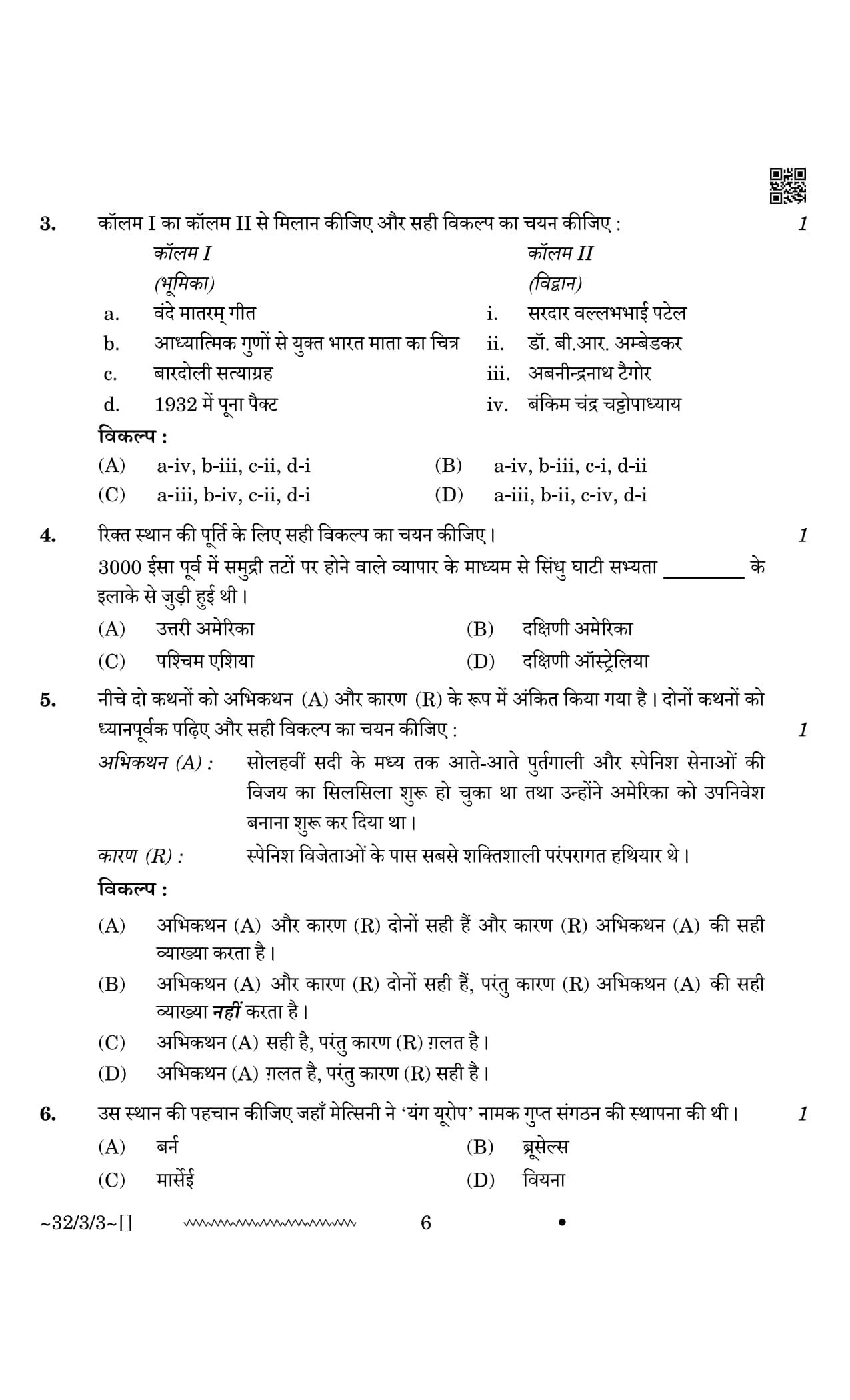
Match Column I with Column II and choose the correct option:
| Column I (Role) | Column II (Scholar) |
|---|---|
| a. The song Vande Mataram | i. Sardar Vallabhbhai Patel |
| b. Picture of Bharat Mata with spiritual qualities | ii. Dr. B.R. Ambedkar |
| c. Bardoli Satyagraha | iii. Abanindranath Tagore |
| d. Poona Pact in 1932 | iv. Bankim Chandra Chattopadhyay |
Choose the correct option to fill in the blank.
The Indus Valley Civilization was linked to the __________ region through coastal trade as early as 3000 BCE.
Two statements labelled as Assertion (A) and Reason (R) are given below. Read both the statements carefully and choose the correct option:
Assertion (A): The Portuguese and Spanish conquest and colonisation of America was decisively under way by the mid-sixteenth century.
Reason (R): The Spanish conquerors had the most powerful conventional weapons.
Identify the place where the secret underground society named ‘Young Europe’ was founded by Mazzini.
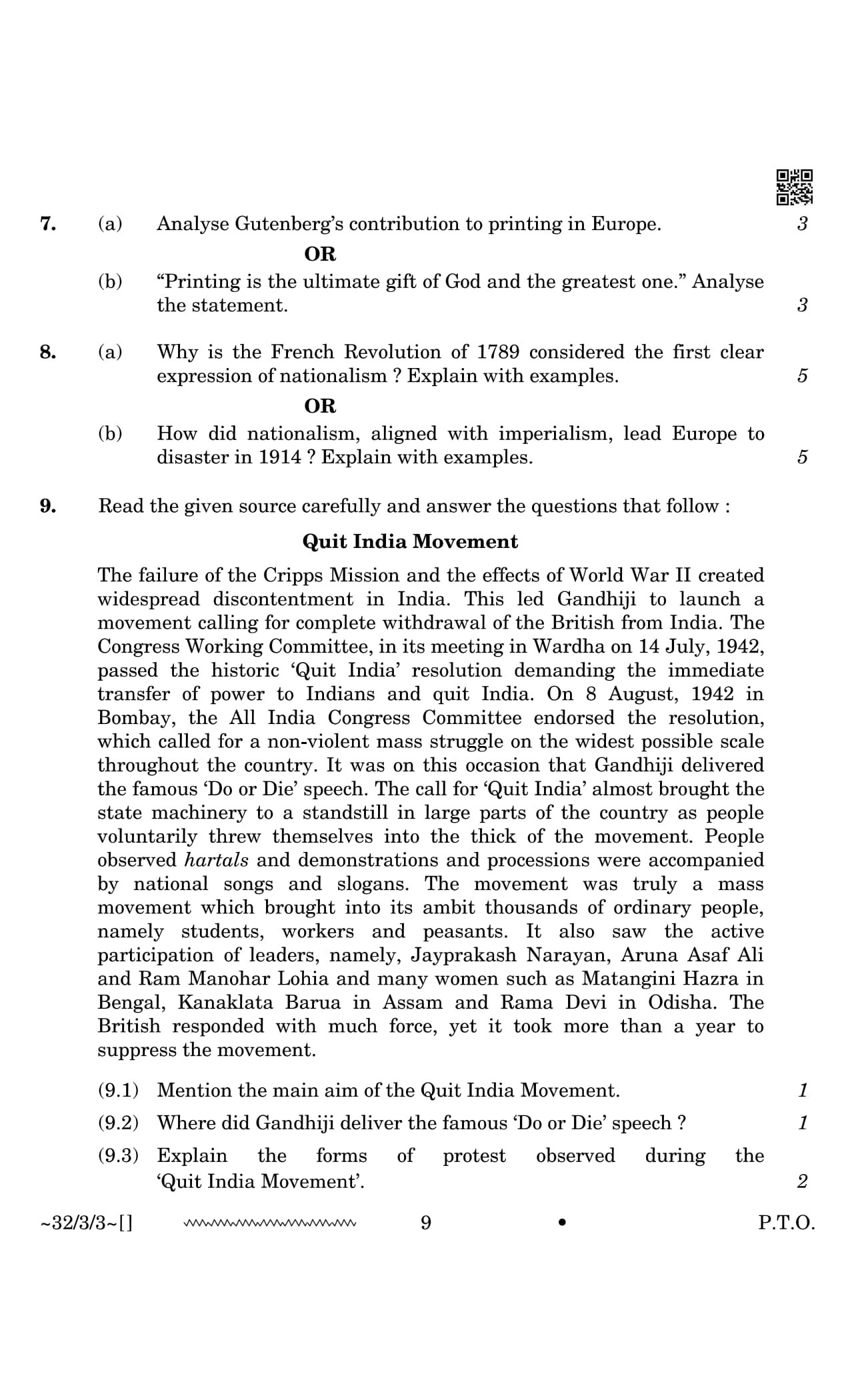
Analyse the contribution of Gutenberg to printing in Europe.
“Printing is the ultimate gift of God and the greatest one.” Analyse the statement.
Why is the French Revolution of 1789 considered the first clear expression of nationalism? Explain with examples.
How did nationalism, aligned with imperialism, lead Europe to disaster in 1914? Explain with examples.
Comprehension:
Read the given source carefully and answer the questions that follow:
Quit India Movement
Read More
The failure of the Cripps Mission and the effects of World War II created widespread discontentment in India. This led Gandhiji to launch a movement calling for complete withdrawal of the British from India. The Congress Working Committee, in its meeting in Wardha on 14 July, 1942, passed the historic ‘Quit India’ resolution demanding the immediate transfer of power to Indians and quit India. On 8 August, 1942 in Bombay, the All India Congress Committee endorsed the resolution, which called for a non-violent mass struggle on the widest possible scale throughout the country. It was on this occasion that Gandhiji delivered the famous ‘Do or Die’ speech. The call for ‘Quit India’ almost brought the state machinery to a standstill in large parts of the country as people voluntarily threw themselves into the thick of the movement. People observed hartals and demonstrations and processions were accompanied by national songs and slogans. The movement was truly a mass movement which brought into its ambit thousands of ordinary people, namely students, workers and peasants. It also saw the active participation of leaders, namely, Jayprakash Narayan, Aruna Asaf Ali and Ram Manohar Lohia and many women such as Matangini Hazra in Bengal, Kanaklata Barua in Assam and Rama Devi in Odisha. The British responded with much force, yet it took more than a year to suppress the movement.Mention the main aim of the Quit India Movement.
Where did Gandhiji deliver the famous ‘Do or Die’ speech?
Explain the forms of protest observed during the ‘Quit India Movement’.
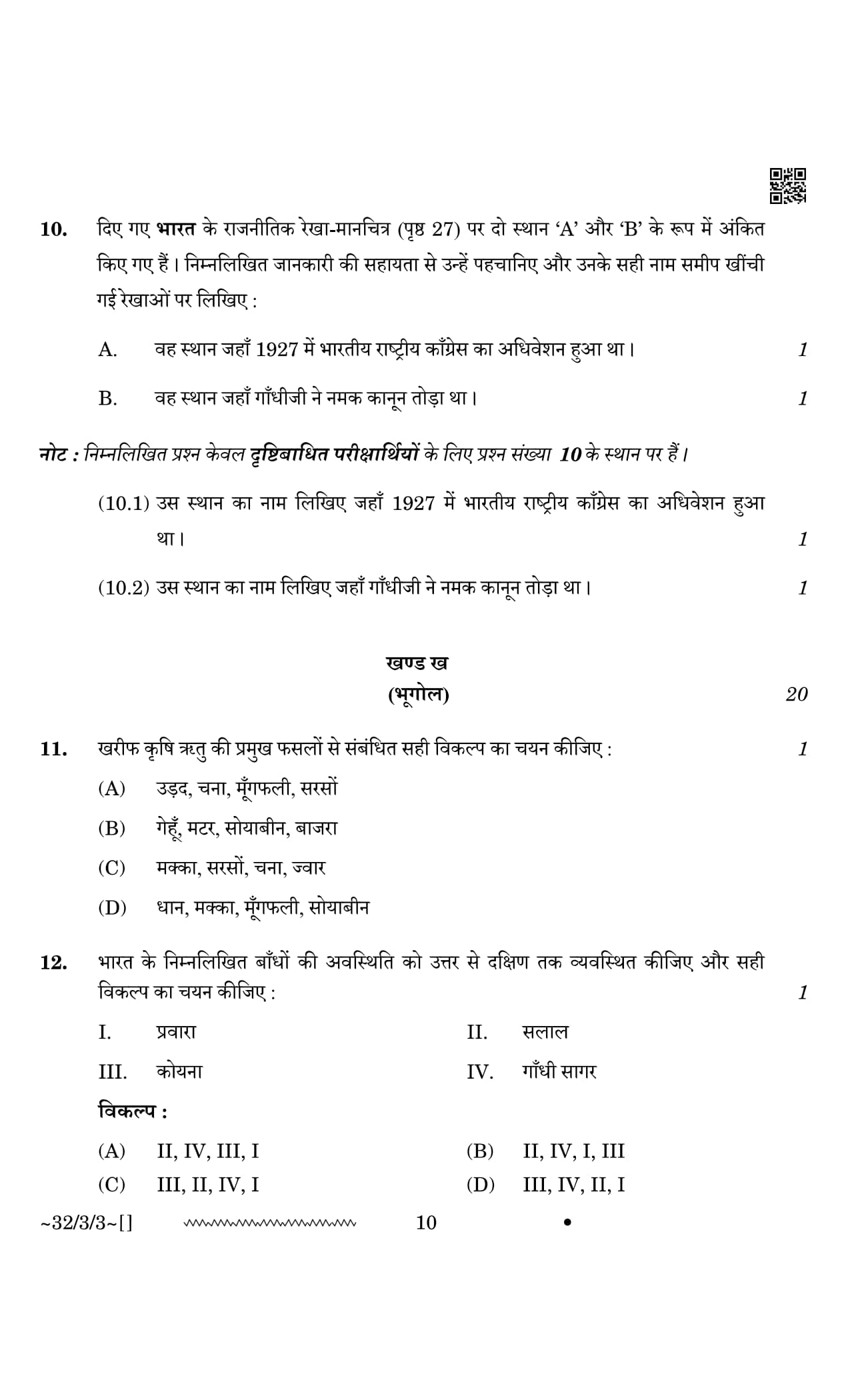
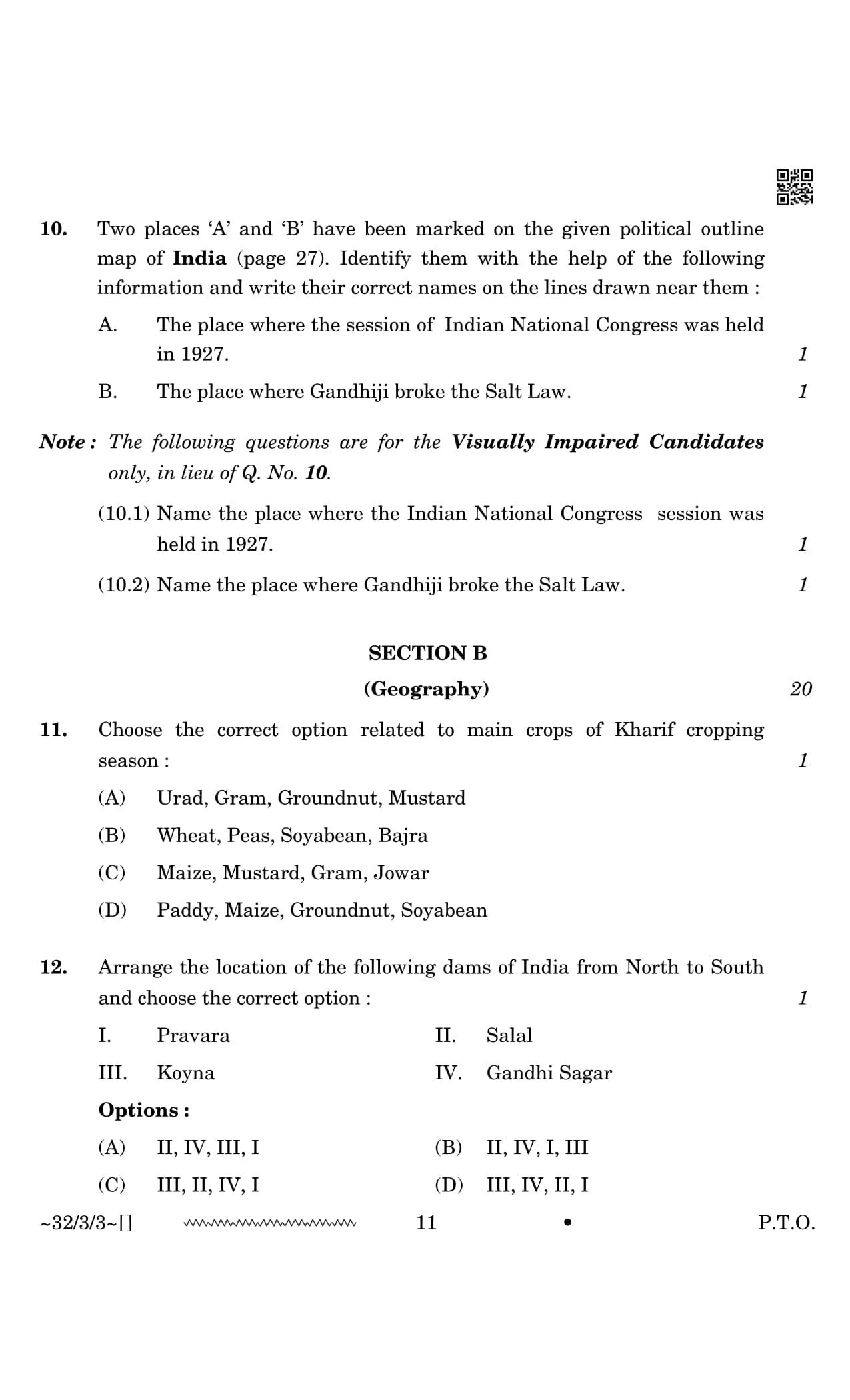
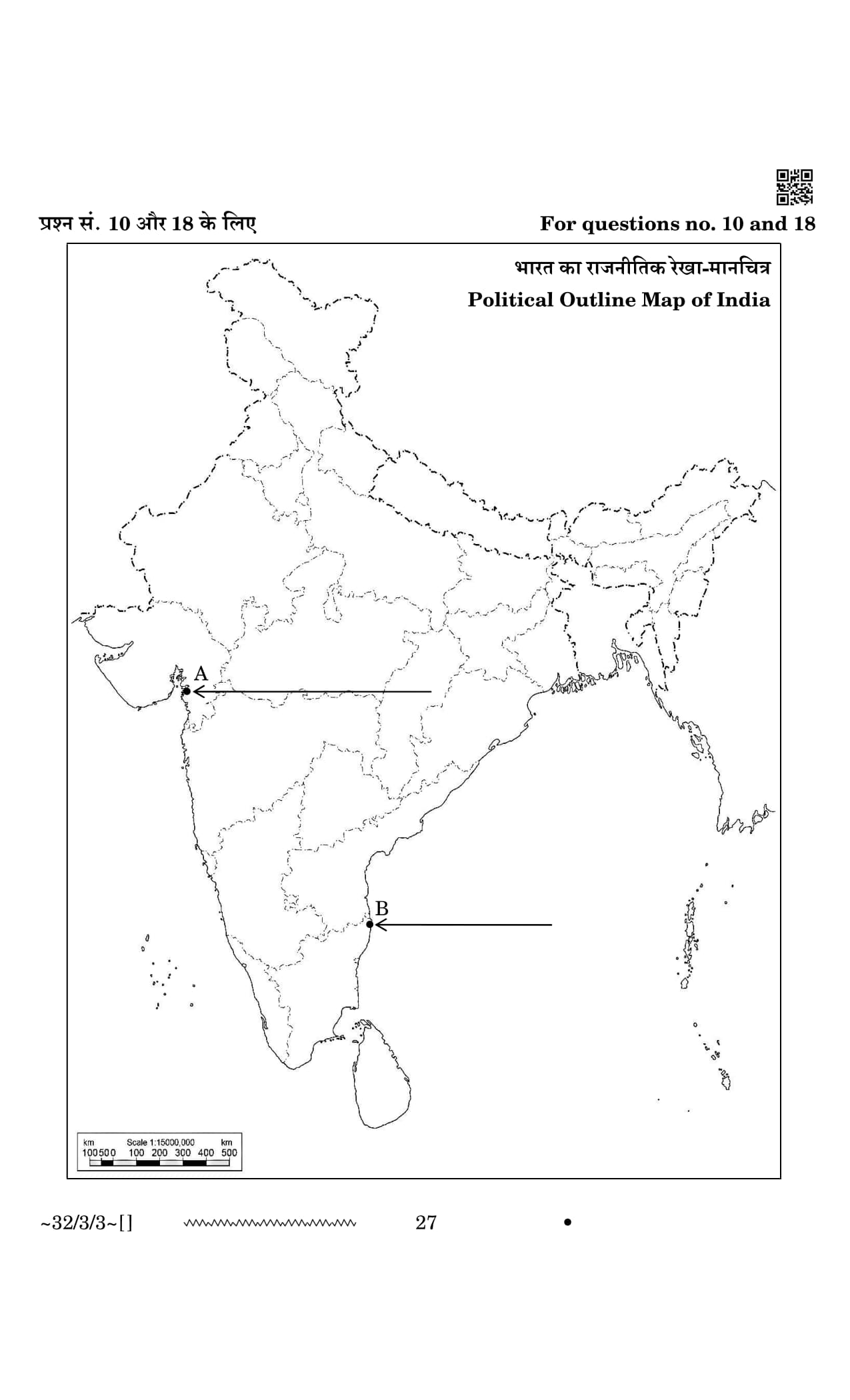
Two places ‘A’ and ‘B’ have been marked on the given political outline map of India. Identify them with the help of the following information and write their correct names on the lines drawn near them:
A. The place where the session of Indian National Congress was held in 1927.
B. The place where Gandhiji broke the Salt Law.

Name the place where the Indian National Congress session was held in 1927.
Name the place where Gandhiji broke the Salt Law.
Choose the correct option related to main crops of Kharif cropping season:
Arrange the location of the following dams of India from North to South and choose the correct option:
I. Pravara II. Salal
III. Koyna IV. Gandhi Sagar
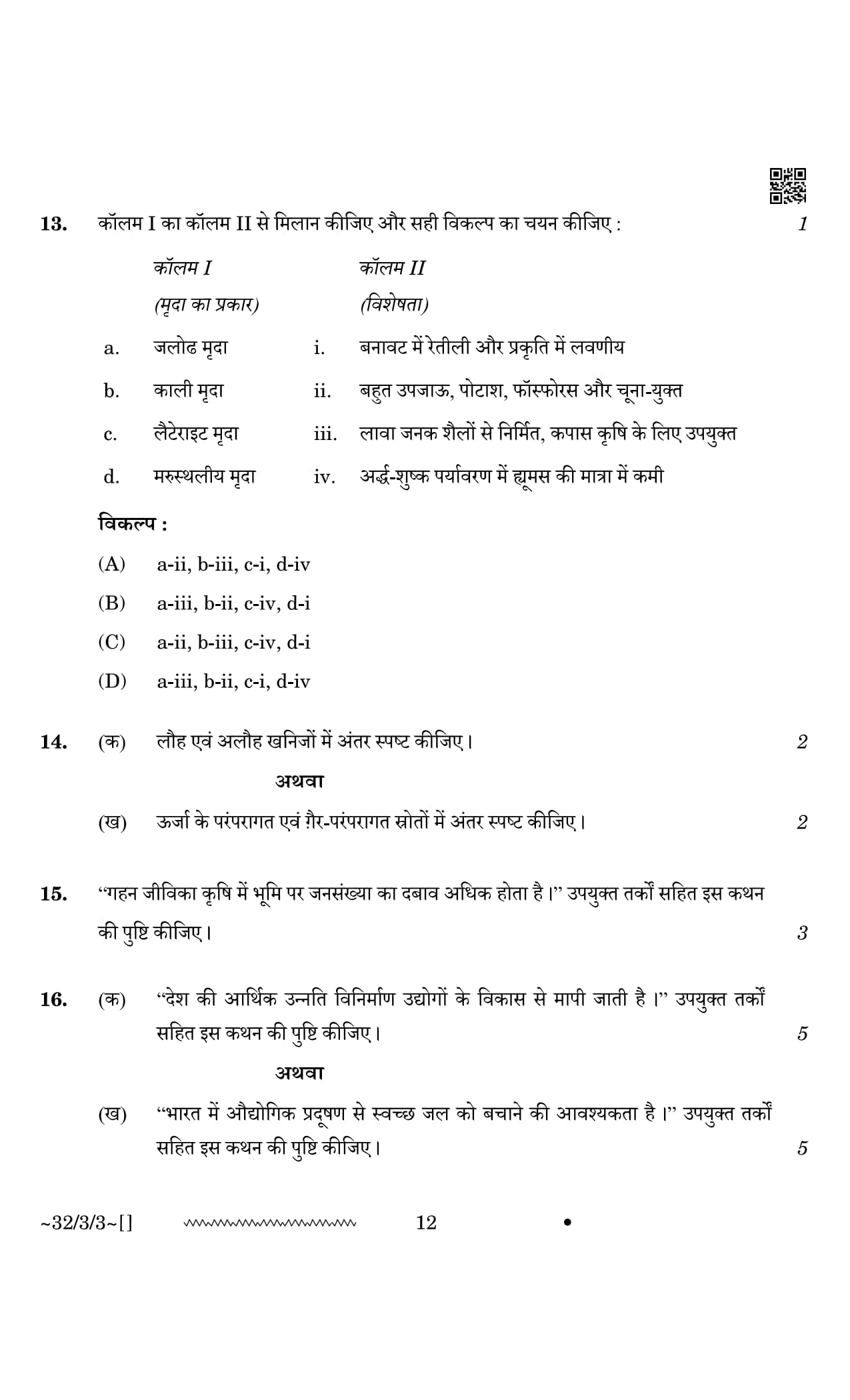
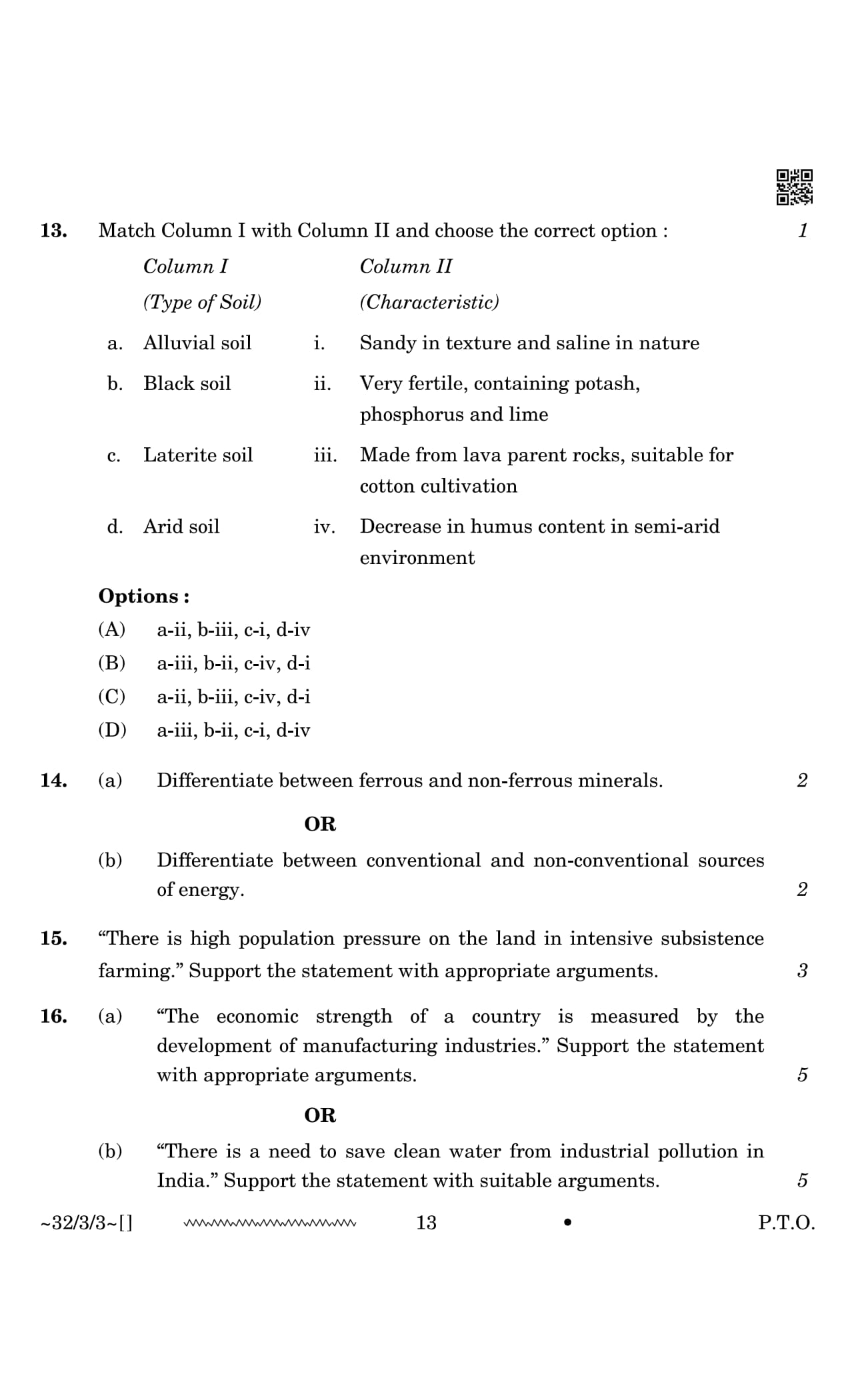
Match Column I with Column II and choose the correct option:
| Column I (Type of Soil) | Column II (Characteristic) |
|---|---|
| a. Alluvial soil | i. Sandy in texture and saline in nature |
| b. Black soil | ii. Very fertile, containing potash, phosphorus and lime |
| c. Laterite soil | iii. Made from lava parent rocks, suitable for cotton cultivation |
| d. Arid soil | iv. Decrease in humus content in semi-arid environment |
Differentiate between ferrous and non-ferrous minerals.
Differentiate between conventional and non-conventional sources of energy.
“There is high population pressure on the land in intensive subsistence farming.” Support the statement with appropriate arguments.
“The economic strength of a country is measured by the development of manufacturing industries.” Support the statement with appropriate arguments.
“There is a need to save clean water from industrial pollution in India.” Support the statement with suitable arguments.
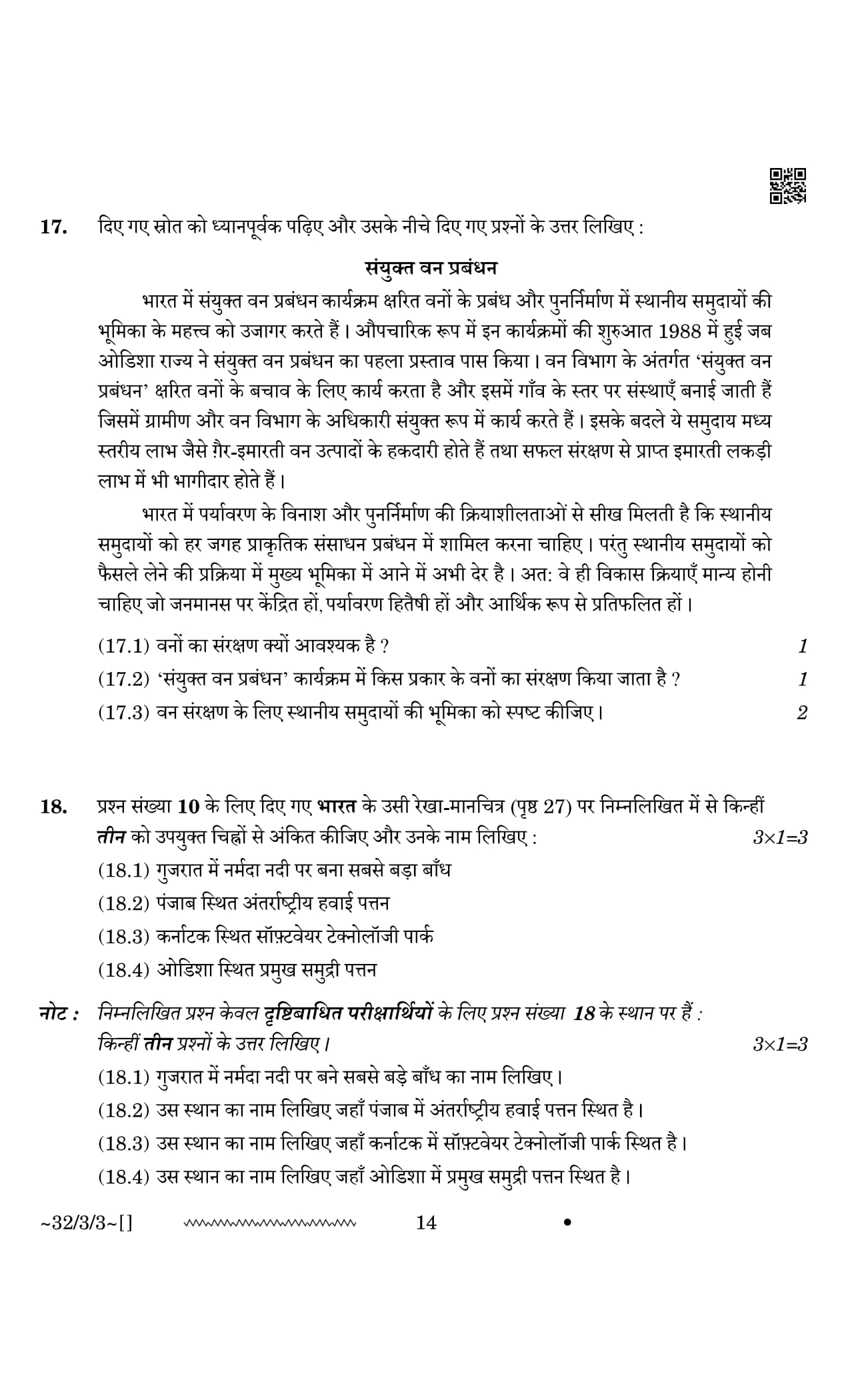
Comprehension:
Read the given source carefully and answer the questions that follow:
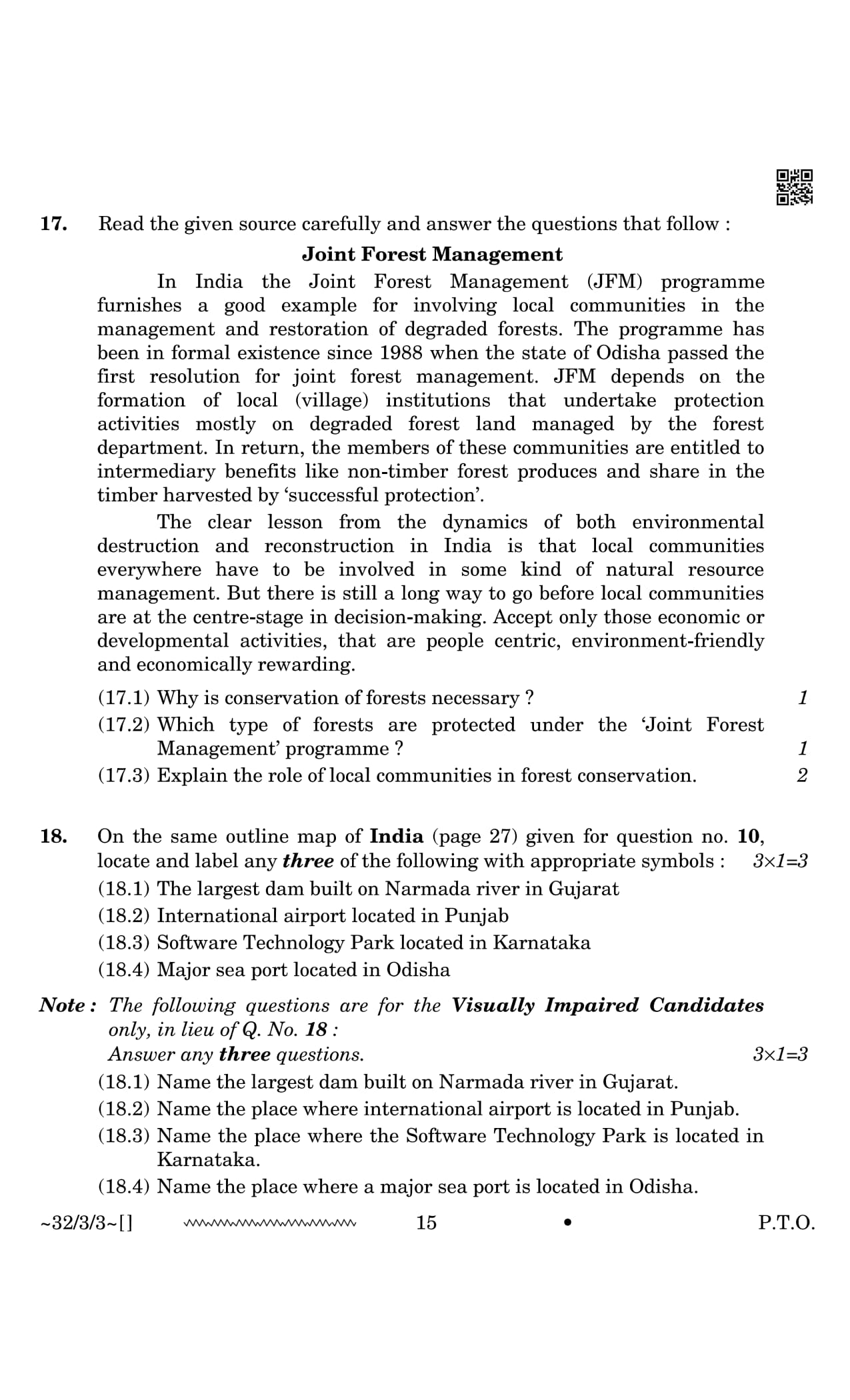
Joint Forest Management
In India the Joint Forest Management (JFM) programme furnishes a good example for involving local communities in the management and restoration of degraded forests. The programme has been in formal existence since 1988 when the state of Odisha passed the first resolution for joint forest management. JFM depends on the formation of local (village) institutions that undertake protection activities mostly on degraded forest land managed by the forest department. In return, the members of these communities are entitled to intermediary benefits like non-timber forest produces and share in the timber harvested by ‘successful protection’.
Read More
The clear lesson from the dynamics of both environmental destruction and reconstruction in India is that local communities everywhere have to be involved in some kind of natural resource management. But there is still a long way to go before local communities are at the centre-stage in decision-making. Accept only those economic or developmental activities, that are people centric, environment-friendly and economically rewarding.
Why is conservation of forests necessary?
Which type of forests are protected under the ‘Joint Forest Management’ programme?
Explain the role of local communities in forest conservation.
On the same outline map of India given for question no. 10, locate and label any three of the following with appropriate symbols:
(a) The largest dam built on Narmada river in Gujarat
(b) International airport located in Punjab
(c) Software Technology Park located in Karnataka
(d) Major sea port located in Odisha
Name the largest dam built on Narmada river in Gujarat.
Name the place where international airport is located in Punjab.
Name the place where the Software Technology Park is located in Karnataka.
Name the place where a major sea port is located in Odisha.
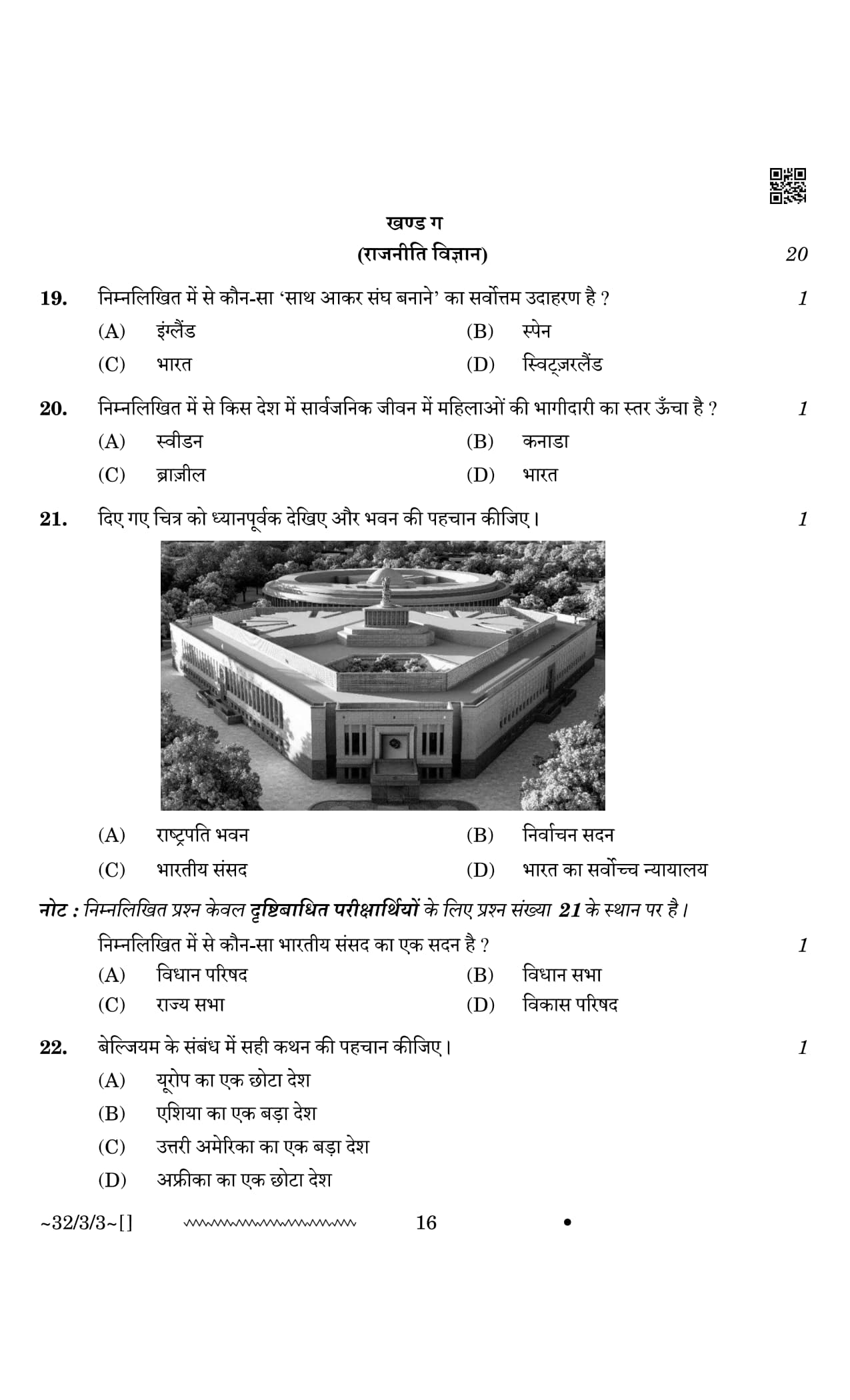
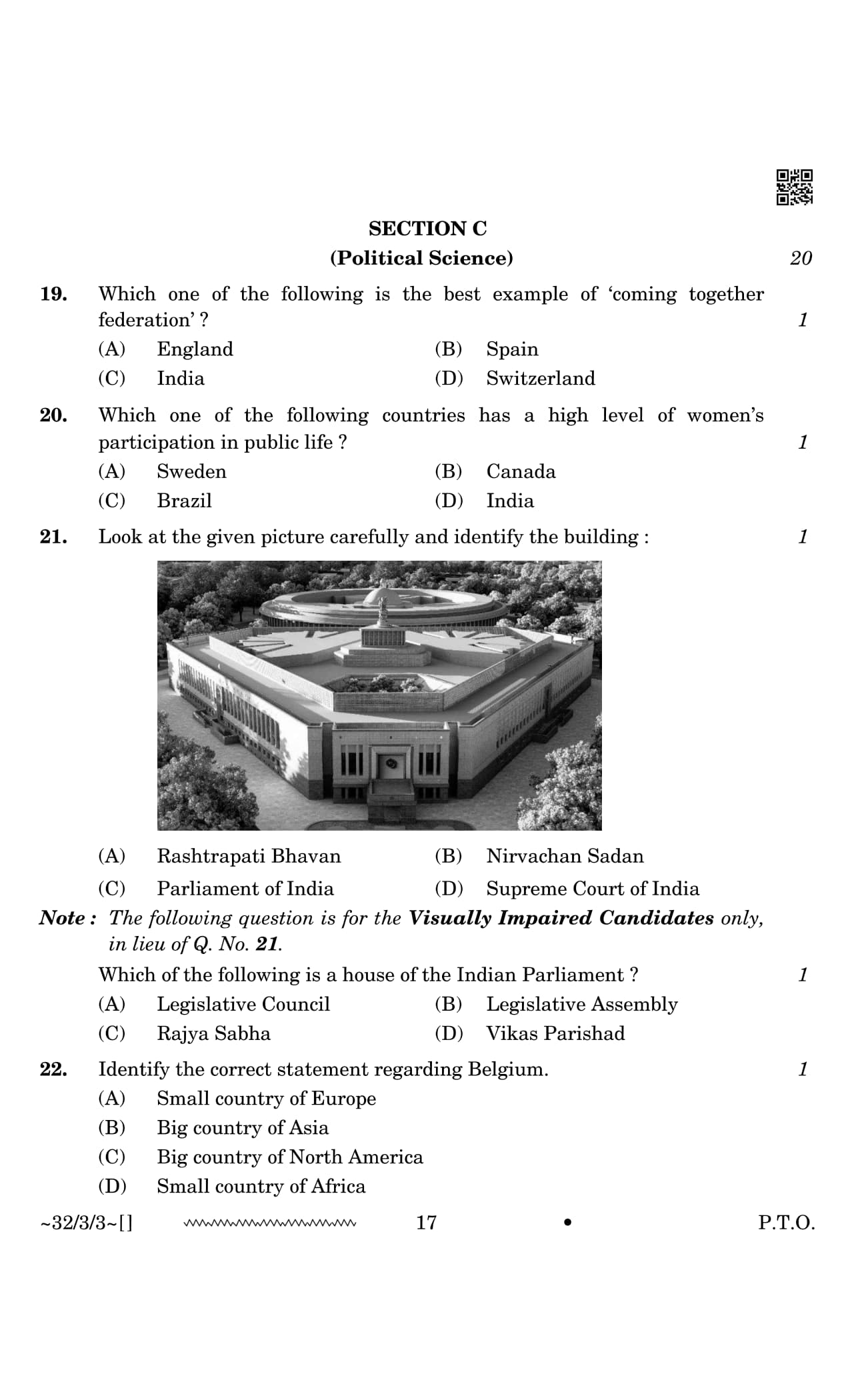
Which one of the following is the best example of ‘coming together federation’?
Which one of the following countries has a high level of women’s participation in public life?

Which of the following is a house of the Indian Parliament?
Identify the correct statement regarding Belgium.
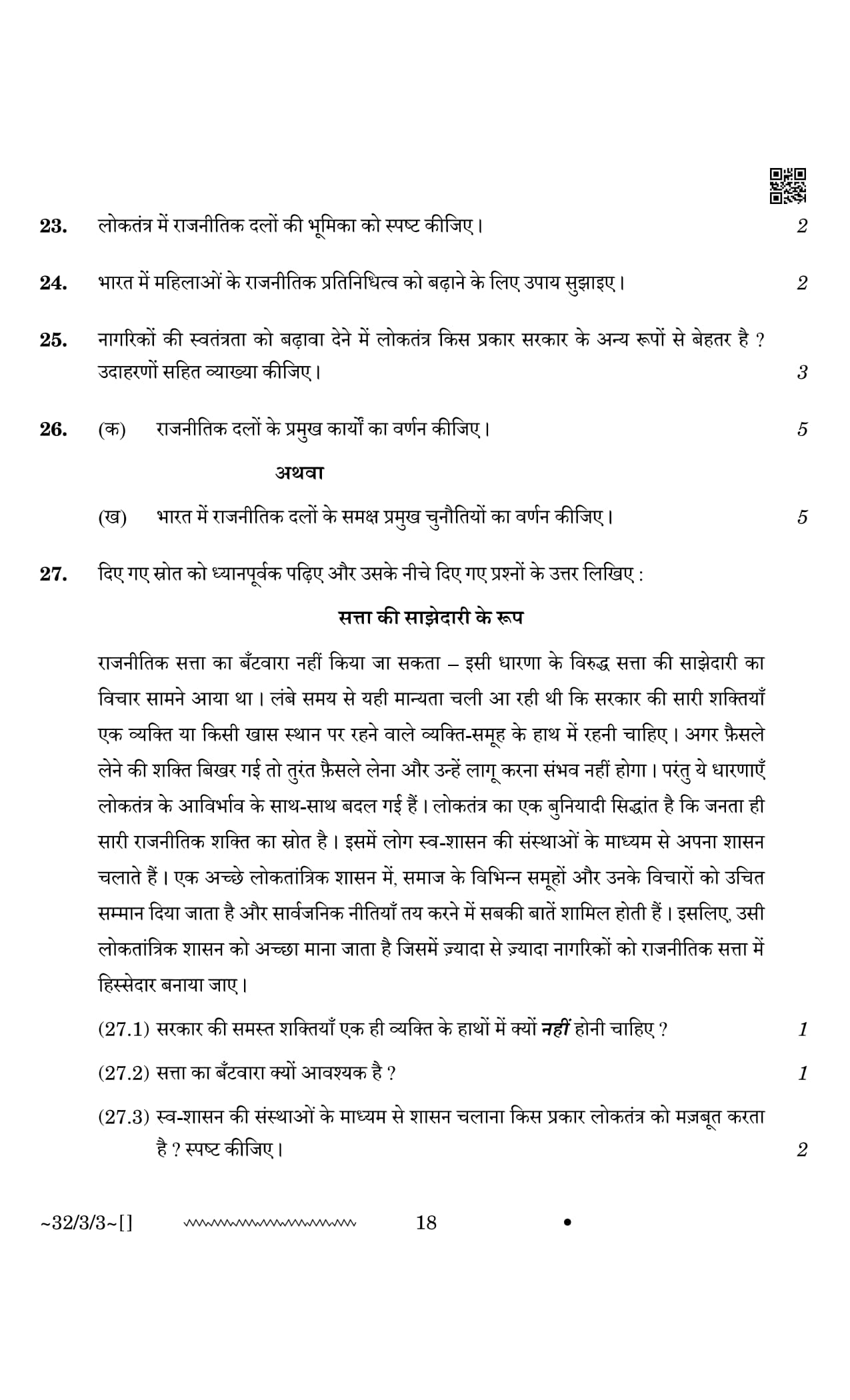
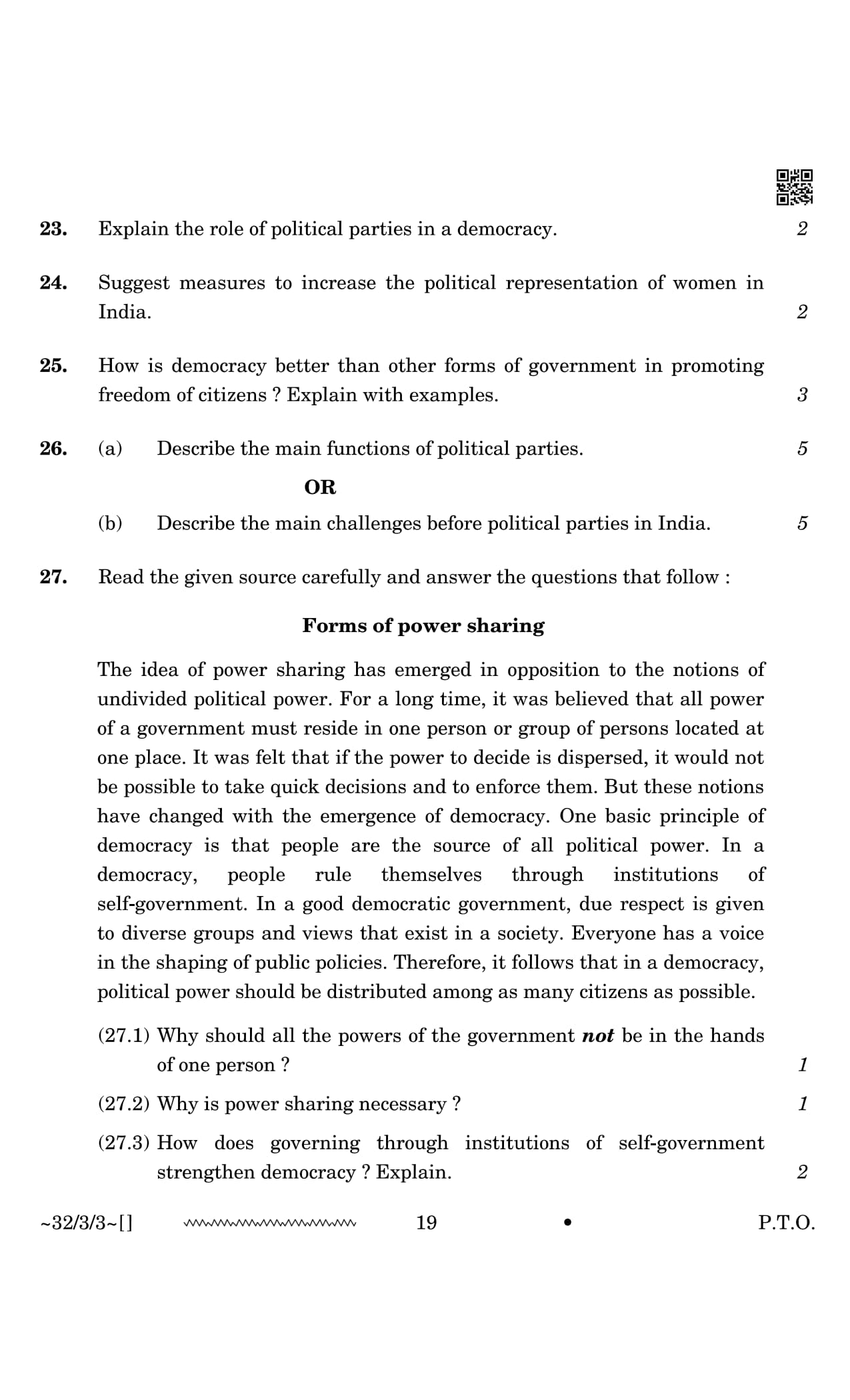
Explain the role of political parties in a democracy.
Suggest measures to increase the political representation of women in India.
How is democracy better than other forms of government in promoting freedom of citizens? Explain with examples.
Describe the main functions of political parties.
Describe the main challenges before political parties in India.
Comprehension:
Read the given source carefully and answer the questions that follow:
Forms of power sharing
Read More
The idea of power sharing has emerged in opposition to the notions of undivided political power. For a long time, it was believed that all power of a government must reside in one person or group of persons located at one place. It was felt that if the power to decide is dispersed, it would not be possible to take quick decisions and to enforce them. But these notions have changed with the emergence of democracy. One basic principle of democracy is that people are the source of all political power. In a democracy, people rule themselves through institutions of self-government. In a good democratic government, due respect is given to diverse groups and views that exist in a society. Everyone has a voice in the shaping of public policies. Therefore, it follows that in a democracy, political power should be distributed among as many citizens as possible.Why should all the powers of the government not be in the hands of one person?
Why is power sharing necessary?
How does governing through institutions of self-government strengthen democracy? Explain.
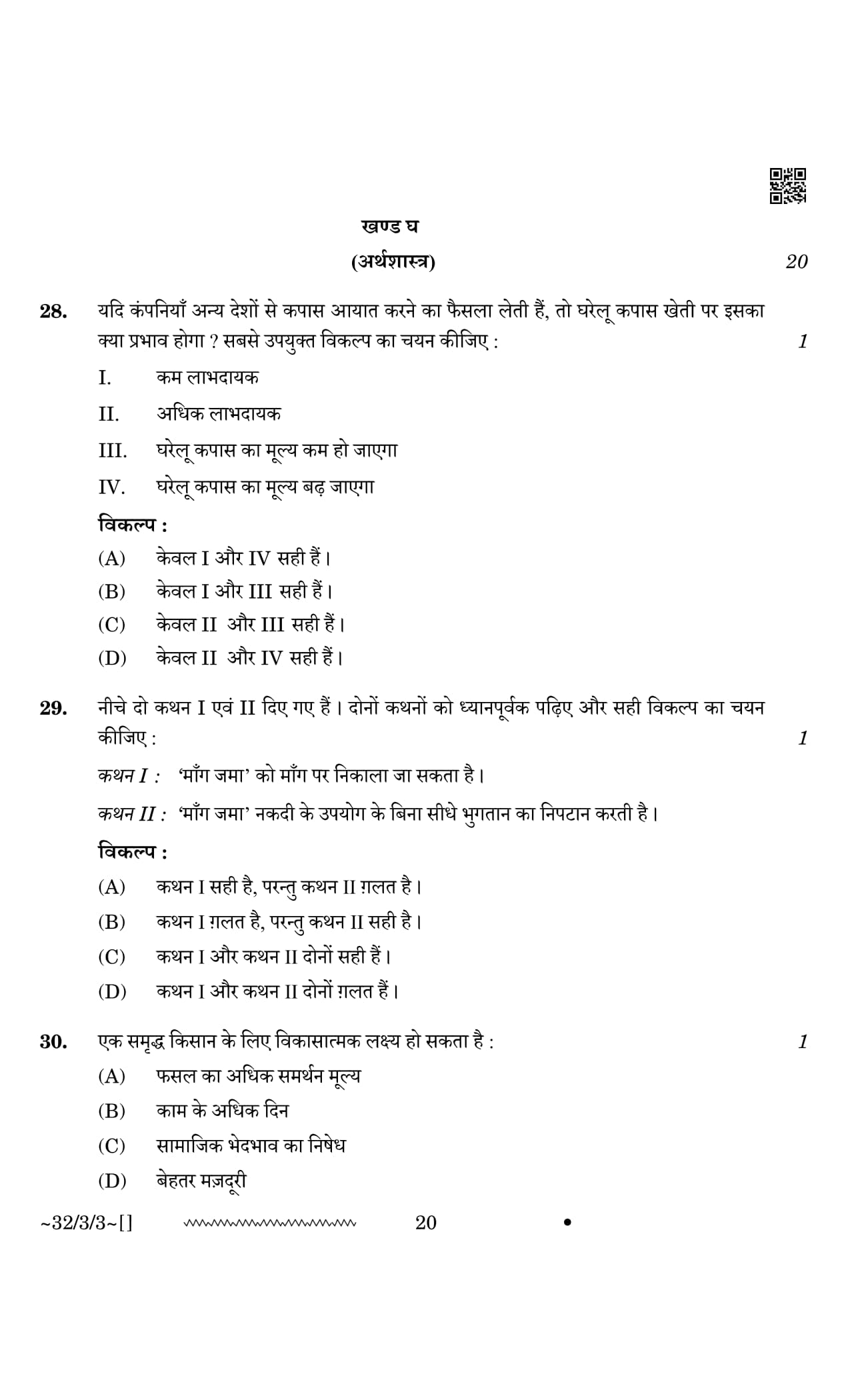
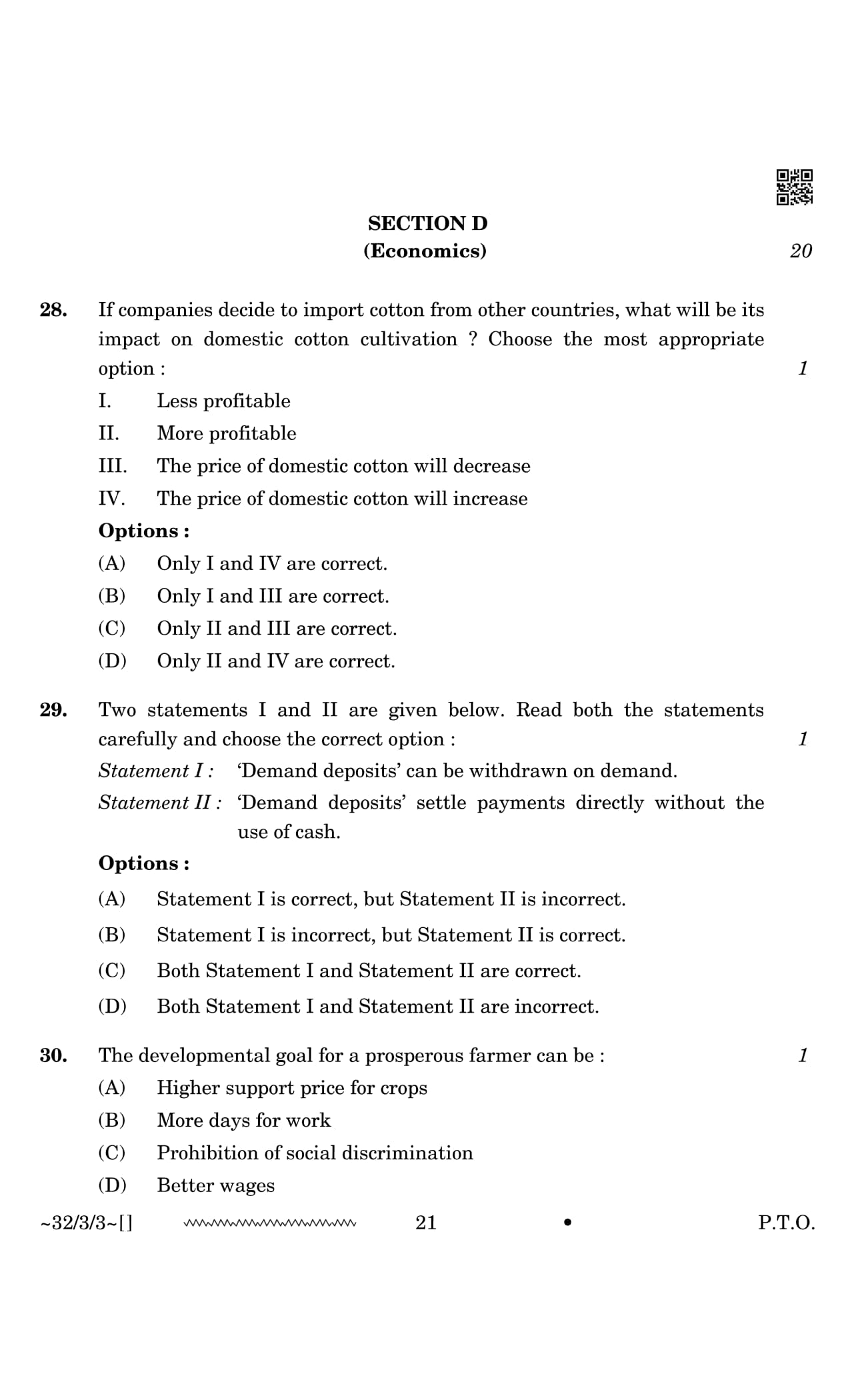
If companies decide to import cotton from other countries, what will be its impact on domestic cotton cultivation? Choose the most appropriate option:
I. Less profitable
II. More profitable
III. The price of domestic cotton will decrease
IV. The price of domestic cotton will increase
Two statements I and II are given below. Read both the statements carefully and choose the correct option:
Statement I: ‘Demand deposits’ can be withdrawn on demand.
Statement II: ‘Demand deposits’ settle payments directly without the use of cash.
The developmental goal for a prosperous farmer can be:
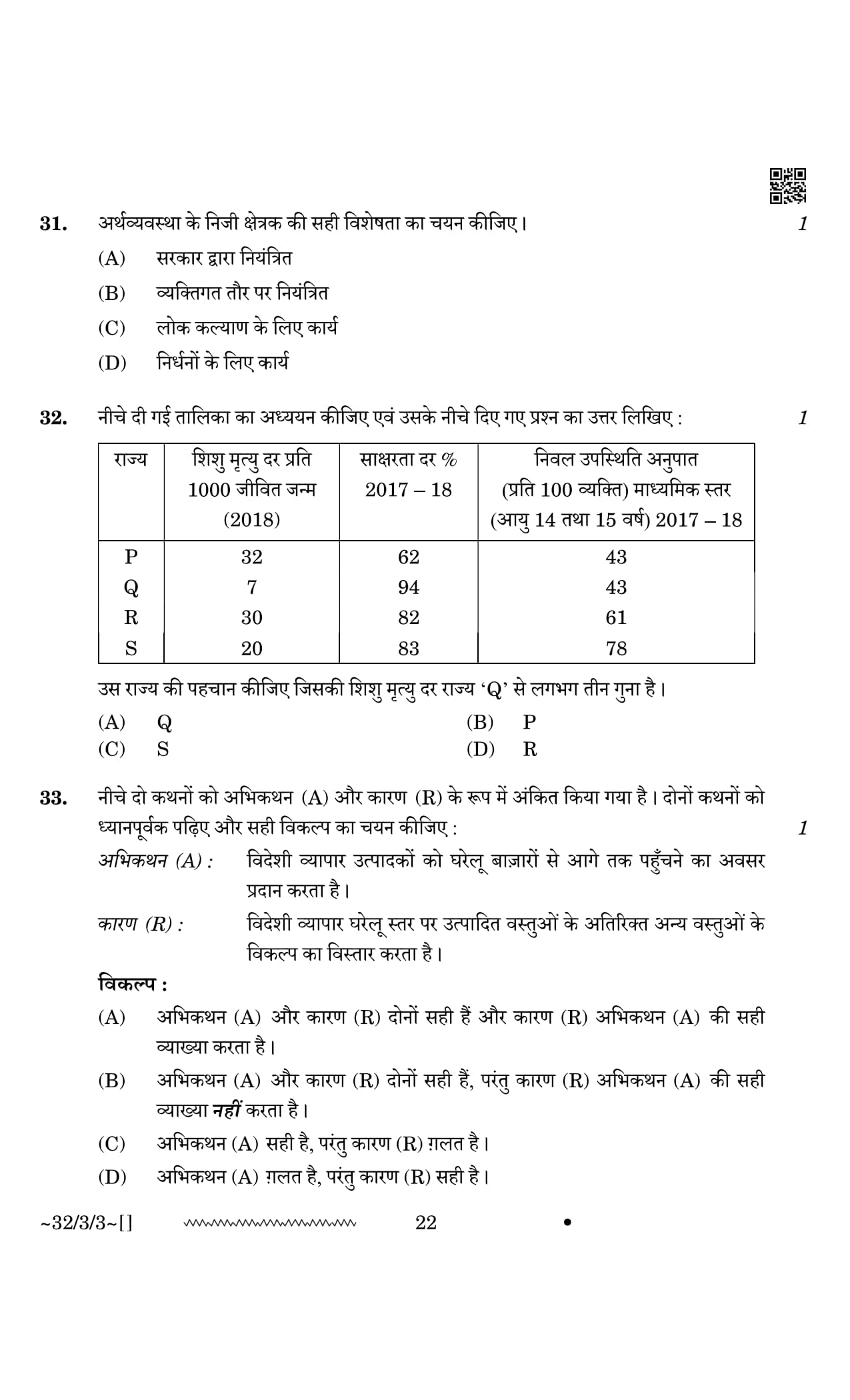
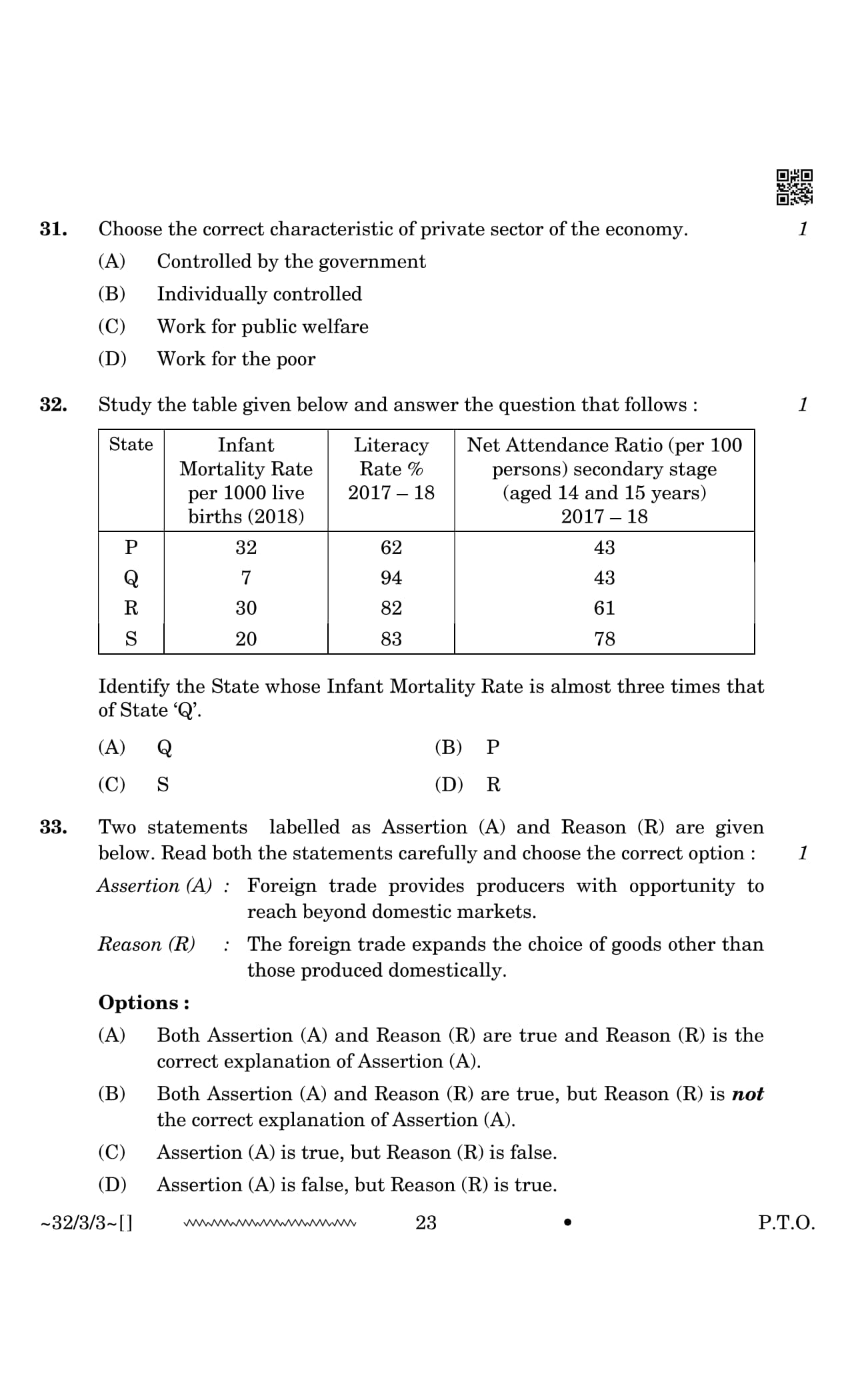
Choose the correct characteristic of private sector of the economy.
Study the table given below and answer the question that follows:
| State | Infant Mortality Rate per 1000 live births (2018) | Literacy Rate % 2017 – 18 | Net Attendance Ratio (per 100 persons) secondary stage (aged 14 and 15 years) 2017 – 18 |
|---|---|---|---|
| P | 32 | 62 | 43 |
| Q | 7 | 94 | 43 |
| R | 30 | 82 | 61 |
| S | 20 | 83 | 78 |
Two statements labelled as Assertion (A) and Reason (R) are given below. Read both the statements carefully and choose the correct option:
Assertion (A): Foreign trade provides producers with opportunity to reach beyond domestic markets.
Reason (R): The foreign trade expands the choice of goods other than those produced domestically.
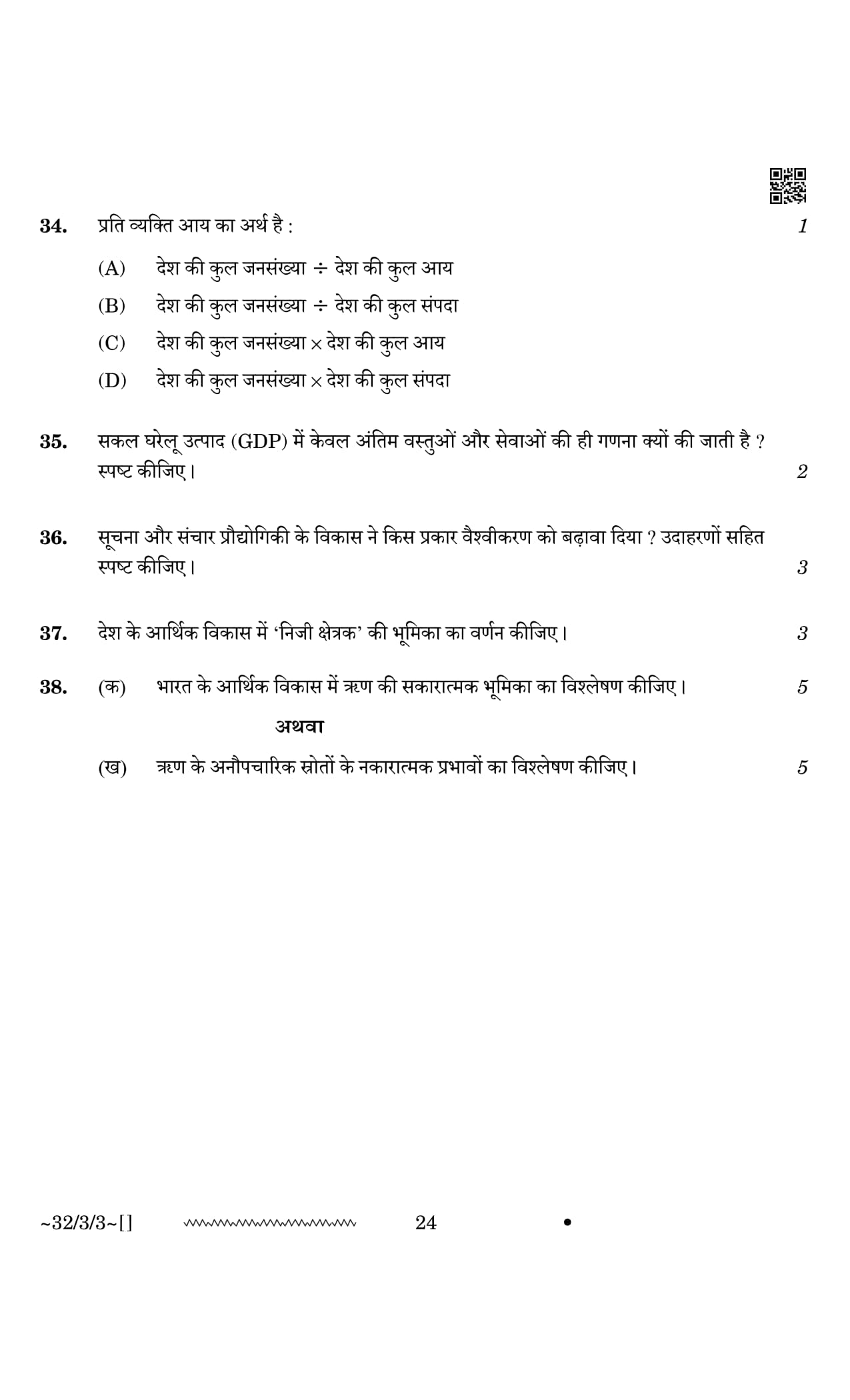
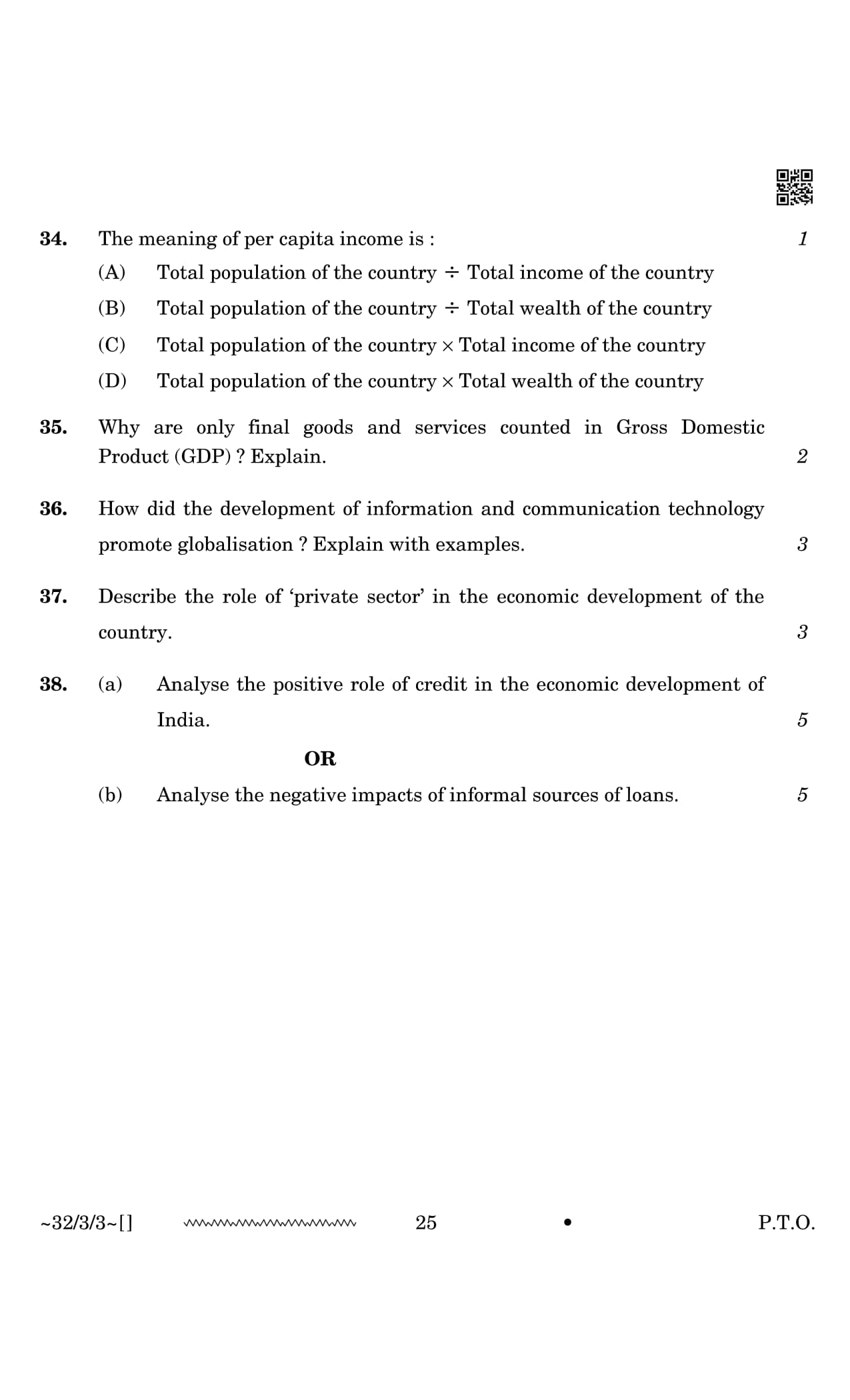
The meaning of per capita income is:
Why are only final goods and services counted in Gross Domestic Product (GDP)? Explain.
How did the development of information and communication technology promote globalisation? Explain with examples.
Describe the role of ‘private sector’ in the economic development of the country.
Analyse the positive role of credit in the economic development of India.
Analyse the negative impacts of informal sources of loans.



Comments