



MHT CET 2026 May 19 Shift 2 PCM Question Paper is available for download here. Maharashtra State CET Cell conducted MHT CET 2026 PCM Exam on May 19 in Shift 2 from 2 PM to 5 PM in CBT mode.
- The MHT CET 2026 PCM Question Paper consists of 150 multiple-choice questions (MCQs) totalling 200 marks divided into 3 sections: Physics, Chemistry, and Mathematics, with 50 questions in each subject.
- Physics and Chemistry questions carry 1 mark each while Mathematics questions carry 2 marks each.
- There is no negative marking for incorrect answers.
Download MHT CET 2026 May 19 Shift 2 PCM Question Paper with Solutions PDF from the links provided below.
MHT CET 2026 May 19 Shift 2 PCM Question Paper PDF Download
| MHT CET 2026 May 19 Shift 2 Question Paper | Download PDF | Check Solution |

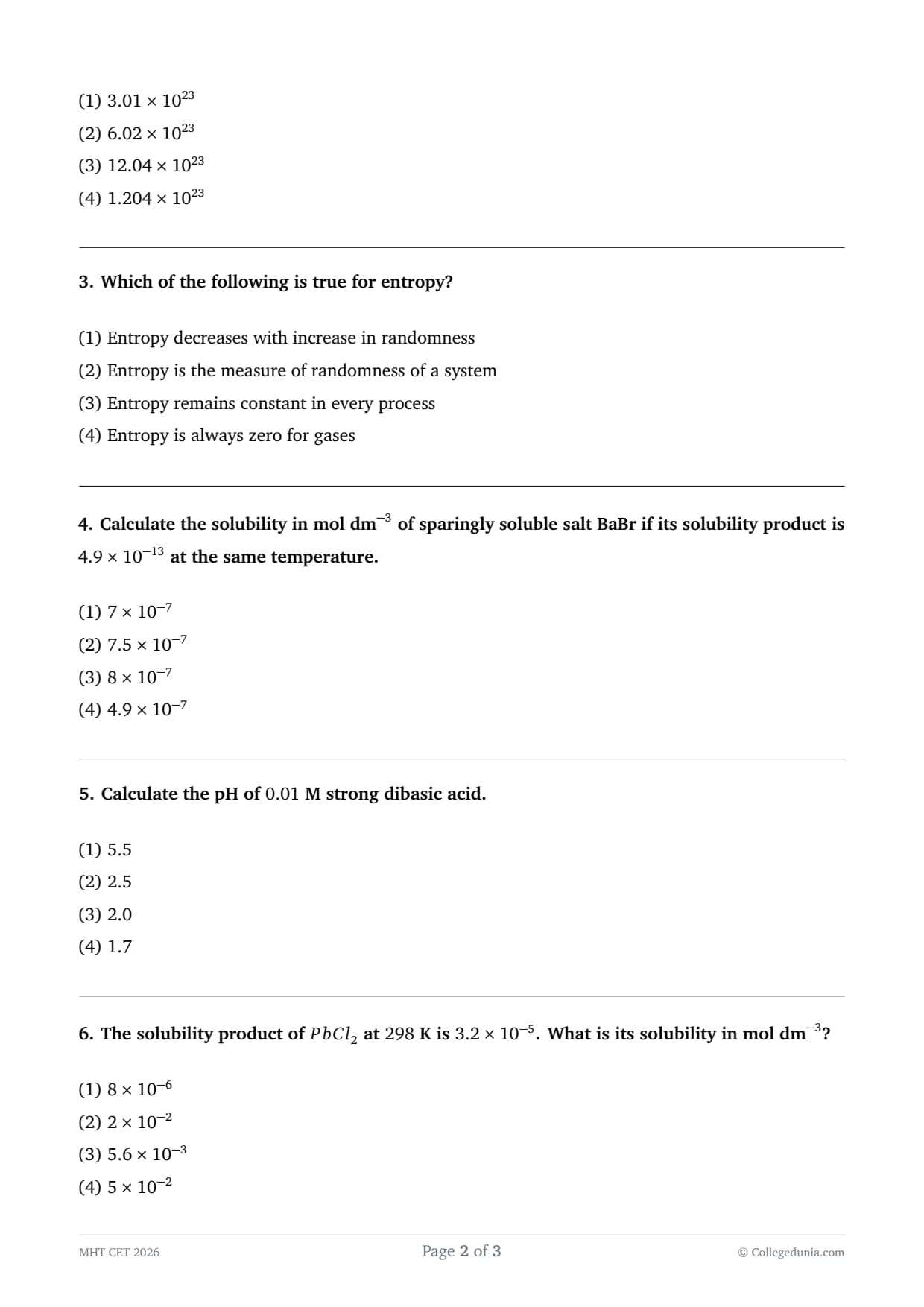
Which of the following statement is correct for vapor pressure?
View Solution
Concept: Vapor pressure is the pressure exerted by the vapor of a liquid when the vapor and liquid are in dynamic equilibrium inside a closed container.
At the surface of a liquid:
Some molecules escape from the liquid phase into the vapor phase.
Some vapor molecules return back to the liquid phase.
When the rate of evaporation becomes equal to the rate of condensation, equilibrium is established and the pressure exerted by vapor molecules is called vapor pressure.
Step 1: Understanding the effect of temperature on molecular motion.
Temperature is directly related to the kinetic energy of molecules.
When temperature increases:
Molecules gain more kinetic energy.
A larger number of molecules acquire enough energy to escape from the liquid surface.
Evaporation increases.
As more molecules enter the vapor phase, the pressure exerted by vapor molecules also increases.
Step 2: Relating temperature with vapor pressure.
Thus,
\[ Increase in temperature \Rightarrow Increase in vapor pressure \]
This is why liquids evaporate faster at higher temperatures.
Step 3: Analyzing the given options.
Vapor pressure decreases with increase in temperature: Incorrect.
Vapor pressure is independent of temperature: Incorrect because vapor pressure strongly depends on temperature.
Vapor pressure increases with increase in temperature: Correct statement.
Vapor pressure becomes zero at high temperature: Incorrect because vapor pressure actually becomes very high at high temperatures.
Step 4: Final conclusion.
Therefore, the correct statement is:
\[ \boxed{Vapor pressure increases with increase in temperature} \]
Hence, the correct option is:
\[ \boxed{(3)\ Vapor pressure increases with increase in temperature} \] Quick Tip: Important facts about vapor pressure: Higher temperature \(\Rightarrow\) Higher vapor pressure Weak intermolecular forces \(\Rightarrow\) Higher vapor pressure Strong intermolecular forces \(\Rightarrow\) Lower vapor pressure Liquids like ether and acetone have high vapor pressure because their intermolecular forces are weak.
Find the number of atoms present in \(11.2\ L\) of nitrogen gas at STP.
View Solution
Concept: At STP (Standard Temperature and Pressure), \[ 1 mole of any gas occupies 22.4\ L \]
Also, \[ 1 mole contains 6.02 \times 10^{23} molecules \]
Nitrogen gas exists as a diatomic molecule: \[ N_2 \]
Hence, each molecule of nitrogen contains: \[ 2 nitrogen atoms \]
Step 1: Calculating the number of moles of nitrogen gas.
Given volume of nitrogen gas:
\[ V = 11.2\ L \]
At STP:
\[ 22.4\ L = 1 mole \]
Therefore,
\[ Number of moles = \frac{11.2}{22.4} \]
\[ = 0.5 mole \]
Step 2: Calculating the number of nitrogen molecules.
We know:
\[ 1 mole = 6.02 \times 10^{23} molecules \]
So,
\[ 0.5 mole = 0.5 \times 6.02 \times 10^{23} \]
\[ = 3.01 \times 10^{23} molecules \]
Step 3: Converting molecules into atoms.
Each molecule of nitrogen gas is:
\[ N_2 \]
Thus, each molecule contains \(2\) atoms.
Therefore,
\[ Number of atoms = 2 \times 3.01 \times 10^{23} \]
\[ = 6.02 \times 10^{23} \]
Step 4: Final conclusion.
Hence, the number of atoms present in \(11.2\ L\) of nitrogen gas at STP is:
\[ \boxed{6.02 \times 10^{23}} \]
Therefore, the correct option is:
\[ \boxed{(2)\ 6.02 \times 10^{23}} \] Quick Tip: Useful STP facts: \(22.4\ L\) gas at STP \(= 1\) mole \(1\) mole \(= 6.02 \times 10^{23}\) molecules For diatomic gases like \(H_2, N_2, O_2, Cl_2\): \[ Atoms = 2 \times Number of molecules \]
Which of the following is true for entropy?
View Solution
Concept: Entropy is a thermodynamic quantity that measures the degree of randomness, disorder, or molecular chaos present in a system.
It is represented by the symbol:
\[ S \]
A system with greater randomness possesses higher entropy.
Examples: \[ Solid < Liquid < Gas \]
because gaseous particles move more freely and randomly than liquids and solids.
Step 1: Understanding the meaning of entropy.
Entropy tells us how disordered a system is.
Highly ordered systems \(\rightarrow\) Low entropy
Highly random systems \(\rightarrow\) High entropy
For example:
Ice has lower entropy because molecules are arranged systematically.
Water vapor has very high entropy because molecules move randomly in all directions.
Step 2: Analyzing each given option.
Entropy decreases with increase in randomness: Incorrect because entropy actually increases with randomness.
Entropy is the measure of randomness of a system: Correct statement.
Entropy remains constant in every process: Incorrect because entropy changes during physical and chemical processes.
Entropy is always zero for gases: Incorrect. Gases generally possess very high entropy.
Step 3: Important thermodynamic interpretation.
Entropy change is given by:
\[ \Delta S = \frac{q_{rev}}{T} \]
where:
\(\Delta S\) = change in entropy
\(q_{rev}\) = reversible heat exchanged
\(T\) = absolute temperature
Entropy tends to increase naturally in spontaneous processes.
Step 4: Final conclusion.
Therefore, the correct statement regarding entropy is:
\[ \boxed{Entropy is the measure of randomness of a system} \]
Hence, the correct option is:
\[ \boxed{(2)\ Entropy is the measure of randomness of a system} \] Quick Tip: Remember the entropy order: \[ Solid < Liquid < Gas \] More freedom of movement \(\Rightarrow\) More randomness \(\Rightarrow\) Higher entropy. Also: Melting increases entropy Vaporization greatly increases entropy Cooling decreases entropy
Calculate the solubility in \(mol dm^{-3}\) of sparingly soluble salt BaBr if its solubility product is \(4.9 \times 10^{-13}\) at the same temperature.
View Solution
Concept: The solubility product constant (\(K_{sp}\)) represents the equilibrium between a sparingly soluble salt and its ions in solution.
For a simple \(1:1\) electrolyte:
\[ AB(s) \rightleftharpoons A^+(aq) + B^-(aq) \]
If the molar solubility is \(s\), then:
\[ [A^+] = s \]
\[ [B^-] = s \]
Hence,
\[ K_{sp} = s \times s = s^2 \]
Step 1: Writing the \(K_{sp}\) expression.
Given:
\[ K_{sp} = 4.9 \times 10^{-13} \]
For the sparingly soluble salt:
\[ K_{sp} = s^2 \]
Therefore,
\[ s^2 = 4.9 \times 10^{-13} \]
Step 2: Simplifying the scientific notation.
Rewrite the number:
\[ 4.9 \times 10^{-13} = 49 \times 10^{-14} \]
Thus,
\[ s = \sqrt{49 \times 10^{-14}} \]
Step 3: Taking square root.
\[ s = \sqrt{49} \times \sqrt{10^{-14}} \]
\[ s = 7 \times 10^{-7} \]
Therefore, the molar solubility is:
\[ 7 \times 10^{-7}\ mol dm^{-3} \]
Step 4: Final conclusion.
Hence, the correct option is:
\[ \boxed{(1)\ 7 \times 10^{-7}} \] Quick Tip: For \(1:1\) sparingly soluble salts: \[ K_{sp} = s^2 \] For \(1:2\) salts like \(CaF_2\): \[ K_{sp} = 4s^3 \] Always remember to adjust the expression according to ionic stoichiometry.
Calculate the pH of \(0.01\ M\) strong dibasic acid.
View Solution
Concept: A strong dibasic acid ionizes completely in water and releases two hydrogen ions \((H^+)\) per molecule.
General form:
\[ H_2A \rightarrow 2H^+ + A^{2-} \]
The pH of a solution is calculated using:
\[ pH = -\log[H^+] \]
Step 1: Calculating hydrogen ion concentration.
Given concentration of strong dibasic acid:
\[ 0.01\ M \]
Since it is dibasic, each molecule gives:
\[ 2H^+ \]
Therefore,
\[ [H^+] = 2 \times 0.01 \]
\[ [H^+] = 0.02\ M \]
Step 2: Applying the pH formula.
\[ pH = -\log(0.02) \]
Rewrite:
\[ 0.02 = 2 \times 10^{-2} \]
Thus,
\[ pH = -\log(2 \times 10^{-2}) \]
Using logarithm properties:
\[ pH = -( \log 2 + \log 10^{-2}) \]
\[ pH = -(0.3010 - 2) \]
\[ pH = 2 - 0.3010 \]
\[ pH \approx 1.7 \]
Step 3: Final conclusion.
Hence, the pH of the solution is:
\[ \boxed{1.7} \]
Therefore, the correct option is:
\[ \boxed{(4)\ 1.7} \] Quick Tip: For strong acids: Monobasic acid: \[ [H^+] = C \] Dibasic acid: \[ [H^+] = 2C \] Tribasic acid: \[ [H^+] = 3C \] Always multiply concentration by the number of ionizable \(H^+\) ions before calculating pH.
The solubility product of \(PbCl_2\) at \(298\ K\) is \(3.2 \times 10^{-5}\). What is its solubility in \(mol dm^{-3}\)?
View Solution
Concept: The solubility product constant \((K_{sp})\) relates the concentration of ions present in a saturated solution of a sparingly soluble salt.
For a salt:
\[ A_xB_y \rightleftharpoons xA^{y+} + yB^{x-} \]
If solubility is \(s\), then ionic concentrations are determined from stoichiometry.
For \(PbCl_2\):
\[ PbCl_2(s) \rightleftharpoons Pb^{2+}(aq) + 2Cl^-(aq) \]
Step 1: Writing ion concentrations in terms of solubility.
Let solubility of \(PbCl_2\) be:
\[ s\ mol dm^{-3} \]
Then,
\[ [Pb^{2+}] = s \]
\[ [Cl^-] = 2s \]
Step 2: Writing the \(K_{sp}\) expression.
\[ K_{sp} = [Pb^{2+}][Cl^-]^2 \]
Substituting concentrations:
\[ K_{sp} = s(2s)^2 \]
\[ K_{sp} = 4s^3 \]
Given:
\[ K_{sp} = 3.2 \times 10^{-5} \]
Therefore,
\[ 4s^3 = 3.2 \times 10^{-5} \]
Step 3: Calculating solubility \(s\).
\[ s^3 = \frac{3.2 \times 10^{-5}}{4} \]
\[ s^3 = 0.8 \times 10^{-5} \]
\[ s^3 = 8 \times 10^{-6} \]
Taking cube root:
\[ s = \sqrt[3]{8 \times 10^{-6}} \]
\[ s = 2 \times 10^{-2}\ mol dm^{-3} \]
Step 4: Final conclusion.
Hence, the solubility of \(PbCl_2\) is:
\[ \boxed{2 \times 10^{-2}\ mol dm^{-3}} \]
Therefore, the correct option is:
\[ \boxed{(2)\ 2 \times 10^{-2}} \] Quick Tip: For salts of the type: \[ MX_2 \rightleftharpoons M^{2+} + 2X^- \] Always remember: \[ K_{sp} = 4s^3 \] Examples: \(PbCl_2\) \(CaF_2\) \(BaI_2\) This shortcut helps solve numerical questions very quickly.
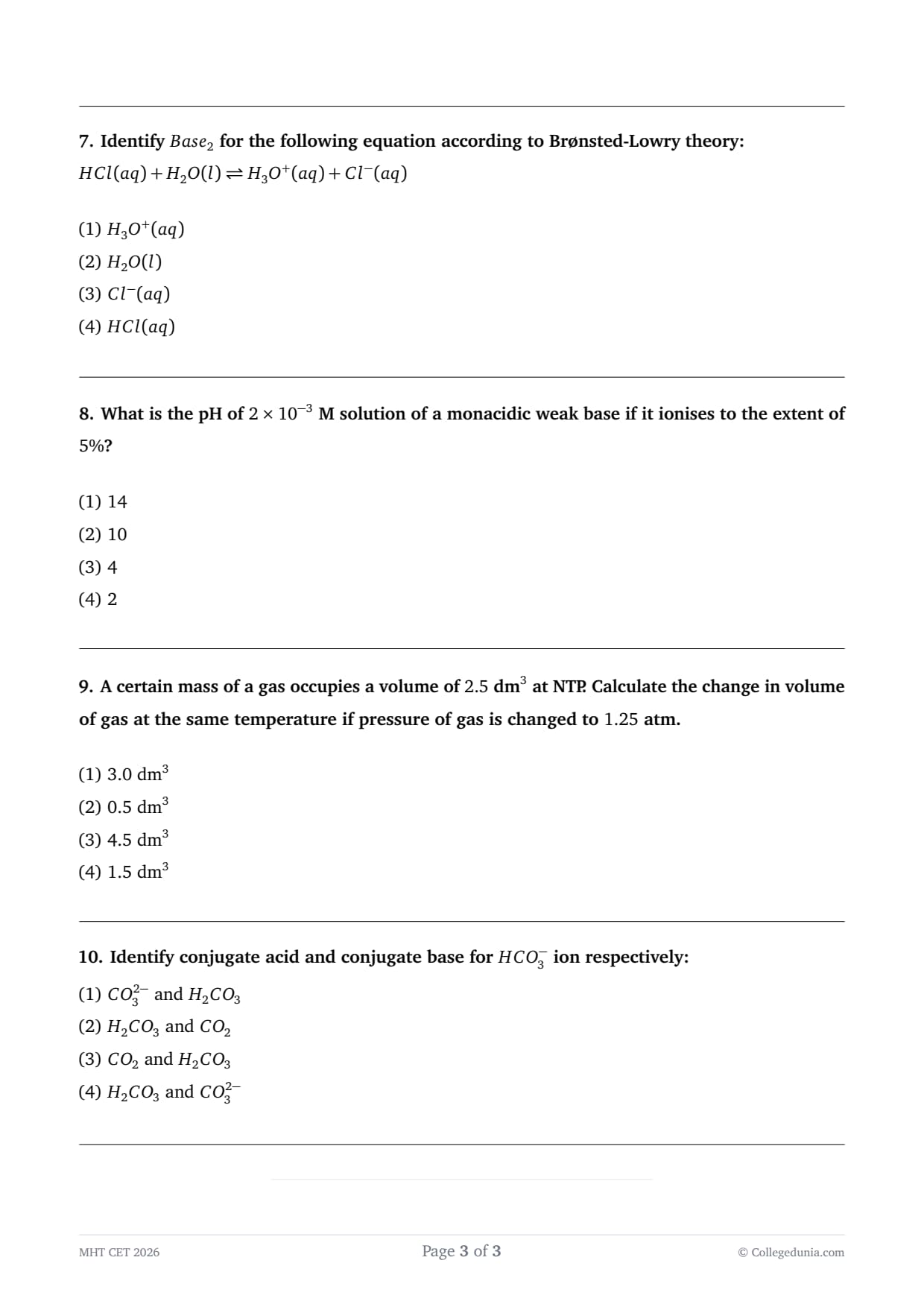
Identify \(Base_2\) for the following equation according to Brønsted-Lowry theory:
\( HCl(aq) + H_2O(l) \rightleftharpoons H_3O^+(aq) + Cl^-(aq) \)
View Solution
Concept:
According to the Brønsted-Lowry acid-base theory:
A Brønsted-Lowry acid is a species that donates a proton \((H^+)\).
A Brønsted-Lowry base is a species that accepts a proton \((H^+)\).
Whenever an acid donates a proton, another species must accept that proton. Thus, acid-base reactions always involve proton transfer.
The general representation is:
\[ Acid_1 + Base_2 \rightleftharpoons Acid_2 + Base_1 \]
where:
\(Acid_1\) donates proton.
\(Base_2\) accepts proton.
\(Acid_2\) is the conjugate acid formed after proton acceptance.
\(Base_1\) is the conjugate base formed after proton donation.
Step 1: Writing the given reaction clearly.
The given reaction is:
\[ HCl(aq) + H_2O(l) \rightleftharpoons H_3O^+(aq) + Cl^-(aq) \]
We now analyze the movement of the proton \((H^+)\).
Step 2: Identifying the proton donor.
In the reaction, \(HCl\) changes into \(Cl^-\).
\[ HCl \rightarrow Cl^- \]
This transformation is possible only if \(HCl\) loses a proton \((H^+)\).
Thus:
\[ HCl donates H^+ \]
Therefore, \(HCl\) behaves as a Brønsted-Lowry acid.
Hence,
\[ HCl = Acid_1 \]
Step 3: Identifying the proton acceptor.
Water molecule changes into hydronium ion:
\[ H_2O \rightarrow H_3O^+ \]
This occurs because water accepts the proton released by \(HCl\).
\[ H_2O + H^+ \rightarrow H_3O^+ \]
Since \(H_2O\) accepts a proton, it behaves as a Brønsted-Lowry base.
Thus:
\[ H_2O = Base_2 \]
Step 4: Identifying conjugate acid-base pairs.
The reaction can now be classified as:
\[ \underbrace{HCl}_{Acid_1} + \underbrace{H_2O}_{Base_2} \rightleftharpoons \underbrace{H_3O^+}_{Acid_2} + \underbrace{Cl^-}_{Base_1} \]
\(HCl\) loses proton and forms \(Cl^-\), therefore \(Cl^-\) is the conjugate base.
\(H_2O\) gains proton and forms \(H_3O^+\), therefore \(H_3O^+\) is the conjugate acid.
Step 5: Evaluating the options.
\(H_3O^+\): This is the conjugate acid formed after proton acceptance, not \(Base_2\).
\(H_2O\): Correct, because it accepts proton from \(HCl\).
\(Cl^-\): This is the conjugate base formed after proton donation by \(HCl\).
\(HCl\): This acts as acid because it donates proton.
Therefore, the correct answer is:
\[ \boxed{H_2O(l)} \] Quick Tip: In Brønsted-Lowry reactions: Species gaining \(H^+\) acts as a base. Species losing \(H^+\) acts as an acid. A quick trick: \[ Gain H^+ \Rightarrow Base \] \[ Lose H^+ \Rightarrow Acid \] Water can behave both as acid and base depending on the reaction, making it an amphoteric substance.
What is the pH of \(2 \times 10^{-3}\ M\) solution of a monacidic weak base if it ionises to the extent of \(5%\)?
View Solution
Concept:
A weak base ionizes partially in aqueous solution to produce hydroxide ions \((OH^-)\).
For a monacidic weak base:
\[ BOH \rightleftharpoons B^+ + OH^- \]
If:
Initial concentration \(= C\)
Degree of ionization \(= \alpha\)
then concentration of hydroxide ions produced is:
\[ [OH^-] = C\alpha \]
After calculating \([OH^-]\), we use:
\[ pOH = -\log[OH^-] \]
and
\[ pH + pOH = 14 \]
Step 1: Writing the given data.
Concentration of weak base:
\[ C = 2 \times 10^{-3}\ M \]
Degree of ionization:
\[ 5% = \frac{5}{100} = 0.05 \]
Step 2: Calculating hydroxide ion concentration.
\[ [OH^-] = C\alpha \]
Substituting values:
\[ [OH^-] = (2 \times 10^{-3})(0.05) \]
\[ [OH^-] = (2 \times 10^{-3})\left(\frac{5}{100}\right) \]
\[ [OH^-] = \frac{10 \times 10^{-3}}{100} \]
\[ [OH^-] = 10^{-4}\ M \]
Step 3: Calculating pOH.
\[ pOH = -\log(10^{-4}) \]
\[ pOH = 4 \]
Step 4: Calculating pH.
Using:
\[ pH + pOH = 14 \]
\[ pH + 4 = 14 \]
\[ pH = 10 \]
Step 5: Final conclusion.
Therefore, the pH of the solution is:
\[ \boxed{10} \]
Hence, the correct option is:
\[ \boxed{(2)\ 10} \] Quick Tip: For weak bases: \[ [OH^-] = C\alpha \] where: \(C\) = concentration \(\alpha\) = degree of ionization Then use: \[ pOH = -\log[OH^-] \] and finally: \[ pH = 14 - pOH \] Always convert percentage ionization into decimal form before substitution.
A certain mass of a gas occupies a volume of \(2.5\ dm^3\) at NTP. Calculate the change in volume of gas at the same temperature if pressure of gas is changed to \(1.25\ atm\).
View Solution
Concept:
Since temperature remains constant, Boyle's law is applicable.
Boyle's law states:
\[ P_1V_1 = P_2V_2 \]
This law shows that pressure and volume are inversely proportional at constant temperature.
Step 1: Writing the given values.
At NTP:
\[ P_1 = 1\ atm \]
Initial volume:
\[ V_1 = 2.5\ dm^3 \]
Final pressure:
\[ P_2 = 1.25\ atm \]
Final volume:
\[ V_2 = ? \]
Step 2: Applying Boyle's law.
\[ P_1V_1 = P_2V_2 \]
Substituting values:
\[ 1 \times 2.5 = 1.25 \times V_2 \]
\[ 2.5 = 1.25V_2 \]
\[ V_2 = \frac{2.5}{1.25} \]
\[ V_2 = 2.0\ dm^3 \]
Step 3: Calculating change in volume.
Initial volume:
\[ 2.5\ dm^3 \]
Final volume:
\[ 2.0\ dm^3 \]
Therefore,
\[ Change in volume = 2.5 - 2.0 \]
\[ = 0.5\ dm^3 \]
Step 4: Final conclusion.
Hence, the decrease in volume of gas is:
\[ \boxed{0.5\ dm^3} \]
Therefore, the correct option is:
\[ \boxed{(2)\ 0.5\ dm^3} \] Quick Tip: For Boyle's law: \[ P \propto \frac{1}{V} \] This means: Increase in pressure causes decrease in volume. Decrease in pressure causes increase in volume. Always remember: \[ P_1V_1 = P_2V_2 \] Temperature must remain constant for Boyle's law to be applicable.
Identify conjugate acid and conjugate base for \( HCO_3^- \) ion respectively:
View Solution
Concept:
According to the Brønsted-Lowry acid-base theory:
A conjugate acid is formed when a species accepts a proton (\(H^+\)).
A conjugate base is formed when a species donates a proton (\(H^+\)).
The ion \( HCO_3^- \) is called the bicarbonate ion and is an amphiprotic species, which means it can behave both as an acid and as a base depending upon the reaction conditions.
Step 1: Finding the conjugate acid of \( HCO_3^- \).
To obtain the conjugate acid, the given species must accept one proton (\(H^+\)).
\[ HCO_3^- + H^+ \rightarrow H_2CO_3 \]
Here, the bicarbonate ion gains one proton and forms carbonic acid.
Therefore, the conjugate acid of \( HCO_3^- \) is:
\[ H_2CO_3 \]
Step 2: Finding the conjugate base of \( HCO_3^- \).
To obtain the conjugate base, the given species must donate one proton (\(H^+\)).
\[ HCO_3^- \rightarrow H^+ + CO_3^{2-} \]
After losing one proton, bicarbonate ion forms carbonate ion.
Therefore, the conjugate base of \( HCO_3^- \) is:
\[ CO_3^{2-} \]
Step 3: Matching with the given options.
From the above calculations:
\[ Conjugate Acid = H_2CO_3 \]
\[ Conjugate Base = CO_3^{2-} \]
Hence, the correct pair is:
\[ H_2CO_3 and CO_3^{2-} \]
Step 4: Evaluation of the given options.
\( CO_3^{2-} \) and \( H_2CO_3 \): Incorrect order.
\( H_2CO_3 \) and \( CO_2 \): Incorrect because \( CO_2 \) is not the conjugate base.
\( CO_2 \) and \( H_2CO_3 \): Incorrect pair.
\( H_2CO_3 \) and \( CO_3^{2-} \): Correct pair. Quick Tip: Remember: \[ Conjugate Acid = Species + H^+ \] \[ Conjugate Base = Species - H^+ \] Always carefully check the charge after adding or removing a proton.
MHT CET PCM Exam Pattern 2026
| Parameter | Details |
|---|---|
| Conducting Body | Maharashtra Common Entrance Test Cell (Maharashtra CET Cell) |
| Exam Mode | Online (Computer-Based Test) |
| Duration | 180 minutes (3 hours) |
| Groups / Subjects | PCM (Physics, Chemistry, Mathematics) for Engineering |
| Total Questions |
150 |
| Total Marks | 200 |
| Question Type | Multiple Choice Questions (MCQs) |
| Marks Distribution |
|
| Negative Marking | No |
| Syllabus Weightage |
|



Comments