



MHT CET 2026 May 13 Shift 1 PCM Question Paper is available for download here. Maharashtra State CET Cell conducted MHT CET 2026 PCM Exam on May 13 in Shift 1 from 9 AM to 12 PM in CBT mode.
- The MHT CET 2026 PCM Question Paper consists of 150 multiple-choice questions (MCQs) totalling 200 marks divided into 3 sections: Physics, Chemistry, and Mathematics, with 50 questions in each subject.
- Physics and Chemistry questions carry 1 mark each while Mathematics questions carry 2 marks each.
- There is no negative marking for incorrect answers.
Download MHT CET 2026 May 13 Shift 1 PCM Question Paper with Solutions PDF from the links provided below.
MHT CET 2026 May 13 Shift 1 PCM Question Paper PDF Download
| MHT CET 2026 May 13 Shift 1 Question Paper | Download PDF | Check Solution |



The rms velocity of hydrogen molecules at 27\(^{\circ}\)C is v. At what temperature will the rms velocity of oxygen molecules equal v?
An ideal gas undergoes a cyclic process ABCA wherein AB is an isothermal expansion, BC is an isochoric pressure drop, and CA is an adiabatic compression. The work done by the gas in the complete cycle is:
A Carnot engine operates between temperatures \(T_{1}\) and \(T_{2}\) (\(T_{1} > T_{2}\)). If \(T_{1}\) is increased by \(\Delta T\) and \(T_{2}\) is decreased by \(\Delta T\), its efficiency will:
A particle executes simple harmonic motion of amplitude A and time period T. The time taken by the particle to travel from the mean position to a distance of A/2 is:
A pendulum clock gives correct time at 20\(^{\circ}\)C. If the coefficient of linear expansion of the pendulum's material is \(\alpha = 1.2 \times 10^{-5}/^{\circ}\)C, the clock will lose time per day at 40\(^{\circ}\)C by approximately:
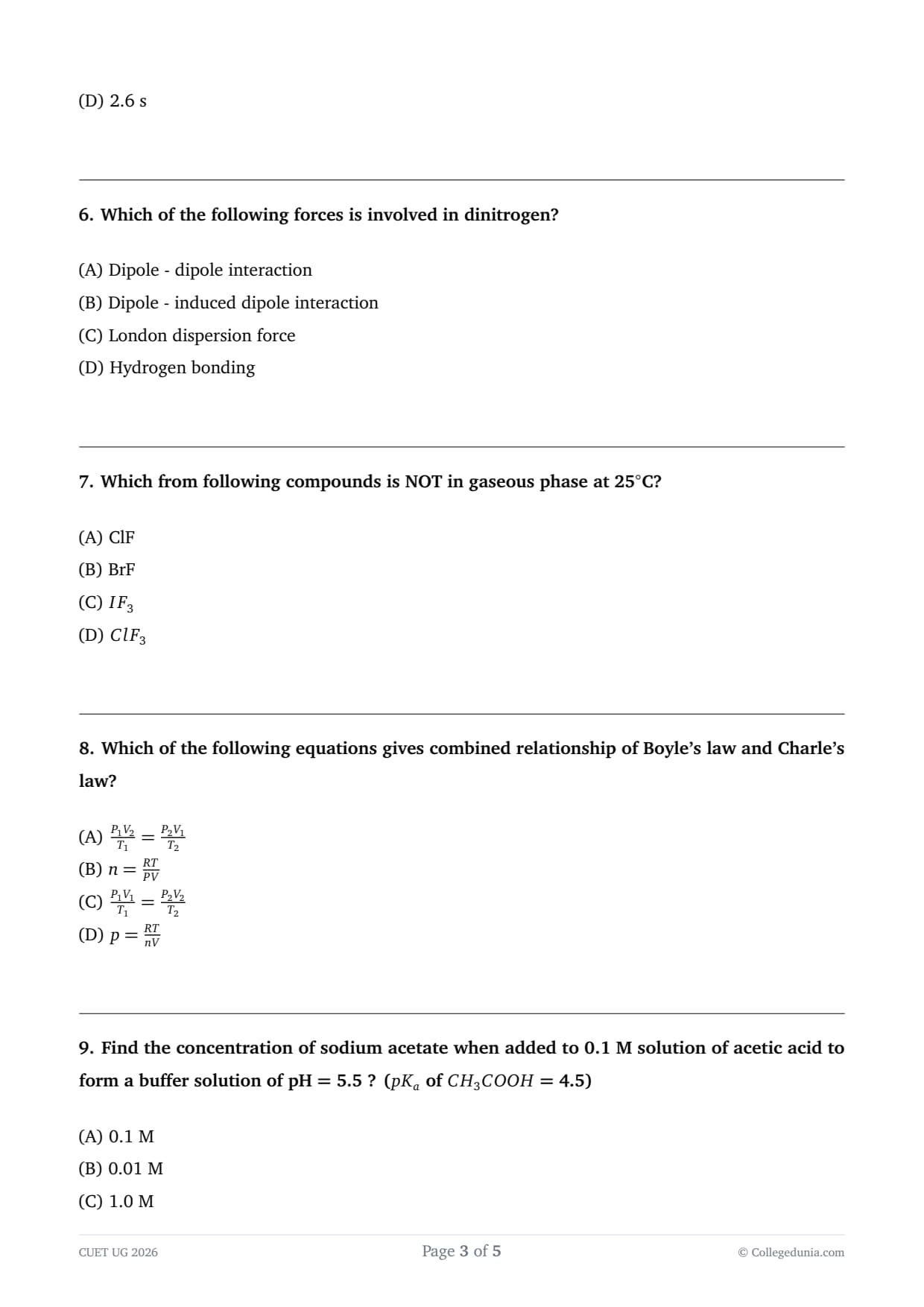
Which of the following forces is involved in dinitrogen?
View Solution
Step 1: Concept
Dinitrogen (\(N_{2}\)) is a homonuclear diatomic molecule, meaning both nitrogen atoms have the same electronegativity.
Step 2: Meaning
Because the electronegativity difference is zero, the bond is perfectly non-polar, and the molecule has no permanent dipole moment.
Step 3: Analysis
Dipole-dipole and dipole-induced dipole interactions require at least one polar molecule. Hydrogen bonding requires H bonded to N, O, or F. For non-polar molecules like \(N_{2}\), the only intermolecular forces present are temporary, instantaneous dipoles.
Step 4: Conclusion
These temporary attractive forces are known as London dispersion forces (or Van der Waals forces).
Final Answer: (C) Quick Tip: All non-polar molecules (like \(O_{2}\), \(H_{2}\), \(Cl_{2}\)) rely solely on London dispersion forces for intermolecular attraction.
Which from following compounds is NOT in gaseous phase at 25\(^{\circ}\)C?
Which of the following equations gives combined relationship of Boyle's law and Charle's law?
View Solution
Step 1: Concept
Boyle's Law states \(V \propto \frac{1}{P}\) (at constant \(T, n\)). Charles's Law states \(V \propto T\) (at constant \(P, n\)).
Step 2: Meaning
Combining these laws for a fixed amount of gas gives the Combined Gas Law: \(V \propto \frac{T}{P}\), or \(\frac{PV}{T} = constant\).
Step 3: Analysis
For two different states of the same gas sample, the ratio of the product of pressure and volume to the absolute temperature must remain equal.
Step 4: Conclusion
This relationship is expressed mathematically as \(\frac{P_{1}V_{1}}{T_{1}} = \frac{P_{2}V_{2}}{T_{2}}\).
Final Answer: (C) Quick Tip: Remember the "PV over T" rule: \(\frac{PV}{T}\) stays constant as long as the amount of gas (\(n\)) doesn't change.
Find the concentration of sodium acetate when added to 0.1 M solution of acetic acid to form a buffer solution of pH = 5.5 ? (\(pK_{a}\) of \(CH_{3}COOH\) = 4.5)
The solubility product of AgBr is \(4.9 \times 10^{-13}\) at a certain temperature. Calculate the solubility.
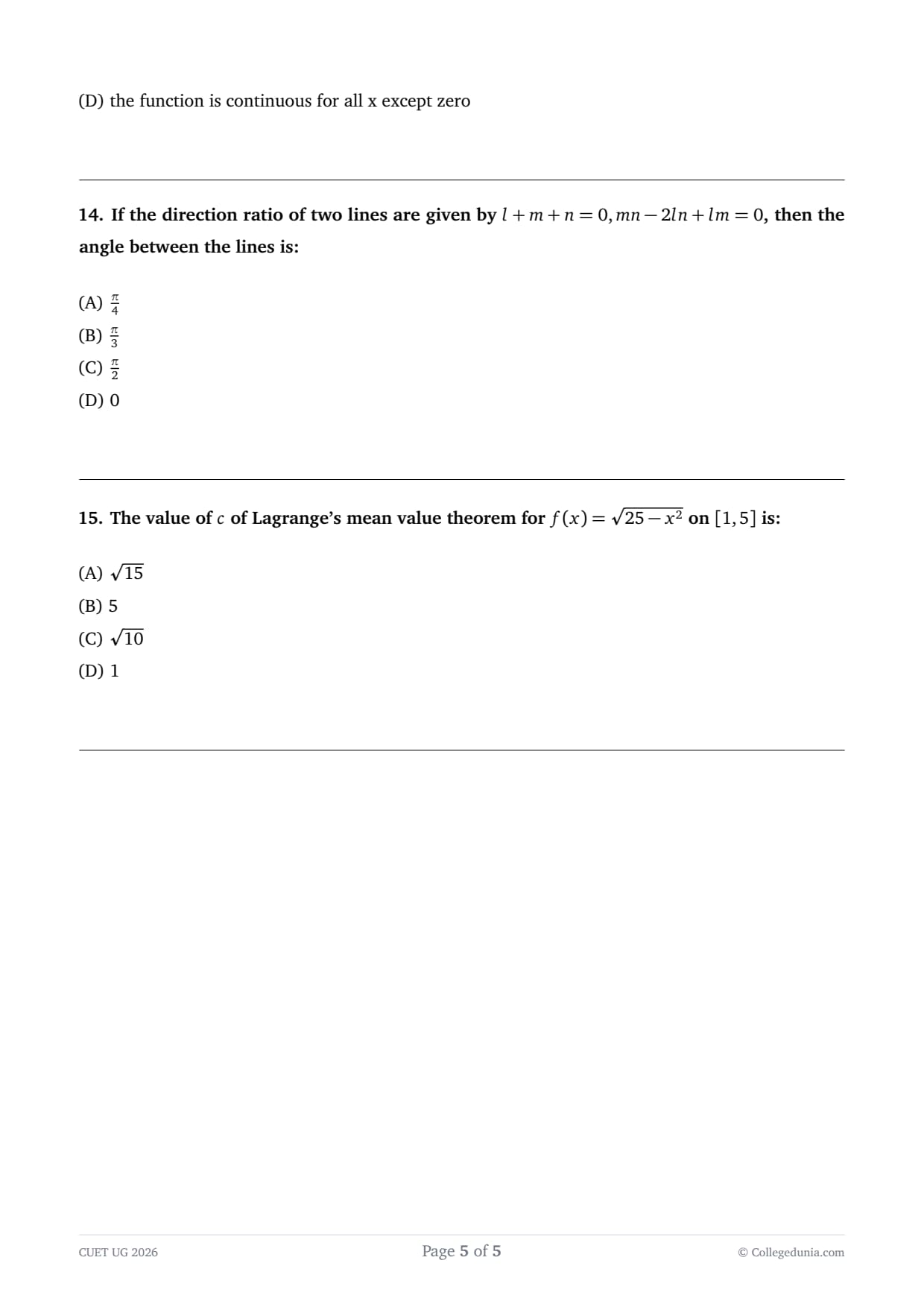
Let \(f(x) = \int \frac{\sqrt{x}}{(1+x)^{2}} dx (x \geq 0)\). Then \(f(3) - f(1)\) is equal to:
Gas is being pumped into a spherical balloon at the rate of \(30ft^{3}/min\). Then the rate at which the radius increases when it reaches the value 15 ft is:
Let the function \(f(x)\) defined as \(f(x) = \frac{x-|x|}{x}\), then:
If the direction ratio of two lines are given by \(l + m + n = 0, mn - 2ln + lm = 0\), then the angle between the lines is:
The value of \(c\) of Lagrange's mean value theorem for \(f(x) = \sqrt{25 - x^{2}}\) on \([1, 5]\) is:
View Solution
Step 1: Concept
Lagrange's Mean Value Theorem (LMVT) states there exists \(c \in (a, b)\) such that \(f'(c) = \frac{f(b) - f(a)}{b - a}\).
Step 2: Meaning
Here \(a=1, b=5\). \(f(1) = \sqrt{25-1} = \sqrt{24}\) and \(f(5) = \sqrt{25-25} = 0\). The slope is \(\frac{0 - \sqrt{24}}{5 - 1} = \frac{-\sqrt{24}}{4}\).
Step 3: Analysis
Differentiate \(f(x)\): \(f'(x) = \frac{1}{2\sqrt{25-x^{2}}}(-2x) = \frac{-x}{\sqrt{25-x^{2}}}\). Set \(f'(c) = slope\): \(\frac{-c}{\sqrt{25-c^{2}}} = \frac{-\sqrt{24}}{4}\).
Squaring both sides: \(\frac{c^{2}}{25-c^{2}} = \frac{24}{16} = \frac{3}{2}\).
Step 4: Conclusion
\(2c^{2} = 3(25 - c^{2}) \Rightarrow 2c^{2} = 75 - 3c^{2} \Rightarrow 5c^{2} = 75 \Rightarrow c^{2} = 15 \Rightarrow c = \sqrt{15}\).
Final Answer: (A) Quick Tip: LMVT finds the point where the instantaneous rate of change equals the average rate of change over the interval.
MHT CET PCM Exam Pattern 2026
| Parameter | Details |
|---|---|
| Conducting Body | Maharashtra Common Entrance Test Cell (Maharashtra CET Cell) |
| Exam Mode | Online (Computer-Based Test) |
| Duration | 180 minutes (3 hours) |
| Groups / Subjects | PCM (Physics, Chemistry, Mathematics) for Engineering |
| Total Questions |
150 |
| Total Marks | 200 |
| Question Type | Multiple Choice Questions (MCQs) |
| Marks Distribution |
|
| Negative Marking | No |
| Syllabus Weightage |
|



Comments