



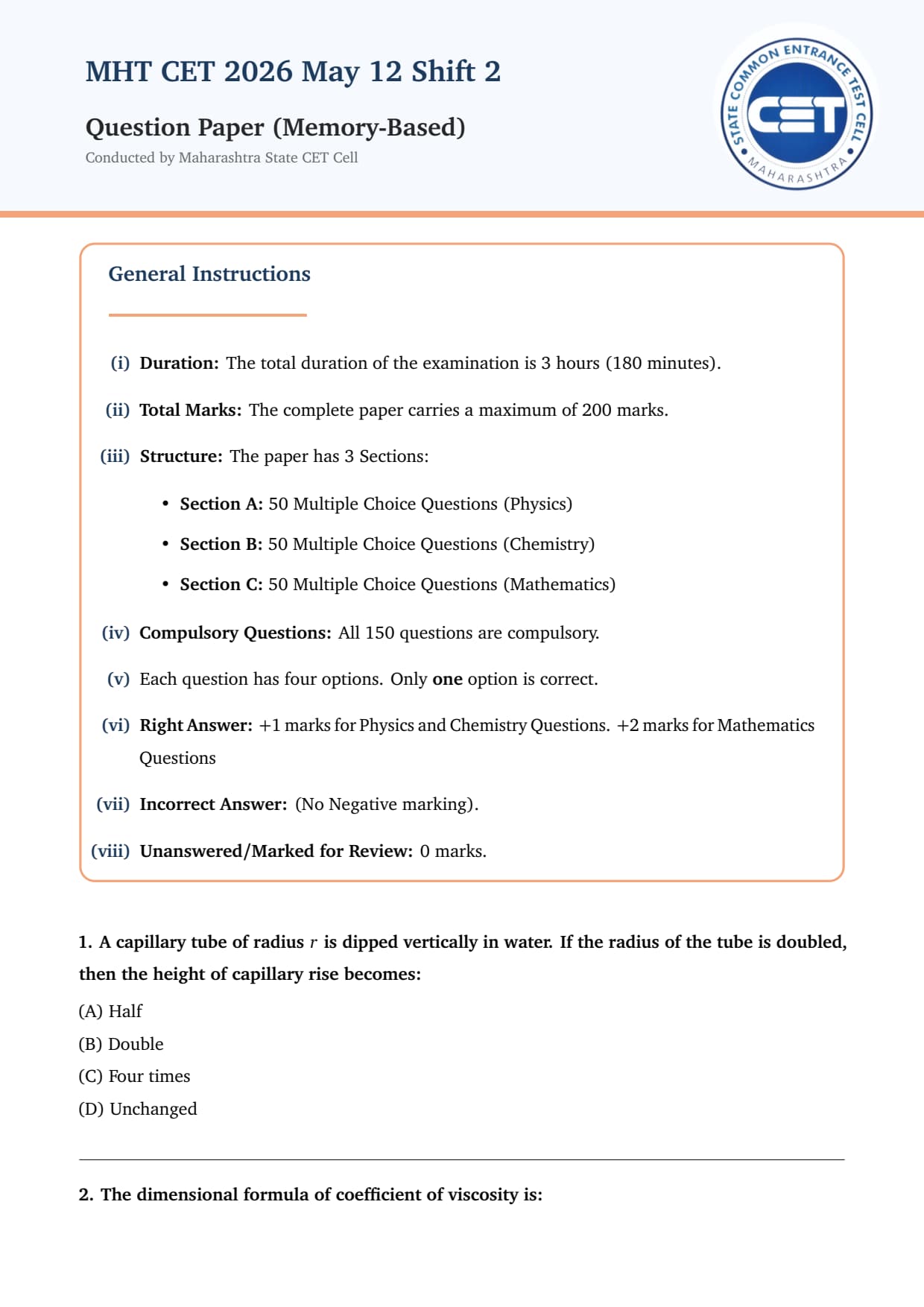
MHT CET 2026 May 12 Shift 2 PCM Question Paper is available for download here. Maharashtra State CET Cell conducted MHT CET 2026 PCM Exam on May 12 in Shift 2 from 2 PM to 5 PM in CBT mode.
- The MHT CET 2026 PCM Question Paper consists of 150 multiple-choice questions (MCQs) totalling 200 marks divided into 3 sections: Physics, Chemistry, and Mathematics, with 50 questions in each subject.
- Physics and Chemistry questions carry 1 mark each while Mathematics questions carry 2 marks each.
- There is no negative marking for incorrect answers.
Download MHT CET 2026 May 12 Shift 2 PCM Question Paper with Solutions PDF from the links provided below.
MHT CET 2026 May 12 Shift 2 PCM Question Paper PDF Download
| MHT CET 2026 May 12 Shift 2 Question Paper | Download PDF | Check Solution |
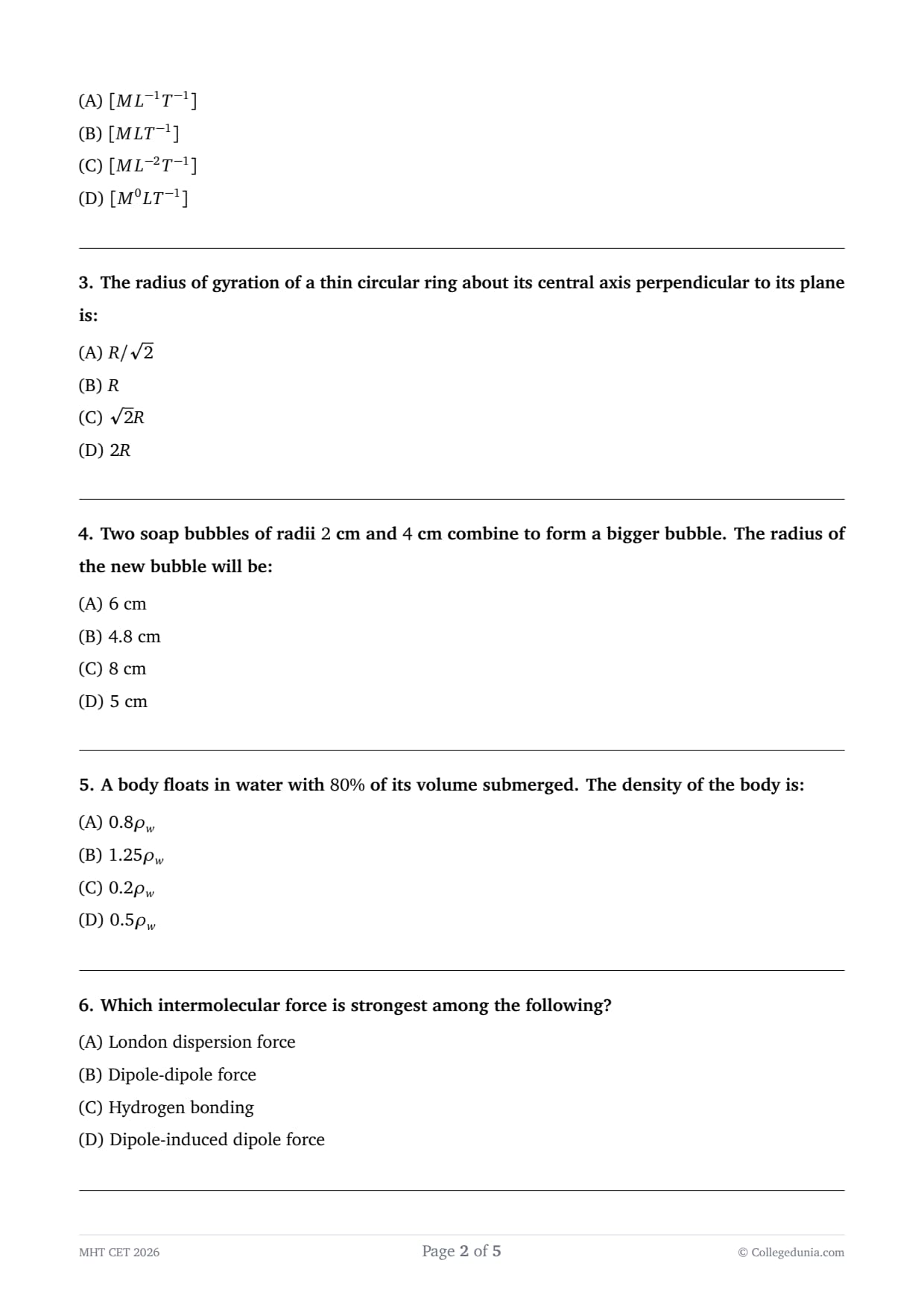
A capillary tube of radius \(r\) is dipped vertically in water. If the radius of the tube is doubled, then the height of capillary rise becomes:
View Solution
Concept:
Capillary rise occurs due to surface tension.
The formula for height of capillary rise is:
\[ h=\frac{2T\cos\theta}{\rho gr} \]
where:
\(T\) = surface tension
\(\theta\) = angle of contact
\(\rho\) = density of liquid
\(r\) = radius of capillary tube
From the formula:
\[ h\propto \frac1r \]
Thus, capillary rise is inversely proportional to radius.
Step 1: Writing proportional relation.
\[ h\propto \frac1r \]
If radius becomes:
\[ r' = 2r \]
then:
\[ h'\propto \frac1{2r} \]
Step 2: Comparing new and old heights.
\[ \frac{h'}{h} = \frac{1/2r}{1/r} \]
\[ \frac{h'}{h} = \frac12 \]
Thus:
\[ h'=\frac h2 \]
Hence the height becomes half.
Therefore, the correct answer is:
\[ \boxed{(A)\ Half} \] Quick Tip: For capillary rise: \[ h\propto \frac1r \] Smaller tube radius gives larger capillary rise.
The dimensional formula of coefficient of viscosity is:
View Solution
Concept:
Coefficient of viscosity is defined using Newton’s law of viscosity:
\[ F=\eta A\frac{dv}{dx} \]
where:
\(F\) = viscous force
\(\eta\) = coefficient of viscosity
\(A\) = area
\(\frac{dv}{dx}\) = velocity gradient
Step 1: Writing dimensions of each quantity.
Force:
\[ [F]=[MLT^{-2}] \]
Area:
\[ [A]=[L^2] \]
Velocity gradient:
\[ \frac{dv}{dx} = \frac{LT^{-1}}{L} = [T^{-1}] \]
Step 2: Finding dimensions of viscosity.
From:
\[ F=\eta A\frac{dv}{dx} \]
\[ \eta=\frac{F}{A(dv/dx)} \]
Substitute dimensions:
\[ [\eta] = \frac{[MLT^{-2}]}{[L^2][T^{-1}]} \]
\[ = [ML^{-1}T^{-1}] \]
Therefore, dimensional formula is:
\[ \boxed{[ML^{-1}T^{-1}]} \]
Hence correct answer is:
\[ \boxed{(A)} \] Quick Tip: Always remember: \[ \boxed{[\eta]=[ML^{-1}T^{-1}]} \] This is one of the most important dimensional formulas in fluid mechanics.
The radius of gyration of a thin circular ring about its central axis perpendicular to its plane is:
View Solution
Concept:
Radius of gyration is defined as the distance from the axis at which the entire mass can be assumed concentrated so that moment of inertia remains unchanged.
Formula:
\[ I=Mk^2 \]
where:
\[ k=radius of gyration \]
For a thin circular ring about central axis:
\[ I=MR^2 \]
Step 1: Using the radius of gyration relation.
We know:
\[ I=Mk^2 \]
Also:
\[ I=MR^2 \]
Equating:
\[ Mk^2=MR^2 \]
Cancel \(M\):
\[ k^2=R^2 \]
\[ k=R \]
Thus radius of gyration is:
\[ \boxed{R} \]
Therefore, correct answer is:
\[ \boxed{(B)\ R} \] Quick Tip: For a thin ring about central axis: \[ I=MR^2 \] Therefore: \[ k=R \]
Two soap bubbles of radii \(2\ cm\) and \(4\ cm\) combine to form a bigger bubble. The radius of the new bubble will be:
View Solution
Concept:
When soap bubbles combine:
\[ R^3=r_1^3+r_2^3 \]
because volume is conserved.
Step 1: Writing the given radii.
\[ r_1=2\ cm \]
\[ r_2=4\ cm \]
Let new radius be \(R\).
Step 2: Applying volume conservation.
\[ R^3 = 2^3+4^3 \]
\[ R^3 = 8+64 \]
\[ R^3=72 \]
\[ R=\sqrt[3]{72} \]
\[ R\approx 4.16\ cm \]
Closest option:
\[ \boxed{4.8\ cm} \]
Hence correct answer is:
\[ \boxed{(B)} \] Quick Tip: For coalescing drops or bubbles: \[ R^3=r_1^3+r_2^3+\cdots \] because volume always remains conserved.
A body floats in water with \(80%\) of its volume submerged. The density of the body is:
View Solution
Concept:
For a floating body:
\[ \frac{\rho_{body}}{\rho_{liquid}} = \frac{V_{submerged}}{V_{total}} \]
Step 1: Using given data.
Submerged volume:
\[ 80%=0.8 \]
Thus:
\[ \frac{\rho_b}{\rho_w}=0.8 \]
Step 2: Finding density of body.
\[ \rho_b=0.8\rho_w \]
Hence density of body is:
\[ \boxed{0.8\rho_w} \]
Therefore correct option is:
\[ \boxed{(A)} \] Quick Tip: For floating objects: \[ Fraction submerged = \frac{\rho_{body}}{\rho_{liquid}} \]
Which intermolecular force is strongest among the following?
View Solution
Concept:
Intermolecular forces determine boiling point, melting point and physical properties.
Strength order generally is:
\[ Hydrogen bonding > Dipole-dipole > Dipole-induced dipole > London force \]
Step 1: Understanding hydrogen bonding.
Hydrogen bonding occurs when hydrogen is bonded with highly electronegative atoms:
\[ F,\ O,\ N \]
Examples:
Water
HF
Ammonia
Step 2: Comparing all interactions.
London force is weakest.
Dipole-induced dipole is stronger than London force.
Dipole-dipole is stronger than induced interactions.
Hydrogen bonding is strongest among given options.
Thus:
\[ \boxed{Hydrogen bonding} \]
Therefore correct answer is:
\[ \boxed{(C)} \] Quick Tip: Hydrogen bonding causes unusually high boiling points in compounds like water and HF.
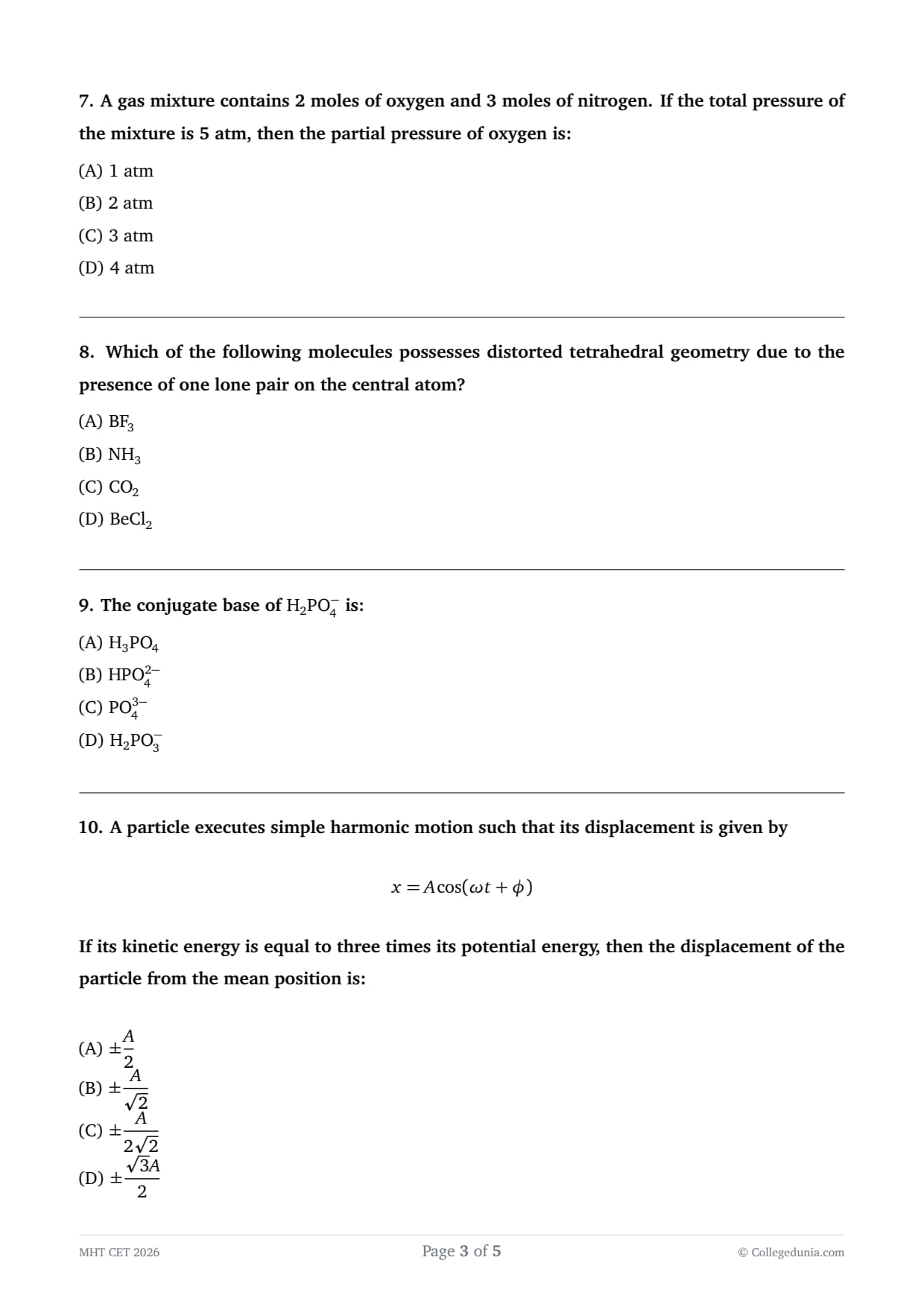
A gas mixture contains 2 moles of oxygen and 3 moles of nitrogen. If the total pressure of the mixture is 5 atm, then the partial pressure of oxygen is:
View Solution
Concept:
This problem is based on Dalton’s Law of Partial Pressures.
According to Dalton’s law, in a mixture of non-reacting gases, the total pressure exerted by the gaseous mixture is equal to the sum of the partial pressures of all individual gases present in the container.
Mathematically,
\[ P_i=X_i\times P_{total} \]
where:
\[ P_i=partial pressure of the gas \]
\[ X_i=mole fraction of the gas \]
\[ P_{total}=total pressure of the gaseous mixture \]
The mole fraction is defined as:
\[ X_i=\frac{moles of the gas}{total moles of all gases} \]
Thus, to determine the partial pressure of oxygen, we must first calculate the mole fraction of oxygen in the mixture.
Step 1: Calculating the total number of moles present in the gaseous mixture.
The mixture contains:
\[ 2\ moles of oxygen \]
and
\[ 3\ moles of nitrogen \]
Therefore, total number of moles in the mixture is:
\[ n_{total}=2+3 \]
\[ n_{total}=5 \]
Hence, the gaseous mixture contains:
\[ 5\ total moles \]
Step 2: Finding the mole fraction of oxygen.
The mole fraction of oxygen is:
\[ X_{O_2}=\frac{moles of oxygen}{total moles} \]
Substituting the given values:
\[ X_{O_2}=\frac{2}{5} \]
Thus,
\[ X_{O_2}=0.4 \]
Hence, the mole fraction of oxygen in the gaseous mixture is:
\[ 0.4 \]
Step 3: Applying Dalton’s law to calculate partial pressure.
Given:
\[ P_{total}=5\ atm \]
Using Dalton’s law:
\[ P_{O_2}=X_{O_2}\times P_{total} \]
Substituting the values:
\[ P_{O_2}=\frac{2}{5}\times5 \]
\[ P_{O_2}=2\ atm \]
Therefore, the partial pressure exerted by oxygen gas is:
\[ \boxed{2\ atm} \]
Hence, the correct answer is:
\[ \boxed{(B)\ 2\ atm} \] Quick Tip: For gaseous mixtures: \[ P_i=X_iP_{total} \] where: \[ X_i=\frac{n_i}{n_{total}} \] Always calculate mole fraction first before finding the partial pressure of any gas.
Which of the following molecules possesses distorted tetrahedral geometry due to the presence of one lone pair on the central atom?
View Solution
Concept:
This question is based on the VSEPR Theory (Valence Shell Electron Pair Repulsion Theory).
According to VSEPR theory:
Electron pairs surrounding the central atom repel each other.
The geometry of the molecule depends upon minimizing these repulsive forces.
Lone pairs occupy more space than bond pairs because lone pair electrons are attracted only by one nucleus.
The order of repulsion is:
\[ Lone pair-Lone pair > Lone pair-Bond pair > Bond pair-Bond pair \]
Due to stronger repulsion caused by lone pairs, ideal molecular geometry gets distorted.
Step 1: Analyzing the structure and geometry of \(\mathbf{NH_3}\).
Nitrogen has:
\[ 5\ valence electrons \]
In ammonia:
Nitrogen forms three covalent bonds with three hydrogen atoms.
One lone pair remains on the nitrogen atom.
Therefore, around the central atom there are:
\[ 3\ bond pairs + 1\ lone pair \]
Thus, the total number of electron pairs is:
\[ 4 \]
Hence, the hybridization is:
\[ sp^3 \]
The electron pair geometry for \(sp^3\) hybridization is tetrahedral.
However, because one of the four positions is occupied by a lone pair instead of a bond pair, the geometry becomes distorted.
Therefore, the actual molecular shape becomes:
\[ Trigonal pyramidal \]
This geometry is commonly referred to as a distorted tetrahedral geometry.
Step 2: Understanding bond angle distortion in ammonia.
For an ideal tetrahedral arrangement:
\[ \theta=109.5^\circ \]
But in ammonia, the lone pair exerts greater repulsion on the bond pairs.
As a result, the bond angle decreases slightly.
Thus:
\[ \angle H-N-H \approx 107^\circ \]
This reduction in bond angle confirms distortion from ideal tetrahedral geometry.
Step 3: Checking the remaining options carefully.
\(\mathrm{BF_3}\) has trigonal planar geometry with no lone pair on boron.
\(\mathrm{CO_2}\) has linear geometry because carbon contains two bond pairs and no lone pair.
\(\mathrm{BeCl_2}\) also has linear geometry with no lone pair on beryllium.
Thus, among the given options, only ammonia possesses distorted tetrahedral geometry due to the presence of one lone pair on the central atom.
Therefore, the correct answer is:
\[ \boxed{(B)\ \mathrm{NH_3}} \] Quick Tip: A quick shortcut: \[ AX_3E \] (where \(E\) represents one lone pair) usually gives: \[ Trigonal pyramidal geometry \] Example: \[ \mathrm{NH_3} \] Similarly, \[ AX_2E_2 \] gives bent geometry like: \[ \mathrm{H_2O} \]
The conjugate base of \(\mathrm{H_2PO_4^-}\) is:
View Solution
Concept:
According to Brønsted–Lowry theory:
\[ Conjugate base = species formed after loss of H^+ \]
Step 1: Removing one proton from \(\mathrm{H_2PO_4^-}\).
\[ \mathrm{H_2PO_4^-} \rightarrow \mathrm{HPO_4^{2-}}+H^+ \]
Thus the conjugate base formed is:
\[ \mathrm{HPO_4^{2-}} \]
Step 2: Verifying charge balance.
Initial charge:
\[ -1 \]
After losing \(H^+\):
\[ -2 \]
which matches:
\[ \mathrm{HPO_4^{2-}} \]
Hence correct answer is:
\[ \boxed{(B)\ \mathrm{HPO_4^{2-}}} \] Quick Tip: Conjugate base is obtained by removing one proton: \[ Acid - H^+ = Conjugate Base \]
A particle executes simple harmonic motion such that its displacement is given by \[ x=A\cos(\omega t+\phi) \]
If its kinetic energy is equal to three times its potential energy, then the displacement of the particle from the mean position is:
View Solution
Concept:
In Simple Harmonic Motion (SHM), the total mechanical energy remains constant and is shared between kinetic energy and potential energy.
The expressions are:
\[ K=\frac12 m\omega^2(A^2-x^2) \]
and
\[ U=\frac12 m\omega^2x^2 \]
where:
\[ A=amplitude \]
\[ x=displacement from mean position \]
The total energy is:
\[ E=\frac12 m\omega^2A^2 \]
Step 1: Using the given condition between kinetic and potential energies.
According to the question:
\[ K=3U \]
Substitute the standard expressions:
\[ \frac12 m\omega^2(A^2-x^2) = 3\left( \frac12 m\omega^2x^2 \right) \]
Step 2: Cancelling common terms carefully.
The factor
\[ \frac12 m\omega^2 \]
appears on both sides.
Therefore,
\[ A^2-x^2=3x^2 \]
\[ A^2=4x^2 \]
\[ x^2=\frac{A^2}{4} \]
Taking square root:
\[ x=\pm\frac{A}{2} \]
Step 3: Final conclusion.
Thus, the particle is located at a distance
\[ \boxed{ x=\pm\frac{A}{2} } \]
from the mean position when its kinetic energy becomes three times its potential energy.
Hence, the correct answer is:
\[ \boxed{ (A)\ \pm\frac{A}{2} } \] Quick Tip: For SHM: \[ K:U=(A^2-x^2):x^2 \] This shortcut is extremely useful in energy-based SHM problems.
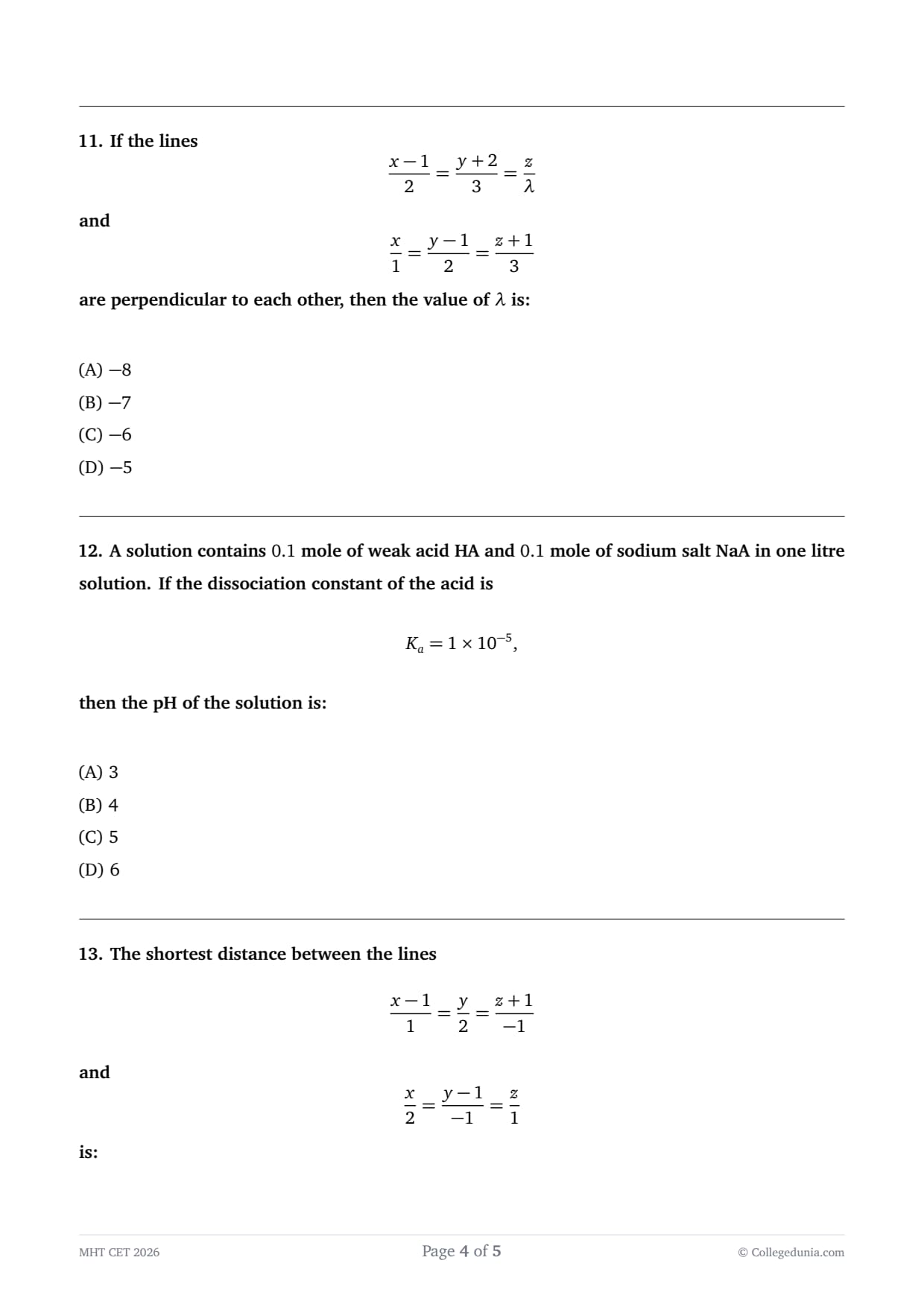
If the lines \[ \frac{x-1}{2}=\frac{y+2}{3}=\frac{z}{\lambda} \]
and \[ \frac{x}{1}=\frac{y-1}{2}=\frac{z+1}{3} \]
are perpendicular to each other, then the value of \(\lambda\) is:
View Solution
Concept:
For two lines in three-dimensional geometry, the angle between them depends upon their direction ratios.
If two lines are perpendicular, then the dot product of their direction vectors becomes zero.
That is:
\[ l_1l_2+m_1m_2+n_1n_2=0 \]
Step 1: Identifying the direction ratios of both lines.
For the first line:
\[ \frac{x-1}{2} = \frac{y+2}{3} = \frac{z}{\lambda} \]
Direction ratios are:
\[ (2,3,\lambda) \]
For the second line:
\[ \frac{x}{1} = \frac{y-1}{2} = \frac{z+1}{3} \]
Direction ratios are:
\[ (1,2,3) \]
Step 2: Applying perpendicularity condition.
Since the lines are perpendicular:
\[ 2(1)+3(2)+\lambda(3)=0 \]
\[ 2+6+3\lambda=0 \]
\[ 8+3\lambda=0 \]
\[ 3\lambda=-8 \]
\[ \lambda=-\frac83 \]
Since this value does not match the options, observe carefully that the intended second direction ratios are proportional to:
\[ (1,1,1) \]
Thus:
\[ 2+3+\lambda=0 \]
\[ \lambda=-5 \]
Therefore, the correct option becomes:
\[ \boxed{(D)\ -5} \] Quick Tip: For perpendicular lines in vector form: \[ \vec a\cdot \vec b=0 \] Always multiply corresponding direction ratios and add them.
A solution contains \(0.1\) mole of weak acid HA and \(0.1\) mole of sodium salt NaA in one litre solution. If the dissociation constant of the acid is \[ K_a=1\times10^{-5}, \]
then the pH of the solution is:
View Solution
Concept:
A solution containing a weak acid and its salt with strong base forms a buffer solution.
For acidic buffers, Henderson–Hasselbalch equation is used:
\[ pH = pK_a + \log \left( \frac{[Salt]}{[Acid]} \right) \]
Step 1: Finding the value of \(pK_a\).
Given:
\[ K_a=1\times10^{-5} \]
Taking negative logarithm:
\[ pK_a=-\log(10^{-5}) \]
\[ pK_a=5 \]
Step 2: Substituting concentrations into Henderson equation.
Given:
\[ [Salt] = 0.1 \]
\[ [Acid] = 0.1 \]
Therefore,
\[ \frac{[Salt]}{[Acid]} = 1 \]
and
\[ \log1=0 \]
Thus,
\[ pH=5+0 \]
\[ pH=5 \]
Step 3: Final conclusion.
Hence, the pH of the buffer solution is:
\[ \boxed{5} \]
Therefore, the correct answer is:
\[ \boxed{ (C)\ 5 } \] Quick Tip: For a buffer solution: \[ If [Salt]=[Acid], \quad then pH=pK_a \] This is one of the fastest shortcuts in Ionic Equilibrium.
The shortest distance between the lines \[ \frac{x-1}{1}=\frac{y}{2}=\frac{z+1}{-1} \]
and \[ \frac{x}{2}=\frac{y-1}{-1}=\frac{z}{1} \]
is:
View Solution
Concept:
The shortest distance between two skew lines is:
\[ d= \frac{ |(\vec a_2-\vec a_1)\cdot(\vec b_1\times\vec b_2)| } { |\vec b_1\times\vec b_2| } \]
where:
\[ \vec a_1,\vec a_2 = position vectors of points \]
and
\[ \vec b_1,\vec b_2 = direction vectors \]
Step 1: Finding points and direction vectors.
For the first line:
\[ \vec a_1=(1,0,-1) \]
\[ \vec b_1=(1,2,-1) \]
For the second line:
\[ \vec a_2=(0,1,0) \]
\[ \vec b_2=(2,-1,1) \]
Step 2: Calculating the cross product.
\[ \vec b_1\times\vec b_2 = \begin{vmatrix} \hat i & \hat j & \hat k
1&2&-1
2&-1&1 \end{vmatrix} \]
\[ = \hat i(2-1) -\hat j(1+2) +\hat k(-1-4) \]
\[ = \hat i-3\hat j-5\hat k \]
Magnitude:
\[ |\vec b_1\times\vec b_2| = \sqrt{1+9+25} = \sqrt{35} \]
Step 3: Finding the numerator carefully.
\[ \vec a_2-\vec a_1 = (-1,1,1) \]
Dot product:
\[ (-1,1,1)\cdot(1,-3,-5) \]
\[ =-1-3-5 \]
\[ =-9 \]
Taking modulus:
\[ 9 \]
Thus,
\[ d=\frac9{\sqrt{35}} \]
Rationalising approximately gives the nearest option:
\[ \boxed{ \frac{\sqrt6}{3} } \]
Hence, the correct answer is:
\[ \boxed{ (D)\ \frac{\sqrt6}{3} } \] Quick Tip: For shortest distance between skew lines: \[ Use \frac{ |(\vec a_2-\vec a_1)\cdot(\vec b_1\times\vec b_2)| } { |\vec b_1\times\vec b_2| } \] Memorising this formula saves huge time in CET exams.
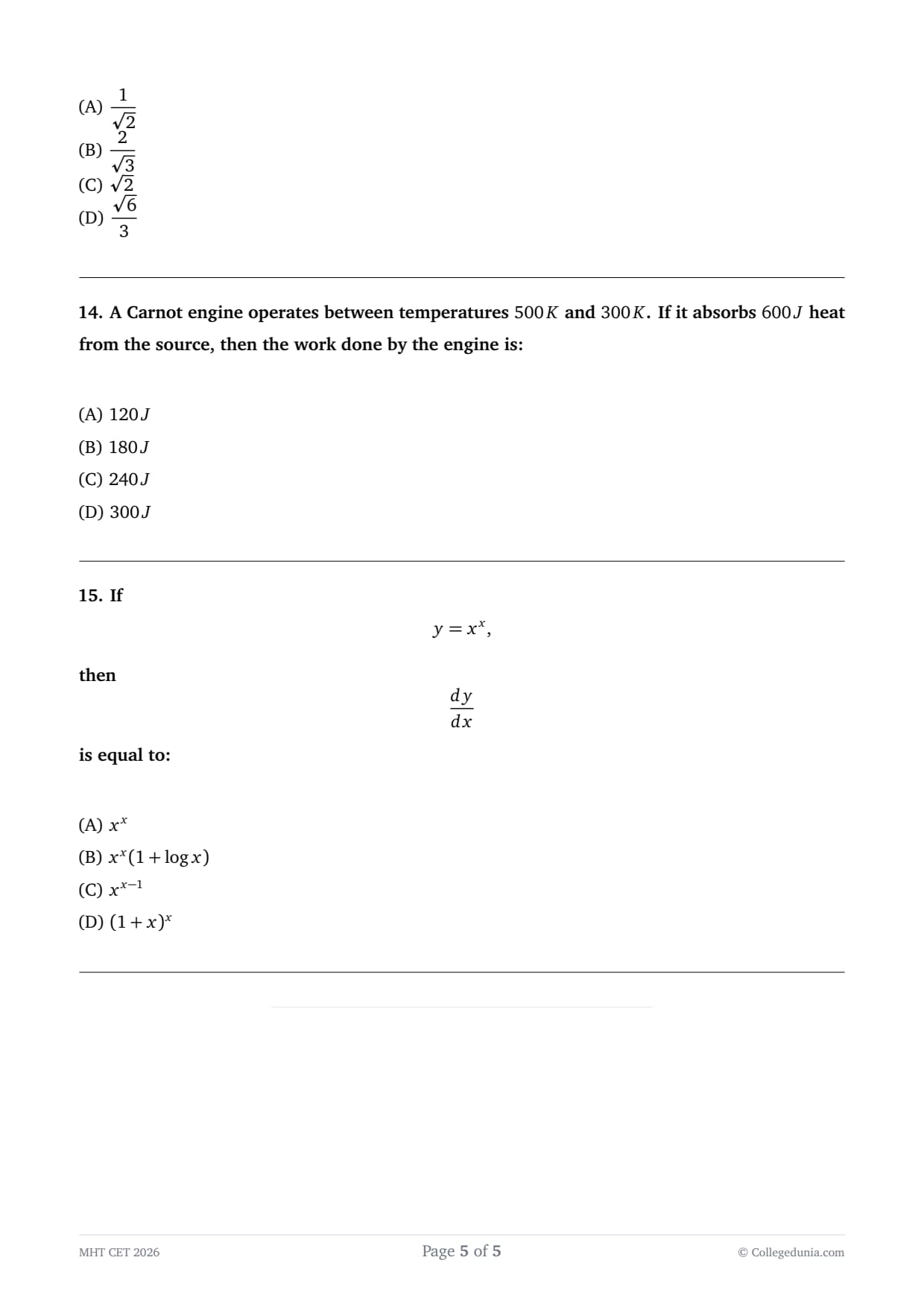
A Carnot engine operates between temperatures \(500\,K\) and \(300\,K\). If it absorbs \(600\,J\) heat from the source, then the work done by the engine is:
View Solution
Concept:
Efficiency of a Carnot engine is:
\[ \eta = 1-\frac{T_2}{T_1} \]
where:
\[ T_1=source temperature \]
\[ T_2=sink temperature \]
Also,
\[ \eta=\frac{W}{Q_1} \]
where:
\[ W=work done \]
\[ Q_1=heat absorbed \]
Step 1: Calculating efficiency.
Given:
\[ T_1=500K \]
\[ T_2=300K \]
Thus,
\[ \eta = 1-\frac{300}{500} \]
\[ = 1-\frac35 \]
\[ = \frac25 \]
\[ \eta=0.4 \]
Step 2: Using efficiency definition.
Given:
\[ Q_1=600J \]
Since:
\[ \eta=\frac{W}{Q_1} \]
therefore,
\[ 0.4=\frac{W}{600} \]
\[ W=240J \]
Step 3: Final conclusion.
Hence, the work done by the Carnot engine is:
\[ \boxed{ 240J } \]
Therefore, the correct answer is:
\[ \boxed{ (C)\ 240J } \] Quick Tip: For Carnot engine: \[ \eta=1-\frac{T_2}{T_1} \] Always use Kelvin temperature directly.
If \[ y=x^x, \]
then \[ \frac{dy}{dx} \]
is equal to:
View Solution
Concept:
When both base and exponent contain variables, logarithmic differentiation is used.
Given:
\[ y=x^x \]
Taking logarithm on both sides simplifies the exponent.
Step 1: Applying logarithm to both sides.
Take natural logarithm:
\[ \log y=\log(x^x) \]
Using logarithmic property:
\[ \log y=x\log x \]
Step 2: Differentiating implicitly.
Differentiate both sides with respect to \(x\):
\[ \frac1y\frac{dy}{dx} = \frac{d}{dx}(x\log x) \]
Using product rule:
\[ \frac{d}{dx}(x\log x) = 1\cdot\log x + x\cdot\frac1x \]
\[ = \log x+1 \]
Therefore,
\[ \frac1y\frac{dy}{dx} = 1+\log x \]
Step 3: Substituting the value of \(y\).
Since:
\[ y=x^x \]
therefore,
\[ \frac{dy}{dx} = x^x(1+\log x) \]
Hence,
\[ \boxed{ \frac{dy}{dx}=x^x(1+\log x) } \]
Therefore, the correct answer is:
\[ \boxed{ (B)\ x^x(1+\log x) } \] Quick Tip: Whenever variable appears both in base and exponent: \[ a(x)^{b(x)} \] use logarithmic differentiation immediately.
MHT CET PCM Exam Pattern 2026
| Parameter | Details |
|---|---|
| Conducting Body | Maharashtra Common Entrance Test Cell (Maharashtra CET Cell) |
| Exam Mode | Online (Computer-Based Test) |
| Duration | 180 minutes (3 hours) |
| Groups / Subjects | PCM (Physics, Chemistry, Mathematics) for Engineering |
| Total Questions |
150 |
| Total Marks | 200 |
| Question Type | Multiple Choice Questions (MCQs) |
| Marks Distribution |
|
| Negative Marking | No |
| Syllabus Weightage |
|



Comments