MHT CET 2017 Biology Question Paper is available for download here. Maharashtra State CET Cell conducted MHT CET 2017 on 11 May 2017.
The MHT CET 2017 Biology Question Paper includes the following:
The MHT CET 2017 Biology paper consists of 100 multiple-choice questions (MCQs) totalling 100 marks.
The time allowed is 90 minutes.
MHT CET 2017 Biology Question Paper with Solution PDF
Also Check:
MHT CET 2017 Biology Questions with Solutions
Biology (Q1 - Q100)
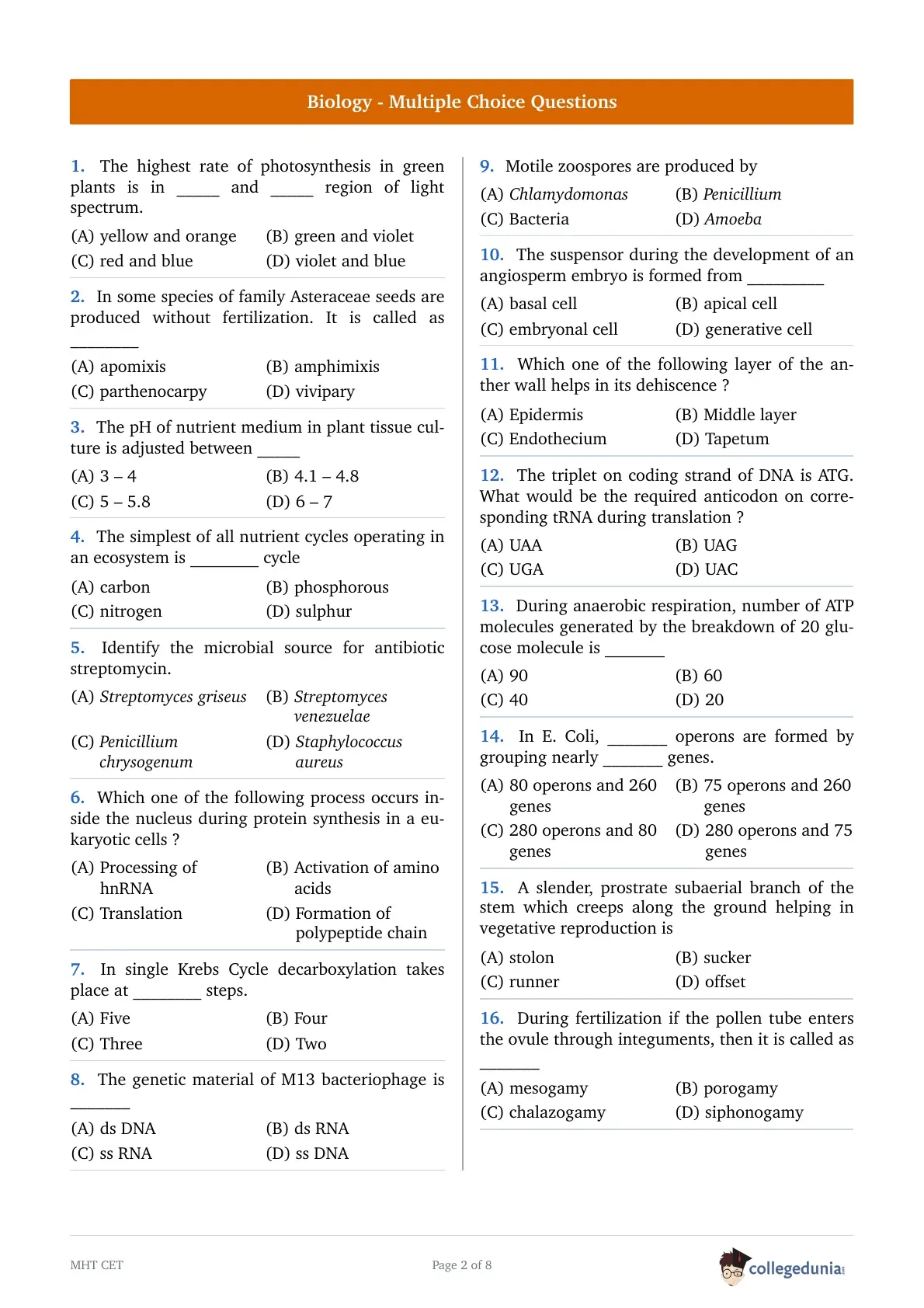
Question 1:
The highest rate of photosynthesis in green plants is in _____ and _____ region of light spectrum.
(A) yellow and orange
(B) green and violet
(C) red and blue
(D) violet and blue
Question 2:
In some species of family Asteraceae seeds are produced without fertilization. It is called as ________
(A) apomixis
(B) amphimixis
(C) parthenocarpy
(D) vivipary
Question 3:
The pH of nutrient medium in plant tissue culture is adjusted between _____
(A) 03-Apr
(B) 4.1 - 4.8
(C) 5 - 5.8
(D) 06-Jul
Question 4:
The simplest of all nutrient cycles operating in an ecosystem is ________ cycle
(A) carbon
(B) phosphorous
(C) nitrogen
(D) sulphur
Question 5:
Identify the microbial source for antibiotic streptomycin
(A) Streptomyces griseus
(B) Streptomyces venezuelae
(C) Penicillium chrysogenum
(D) Staphylococcus aureus
Question 6:
Which one of the following process occurs inside the nucleus during protein synthesis in a eukaryotic cells ?
(A) Processing of hnRNA
(B) Activation of amino acids
(C) Translation
(D) Formation of polypeptide chain
Question 7:
In single Krebs Cycle decarboxylation takes place at ________ steps
(A) Five
(B) Four
(C) Three
(D) Two
Question 8:
The genetic material of M bacteriophage is _______
(A) ds DNA
(B) ds RNA
(C) ss RNA
(D) ss DNA
Question 9:
Motile zoospores are produced by
(A) Chlamydomonas
(B) Penicillium
(C) Bacteria
(D) Amoeba
Question 10:
The suspensor during the development of an angiosperm embryo is formed from _________
(A) basal cell
(B) apical cell
(C) embryonal cell
(D) generative cell
Question 11:
Which one of the following layer of the anther wall helps in its dehiscence ?
(A) Epidermis
(B) Middle layer
(C) Endothecium
(D) Tapetum
Question 12:
The triplet on coding strand of DNA is ATG. What would be the required anticodon on corresponding tRNA during translation ?
(A) UAA
(B) UAG
(C) UGA
(D) UAC
Question 13:
During anaerobic respiration, number of ATP molecules generated by the breakdown of 20 glucose molecule is _______
(A) 90
(B) 60
(C) 40
(D) 20
Question 14:
In E. Coli, _______ operons are formed by grouping nearly _______ genes.
(A) 80 operons and 260 genes
(B) 75 operons and 260 genes
(C) 280 operons and 80 genes
(D) 280 operons and 75 genes
Question 15:
A slender, prostrate subaerial branch of the stem which creeps along the ground helping in vegetative reproduction is
(A) stolon
(B) sucker
(C) runner
(D) offset
Question 16:
During fertilization if the pollen tube enters the ovule through integuments, then it is called as _______
(A) mesogamy
(B) porogamy
(C) chalazogamy
(D) siphonogamy
Question 17:
To determine whether F1 hybrid is homozygous or heterozygous for a particular trait ________ cross is performed.
(A) monohybrid
(B) test
(C) back
(D) reciprocal
Question 18:
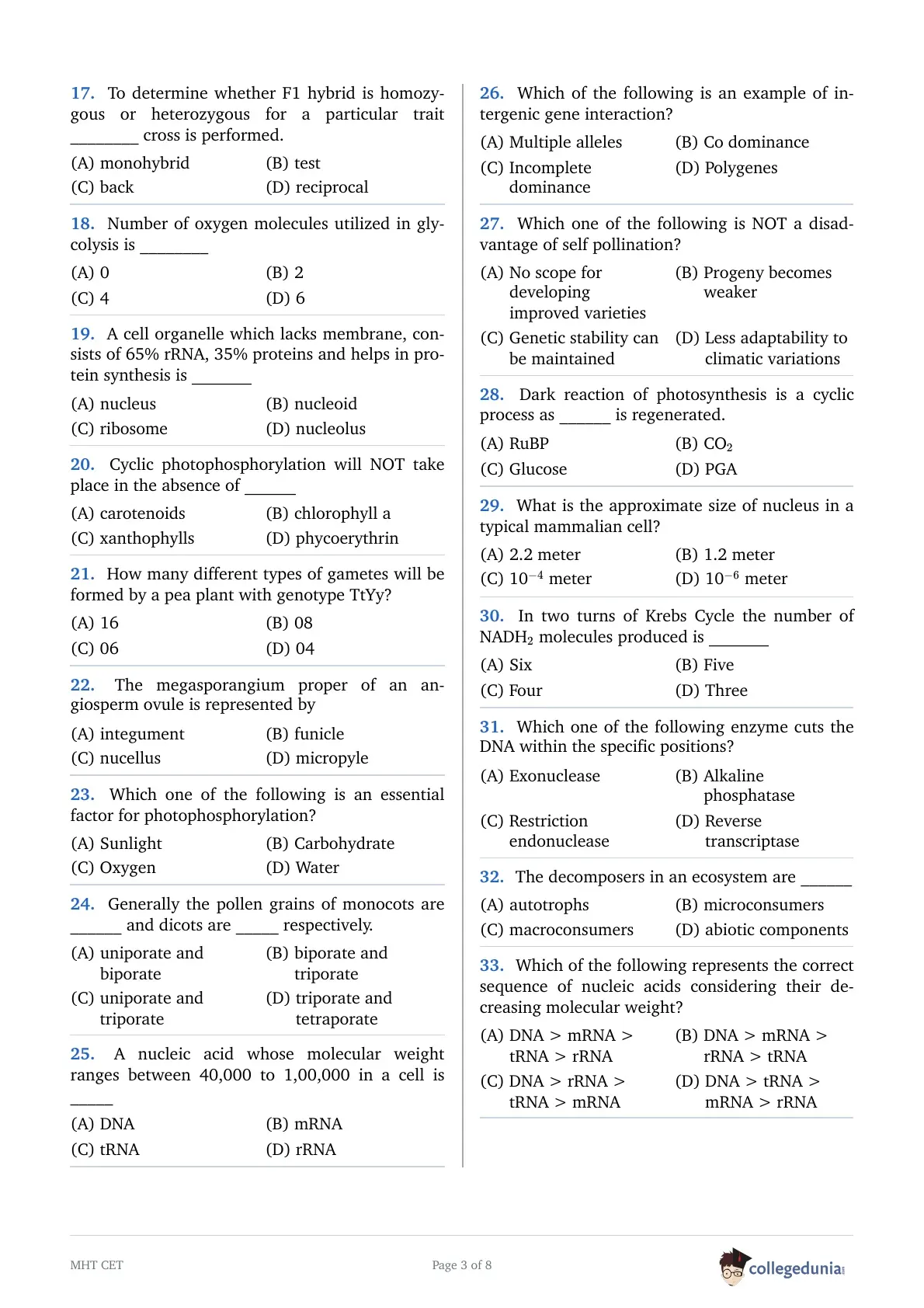
Number of oxygen molecules utilized in glycolysis is ________
Question 19:
A cell organelle which lacks membrane, consists of 65% rRNA, 35% proteins and helps in protein synthesis is _______
(A) nucleus
(B) nucleoid
(C) ribosome
(D) nucleolus
Question 20:
Cyclic photophosphorylation will NOT take place in the absence of ______
(A) carotenoids
(B) chlorophyll a
(C) xanthophylls
(D) phycoerythrin
Question 21:
How many different types of gametes will be formed by a pea plant with genotype TtYy?
(A) 16
(B) 08
(C) 06
(D) 04
Question 22:
The megasporangium proper of an angiosperm ovule is represented by
(A) integument
(B) funicle
(C) nucellus
(D) micropyle
Question 23:
Which one of the following is an essential factor for photophosphorylation?
(A) Sunlight
(B) Carbohydrate
(C) Oxygen
(D) Water
Question 24:
Generally the pollen grains of monocots are ______ and dicots are _____ respectively.
(A) uniporate and biporate
(B) biporate and triporate
(C) uniporate and triporate
(D) triporate and tetraporate
Question 25:
A nucleic acid whose molecular weight ranges between 40,000 to 1,00,000 in a cell is _____
(A) DNA
(B) mRNA
(C) tRNA
(D) rRNA
Question 26:
Which of the following is an example of intergenic gene interaction?
(A) Multiple alleles
(B) Co-dominance
(C) Incomplete dominance
(D) Polygenes
Question 27:
Which one of the following is NOT a disadvantage of self pollination?
(A) No scope for developing improved varieties
(B) Progeny becomes weaker
(C) Genetic stability can be maintained
(D) Less adaptability to climatic variations
Question 28:
Dark reaction of photosynthesis is a cyclic process as ______ is regenerated.
(A) RuBP
(B) CO\(_2\)
(C) Glucose
(D) PGA
Question 29:
What is the approximate size of nucleus in a typical mammalian cell?
(A) 2.2 meter
(B) 1.2 meter
(C) 10\(^{-4}\) meter
(D) 10\(^{-6}\) meter
Question 30:
In two turns of Krebs Cycle the number of NADH\(_2\) molecules produced is _______
(A) Six
(B) Five
(C) Four
(D) Three
Question 31:
Which one of the following enzyme cuts the DNA within the specific positions?
(A) Exonuclease
(B) Alkaline phosphatase
(C) Restriction endonuclease
(D) Reverse transcriptase
Question 32:
The decomposers in an ecosystem are ______
(A) autotrophs
(B) microconsumers
(C) macroconsumers
(D) abiotic components
Question 33:
Which of the following represents the correct sequence of nucleic acids considering their decreasing molecular weight?
(A) DNA > mRNA > tRNA > rRNA
(B) DNA > mRNA > rRNA > tRNA
(C) DNA > rRNA > tRNA > mRNA
(D) DNA > tRNA > mRNA > rRNA
Question 34:
In members of family Crassulaceae _______ is regenerated from starch during night.
(A) Phospho Enol Pyruvic Acid
(B) Pyruvic Acid
(C) Malic Acid
(D) Oxalo Acetic Acid
Question 35:
Which one of the following plants reproduces vegetatively by epiphyllous buds?
(A) Sweet potato
(B) Potato
(C) Onion
(D) Kalanchoe
Question 36:
In Aulosira, Tolypothrix and Nostoc, _______ are the sites for nitrogen fixation.
(A) vesicles
(B) arbuscles
(C) akinetes
(D) heterocysts
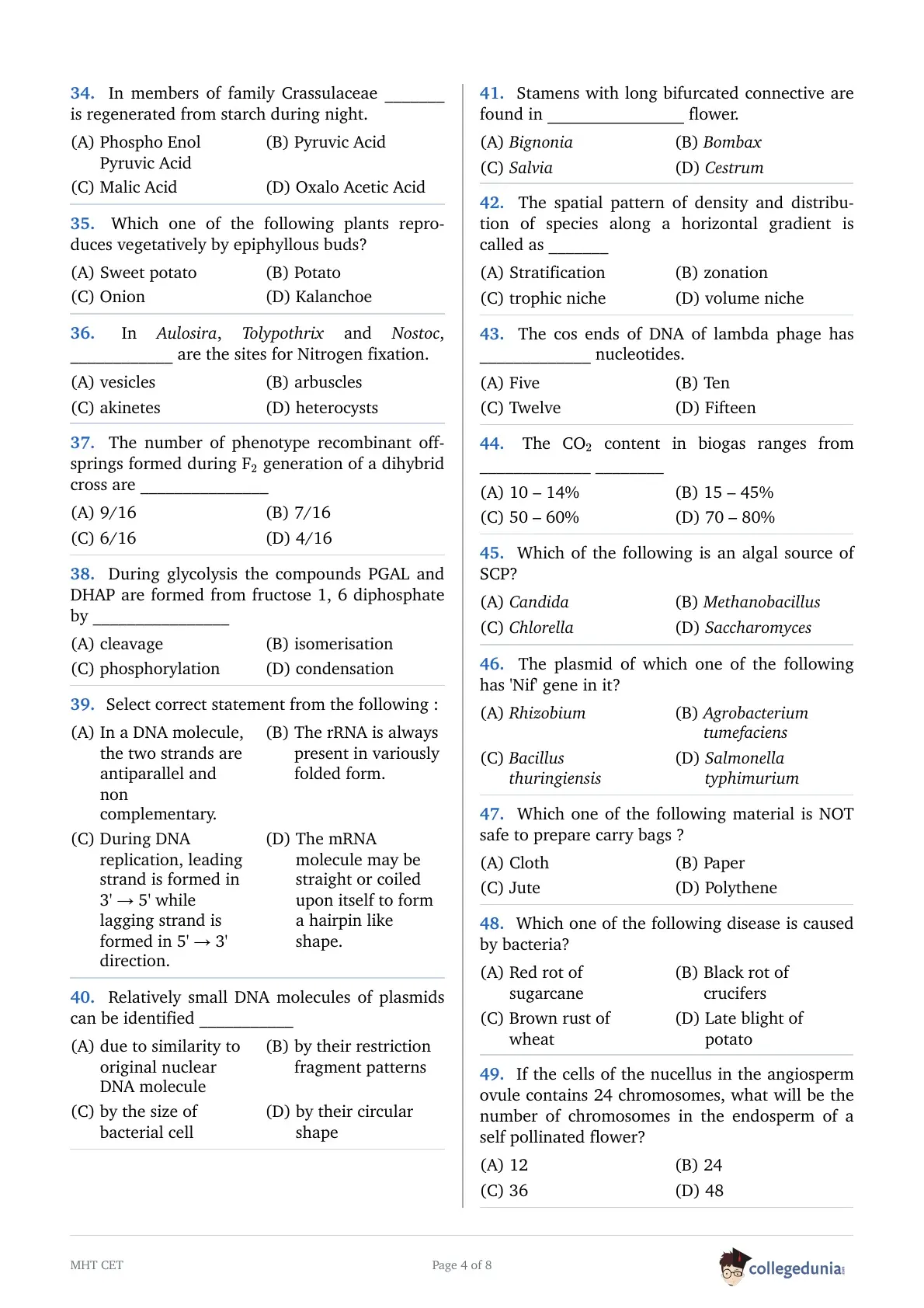
Question 37:
The number of phenotype recombinant offsprings formed during F\(_2\) generation of a dihybrid cross are _______________
(A) 9/16
(B) 7/16
(C) 6/16
(D) 4/16
Question 38:
During glycolysis the compounds PGAL and DHAP are formed from fructose 1, 6 diphosphate by ________________
(A) cleavage
(B) isomerisation
(C) phosphorylation
(D) condensation
Question 39:
Select correct statement from the following :
(A) In a DNA molecule, the two strands are antiparallel and non complementary.
(B) The rRNA is always present in variously folded form.
(C) During DNA replication, leading strand is formed in 3' → 5' while lagging strand is formed in 5' → 3' direction.
(D) The mRNA molecule may be straight or coiled upon itself to form a hairpin like shape.
Question 40:
Relatively small DNA molecules of plasmids can be identified ___________
(A) due to similarity to original nuclear DNA molecule
(B) by their restriction fragment patterns
(C) by the size of bacterial cell
(D) by their circular shape
Question 41:
Stamens with long bifurcated connective are found in ________________ flower.
(A) Bignonia
(B) Bombax
(C) Salvia
(D) Cestrum
Question 42:
The spatial pattern of density and distribution of species along a horizontal gradient is called as _______
(A) Stratification
(B) zonation
(C) trophic niche
(D) volume niche
Question 43:
The cos ends of DNA of lambda phage has _____________ nucleotides.
(A) Five
(B) Ten
(C) Twelve
(D) Fifteen
Question 44:
The CO\(_2\) content in biogas ranges from _____________ ________
(A) 10 – 14%
(B) 15 – 45%
(C) 50 – 60%
(D) 70 – 80%
Question 45:
Which of the following is an algal source of SCP?
(A) Candida
(B) Methanobacillus
(C) Chlorella
(D) Saccharomyces
Question 46:
The plasmid of which one of the following has 'Nif' gene in it?
(A) Rhizobium
(B) Agrobacterium tumefaciens
(C) Bacillus thuringiensis
(D) Salmonella typhimurium
Question 47:
Which one of the following material is NOT safe to prepare carry bags ?
(A) Cloth
(B) Paper
(C) Jute
(D) Polythene
Question 48:
Which one of the following disease is caused by bacteria?
(A) Red rot of sugarcane
(B) Black rot of crucifers
(C) Brown rust of wheat
(D) Late blight of potato
Question 49:
If the cells of the nucellus in the angiosperm ovule contains 24 chromosomes, what will be the number of chromosomes in the endosperm of a self pollinated flower?
(A) 12
(B) 24
(C) 36
(D) 48
Question 50:
Which one of the following is NOT a bacterial herbicide?
(A) Pseudomonas sp.
(B) Xanthomonas sp.
(C) Fusarium sp.
(D) Agrobacterium sp.
Question 51:
Formation of urea takes place in the _______.
(A) Heart
(B) Kidney
(C) Liver
(D) Lung
Question 52:
In MOET technique, ______ is administered to bring about super ovulation.
(A) ACTH
(B) FSH
(C) LH
(D) TSH
Question 53:
Seymouria is a connecting link between ________.
(A) Aves and mammals
(B) Amphibians and Reptiles
(C) Pisces and Amphibians
(D) Reptiles and Aves
Question 54:
Which one of the following is NOT an example of ex-situ conservation of endangered species?
(A) Zoological park
(B) National park
(C) Culture collection
(D) Botanical garden
Question 55:
Atrial systole lasts for _______ in Cardiac Cycle
(A) 0.1 second
(B) 0.3 second
(C) 0.5 second
(D) 0.7 second
Question 56:
Select the correct match :
(A) (a) – (iv)
(B) (b) – (v)
(C) (c) – (i)
(D) (d) – (ii)
Question 57:
Transgenic animals are extensively used for all of the following procedures EXCEPT
(A) Bioremediation
(B) Chemical safety
(C) Vaccine safety
(D) Toxicity test
Question 58:
Grave's disease is characterised by the following EXCEPT
(A) Deposition of fats in eye sockets
(B) Enlargement of thyroid gland
(C) Weight loss
(D) Weight gain
Question 59:
Feminised males have _______ chromosomes.
(A) 44
(B) 45
(C) 46
(D) 47
Question 61:
Deposition of fatty substances in the lining of arteries is termed as ______.
(A) Arteriosclerosis
(B) Atherosclerosis
(C) Arthritis
(D) Angiogenesis
Question 62:
An axial filament in the tail of sperm is modified _______.
(A) Distal centriole
(B) Endoplasmic reticulum
(C) Golgi complex
(D) Proximal centriole
Question 63:
In DNA fingerprinting technique, the radioactive intermediates formed during hybridization are ____ molecules
(A) Double-stranded DNA
(B) Single-stranded DNA
(C) Single-stranded mRNA
(D) Double-stranded rRNA
Question 64:
The functional area of human cerebrum marked by 'X' is _________.
(A) Wernicke's area
(B) Somato-sensory area
(C) Premotor area
(D) Broca's area
Question 65:
Uraemia is indicated when the blood urea level rises above ________
(A) 0.05%
(B) 0.04 %
(C) 0.03%
(D) 0.02%
Question 66:
Introduction of attenuated pathogens in human body results in ________
(A) Artificial acquired active immunity
(B) Artificial acquired passive immunity
(C) Natural acquired active immunity
(D) Natural acquired passive immunity
Question 67:
HCG is secreted by _________
(A) Allantois
(B) Corona radiata
(C) Corpus luteum
(D) Placenta
Question 68:
Banting and Best successfully purified insulin from the pancreas of _______
(A) Guinea pig
(B) Dog
(C) Cow
(D) Buffalo
Question 69:
Organ of Corti is located on the ________
(A) Basilar membrane
(B) Basement membrane
(C) Reissner membrane
(D) Synovial membrane
Question 70:
The ____________ is a primary constriction
(A) Telomere
(B) Sarcomere
(C) Chromomere
(D) Centromere
Question 71:
Southern blotting technique uses _________ paper for embedding DNA strands.
(A) Whatman No. 1
(B) Parchment
(C) Nitrocellulose
(D) Cellophane
Question 72:
If cranial nerves : 12 pairs, then spinal nerves :
(A) 30 pairs
(B) 31 pairs
(C) 32 pairs
(D) 33 pairs
Question 73:
One of the following is NOT an example of incomplete sex-linkage
(A) Total colour-blindness
(B) Retinitis pigmentosa
(C) Nephritis
(D) Myopia
Question 74:
During secretory phase of menstrual cycle, the endometrial lining attains thickness of __________
(A) 10 - 12 mm
(B) 5 - 6 mm
(C) 3 - 4 mm
(D) 1 - 2 mm
Question 75:
Homo habilis is also called _________
(A) Tool maker man
(B) Man with ape brain
(C) Java ape man
(D) Heidelberg man
Question 76:
The prostatic fluid forms about ___________ of total volume of semen.
(A) 60%
(B) 50%
(C) 40%
(D) 30%
Question 77:
In gene therapy, __________ can be treated by the DNase gene.
(A) Pituitary dwarfism
(B) Hepatitis B
(C) Hemophilia
(D) Cystic fibrosis
Question 78:
Stimulation of RBC production is by the hormone _________
(A) Aldosterone
(B) Adrenaline
(C) Cortisol
(D) Nor Adrenaline
Question 79:
The yellow colour of urine is due to the presence of
(A) urea
(B) uric acid
(C) urochrome
(D) bilirubin
Question 80:
Mule is an example of _______
(A) Cross-breeding
(B) Interspecific Hybridization
(C) Out-breeding
(D) Out-crossing
Question 81:
Select the correct match :
(A) a – iv, b – i, c – iii, d – ii
(B) a – iii, b – ii, c – iv, d – i
(C) a – ii, b – iii, c – iv, d – i
(D) a – iv, b – iii, c – i, d – ii
Question 82:
When members of a population attain sexual maturity at different times preventing inter breeding, it is termed as _________ isolation.
(A) Seasonal
(B) Mechanical
(C) Habitat
(D) Ethological
Question 83:
One of the following is a positive inter-action in a population.
(A) Adamsia – Hermit Crab
(B) Plasmodium – Mosquito
(C) Sacculina – Crab
(D) Wuchereria – Man
Question 84:
Mitral valve and tricuspid valve are attached to the papillary muscles by ______
(A) Corpus callosum
(B) Columnae carnae
(C) Crura cerebri
(D) Chordae tendinae
Question 85:
Cytotoxic T-cells are ______
(A) Helper T-cells
(B) Killer T-cells
(C) Memory T-cells
(D) Suppressor T-cells
Question 86:
Organisms possessing strong and stout forelimbs with clawed digits show ______ adaptations
(A) Arboreal
(B) Cursorial
(C) Fossorial
(D) Volant
Question 87:
Athlete's foot is caused by a _____
(A) Virus
(B) Roundworm
(C) Fungus
(D) Bacterium
Question 88:
The birth control pill contains _____
(A) Progesterone and estrogen
(B) LH and estrogen
(C) FSH and LH
(D) FSH and estrogen
Question 89:
Find the correct match :
(A) a – iii
(B) b – v
(C) c – i
(D) d – iv
Question 90:
Select the correct sequence of the F\(_1\) generation.
(A) ① \(X^HX^H\), ② \(X^hX^H\), ③ \(X^HY\), ④ \(X^HY\)
(B) ① \(X^HX^h\), ② \(X^HX^h\), ③ \(X^HY\), ④ \(X^HY\)
(C) ① \(X^HX^h\), ② \(X^hX^H\), ③ \(X^hY\), ④ \(X^hY\)
(D) ① \(X^hX^H\), ② \(X^HX^h\), ③ \(X^HY\), ④ \(X^hY\)
Question 91:
Treponema pallidum is a _____ bacterium.
(A) Streptococcus
(B) Streptobacillus
(C) Spirochaete
(D) Oligochaete
Question 92:
In the given diagram, water absorption does NOT occur in part labelled as _____
Question 93:
Maximum cranial capacity is found in ________
(A) Homo habilis
(B) Homo erectus
(C) Homo neanderthalensis
(D) Homo sapiens fossilis
Question 94:
Methods to control air pollution include the following EXCEPT
(A) Scrubber
(B) Electrostatic precipitator
(C) Electrodialysis
(D) Catalytic converter
Question 95:
During sinus arrhythmia _________
(A) Heart rate increases during inspiration
(B) Heart beat decreases during inspiration
(C) Heart rate increases during expiration
(D) Heart rate remains constant
Question 96:
Francisco Redi and Spallanzani disproved the theory of _______ by their classical experiments.
(A) Abiogenesis
(B) Biogenesis
(C) Cosmozoic
(D) Special creation
Question 97:
Density of population increases when ____________
(A) Emigration increases
(B) Immigration decreases
(C) Mortality increases
(D) Natality increases
Question 98:
Antibodies are synthesized by _______
(A) Eosinophil
(B) Lymphocyte
(C) Monocyte
(D) Neutrophil
Question 99:
Kupffer's cells of liver are an example of _______
(A) Anatomical barrier
(B) Inflammatory barrier
(C) Physiological barrier
(D) Phagocytic barrier
Question 100:
The spermiogenesis involves all of the following EXCEPT
(A) Formation of mitochondrial sheath
(B) Formation of proximal and distal centrioles
(C) Formation of acrosomes
(D) Shortening of sperm








Comments