




MHT CET 2016 Physics and Chemistry (Set 11) Question Paper is available for download here. Maharashtra State CET Cell conducted MHT CET 2016 on 5 May 2016.
The MHT CET 2016 Physics and Chemistry (Set 11) Question Paper includes the following:
- The MHT CET 2016 Physics and Chemistry paper (Question Booklet Version 11) consists of 100 multiple-choice questions (MCQs) totalling 100 marks: Physics (50 questions) and Chemistry (50 questions).
- The time allowed is 90 minutes.
MHT CET 2016 Physics and Chemistry (Set 11) Question Paper with Solution PDF
| CD PDF | CD PDF with Solutions |
|---|---|
| Download Collegedunia PDF 0.62 MB | - |
Also Check:
MHT CET 2016 Physics and Chemistry (Set 11) Questions with Solutions
Physics (Q1 - Q50)
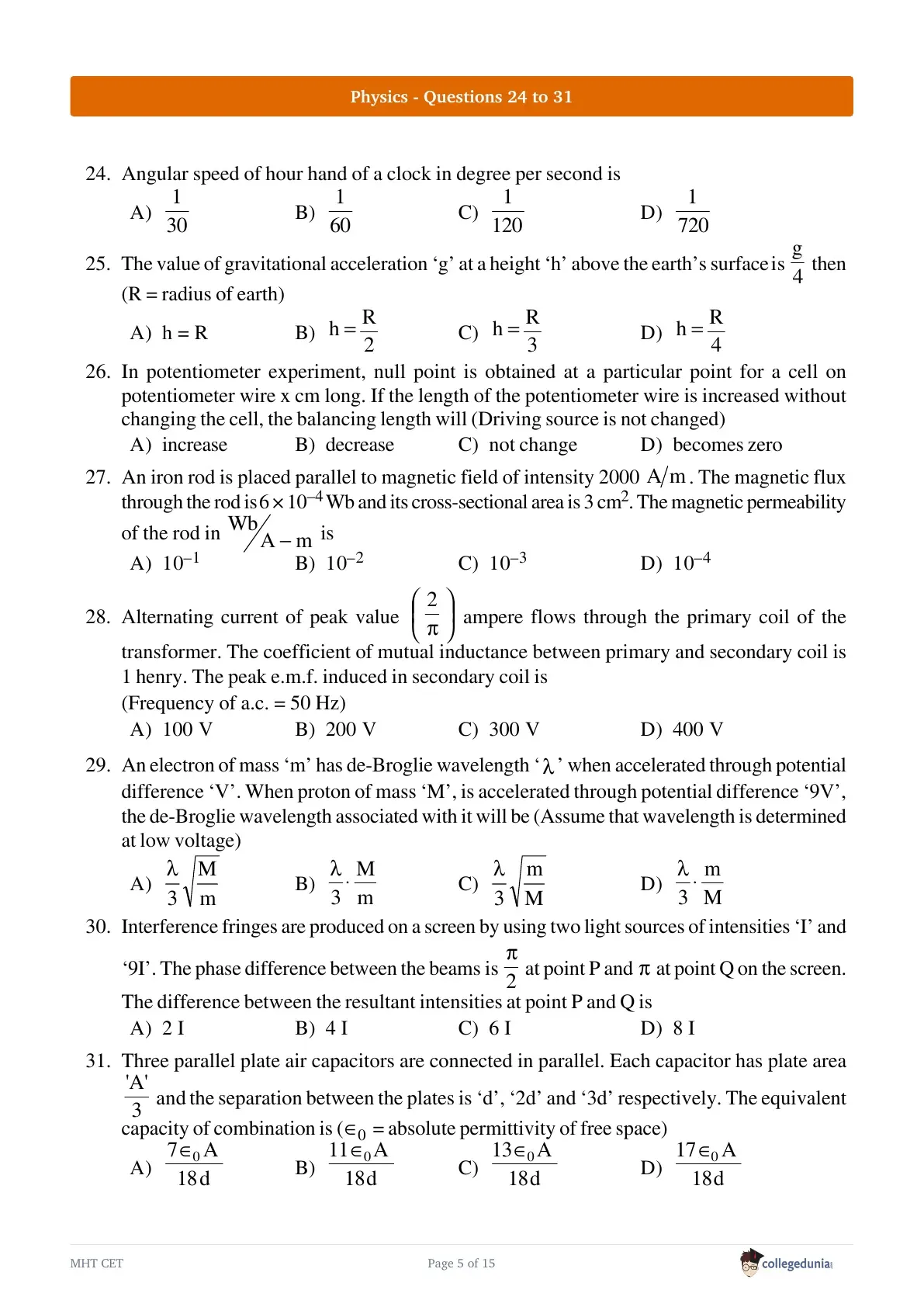
In potentiometer experiment, null point is obtained at a particular point for a cell on potentiometer wire x cm long. If the length of the potentiometer wire is increased without changing the cell, the balancing length will (Driving source is not changed)
An iron rod is placed parallel to magnetic field of intensity 2000 Am^-1. The magnetic flux through the rod is 6 x 10^-4 Wb and its cross-sectional area is 3 cm^2. The magnetic permeability of the rod in Wb A^-1 m^-1 is
Alternating current of peak value \(\left(\frac{2}{\pi}\right)\) ampere flows through the primary coil of the transformer. The coefficient of mutual inductance between primary and secondary coil is 1 henry. The peak e.m.f. induced in secondary coil is (Frequency of \(AC = 50\, Hz\))
An electron of mass m has de-Broglie wavelength lambda when accelerated through potential difference V. When proton of mass M, is accelerated through potential difference 9V, the de-Broglie wavelength associated with it will be (Assume that wavelength is determined at low voltage)
Interference fringes are produced on a screen by using two light sources of intensities I and 9I. The phase difference between the beams is pi/2 at point P and pi at point Q on the screen. The difference between the resultant intensities at point P and Q is
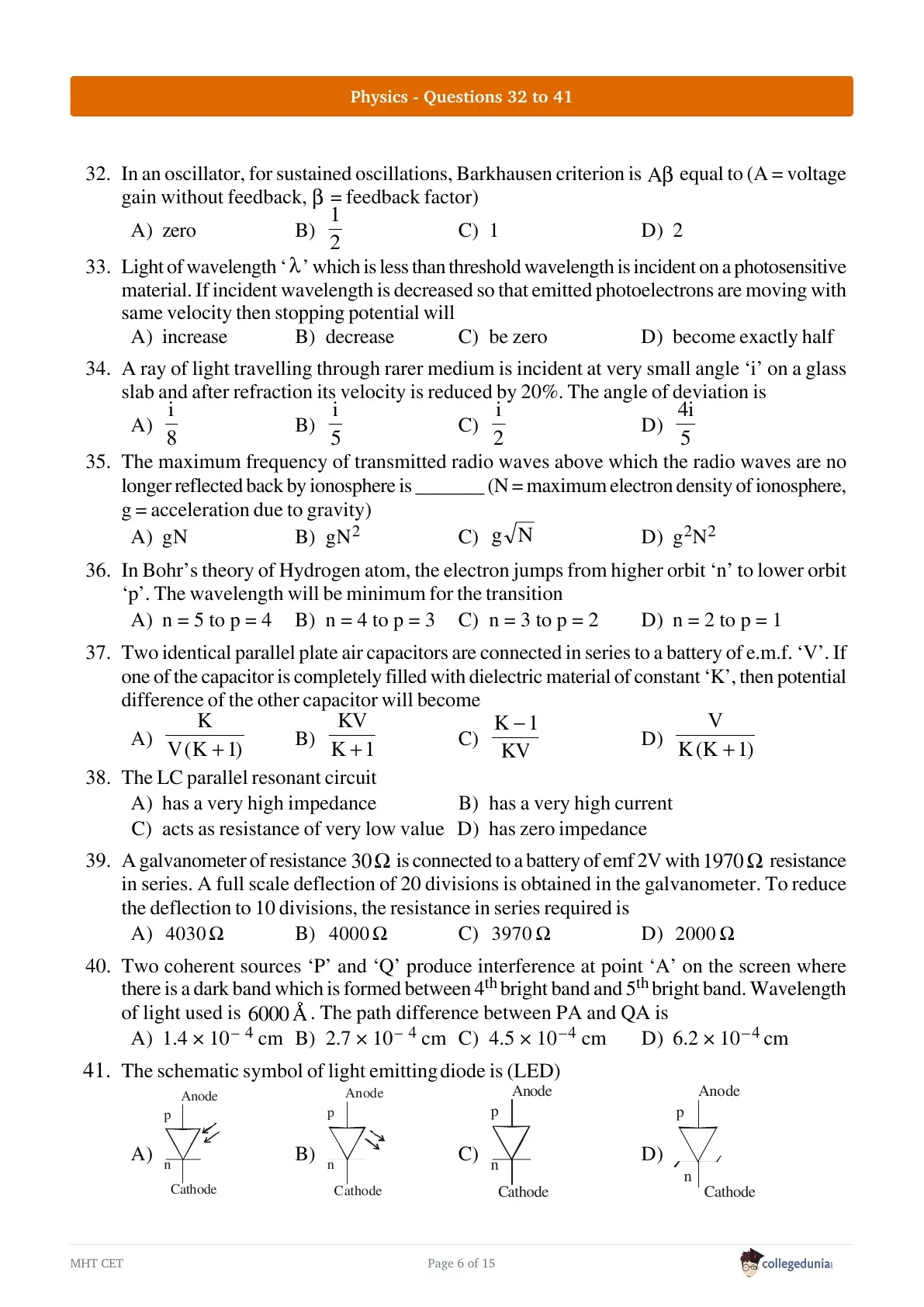
From Brewster�s law, except for polished metallic surfaces, the polarising angle
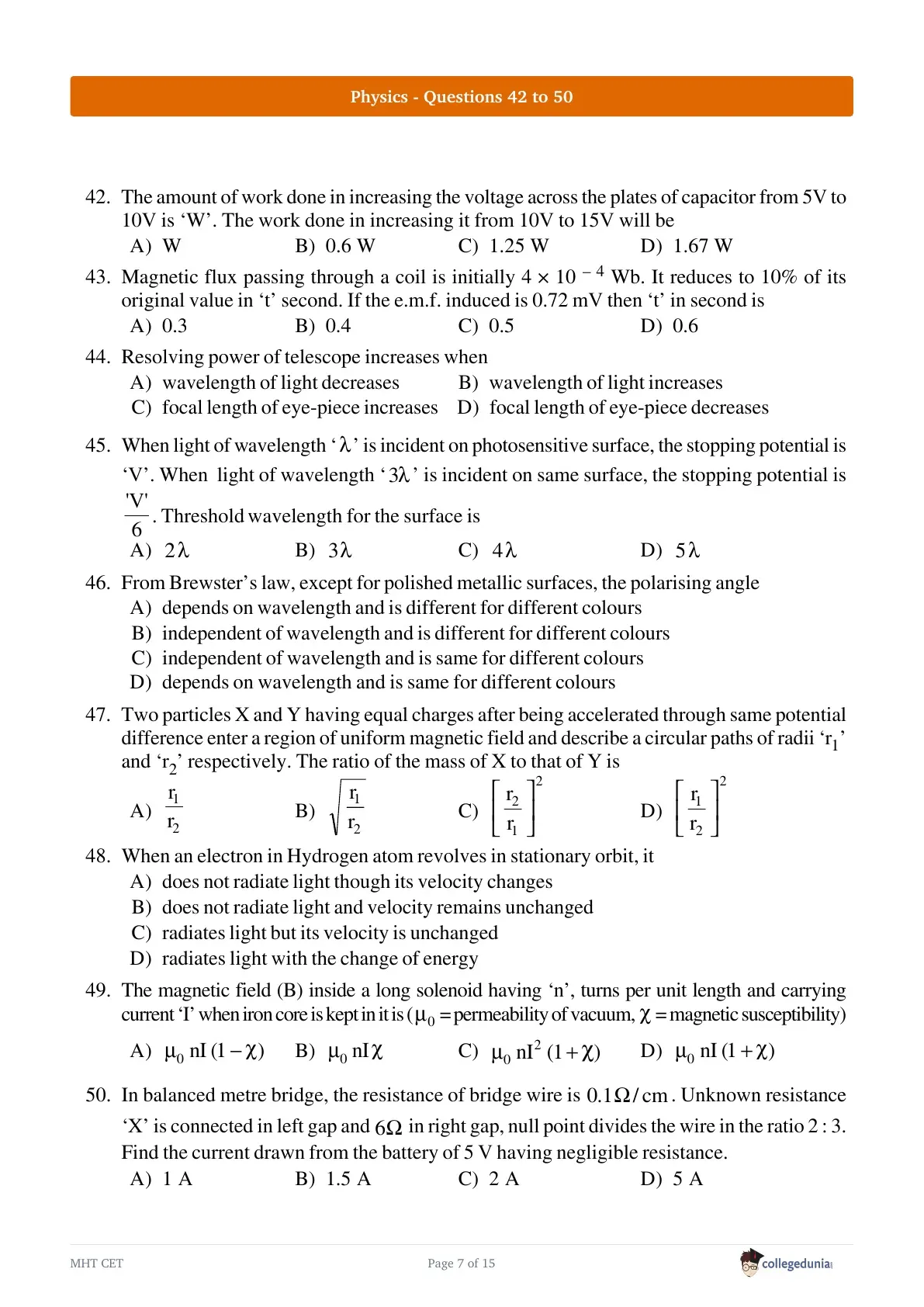
Two particles X and Y having equal charges after being accelerated through same potential difference enter a region of uniform magnetic field and describe a circular paths of radii r1 and r2 respectively. The ratio of the mass of X to that of Y is
When an electron in hydrogen atom revolves in stationary orbit, it
The magnetic field (B) inside a long, solenoid having n turns per unit length and carrying current, when iron core is kept in it is (mu_0 = permeability of vacuum, x = magnetic susceptibility)
In balanced meter bridge, the resistance of bridge wire is 0.1 ohm/cm. Unknown resistance X is connected in left gap and 6 ohm in right gap, null point divides the wire in the ratio 2:3. Find the current drawn from the battery of 5V having negligible resistance
Three parallel plate air capacitors are connected in parallel. Each capacitor has plate area A/3 and the separation between the plates is d, 2d and 3d respectively. The equivalent capacity of combination is (epsilon_0 = absolute permittivity of free space)
In an oscillator, for sustained oscillations, Barkhausen criterion is \(A\beta\) equal to (\(A =\) voltage gain without feedback, \(\beta =\) feedback factor)
Light of wavelength lambda which is less than threshold wavelength is incident on a photosensitive material. If incident wavelength is decreased so that emitted photoelectrons are moving with same velocity, then stopping potential will
A ray of light travelling through rarer medium is incident at very small angle i on a glass slab and after refraction its velocity is reduced by 20%. The angle of deviation is
The maximum frequency of transmitted radio waves above which the radio waves are no longer reflected back by ionosphere is (\(N\) = maximum electron density of Ionosphere)
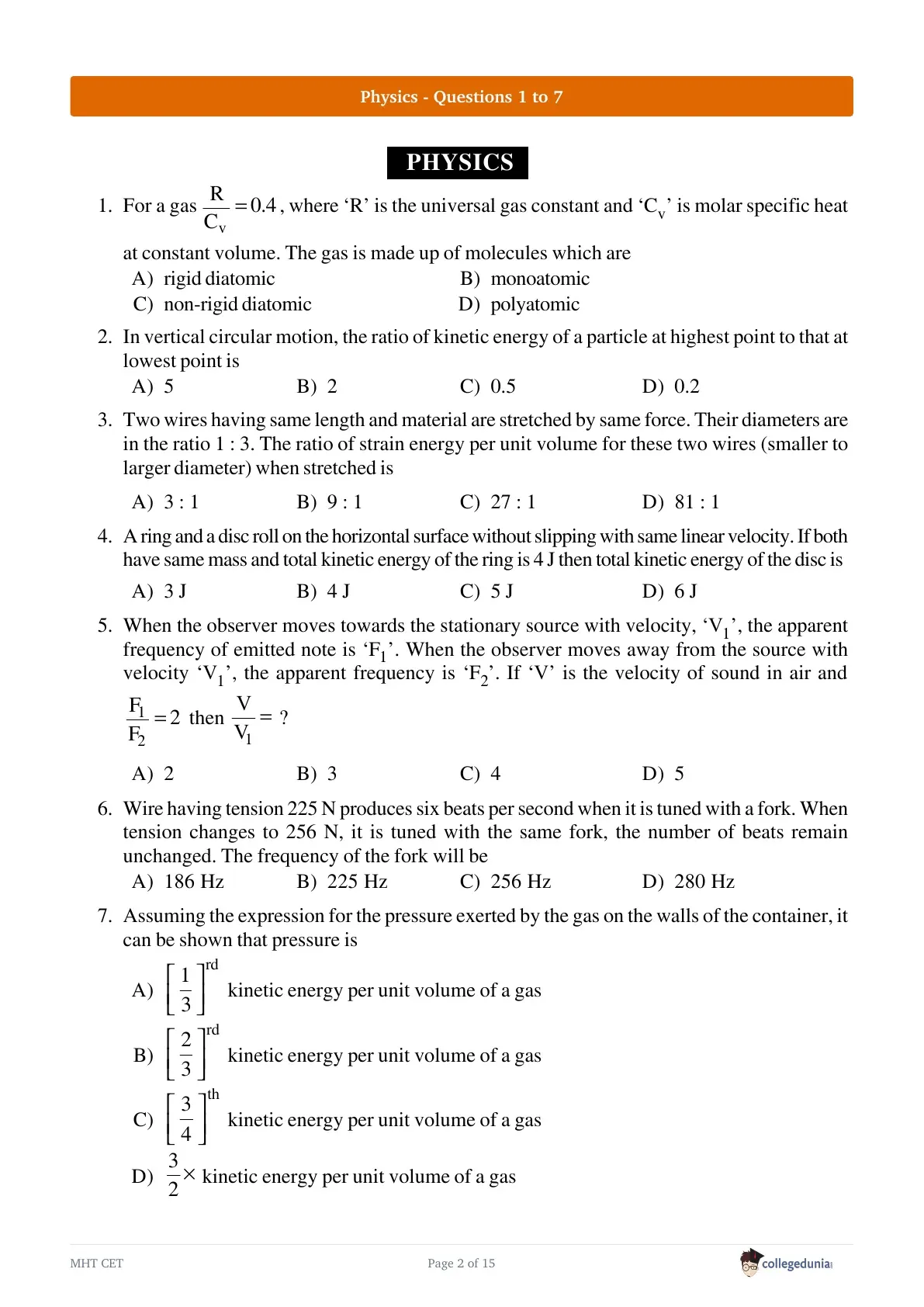
Wire having tension \(225\, N\) produces six beats per second when it is tuned with a fork. When tension changes to \(256\, N\), it is tuned with the same fork, the number of beats remain unchanged. The frequency of the fork will be
Assuming the expression for the pressure exerted by the gas on the walls of the container, it can be shown that pressure is
A mass \(m_1\) connected to a horizontal spring performs \(S.H.M.\) with amplitude \(A\). While mass \(m_1\) is passing through mean position another mass \(m_2\) is placed on it so that both the masses move together with amplitude \(A_1\). The ratio of \(\frac{A_{1}}{A}\) is \(\left(m_{2} < m_{1}\right)\)
A particle moves along a circle of radius ?\(r\)? with constant tangential acceleration. If the velocity of the particle is ?\(?\)? at the end of second revolution, after the revolution has started then the tangential acceleration is
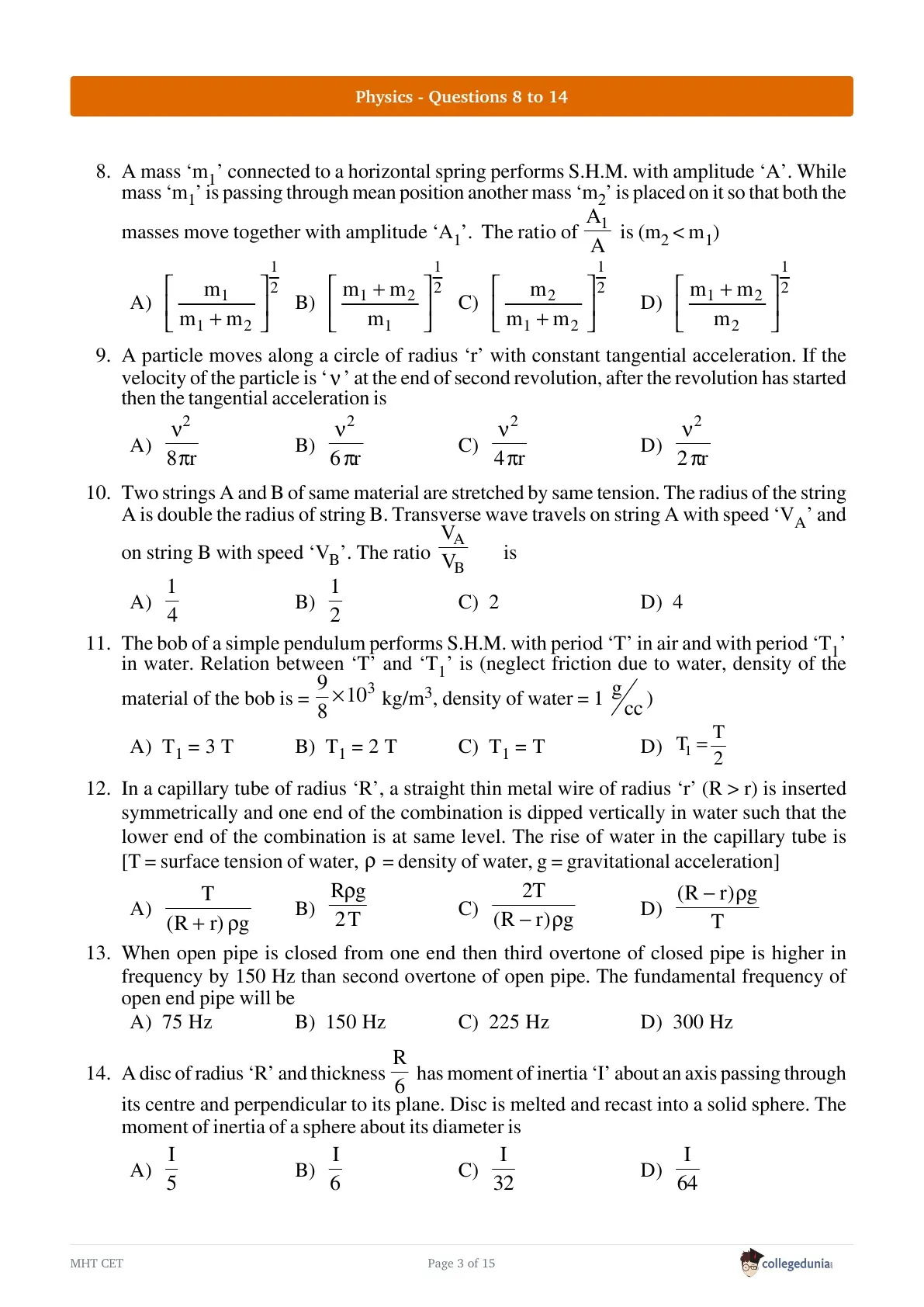
Two strings \(A\) and \(B\) of same material are stretched by same tension. The radius of the string \(A\) is double the radius of string \(B\). Transverse wave travels on string \(A\) with speed ?\(V_A\)? and on string \(B\) with speed ?\(V_B\)?. The ratio \(\frac{V_{A}}{V_{B}}\) is
Which of the following quantity does not change due to damping of oscillations?
If the end correction of an open pipe is 0.8 cm, then the inner radius of that pipe will be
A progressive wave is represented by y = 12 sin(5t - 4x) cm. On this wave, how far away are the two points having phase difference of 90 degrees?
Two particles of masses m and 9m are separated by a distance r. At a point on the line joining them the gravitational field is zero. The gravitational potential at that point is (G = universal constant of gravitation)
A black rectangular surface of area A emits energy E per second at 27C. If length and breadth are reduced to 1/3rd of initial value and temperature is raised to 327C, then energy emitted per second becomes
For a gas \(\frac{R}{C_{v}} = 0.4\), where ?\(R\)? is the universal gas constant and ?\(C_v\)? is molar specific heat at constant volume. The gas is made up of molecules which are
In vertical circular motion, the ratio of kinetic energy of a particle at highest point to that at lowest point is
Two wires having same length and material are stretched by same force. Their diameters are in the ratio \(1 : 3\). The ratio of strain energy per unit volume for these two wires (smaller to larger diameter) when stretched is
A ring and a disc roll on the horizontal surface without slipping with same linear velocity. If both have same mass and total kinetic energy of the ring is \(4\, J\) then total kinetic energy of the disc is
When the observer moves towards the stationary source with velocity, \(V_1\), the apparent frequency of emitted note is \(F_1\). When the observer moves away from the source with velocity \(V_1\), the apparent frequency is \(F_2\). If \(V\) is the velocity of sound in air and \(\frac{F_{1}}{F_{2}} = 2\) then \(\frac{V}{V_{1}}=\) ?
A liquid drop having surface energy E is spread into 512 droplets of same size. The final surface energy of the droplets is
Let M be the mass and L be the length of a thin uniform rod. In first case, axis of rotation is passing through centre and perpendicular to the length of the rod. In second case, axis of rotation is passing through one end and perpendicular to the length of the rod. The ratio of radius of gyration in first case to second case is
A simple pendulum of length \(l\) has maximum angular displacement \(\theta\). The maximum kinetic energy of the bob of mass \(m\) is (\(g =\) acceleration due to gravity)
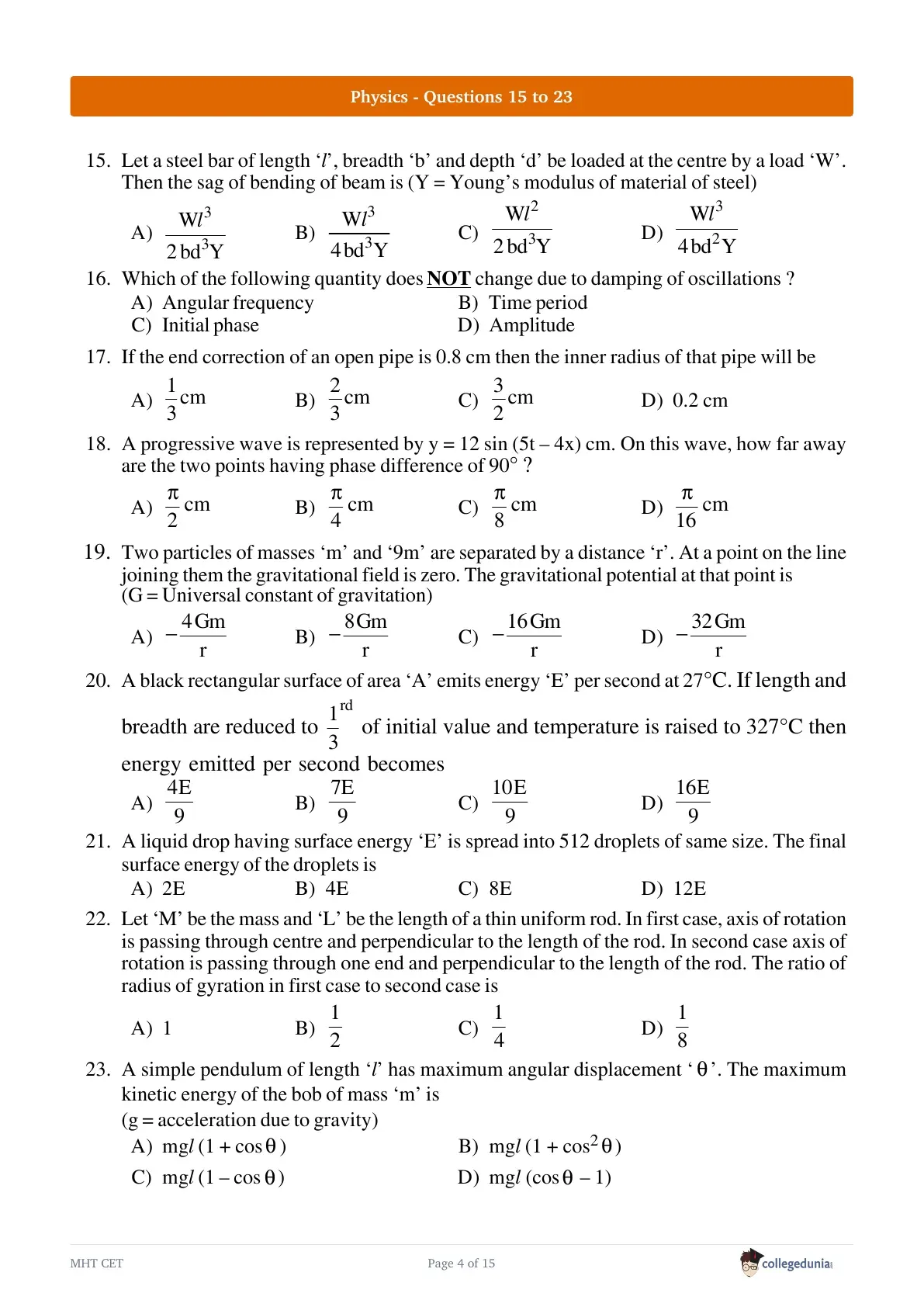
Angular speed of hour hand of a clock in degree per second is
The value of gravitational acceleration g at a height h above the earth's surface is g/4, then (R = radius of earth)
The amount of work done in increasing the voltage across the plates of capacitor from 5V to 10V is W. The work done in increasing it from 10V to 15V will be
Magnetic flux passing through a coil is initially 4x10^-4 Wb. It reduces to 10% of its original value in t second. If the emf induced is 0.72 mV then t in second is
Resolving power of telescope increases when
When light of wavelength lambda is incident on photosensitive surface, the stopping potential is V. When light of wavelength 3*lambda is incident on same surface, the stopping potential is V/6. Threshold wavelength for the surface is
The bob of a simple pendulum performs SHM with period T in air and with period T1 in water. Relation between T and T1 is (neglect friction due to water, density of the material of the bob is = (9/8)x10^3 kg/m^3, density of water = 1 gcc^-1)
In a capillary tube of radius R, a straight thin metal wire of radius r (R>r) is inserted symmetrically and one end of the combination is dipped vertically in water such that the lower end of the combination is at same level. The rise of water in the capillary tube is [T = surface tension of water, rho = density of water and g = gravitational acceleration]
When open pipe is closed from one end, then third overtone of closed pipe is higher in frequency by 150 Hz than second overtone of open pipe. The fundamental frequency of open end pipe will be
A disc of radius R and thickness R/6 has moment of inertia I about an axis passing through its centre and perpendicular to its plane. Disc is melted and recast into a solid sphere. The moment of inertia of a sphere about its diameter is
Let a steel bar of length l, breadth b and depth d be loaded at the centre by a load W. Then the sag of bending of beam is (Y = Young's modulus of material of steel)
In Bohr's theory of hydrogen atom, the electron jumps from higher orbit n to lower orbit p. The wavelength will be minimum for the transition
Two identical parallel plate air capacitors are connected in series to a battery of e.m.f. \(V\). If one of the capacitor is completely filled with dielectric material of constant \(K\), then potential difference of the other capacitor will become
The L-C parallel resonant circuit
A galvanometer of resistance 30 ohm is connected to a battery of emf 2V with 1970 ohm resistance in series. A full scale deflection of 20 divisions is obtained in the galvanometer. To reduce the deflection to 10 divisions, the resistance in series required is
Two coherent sources P and Q produce interference at point A on the screen where there is a dark band which is formed between 4th bright band and 5th bright band. Wavelength of light used is 6000 Angstrom. The path difference between PA and QA is
Chemistry (Q51 - Q100)
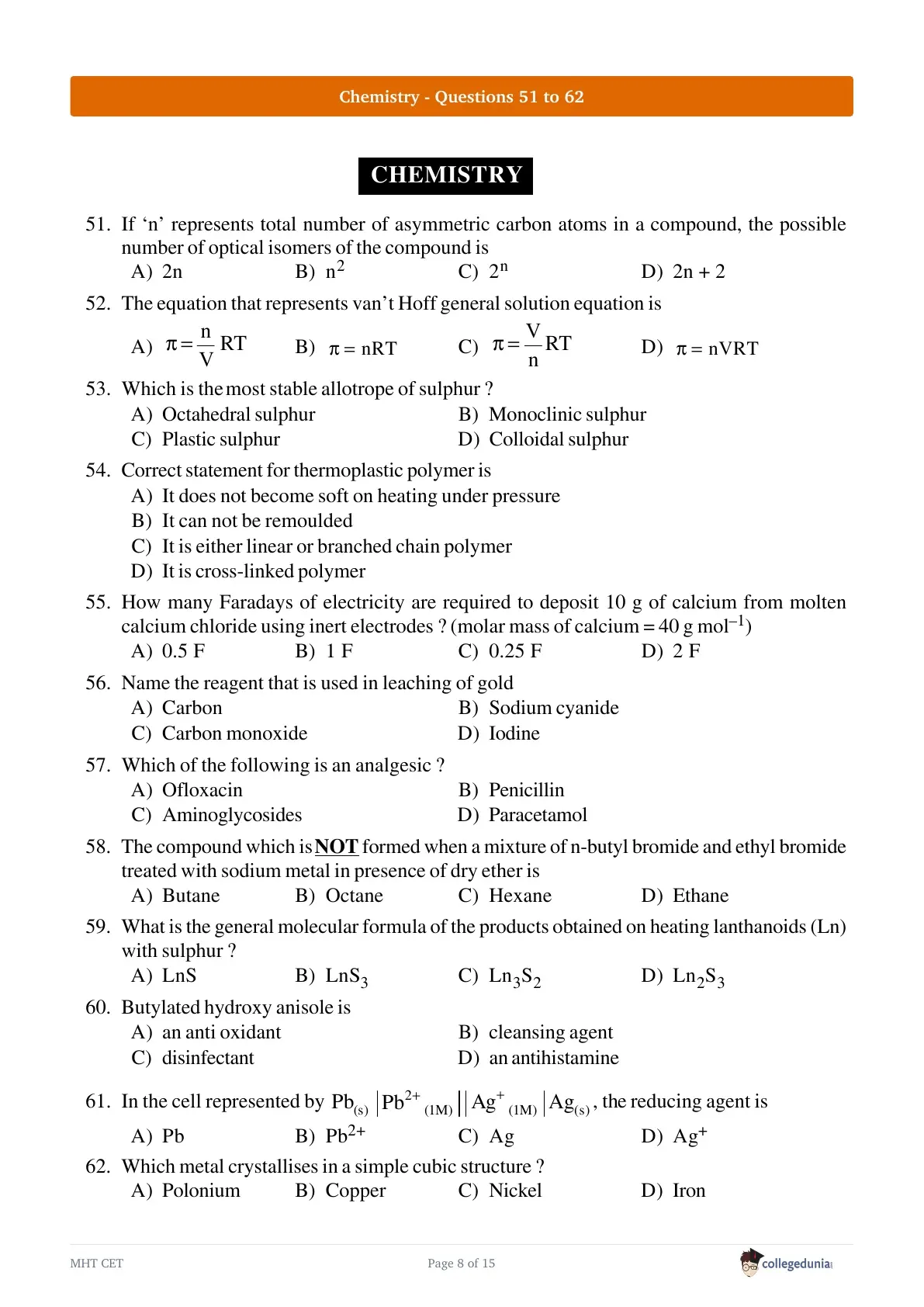
If 'n' represents total number of asymmetric carbon atoms in a compound, then the possible number of optical isomers of the compound is
The equation that represents general van't Hoff equation is
Which is the most stable allotrope of sulphur?
Select the correct statement for thermoplastic polymer.
How many Faradays of electricity are required to deposit 10 g of calcium from molten calcium chloride using inert electrodes? (Molar mass of calcium = 40 g/mol)
Name the reagent that is used in leaching of gold.
Which of the following is an analgesic?
The compound which is not formed when a mixture of n-butyl bromide and ethyl bromide treated with sodium metal in the presence of dry ether is
What is the general molecular formula of the products obtained on heating lanthanoids (Ln) with sulphur?
Butylated hydroxy anisole is a/an
In the cell represented by Pb(s)|Pb2+(1M)||Ag+(1M)|Ag(s), the reducing agent is
Which metal crystallises in a simple cubic structure?
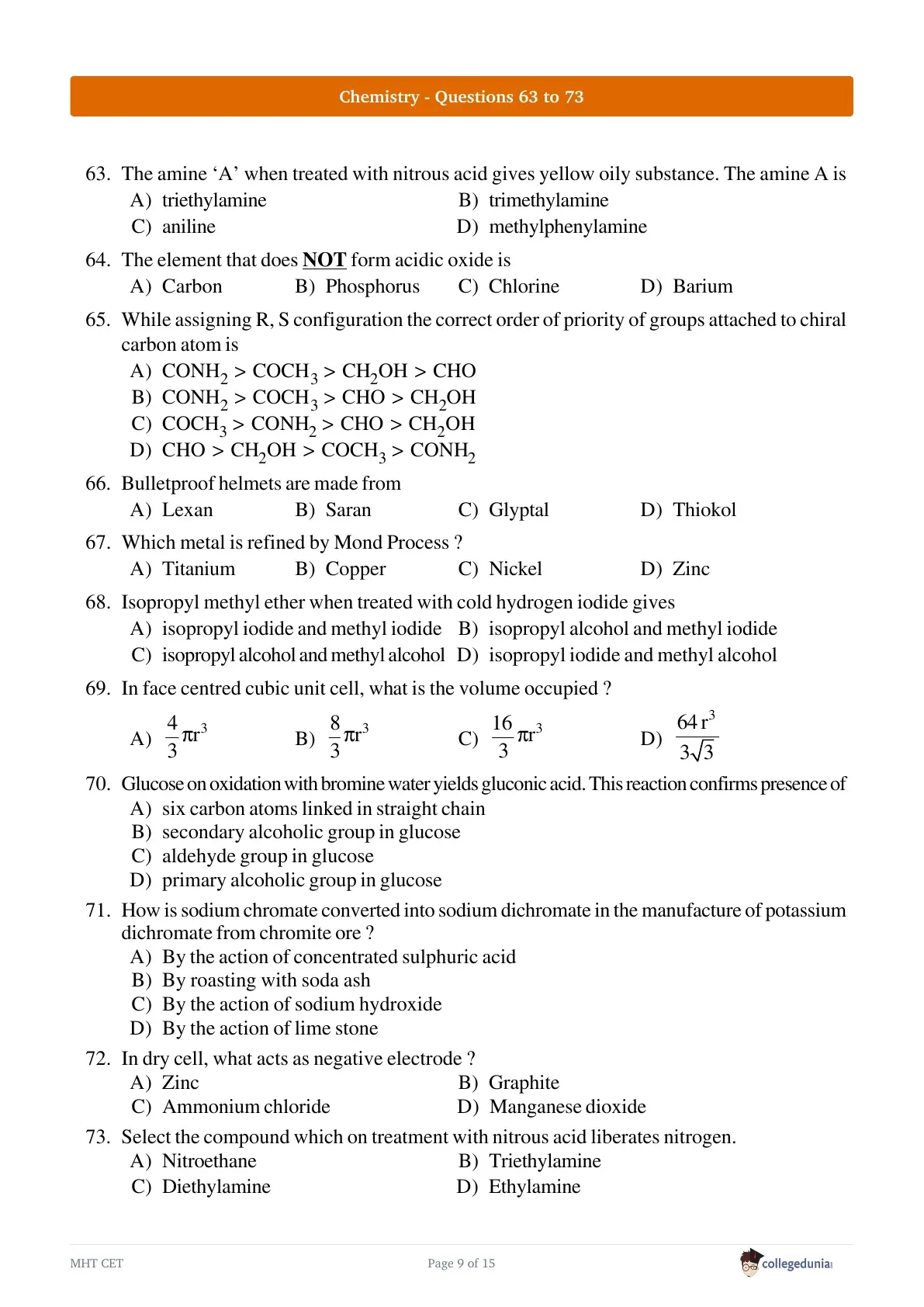
The amine 'A' when treated with nitrous acid gives yellow oily substance. The amine A is
The element that does not form acidic oxide is
While assigning R, S configuration, the correct order of priority of groups attached to chiral carbon atom is
Bulletproof helmets are made from
Which metal is refined by Mond's process?
Isopropyl methyl ether when treated with cold hydrogen iodide gives
In face centred cubic unit cell, what is the volume occupied?
Glucose on oxidation with bromine water yields gluconic acid. This reaction confirms the presence of
How is sodium chromate converted into sodium dichromate in the manufacture of potassium dichromate from chromite ore?
In dry cell, what acts as a negative electrode?
Select the compound which on treatment with nitrous acid liberates nitrogen.
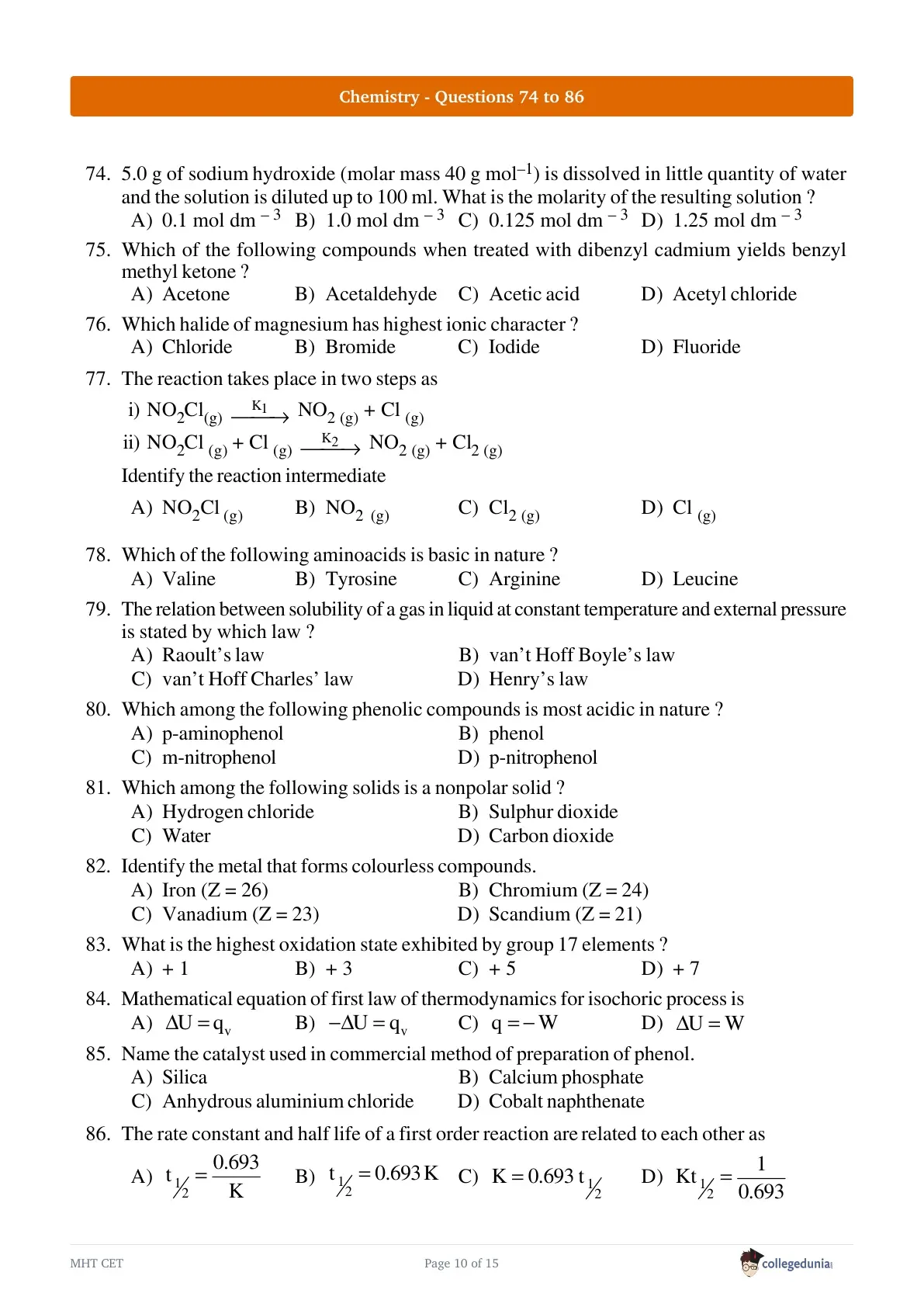
5.0 g of sodium hydroxide (molar mass 40 g/mol) is dissolved in little quantity of water and the solution is diluted upto 100 mL. What is the molarity of the resulting solution?
Which of the following compound when treated with dibenzyl cadmium yields benzyl methyl ketone?
Which halide of magnesium has highest ionic character?
The reaction takes place in two steps as (i) NO2Cl(g) -k1-> NO2(g)+Cl(g), (ii) NO2Cl(g)+Cl(g) -k2-> NO2(g)+Cl2(g). Identify the reaction intermediate.
Which of the following amino acid is basic in nature?
The relation between solubility of a gas in liquid at constant temperature and external pressure is stated by which law?
Which among the following phenolic compound is most acidic in nature?
Which among the following solid is a non-polar solid?
Identify the metal that forms colourless compounds.
What is the highest oxidation state exhibited by group 17 elements?
Mathematical equation of first law of thermodynamics for isochoric process is
Name the catalyst used in commercial method of preparation of phenol.
The rate constant and half-life of a first order reaction are related to each other as
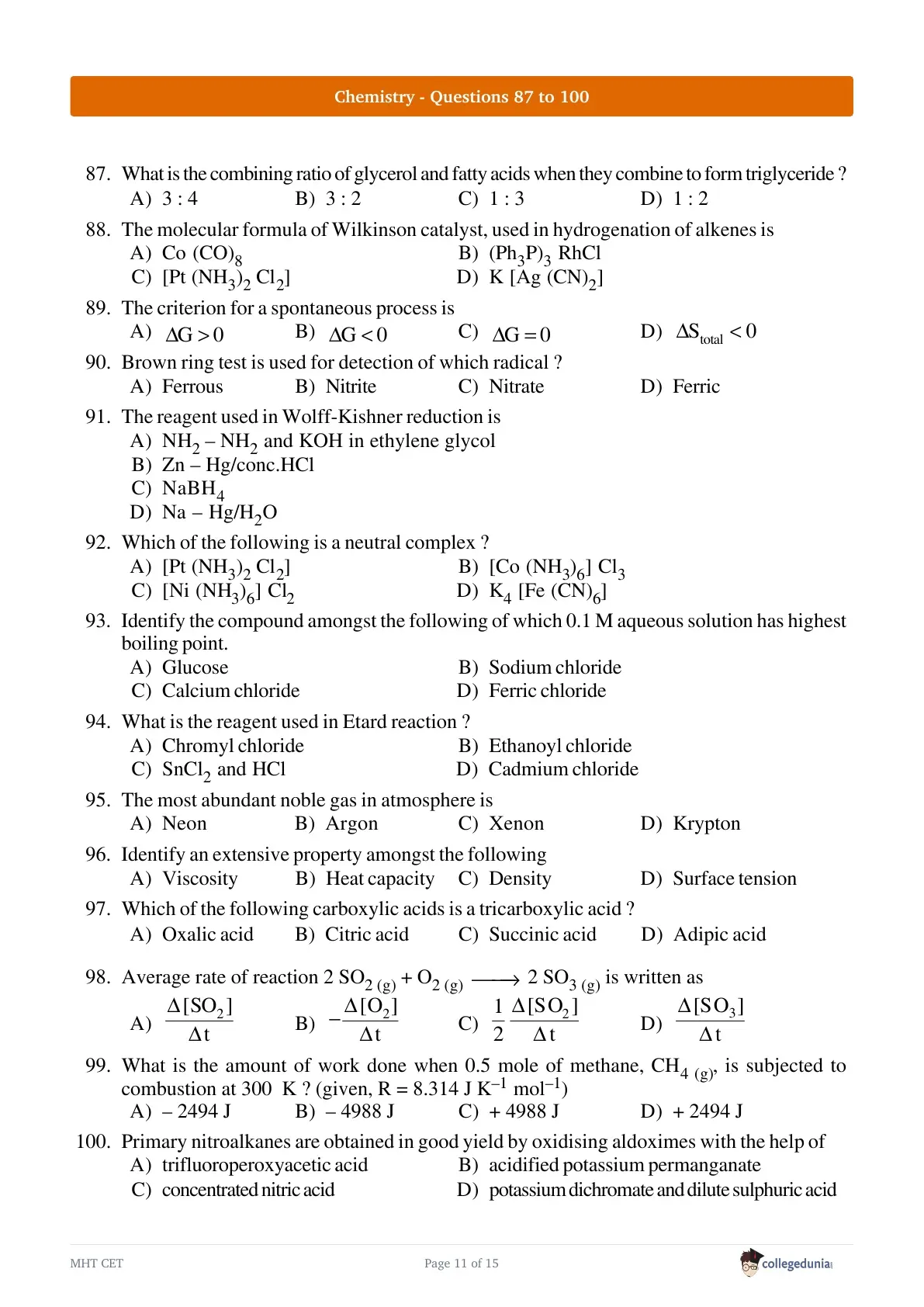
What is the combining ratio of glycerol and fatty acid when they combine to form triglyceride?
The molecular formula of Wilkinson's catalyst used in the hydrogenation of alkenes is
The criterion for a spontaneous process is
Brown ring test is used for detection of which radical?
The reagent used in Wolff-Kishner reduction is
Which of the following is a neutral complex?
Identify the compound amongst the following of which 0.1 M aqueous solution has highest boiling point.
Which reagent is used in Etard reaction?
The most abundant noble gas in atmosphere is
Identify an extensive property amongst the following.
Which of the following carboxylic acids is a tricarboxylic acid?
Average rate of reaction for the following reaction, 2SO2(g)+O2(g) -> 2SO3(g) is written as
What is the amount of work done when 0.5 mole of methane, CH4(g), is subjected to combustion at 300 K? (Given, R=8.314 JK^-1 mol^-1)
Primary nitroalkanes are obtained in good yield by oxidising aldoximes with the help of



Comments