




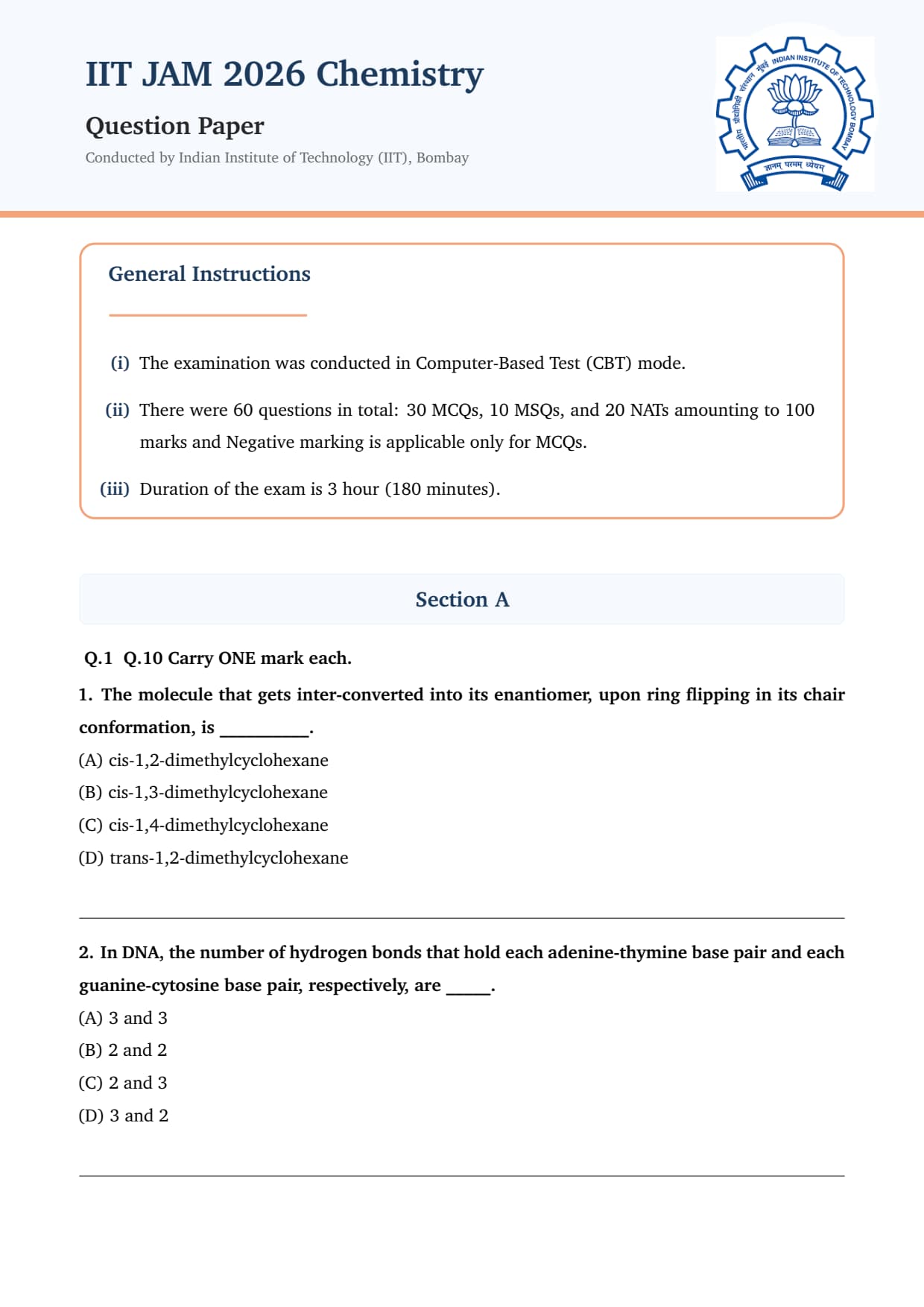
The IIT JAM 2026 Chemistry (CY) exam, was held on 15 February, from 9:30 AM to 12:30 PM. IIT JAM 2026 Chemistry (CY) Question Paper with Solution PDF is available for the download here.
There was 60 questions in total: 30 MCQs, 10 MSQs, and 20 NATs amounting to 100 marks and Negative marking is applicable only for MCQs.
IIT JAM 2026 Chemistry (CY) Question Paper with Solution PDF – Memory Based
| IIT JAM 2026 Chemistry (CY) Question Paper |  Download Download |
Check Solutions |
The molecule that gets inter-converted into its enantiomer, upon ring flipping in its chair conformation, is __________.
In DNA, the number of hydrogen bonds that hold each adenine-thymine base pair and each guanine-cytosine base pair, respectively, are _____.
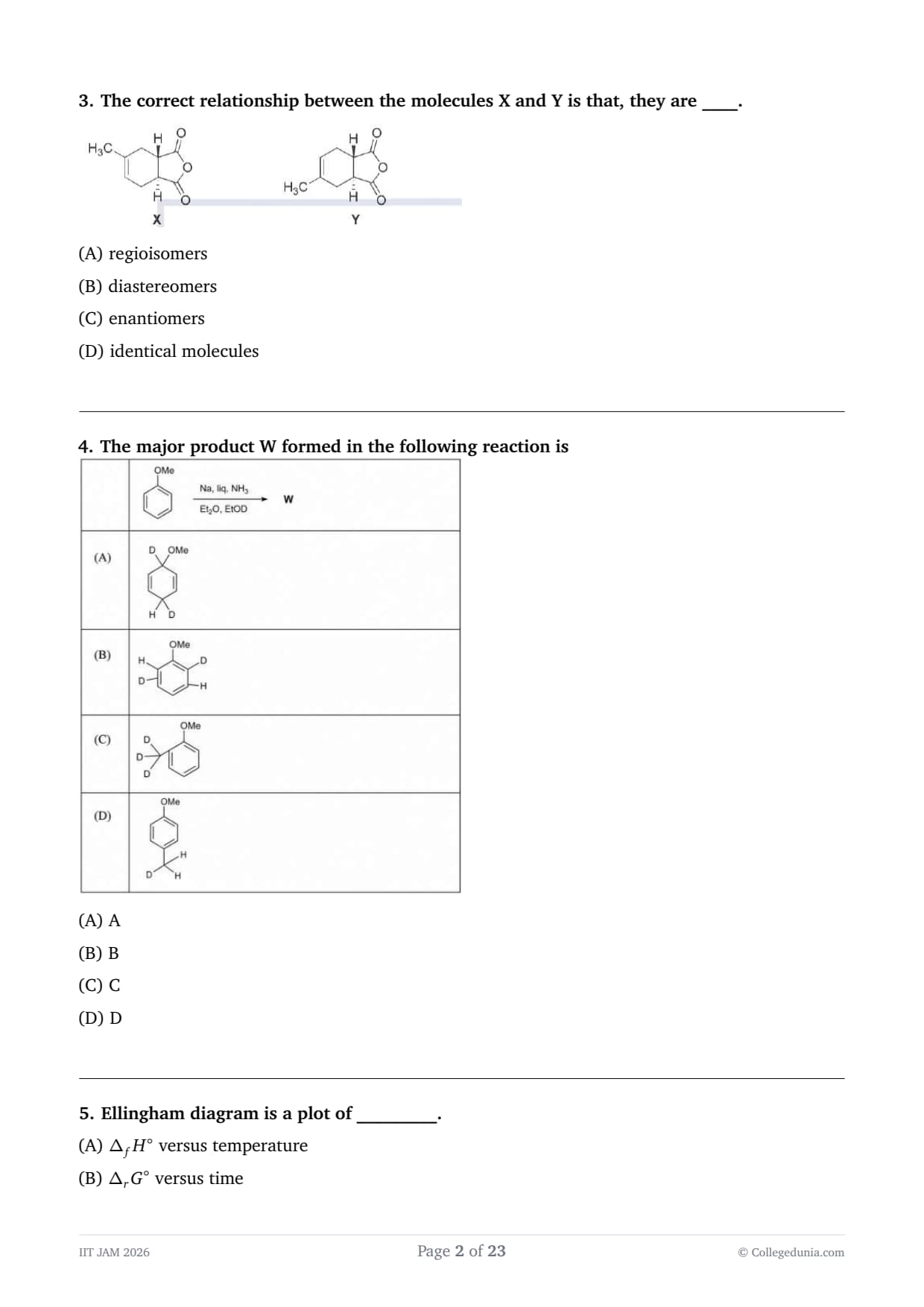
The correct relationship between the molecules X and Y is that, they are ____.

The major product W formed in the following reaction is

Ellingham diagram is a plot of _________.
The major product formed from the reaction between B\(_2\)H\(_6\) and two equivalents of NH\(_3\) at 300 \(^\circ\)C is _____.
The metal that is used as a catalyst in the synthesis of (CH\(_3\))\(_2\)SiCl\(_2\) in Rochow-Muller process is ____.
The molecule that has ONLY one lone pair of electrons on xenon is ____.
For first-order diffraction, the smallest value of \(d_{hkl}\) that can be detected with X-ray having a wavelength of 1.54 Å is ____ Å.
For an ideal gas, the isothermal compressibility \(k_T = -\frac{1}{V}\left(\frac{\partial V}{\partial P}\right)_T\) is ____.
The Lennard-Jones (LJ) potential of interaction between two molecules as a function of distance (\(r\)), is given by \(V_{LJ}(r) = 4\epsilon \left[ \left(\frac{\sigma}{r}\right)^{12} - \left(\frac{\sigma}{r}\right)^6 \right]\), where \(\epsilon\) and \(\sigma\) are constantsThe expression of \(r\) at which \(V_{LJ}(r)\) reaches minimum is ____.
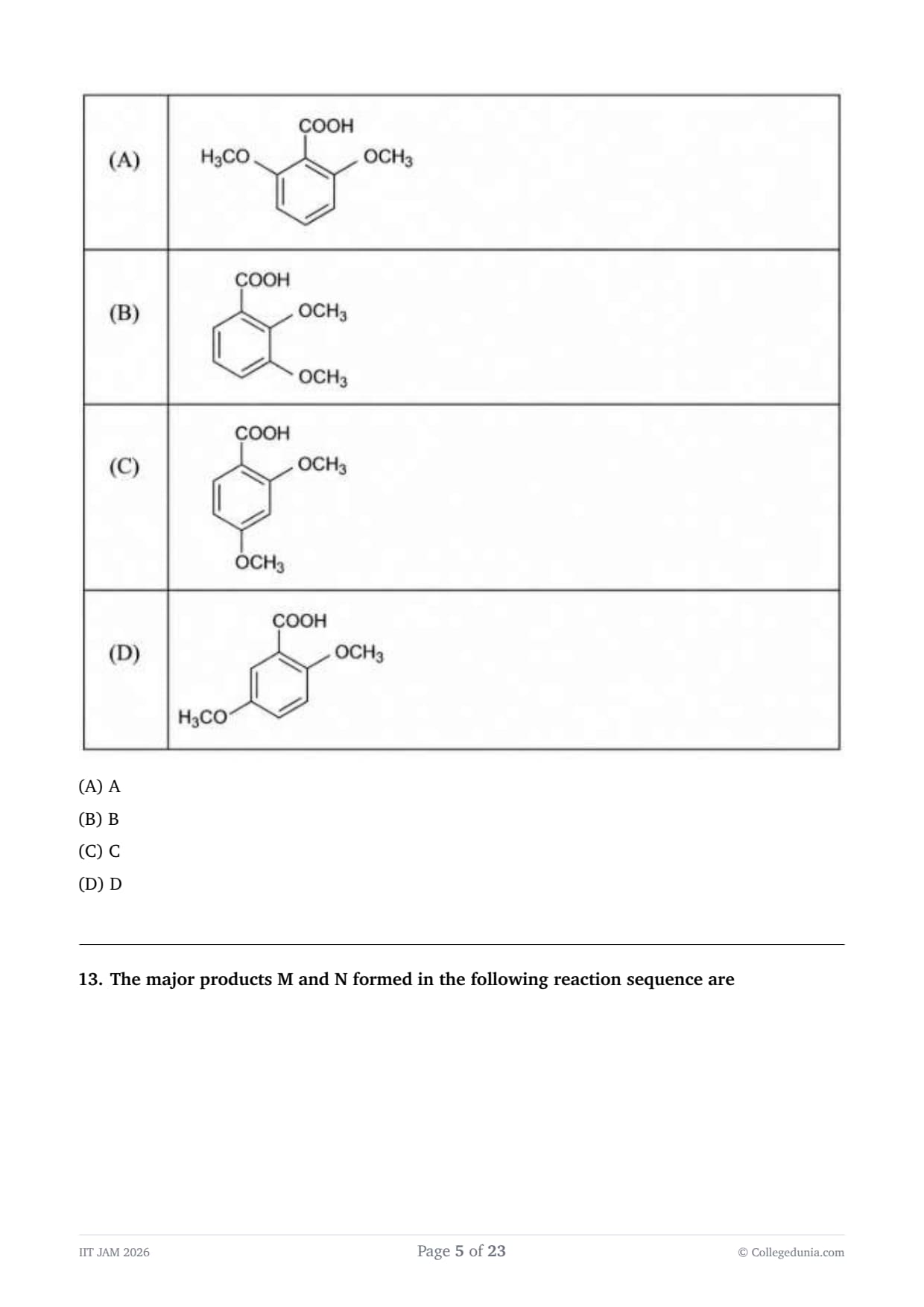
The \(^1\)H-NMR spectral data of a compound X is as follows: \(\delta\) (ppm): 11.6 (s, 1H, exchangeable with D\(_2\)O), 7.60 (d, 1H, \(J = 7.2\) Hz), 7.20 (t, 1H, \(J = 7.2\) Hz), 6.90 (d, 1H, \(J = 7.2\) Hz), 3.70 (s, 3H), 3.58 (s, 3H)Based on the spectral data, choose the appropriate structure for compound X.

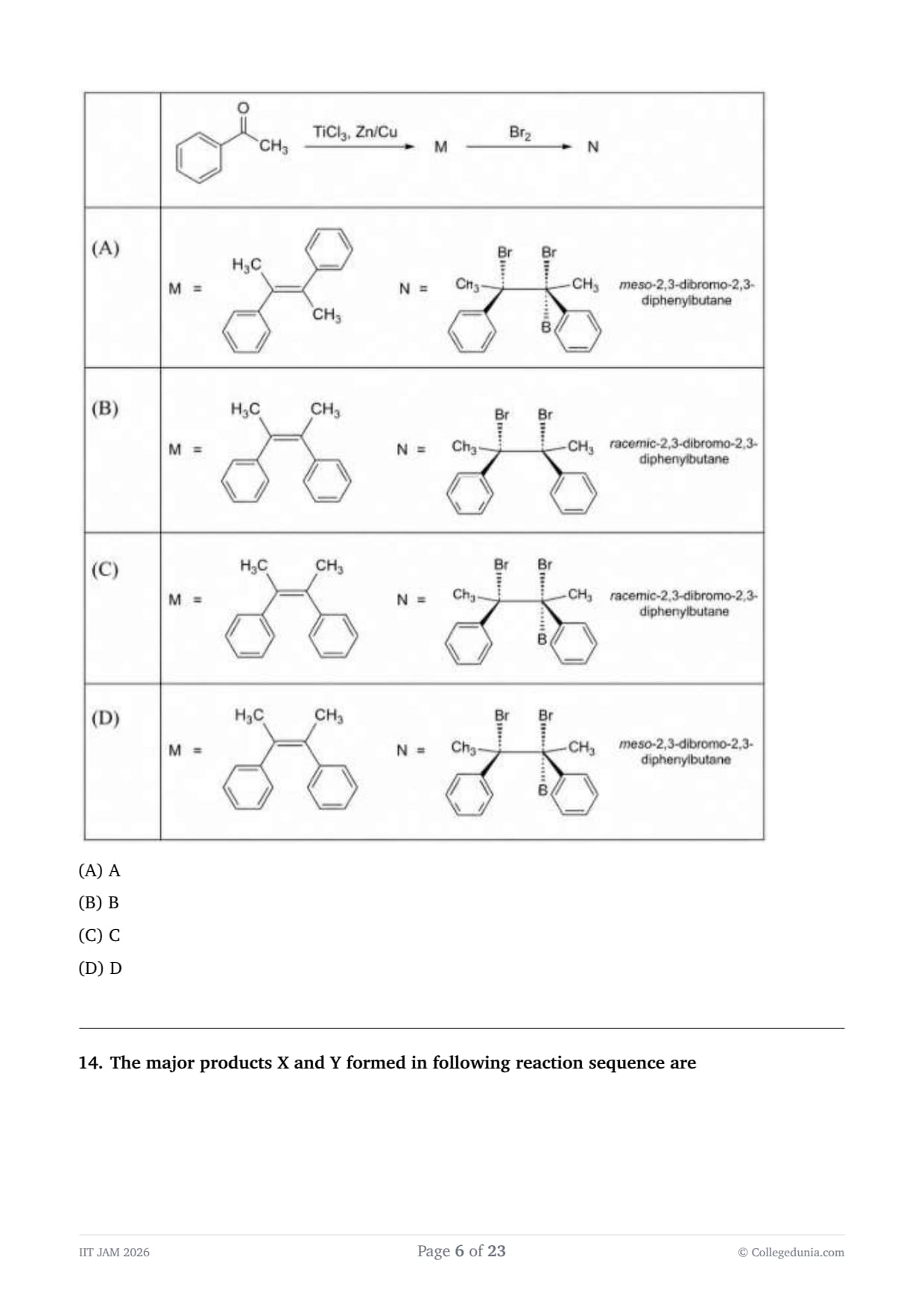
The major products M and N formed in the following reaction sequence are

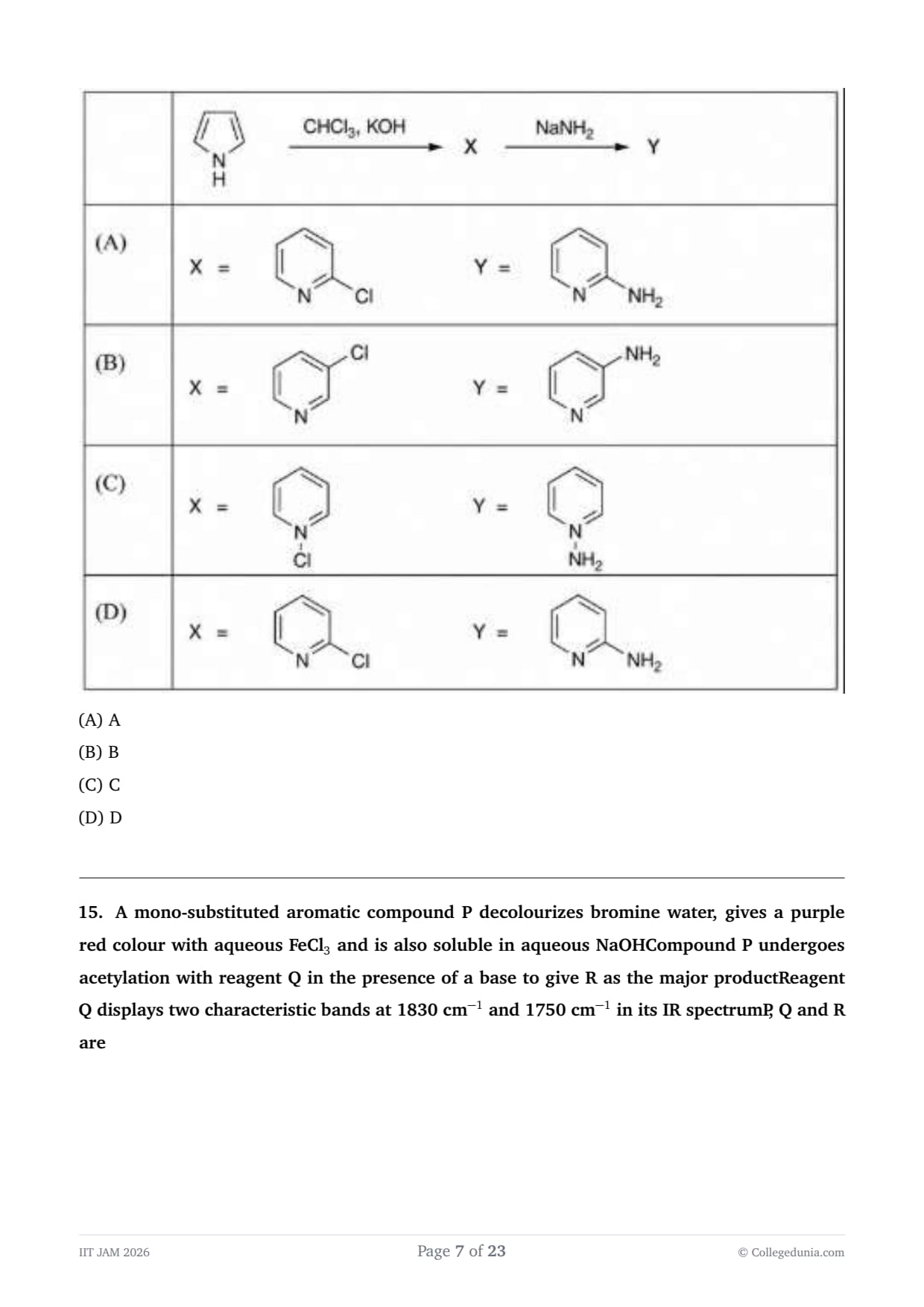
The major products X and Y formed in following reaction sequence are

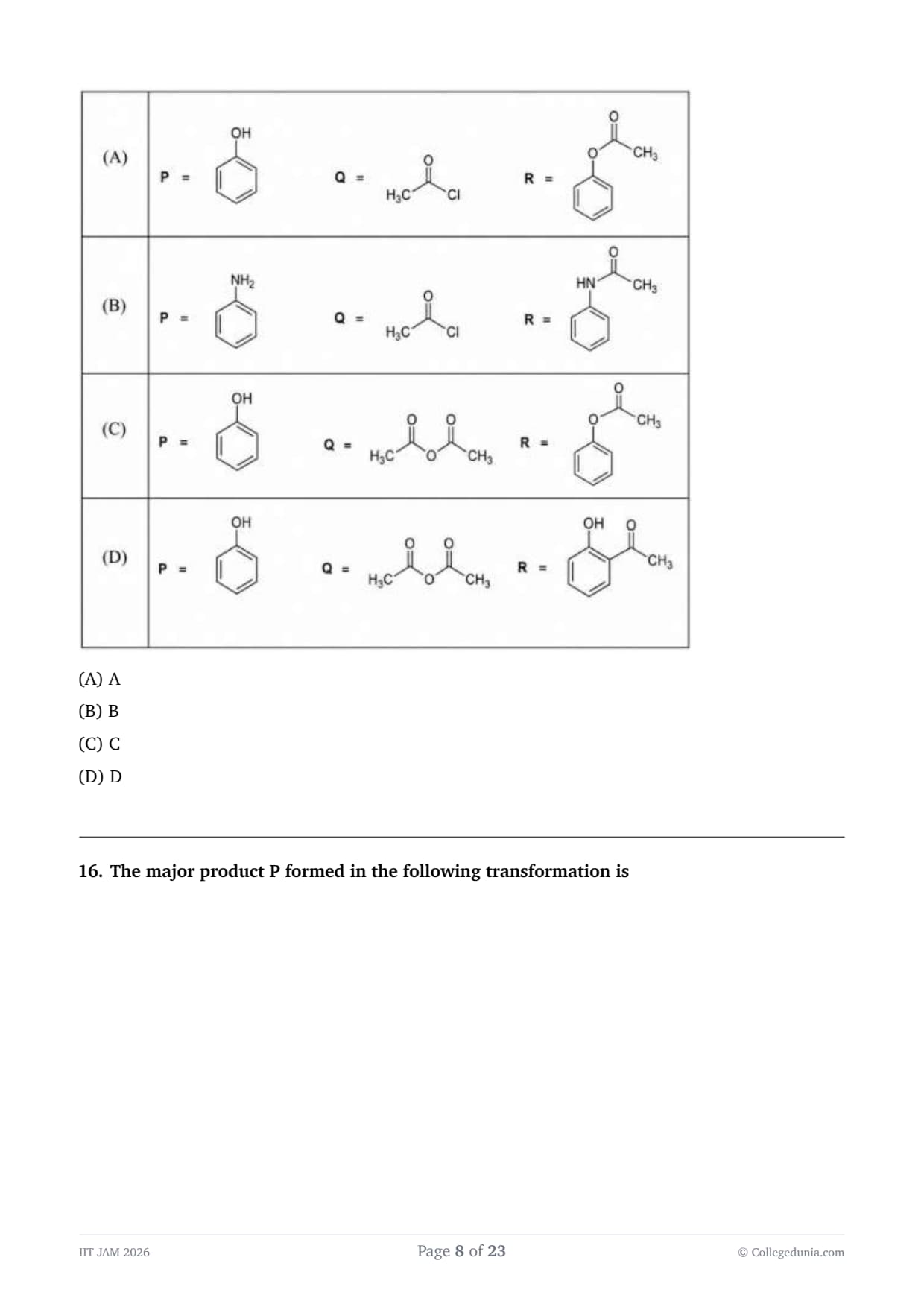
A mono-substituted aromatic compound P decolourizes bromine water, gives a purple red colour with aqueous FeCl\(_3\) and is also soluble in aqueous NaOHCompound P undergoes acetylation with reagent Q in the presence of a base to give R as the major productReagent Q displays two characteristic bands at 1830 cm\(^{-1}\) and 1750 cm\(^{-1}\) in its IR spectrumP, Q and R are

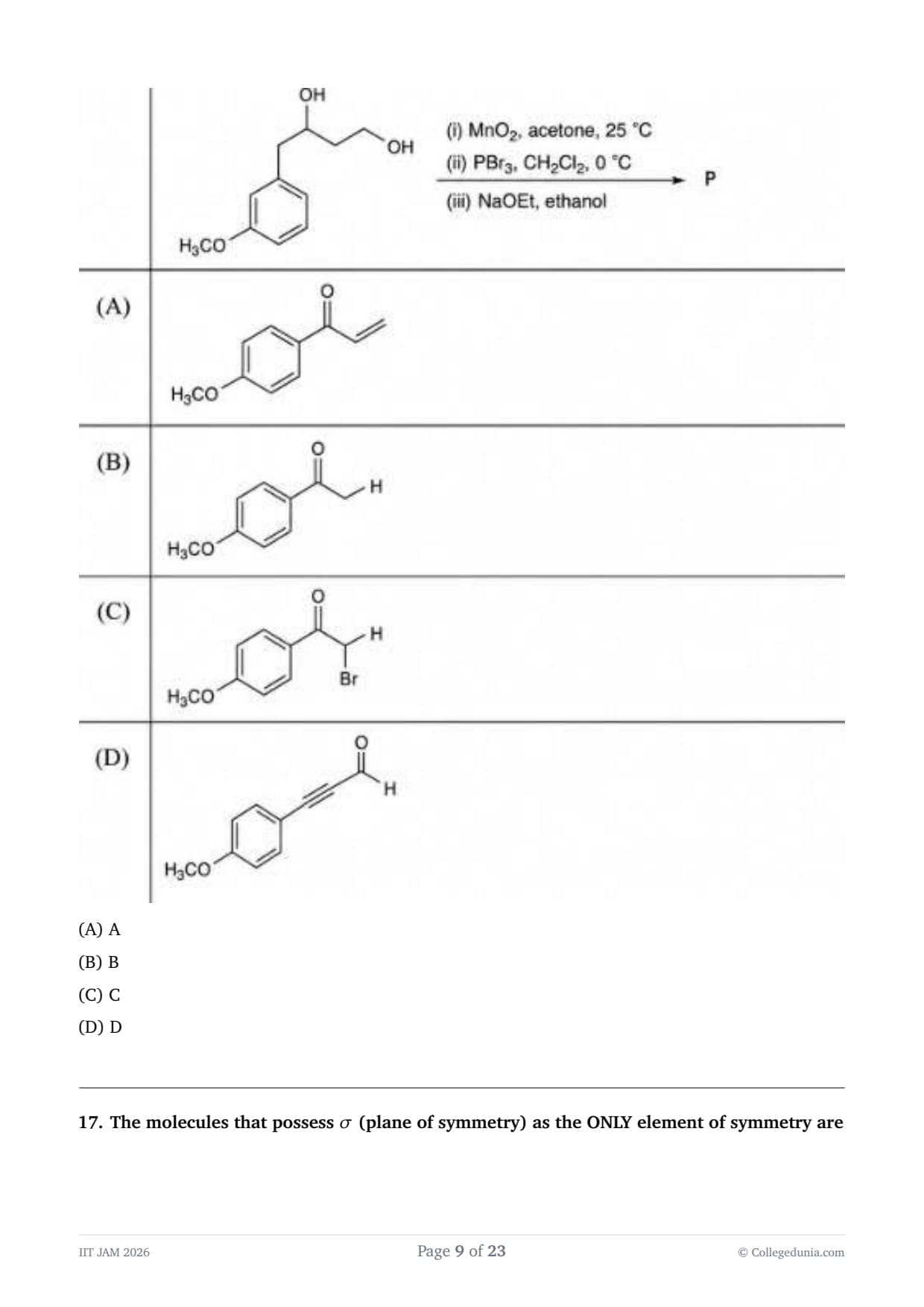
The major product P formed in the following transformation is

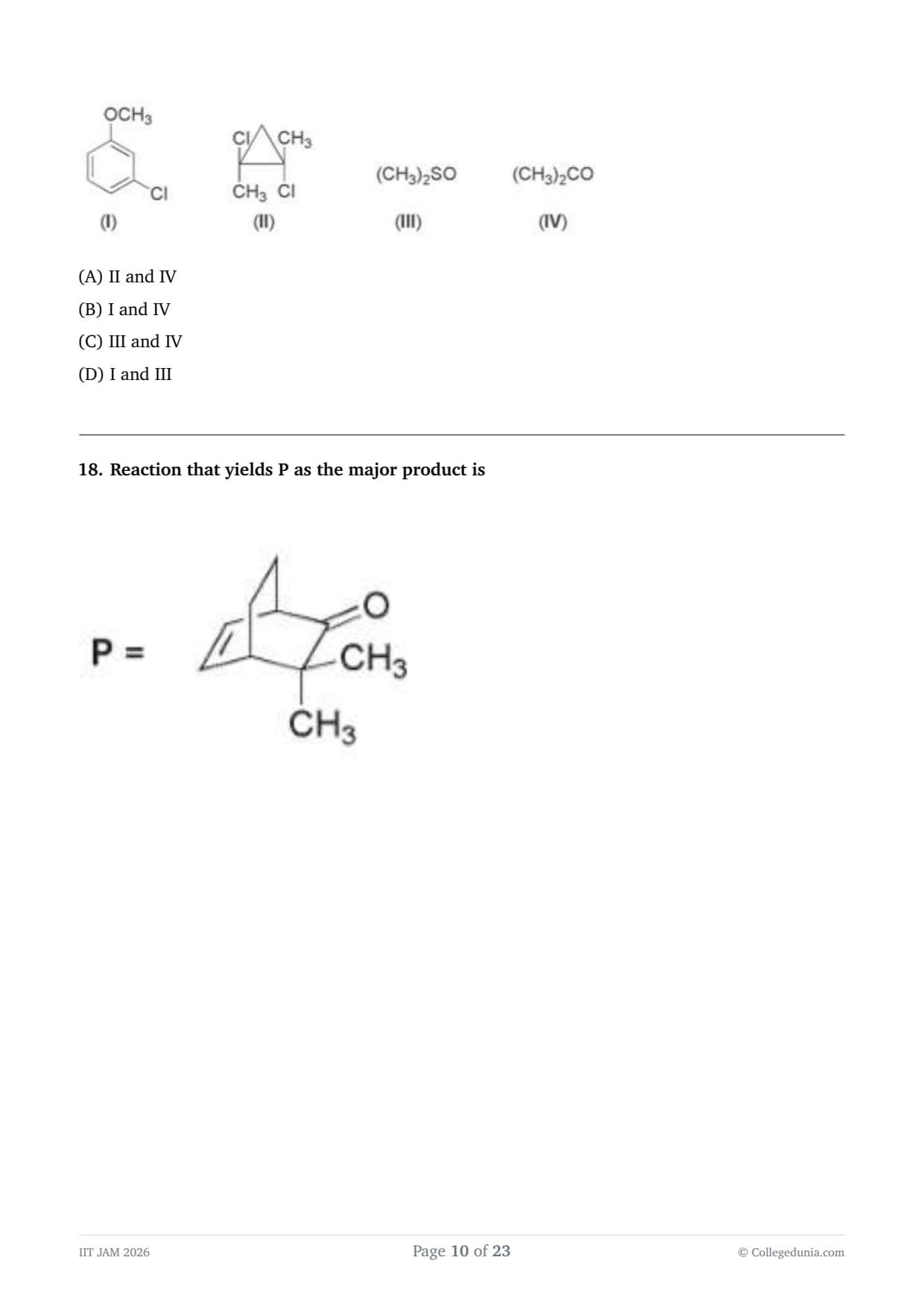
The molecules that possess \(\sigma\) (plane of symmetry) as the ONLY element of symmetry are

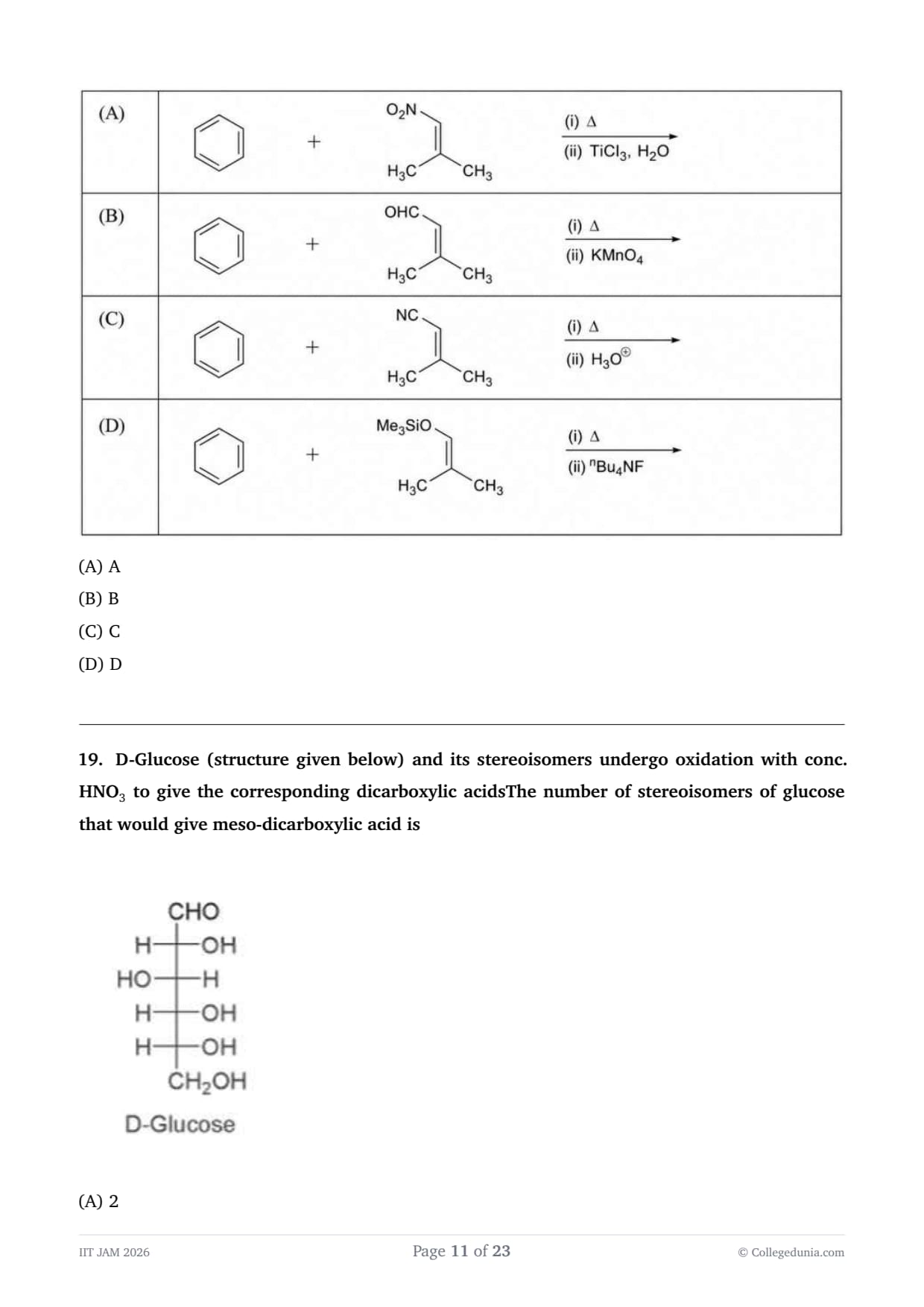
Reaction that yields P as the major product is


D-Glucose (structure given below) and its stereoisomers undergo oxidation with conc. HNO\(_3\) to give the corresponding dicarboxylic acidsThe number of stereoisomers of glucose that would give meso-dicarboxylic acid is

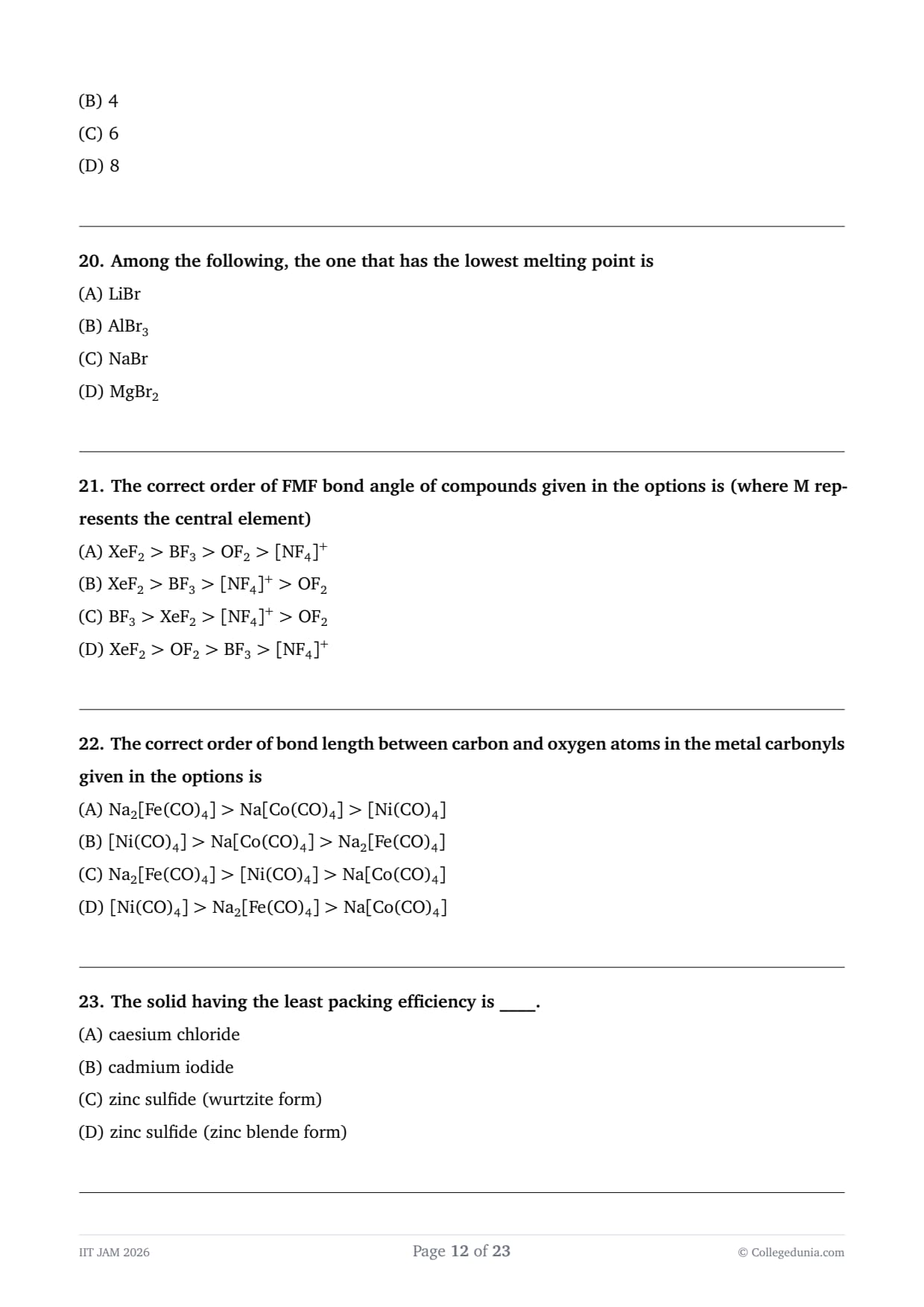
Among the following, the one that has the lowest melting point is
The correct order of F–M–F bond angle of compounds given in the options is (where M represents the central element)
The correct order of bond length between carbon and oxygen atoms in the metal carbonyls given in the options is
The solid having the least packing efficiency is ____.
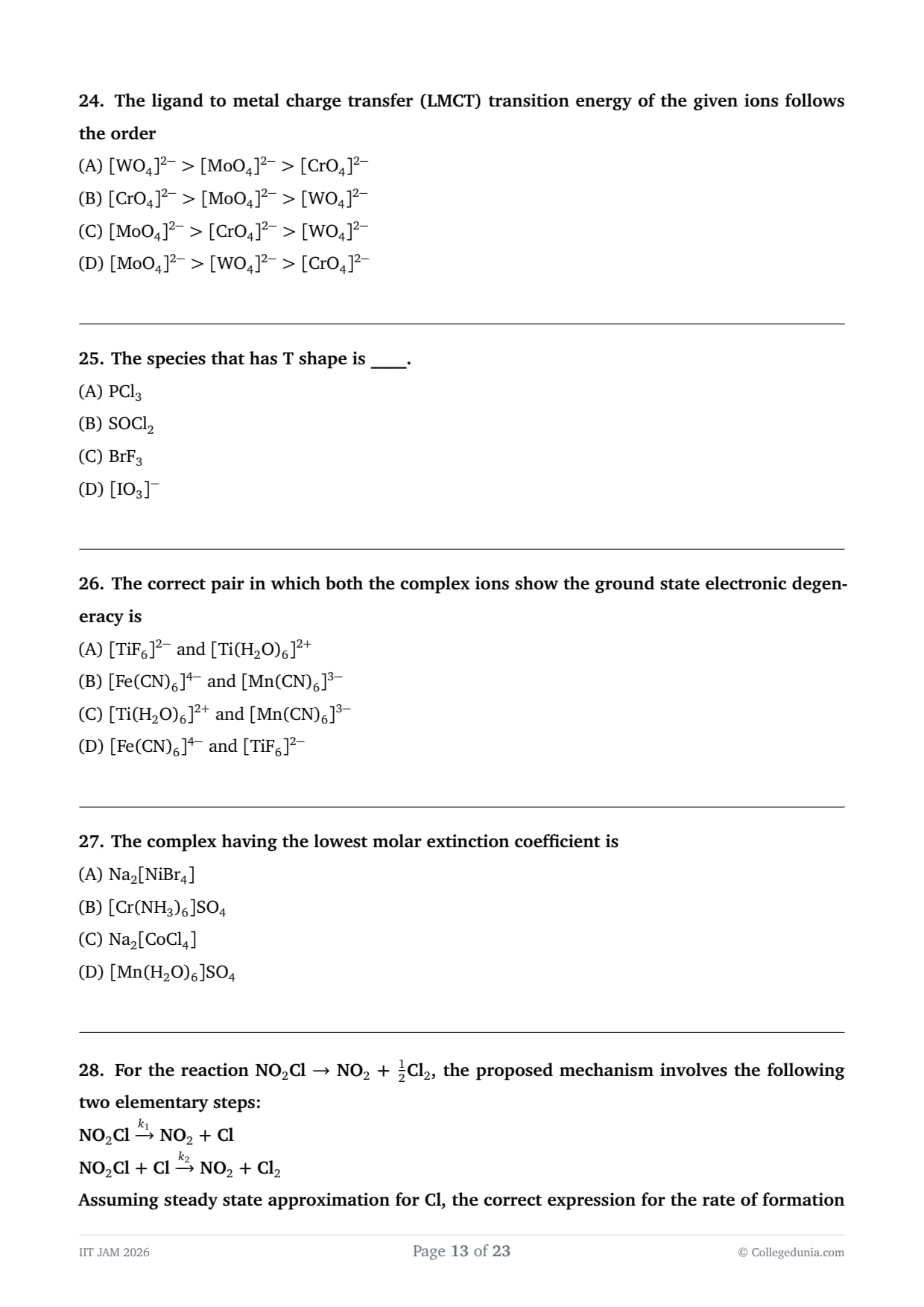
The ligand to metal charge transfer (LMCT) transition energy of the given ions follows the order
The species that has ‘T’ shape is ____.
The correct pair in which both the complex ions show the ground state electronic degeneracy is
The complex having the lowest molar extinction coefficient is
For the reaction NO\(_2\)Cl \(\rightarrow\) NO\(_2\) + \(\frac{1}{2}\)Cl\(_2\), the proposed mechanism involves the following two elementary steps:
NO\(_2\)Cl \(\xrightarrow{k_1}\) NO\(_2\) + Cl
NO\(_2\)Cl + Cl \(\xrightarrow{k_2}\) NO\(_2\) + Cl\(_2\)
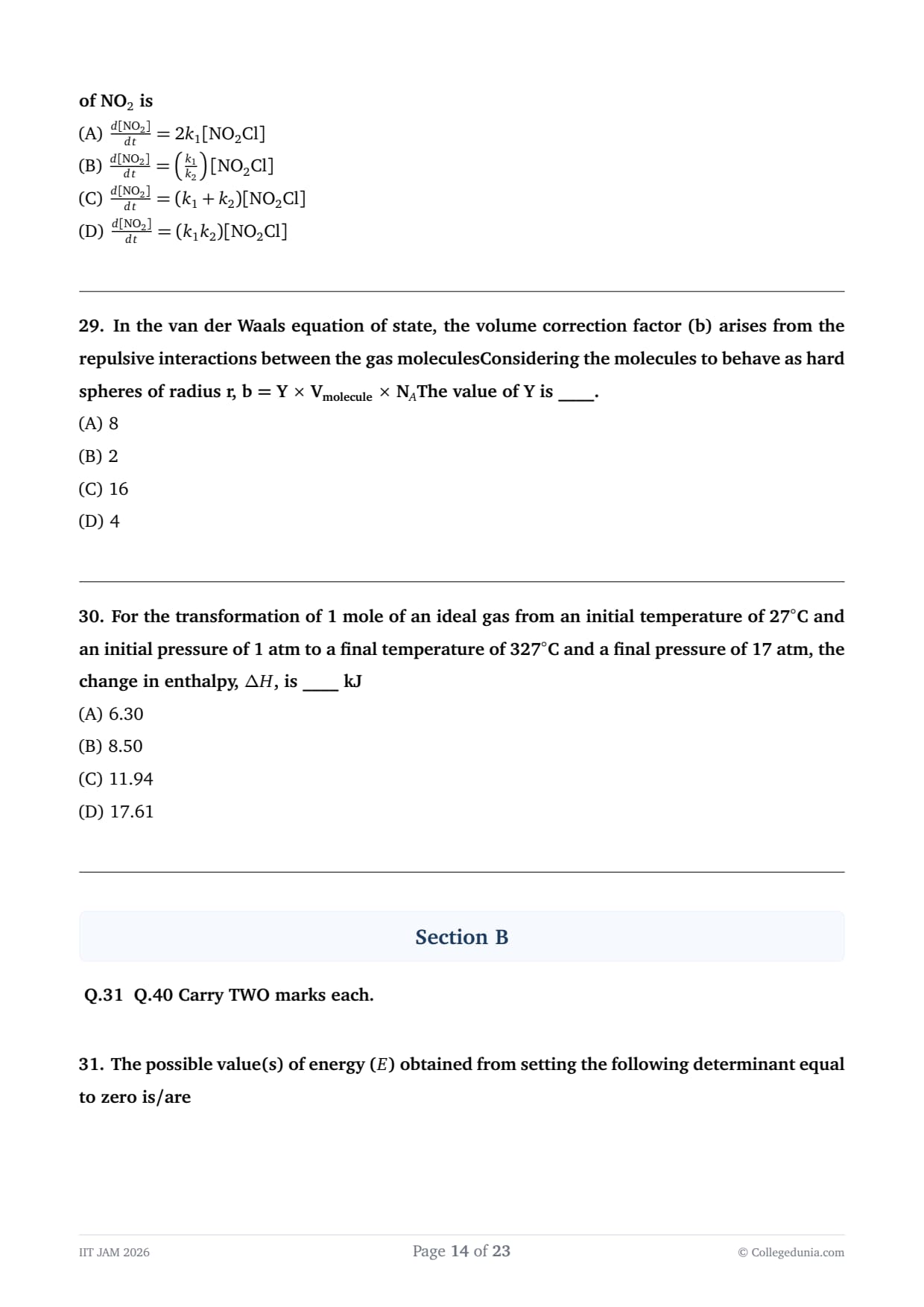
Assuming steady state approximation for Cl, the correct expression for the rate of formation of NO\(_2\) is
In the van der Waals equation of state, the volume correction factor (b) arises from the repulsive interactions between the gas moleculesConsidering the molecules to behave as hard spheres of radius r, b = Y \(\times\) V\(_{molecule}\) \(\times\) N\(_A\)The value of Y is ____.
For the transformation of 1 mole of an ideal gas from an initial temperature of 27\(^\circ\)C and an initial pressure of 1 atm to a final temperature of 327\(^\circ\)C and a final pressure of 17 atm, the change in enthalpy, \(\Delta H\), is ____ kJ
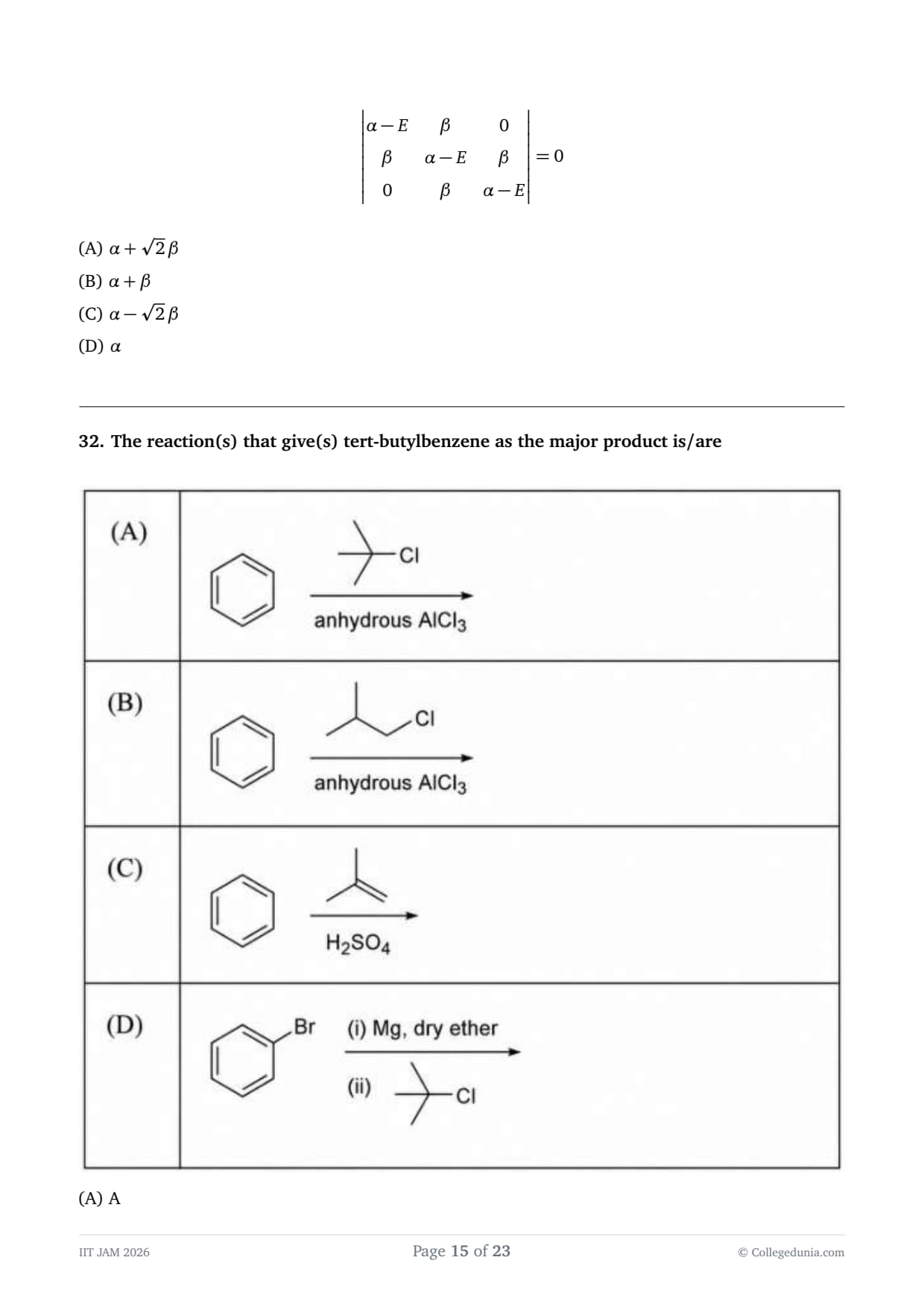
The possible value(s) of energy (\(E\)) obtained from setting the following determinant equal to zero is/are
\[ \left| \begin{matrix} \alpha - E & \beta & 0
\beta & \alpha - E & \beta
0 & \beta & \alpha - E \end{matrix} \right| = 0 \]
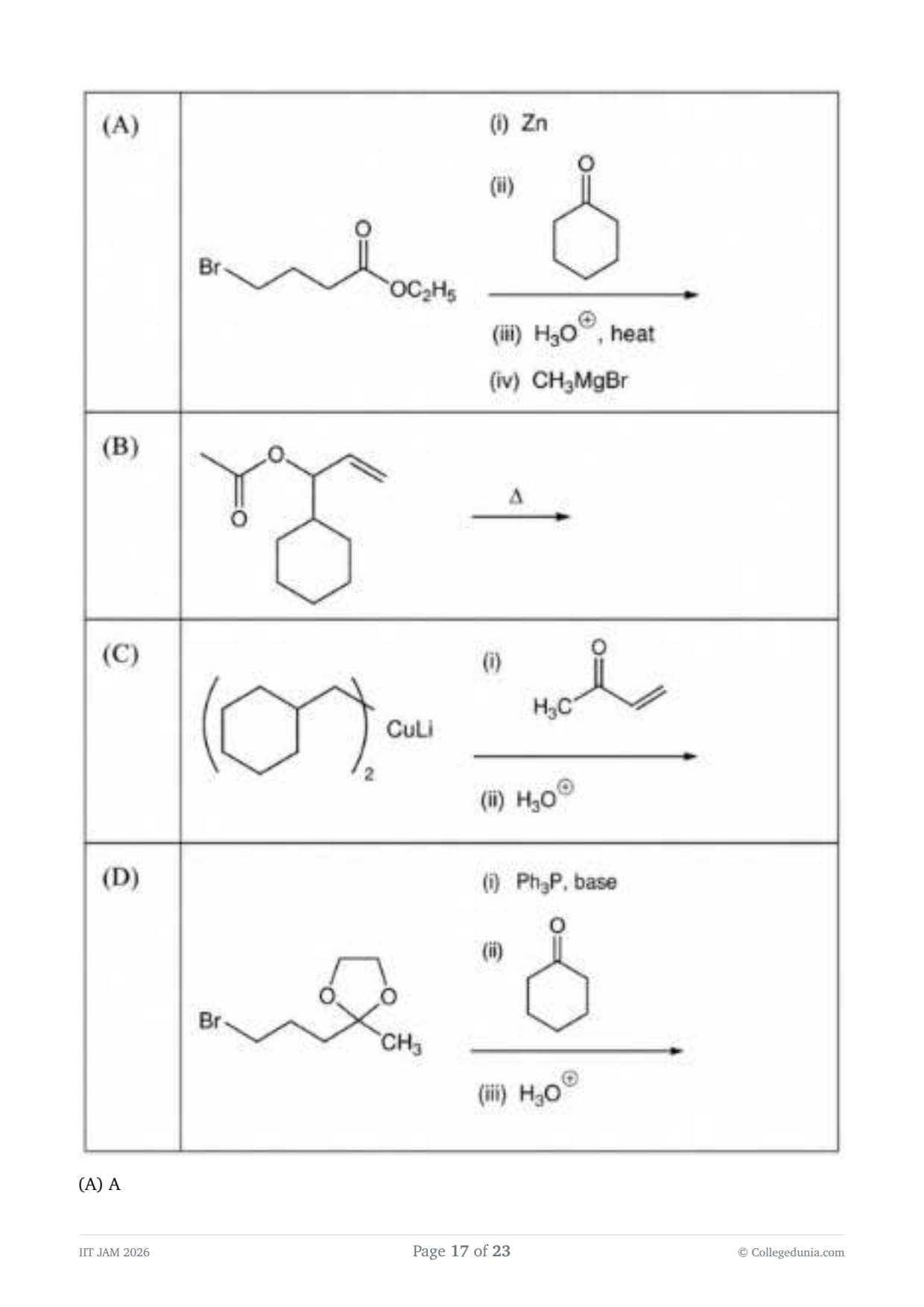
The reaction(s) that give(s) tert-butylbenzene as the major product is/are

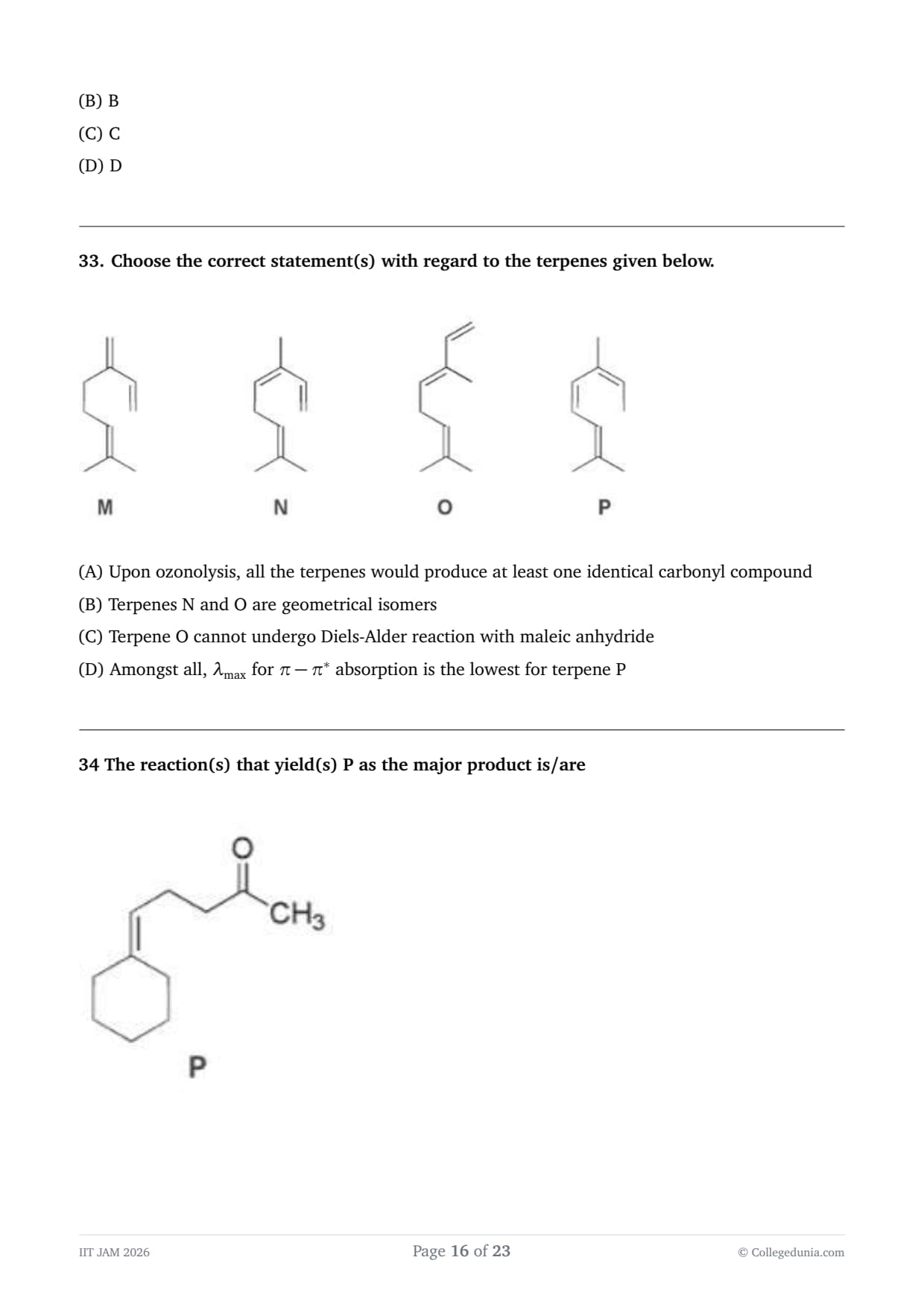
Choose the correct statement(s) with regard to the terpenes given below.

The reaction(s) that yield(s) P as the major product is/are


Set(s) of reagents that convert(s) benzoyl chloride to aniline is/are
The reactions of Li, Na and K with an excess of oxygen results in the formation of X, Y and Z respectively, as major productsThe correct option(s) is/are
Choose the correct option(s) with regard to haemoglobin (Hb)
Choose the correct statement(s) with regard to the complexometric titration of [Ni(H\(_2\)O)\(_6\)]\(^{2+}\) ion with a complexing agent Na\(_2\)H\(_2\)EDTA, using a suitable indicator under basic conditions.
The correct statement(s) for graphite is/are
The Langmuir isotherm for the adsorption of a gas on a solid surface can be expressed as \(\theta = \frac{Kp}{1+Kp}\)The correct statement(s) about this isotherm is/are
[Given: \(\theta\) is the fractional coverage; \(p\) is the pressure of the gas; \(K\) is a constant]
For the equation \(y = 3x^5 + 4x^4 - 3x^3 + x^2 - 2x + 1\), the value of \(\frac{d^5y}{dx^5}\) is ____. (answer in integer)
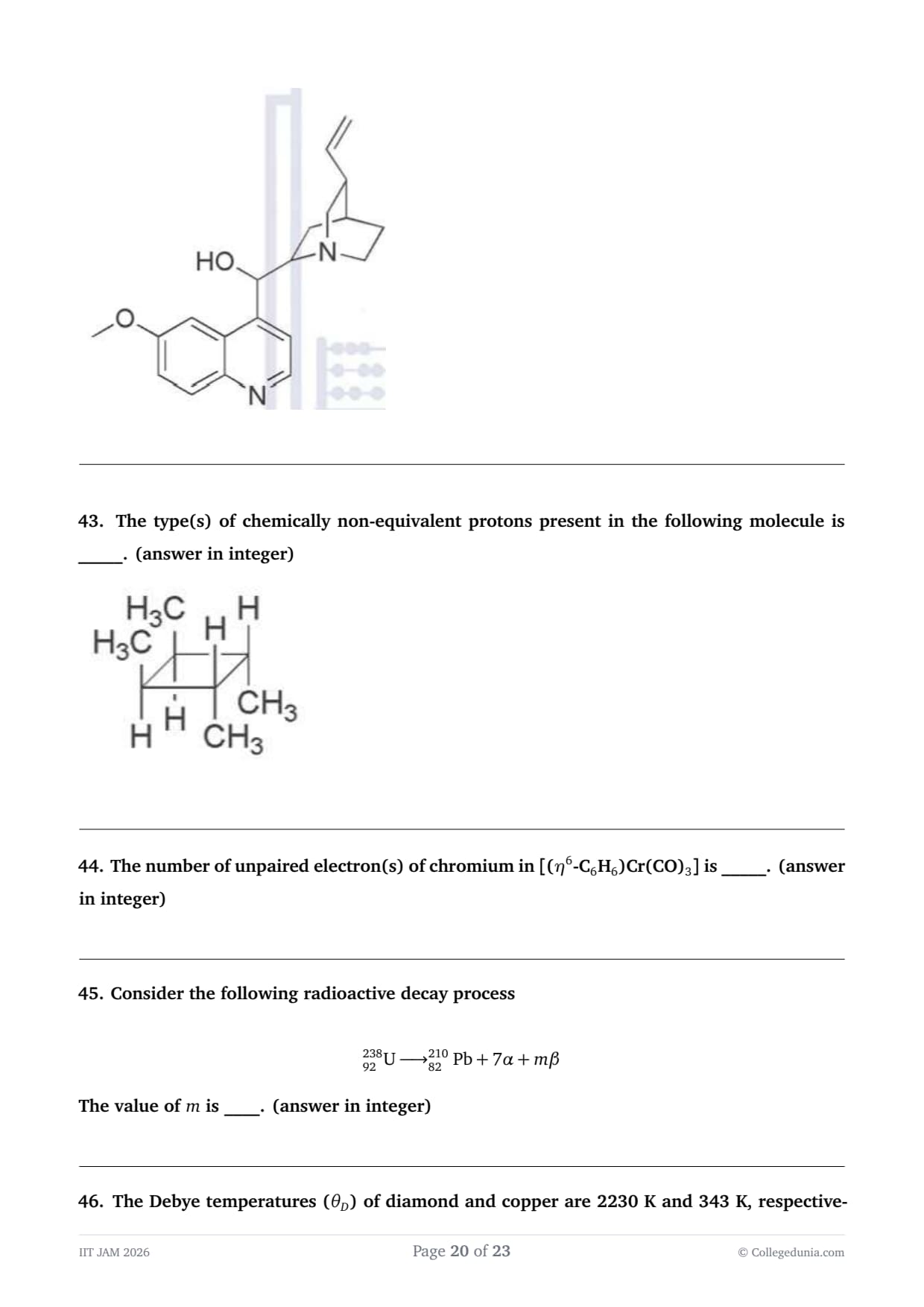
The number of stereogenic centre(s) present in the given alkaloid is ____. (answer in integer)

The type(s) of chemically non-equivalent protons present in the following molecule is _____. (answer in integer)

The number of unpaired electron(s) of chromium in [(\(\eta^6\)-C\(_6\)H\(_6\))Cr(CO)\(_3\)] is _____. (answer in integer)
Consider the following radioactive decay process
\[ ^{238}_{92}U \longrightarrow ^{210}_{82}Pb + 7\alpha + m\beta \]
The value of \(m\) is ____. (answer in integer)
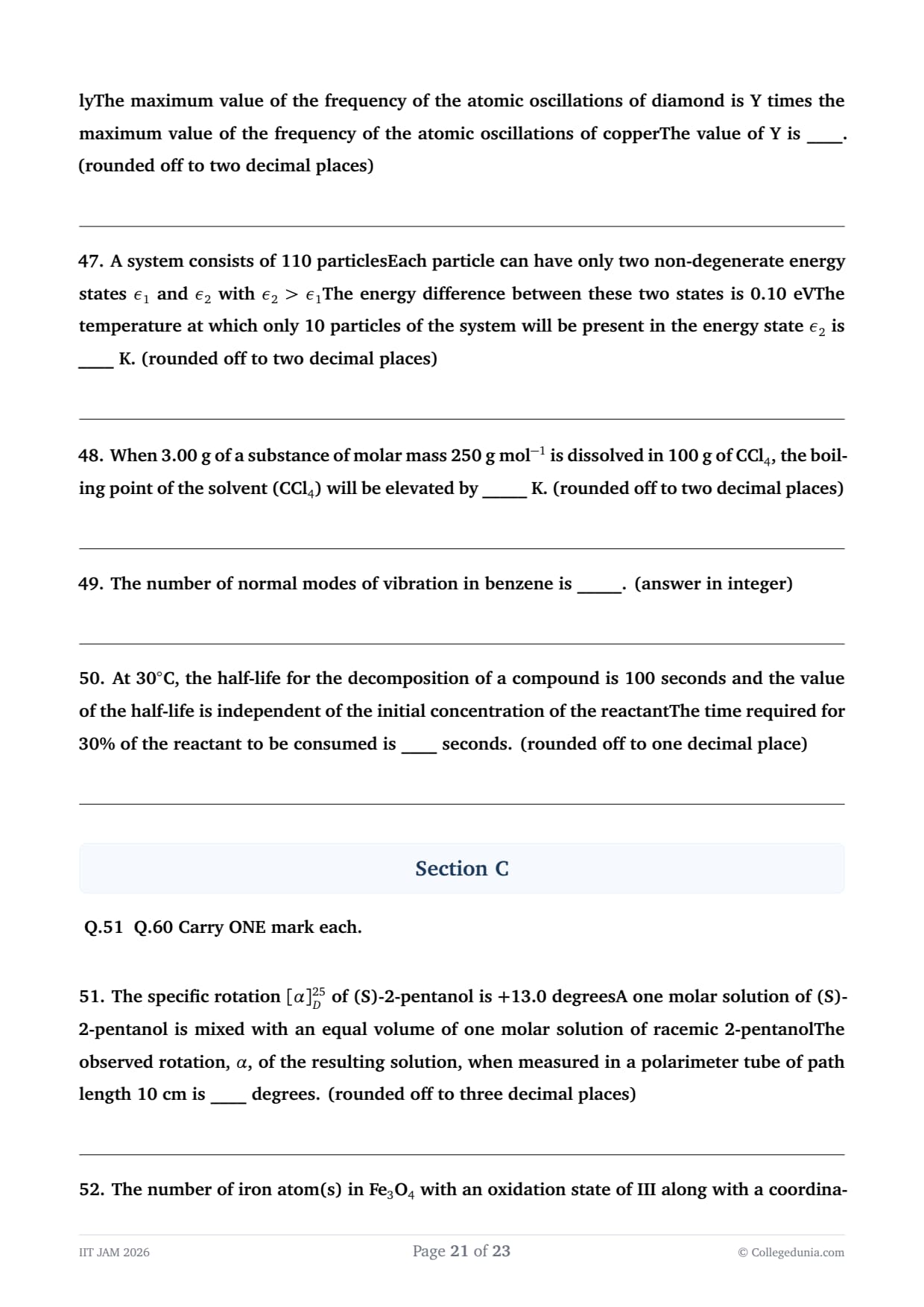
The Debye temperatures (\(\theta_D\)) of diamond and copper are 2230 K and 343 K, respectivelyThe maximum value of the frequency of the atomic oscillations of diamond is Y times the maximum value of the frequency of the atomic oscillations of copperThe value of Y is ____. (rounded off to two decimal places)
A system consists of 110 particlesEach particle can have only two non-degenerate energy states \(\epsilon_1\) and \(\epsilon_2\) with \(\epsilon_2 > \epsilon_1\)The energy difference between these two states is 0.10 eVThe temperature at which only 10 particles of the system will be present in the energy state \(\epsilon_2\) is ____ K. (rounded off to two decimal places)
When 3.00 g of a substance of molar mass 250 g mol\(^{-1}\) is dissolved in 100 g of CCl\(_4\), the boiling point of the solvent (CCl\(_4\)) will be elevated by _____ K. (rounded off to two decimal places)
The number of normal modes of vibration in benzene is _____. (answer in integer)
At 30\(^\circ\)C, the half-life for the decomposition of a compound is 100 seconds and the value of the half-life is independent of the initial concentration of the reactantThe time required for 30% of the reactant to be consumed is ____ seconds. (rounded off to one decimal place)
The specific rotation \([\alpha]_D^{25}\) of (S)-2-pentanol is +13.0 degreesA one molar solution of (S)-2-pentanol is mixed with an equal volume of one molar solution of racemic 2-pentanolThe observed rotation, \(\alpha\), of the resulting solution, when measured in a polarimeter tube of path length 10 cm is ____ degrees. (rounded off to three decimal places)
The number of iron atom(s) in Fe\(_3\)O\(_4\) with an oxidation state of III along with a coordination number of six is ____. (answer in integer)
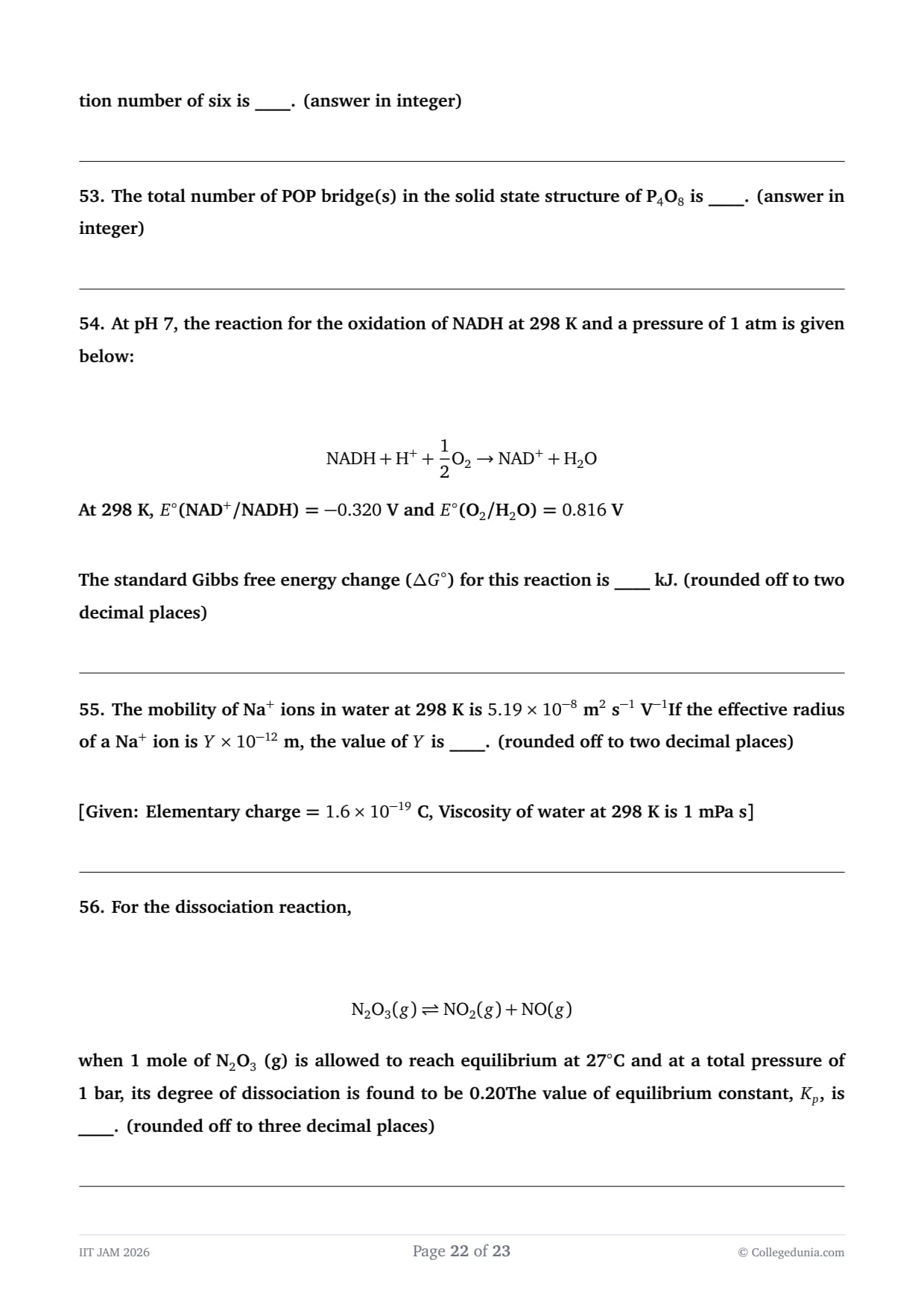
The total number of P–O–P bridge(s) in the solid state structure of P\(_4\)O\(_8\) is ____. (answer in integer)
At pH 7, the reaction for the oxidation of NADH at 298 K and a pressure of 1 atm is given below:
\[ NADH + H^+ + \frac{1}{2}O_2 \rightarrow NAD^+ + H_2O \]
At 298 K, \(E^\circ\)(NAD\(^+\)/NADH) = \(-0.320\) V and \(E^\circ\)(O\(_2\)/H\(_2\)O) = \(0.816\) V
The standard Gibbs free energy change (\(\Delta G^\circ\)) for this reaction is ____ kJ. (rounded off to two decimal places)
The mobility of Na\(^+\) ions in water at 298 K is \(5.19 \times 10^{-8}\) m\(^2\) s\(^{-1}\) V\(^{-1}\)If the effective radius of a Na\(^+\) ion is \(Y \times 10^{-12}\) m, the value of \(Y\) is ____. (rounded off to two decimal places)
[Given: Elementary charge = \(1.6 \times 10^{-19}\) C, Viscosity of water at 298 K is 1 mPa s]
For the dissociation reaction,
\[ N_2O_3 (g) \rightleftharpoons NO_2 (g) + NO (g) \]
when 1 mole of N\(_2\)O\(_3\) (g) is allowed to reach equilibrium at 27\(^\circ\)C and at a total pressure of 1 bar, its degree of dissociation is found to be 0.20The value of equilibrium constant, \(K_p\), is ____. (rounded off to three decimal places)
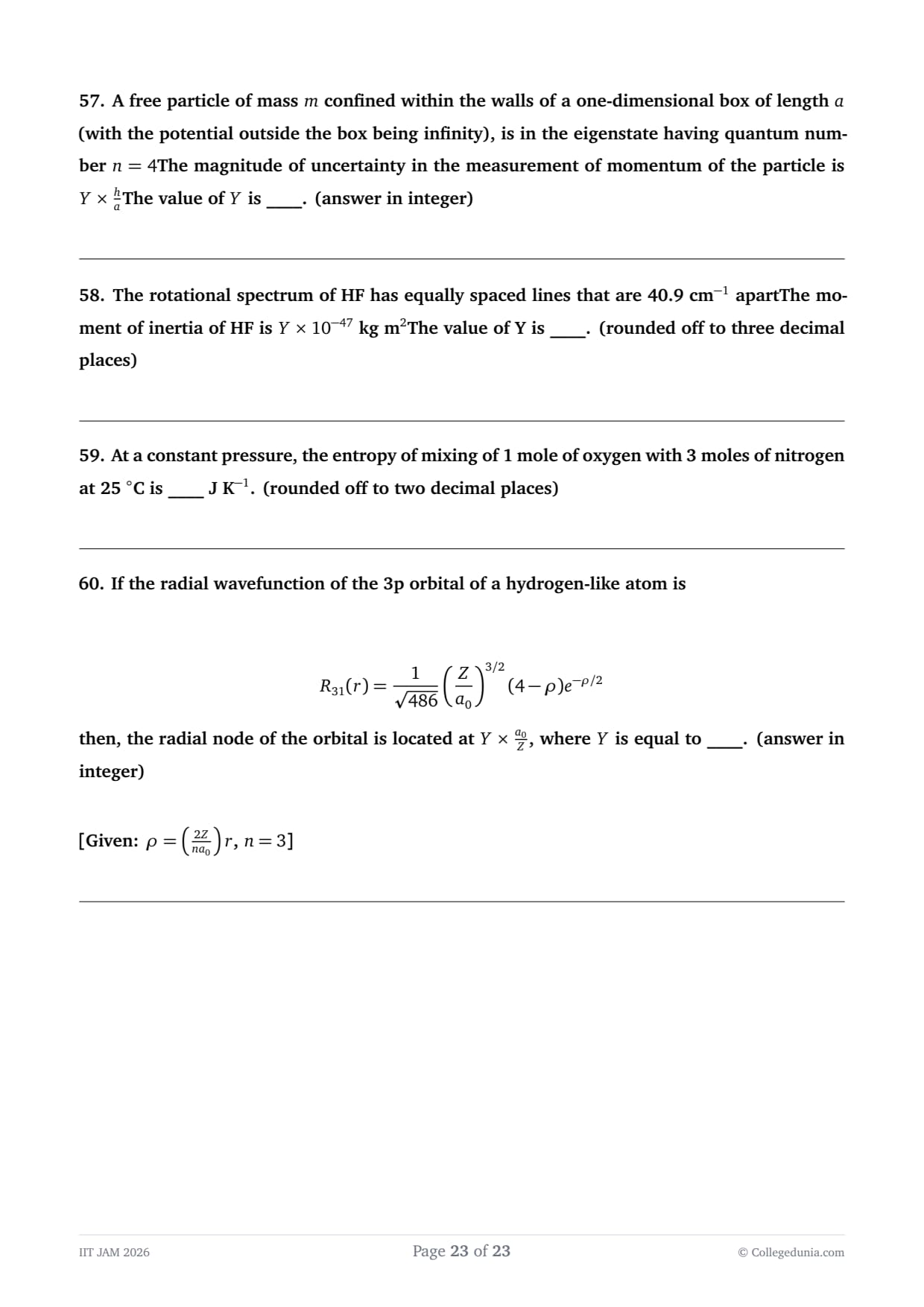
A free particle of mass \(m\) confined within the walls of a one-dimensional box of length \(a\) (with the potential outside the box being infinity), is in the eigenstate having quantum number \(n = 4\)The magnitude of uncertainty in the measurement of momentum of the particle is \(Y \times \frac{h}{a}\)The value of \(Y\) is ____. (answer in integer)
The rotational spectrum of HF has equally spaced lines that are 40.9 cm\(^{-1}\) apartThe moment of inertia of HF is \(Y \times 10^{-47}\) kg m\(^2\)The value of Y is ____. (rounded off to three decimal places)
At a constant pressure, the entropy of mixing of 1 mole of oxygen with 3 moles of nitrogen at 25 \(^\circ\)C is ____ J K\(^{-1}\). (rounded off to two decimal places)
If the radial wavefunction of the 3p orbital of a hydrogen-like atom is
\[ R_{31}(r) = \frac{1}{\sqrt{486}} \left(\frac{Z}{a_0}\right)^{3/2} (4 - \rho)e^{-\rho/2} \]
then, the radial node of the orbital is located at \(Y \times \frac{a_0}{Z}\), where \(Y\) is equal to ____. (answer in integer)
[Given: \(\rho = \left(\frac{2Z}{na_0}\right)r\), \(n=3\)]
IIT JAM 2026 High Weightage Topics



Comments