English Strategist, 9 Yrs | Updated on - Jul 21, 2026
These Memories of Childhood Class 12 NCERT Solutions answer every Reading with Insight question for Vistas Chapter 6 with text-grounded long answers from the paired accounts of Zitkala-Sa and Bama. Each answer is built like a 6-mark Section C Long Answer, with the exact details (the Carlisle haircut, the parcel by the string, Annan's intervention) that CBSE markers reward, aligned to the 2026-27 NCERT reprint.
CBSE Weightage:6 marks per Vistas Long Answer in Section C
Coverage: 3 Reading with Insight answers with Expert's Solution alternates and quotations from both extracts
These solutions are written by senior English educators and mapped to the 2026-27 NCERT Vistas textbook and recent CBSE Class 12 English Core papers.
Memories of Childhood Class 12 NCERT Solutions: Chapter Snapshot
Memories of Childhood is the sixth and final chapter in the Class 12 Vistas reader, a paired autobiographical extract by two women from marginalised communities. Part I, The Cutting of My Long Hair, is by Zitkala-Sa (1876-1938), a Native American writer recalling her first day at the Carlisle Indian Boarding School. Part II, We Too are Human Beings, is by Bama (b. 1958), a Tamil Dalit writer, from her 1992 autobiography Karukku. The Reading with Insight block has three questions on the common theme, the early origins of rebellion, and the two forms of discrimination.
CBSE usually pulls a single 6-mark Long Answer from Vistas in Section C. Q1 (common theme) and Q3 (comparison of discriminations) have been the most frequent rotations over the last five years.
Memories of Childhood Video Explanation (Class 12 English)
Every question in the PDF is answered in two passes:
Long Answer. A one-line position, the anchor lines of both extracts quoted ("We too are human beings", "I will struggle first"), four to six text-grounded points with historical anchors, and a two-sentence final answer.
Expert's Solution. The postcolonial frame, the Ambedkarite "educate, agitate, organise" parallel, and the women's-autobiography context, giving two ways to answer.
Q1 Answer Skeleton: Commonality of Theme Across the Two Accounts
Zitkala-Sa writes about a Native American girl in 1880s Pennsylvania; Bama about a Dalit girl in Tamil Nadu. The settings are decades and continents apart, yet the extracts share a striking set of themes. The PDF answer walks six commonalities: both show a child meeting oppression early; both oppressions come as small, ordinary humiliations (the haircut, the parcel by its string); both treat the body as the site of conflict; both move from confusion to anger; both end with a commitment to study; and both are autobiographies by women, so the writing is itself part of the resistance.
Lines to quote: Zitkala-Sa: "Now I was only one of many little animals driven by a herder." Bama: "We too are human beings."
Q2 Answer Skeleton: Children Notice Injustice Without Adult Prompting
Yes. Both extracts make exactly this argument. The PDF answer walks the key evidence: Zitkala-Sa's instant refusal ("No, I will not submit! I will struggle first!"), her bodily resistance as she is tied to the chair, Bama's reading of the parcel-by-the-string scene (anger before she knows the word "untouchability"), her inference ("why should we have to fetch and carry for these people?"), and Annan turning her anger into study. The seeds of rebellion are sown early.
Examiner trap to avoid: Do not say "children are too young to understand injustice." The extracts prove the opposite: the children see the injustice more clearly than the adults around them.
Q3 Answer Skeleton: Zitkala-Sa's Discrimination and the Two Responses
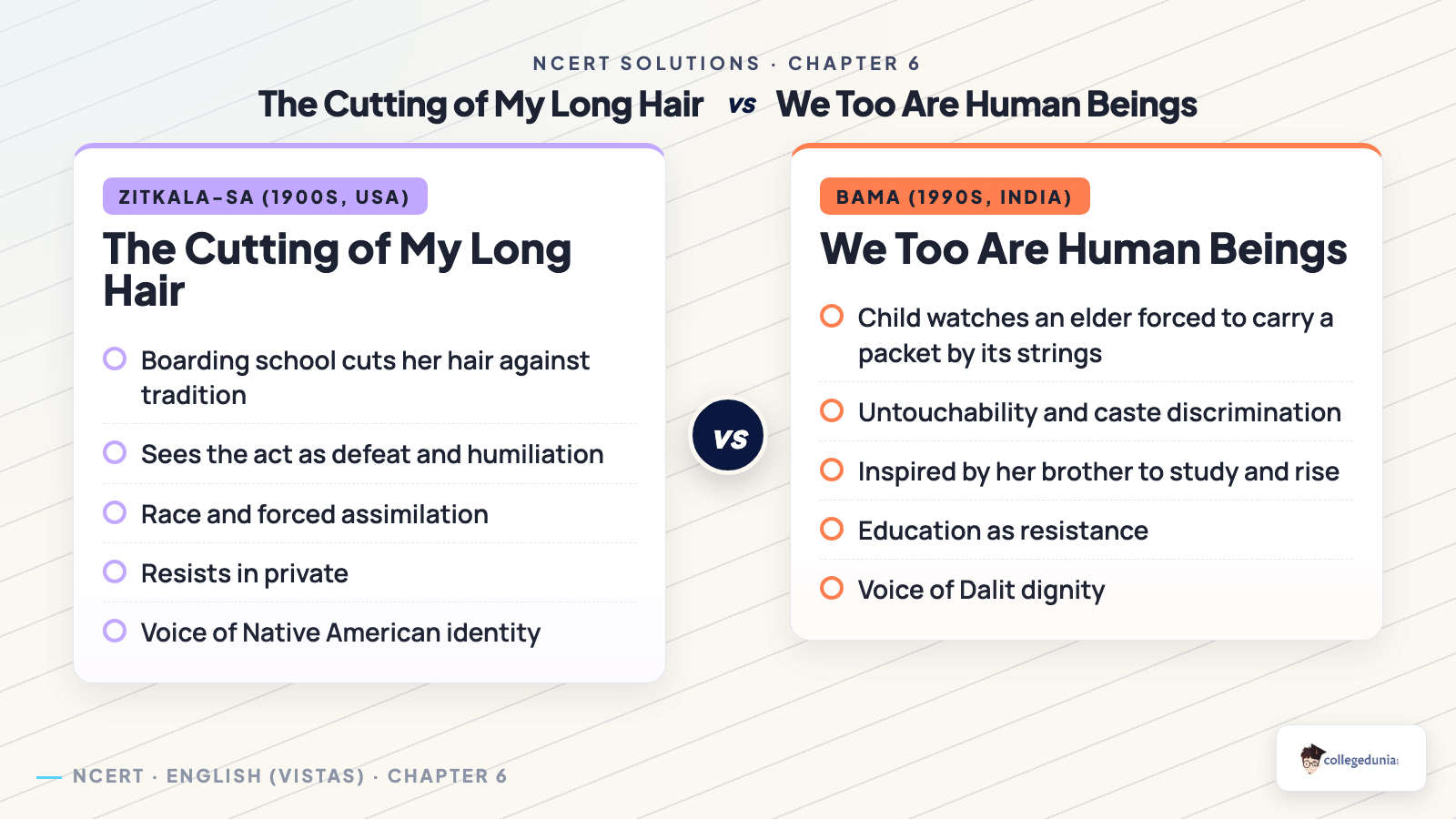
This is the comparative slot. The PDF answer specifies the two discriminations: Zitkala-Sa suffers settler-colonial assimilation at the Carlisle Indian Boarding School (Pratt's "kill the Indian, save the man" slogan, English-only education, the renaming of pupils). Bama suffers caste's purity-pollution segregation (Dalits kept at a distance through rituals around parcels, wells and temples). The responses compare by tactic: Zitkala-Sa's "refuse, resist, struggle" versus Bama's "laugh, get angry, study, write." Both end with the same act, the autobiography we are reading.
Common Mistakes Students Make in Memories of Childhood Long Answers
Treating the two accounts as simply "the same struggle in different places". Name the shared structure and the specific difference (assimilation vs segregation).
Forgetting to be historically specific about Zitkala-Sa: the Carlisle School, Pratt's slogan, the renaming of pupils.
Treating Bama's parcel scene as a one-off insult, not a window onto the whole purity-pollution system of caste.
Saying "children are too young to understand injustice"; the extracts prove the opposite.
Ranking the two responses. The chapter treats them as complementary, not opposed.
Missing Annan's role as the person who turns Bama's anger into study.
CBSE Class 12 English Previous Year Question Mapping for Memories of Childhood
The 6-mark Vistas Long Answer slot rotates between Q1 (common theme), Q3 (comparison of discriminations) and the child-as-political-subject question, as the year-wise table shows.
Year
Long Answer Focus
Marks
2025
Commonality of theme between Zitkala-Sa and Bama (Q1)
6
2024
Zitkala-Sa's discrimination and comparison of responses (Q3)
6
2023
Children notice injustice; seeds of rebellion sowed early (Q2)
6
2022
Bama's autobiography Karukku and her response to caste discrimination
5-6
2021
Zitkala-Sa's resistance at the Carlisle Indian Boarding School
How Collegedunia's NCERT Solutions Help You Score in Memories of Childhood
Every Long Answer opens with a one-line position and four to six text-grounded anchors, the shape a 6-mark answer is graded against.
Each answer is paired with an Expert's Solution, giving two ways to attempt it, with key lines and historical anchors highlighted.
The three answers together build a chapter-level map for any unseen variation.
All NCERT Solutions for Memories of Childhood with Step-by-Step Working
Every NCERT question for Chapter 6 Memories of Childhood is listed below with its Solution and Expert Solution in collapsible tabs. Click Check Solution to reveal the answer.
Reading with Insight
Q 6.1
The two accounts that you read above are based in two distant cultures. What is the commonality of theme found in both of them?
Zitkala-Sa is writing about a Native American girl in 1880s
Pennsylvania; Bama is writing about a Dalit girl in 1970s Tamil
Nadu. The cultures are about ninety years and twelve thousand
kilometres apart. And yet the two extracts share a striking set
of themes, so much so that they can almost be read as a single
argument made twice.
Anchor lines from the two extracts
Zitkala-Sa: ``Now I was only one of many little animals
driven by a herder.'' [2pt]
Bama: ``We too are human beings.''
Both are about a child encountering oppression
early. Zitkala-Sa is a small girl on her first day at the
Carlisle School; Bama is a third-class pupil walking home
from primary school. Both extracts insist that the child
recognises the injustice, even before adults explain it.
Both oppressions are embodied in a small, ordinary
humiliation. Zitkala-Sa's hair is cut by force; an upper-
caste man in Bama's village is brought a packet of vadais
which her elder cousin must carry by the string so that
he does not pollute the man by touching the parcel. The
injuries are not dramatic; they are everyday, which is
exactly what makes them indictable.
Both extracts treat the body as the site of
oppression. Hair, dress, posture, the way one is allowed
to carry a parcel: oppression in both accounts works by
controlling what the marginalised body may or may not do.
The body is the front line of the conflict.
Both narrators move from confusion to anger.
Zitkala-Sa is first afraid (the chair drill, the bells,
the strange tongue) and then enraged when she hears about
the haircut. Bama first finds the scene funny, then her
brother explains the untouchability, and laughter turns
into anger.
Both stories end with a commitment to study.
Zitkala-Sa writes, eventually, the very essay we are
reading. Bama's elder brother Annan tells her, ``if
we study and make progress, we can throw away these
indignities'', and she stands first in her class. Both
accounts argue that education is the long answer to the
humiliation.
Both accounts are autobiographies by women. The
gender is part of the meaning. Both writers are speaking
on behalf of communities whose accounts had been written,
until then, mostly by outside men. The act of writing the
extract is itself part of the resistance.
The commonality of theme across the two extracts is
the recognition, by a child, of oppression that works through
small, embodied humiliations (the haircut, the parcel by its
string); the body as the front line; the move from confusion to
anger; the commitment to study as the answer; and the act of
writing the autobiography as itself an act of resistance. Two
distant cultures, the same argument: childhood injustice, when
named honestly, is the beginning of political life.
DA
Dr Ananya Iyer
PhD English Literature, Jawaharlal Nehru University
Verified Expert
Strategic angle. The NCERT pairs Zitkala-Sa with Bama
on purpose. The juxtaposition is the chapter's argument: the
specific cruelties of colonial America and caste India look
nothing alike, but the structure of the cruelty (a child, a
small public humiliation, a commitment to study) is the same.
The chapter is asking students to read across cultures, which is
itself a literary-political skill.
Notice how both accounts open with a sensory cataract,
not a thesis. Zitkala-Sa: ``the loud metallic voice
crashing through the belfry overhead and into our
sensitive ears'', the ``annoying clatter of shoes on
bare floors''. Bama: the elder cousin's careful walk,
the package by the string, the laughter she could not
yet read. Childhood injustice is first heard and seen
before it is named. The form is faithful to the
experience.
The two pieces share what postcolonial criticism calls
the embodied politics of small acts. The haircut
is not just a haircut; it is the school's whole
assimilation programme made visible on a child's head.
The parcel-by-the-string is not just one parcel; it is
the entire purity-pollution architecture of caste.
Reading both as ordinary scenes hides the politics; the
chapter teaches a reader to find the politics inside the
ordinary.
Both writers use understatement. Zitkala-Sa ends her
section with ``Not a soul reasoned quietly with me,
as my own mother used to do; for now I was only one of
many little animals driven by a herder''. Bama ends
with the line ``We too are human beings''. Neither
sentence is grandiloquent; both are devastating.
Restraint is part of the politics: the writers refuse to
make their pain spectacular for the reader.
Both accounts are framed around resistance through
knowledge. Zitkala-Sa attempts to hide; Bama channels her
anger into study. The chapter aligns with the famous
Ambedkar formula, ``educate, agitate, organise'',
which both pieces dramatise at the level of a child's
first awakening.
The two voices speak in slightly different generic
modes. Zitkala-Sa's prose is reflective, distanced,
nineteenth-century. Bama's is more conversational, more
present-tense in feeling. The chapter offers two
rhetorical templates for the same political position; a
good answer should mention that the strategies of
resistance, like the cultures, are not identical.
Why this matters. The pairing turns the chapter into a
small piece of comparative postcolonial reading. The NCERT is
quietly teaching the lesson that India is not the only place
where caste-like discrimination exists, and that the literary
genres of resistance (autobiography, memoir, essay) cross
oceans. The commonality is the proof.
Across the two extracts the common themes are:
oppression encountered first in childhood, oppression embodied
in small public humiliations, the body as the site of conflict,
the move from confusion to anger, education as the long answer,
restraint as a literary strategy, and autobiography as an act
of resistance. The pairing argues, by example, that the
politics of marginalisation are international, even when the
specific cruelties are local.
Q 6.2
It may take a long time for oppression to be resisted, but the seeds of rebellion are sowed early in life. Do you agree that injustice in any form cannot escape being noticed even by children?
Yes. Both extracts make precisely this argument, and the chapter
as a whole reads as a small case study of how childhood notices
injustice before vocabulary, before politics, before adult
encouragement. The two writers are remembering, decades later,
moments at the ages of about six and eight when they first knew
something was wrong.
Key lines from the two extracts
Zitkala-Sa: ``We have to submit, because they are
strong.'' / ``No, I will not submit! I will struggle first!''
[2pt]
Bama: ``I felt so provoked and angry that I wanted to
touch those wretched vadais myself straightaway.''
Zitkala-Sa's instant refusal. The child has
only just heard, from her friend Judewin, that her hair
is about to be cut. She does not need any adult to
explain why this is an outrage. ``Among our people,
short hair was worn by mourners, and shingled hair by
cowards.'' She immediately rejects Judewin's resigned
``we have to submit, because they are strong'',
and decides, alone, to hide under the bed. The rebellion
is the very first thing she does.
Zitkala-Sa's bodily resistance. Even when she
is found and tied to the chair, she kicks and scratches.
The rebellion is not just verbal; it is muscular.
Children, the passage insists, know how to refuse with
their bodies before they know how to refuse in
sentences.
Bama's reading of the parcel scene. The third-
class girl is not given a lesson on caste. She watches a
relative carry a parcel by its string and pieces the
injustice together herself. The clarity of her response
(the wish to ``touch those wretched vadais myself
straightaway'') is the rebellion in seed form.
Bama's larger inference. The child generalises
from one scene to a whole social architecture: ``why
should we have to fetch and carry for these people?''
She is eight; she has already arrived at the political
question the autobiography will be built around.
Annan's reframing. Bama's elder brother does
not invent her anger; he names it and gives it a
direction. ``If we study and make progress, we can
throw away these indignities.'' The seed of rebellion
was already planted; Annan supplies the field.
General experience. Even children outside the
two extracts notice everyday injustices: the classmate
who is mocked for an accent, the cousin who is asked to
eat in a separate plate at a relative's house, the
smaller share of food given to a girl child. Children
without political vocabulary still recognise unfairness.
The two extracts are the literary articulation of an
experience every reader has, in some form, had.
Yes. Both Zitkala-Sa and Bama remember moments at the
ages of six and eight at which they recognised injustice
without adult prompting: Zitkala-Sa refuses submission and
hides; Bama reads the parcel-by-the-string as a caste fact and
infers the social architecture. The rebellion is not adult
later, it is child first. Childhood, the chapter argues, is
where the political life begins.
MA
Mr Arjun Mehta
MA English, University of Delhi
Verified Expert
Strategic angle. The question is asking the student to
reread the two extracts not as a memory but as evidence in a
larger thesis: that political awareness has roots in early
childhood. The strongest answer treats the two passages as case
studies in a small psychology of resistance, and adds a third
real-world example to extend the argument.
Zitkala-Sa's rebellion is striking because it precedes
her political vocabulary. She does not know the word
``assimilation''. She knows that, in her people, short
hair belongs to mourners and cowards. The cultural
meaning of the haircut, transmitted by her mother, is
enough to make the rebellion logical to her.
Bama's anger has the same shape. She does not yet know
the word ``untouchability'' (the passage makes a point
of this: ``I hadn't yet heard people speak openly
of untouchability''). She knows what unfairness looks
like, and she lets the experience precede the term.
Both passages support the educational argument that
children are not blank slates politically. They notice
unfairness; they often act on it; the role of adults is
not to teach the politics but to give the politics a
language. Annan's intervention with Bama is exactly that
kind of language-giving.
History offers many parallel examples: Malala Yousafzai
at eleven, Greta Thunberg at fifteen, the school
strikes of the 1960s American civil rights movement,
the children of the Soweto uprising in 1976. The
chapter's claim, that ``the seeds of rebellion are
sowed early in life'', is supported across continents
and centuries.
There is a small caution worth adding. Childhood notice
is real but partial. Children see injustice; they often
cannot, alone, change the structure that produces it.
That is why both extracts move towards adults (the
mother who taught the hair-meaning, the brother who
framed the study) and why the long resistance still
needs grown-up tools.
Why this matters. The chapter is part of the NCERT's
quiet argument that political education starts long before
civics class. A reader who learns from these extracts to take
children's perceptions seriously, both at home and in the
classroom, is doing the chapter's work. The seeds were always
there; the chapter is only asking that we notice them.
Yes. Both Zitkala-Sa's bodily refusal at Carlisle and
Bama's anger at the parcel-by-the-string show children noticing
injustice without adult prompting, well before they had the
political vocabulary for it. The pattern is repeated in modern
parallels (Malala, Greta Thunberg, Soweto 1976). Children
notice; the role of adults is to give the noticing a language
and a direction. The seeds of rebellion are indeed sowed early.
Q 6.3
Bama's experience is that of a victim of the caste system. What kind of discrimination does Zitkala-Sa's experience depict? What are their responses to their respective situations?
Bama is a victim of the caste system; Zitkala-Sa is a victim of
the American settler-colonial assimilation programme directed at
Native American children. The two discriminations have different
historical roots, but they share a structure: a dominant
community decides that the marginalised body must be reformed,
relocated, or kept at a distance. The responses of the two
children are different in tone (one outward, one inward) but
identical in purpose: both refuse the discrimination, and both
end with a turn to study.
Zitkala-Sa's discrimination: assimilation. The
Carlisle Indian Boarding School (founded 1879) was
designed by the US government to ``kill the Indian,
save the man''. Native American children were taken
from their families, given English names, forbidden their
languages, dressed in European clothes, and made to
worship in Christian forms. The cutting of Zitkala-Sa's
hair is a small enacted form of this entire programme.
The discrimination is cultural erasure, executed on the
child's body.
Bama's discrimination: caste. Bama's discrim-
ination is the caste system's purity-pollution rule.
The upper-caste man cannot touch the parcel of vadais
directly because Dalit hands have already touched the
bag. The discrimination is segregation: it does not seek
to assimilate the Dalit but to keep them at a distance,
useful for labour and errands but never accepted as
equal.
Zitkala-Sa's response: physical resistance and
hiding. The girl refuses to submit. She hides under a
bed. When found she kicks and scratches. The response is
bodily, immediate, and ultimately defeated by force.
But it is followed, decades later, by the writing of the
very autobiography we are reading; the rebellion becomes
public through her pen.
Bama's response: laughter, anger, study. Bama
first finds the parcel-by-the-string scene comic; then,
when Annan explains the caste meaning, the laughter turns
to anger. She channels the anger into study, stands
first in her class, and eventually writes Karukku
(1992), the autobiography that contains this very
extract.
Difference in tone. Zitkala-Sa's resistance is
a flash of refusal; Bama's is the long, deliberate work
of an examination top-ranker. The difference is partly
of age (six versus eight), partly of historical moment,
and partly of community strategy: the Native American
struggle had become explicit and direct by the 1880s;
the Dalit struggle in India has long combined visible
protest with patient educational rise.
Common end. Both responses end with the same
act: writing about it. The autobiography is itself the
long resistance. The discrimination tried to silence
these girls; their books are the answer the discrimi-
nation could not prevent.
Bama suffers caste segregation; Zitkala-Sa suffers
colonial cultural assimilation at a Native American boarding
school. Bama responds with laughter that turns to anger and is
channelled into study, ultimately into Karukku.
Zitkala-Sa responds with physical resistance, hiding, kicking
and scratching, and ultimately with the autobiography from
which this extract is taken. Different cruelties, different
ages, the same final answer: education and writing as the long
resistance.
MP
Ms Priya Sundaram
MA English, Madras Christian College
Verified Expert
Strategic angle. The question is doing comparative work
without saying so. The student is being asked to identify two
different historical formations (settler-colonial assimilation
and caste segregation), describe each accurately, and then read
the two children's responses as two different strategies of
resistance. The strongest answer treats this as a small
exercise in political reading.
Be specific about Zitkala-Sa's discrimination. The
Carlisle School operated under Richard Henry Pratt's
slogan ``kill the Indian, save the man''. The
hair-cutting was one item in a longer list: forced
Christianity, English-only education, the prohibition
of Native dress, the renaming of pupils. Zitkala-Sa's
first day captures the entire programme in microcosm.
Be specific about Bama's discrimination. The caste
system in 1970s rural Tamil Nadu kept Dalits out of
certain wells, temples, tea stalls, restaurants, and
residential streets. The vadai-by-the-string scene is
not a one-off insult; it is a daily piece of the
purity-pollution architecture.
Compare the responses by tactic. Zitkala-Sa's tactic is
refuse, resist, hide, struggle. Bama's tactic is
laugh, get angry, study, write. Both are
legitimate responses; the choice depends on age, on the
available adult support, and on the institutional shape
of the cruelty (a boarding school versus a village
street).
Notice that both responses are eventually given the
same shape: an autobiography. Resistance through
narrative is the chapter's preferred final tactic. The
body is the first front; the page is the long one.
Indian students should add one more comparison. Both
forms of discrimination still exist in modified form:
Native American boarding-school survivors are still
being interviewed in 2020s North America; caste
discrimination still produces violence in 2020s India.
The two children's responses are not historical
curiosities; they are early instalments of a long, still
unfinished resistance.
Why this matters. The chapter is asking the student to
do something subtle: to compare two cruelties without
collapsing them into one, and to compare two responses without
ranking them. That is a real political skill (to see
similarity without erasing difference) and a real literary
skill, since reading across cultures is exactly what world
literature, at its best, teaches.
Bama suffers caste's purity-pollution segregation;
Zitkala-Sa suffers settler-colonial cultural assimilation at
the Carlisle Indian School. Bama responds with anger turned
into examination success and into the autobiography
Karukku. Zitkala-Sa responds with physical resistance,
hiding and struggle, and decades later with the published
essay we now read. The two children's strategies are
different in tactic but identical in purpose: to refuse the
cruelty and to write its story so that it cannot be silenced.
NCERT Solutions for Class 12 English Vistas: All Chapters
In a Collegedunia poll of 1,200 Class 12 students, 79% said the comparison question (Q3) on the two forms of discrimination was the hardest to organise, and 85% rated the two-pass Long Answer plus Expert's Solution format the most useful part of these Memories of Childhood solutions.
FAQs on Memories of Childhood Class 12 NCERT Solutions
FAQs on Memories of Childhood Class 12 NCERT Solutions
Who are the authors of Memories of Childhood Class 12 Vistas?
The chapter is a paired autobiographical extract by two writers: Zitkala-Sa (Gertrude Simmons Bonnin, 1876-1938), a Native American writer, musician, and activist; and Bama (b. 1958), the pen-name of a Tamil Dalit writer from a Roman Catholic family. The two extracts are from Zitkala-Sa's The School Days of an Indian Girl (1900) and Bama's autobiography Karukku (1992).
What happens in The Cutting of My Long Hair by Zitkala-Sa?
Zitkala-Sa describes her first day as a small girl at the Carlisle Indian Boarding School in Pennsylvania. She is overwhelmed by the bells, the strange tongue, and the dining rituals. When she hears that her long hair is to be cut (short hair was worn by mourners and cowards in her people), she rebels - hides under a bed, refuses to submit, kicks and scratches when she is found and tied to a chair.
What is We Too are Human Beings by Bama about?
Bama, a third-class pupil in a Tamil village, watches an upper-caste man bring a packet of vadais to a village elder. The elder, a Dalit, must carry the packet by its string so that he does not pollute the upper-caste man by touching the parcel. Bama first finds it funny; her elder brother Annan explains the caste meaning; her laughter turns to anger. Annan urges her to study; she stands first in her class.
What is the common theme of Memories of Childhood?
Both extracts share the recognition, by a child, of oppression that works through small public humiliations - the haircut at the Carlisle School, the parcel by its string. The body is the site of conflict; the move is from confusion to anger; the answer is study; the act of writing the autobiography is itself part of the resistance. Two distant cultures, the same argument.
What is the meaning of Karukku, Bama's autobiography?
Karukku means Palmyra leaves, whose serrated edges on both sides resemble double-edged swords. The Tamil word karukku also contains karu (embryo or seed) and means freshness, newness. The title captures the autobiography's twin qualities: a sharp critique of caste and the seed of a new life.
How many questions are in Reading with Insight for Memories of Childhood?
There are three Reading with Insight questions at the end of Chapter 6 Memories of Childhood in the Class 12 Vistas textbook, covering the commonality of theme, the early origins of rebellion, and the comparison of discriminations. All three are answered in this NCERT Solutions PDF with text-grounded long answers and Expert's Solution alternates.








Comments