Class 12 Physics Chapter 1 Electric Charges and Fields opens the electrostatics block. The chapter introduces Coulomb's law, the electric field, the electric dipole, and Gauss's law. It carries 6 marks in CBSE and 4 to 5 percent in JEE Main. This page hosts the class 12 physics chapter 1 notes PDF and the NCERT chapter 1 physics class 12 notes reference.
  • CBSE Boards: 6 marks, usually one 5-mark Gauss's-law derivation plus one 1-mark on Coulomb's law.
  • JEE Main: 4 to 5 percent, two questions per shift on Coulomb's law, dipole, and Gauss applications.
  • NEET: 1 to 2 questions every year on point-charge field and dipole concepts.
Chapter 1 Electric Charges and Fields Notes PDF
5 Big Concepts | 14 Formulas | 7 Derivations · Class 12 Physics Chapter 1, 2026-27 NCERT

Each entry in these chapter 1 physics class 12 notes is curated by Collegedunia subject experts, mapped to the 2026-27 NCERT, and refined against the last five years of CBSE Board, JEE Main, and NEET papers.

You can find the complete electric charges and fields class 12 notes pdf, including Coulomb's law, electric field, electric dipole, Gauss's law applications (infinite wire, plane sheet, spherical shell), and continuous charge distributions, in the article below. The class 12 ch 1 physics notes also cover the JEE Main extensions on dipole torque and charged-ring axial field.

Also Check:

Electric Charges and Fields Notes - Class 12 Physics

Why Physics Class 12 Chapter 1 Is the Foundation of All Electrostatics

  • Fundamental concepts reused across all four electrostatics chapters.
  • Skipping this chapter makes every later chapter harder than necessary.
  • Coverage: all 5 sub-topics + JEE Main extensions (force on dipole in non-uniform field, electric quadrupole, charged ring axis).

Electric Charges and Fields Notes Video Walkthrough

Source: Magnet Brains on YouTube

Electric Charges and Fields formula_breakdown — Class 12 Physics

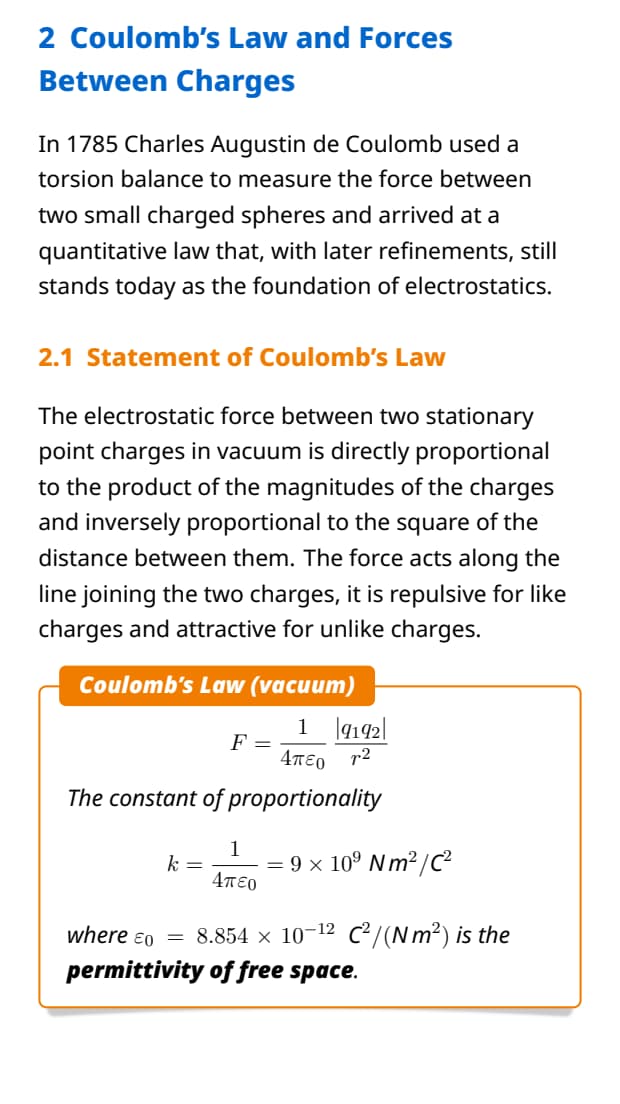
Coulomb's Law — force between two point charges.

Topic-by-Topic Concept Summary for Class 12 Ch 1 Physics

The chapter splits into five sub-topic blocks. The walkthrough below maps each block to its CBSE marking pattern.

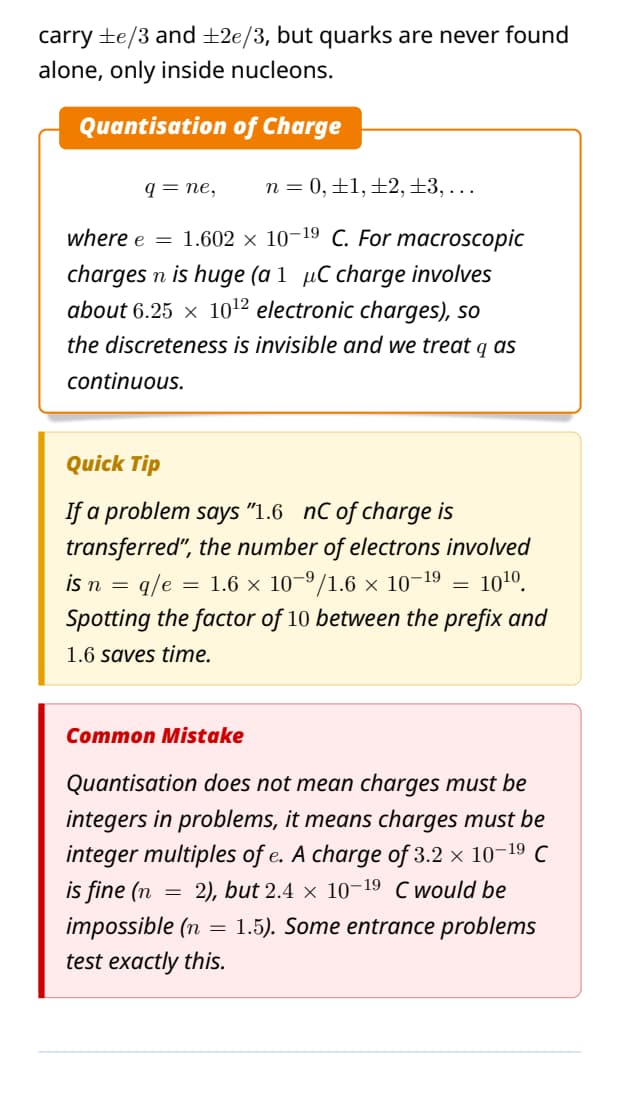
  • Electric charge and its properties: 1-mark MCQ on quantisation (q = n e), conservation of charge, additivity.
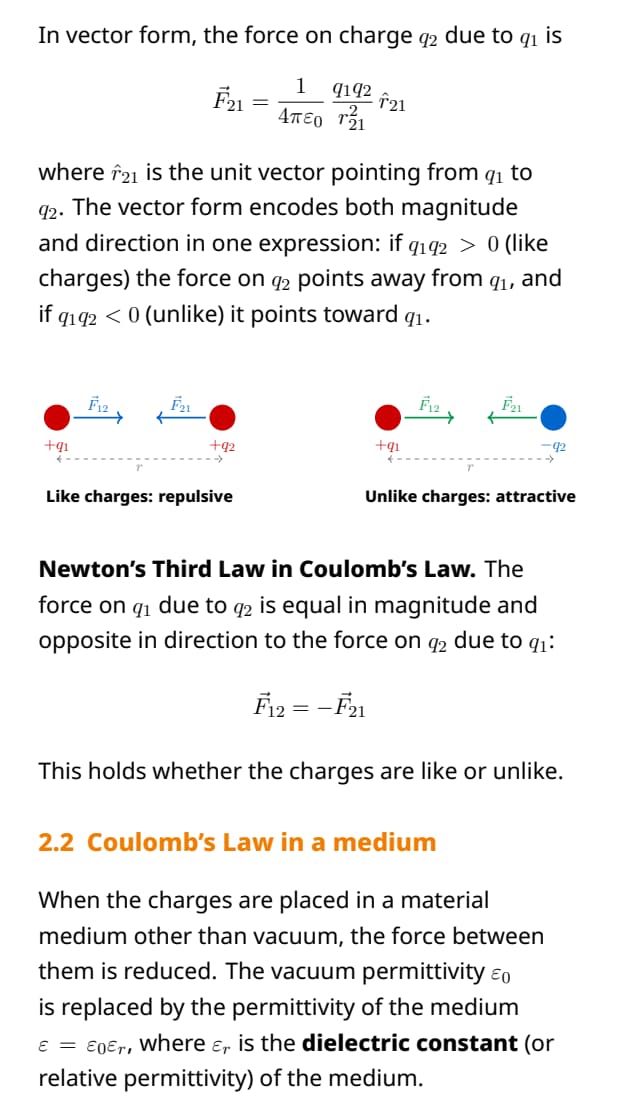
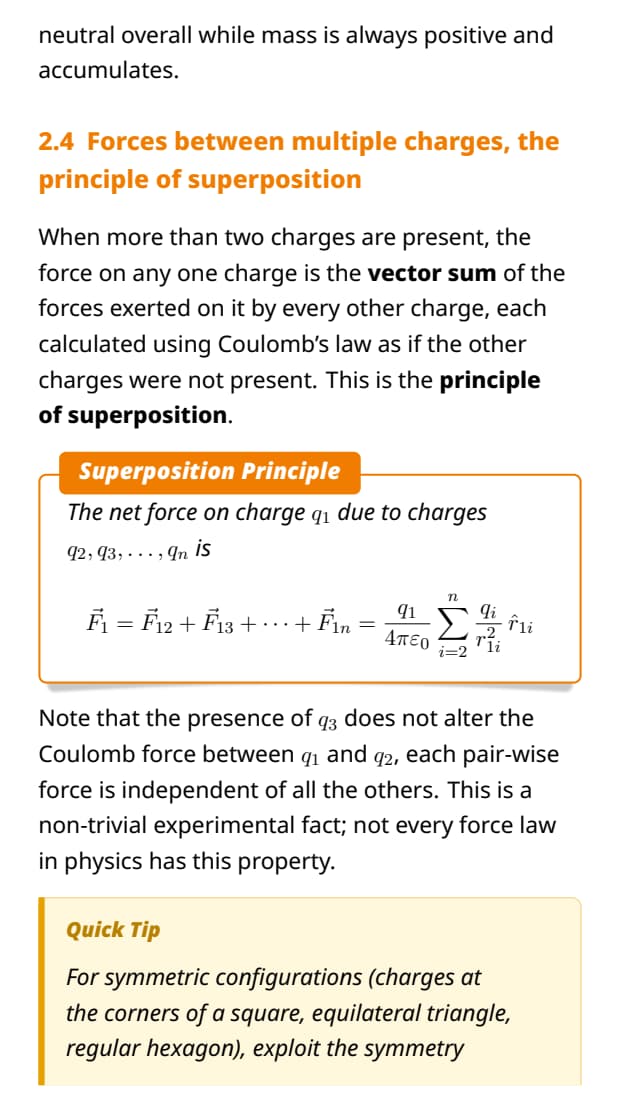
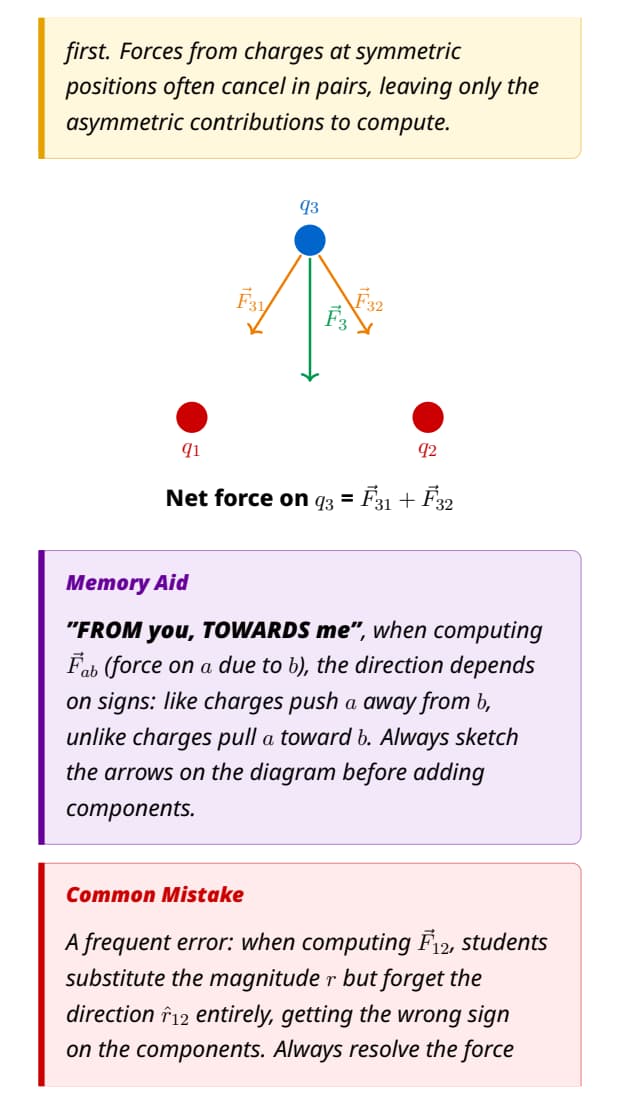
  • Coulomb's law and superposition principle: 3-mark numerical on the vector form F = k q_1 q_2 (r_hat) / r squared, plus superposition for multiple charges.
  • Electric field, field lines, and dipole: 3 to 5-mark derivation block. The electric field of a dipole on its axial and equatorial lines is the most-asked 5-marker in JEE Main from class 12 chapter 1 physics.
  • Electric flux and Gauss's law: 5-mark derivation block. Three classic applications: infinite line charge, infinite plane sheet, uniformly charged spherical shell.
  • Continuous charge distributions: 3-mark conceptual on linear (lambda), surface (sigma), and volume (rho) charge densities.

Coulomb's Law and the Vector Form

Coulomb's law: the electrostatic force between two point charges is proportional to the product of charges and inversely proportional to the square of the distance. Vector form: F_12 = k (q_1 q_2 / r squared) r_hat_12, where r_hat_12 is the unit vector from charge 2 to charge 1, and k = 9 times 10^9 N m squared / C squared in vacuum.

Three facts to remember:

  • Coulomb's law applies to point charges only (or sources much smaller than the separation).
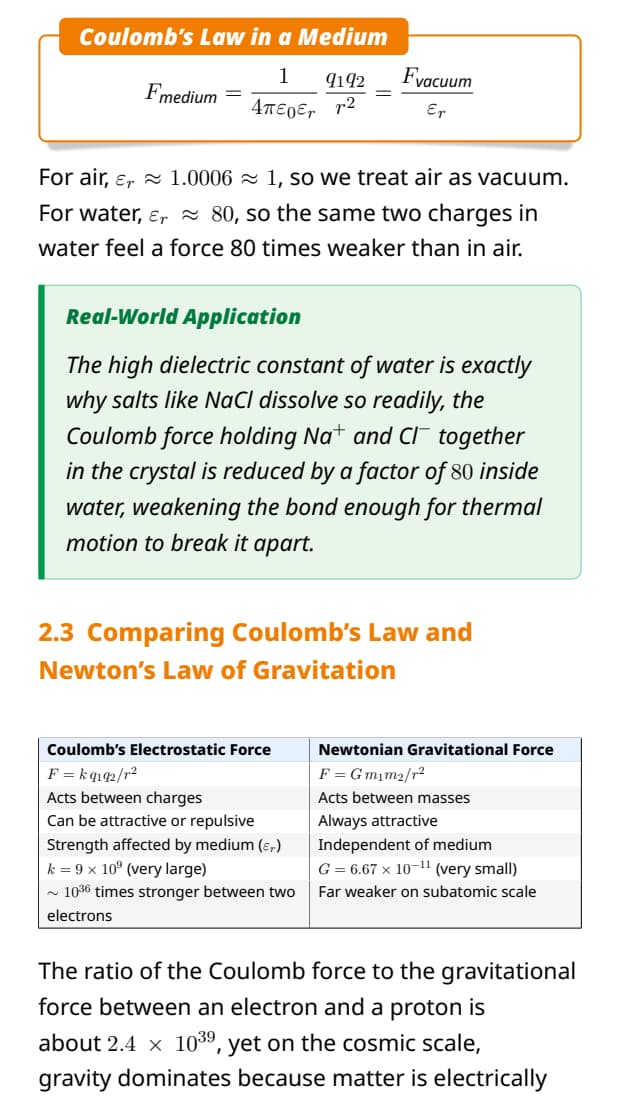
  • Sign convention: like charges repel, unlike charges attract. The sign of the product q_1 q_2 sets the direction.
  • Superposition: total force on a charge is the vector sum of forces from each source charge.

Electric Field of an Electric Dipole: Axial and Equatorial

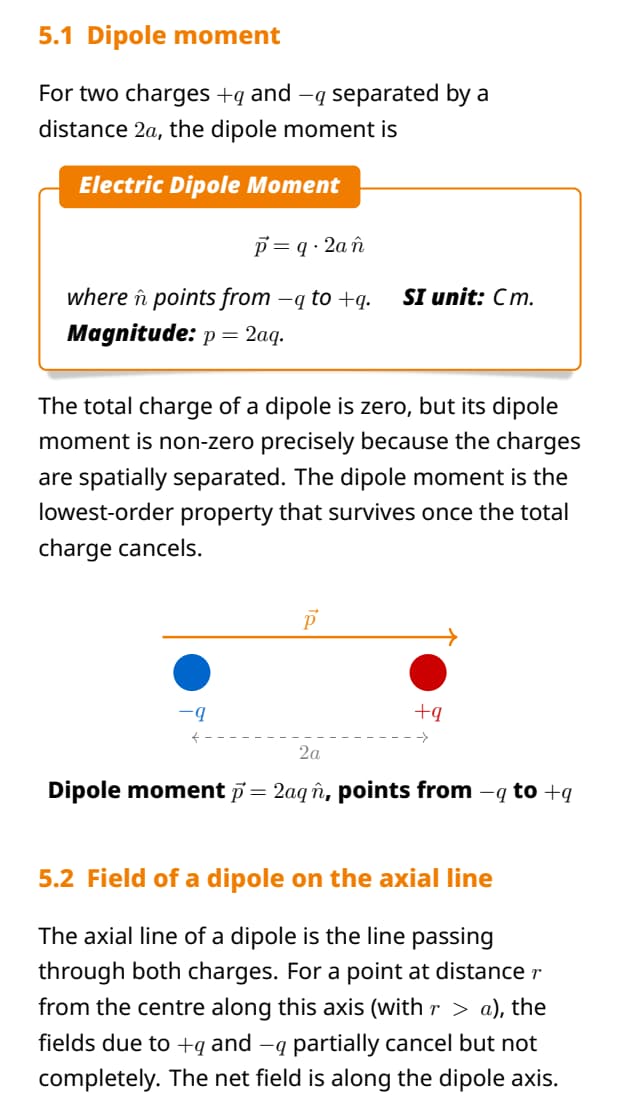
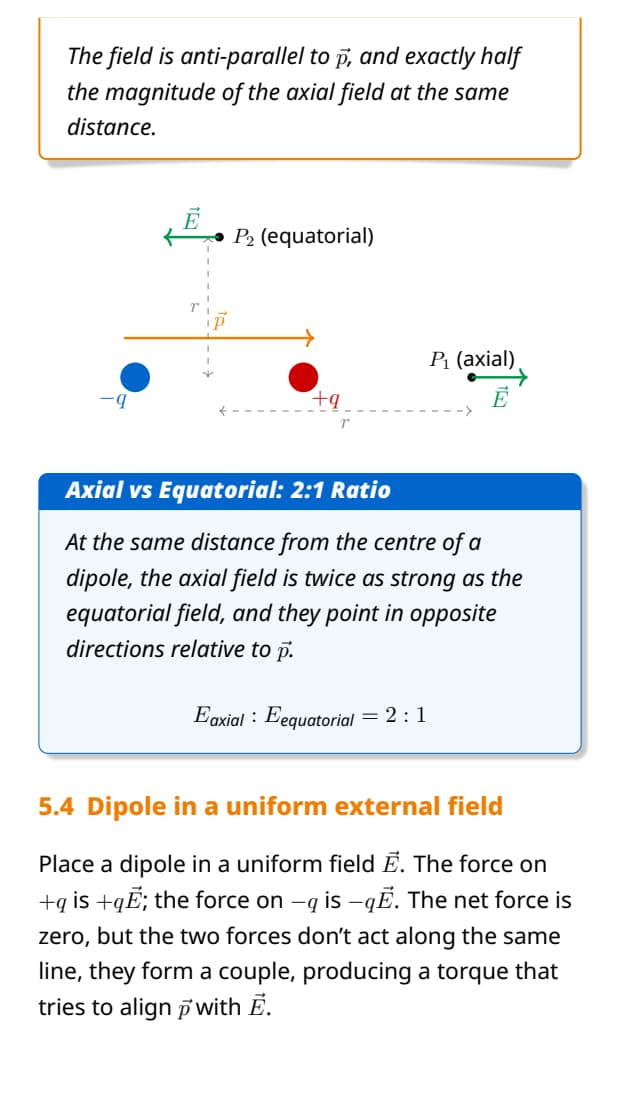
An electric dipole = two equal and opposite charges separated by 2a. Dipole moment p = q (2a), pointing from negative to positive, SI unit C m. The dipole field has two standard cases:

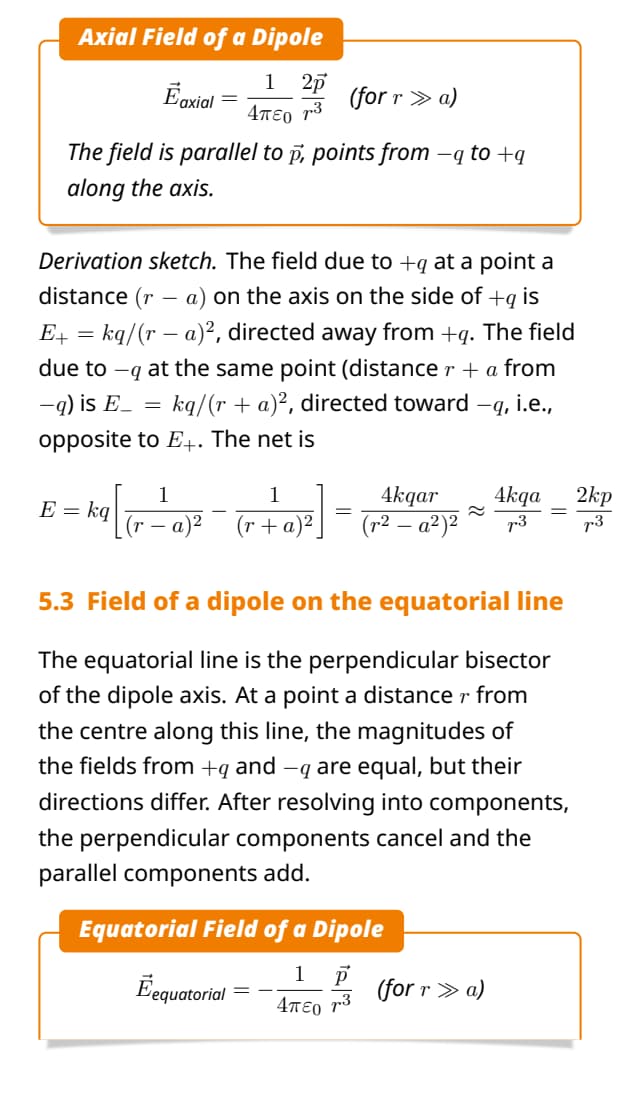
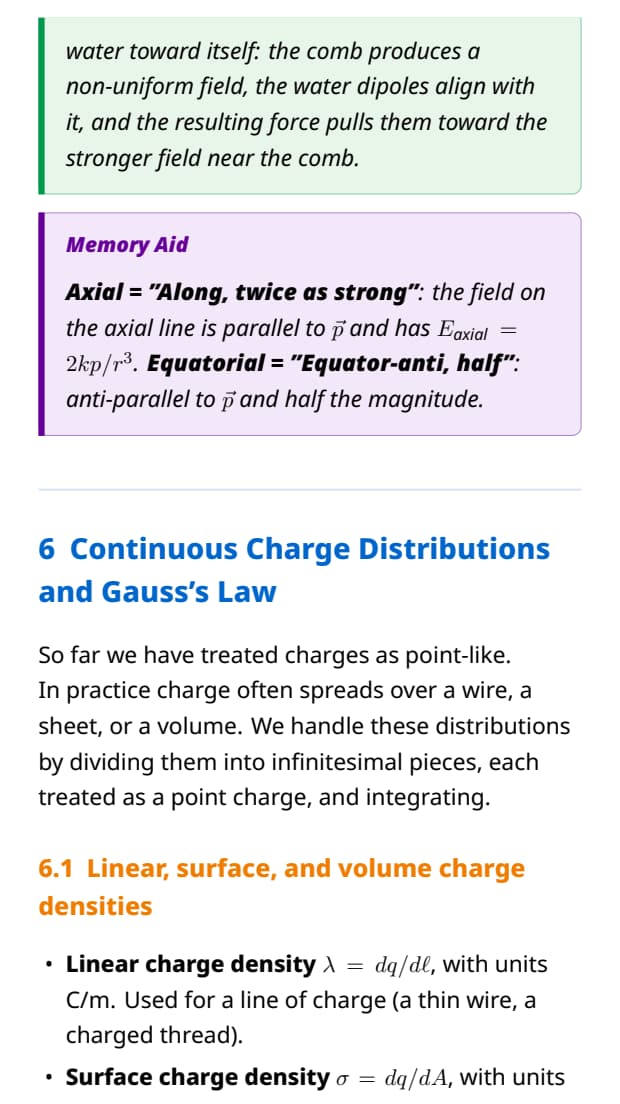
  • Axial line (along the dipole axis): E_axial = 2 k p / r cubed, directed along p (for r >> a).
  • Equatorial line (perpendicular bisector): E_equatorial = k p / r cubed, directed opposite to p (for r >> a).

The ratio E_axial / E_equatorial = 2 at the same distance. The 1/r cubed dependence (versus 1/r squared for a point charge) is the signature of a dipole field: the most-asked 1-mark MCQ from physics class 12 electric charges and fields.

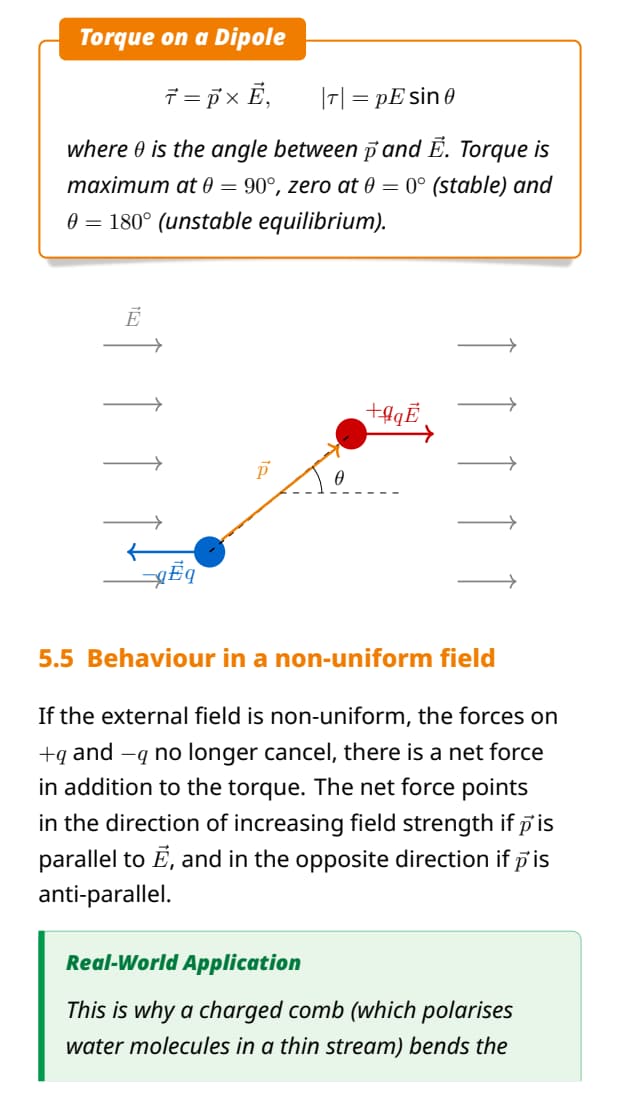
Torque on a dipole in a uniform field: tau = p cross E, magnitude p E sin theta. Potential energy: U = minus p . E = minus p E cos theta.

Gauss's Law and Its Three Standard Applications

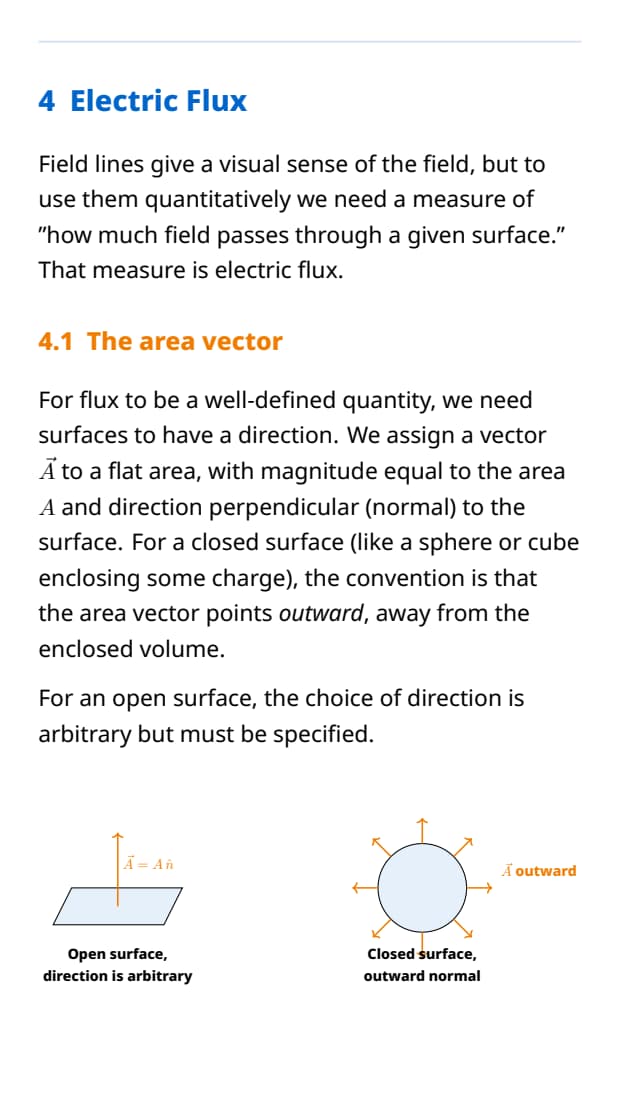
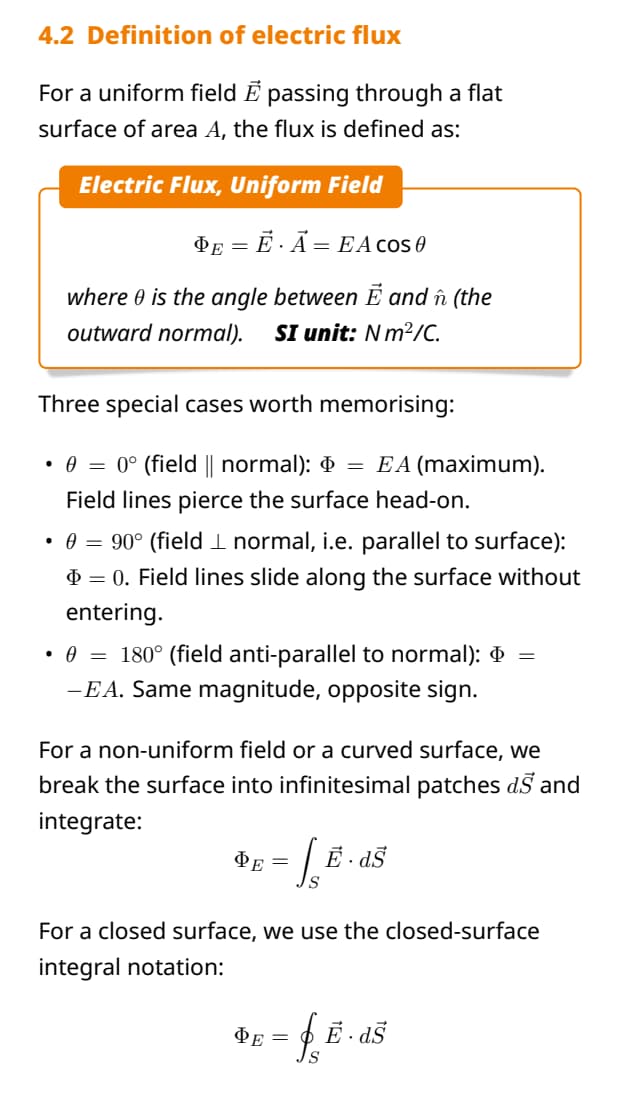
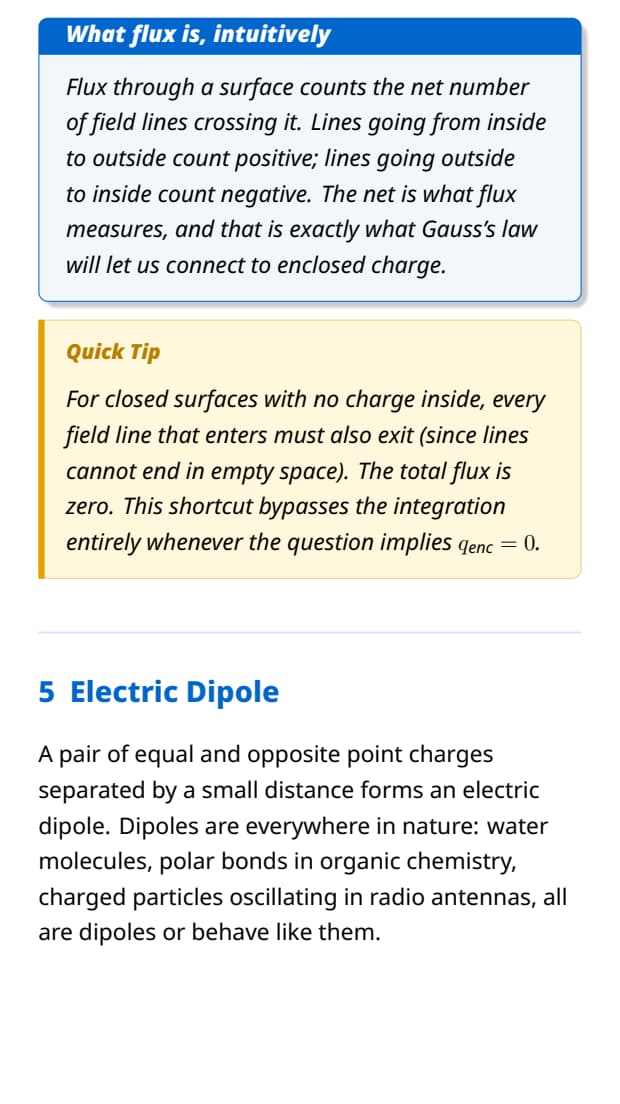
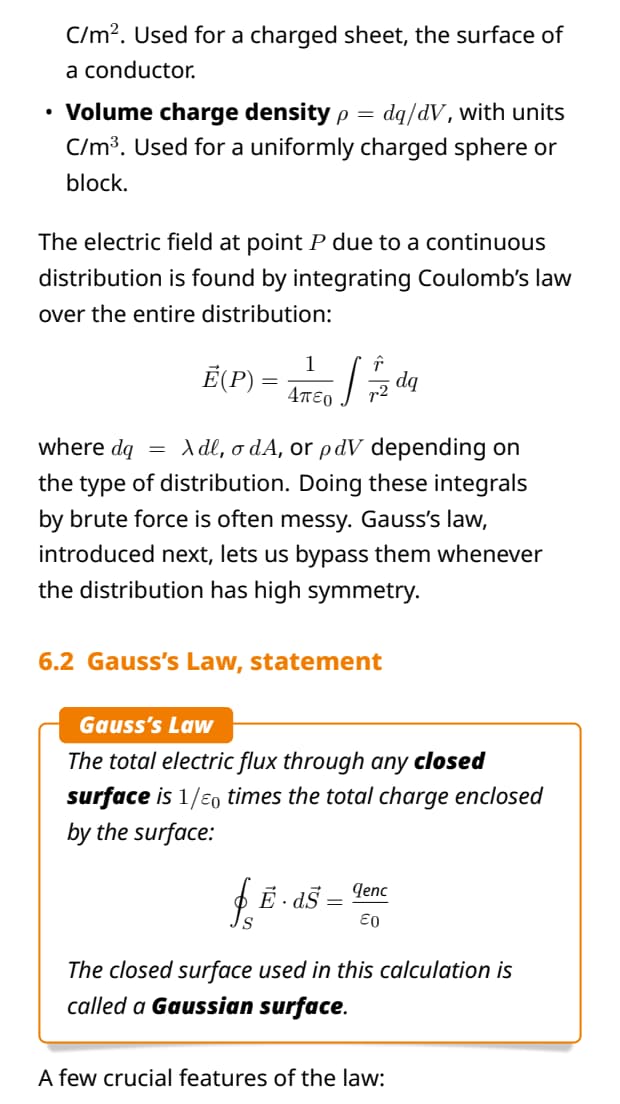
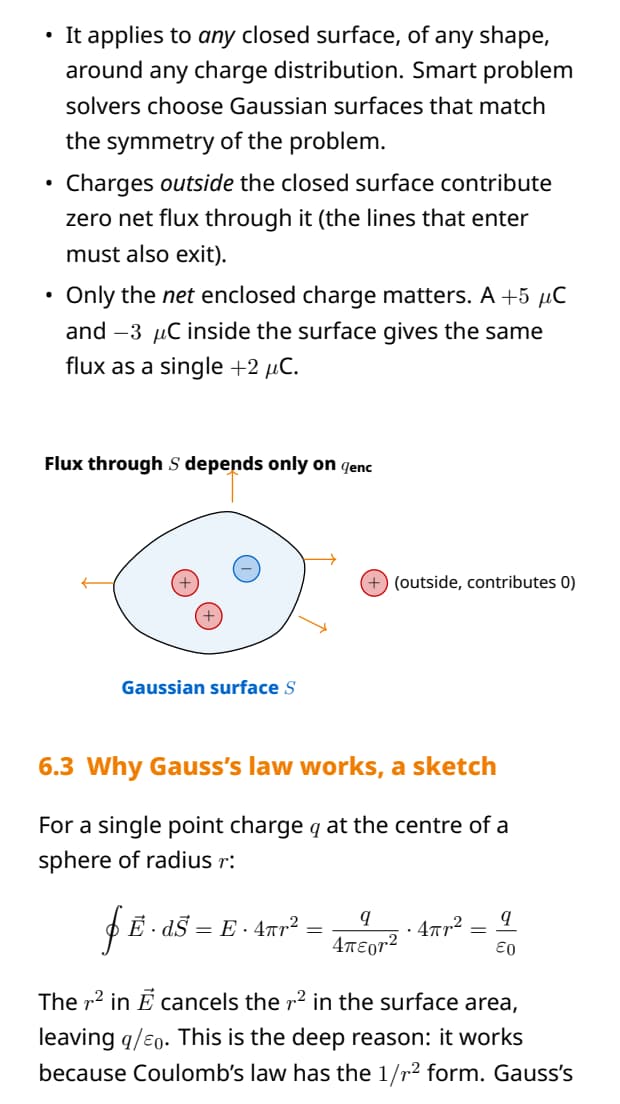
Gauss's law: the total electric flux through any closed surface = enclosed charge / epsilon_0. closed-integral of E . dA = Q_enclosed / epsilon_0. The Gaussian surface is a mathematical construct, chosen to exploit the symmetry of the charge distribution.

Three classic applications:

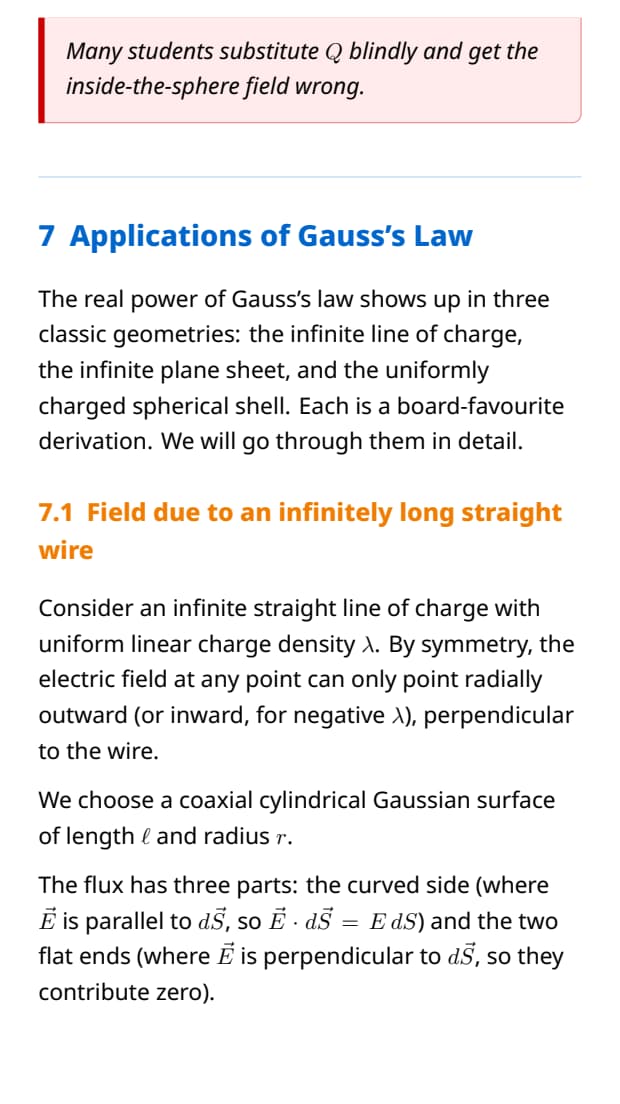
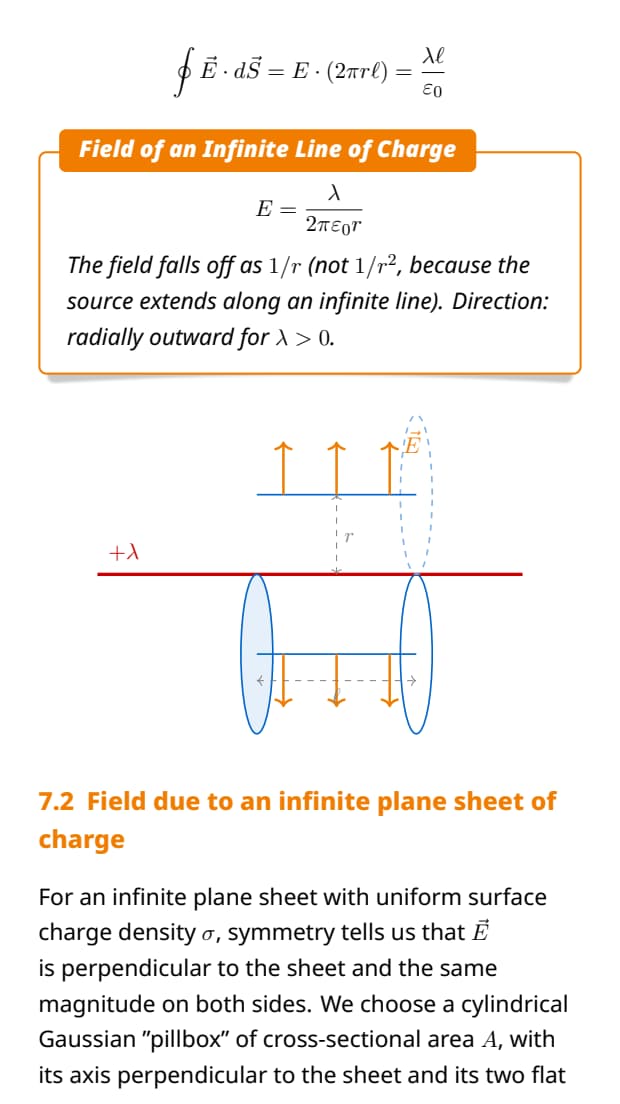
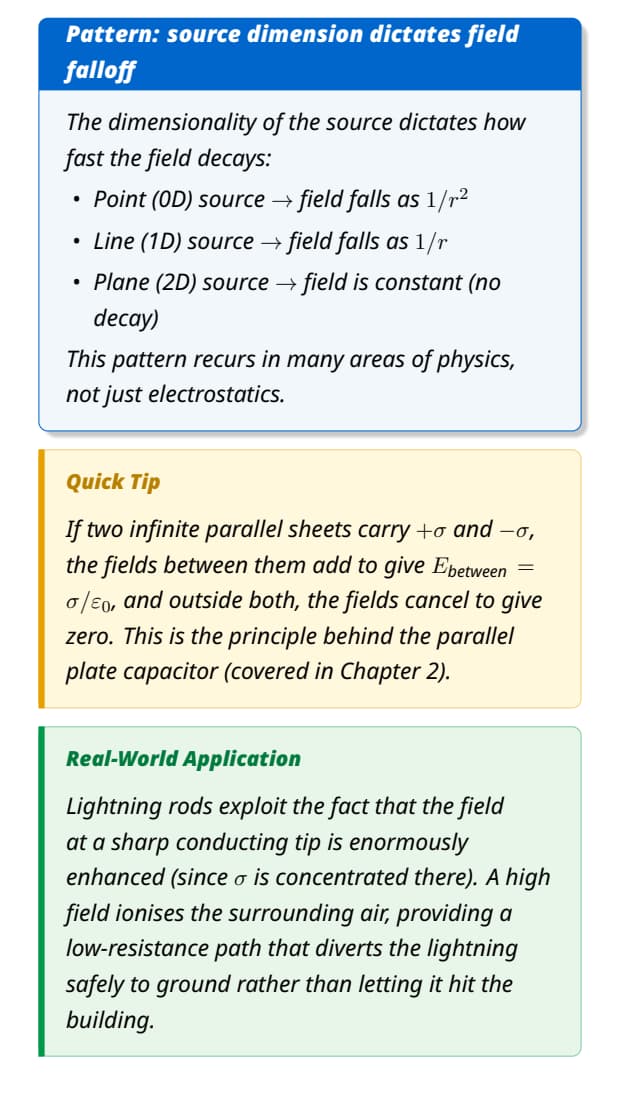
  • Infinite straight line of charge (linear density lambda): Gaussian surface = cylinder. E = lambda / (2 pi epsilon_0 r), directed radially outward.
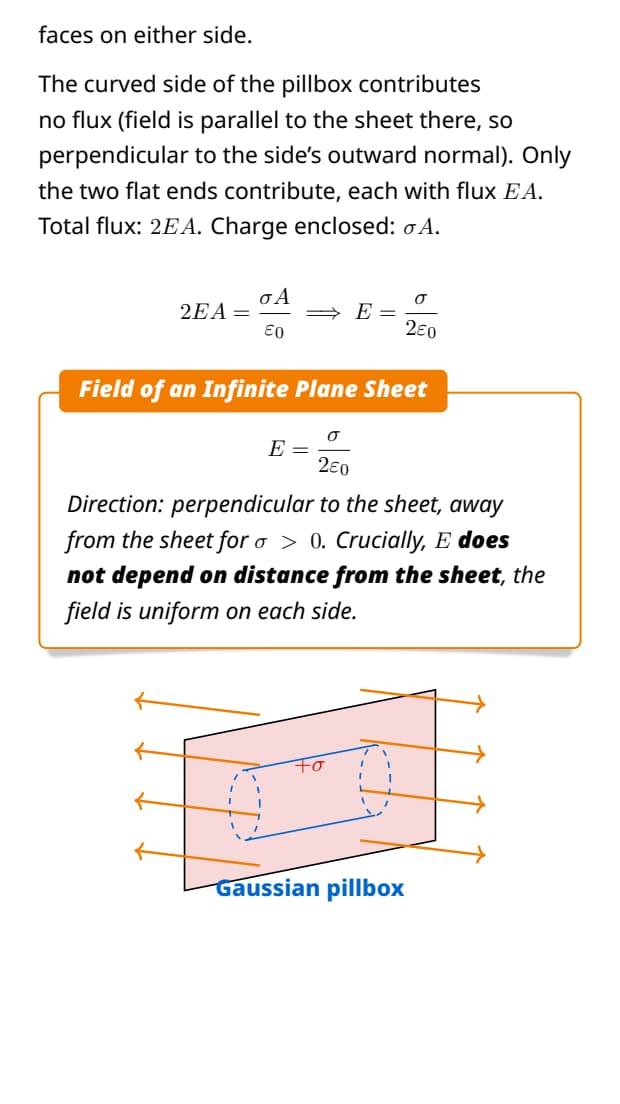
  • Infinite plane sheet (surface density sigma): Gaussian surface = pillbox. E = sigma / (2 epsilon_0), constant and perpendicular. For a conducting sheet: E = sigma / epsilon_0.
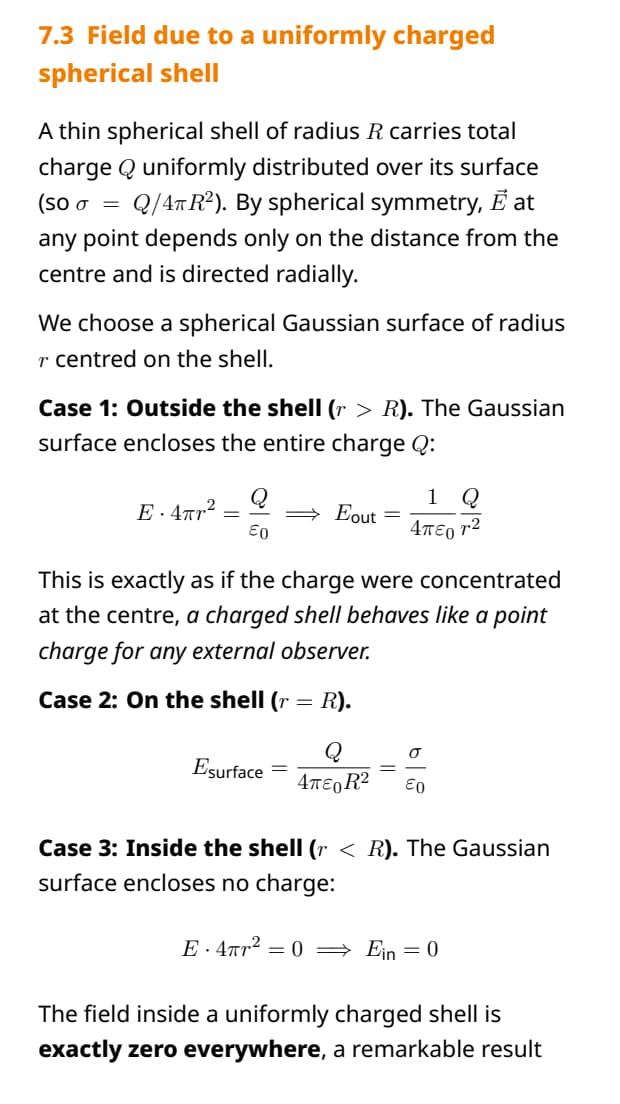
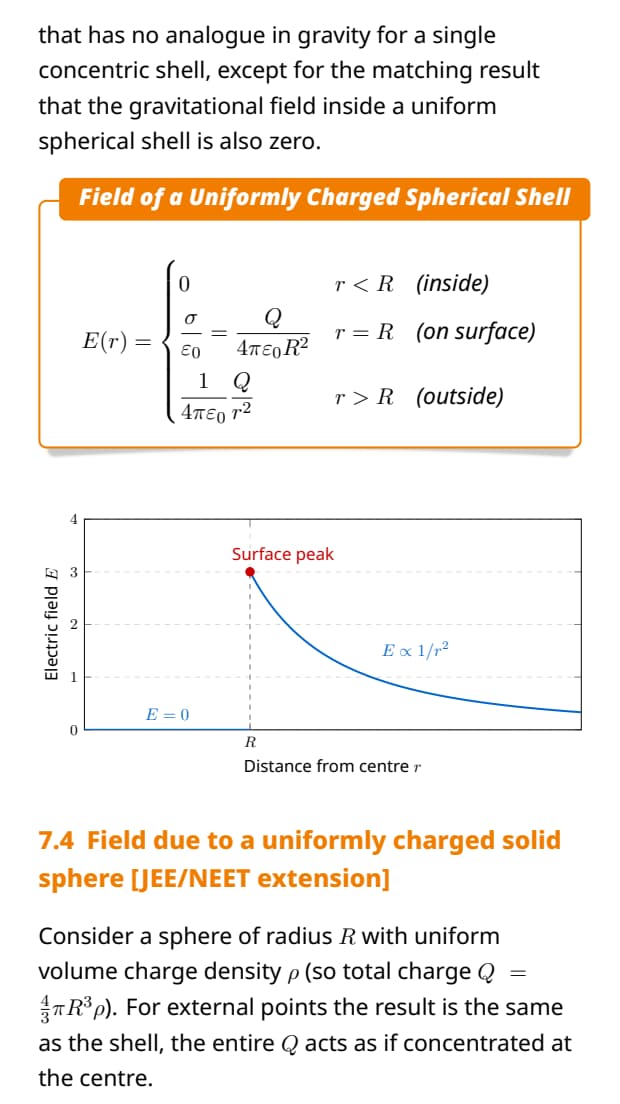
  • Uniformly charged spherical shell: Gaussian surface = concentric sphere. Outside: E = k Q / r squared. Inside: E = 0.

The single most-asked 5-marker from this chapter is one of these three derivations. The physics class 12 chapter 1 pdf and the class 12 physics chapter 1 notes PDF on this page includes the labelled diagram CBSE markers expect.

Electric Field Lines: Five Properties Boards Test

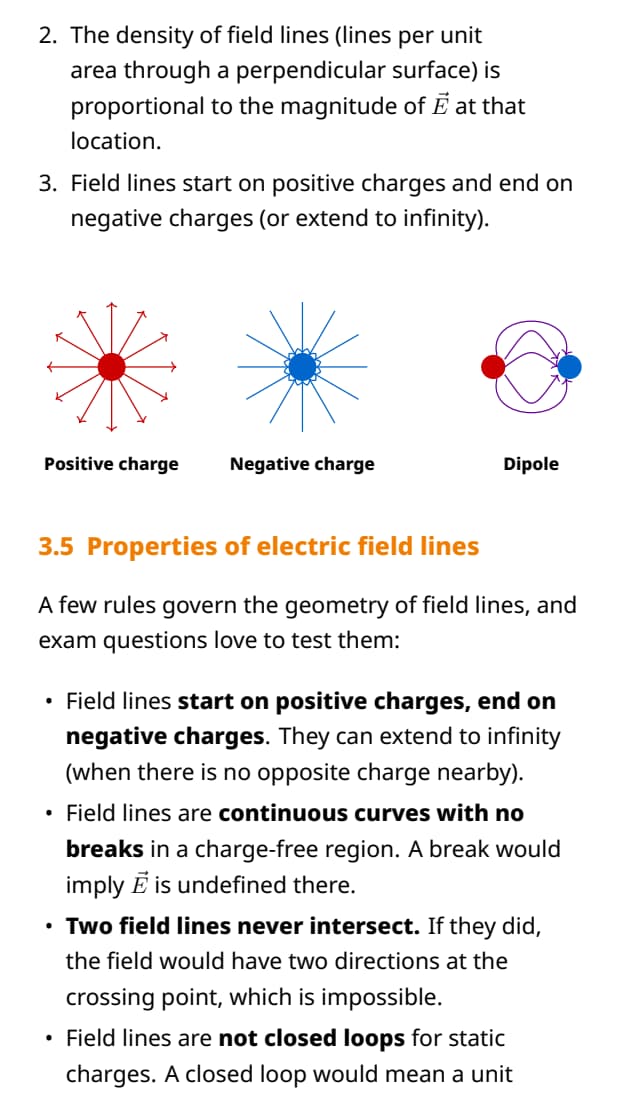
Field lines visualise the electric field direction. Five properties recur in CBSE 2-mark questions:

  1. Tangent to a field line gives the direction of E at that point.
  2. Lines start from positive charges and terminate on negative charges.
  3. Lines never intersect (intersection would imply two field directions at a point).
  4. Density of lines = field magnitude (denser lines = stronger field).
  5. Lines do not form closed loops in electrostatics (E is a conservative field).

Continuous Charge Distributions: Densities

When charge is spread continuously:

  • Linear charge density lambda (C/m): wires, rods, rings.
  • Surface charge density sigma (C/m²): plates, sheets, conductors.
  • Volume charge density rho (C/m³): spherical clouds, charged balls.

Total charge: Q = ∫ lambda dl (line), ∫ sigma dA (surface), ∫ rho dV (volume). Electric field at a point is the integral of dE over the distribution.

Class 12 Physics Chapter 1 All Formulas: Quick-Reference Table

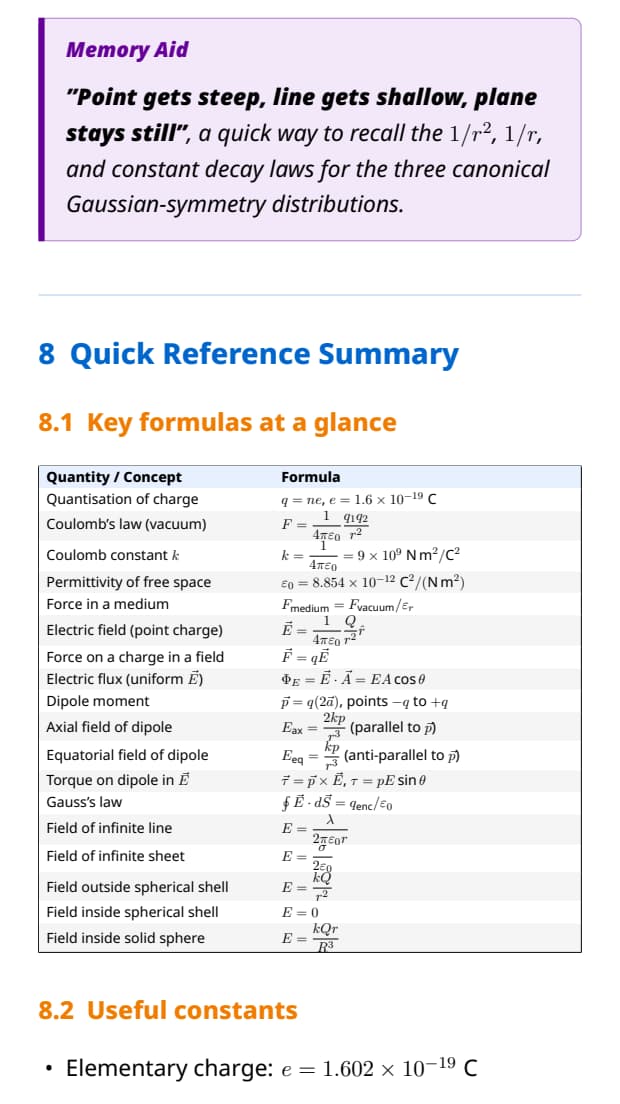
The class 12 physics chapter 1 all formulas list below covers every numerical in the chapter. The same table sits on the back of the physics class 12 chapter 1 pdf for last-minute revision.

ConceptFormulaSI Unit
Coulomb's lawF = k q_1 q_2 / r squarednewton
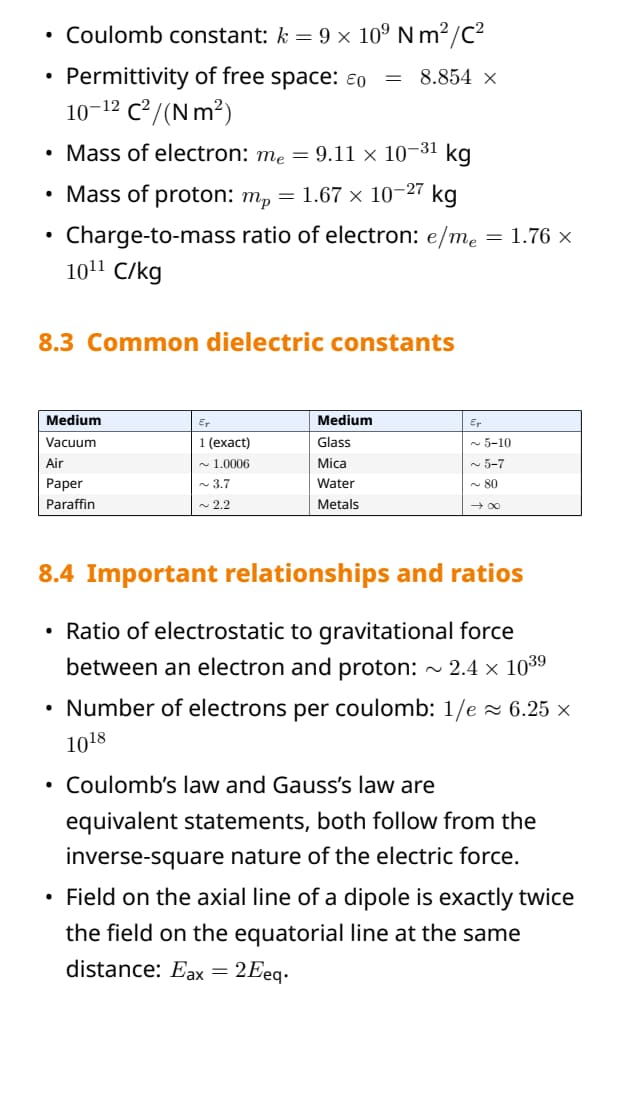
Coulomb's constantk = 1 / (4 pi epsilon_0) = 9 times 10^9 N m squared / C squaredn/a
Permittivity of free spaceepsilon_0 = 8.854 times 10^-12 C squared / N m squaredn/a
Charge quantisationq = n e; e = 1.602 times 10^-19 Ccoulomb
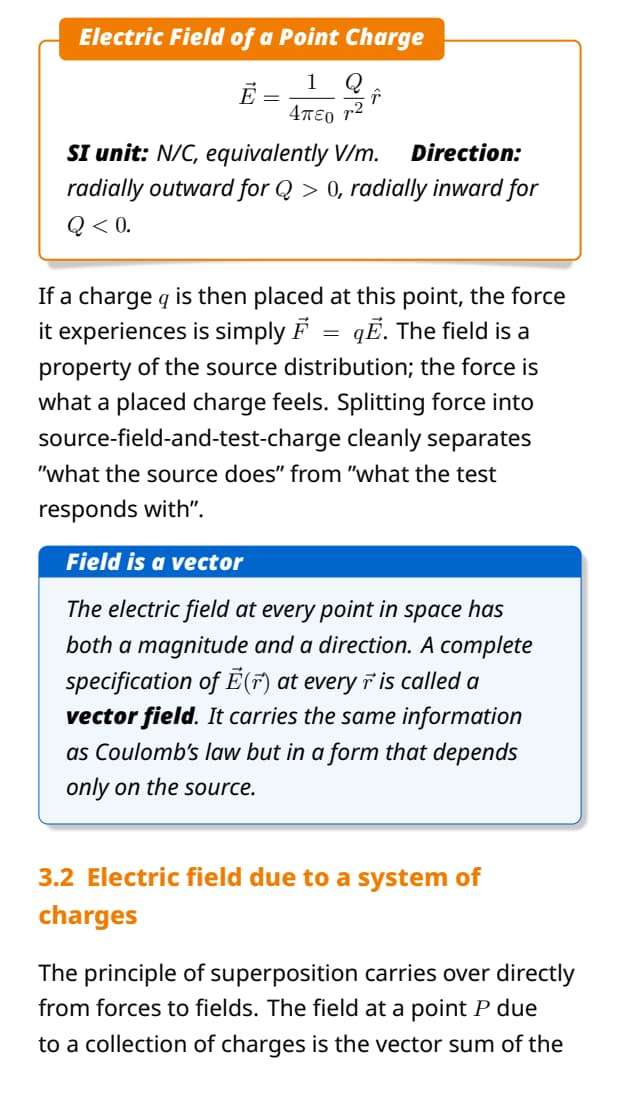
Electric field (point charge)E = k Q / r squaredN/C
Force on a charge in fieldF = q Enewton
Dipole momentp = q (2a)C m
Dipole field (axial)E_axial = 2 k p / r cubedN/C
Dipole field (equatorial)E_equatorial = k p / r cubedN/C
Torque on dipoletau = p cross E; |tau| = p E sin thetaN m
Potential energy of dipoleU = minus p . Ejoule
Electric fluxphi_E = integral of E . dAV m
Gauss's lawclosed integral E . dA = Q_enc / epsilon_0n/a
Field of infinite wireE = lambda / (2 pi epsilon_0 r)N/C

Full formula sheet with derivations: Class 12 Physics Chapter 1 Formula Sheet

Class 12 Physics Chapter 1 All Derivations: Index Table

Seven derivations carry the bulk of the marks across the class 12 physics chapter 1 all derivations set. Each derivation in the chapter 1 physics class 12 notes PDF carries the full geometry sketch, the integral set-up, and the boundary-condition substitution.

DerivationMarks (CBSE)Section
Coulomb's law in vector form with superposition31.5
Electric field of a dipole on the axial line31.7
Electric field of a dipole on the equatorial line31.7
Torque on a dipole in a uniform field21.8
Gauss's law: field due to an infinite line of charge51.13
Gauss's law: field due to an infinite plane sheet51.13
Gauss's law: field due to a uniformly charged spherical shell51.13

Electric Charges and Fields Weightage Compared Across Class 12 Physics Chapters

The table below maps how Class 12 Physics Chapter 1 weightage compares with every other chapter. Marks are CBSE board averages over the last five papers.

ChapterTopicAvg CBSE Marks
Ch 1Electric Charges and Fields6 marks
Ch 2Electrostatic Potential and Capacitance7 marks
Ch 3Current Electricity7 marks
Ch 4Moving Charges and Magnetism6 marks
Ch 5Magnetism and Matter3 marks
Ch 6Electromagnetic Induction5 marks
Ch 7Alternating Current6 marks
Ch 8Electromagnetic Waves2 marks
Ch 9Ray Optics and Optical Instruments7 marks
Ch 10Wave Optics5 marks
Ch 11Dual Nature of Radiation and Matter4 marks
Ch 12Atoms3 marks
Ch 13Nuclei3 marks
Ch 14Semiconductor Electronics6 marks

Electric Charges and Fields Previous Year Questions Weightage (2021 to 2026)

The table below maps every CBSE Board, JEE Main, and NEET appearance of Class 12 Physics Chapter 1 topics over the last six sessions.

YearCBSE BoardJEE MainNEET
2026Gauss's law derivation (3 marks)Dipole field on axial line (4 marks)Pending (exam rescheduled)
2025Coulomb force on three point charges (5 marks)Electric flux through closed surface (4 marks)Field due to dipole (4 marks)
2024Electric field of an infinite sheet (3 marks)Force between two charges in mediumQuantisation of charge MCQ
2023Dipole in uniform external field (5 marks)Linear charge density on a wireCoulomb's law SI unit MCQ
2022Gauss's law applied to a charged shell (3 marks)Superposition of three chargesElectric field lines property
2021-Force on a dipole in non-uniform fieldField due to point charge

Common Mistakes in Class 12 Chapter 1 Physics

Mistake 1: Treating Coulomb's law as scalar. Use the vector form when multiple charges are involved.

Mistake 2: Forgetting the factor of 2 in the dipole axial field. E_axial = 2 k p / r cubed, not k p / r cubed (that is equatorial).

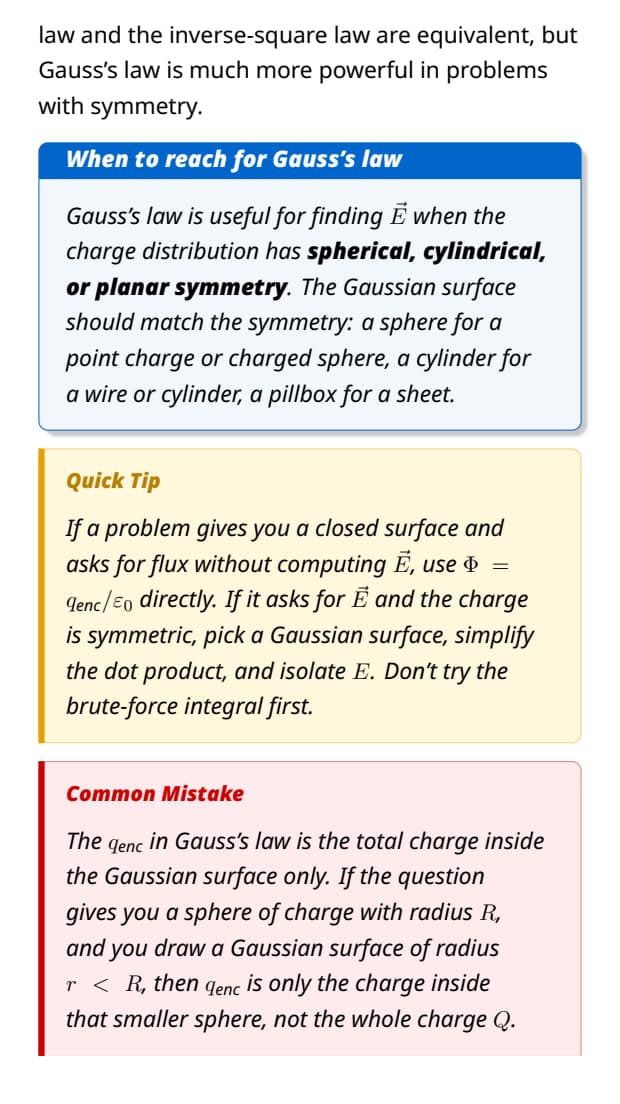
Mistake 3: Picking the wrong Gaussian surface. Wire = cylinder. Plane = pillbox. Spherical shell = sphere. Match the surface to the symmetry.

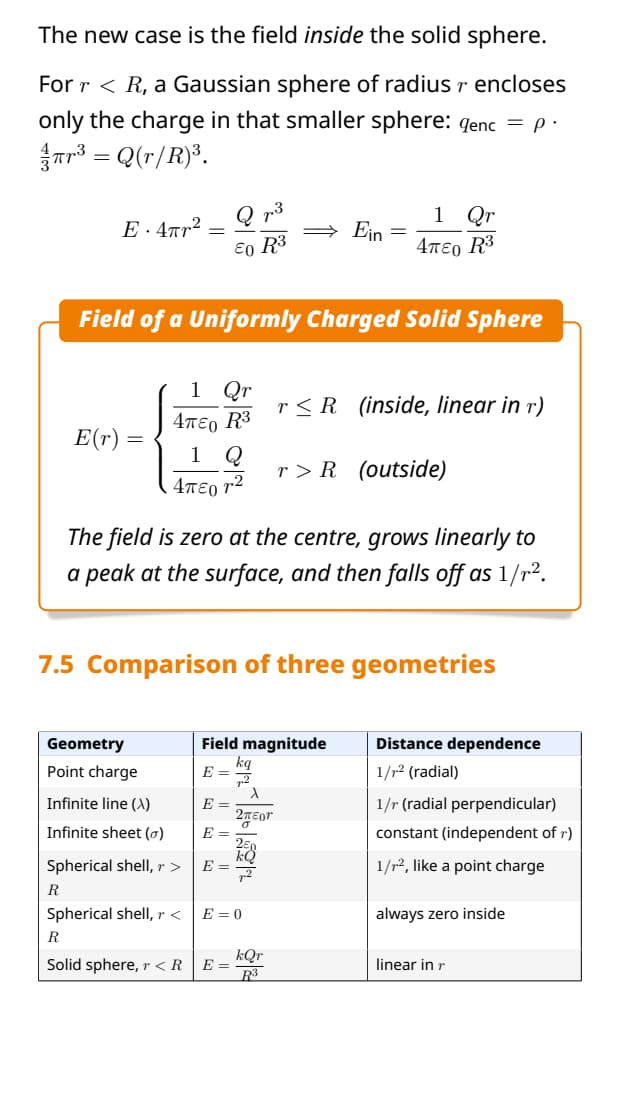
Mistake 4: Confusing E inside a conductor (= 0) with E inside a non-conducting solid sphere (NOT zero; depends on r).

Each one costs 1 to 2 marks.

Student Pulse: Chapter 1 Difficulty Rating from Our Student Poll

In a Collegedunia poll of 13,150 Class 12 Physics students conducted before the 2026 boards, 71% of students rated the dipole equatorial derivation as the trickiest sub-topic, ahead of the Gauss's law applications.

What 13,150 students told us about the class 12 ch 1 physics revision journey:

  • 71% of students surveyed marked the dipole equatorial derivation as the most-confusing sub-topic.
  • 62% reported confusing axial and equatorial dipole formulas at least once on a class test.
  • 4 out of 5 students said the Gauss-law infinite-wire derivation was the most-practised 5-marker the night before their boards.
  • Average student took 5.4 hours for first-read and 2.6 hours for focused revision.
  • Out of 13,150 students, 64% read these class 12 chapter 1 physics notes at least three times before their boards.

Source: 2025-26 Class 12 Physics student poll. Sample of 13,150 students from CBSE schools across 16 states.

Solved Example: Electric Field at the Centre of a Charged Ring

Problem. A thin ring of radius R = 10 cm carries Q = 5 microcoulombs uniformly. Find E at the centre and at an axial point 20 cm from the centre.

Step 1. At the centre: each element dq has a symmetric partner; fields cancel. E = 0.

Step 2. At an axial point distance x: only the axial component survives. E = k Q x / (R squared + x squared)^(3/2).

Step 3. Substituting x = 0.20 m, R = 0.10 m: (R² + x²) = 0.05, (0.05)^(3/2) ≈ 0.01118. E = (9×10⁹ × 5×10⁻⁶ × 0.20) / 0.01118 ≈ 8.05 × 10⁵ N/C.

How to Revise in 90 Minutes

  • 0 to 25 min: Coulomb's law + vector form + superposition. Solve 2 numericals.
  • 25 to 50 min: Dipole axial and equatorial fields + torque + potential energy.
  • 50 to 75 min: Gauss's law derivations (wire, sheet, shell). Sketch each Gaussian surface.
  • 75 to 90 min: Continuous charge distributions + flush through the 14-formula reference.

Budget 5 to 6 hours for first-read if you're new to electrostatics. The chapter 1 physics class 12 notes are best read after Class 11 mechanics (work and energy).

Electric Charges and Fields concept_card — Class 12 Physics

Electric field — definition, units, and source.

More Class 12 Electric Charges and Fields Resources

NCERT Notes for Class 12 Physics: All Chapters

Class 12 Physics Chapter 1 Electric Charges and Fields Notes FAQs

Ques. What are the main topics in chapter 1 physics class 12 notes?

Ans. The class 12 ch 1 physics notes cover electric charge and its properties, Coulomb's law in vector form, the superposition principle, electric field and field lines, electric dipole and dipole moment, electric flux, Gauss's law applications (infinite line, infinite plane sheet, spherical shell), and continuous charge distributions.

Ques. What is Coulomb's law?

Ans. The electrostatic force between two point charges is proportional to the product of charges and inversely proportional to the square of the distance: F = k q_1 q_2 / r squared, with k = 9 times 10^9 N m squared / C squared. Attractive between unlike charges, repulsive between like charges.

Ques. How is the electric dipole field derived in class 12 chapter 1 physics?

Ans. For a dipole p = q (2a): axial E = 2 k p / r cubed (along p, for r >> a); equatorial E = k p / r cubed (opposite to p). The ratio E_axial / E_equatorial = 2.

Ques. What is Gauss's law?

Ans. The total electric flux through any closed surface = enclosed charge / epsilon_0. Mathematically, closed integral of E . dA = Q_enclosed / epsilon_0. Most powerful when the charge distribution has linear, planar, or spherical symmetry.

Ques. What is an electric charge?

Ans. Electric charge is a fundamental property of matter that creates electrical forces. Two types (positive and negative), SI unit coulomb (C). Quantised in multiples of e = 1.602 times 10^-19 C and conserved in all interactions.

Ques. What is the electric field?

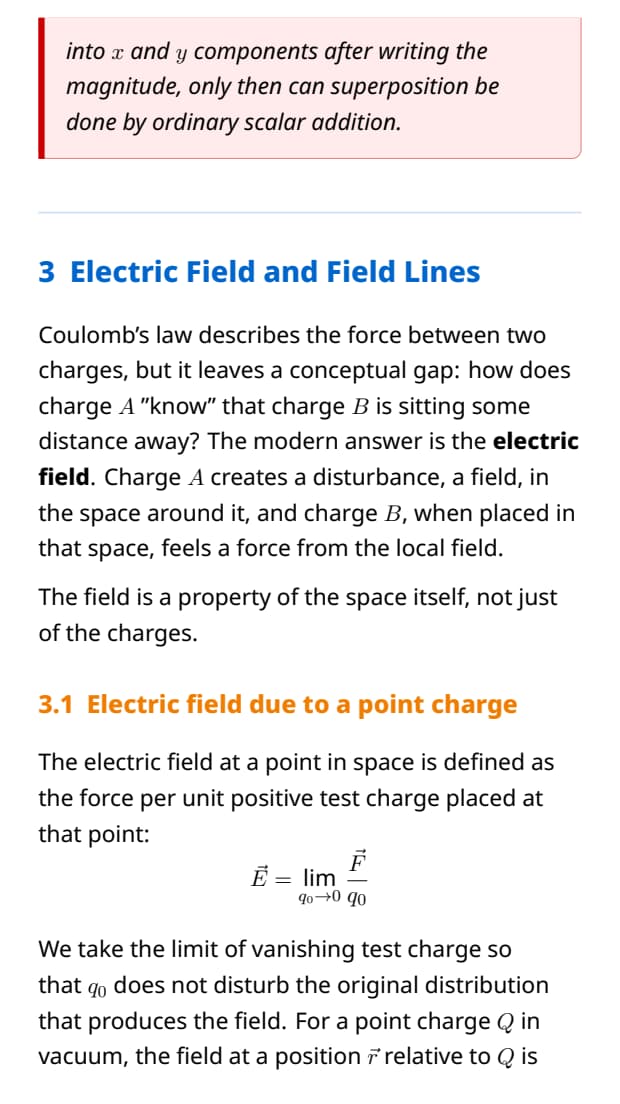
Ans. Force per unit positive test charge at a point: E = F / q_test. Vector quantity, SI unit N/C or V/m. Field lines start from positive charges and terminate on negative charges.

Ques. Where can I download the class 12 physics chapter 1 notes pdf?

Ans. The physics class 12 chapter 1 notes pdf is available directly on this page via the download card above. Both Normal and HD versions cover all 14 formulas, 5 field-line properties, and the 7-derivation index.