




NCERT is the official textbook publisher for CBSE and most state boards in India. This page offers every NCERT resource on Collegedunia. You get textbooks, solutions, notes, formula sheets, handwritten notes, exemplar problems and exemplar solutions. All of it follows the rationalised 2026-27 NCERT syllabus.
- Resource types per subject: NCERT Solutions, NCERT Notes, Formula Sheet, Handwritten Notes, NCERT Book PDF, NCERT Exemplar Solutions, NCERT Exemplar Book PDF.
- Follows: the CBSE 2026-27 syllabus. It helps for Class 12 boards (15 February to April 2027), JEE Main, JEE Advanced, NEET and CUET (UG).
NCERT Class 12 Physics
NCERT Class 12 Physics follows the rationalised 2026-27 syllabus. It has 14 chapters grouped into 8 CBSE units. The board paper is 70 theory + 30 practical. The same NCERT chapters are the base reading for JEE Main, JEE Advanced and NEET Physics.

NCERT Class 12 Chemistry
NCERT Class 12 Chemistry has 10 chapters after the 2026-27 changes. They split into Physical, Inorganic and Organic. The board paper is 70 theory + 30 practical. The same NCERT is also the base book for NEET Chemistry and JEE Main Chemistry.
NCERT Class 12 Maths
NCERT Class 12 Mathematics is an 80-mark theory-only paper with 13 chapters in the 2026-27 syllabus. The Calculus block (Ch 5 to 9) alone is worth about 35 marks. It is also the base book for JEE Main, JEE Advanced and CUET (UG) Mathematics.
NCERT Class 12 Biology
NCERT Class 12 Biology follows the 2026-27 rationalised syllabus. It has 13 chapters across 5 CBSE units. The board paper is 70 theory + 30 practical. NCERT diagrams and Exemplar problems are the most-used resources for NEET aspirants.
NCERT Class 12 English Core
NCERT Class 12 English Core is an 80-mark theory paper. It is built around two NCERT books: Flamingo (prose + poetry) and Vistas (supplementary), with 19 chapters in all. Literature alone carries 40 marks. NCERT has no Formula Sheet or Exemplar for English, so only 4 resources show here.
NCERT Class 12 Accountancy
NCERT Class 12 Accountancy is an 80-mark theory paper. It is taught from two NCERT volumes: Part 1 Partnership Firms and Part 2 Company Accounts & Analysis of Financial Statements, with 10 chapters in all. Partnership Accounts alone carries 25 marks.
NCERT Class 12 Business Studies
NCERT Class 12 Business Studies is an 80-mark theory paper with 11 chapters in the rationalised 2026-27 syllabus. Financial Markets is dropped. Marketing is now Ch 10 and Consumer Protection is now Ch 11. Marketing alone is worth about 10 marks.
What is NCERT and Why Every Student Uses It
NCERT (National Council of Educational Research and Training) started in 1961. It is the central body for school syllabus and textbooks in India. Three reasons keep its books at the centre of every student's prep:
- Written by subject experts: university teachers and senior CBSE teachers write each NCERT textbook. Other experts then check it before print.
- The official CBSE syllabus base: CBSE board papers stay strictly within the NCERT chapter list and exercise types.
- Used directly by state boards: the UP, MP, Bihar, Rajasthan, Himachal Pradesh, Uttarakhand and Chhattisgarh boards use NCERT books as they are.
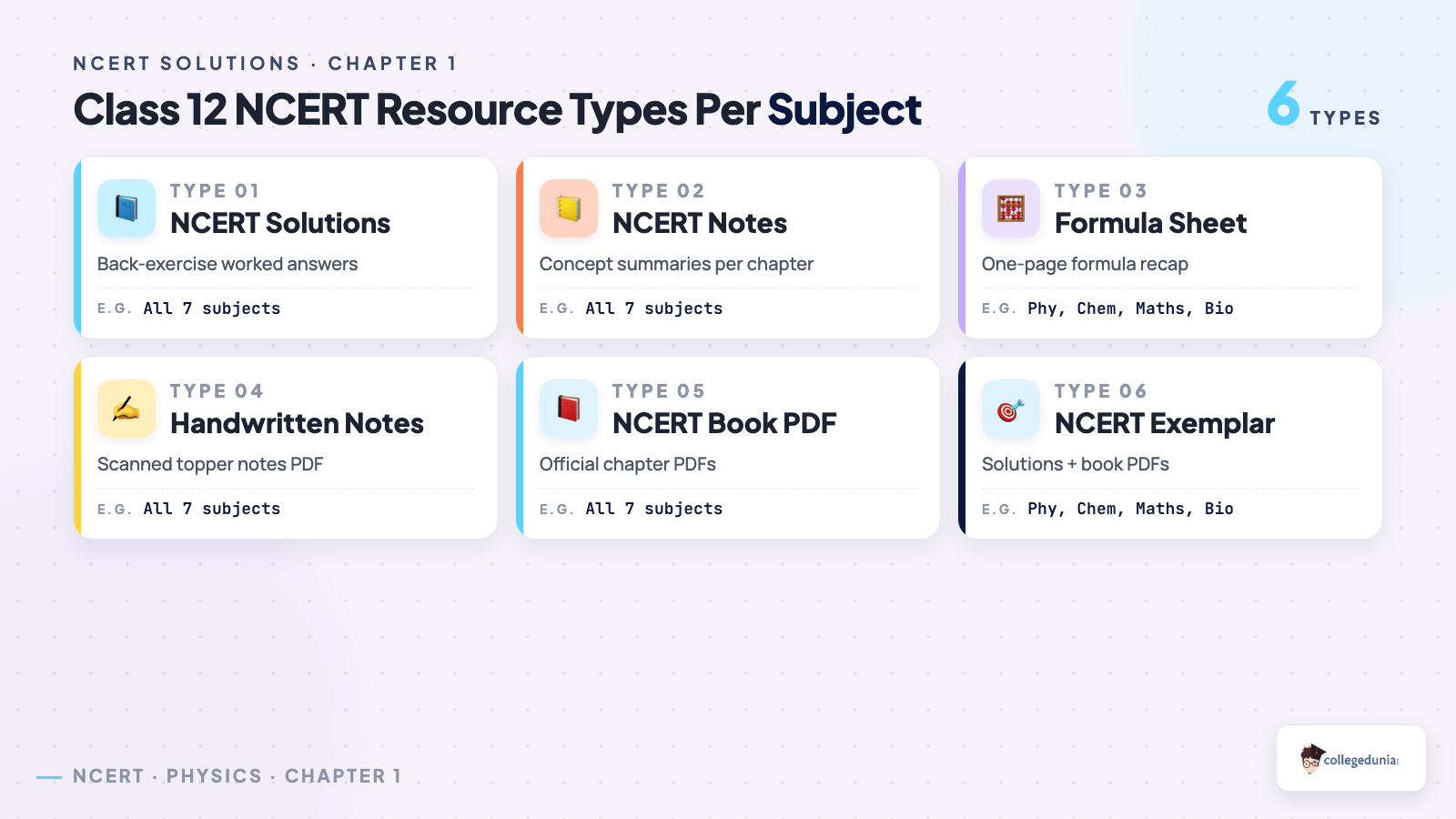
NCERT Resource Types: Which One to Use When
Seven resource formats are made for the NCERT syllabus. Each one fits a different revision stage. Use the table to match the format to the time you have left.
| Resource Type | What It Is | Best Used For | Time Required |
|---|---|---|---|
| NCERT Solutions | Step-by-step answers to every back-exercise question. | First attempt plus answer-writing practice. | 4 to 6 hours per chapter. |
| NCERT Notes | A 20 to 25-page revision PDF per chapter with formula boxes, diagrams and common mistakes. | Second-pass revision after one full textbook read. | 2 to 3 hours per chapter. |
| Formula Sheet | A small 2-column PDF with every formula and constant in a subject. | Last-week revision, one page per night. | 30 to 45 minutes per subject. |
| Handwritten Notes | Scanned-look notebook PDFs with hand-drawn formula boxes. | Morning revision before the exam, and offline phone reading. | 20 to 30 minutes per chapter. |
| NCERT Book PDF | The official chapterwise NCERT textbook PDF. | First read, and a reference during answer practice. | 3 to 5 hours per chapter. |
| Exemplar Solutions | Worked answers for the harder NCERT Exemplar Problems set. | JEE Main, JEE Advanced and NEET prep. | 5 to 7 hours per chapter. |
| Exemplar Book PDF | The official NCERT Exemplar Problems book PDF. | Direct entrance-exam practice. | 2 to 4 hours per chapter. |
CBSE 2027 Board Exam Calendar
The CBSE 2026-27 school year ends with two board exams. Class 12 is the senior secondary board. Class 10 is the secondary board. Practicals and internal assessment finish by 31 January 2027 for both classes.
| Class | Theory Paper Window | Practical / IA Cut-off | Result Expected |
|---|---|---|---|
| Class 10 | February to March 2027 | 31 January 2027 | May 2027 |
| Class 12 | 15 February to April 2027 | 31 January 2027 | May 2027 |
Rationalised NCERT 2026-27: What Changed
The 2026-27 NCERT print is the rationalised edition. It is the second big revision since 2023, when NCF 2023 came in. The revision dropped repeated sections, cut old chapters and reduced the page count by about 20 per cent. Here are the key changes for Class 12 students:
- Business Studies: the Financial Markets chapter is dropped. Marketing is now Ch 10 and Consumer Protection is now Ch 11. Total chapters 11.
- Chemistry: the General Principles and Processes of Isolation of Elements chapter is dropped. Total chapters 10.
- Maths and Physics: the chapter list is the same. Only extra exercises and proofs inside each chapter are removed.
NCERT for JEE Main, JEE Advanced, NEET and CUET (UG)
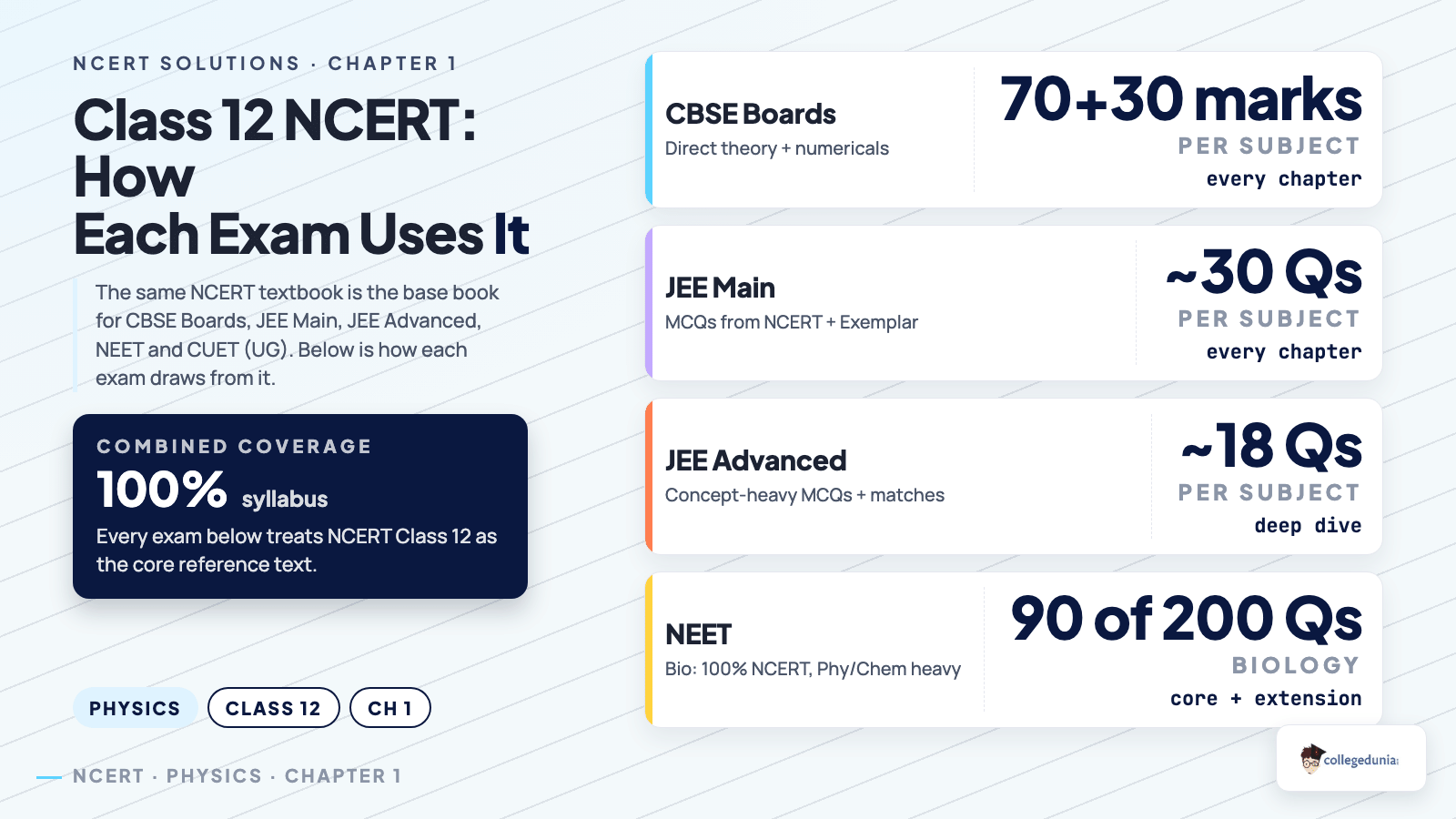
NCERT Class 11 and Class 12 are the base reading for every major UG entrance exam in India. How much each exam uses NCERT varies:
| Exam | NCERT Reliance | Subjects Drawn From NCERT | How to Use NCERT |
|---|---|---|---|
| JEE Main | ~50 to 60% of questions | Physics, Chemistry, Mathematics | Learn the NCERT line text. Use Exemplar problems for harder questions. |
| JEE Advanced | ~30 to 40% concept base | Physics, Chemistry, Mathematics | Use NCERT for clear concepts. Use reference books (HC Verma, RD Sharma) for harder problems. |
| NEET | ~95 to 100% in Biology | Physics, Chemistry, Biology | Read NCERT Biology word by word. Physics and Chemistry need NCERT plus Exemplar. |
| CUET (UG) | ~100% (mapped to Class 12 syllabus) | All Domain subjects + General Test | The NCERT chapter list is the CUET syllabus. You need no extras. |
NCERT vs Reference Books: When to Switch
NCERT is the base, but it is not always enough. Here is what most coaching teachers advise:
| Subject | Use NCERT First | Switch to Reference For | Recommended Reference |
|---|---|---|---|
| Class 12 Physics | Concepts, back-exercise and Exemplar. | Harder JEE Advanced problems. | HC Verma, DC Pandey |
| Class 12 Chemistry | NCERT plus Exemplar are almost enough. | JEE Advanced numericals (Physical Chem only). | O.P. Tandon, P. Bahadur |
| Class 12 Mathematics | Concepts, back-exercise and Miscellaneous. | More problem variety for JEE. | RD Sharma, Cengage |
| Class 12 Biology | NCERT alone is the best resource. | NEET MCQ practice only. | Trueman's, MTG Fingertips |
| Class 12 English | NCERT plus sample papers are enough. | Writing skills and grammar practice. | Wren & Martin, Arihant |
| Class 12 Accountancy | NCERT plus DK Goel for more problems. | Strict-format company-account problems. | TS Grewal, DK Goel |
| Class 12 Business Studies | NCERT theory plus sample papers cover the paper. | Case-study answer writing. | Poonam Gandhi, Sandeep Garg |
How to Use NCERT Solutions, Notes and Exemplar Together
The three resources work together, they do not replace each other. A full revision uses all three in order:
- Step 1, NCERT Book PDF: read each chapter once from start to end (3 to 5 hours per chapter).
- Step 2, NCERT Solutions: try every back-exercise question. Then check it against the worked solution (4 to 6 hours per chapter).
- Step 3, NCERT Notes: use the 20 to 25-page revision PDF for your second-pass summary (2 to 3 hours per chapter).
- Step 4, NCERT Exemplar: try the harder problem set for entrance-exam depth (5 to 7 hours per chapter).
- Step 5, Formula Sheet + Handwritten Notes: last-week revision and a quick recap on exam morning.
Common Mistakes Class 12 Students Make with NCERT
- Skipping the back-exercise questions. The boards reuse them almost word for word. That is why the Solutions PDF exists.
- Using the older non-rationalised NCERT. If your PDF still has Financial Markets in Business Studies, or the old Chemistry chapter on isolation of metals, it is the wrong edition.
- Reading the textbook once and calling it revision. Use the Notes PDF for the second pass. Reading the same textbook twice is slow.
- Ignoring Exemplar for boards. CBSE long-answer questions often come from Exemplar, mostly in Maths and Physics.
- Treating board prep and entrance prep as separate. NCERT covers both. Add Exemplar plus one reference book, and the same prep works for boards, JEE and NEET.
Student Pulse: What 18,420 Class 12 Students Told Us
In an internal Class 12 prep survey of 18,420 students across CBSE schools before the 2027 boards:
- 72% said NCERT Solutions PDFs were their most-used revision resource.
- 64% said they revise NCERT Notes the night before each paper, not the textbook.
- 58% of NEET aspirants said the NCERT Biology Book PDF plus diagrams were enough. Only 11% of Physics-NEET aspirants said the same.
- 81% of JEE-track students said NCERT Exemplar was more useful than reference books for the first two months.
NCERT Hindi Medium PDFs
NCERT prints every textbook above in both English and Hindi. The Hindi medium PDFs (sometimes named "Bhautiki", "Rasayan Vigyan", "Ganit", "Jeev Vigyan") use the same chapter list and exercise numbers as the English print. Students in Hindi-medium CBSE schools and the UP, MP, Bihar, Rajasthan and Uttarakhand state boards use them directly. Notes, Formula Sheets and Handwritten Notes come in English by default. Hindi medium versions are being added subject by subject.
Coming Soon: NCERT Class 6 to Class 11
NCERT resources for Class 6, 7, 8, 9, 10 and 11 are on the way. We will publish them here chapter by chapter through the 2026-27 school year. Here is what to expect:
- Class 6 to 8 (Middle School): NCERT Book PDFs, Solutions and Notes in Maths, Science, Social Science, English, Hindi and Sanskrit.
- Class 9 and 10 (Secondary School): full coverage for the CBSE board year, plus Exemplar Solutions for Maths and Science.
- Class 11 (Senior Secondary, Year 1): full coverage across Science, Commerce and Humanities streams, like the Class 12 set.
NCERT 2026-27: Frequently Asked Questions
NCERT Class 12 and Cross-Class FAQs
Ques. Are all NCERT PDFs on this page free to download?
Ans. Yes. Every NCERT Book PDF, NCERT Solutions PDF, Notes PDF, Formula Sheet, Handwritten Notes PDF, Exemplar Solutions and Exemplar Book PDF linked here is free for students.
Ques. Which NCERT edition is the 2026-27 syllabus based on?
Ans. The 2026-27 syllabus uses the rationalised NCERT print. This edition dropped some chapters and cut extra sections from the older textbooks. For example, Class 12 Business Studies no longer has the Financial Markets chapter. Every resource on this page follows the 2026-27 syllabus.
Ques. When do the CBSE 2027 board exams begin?
Ans. The Class 12 boards begin on 15 February 2027. Class 10 boards run in the same February-to-March 2027 window. Practical exams and internal assessment for both classes are due by 31 January 2027.
Ques. Is the Class 11 and Class 12 NCERT enough for JEE Main and NEET?
Ans. NCERT is the base, but not enough on its own. JEE Main draws about 50 to 60% of questions from NCERT line text. The rest needs harder practice from the NCERT Exemplar plus one or two reference books. NEET Biology is close to 100% NCERT. Physics and Chemistry need NCERT plus Exemplar.
Ques. Which NCERT classes have an Exemplar book?
Ans. NCERT Exemplar Problems come out for Classes 9, 10, 11 and 12 in Mathematics, Physics, Chemistry and Biology. There are no Exemplar books for Class 6, 7, 8, English, Hindi, Social Science or Commerce subjects.
Ques. Is the same NCERT used in state boards like UP, MP and Bihar?
Ans. Most state boards (UP, MP, Bihar, Rajasthan, HP, Uttarakhand, Chhattisgarh) and CBSE schools across the country use the NCERT textbooks directly. Some state boards (Maharashtra, Karnataka, Tamil Nadu, Kerala, Gujarat, West Bengal) print their own textbooks, but their syllabus often matches NCERT closely.
Ques. What is the difference between NCERT Solutions and NCERT Notes?
Ans. NCERT Solutions are step-by-step answers to the back-exercise questions in each chapter. They help with answer-writing practice. NCERT Notes are a short 20 to 25-page revision summary of the same chapter with formula boxes, diagrams, common mistakes and memory tricks. They help with second-pass revision.
Ques. When will NCERT Class 6 to Class 11 resources be available?
Ans. NCERT resources for Class 6 to Class 11 are being published chapter by chapter through the 2026-27 school year. Class 10 (board year) and Class 11 (JEE / NEET foundation year) come first. Class 6 to 8 follow.





Comments