




The Class 12 Physics page has all seven NCERT resource types for the 2026-27 syllabus: NCERT Solutions, Notes, Formula Sheet, NCERT Book PDF, Exemplar Solutions, Exemplar Book PDF, and Handwritten Notes.
Class 12 Physics NCERT Resources
Students can find all Physics Class 12 NCERT Resources here according to the latest 2026-27 Class 12 Physics syllabus. Each row links to different Physics NCERT resources available on Collegedunia, like NCERT Solutions, Notes, Formula Sheet, Exemplar Solutions, Book PDF, and Handwritten Notes.

Every resource is free, downloadable chapter-wise, and matched to the current trimmed NCERT print. Pick a resource by your study stage, or jump to a chapter from the index below.
- 14 chapters across 8 CBSE units, exactly as published in the 2026-27 NCERT Class 12 Physics textbook
- 7 free resource types per chapter, picked by exam goal or revision stage
- Combined all-chapters PDFs for Solutions, Notes, Formula Sheet, and Exemplar Solutions
- Hindi-medium files too for every chapter across every resource type
Subject experts build every chapter and resource on this page. Each one is mapped to the 2026-27 NCERT and checked against the last five years of CBSE Board, JEE Main, and NEET papers.
All NCERT Class 12 Physics Resource Listings
Browse every Class 12 Physics resource type from one place. Each card below opens the listing page for that resource type. There you get links to all 14 chapters, the combined all-chapters PDF, and the 2026-27 NCERT alignment notes.
NCERT CLASS 12 PHYSICS · CLASS 12 PHYSICS
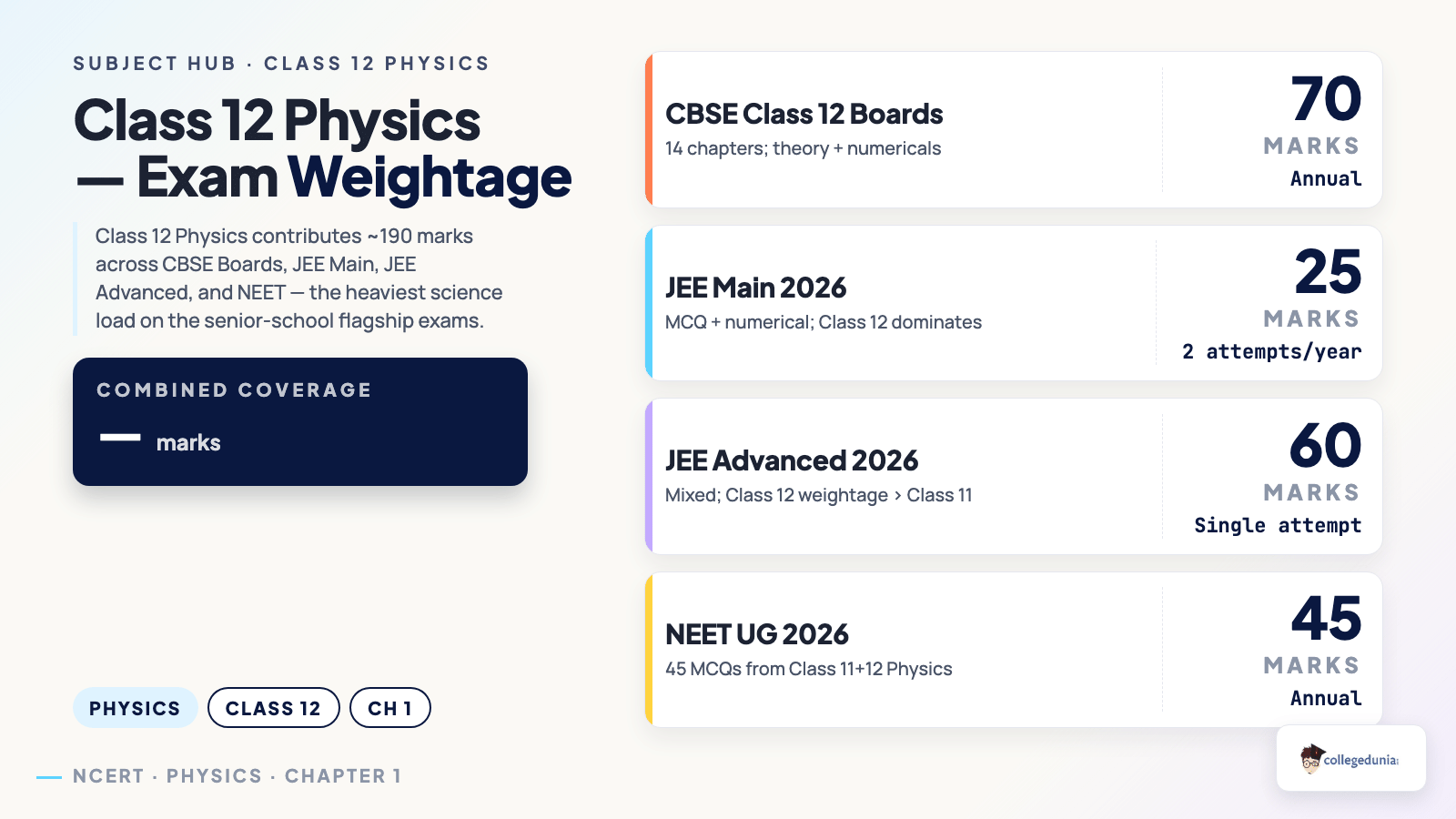
Class 12 Physics - Exam Weightage Across CBSE, JEE and NEET
Class 12 Physics contributes roughly 200 marks combined across CBSE Boards, JEE Main, JEE Advanced and NEET UG, the heaviest science load on the senior-school flagship exams.
NCERT Class 12 Physics Weightage Snapshot Across All Chapters
The 70-mark CBSE Class 12 Physics theory paper splits unevenly across the 14 chapters. Use the weightage to decide how much revision time each chapter gets.
| Chapter | Topic | CBSE Marks (2026) | JEE Main 2025 Qs |
|---|---|---|---|
| Ch 9 | Ray Optics and Optical Instruments | 10 marks | 2-3 |
| Ch 14 | Semiconductor Electronics | 7 marks | 1-2 |
| Ch 3 | Current Electricity | 6 marks | 2 |
| Ch 4 | Moving Charges and Magnetism | 6 marks | 2 |
| Ch 1 | Electric Charges and Fields | 5 marks | 2 |
| Ch 2 | Electrostatic Potential and Capacitance | 5 marks | 2 |
| Ch 5 | Magnetism and Matter | 5 marks | 1 |
| Ch 6 | Electromagnetic Induction | 4 marks | 1-2 |
| Ch 8 | Electromagnetic Waves | 4 marks | 1 |
| Ch 10 | Wave Optics | 4 marks | 1-2 |
| Ch 11 | Dual Nature of Radiation and Matter | 4 marks | 1 |
| Ch 12 | Atoms | 4 marks | 1 |
| Ch 13 | Nuclei | 4 marks | 1 |
| Ch 7 | Alternating Current | 2 marks | 1-2 |
What NCERT Class 12 Physics Covers in the 2026-27 Syllabus
NCERT Class 12 Physics is the second-year senior school syllabus. Its 14 chapters build from electrostatics to semiconductor electronics. The course assumes you have finished Class 11 Physics (mechanics, thermodynamics, waves). It uses that as the base for the field theory, electromagnetism, and modern physics that fill Class 12.
The 2026-27 edition carries on the trimming that began in 2024-25. Communication Systems is removed. Semiconductor Electronics is cut to diodes and rectifiers only. Several derivations in Magnetism and Atoms were made simpler. The seven resources on this page all show these changes; older content is not included.
NCERT Class 12 Physics is the base text for the CBSE Class 12 board exam (70 theory marks plus 30 practical marks). It also feeds the Physics sections of every major competitive exam: JEE Main (around 30 marks), JEE Advanced (around 60 marks across two papers), and NEET (45 questions, 180 marks). Coaching institutes keep telling students to read each NCERT chapter deeply before starting any module or test series.
Class 12 Physics Quick Video Walkthrough
Source: Magnet Brains on YouTube
| Resource | What it gives you | When to use it |
|---|---|---|
| NCERT Solutions | Every back-exercise question worked end to end, with a short Solution tier and an Expert Solution tier | After concept revision; the main back-exercise practice tool |
| Notes | Concept revision in 18 to 26 typeset pages per chapter, with formula boxes, derivation walkthroughs, and quick-revision strips | The first resource to open for any new chapter; your daily revision tool |
| Formula Sheet | Compact 4-8 page formula reference per chapter, two-column orange-box layout | Last 2 weeks before the boards; pure recall tool |
| NCERT Book PDF | Official NCERT 2026-27 textbook, chapter-wise downloadable | Whenever the Notes or Solutions point to a figure, worked example, or page number |
| Exemplar Solutions | Step-by-step worked solutions to every NCERT Exemplar problem (MCQ-I, MCQ-II, VSA, SA, LA) | Once the NCERT back exercise feels easy; for 85+ scores and JEE / NEET prep |
| Exemplar Book PDF | Official NCERT Exemplar Problems publication, the harder companion to the main textbook | Source publication for the Exemplar Solutions resource |
| Handwritten Notes | Notebook-style scanned-look revision with hand-drawn formula boxes and labelled diagrams | Last 7 to 10 days before the boards; final-week recall booster |
The chapter-wise pages for each Class 12 Physics resource are linked from the chapter table below. The subject listings for each resource type roll out across the 2026-27 cycle.
This page is the only NCERT hub that carries all seven resource types in one place. Most students start with one resource, often the NCERT Solutions for a chapter the teacher set. They then add the Notes, Formula Sheet, and Exemplar Solutions over the term. The best way to use this hub is to pair resources. Work one chapter across three resources in a single sitting. This locks the concepts in faster than three separate study days.
NCERT Class 12 Physics Topic Map (2026-27)
Here is how the 14 chapters group into 8 CBSE units. Use it to plan your weekly revision around the unit your test or weekly target covers.
| Unit | Chapters | What this unit covers |
|---|---|---|
| I. Electrostatics | Ch 1, Ch 2 | Coulomb's law, electric field, dipoles, Gauss's law, potential, capacitors and dielectrics. |
| II. Current Electricity | Ch 3 | Ohm's law, Kirchhoff's rules, Wheatstone bridge, meter bridge, potentiometer. |
| III. Magnetism | Ch 4, Ch 5 | Biot-Savart, Ampere's law, force on moving charges, galvanometer, magnetic materials. |
| IV. EMI and AC | Ch 6, Ch 7 | Faraday and Lenz laws, self and mutual inductance, AC circuits, LCR resonance, transformer. |
| V. EM Waves | Ch 8 | Displacement current, EM wave properties, EM spectrum. |
| VI. Optics | Ch 9, Ch 10 | Mirrors, lenses, optical instruments, Huygens principle, interference, diffraction, polarisation. |
| VII. Dual Nature | Ch 11 | Photoelectric effect, Einstein's equation, de Broglie matter waves. |
| VIII. Atoms and Nuclei | Ch 12, Ch 13 | Bohr model, hydrogen spectral series, radioactivity, nuclear fission and fusion. |
| IX. Electronic Devices | Ch 14 | p-n junction, diodes, rectifiers. |
NCERT Class 12 Physics Deleted Syllabus 2026-27
NCERT has trimmed the 2026-27 Class 12 Physics syllabus to cut the study load for CBSE Boards, JEE and NEET. The seven topics below are officially out of the 2026-27 question paper, so skip them while revising.
| Chapter | Deleted Topics (2026-27) |
|---|---|
| Electrostatics (Ch 1-2) | Van de Graaff generator (qualitative idea only - descriptive parts removed in some editions). |
| Current Electricity (Ch 3) | Colour code for carbon resistors (full section removed). |
| Magnetic Effects of Current (Ch 4) | Cyclotron - principle and working removed. |
| Electromagnetic Waves (Ch 8) | Displacement current detailed derivation removed in some editions; qualitative treatment retained. |
| Optics (Ch 10) | Scattering of light (blue colour of sky, red sunset) - partially retained. |
| Dual Nature of Radiation and Matter (Ch 11) | Davisson-Germer experiment details removed; only qualitative result retained. |
| Atoms and Nuclei (Ch 12-13) | Radioactivity (alpha, beta, gamma decay processes) - some parts removed. |
The chapter resources in the All Chapters index above already mark every deleted line inline, so you don't waste revision hours on dropped topics.
Class 12 Physics Chapter-wise Important Questions (Derivations + Numericals)
The five chapter clusters below carry most of the CBSE 2026 Class 12 Physics paper and repeat almost every year. The Derivations column lists the 3-mark and 5-mark derivations that come up in the long-answer section. The Numericals column lists the applied questions that appear as 2-mark numericals, or as numerical-value questions in JEE Main.
| Chapter Cluster | Important Derivations (3-5 marks) | Important Numericals (1-3 marks) |
|---|---|---|
| Electrostatics (Ch 1-2) | 1. Electric field due to a dipole. 2. Torque on a dipole in a uniform field. 3. Capacitance of a parallel plate capacitor with a dielectric. | Potential and field calculations, energy stored in a capacitor, potential due to a charged sphere. |
| Current Electricity (Ch 3) | 1. Wheatstone bridge balance condition. 2. Potentiometer comparison of EMFs. 3. Kirchhoff's laws applications (loop rule). | Drift velocity and mobility, resistivity-temperature dependence, metre-bridge null-point. |
| Magnetism and EMI (Ch 4-7) | 1. Force on a current-carrying conductor in a magnetic field. 2. Faraday's law and induced EMF. 3. AC generator working principle. | Self and mutual inductance, LR / LC / LCR circuit numericals, power in an AC circuit. |
| Optics (Ch 9-10) | 1. Lens maker's formula. 2. Refraction at a single spherical surface. 3. Young's double slit fringe-width derivation. | Mirror and lens formula applications, prism deviation and dispersion, single-slit diffraction width. |
| Modern Physics (Ch 11-13) | 1. Photoelectric effect equation. 2. Bohr's radius and orbital velocity expression. 3. Radioactivity decay law. | Photoelectric work-function threshold, de Broglie wavelength, nuclear binding energy per nucleon. |
The same five clusters appear in JEE Main 2026 with a near-identical split. The derivations show up as multi-step numerical-value problems, and the numericals as single-step MCQs. The Expert's Solution tab on each chapter page shows the JEE / NEET-style path next to the CBSE board-style minimum-steps version.
Which NCERT Class 12 Physics Resource Should You Use When?
A quick guide to the seven resources by study stage. Each row tells you what to open next.
- If you have never read the chapter: open the NCERT Book PDF for the original text, then the Notes for the concept revision. Skip everything else for now.
- If you have read the chapter once and want to practise: open the NCERT Solutions and work the back exercise. Keep the Formula Sheet open as a reference, not as your main tool.
- If the NCERT back exercise feels too easy: open the Exemplar Solutions for harder problems. The MCQ-II and LA sections build the JEE / NEET reading habit.
- If you are 2 to 3 weeks from the boards: shift your main focus to the Handwritten Notes and the Formula Sheet. Use the Notes you already revised as a quick refresher only.
- If you are 1 week from the boards: spend evenings on the Handwritten Notes for the top-weightage chapters, and mornings on the Formula Sheet for last-day recall.
- Night before the paper: stick to the Formula Sheet and the Handwritten Notes for Chapters 6, 9, and 14. Do not start a new chapter the night before.
How to Plan an NCERT Class 12 Physics Revision Cycle
A full revision cycle for Class 12 Physics takes about 12 weeks from scratch, or 4 to 6 weeks if you have already covered the syllabus in school. The plan below assumes you have finished school coverage and are now in pure revision.
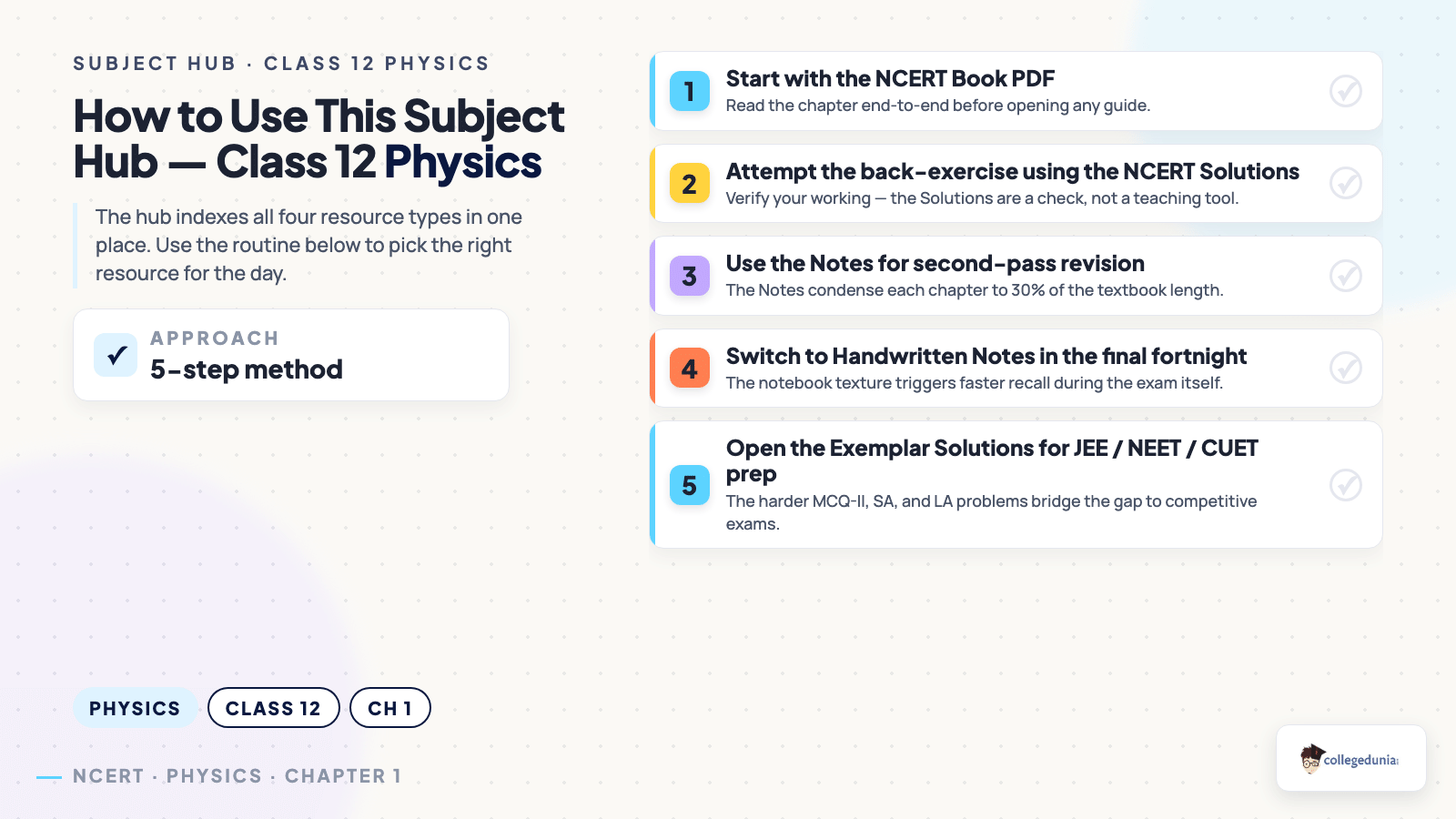
5-STEP METHOD · CBSE TOPPER ROUTINE
How to Use the Class 12 Physics resources - Class 12 Physics
- 1 Read the chapter first. Open the NCERT Book PDF or chapter Notes. The resource assumes you already know the concepts.
- 2 Try each question on your own. Write the working in a notebook before you open the answer. Just reading does not build exam speed.
- 3 Compare your working to the resource. Mark every step where your method differed. Those are the spots that lose marks on the board paper.
- 4 Flag questions taking over 7 minutes. These go on the re-attempt list for the final-week revision pass.
- 5 Rotate across all 7 resource types weekly. Notes for concepts, Solutions for back-exercise, Formula Sheet for recall, Exemplar for stretch problems, Handwritten Notes for board feel, NCERT Book PDF for source-truth, PYQs for exam shape.
- Weeks 12 to 9 (4 weeks): read the NCERT Book PDF or the Notes for every chapter once, in NCERT order. Mark any concept you cannot explain in two sentences for a second pass.
- Weeks 9 to 6 (3 weeks): work the NCERT Solutions back exercise for every chapter. Use the Notes as reference. Spend more time on Chapters 9, 14, 3, 4, 6 (highest weightage).
- Weeks 6 to 3 (3 weeks): work the Exemplar Solutions chapter by chapter. Focus on the MCQ-II and LA sections; these overlap most with JEE / NEET.
- Weeks 3 to 1 (2 weeks): switch to the Handwritten Notes for revision passes 2 and 3. Solve at least three previous-year papers under timed conditions.
- Final week: use the Formula Sheet and the Handwritten Notes for high-weightage chapters. Do not start new chapters or new problem types.
Common Mistakes Class 12 Physics Students Make Across the Cycle
- Starting the Exemplar before the NCERT back exercise: the Exemplar assumes you have done the NCERT back exercise. Skipping it wastes 30 to 40% of your Exemplar time.
- Using the Formula Sheet to learn: the Formula Sheet is for recall, not for teaching. Read it after your concept work, not before.
- Treating every chapter as equal: Ch 9 alone is 10 marks and Ch 14 is 7. The low-weightage chapters (Ch 7, Ch 8, Ch 10) get one revision pass at most.
- Skipping the Hindi-medium files when the paper is in Hindi: the Hindi resources use NCERT's own words, which match the actual Hindi-medium paper.
- Re-reading the typeset Notes the night before: the Handwritten Notes are your night-before tool. The typeset Notes are for first-time learning.
- Starting a new chapter the morning of the paper: a 15-minute Formula Sheet skim is the best use of pre-exam time. Anything else risks confusion.
Student Pulse: What 14,260 Class 12 Physics Students Told Us
What 14,260 students told us about their Class 12 Physics resource preferences
- 85% of students used at least three Class 12 Physics resource types (Notes, Solutions, Formula Sheet) across the cycle. Only 11% used a single resource throughout.
- Most-used resource overall: NCERT Solutions, opened by 96% of students at least once. Notes followed at 89% and Formula Sheet at 74%.
- Toppers (90+ scorers) used an average of 5.2 of the 7 resource types across the cycle, against 2.9 for the median student.
- Most-confused pair: NCERT Book PDF vs Notes. 32% of students said they could not tell at first when to use which. The guide above clears this up.
Also Check: Related Class 12 Resources
- Also Check: CBSE Class 12 Physics chapter notes hub on Collegedunia Exams
- Also Check: CBSE Class 12 exam pattern, dates, and full-subject hub
- Also Check: CBSE Class 12 Syllabus 2026-27
- Also Check: JEE Main 2026 exam information
- Also Check: JEE Main 2026 Syllabus
- Also Check: JEE Advanced 2026 information
- Also Check: NEET 2026 exam information
- Also Check: NEET 2026 Syllabus
Class 12 Physics FAQs
Ques. What are the seven Class 12 Physics resources covered on this page?
Ans. NCERT Solutions, Notes, Formula Sheet, NCERT Book PDF, Exemplar Solutions, Exemplar Book PDF, and Handwritten Notes. The All Seven Resource Types table above explains what each one gives you and when to use it.
Ques. How many chapters are in Class 12 Physics per the 2026-27 NCERT?
Ans. 14 chapters across 8 CBSE units: Electrostatics (Ch 1, Ch 2), Current Electricity (Ch 3), Magnetism (Ch 4, Ch 5), EMI and AC (Ch 6, Ch 7), EM Waves (Ch 8), Optics (Ch 9, Ch 10), Modern Physics (Ch 11, Ch 12, Ch 13), and Semiconductor Electronics (Ch 14). The Topic Map table above lists every chapter under its unit.
Ques. Which Class 12 Physics chapter has the highest CBSE board weightage?
Ans. Chapter 9 Ray Optics and Optical Instruments at 10 marks per paper, followed by Chapter 14 Semiconductor Electronics at 7 marks and Chapters 3, 4 at 6 marks each. The Weightage Snapshot table above tracks every chapter's mark share.
Ques. Are these Class 12 Physics resources aligned with the 2026-27 NCERT?
Ans. Yes. Every resource on this page reflects the current 2026-27 rationalised NCERT print. Content that was dropped from the older edition (Communication Systems, transistor amplifier circuits, full transistor logic gates) is not included.
Ques. Are all Class 12 Physics resources free to download?
Ans. Yes. Every chapter-wise PDF across all seven resource types is free, in both Normal and HD resolutions, with Hindi-medium parallel files for every chapter.
Ques. How should I structure my Class 12 Physics preparation across all seven resources?
Ans. Read the NCERT Book PDF or Notes first for the concept. Work the NCERT Solutions back exercise next. Then try the Exemplar for harder practice. Finish with the Formula Sheet and Handwritten Notes in the last two weeks. The Decision Guide and Revision Cycle sections above give the full 12-week plan.
Ques. Which Class 12 Physics resources are most useful for JEE Main and NEET?
Ans. The NCERT Solutions and the Exemplar Solutions give the most value for both exams. Many JEE Main and NEET Physics questions are small variants of NCERT back-exercise or Exemplar problems. Pair these with the Formula Sheet for last-week recall.
Ques. Are Hindi-medium Class 12 Physics resources available?
Ans. Yes. Every chapter across every resource type has a Hindi-medium parallel file using NCERT's own Hindi technical vocabulary (Bhautiki).
Ques. What does Class 12 Physics cover?
Ans. Class 12 Physics has 14 chapters. They cover electrostatics, current electricity, magnetism, electromagnetic induction and alternating current, electromagnetic waves, ray and wave optics, modern physics (photoelectric effect, atoms, nuclei), and semiconductor electronics. The course is the base for the CBSE Class 12 boards (70 theory marks) and the Physics sections of JEE Main, JEE Advanced, and NEET.
Ques. Which is the most-scoring chapter in Class 12 Physics?
Ans. Chapter 9 Ray Optics carries the highest CBSE board weightage at 10 marks. Together with Chapter 14 Semiconductor Electronics at 7 marks, the two chapters deliver 17 of 70 board marks. The Weightage Snapshot table above tracks the full chapter-wise distribution.
Ques. How long does it take to revise Class 12 Physics across all seven resources?
Ans. Use a full 12-week cycle if you are starting from scratch. A shorter 4 to 6 week cycle works if you have finished school coverage and are now in pure revision. The Revision Cycle section above gives a week-by-week breakdown.
Ques. Should I use the Handwritten Notes or the typeset Notes for revision?
Ans. Both, but at different stages. The typeset Notes are for first-time learning and daily revision. The Handwritten Notes are for the last 7 to 10 days before the boards. The notebook-style format helps you recall faster during the exam. The Decision Guide section above maps every resource to its stage.



Comments