NCERT Solutions for Class 11 Entrepreneurship Chapter 2 Self-management Skills are prepared for the 2026-27 syllabus with direct, board-ready answers. The chapter covers self-awareness, grooming, hygiene, teamwork, networking, motivation, goal setting and time management. Students can use the PDF for revision and the embedded question cards for quick answer checking.
All 23 Check Your Progress questions are solved with separate Solution and Expert Solution tabs.
The answers cover MCQs, true-false items, short responses, tables and self-management examples.
The page is aligned with the Class 11 Entrepreneurship 2026-27 textbook source used for Chapter 2.
Class 11 Entrepreneurship Chapter 2 Solutions PDFDownload PDF
Student Feedback: More than 10,000 students use Collegedunia NCERT resources to revise solved questions, activity tables and downloadable PDFs before school tests.
The chapter is practice-heavy. It asks students to connect personal habits with practical workplace behaviour, so answers should be short, clear and tied to the situation given in the question.
Question Area
What It Tests
Answer Method
Action plan
Strengths, weaknesses and improvement activities
Use a table with one clear action for each weakness
Grooming and hygiene
Appropriate dress, health habits and first impression
Match the option with place, purpose and cleanliness
Teamwork and networking
Group roles, leadership, contacts and polite communication
Write benefits first, then add a real example
Motivation, goals and time
Internal drive, SMART goals and daily planning
Use definitions with one practical step or situation clue
A good answer in this chapter should show self-awareness. Start with the habit or problem, convert it into an improvement action and then make the action measurable.
Identify one strength that can support learning or workplace conduct.
Name one weakness without exaggeration.
Write a specific activity such as daily reading, weekly feedback or a fixed study slot.
Review the action after a week so the plan becomes trackable.
Teamwork, Networking and Motivation in Chapter 2
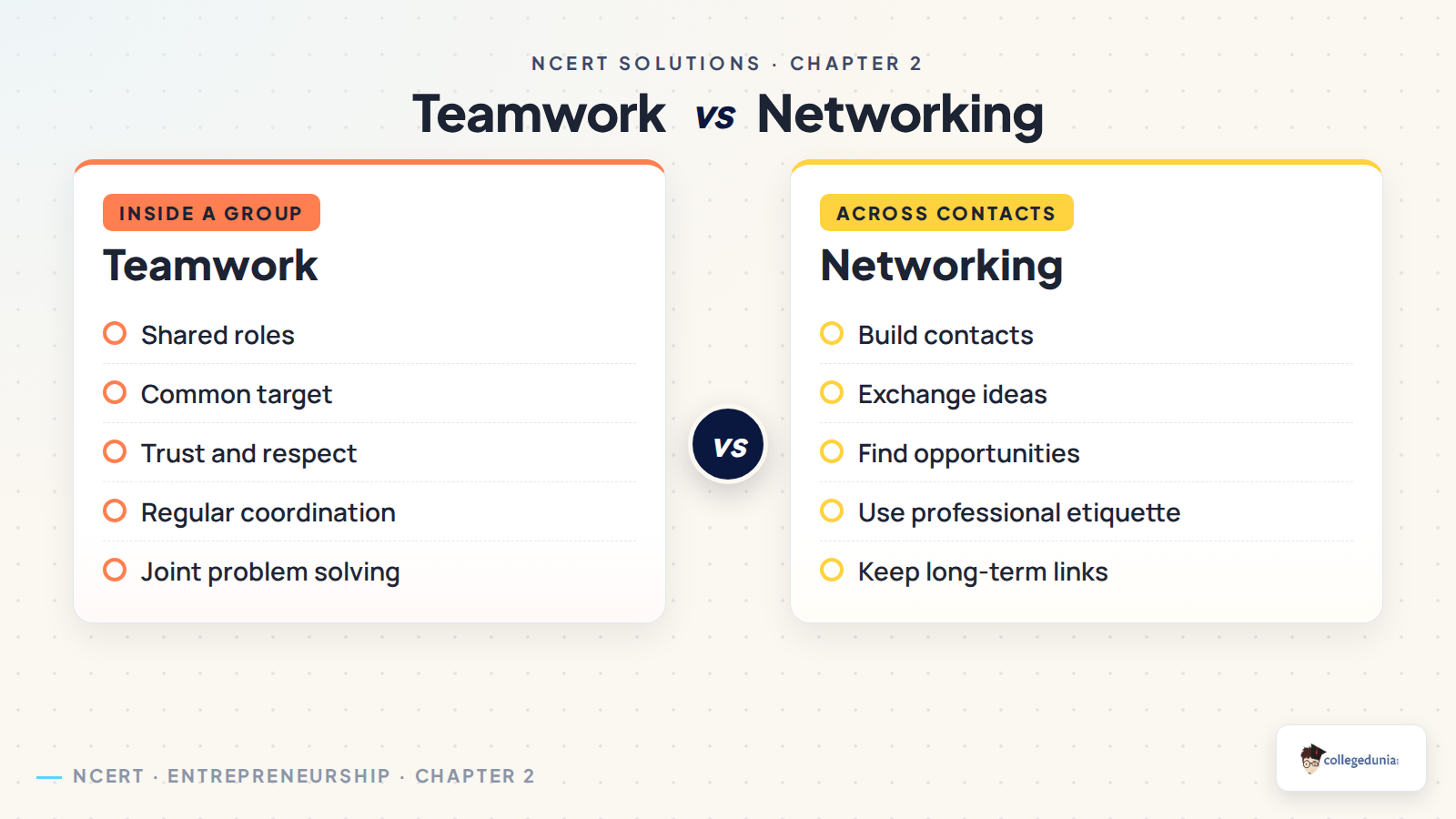
Several questions test whether students can separate related life skills. Teamwork happens inside a group working towards one goal, while networking means building useful contacts through polite and sincere communication.
For teamwork answers, mention roles, shared responsibility, confidence and faster completion.
For networking answers, mention conversation, listening, trust and long-term contact building.
For motivation answers, check whether the reason comes from inside the learner or from an outside reward.
Common Mistakes in Self-management Skills Answers
Most errors in this chapter happen when students write general personality advice instead of answering the exact situation. The PDF keeps each answer linked to the NCERT question wording.
Do not call every neat dress formal. Match clothing with office, school or social context.
Do not confuse self-confidence with self-motivation. Confidence is belief in ability, while motivation is the drive to act.
Do not write only one word for SMART goals. Expand Specific, Measurable, Achievable, Realistic and Timebound.
For time management, include organise, prioritise, control and track.
Class 11 Entrepreneurship Cross-Resource Study Links
Use these linked resources with the solutions PDF when you want a faster revision loop. Read the notes first, solve the question cards next and then use the NCERT book PDF to verify textbook wording.
All NCERT Solutions for Class 11 Entrepreneurship Chapter 2 Self-management Skills with Step-by-Step Solutions
Each question below has two tabs. Check Solution gives the direct textbook-style answer, while Expert Solution adds an examiner-friendly way to organise the same point.
Unit 2 Check Your Progress
Q 2.1
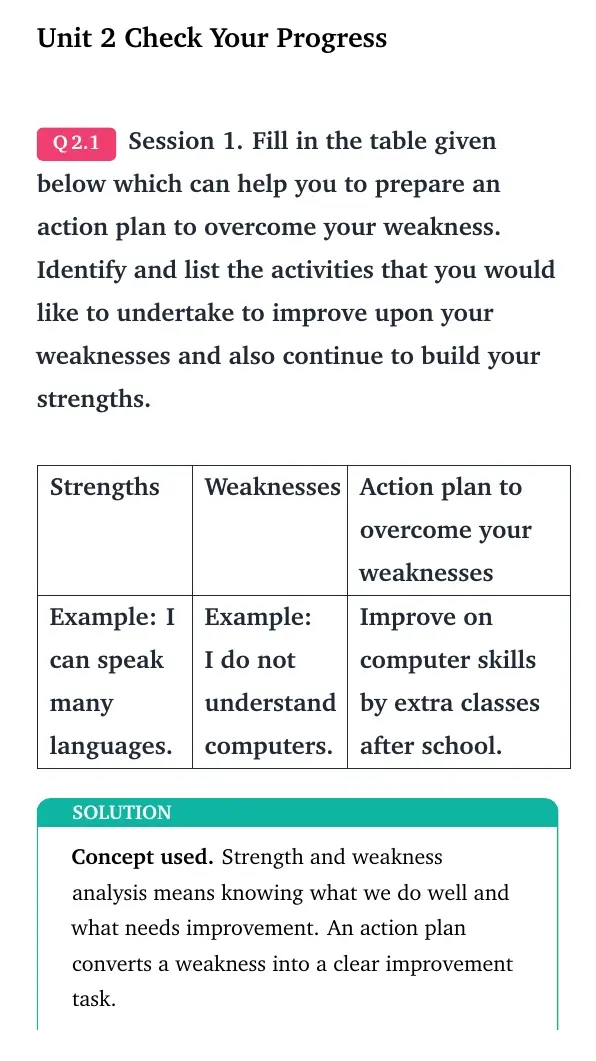
Session 1. Fill in the table given below which can help you to prepare an action plan to overcome your weakness. Identify and list the activities that you would like to undertake to improve upon your weaknesses and also continue to build your strengths.
Strengths
Weaknesses
Action plan to overcome your weaknesses
Example: I can speak many languages.
Example: I do not understand computers.
Improve on computer skills by extra classes after school.
Concept used. Strength and weakness analysis means knowing what we do well and what needs improvement. An action plan converts a weakness into a clear improvement task.
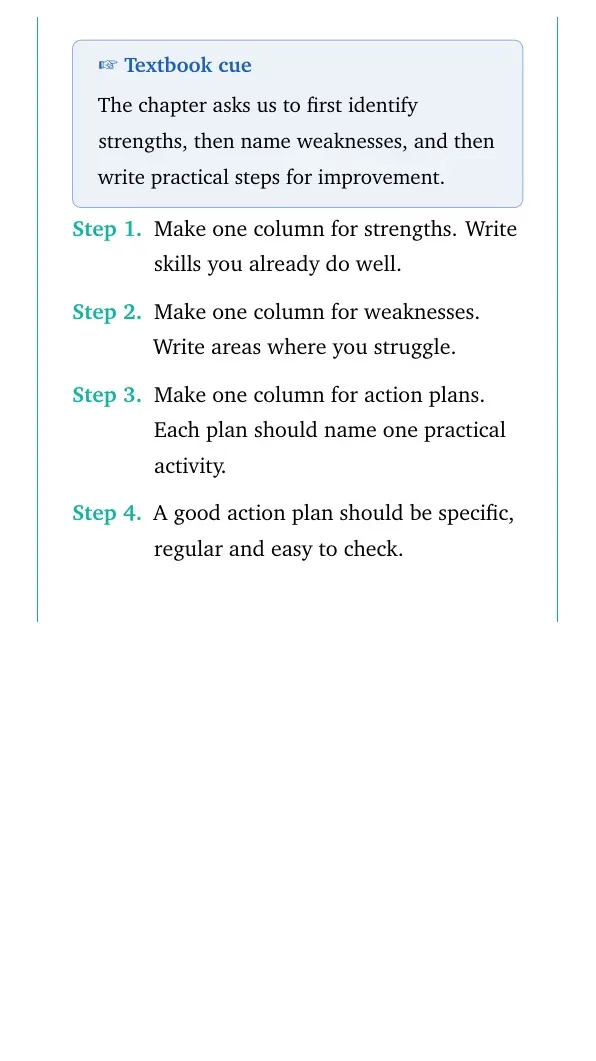
Textbook cue
The chapter asks us to first identify strengths, then name weaknesses, and then write practical steps for improvement.
Make one column for strengths. Write skills you already do well.
Make one column for weaknesses. Write areas where you struggle.
Make one column for action plans. Each plan should name one practical activity.
A good action plan should be specific, regular and easy to check.
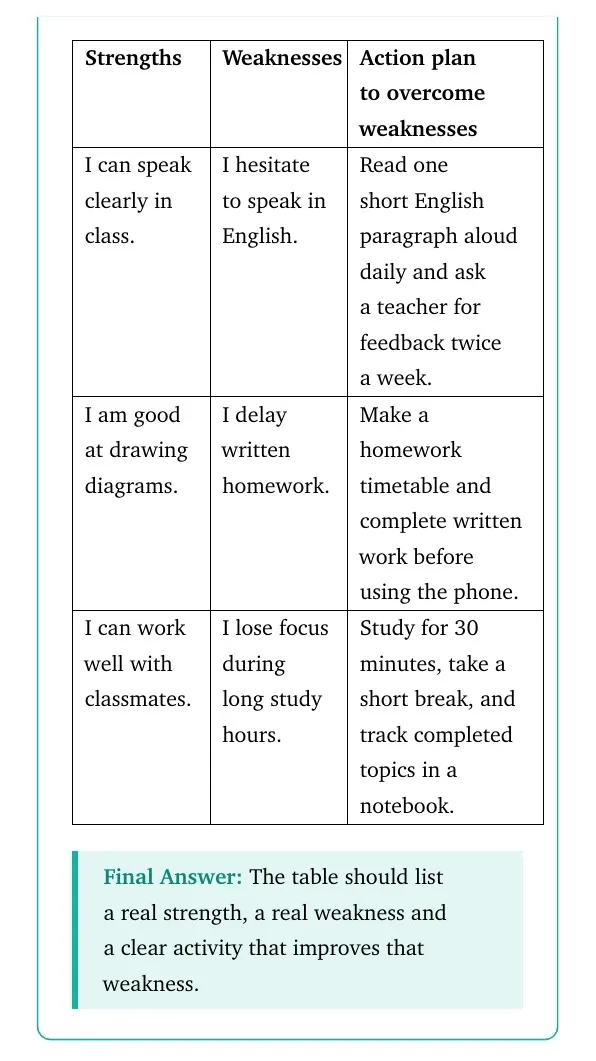
Strengths
Weaknesses
Action plan to overcome weaknesses
I can speak clearly in class.
I hesitate to speak in English.
Read one short English paragraph aloud daily and ask a teacher for feedback twice a week.
I am good at drawing diagrams.
I delay written homework.
Make a homework timetable and complete written work before using the phone.
I can work well with classmates.
I lose focus during long study hours.
Study for 30 minutes, take a short break, and track completed topics in a notebook.
The table should list a real strength, a real weakness and a clear activity that improves that weakness.
AS
Aditi Sharma
MBA Entrepreneurship, Delhi University
Verified Expert
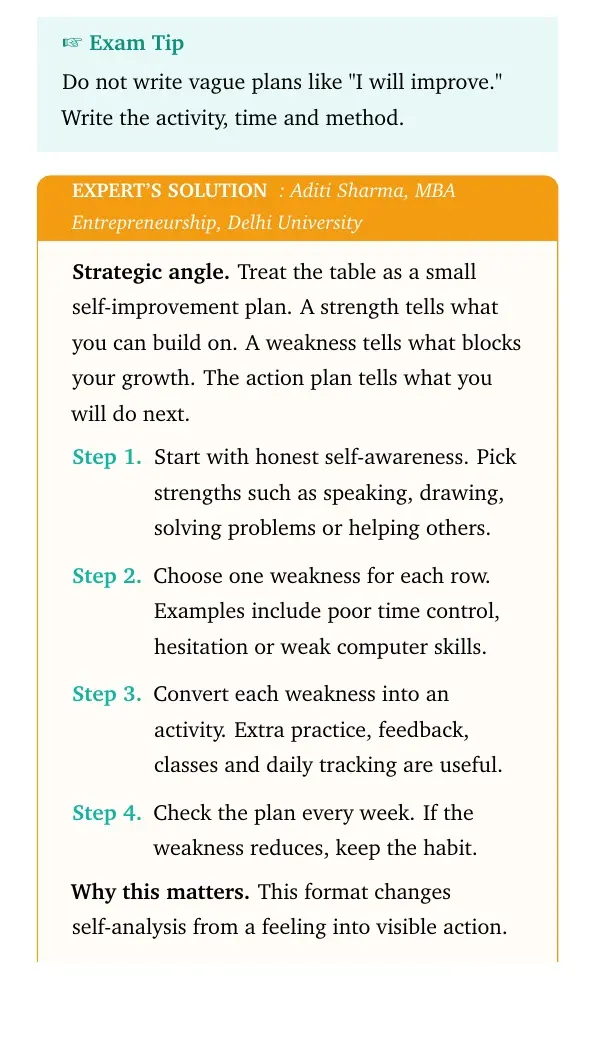
Strategic angle. Treat the table as a small self-improvement plan. A strength tells what you can build on. A weakness tells what blocks your growth. The action plan tells what you will do next.
Start with honest self-awareness. Pick strengths such as speaking, drawing, solving problems or helping others.
Choose one weakness for each row. Examples include poor time control, hesitation or weak computer skills.
Convert each weakness into an activity. Extra practice, feedback, classes and daily tracking are useful.
Check the plan every week. If the weakness reduces, keep the habit.
Why this matters. This format changes self-analysis from a feeling into visible action.
A good action-plan table connects each weakness with a practical, trackable improvement activity.
Q 2.2
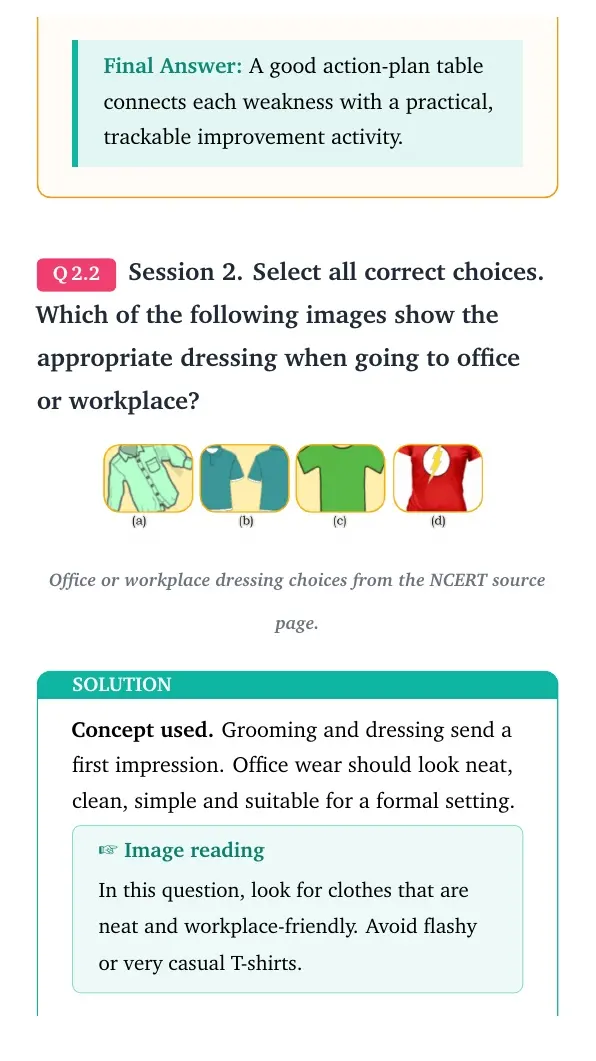
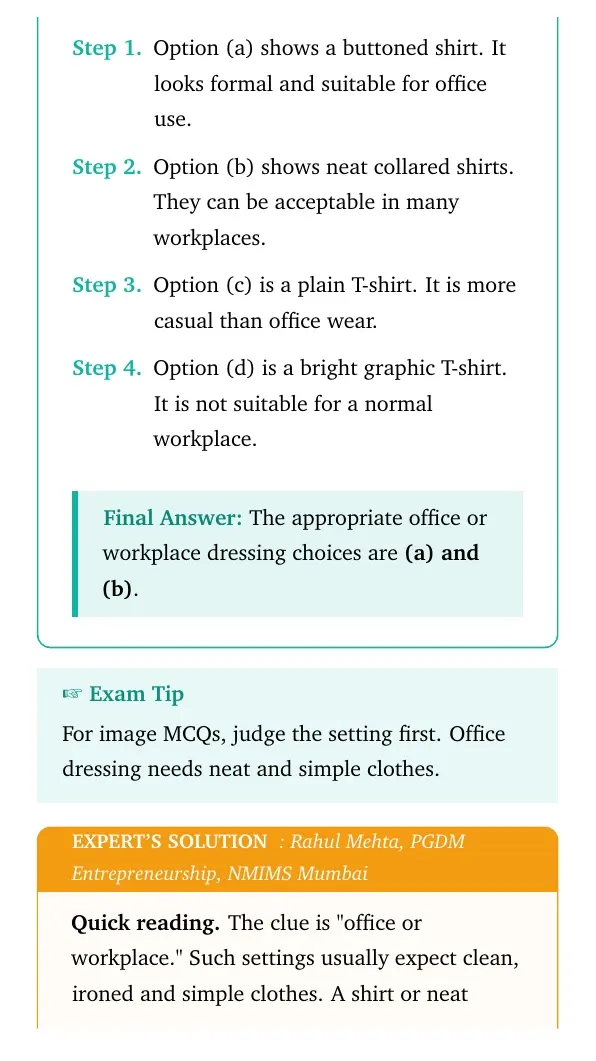
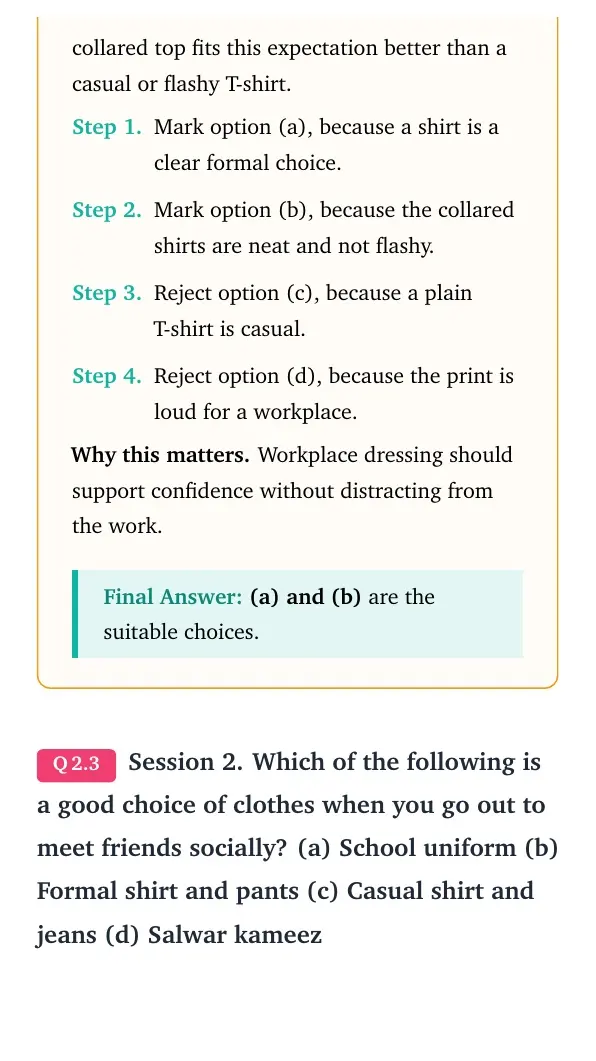
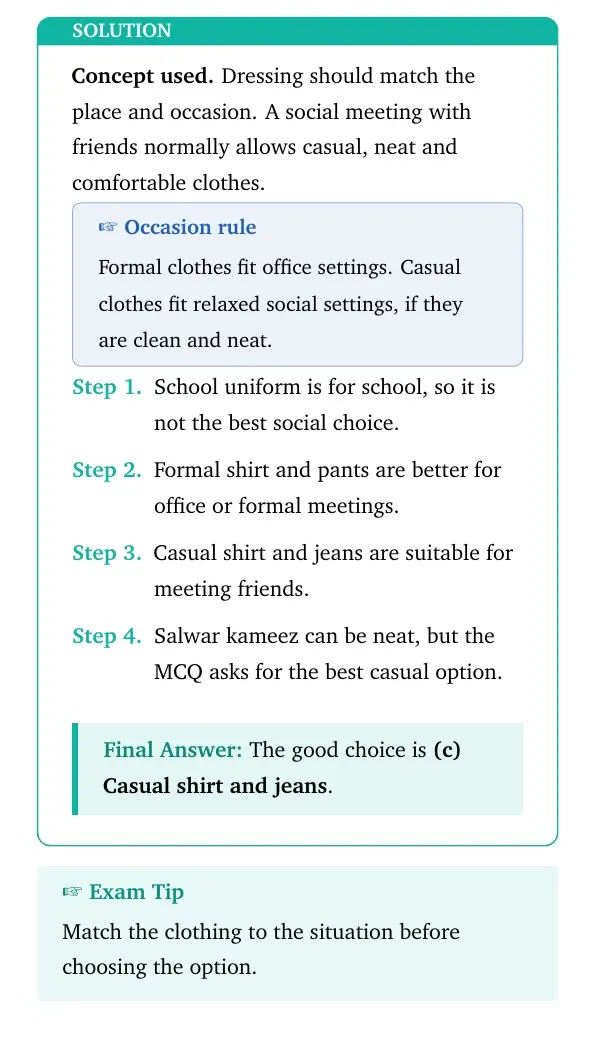
Session 2. Select all correct choices. Which of the following images show the appropriate dressing when going to office or workplace?
Office or workplace dressing choices from the NCERT source page.
Concept used. Grooming and dressing send a first impression. Office wear should look neat, clean, simple and suitable for a formal setting.
Image reading
In this question, look for clothes that are neat and workplace-friendly. Avoid flashy or very casual T-shirts.
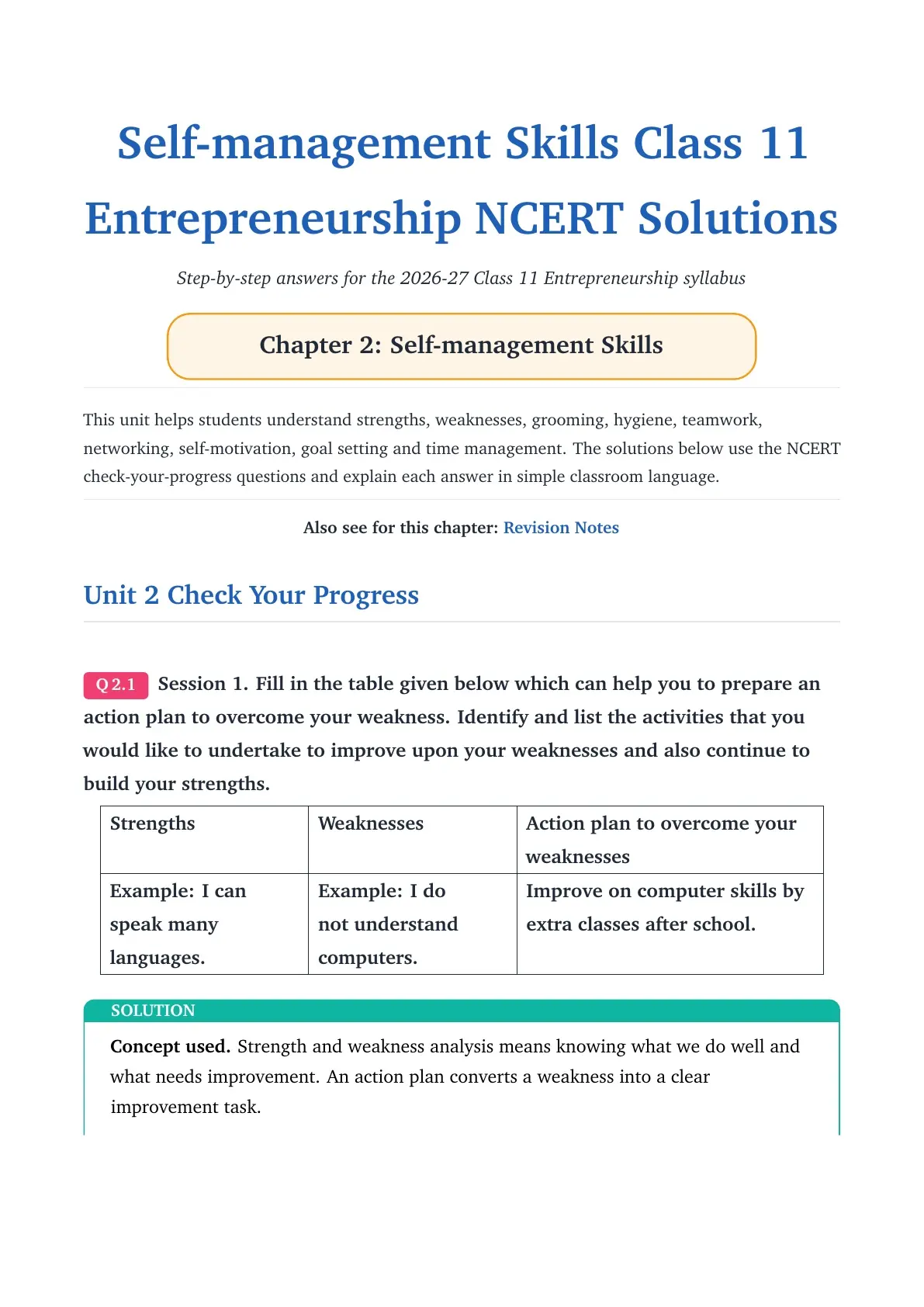
Option (a) shows a buttoned shirt. It looks formal and suitable for office use.
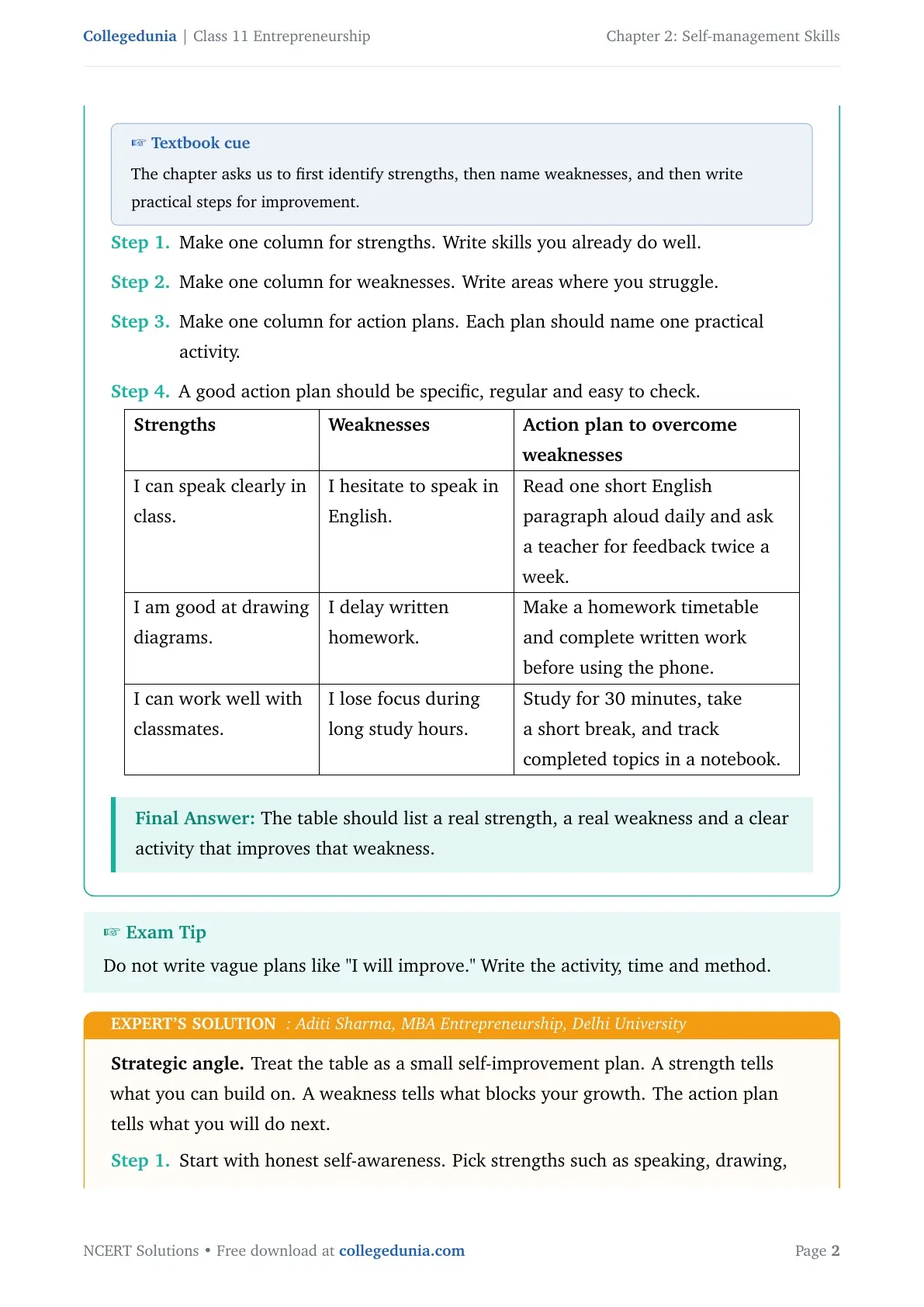
Option (b) shows neat collared shirts. They can be acceptable in many workplaces.
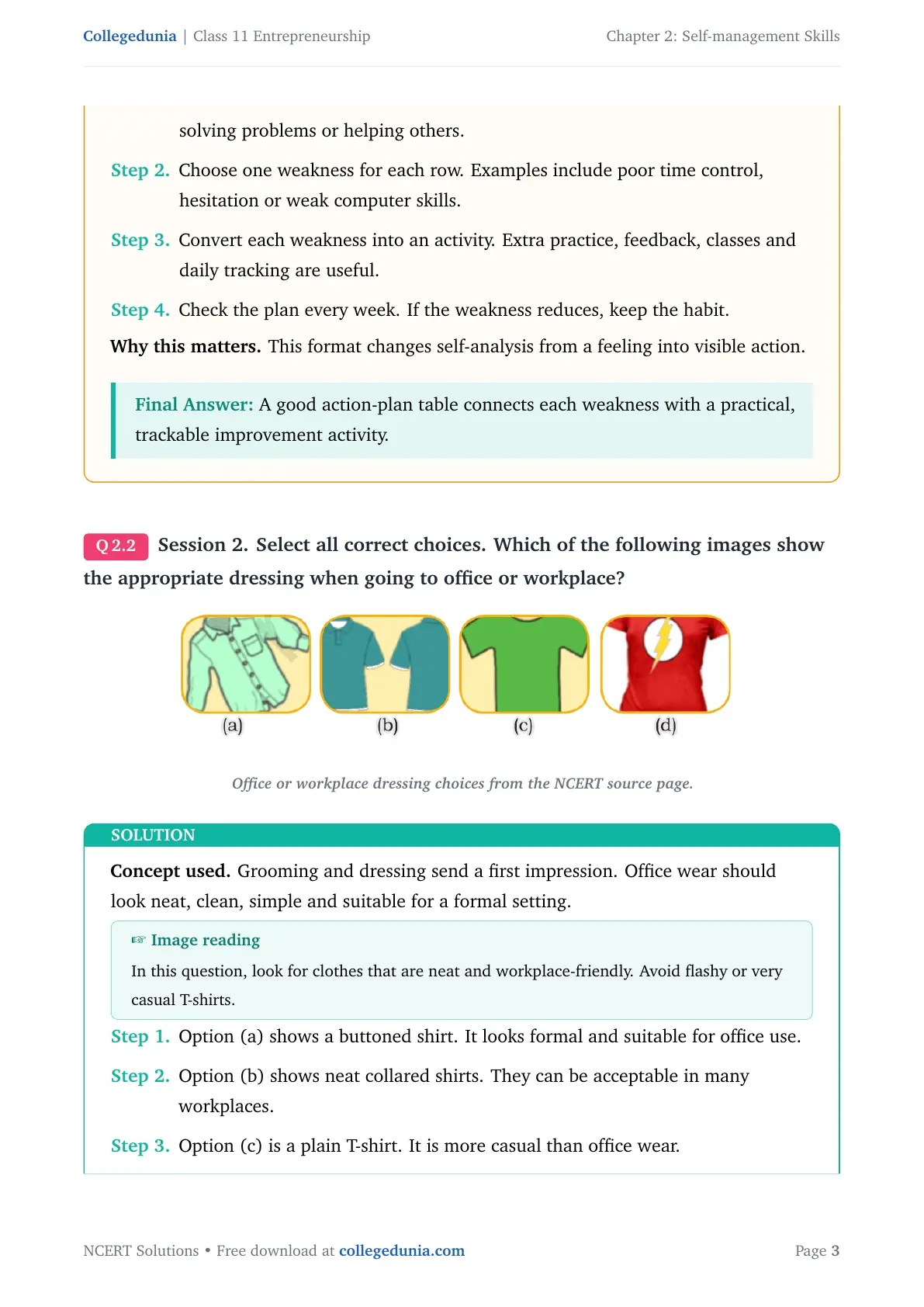
Option (c) is a plain T-shirt. It is more casual than office wear.
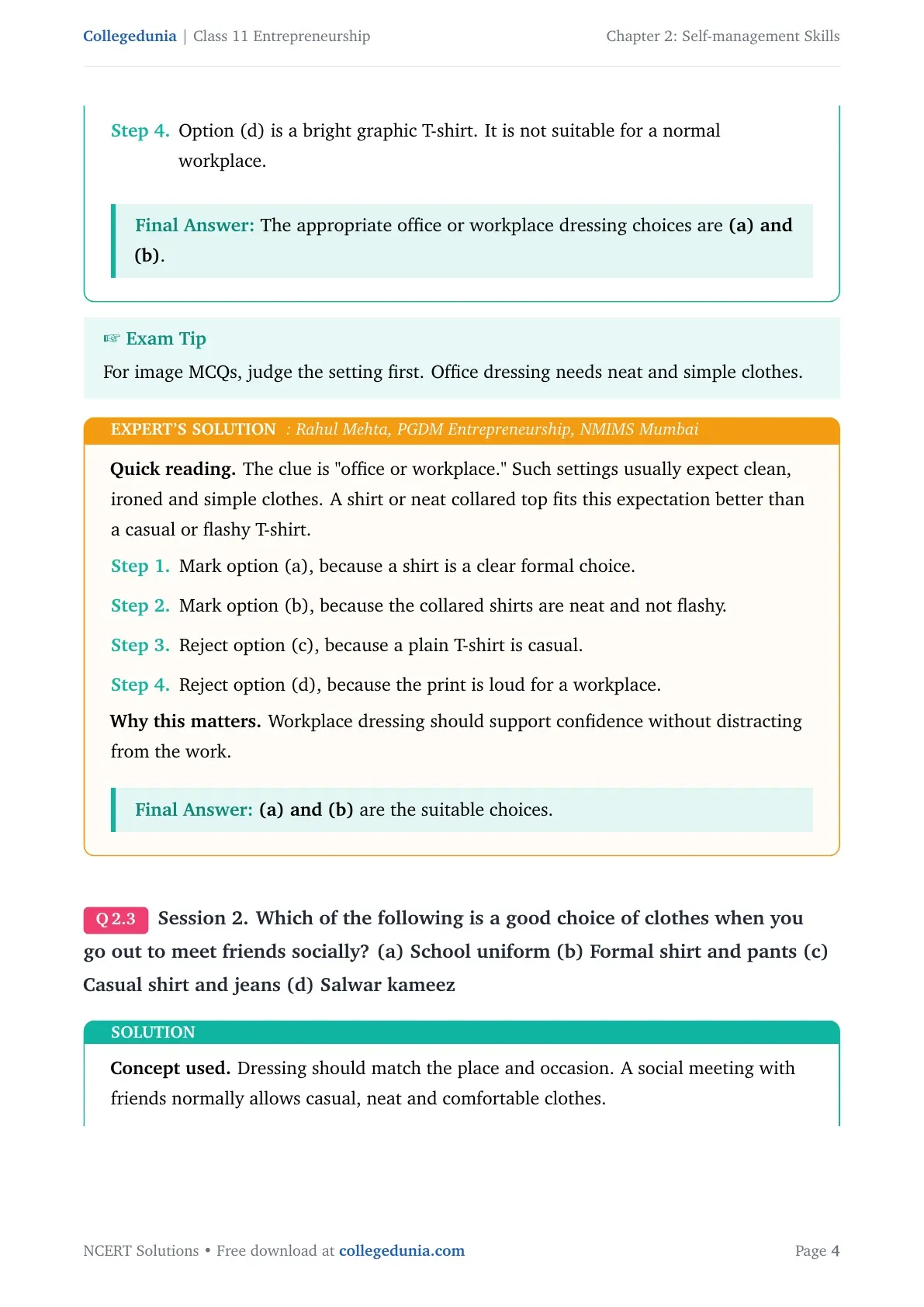
Option (d) is a bright graphic T-shirt. It is not suitable for a normal workplace.
The appropriate office or workplace dressing choices are (a) and (b).
RM
Rahul Mehta
PGDM Entrepreneurship, NMIMS Mumbai
Verified Expert
Quick reading. The clue is "office or workplace." Such settings usually expect clean, ironed and simple clothes. A shirt or neat collared top fits this expectation better than a casual or flashy T-shirt.
Mark option (a), because a shirt is a clear formal choice.
Mark option (b), because the collared shirts are neat and not flashy.
Reject option (c), because a plain T-shirt is casual.
Reject option (d), because the print is loud for a workplace.
Why this matters. Workplace dressing should support confidence without distracting from the work.
(a) and (b) are the suitable choices.
Q 2.3
Session 2. Which of the following is a good choice of clothes when you go out to meet friends socially? (a) School uniform (b) Formal shirt and pants (c) Casual shirt and jeans (d) Salwar kameez
Concept used. Dressing should match the place and occasion. A social meeting with friends normally allows casual, neat and comfortable clothes.
Occasion rule
Formal clothes fit office settings. Casual clothes fit relaxed social settings, if they are clean and neat.
School uniform is for school, so it is not the best social choice.
Formal shirt and pants are better for office or formal meetings.
Casual shirt and jeans are suitable for meeting friends.
Salwar kameez can be neat, but the MCQ asks for the best casual option.
The good choice is (c) Casual shirt and jeans.
KR
Kavita Rao
M.Com Business Studies, University of Delhi
Verified Expert
Strategic angle. The question compares purpose, not fashion. School uniform has a fixed school purpose. Formal shirt and pants suit work. A casual shirt and jeans suit a relaxed meeting with friends.
Eliminate school uniform because the person is not going to school.
Eliminate formal office wear because the setting is social.
Choose casual shirt and jeans because it matches a friendly outing.
Keep the grooming rule: casual still means neat and clean.
Why this matters. Appropriate dressing means choosing clothes by context.
(c) Casual shirt and jeans.
Q 2.4
Session 2. Dressing and grooming does not affect your overall impression on others. (a) True (b) False
Concept used. Grooming affects first impression. The chapter says dressing and grooming can show confidence, neatness and smartness.
Negation check
The sentence says "does not affect." Since grooming does affect impression, the statement is false.
Dressing means the clothes we wear.
Grooming means keeping ourselves neat, tidy and clean.
The chapter says these habits send a message about confidence and smartness.
So the statement that grooming does not affect impression is incorrect.
The correct answer is (b) False.
NS
Neha Sethi
MBA Finance, Symbiosis Pune
Verified Expert
Quick reading. This is a true-false question with a negative phrase. The chapter clearly connects grooming with confidence and impression. Therefore the negative statement is not correct.
Read the claim: grooming does not affect overall impression.
Compare it with the chapter idea: grooming helps us look neat and confident.
Since the claim contradicts the chapter idea, mark it false.
Why this matters. Negative true-false questions often test careful reading.
False. Dressing and grooming do affect overall impression.
Q 2.5
Session 3. You have just finished attending a class in a biology lab. You have to go back to your classroom for other classes. After the lab, should you wash your hands? (a) Not really, you did not use the washroom as such. (b) You can just clean your hands under running water. (c) You should follow your hand-wash routine: wash, rinse and dry.
Concept used. Personal hygiene means keeping ourselves clean to stay healthy. Hand washing removes dirt and germs after lab work.
Hygiene cue
The chapter says to wash hands as many times as needed, such as when they are dirty.
A biology lab may have dust, specimens, chemicals or surfaces touched by many students.
Only rinsing under water is incomplete because soap and proper drying matter.
The safest habit is to wash, rinse and dry hands before returning to class.
The correct answer is (c) You should follow your hand-wash routine: wash, rinse and dry.
PI
Pranav Iyer
M.Sc Public Health, TISS Mumbai
Verified Expert
Strategic angle. A lab is a shared work area. Even if the student has not used the washroom, hands may carry germs or dirt from lab surfaces. Proper washing protects the student and classmates.
Identify the risk: lab surfaces may not be clean.
Compare the options: no washing and water-only cleaning are weak choices.
Pick the complete hygiene routine: wash, rinse and dry.
Why this matters. Good hand hygiene stops many common infections from spreading.
(c) is correct.
Q 2.6
Session 3. Do you think people living in hill stations can skip taking bath for many days? (a) No, irrespective of the climate, one should take a bath regularly. (b) Not taking bath for many days is acceptable for people staying in cold climate. (c) If you wipe yourself with a wet cloth, that is enough.
Concept used. Personal hygiene is a daily habit. Climate may change comfort, but it does not remove the need for regular cleanliness.
Reasoning cue
Cold weather can reduce sweating, but germs and body odour can still build up.
Bathing helps remove sweat, dirt and germs from the body.
People in cold areas still need regular cleaning.
A wet cloth may help briefly, but it is not a full replacement for bathing.
The correct answer is (a) No, irrespective of the climate, one should take a bath regularly.
TN
Tara Nair
M.Sc Health Education, Delhi University
Verified Expert
Quick reading. The strongest option uses the word "regularly." That matches the chapter's WASH step. A cold climate does not make poor hygiene acceptable.
Read the core issue: can people skip bathing for many days?
Apply the WASH rule: take a bath every day or as needed.
Reject options that excuse long gaps in bathing.
Why this matters. Personal hygiene protects health and also builds a clean public image.
(a) is correct.
Q 2.7
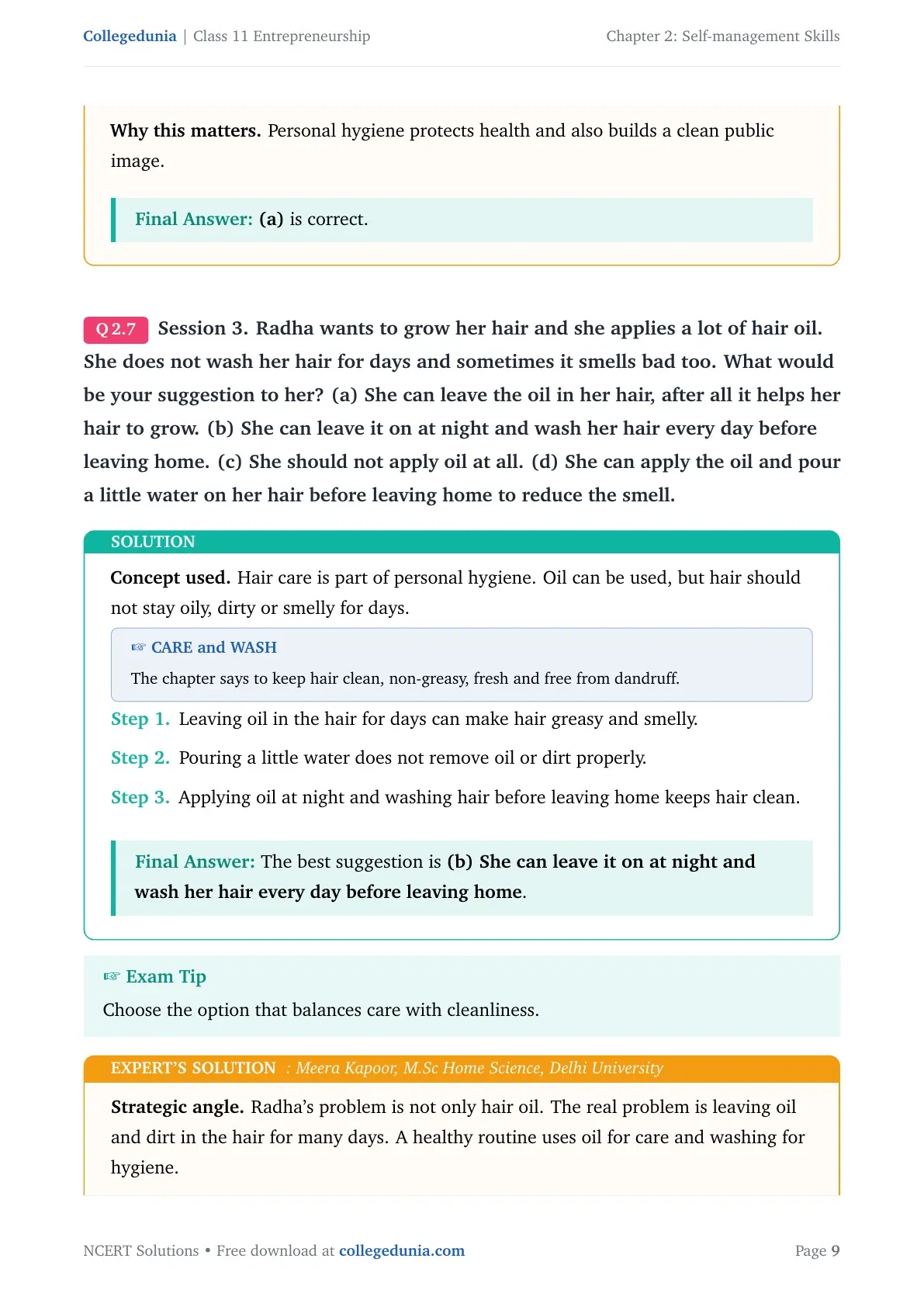
Session 3. Radha wants to grow her hair and she applies a lot of hair oil. She does not wash her hair for days and sometimes it smells bad too. What would be your suggestion to her? (a) She can leave the oil in her hair, after all it helps her hair to grow. (b) She can leave it on at night and wash her hair every day before leaving home. (c) She should not apply oil at all. (d) She can apply the oil and pour a little water on her hair before leaving home to reduce the smell.
Concept used. Hair care is part of personal hygiene. Oil can be used, but hair should not stay oily, dirty or smelly for days.
CARE and WASH
The chapter says to keep hair clean, non-greasy, fresh and free from dandruff.
Leaving oil in the hair for days can make hair greasy and smelly.
Pouring a little water does not remove oil or dirt properly.
Applying oil at night and washing hair before leaving home keeps hair clean.
The best suggestion is (b) She can leave it on at night and wash her hair every day before leaving home.
MK
Meera Kapoor
M.Sc Home Science, Delhi University
Verified Expert
Strategic angle. Radha's problem is not only hair oil. The real problem is leaving oil and dirt in the hair for many days. A healthy routine uses oil for care and washing for hygiene.
Identify the poor habit: not washing hair for days.
Keep the useful part: oil may be applied for a limited time.
Add the hygiene step: wash hair properly before going out.
Why this matters. Clean hair prevents smell and supports a neat appearance.
(b) is correct.
Q 2.8
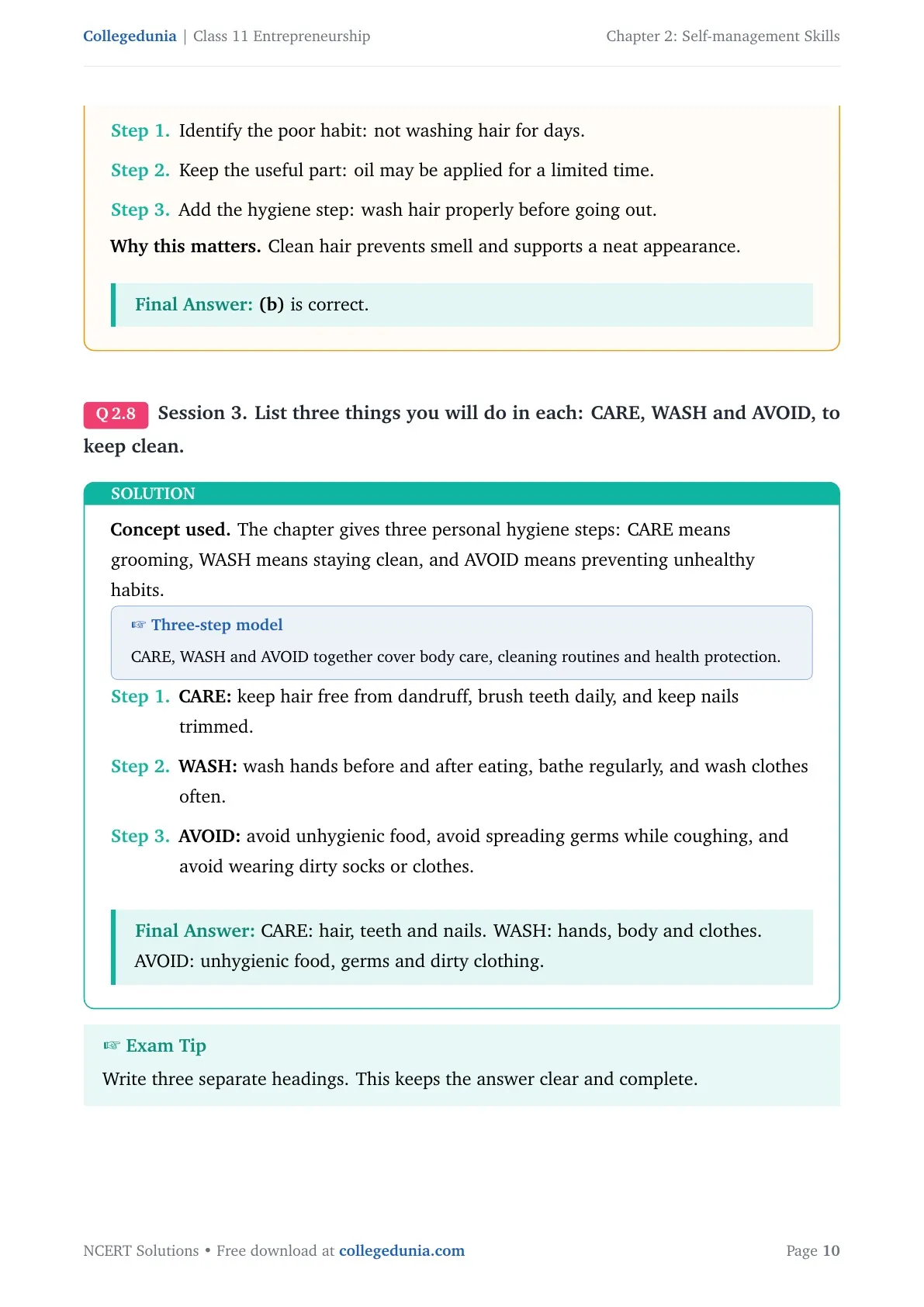
Session 3. List three things you will do in each: CARE, WASH and AVOID, to keep clean.
Concept used. The chapter gives three personal hygiene steps: CARE means grooming, WASH means staying clean, and AVOID means preventing unhealthy habits.
Three-step model
CARE, WASH and AVOID together cover body care, cleaning routines and health protection.
CARE: keep hair free from dandruff, brush teeth daily, and keep nails trimmed.
WASH: wash hands before and after eating, bathe regularly, and wash clothes often.
AVOID: avoid unhygienic food, avoid spreading germs while coughing, and avoid wearing dirty socks or clothes.
CARE: hair, teeth and nails. WASH: hands, body and clothes. AVOID: unhygienic food, germs and dirty clothing.
PD
Pooja Desai
M.Sc Home Science, Mumbai University
Verified Expert
Quick reading. The question is asking for a classified list, not a paragraph. CARE covers personal grooming. WASH covers cleaning actions. AVOID covers choices that prevent bad hygiene and sickness.
Under CARE, write daily grooming habits: hair, teeth and nails.
Under WASH, write cleaning habits: hands, bath and clothes.
Under AVOID, write prevention habits: unhygienic food, germ spread and dirty clothing.
Why this matters. A classified answer helps the examiner see all three parts.
List three correct habits under each heading: CARE, WASH and AVOID.
Q 2.9
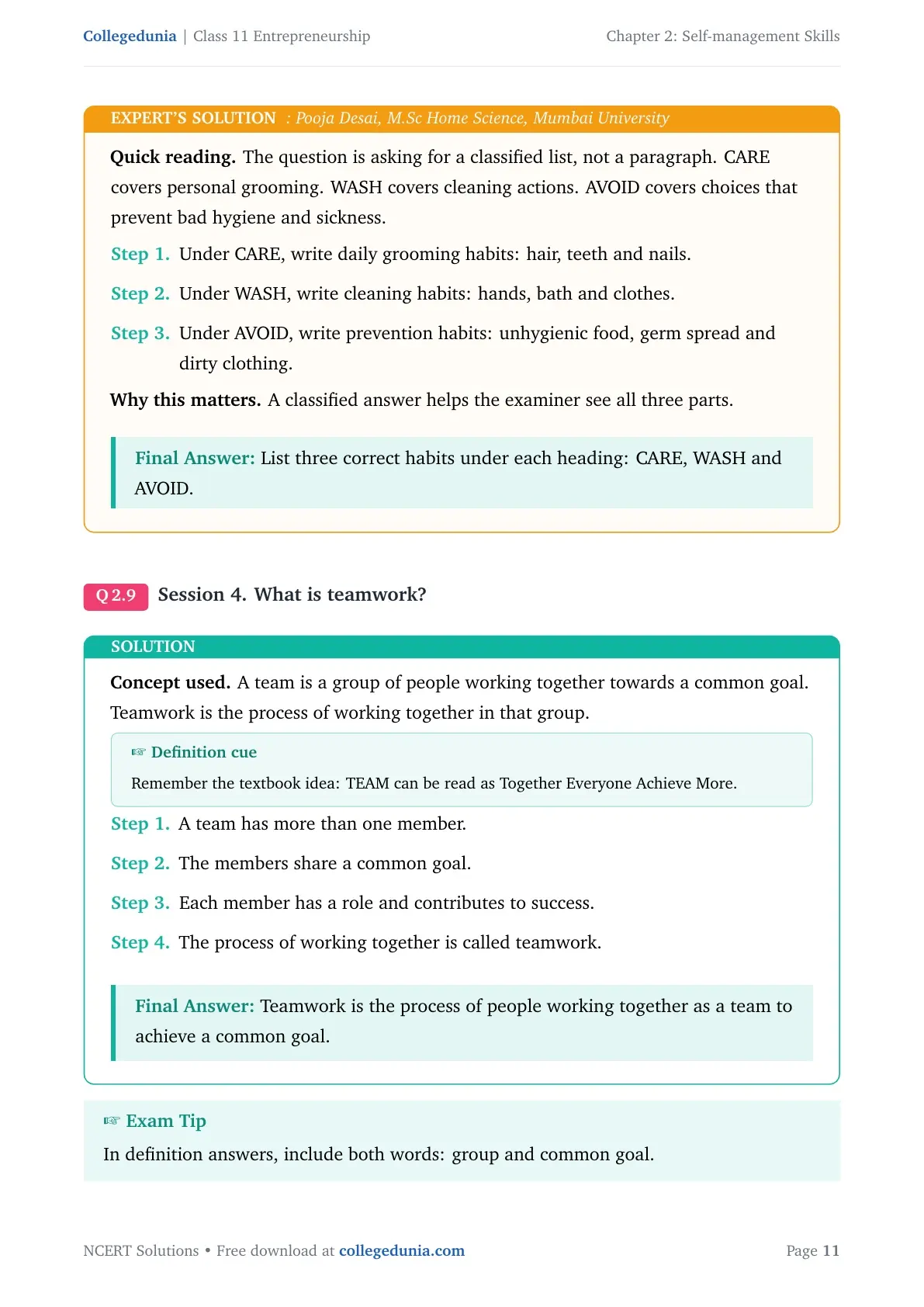
Session 4. What is teamwork?
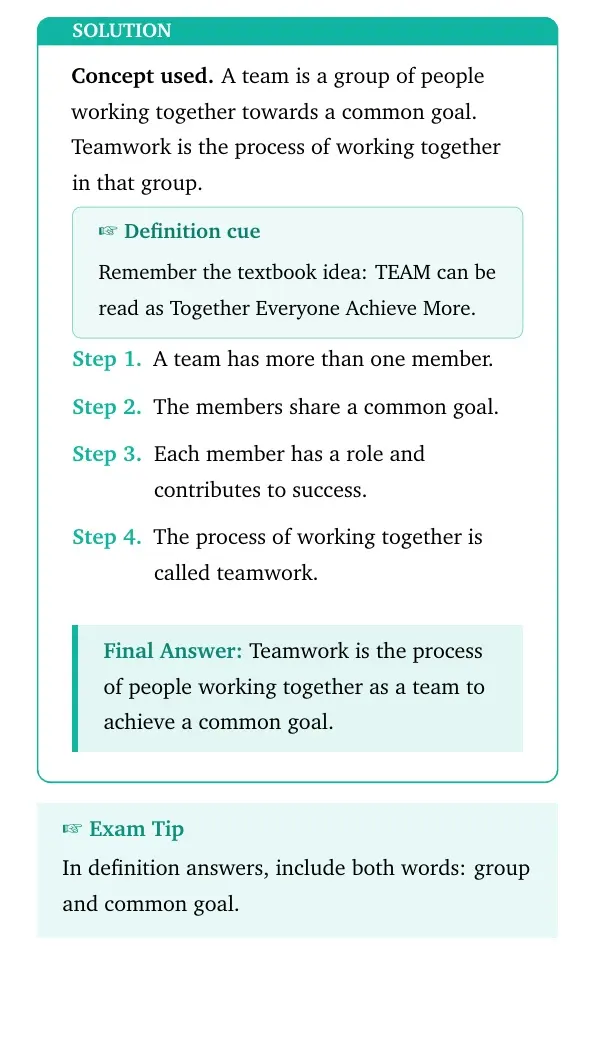
Concept used. A team is a group of people working together towards a common goal. Teamwork is the process of working together in that group.
Definition cue
Remember the textbook idea: TEAM can be read as Together Everyone Achieve More.
A team has more than one member.
The members share a common goal.
Each member has a role and contributes to success.
The process of working together is called teamwork.
Teamwork is the process of people working together as a team to achieve a common goal.
AS
Arjun Singh
MBA Human Resources, XLRI Jamshedpur
Verified Expert
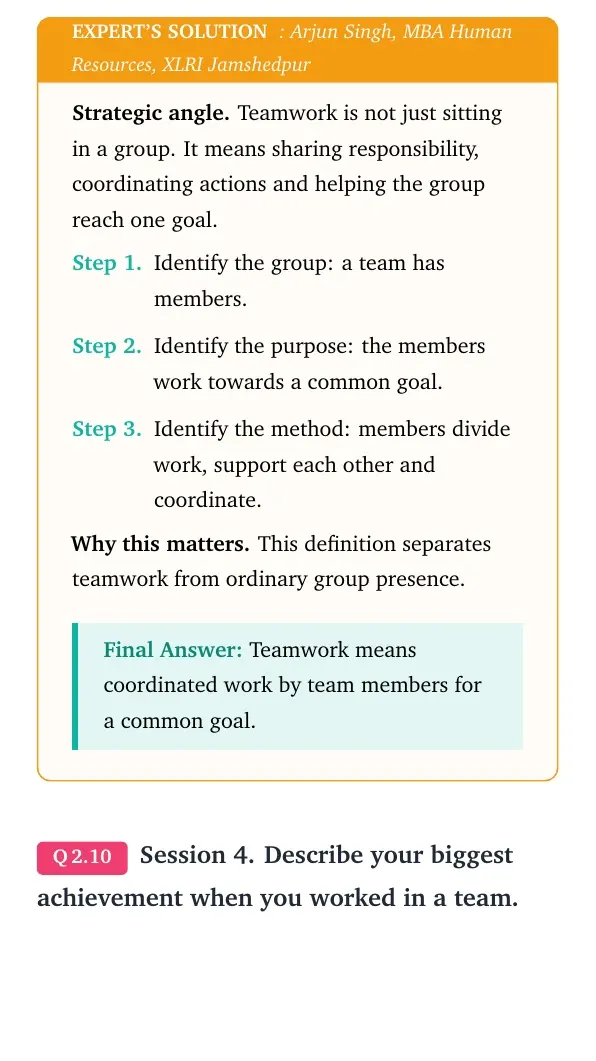
Strategic angle. Teamwork is not just sitting in a group. It means sharing responsibility, coordinating actions and helping the group reach one goal.
Identify the group: a team has members.
Identify the purpose: the members work towards a common goal.
Identify the method: members divide work, support each other and coordinate.
Why this matters. This definition separates teamwork from ordinary group presence.
Teamwork means coordinated work by team members for a common goal.
Q 2.10
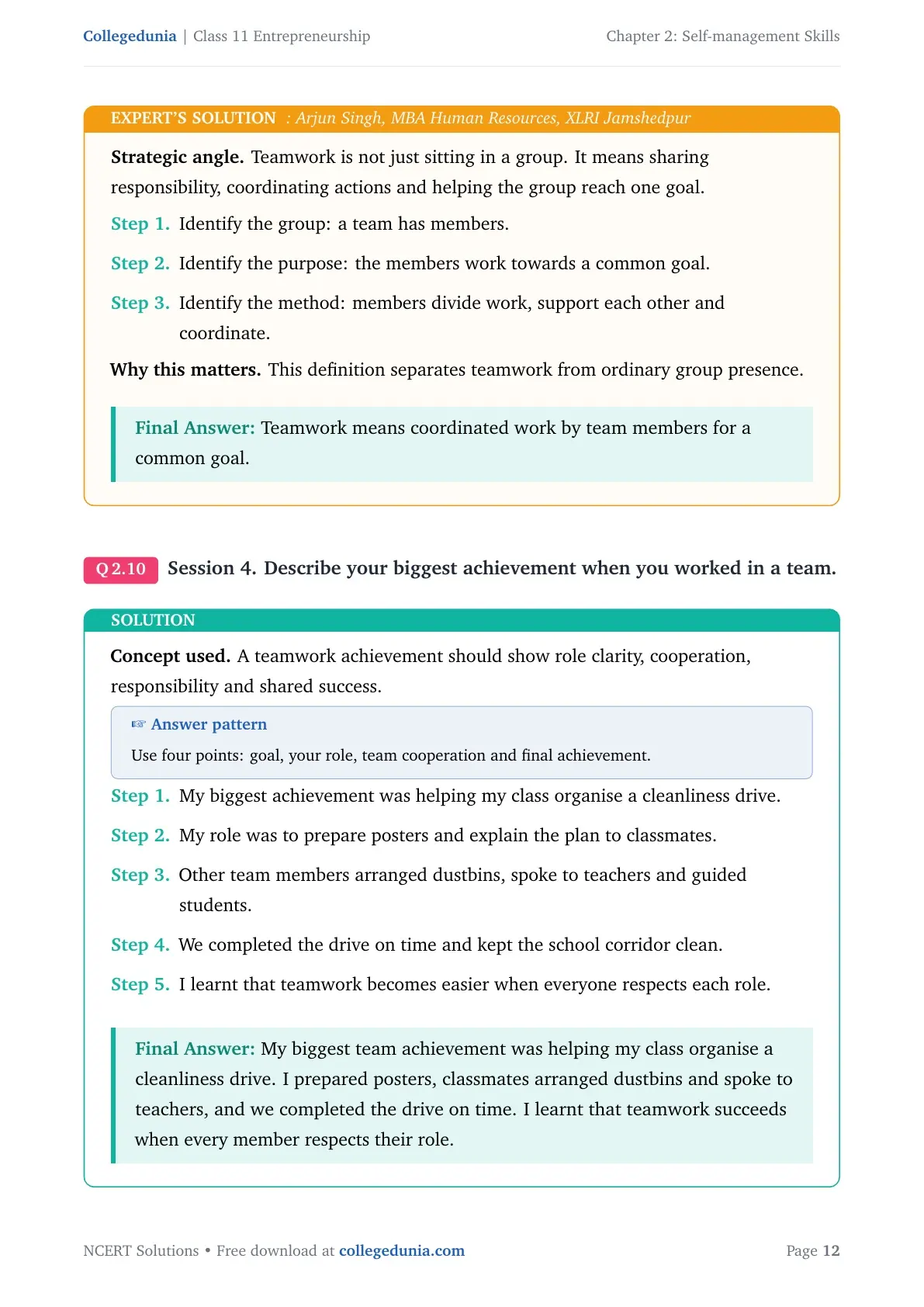
Session 4. Describe your biggest achievement when you worked in a team.
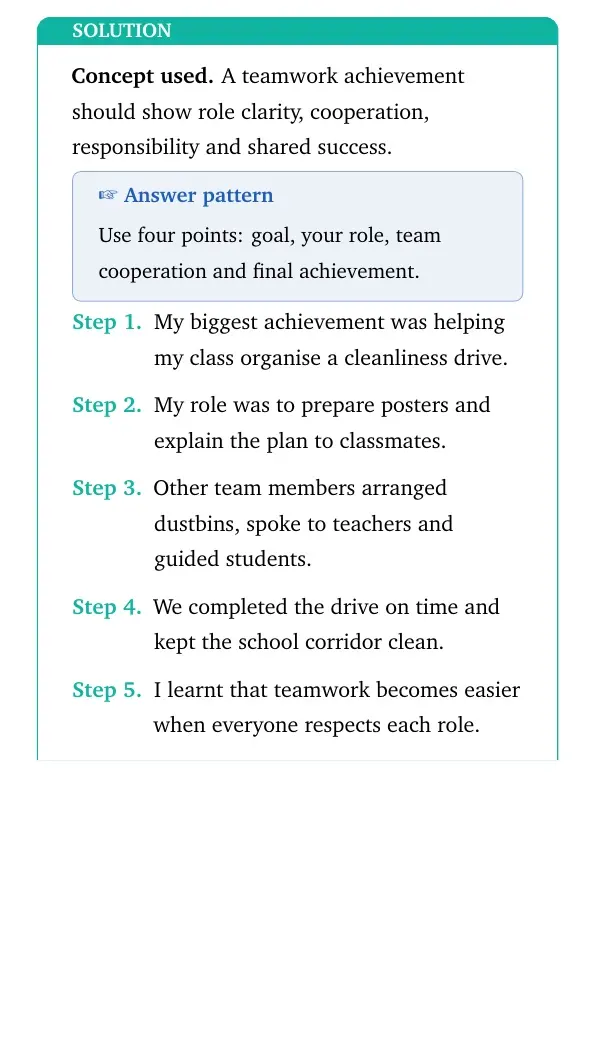
Concept used. A teamwork achievement should show role clarity, cooperation, responsibility and shared success.
Answer pattern
Use four points: goal, your role, team cooperation and final achievement.
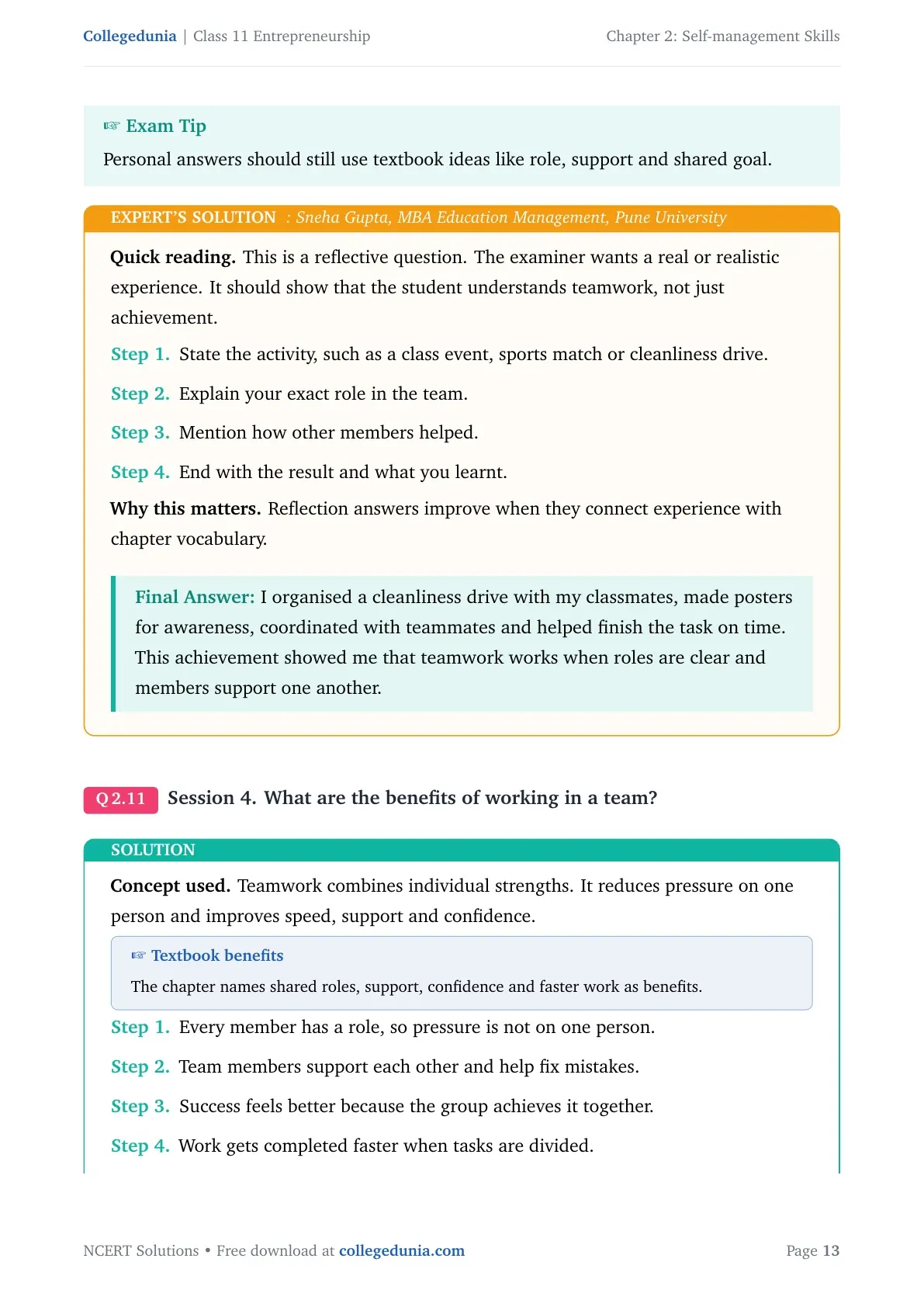
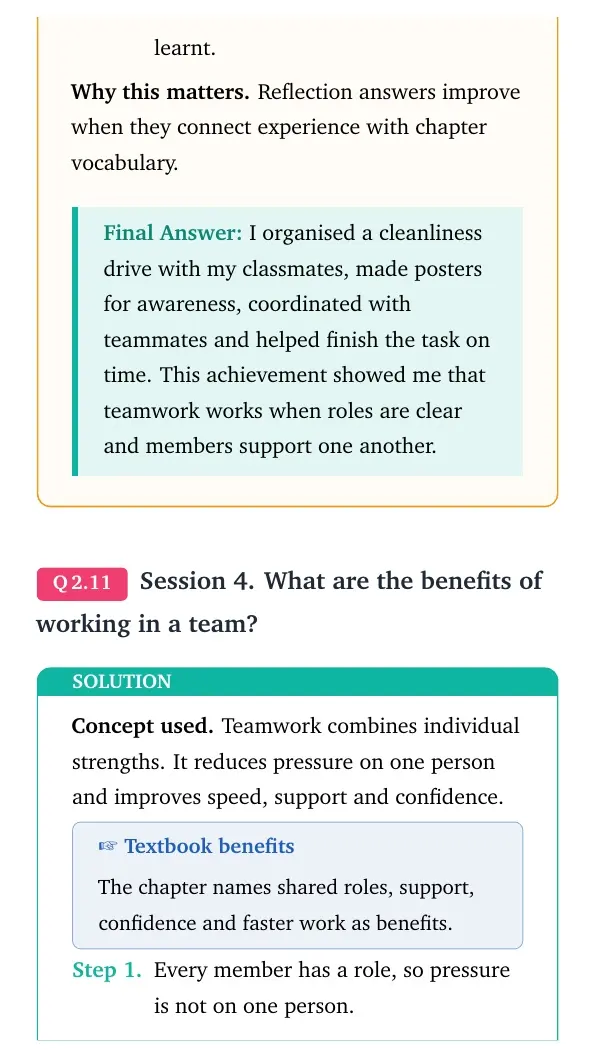
My biggest achievement was helping my class organise a cleanliness drive.
My role was to prepare posters and explain the plan to classmates.
Other team members arranged dustbins, spoke to teachers and guided students.
We completed the drive on time and kept the school corridor clean.
I learnt that teamwork becomes easier when everyone respects each role.
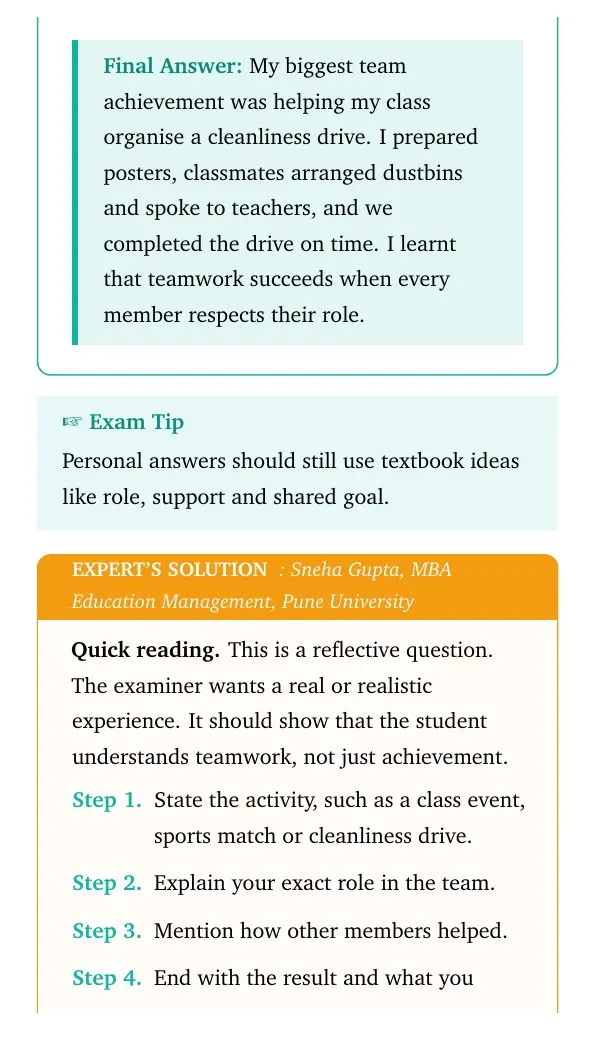
My biggest team achievement was helping my class organise a cleanliness drive. I prepared posters, classmates arranged dustbins and spoke to teachers, and we completed the drive on time. I learnt that teamwork succeeds when every member respects their role.
SG
Sneha Gupta
MBA Education Management, Pune University
Verified Expert
Quick reading. This is a reflective question. The examiner wants a real or realistic experience. It should show that the student understands teamwork, not just achievement.
State the activity, such as a class event, sports match or cleanliness drive.
Explain your exact role in the team.
Mention how other members helped.
End with the result and what you learnt.
Why this matters. Reflection answers improve when they connect experience with chapter vocabulary.
I organised a cleanliness drive with my classmates, made posters for awareness, coordinated with teammates and helped finish the task on time. This achievement showed me that teamwork works when roles are clear and members support one another.
Q 2.11
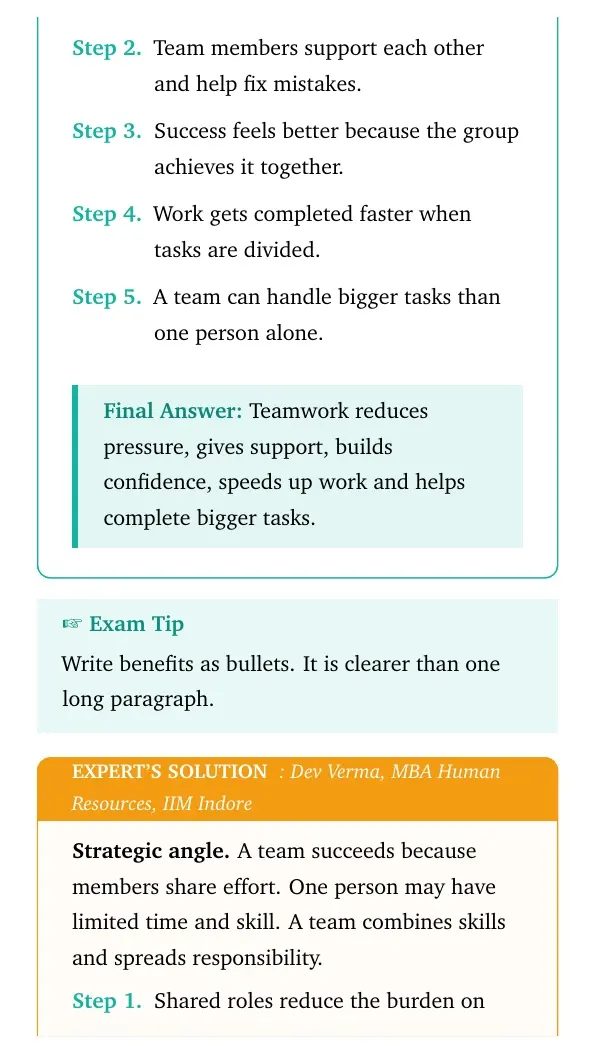
Session 4. What are the benefits of working in a team?
Concept used. Teamwork combines individual strengths. It reduces pressure on one person and improves speed, support and confidence.
Textbook benefits
The chapter names shared roles, support, confidence and faster work as benefits.
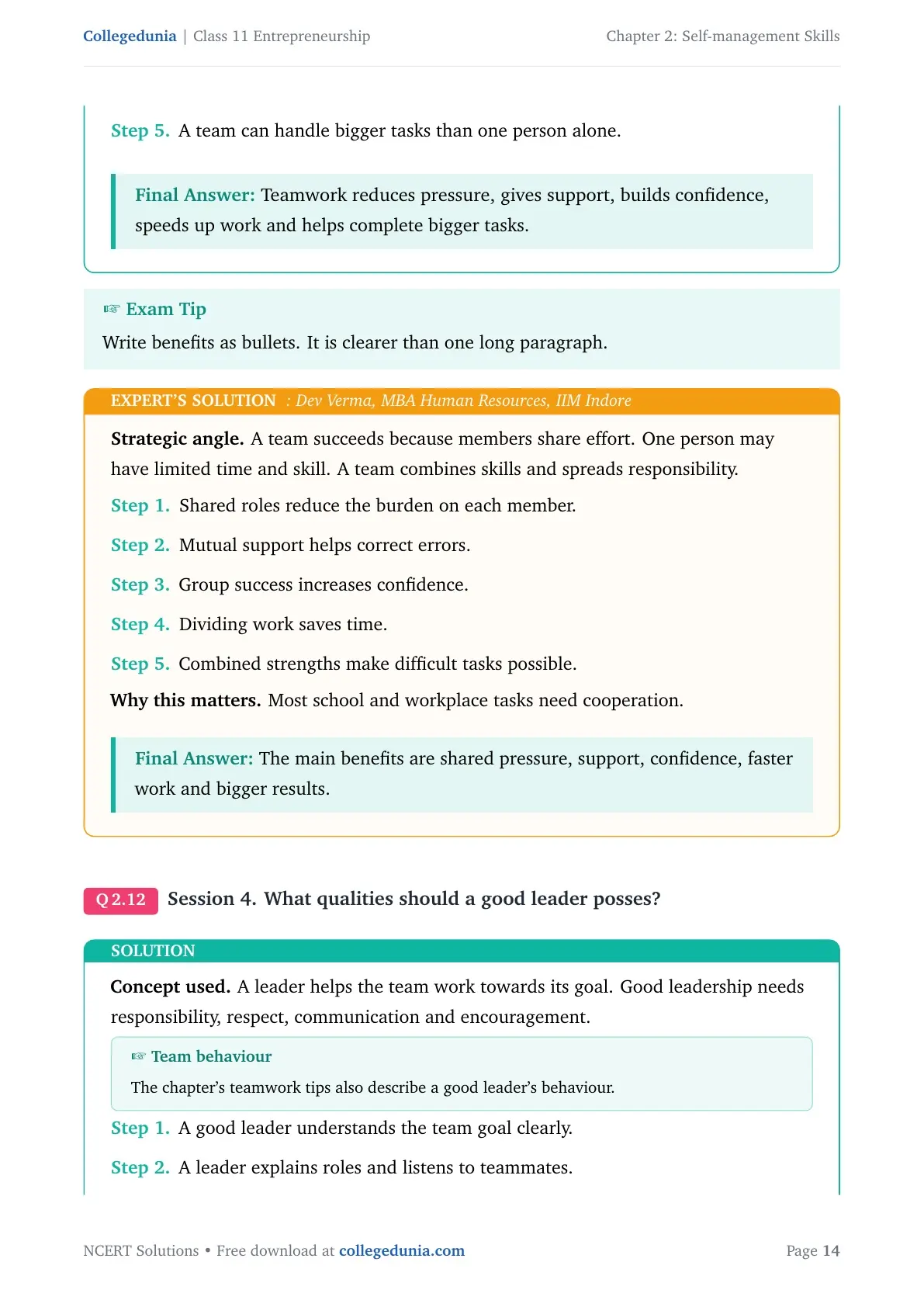
Every member has a role, so pressure is not on one person.
Team members support each other and help fix mistakes.
Success feels better because the group achieves it together.
Work gets completed faster when tasks are divided.
A team can handle bigger tasks than one person alone.
Teamwork reduces pressure, gives support, builds confidence, speeds up work and helps complete bigger tasks.
DV
Dev Verma
MBA Human Resources, IIM Indore
Verified Expert
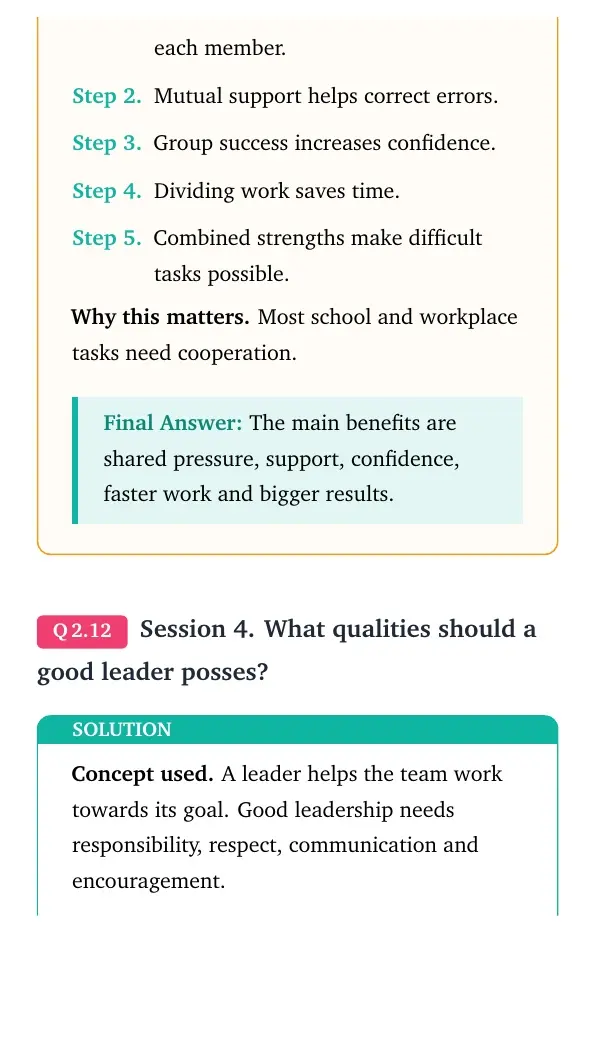
Strategic angle. A team succeeds because members share effort. One person may have limited time and skill. A team combines skills and spreads responsibility.
Shared roles reduce the burden on each member.
Mutual support helps correct errors.
Group success increases confidence.
Dividing work saves time.
Combined strengths make difficult tasks possible.
Why this matters. Most school and workplace tasks need cooperation.
The main benefits are shared pressure, support, confidence, faster work and bigger results.
Q 2.12
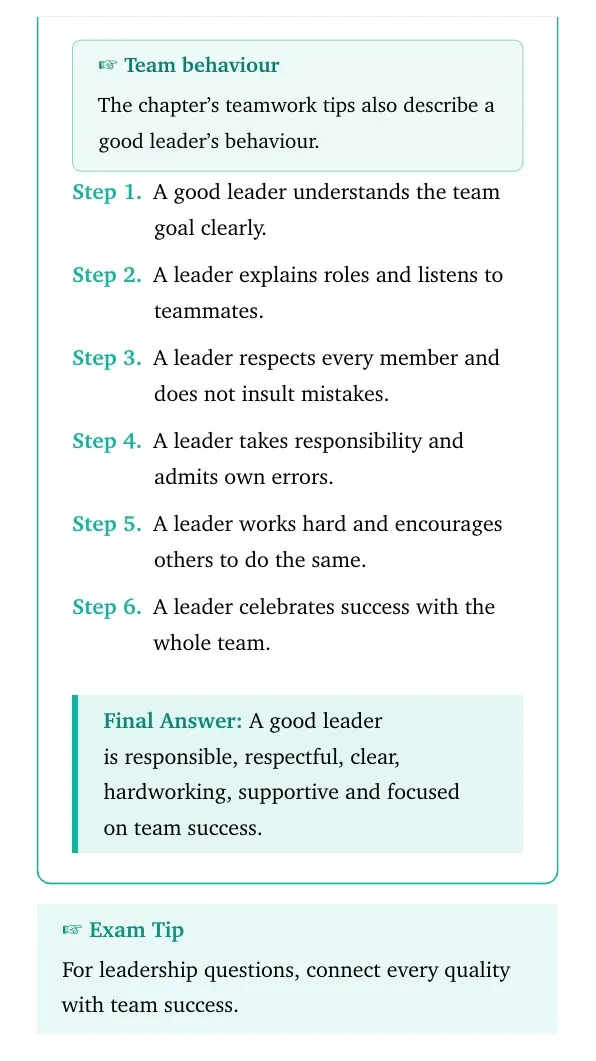
Session 4. What qualities should a good leader posses?
Concept used. A leader helps the team work towards its goal. Good leadership needs responsibility, respect, communication and encouragement.
Team behaviour
The chapter's teamwork tips also describe a good leader's behaviour.
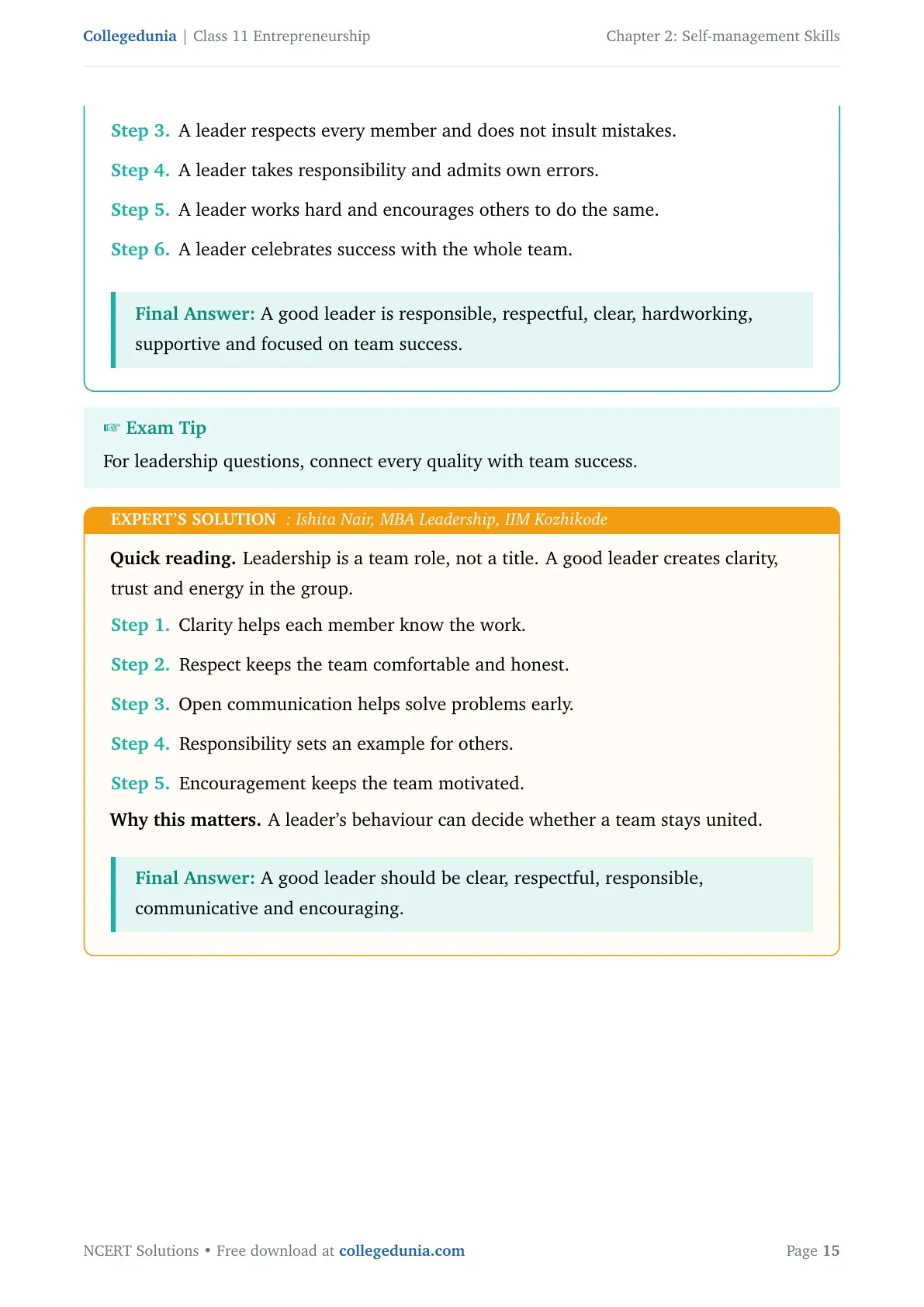
A good leader understands the team goal clearly.
A leader explains roles and listens to teammates.
A leader respects every member and does not insult mistakes.
A leader takes responsibility and admits own errors.
A leader works hard and encourages others to do the same.
A leader celebrates success with the whole team.
A good leader is responsible, respectful, clear, hardworking, supportive and focused on team success.
IN
Ishita Nair
MBA Leadership, IIM Kozhikode
Verified Expert
Quick reading. Leadership is a team role, not a title. A good leader creates clarity, trust and energy in the group.
Clarity helps each member know the work.
Respect keeps the team comfortable and honest.
Open communication helps solve problems early.
Responsibility sets an example for others.
Encouragement keeps the team motivated.
Why this matters. A leader's behaviour can decide whether a team stays united.
A good leader should be clear, respectful, responsible, communicative and encouraging.
Q 2.13
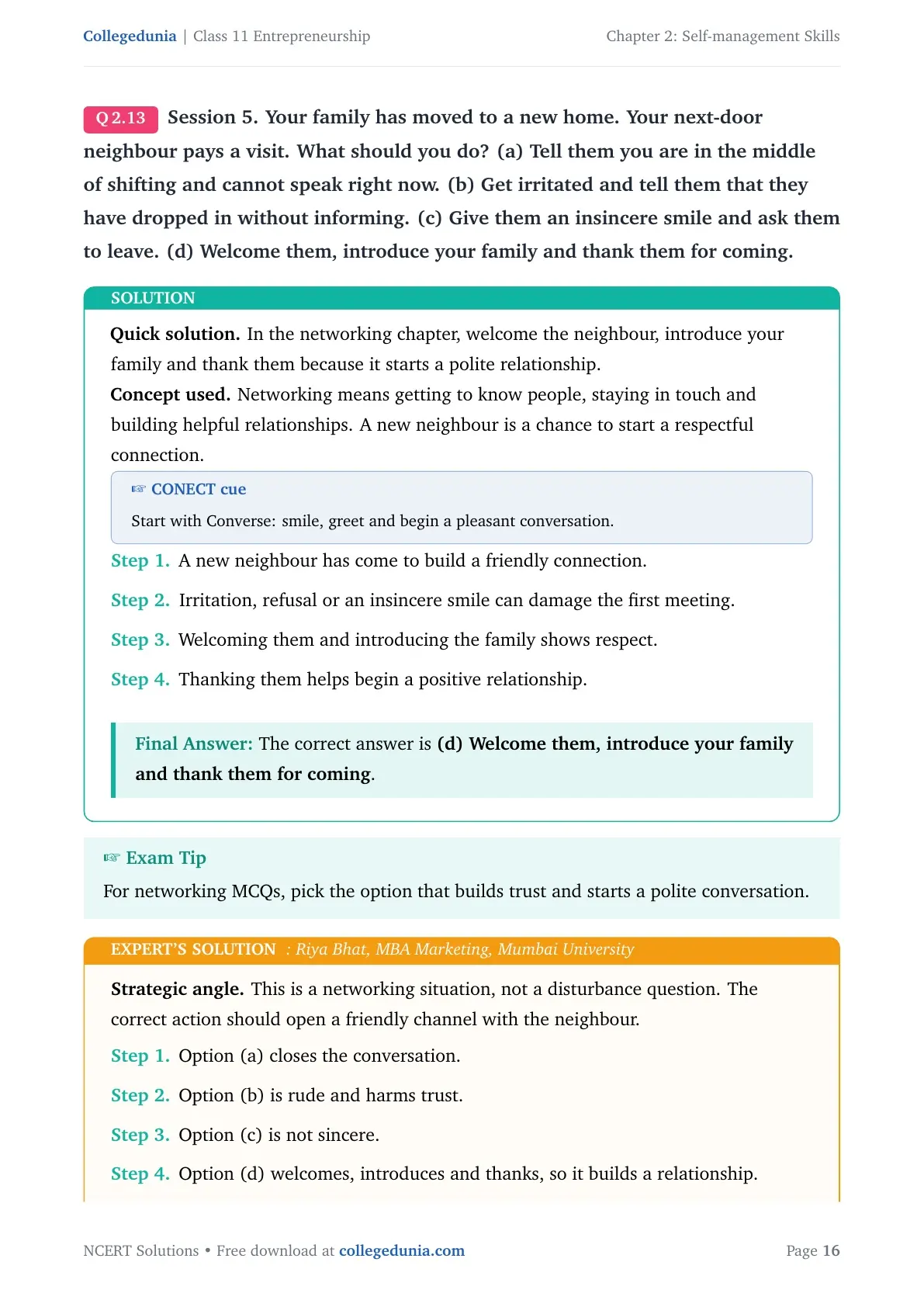
Session 5. Your family has moved to a new home. Your next-door neighbour pays a visit. What should you do? (a) Tell them you are in the middle of shifting and cannot speak right now. (b) Get irritated and tell them that they have dropped in without informing. (c) Give them an insincere smile and ask them to leave. (d) Welcome them, introduce your family and thank them for coming.
Quick solution. In the networking chapter, welcome the neighbour, introduce your family and thank them because it starts a polite relationship.
Concept used. Networking means getting to know people, staying in touch and building helpful relationships. A new neighbour is a chance to start a respectful connection.
CONECT cue
Start with Converse: smile, greet and begin a pleasant conversation.
A new neighbour has come to build a friendly connection.
Irritation, refusal or an insincere smile can damage the first meeting.
Welcoming them and introducing the family shows respect.
Thanking them helps begin a positive relationship.
The correct answer is (d) Welcome them, introduce your family and thank them for coming.
RB
Riya Bhat
MBA Marketing, Mumbai University
Verified Expert
Strategic angle. This is a networking situation, not a disturbance question. The correct action should open a friendly channel with the neighbour.
Option (a) closes the conversation.
Option (b) is rude and harms trust.
Option (c) is not sincere.
Option (d) welcomes, introduces and thanks, so it builds a relationship.
Why this matters. Strong networks often begin with small polite interactions.
(d) is correct.
Q 2.14
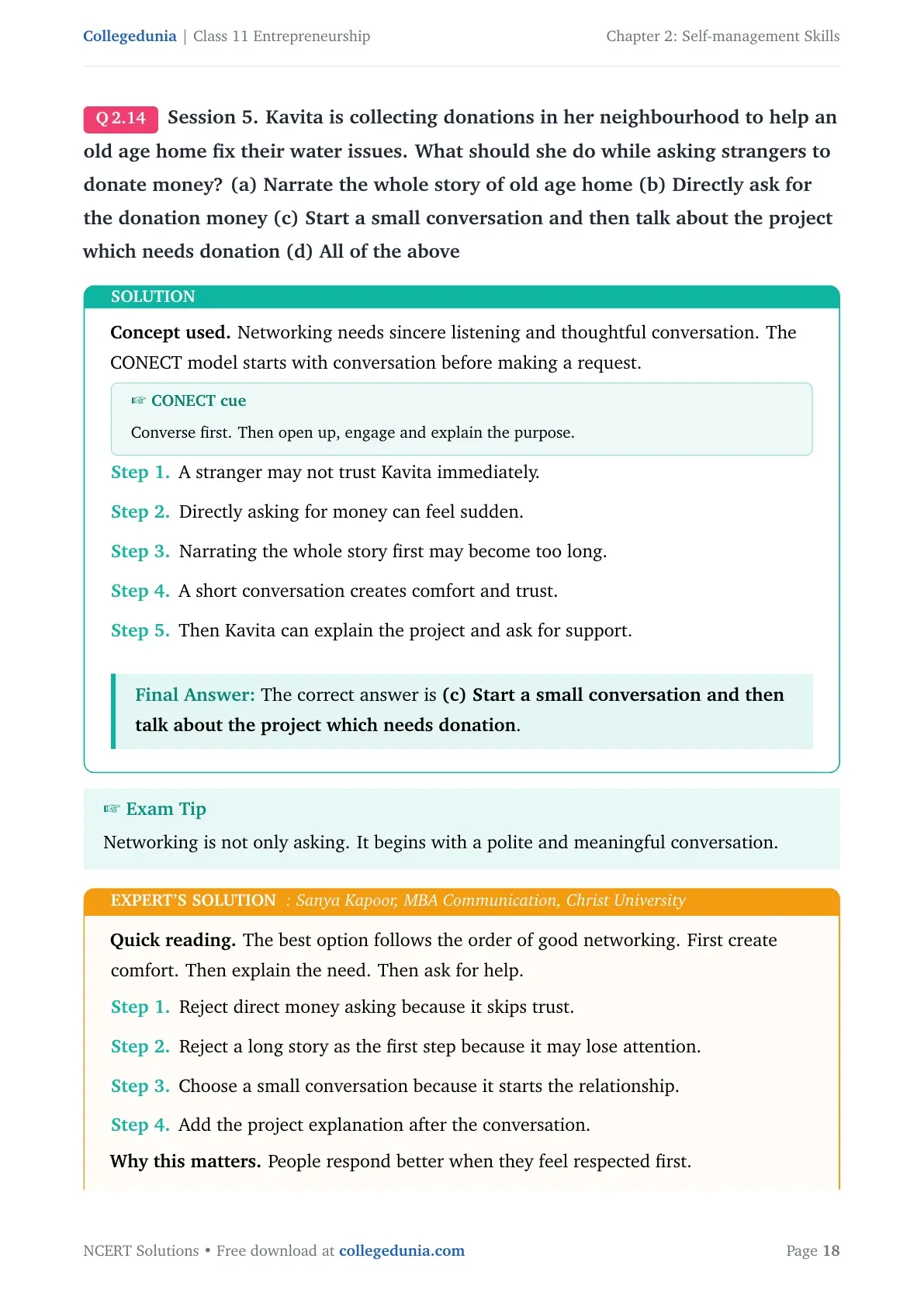
Session 5. Kavita is collecting donations in her neighbourhood to help an old age home fix their water issues. What should she do while asking strangers to donate money? (a) Narrate the whole story of old age home (b) Directly ask for the donation money (c) Start a small conversation and then talk about the project which needs donation (d) All of the above
Concept used. Networking needs sincere listening and thoughtful conversation. The CONECT model starts with conversation before making a request.
CONECT cue
Converse first. Then open up, engage and explain the purpose.
A stranger may not trust Kavita immediately.
Directly asking for money can feel sudden.
Narrating the whole story first may become too long.
A short conversation creates comfort and trust.
Then Kavita can explain the project and ask for support.
The correct answer is (c) Start a small conversation and then talk about the project which needs donation.
SK
Sanya Kapoor
MBA Communication, Christ University
Verified Expert
Quick reading. The best option follows the order of good networking. First create comfort. Then explain the need. Then ask for help.
Reject direct money asking because it skips trust.
Reject a long story as the first step because it may lose attention.
Choose a small conversation because it starts the relationship.
Add the project explanation after the conversation.
Why this matters. People respond better when they feel respected first.
(c) is correct.
Q 2.15
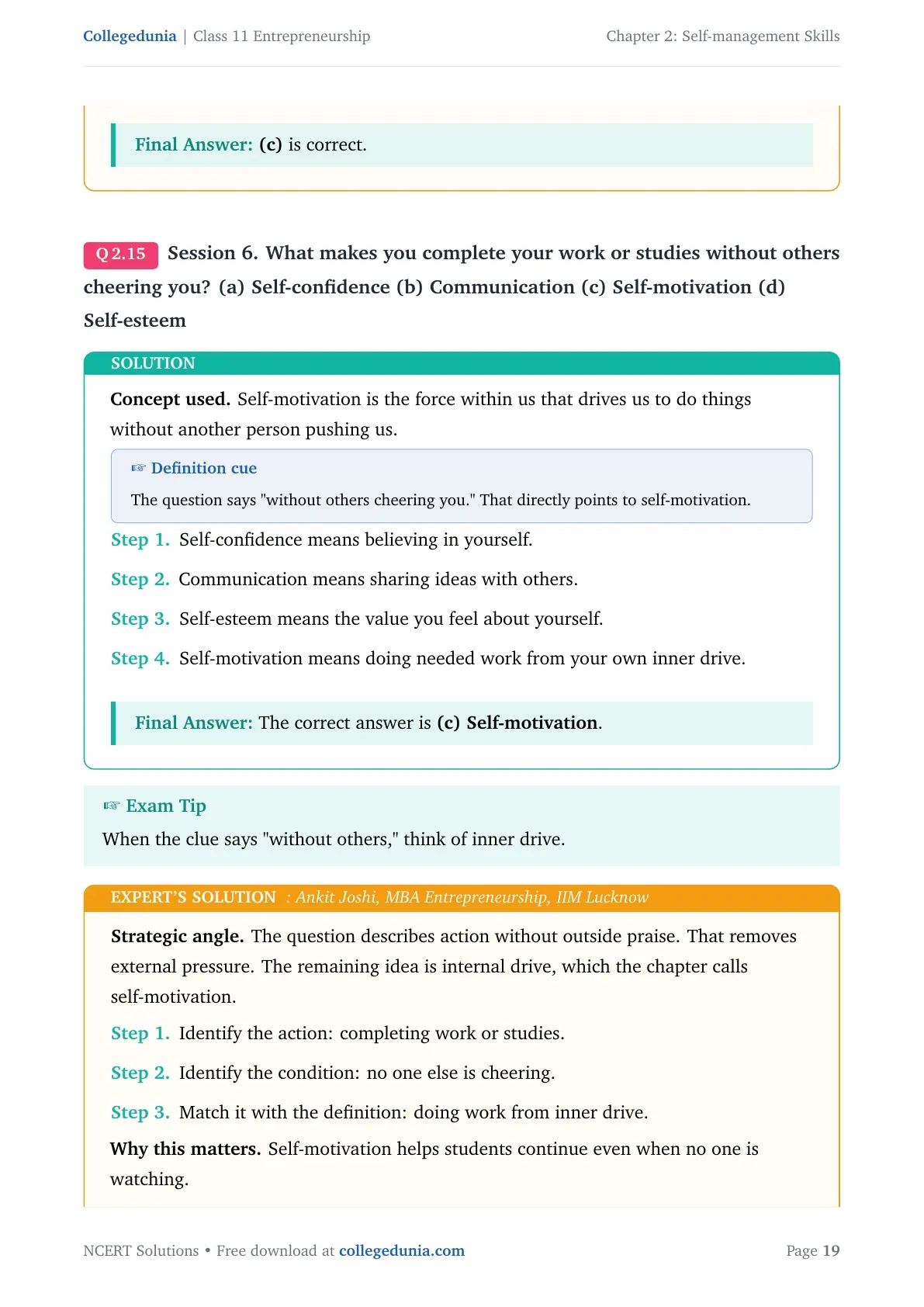
Session 6. What makes you complete your work or studies without others cheering you? (a) Self-confidence (b) Communication (c) Self-motivation (d) Self-esteem
Concept used. Self-motivation is the force within us that drives us to do things without another person pushing us.
Definition cue
The question says "without others cheering you." That directly points to self-motivation.
Self-confidence means believing in yourself.
Communication means sharing ideas with others.
Self-esteem means the value you feel about yourself.
Self-motivation means doing needed work from your own inner drive.
The correct answer is (c) Self-motivation.
AJ
Ankit Joshi
MBA Entrepreneurship, IIM Lucknow
Verified Expert
Strategic angle. The question describes action without outside praise. That removes external pressure. The remaining idea is internal drive, which the chapter calls self-motivation.
Identify the action: completing work or studies.
Identify the condition: no one else is cheering.
Match it with the definition: doing work from inner drive.
Why this matters. Self-motivation helps students continue even when no one is watching.
(c) Self-motivation.
Q 2.16
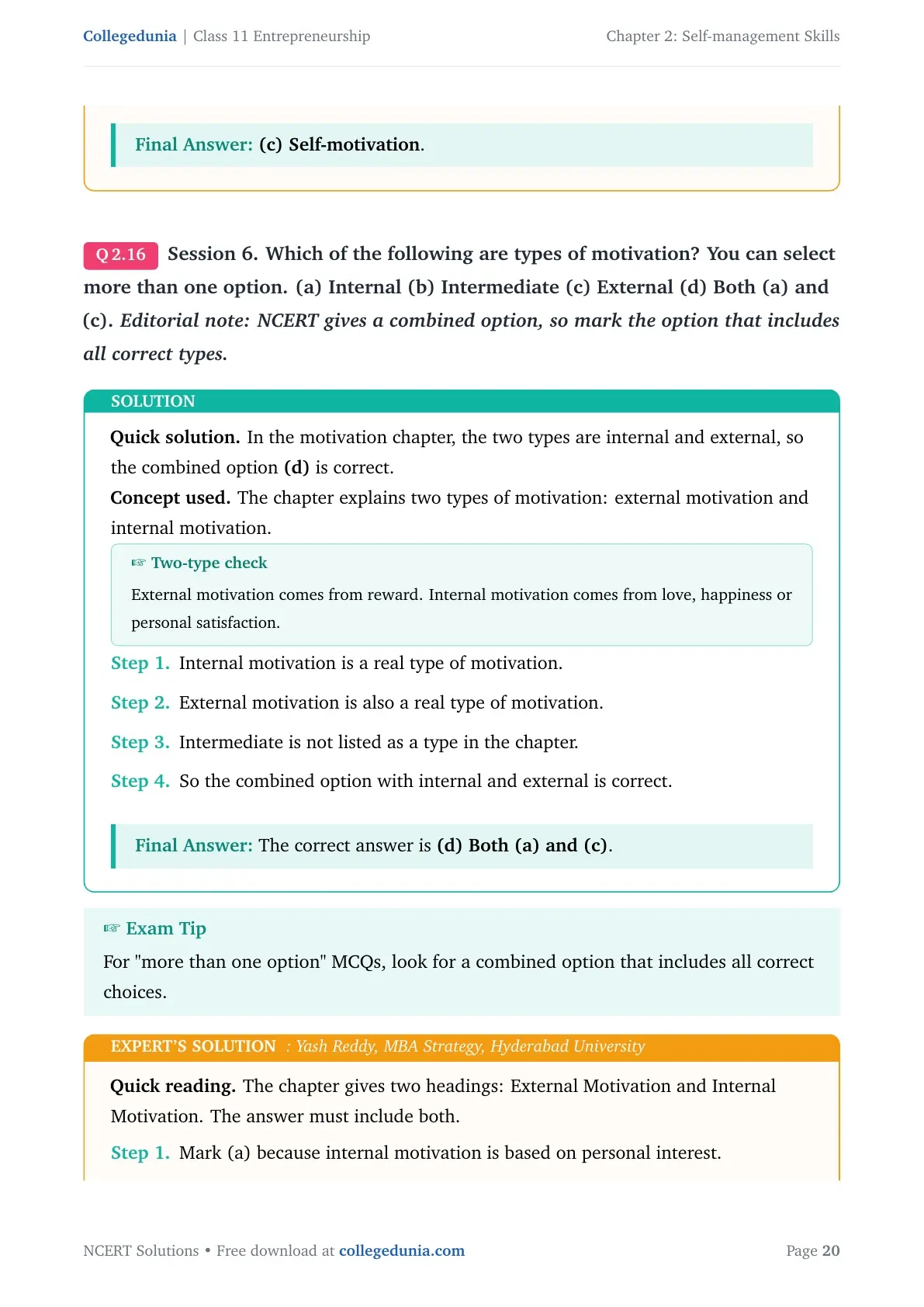
Session 6. Which of the following are types of motivation? You can select more than one option. (a) Internal (b) Intermediate (c) External (d) Both (a) and (c). Editorial note: NCERT gives a combined option, so mark the option that includes all correct types.
Quick solution. In the motivation chapter, the two types are internal and external, so the combined option (d) is correct.
Concept used. The chapter explains two types of motivation: external motivation and internal motivation.
Two-type check
External motivation comes from reward. Internal motivation comes from love, happiness or personal satisfaction.
Internal motivation is a real type of motivation.
External motivation is also a real type of motivation.
Intermediate is not listed as a type in the chapter.
So the combined option with internal and external is correct.
The correct answer is (d) Both (a) and (c).
YR
Yash Reddy
MBA Strategy, Hyderabad University
Verified Expert
Quick reading. The chapter gives two headings: External Motivation and Internal Motivation. The answer must include both.
Mark (a) because internal motivation is based on personal interest.
Do not mark (b) because intermediate is not a listed type.
Mark (c) because external motivation is based on reward or recognition.
Pick (d) because it combines (a) and (c).
Why this matters. This question tests exact textbook categories.
(d) is correct.
Q 2.17
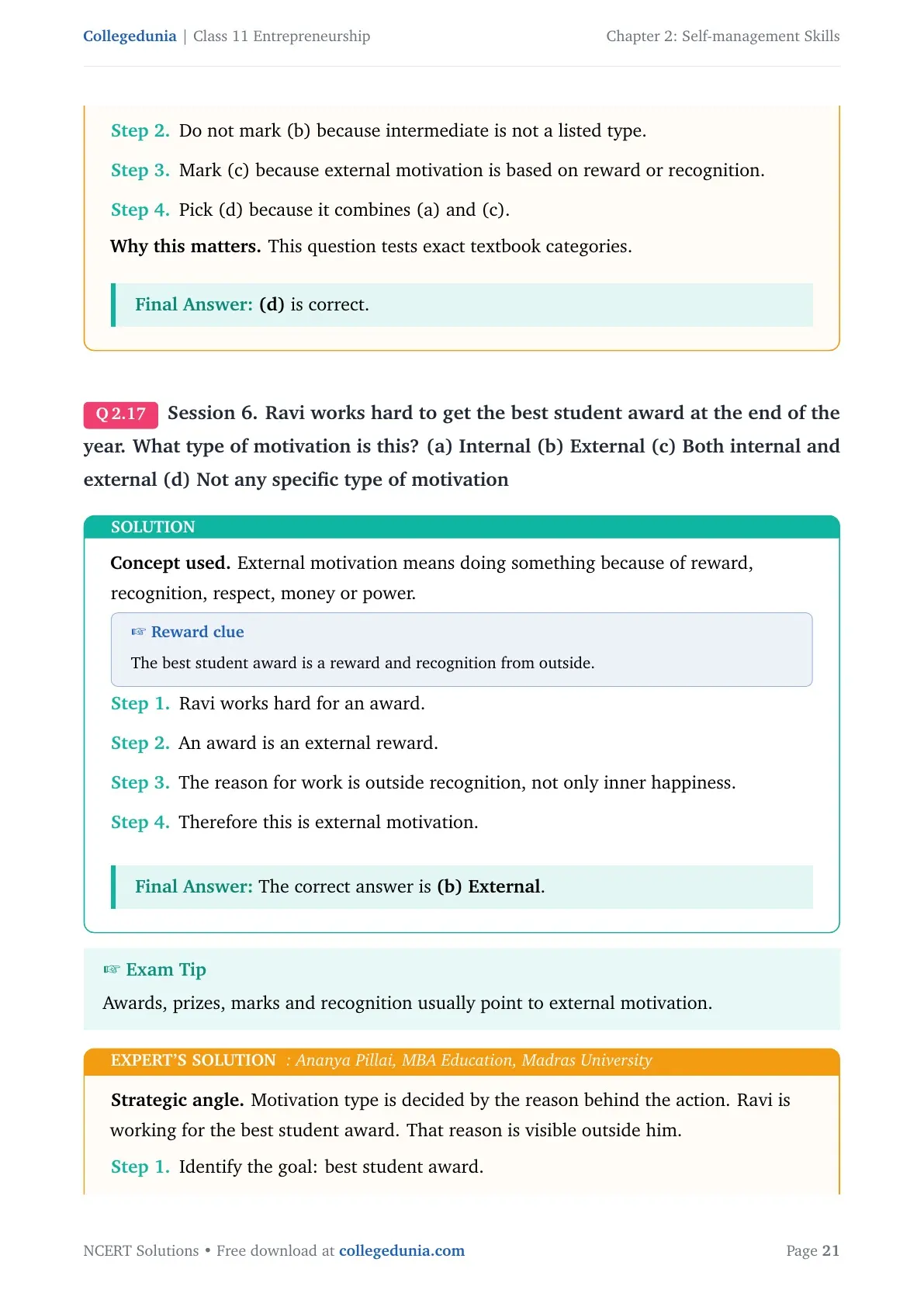
Session 6. Ravi works hard to get the best student award at the end of the year. What type of motivation is this? (a) Internal (b) External (c) Both internal and external (d) Not any specific type of motivation
Concept used. External motivation means doing something because of reward, recognition, respect, money or power.
Reward clue
The best student award is a reward and recognition from outside.
Ravi works hard for an award.
An award is an external reward.
The reason for work is outside recognition, not only inner happiness.
Therefore this is external motivation.
The correct answer is (b) External.
AP
Ananya Pillai
MBA Education, Madras University
Verified Expert
Strategic angle. Motivation type is decided by the reason behind the action. Ravi is working for the best student award. That reason is visible outside him.
Identify the goal: best student award.
Classify the goal: reward and recognition.
Match the category: rewards belong to external motivation.
Why this matters. Knowing the reason helps classify motivation correctly.
(b) External.
Q 2.18
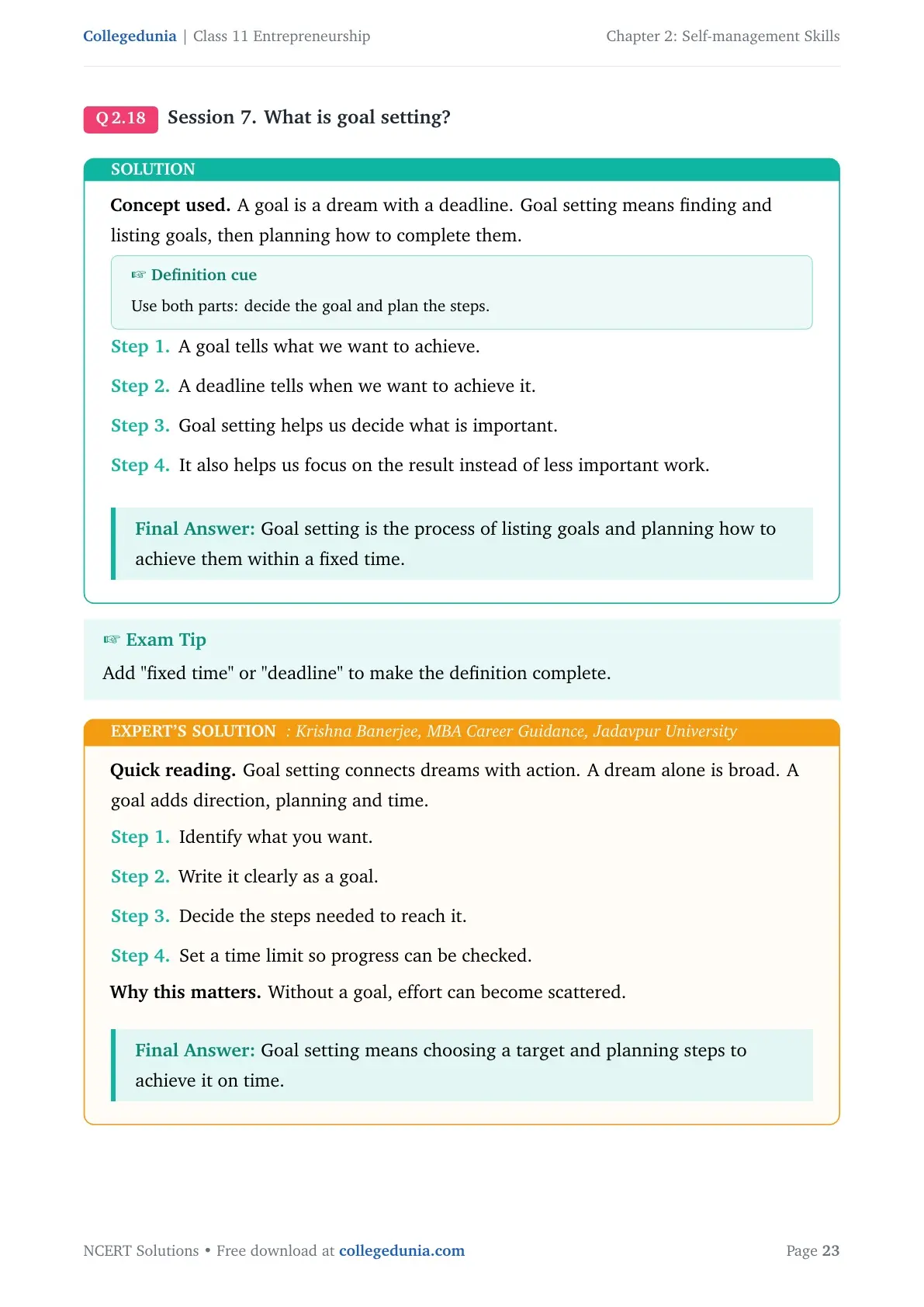
Session 7. What is goal setting?
Concept used. A goal is a dream with a deadline. Goal setting means finding and listing goals, then planning how to complete them.
Definition cue
Use both parts: decide the goal and plan the steps.
A goal tells what we want to achieve.
A deadline tells when we want to achieve it.
Goal setting helps us decide what is important.
It also helps us focus on the result instead of less important work.
Goal setting is the process of listing goals and planning how to achieve them within a fixed time.
KB
Krishna Banerjee
MBA Career Guidance, Jadavpur University
Verified Expert
Quick reading. Goal setting connects dreams with action. A dream alone is broad. A goal adds direction, planning and time.
Identify what you want.
Write it clearly as a goal.
Decide the steps needed to reach it.
Set a time limit so progress can be checked.
Why this matters. Without a goal, effort can become scattered.
Goal setting means choosing a target and planning steps to achieve it on time.
Q 2.19
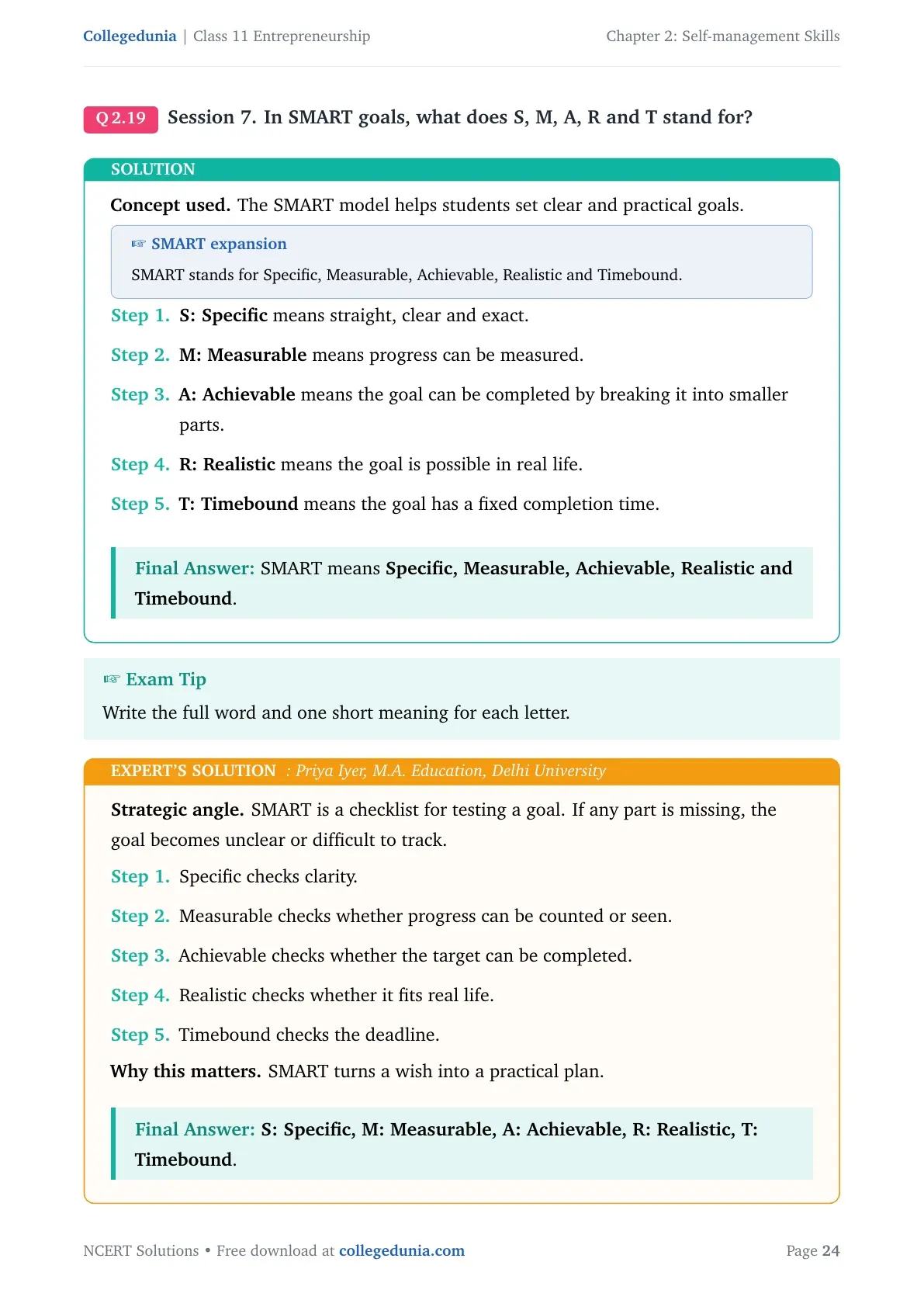
Session 7. In SMART goals, what does S, M, A, R and T stand for?
Concept used. The SMART model helps students set clear and practical goals.
SMART expansion
SMART stands for Specific, Measurable, Achievable, Realistic and Timebound.
S: Specific means straight, clear and exact.
M: Measurable means progress can be measured.
A: Achievable means the goal can be completed by breaking it into smaller parts.
R: Realistic means the goal is possible in real life.
T: Timebound means the goal has a fixed completion time.
SMART means Specific, Measurable, Achievable, Realistic and Timebound.
PI
Priya Iyer
M.A. Education, Delhi University
Verified Expert
Strategic angle. SMART is a checklist for testing a goal. If any part is missing, the goal becomes unclear or difficult to track.
Specific checks clarity.
Measurable checks whether progress can be counted or seen.
Achievable checks whether the target can be completed.
Realistic checks whether it fits real life.
Timebound checks the deadline.
Why this matters. SMART turns a wish into a practical plan.
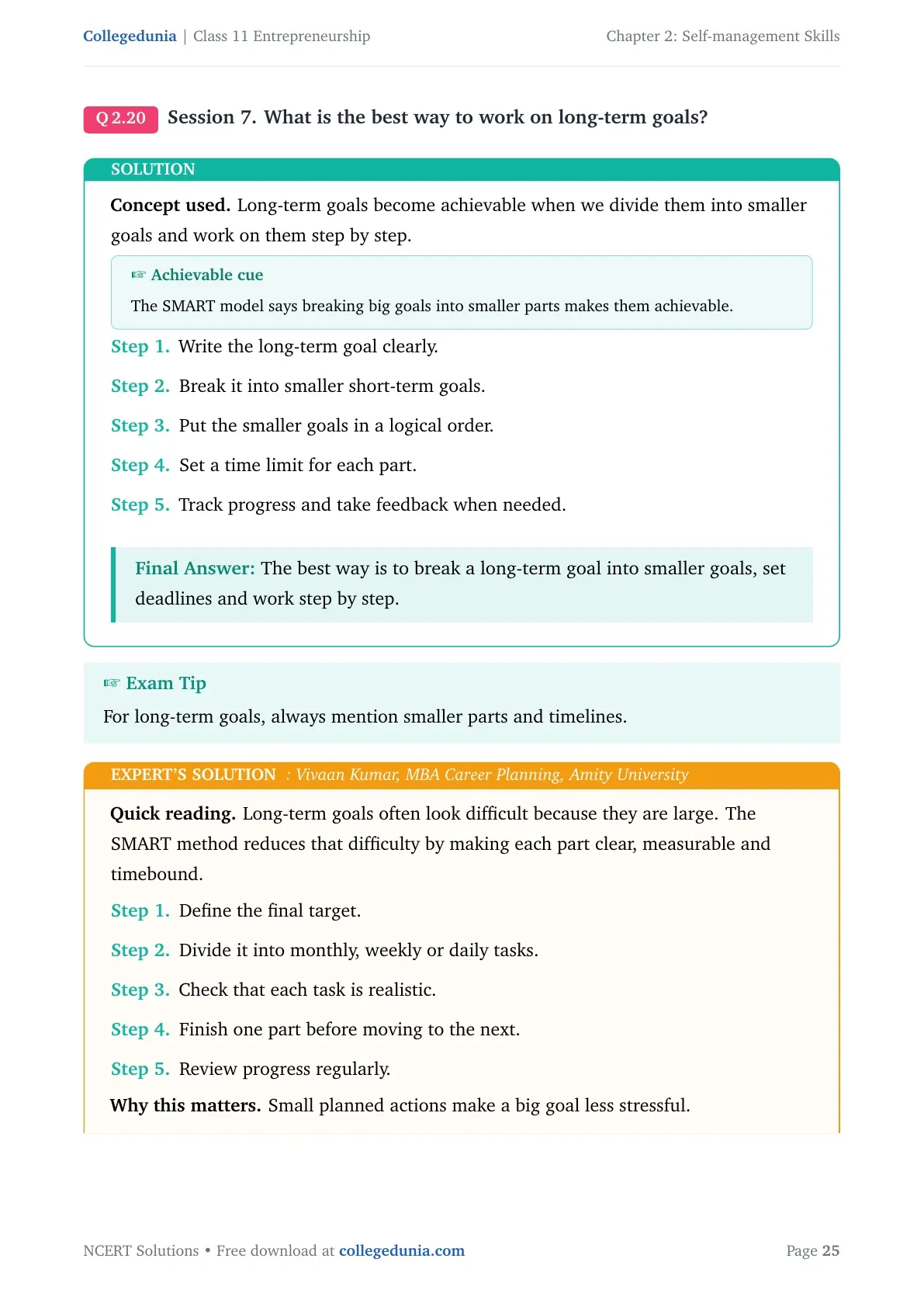
Session 7. What is the best way to work on long-term goals?
Concept used. Long-term goals become achievable when we divide them into smaller goals and work on them step by step.
Achievable cue
The SMART model says breaking big goals into smaller parts makes them achievable.
Write the long-term goal clearly.
Break it into smaller short-term goals.
Put the smaller goals in a logical order.
Set a time limit for each part.
Track progress and take feedback when needed.
The best way is to break a long-term goal into smaller goals, set deadlines and work step by step.
VK
Vivaan Kumar
MBA Career Planning, Amity University
Verified Expert
Quick reading. Long-term goals often look difficult because they are large. The SMART method reduces that difficulty by making each part clear, measurable and timebound.
Define the final target.
Divide it into monthly, weekly or daily tasks.
Check that each task is realistic.
Finish one part before moving to the next.
Review progress regularly.
Why this matters. Small planned actions make a big goal less stressful.
Break the big goal into small SMART goals and follow them regularly.
Q 2.21
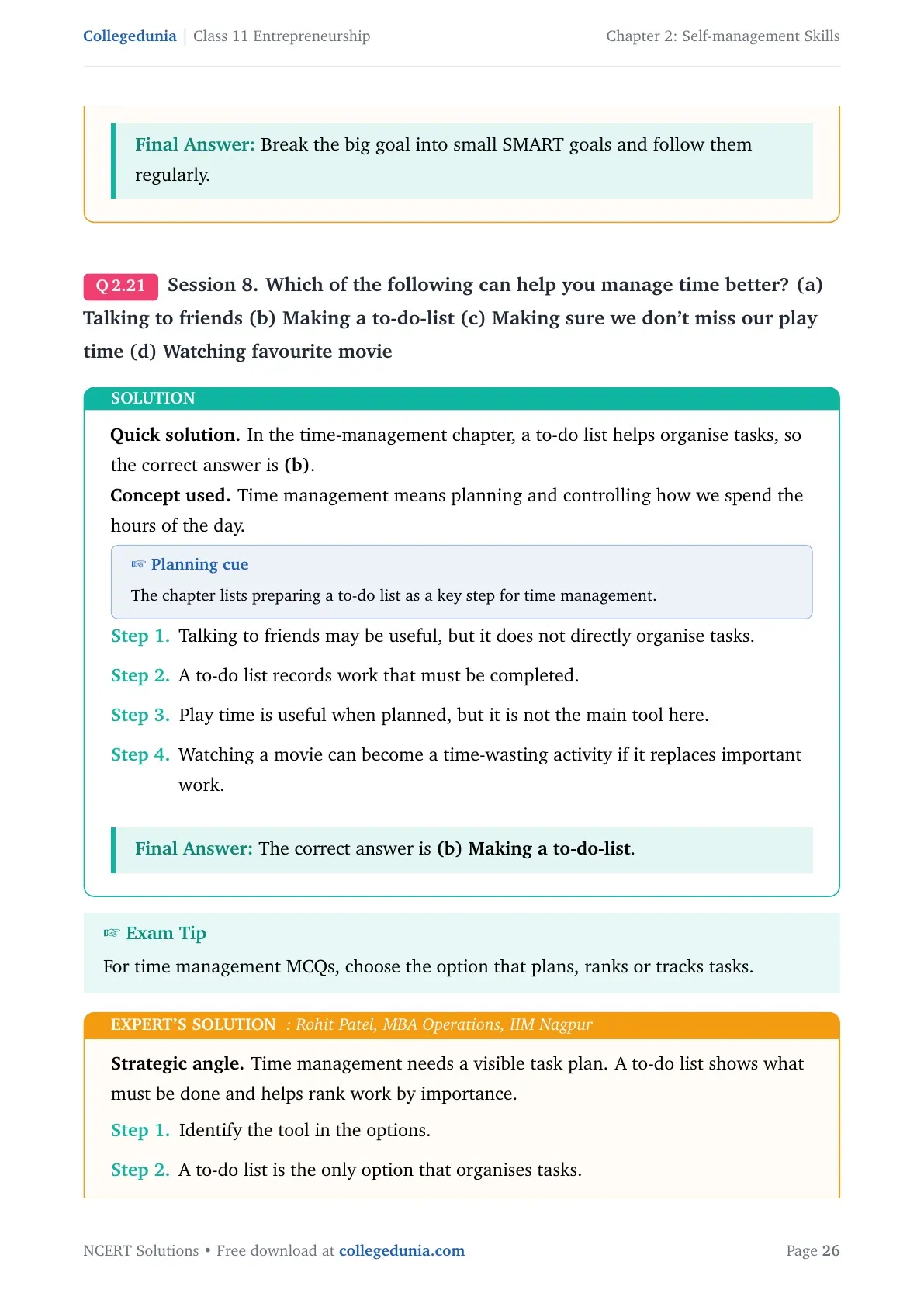
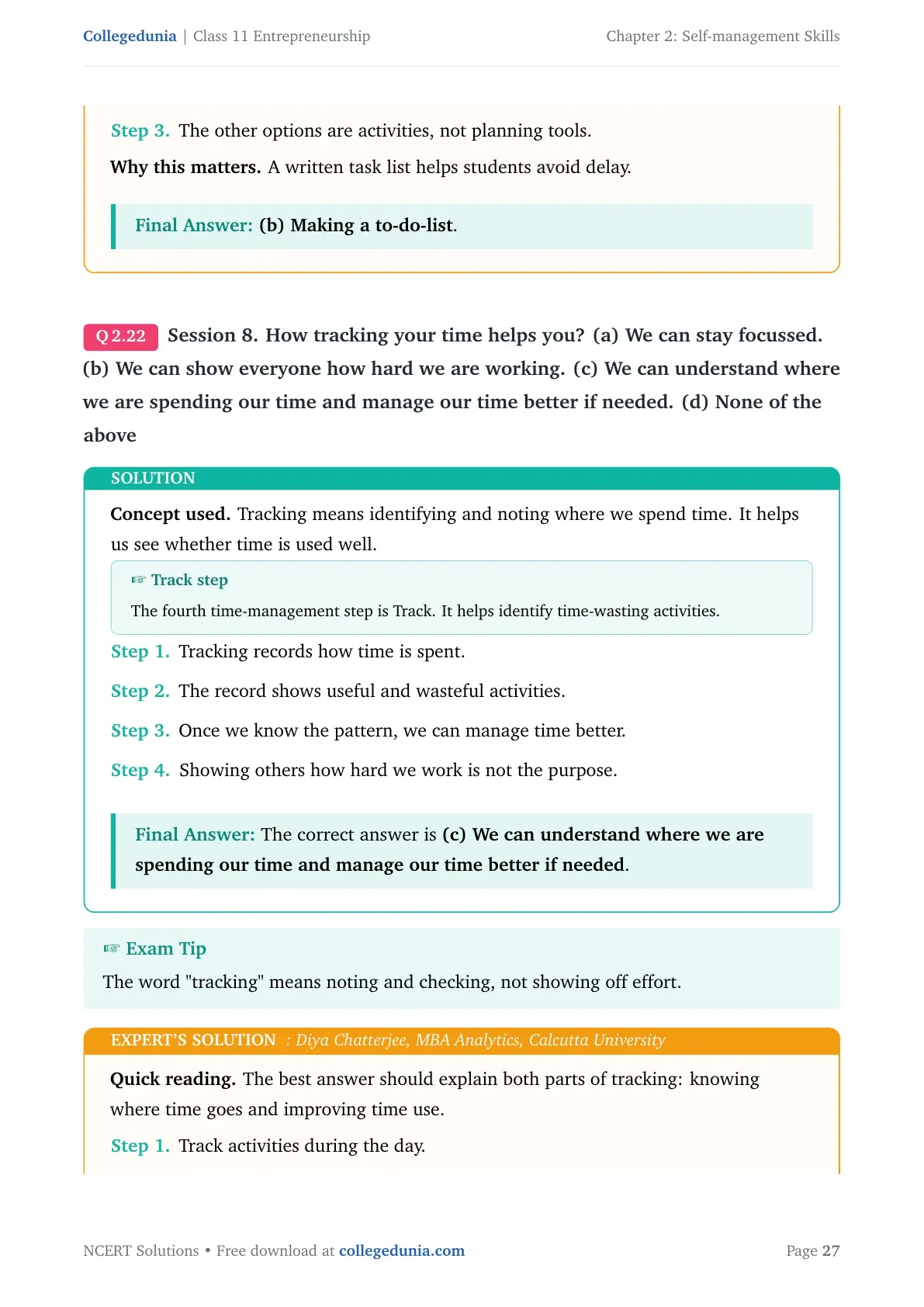
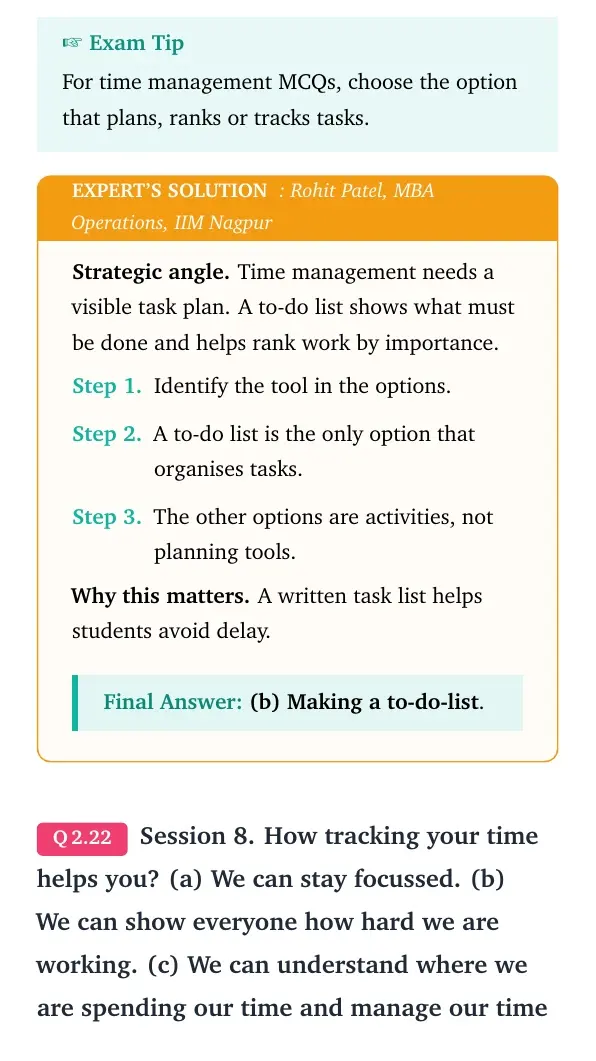
Session 8. Which of the following can help you manage time better? (a) Talking to friends (b) Making a to-do-list (c) Making sure we don’t miss our play time (d) Watching favourite movie
Quick solution. In the time-management chapter, a to-do list helps organise tasks, so the correct answer is (b).
Concept used. Time management means planning and controlling how we spend the hours of the day.
Planning cue
The chapter lists preparing a to-do list as a key step for time management.
Talking to friends may be useful, but it does not directly organise tasks.
A to-do list records work that must be completed.
Play time is useful when planned, but it is not the main tool here.
Watching a movie can become a time-wasting activity if it replaces important work.
The correct answer is (b) Making a to-do-list.
RP
Rohit Patel
MBA Operations, IIM Nagpur
Verified Expert
Strategic angle. Time management needs a visible task plan. A to-do list shows what must be done and helps rank work by importance.
Identify the tool in the options.
A to-do list is the only option that organises tasks.
The other options are activities, not planning tools.
Why this matters. A written task list helps students avoid delay.
(b) Making a to-do-list.
Q 2.22
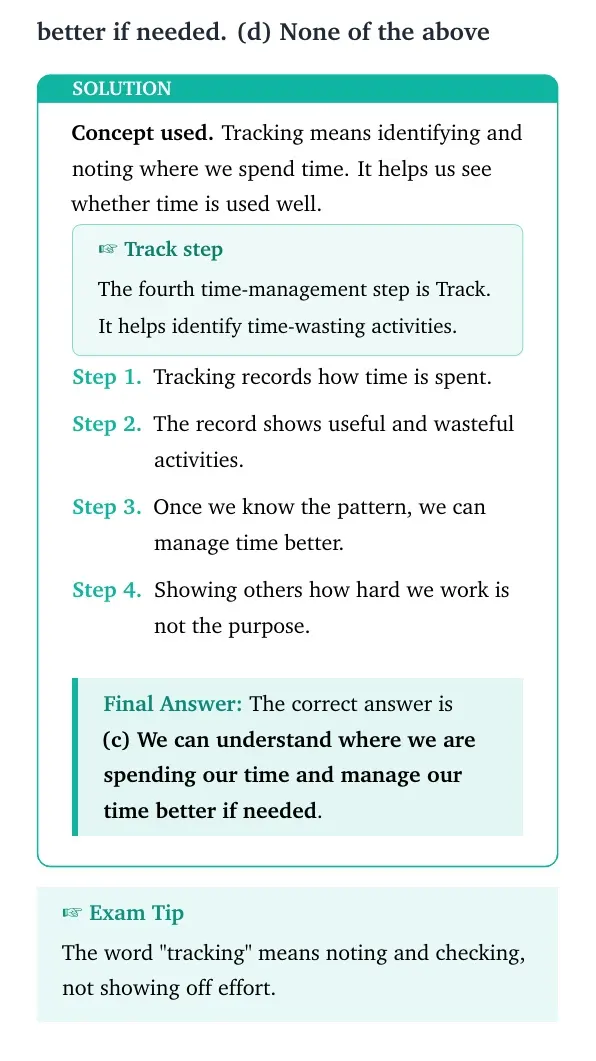
Session 8. How tracking your time helps you? (a) We can stay focussed. (b) We can show everyone how hard we are working. (c) We can understand where we are spending our time and manage our time better if needed. (d) None of the above
Concept used. Tracking means identifying and noting where we spend time. It helps us see whether time is used well.
Track step
The fourth time-management step is Track. It helps identify time-wasting activities.
Tracking records how time is spent.
The record shows useful and wasteful activities.
Once we know the pattern, we can manage time better.
Showing others how hard we work is not the purpose.
The correct answer is (c) We can understand where we are spending our time and manage our time better if needed.
DC
Diya Chatterjee
MBA Analytics, Calcutta University
Verified Expert
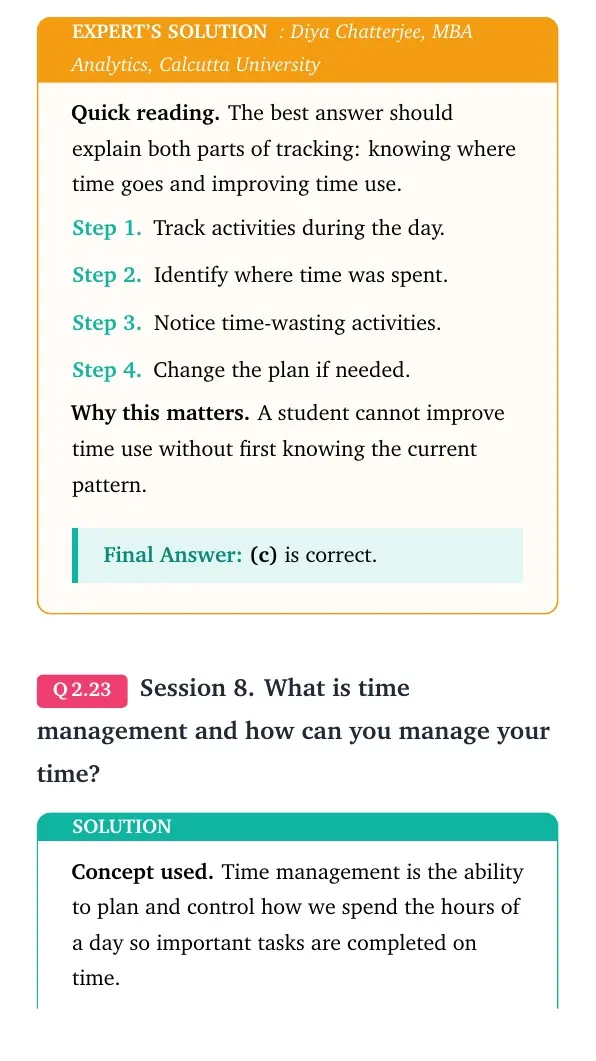
Quick reading. The best answer should explain both parts of tracking: knowing where time goes and improving time use.
Track activities during the day.
Identify where time was spent.
Notice time-wasting activities.
Change the plan if needed.
Why this matters. A student cannot improve time use without first knowing the current pattern.
(c) is correct.
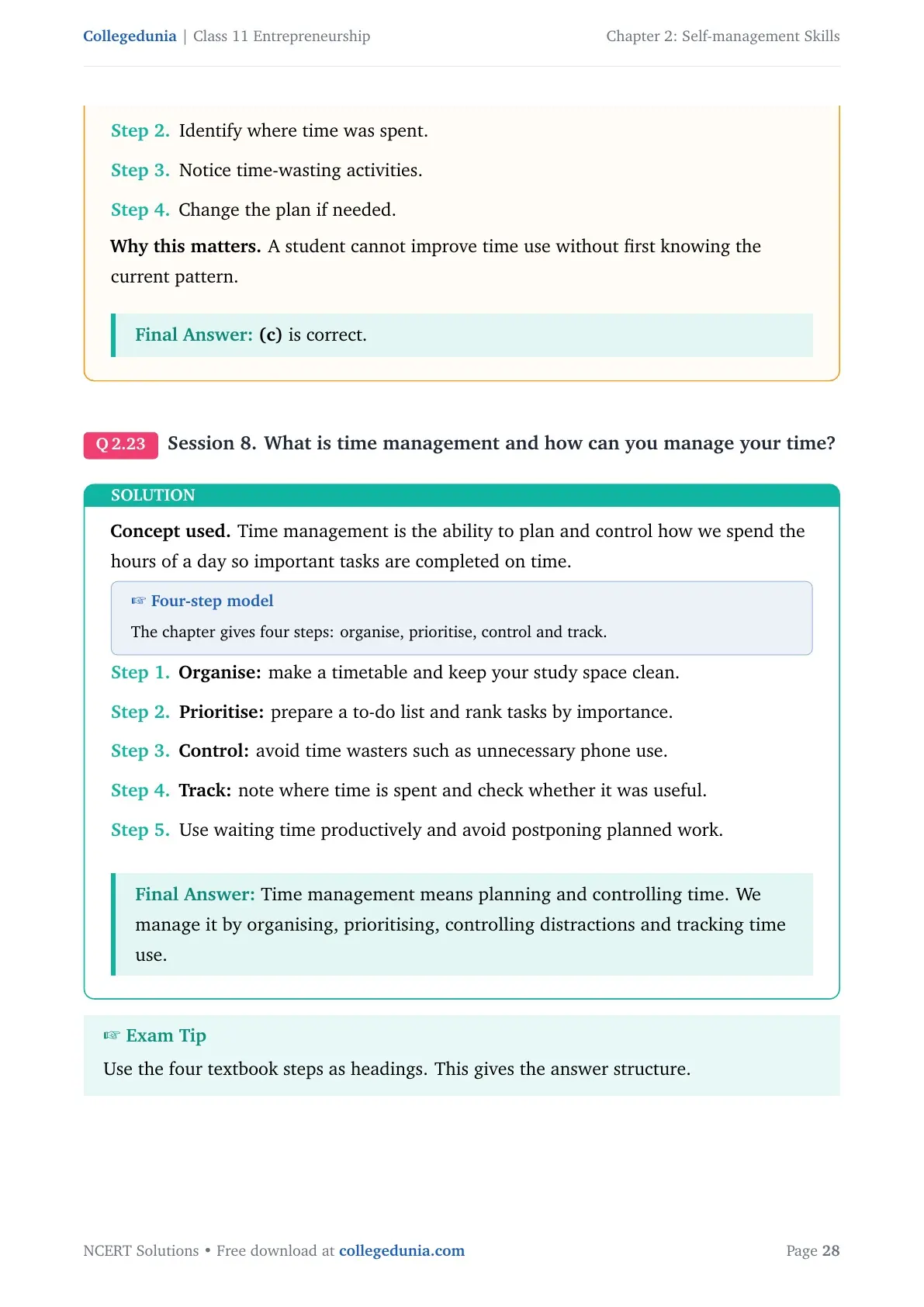
Q 2.23
Session 8. What is time management and how can you manage your time?
Concept used. Time management is the ability to plan and control how we spend the hours of a day so important tasks are completed on time.
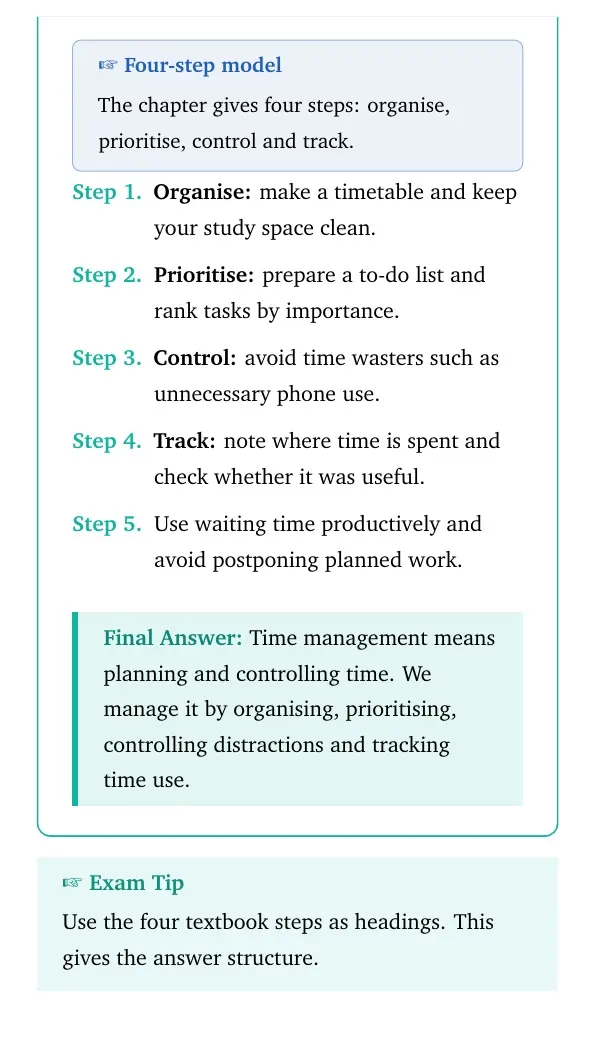
Four-step model
The chapter gives four steps: organise, prioritise, control and track.
Organise: make a timetable and keep your study space clean.
Prioritise: prepare a to-do list and rank tasks by importance.
Control: avoid time wasters such as unnecessary phone use.
Track: note where time is spent and check whether it was useful.
Use waiting time productively and avoid postponing planned work.
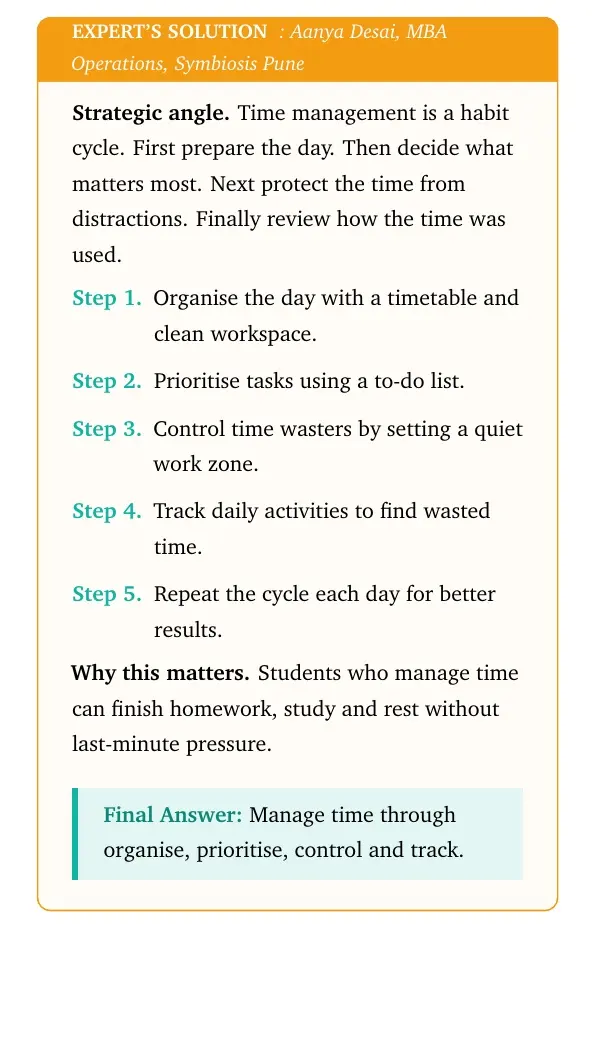
Time management means planning and controlling time. We manage it by organising, prioritising, controlling distractions and tracking time use.
AD
Aanya Desai
MBA Operations, Symbiosis Pune
Verified Expert
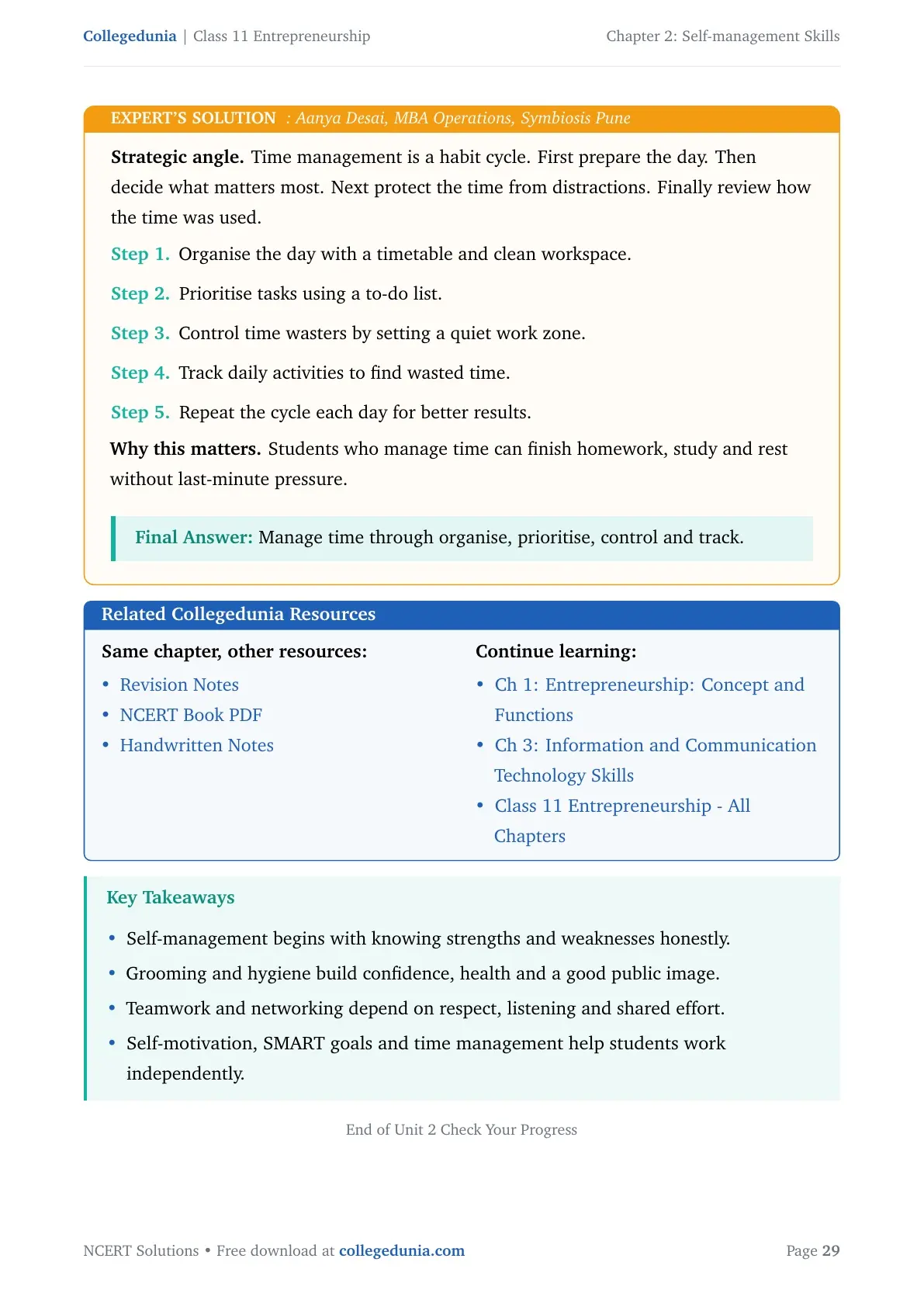
Strategic angle. Time management is a habit cycle. First prepare the day. Then decide what matters most. Next protect the time from distractions. Finally review how the time was used.
Organise the day with a timetable and clean workspace.
Prioritise tasks using a to-do list.
Control time wasters by setting a quiet work zone.
Track daily activities to find wasted time.
Repeat the cycle each day for better results.
Why this matters. Students who manage time can finish homework, study and rest without last-minute pressure.
Manage time through organise, prioritise, control and track.
Class 11 Entrepreneurship Chapter 2 NCERT Solutions FAQs
Ques. What is Class 11 Entrepreneurship Chapter 2 about?
Ans. Class 11 Entrepreneurship Chapter 2 covers self-management skills such as self-awareness, grooming, hygiene, teamwork, networking, motivation, goal setting and time management.
Ques. Are these NCERT Solutions for Class 11 Entrepreneurship Chapter 2 based on the 2026-27 syllabus?
Ans. Yes. The solutions are prepared for the 2026-27 syllabus and follow the local NCERT source PDF used for the scheduled Chapter 2 row.
Ques. How many questions are solved in this chapter?
Ans. The PDF and article solve 23 Check Your Progress questions covering tables, MCQs, true-false items and short-answer self-management situations.
Ques. What does SMART mean in goal setting?
Ans. SMART stands for Specific, Measurable, Achievable, Realistic and Timebound. The model helps students turn a broad aim into a clear and practical goal.
Ques. Can I download the Class 11 Entrepreneurship Chapter 2 Solutions PDF?
Ans. Yes. The PDF section on this page provides the downloadable NCERT Solutions PDF for Class 11 Entrepreneurship Chapter 2, along with embedded page previews for online revision.











Comments