




Class 12 is your biggest year for CBSE boards, JEE and NEET. The NCERT textbook is your base book for all three. Every chapter on this page matches the new 2026-27 NCERT syllabus and the latest CBSE marking scheme. So the same PDFs help you revise for the 15 February 2027 boards and prep for entrance exams through 2027.
NCERT Class 12 Physics
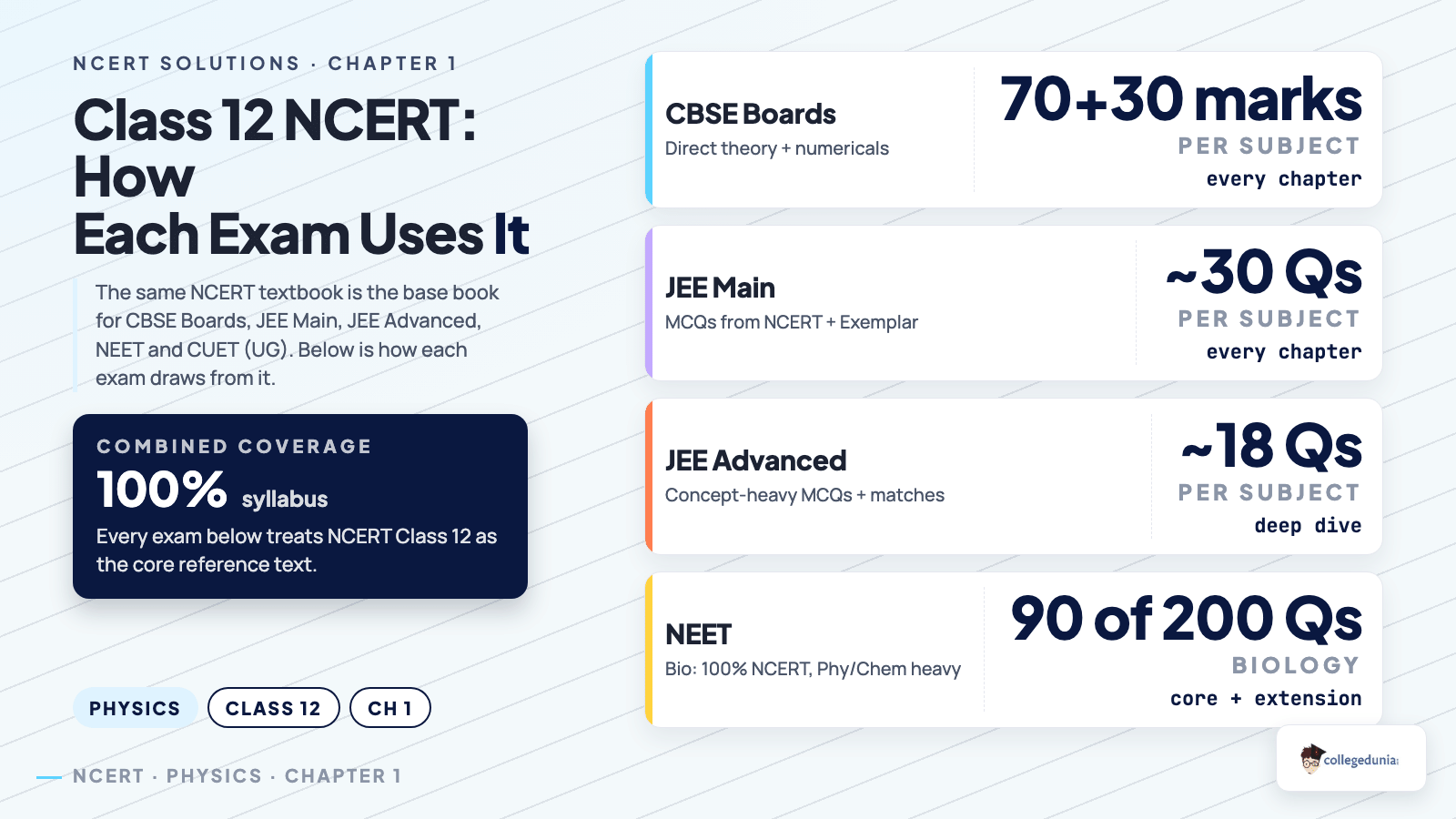
NCERT Class 12 Physics follows the new 2026-27 syllabus. It has 14 chapters grouped into 8 CBSE units. The board paper is 70 marks theory + 30 marks practical. The same NCERT chapters are also your base for JEE Main, JEE Advanced and NEET Physics.


- Subjects covered: Physics, Chemistry, Mathematics, Biology, English Core, Accountancy, Business Studies.
- Resource types per subject: NCERT Solutions, Notes, Formula Sheet, Handwritten Notes, NCERT Book PDF, Exemplar Solutions, Exemplar Book PDF. Commerce and English have 4, since NCERT does not publish a Formula Sheet or Exemplar for those.
- Aligned to: CBSE Class 12 Boards (15 February - April 2027), JEE Main, JEE Advanced, NEET and CUET (UG).
NCERT Class 12 Chemistry
NCERT Class 12 Chemistry has 10 chapters in the 2026-27 syllabus. They fall into three parts: Physical, Inorganic and Organic. The board paper is 70 marks theory + 30 marks practical. The same NCERT is also your base book for NEET and JEE Main Chemistry.
NCERT Class 12 Maths
NCERT Class 12 Mathematics is an 80-mark theory-only paper. It has 13 chapters in the 2026-27 syllabus, grouped under 6 CBSE units. The Calculus block (Ch 5-9) alone is worth about 35 marks, almost half the paper. It is also your base book for JEE Main, JEE Advanced and CUET (UG) Mathematics.
NCERT Class 12 Biology
NCERT Class 12 Biology follows the 2026-27 syllabus. It has 13 chapters grouped into 5 CBSE units. The board paper is 70 marks theory + 30 marks practical. NCERT diagrams and Exemplar problems are the most-used resources for NEET aspirants.
NCERT Class 12 English Core
NCERT Class 12 English Core is an 80-mark theory paper. It is built around two NCERT books: Flamingo (prose and poetry) and Vistas (supplementary reader), with 19 chapters in all. The paper is split between Reading, Creative Writing and Literature.
NCERT Class 12 Accountancy
NCERT Class 12 Accountancy is an 80-mark theory paper. It is taught from two NCERT books: Part 1 Partnership Firms and Part 2 Company Accounts & Analysis of Financial Statements, with 10 chapters in all. Practical sums on Cash Flow Statement and Ratio Analysis often decide your score.
NCERT Class 12 Business Studies
NCERT Class 12 Business Studies is an 80-mark theory paper with 11 chapters in the 2026-27 syllabus. Financial Markets has been dropped. So Marketing is now Ch 10 and Consumer Protection is now Ch 11 (the last chapter). Marketing alone is worth about 10 marks.
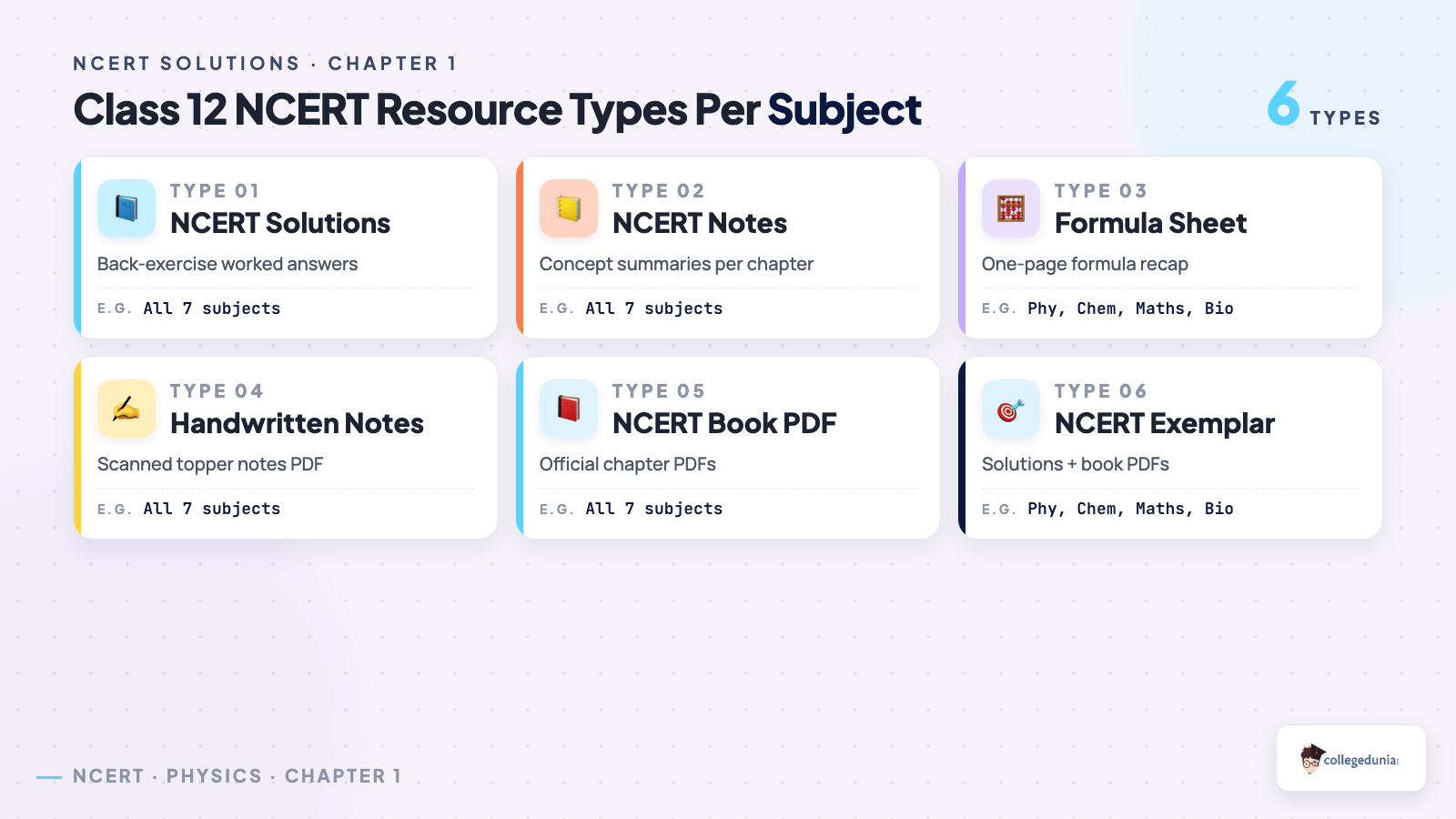
What Each Class 12 NCERT Resource Type Delivers
Class 12 has seven resource types. Each one solves a different revision problem. Pick the one that fits the time you have left before the board paper.
| Resource Type | What It Is | Best For | Time to Use |
|---|---|---|---|
| NCERT Solutions | Step-by-step answers to every back-exercise question. Two tabs (Solution + Expert's Solution), with CBSE step-marking shown. | First attempt plus answer-writing practice. | 4 to 6 hours per chapter. |
| NCERT Notes | A 20 to 25-page revision PDF per chapter. It has formula boxes, concept boxes, TikZ diagrams, common mistakes, mnemonics and a quick summary. | Second revision after one full read of the textbook. | 2 to 3 hours per chapter. |
| Formula Sheet | A short 2-column PDF with every formula, constant and key relation for the whole subject. Each formula also gets a plain-meaning note. | Last-week revision, one page per night. | 30 to 45 minutes per subject. |
| Handwritten Notes | Scanned-look notebook PDFs with pen strokes, ruled paper and hand-drawn formula boxes. Great for visual learners and quick offline reading. | Morning revision before the exam, or phone reading on the go. | 20 to 30 minutes per chapter. |
| NCERT Book PDF | The official chapter-wise NCERT textbook PDF. It matches the 2026-27 NCERT print exactly. | First read, and a reference while you practice writing answers. | 3 to 5 hours per chapter. |
| Exemplar Solutions | Answers to the harder NCERT Exemplar Problems set. Covers MCQ, MCQ-II, VSA, SA and LA types with full step-marking. | JEE Main, JEE Advanced and NEET prep, plus CBSE long-answer depth. | 5 to 7 hours per chapter. |
| Exemplar Book PDF | The official NCERT Exemplar Problems book PDF, chapter by chapter. | Direct entrance-exam practice and answer-only review. | 2 to 4 hours per chapter. |
CBSE Class 12 Board 2027 Pattern: Marks Distribution Per Subject
CBSE Class 12 uses an 80 + 20 split for most subjects. That means 80 marks for the theory paper and 20 marks for internal assessment, practicals or project work. The table below shows the theory marks per subject and the practical or IA split where it applies.
| Subject | Theory | Practical / IA | Paper Duration | Highest-Weight Chapter |
|---|---|---|---|---|
| Physics | 70 | 30 (practical) | 3 hours | Electrostatics + Current Electricity (16 marks combined) |
| Chemistry | 70 | 30 (practical) | 3 hours | Electrochemistry + Chemical Kinetics (12 marks combined) |
| Mathematics | 80 | 20 (internal) | 3 hours | Calculus block (Continuity + Application of Derivatives + Integrals + Application of Integrals + Differential Equations), 35 marks |
| Biology | 70 | 30 (practical) | 3 hours | Genetics and Evolution (18 marks) |
| English (Core) | 80 | 20 (project) | 3 hours | Flamingo Prose (22 marks) |
| Accountancy | 80 | 20 (project) | 3 hours | Partnership Accounts (25 marks) |
| Business Studies | 80 | 20 (project) | 3 hours | Marketing (10 marks single chapter, highest in BSt) |
Class 12 Subject Difficulty and Time-to-Master Comparison
Difficulty and study time change a lot from subject to subject. The numbers below show the median time a Class 12 student needs over the year to finish one full NCERT pass plus one revision pass. They come from study plans used by CBSE prep coaches.
| Subject | Conceptual Difficulty | Volume of Content | Total Hours (NCERT + revision) | Time-Per-Day Recommendation |
|---|---|---|---|---|
| Physics | High (formula-heavy, numerical-heavy) | 14 chapters / 350 pages | 120 to 140 hours | 45 minutes |
| Chemistry | Medium-High (mix of theory + numerical + reactions) | 10 chapters / 270 pages | 90 to 110 hours | 40 minutes |
| Mathematics | High (problem-volume-driven; calculus block dominates) | 13 chapters / 380 pages | 140 to 160 hours | 60 minutes |
| Biology | Medium (memorisation-heavy with diagrams) | 13 chapters / 320 pages | 100 to 120 hours | 45 minutes |
| English (Core) | Low-Medium (reading-heavy, low conceptual load) | 19 chapters across 3 books (Flamingo + Vistas + Supplementary) | 60 to 80 hours | 30 minutes |
| Accountancy | Medium-High (problem-volume + format-strict) | 10 chapters across 2 parts (Partnership + Company Accounts) | 100 to 120 hours | 45 minutes |
| Business Studies | Medium (theory-heavy with framework recall) | 11 chapters / 280 pages | 70 to 90 hours | 30 minutes |
Recommended Study Plan: Class 12 Board + Entrance Prep Together
The biggest mistake Class 12 students make is treating board prep and entrance prep as two separate things. The 2026-27 syllabus is built so your NCERT pass is the base for JEE Main, NEET and CUET. The only gap is how hard the problems get. The three-block plan below covers both in the same year.
- Block 1 (April to September): NCERT-first pass. Read the chapter, work the back exercises, build a one-page summary using the Notes PDF. Target: cover all chapters of every subject by end-September. Track using the seven Notes PDFs per subject; tick one chapter off per week per subject.
- Block 2 (October to December): Exemplar + previous year deep-dive. For Science Stream subjects, switch to the NCERT Exemplar Solutions for harder problems and run a JEE Main / NEET PYQ set per chapter alongside it. For Commerce + English, run the CBSE PYQ set chapter-by-chapter and rehearse answer-format writing.
- Block 3 (January to February): Formula Sheet + Handwritten Notes revision. Stop reading new material. Cycle through the Formula Sheet and Handwritten Notes for 30 minutes each subject per day. Take one full mock CBSE paper per week. The final 10 days before the board are mock-paper + revision only.
Tip: The single best ratio for Class 12 Science Stream students is roughly 60% NCERT-based study + 40% PYQ practice. Going below 50% NCERT loses board marks; going above 70% loses competitive-exam marks.
Common Mistakes Class 12 Students Make Across Subjects
These five mistakes account for the bulk of avoidable marks lost across the Class 12 cohort. They appear in every subject, with subject-specific variants.
- Skipping the NCERT in-text examples. CBSE setters lift roughly 15 to 20% of board-paper questions directly from in-text solved examples. Many students focus only on back-exercise questions and miss this entirely.
- Treating Exemplar as optional. For Science Stream subjects, JEE Main draws 30 to 40% of its question patterns from NCERT Exemplar Problems. Going to other reference books before finishing the Exemplar set is the most common mis-prioritisation.
- Reading the Formula Sheet without solving alongside it. The Formula Sheet alone does not build problem-solving fluency. It is a revision tool, not a learning tool. Use it after at least one full chapter pass.
- Writing CBSE answers in paragraph form. CBSE marking is step-based. A clean numbered-steps answer scores 1 to 2 marks higher than the same content written as prose. Practice this against the NCERT Solutions PDFs which are formatted exactly to the marking-scheme step shape.
- Ignoring the practical and project component. 20 to 30 marks per subject sit in practical or internal assessment. Students preparing only for theory routinely drop 5 to 8 marks per subject because they did not engage with the lab record, viva, or project rubric.
Student Pulse: What 12,840 Class 12 Students Told Us
In a Collegedunia poll of 12,840 Class 12 students conducted before the 2027 boards:
- 68% of students rated Class 12 Physics and Mathematics as the two highest-difficulty subjects in their stream, with the Physics Current Electricity chapter and the Mathematics Integrals chapter named most often as "hardest single chapter".
- Out of 12,840 students surveyed, the average student spent 8 to 10 hours per subject per week in the final three months before the board paper. Toppers (top 10% of the surveyed pool) averaged 12 hours per subject per week and 4 hours of pure PYQ practice.
- 73% of JEE Main aspirants in the surveyed cohort reported using the NCERT Solutions and Exemplar Solutions PDFs as their primary Class 12 Physics, Chemistry and Mathematics resource over private coaching modules.
- Most-skipped chapter cluster: the Class 12 Biology Reproduction unit (skipped by ~24% of NEET-track students despite carrying 14 marks in the CBSE paper). The same cohort regretted the skip when comparing scores against the topper sample.
- Toppers reported that writing a one-page handwritten summary per chapter (mirroring the Handwritten Notes PDF format) added an average of 4 to 6 marks per subject on the board paper.
Source: 2026-27 Class 12 student survey. Sample of 12,840 students from CBSE-affiliated schools across 18 Indian states. Survey window: October 2026 to January 2027.
How NCERT Class 12 Compares with Other Reference Books
NCERT is the foundation textbook for the CBSE Class 12 board paper. Reference books extend NCERT depth for entrance prep. The pairing below maps the most-used reference books per subject and what gap they fill.
| Subject | Primary Reference Book | Gap It Fills vs NCERT | When to Use |
|---|---|---|---|
| Physics | HC Verma + DC Pandey | Conceptual depth + JEE-level problem variety | After NCERT pass + Exemplar |
| Chemistry | OP Tandon (Physical) + MS Chouhan (Organic) + JD Lee (Inorganic) | Mechanism-level organic + advanced numerical physical | After NCERT + during JEE Main prep |
| Mathematics | RD Sharma + Cengage | Problem-volume + JEE Advanced pattern questions | After NCERT pass; Cengage for JEE Adv only |
| Biology | Trueman's Elementary Biology + Pradeep's Objective Biology | NEET-pattern MCQ + extended conceptual diagrams | October onwards for NEET track |
| English (Core) | Arihant CBSE Sample Papers | Format practice + writing-section drills | December onwards |
| Accountancy | TS Grewal + DK Goel | Problem volume + format variations | Run alongside NCERT |
| Business Studies | Sandeep Garg | Case-study practice + answer-format polish | After NCERT |
PDF Download Formats and Languages
Every Class 12 NCERT resource on this page is available as a downloadable PDF. The download card on each subject page exposes three format and language options.
- HD format (default): 1200 DPI render, sharp on tablets and large mobile screens, ideal for the on-screen reading style most Class 12 students use.
- Standard format: Smaller file size (about 40% lighter) for low-bandwidth downloads. Same content, lower DPI. Recommended for offline distribution.
- Hindi-medium PDFs: Available for Class 12 Physics, Chemistry, Mathematics, Biology NCERT Book PDFs and Solutions. Use the language toggle on each subject page.
- Mobile flipbook: Each subject page carries an embedded page-by-page flipbook of the NCERT Solutions PDF; readable on the page without downloading.
- Print-optimised mode: The standard PDF prints cleanly at A4 size; HD PDFs may need scale-to-fit when printed.
JEE Main, NEET and CUET (UG) Prep Alongside Class 12 Boards
The Class 12 NCERT syllabus is the foundation for every major Indian undergraduate entrance examination. The table below maps which Class 12 subjects feed which entrance papers, and what proportion of each entrance paper draws directly from Class 12 NCERT.
| Entrance Exam | Class 12 Subjects That Feed It | NCERT Class 12 Weight in Paper | Recommended Resource Stack |
|---|---|---|---|
| JEE Main | Physics + Chemistry + Mathematics | ~ 60 to 70% of pattern coverage | NCERT Solutions + Exemplar Solutions + chapter PYQ practice |
| JEE Advanced | Physics + Chemistry + Mathematics | ~ 40 to 50% (rest is conceptual depth beyond NCERT) | NCERT + Exemplar + reference book (HC Verma / Cengage) |
| NEET (UG) | Physics + Chemistry + Biology | ~ 85 to 90% of questions trace to NCERT | NCERT Notes + Exemplar (Bio especially) + Trueman's |
| CUET (UG) | Any 4 chosen Class 12 subjects + general test | ~ 100% (CUET is explicitly NCERT-based) | NCERT Solutions + Notes for chosen subjects |
| State CETs (KCET, MHT-CET, WBJEE, etc.) | Stream-dependent | ~ 70 to 90% | NCERT + state-specific PYQ set |
| NDA / NA | Mathematics + General Ability (Physics, Chemistry, History, Geography) | ~ 65% | NCERT Solutions + Pathfinder NDA |
Why Class 12 NCERT 2026-27 Edition Matters
The 2026-27 print is the rationalised NCERT, which dropped roughly 10 to 12% of content from the pre-2024 syllabus across science subjects. Studying from older editions creates a real risk of preparing material that is no longer in scope for the CBSE 2027 board paper, JEE Main 2027, or NEET 2027.
- Physics: Class 12 Physics 2026-27 dropped Communication Systems (the old Chapter 15) and trimmed two semiconductor sub-topics. Total chapters now 14.
- Chemistry: Class 12 Chemistry 2026-27 dropped The Solid State (old Chapter 1), Surface Chemistry (old Chapter 5), p-Block Elements Group 15 (old Chapter 7), and Polymers (old Chapter 15). Total chapters now 10.
- Mathematics: Class 12 Mathematics 2026-27 retained all 13 chapters with minor sub-topic compression in Linear Programming and Probability.
- Biology: Class 12 Biology 2026-27 dropped Strategies for Enhancement in Food Production (old Chapter 9), Environmental Issues (old Chapter 16), and trimmed the Microbes chapter. Total chapters now 13.
- Business Studies: Class 12 Business Studies 2026-27 dropped Financial Markets (the old Chapter 10), reducing the count to 11 chapters total. Marketing is now Chapter 10 and Consumer Protection is Chapter 11.
Also Check: Every PDF and Solutions article on this page has been refreshed for the 2026-27 syllabus; chapter numbering on every subject card reflects the rationalised structure.
Class 12 NCERT 2026-27: Frequently Asked Questions
Class 12 NCERT 2026-27: Frequently Asked Questions
Ques. How many subjects are covered for Class 12 NCERT on this page?
Ans. Seven subjects are live: Physics, Chemistry, Mathematics, Biology (Science Stream), English (Core), Accountancy and Business Studies (Commerce and Humanities core). Each subject has its dedicated page with chapter-wise downloads, plus the full set of resource-type PDFs.
Ques. Which resource type should a Class 12 student start with?
Ans. Start with the NCERT Book PDF for a first read of the chapter, then move to the NCERT Solutions PDF for the back-exercise pass, and then use the Notes PDF for revision. Formula Sheet and Handwritten Notes are last-week revision tools. Exemplar Solutions are for entrance prep after the first NCERT pass.
Ques. Are these Class 12 PDFs free to download?
Ans. Yes. Every Class 12 NCERT Solutions, Notes, Formula Sheet, Handwritten Notes, NCERT Book PDF, Exemplar Solutions and Exemplar Book PDF on this Collegedunia page is free with no registration, ad-gating, or paywall.
Ques. Are the Class 12 PDFs aligned to the 2026-27 syllabus?
Ans. Yes. Every PDF on this page uses the rationalised 2026-27 NCERT edition. Subjects that dropped or renumbered chapters (Chemistry, Physics, Business Studies, Biology) have been fully updated to the new chapter list.
Ques. When does the CBSE Class 12 board exam 2027 begin?
Ans. The CBSE Class 12 board exams for the 2026-27 academic year begin on 15 February 2027 and run through April 2027. Practical assessments wrap by 31 January 2027. CBSE publishes the per-subject date sheet roughly six weeks before the first paper.
Ques. How is the Class 12 board marks-distribution structured?
Ans. Most subjects follow an 80 + 20 split: 80 marks theory paper, 20 marks internal assessment. Science subjects (Physics, Chemistry, Biology) carry 70 theory + 30 practical instead. Mathematics, English, Accountancy and Business Studies are 80 + 20 with the 20 sitting on a project or internal assessment.
Ques. Which is the highest-weight subject for JEE Main from Class 12?
Ans. All three Science Stream subjects (Physics, Chemistry, Mathematics) carry equal weight in JEE Main, with 25 questions per subject. Roughly 60 to 70% of JEE Main 2027 questions trace directly to the Class 12 NCERT syllabus, with the rest pulled from Class 11 NCERT and conceptual extensions.
Ques. Is Class 12 NCERT enough for NEET 2027?
Ans. For Biology and Chemistry, yes for roughly 85 to 90% of the paper. For Physics, NCERT is the foundation but NEET-pattern numerical practice from HC Verma or DC Pandey adds 5 to 8 marks on average. Combine NCERT Notes + Exemplar Solutions + a NEET PYQ set.
Ques. What is the NCERT Exemplar and how is it different from the regular NCERT?
Ans. NCERT Exemplar Problems is a separate NCERT-published book with harder, exam-style questions across MCQ, MCQ-II, VSA, SA and LA formats. It is the recommended source for JEE Main, JEE Advanced and NEET practice because roughly 30 to 40% of competitive-exam question patterns trace to it. Exemplar Solutions on this page are available for Physics, Chemistry, Mathematics and Biology.
Ques. Do Class 12 Commerce subjects have Exemplar Solutions?
Ans. No. NCERT does not publish Exemplar Problems books for Accountancy, Business Studies, Economics, English Core or other Commerce and Humanities subjects. For these, the four available resource types (NCERT Solutions, Notes, Handwritten Notes, NCERT Book PDF) plus the CBSE PYQ set are the full preparation stack.
Ques. How are the Class 12 Handwritten Notes different from the regular Notes?
Ans. Handwritten Notes are scanned-look notebook PDFs designed for quick visual revision: ballpoint pen strokes, ruled paper, hand-drawn formula boxes, mnemonics in the margin, and corrections shown as strikethroughs to feel like genuine student notes. The regular Notes PDF is a typeset 20 to 25-page revision guide with formula boxes and TikZ diagrams. Use Handwritten Notes for the final week of revision and the typeset Notes for second-pass revision earlier in the year.
Ques. What is the best Class 12 study plan for both boards and entrance prep?
Ans. Three blocks across the year: April to September for the NCERT-first pass (read + back-exercises + Notes summary), October to December for Exemplar and PYQ deep-dive, January to February for Formula Sheet and Handwritten Notes revision plus weekly mock papers. Roughly 60% NCERT-based study and 40% PYQ practice is the recommended ratio for Science Stream students.
Ques. Does this page cover Class 12 Sample Papers?
Ans. The Physics card carries a dedicated Class 12 Physics Chapterwise PYQ Index. Sample papers and pre-board mock papers will be added to the corresponding subject pages in the December to January window before the 2027 boards.
Ques. Can I download all Class 12 PDFs as a single bundle?
Ans. Each subject page hosts a per-resource-type bundle. For a single combined bundle, downloading subject by subject from each page is the fastest path. The total full bundle (all 7 subjects + all 7 resource types) runs roughly 350 MB.



Comments