Business Studies Editor, MBA | Updated on - Jul 21, 2026
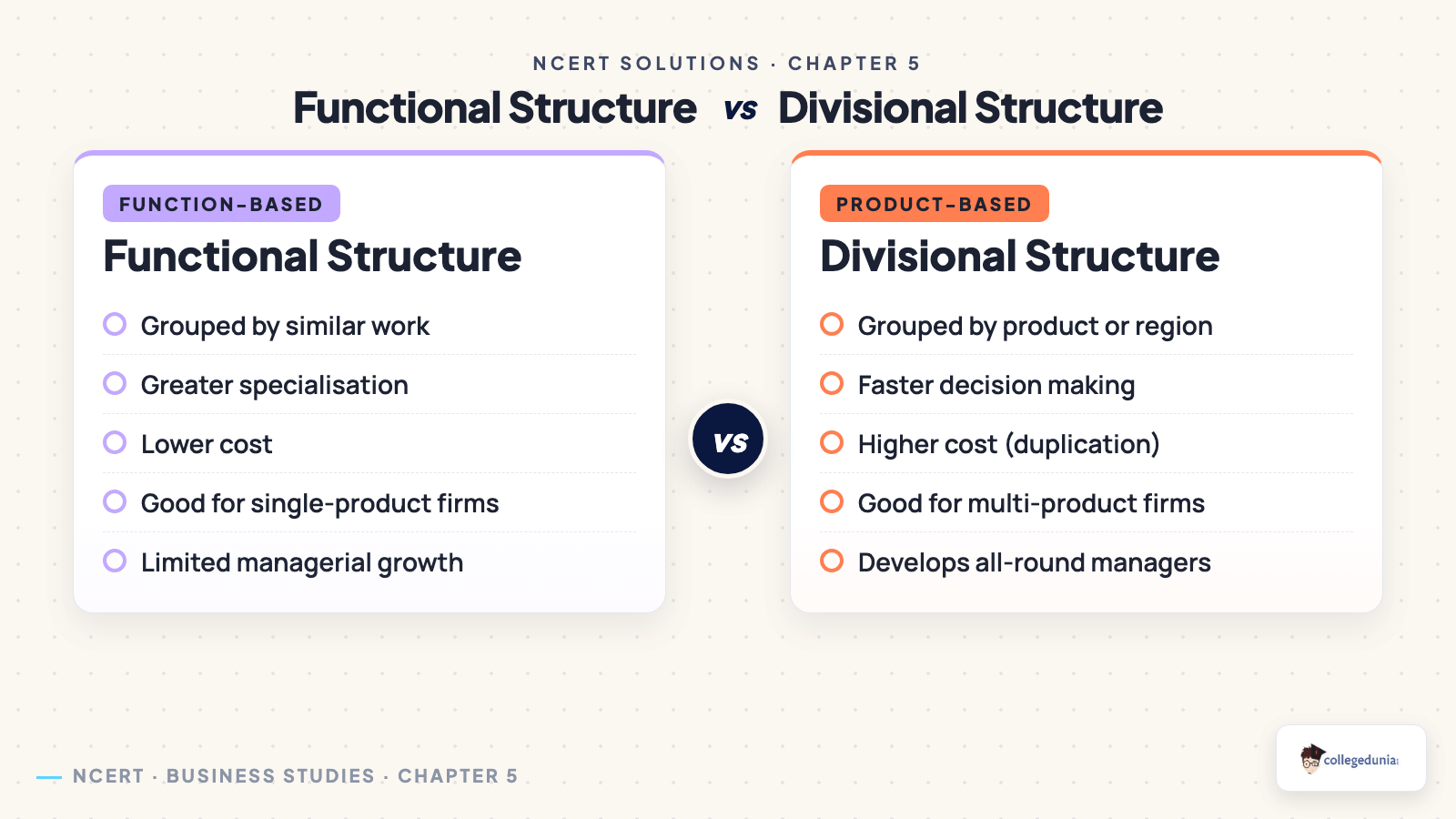
If you are preparing the Class 12 Business Studies board paper, Organising is a scoring chapter you should not leave to the last minute. These NCERT Solutions work through every question on the organising process, organisation structures and delegation, in line with the 2026-27 CBSE syllabus.
CBSE Weightage: 6 to 10 marks (Unit 2, Principles and Functions of Management). One Short Answer plus one Long Answer is the recurring pattern.
Question Count: 5 Very Short Answer plus 7 Short Answer plus 8 Long Answer (20 in total).
You can find the complete NCERT Solutions for Organising, including answers on the four-step organising process (I-D-A-R), the two structures (functional and divisional with advantages and limitations), formal vs informal organisation, the three elements of delegation (A-R-A), and decentralisation, in the article below.
These NCERT Solutions are curated by senior Commerce educators, mapped to the 2026-27 NCERT Business Studies textbook, and refined against the last five years of CBSE Class 12 Business Studies Board papers.
The Business Studies Chapter 5 end-of-chapter exercises are split into three sub-sections by mark weightage. The table groups the 20 questions by sub-section so you can target the clusters CBSE tests most heavily.
Sub-section
Question Count
Focus Area
Difficulty
Very Short Answer
5
Informal organisation, span of management, functional structure circumstances, functional diagram, structure recommendation for split-location consumer goods firm
Easy
Short Answer
7
Organising process steps, delegation elements, informal-formal interaction, centralisation vs decentralisation in large firms, decentralisation as extended delegation, structure for diversified firm, parity of authority and responsibility case
Medium
Long Answer
8
Why delegation is essential, divisional structure advantages and limitations, decentralisation as policy, distinguish centralisation vs decentralisation, distinguish functional vs divisional structure, toy company diversification case, sewing-machines formal-informal case, X Ltd FMCG centralisation case
Medium to Hard
The 6-mark CBSE board question almost always comes from the divisional vs functional structure distinction or one of the case-based long answers (Q6, Q7, Q8 in Long Answer cluster). Three of these long answers carry 18 of the 20 total marks awarded for this chapter on the board.
Concept Anchor: Delegation has three inseparable elements: Authority flows downward, Responsibility flows upward, and Accountability cannot be delegated. Memorise this A-R-A triple and most delegation case studies become easy.
What the Class 12 Business Studies Chapter 5 NCERT Solutions PDF Contains
The PDF contains solved answers to every Very Short, Short, and Long Answer question from the NCERT Business Studies textbook Chapter 5, presented in a CBSE marker-friendly format that stays close to the prescribed step-marking pattern.
Concept-used opener on every question stating the definition, process step, or structural principle being applied.
Step-by-step working with each idea on its own line so each step can be marked independently.
Case-mapping for every situational question (Neha shoes, toy company, sewing machines, X Ltd cosmetics), so the case phrase is quoted alongside the matching concept.
Expert Solution on every question that supplies an MBA-style alternate angle plus a short board-strategy note.
Common-mistake call-outs on the highest-risk questions, for example confusing functional with divisional structure based on geographical spread alone.
How will Collegedunia's NCERT Solutions Help You with Organising?
Three concept clusters drive over 85% of marks in this chapter: the two organisation structures, delegation and decentralisation, and case-based structure choice. The Collegedunia solutions are written so that these clusters are internalised while you practise, rather than memorised after the fact.
2026-27 NCERT Alignment: Every solution matches the current Business Studies textbook chapter order and the latest CBSE marking scheme.
Marker-Style Answer Structure: Bold-titled bullet points, each developed in two lines, mirroring CBSE step-marking expectations.
Expert Verification: Every case-mapping and structure-recommendation is cross-checked against the NCERT textbook language.
Common-Mistake Inline Notes: Functional vs divisional structure for spread locations, parity of authority and responsibility, delegation vs decentralisation - all flagged at the point of error.
Solved Example: Divisional Structure Walk-Through
The solved example below shows the answer shape a CBSE marker expects for a typical 6-mark question on divisional structure. The same structure transfers to every "recommend a structure" or "advantages and limitations of divisional structure" question.
Question (6 marks). What is a divisional structure? Discuss its advantages and limitations.
Definition (1M). A divisional organisation structure groups activities by product, region, or customer. Each division is a self-contained unit with its own production, marketing, finance, and HR sub-departments.
Advantages (2.5M).
Product specialisation - each division becomes expert in its product line.
Quicker decisions - the division head has end-to-end authority.
Accountability for performance - each division's profit can be measured separately.
Flexibility - one division can change strategy without disturbing others.
Expansion - adding a new product line means adding a new division.
Limitations (2.5M).
Departmental conflict - divisions may compete for firm-wide resources.
Duplication of resources - each division has its own production, marketing, and finance.
Higher cost - duplication raises overhead.
Ignoring organisational interest - division heads may prioritise their division over the firm.
Note the explicit duplication-of-resources limitation. CBSE awards a full mark for stating this with one example (Tata Motors has separate production lines for commercial and passenger vehicles), so writing it as a labelled bullet protects that mark.
Top Five Most-Tested Concepts in Class 12 Business Studies Chapter 5
Functional vs Divisional Structure. Distinguish question or "recommend a structure" case. Six bases of difference, each developed in two lines.
Three Elements of Delegation. Authority, Responsibility, Accountability with the three directional rules (down, up, non-delegable).
Four-Step Organising Process. I-D-A-R per NCERT: identify and divide work, departmentalise, assign duties, establish authority and reporting relationships.
Formal vs Informal Organisation. Why both coexist; how informal supports formal through grapevine, gap-filling, morale, and feedback.
Centralisation vs Decentralisation. Six bases of difference; how decentralisation is delegation extended to the lowest level.
Previous-Year Question Trend: CBSE 2025 to 2020
Year
Marks From This Chapter
Topics Tested
2025
9
Functional vs divisional structure (6M case), delegation elements (3M)
2024
7
Informal organisation support (3M), divisional structure recommendation case (4M)
2023
6
Steps of organising process (5M), span of management (1M VSA)
2022
10
Centralisation vs decentralisation distinguish (6M), parity of authority case (4M)
2021
5
Elements of delegation (3M), informal organisation VSA (2M)
2020
8
Divisional structure advantages and limitations (6M), span of management VSA (2M)
The pattern is stable: one 5-6 mark long answer from the structure or decentralisation cluster, one 3-4 mark short answer on delegation, and a 1-2 mark VSA on span of management or informal organisation.
Common Mistakes Students Make in Organising
Confusing functional with divisional structure for geographically spread firms. Multiple locations alone do not trigger divisional structure. Only product-level (or true region-with-own-product) differentiation does.
Treating responsibility and accountability as the same. Responsibility is the obligation to do the task; accountability is being answerable for the outcome. Responsibility can be transferred via delegation, accountability cannot.
Saying delegation is the same as decentralisation. Delegation is one-to-one; decentralisation is firm-wide and is a policy choice.
Forgetting the directional rules of delegation. Authority flows down, responsibility flows up, accountability is non-delegable. State the three rules explicitly.
Listing fewer than four organising-process steps. NCERT lists four steps and each carries roughly one mark; an incomplete list caps the marks.
All NCERT Solutions for Organising with Step-by-Step Working
Every NCERT textbook question for Class 12 Business Studies Chapter 5 Organising is listed below with its full Solution and Expert Solution hidden inside collapsible tabs. Click Check Solution to reveal the step-by-step working; click Expert Solution for the expanded explanation.
Very Short Answer Type
Q 5.1
Identify the network of social relationships which arises
spontaneously due to interaction at work.
Concept used. An informal organisation is the
network of social and personal relationships that emerges
spontaneously when employees interact at work. It is not designed
by management and does not appear on the organisation chart.
In every workplace, employees from different departments
and levels meet during work, breaks, and after hours.
Through repeated interaction they form friendships,
common interest groups, and informal communication
networks (sometimes called the ``grapevine'').
These networks arise on their own, without management
designing them, and they exist alongside the formal
organisation structure.
Such a network is termed the informal organisation.
The network of social relationships that arises
spontaneously from workplace interaction is called the
informal organisation.
PS
Priya Sharma
MBA HR, IIM Bangalore
Verified Expert
Strategic angle. The keyword in the stem is
spontaneously. Informal organisation is the only NCERT
concept that uses this word. Spot it, write the answer.
Management never designs the informal organisation; it
emerges by itself when people interact during work.
It coexists with the formal organisation but is invisible
on the official organisation chart of the firm.
Informal organisation channels information faster than
formal channels through the grapevine, and helps morale
because employees can vent their grievances informally.
Why this matters. CBSE often follows up this VSA with a
short answer on how informal organisation supports the formal
organisation. Memorise both halves of the topic.
Informal organisation.
Q 5.2
What does the term `Span of management' refer to?
Concept used.Span of management (also called
span of control) is the number of subordinates that can be
effectively managed by a superior. It is a critical organising
decision because it determines the shape of the organisation
chart (tall vs flat).
Each manager can supervise only a limited number of
subordinates effectively; beyond that limit, supervision
becomes diluted and control weakens.
Span of management refers to this maximum effective
number for a given manager and a given task.
A wide span means many subordinates per manager (flat
organisation, fewer levels); a narrow span means few
subordinates per manager (tall organisation, many
levels).
Factors affecting the span include the manager's
capability, subordinates' competence, nature of work, and
availability of information systems.
Span of management refers to the number of subordinates
that can be effectively managed by a superior. It shapes whether
the organisation is tall or flat.
AV
Aditya Verma
M.Com, Delhi School of Economics
Verified Expert
Strategic angle. Span of management is a one-mark VSA in
some sessions and a sub-part of a 4-mark short answer in others.
The full answer has three pieces: definition, what determines it,
and its effect on hierarchy.
Definition: number of subordinates per manager that can
be supervised effectively given the manager's time and
task.
Determinants: manager's capability, subordinates'
competence, task complexity, and the quality of
information systems available to the manager.
Effect on hierarchy: wide span gives a flat hierarchy
with fewer levels; narrow span gives a tall hierarchy
with many levels and more layers of supervision.
Why this matters. A narrow span concentrates control in
fewer hands but adds levels; a wide span dilutes control but
empowers subordinates. The choice ties directly into
decentralisation.
The number of subordinates a manager can effectively
supervise, which controls the organisation's number of levels.
Q 5.3
State any two circumstances under which the functional
structure will prove to be an appropriate choice.
Concept used. A functional structure groups
activities by function (production, ncert-notes-class-12-business-studies-chapter-10-marketing, finance, HR). It
suits organisations that need depth of specialisation in each
function and are not yet diversified into multiple product lines
or regions.
Circumstance 1: Single product or limited product
line. When a firm produces one main product (or a small
related set), splitting by function gives every product
the depth of expertise it needs. Adding divisional layers
would only duplicate effort.
Circumstance 2: Need for specialisation in each
function. When deep functional expertise is required
(an engineering firm, a tax-consulting firm), the
functional structure pools all specialists of one type
into one department where they reinforce each other.
Functional structure is appropriate when (a) the firm
has a single or limited product line, and (b) deep functional
specialisation is required.
SI
Sneha Iyer
MBA Marketing, NMIMS Mumbai
Verified Expert
Strategic angle. The CBSE rubric on this question rewards
naming the two circumstances and giving one short justification
for each. Avoid the trap of listing four or five overlapping
circumstances.
Pick two clearly different circumstances: one based on
product range, one based on function depth.
Add a one-line example under each so the marker can trace
your answer to a real situation.
Avoid mixing in advantages of functional structure (cost
savings, easier control); the question asks for
circumstances, not advantages.
Why this matters. Functional structure is the default
choice for new and single-line firms. Once a firm diversifies into
multiple unrelated products or regions, the divisional structure
takes over.
Single product line and need for deep functional
specialisation are the two circumstances that justify a
functional structure.
Q 5.4
Draw a diagram depicting a functional structure.
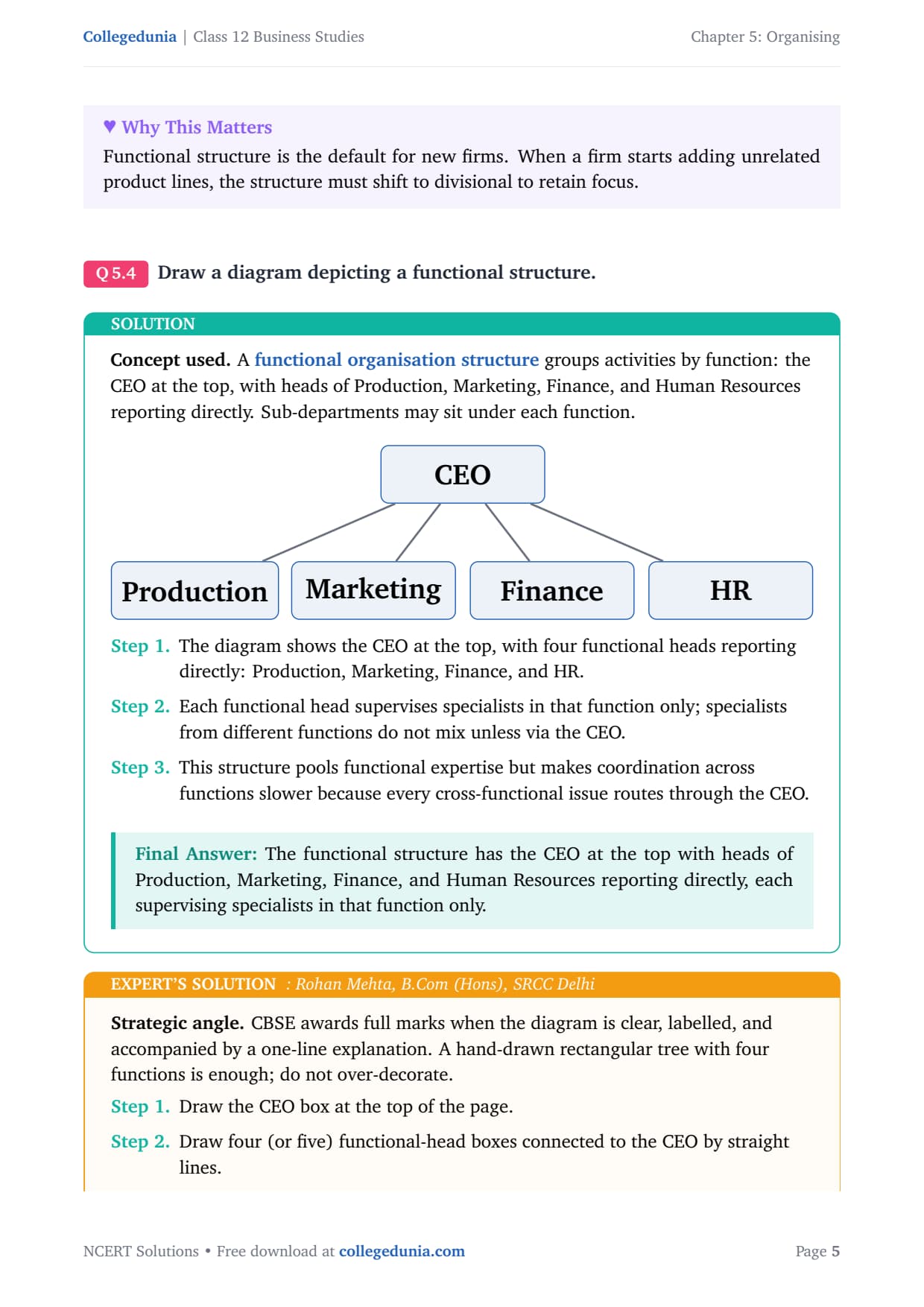
Concept used. A functional organisation
structure groups activities by function: the CEO at the top, with
heads of Production, Marketing, Finance, and Human Resources
reporting directly. Sub-departments may sit under each function.
!%
[See diagram in the PDF version]
%
%
The diagram shows the CEO at the top, with four
functional heads reporting directly: Production,
Marketing, Finance, and HR.
Each functional head supervises specialists in that
function only; specialists from different functions do
not mix unless via the CEO.
This structure pools functional expertise but makes
coordination across functions slower because every
cross-functional issue routes through the CEO.
The functional structure has the CEO at the top with
heads of Production, Marketing, Finance, and Human Resources
reporting directly, each supervising specialists in that
function only.
RM
Rohan Mehta
B.Com (Hons), SRCC Delhi
Verified Expert
Strategic angle. CBSE awards full marks when the diagram
is clear, labelled, and accompanied by a one-line explanation. A
hand-drawn rectangular tree with four functions is enough; do not
over-decorate.
Draw the CEO box at the top of the page.
Draw four (or five) functional-head boxes connected to
the CEO by straight lines.
Add one line of caption beneath the diagram identifying
it as a functional structure.
Why this matters. Diagram questions are easy marks if
you have practised the layout. Keep boxes uniform in size and
lines straight; CBSE does not require artistic quality, only
clarity.
Functional structure diagram: CEO at top, four
functional heads (Production, Marketing, Finance, HR) below,
connected by straight lines.
Q 5.5
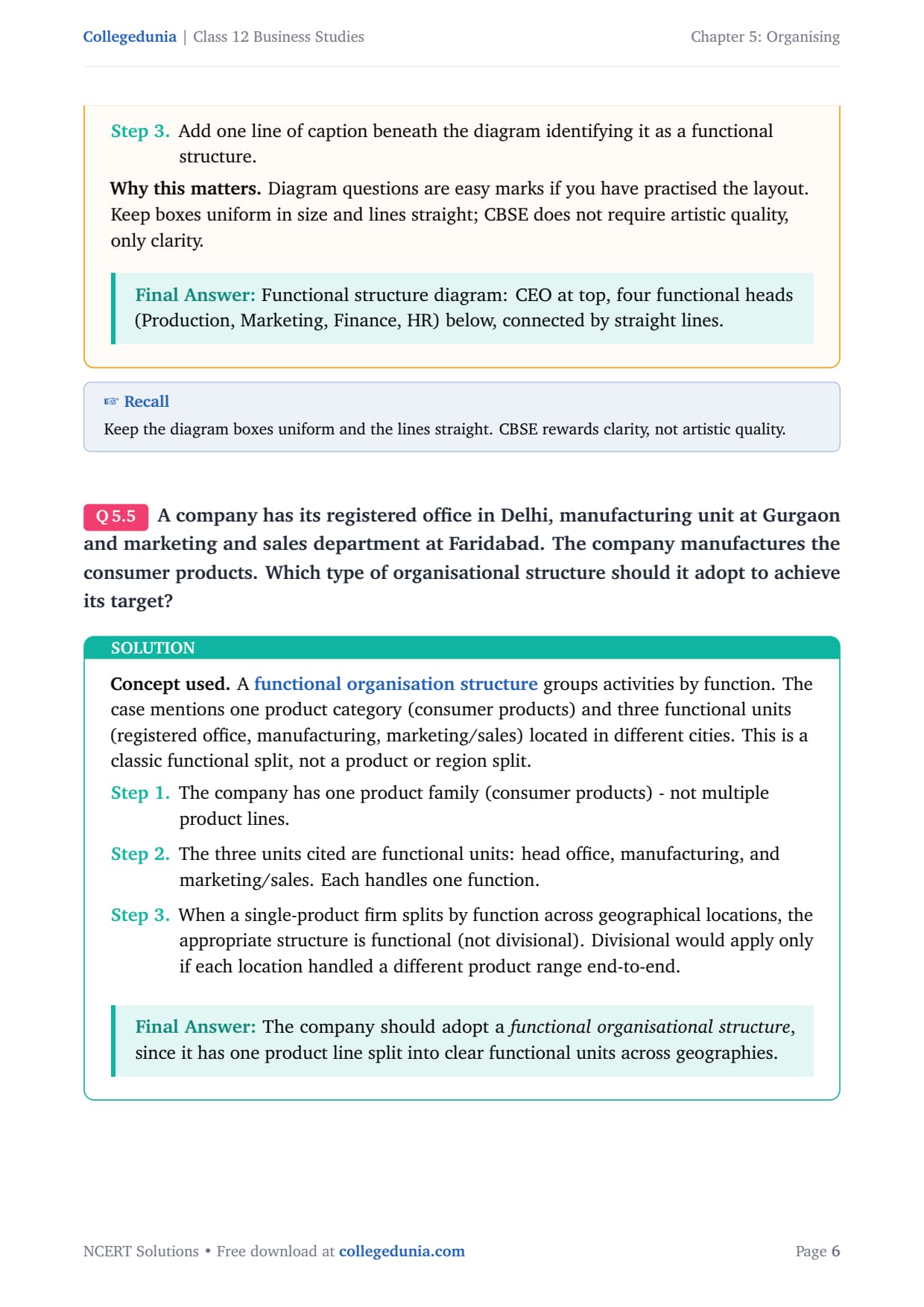
A company has its registered office in Delhi,
manufacturing unit at Gurgaon and ncert-notes-class-12-business-studies-chapter-10-marketing and sales department
at Faridabad. The company manufactures the consumer products.
Which type of organisational structure should it adopt to achieve
its target?
Concept used. A functional organisation
structure groups activities by function. The case mentions one
product category (consumer products) and three functional units
(registered office, manufacturing, ncert-notes-class-12-business-studies-chapter-10-marketing/sales) located in
different cities. This is a classic functional split, not a
product or region split.
The company has one product family (consumer products) -
not multiple product lines.
The three units cited are functional units: head office,
manufacturing, and ncert-notes-class-12-business-studies-chapter-10-marketing/sales. Each handles one
function.
When a single-product firm splits by function across
geographical locations, the appropriate structure is
functional (not divisional). Divisional would apply only
if each location handled a different product range
end-to-end.
The company should adopt a functional
organisational structure, since it has one product line split
into clear functional units across geographies.
VS
Vikram Singh
MBA Strategy, IIM Lucknow
Verified Expert
Strategic angle. The trap in this case is the multiple
locations, which can fool students into picking divisional
structure. Read carefully: each location handles one
function, not a separate product line.
Check for product diversity: one product family means
functional, multiple product lines mean divisional.
Check for the role of each location: function-by-location
is functional; product-by-location is divisional.
Both checks point to functional here, with multiple
geographies but one product family.
Why this matters. Geographical spread alone does not
trigger divisional structure. Only product-level (or region-level
with product-level autonomy) differentiation does.
Functional organisational structure, because the firm
has one product family even though its functions are spread
across cities.
Short Answer Type
Q 5.6
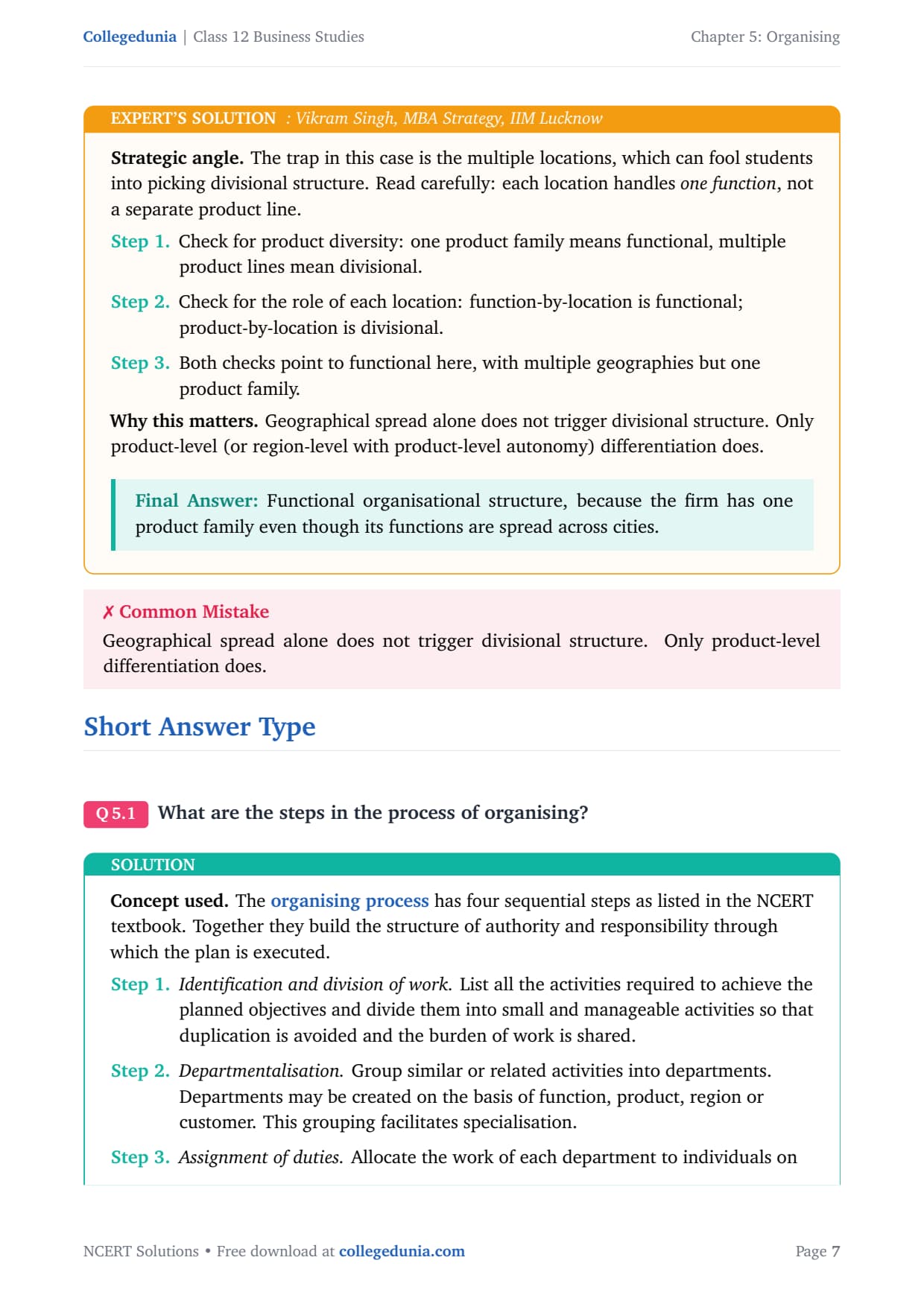
What are the steps in the process of organising?
Concept used. The organising process has four
sequential steps as listed in the NCERT textbook. Together they
build the structure of authority and responsibility through which
the plan is executed.
Identification and division of work. List all the
activities required to achieve the planned objectives and
divide them into small and manageable activities so that
duplication is avoided and the burden of work is shared.
Departmentalisation. Group similar or related
activities into departments. Departments may be created
on the basis of function, product, region or customer.
This grouping facilitates specialisation.
Assignment of duties. Allocate the work of each
department to individuals on the basis of their skills
and competencies. Each department is placed under the
charge of a person who is best fitted to perform it.
Establishing authority and reporting relationships.
Define who reports to whom and the extent of authority
each individual will exercise. This creates the chain of
command, fixes accountability and builds a hierarchical
structure for coordination.
The four steps of the organising process per NCERT are
identification and division of work, departmentalisation,
assignment of duties, and establishing authority and reporting
relationships.
AK
Anjali Kapoor
CA, ICAI Mumbai
Verified Expert
Strategic angle. The four-step organising process is one
of the highest-yield long answers in this chapter. Memorise the
order using the mnemonic I-D-A-R: Identify,
Departmentalise, Assign,
Reporting (authority).
Each step earns roughly one mark in a 4-mark answer; do
not skip steps in favour of writing fewer steps in more
detail.
Add a real-world example under each step (e.g. "ncert-notes-class-12-business-studies-chapter-10-marketing
and sales activities are grouped into the ncert-notes-class-12-business-studies-chapter-10-marketing
department") to anchor the answer.
Close with the role of establishing authority and
reporting relationships as the binding step that gives
the structure its hierarchy.
Why this matters. The organising process feeds into
delegation and decentralisation. Once the structure is built,
authority flows through it from top to bottom; that is the
delegation step in the next concept block.
Four-step organising process: identify and divide work,
departmentalise, assign duties, establish authority and reporting
relationships.
Q 5.7
Discuss the elements of delegation.
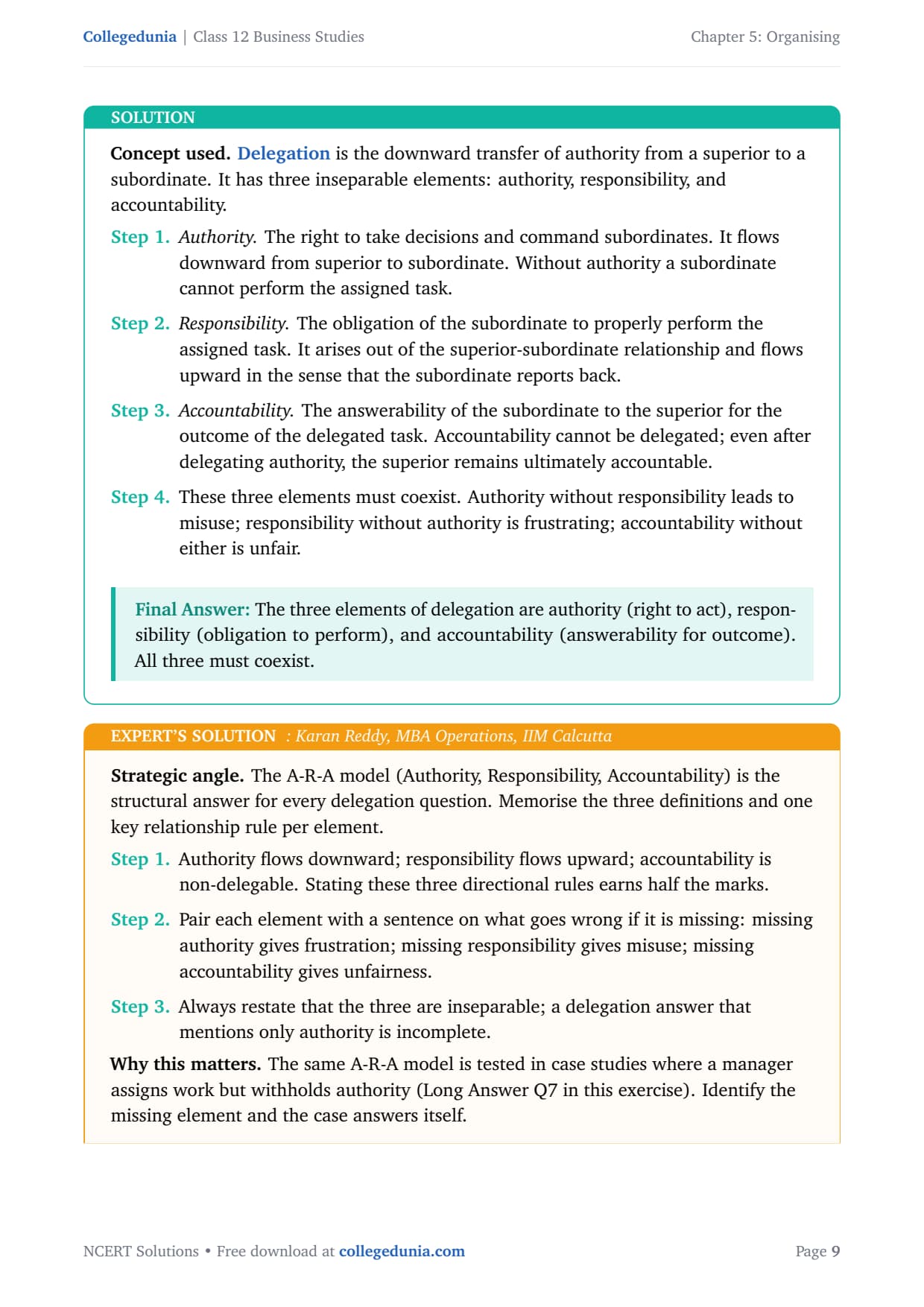
Concept used.Delegation is the downward
transfer of authority from a superior to a subordinate. It has
three inseparable elements: authority, responsibility, and
accountability.
Authority. The right to take decisions and command
subordinates. It flows downward from superior to
subordinate. Without authority a subordinate cannot
perform the assigned task.
Responsibility. The obligation of the subordinate
to properly perform the assigned task. It arises out of
the superior-subordinate relationship and flows upward in
the sense that the subordinate reports back.
Accountability. The answerability of the
subordinate to the superior for the outcome of the
delegated task. Accountability cannot be delegated; even
after delegating authority, the superior remains
ultimately accountable.
These three elements must coexist. Authority without
responsibility leads to misuse; responsibility without
authority is frustrating; accountability without either
is unfair.
The three elements of delegation are authority (right
to act), responsibility (obligation to perform), and
accountability (answerability for outcome). All three must
coexist.
KR
Karan Reddy
MBA Operations, IIM Calcutta
Verified Expert
Strategic angle. The A-R-A model (Authority,
Responsibility, Accountability) is the structural answer for
every delegation question. Memorise the three definitions and one
key relationship rule per element.
Authority flows downward; responsibility flows upward;
accountability is non-delegable. Stating these three
directional rules earns half the marks.
Pair each element with a sentence on what goes wrong if
it is missing: missing authority gives frustration;
missing responsibility gives misuse; missing
accountability gives unfairness.
Always restate that the three are inseparable; a
delegation answer that mentions only authority is
incomplete.
Why this matters. The same A-R-A model is tested in
case studies where a manager assigns work but withholds authority
(Long Answer Q7 in this exercise). Identify the missing element
and the case answers itself.
Authority, responsibility, and accountability - the
three inseparable elements of delegation, each with its own
directional rule.
Q 5.8
How does informal organisation support the formal
organisation?
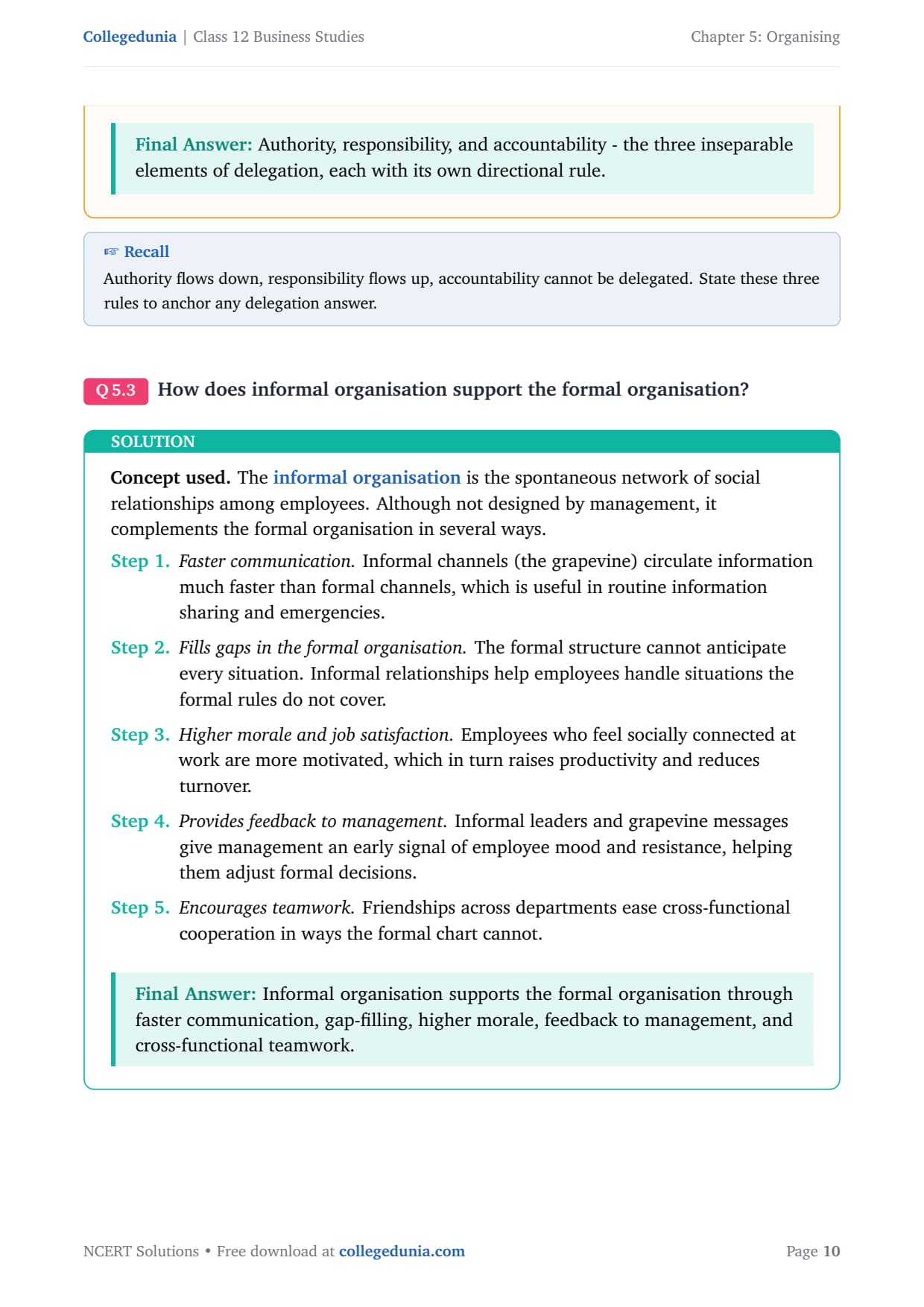
Concept used. The informal organisation is the
spontaneous network of social relationships among employees.
Although not designed by management, it complements the formal
organisation in several ways.
Faster communication. Informal channels (the
grapevine) circulate information much faster than formal
channels, which is useful in routine information sharing
and emergencies.
Fills gaps in the formal organisation. The formal
structure cannot anticipate every situation. Informal
relationships help employees handle situations the formal
rules do not cover.
Higher morale and job satisfaction. Employees who
feel socially connected at work are more motivated, which
in turn raises productivity and reduces turnover.
Provides feedback to management. Informal leaders
and grapevine messages give management an early signal of
employee mood and resistance, helping them adjust formal
decisions.
Encourages teamwork. Friendships across departments
ease cross-functional cooperation in ways the formal
chart cannot.
Informal organisation supports the formal organisation
through faster communication, gap-filling, higher morale,
feedback to management, and cross-functional teamwork.
MJ
Meera Joshi
M.Com (Marketing), Mumbai University
Verified Expert
Strategic angle. CBSE expects a balanced answer in the
3-4 mark short answer format. Lead with two or three benefits
that directly help the formal organisation, then close with the
control implication.
Open with faster communication (the grapevine) - the
single most quoted benefit of informal organisation.
Add gap-filling and morale - two benefits that link
directly to firm performance.
Close with the feedback-loop function: managers can
sense employee mood and act before it becomes a formal
dispute.
Why this matters. Managers should not try to abolish
the informal organisation; that only drives it underground. The
best stance is to recognise it and use it to support formal
decisions.
Informal organisation supports the formal organisation
by speeding communication, plugging gaps, raising morale, and
giving managers an early signal of employee sentiment.
Q 5.9
Can a large sized organisation be totally centralised or
decentralised? Give your opinion.
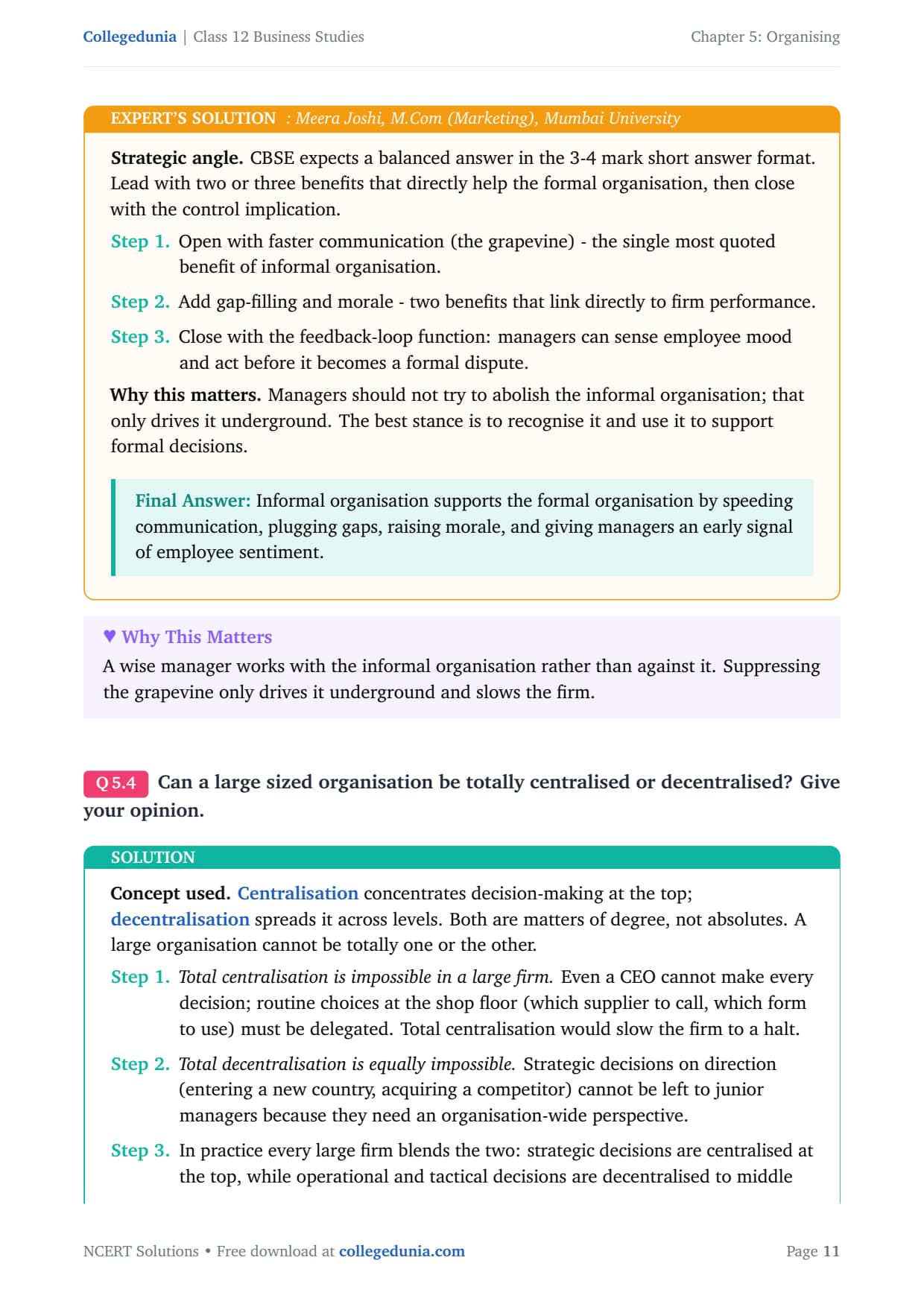
Concept used.Centralisation concentrates
decision-making at the top; decentralisation spreads it
across levels. Both are matters of degree, not absolutes. A large
organisation cannot be totally one or the other.
Total centralisation is impossible in a large firm.
Even a CEO cannot make every decision; routine choices at
the shop floor (which supplier to call, which form to
use) must be delegated. Total centralisation would slow
the firm to a halt.
Total decentralisation is equally impossible.
Strategic decisions on direction (entering a new country,
acquiring a competitor) cannot be left to junior managers
because they need an organisation-wide perspective.
In practice every large firm blends the two: strategic
decisions are centralised at the top, while operational
and tactical decisions are decentralised to middle and
lower levels.
The right balance depends on the firm's size, industry,
environment uncertainty, and management philosophy.
No - a large organisation can be neither totally
centralised nor totally decentralised. Strategic decisions sit at
the top while operational decisions are delegated.
AN
Arjun Nair
MBA HR, XLRI Jamshedpur
Verified Expert
Strategic angle. The CBSE rubric awards three points
here: state the impossibility of both extremes, give one reason
for each, and then explain the blended reality.
State the clear ``no'' upfront.
Explain why total centralisation fails: the volume of
decisions overwhelms the top.
Explain why total decentralisation fails: strategic
coherence is lost when junior managers make
organisation-wide decisions.
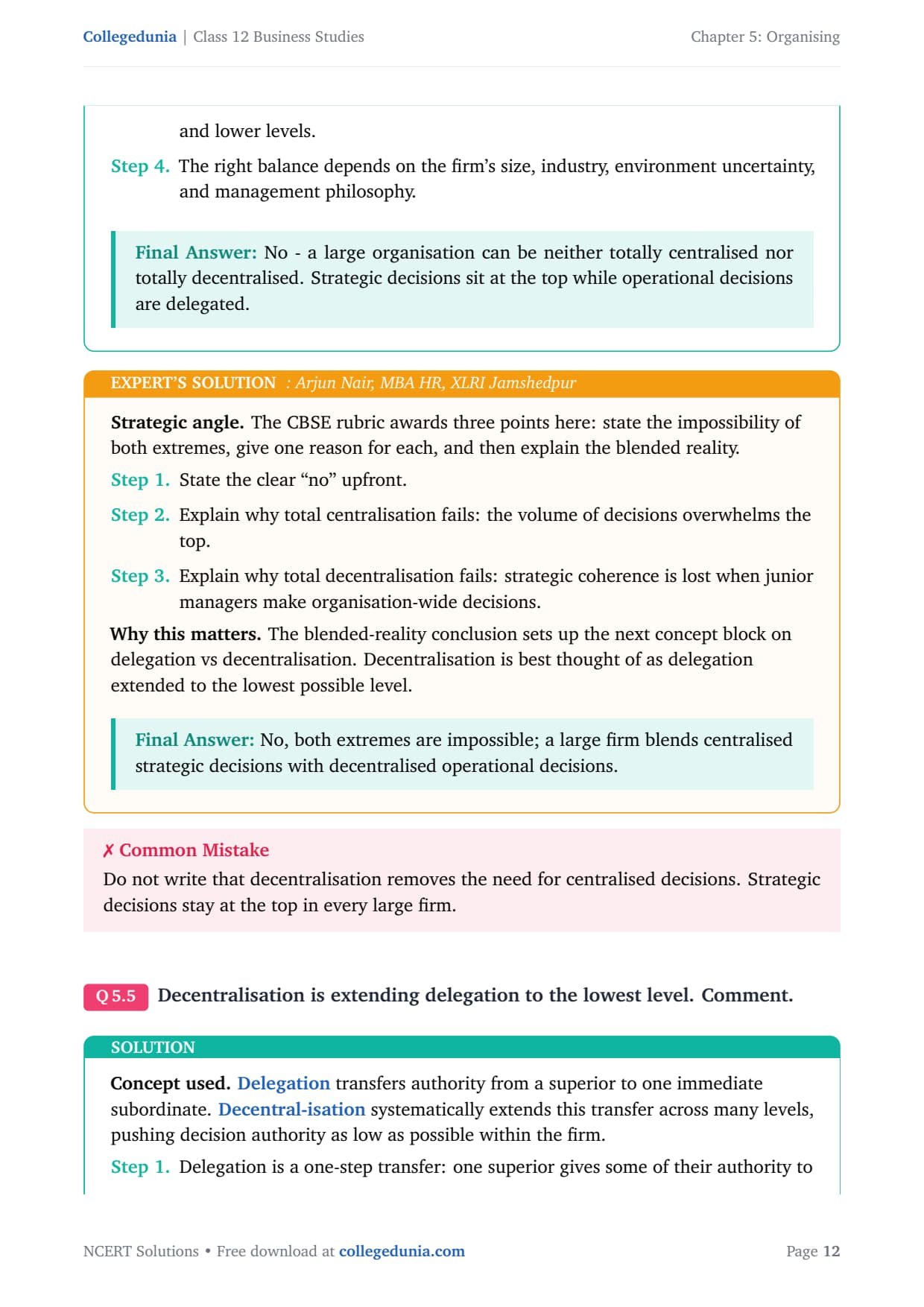
Why this matters. The blended-reality conclusion sets
up the next concept block on delegation vs decentralisation.
Decentralisation is best thought of as delegation extended to
the lowest possible level.
No, both extremes are impossible; a large firm blends
centralised strategic decisions with decentralised operational
decisions.
Q 5.10
Decentralisation is extending delegation to the lowest
level. Comment.
Concept used.Delegation transfers authority
from a superior to one immediate subordinate. Decentral-%
isation systematically extends this transfer across many levels,
pushing decision authority as low as possible within the firm.
Delegation is a one-step transfer: one superior gives
some of their authority to one subordinate. It happens
between two people.
Decentralisation extends this transfer organisation-wide:
every superior delegates downward, until the lowest level
that can take a decision has the authority to do so.
Therefore the statement is correct: decentralisation is
the systematic extension of delegation to the lowest
feasible level.
However, decentralisation is also a philosophy and policy
of the firm, not just an accumulation of delegations. It
requires consistent application across departments and a
culture that supports lower-level decision-making.
The statement is correct: decentralisation is
delegation systematically extended to the lowest feasible level,
and it is also a firm-wide policy of pushing authority downward.
PB
Pooja Bansal
MBA International Business, IIFT Delhi
Verified Expert
Strategic angle. A "comment" answer in CBSE expects
agreement or disagreement with reasoning. The textbook supports
agreement here, so the answer is "yes, with two layers of
explanation".
Layer 1: the structural extension - delegation between
two people becomes decentralisation when repeated across
all levels.
Layer 2: the policy extension - decentralisation also
carries a cultural intent of pushing authority downward
consistently.
Conclude that both layers must coexist for true
decentralisation; a firm with only one or two delegations
is not decentralised.
Why this matters. The "policy" framing distinguishes
decentralisation from accidental scattered delegations. A truly
decentralised firm has it as a stated philosophy, not a
consequence.
Yes, the statement is correct - decentralisation is
both the structural extension of delegation to the lowest level
and the firm-wide policy that sustains it.
Q 5.11
Neha runs a factory wherein she manufactures shoes. The
business has been doing well and she intends to expand by
diversifying into leather bags as well as western formal wear
thereby making her company a complete provider of corporate wear.
This will enable her to market her business unit as the one stop
for working women. Which type of structure would you recommend
for her expanded organisation and why?
Concept used. A divisional organisation
structure groups activities by product line. It suits firms with
multiple unrelated product categories, because each division can
run end-to-end with its own production, ncert-notes-class-12-business-studies-chapter-10-marketing and finance
sub-units. Neha's expansion creates three product categories
(shoes, leather bags, formal wear), which is the classic divisional
trigger.
Neha's expanded firm has three distinct product
categories that share little operational similarity
(footwear, bags, apparel each need different production
skills and supplier networks).
A functional structure would force each function
(production, ncert-notes-class-12-business-studies-chapter-10-marketing) to handle all three product lines
together, leading to poor focus and slow decisions.
A divisional structure gives each product line its own
division head with end-to-end responsibility (production,
ncert-notes-class-12-business-studies-chapter-10-marketing, finance, HR sub-units within the division).
Reasons to recommend divisional: (a) clear product
accountability, (b) faster decisions because each
division head has full authority, (c) ease of expansion
when a fourth product line is added later, (d) easier
performance measurement at division level.
Recommend a divisional organisation structure split by
product line - shoes division, leather bags division, formal wear
division - because each product category needs end-to-end focus
and the divisions can be evaluated separately.
RK
Rahul Khanna
M.Com (Finance), Christ University Bangalore
Verified Expert
Strategic angle. The case has the classic marker of
divisional structure: multiple unrelated product lines being added
to an existing single-product firm. Anchor the answer to this
product-diversity trigger.
Identify the product-diversity trigger: three distinct
product categories.
Recommend divisional structure with one division per
product line, naming each division explicitly to anchor
the case.
State four benefits of divisional structure that apply
specifically to Neha's case: product focus, decision
speed, expansion ease, and performance measurement.
Why this matters. The same logic applies to long-answer
case studies later in this exercise (Q6 - toy company expanding
into electronic toys). Once you internalise the product-diversity
trigger, multiple case studies become easy.
Divisional structure by product line: shoes, leather
bags, formal wear - each as a self-contained division.
Q 5.12
The production manager asked the foreman to achieve a
target production of 200 units per day, but he doesn't give him
the authority to requisition tools and materials from the stores
department. Can the production manager blame the foreman if he is
not able to achieve the desired target? Give reasons.
Concept used.Delegation requires three
elements - authority, responsibility, accountability - to coexist.
Assigning responsibility without authority makes execution
impossible and is unfair to the subordinate.
The foreman has been given the responsibility to
achieve 200 units per day. He is expected to perform this
task.
However, the foreman has not been given the
authority to requisition tools and materials. Tools
and materials are essential inputs for production.
Without the authority over essential inputs, the foreman
cannot perform the assigned task. He must constantly seek
approvals from the production manager for routine
requisitions, which delays work.
Therefore the production manager cannot fairly blame the
foreman. The principle of parity of authority and
responsibility - one of the textbook principles of
delegation - has been violated.
The production manager is the one who erred by delegating
responsibility without matching authority. He is
accountable for the failure.
No - the production manager cannot blame the foreman.
The principle of parity of authority and responsibility has been
violated; responsibility was given without the matching
authority over essential inputs.
DM
Divya Menon
CMA, Institute of Cost Accountants Kolkata
Verified Expert
Strategic angle. The case has a textbook violation of
parity: responsibility without authority. The CBSE rubric expects
naming the principle and identifying the missing element.
Name the textbook principle: parity of authority and
responsibility. Both must be equal.
Identify the missing element in the case: authority over
tool and material requisitions.
Conclude with whose fault it is: the production manager
(the delegator), not the foreman (the delegate).
Why this matters. Case studies on delegation almost
always test one of two principles: parity of authority and
responsibility, or absoluteness of accountability. Spot the
principle, name it, identify the violation.
No - parity of authority and responsibility is
violated. The production manager is at fault for delegating
responsibility without the authority over essential inputs.
Long Answer Type
Q 5.13
Why is delegation considered essential for effective
organising?
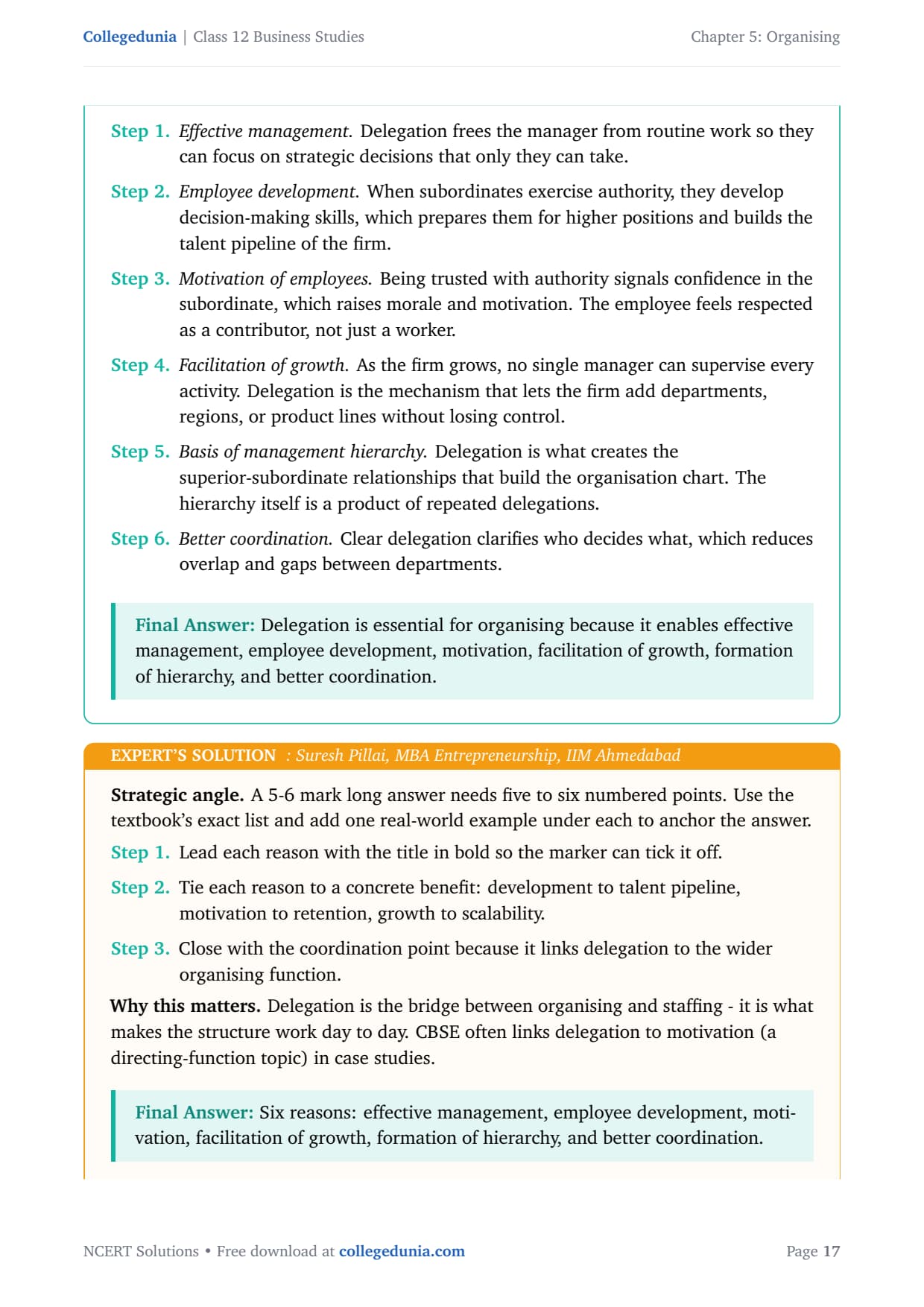
Concept used.Delegation is the downward
transfer of authority from a superior to a subordinate. Without
delegation, an organisation cannot scale because every decision
would route to the top. The textbook lists five reasons
delegation is essential.
Effective management. Delegation frees the
manager from routine work so they can focus on strategic
decisions that only they can take.
Employee development. When subordinates exercise
authority, they develop decision-making skills, which
prepares them for higher positions and builds the talent
pipeline of the firm.
Motivation of employees. Being trusted with
authority signals confidence in the subordinate, which
raises morale and motivation. The employee feels
respected as a contributor, not just a worker.
Facilitation of growth. As the firm grows, no
single manager can supervise every activity. Delegation
is the mechanism that lets the firm add departments,
regions, or product lines without losing control.
Basis of management hierarchy. Delegation is what
creates the superior-subordinate relationships that build
the organisation chart. The hierarchy itself is a
product of repeated delegations.
Better coordination. Clear delegation clarifies
who decides what, which reduces overlap and gaps between
departments.
Delegation is essential for organising because it
enables effective management, employee development, motivation,
facilitation of growth, formation of hierarchy, and better
coordination.
SP
Suresh Pillai
MBA Entrepreneurship, IIM Ahmedabad
Verified Expert
Strategic angle. A 5-6 mark long answer needs five to
six numbered points. Use the textbook's exact list and add one
real-world example under each to anchor the answer.
Lead each reason with the title in bold so the marker
can tick it off.
Tie each reason to a concrete benefit: development to
talent pipeline, motivation to retention, growth to
scalability.
Close with the coordination point because it links
delegation to the wider organising function.
Why this matters. Delegation is the bridge between
organising and staffing - it is what makes the structure work
day to day. CBSE often links delegation to motivation (a
directing-function topic) in case studies.
Six reasons: effective management, employee
development, motivation, facilitation of growth, formation of
hierarchy, and better coordination.
Additional drilldown. Pair each of the six reasons with one Indian business example: Tata's talent-pipeline approach (employee development), Infosys' regional empowerment (growth), Reliance's functional empowerment of CXOs (effective management). These named examples lift a 5-mark answer into the 6-mark band by adding concrete anchoring that CBSE markers explicitly reward.
Q 5.14
What is a divisional structure? Discuss its advantages
and limitations.
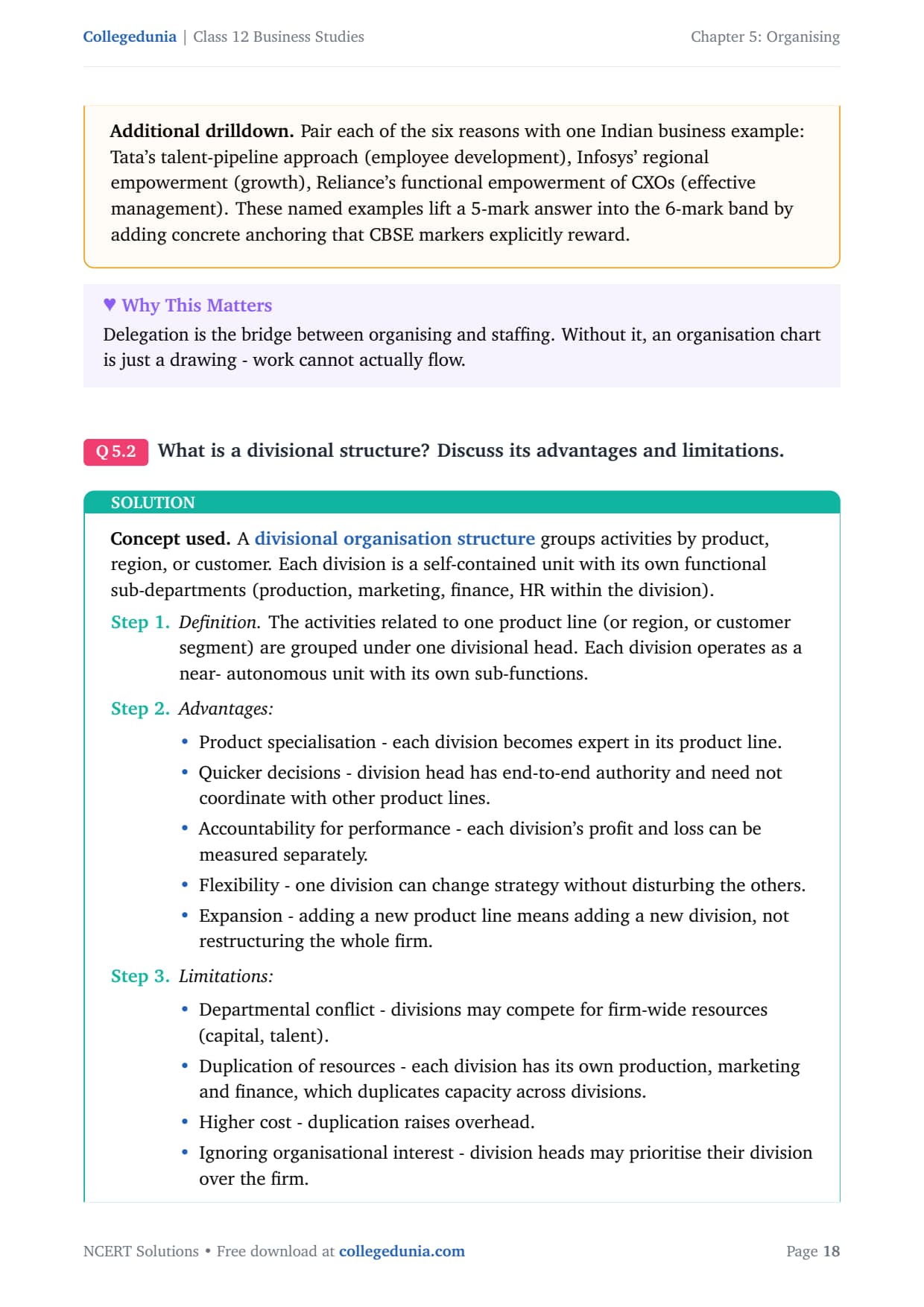
Concept used. A divisional organisation
structure groups activities by product, region, or customer.
Each division is a self-contained unit with its own functional
sub-departments (production, ncert-notes-class-12-business-studies-chapter-10-marketing, finance, HR within the
division).
Definition. The activities related to one product
line (or region, or customer segment) are grouped under
one divisional head. Each division operates as a near-
autonomous unit with its own sub-functions.
Advantages:
Product specialisation - each division becomes
expert in its product line.
Quicker decisions - division head has end-to-end
authority and need not coordinate with other
product lines.
Accountability for performance - each division's
profit and loss can be measured separately.
Flexibility - one division can change strategy
without disturbing the others.
Expansion - adding a new product line means
adding a new division, not restructuring the
whole firm.
Limitations:
Departmental conflict - divisions may compete
for firm-wide resources (capital, talent).
Duplication of resources - each division has its
own production, ncert-notes-class-12-business-studies-chapter-10-marketing and finance, which
duplicates capacity across divisions.
Higher cost - duplication raises overhead.
Ignoring organisational interest - division
heads may prioritise their division over the
firm.
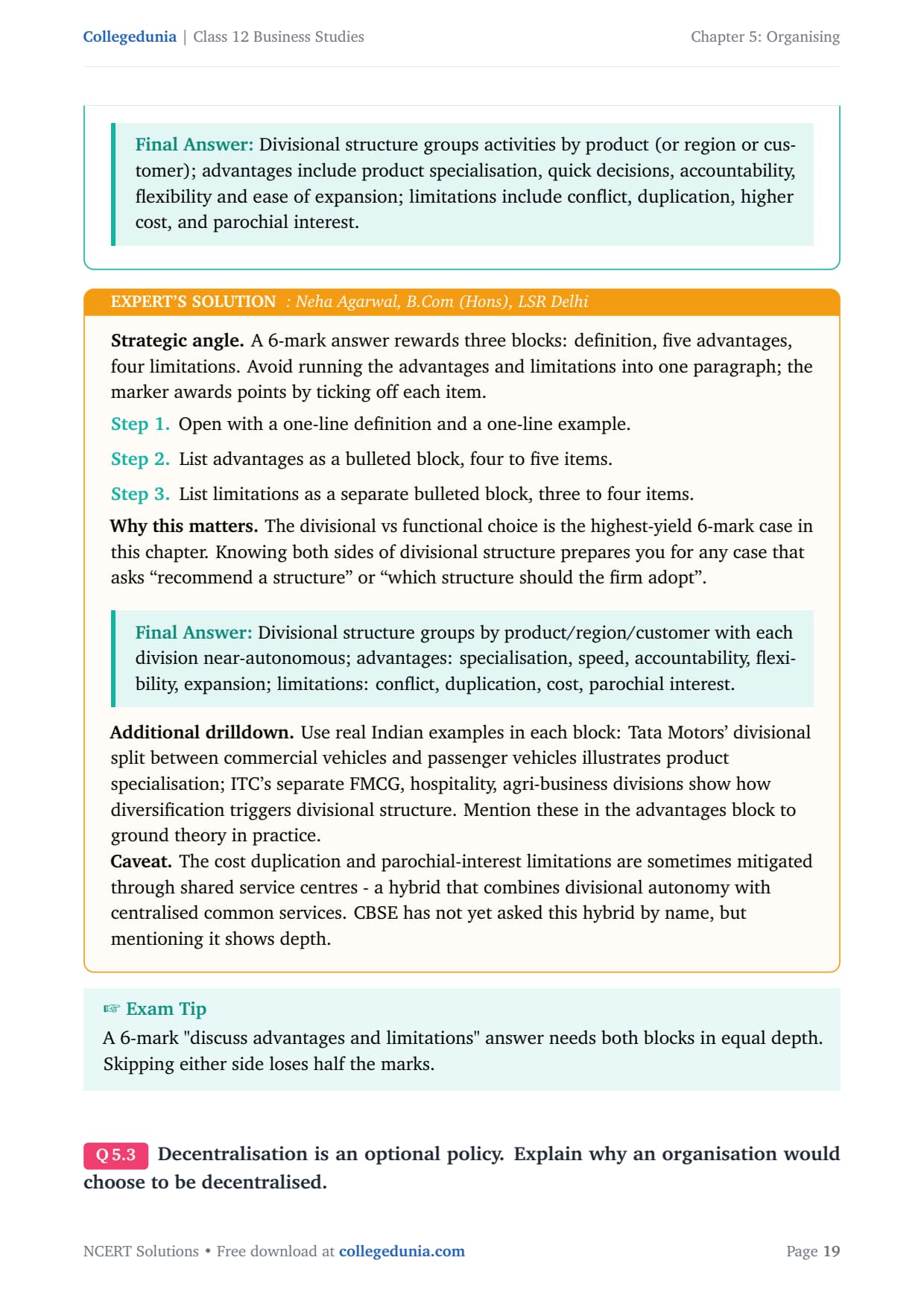
Divisional structure groups activities by product (or
region or customer); advantages include product specialisation,
quick decisions, accountability, flexibility and ease of
expansion; limitations include conflict, duplication, higher
cost, and parochial interest.
NA
Neha Agarwal
B.Com (Hons), LSR Delhi
Verified Expert
Strategic angle. A 6-mark answer rewards three blocks:
definition, five advantages, four limitations. Avoid running the
advantages and limitations into one paragraph; the marker awards
points by ticking off each item.
Open with a one-line definition and a one-line example.
List advantages as a bulleted block, four to five items.
List limitations as a separate bulleted block, three to
four items.
Why this matters. The divisional vs functional choice
is the highest-yield 6-mark case in this chapter. Knowing both
sides of divisional structure prepares you for any case that
asks ``recommend a structure'' or ``which structure should the
firm adopt''.
Divisional structure groups by product/region/customer
with each division near-autonomous; advantages: specialisation,
speed, accountability, flexibility, expansion; limitations:
conflict, duplication, cost, parochial interest.
Additional drilldown. Use real Indian examples in each block: Tata Motors' divisional split between commercial vehicles and passenger vehicles illustrates product specialisation; ITC's separate FMCG, hospitality, agri-business divisions show how diversification triggers divisional structure. Mention these in the advantages block to ground theory in practice.
Caveat. The cost duplication and parochial-interest limitations are sometimes mitigated through shared service centres - a hybrid that combines divisional autonomy with centralised common services. CBSE has not yet asked this hybrid by name, but mentioning it shows depth.
Q 5.15
Decentralisation is an optional policy. Explain why an
organisation would choose to be decentralised.
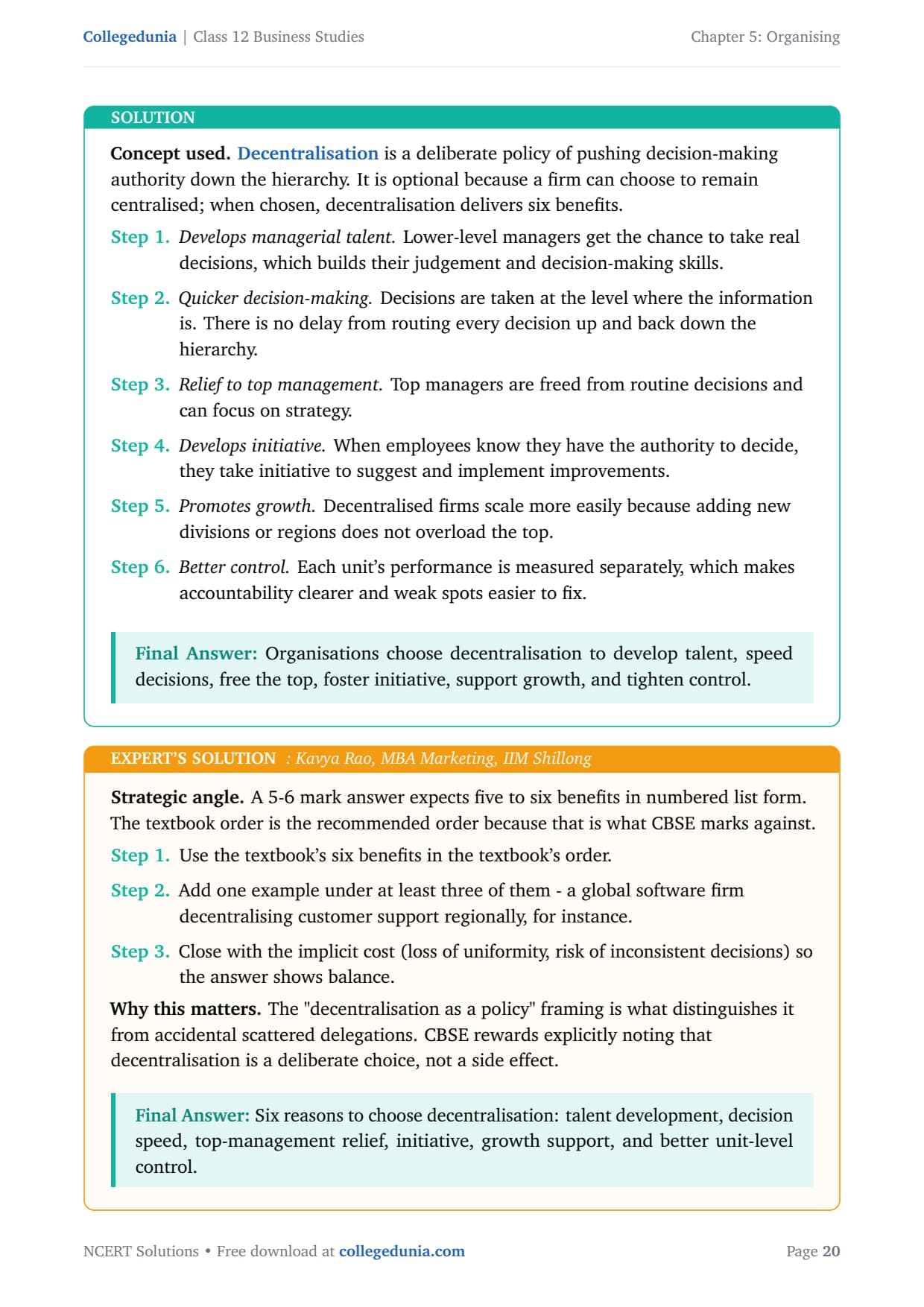
Concept used.Decentralisation is a deliberate
policy of pushing decision-making authority down the hierarchy.
It is optional because a firm can choose to remain centralised;
when chosen, decentralisation delivers six benefits.
Develops managerial talent. Lower-level managers
get the chance to take real decisions, which builds
their judgement and decision-making skills.
Quicker decision-making. Decisions are taken at
the level where the information is. There is no delay
from routing every decision up and back down the
hierarchy.
Relief to top management. Top managers are freed
from routine decisions and can focus on strategy.
Develops initiative. When employees know they have
the authority to decide, they take initiative to suggest
and implement improvements.
Promotes growth. Decentralised firms scale more
easily because adding new divisions or regions does not
overload the top.
Better control. Each unit's performance is
measured separately, which makes accountability clearer
and weak spots easier to fix.
Organisations choose decentralisation to develop
talent, speed decisions, free the top, foster initiative, support
growth, and tighten control.
KR
Kavya Rao
MBA Marketing, IIM Shillong
Verified Expert
Strategic angle. A 5-6 mark answer expects five to six
benefits in numbered list form. The textbook order is the
recommended order because that is what CBSE marks against.
Use the textbook's six benefits in the textbook's order.
Add one example under at least three of them - a global
software firm decentralising customer support
regionally, for instance.
Close with the implicit cost (loss of uniformity, risk
of inconsistent decisions) so the answer shows balance.
Why this matters. The "decentralisation as a policy"
framing is what distinguishes it from accidental scattered
delegations. CBSE rewards explicitly noting that
decentralisation is a deliberate choice, not a side effect.
Six reasons to choose decentralisation: talent
development, decision speed, top-management relief, initiative,
growth support, and better unit-level control.
Q 5.16
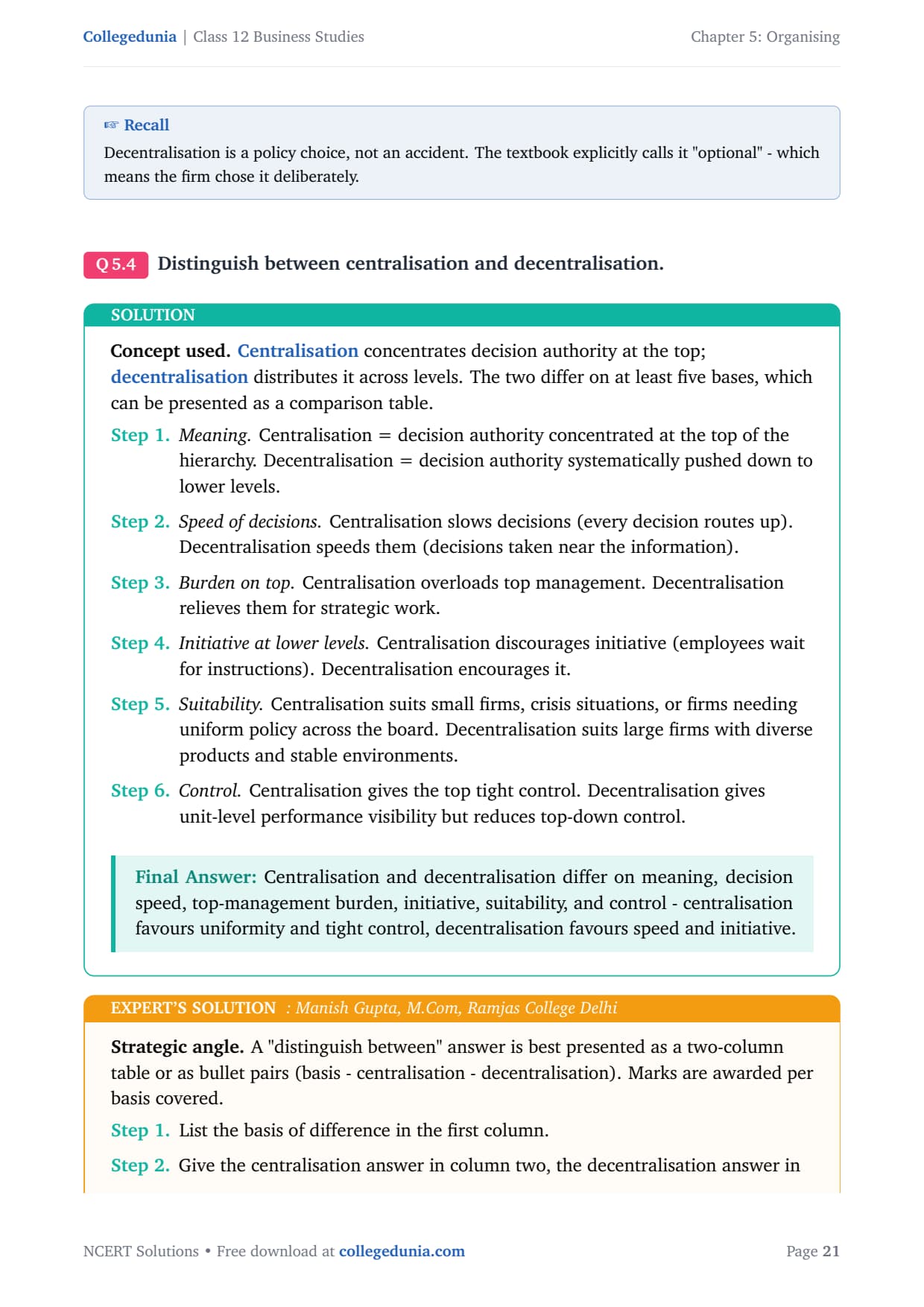
Distinguish between centralisation and
decentralisation.
Concept used.Centralisation concentrates
decision authority at the top; decentralisation
distributes it across levels. The two differ on at least five
bases, which can be presented as a comparison table.
Meaning. Centralisation = decision authority
concentrated at the top of the hierarchy.
Decentralisation = decision authority systematically
pushed down to lower levels.
Speed of decisions. Centralisation slows decisions
(every decision routes up). Decentralisation speeds them
(decisions taken near the information).
Burden on top. Centralisation overloads top
management. Decentralisation relieves them for strategic
work.
Initiative at lower levels. Centralisation
discourages initiative (employees wait for instructions).
Decentralisation encourages it.
Suitability. Centralisation suits small firms,
crisis situations, or firms needing uniform policy across
the board. Decentralisation suits large firms with
diverse products and stable environments.
Control. Centralisation gives the top tight
control. Decentralisation gives unit-level performance
visibility but reduces top-down control.
Centralisation and decentralisation differ on meaning,
decision speed, top-management burden, initiative, suitability,
and control - centralisation favours uniformity and tight
control, decentralisation favours speed and initiative.
MG
Manish Gupta
M.Com, Ramjas College Delhi
Verified Expert
Strategic angle. A "distinguish between" answer is best
presented as a two-column table or as bullet pairs (basis -
centralisation - decentralisation). Marks are awarded per basis
covered.
List the basis of difference in the first column.
Give the centralisation answer in column two, the
decentralisation answer in column three.
Cover five to six bases for a 5-mark answer; cover four
for a 4-mark answer.
Why this matters. The same five bases get reused in
case-study questions ("which approach should the firm adopt?").
Memorising the bases makes both kinds of questions trivial.
Centralisation vs decentralisation differ on meaning,
decision speed, burden on top, lower-level initiative,
suitability, and control.
Q 5.17
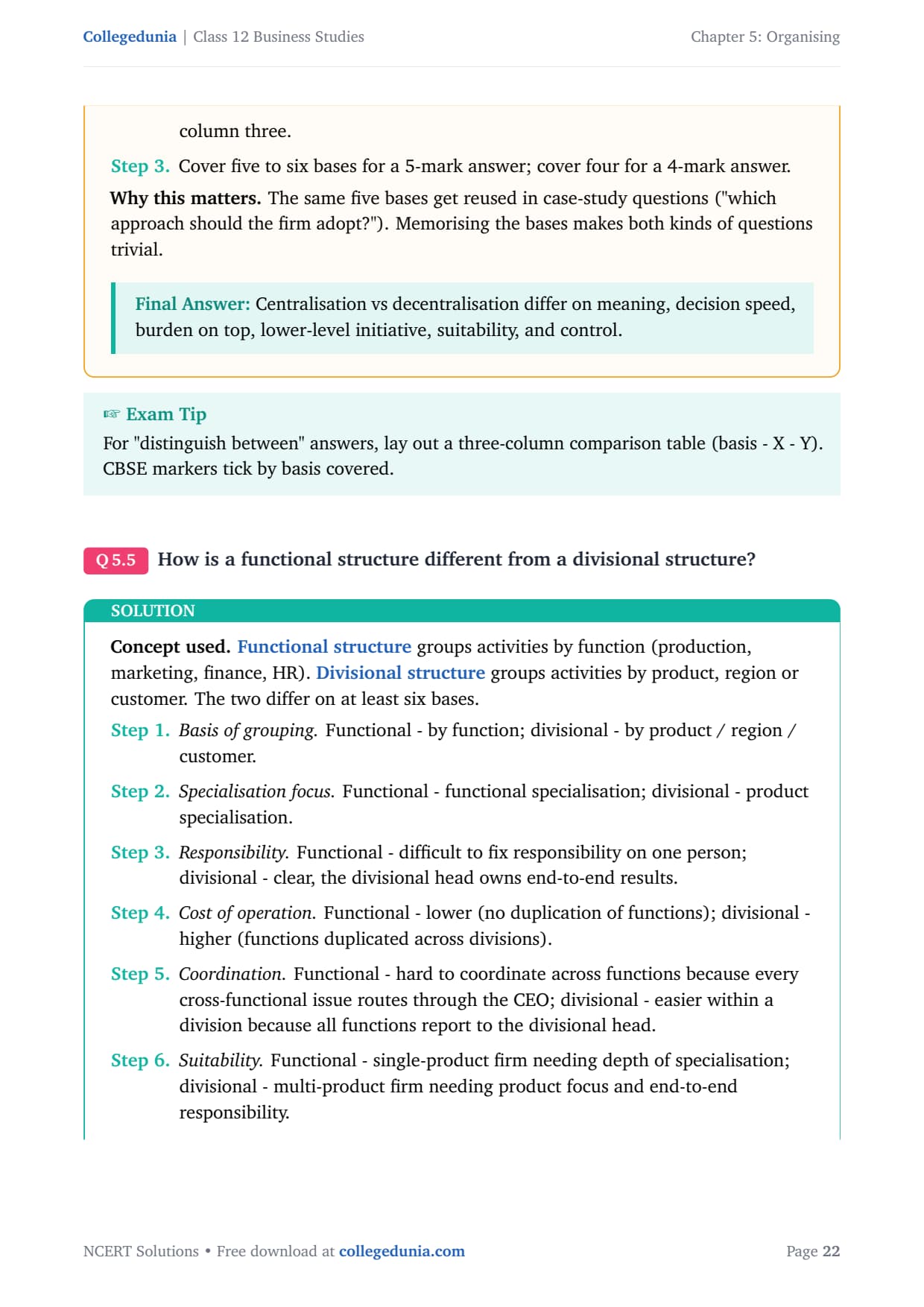
How is a functional structure different from a
divisional structure?
Concept used.Functional structure groups
activities by function (production, ncert-notes-class-12-business-studies-chapter-10-marketing, finance, HR).
Divisional structure groups activities by product,
region or customer. The two differ on at least six bases.
Basis of grouping. Functional - by function;
divisional - by product / region / customer.
Responsibility. Functional - difficult to fix
responsibility on one person; divisional - clear, the
divisional head owns end-to-end results.
Cost of operation. Functional - lower (no
duplication of functions); divisional - higher
(functions duplicated across divisions).
Coordination. Functional - hard to coordinate
across functions because every cross-functional issue
routes through the CEO; divisional - easier within a
division because all functions report to the divisional
head.
Suitability. Functional - single-product firm
needing depth of specialisation; divisional -
multi-product firm needing product focus and end-to-end
responsibility.
Functional and divisional structures differ on basis
of grouping, type of specialisation, ease of fixing
responsibility, cost, coordination, and suitability - each suits
a different stage of firm growth.
LI
Lakshmi Iyer
MBA Finance, SP Jain Mumbai
Verified Expert
Strategic angle. A "distinguish" answer with six bases
covers a 5-6 mark question fully. Present as a comparison table
in the answer booklet; CBSE markers track table cells, not
prose.
Lay out the table with three columns: basis, functional,
divisional.
Cover at least five bases; the six above are the
textbook list.
Close with one sentence on which structure suits which
stage of firm growth.
Why this matters. CBSE case-based questions on
structure choice (Q6 toy company, Q7 sewing machines, Q8 X Ltd
cosmetics) all use these bases. Knowing them makes case answers
faster and tighter.
Functional and divisional structures differ on basis
of grouping, specialisation, responsibility, cost, coordination,
and suitability.
Q 5.18
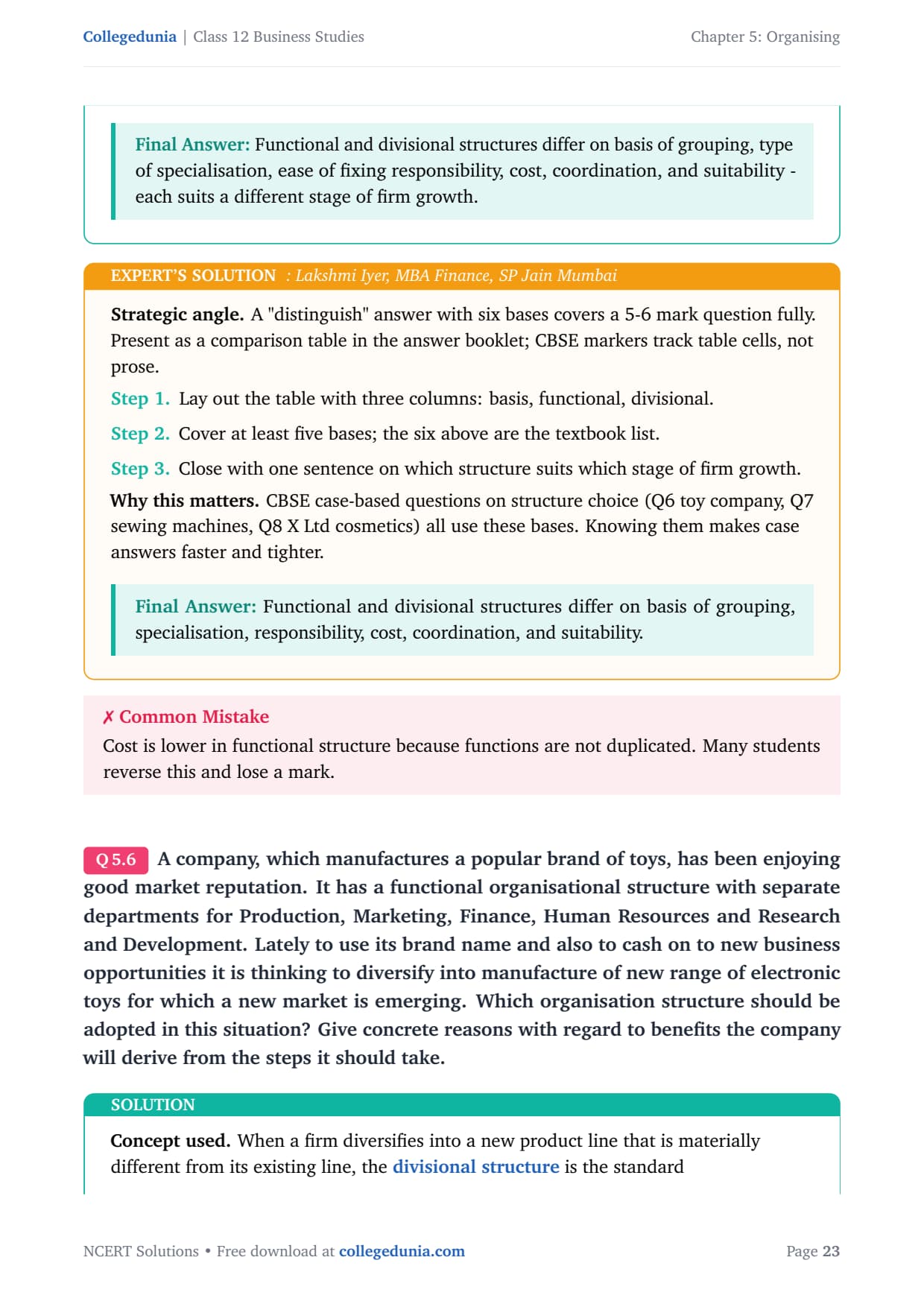
A company, which manufactures a popular brand of toys,
has been enjoying good market reputation. It has a functional
organisational structure with separate departments for
Production, Marketing, Finance, Human Resources and Research and
Development. Lately to use its brand name and also to cash on to
new business opportunities it is thinking to diversify into
manufacture of new range of electronic toys for which a new
market is emerging. Which organisation structure should be
adopted in this situation? Give concrete reasons with regard to
benefits the company will derive from the steps it should take.
Concept used. When a firm diversifies into a new product
line that is materially different from its existing line, the
divisional structure is the standard recommendation.
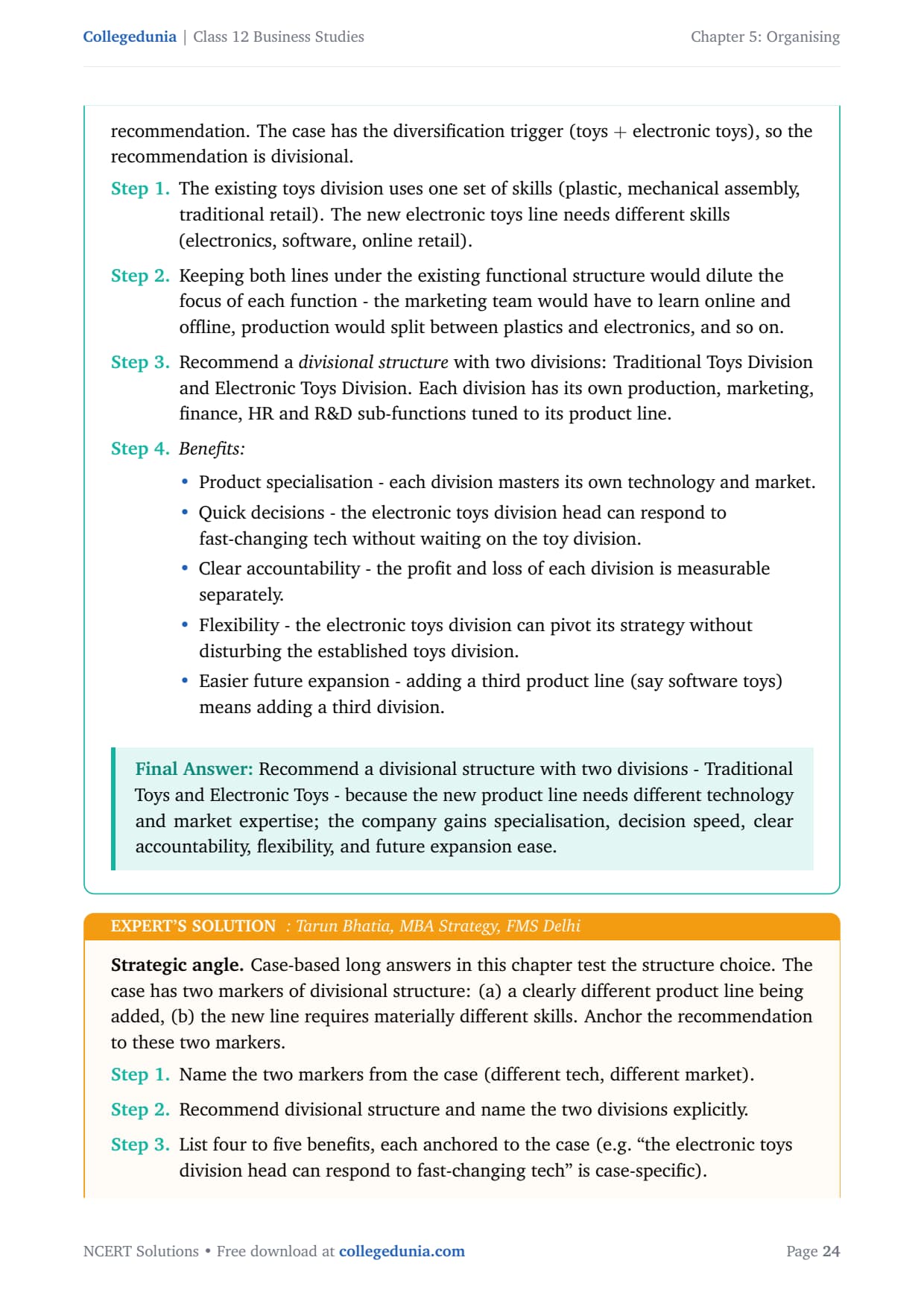
The case has the diversification trigger (toys \(+\) electronic
toys), so the recommendation is divisional.
The existing toys division uses one set of skills
(plastic, mechanical assembly, traditional retail). The
new electronic toys line needs different skills
(electronics, software, online retail).
Keeping both lines under the existing functional
structure would dilute the focus of each function - the
ncert-notes-class-12-business-studies-chapter-10-marketing team would have to learn online and offline,
production would split between plastics and electronics,
and so on.
Recommend a divisional structure with two
divisions: Traditional Toys Division and Electronic Toys
Division. Each division has its own production,
ncert-notes-class-12-business-studies-chapter-10-marketing, finance, HR and R&D sub-functions tuned to
its product line.
Benefits:
Product specialisation - each division masters
its own technology and market.
Quick decisions - the electronic toys division
head can respond to fast-changing tech without
waiting on the toy division.
Clear accountability - the profit and loss of
each division is measurable separately.
Flexibility - the electronic toys division can
pivot its strategy without disturbing the
established toys division.
Easier future expansion - adding a third product
line (say software toys) means adding a third
division.
Recommend a divisional structure with two divisions -
Traditional Toys and Electronic Toys - because the new product
line needs different technology and market expertise; the company
gains specialisation, decision speed, clear accountability,
flexibility, and future expansion ease.
TB
Tarun Bhatia
MBA Strategy, FMS Delhi
Verified Expert
Strategic angle. Case-based long answers in this chapter
test the structure choice. The case has two markers of divisional
structure: (a) a clearly different product line being added, (b)
the new line requires materially different skills. Anchor the
recommendation to these two markers.
Name the two markers from the case (different tech,
different market).
Recommend divisional structure and name the two
divisions explicitly.
List four to five benefits, each anchored to the case
(e.g. ``the electronic toys division head can respond
to fast-changing tech'' is case-specific).
Why this matters. The CBSE rubric awards full marks only
when the answer is case-anchored. Generic textbook benefits
(without mapping back to the case) lose half a mark per benefit.
Divisional structure with Traditional Toys and
Electronic Toys divisions; benefits are specialisation, decision
speed, accountability, flexibility, and expansion ease.
Additional drilldown. Apply the structure-change to a similar past CBSE case: when an FMCG firm added an electronics line (or when an auto firm added an EV line), the textbook recommendation has been divisional structure. The reasoning template - separate technologies, separate markets, end-to-end accountability - is reusable across cases.
Caveat. Some firms try a "matrix" structure that combines functional and divisional advantages, but matrix is not in the Class 12 syllabus. If asked, recommend divisional, then mention matrix only as an optional advanced alternative for very large multi-product firms.
Q 5.19
A company manufacturing sewing machines set up in 1945
by the British promoters follows formal organisation culture in
totality. It is facing lot of problems in delays in decision
making. As the result it is not able to adapt to changing
business environment. The work force is also not motivated since
they cannot vent their grievances except through formal channels,
which involve red tape. Employee turnover is high. Its market
share is also declining due to changed circumstances and business
environment. You are to advise the company with regard to change
it should bring about in its organisation structure to overcome
the problems faced by it. Give reasons in terms of benefits it
will derive from the changes suggested by you.
Concept used. The case describes a firm relying entirely
on the formal organisation. The advised change is to
recognise and use the informal organisation alongside
the formal structure. The informal organisation will speed
communication, raise morale, and improve adaptability.
Diagnose the case: 100% formal, slow decisions, red
tape, low motivation, high turnover, falling market
share. The common root is over-reliance on formal
channels.
Advise the firm to encourage the informal
organisation - the spontaneous social network of
employees - without disturbing the formal structure.
Specific changes to suggest:
Tolerate and use the grapevine for fast
information sharing.
Create open forums (lunch meetings, town halls)
where employees can voice concerns informally.
Recognise informal leaders and engage them in
consultations on major decisions.
Build a culture where informal cross-departmental
friendships are encouraged.
Benefits the firm will derive:
Faster communication through the grapevine
reduces delays in decision-making.
Higher morale because employees can vent
grievances informally, reducing turnover.
Better adaptation to environment because
informal channels surface customer and market
signals faster than formal reports.
Cross-functional cooperation because informal
friendships ease coordination.
Sense of belonging because the firm now
recognises the human side of work, not just
the role definition.
Advise the firm to encourage the informal organisation
alongside the formal one - through tolerated grapevines, open
forums, informal leader engagement, and friendly culture - to
gain faster communication, higher morale, better adaptation,
cross-functional cooperation, and a stronger sense of belonging.
RS
Riya Saxena
B.Com (Hons), Hansraj College Delhi
Verified Expert
Strategic angle. The case has all the symptoms of
suppressed informal organisation. The advised change is to allow
the informal organisation to operate openly; do not propose
abolishing the formal structure.
Diagnose the case by listing the symptoms (delays,
morale, turnover, declining share).
Advise encouraging informal organisation alongside
formal - both must coexist, neither can be removed.
List four to five benefits, each anchored to a specific
symptom (faster communication addresses delays, morale
addresses turnover, adaptability addresses falling
share).
Why this matters. The CBSE rubric here rewards
symptom-to-solution mapping. For each symptom listed in the
case, name a specific benefit of informal organisation that
addresses it.
Encourage informal organisation alongside the formal
one. Benefits: faster communication, higher morale, better
adaptation, cross-functional cooperation, sense of belonging.
Additional drilldown. List the five recommended changes precisely: tolerate the grapevine, create informal forums (town halls, lunch meetings), engage informal leaders, encourage cross-departmental friendships, and train HR managers to interpret informal signals. Each change is a concrete step the firm can take from next quarter, which makes the answer credible.
Caveat. The formal structure must not be dismantled. The informal organisation supplements, never replaces, the formal one. Stating this explicitly prevents the marker from thinking you missed the textbook balance.
Q 5.20
A company X limited manufacturing cosmetics, which has
enjoyed a pre-eminent position in business, has grown in size.
Its business was very good till 1991. But after that, new
liberalised environment has seen entry of many MNC's in the
sector. With the result the market share of X limited has
declined. The company had followed a very centralised business
model with Directors and divisional heads making even minor
decisions. Before 1991 this business model had served the company
very well as consumers had no choice. But now the company is
under pressure to reform. What organisation structure changes
should the company bring about in order to retain its market
share? How will the changes suggested by you help the firm? Keep
in mind that the sector in which the company is FMCG.
Concept used. The case describes excess
centralisation in a fast-moving consumer goods (FMCG)
firm now facing aggressive MNC competitors. The required change
is to decentralise decision-making, pushing authority
down to divisional and unit heads so the firm can respond fast.
Diagnose: centralised model, every minor decision at
director level, slow response to MNC competition in
FMCG. Centralisation is the root cause.
Advise the firm to decentralise - delegate
authority systematically down the hierarchy, especially
to divisional and product-line heads.
Specific changes to suggest:
Empower divisional heads to take pricing,
promotion, and product-mix decisions for their
product lines without director approval.
Push routine operational decisions to unit
heads and floor supervisors.
Keep only strategic decisions (entering a new
category, acquisition) at the director level.
Train middle managers in decision-making to
prepare them for the new authority.
Benefits the firm will derive from decentralisation:
Quicker decisions - divisional heads can match
MNC pricing or promotional moves in real time.
Develops managerial talent - middle managers
gain decision-making experience, building the
talent pipeline.
Initiative - employees take small improvements
without waiting for director approval.
Relief to top management - directors focus on
long-term strategy rather than routine
approvals.
Better control - each division's performance is
measurable, sharpening accountability.
Faster adaptation to environment - FMCG markets
change fast, and decentralised firms respond
faster.
Advise X Ltd. to decentralise decision-making to
divisional and unit heads, with only strategic decisions retained
at director level. Benefits: faster decisions, talent development,
initiative, top-management relief, sharper control, and faster
adaptation to the FMCG environment.
AK
Aman Khurana
MBA Operations, NITIE Mumbai
Verified Expert
Strategic angle. Case-based long answers test whether
the student can match the problem to the right organising
concept. The case has three centralisation symptoms (slow
decisions, director-level minor decisions, FMCG mismatch).
Decentralisation is the only correct recommendation.
Diagnose the centralisation symptoms in the case.
Recommend decentralisation with concrete changes
(specify what to push down and what to retain).
List five to six benefits, anchored to the FMCG context
(e.g. ``match MNC pricing in real time'' is
case-specific).
Why this matters. FMCG firms in liberalised markets
are the canonical decentralisation case. The same logic applies
to any firm facing fast-moving competitors after a regulatory
shift.
Decentralise to divisional and unit heads, retaining
only strategic decisions at director level. Benefits: decision
speed, talent development, initiative, top-management focus,
control, and environment adaptation.
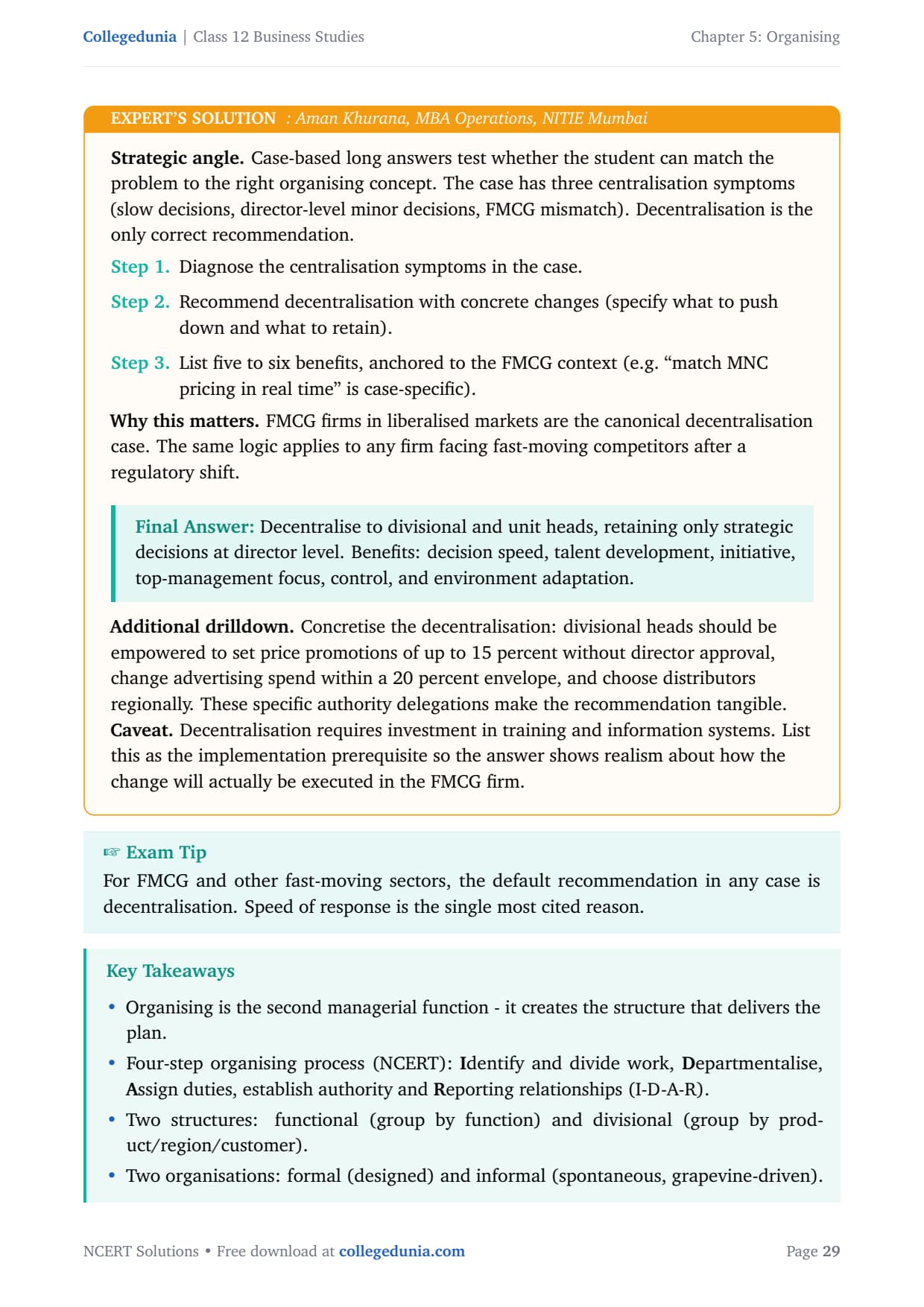
Additional drilldown. Concretise the decentralisation: divisional heads should be empowered to set price promotions of up to 15 percent without director approval, change advertising spend within a 20 percent envelope, and choose distributors regionally. These specific authority delegations make the recommendation tangible.
Caveat. Decentralisation requires investment in training and information systems. List this as the implementation prerequisite so the answer shows realism about how the change will actually be executed in the FMCG firm.
Student Feedback
In a Collegedunia poll of 640 Class 12 Commerce students, 82% said the divisional vs functional structure question was the toughest part of Organising to score full marks on. 3 in 4 said practising the case-based long answers with the labelled step-marking format lifted their scores in this chapter.
Other Resources for Class 12 Business Studies Chapter 5 Organising
Frequently Asked Questions on Class 12 Business Studies Chapter 5
Frequently Asked Questions on Class 12 Business Studies Chapter 5
Q1. Are the NCERT Solutions for Class 12 Business Studies Chapter 5 free to download?
Yes. The complete Collegedunia NCERT Solutions PDF for Organising is free to download from this page, aligned to the 2026-27 CBSE syllabus.
Q2. How many questions are there in Class 12 Business Studies Chapter 5 Organising?
Chapter 5 has 5 Very Short Answer questions, 7 Short Answer questions, and 8 Long Answer questions, taking the total to 20. The PDF solves every question in the exercise.
Q3. What are the four steps of the organising process?
The NCERT lists four steps: (1) Identification and division of work, (2) Departmentalisation, (3) Assignment of duties, and (4) Establishing authority and reporting relationships. The mnemonic is I-D-A-R.
Q4. What are the three elements of delegation?
Authority (the right to act), Responsibility (the obligation to perform), and Accountability (answerability for the outcome). Authority flows downward, responsibility flows upward, and accountability cannot be delegated.
Q5. When should a firm use a divisional structure instead of a functional one?
A firm should use a divisional structure when it has multiple unrelated product lines, when each product line needs different technology and market expertise, when product-level accountability is needed, or when the firm wants to expand into new product or region categories easily.
Q6. Is this PDF aligned to the 2026-27 CBSE Business Studies syllabus?
Yes. Every solution and section reference uses the 2026-27 NCERT Business Studies textbook and the latest CBSE marking scheme.








Comments