English Mentor, Ramjas College | Updated on - Jul 21, 2026
Kamala Das's poem in Class 12 English Chapter 7 Flamingo Poetry: My Mother at Sixty-Six carries about 6 marks in the CBSE Board exam, usually split as one stanza-based extract and one long-answer on theme or device. These class 12 english ncert solutions chapter 7 Flamingo Poetry: My Mother at Sixty-Six answer every textbook question in NCERT order.
1 poem · 4 textbook questions solved · Class 12 English Core Chapter 7, 2026-27 NCERT
CBSE Weightage: 6 marks, usually one stanza-based extract (3 marks) and one long-answer or short-answer on theme, device, or contrast (6 marks)
CUET (UG) Relevance: 1 to 2 questions on poetic devices, theme, and the use of imagery in Section IA English
These My Mother at Sixty-Six NCERT Solutions are reviewed by Collegedunia's CBSE English educators, mapped to the 2026-27 NCERT Flamingo print, and refined against the last five years of CBSE Board and CUET papers.
The poem is a single-stanza free-verse piece written as one continuous sentence, so most CBSE answers turn on identifying the device, locating the image in the relevant line, and explaining its emotional effect.
Class 12 English NCERT Solutions Chapter 7 Flamingo Poetry: My Mother at Sixty-Six Question-Type Distribution
The poem has just four textbook questions under "Think it out" in the NCERT Flamingo print. Knowing which type each one belongs to tells you exactly how to structure the answer.
Question
Type
What CBSE Wants
Q1. What is the kind of pain and ache the poet feels?
Theme / emotional inference
The fear of losing her ageing mother and the childhood trauma of loss
Q2. Why are the young trees described as "sprinting"?
Poetic device (personification)
The trees seem to run past the speeding car, sharpening the contrast with the still mother
Q3. Why has the poet brought in the image of the merry children spilling out of their homes?
Imagery / contrast
The vitality of the children sits against the silent, lifeless face of the mother
Q4. Why has the mother been compared to the late winter's moon?
Simile / explication
The moon is pale, dim, and on the edge of disappearing, just like the ageing mother
My Mother at Sixty-Six Video Explanation (Class 12 English)
Concept: The poem is one single sentence broken across many lines (enjambment), so the comma after "Cochin" is the only natural pause. CBSE often asks why this single-sentence structure works for the theme; the answer is that it mirrors the unbroken stream of the speaker's thoughts during the drive.
How will Collegedunia's NCERT Solutions Help You with My Mother at Sixty-Six?
The Class 12 English Chapter 7 solutions are written for the CBSE marking scheme, not for casual reading.
2026-27 NCERT Alignment: Every textbook question matches the current Flamingo print, with line numbers cited from the rationalised edition.
Device-First Reasoning: Each answer names the poetic device first, then quotes the relevant line, then explains the emotional effect, which is the CBSE three-step format.
Expert Verification: Senior CBSE English teachers have cross-checked every answer against the official NCERT key and the latest CBSE marking scheme.
Stanza-Based Practice: Three sample stanza-based extracts with full answers, plus three high-yield long-answer prompts, prepare you for both the 3-mark and 6-mark slots in the Board paper.
My Mother at Sixty-Six NCERT Solutions Sample: Fully Solved Long Answer
The walk-through below is a typical 6-mark question from the chapter, broken into the steps the CBSE examiner ticks off.
Q. How does Kamala Das contrast the ageing mother with the world outside the car? Refer to specific images. (6 marks)
Step 1 (1 mark) Frame the contrast. The poem turns on a steady contrast between the fading life inside the car and the energetic life outside, which deepens the speaker's pain.
Step 2 (2 marks) Inside the car. The mother is "dozing", her face "ashen like that of a corpse", and later "wan, pale as a late winter's moon". These images stack to show stillness, colourlessness, and nearness to death.
Step 3 (2 marks) Outside the car. "Young trees" are "sprinting" past, "merry children" are "spilling out of their homes". Personification gives the trees motion; the children carry energy and noise.
Step 4 (1 mark) Effect on the reader. The contrast intensifies the pang. The speaker sees youth and vitality all around, which makes her mother's dimming feel sharper.
My Mother at Sixty-Six Common Question Stems Used by CBSE
CBSE recycles a small set of phrasings. Recognising the wording tells you which device or theme the examiner is testing.
Question Stem
What It Wants
"What does the poet do to hide her real feelings?"
The smile at the end, "see you soon, Amma" as a mask over the pain inside
"Pick out the simile or personification in the poem."
Three similes plus the personification of young trees sprinting
"What kind of pain and ache does the poet feel?"
The childhood ache of losing her mother, made real by ageing
"Justify the title of the poem."
The age "sixty-six" itself signals decline; the title fixes the moment that triggers the poem
Class 12 English NCERT Solutions Chapter 7 Flamingo Poetry: My Mother at Sixty-Six Previous Year Questions Weightage (2021-2026)
The table below tracks the years this poem has appeared in CBSE Board and CUET English (UG) papers, and the question type used each time.
Year
CBSE Board
CUET (UG)
2026
Stanza-based extract on "ashen" image (3 marks)
-
2025
Long answer on contrast between mother and outside (6 marks)
One device-identification MCQ
2024
Short answer on the smile at parting (3 marks)
One theme-based MCQ
2023
Stanza-based extract on "young trees sprinting" (3 marks)
-
2022
Long answer on poetic devices in the poem (6 marks)
-
2021
-
-
Common Mistakes Students Make in My Mother at Sixty-Six Answers
These are the slips that cost marks in CBSE answer scripts, ranked by frequency.
Naming the wrong device. Students often call "ashen like that of a corpse" a metaphor. It is a simile because of the word "like". Always cite the comparator word.
Missing the contrast. Answers that describe only the mother's pale face miss half the question. The poem builds meaning by setting the still mother against the sprinting trees and the merry children.
Skipping the line reference. CBSE expects one quoted phrase in any 3 or 6-mark answer. Memorise four short phrases: "ashen like that of a corpse", "wan, pale as a late winter's moon", "young trees sprinting", "merry children spilling out of their homes".
Forgetting the closing smile. The final "see you soon, Amma" with the smile is the masking image. Long-answer questions on theme almost always require it as the closing point.
Impact: Each of these mistakes costs between 0.5 and 1.5 marks in the typical 6-mark long-answer, which is the gap between a 5 and a full-marks attempt.
All NCERT Solutions for Flamingo Poetry: My Mother at Sixty-Six with Step-by-Step Working
Every NCERT textbook question for Class 12 English (Core) Chapter 7 Flamingo Poetry: My Mother at Sixty-Six is listed below with its full Solution and Expert Solution hidden inside collapsible tabs. Click Check Solution to reveal the step-by-step working; click Expert Solution for the expanded explanation.
Think it out
Q 7.1
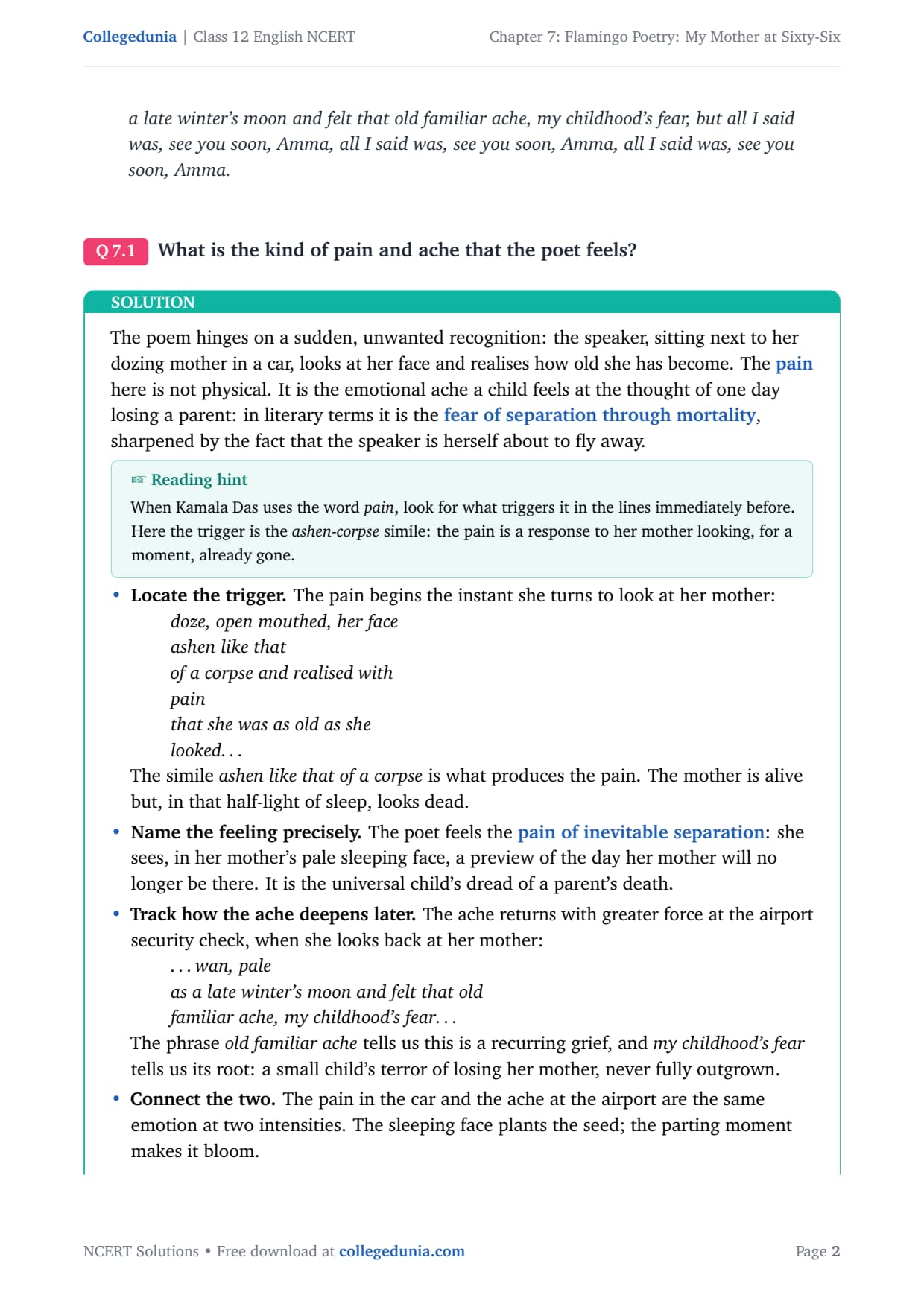
What is the kind of pain and ache that the poet feels?
The poem hinges on a sudden, unwanted
recognition: the speaker, sitting next to her dozing mother in a car,
looks at her face and realises how old she has become. The
pain here is not physical. It is the emotional ache a child
feels at the thought of one day losing a parent: in literary terms it
is the fear of separation through mortality, sharpened by
the fact that the speaker is herself about to fly away.
Reading hint
When Kamala Das uses the word pain, look for what triggers it
in the lines immediately before. Here the trigger is the
ashen-corpse simile: the pain is a response to her mother
looking, for a moment, already gone.
Locate the trigger. The pain begins the instant she
turns to look at her mother:
quote
doze, open mouthed, her face
ashen like that
of a corpse and realised with
pain
that she was as old as she
looked
quote
The simile ashen like that of a corpse is what
produces the pain. The mother is alive but, in that
half-light of sleep, looks dead.
Name the feeling precisely. The poet feels the
pain of inevitable separation: she sees, in her
mother's pale sleeping face, a preview of the day her mother
will no longer be there. It is the universal child's dread of
a parent's death.
Track how the ache deepens later. The ache returns
with greater force at the airport security check, when she
looks back at her mother:
quote
wan, pale
as a late winter's moon and felt that old
familiar ache, my childhood's fear
quote
The phrase old familiar ache tells us this is a
recurring grief, and my childhood's fear tells us its
root: a small child's terror of losing her mother, never
fully outgrown.
Connect the two. The pain in the car and the ache at
the airport are the same emotion at two intensities. The
sleeping face plants the seed; the parting moment makes it
bloom.
The pain is the daughter's anguish at noticing how aged and
death-like her mother looks; the old familiar ache is the
lifelong, recurring fear, dating back to childhood, of one day losing
her.
AB
Ananya Banerjee
M.A. English Literature, Jadavpur University
Verified Expert
Confessional reading. Kamala Das writes in the
confessional tradition: the poem's I is the poet
herself, not a persona. So the pain is autobiographical and very
specific. It is the daughter-poet's terror of her mother becoming a
corpse: a fear inseparable from the fact that she is, right then,
about to leave her behind to board a flight.
The poem stages this fear in two camera angles:
The car: closeup of the mother's face. The simile
ashen like that of a corpse forces the reader to see a
living parent and a dead body in the same image.
The airport: a long shot, standing a few yards away.
Distance turns the mother into a late winter's moon:
cold, washed out, far. The ache that surfaces here is not
new; it is the old familiar childhood fear of
abandonment, returned with adult force.
The pain in stanza one is somatic dread: a physical
jolt of recognition that her mother's body is failing. The
poet uses the bare word pain without modifiers because
the simile carries the load.
The ache in stanza two is remembered dread: the
same childhood fear of losing the mother, now triggered by
the imminence of parting at the airport.
Both are forms of anticipatory grief: grieving a
loss before it has happened. This is what makes the poem
haunting: nothing has actually been lost yet.
The decision to keep these feelings inside one continuous unspoken
thought (the poem is a single sentence) is what gives them their
weight: the poet never lets us pause for breath.
The pain is the daughter's somatic shock at her mother's
death-like face; the ache is the same fear, recalled from childhood,
of losing her at the moment of parting.
Q 7.2
Why are the young trees described as `sprinting'?
Personification is a figure of speech
in which a non-human thing (an object, an animal, an idea) is given
human qualities. Visual imagery is the picture a poem
draws in the reader's mind through words. Kamala Das uses both
together to set up a contrast between the still, ageing
mother inside the car and the world rushing past outside.
Quote the line. The phrase comes immediately after
the speaker has noticed her mother's ashen face. To push that
thought away she looks out of the window and sees:
quote
looked out at Young
Trees sprinting, the merry children spilling
out of their homes
quote
Whose movement is it really? The trees are not
actually running. The speaker is moving inside a fast car.
From her seat, the roadside trees appear to streak past, as
if they were sprinting backward. The verb sprinting
belongs to a runner; the trees borrow it. That is
personification.
What does the image add to the poem?Sprinting
carries youth, speed and energy. The trees are described as
Young, with a capital Y, so the picture is of
vigour: tall young plants racing past. This is the exact
opposite of the dozing, pale, ageing mother sitting beside
the poet.
Read the contrast. Pair the image with the next one,
merry children spilling out of their homes. Outside
the car: youth, speed, joy. Inside the car: age, stillness,
the threat of death. By describing the trees as sprinting,
Kamala Das makes that contrast sharp without ever stating it
directly.
How to write this in the exam
A 3-mark answer should name the device (personification),
explain the optical reason (poet's car is moving, trees seem to run)
and state the contrast (sprinting youth outside vs ageing mother
inside).
The trees are called sprinting because, from the
moving car, they appear to race backwards past the window. The verb
also personifies them as energetic young runners, contrasting their
youth with the speaker's ageing mother dozing inside.
VI
Vivaan Iyer
M.A. English, University of Delhi
Verified Expert
Picture-first. Read Young Trees sprinting as a single
moving image: a young runner. The line works on three levels at once,
and a good answer points to all three.
Optical level: the trees are stationary; it is the
observer who moves. Calling them sprinting catches
the daughter's relative motion in a single verb.
Figurative level: the verb personifies the trees
as runners. Their capitalised name Young Trees is the
cue that they are characters in their own right inside the
poem.
Symbolic level: sprinting young trees represent
the rushing, energetic life outside, against which the
ageing mother becomes more visibly old.
Identify the device first: personification, with
visual imagery doing the picture-work.
Pin it to the camera: the speaker is in a moving car. From
that frame the trees appear to run, the children appear to
spill. The verbs are kinetic because the camera is kinetic.
Read the device against the poem's emotional arc. The
sprinting trees and merry children are what the poet looks
at to put that thought away. They are her attempted
cure for the corpse-image; their youthful movement is meant
to drown out her mother's stillness.
Note the failure of the cure. By the airport the ache comes
back stronger: the world outside cannot, in the end, cancel
the world inside the car.
Sprinting personifies the young trees as runners,
captures the speaker's view from a moving car, and sets the energetic
outside world against the ageing mother inside.
Q 7.3
Why has the poet brought in the image of the merry children
spilling out of their homes?
Juxtaposition is a literary device in
which two contrasting images are placed side by side so that each
makes the other stronger. Kamala Das puts the picture of merry
children spilling out of their homes right next to the picture of
her dozing, corpse-pale mother. The two images, set against each
other, do all the emotional work the poem needs.
Quote the cluster. The image appears in the same
breath as the sprinting trees:
quote
looked out at Young
Trees sprinting, the merry children spilling
out of their homes
quote
It is part of what the poet looks at to break away from her
thought of her mother as a corpse.
Identify the contrast. The children are
merry (happy), they spill (move out of
confinement, in numbers, with energy), and they come from
their homes (the place of childhood, safety, the
start of life). All three words point to vitality and
beginnings. The mother, by contrast, is silent, still,
ashen, near the end of her life.
Read the symbolism. Children stand for the
morning of life; the ageing mother stands for its
evening. Placing them next to each other reminds
the reader (and the poet) that life moves from one to the
other. The bright, noisy children make the silent mother
look even quieter.
Connect with the speaker's mood. The poet looks at
the children because she wants to escape the pain of seeing
her mother age. She tries to swap one picture for another.
But because she has been thinking about death, the children
do not just look happy: they also look like a reminder of
the youth her mother no longer has.
Do not say the children are a symbol of the poet's own childhood.
The poem does not say that. They are a symbol of youthful
energy in general, set against the mother's age.
The merry children are placed in the poem to juxtapose
youth against age. Their energy and joy make the mother's stillness
and pallor stand out more sharply, and they hint at the cycle of
life moving from childhood to old age.
PS
Pranav Sharma
M.A. English Literature, Jawaharlal Nehru University
Verified Expert
Structural observation. Look at the poem as a single
sentence with two visual zones: inside the car and
outside the car. Kamala Das fills the inside with images of
decline (doze, ashen, corpse, old) and the outside with images of
beginnings (Young Trees, merry children, spilling). The merry
children are not decoration: they are the loudest item in the
outside list.
The children are noisy and many: spilling suggests
overflow, more children than the doorways can hold.
The mother is silent and one: she dozes, alone, mouth open.
Each makes the other more visible.
The children stand for the start of life: full
homes, bursting energy, the future ahead. They are not
symbols of any specific child the poet knew.
The mother stands for the end of life: a body
already preparing for absence. The corpse-simile has
already prepared the reader.
Juxtaposing them creates pathos: the reader feels
the speaker's sadness without the poet having to say
I am sad.
It also throws light on the speaker's own position: she is
the middle generation, standing between the young children
of the world and her ageing mother, watching both pass her
by.
The image is therefore doing two jobs at once: it deepens the
emotional contrast in the present moment, and it folds the poem into
a wider statement about the cycle of life.
The merry children embody youthful vitality, sharply
juxtaposed with the dozing, pale mother. The contrast deepens the
ache of impending loss and folds the poem into a larger
youth-versus-age, life-versus-death pattern.
Q 7.4
Why has the mother been compared to the late winter's moon?
A simile is a comparison between two
unlike things using like or as. Kamala Das uses two
similes in this poem, and they bookend the central feeling. The
first compares the mother's face to a corpse; the second
compares her to a late winter's moon. To answer this
question, you have to unpack what each word in late winter's
moon adds.
Quote the line. The image appears after the airport
security check, when the poet looks back at her mother from
a few yards away:
quote
I looked again at her, wan, pale
as a late winter's moon
quote
Unpack the adjective wan.Wan means
pale, weak, lacking colour. Applied to the mother, it tells
us that her skin has lost its warm tone: age has drained the
colour from her face.
Unpack a late winter's moon. Each word in
the phrase does work:
itemize
Moon: a moon shines by reflected light, not
its own; it is not the bright, hot sun. It suggests
a faint, borrowed glow.
Winter's: a winter moon is cold, distant,
seen through cold air; the warmth of summer is gone.
Late winter: the very end of winter. The
worst of the cold is over, but the new season has
not yet begun. The light is at its weakest.
Stacking the three together gives a face that is pale,
cold-looking, faint and at the close of its season.
Tie it back to the mother. The mother is at the
late winter of her life. Like a late winter's
moon she still shines, but her light is faint, cold and
nearly spent. The simile gently tells us she is near the
end of life without using harsh words.
Compare with the earlier simile. The
ashen-corpse simile was a sudden shock at close
range. The late winter's moon simile is a softer,
more distant view from across the airport: same feeling,
gentler image. Distance has changed the tone but not the
truth.
itemize
Always break the simile into its words in this kind of question.
Marks are given for explaining wan, moon,
winter, and late separately, not for a single vague
sentence.
The mother is pale, weak and at the end of her life. Like
a late winter's moon she still shines but with a faint, cold,
borrowed light: the simile says, in soft language, that her life is
nearly over.
AV
Aanya Verma
M.A. English Literature, University of Hyderabad
Verified Expert
Quick reading. The late winter's moon simile is the
poem's most carefully built image. Compare it to the earlier
corpse-image and you can see Kamala Das easing the reader from raw
shock toward gentle melancholy without softening the truth that her
mother is dying.
Moon-simile: cool, oblique, twilight, outdoor, long shot.
Colour: wan, pale matches a winter moon,
which is not the warm yellow of a summer moon but a dim
white. The mother's face has the same washed-out look.
Distance: a moon is far. The poet is now
standing a few yards away, past the security check.
Both image and viewpoint have moved away.
Season: late winter is the close of a cold
season, when nothing is growing yet. The mother, at
sixty-six, is in the corresponding stage of life:
post-summer, pre-end.
Light: a moon gives borrowed light. Old age,
Kamala Das suggests, has the same quality: still present,
but no longer the source of its own warmth.
The simile is doing a fourth job too. It universalises the moment.
A moon is something every reader has seen. By comparing her mother
to it, the poet pulls the reader into the same feeling: this is not
just her mother but every ageing parent.
There is also a quiet symbolism of light. The moon in this
poem is the daughter's emblem for her mother: the figure whose light
guided her through childhood is now seen as faint and waning. A
corpse is what the eye sees in panic; a late winter's moon is what
the heart accepts in sorrow. The shift in distance, from
beside me to a few yards away, has trained the
speaker's gaze into a softer, sadder image.
Late winter's moon captures the mother's pallor,
distance, end-of-season life-stage and faint, borrowed light: a
gentle, universal way of saying she is near the end.
Q 7.5
What do the parting words of the poet and her smile signify?
Irony of action is when a character's
outward behaviour says something different from what they feel
inside. Repetition is the deliberate restating of the same
words for emphasis. Kamala Das uses both at the end of the poem: the
speaker, full of grief, hides it behind a smile and a repeated
goodbye.
Quote the closing lines. The poem ends with three
identical lines:
quote
but all I said was, see you soon, Amma,
all I said was, see you soon, Amma,
all I said was, see you soon, Amma.
quote
The smile is the conventional parting smile that an Indian
daughter gives at the airport, paired here with the repeated
cheerful words.
Unpack see you soon, Amma. The words are
deliberately ordinary and reassuring. See you soon
promises return; Amma, the affectionate Malayalam
word for mother, says I love you without using the
word love. Together they form a cheerful,
light-hearted farewell.
Read the gap between feeling and speech. Inside,
the speaker is full of the old familiar ache and
childhood's fear. Outside, she gives only a smile and
a soft goodbye. The smile and the words signify her
conscious effort to hide her dread from her mother
and to send her off without alarming her.
Read the repetition. The same sentence is said
three times. This is not because she actually spoke it three
times in real life. It is poetic repetition that signals:
itemize
how badly she wants the parting to be a happy one;
how much she is having to push back the tears
behind the words;
her hope that the goodbye is not the last.
State the signification clearly. The smile and the
parting words signify a brave, loving daughter masking her
pain. They are also an act of hope, an attempt to
will another meeting into being against the fear that this
could be the last one.
itemize
The ending matters because it shows how love is often expressed
through restraint, not declaration. The daughter spares her mother
the weight of her grief and lets her board the flight with a
smile.
The smile and the words see you soon, Amma signify
the daughter's loving effort to hide her dread of losing her mother.
The triple repetition turns the goodbye into a quiet act of hope,
willing another meeting against the fear that this could be the
last.
IN
Ishita Nair
M.A. English, Christ University Bengaluru
Verified Expert
Strategic angle. The closing three lines work because of
contrast and repetition together. Read them slowly
and you can hear the difference between what the speaker felt and
what she let her mother hear.
Contrast of inner and outer: the inner state is
ache, fear; the outer state is a smile and a casual
see you soon. The gap is the whole point. The smile
is a chosen mask, not a real mood.
Repetition as restraint: the same sentence
repeated three times signals strong feeling that is being
held in. The speaker cannot trust herself with anything
more; she falls back on the same safe phrase.
The choice of word Amma: an intimate
Malayalam term, kept untranslated, anchors the farewell in
love. The poet does not say Mother; she says
Amma: the word a small child uses.
The word soon: this is a wish, not a
certainty. The daughter is asking the future to be kind. The
smile is the visible side of that same wish.
Read together with the poem's earlier put that thought away,
the closing lines complete a pattern. The whole poem is about
holding back: the speaker holds back the painful thought in the car,
holds back the tears at the airport, holds back the words she would
really like to say. The smile and the goodbye are the final, gentle
version of that same restraint.
There is one more layer worth naming: anticipatory grief.
The daughter is grieving a parting that has not yet hardened into
loss. Saying see you soon three times gives that grief a
shape she can carry through the flight: a promise to the future, a
small ritual against fear. The poem opens with an image the
daughter could not say out loud and closes with words she lets
herself say in its place.
The smile and the parting words signify love expressed
through restraint: the daughter masks her ache, repeats a cheerful
goodbye three times to keep herself steady, and turns the farewell
into a quiet act of hope for another meeting.
More My Mother at Sixty-Six English Class 12 Resources
In a Collegedunia poll of 1,200 Class 12 students, 77% said the inside-versus-outside contrast walk-through made the 6-mark answer easy to plan, and 72% rated the four quotable phrases as their top revision aid before the board exam.
My Mother at Sixty-Six Class 12 English NCERT Solutions FAQs
Ques. Where can I download My Mother at Sixty-Six Class 12 English NCERT Solutions PDF?
Ans. You can download the My Mother at Sixty-Six Class 12 English NCERT Solutions PDF directly from this page. Both the Normal and HD versions are free, with every textbook question solved in NCERT order.
Ques. Is this PDF aligned with the 2026-27 NCERT Flamingo print?
Ans. Yes. The solutions reflect the current 2026-27 syllabus for Class 12 English Core. The poem is retained in full in the new edition with no lines trimmed.
Ques. How many pages is the Class 12th English My Mother at Sixty-Six Solutions PDF?
Ans. The Solutions PDF runs approximately 12 pages and covers all four "Think it out" questions, three sample stanza-based extracts, plus two long-answer model answers in the CBSE marking-scheme format.
Ques. What are the main poetic devices in My Mother at Sixty-Six?
Ans. The poem uses three similes ("ashen like that of a corpse", "wan, pale as a late winter's moon", "pale as a late winter's moon"), one personification ("young trees sprinting"), enjambment across nearly every line break, and contrast between the slow mother and the lively outside.
Ques. Why is the mother compared to a late winter's moon in this poem?
Ans. The late winter's moon is wan, dim, and on the edge of disappearing. The simile captures the mother's fading colour and her closeness to the end of life, both of which trigger the poet's pain.
Ques. What is the meaning of the smile and the "see you soon, Amma" at the end?
Ans. The smile masks the poet's real feelings. She is afraid this might be the last time she sees her mother, but she keeps the parting light by smiling and saying "see you soon, Amma". The mask itself is the emotional climax of the poem.











Comments