Economics Mentor, Shaheed Bhagat Singh College | Updated 3+ months ago
The NCERT Solutions for Class 12 Business Studies Chapter 4 Planning answer every textbook question using the Koontz and O'Donnell framework the chapter is built on. You get the features, importance, limitations and the seven-step planning process solved in full for the 2026-27 CBSE syllabus.
CBSE Weightage: 5 to 8 marks (Unit 2, Principles and Functions of Management). One Short Answer plus one Long Answer is the recurring pattern.
Question Count: 5 Very Short Answer plus 6 Short Answer plus 3 Long Answer (14 in total).
These solutions are mapped to the 2026-27 NCERT Business Studies textbook and checked against the last five years of CBSE board papers.
The Business Studies Chapter 4 end-of-chapter exercises are split into three sub-sections by mark weightage. The table groups the 14 questions by sub-section so you can target the clusters CBSE tests most heavily.
Sub-section
Question Count
Focus Area
Difficulty
Very Short Answer
5
How planning provides direction, identifying the planning step in a case, why rules are plans, identifying type of plan, planning in a dynamic environment
Easy
Short Answer
6
Main aspects of planning's definition, why planning does not ensure success, strategic decisions, critical comment on creativity, Airtel-Jio strategy case, classifying single-use vs standing plans
Medium
Long Answer
3
Six limitations of planning, seven-step planning process, features of planning illustrated by C Ltd. case
Medium to Hard
The 6-mark CBSE board question almost always comes from the seven-step planning process or the eight types of plans. Two long answers from these two topics cover roughly 80 percent of the recurring board template.
Concept Anchor: The seven-step planning process is S-D-I-E-S-I-F: Set objectives, Develop premises, Identify alternatives, Evaluate alternatives, Select alternative, Implement plan, Follow up. Skipping any step in your answer caps the marks at one per step missed.
What the Class 12 Business Studies Chapter 4 NCERT Solutions PDF Contains
The PDF contains solved answers to every Very Short, Short, and Long Answer question from the NCERT Business Studies textbook Chapter 4, presented in a CBSE marker-friendly format that stays close to the prescribed step-marking pattern.
Concept-used opener on every question, stating the definition or process step being applied.
Step-by-step working with each idea on its own line, so each step can be marked on its own.
Case-mapping that quotes the case phrase next to the matching concept.
Expert Solution on every question with an alternate angle plus a short board-strategy note.
How will Collegedunia's NCERT Solutions Help You with Planning?
Three concept clusters drive over 80% of marks in this chapter: the seven-step planning process, the eight types of plans, and the seven features plus six limitations. The Collegedunia solutions are written so that these clusters are internalised while you practise, rather than memorised after the fact.
2026-27 NCERT Alignment: Every solution matches the current textbook order and the latest CBSE marking scheme.
Marker-Style Structure: Bold-titled points that mirror CBSE step-marking.
Common-Mistake Notes: Rule vs procedure and list vs evaluate alternatives, flagged at the point of error.
Solved Example: Seven-Step Planning Process Walk-Through
The solved example below shows the answer shape a CBSE marker expects for a 6-mark question on the planning process. The same structure transfers to every "steps of planning" or "explain the planning process" question in the chapter.
Question (6 marks). What are the steps taken by management in the planning process?
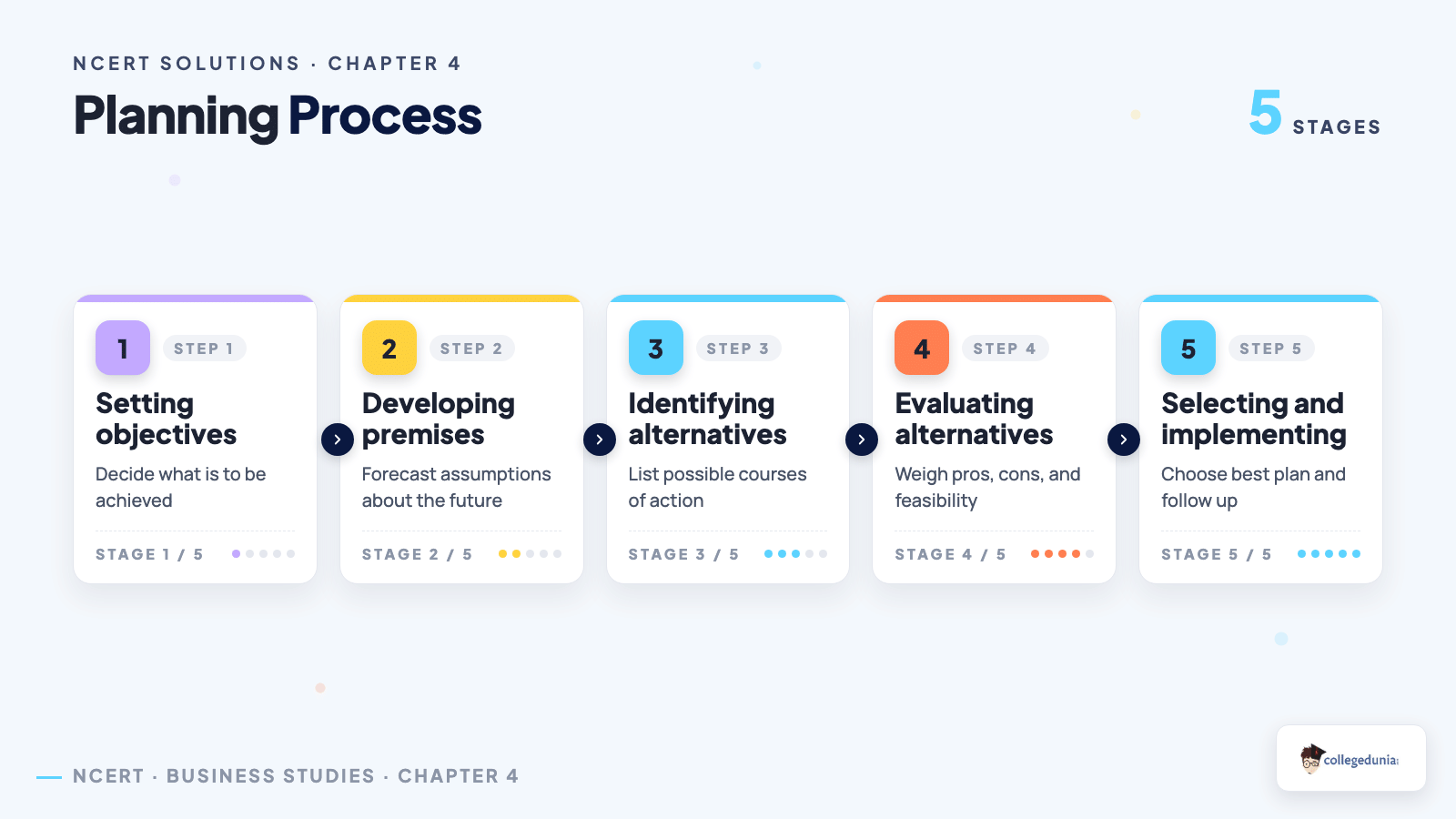
Step 1 (1M), Setting objectives. Objectives are decided for the whole organisation and for each department. They state what the firm wants to achieve in the planning period.
Step 2 (1M), Developing premises. Premises are assumptions about future conditions, demand, prices, competition, government policy. The plan is built on these assumed conditions.
Step 3 (1M), Identifying alternative courses of action. Once the objective and premises are set, the planner lists out the possible routes to reach the objective.
Step 4 (1M), Evaluating alternative courses. Each alternative is weighed for its pros and cons - cost, time required, feasibility, risk, and expected return.
Step 5 (1M), Selecting an alternative. The best alternative is chosen on the basis of evaluation. Often a combination of alternatives is selected to balance risk and return.
Step 6 (1M), Implementing the plan. The selected plan is put into action by allocating resources, fixing responsibilities, and communicating it to employees so that work begins on the ground.
Step 7 (1M), Follow-up action. Actual results are monitored, compared with the plan, and any deviation is corrected. Follow-up closes the loop and feeds learning into the next planning cycle.
Note the explicit follow-up step. Many students drop step 7 and lose a full mark. The mnemonic S-D-I-E-S-I-F keeps all seven steps (Set, Develop, Identify, Evaluate, Select, Implement, Follow-up) in your head right through the exam.
Top Five Most-Tested Concepts in Class 12 Business Studies Chapter 4
Seven-Step Planning Process. Set objectives, develop premises, identify alternatives, evaluate alternatives, select alternative, implement, follow up. Tested as a 5-6 mark long answer almost every year.
Eight Types of Plans. Objective, strategy, policy, procedure, method, rule, programme, budget. Sub-classification into standing plans (objective, strategy, policy, procedure, method, rule - six in all) vs single-use plans (programme, budget).
Seven Features of Planning. Focus on achieving objectives, primary function, pervasive, continuous, futuristic, decision-making, mental exercise. The features get re-used in case studies as the "identify the features" hint format.
Importance and Limitations of Planning. Six importance points plus six limitations, often paired in the same 5-mark question.
Strategy and its Three Dimensions. Long-term objectives, the course of action, and the resources needed. The Airtel-Jio case is the usual trigger for this 6-mark question.
Previous-Year Question Trend: CBSE 2025 to 2020
The table below tracks how Chapter 4 has been examined across the last six CBSE Class 12 Business Studies board papers. The mark distribution is remarkably stable across sessions.
Year
Marks From This Chapter
Topics Tested
2025
6
Steps in planning process (6M case-based long answer)
2024
7
Types of plans VSA (1M), features of planning case study (6M)
2023
5
Importance of planning (5M long answer)
2022
8
Limitations of planning (5M), rule vs procedure VSA (1M), single-use vs standing classification (2M)
2021
6
Strategy with three dimensions case study (6M)
2020
5
Planning process steps (5M long answer)
The pattern is stable: one 5-6 mark long answer from the planning process or limitations, one 1-2 mark VSA on type of plan, occasionally a case-based situational question. Practising one long answer and one VSA per session covers the realistic board scenario.
Common Mistakes Students Make in Planning
Confusing step 3 with step 4 of the planning process. Step 3 is identifying alternatives (listing the options). Step 4 is evaluating alternatives (weighing the pros and cons). Case studies use the verb "outline" or "list" for step 3 and "weigh" or "compare" for step 4.
Confusing rule with procedure. A rule is a single specific instruction (no smoking). A procedure is a sequence of steps (recruitment procedure). Watch the case for "one fixed action" vs "step-by-step sequence".
Writing only 3 or 4 steps of the planning process. CBSE awards roughly one mark per step. A 5-step answer caps at 5 marks even if each step is well-written.
Dropping the counter-point in "critically comment" answers. "Planning reduces creativity" needs both sides: it reduces creativity at execution level but promotes creativity at planning level.
Forgetting the follow-up step in the planning process. Step 7 is monitoring actual vs planned results. Many students stop at step 6 (implementation) and lose the final mark.
All NCERT Solutions for Planning with Step-by-Step Working
Every NCERT textbook question for Class 12 Business Studies Chapter 4 Planning is listed below with its full Solution and Expert Solution hidden inside collapsible tabs. Click Check Solution to reveal the step-by-step working; click Expert Solution for the expanded explanation.
Very Short Answer Type
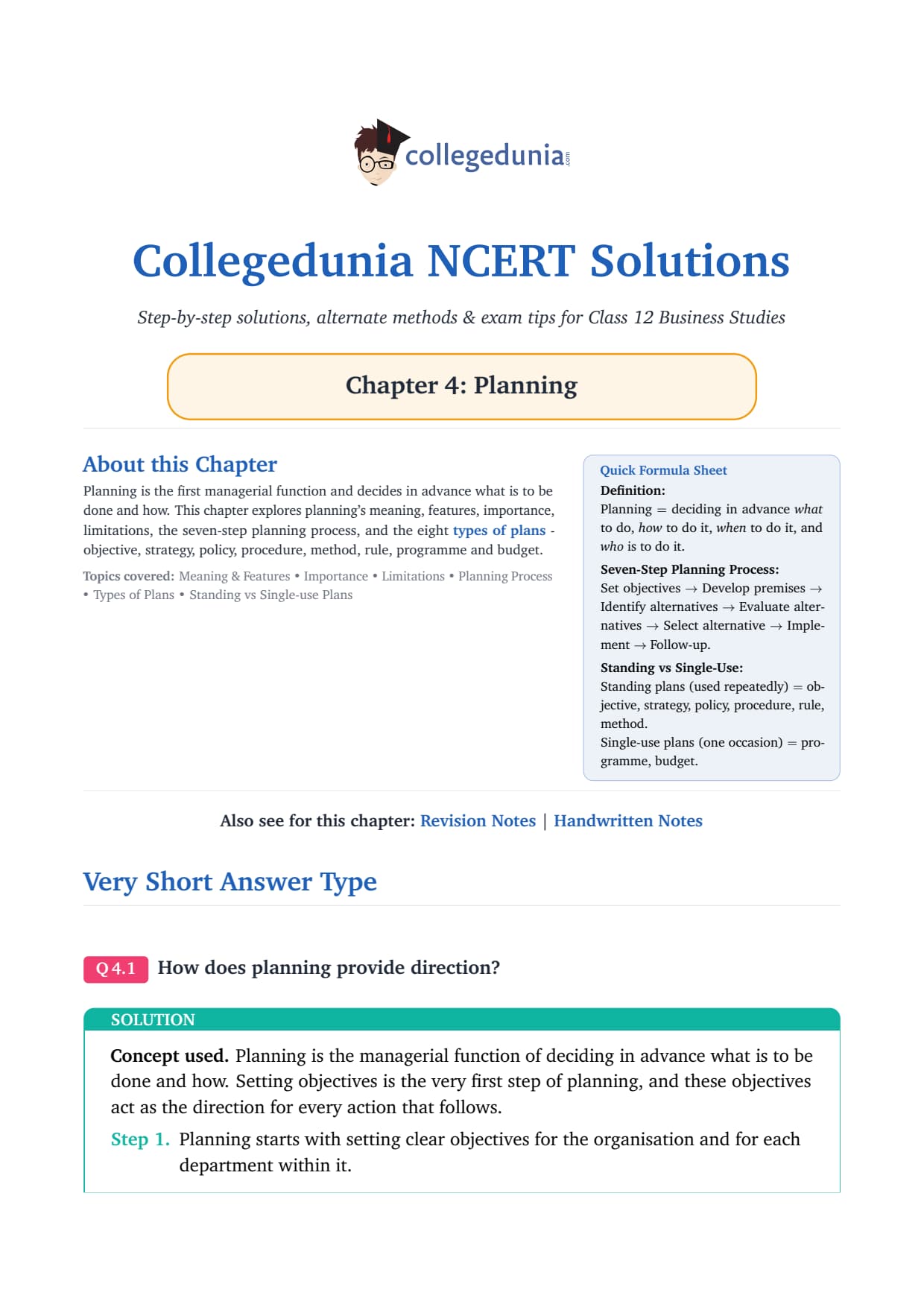
Q 4.1
How does planning provide direction?
Concept used. Planning is the managerial function of
deciding in advance what is to be done and how. Setting objectives
is the very first step of planning, and these objectives act as the
direction for every action that follows.
Planning starts with setting clear objectives for the
organisation and for each department within it.
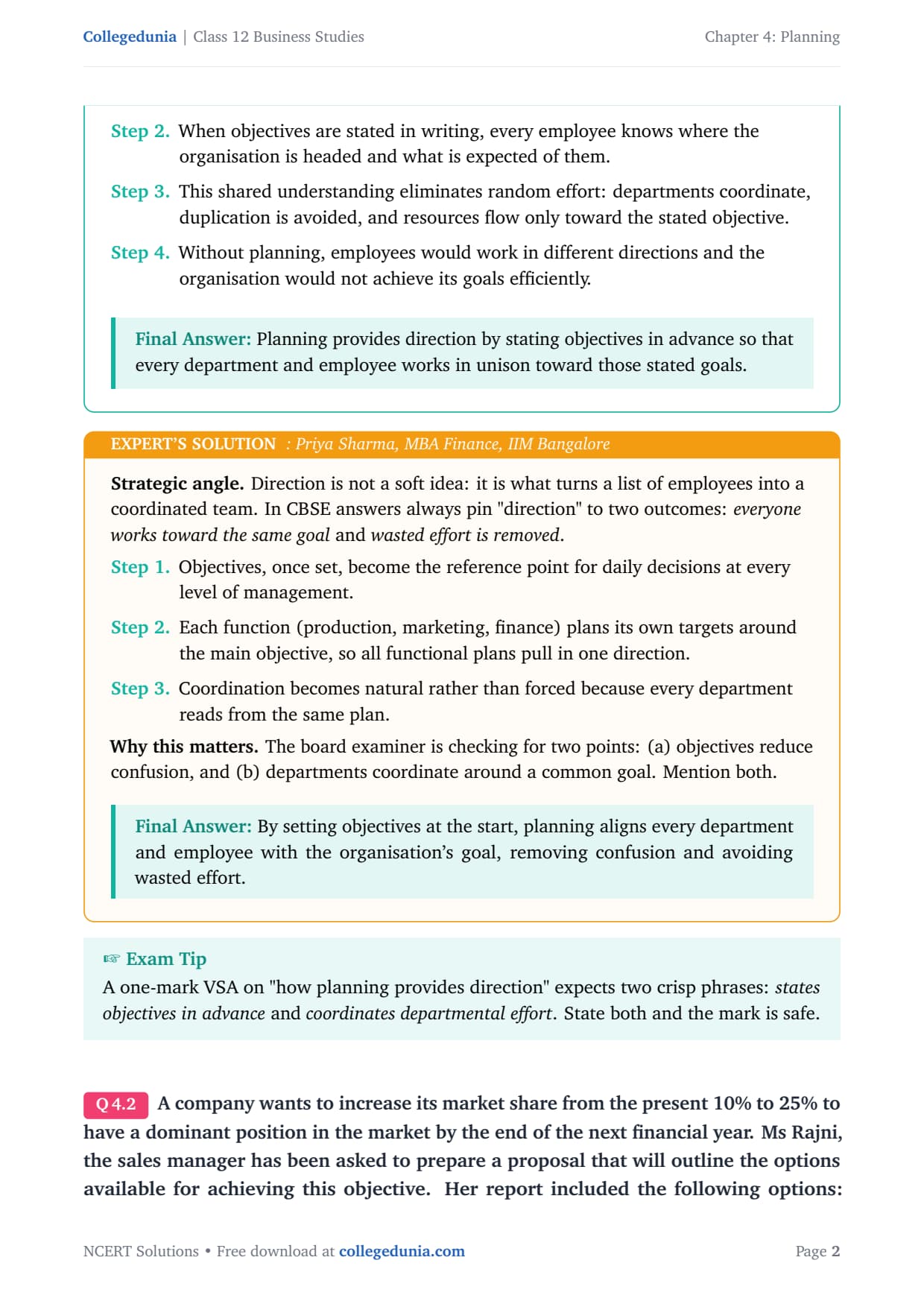
When objectives are stated in writing, every employee
knows where the organisation is headed and what is
expected of them.
This shared understanding eliminates random effort:
departments coordinate, duplication is avoided, and
resources flow only toward the stated objective.
Without planning, employees would work in different
directions and the organisation would not achieve its
goals efficiently.
Planning provides direction by stating objectives in
advance so that every department and employee works in unison
toward those stated goals.
PS
Priya Sharma
MBA Finance, IIM Bangalore
Verified Expert
Strategic angle. Direction is not a soft idea: it is what
turns a list of employees into a coordinated team. In CBSE answers
always pin "direction" to two outcomes: everyone works toward
the same goal and wasted effort is removed.
Objectives, once set, become the reference point for
daily decisions at every level of management.
Each function (production, ncert-notes-class-12-business-studies-chapter-10-marketing, finance) plans its
own targets around the main objective, so all functional
plans pull in one direction.
Coordination becomes natural rather than forced because
every department reads from the same plan.
Why this matters. The board examiner is checking for two
points: (a) objectives reduce confusion, and (b) departments
coordinate around a common goal. Mention both.
By setting objectives at the start, planning aligns
every department and employee with the organisation's goal,
removing confusion and avoiding wasted effort.
Q 4.2
A company wants to increase its market share from the
present 10% to 25% to have a dominant position in the market by
the end of the next financial year. Ms Rajni, the sales manager
has been asked to prepare a proposal that will outline the options
available for achieving this objective. Her report included the
following options: entering new markets, expanding the product
range offered to customers, using sales promotion techniques such
as giving rebates, discounts or increasing the budget for
advertising activities. Which step of the planning process has
been performed by Ms Rajni?
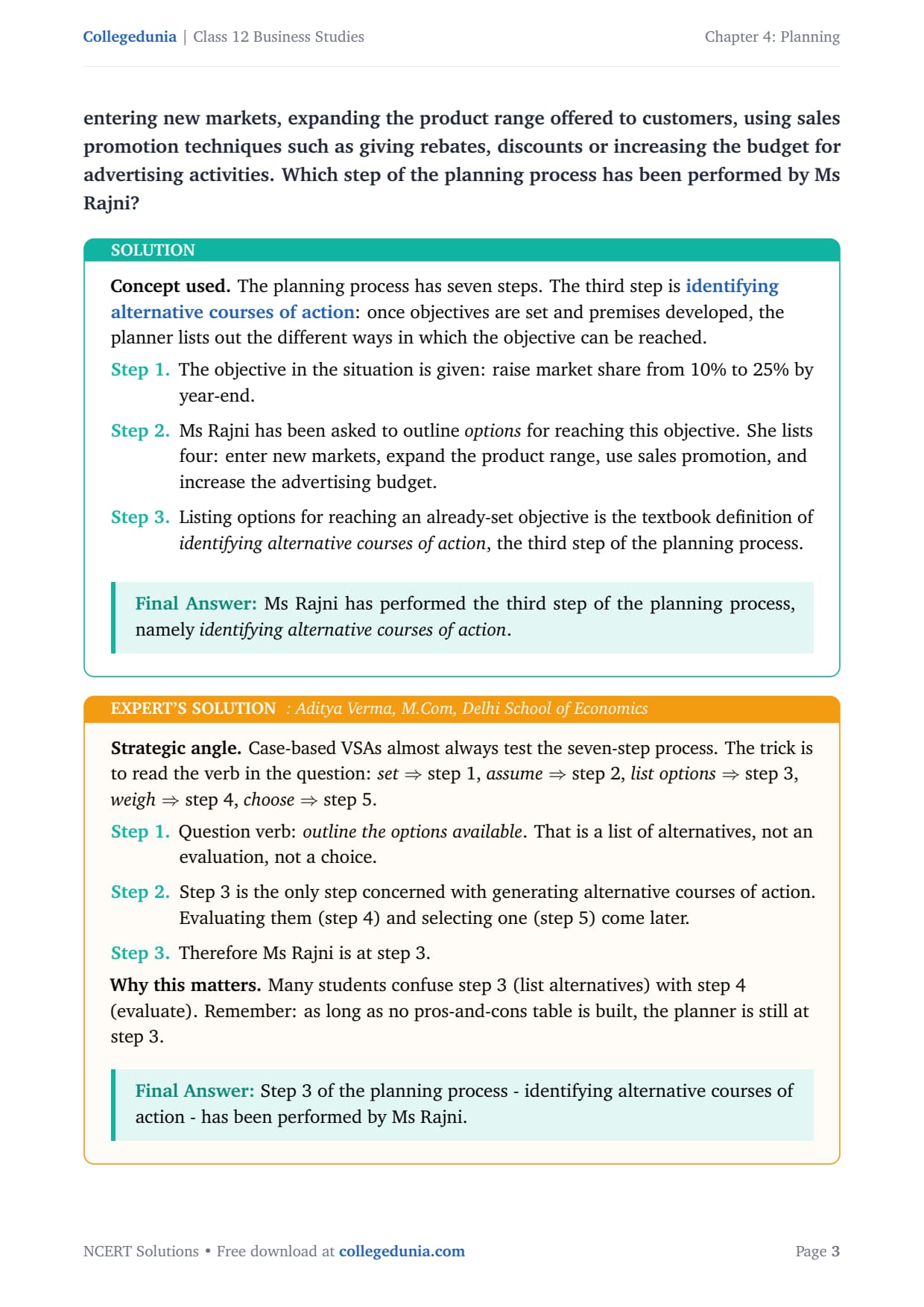
Concept used. The planning process has seven steps. The
third step is identifying alternative courses of action:
once objectives are set and premises developed, the planner lists
out the different ways in which the objective can be reached.
The objective in the situation is given: raise market share
from 10% to 25% by year-end.
Ms Rajni has been asked to outline options for
reaching this objective. She lists four: enter new markets,
expand the product range, use sales promotion, and
increase the advertising budget.
Listing options for reaching an already-set objective is
the textbook definition of identifying alternative
courses of action, the third step of the planning process.
Ms Rajni has performed the third step of the planning
process, namely identifying alternative courses of action.
AV
Aditya Verma
M.Com, Delhi School of Economics
Verified Expert
Strategic angle. Case-based VSAs almost always test the
seven-step process. The trick is to read the verb in the question:
set \(\Rightarrow\) step 1, assume \(\Rightarrow\) step 2,
list options \(\Rightarrow\) step 3, weigh
\(\Rightarrow\) step 4, choose \(\Rightarrow\) step 5.
Question verb: outline the options available. That
is a list of alternatives, not an evaluation, not a
choice.
Step 3 is the only step concerned with generating
alternative courses of action. Evaluating them (step 4)
and selecting one (step 5) come later.
Therefore Ms Rajni is at step 3.
Why this matters. Many students confuse step 3 (list
alternatives) with step 4 (evaluate). Remember: as long as no
pros-and-cons table is built, the planner is still at step 3.
Step 3 of the planning process - identifying alternative
courses of action - has been performed by Ms Rajni.
Q 4.3
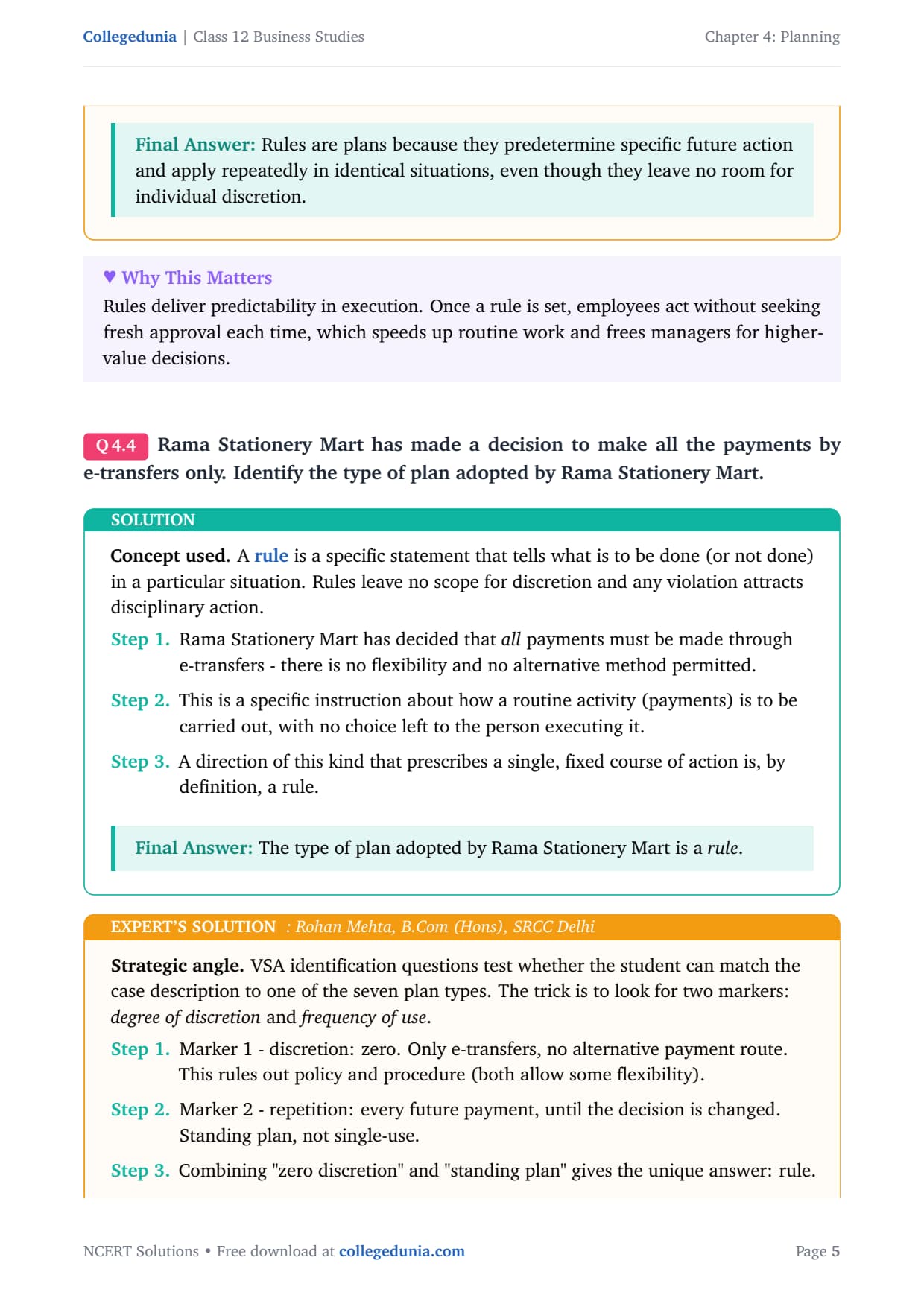
Why are rules considered to be plans?
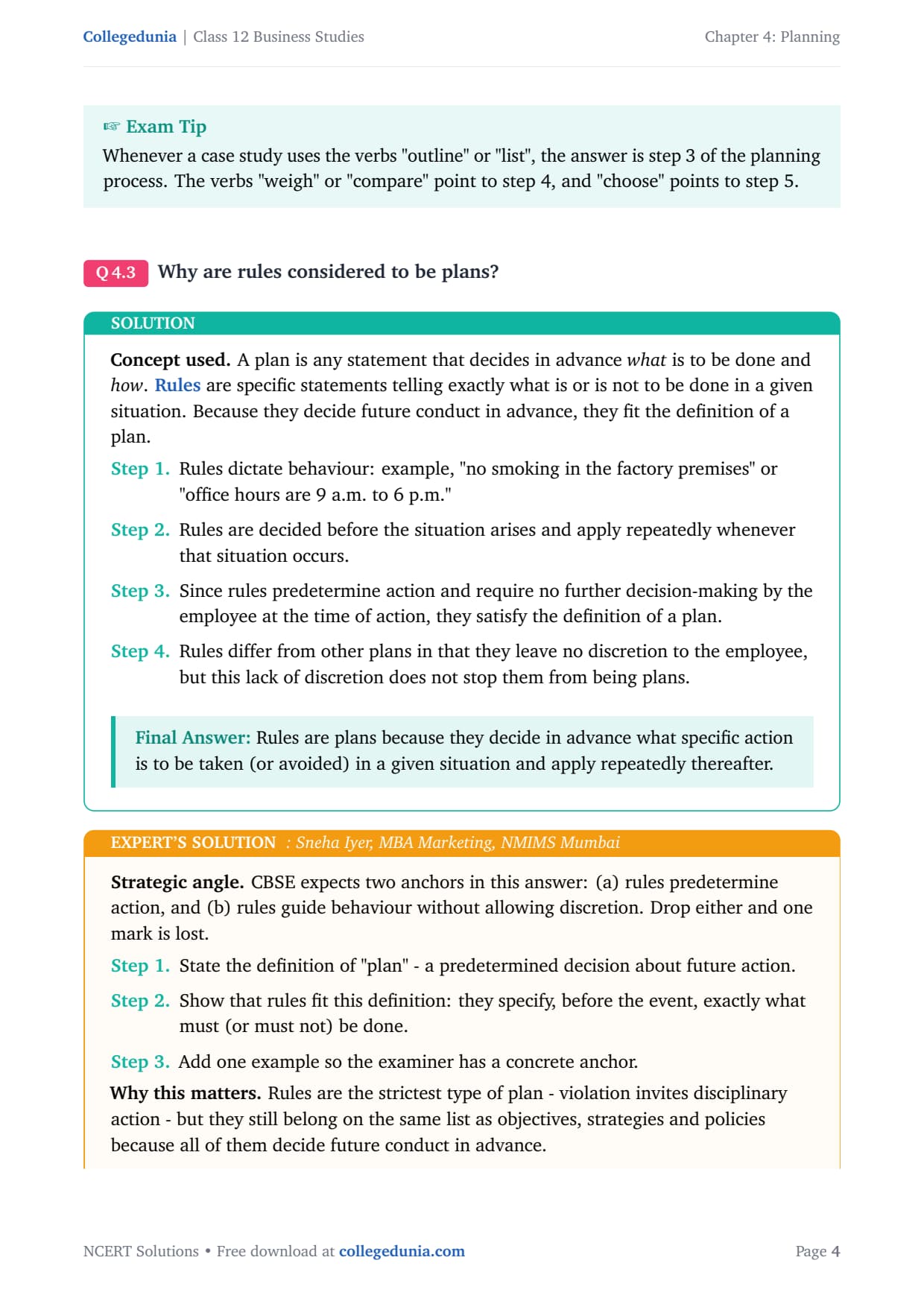
Concept used. A plan is any statement that decides in
advance what is to be done and how. Rules
are specific statements telling exactly what is or is not to be
done in a given situation. Because they decide future conduct in
advance, they fit the definition of a plan.
Rules dictate behaviour: example, "no smoking in the
factory premises" or "office hours are 9 a.m. to
6 p.m."
Rules are decided before the situation arises and apply
repeatedly whenever that situation occurs.
Since rules predetermine action and require no further
decision-making by the employee at the time of action,
they satisfy the definition of a plan.
Rules differ from other plans in that they leave no
discretion to the employee, but this lack of discretion
does not stop them from being plans.
Rules are plans because they decide in advance what
specific action is to be taken (or avoided) in a given situation
and apply repeatedly thereafter.
SI
Sneha Iyer
MBA Marketing, NMIMS Mumbai
Verified Expert
Strategic angle. CBSE expects two anchors in this answer:
(a) rules predetermine action, and (b) rules guide behaviour
without allowing discretion. Drop either and one mark is lost.
State the definition of "plan" - a predetermined decision
about future action.
Show that rules fit this definition: they specify, before
the event, exactly what must (or must not) be done.
Add one example so the examiner has a concrete anchor.
Why this matters. Rules are the strictest type of plan -
violation invites disciplinary action - but they still belong on
the same list as objectives, strategies and policies because all
of them decide future conduct in advance.
Rules are plans because they predetermine specific
future action and apply repeatedly in identical situations, even
though they leave no room for individual discretion.
Q 4.4
Rama Stationery Mart has made a decision to make all the
payments by e-transfers only. Identify the type of plan adopted by
Rama Stationery Mart.
Concept used. A rule is a specific statement
that tells what is to be done (or not done) in a particular
situation. Rules leave no scope for discretion and any violation
attracts disciplinary action.
Rama Stationery Mart has decided that all payments
must be made through e-transfers - there is no flexibility
and no alternative method permitted.
This is a specific instruction about how a routine
activity (payments) is to be carried out, with no choice
left to the person executing it.
A direction of this kind that prescribes a single, fixed
course of action is, by definition, a rule.
The type of plan adopted by Rama Stationery Mart is a
rule.
RM
Rohan Mehta
B.Com (Hons), SRCC Delhi
Verified Expert
Strategic angle. VSA identification questions test
whether the student can match the case description to one of the
seven plan types. The trick is to look for two markers:
degree of discretion and frequency of use.
Marker 1 - discretion: zero. Only e-transfers, no
alternative payment route. This rules out policy and
procedure (both allow some flexibility).
Marker 2 - repetition: every future payment, until the
decision is changed. Standing plan, not single-use.
Combining "zero discretion" and "standing plan" gives the
unique answer: rule.
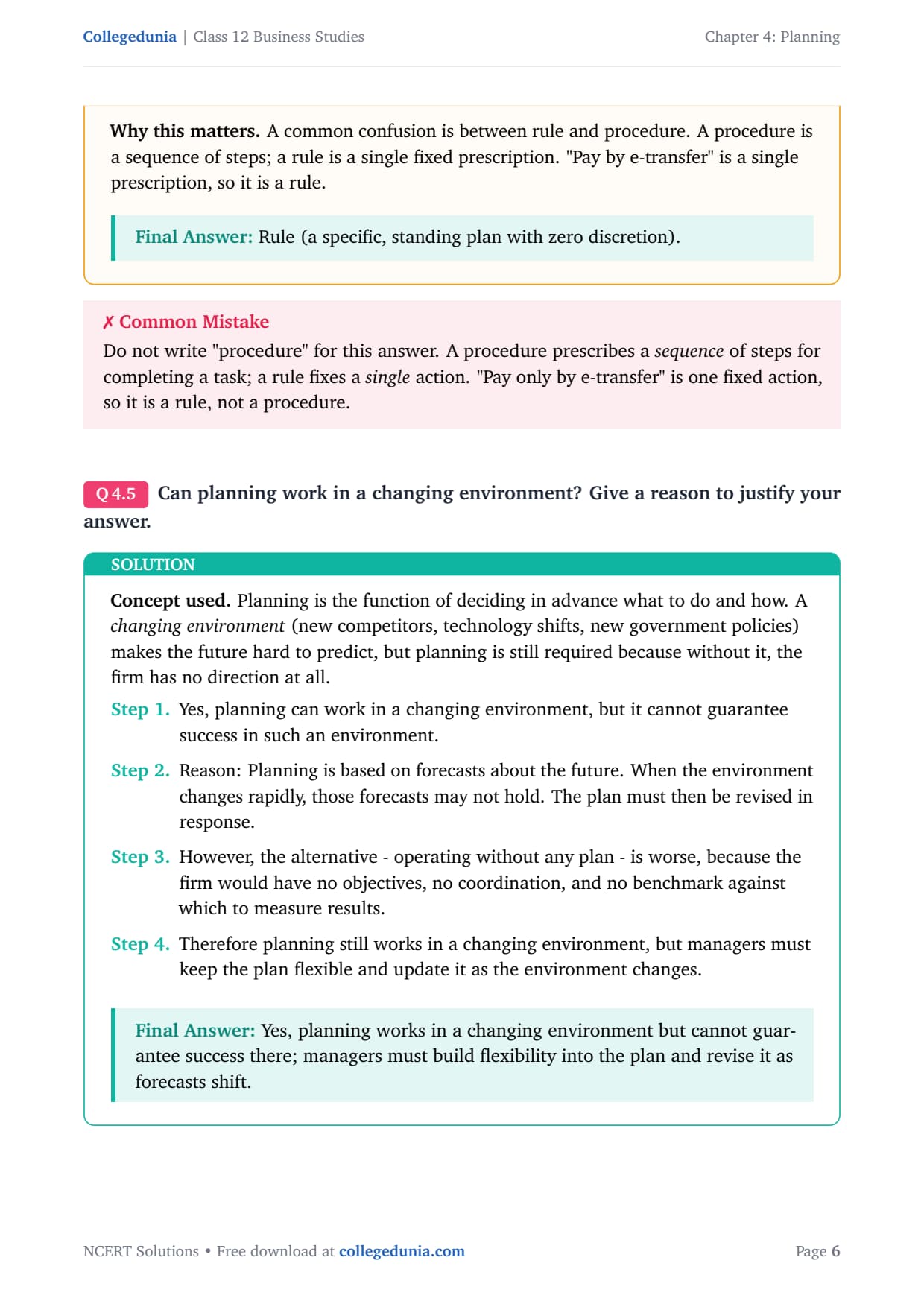
Why this matters. A common confusion is between rule and
procedure. A procedure is a sequence of steps; a rule is a single
fixed prescription. "Pay by e-transfer" is a single prescription,
so it is a rule.
Rule (a specific, standing plan with zero discretion).
Q 4.5
Can planning work in a changing environment? Give a
reason to justify your answer.
Concept used. Planning is the function of deciding in
advance what to do and how. A changing environment (new
competitors, technology shifts, new government policies) makes the
future hard to predict, but planning is still required because
without it, the firm has no direction at all.
Yes, planning can work in a changing environment, but it
cannot guarantee success in such an environment.
Reason: Planning is based on forecasts about the future.
When the environment changes rapidly, those forecasts may
not hold. The plan must then be revised in response.
However, the alternative - operating without any plan -
is worse, because the firm would have no objectives, no
coordination, and no benchmark against which to measure
results.
Therefore planning still works in a changing environment,
but managers must keep the plan flexible and update it as
the environment changes.
Yes, planning works in a changing environment but
cannot guarantee success there; managers must build flexibility
into the plan and revise it as forecasts shift.
VS
Vikram Singh
MBA Strategy, IIM Lucknow
Verified Expert
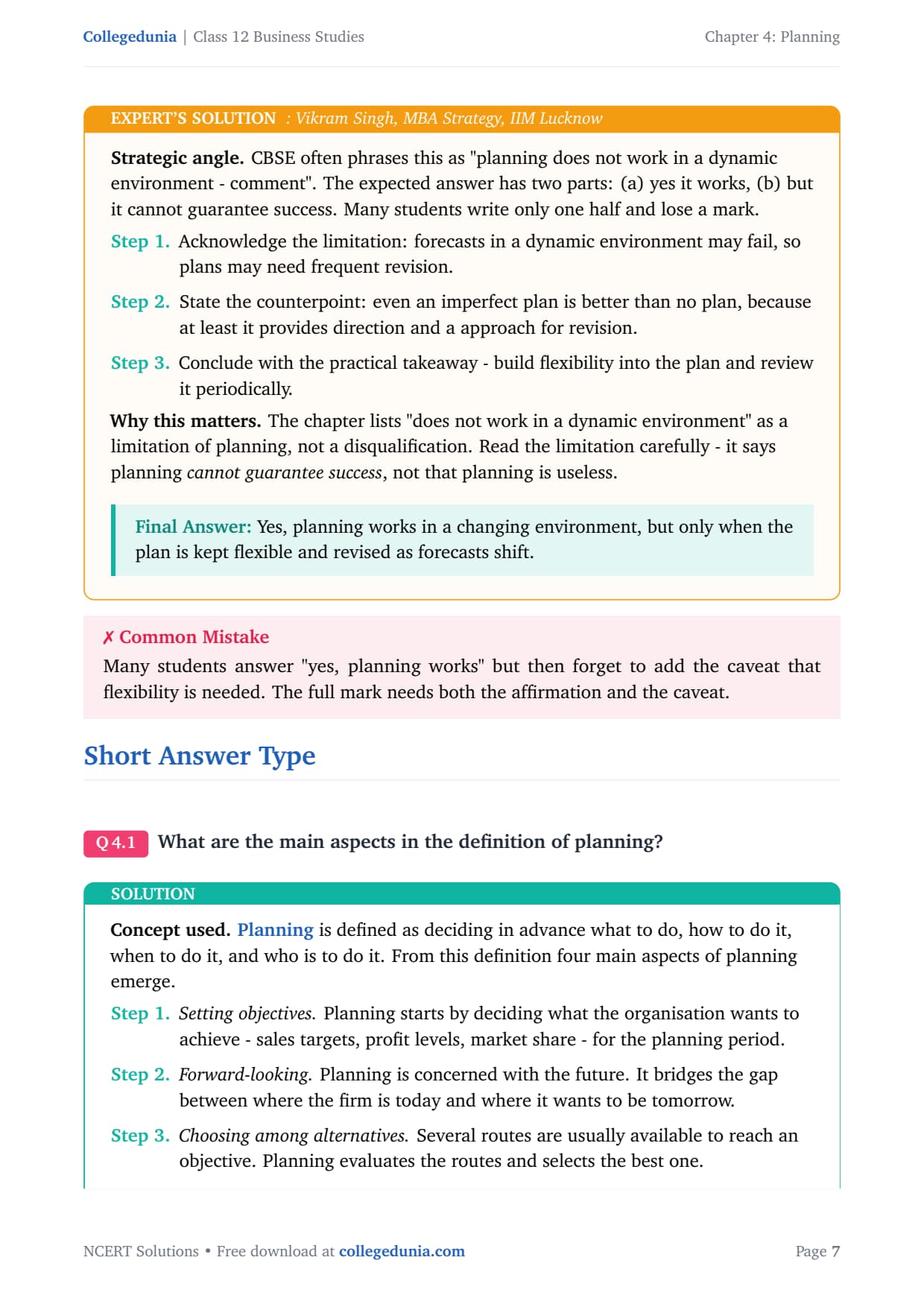
Strategic angle. CBSE often phrases this as "planning
does not work in a dynamic environment - comment". The expected
answer has two parts: (a) yes it works, (b) but it cannot
guarantee success. Many students write only one half and lose a
mark.
Acknowledge the limitation: forecasts in a dynamic
environment may fail, so plans may need frequent revision.
State the counterpoint: even an imperfect plan is better
than no plan, because at least it provides direction and a
approach for revision.
Conclude with the practical takeaway - build flexibility
into the plan and review it periodically.
Why this matters. The chapter lists "does not work in a
dynamic environment" as a limitation of planning, not a
disqualification. Read the limitation carefully - it says planning
cannot guarantee success, not that planning is useless.
Yes, planning works in a changing environment, but only
when the plan is kept flexible and revised as forecasts shift.
Short Answer Type
Q 4.6
What are the main aspects in the definition of planning?
Concept used.Planning is defined as deciding
in advance what to do, how to do it, when to do it, and who is to
do it. From this definition four main aspects of planning emerge.
Setting objectives. Planning starts by deciding
what the organisation wants to achieve - sales targets,
profit levels, market share - for the planning period.
Forward-looking. Planning is concerned with the
future. It bridges the gap between where the firm is today
and where it wants to be tomorrow.
Choosing among alternatives. Several routes are
usually available to reach an objective. Planning
evaluates the routes and selects the best one.
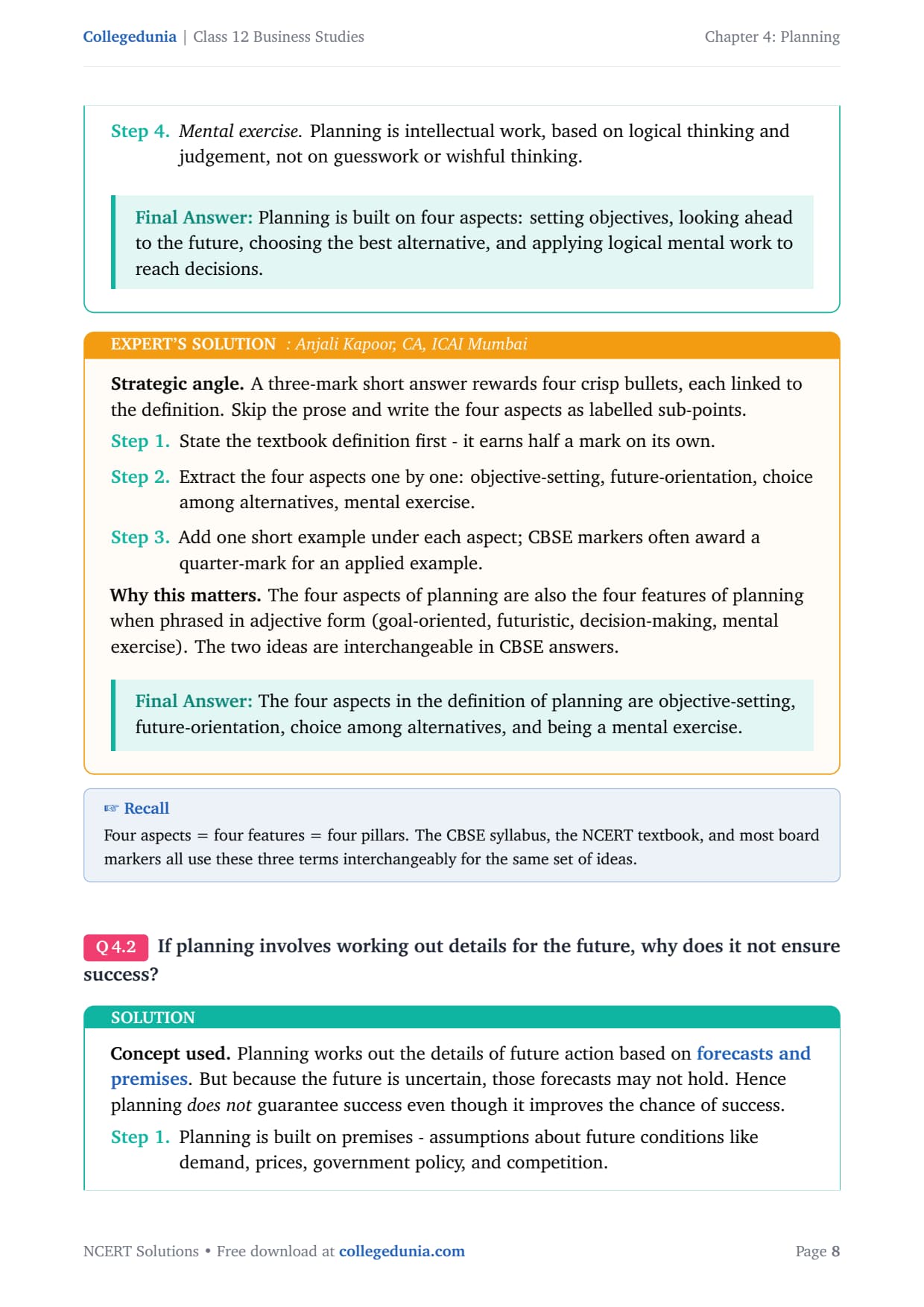
Mental exercise. Planning is intellectual work,
based on logical thinking and judgement, not on guesswork
or wishful thinking.
Planning is built on four aspects: setting objectives,
looking ahead to the future, choosing the best alternative, and
applying logical mental work to reach decisions.
AK
Anjali Kapoor
CA, ICAI Mumbai
Verified Expert
Strategic angle. A three-mark short answer rewards four
crisp bullets, each linked to the definition. Skip the prose and
write the four aspects as labelled sub-points.
State the textbook definition first - it earns half a
mark on its own.
Extract the four aspects one by one: objective-setting,
future-orientation, choice among alternatives, mental
exercise.
Add one short example under each aspect; CBSE markers
often award a quarter-mark for an applied example.
Why this matters. The four aspects of planning are also
the four features of planning when phrased in adjective form
(goal-oriented, futuristic, decision-making, mental exercise).
The two ideas are interchangeable in CBSE answers.
The four aspects in the definition of planning are
objective-setting, future-orientation, choice among alternatives,
and being a mental exercise.
Q 4.7
If planning involves working out details for the future,
why does it not ensure success?
Concept used. Planning works out the details of future
action based on forecasts and premises. But because the
future is uncertain, those forecasts may not hold. Hence planning
does not guarantee success even though it improves the
chance of success.
Planning is built on premises - assumptions about future
conditions like demand, prices, government policy, and
competition.
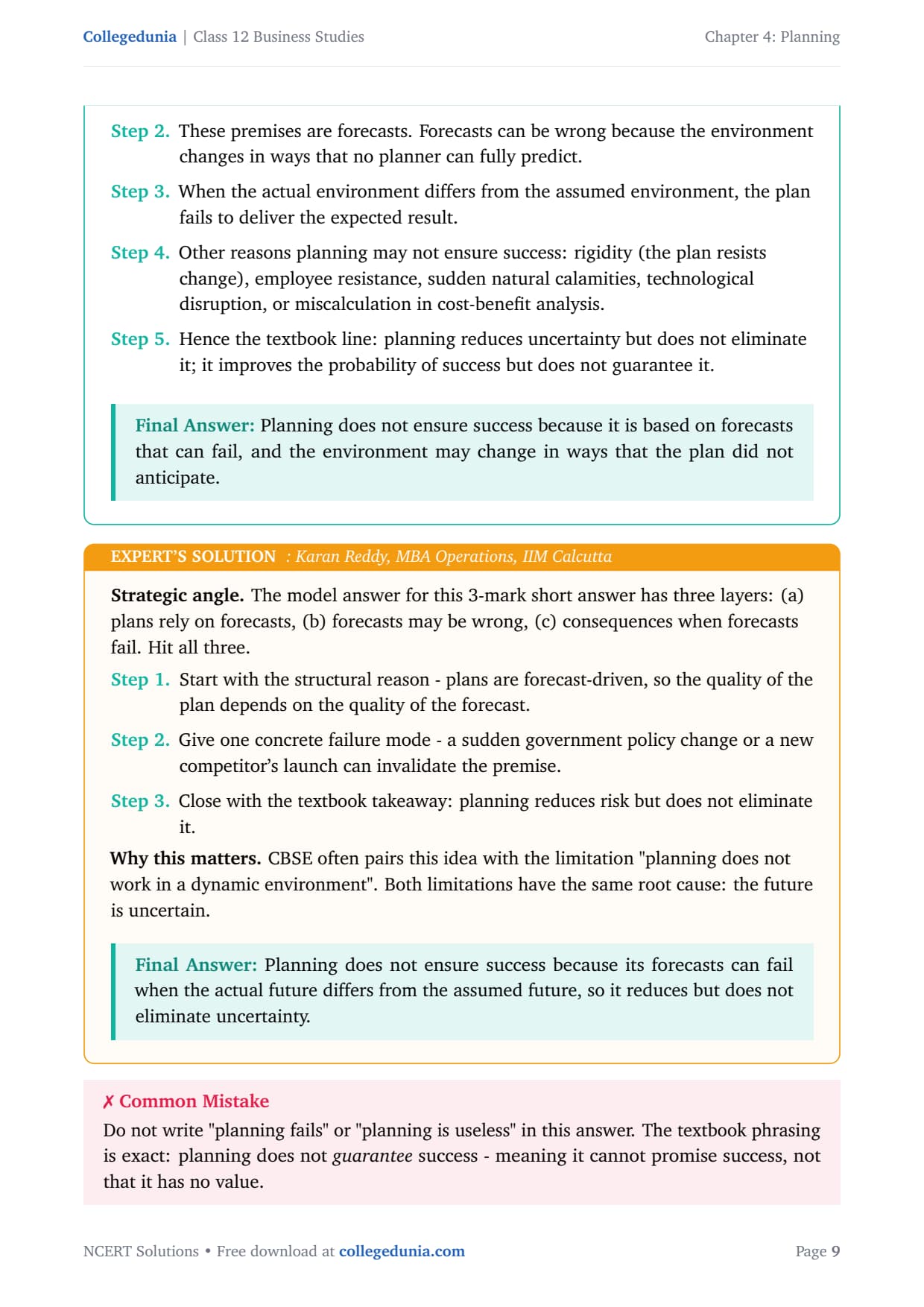
These premises are forecasts. Forecasts can be wrong
because the environment changes in ways that no planner
can fully predict.
When the actual environment differs from the assumed
environment, the plan fails to deliver the expected
result.
Other reasons planning may not ensure success: rigidity
(the plan resists change), employee resistance, sudden
natural calamities, technological disruption, or
miscalculation in cost-benefit analysis.
Hence the textbook line: planning reduces uncertainty
but does not eliminate it; it improves the probability of
success but does not guarantee it.
Planning does not ensure success because it is based on
forecasts that can fail, and the environment may change in ways
that the plan did not anticipate.
KR
Karan Reddy
MBA Operations, IIM Calcutta
Verified Expert
Strategic angle. The model answer for this 3-mark short
answer has three layers: (a) plans rely on forecasts, (b)
forecasts may be wrong, (c) consequences when forecasts fail. Hit
all three.
Start with the structural reason - plans are
forecast-driven, so the quality of the plan depends on the
quality of the forecast.
Give one concrete failure mode - a sudden government
policy change or a new competitor's launch can invalidate
the premise.
Close with the textbook takeaway: planning reduces risk
but does not eliminate it.
Why this matters. CBSE often pairs this idea with the
limitation "planning does not work in a dynamic environment". Both
limitations have the same root cause: the future is uncertain.
Planning does not ensure success because its forecasts
can fail when the actual future differs from the assumed future,
so it reduces but does not eliminate uncertainty.
Q 4.8
What kind of strategic decisions are taken by business
organisations?
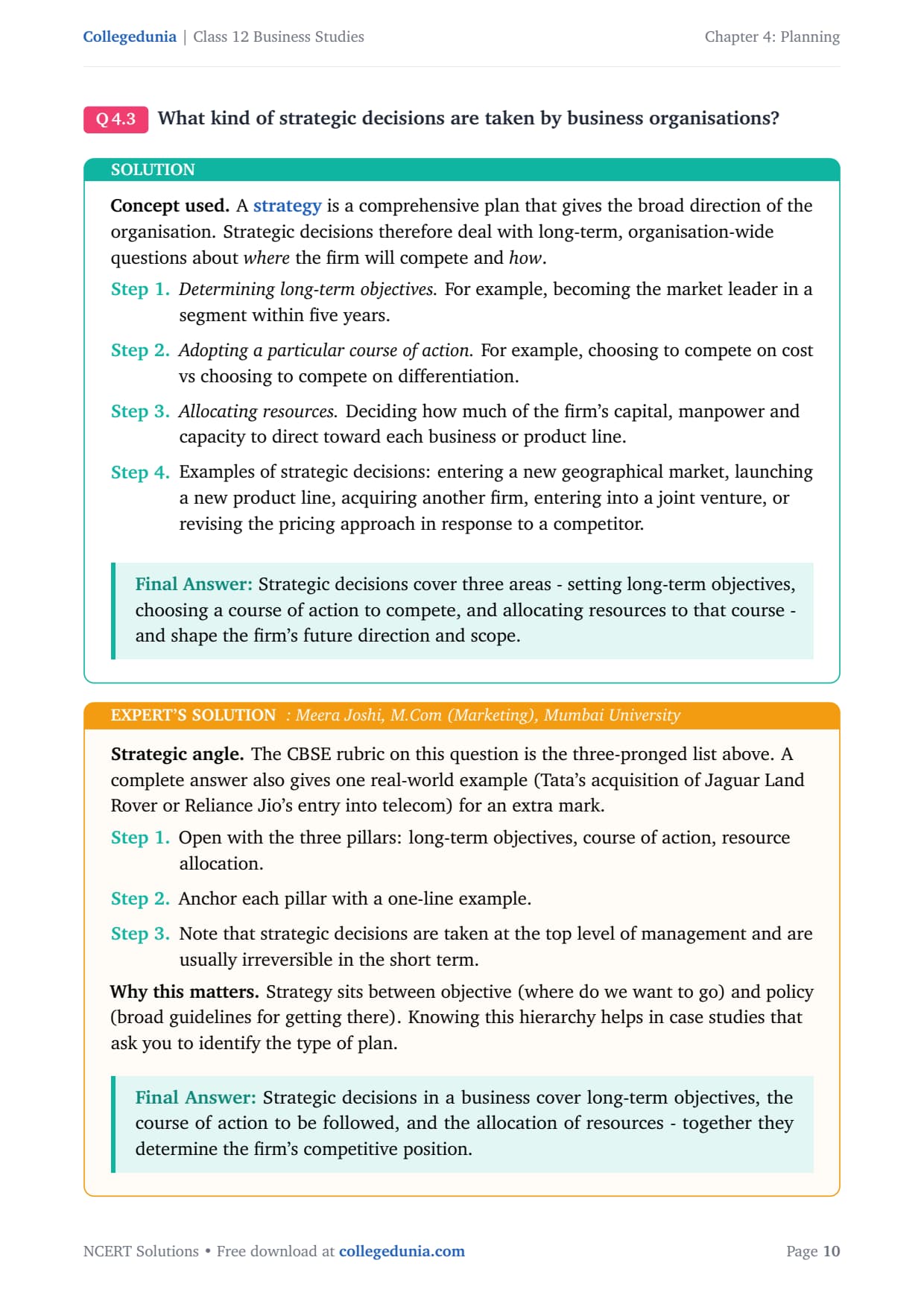
Concept used. A strategy is a comprehensive
plan that gives the broad direction of the organisation. Strategic
decisions therefore deal with long-term, organisation-wide
questions about where the firm will compete and how.
Determining long-term objectives. For example,
becoming the market leader in a segment within five years.
Adopting a particular course of action. For
example, choosing to compete on cost vs choosing to
compete on differentiation.
Allocating resources. Deciding how much of the
firm's capital, manpower and capacity to direct toward
each business or product line.
Examples of strategic decisions: entering a new
geographical market, launching a new product line,
acquiring another firm, entering into a joint venture, or
revising the pricing approach in response to a competitor.
Strategic decisions cover three areas - setting
long-term objectives, choosing a course of action to compete, and
allocating resources to that course - and shape the firm's future
direction and scope.
MJ
Meera Joshi
M.Com (Marketing), Mumbai University
Verified Expert
Strategic angle. The CBSE rubric on this question is the
three-pronged list above. A complete answer also gives one
real-world example (Tata's acquisition of Jaguar Land Rover or
Reliance Jio's entry into telecom) for an extra mark.
Open with the three pillars: long-term objectives, course
of action, resource allocation.
Anchor each pillar with a one-line example.
Note that strategic decisions are taken at the top level
of management and are usually irreversible in the short
term.
Why this matters. Strategy sits between objective (where
do we want to go) and policy (broad guidelines for getting there).
Knowing this hierarchy helps in case studies that ask you to
identify the type of plan.
Strategic decisions in a business cover long-term
objectives, the course of action to be followed, and the
allocation of resources - together they determine the firm's
competitive position.
Q 4.9
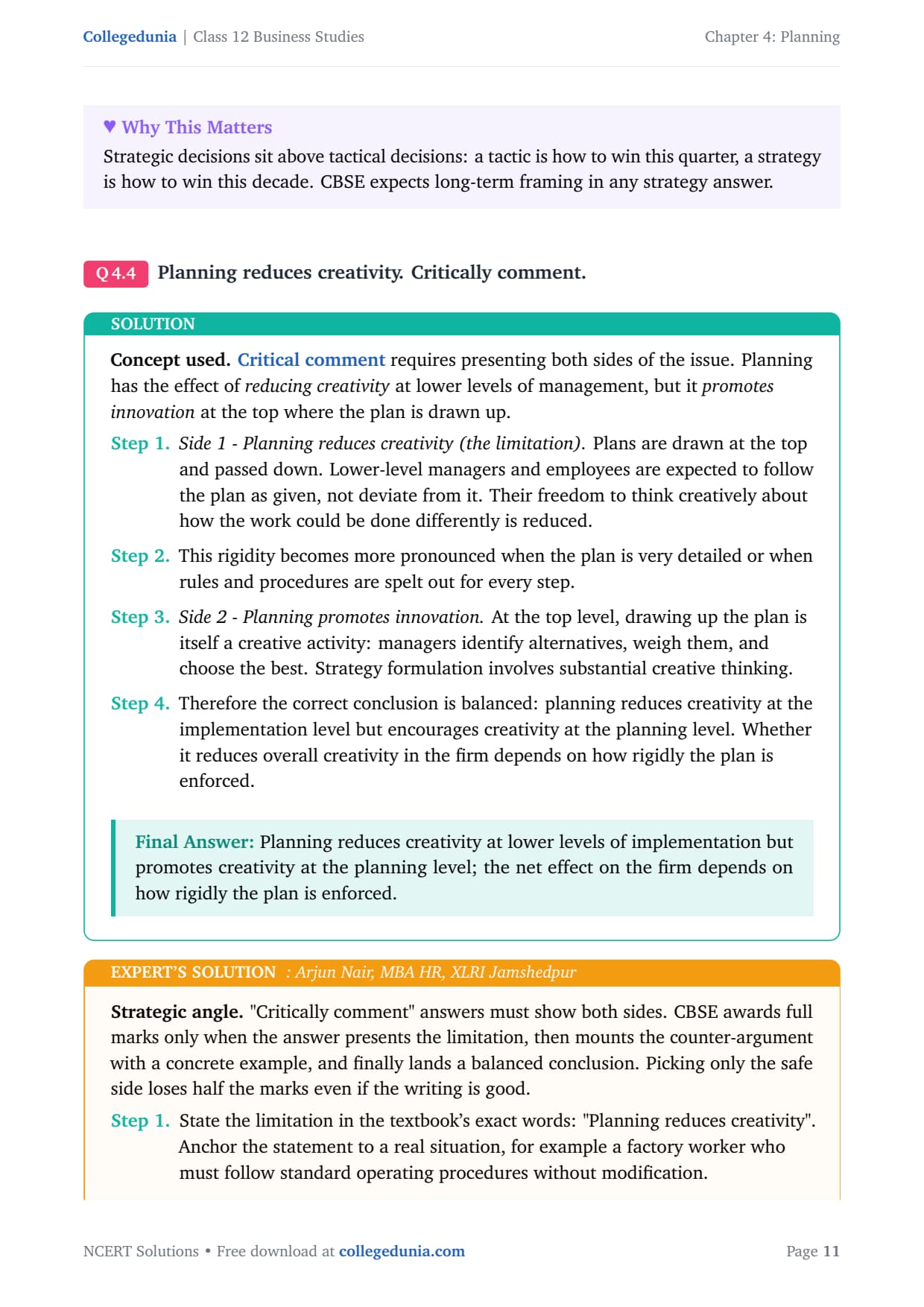
Planning reduces creativity. Critically comment.
Concept used.Critical comment requires
presenting both sides of the issue. Planning has the effect of
reducing creativity at lower levels of management, but it
promotes innovation at the top where the plan is drawn up.
Side 1 - Planning reduces creativity (the
limitation). Plans are drawn at the top and passed down.
Lower-level managers and employees are expected to follow
the plan as given, not deviate from it. Their freedom to
think creatively about how the work could be done
differently is reduced.
This rigidity becomes more pronounced when the plan is
very detailed or when rules and procedures are spelt out
for every step.
Side 2 - Planning promotes innovation. At the top
level, drawing up the plan is itself a creative activity:
managers identify alternatives, weigh them, and choose the
best. Strategy formulation involves substantial creative
thinking.
Therefore the correct conclusion is balanced: planning
reduces creativity at the implementation level but
encourages creativity at the planning level. Whether it
reduces overall creativity in the firm depends on how
rigidly the plan is enforced.
Planning reduces creativity at lower levels of
implementation but promotes creativity at the planning level; the
net effect on the firm depends on how rigidly the plan is
enforced.
AN
Arjun Nair
MBA HR, XLRI Jamshedpur
Verified Expert
Strategic angle. "Critically comment" answers must show
both sides. CBSE awards full marks only when the answer presents
the limitation, then mounts the counter-argument with a concrete
example, and finally lands a balanced conclusion. Picking only
the safe side loses half the marks even if the writing is good.
State the limitation in the textbook's exact words:
"Planning reduces creativity". Anchor the statement to a
real situation, for example a factory worker who must
follow standard operating procedures without modification.
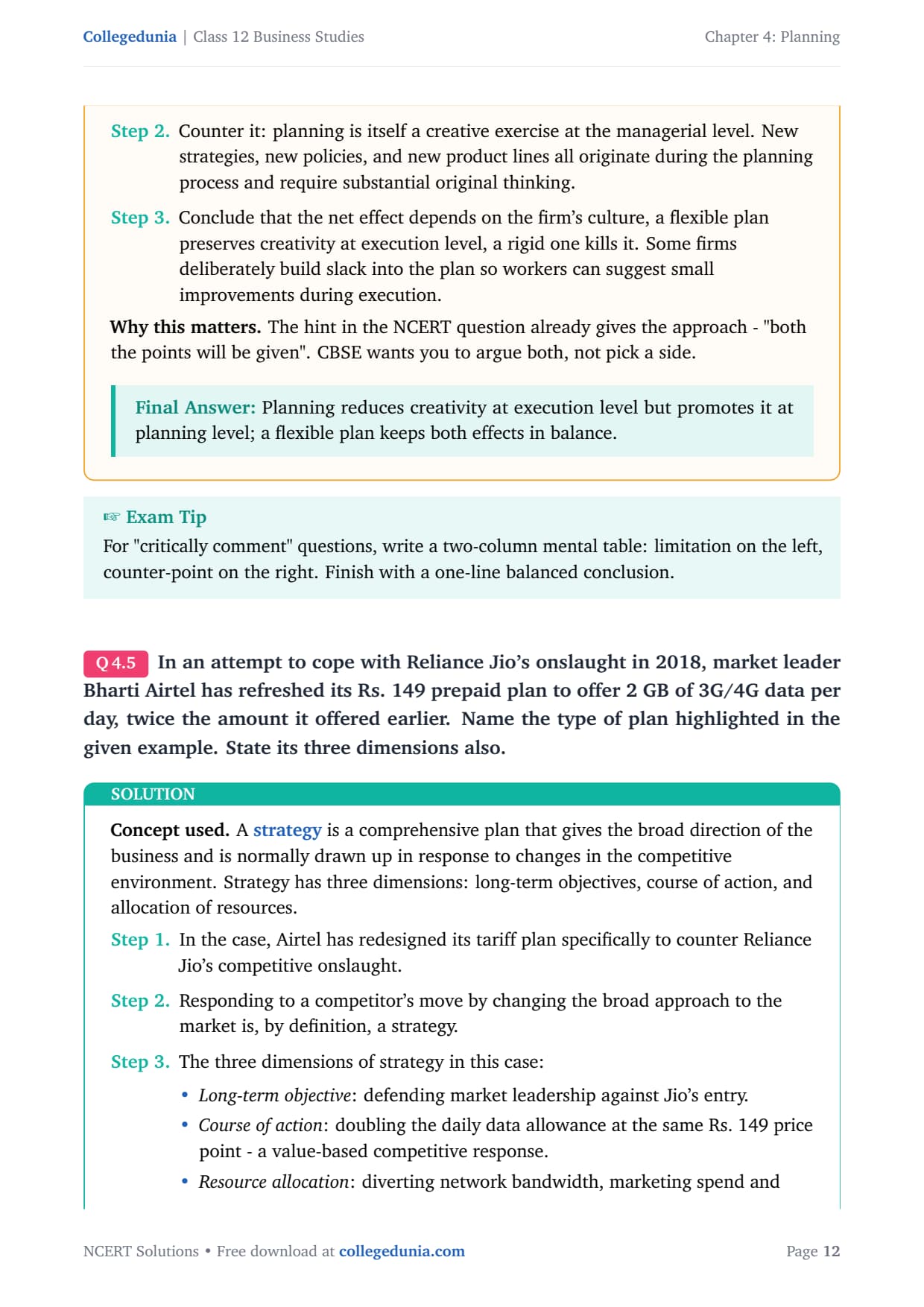
Counter it: planning is itself a creative exercise at the
managerial level. New strategies, new policies, and new
product lines all originate during the planning process
and require substantial original thinking.
Conclude that the net effect depends on the firm's
culture, a flexible plan preserves creativity at execution
level, a rigid one kills it. Some firms deliberately build
slack into the plan so workers can suggest small
improvements during execution.
Why this matters. The hint in the NCERT question already
gives the approach - "both the points will be given". CBSE wants
you to argue both, not pick a side.
Planning reduces creativity at execution level but
promotes it at planning level; a flexible plan keeps both effects
in balance.
Q 4.10
In an attempt to cope with Reliance Jio's onslaught in
2018, market leader Bharti Airtel has refreshed its Rs. 149 prepaid
plan to offer 2 GB of 3G/4G data per day, twice the amount it
offered earlier. Name the type of plan highlighted in the given
example. State its three dimensions also.
Concept used. A strategy is a comprehensive
plan that gives the broad direction of the business and is
normally drawn up in response to changes in the competitive
environment. Strategy has three dimensions: long-term objectives,
course of action, and allocation of resources.
In the case, Airtel has redesigned its tariff plan
specifically to counter Reliance Jio's competitive
onslaught.
Responding to a competitor's move by changing the broad
approach to the market is, by definition, a strategy.
The three dimensions of strategy in this case:
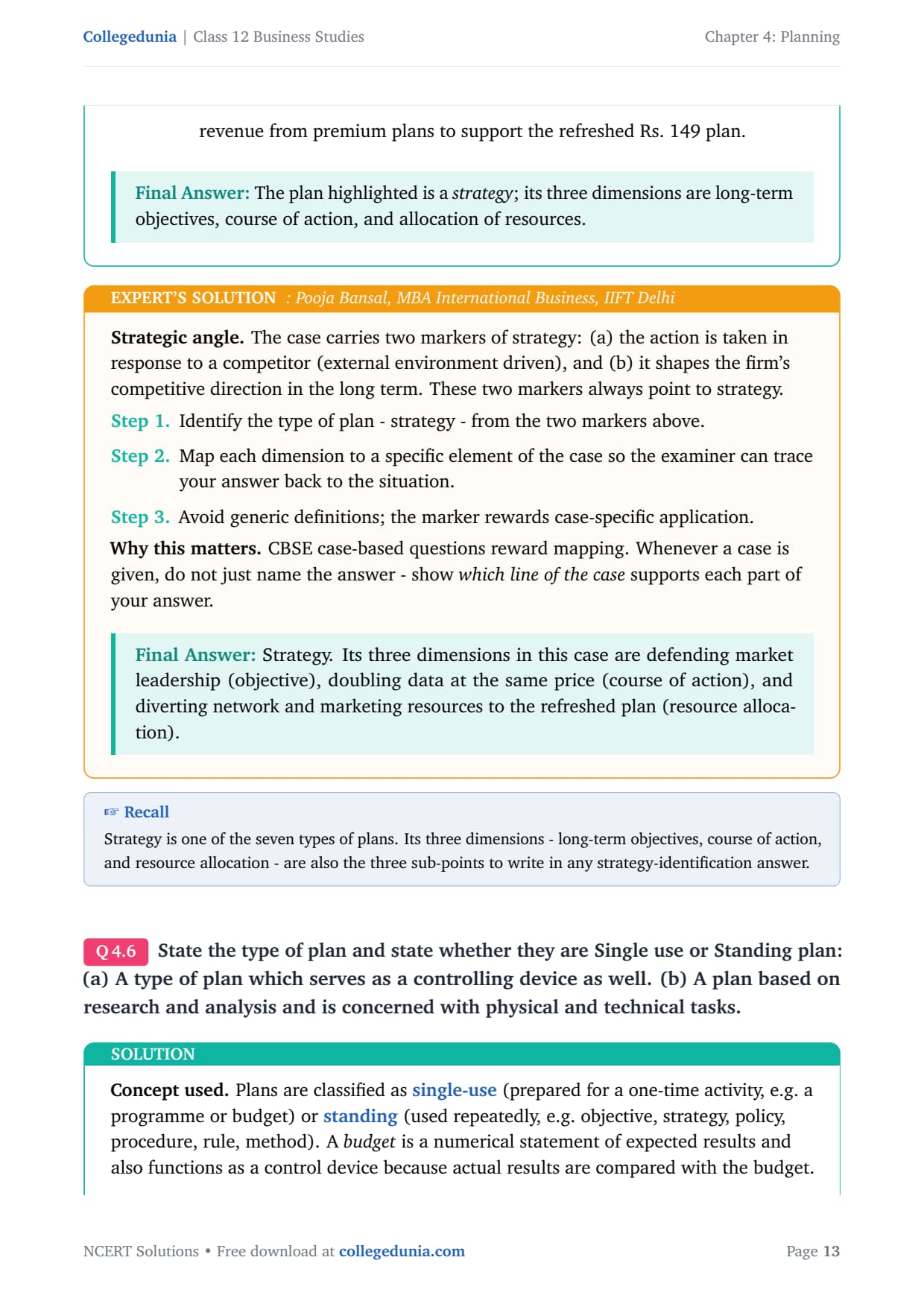
Long-term objective: defending market
leadership against Jio's entry.
Course of action: doubling the daily data
allowance at the same Rs. 149 price point - a
value-based competitive response.
Resource allocation: diverting network
bandwidth, ncert-notes-class-12-business-studies-chapter-10-marketing spend and revenue from
premium plans to support the refreshed Rs. 149
plan.
The plan highlighted is a strategy; its three
dimensions are long-term objectives, course of action, and
allocation of resources.
PB
Pooja Bansal
MBA International Business, IIFT Delhi
Verified Expert
Strategic angle. The case carries two markers of
strategy: (a) the action is taken in response to a competitor
(external environment driven), and (b) it shapes the firm's
competitive direction in the long term. These two markers always
point to strategy.
Identify the type of plan - strategy - from the two
markers above.
Map each dimension to a specific element of the case so
the examiner can trace your answer back to the situation.
Avoid generic definitions; the marker rewards
case-specific application.
Why this matters. CBSE case-based questions reward
mapping. Whenever a case is given, do not just name the answer -
show which line of the case supports each part of your
answer.
Strategy. Its three dimensions in this case are
defending market leadership (objective), doubling data at the
same price (course of action), and diverting network and
ncert-notes-class-12-business-studies-chapter-10-marketing resources to the refreshed plan (resource allocation).
Q 4.11
State the type of plan and state whether they are Single
use or Standing plan: (a) A type of plan which serves as a
controlling device as well. (b) A plan based on research and
analysis and is concerned with physical and technical tasks.
Concept used. Plans are classified as single-use
(prepared for a one-time activity, e.g. a programme or budget) or
standing (used repeatedly, e.g. objective, strategy,
policy, procedure, rule, method). A budget is a numerical
statement of expected results and also functions as a control
device because actual results are compared with the budget. A
method is the prescribed way of performing a task,
developed through research and analysis of physical and technical
work.
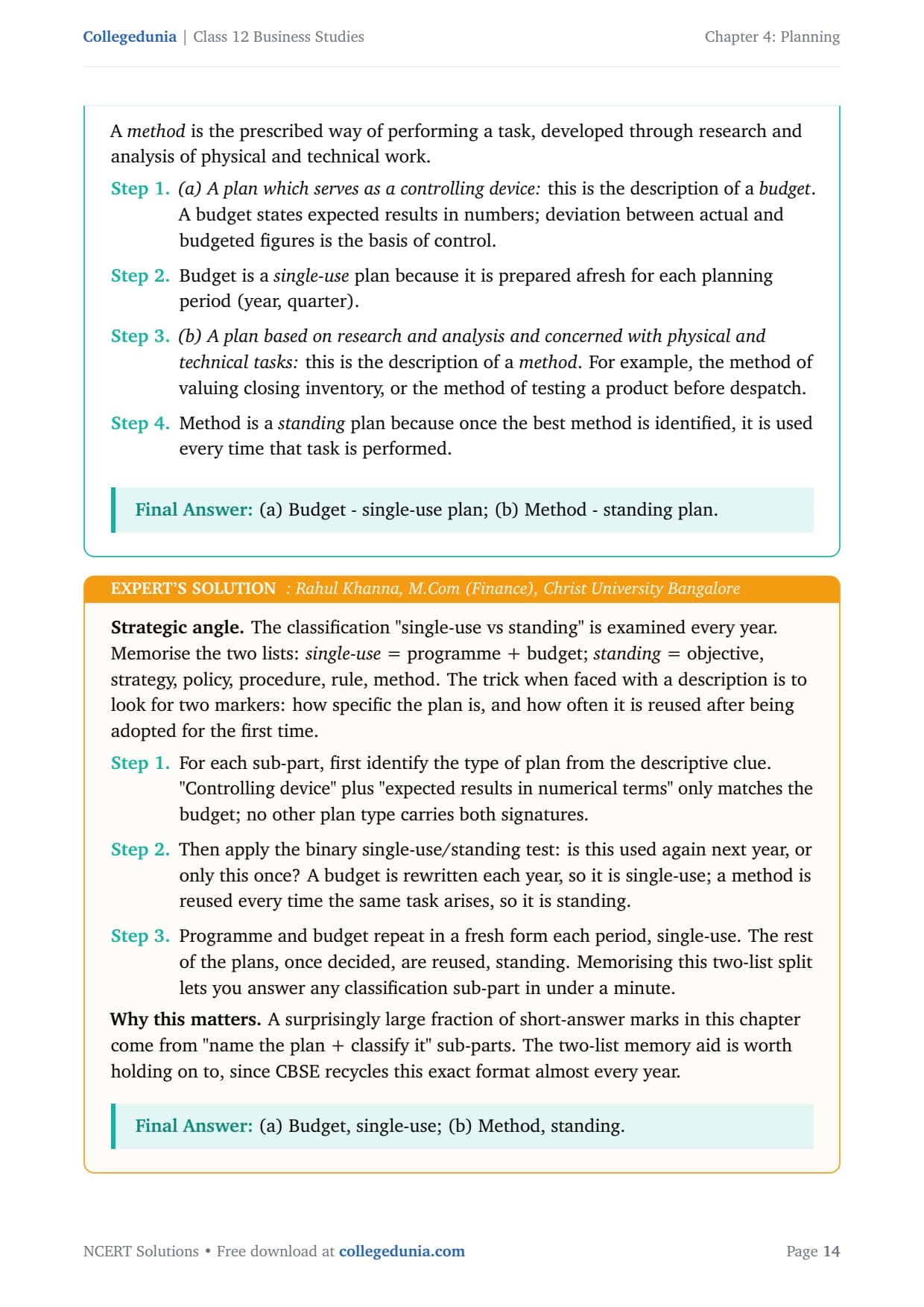
(a) A plan which serves as a controlling device:
this is the description of a budget. A budget
states expected results in numbers; deviation between
actual and budgeted figures is the basis of control.
Budget is a single-use plan because it is prepared
afresh for each planning period (year, quarter).
(b) A plan based on research and analysis and
concerned with physical and technical tasks: this is the
description of a method. For example, the method of
valuing closing inventory, or the method of testing a
product before despatch.
Method is a standing plan because once the best
method is identified, it is used every time that task is
performed.
Strategic angle. The classification "single-use vs
standing" is examined every year. Memorise the two lists:
single-use = programme + budget; standing =
objective, strategy, policy, procedure, rule, method. The trick
when faced with a description is to look for two markers: how
specific the plan is, and how often it is reused after being
adopted for the first time.
For each sub-part, first identify the type of plan from
the descriptive clue. "Controlling device" plus "expected
results in numerical terms" only matches the budget; no
other plan type carries both signatures.
Then apply the binary single-use/standing test: is this
used again next year, or only this once? A budget is
rewritten each year, so it is single-use; a method is
reused every time the same task arises, so it is
standing.
Programme and budget repeat in a fresh form each period,
single-use. The rest of the plans, once decided, are
reused, standing. Memorising this two-list split lets you
answer any classification sub-part in under a minute.
Why this matters. A surprisingly large fraction of
short-answer marks in this chapter come from "name the plan +
classify it" sub-parts. The two-list memory aid is worth holding
on to, since CBSE recycles this exact format almost every year.
(a) Budget, single-use; (b) Method, standing.
Long Answer Type
Q 4.12
Why is it that organisations are not always able to
accomplish all their objectives?
Concept used. Organisations set objectives during the
planning function, but reaching them depends on the planning's
quality and the environment in which it is executed. Six
limitations of planning explain why objectives are
sometimes missed.
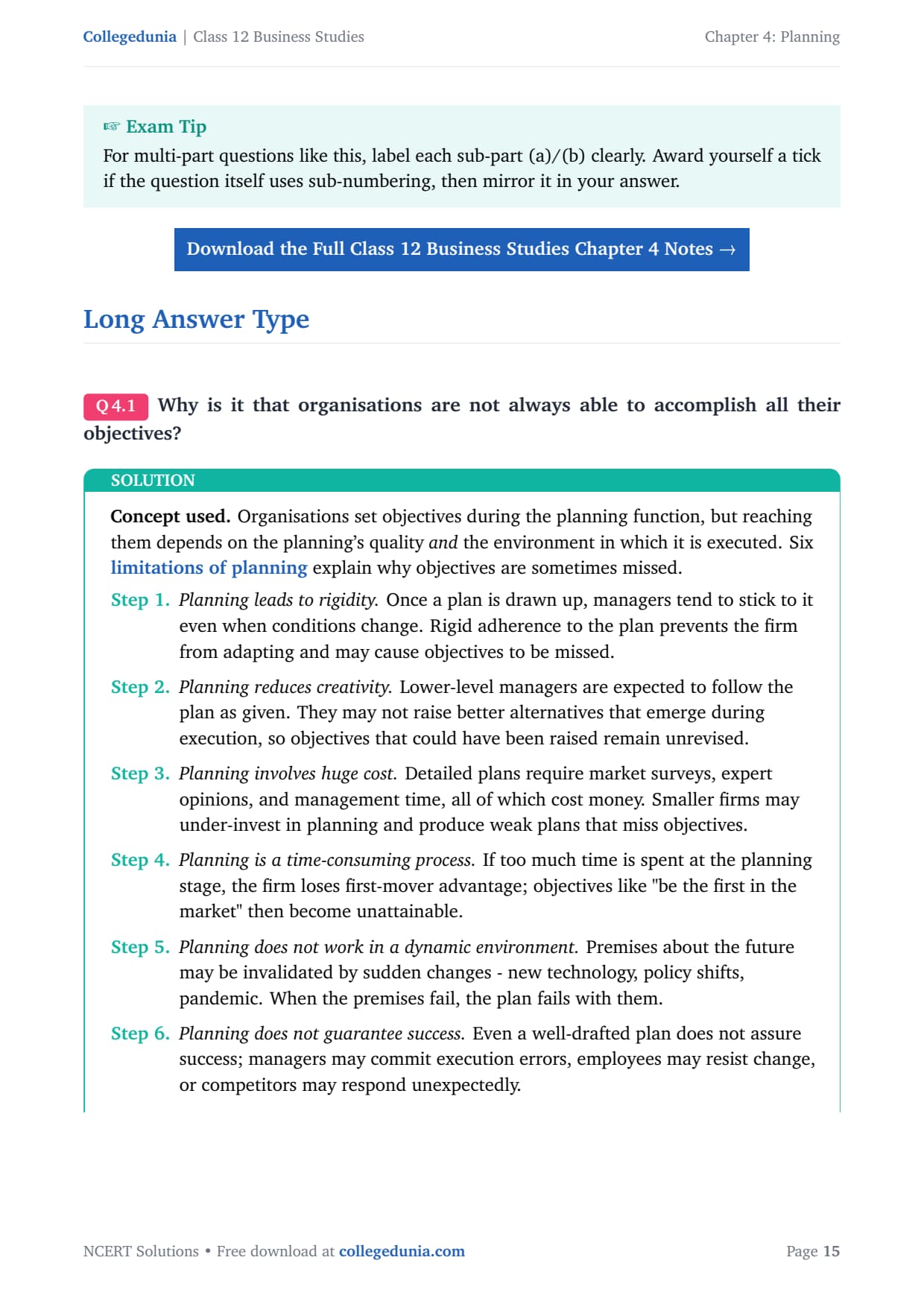
Planning leads to rigidity. Once a plan is drawn
up, managers tend to stick to it even when conditions
change. Rigid adherence to the plan prevents the firm from
adapting and may cause objectives to be missed.
Planning reduces creativity. Lower-level managers
are expected to follow the plan as given. They may not
raise better alternatives that emerge during execution,
so objectives that could have been raised remain
unrevised.
Planning involves huge cost. Detailed plans require
market surveys, expert opinions, and management time, all
of which cost money. Smaller firms may under-invest in
planning and produce weak plans that miss objectives.
Planning is a time-consuming process. If too much
time is spent at the planning stage, the firm loses
first-mover advantage; objectives like "be the first in
the market" then become unattainable.
Planning does not work in a dynamic environment.
Premises about the future may be invalidated by sudden
changes - new technology, policy shifts, pandemic. When
the premises fail, the plan fails with them.
Planning does not guarantee success. Even a
well-drafted plan does not assure success; managers may
commit execution errors, employees may resist change, or
competitors may respond unexpectedly.
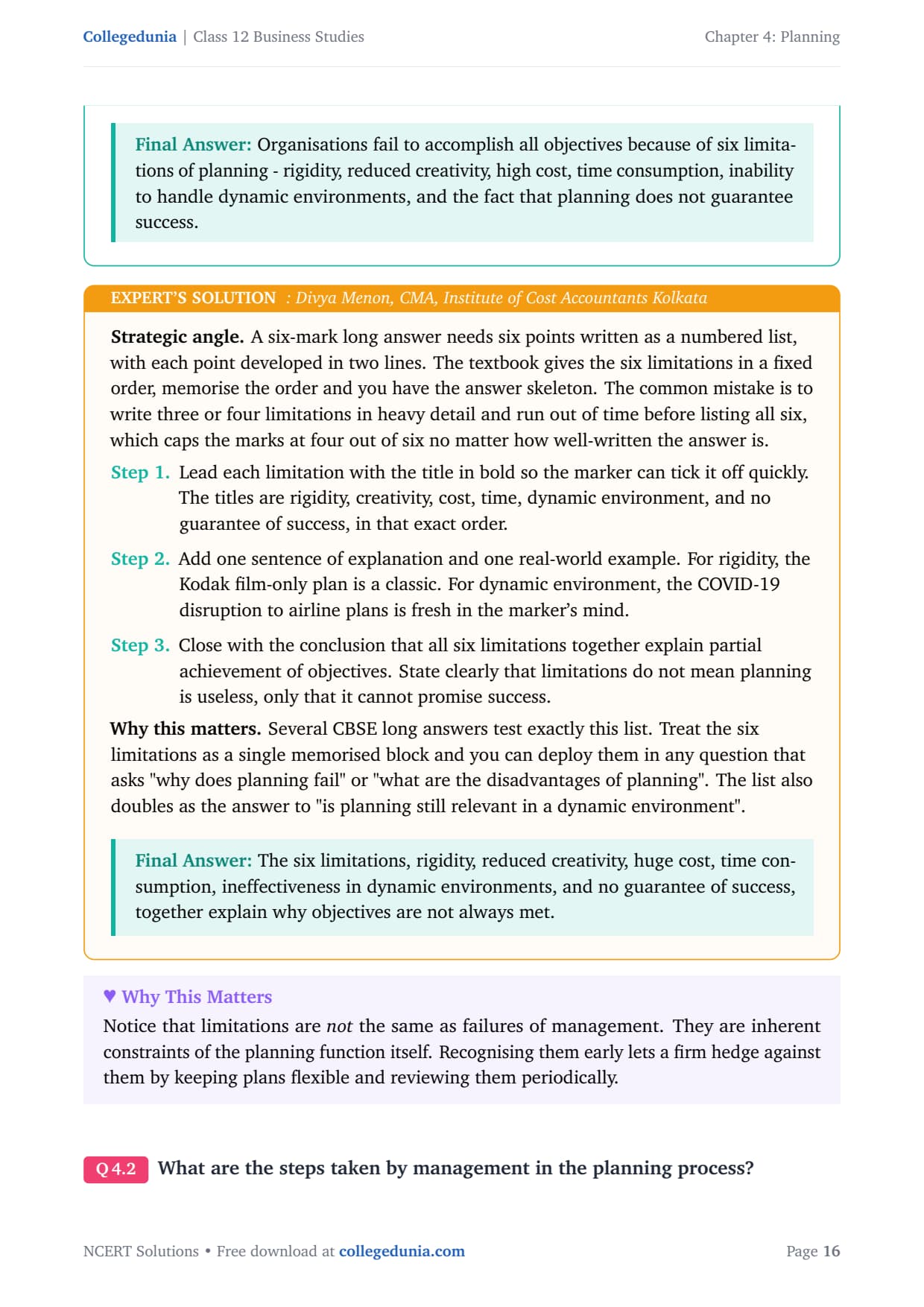
Organisations fail to accomplish all objectives because
of six limitations of planning - rigidity, reduced creativity,
high cost, time consumption, inability to handle dynamic
environments, and the fact that planning does not guarantee
success.
DM
Divya Menon
CMA, Institute of Cost Accountants Kolkata
Verified Expert
Strategic angle. A six-mark long answer needs six points
written as a numbered list, with each point developed in two
lines. The textbook gives the six limitations in a fixed
order, memorise the order and you have the answer skeleton. The
common mistake is to write three or four limitations in heavy
detail and run out of time before listing all six, which caps the
marks at four out of six no matter how well-written the answer is.
Lead each limitation with the title in bold so the marker
can tick it off quickly. The titles are rigidity,
creativity, cost, time, dynamic environment, and no
guarantee of success, in that exact order.
Add one sentence of explanation and one real-world
example. For rigidity, the Kodak film-only plan is a
classic. For dynamic environment, the COVID-19 disruption
to airline plans is fresh in the marker's mind.
Close with the conclusion that all six limitations
together explain partial achievement of objectives. State
clearly that limitations do not mean planning is useless,
only that it cannot promise success.
Why this matters. Several CBSE long answers test exactly
this list. Treat the six limitations as a single memorised block
and you can deploy them in any question that asks "why does
planning fail" or "what are the disadvantages of planning". The
list also doubles as the answer to "is planning still relevant in
a dynamic environment".
The six limitations, rigidity, reduced creativity, huge
cost, time consumption, ineffectiveness in dynamic environments,
and no guarantee of success, together explain why objectives are
not always met.
Q 4.13
What are the steps taken by management in the planning
process?
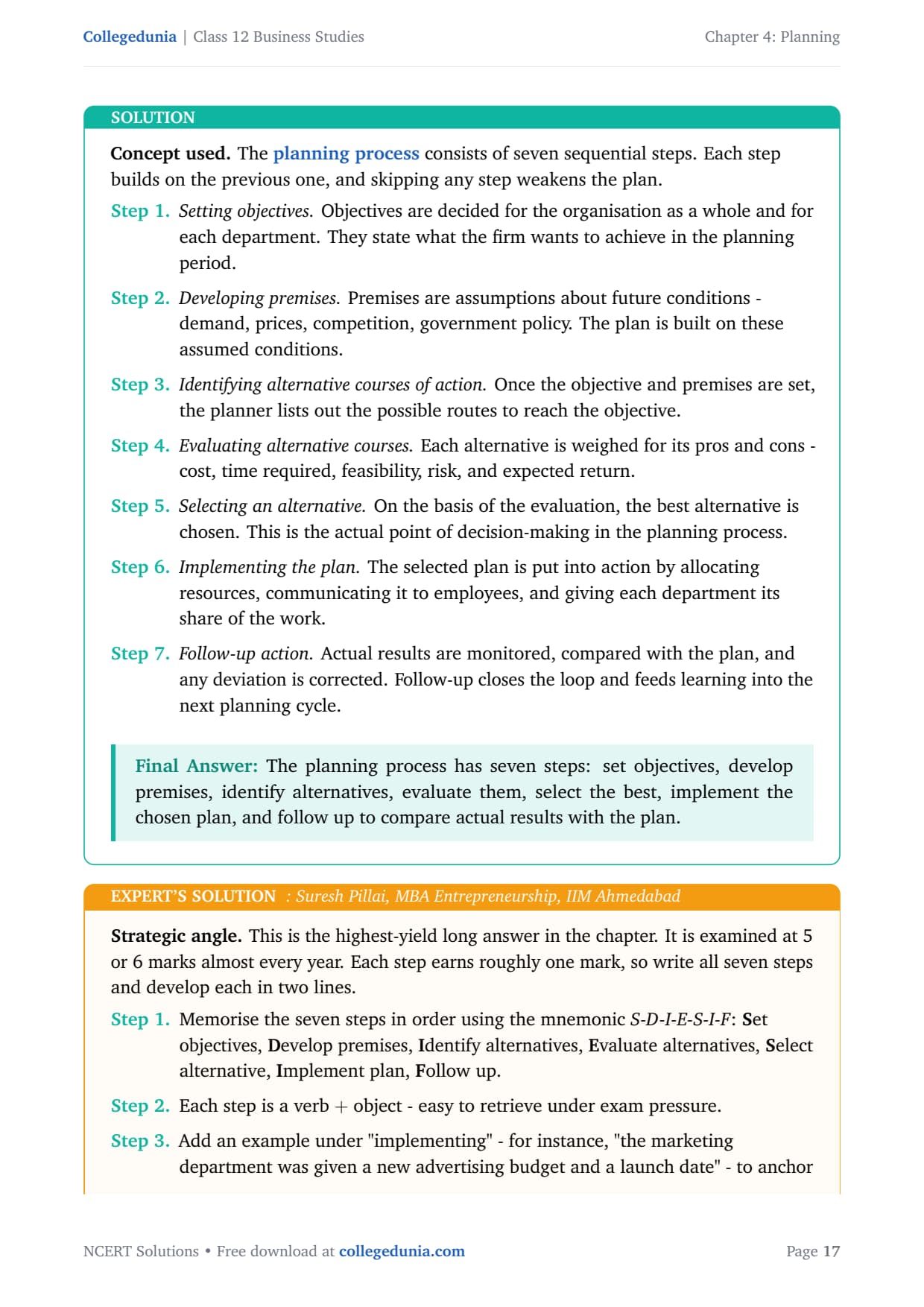
Concept used. The planning process consists of
seven sequential steps. Each step builds on the previous one, and
skipping any step weakens the plan.
Setting objectives. Objectives are decided for the
organisation as a whole and for each department. They
state what the firm wants to achieve in the planning
period.
Developing premises. Premises are assumptions
about future conditions - demand, prices, competition,
government policy. The plan is built on these assumed
conditions.
Identifying alternative courses of action. Once the
objective and premises are set, the planner lists out the
possible routes to reach the objective.
Evaluating alternative courses. Each alternative
is weighed for its pros and cons - cost, time required,
feasibility, risk, and expected return.
Selecting an alternative. On the basis of the
evaluation, the best alternative is chosen. This is the
actual point of decision-making in the planning process.
Implementing the plan. The selected plan is put
into action by allocating resources, communicating it to
employees, and giving each department its share of the
work.
Follow-up action. Actual results are monitored,
compared with the plan, and any deviation is corrected.
Follow-up closes the loop and feeds learning into the next
planning cycle.
The planning process has seven steps: set objectives,
develop premises, identify alternatives, evaluate them, select
the best, implement the chosen plan, and follow up to compare
actual results with the plan.
SP
Suresh Pillai
MBA Entrepreneurship, IIM Ahmedabad
Verified Expert
Strategic angle. This is the highest-yield long answer in
the chapter. It is examined at 5 or 6 marks almost every year.
Each step earns roughly one mark, so write all seven steps and
develop each in two lines.
Memorise the seven steps in order using the mnemonic
S-D-I-E-S-I-F: Set objectives,
Develop premises, Identify alternatives,
Evaluate alternatives, Select
alternative, Implement plan, Follow up.
Each step is a verb \(+\) object - easy to retrieve under
exam pressure.
Add an example under "implementing" - for instance, "the
ncert-notes-class-12-business-studies-chapter-10-marketing department was given a new advertising budget
and a launch date" - to anchor the answer in practice.
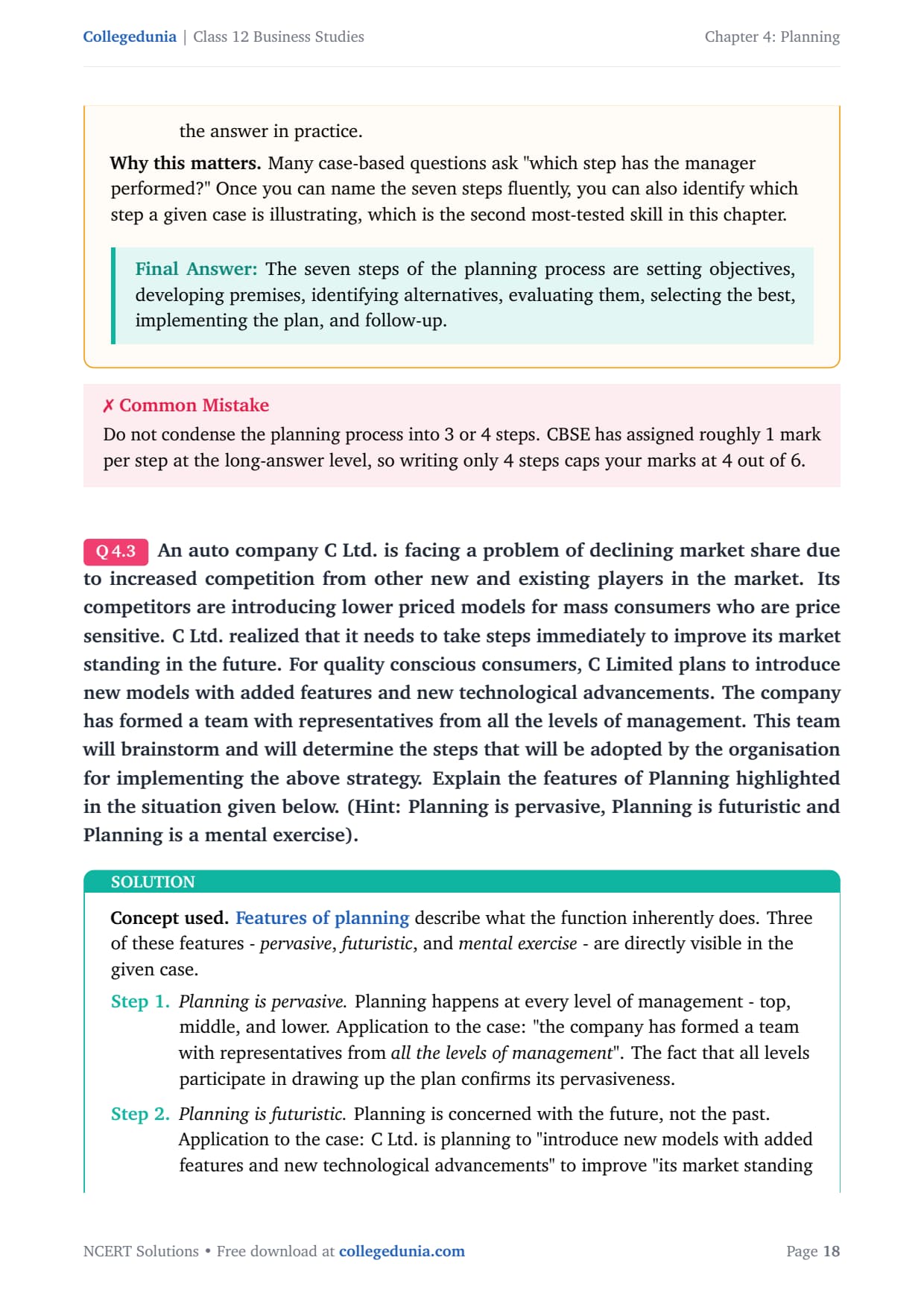
Why this matters. Many case-based questions ask "which
step has the manager performed?" Once you can name the seven
steps fluently, you can also identify which step a given case is
illustrating, which is the second most-tested skill in this
chapter.
The seven steps of the planning process are setting
objectives, developing premises, identifying alternatives,
evaluating them, selecting the best, implementing the plan, and
follow-up.
Q 4.14
An auto company C Ltd. is facing a problem of declining
market share due to increased competition from other new and
existing players in the market. Its competitors are introducing
lower priced models for mass consumers who are price sensitive.
C Ltd. realized that it needs to take steps immediately to
improve its market standing in the future. For quality conscious
consumers, C Limited plans to introduce new models with added
features and new technological advancements. The company has
formed a team with representatives from all the levels of
management. This team will brainstorm and will determine the
steps that will be adopted by the organisation for implementing
the above strategy. Explain the features of Planning highlighted
in the situation given below. (Hint: Planning is pervasive,
Planning is futuristic and Planning is a mental exercise).
Concept used.Features of planning describe
what the function inherently does. Three of these features -
pervasive, futuristic, and mental exercise -
are directly visible in the given case.
Planning is pervasive. Planning happens at every
level of management - top, middle, and lower.
Application to the case: "the company has formed a team
with representatives from all the levels of
management". The fact that all levels participate in
drawing up the plan confirms its pervasiveness.
Planning is futuristic. Planning is concerned with
the future, not the past. Application to the case: C
Ltd. is planning to "introduce new models with added
features and new technological advancements" to improve
"its market standing in the future". The plan is
aimed at a future event, confirming this feature.
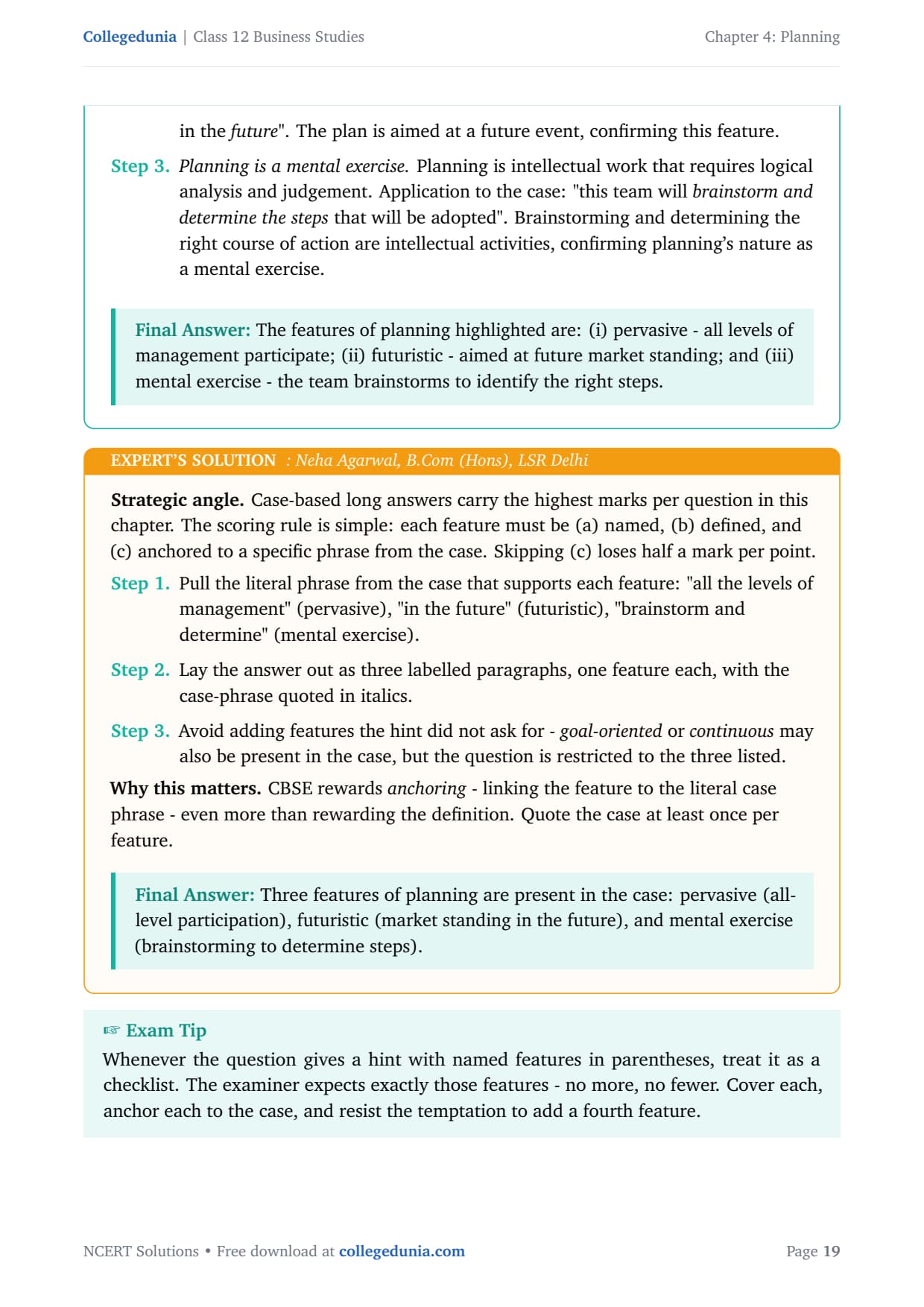
Planning is a mental exercise. Planning is
intellectual work that requires logical analysis and
judgement. Application to the case: "this team will
brainstorm and determine the steps that will be
adopted". Brainstorming and determining the right course
of action are intellectual activities, confirming
planning's nature as a mental exercise.
The features of planning highlighted are: (i) pervasive
- all levels of management participate; (ii) futuristic - aimed
at future market standing; and (iii) mental exercise - the team
brainstorms to identify the right steps.
NA
Neha Agarwal
B.Com (Hons), LSR Delhi
Verified Expert
Strategic angle. Case-based long answers carry the
highest marks per question in this chapter. The scoring rule is
simple: each feature must be (a) named, (b) defined, and (c)
anchored to a specific phrase from the case. Skipping (c) loses
half a mark per point.
Pull the literal phrase from the case that supports each
feature: "all the levels of management" (pervasive), "in
the future" (futuristic), "brainstorm and determine"
(mental exercise).
Lay the answer out as three labelled paragraphs, one
feature each, with the case-phrase quoted in italics.
Avoid adding features the hint did not ask for -
goal-oriented or continuous may also be
present in the case, but the question is restricted to
the three listed.
Why this matters. CBSE rewards anchoring -
linking the feature to the literal case phrase - even more than
rewarding the definition. Quote the case at least once per
feature.
Three features of planning are present in the case:
pervasive (all-level participation), futuristic (market standing
in the future), and mental exercise (brainstorming to determine
steps).
Student Feedback
In a Collegedunia poll of 940 Class 12 Commerce students, 82% said the seven-step planning process was the part they revised most before the board exam. 3 in 4 said the step-marked solutions were why their Planning answers scored full marks.
Other Resources for Class 12 Business Studies Chapter 4 Planning
Frequently Asked Questions on Class 12 Business Studies Chapter 4
Frequently Asked Questions on Class 12 Business Studies Chapter 4
Q1. Are the NCERT Solutions for Class 12 Business Studies Chapter 4 free to download?
Yes. The complete Collegedunia NCERT Solutions PDF for Planning is free to download from this page, aligned to the 2026-27 CBSE syllabus.
Q2. How many questions are there in Class 12 Business Studies Chapter 4 Planning?
Chapter 4 has 5 Very Short Answer questions, 6 Short Answer questions, and 3 Long Answer questions, taking the total to 14. The PDF solves every question in the exercise.
Q3. What are the seven steps of the planning process?
The seven steps are (1) Setting objectives, (2) Developing premises, (3) Identifying alternative courses of action, (4) Evaluating alternative courses, (5) Selecting an alternative, (6) Implementing the plan, and (7) Follow-up action. The mnemonic is S-D-I-E-S-I-F.
Q4. What is the difference between a rule and a procedure?
A rule is a specific statement of what is or is not to be done in a given situation (for example, "no smoking"). It is a single fixed prescription with zero discretion. A procedure is a sequence of steps for carrying out a routine task (for example, the steps of recruitment). Procedures involve multiple sequential actions, rules do not.
Q5. Which types of plans are single-use and which are standing plans?
Of the eight types of plans, six are standing plans (objective, strategy, policy, procedure, method, rule) used repeatedly over time once decided, and two are single-use plans (programme, budget) prepared afresh for a one-time activity or planning period.
Q6. How does Koontz and O'Donnell define planning?
According to Koontz and O'Donnell, "Planning is deciding in advance what to do, how to do it, when to do it, and who is to do it. Planning bridges the gap from where we are to where we want to go." It is the bridge between the present position of the firm and the desired future position.
Q7. What are the three dimensions of a strategy?
A strategy has three dimensions: (i) determining long-term objectives, (ii) adopting a particular course of action, and (iii) allocating the resources necessary to achieve the objectives. All three must be present for a plan to qualify as a strategy.
Q8. Is this PDF aligned to the 2026-27 CBSE Business Studies syllabus?
Yes. Every solution and section reference uses the 2026-27 NCERT Business Studies textbook and the latest CBSE marking scheme.








Comments