




Inside the NCERT Notes for Class 6 Vocational Education Kaushal Bodh Chapter 2 Biodiversity Register, you will find the full list of register terms, all five description tables explained row by row, and every Biodiversity Heritage Site named in the book, according to the latest 2026-27 Kaushal Bodh textbook.
- Covers all seven activities of the project, from spotting living things around you to presenting your findings in two parts.
- Explains all eleven register terms, from scientific name to GI tag, using the book's own examples.
- Lists the five description tables (2.3 to 2.7) and the Biodiversity Heritage Sites named in the chapter.
Every section in these Biodiversity Register notes is checked against the 2026-27 Kaushal Bodh print and matched to the way a Class 6 project file and class discussion ask about register terms, survey planning and the five description tables.
What a Biodiversity Register Is and Why Class 6 Students Make One
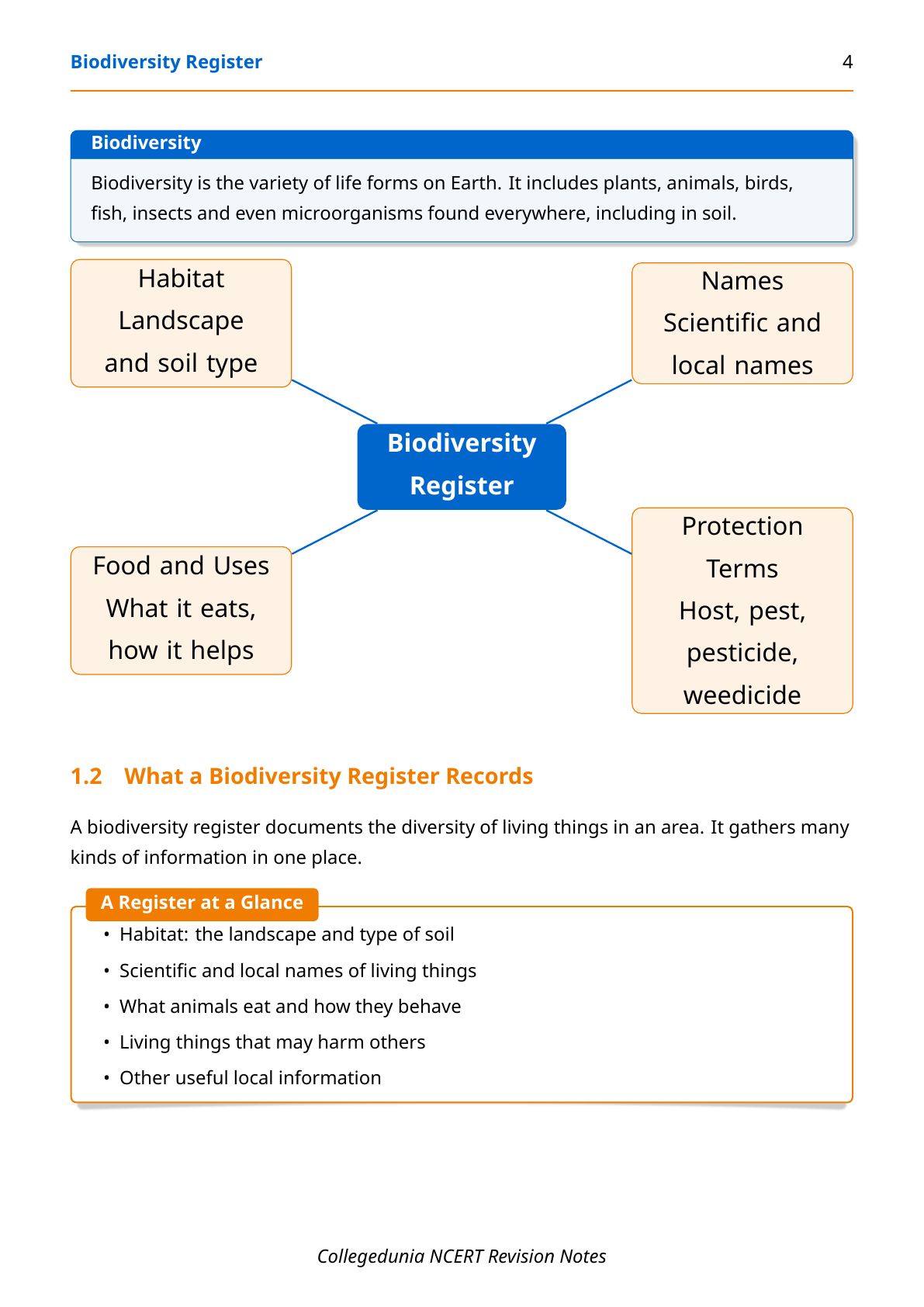
Biodiversity means the variety of life forms on earth. It covers plants, animals, birds, fish, insects and even the microorganisms found in soil. A biodiversity register is the notebook where that variety is written down for one area. You already met the idea of biodiversity in Science, and this project asks you to record it yourself.
The book says the register holds information about habitat, which includes the landscape and the type of soil, along with the scientific and local names of living things, what animals eat, and living things that may harm others.
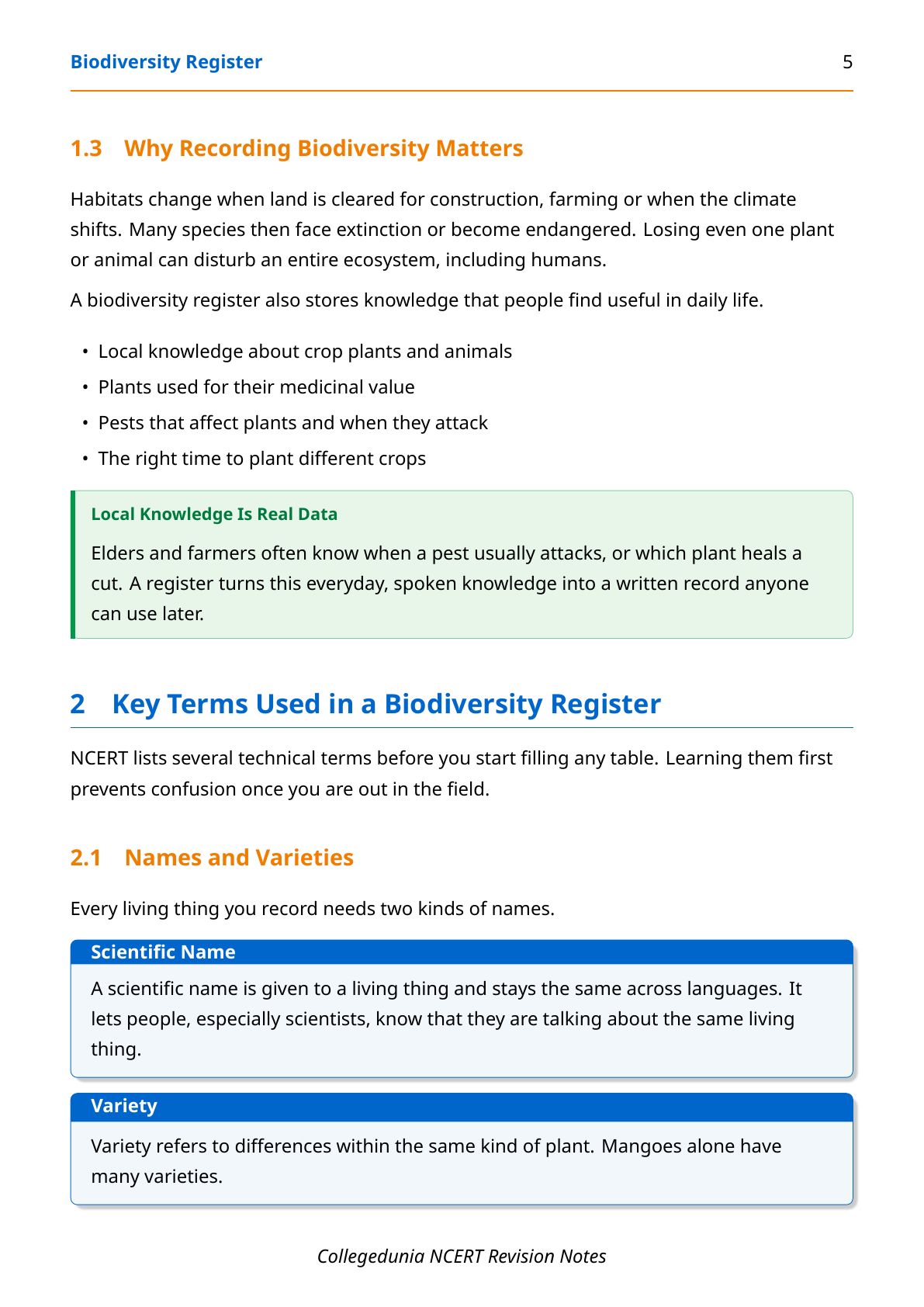
Recording biodiversity matters because habitats keep changing. Land gets cleared for construction or farming, and the climate shifts. When that happens, some species become endangered or face extinction, and losing even one plant or species affects the whole ecosystem, humans included.
The register is also useful in everyday village and city life. The book names four kinds of help it gives.
- Local knowledge about crop plants and animals in the area.
- Plants with a medicinal value.
- Pests that affect nearby plants.
- The right time to plant crops.
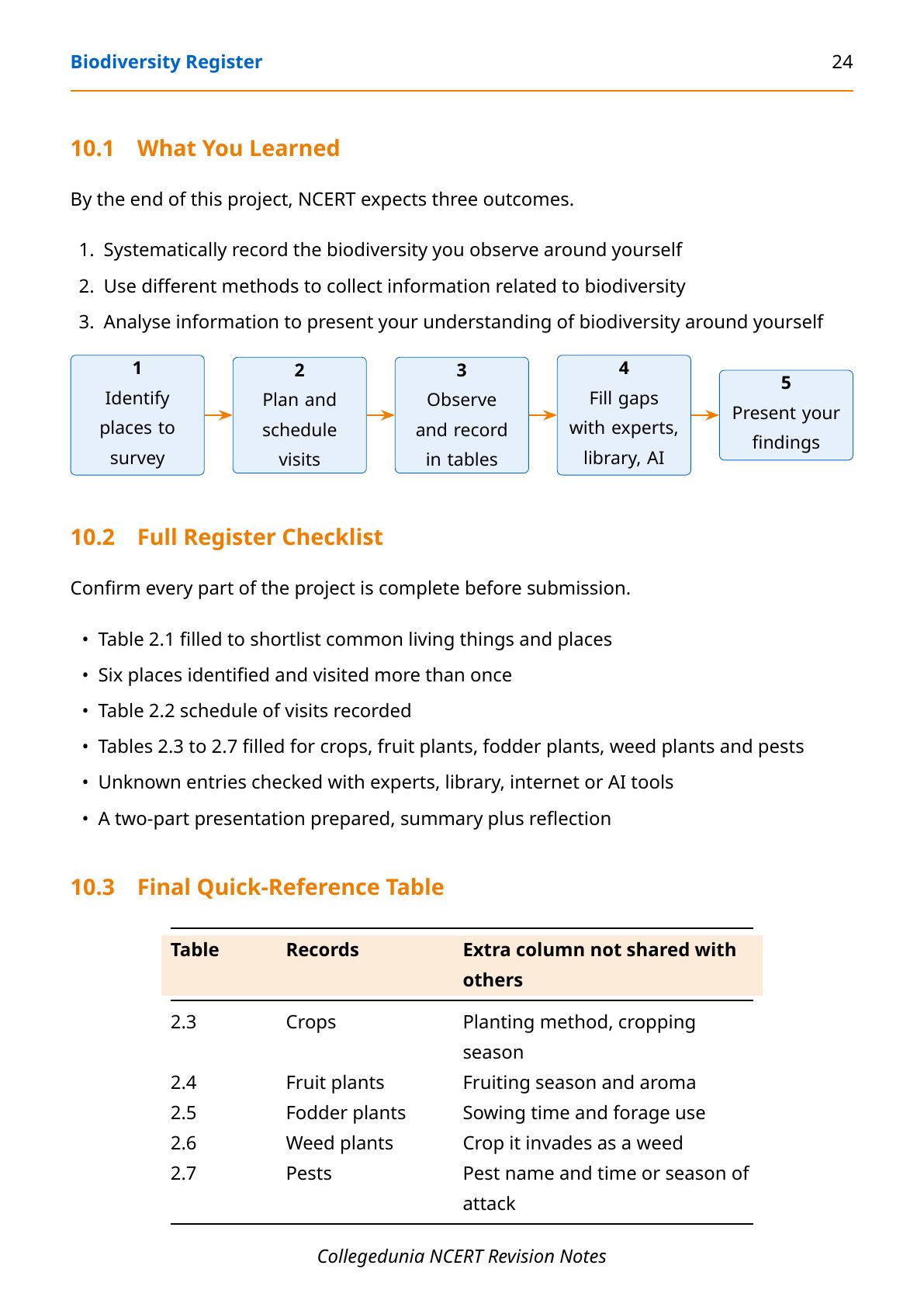
By the end of the project you should be able to record biodiversity around you in a systematic way, use different methods to gather information, and analyse that information to present your understanding of it.
Biodiversity Register Project Video by NCERT
Source: NCERT OFFICIAL on YouTube
Terms Used in the Biodiversity Register Every Class 6 Student Should Know
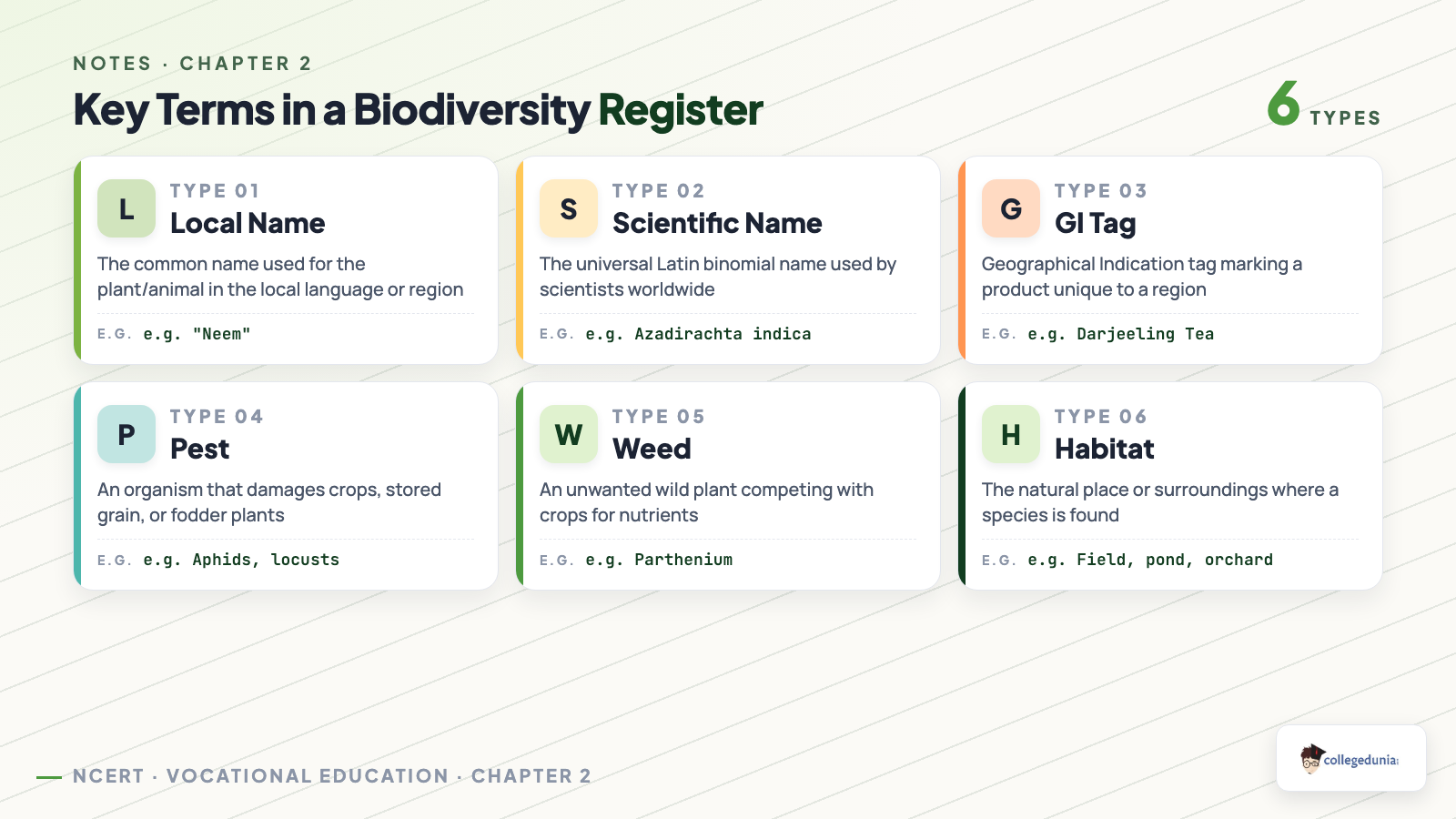
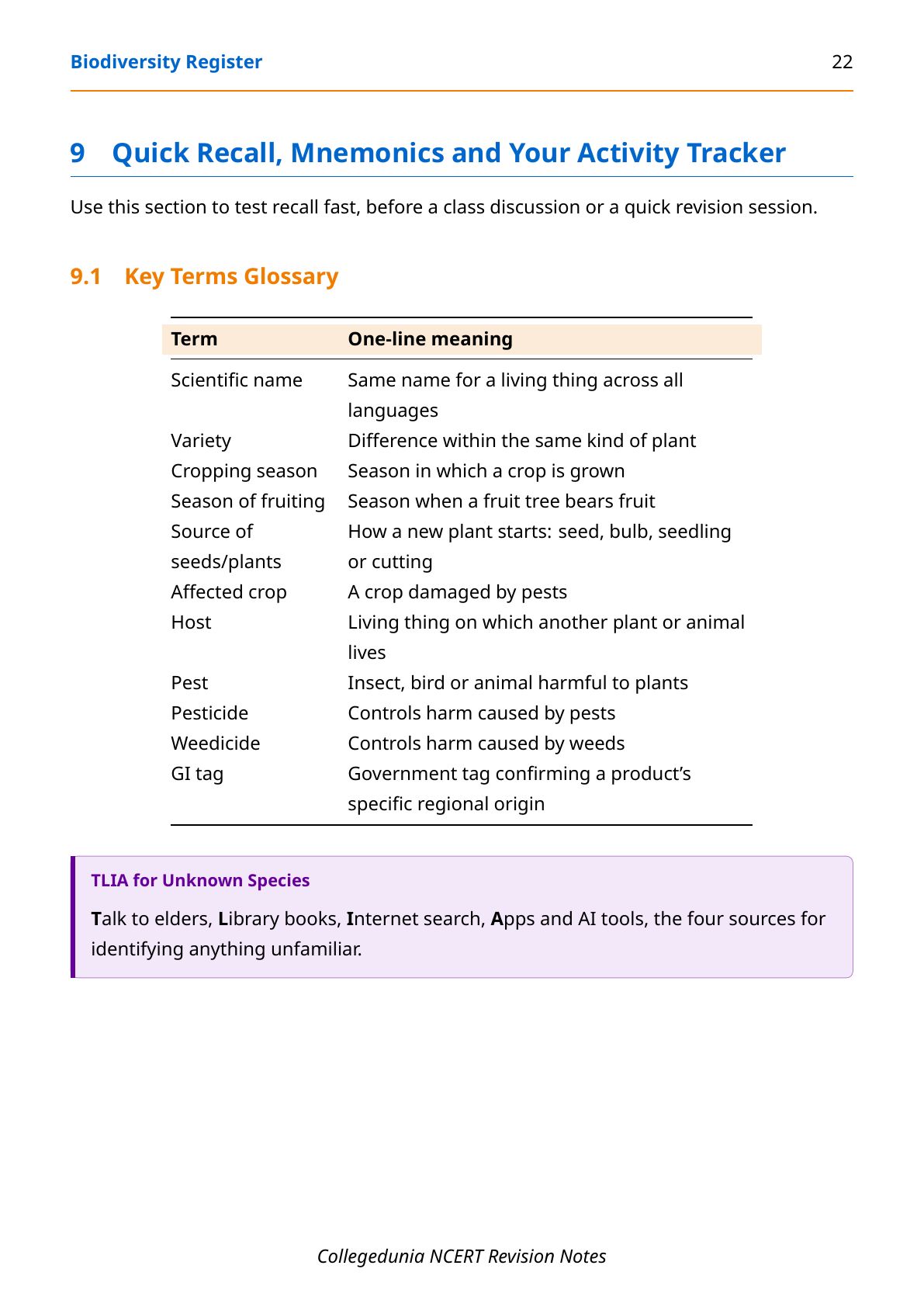
The book opens with a boxed word list before the activities begin. Each term is a ready one-line answer, so it is worth learning the meaning first and the example second.
| Term | What it means |
|---|---|
| Scientific name | A name for a living thing that stays the same across languages, so people everywhere know they mean the same living thing. |
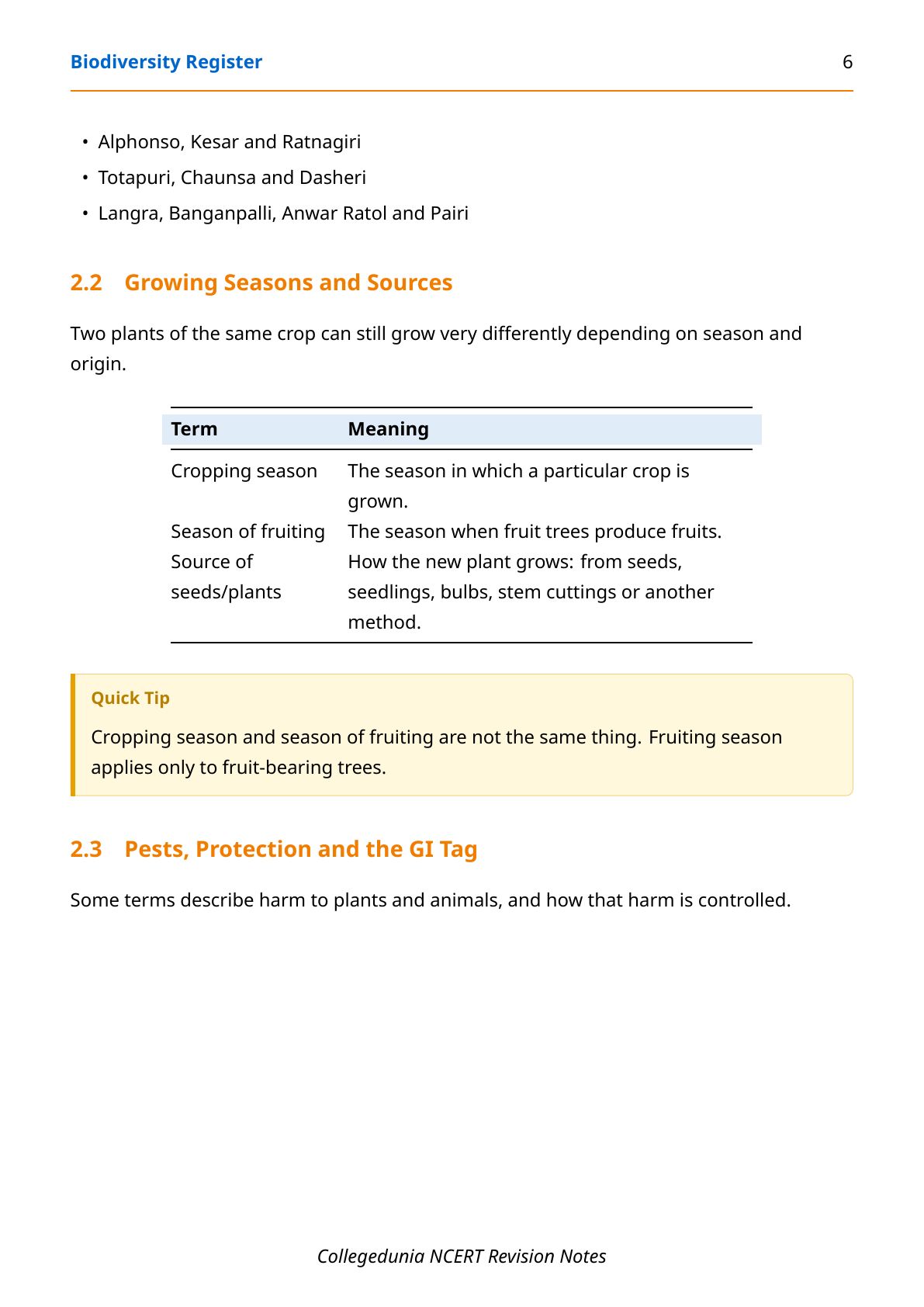
| Variety | Differences within a similar kind of plant, such as the mango varieties Alphonso, Kesar, Ratnagiri, Totapuri, Chaunsa, Dasheri, Langra, Banganpalli, Anwar Ratol and Pairi. |
| Cropping season | The season in which a particular crop is grown. |
| Season of fruiting | The season when fruit trees produce fruits. |
| Source of seeds or plants | How a new plant grows, whether from seeds, seedlings, bulbs, stem cuttings or another method. |
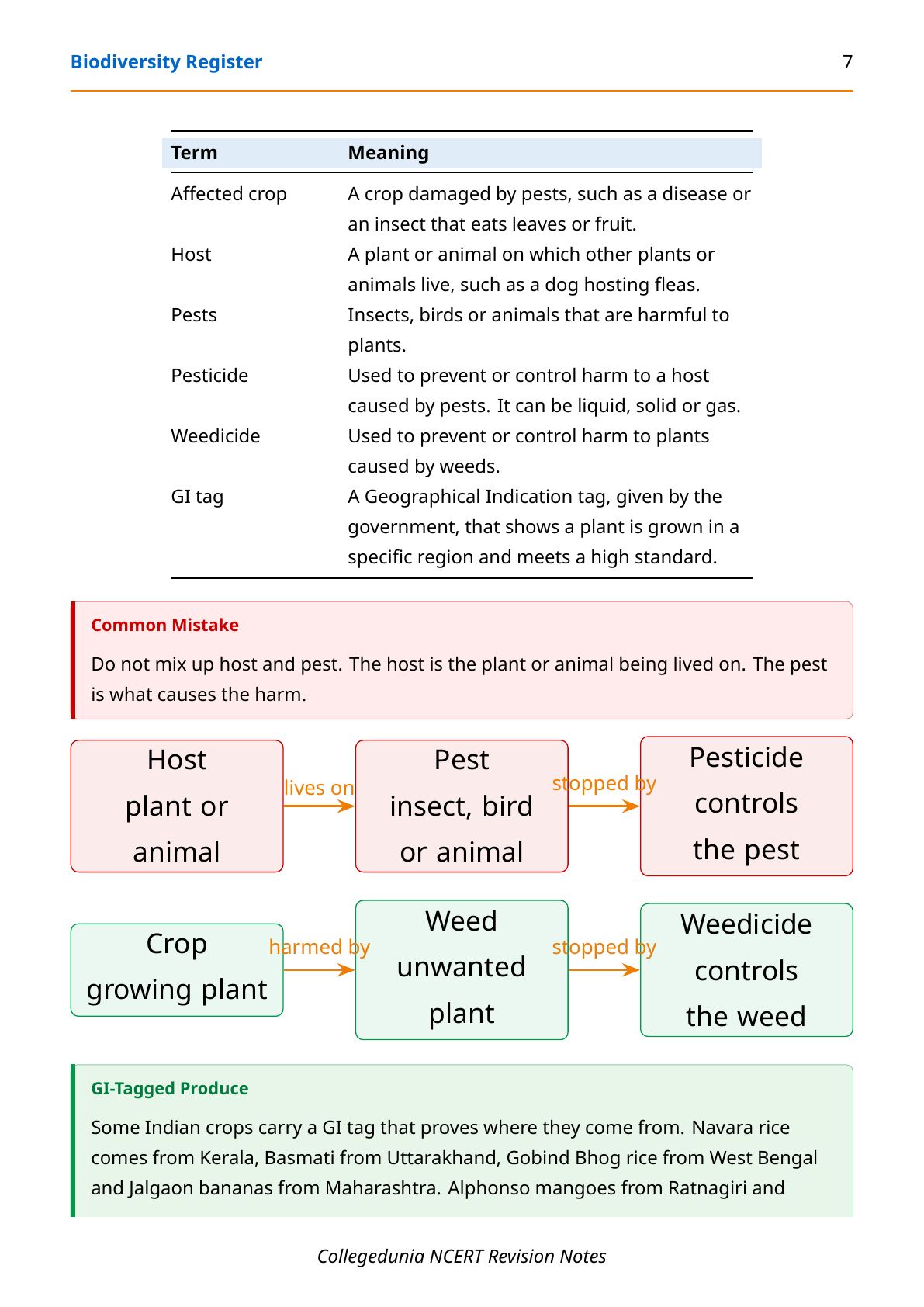
| Affected crop | A crop damaged by disease, by pests, or by insects that eat its leaves or fruits. |
| Host | A plant or animal that other living things live on. Dogs are hosts for fleas, and some plants are hosts for caterpillars. |
| Pests | Insects, birds or animals that are harmful to plants. |
| Pesticide | Used to prevent or control harm to hosts by pests. It can be a liquid, a solid or a gas. |
| Weedicide | Used to prevent or control harm to plants by weeds. |
| GI tag | A Geographical Indication tag, given by the government, that shows a plant is grown in a specific place and every batch from that area meets a high standard. |
The book's GI tag examples are worth remembering on their own. Navara rice from Kerala, Basmati from Uttarakhand and Gobind Bhog rice from West Bengal all carry GI tags, and so do Jalgaon bananas from Maharashtra.
What You Need and How to Stay Safe on a Biodiversity Field Visit
The book lists simple materials for this project. Nothing on the list needs to be bought specially, and most items are already at home or in the classroom.
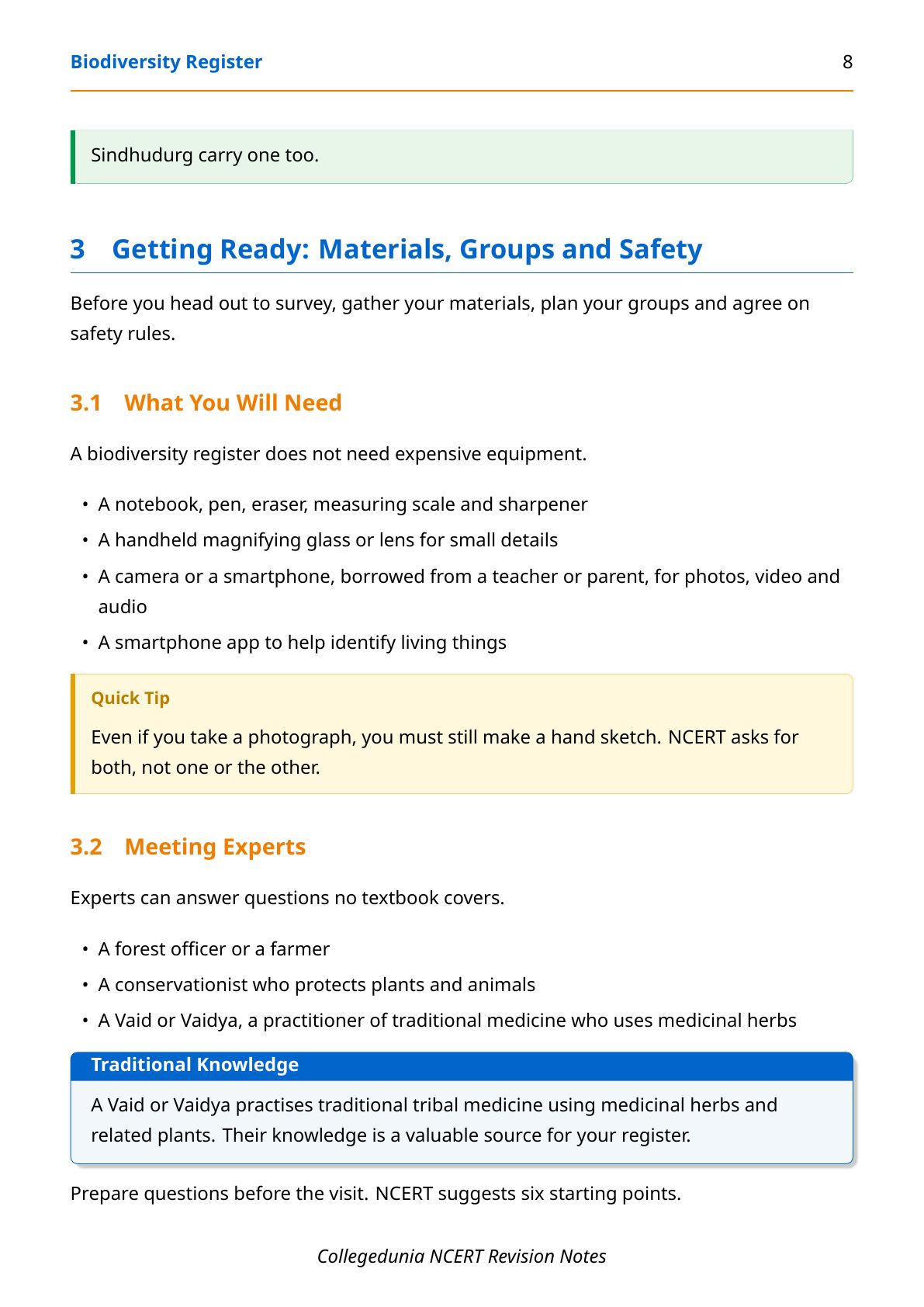
- A notebook, pen, eraser, measuring scale and sharpener for every visit.
- A handheld magnifying glass or lens to look closely at small plants or insects.
- A camera or smartphone, borrowed from a teacher or parent, for photos and short recordings, though sketches are still required for the register.
- A smartphone can also help you identify a plant or animal you do not recognise.
Field visits also come with safety rules, and the book asks you to discuss these before you set out.
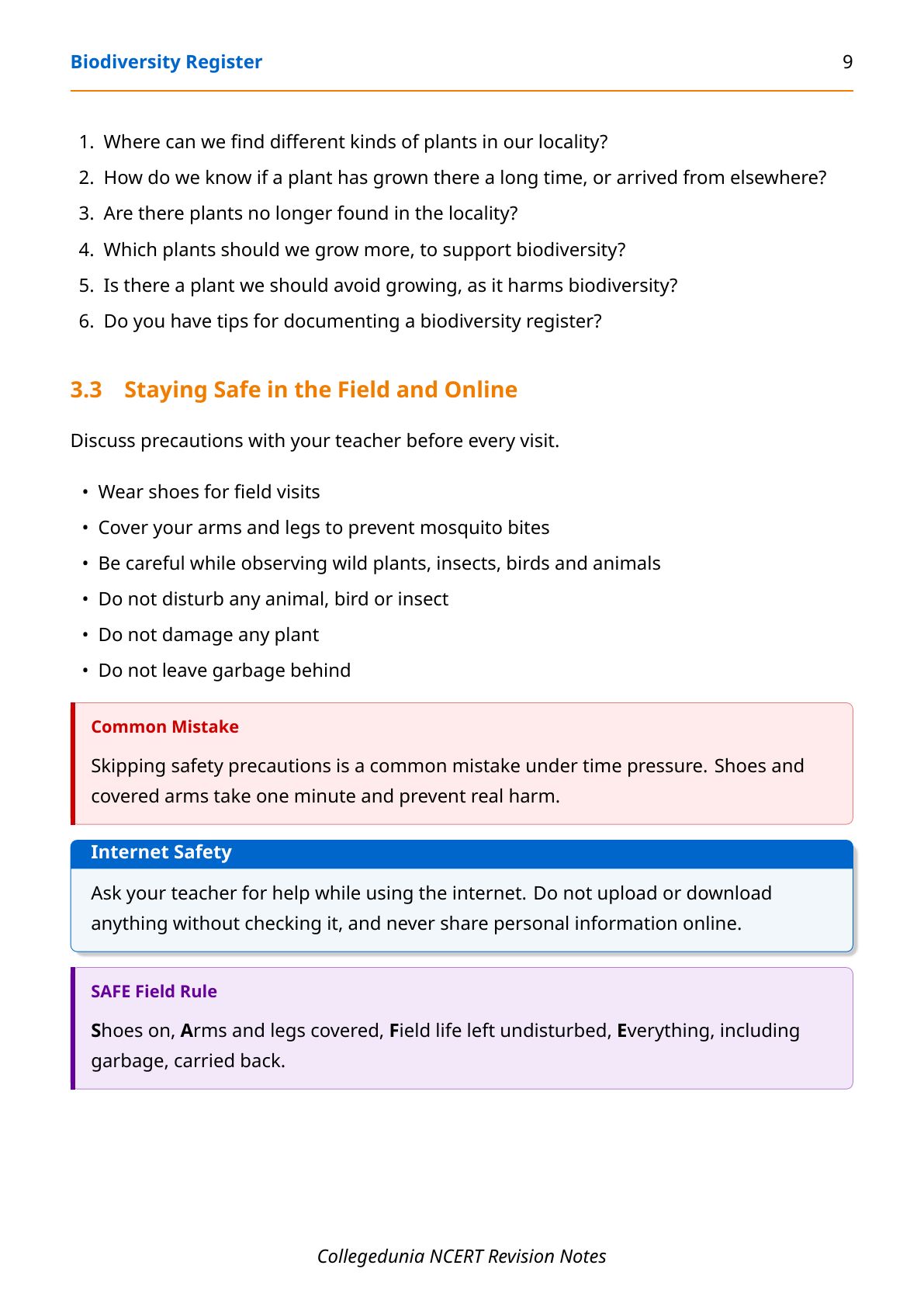
- Wear shoes for every field visit and cover your arms and legs to prevent mosquito bites.
- Be careful while observing wild plants, insects, birds and animals, and never disturb them or damage a plant.
- Do not leave any garbage behind, since it harms the living things you are recording.
- For internet safety, ask a teacher for help, avoid uploading or downloading anything unchecked, and never share personal information online.
The Seven Activities of the Biodiversity Register Project
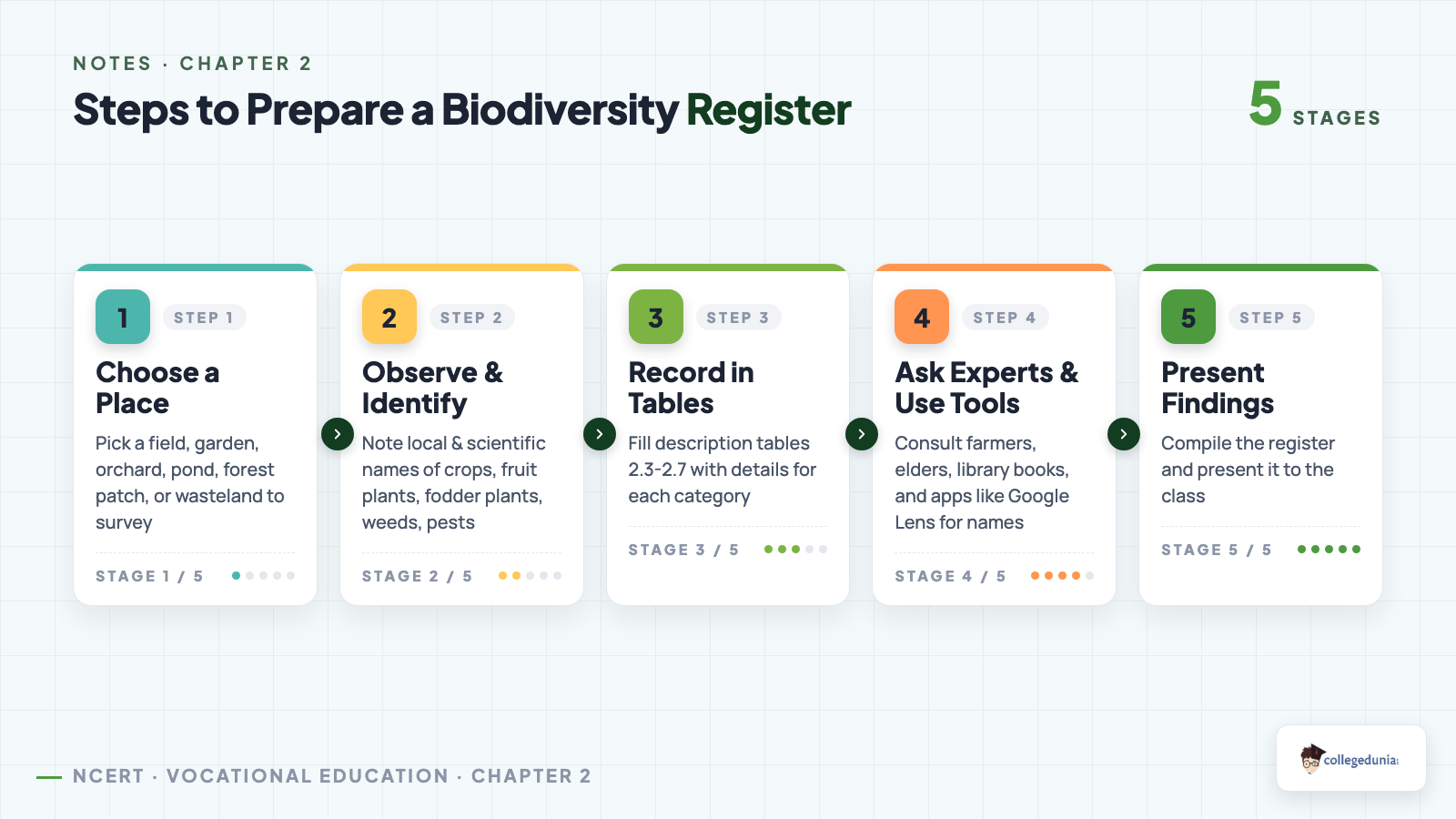
The project moves through seven linked activities. Reading them in order before you start makes the whole register easier to plan.
| Activity | What it asks you to do |
|---|---|
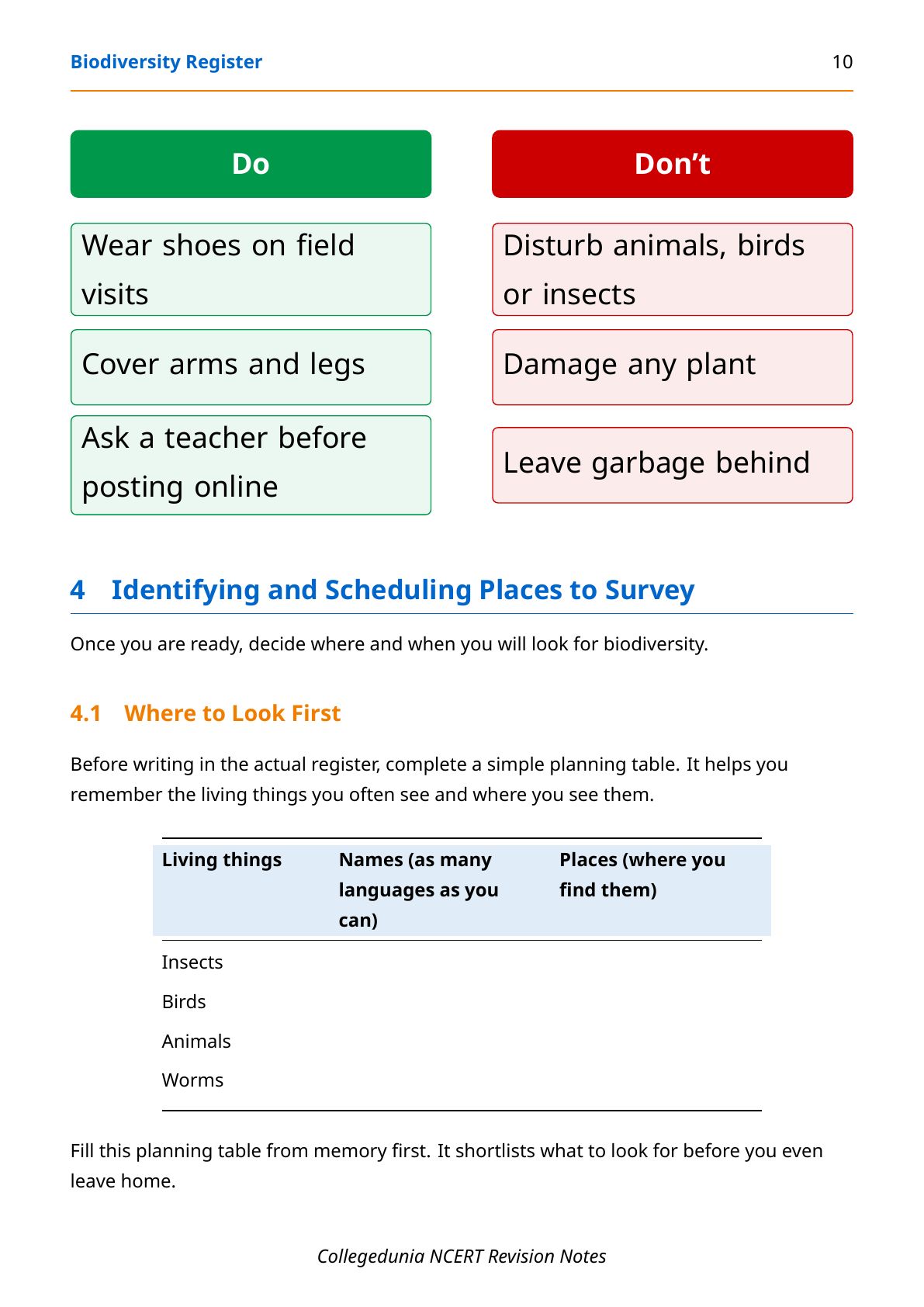
| Activity 1: What is around us? | Observe the insects, birds, animals and worms near you and fill Table 2.1 with their names and where you spotted them. |
| Activity 2: Meet an expert | Invite a forest officer, farmer, conservationist or a Vaid or Vaidya (a traditional medicine practitioner) and ask prepared questions about local biodiversity. |
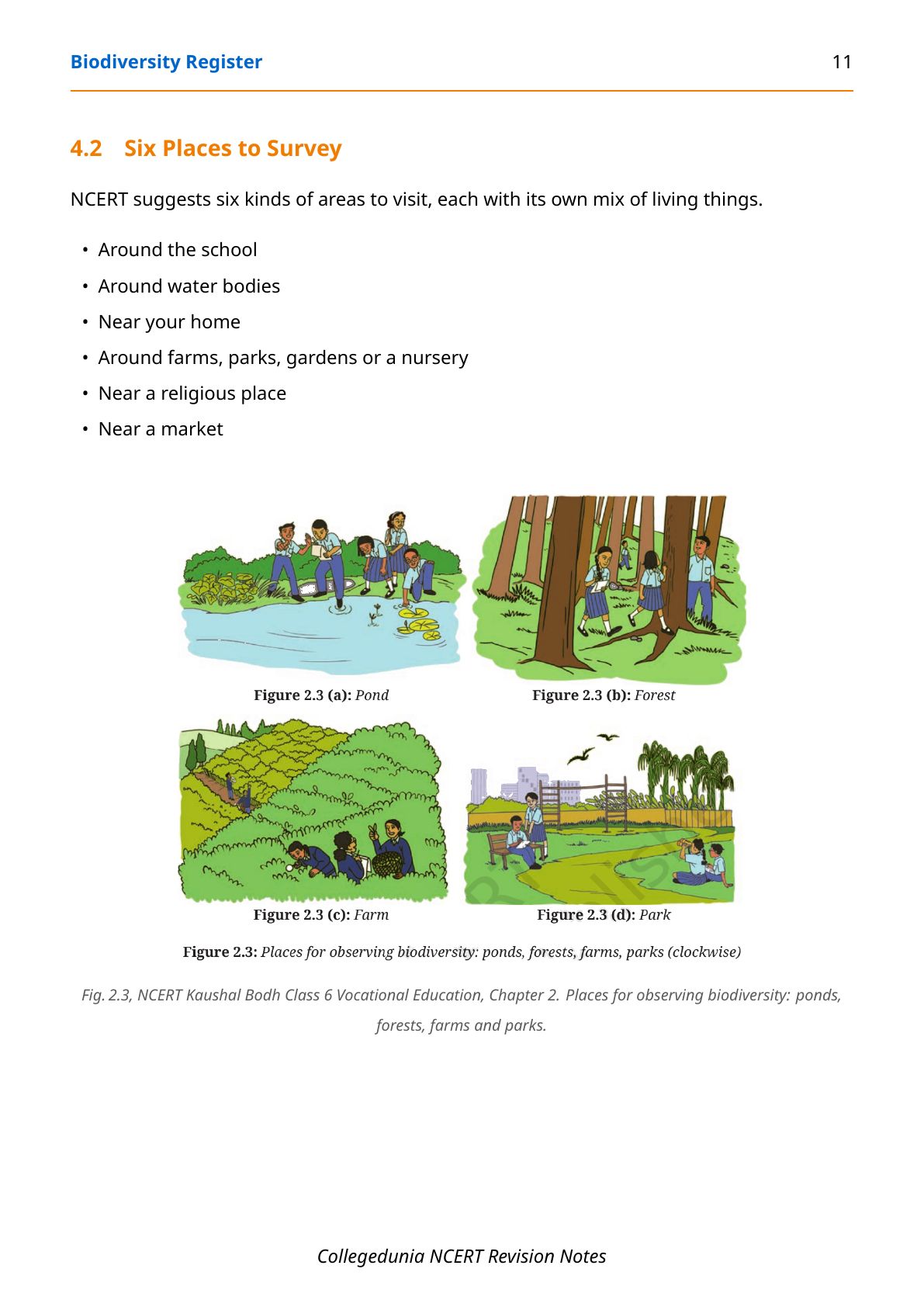
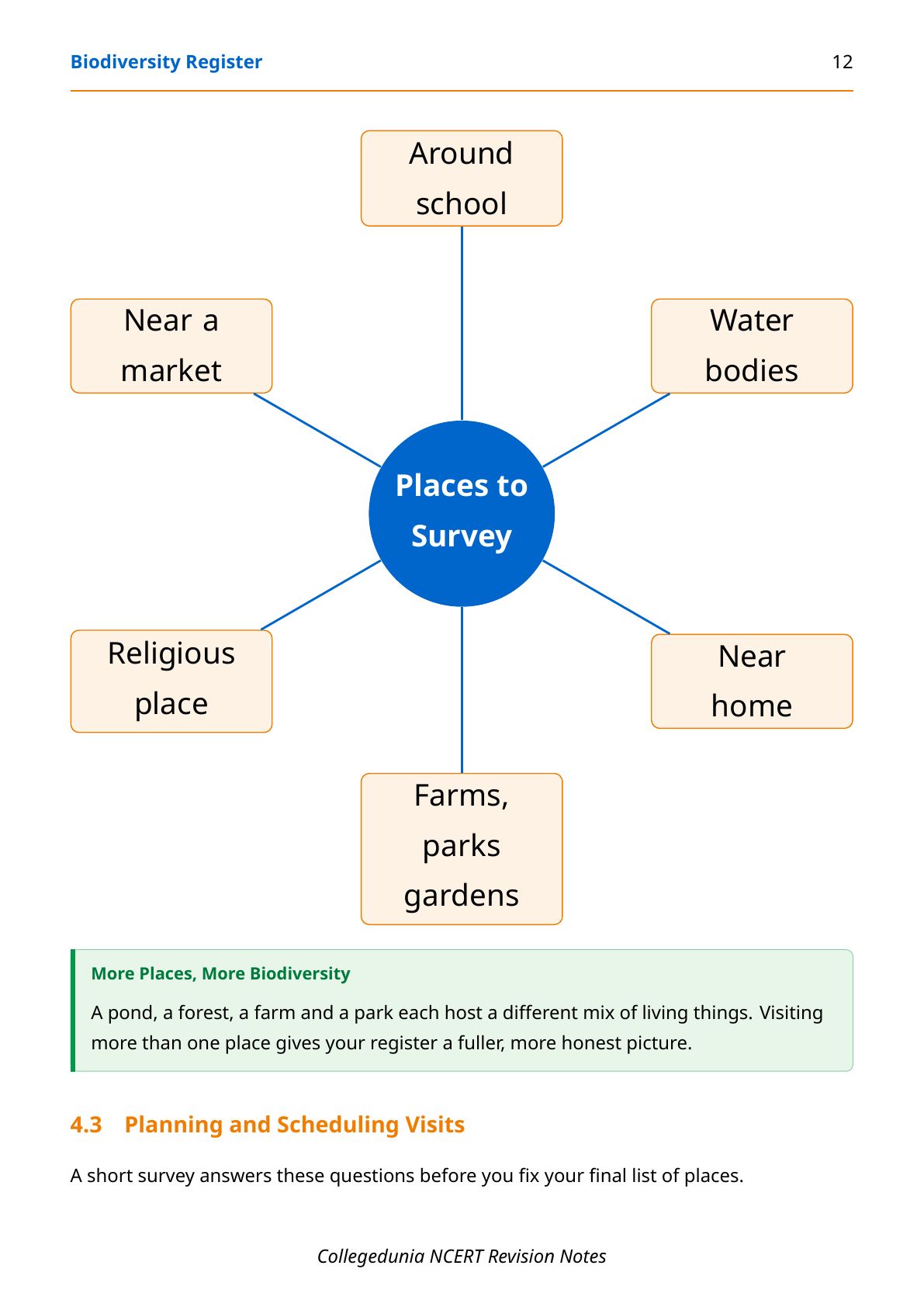
| Activity 3: Identify places to survey | Choose areas such as near school, water bodies, home, farms or gardens, a religious place and a market, then answer the survey-planning questions. |
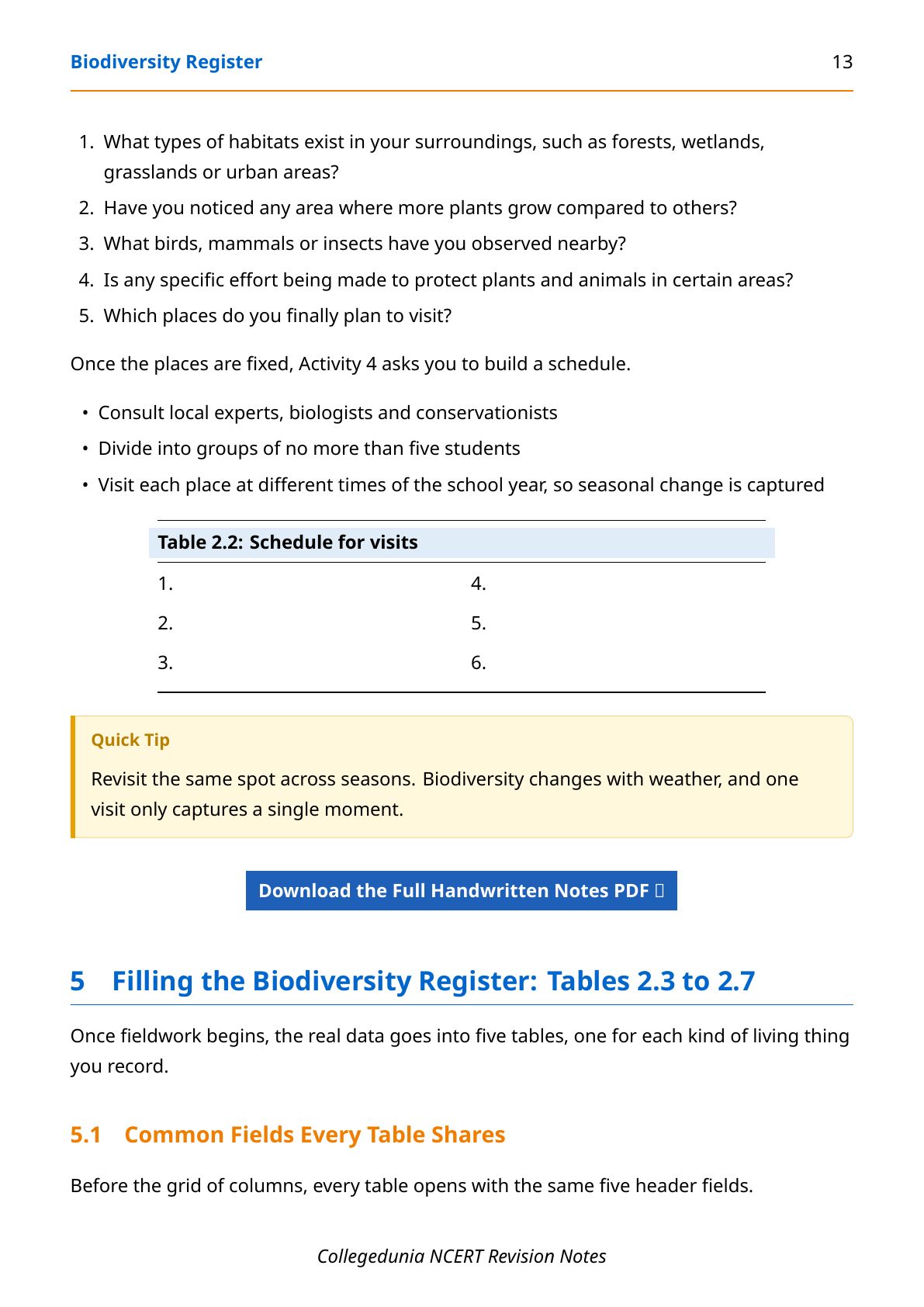
| Activity 4: Scheduling visits | Split into groups of up to five students and fill Table 2.2 with a visit schedule across different times of the school year. |
| Activity 5: Filling in the biodiversity register | Record observations for each place you visit in Tables 2.3 to 2.7, covering crops, fruit plants, fodder plants, weed plants and pests. |
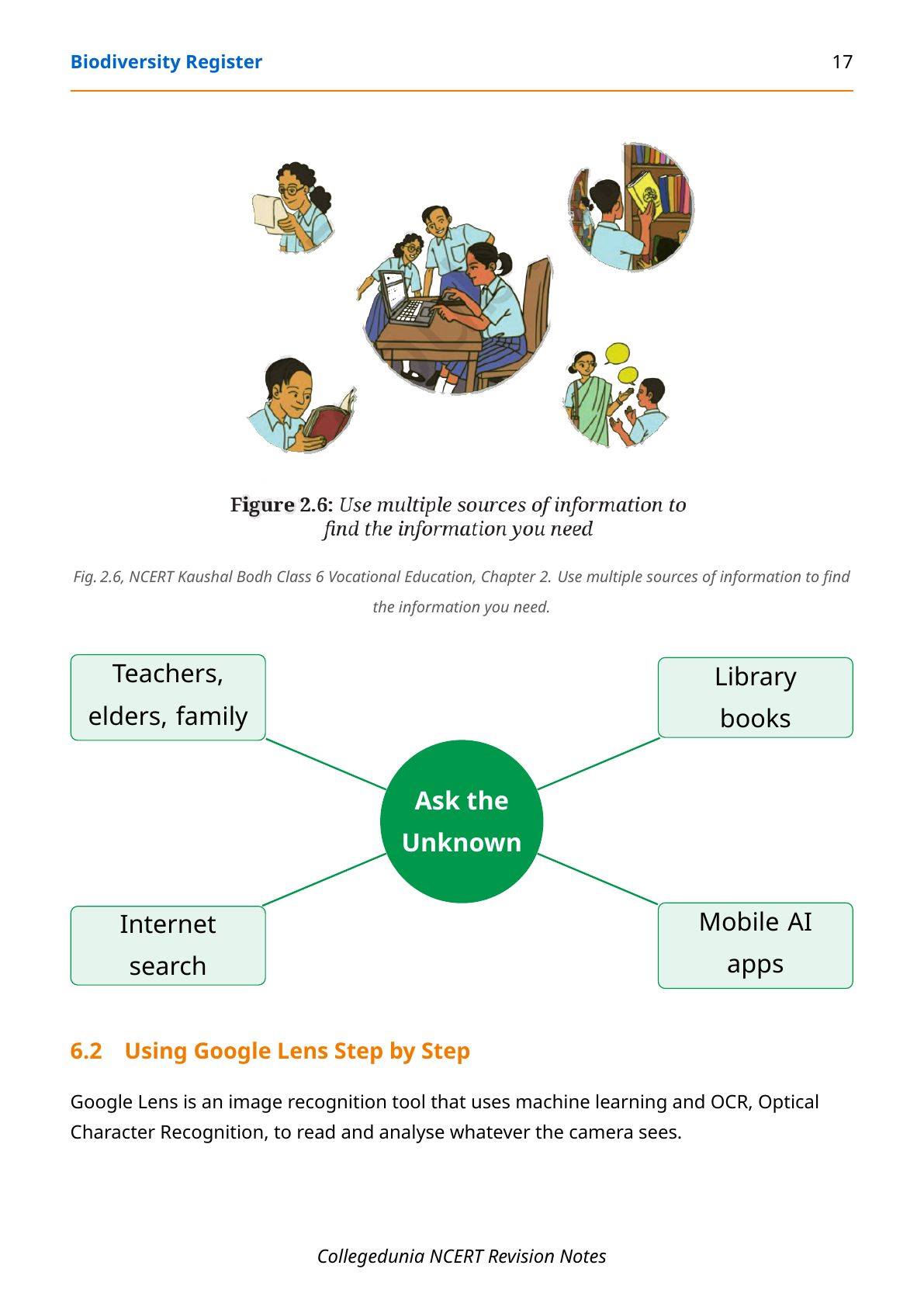
| Activity 6: Identifying 'unknown' | Fill missing information by asking an expert, a community member, or by using an AI tool such as Google Lens. |
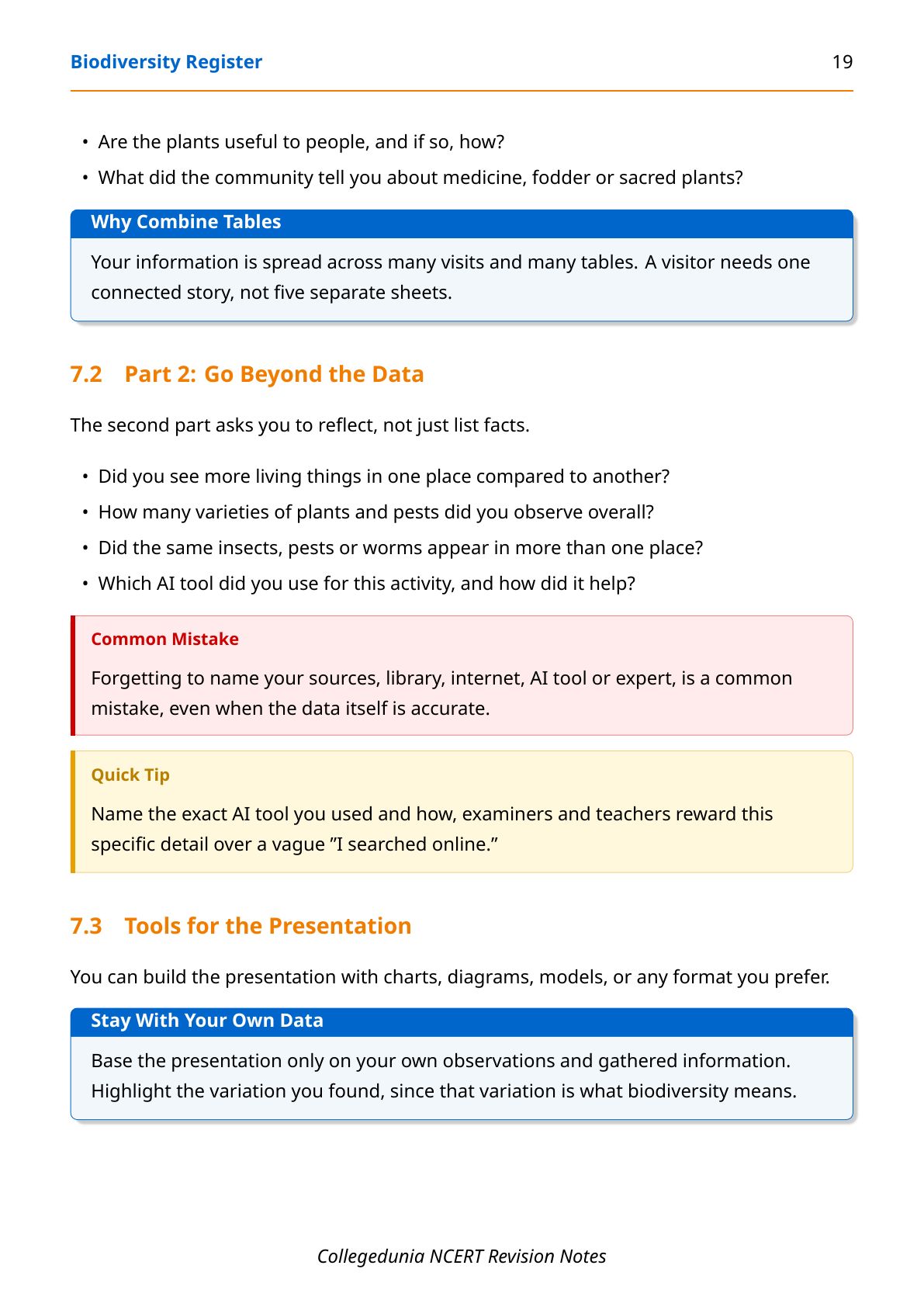
| Activity 7: Presentation of the biodiversity register | Prepare a two-part presentation: a summary of your findings, and a deeper look using charts, diagrams or models. |
Note how Activity 5 sits in the middle of the project. It is the activity most students spend the most time on, since it is where the five description tables actually get filled.
The Five Description Tables 2.3 to 2.7 Explained
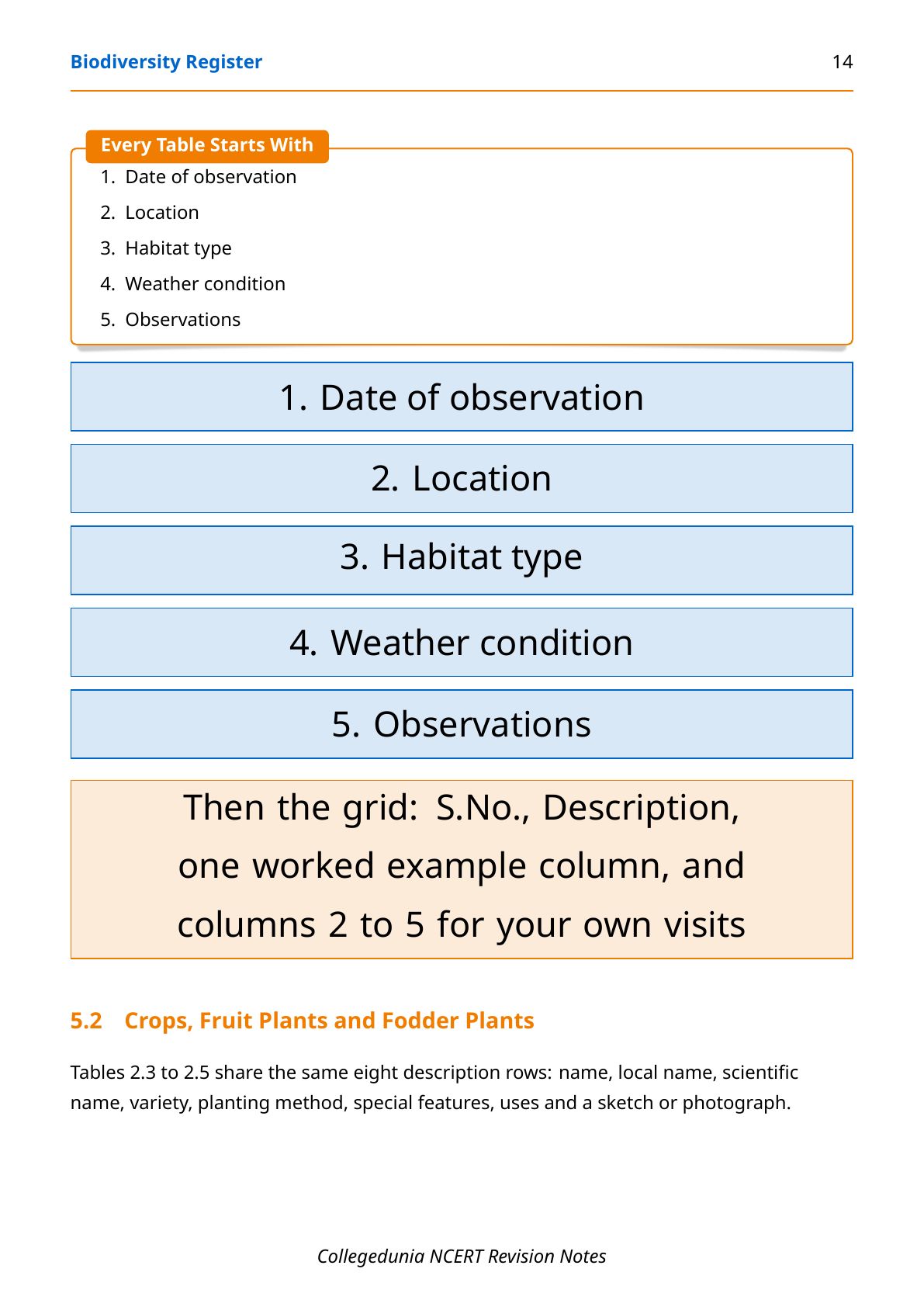
Once you start visiting places, all your observations go into five tables. Each table shares the same eight-row shape, so learning the shape once saves time on every table after.
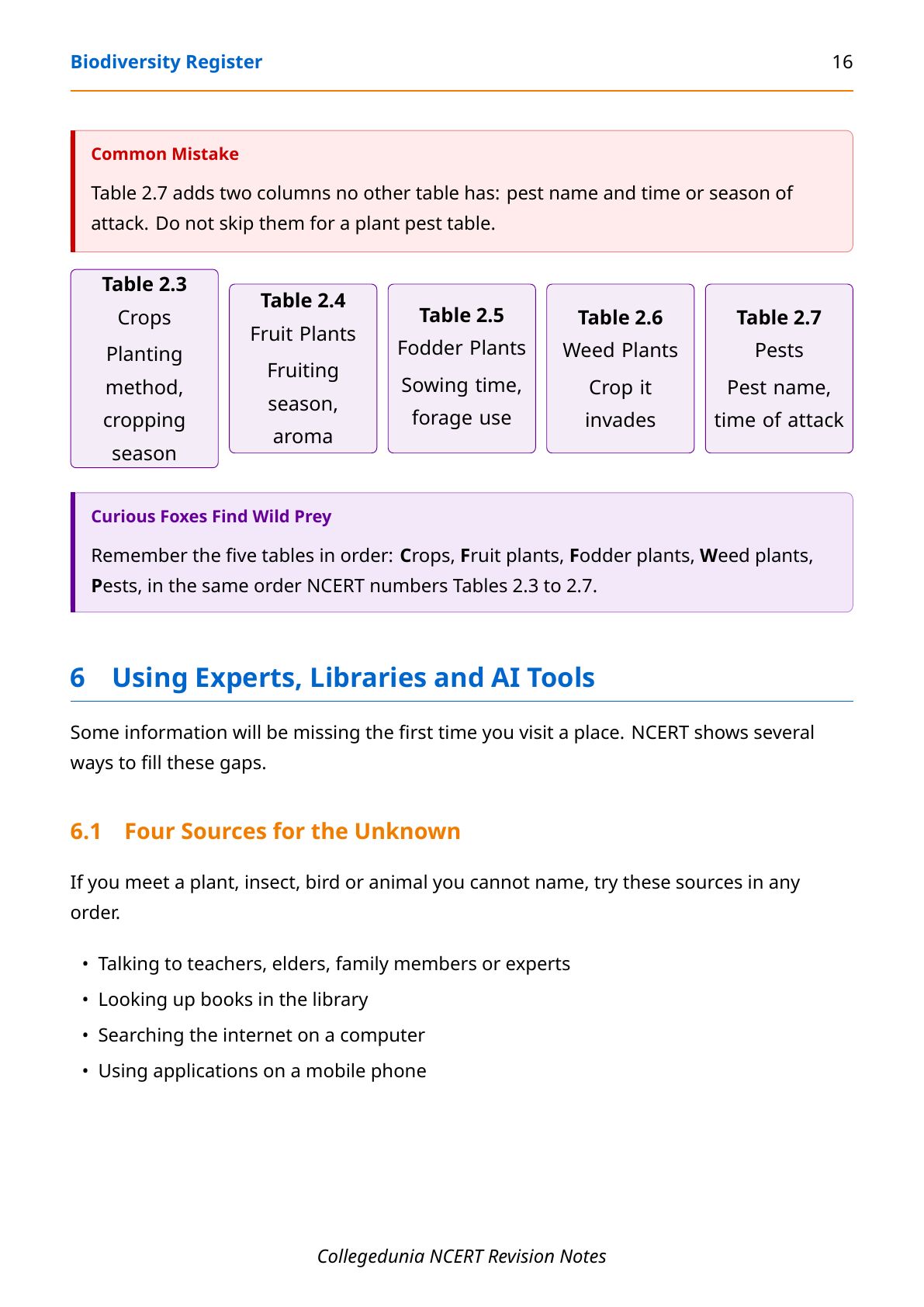
| Table | What it records | Book's example |
|---|---|---|
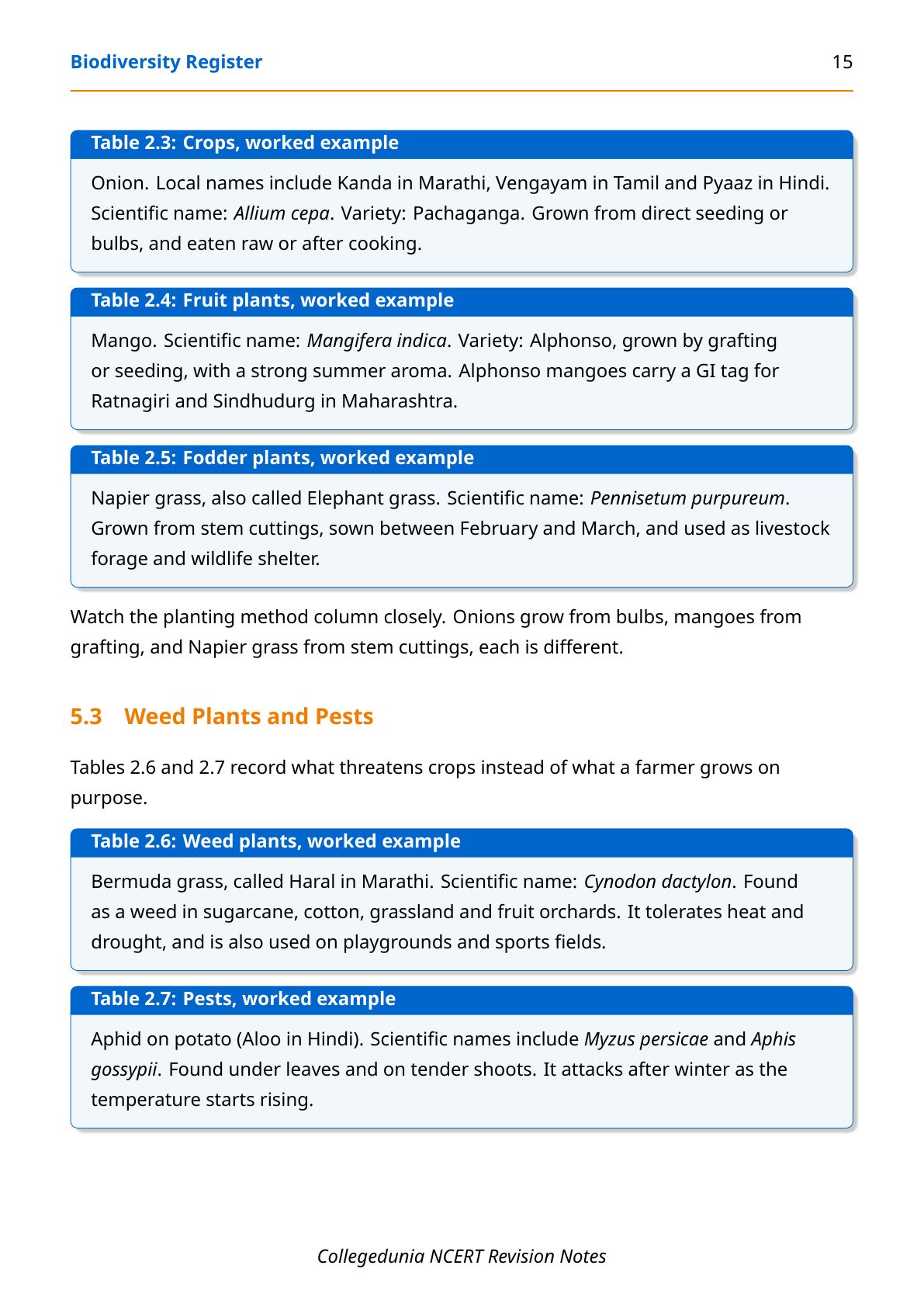
| Table 2.3: Description of Crops | Crop name, local name, scientific name, variety, planting method, special features, uses, sketch or photograph. | Onion (Allium cepa), variety Pachaganga. |
| Table 2.4: Description of Fruit Plants | Same shape as Table 2.3, with fruiting season and aroma noted as special features. | Mango (Mangifera indica), variety Alphonso. |
| Table 2.5: Description of Fodder Plants | Same shape, with sowing time noted as a special feature and use as forage for livestock. | Napier grass (Pennisetum purpureum). |
| Table 2.6: Description of Weed Plants | Plant name, local and scientific name, variety, which crop it is found in, special features and uses. | Bermuda grass (Cynodon dactylon). |
| Table 2.7: Description of Pests | Plant name, pest name and its scientific name, habitat, special features, and the time or season of attack. | Aphid on potato, active after winter. |
The book's own note is worth keeping close: Alphonso mangoes carry a GI tag for their origin in Maharashtra's Ratnagiri and Sindhudurg regions, which is the kind of detail Table 2.4 expects you to notice and record.
Meeting Experts and Using Google Lens to Fill Missing Information
Two of the seven activities are about finding information you cannot observe on your own. Activity 2 asks you to speak to people, and Activity 6 asks you to use technology when a person is not available.
For Activity 2, the book suggests inviting a forest officer, a farmer, a conservationist, or a Vaid or Vaidya, someone who practises traditional medicine using herbs and plants. Sample questions include where local plants can be found, whether any plants have disappeared from the area, and which plants help or harm biodiversity.
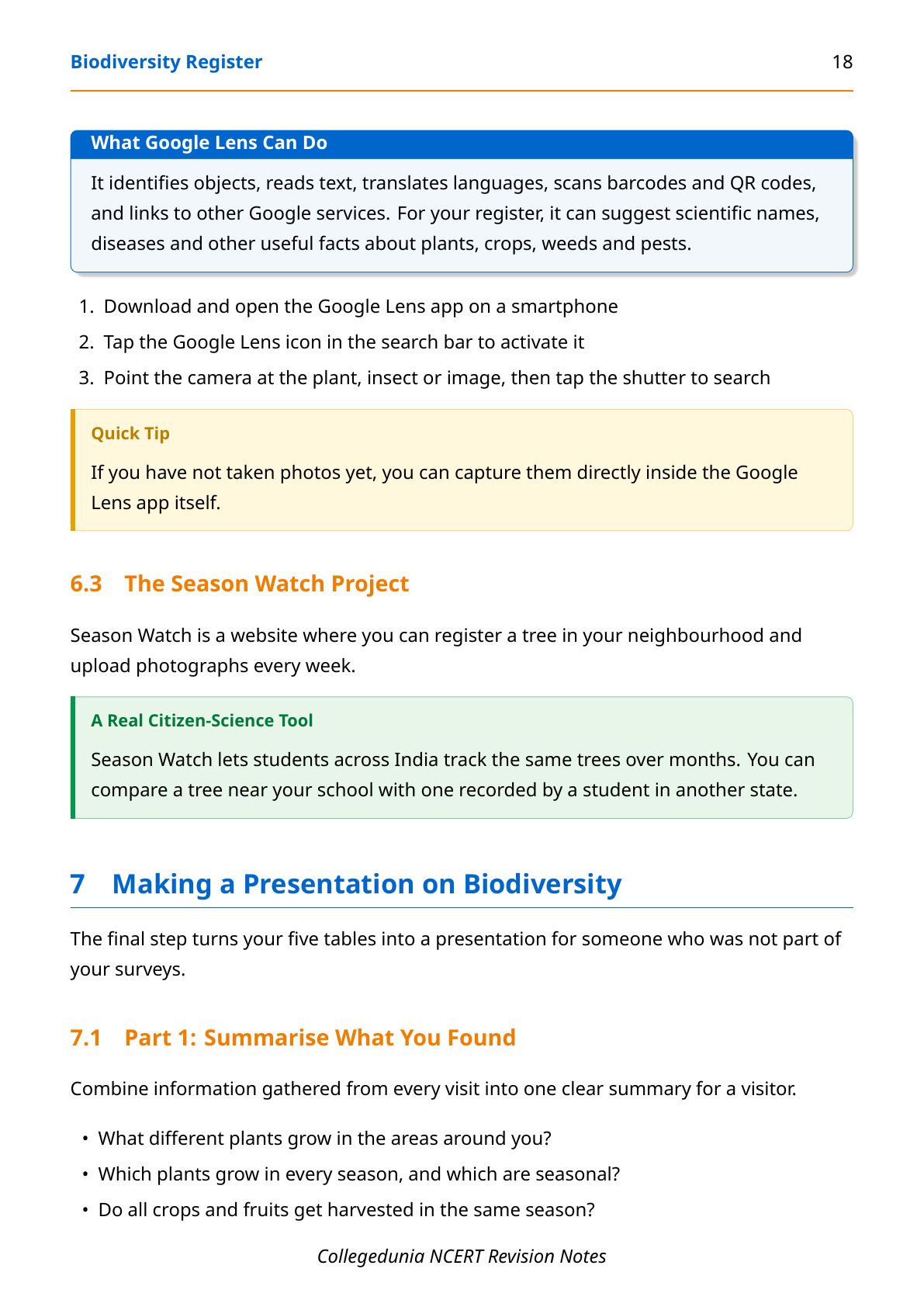
For Activity 6, the book introduces Google Lens as one way to identify an unfamiliar plant, insect, bird or animal. Google Lens uses image recognition and text scanning to identify objects, read text, translate languages and scan codes, and you can open it through the Google Photos app or as a standalone app.
- Point the camera at the plant, insect or image you want to identify and tap the shutter to search.
- Use the result to add the missing scientific name or other details to Tables 2.3 to 2.7.
- Always confirm what an AI tool tells you with a teacher or another source before treating it as final.
Biodiversity Heritage Sites of India Named in the Chapter
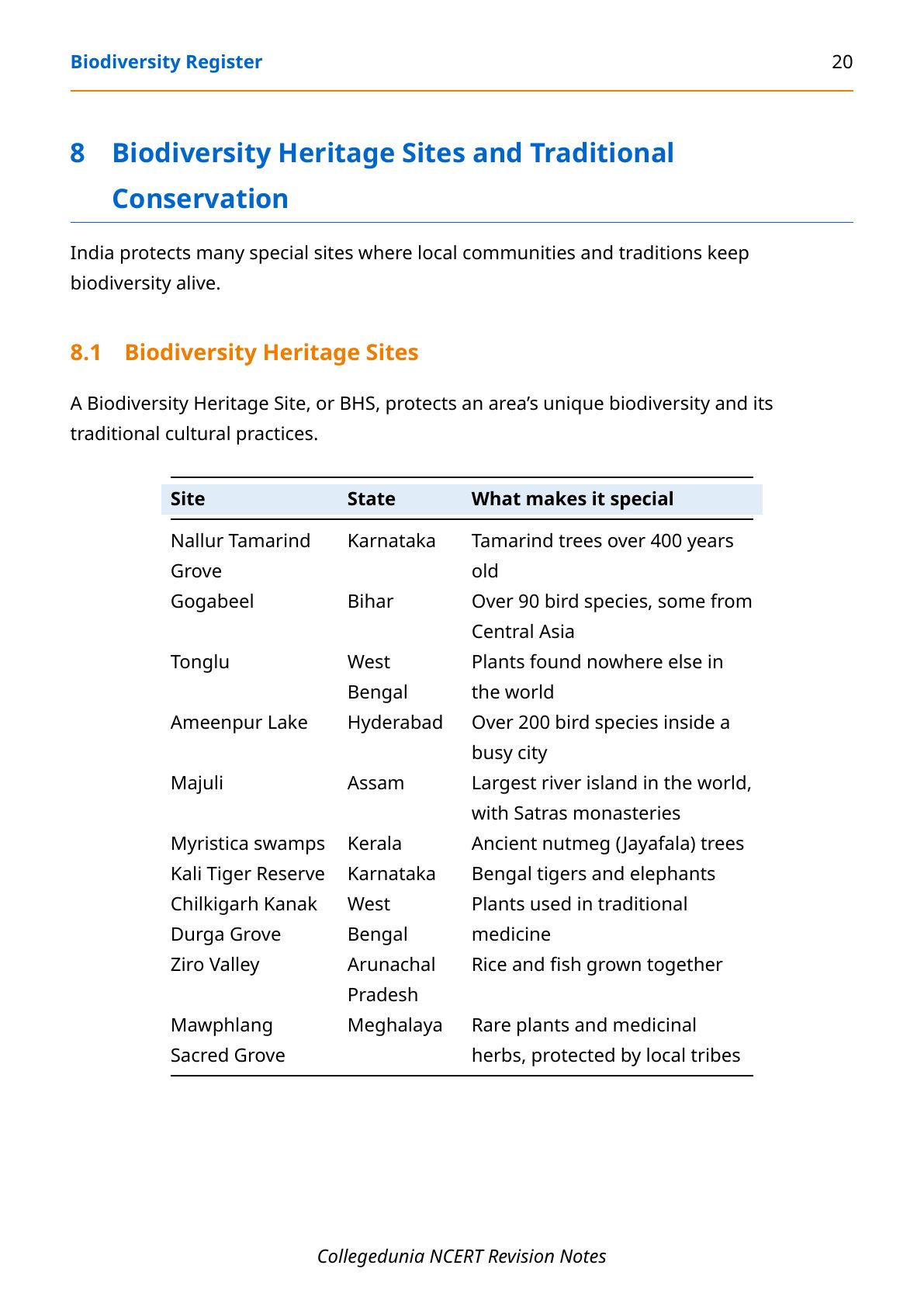
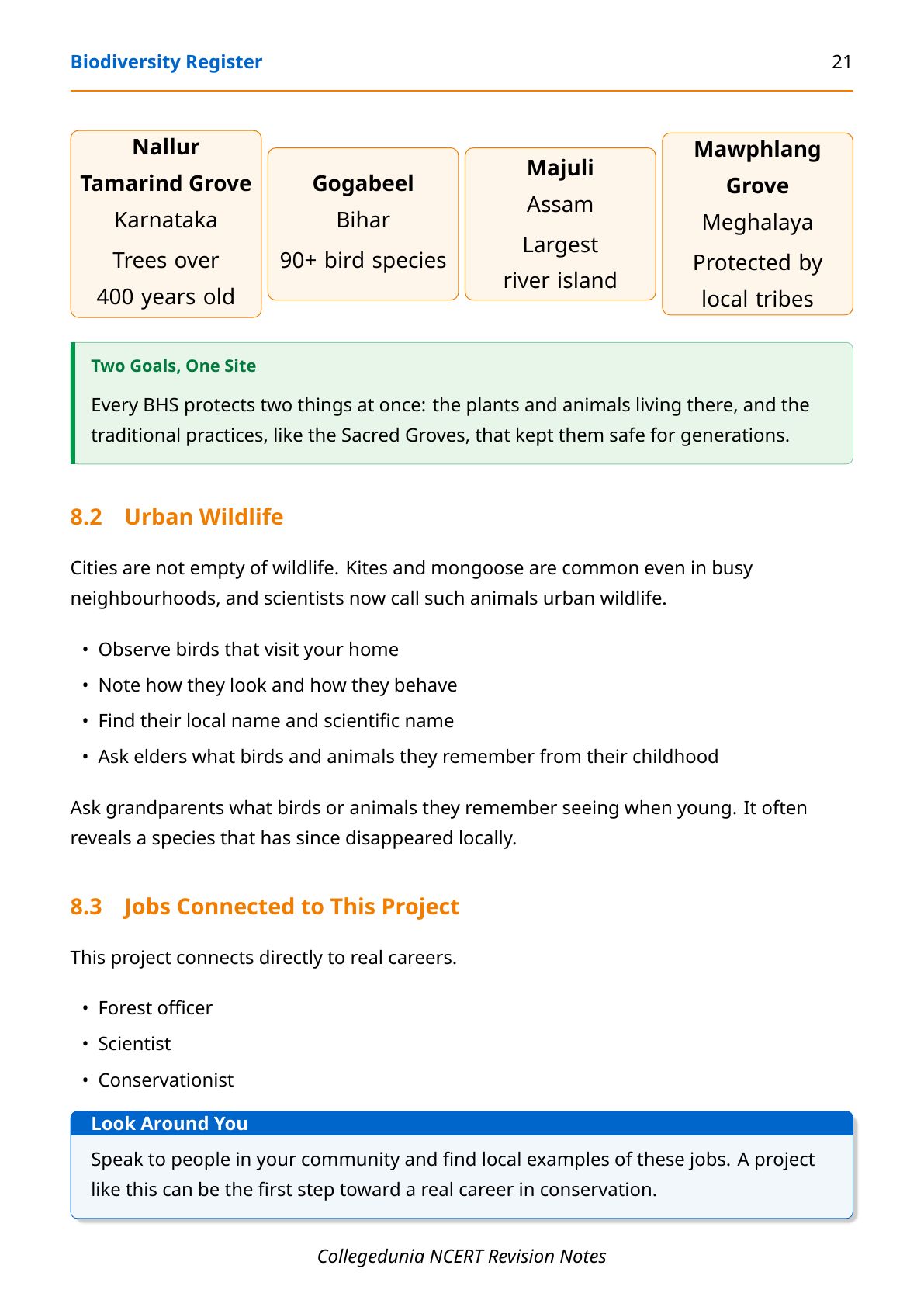
The chapter's "Did you know?" box lists ten Biodiversity Heritage Sites across India, places recognised for protecting rare species and the traditional practices linked to them.
| Site | State | What makes it notable |
|---|---|---|
| Nallur Tamarind Grove | Karnataka | Tamarind trees over 400 years old. |
| Gogabeel | Bihar | Home to over 90 bird species, including visitors from Central Asia. |
| Tonglu | West Bengal | Plants found nowhere else in the world. |
| Ameenpur Lake | Hyderabad | Over 200 bird species inside a busy city. |
| Majuli | Assam | The world's biggest river island, home to monasteries called Satras. |
| Myristica swamps | Kerala | Ancient nutmeg (Jayafala) trees. |
| Kali Tiger Reserve | Karnataka | Bengal tigers and elephants. |
| Chilkigarh Kanak Durga Sacred Grove | West Bengal | Medicinal plants protected by the local community. |
| Ziro Valley | Arunachal Pradesh | Rice and fish grown together in one field. |
| Mawphlang Sacred Grove | Meghalaya | Rare plants and medicinal herbs protected by local tribes. |
Common Mistakes Students Make in the Biodiversity Register Project
Watch out for these five habits:
- Leaving a table row blank instead of asking a teacher first, as the book asks you to.
- Recording a local name in only one language when the table asks for as many languages as possible.
- Visiting a place only once instead of returning across different seasons to note changes.
- Forgetting to note the source of seeds or plants, a row students often skip by mistake.
- Sketching an unfamiliar plant or insect only, and never following up with an expert or Google Lens to confirm its name.
Quick Recall Table for the Biodiversity Register Chapter
| Fact | Detail |
|---|---|
| Number of activities | 7, from observation to presentation. |
| Description tables | 5, Tables 2.3 to 2.7. |
| Register terms | 11, scientific name to GI tag. |
| Group size for visits | Maximum 5 students per group. |
| Presentation format | 2 parts, a summary and a deeper analysis. |
| Heritage Sites named | 10 sites across India. |
Student Feedback: In a Collegedunia survey of 12,140 Class 6 students who completed the biodiversity register project, 68% of students said filling Tables 2.3 to 2.7 for every place they visited took longer than any other activity. Most said keeping one table open per place, instead of switching between all five at once, made the recording go faster.
Source: 2026-27 Class 6 Vocational Education student survey. Sample of 12,140 students from schools across 14 states.
What These Notes Cover for the Biodiversity Register Chapter
These notes are written to sit next to your own biodiversity register, not replace it. They pull together everything the printed chapter explains, so you always have a reference while filling your own tables.
- The full eleven-term word list with GI tag examples.
- All seven activities summarised in the order the book presents them.
- Every row of the five description tables, explained with the book's own worked examples.
- The complete list of Biodiversity Heritage Sites named in the chapter.
- A common-mistakes list and a one-page quick recall table for last-minute revision.
How to Use the Biodiversity Register Notes Most Effectively
These notes work best alongside your field visits, not instead of them. A simple three-step routine keeps the project on track.
- Before your first visit: read the term list and the eight-row table shape once, so you know exactly what to note down in the field.
- After each visit: fill in your own copy of Tables 2.3 to 2.7 using local names, scientific names where you can find them, and a quick sketch.
- Before your presentation: revise the quick recall table and the Heritage Sites list, since both come up often in class discussion.
How These Notes Pair with the Biodiversity Register Handwritten Notes
The chapter also has a handwritten-notes version that copies out every table by hand, page by page, in the order the book presents them. Students who prefer working from a written page rather than a typed one often use both together.
| Resource | Best used for | Open it |
|---|---|---|
| Handwritten Notes | The full word list and all five register tables copied out by hand, ready for quick revision | Biodiversity Register Class 6 Handwritten Notes |
| NCERT Book PDF | The official Kaushal Bodh chapter with all original figures and blank tables | Biodiversity Register Class 6 NCERT Book PDF (coming soon) |
NCERT Notes for Class 6 Vocational Education Kaushal Bodh: All Chapters
Related Links: typed chapter notes for every project in the Class 6 Kaushal Bodh textbook, written to the 2026-27 syllabus.
| Chapter | Resource |
|---|---|
| Chapter 1 | School Kitchen Garden Class 6 Notes (coming soon) |
| Chapter 2 | Biodiversity Register Class 6 Notes |
| Chapter 3 | Maker Skills Class 6 Notes (coming soon) |
| Chapter 4 | Animation and Games Class 6 Notes (coming soon) |
| Chapter 5 | School Museum Class 6 Notes (coming soon) |
| Chapter 6 | Cooking without Fire Class 6 Notes (coming soon) |
Biodiversity Register Class 6 Vocational Education Kaushal Bodh Notes FAQs
Ques. What is a biodiversity register in Class 6 Vocational Education?
Ans. A biodiversity register is a notebook where a student records the variety of living things found in an area, along with details such as habitat, local and scientific names, and living things that may harm others.
Ques. Where can I download the Class 6 Biodiversity Register Notes PDF?
Ans. You can download the Class 6 Vocational Education Kaushal Bodh Chapter 2 Biodiversity Register Notes PDF directly from this page, free of cost.
Ques. Are these notes based on the 2026-27 NCERT Kaushal Bodh book?
Ans. Yes. These notes follow the 2026-27 reprint of the Kaushal Bodh Vocational Education Activity Book for Grade 6, including all seven activities and all five description tables exactly as printed.
Ques. How many activities are there in the Biodiversity Register project?
Ans. There are seven activities, starting with observing living things around you and ending with a two-part presentation of your findings.
Ques. What are the five tables used to fill the biodiversity register?
Ans. Tables 2.3 to 2.7 cover crops, fruit plants, fodder plants, weed plants and pests. Each table records the local name, scientific name, variety, special features and uses of what you observe.
Ques. What is a GI tag, and why does the chapter mention it?
Ans. A GI tag, short for Geographical Indication tag, is given by the government to confirm that a plant is grown in a specific place and meets a high standard. The chapter uses Basmati rice and Alphonso mangoes as examples.
Ques. Do I need a smartphone to complete this project?
Ans. No. A camera or smartphone helps with photos and identification, but the book asks every student to also make sketches by hand, so the project can be completed without one.
Ques. How is Google Lens used in the Biodiversity Register project?
Ans. Google Lens is an image recognition tool you can use in Activity 6 to identify an unfamiliar plant, insect, bird or animal by pointing your camera at it, then confirming the result with a teacher or another source.
Ques. What are Biodiversity Heritage Sites?
Ans. Biodiversity Heritage Sites are areas in India recognised for their unique biodiversity and for protecting traditional cultural practices linked to the natural environment, such as the Nallur Tamarind Grove and the Mawphlang Sacred Grove.
Ques. How many pages is the Class 6 Biodiversity Register Notes PDF?
Ans. The Notes PDF runs to a compact length that covers the full term list, all seven activities and all five description tables, along with a quick recall table for revision.



Comments