




India and Her Neighbours is the chapter where students mix up land neighbours and maritime neighbours. They also forget which temple, corridor or trade route belongs to which country. The NCERT Solutions Class 7 Social Science Chapter 2 India and Her Neighbours below answer every question and activity from the chapter. They follow the latest 2026-27 NCERT syllabus.
- Question coverage: India and Her Neighbours Class 7 NCERT Solutions cover all 8 exercise questions plus the 4-part map activity.
- Exam weight: Questions on this chapter usually carry 5 to 7 marks in the Class 7 Social Science annual paper.
- Also on this page: a 15-country neighbour table, SAARC facts, and links to the Notes and Book PDF.
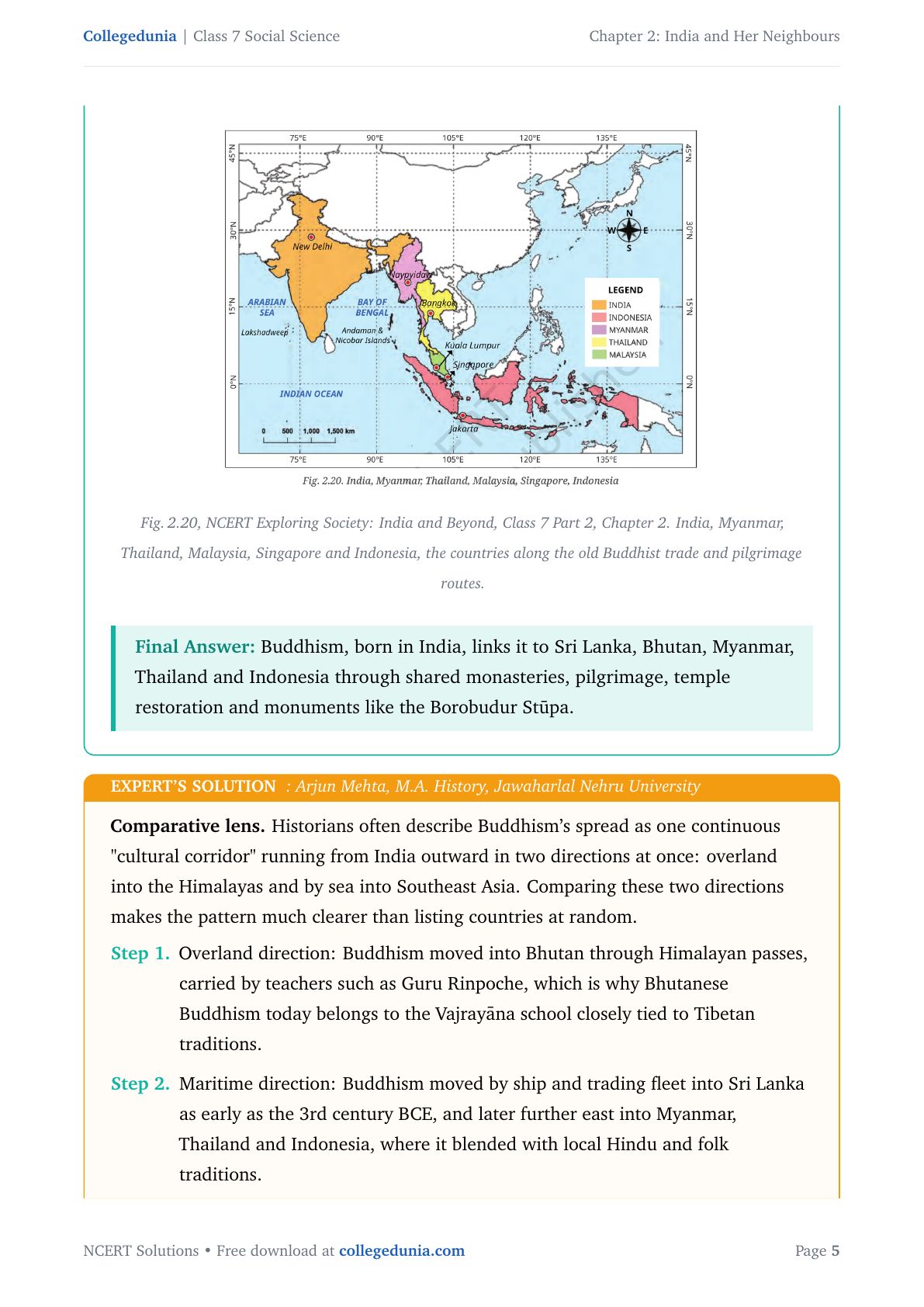
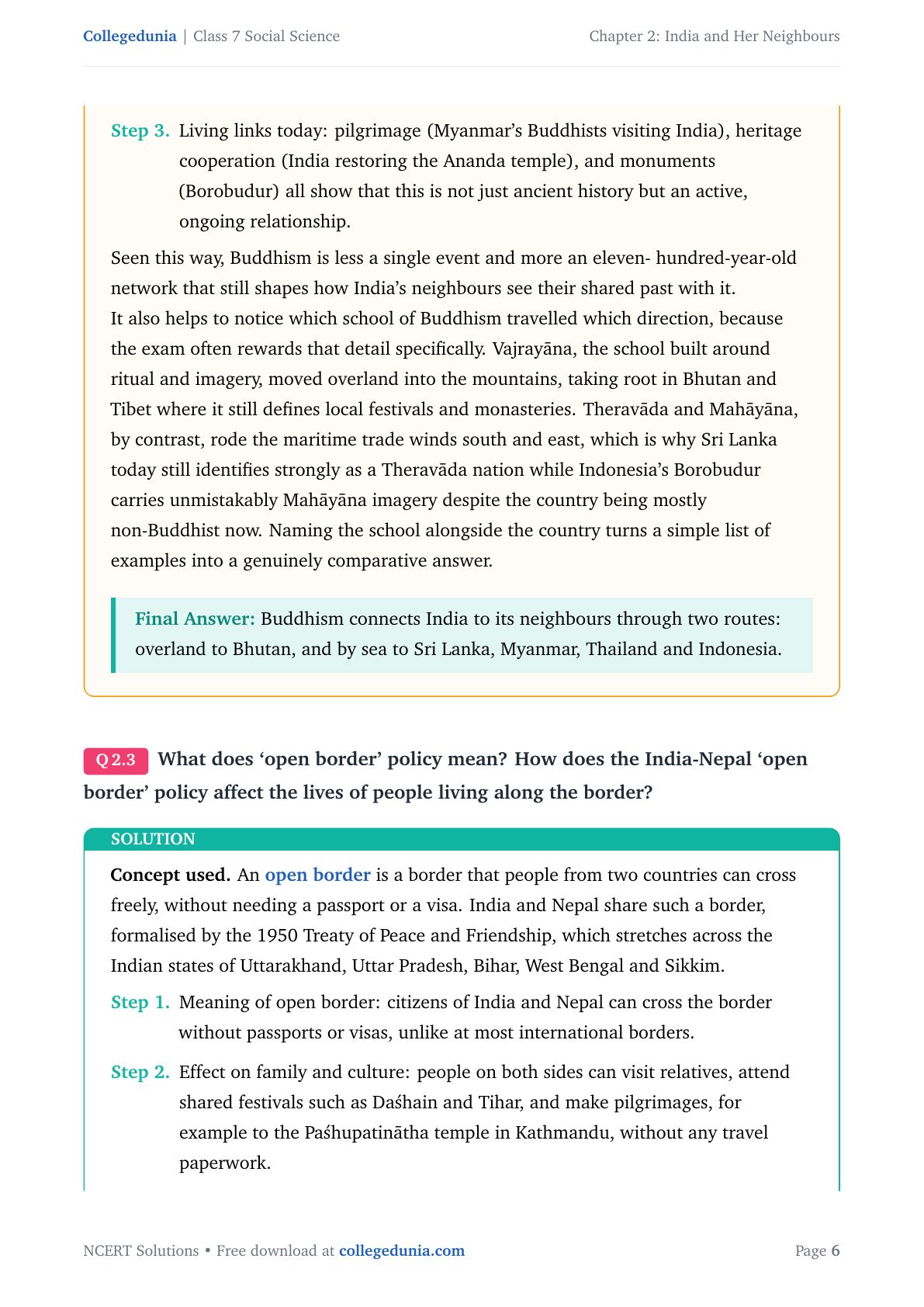
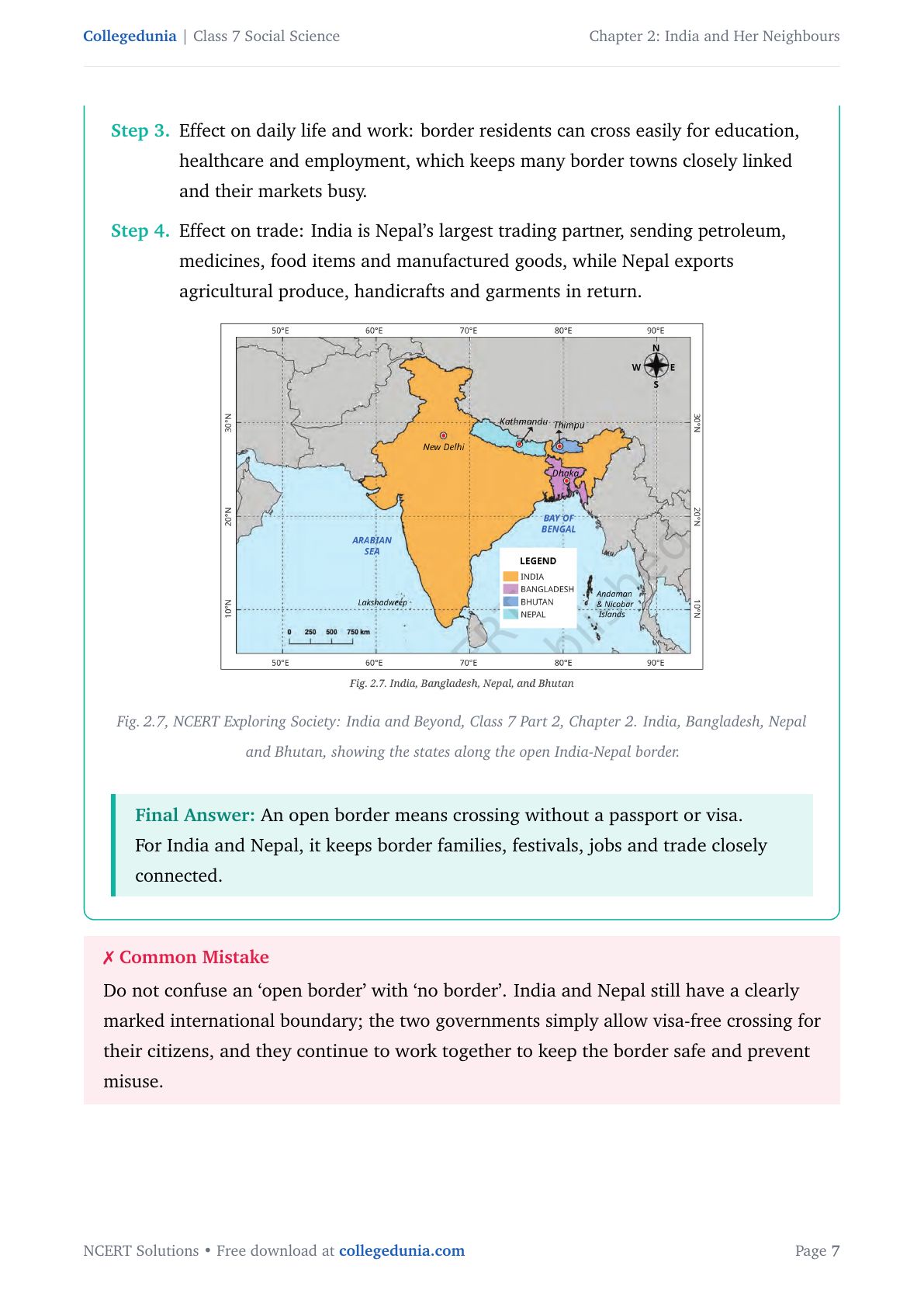
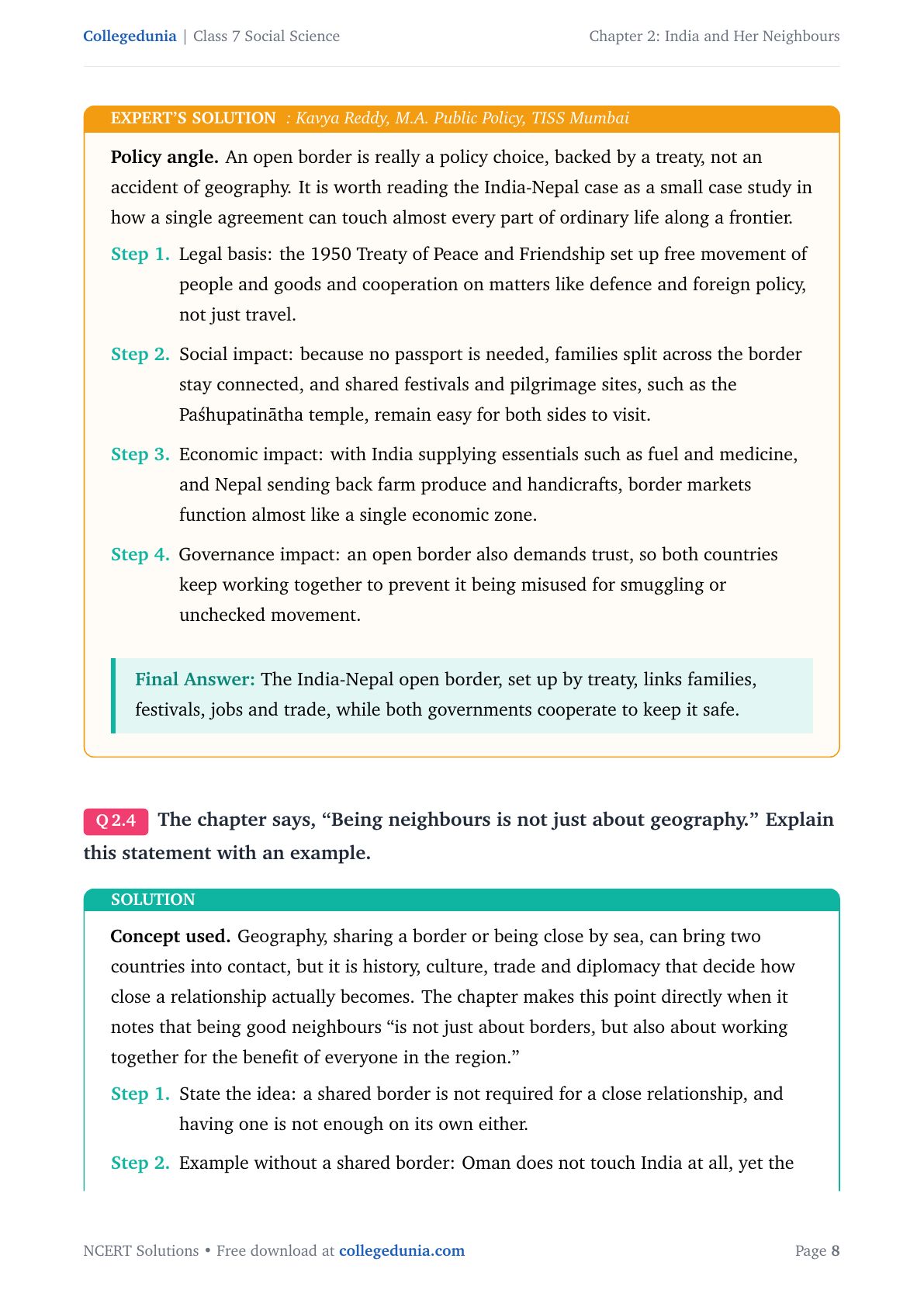
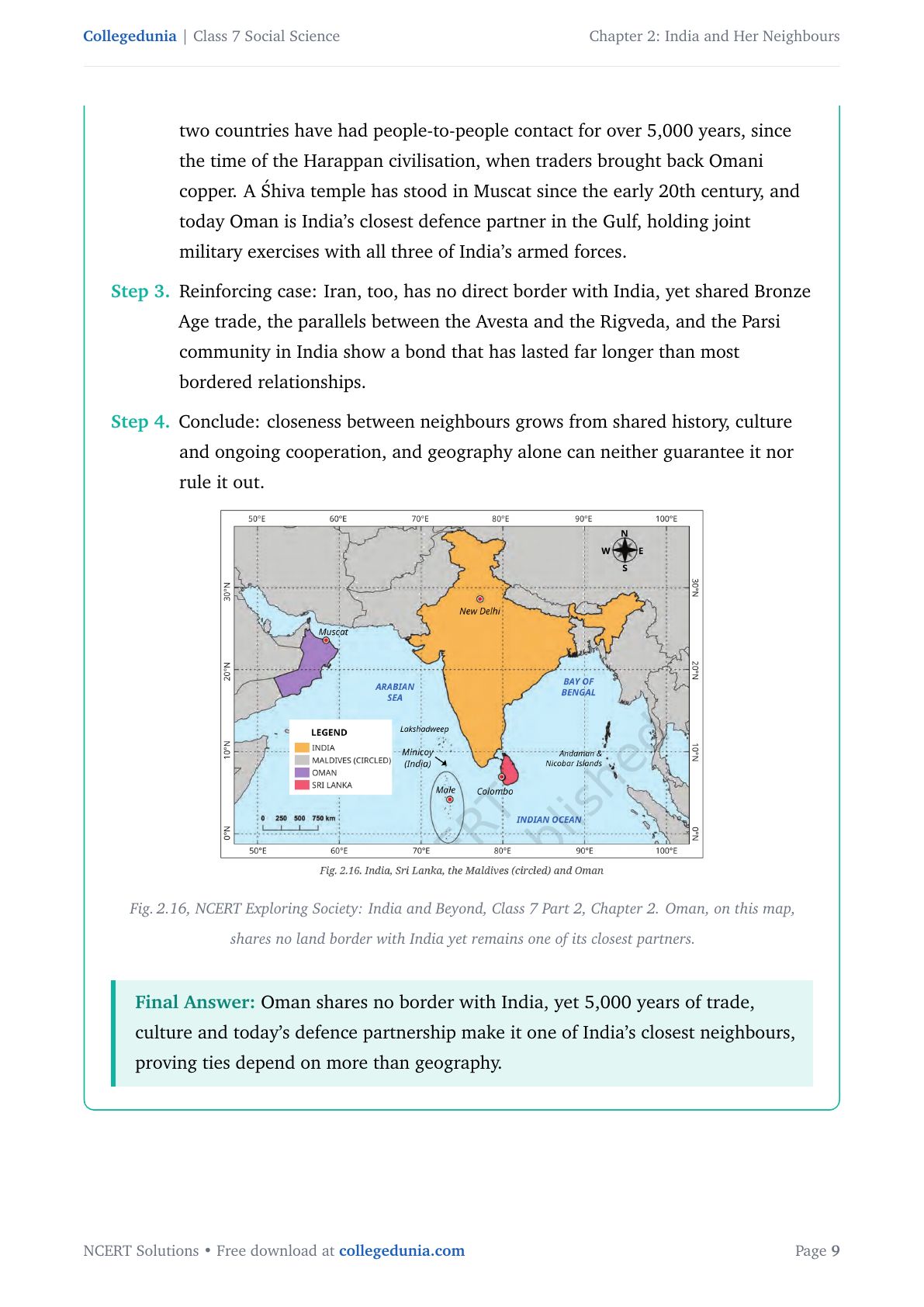
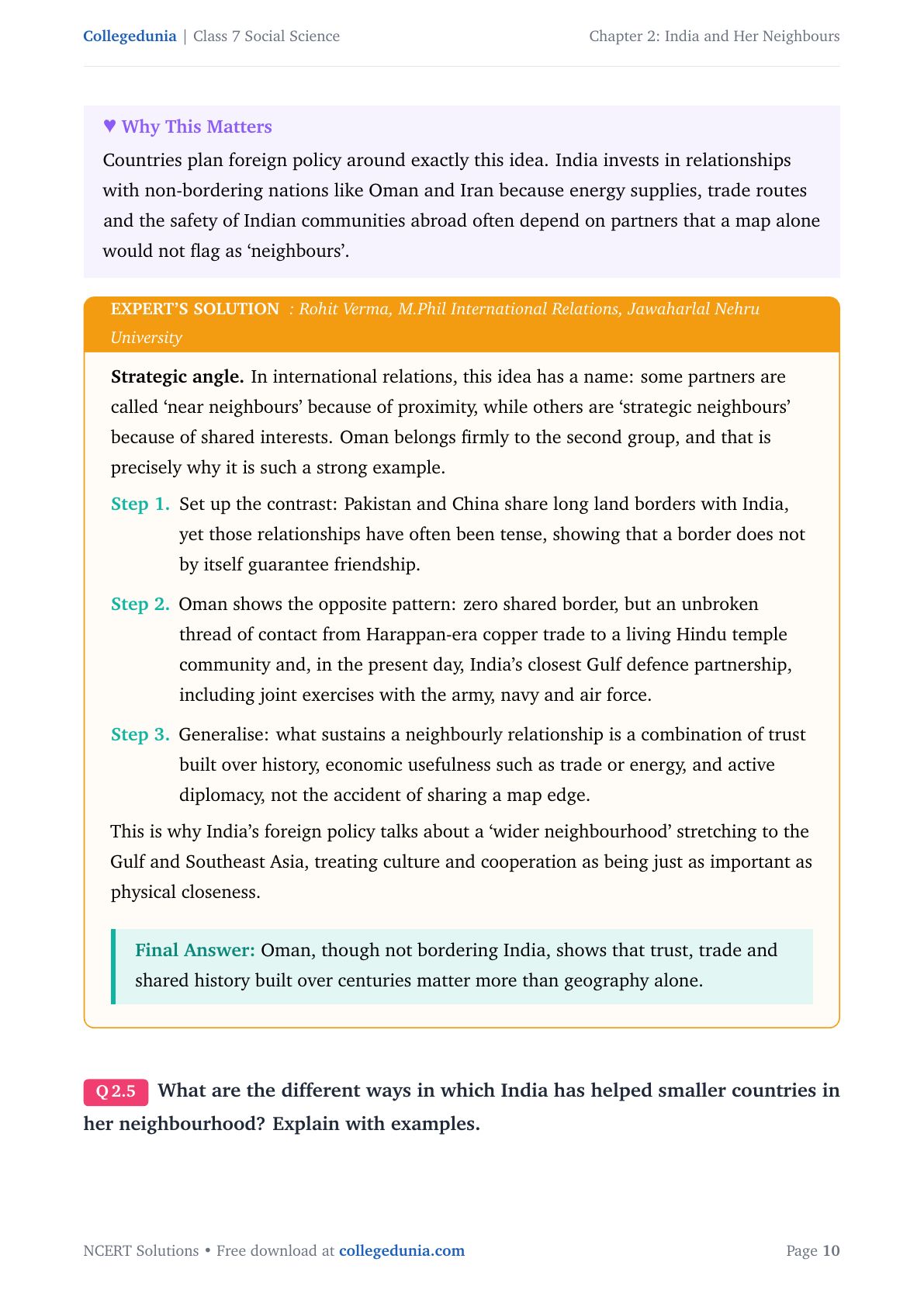
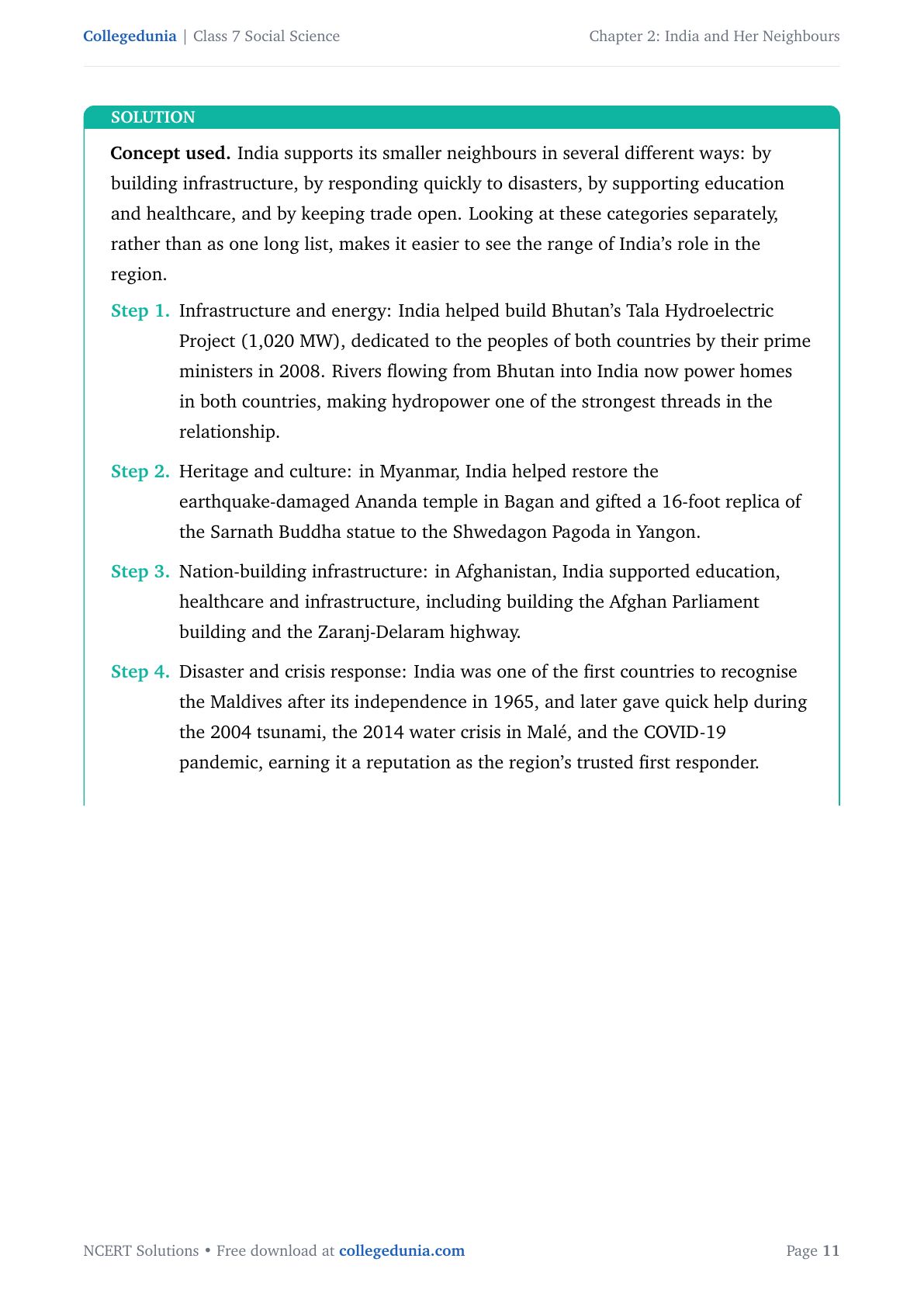
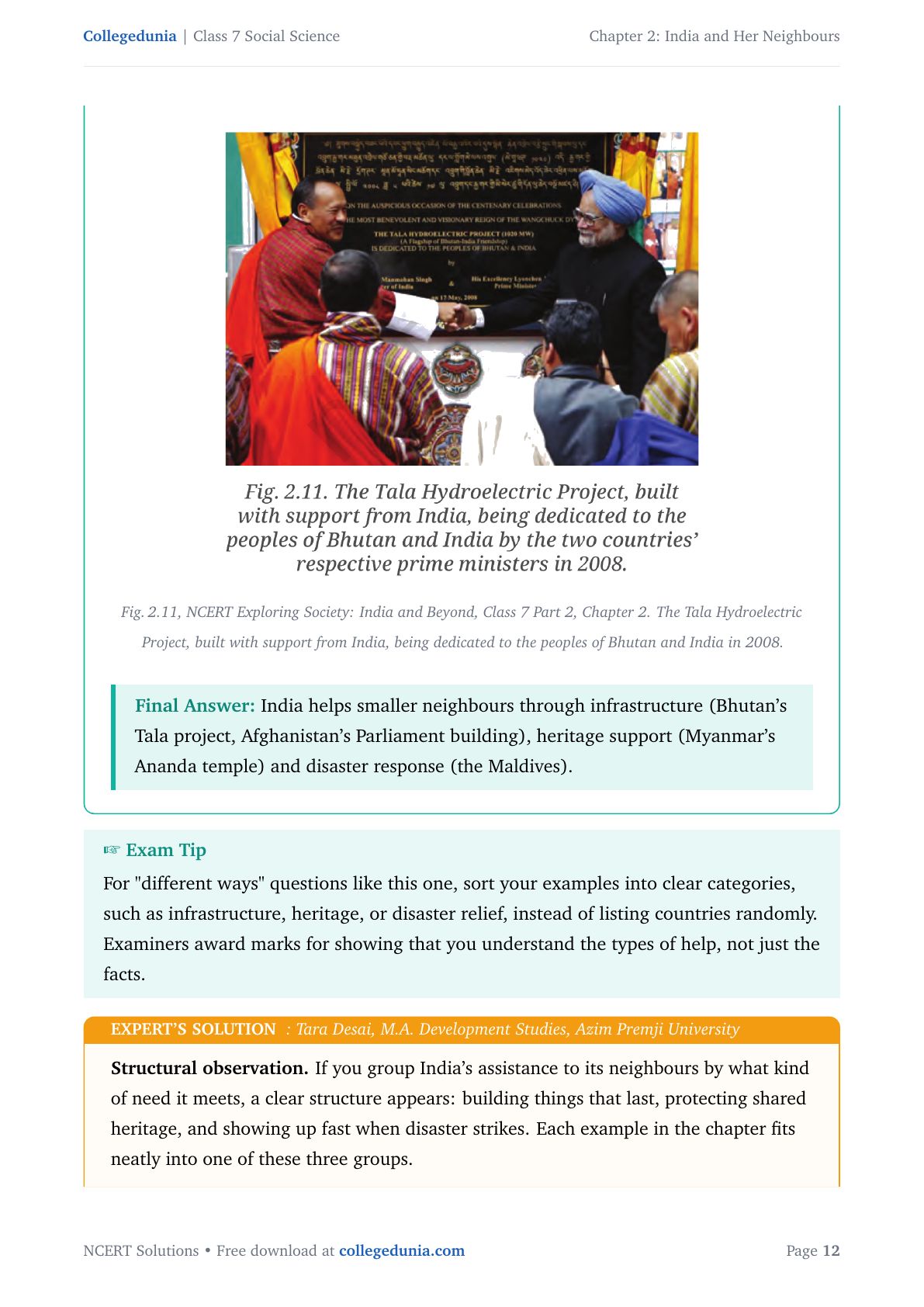
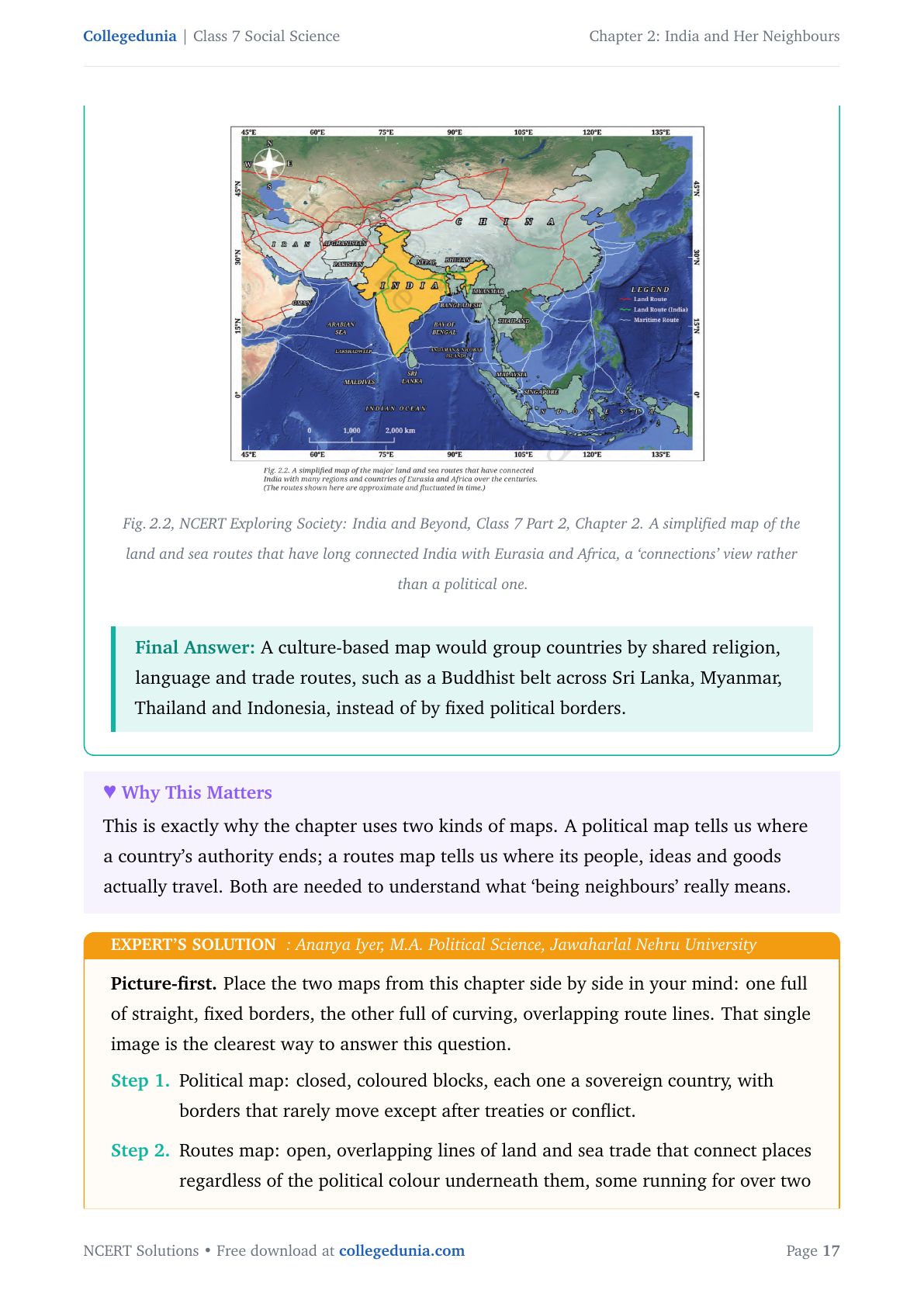
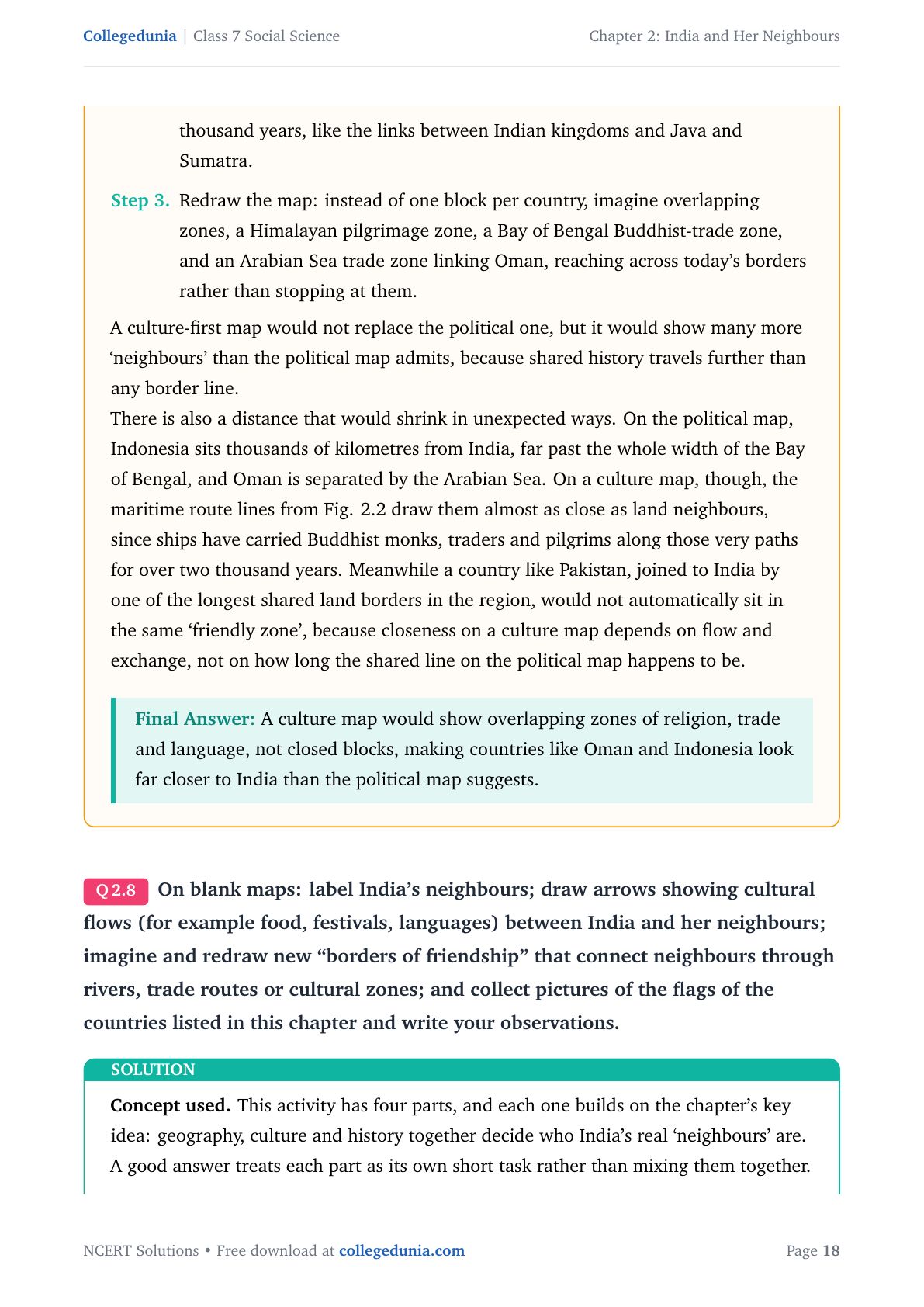
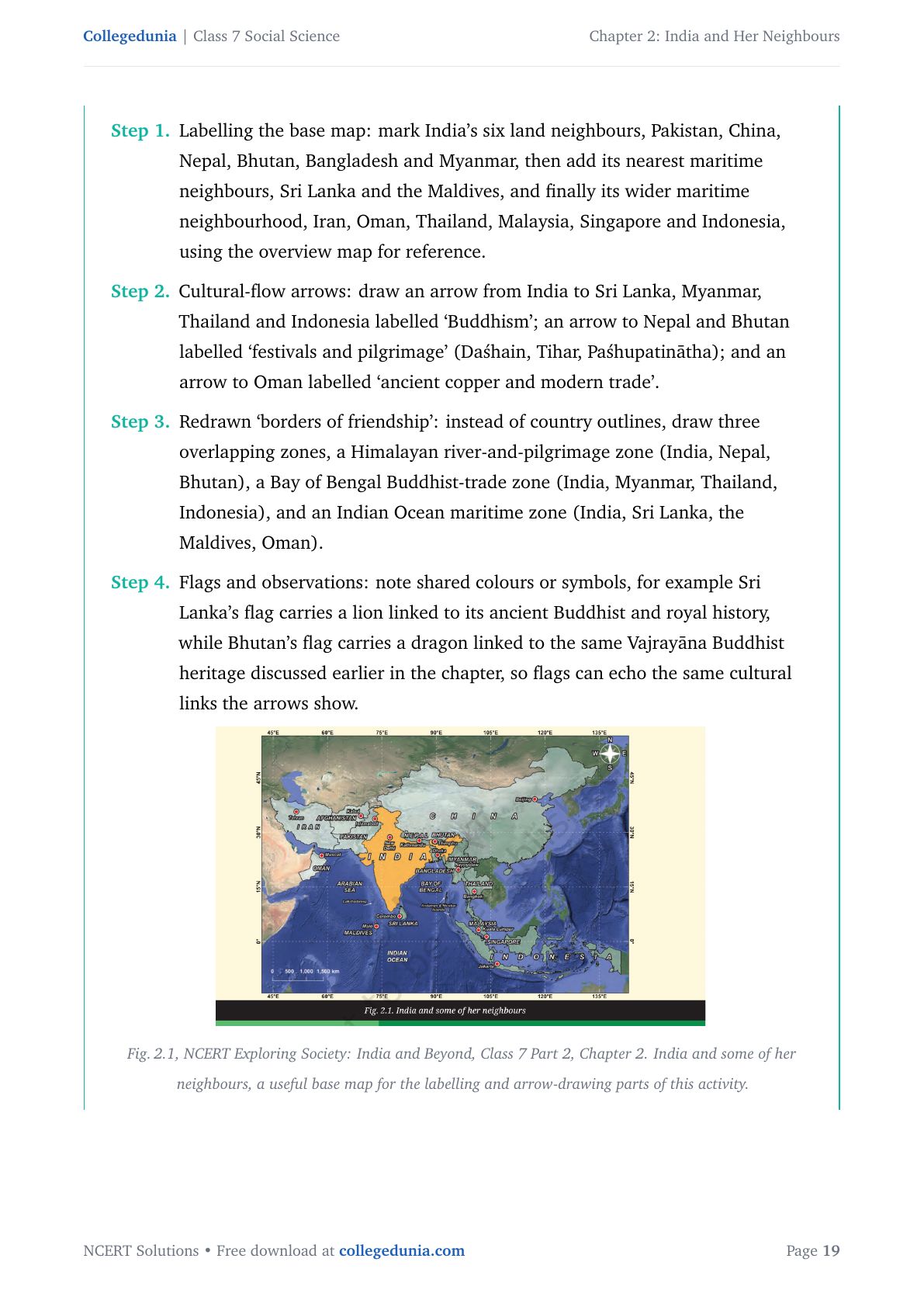
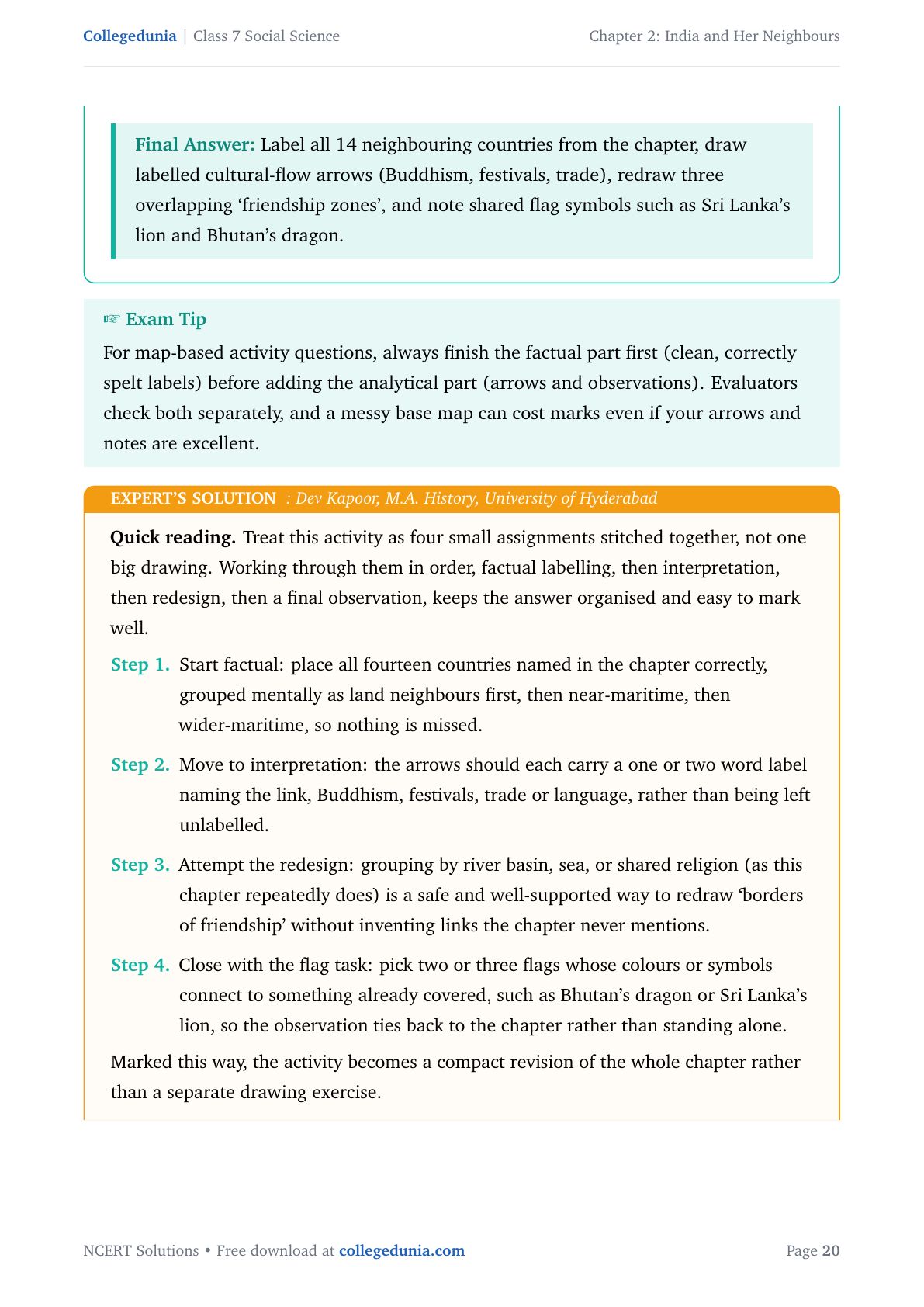
Every NCERT solution for Class 7 Social Science Chapter 2 India and Her Neighbours in this Collegedunia compilation is curated by subject experts, checked against the 2026-27 rationalised NCERT print, and written in the plain language a Class 7 student actually needs.
Want the full worked answers, one question at a time? Open the dedicated question bank below for India and Her Neighbours Class 7 Questions and Answers. Every answer is worked out step by step, including the map-based activity, part by part.
View All Step-by-Step Solutions for India and Her Neighbours
Why India and Her Neighbours Matters for Class 7 Social Science
This page, NCERT Solutions Class 7 Social Science Chapter 2 India and Her Neighbours, opens Theme A of Exploring Society: India and Beyond, Grade 7 Part 2. It comes right after the farming chapter. Instead of listing country facts one by one, it builds around three Big Questions. NCERT wants students to keep asking these as they read, and most exam questions circle back to one of them.
India's land boundary stretches over 15,100 km. Her coastline runs to about 11,100 km. That is why the chapter treats India as both a land power and a maritime nation. An answer that only lists country names usually loses marks. The chapter's whole point is that neighbourhood means geography, history and shared culture together, not borders alone.
| Big Question from the chapter | What it really asks you to explain |
|---|---|
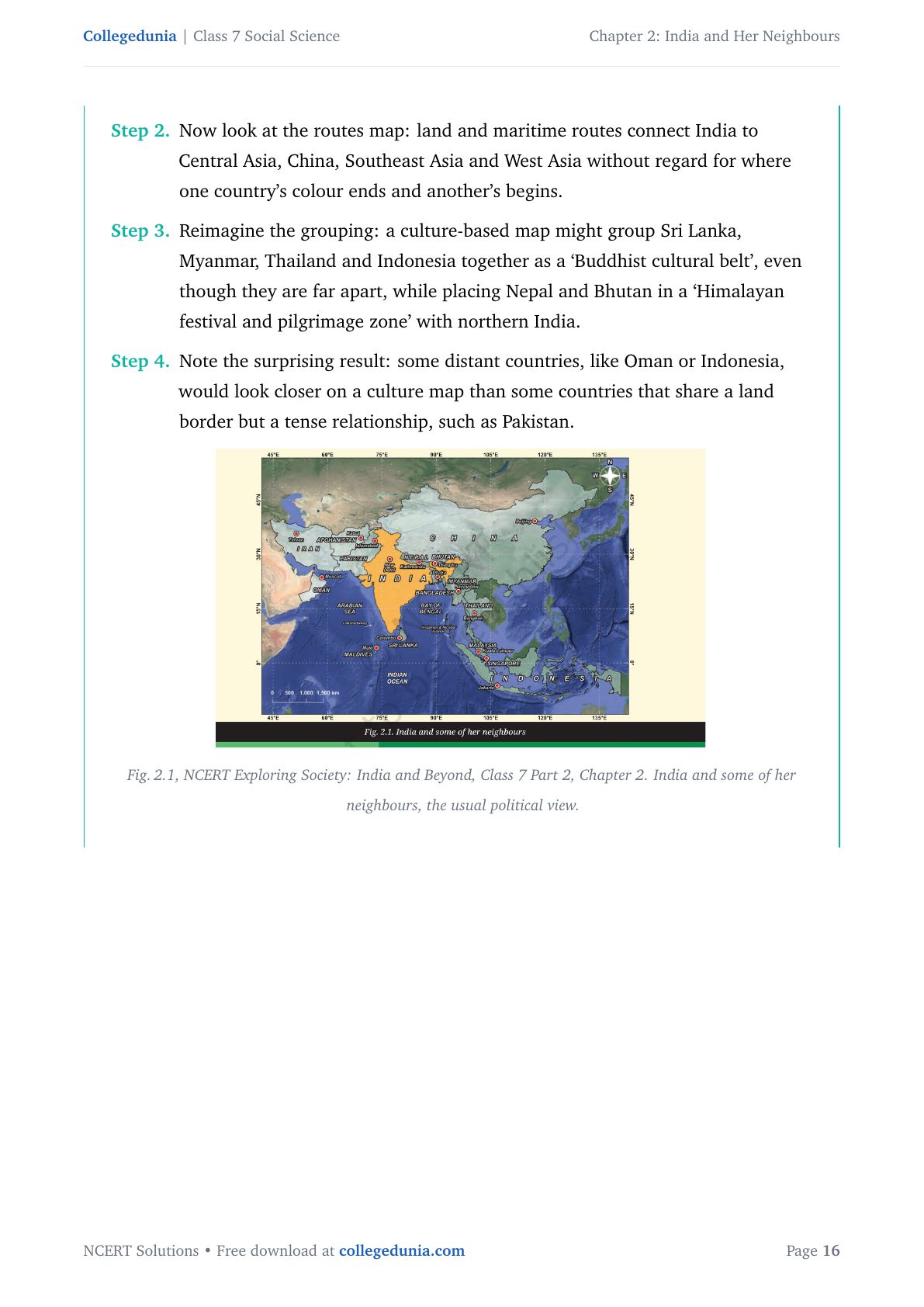
| What defines a neighbour? Is it just shared land borders? | Why Sri Lanka, the Maldives and even Oman count as neighbours despite having no land border with India |
| How do geography and history influence the nature of India's relationships with her neighbours? | Why the same country can be both a trade partner and a source of tension, such as China or Pakistan |
| In what ways are India and her neighbours interconnected today? | Trade, disaster relief, open borders, shared rivers, and regional groups like SAARC |
Name the Big Question your answer is responding to. Then back it up with a real example, such as the Kartarpur Corridor or the Sundarban National Park. This scores better than a plain list of country names. It is exactly what the India and Her Neighbours Class 7 NCERT Solutions on this page are built to demonstrate.
India and Her Neighbours Video Solutions
Source: Magnet Brains on YouTube
India and Her Neighbours Question and Activity Breakdown
The India and Her Neighbours chapter closes with 8 numbered questions. The last one is a multi-part map activity, not a written answer. Some questions ask for a definition, some for an explanation, and some ask you to reflect and reason. Knowing which is which saves time.
| Question | What it covers | Answer type |
|---|---|---|
| Q1 | Explain who a maritime neighbour is, with two examples with respect to India | Short answer |
| Q2 | How Buddhism created links between India and her neighbours, with examples | Explanatory, with examples |
| Q3 | What the India-Nepal open border policy means and how it affects border communities | Explanatory |
| Q4 | Explain the statement "Being neighbours is not just about geography" with an example | Reasoning |
| Q5 | The different ways India has helped smaller neighbouring countries | Explanatory, with examples |
| Q6 | How shared challenges become opportunities for cooperation, with chapter examples | Reasoning |
| Q7 | How the map of the region would look if borders were drawn only by culture and connections | Reflective |
| Q8 | Blank map activity: label India's neighbours, draw cultural-flow arrows, redraw "borders of friendship", collect neighbouring flags | Map-based activity, 4 parts |
Six of the eight items are written answers. Q8 is a classroom map activity with four parts. Teachers usually pick Q1, Q2, Q3 and Q5 for periodic tests, since these have clear, factual answers that are easy to mark.
India's Seven Land Neighbours: Borders, History and Culture
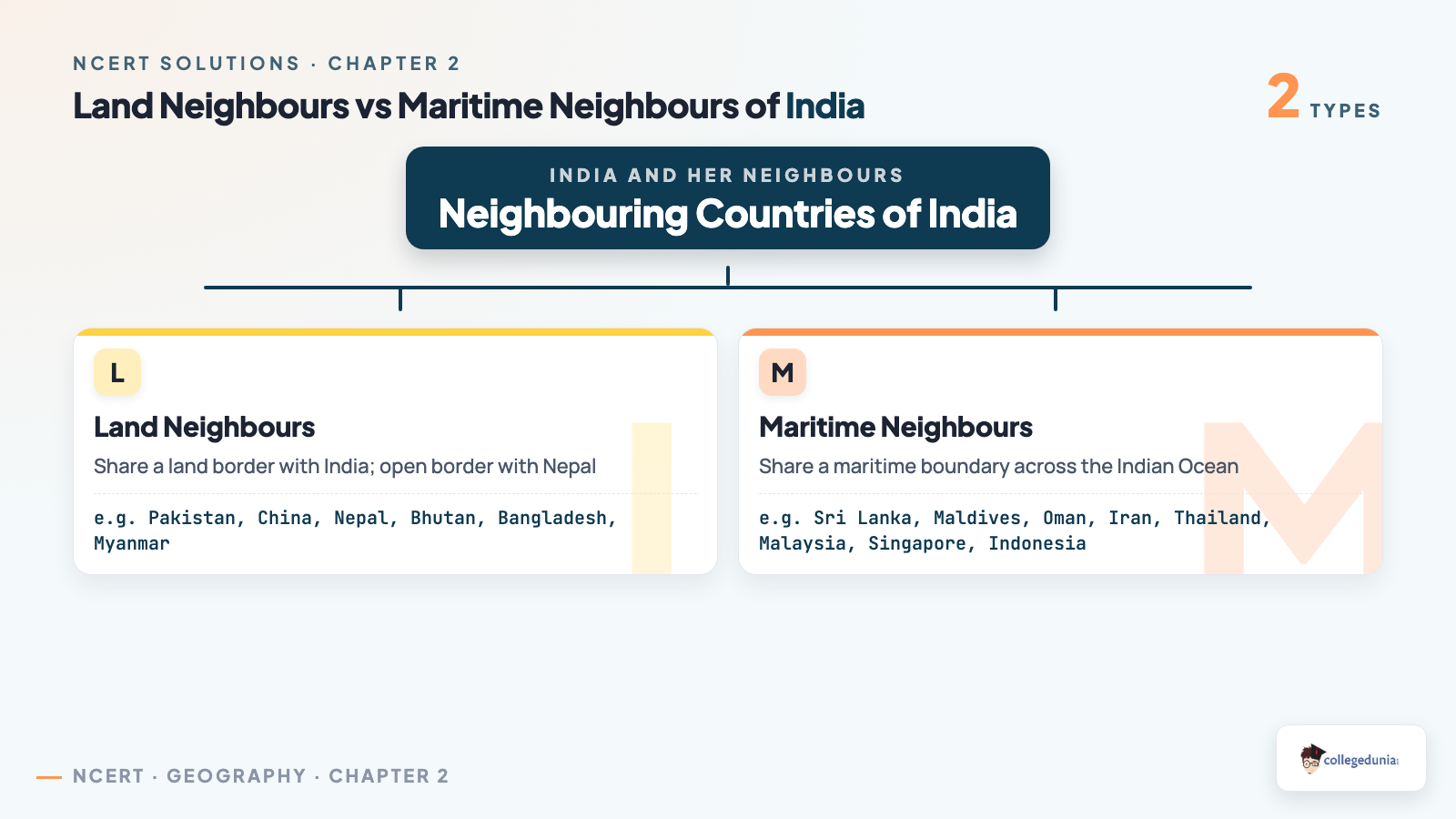
The chapter groups India's seven land-based neighbours under their own themed headings. Match-the-country questions in worksheets are usually built from this list. Every country pairing links India's border states to one historical or cultural fact worth remembering.
| Country | Indian border states/UTs | One fact worth remembering |
|---|---|---|
| China | Arunachal Pradesh, Sikkim, Uttarakhand, Himachal Pradesh, Ladakh | Buddhism travelled from India to China from the 1st century CE through monks such as Faxian and Xuanzang |
| Pakistan | Gujarat, Rajasthan, Punjab, Jammu and Kashmir, Ladakh | The Kartarpur Corridor lets Hindu and Sikh pilgrims cross visa-free to the Gurdwara Darbar Sahib |
| Bangladesh | West Bengal, Assam, Meghalaya, Tripura, Mizoram | Born in 1971; the Sundarban National Park is shared between the two countries |
| Nepal | Uttarakhand, Uttar Pradesh, Bihar, West Bengal, Sikkim | The 1950 Treaty of Peace and Friendship created an open border with no visa or passport needed |
| Bhutan | Sikkim, West Bengal, Assam, Arunachal Pradesh | Bhutan's rivers power hydroelectric projects like Tala, built with India's support |
| Myanmar | Arunachal Pradesh, Nagaland, Manipur, Mizoram | Called India's gateway to Southeast Asia; also shares a maritime boundary in the Bay of Bengal |
| Afghanistan | No direct land access since 1947, reached via Pakistan | The ancient Uttarapatha trade route once linked the Ganga plains to Afghanistan and Central Asia |
Pakistan and Bangladesh both share a complicated history with India tied to Partition. But the chapter keeps political tension separate from cultural closeness. Shrines, festivals and languages still connect people across these borders.
SAARC and How India's Neighbours Cooperate Through Regionalism
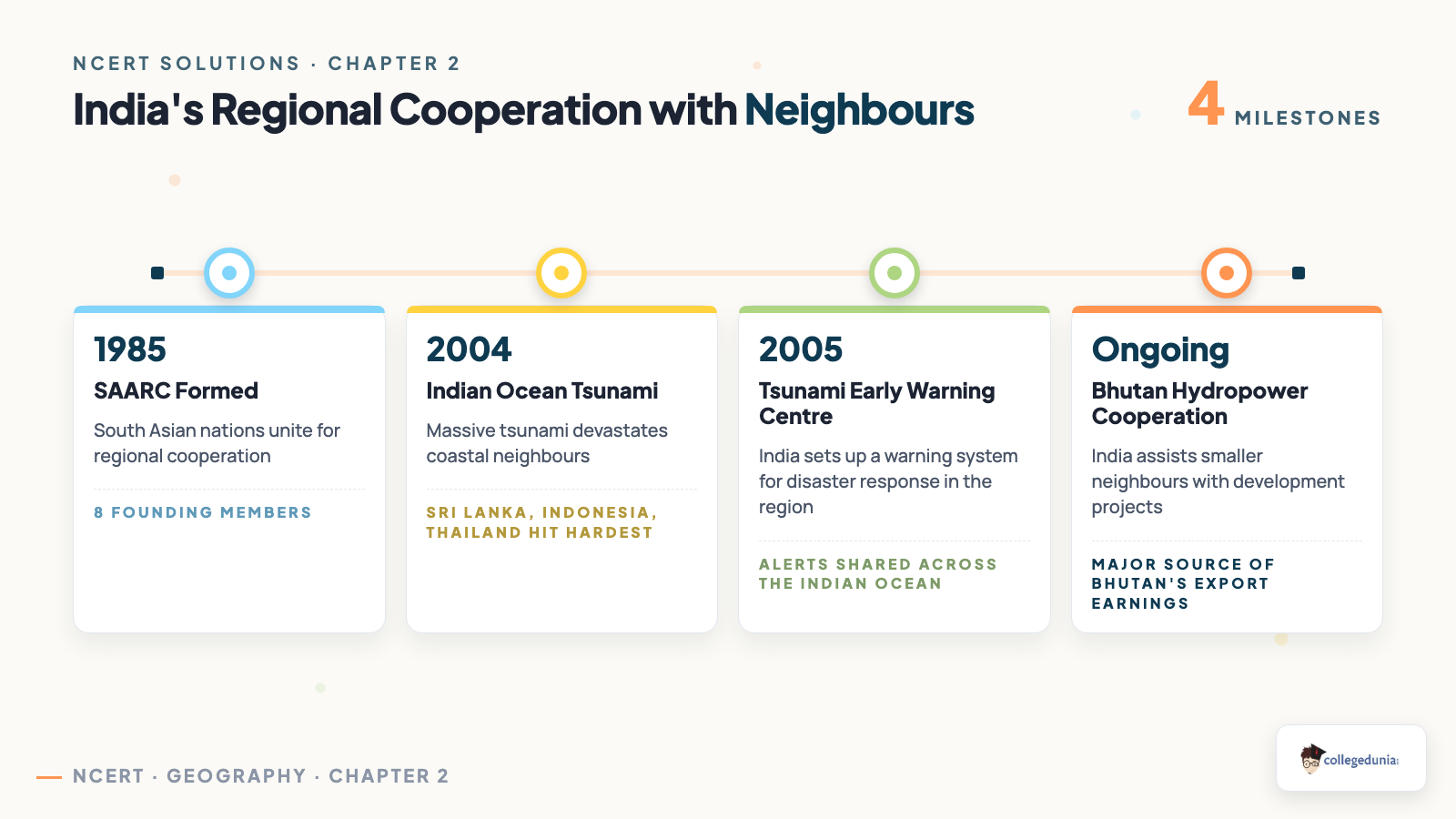
The chapter introduces regionalism. This is the idea that neighbouring countries work together for shared peace, stability and progress, not just to settle border disputes. India's central position in South Asia makes her a natural hub for this cooperation.
- SAARC (South Asian Association for Regional Cooperation) was formed in 1985 to promote science, education, health and economic cooperation among its members.
- Eight member countries: Afghanistan, Bangladesh, Bhutan, India, the Maldives, Nepal, Pakistan and Sri Lanka.
- The Indian Ocean carries about half the world's container ships, a third of its bulk cargo and two-thirds of its oil, connecting close to 2.7 billion people.
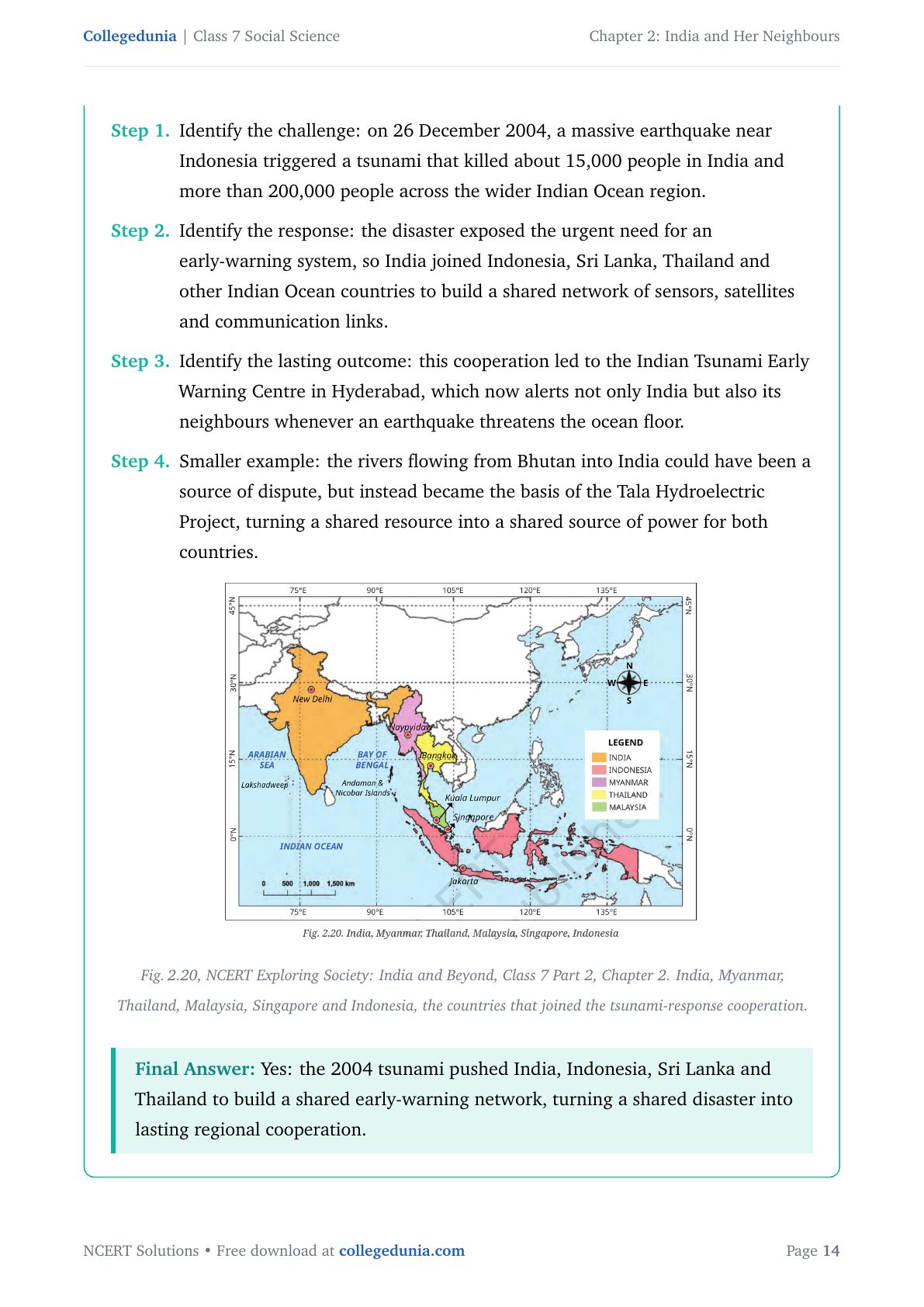
- Disaster relief is one of the clearest examples of regionalism, seen when India helped the Maldives during the 2004 tsunami and the 2014 Male water crisis.
Political tensions among some SAARC members often disrupt its work. This is a good example for Q6: shared challenges do not always turn into successful cooperation. The chapter wants students to notice both the successes and the limits.
India's Eight Maritime Neighbours Across the Indian Ocean
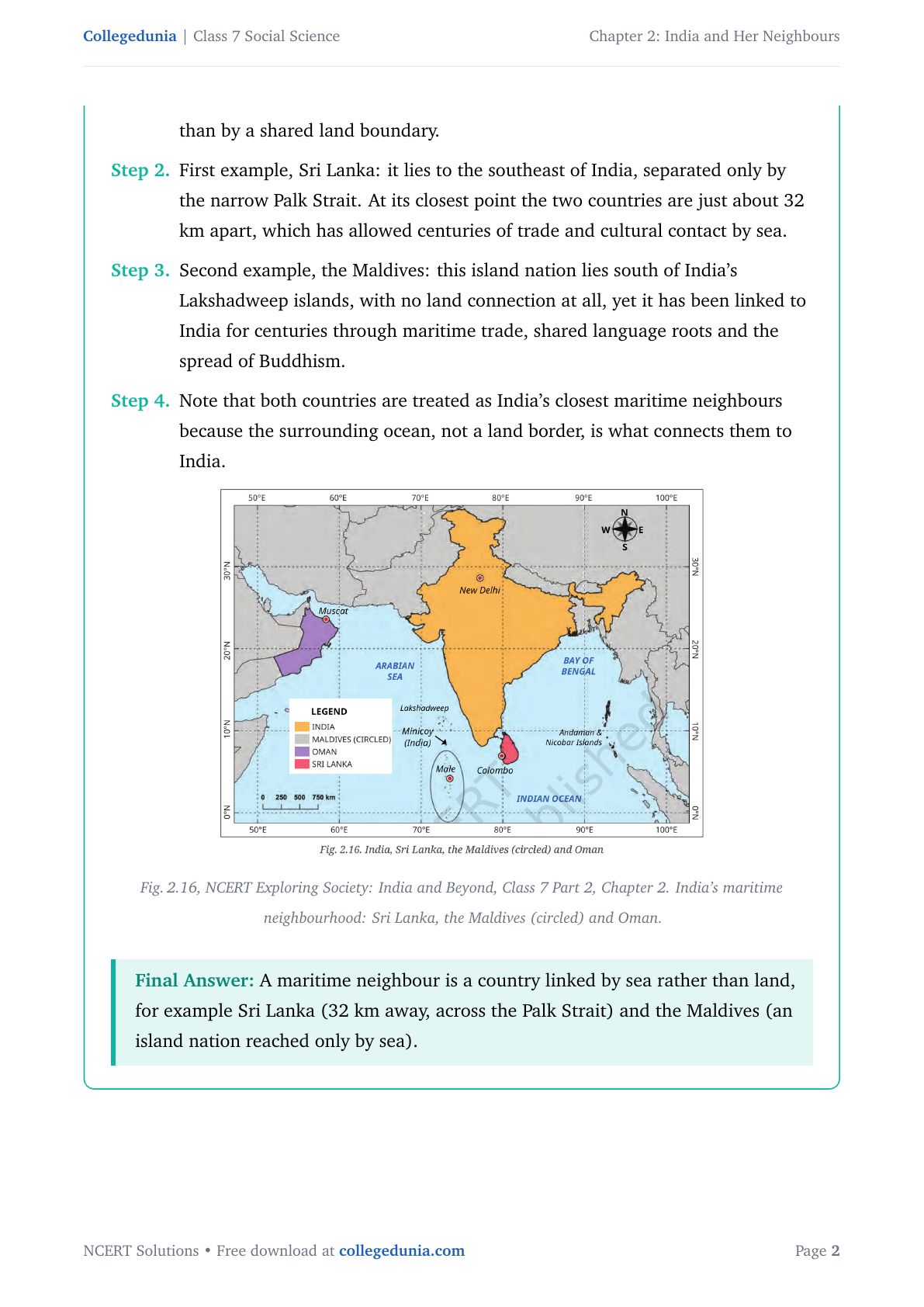
India is surrounded by sea on three sides. So the chapter treats maritime neighbours as seriously as land neighbours. A country does not need a shared land border to count. It only needs a link by sea trade, pilgrimage or history.
| Country | Link to India | One fact worth remembering |
|---|---|---|
| Sri Lanka | Separated by the Palk Strait, about 32 km at the nearest point | Ashoka's children Mahendra and Sanghamitra introduced Buddhism there in the 3rd century BCE |
| Maldives | About 130 km from Minicoy, Lakshadweep | India was among the first to recognise its 1965 independence and helped during the 2004 tsunami |
| Thailand | Shared maritime boundary in the Bay of Bengal | The Ayutthaya Kingdom, founded in 1351, was named after Ayodhya |
| Malaysia | Sea route across the Bay of Bengal | About 9% of Malaysians are of Indian origin, many descended from plantation workers |
| Singapore | Ancient maritime trade and Buddhist contact | Tamil is one of Singapore's four official languages |
| Indonesia | Separated by the Bay of Bengal and Andaman Sea | The Borobudur Stupa, built in the 8th and 9th centuries CE, is the world's largest Buddhist monument |
| Iran | Historic land and sea routes via Pakistan and Afghanistan | India is helping develop Iran's Chabahar Port for better access to Afghanistan and Central Asia |
| Oman | Maritime boundary across the Arabian Sea | Called the Land of Copper; ties with India date back over 5,000 years to Harappan trade |
Buddhism, Trade Routes and Shared Culture Across India's Neighbourhood
Cultural links explain why India calls so many far-off countries neighbours. Long before modern borders existed, ideas, religion and trade goods moved along a few famous routes. Questions on this section often ask you to connect a place name to its Indian root.
- The Uttarapatha linked the Ganga plains to Central Asia through Gandhara, carrying Buddhism, Hinduism, art and philosophy into Afghanistan.
- The Silk Route connected India with Iran and beyond, moving goods, language and ideas in both directions for centuries.
- Three schools of Buddhism, Theravada, Mahayana and Vajrayana, spread from India to Sri Lanka, Southeast Asia, China, Tibet and Bhutan in that order over roughly a thousand years.
- Place names borrowed from India show up across Southeast Asia, Dvaravati and Ayutthaya in Thailand echo Dvaraka and Ayodhya, and Singapore's name comes from the Sanskrit-rooted "Singapuram".
The chapter's closing message is simple. India spread her traditions peacefully, mostly through trade, pilgrimage and culture, not conquest. Modern projects like the India-Myanmar-Thailand Trilateral Highway try to revive these old links for today's trade and travel.
Common Mistakes Students Make in the India and Her Neighbours Chapter
Read this list before your next test. Each mistake below has cost real marks on Class 7 papers.
- Calling every neighbour a land neighbour. Sri Lanka, the Maldives, Thailand, Malaysia, Singapore, Indonesia, Iran and Oman are all maritime neighbours with no shared land border.
- Missing Ladakh or Sikkim when listing the Indian states and Union Territories that border China, since the full list has five entries.
- Confusing Kartarpur Corridor facts, writing that it needs a visa when the chapter clearly states it only needs a permit.
- Treating SAARC and regionalism as the same thing. SAARC is one regional organisation; regionalism is the broader idea of neighbours cooperating for shared progress.
- Forgetting the "why" behind a fact, such as naming the Sundarban National Park without explaining that it is a UNESCO site jointly managed by India and Bangladesh.
Student Feedback: In a Collegedunia survey of 10,540 Class 7 students, 58% named telling land neighbours apart from maritime neighbours as the hardest part of this chapter. Students who scored well shared one habit that helped. They drew a quick blank map and marked each country "land" or "sea" before writing any answer.
Source: 2026-27 Class 7 Social Science student survey. Sample of 10,540 students from CBSE schools across 14 states.
How to Study India and Her Neighbours Effectively
This chapter covers 15 countries in one go, so a single reading rarely sticks. Split your revision into short blocks. Draw the map more than once instead of trying to memorise everything at once.
- Block 1, 25 minutes. Read Framing the Neighbourhood and note the three Big Questions along with India's land and sea boundary figures.
- Block 2, 35 minutes. Learn the seven land neighbours table, focusing on border states and one fact per country.
- Block 3, 35 minutes. Learn the eight maritime neighbours table along with SAARC and the Buddhism and trade route section.
- Night before, 20 minutes. Re-read the Common Mistakes list, then attempt Q1, Q3 and Q5 from memory and check them against the solutions PDF.
Short on time? The India and Her Neighbours Class 7 Important Questions to focus on first are Q1, Q3 and Q5. Together they cover a definition, an explanation and a reasoning-based answer.
More India and Her Neighbours Class 7 Resources
Also Check: the same chapter is available in other formats on Collegedunia. Read the solutions first, then the notes for a deeper topic walk-through.
| Resource | Best used for | Open it |
|---|---|---|
| NCERT Notes | Topic-by-topic summary of India's land and maritime neighbours | India and Her Neighbours Class 7 Notes (coming soon) |
| NCERT Book PDF | The official 2026-27 chapter text with all figures and maps | Class 7 Social Science Part 2 Chapter 2 Book PDF |
| Handwritten Notes | Quick one-sitting revision in clear handwriting | India and Her Neighbours Class 7 Handwritten Notes |
The NCERT Solutions Class 7 Social Science Chapter 2 India and Her Neighbours page pairs well with the Notes and the Book PDF above. Use the solutions first for exam-ready answers. Then use the Book PDF to revisit the original maps and figures.
NCERT Solutions for Class 7 Social Science Part 2: All Chapters
The table below lists NCERT Solutions for every chapter of Part 2. Move to the next chapter once this one is done.
| Chapter | Resource |
|---|---|
| Chapter 1 | The Story of Indian Farming Class 7 NCERT Solutions |
| Chapter 2 | India and Her Neighbours Class 7 NCERT Solutions |
| Chapter 3 | Empires and Kingdoms 6th to 10th Centuries Class 7 NCERT Solutions (coming soon) |
| Chapter 4 | Turning Tides 11th and 12th Centuries Class 7 NCERT Solutions (coming soon) |
| Chapter 5 | India, a Home to Many Class 7 NCERT Solutions (coming soon) |
| Chapter 6 | The State, the Government, and You Class 7 NCERT Solutions (coming soon) |
| Chapter 7 | Infrastructure, Engine of India's Development Class 7 NCERT Solutions (coming soon) |
| Chapter 8 | Banks and the Magic of Finance Class 7 NCERT Solutions (coming soon) |
India and Her Neighbours Class 7 NCERT Solutions FAQs
Questions Students Ask About India and Her Neighbours Solutions
Ques. Where can I download the India and Her Neighbours Class 7 NCERT Solutions PDF?
Ans. Use the download option at the top of this page. The Class 7 Social Science Chapter 2 India and Her Neighbours NCERT Solutions PDF is free, covers all 8 questions and the map-based activity from the chapter, and is available in both Normal and HD quality.
Ques. What are the Big Questions India and Her Neighbours Chapter 2 opens with?
Ans. The chapter opens with three Big Questions: what defines a neighbour, how geography and history shape India's relationships with her neighbours, and how India and her neighbours stay interconnected today. Most exam answers score better when they link back to one of these three ideas.
Ques. What is a maritime neighbour?
Ans. A maritime neighbour is a country connected to another by a shared sea or ocean, even without a direct land border. For India, Sri Lanka and the Maldives are the closest examples, along with farther maritime neighbours such as Thailand, Indonesia and Oman.
Ques. Who are India's seven land neighbours?
Ans. India's seven land-based neighbours, as covered in this chapter, are China, Pakistan, Bangladesh, Nepal, Bhutan, Myanmar and Afghanistan. Each shares a land border with specific Indian states or Union Territories, except Afghanistan, which lost its direct land link after Pakistan was created in 1947.
Ques. What is regionalism, and why does the chapter mention it?
Ans. Regionalism is when neighbouring countries work together for shared peace, stability and progress rather than only focusing on borders. The chapter uses India's role in disaster relief and trade to show how regionalism benefits an entire region, not just one country.
Ques. What are India's maritime neighbours, according to the chapter?
Ans. The chapter covers eight maritime neighbours: Sri Lanka, the Maldives, Thailand, Malaysia, Singapore, Indonesia, Iran and Oman. Each is linked to India by sea trade, pilgrimage routes or shared history rather than a land border.
Ques. What is the Kartarpur Corridor?
Ans. The Kartarpur Corridor is a visa-free border crossing between India and Pakistan that lets Indian pilgrims visit the Gurdwara Darbar Sahib in Kartarpur using only a permit. It opened in 2019 to mark Guru Nanak Dev's 550th birth anniversary.
Ques. How did Buddhism create links between India and her neighbours?
Ans. Buddhism spread from India through monks, traders and pilgrims to countries such as China, Sri Lanka, Thailand, Myanmar and Bhutan. Its three schools, Theravada, Mahayana and Vajrayana, travelled along land and sea routes, leaving behind shared shrines, art and festivals still visible today.
Ques. What does the India-Nepal open border policy mean?
Ans. An open border means citizens of India and Nepal can cross without a visa or passport. It lets border families access education, healthcare, employment and trade easily, and it rests on the 1950 Treaty of Peace and Friendship between the two countries.
Ques. Why does the chapter say "Being neighbours is not just about geography"?
Ans. Because countries like Sri Lanka, the Maldives and Oman have no shared land border with India but are still considered close neighbours through sea trade, Buddhism, migration and history. Geography starts a relationship, but culture, trade and cooperation are what keep it strong.
Ques. What is SAARC and which countries are its members?
Ans. SAARC, the South Asian Association for Regional Cooperation, was formed in 1985 to promote shared progress in science, education, health and the economy. Its eight members are Afghanistan, Bangladesh, Bhutan, India, the Maldives, Nepal, Pakistan and Sri Lanka.
Ques. Is this NCERT Solutions PDF aligned with the 2026-27 syllabus?
Ans. Yes. This page follows the current 2026-27 edition of Exploring Society: India and Beyond, Grade 7 Part 2, and every answer matches the chapter content and question order printed in that edition.
Ques. How many questions are in the India and Her Neighbours chapter, and what types are they?
Ans. The chapter has 8 questions in total. Questions 1 to 7 are short-answer, explanatory or reflective, while Question 8 is a map-based classroom activity with four separate parts covering labelling, cultural-flow arrows and flags.



Comments