




The Class 8 Mathematics Notes for A Square and A Cube bring together every pattern, root-finding method, and historical fact that the CBSE Class 8 exam actually tests.
- CBSE Weightage: 6-8 marks, tested through MCQs, short-answer patterns and one root-finding question.
- Chapter Length: 21-page notes PDF covering square numbers, cube numbers, and both root-finding methods.
- Cross-check: Pairs well with the Class 8 Maths Part 1 Rational Numbers and Powers chapters for number-sense practice.
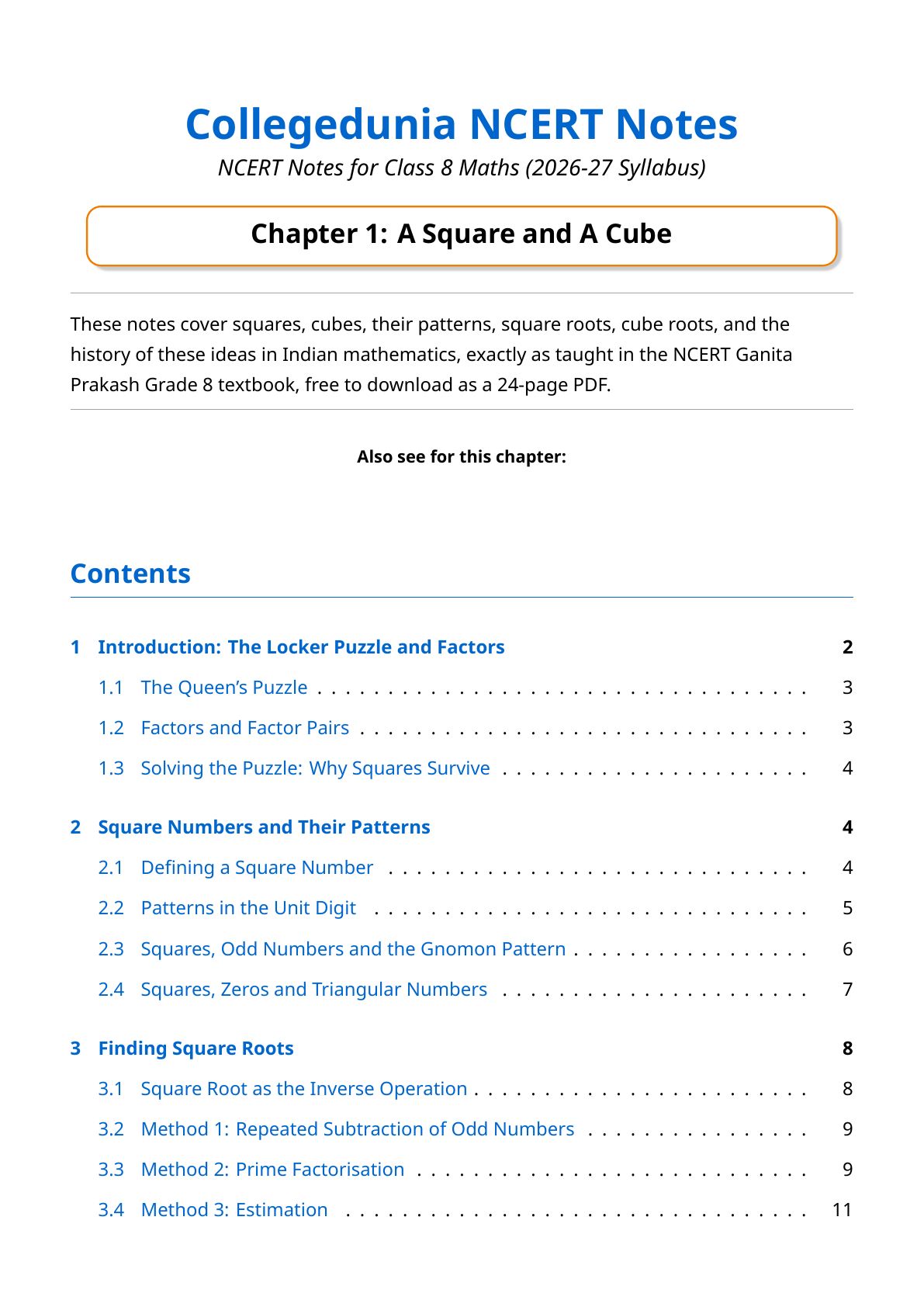
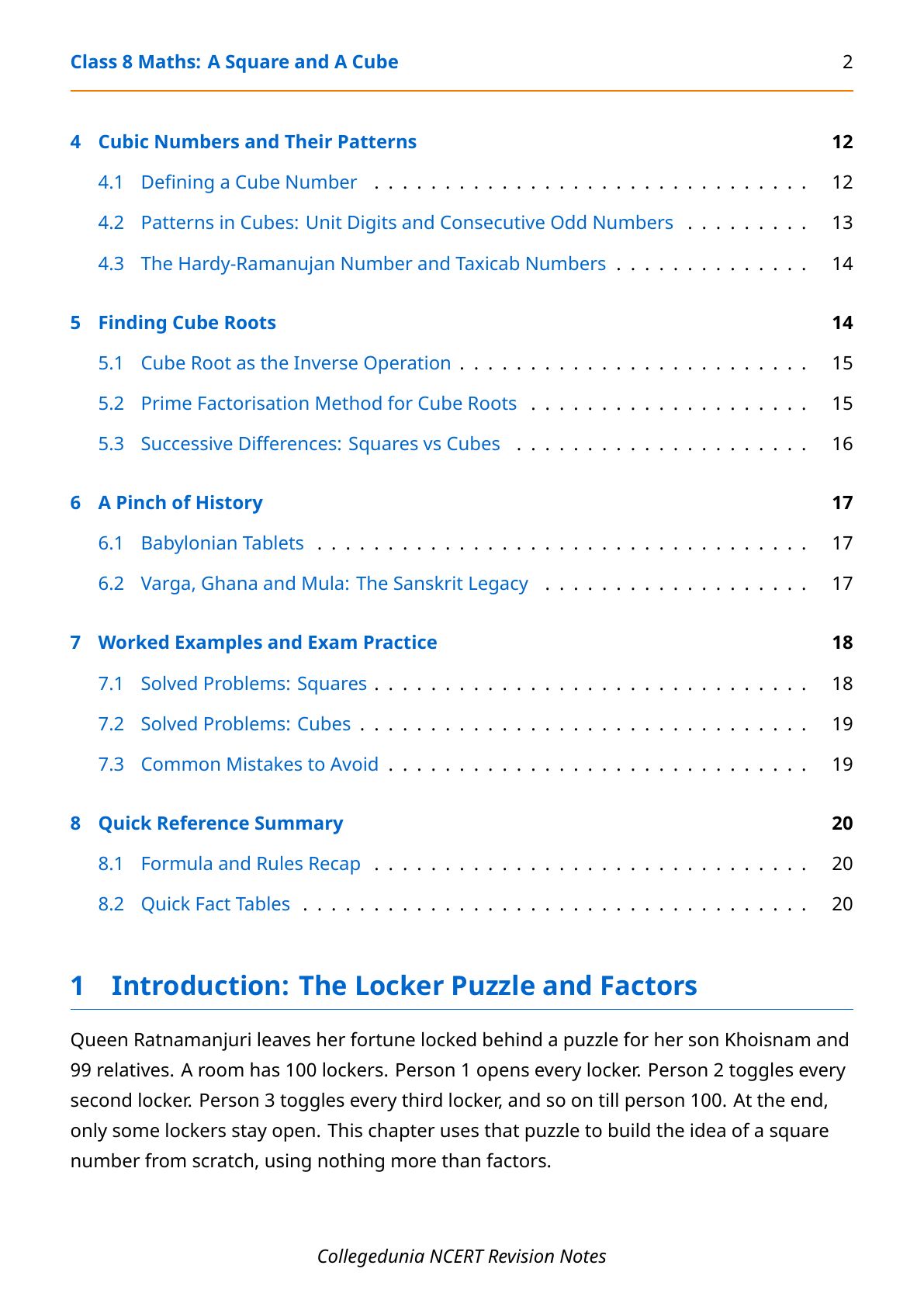
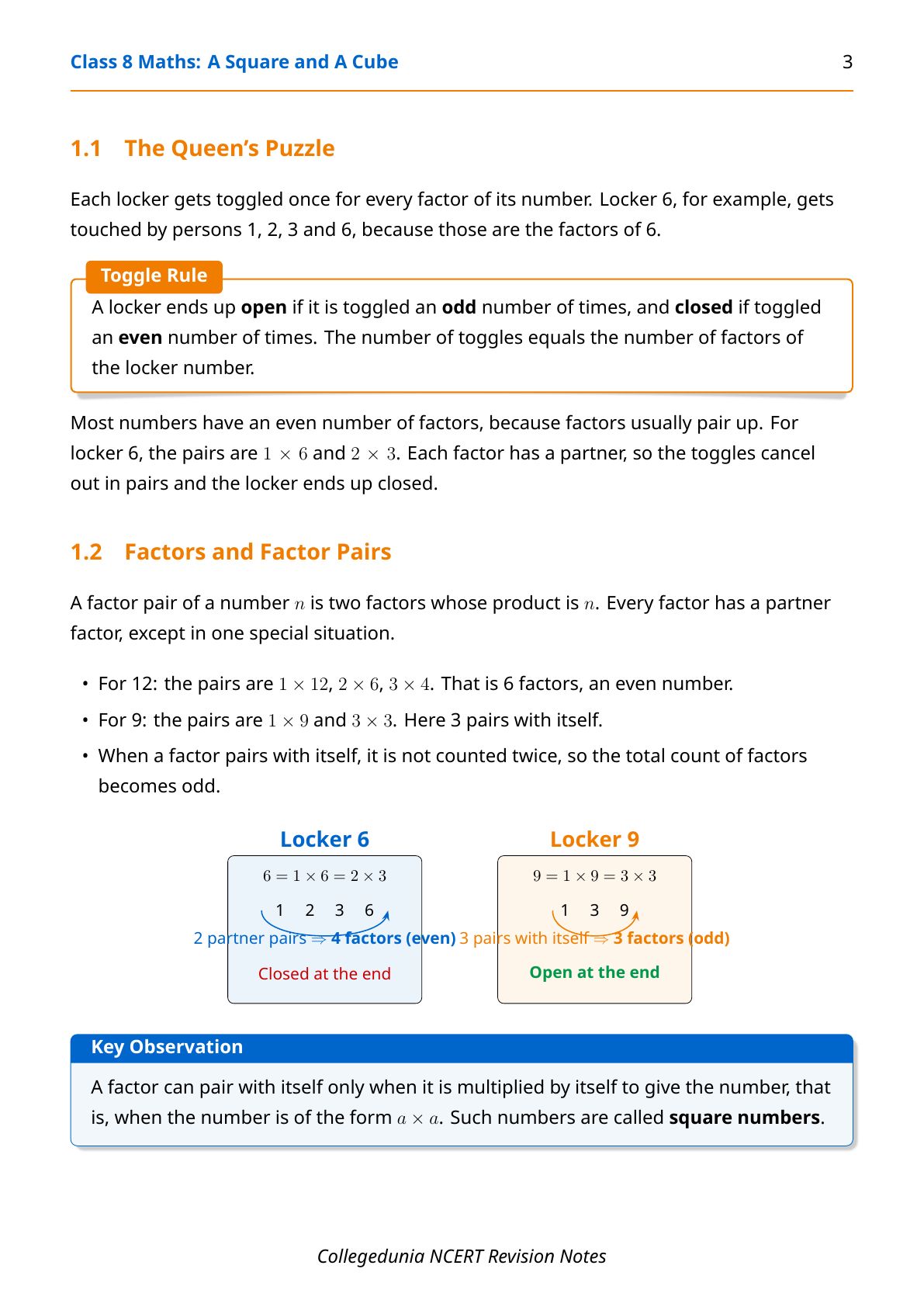
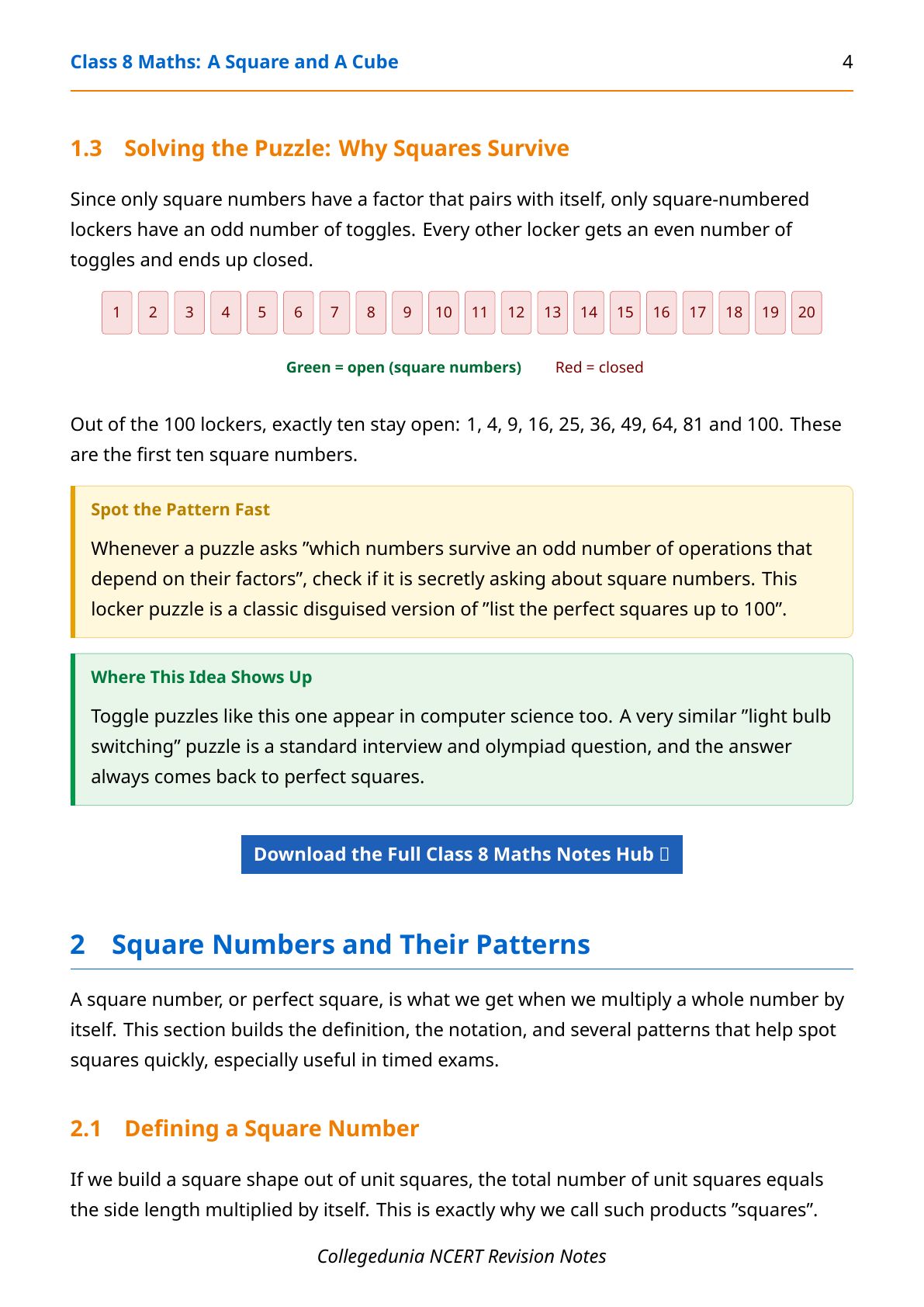
These Class 8 Mathematics notes for A Square and A Cube are curated by subject experts, according to the 2026-27 NCERT Ganita Prakash Part I textbook, and checked against the last five years of CBSE Class 8 question patterns.
Student Feedback
What 11,860 students told us about their A Square and A Cube revision journey: 68% of Class 8 students said estimating square roots (without a calculator) was the hardest part of this chapter, ahead of prime factorisation and the taxicab number story.
Source: 2026-27 Class 8 Mathematics student poll. Sample of 11,860 students from CBSE schools across 14 states, conducted before the 2026 boards.
|
Table of Contents |
What A Square and A Cube Covers in the 2026-27 NCERT
Chapter 1 of Ganita Prakash Part I opens with a locker-room puzzle and uses it to introduce square numbers and cube numbers as two related number families. From there, the chapter builds up patterns, root-finding methods, and a short history of how squares and cubes were named.
- Square numbers, cube numbers, and how to spot them from patterns
- Three methods to find a square root: repeated subtraction, prime factorisation, estimation
- The prime factorisation method to find a cube root
- The Hardy-Ramanujan taxicab number 1729
- The Sanskrit terms varga (square) and ghana (cube), and the Babylonian roots of mula (root)
Square Numbers and Number Patterns in A Square and A Cube
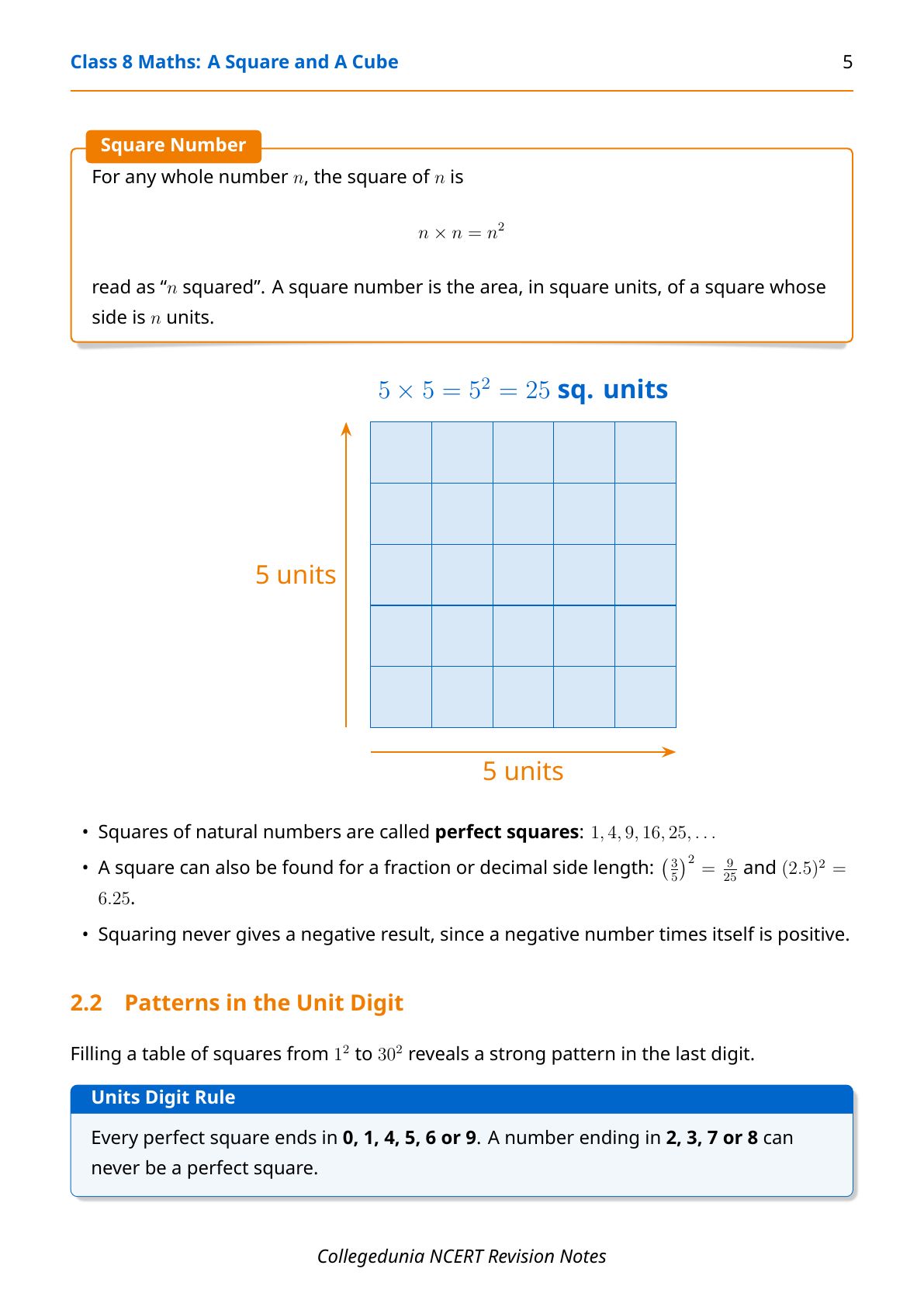
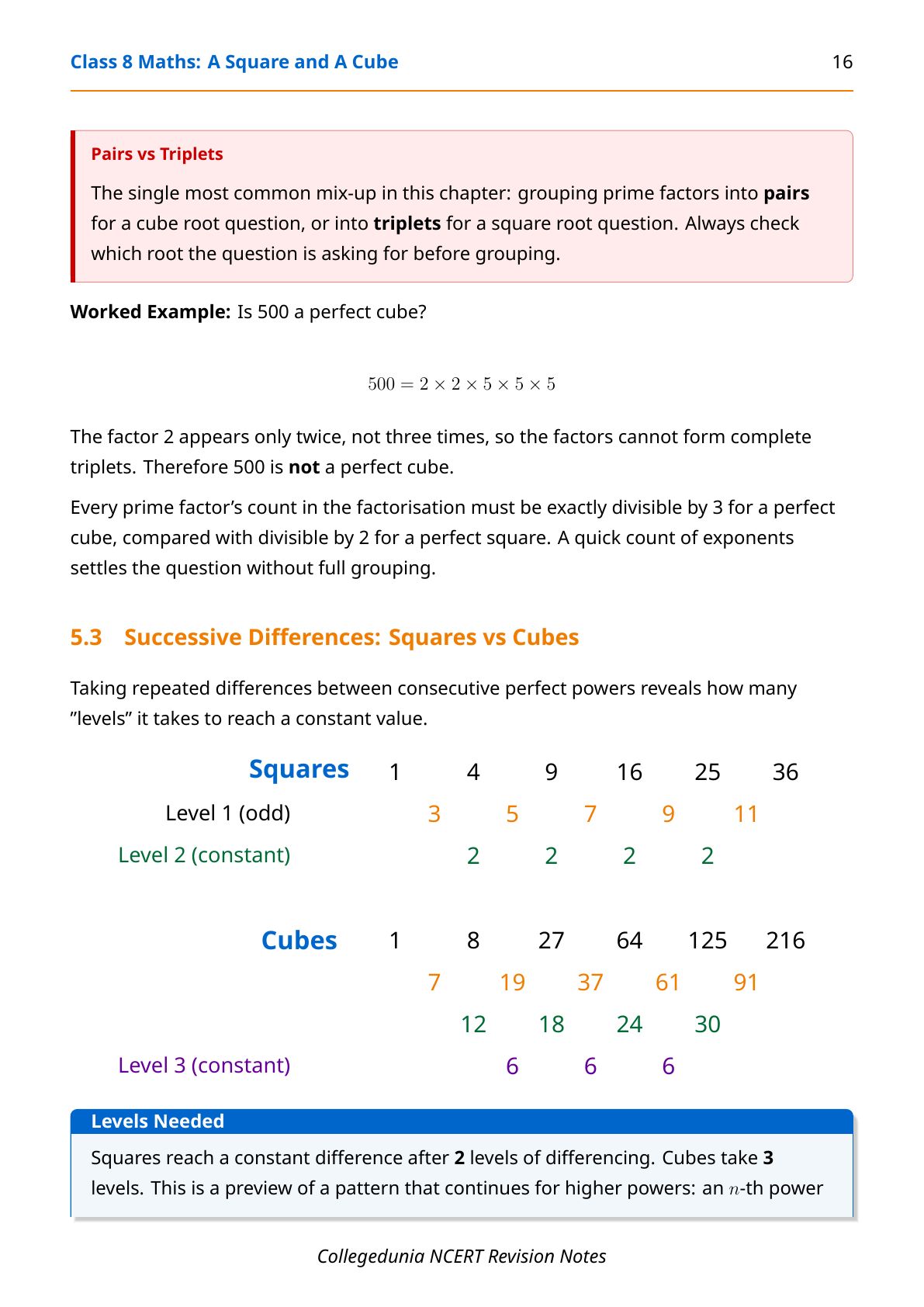
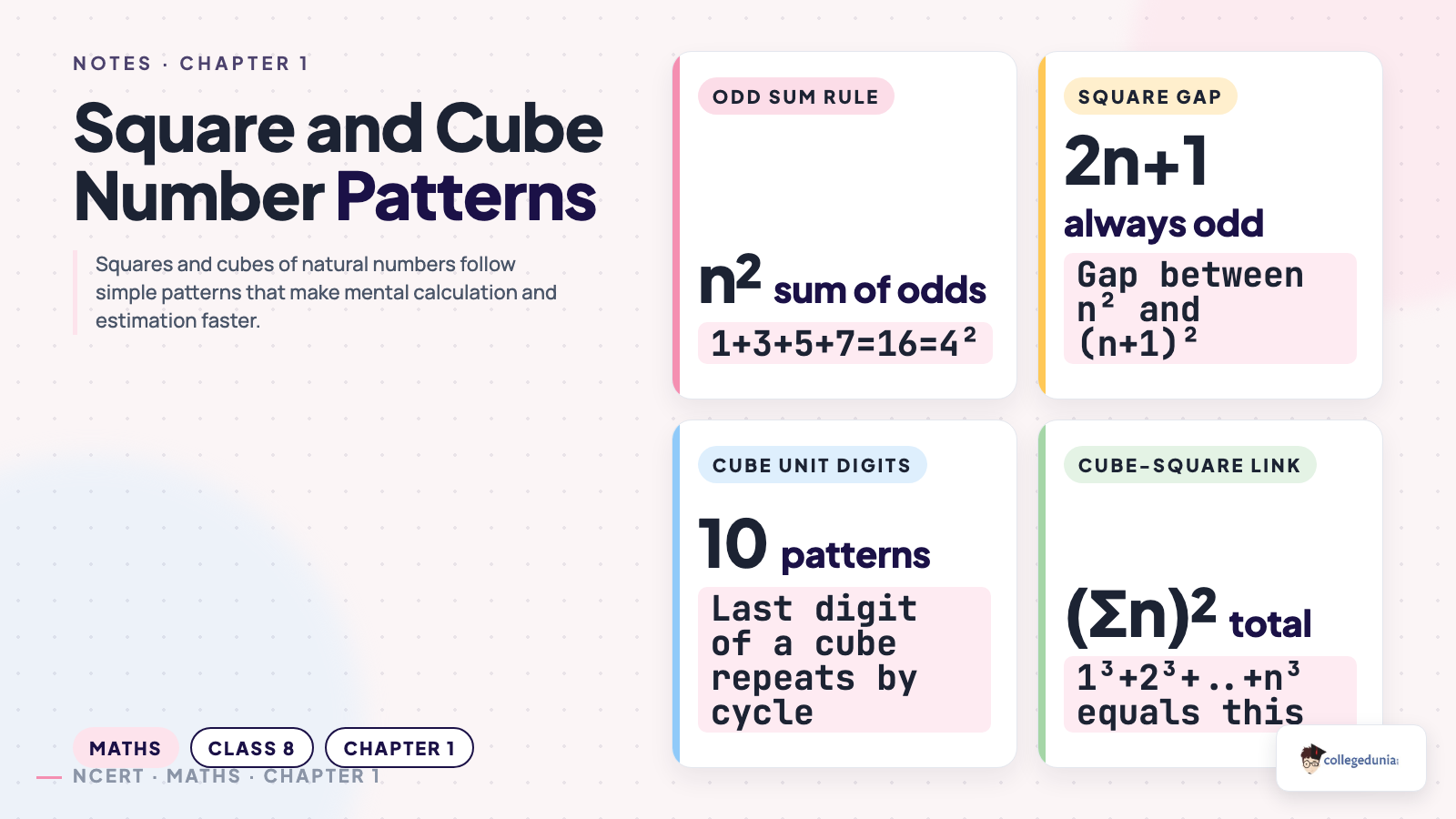
A square number is what you get when you multiply a whole number by itself. The notes lay out several patterns that make square numbers easy to spot and calculate without long multiplication.
| Pattern | Rule | Example |
|---|---|---|
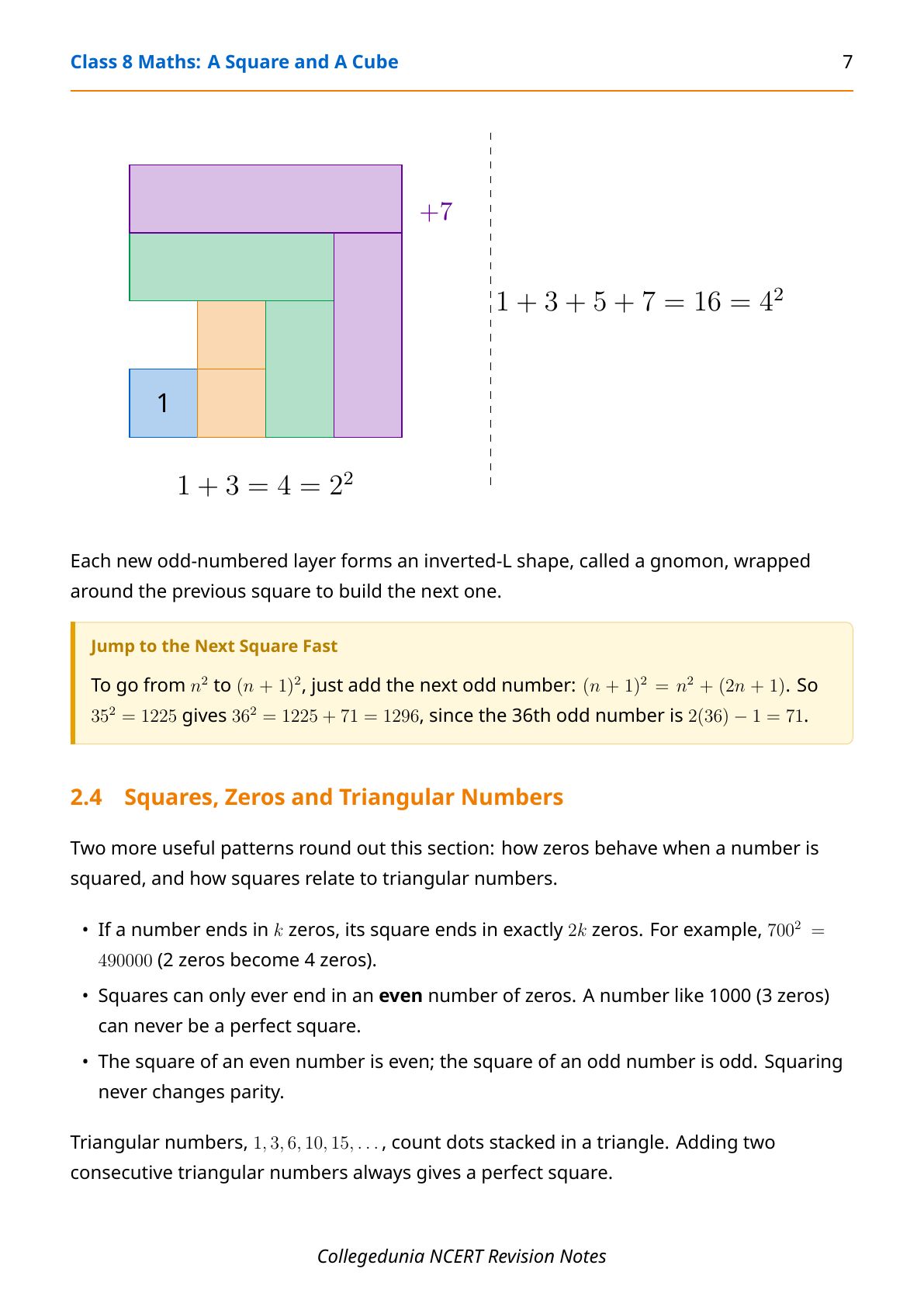
| Sum of consecutive odd numbers | Sum of first n odd numbers = n² | 1+3+5+7 = 16 = 4² |
| Gap between consecutive squares | (n+1)² - n² = 2n+1 | 6² - 5² = 11 |
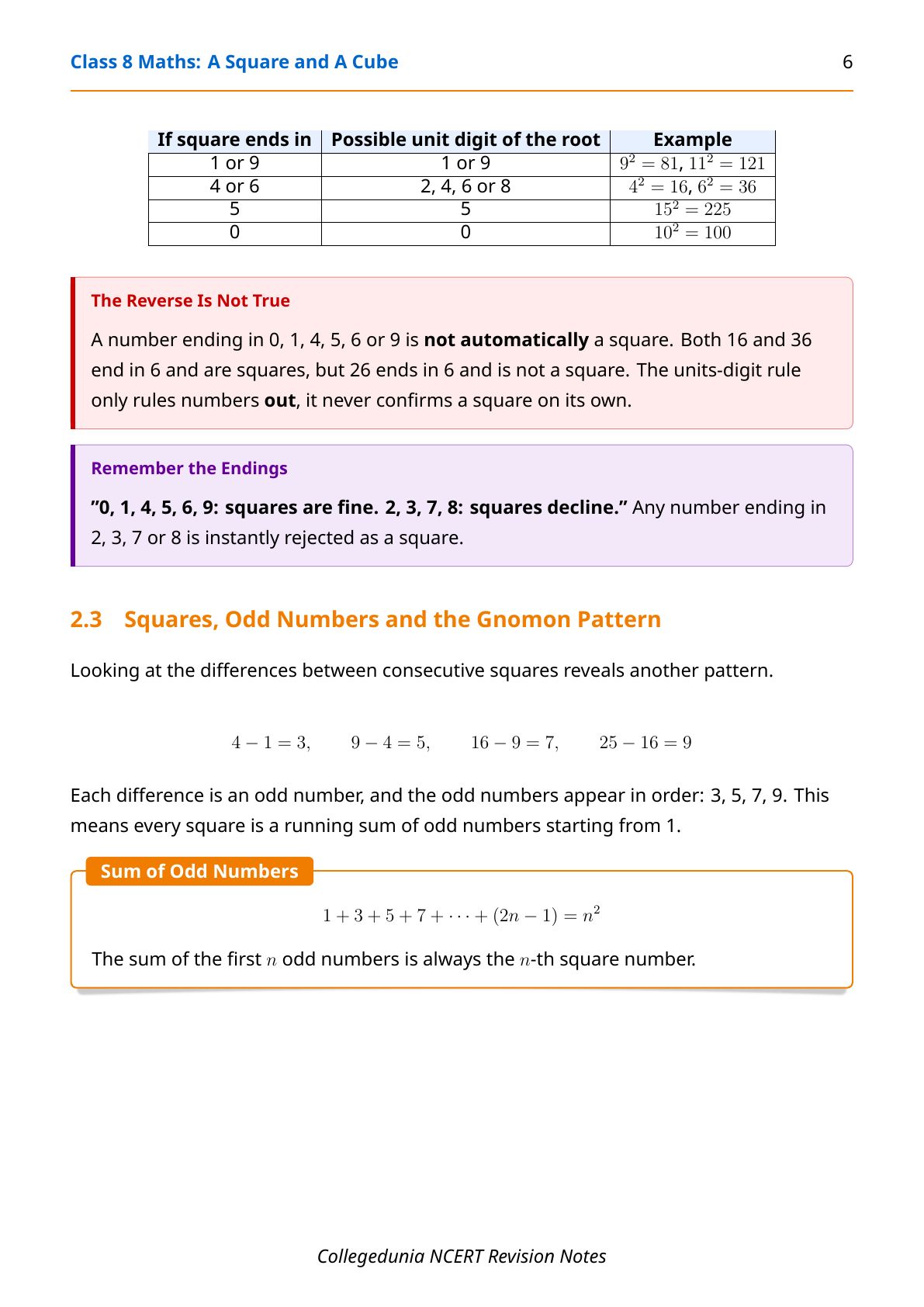
| Unit digit rule | Squares never end in 2, 3, 7 or 8 | 47² ends in 9, not 47's own digit |
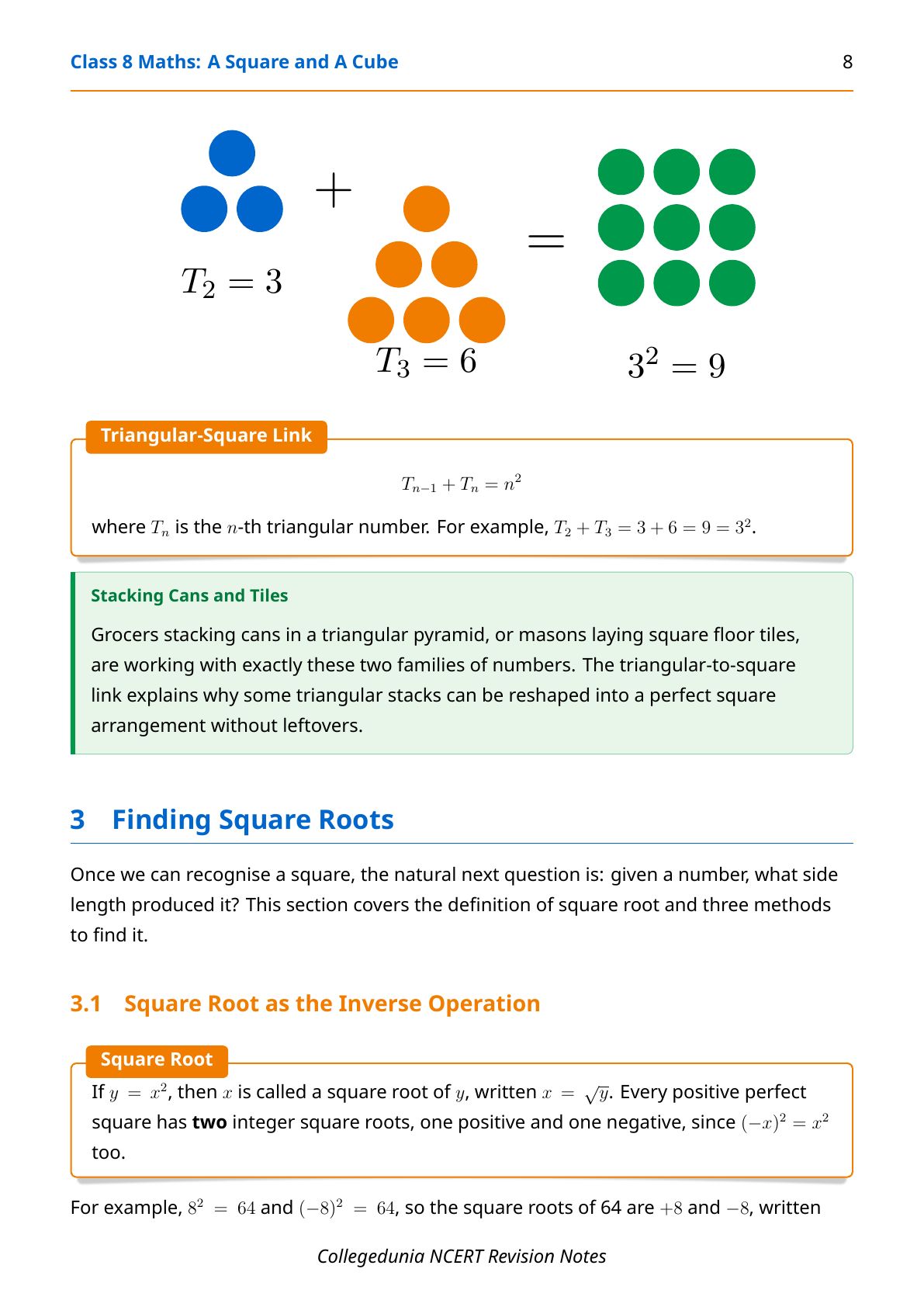
| Number of zeros | A square of a number ending in zeros always has an even count of zeros | 200² = 40000 (4 zeros) |
A Square and A Cube Explained for Class 8 Boards
Source: Learn With Mansi Juniors on YouTube
Cube Numbers and Patterns for Class 8 Boards
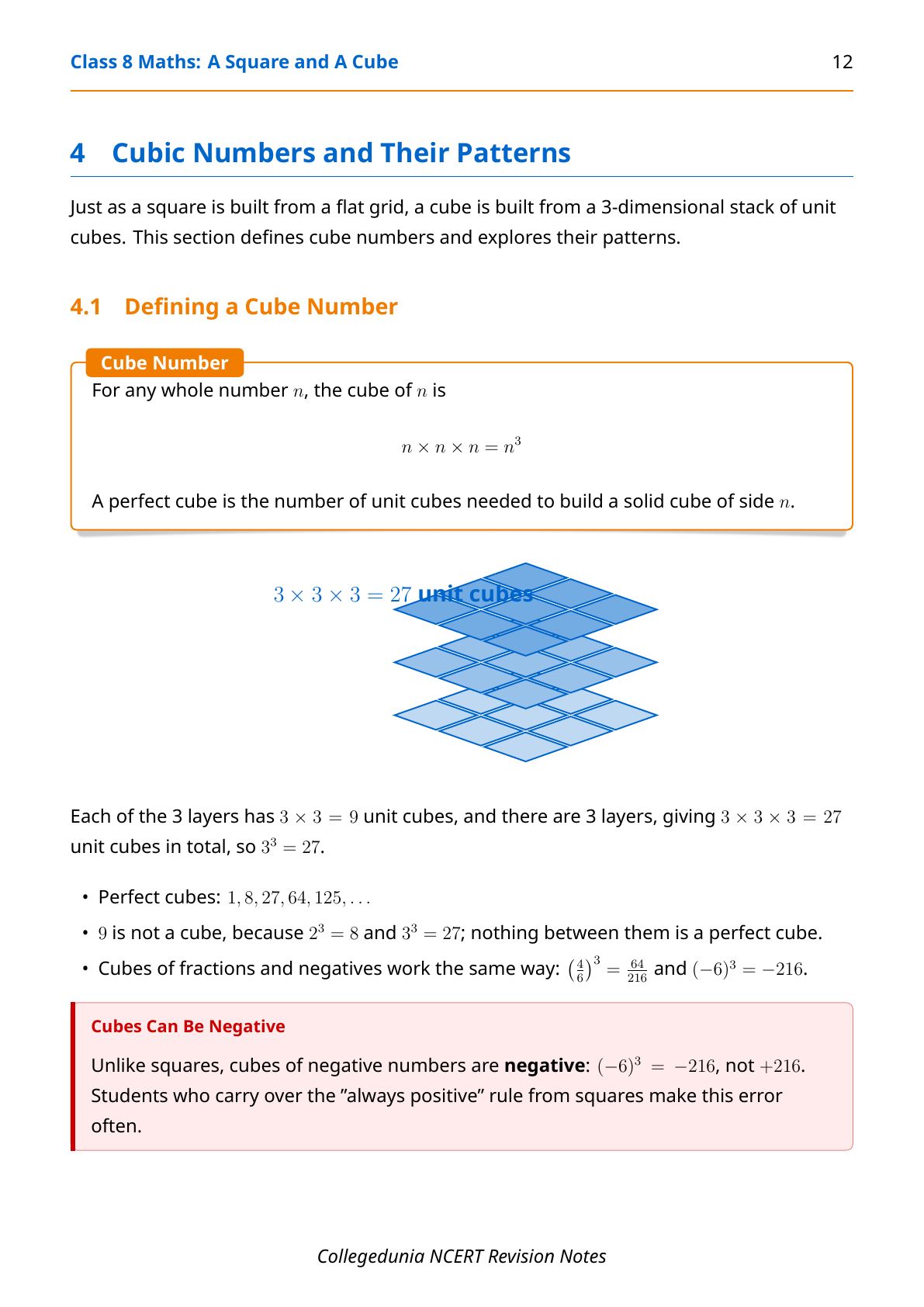
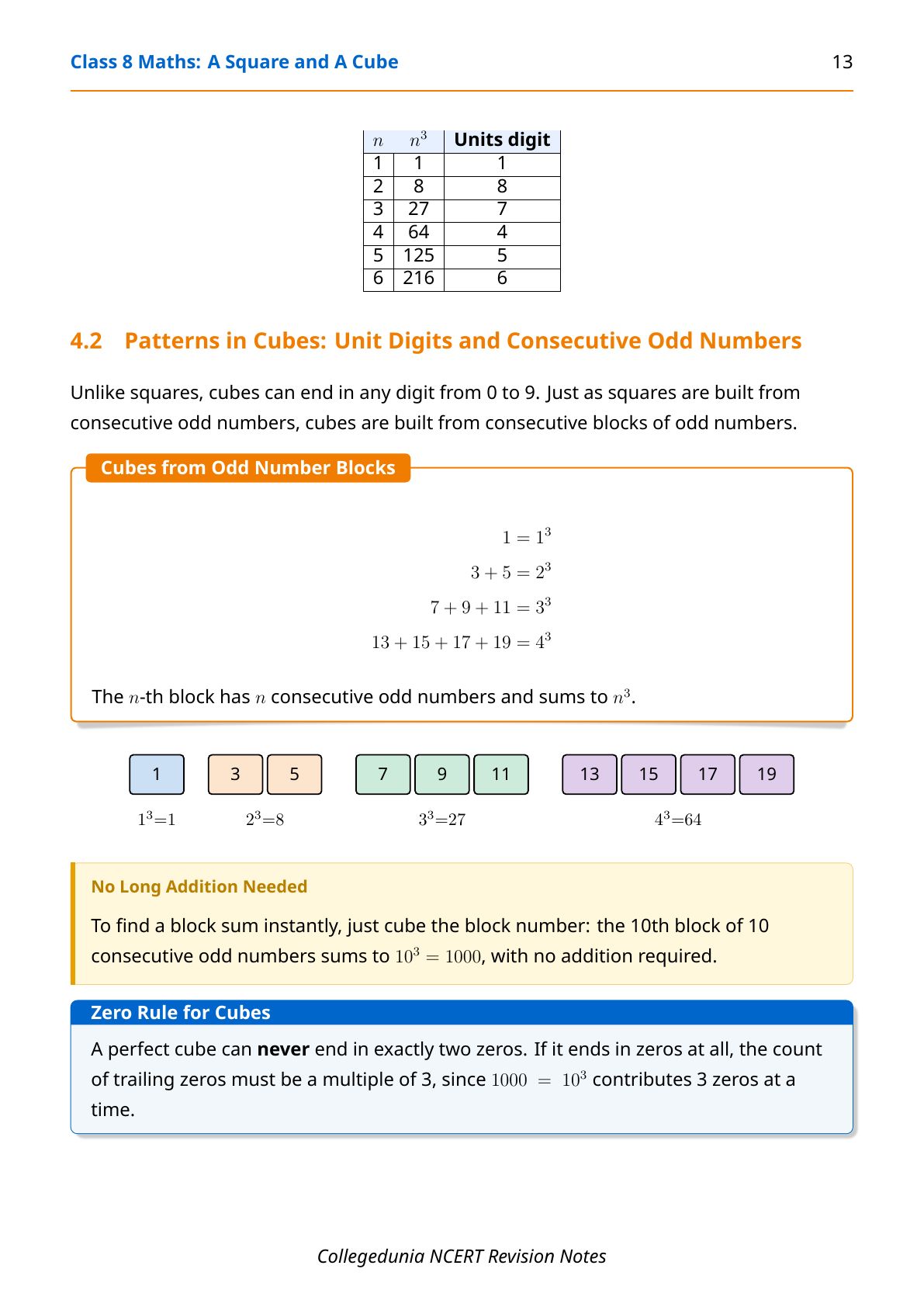
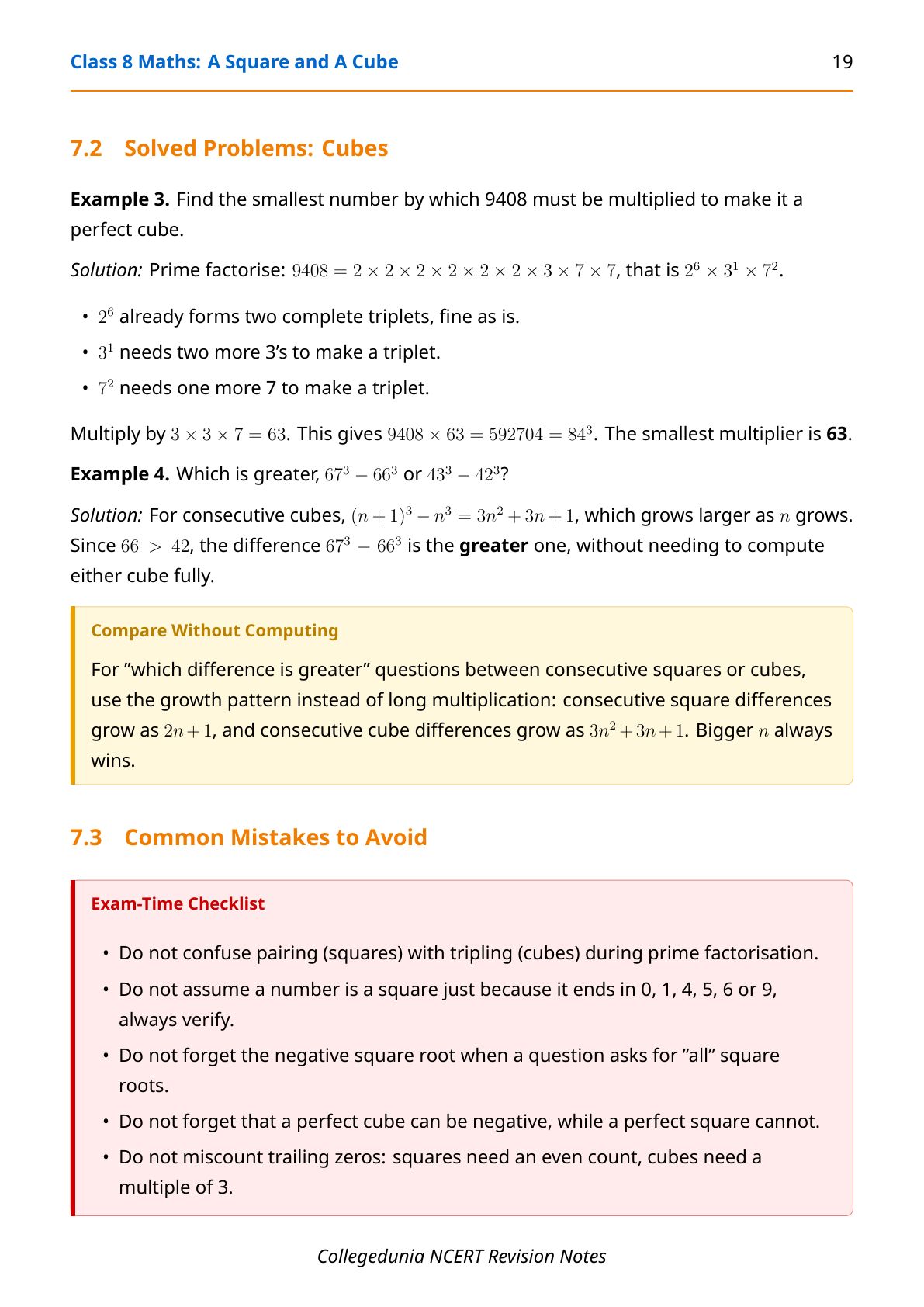
A cube number is a number multiplied by itself three times. Just like squares, cubes follow a repeating pattern in their last digit, which is a quick way to sanity-check an answer.
- The cube of a number ending in 1 always ends in 1 (11³ = 1331)
- The cube of a number ending in 4 always ends in 4 (14³ = 2744)
- Sum of the first n cubes equals the square of the sum of the first n numbers: 1³+2³+3³ = 36 = 6²
- Only 10 unit-digit outcomes are possible for any cube, one for each digit 0-9
These digit patterns matter most when you are asked to check whether a large number is a perfect cube without a calculator, which is a common CBSE question type for this chapter.
How to Find a Square Root in A Square and A Cube
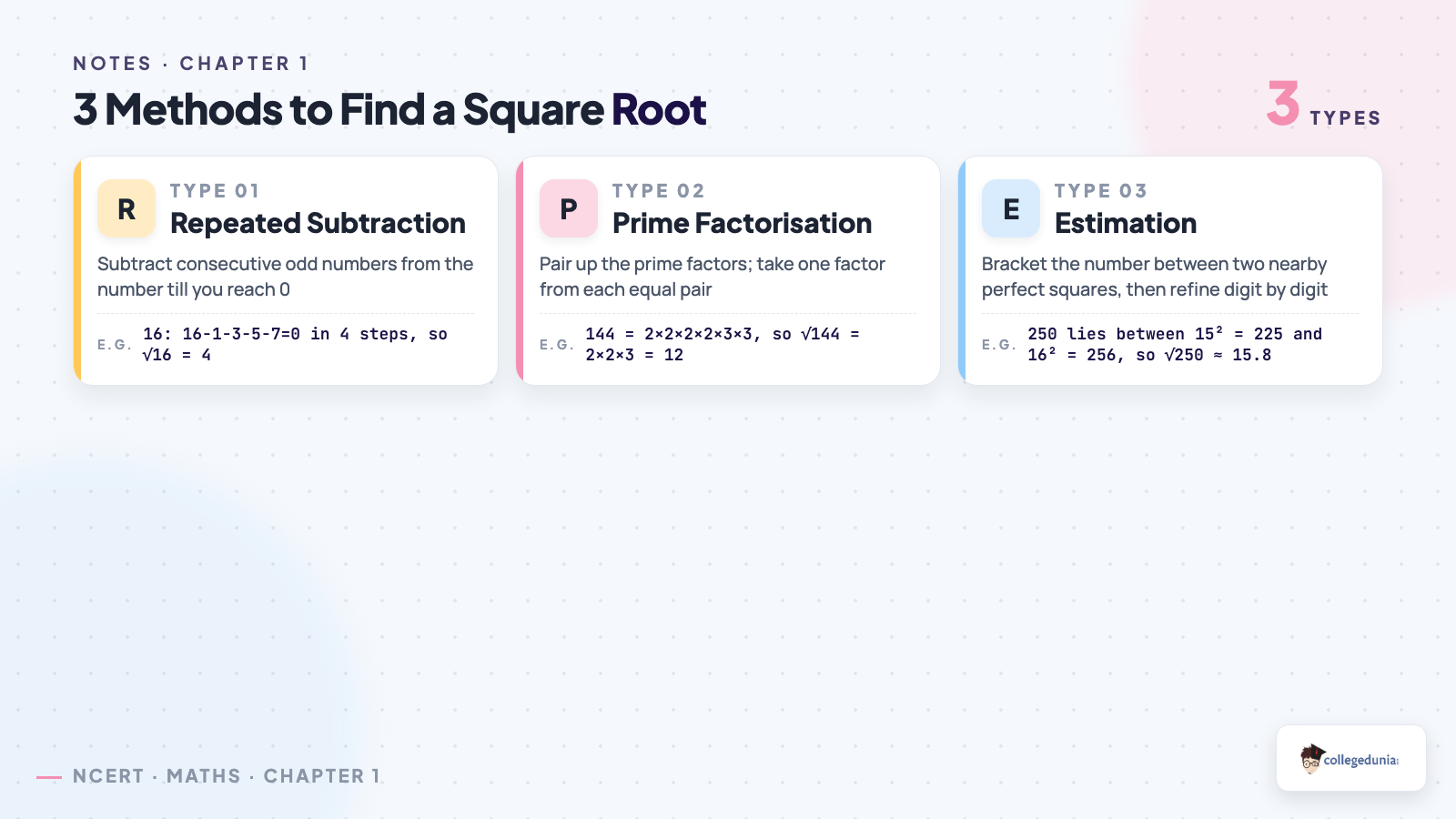
The notes teach three separate methods to find a square root, and the CBSE exam can ask you to use any one of them. Knowing when each method is fastest saves time in the exam.
| Method | Best used for | How it works |
|---|---|---|
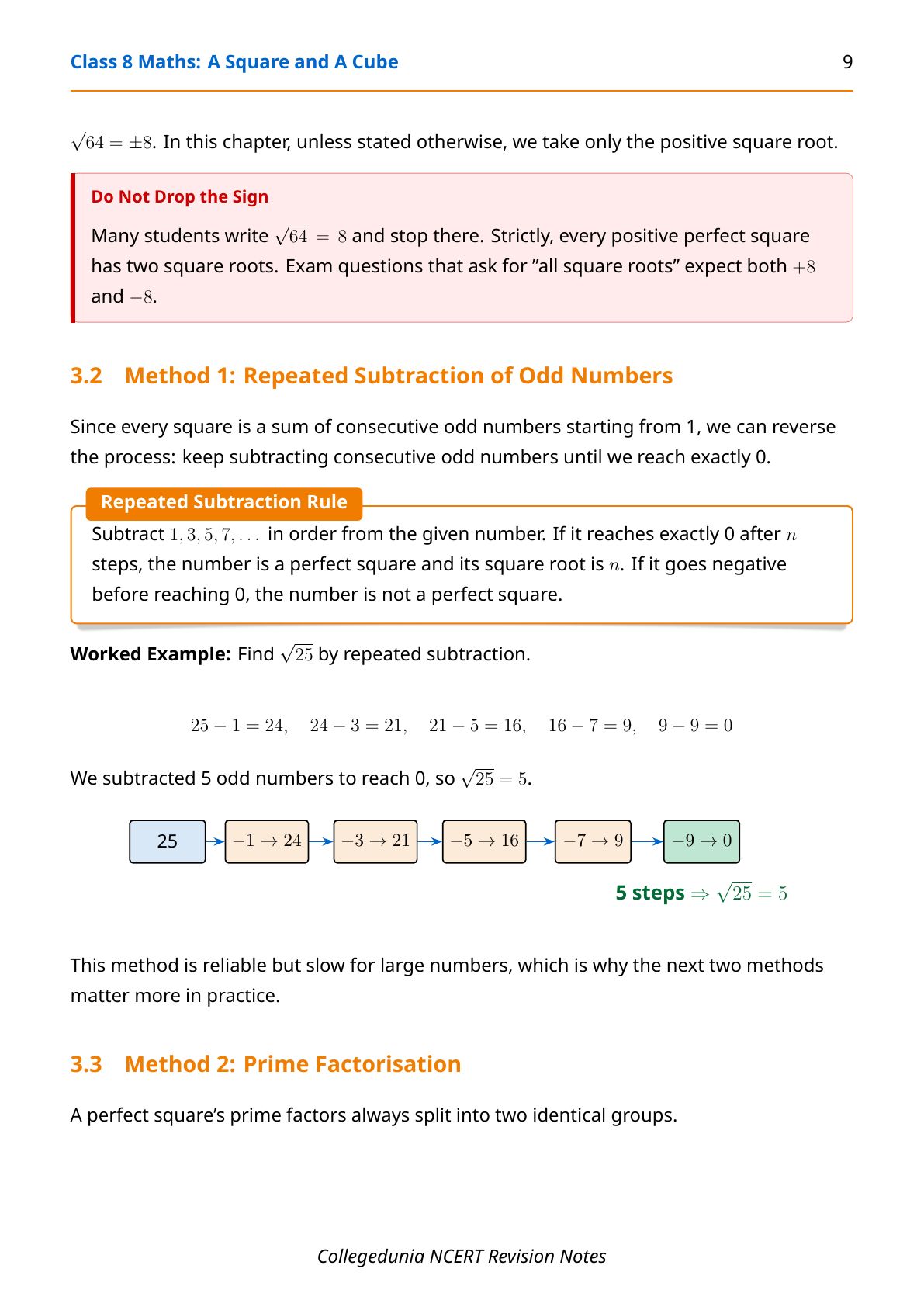
| Repeated Subtraction | Small perfect squares | Subtract consecutive odd numbers until you reach 0; the count of steps is the root |
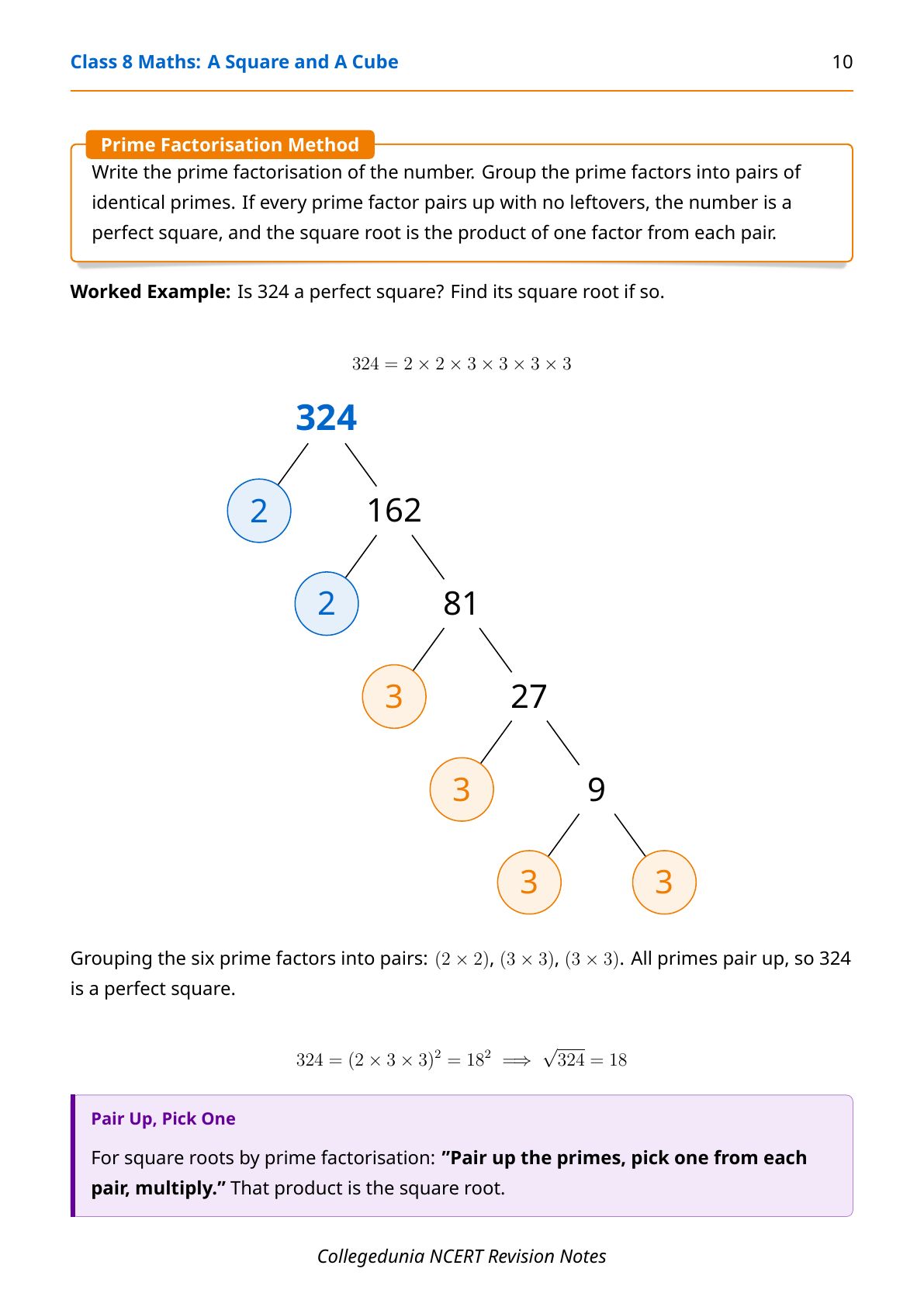
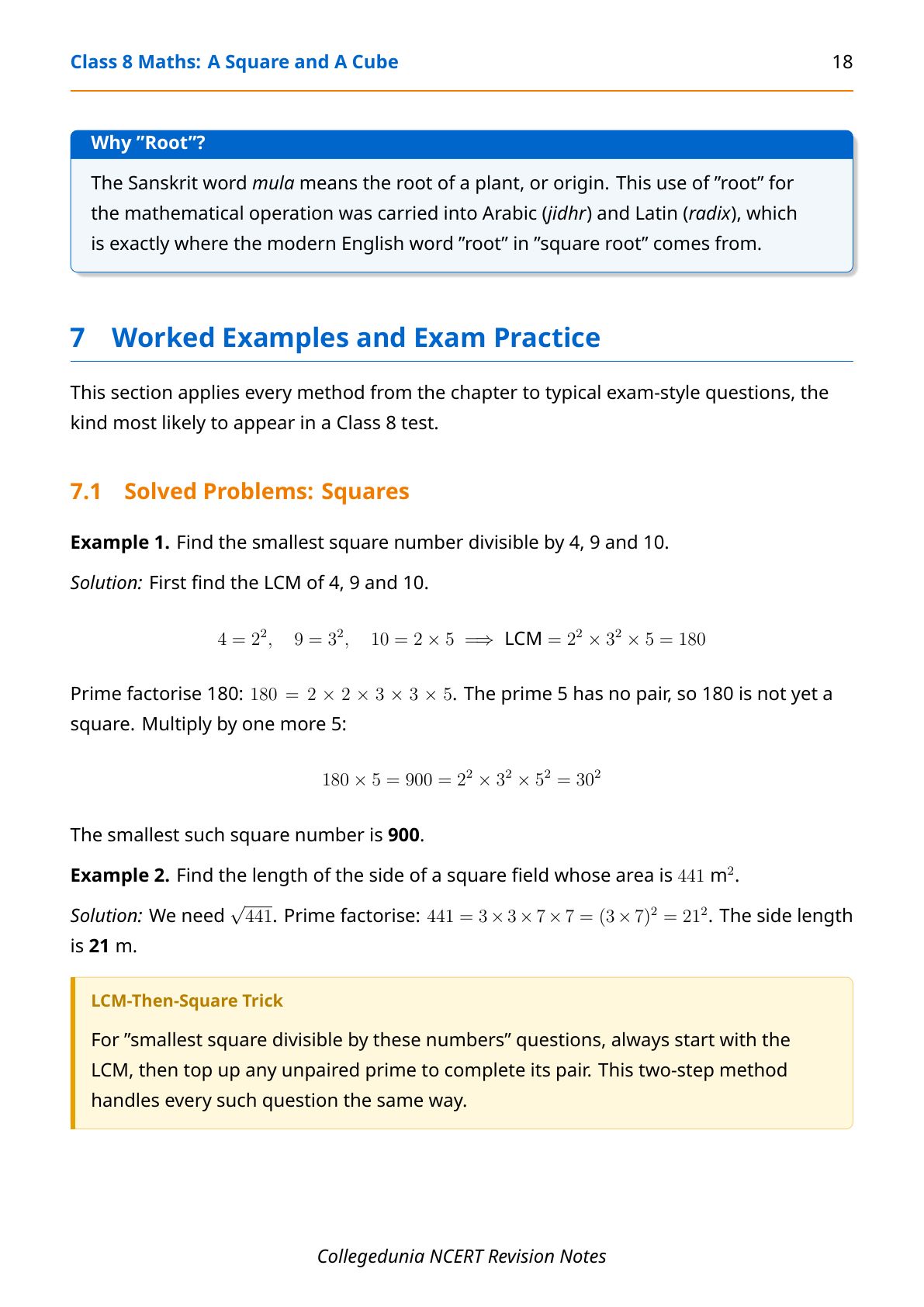
| Prime Factorisation | Any perfect square, especially large ones | Break the number into prime factors, pair them up, take one factor from each pair |
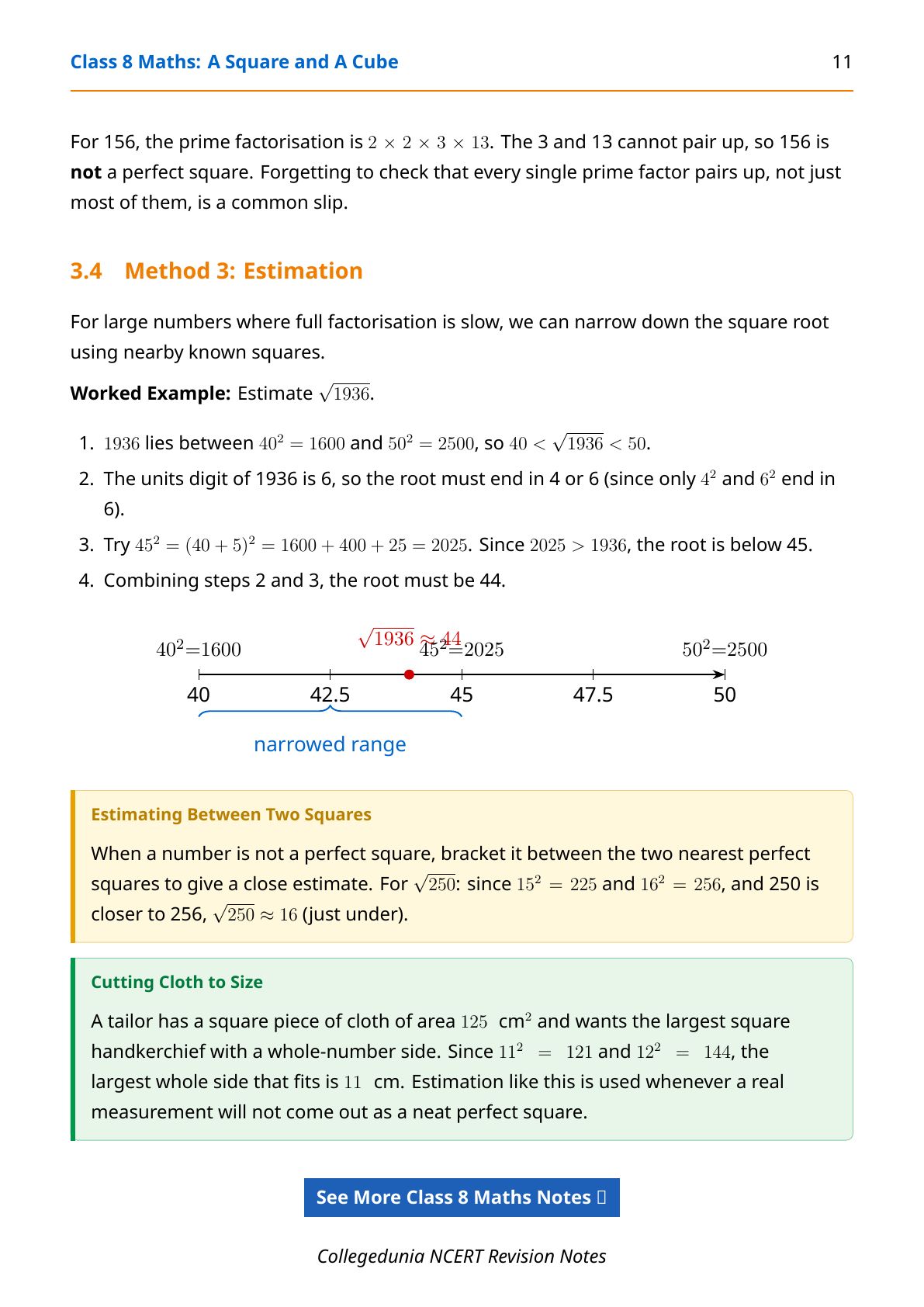
| Estimation | Numbers that are not perfect squares | Bracket the number between two known squares, then refine digit by digit |
How to Find a Cube Root for the A Square and A Cube Chapter
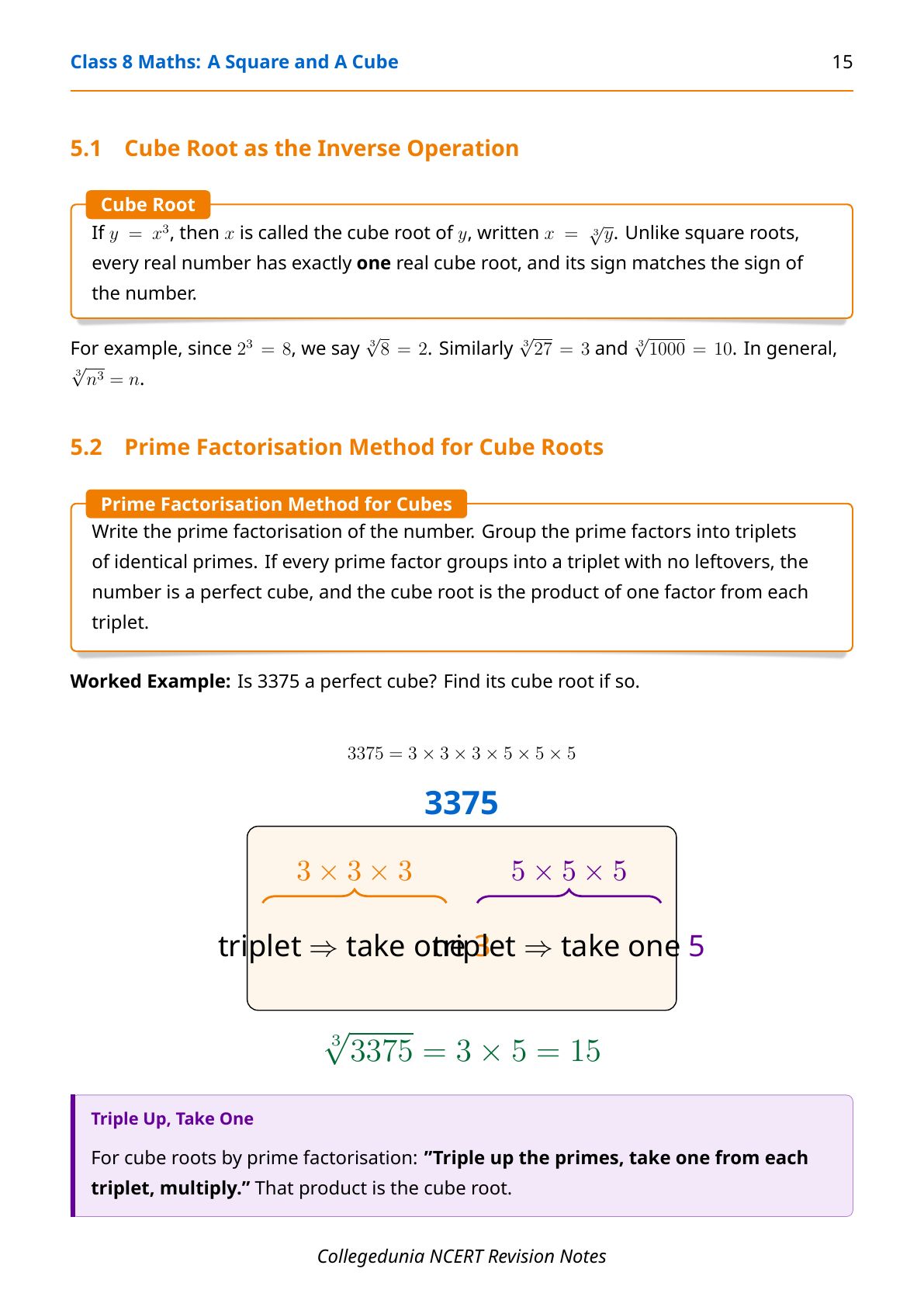
The cube root method in this chapter uses prime factorisation grouped in threes instead of pairs. Group the prime factors into sets of three identical factors, then take one factor from each group.
- Write the number as a product of primes
- Group the primes into sets of three identical factors
- Multiply one factor from each group to get the cube root
- If any factor is left over without a group of three, the number is not a perfect cube
The Hardy-Ramanujan Number 1729 and Why It Matters
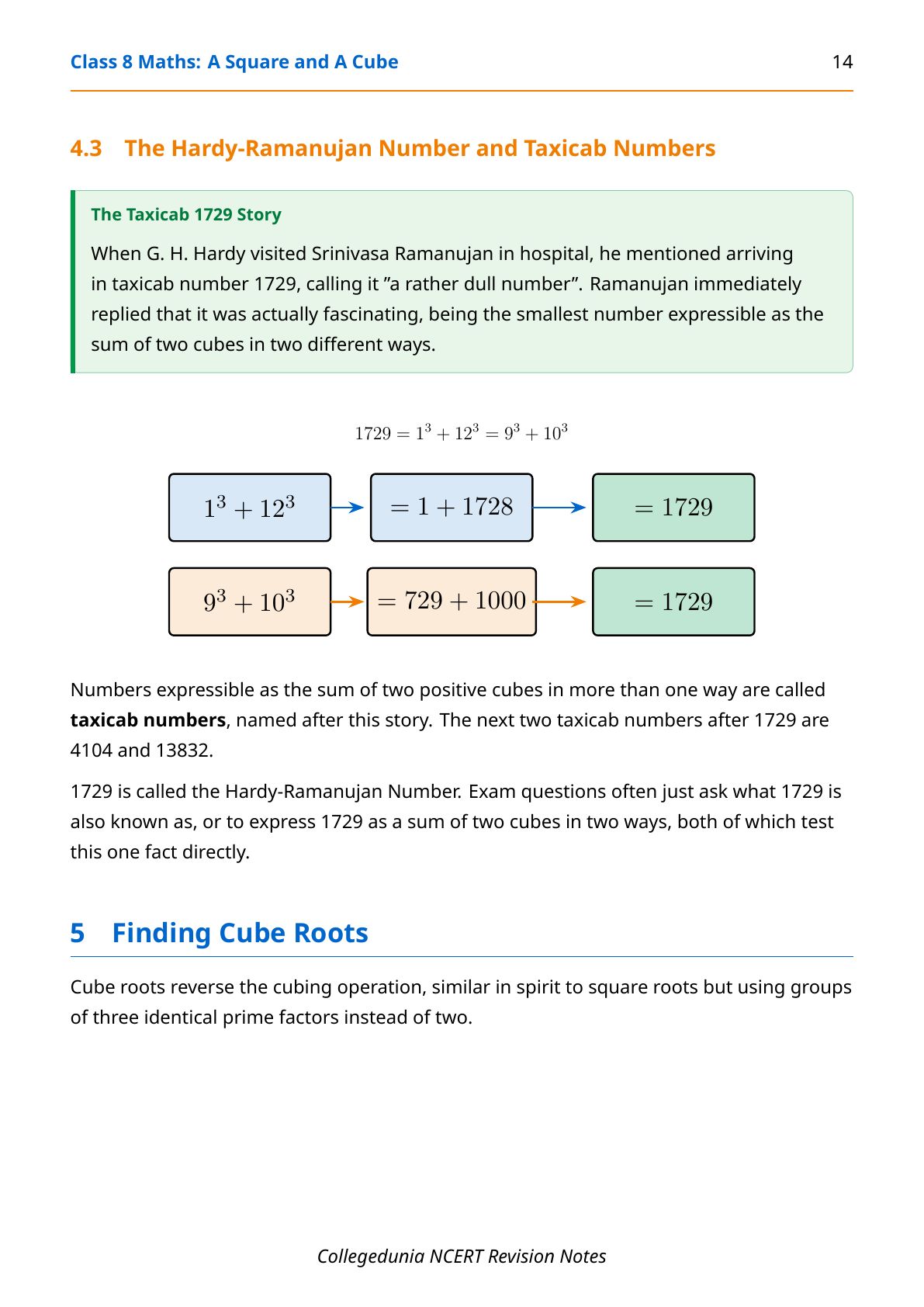
The chapter tells the famous story of mathematician Srinivasa Ramanujan and the taxicab number 1729. When G.H. Hardy mentioned the taxi number 1729 sounded "dull," Ramanujan replied that it was actually a very interesting number.
1729 is the smallest number that can be written as the sum of two cubes in two different ways:
- 1³ + 12³ = 1 + 1728 = 1729
- 9³ + 10³ = 729 + 1000 = 1729
This anecdote is a favourite short-answer and FAQ-style question in Class 8 exams, so remembering both cube pairs is worth the extra minute of revision.
Varga, Ghana and Mula: The History Behind Squares and Cubes
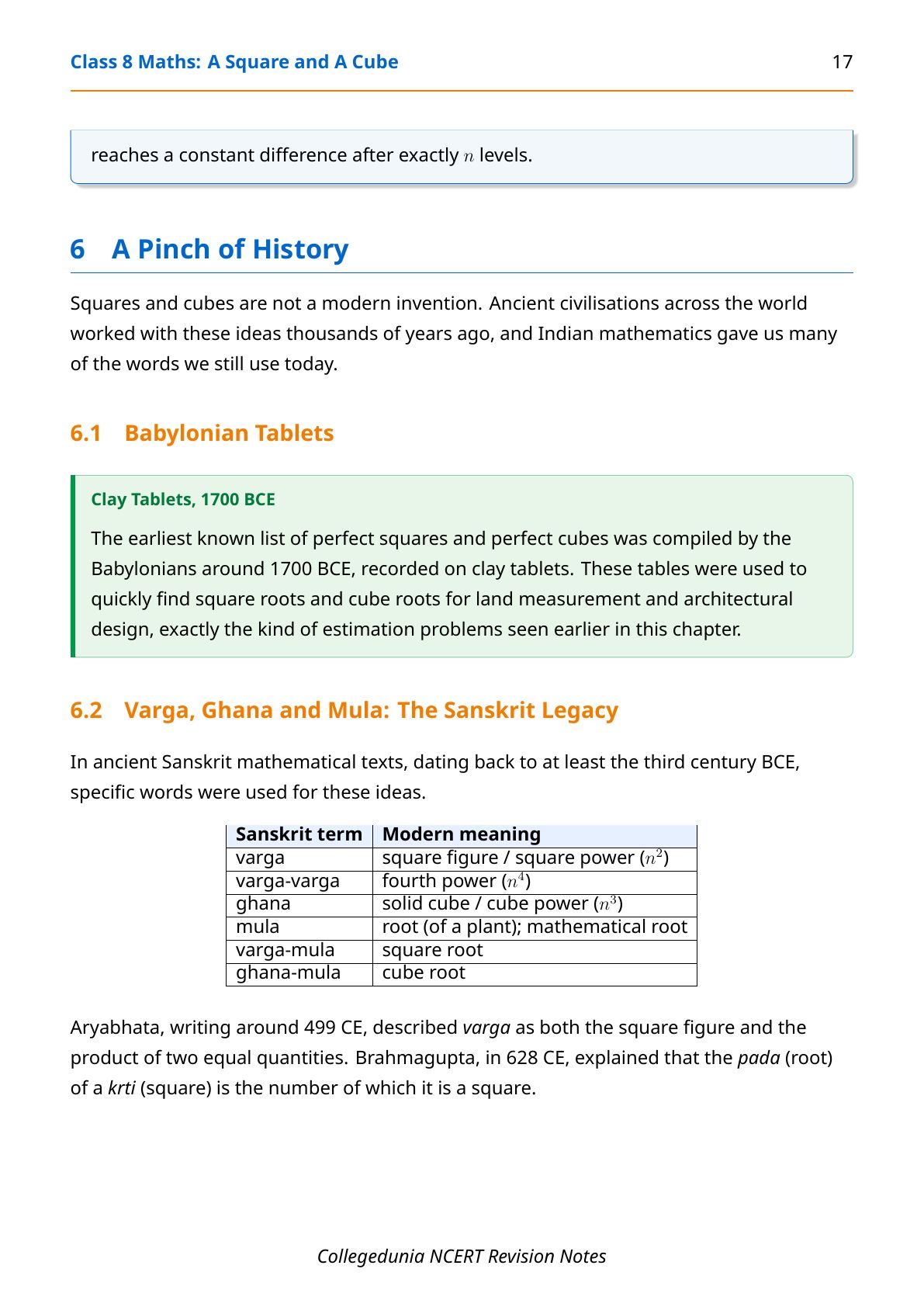
The chapter also traces where the words "square" and "cube" come from. In Sanskrit, mathematicians used varga for square and ghana for cube long before the English terms existed, while the word mula meant root, the origin of the modern term "square root."
- Varga (Sanskrit) means square, used by ancient Indian mathematicians in texts on number theory
- Ghana (Sanskrit) means cube or solid, referring to a three-dimensional block
- Mula (Sanskrit) means root, the base of the modern words square root and cube root
- Babylonian mathematicians (around 1800 BCE) also worked with square tables on clay tablets, showing squares and cubes were studied across ancient civilisations
A Square and A Cube Important Formulas at a Glance
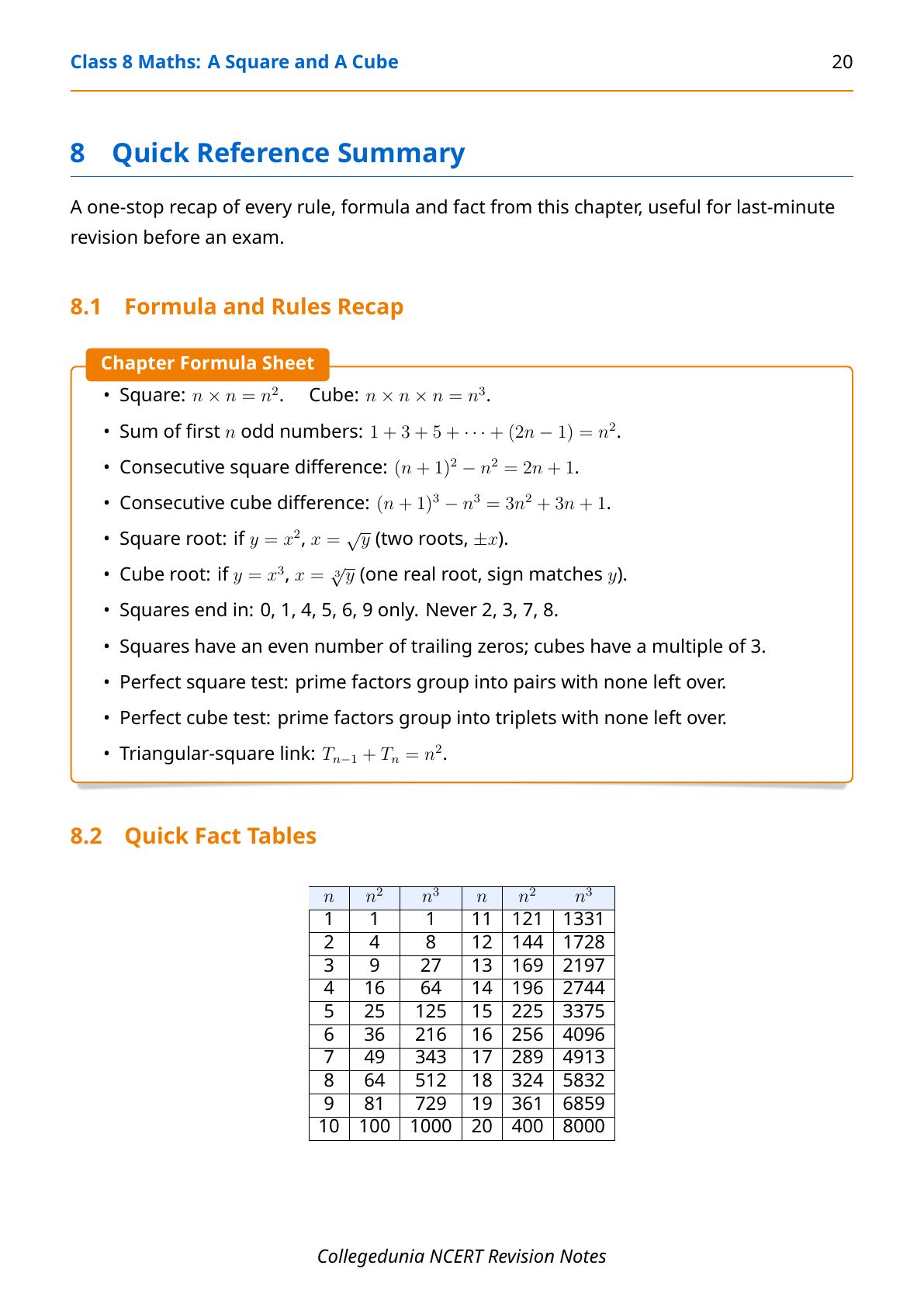
These are the formulas and rules from the chapter worth keeping on a single revision card.
| Rule | Statement | Example |
|---|---|---|
| Sum of odd numbers | 1+3+5+...+(2n-1) = n² | 1+3+5 = 9 = 3² |
| Consecutive square gap | (n+1)² - n² = 2n+1 | 10²-9² = 19 |
| Cube of a sum | 1³+2³+...+n³ = (1+2+...+n)² | 1³+2³+3³ = 36 = 6² |
| Square root by pairs | Group prime factors in pairs of 2 | √144 = 2×2×3 = 12 |
| Cube root by triples | Group prime factors in sets of 3 | ∛1728 = 2×2×3 = 12 |
Common Mistakes Students Make in the A Square and A Cube Chapter
Most marks lost on this chapter come from small slips rather than not knowing the method.
- Forgetting to check the unit digit before starting repeated subtraction on a large number
- Pairing prime factors incorrectly when one prime appears an odd number of times
- Mixing up the pairing rule (squares) with the tripling rule (cubes)
- Writing 1729 as only one cube-sum pair instead of both
How to Use the A Square and A Cube Notes Page Most Effectively
A short, focused study plan works better than reading the chapter start to finish in one sitting.
- Read the patterns first: go through the square and cube number-pattern tables before attempting any root-finding problem.
- Practise one method at a time: do 5 repeated-subtraction problems, then 5 prime-factorisation problems, then 5 estimation problems, instead of mixing them.
- Revise the 1729 story: this comes up often as a short-answer or FAQ-style question.
PDF Download Formats for the A Square and A Cube Chapter
The A Square and A Cube notes PDF is available in a single, print-ready format that matches the 2026-27 NCERT Ganita Prakash Part I textbook page for page.
- Free to download, no login required
- Print-ready formula boxes and worked examples for offline revision
- Matches the chapter numbering used in the 2026-27 print edition
More Class 8 Mathematics Part 1 Resources
Chapter 1 handwritten notes, solutions and the book PDF for A Square and A Cube are on their way. In the meantime, these Class 8 Mathematics Part 1 handwritten notes for other chapters are already live:
| Resource | Status |
|---|---|
| A Square and A Cube Class 8 Notes | Live (this page) |
| A Square and A Cube Class 8 Solutions (coming soon) | - |
| A Square and A Cube Class 8 Handwritten Notes (coming soon) | - |
| A Square and A Cube Class 8 NCERT Book PDF (coming soon) | - |
| A Story of Numbers Class 8 Handwritten Notes | Live |
| We Distribute, Yet Things Multiply Class 8 Handwritten Notes | Live |
A Square and A Cube Class 8 Mathematics Notes FAQs
Ques. Where can I download A Square and A Cube Class 8 Mathematics Notes PDF?
Ans. You can download the A Square and A Cube Class 8 Mathematics Notes PDF directly from this page, free of cost and without any login.
Ques. Is this A Square and A Cube Notes PDF aligned with the 2026-27 NCERT?
Ans. Yes. This page reflects the current 2026-27 syllabus for Class 8 Mathematics Part 1, and matches the Ganita Prakash Part I textbook chapter numbering.
Ques. How many pages is the Class 8 Mathematics A Square and A Cube Notes PDF?
Ans. The Notes PDF runs 21 pages and covers square numbers, cube numbers, square root and cube root methods, the Hardy-Ramanujan number 1729, and the history of the terms varga, ghana and mula.
Ques. What are the three methods to find a square root in this chapter?
Ans. The chapter teaches repeated subtraction, prime factorisation, and estimation. Prime factorisation works best for large perfect squares, while estimation is used for numbers that are not perfect squares.
Ques. What is special about the number 1729 in A Square and A Cube?
Ans. 1729 is the smallest number that can be written as the sum of two cubes in two different ways: 1³+12³ and 9³+10³. It is known as the Hardy-Ramanujan number.
Ques. What do varga, ghana and mula mean in this chapter?
Ans. Varga is the Sanskrit word for square, ghana means cube, and mula means root, the origin of the modern terms square root and cube root.
Ques. How is a cube root different from a square root method?
Ans. A square root groups prime factors in pairs of two, while a cube root groups prime factors in sets of three. One factor is taken from each group either way.
Ques. What is a square number?
Ans. A square number is the result of multiplying a whole number by itself, such as 4×4 = 16. It also equals the sum of the first n odd numbers.
Ques. How is a cube number defined?
Ans. A cube number is a whole number multiplied by itself three times, such as 4×4×4 = 64.
Ques. What are perfect squares and perfect cubes?
Ans. A perfect square is a number whose square root is a whole number, such as 25. A perfect cube is a number whose cube root is a whole number, such as 27.



Comments