




Five area formulas, three dissection proofs, and two different ways to prove the trapezium rule come from one chapter of Ganita Prakash Part 2, Chapter 7 Area. These ncert notes class 8 maths chapter 7 Area walk through every proof, every solved example, and the acre-to-hectare conversions Class 8 tests ask, for the 2026-27 session.
- Chapter: Chapter 7, the last chapter of Ganita Prakash Part 2, the Class 8 Maths textbook for 2026-27
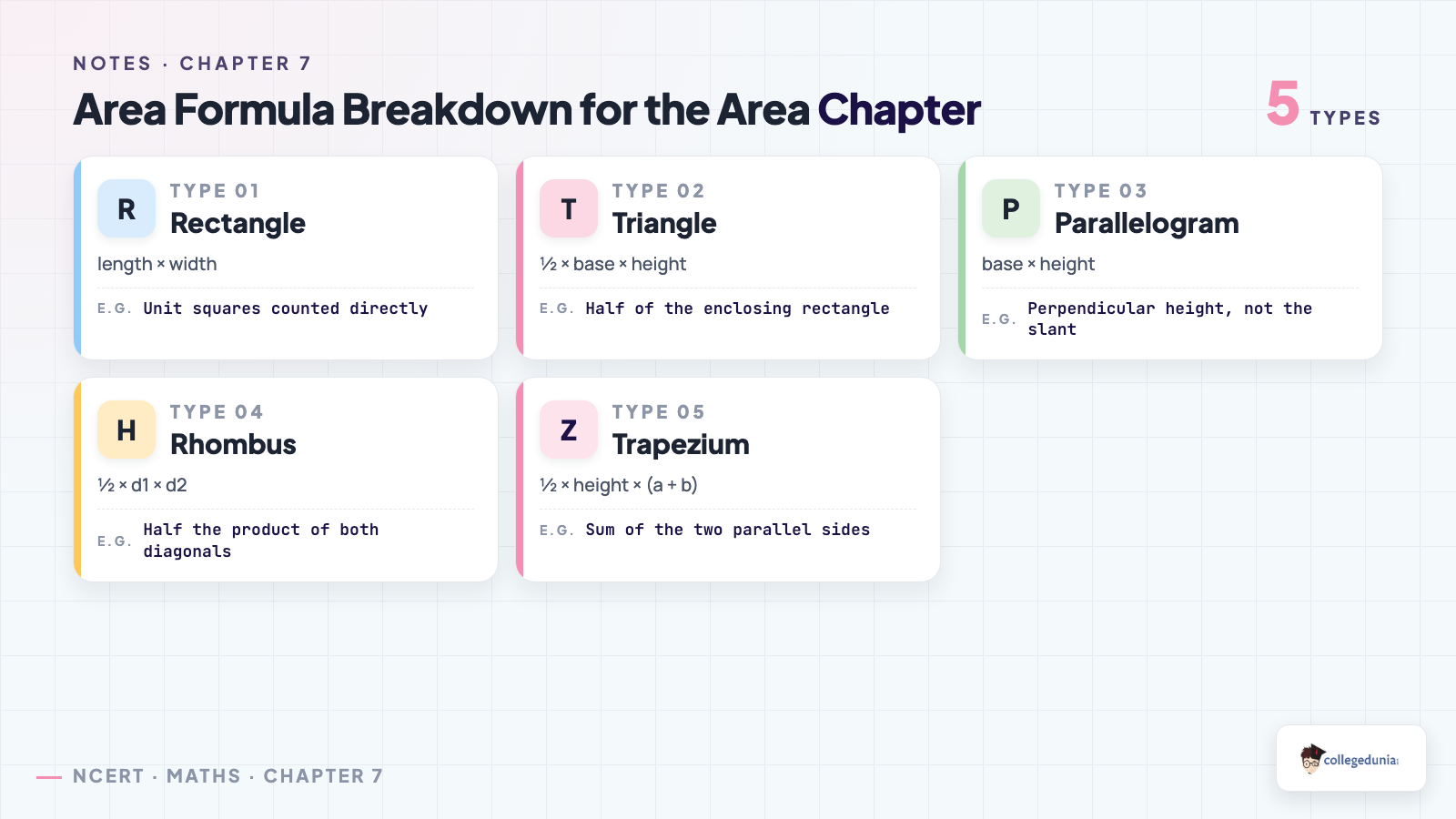
- Five formulas to fix: rectangle, triangle, parallelogram, rhombus and trapezium, each proved by cutting and rearranging
- Real-world skill: converting between cm², m², acres and hectares for land and classroom problems
Every proof, solved example and conversion table in this Collegedunia compilation of Class 8 Maths notes for the Area chapter is checked line by line against the printed Ganita Prakash Part 2 chapter for the 2026-27 session.
Rectangle and Square Area: Where Every Formula in the Area Chapter Starts
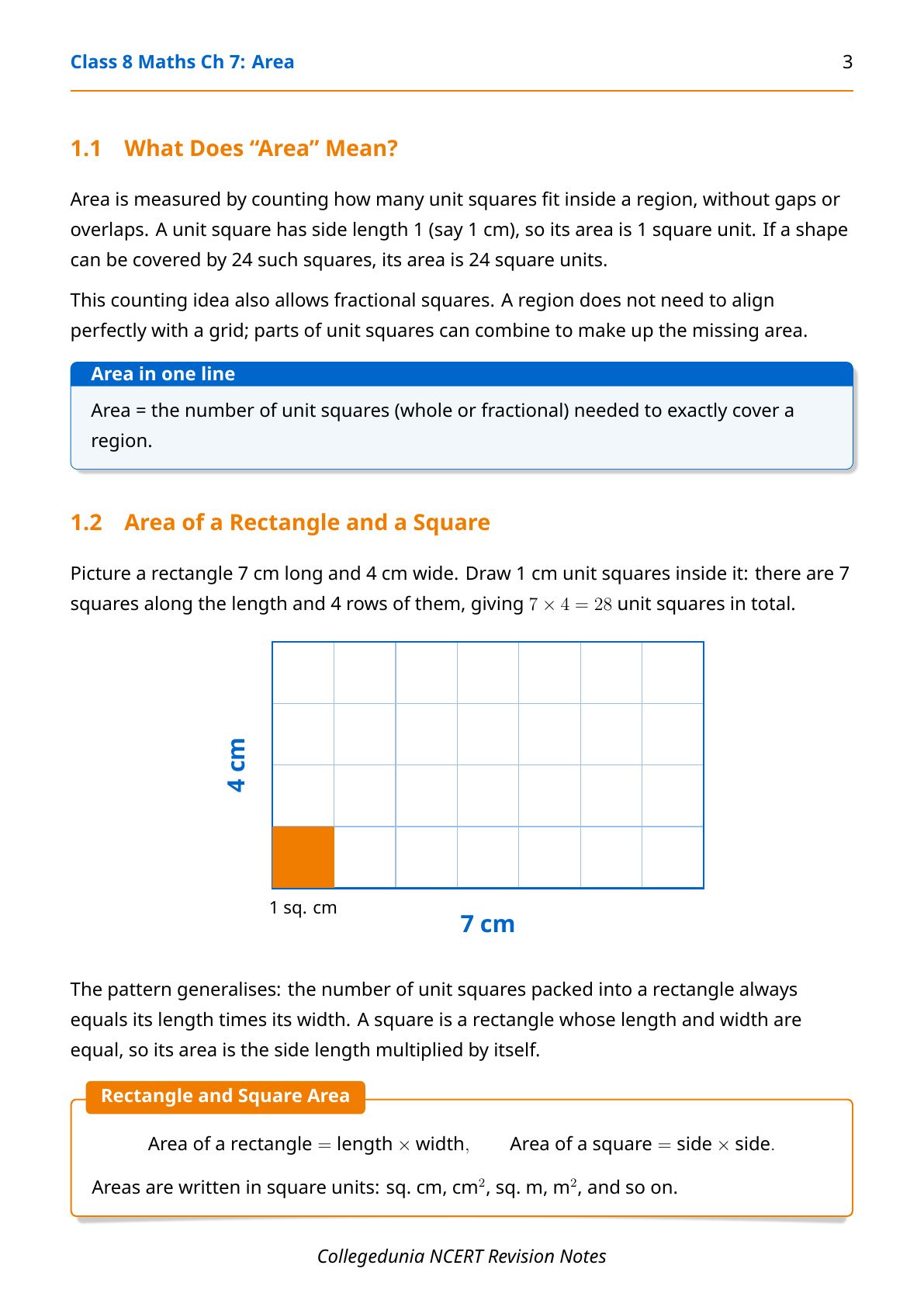
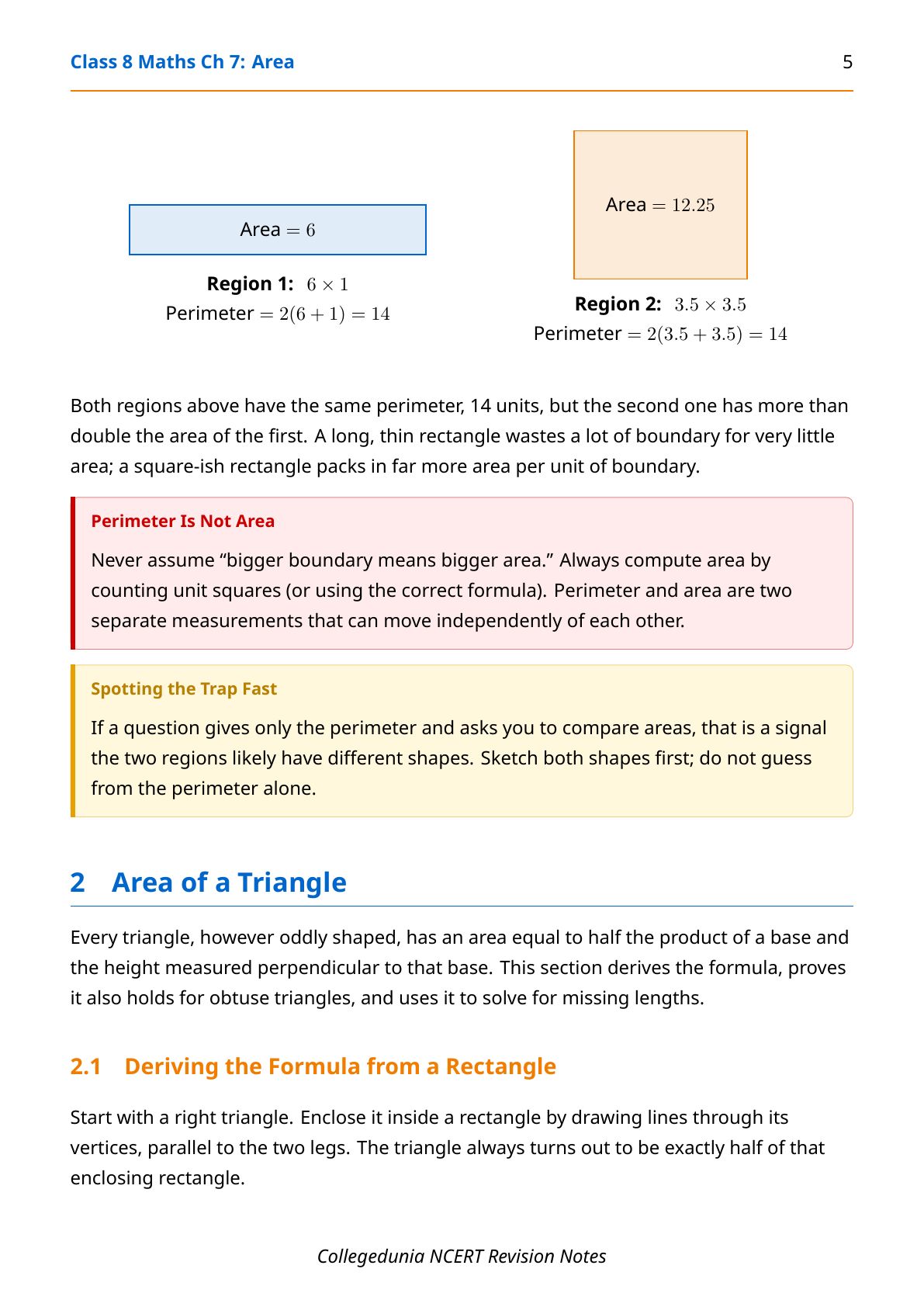
Area measures how much surface a flat shape covers. The chapter starts with unit squares, small squares of side 1 cm, and counts how many of them fit inside a shape. Two rectangles with sidelengths 7 cm by 4 cm and 8 cm by 3 cm look close in size, but counting unit squares shows they are not.
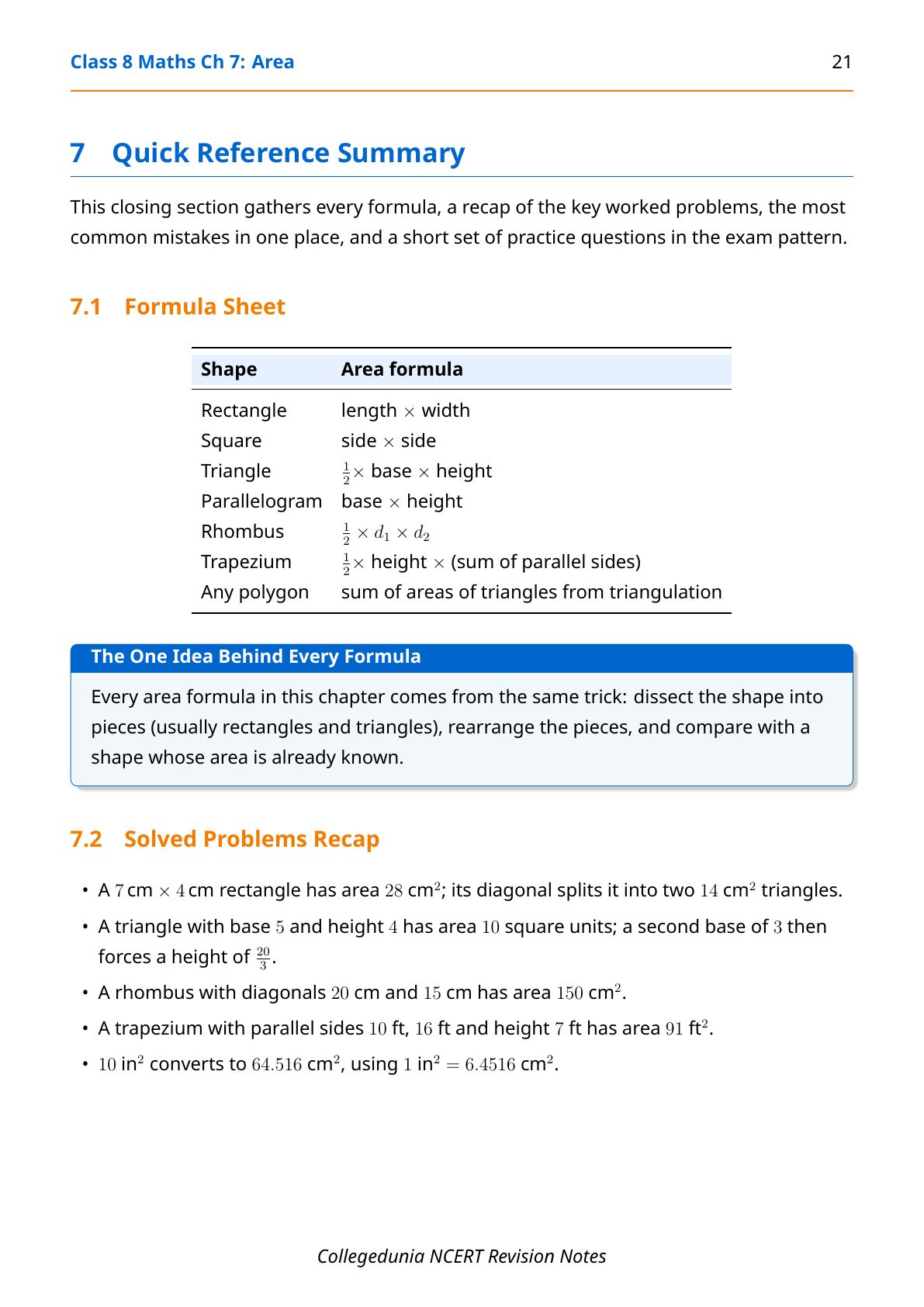
The 7 cm by 4 cm rectangle holds 7 × 4 = 28 unit squares. The 8 cm by 3 cm rectangle holds 8 × 3 = 24 unit squares. Area of a rectangle = length × width. A square is a rectangle with equal sides, so its area is simply side × side.
- Unit of area: written as sq. cm or cm², always a squared unit since two lengths are multiplied
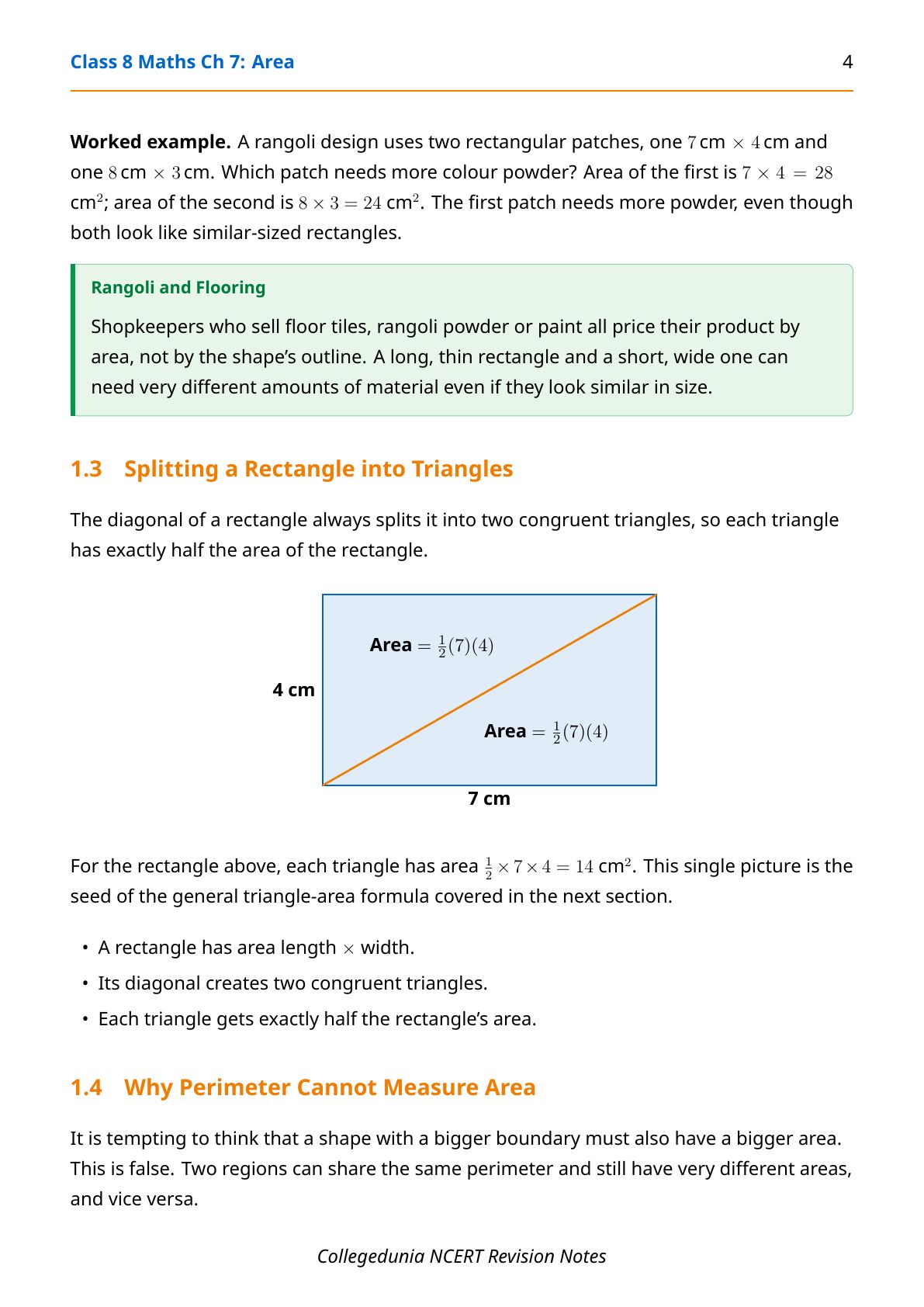
- Diagonal split: the diagonal of a rectangle cuts it into two congruent triangles of equal area
- Half-rectangle rule: each of those triangles has area equal to half the rectangle's area
Area Class 8 Maths Explained: Rectangles, Squares and Triangles
Source: Class 8 Maths - MathsByShweta on YouTube
Area of a Triangle: Proof by Enclosing It in a Rectangle
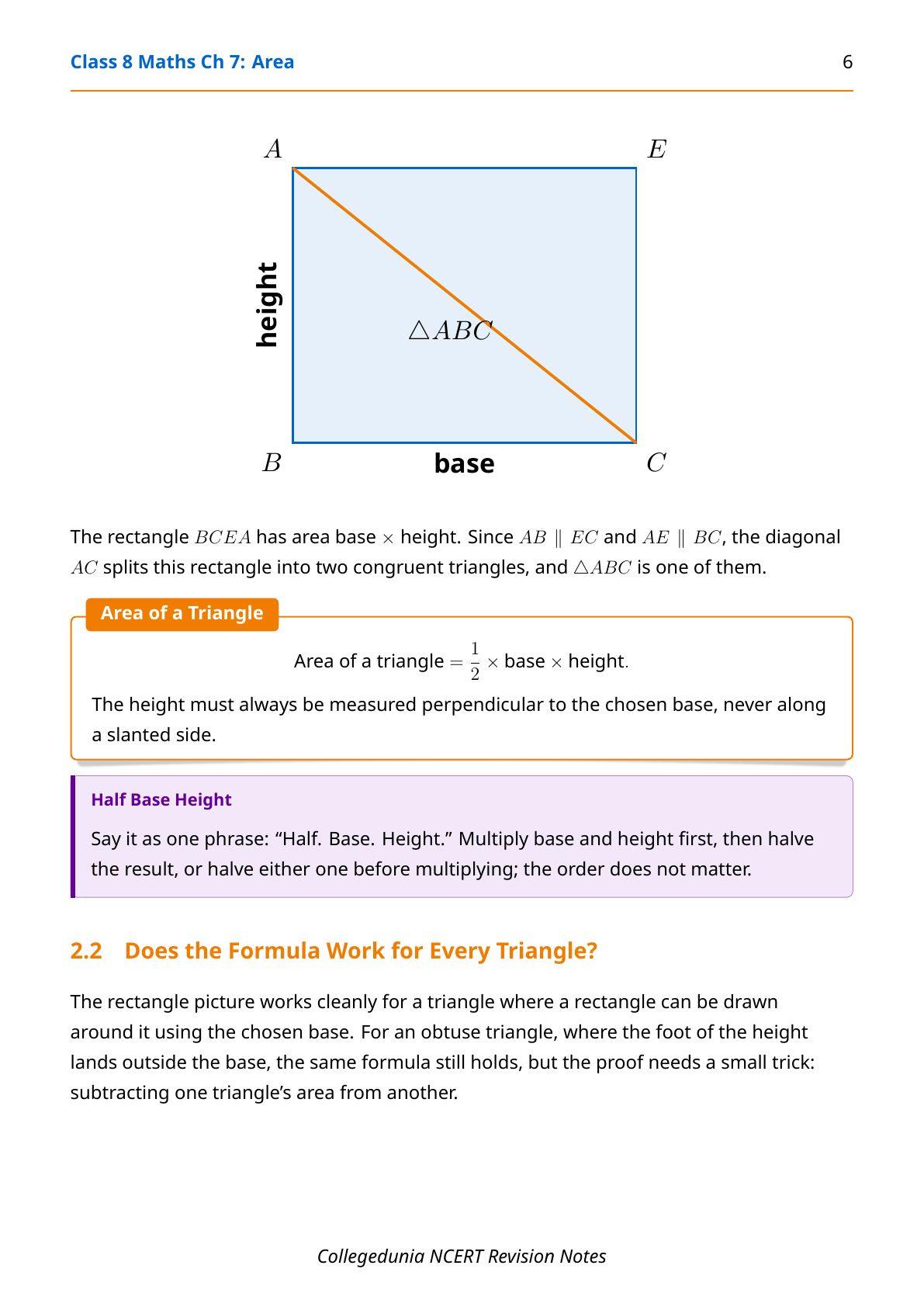
Every triangle can be enclosed in a rectangle that shares its base and touches its highest point. Draw BCDE around triangle ABC so that BC is one side of the rectangle and the rectangle's height matches the triangle's height. Splitting BCDE with the two remaining lines shows the triangle covers exactly half the rectangle.
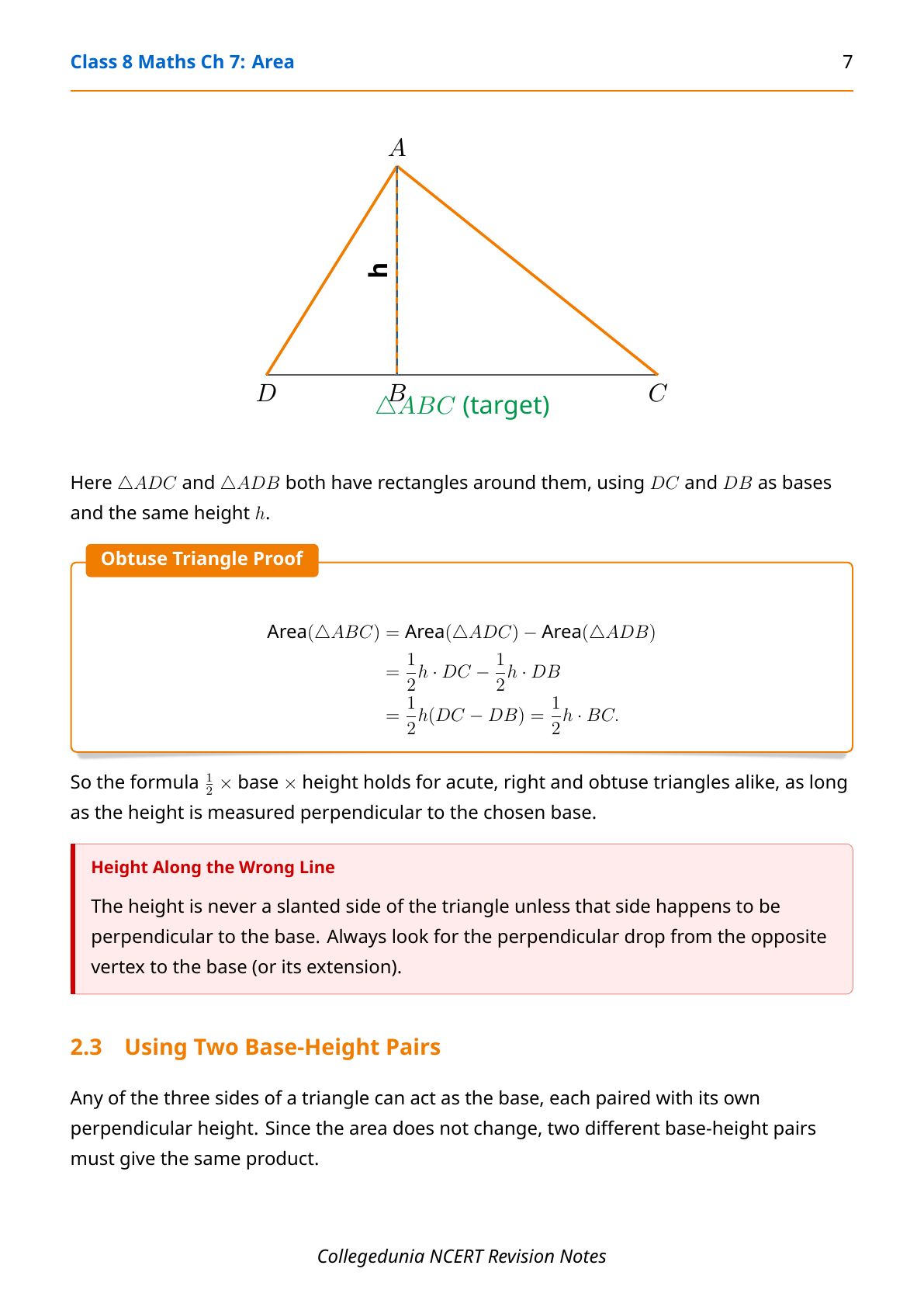
Area of a triangle = ½ × base × height. This holds even for a triangle where the top vertex does not sit directly above the base. Split that triangle into two right triangles using the height line, find each one's area as a rectangle-half, and subtract. The difference still simplifies to ½ × base × height, so the formula holds for every triangle.
| Base (units) | Height (units) | Area (sq. units) |
|---|---|---|
| 5 | 4 | 10 |
| 7 | 3 | 10.5 |
| 7 (as base BC) | 5 (as base AC, giving BY) | 15/2 = 7.5 |
| 10 | 6 | 30 |
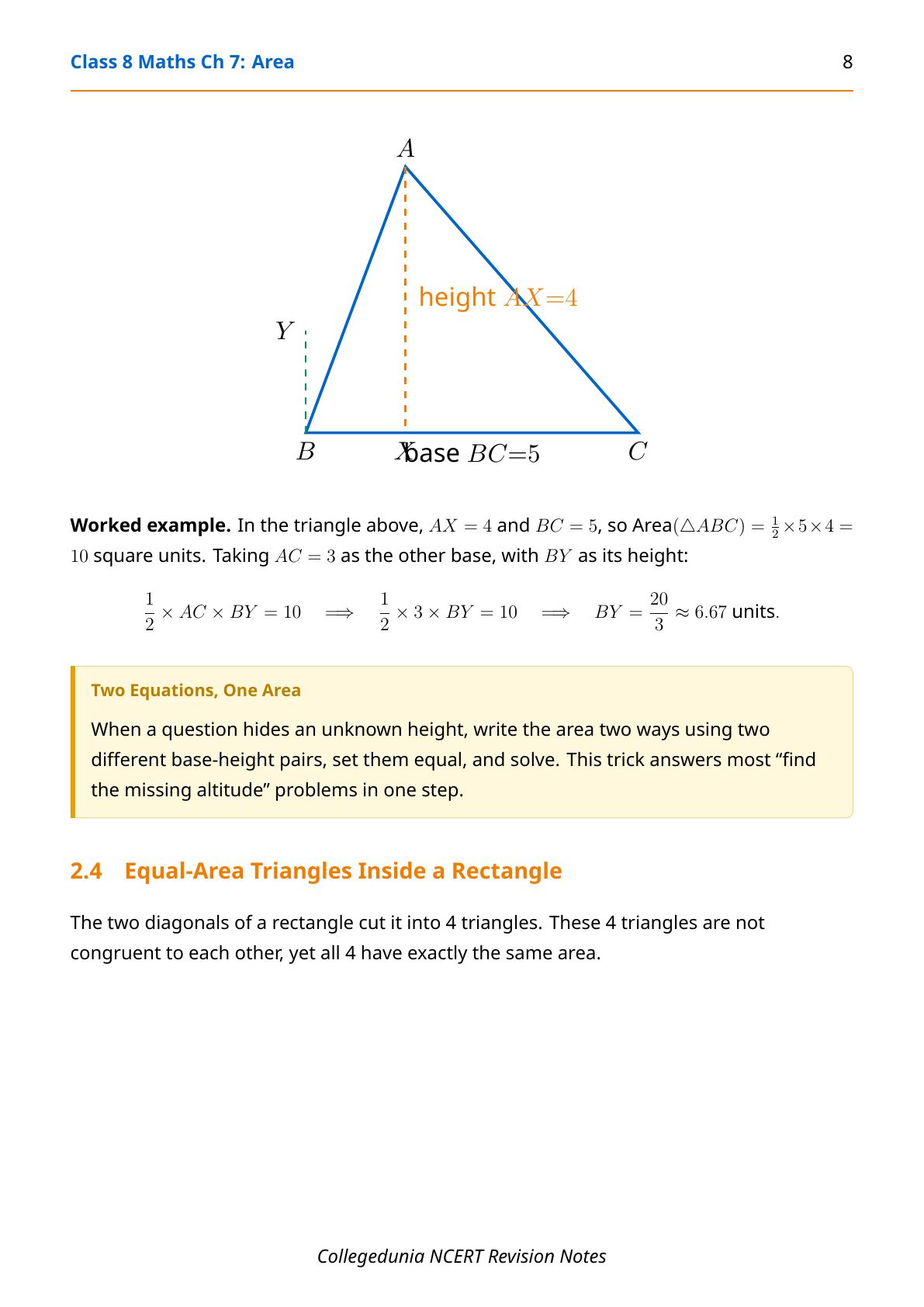
The same triangle gives the same area no matter which side you treat as the base, as long as you use the matching height. If Area = ½ × AX × BC = ½ × BY × AC, both expressions must be equal, and solving for the unknown height BY needs only one line of algebra.
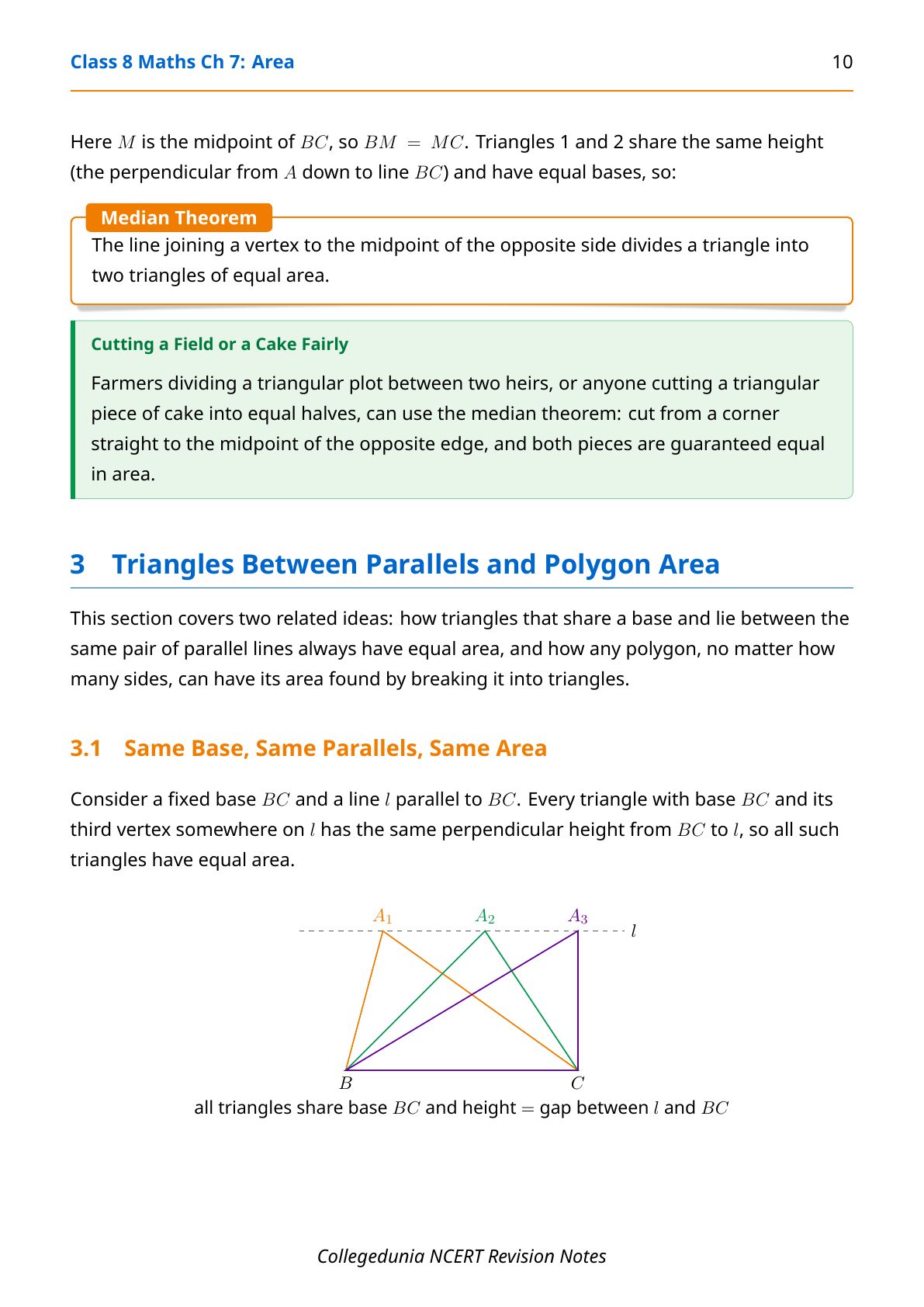
A vertex-to-midpoint line always splits a triangle into two equal-area halves. Both smaller triangles share the same height from the opposite vertex, and their bases are equal because the point is a midpoint, so ½ × base × height gives the same product for both.
Area of a Parallelogram: Converting It Into a Rectangle by Dissection
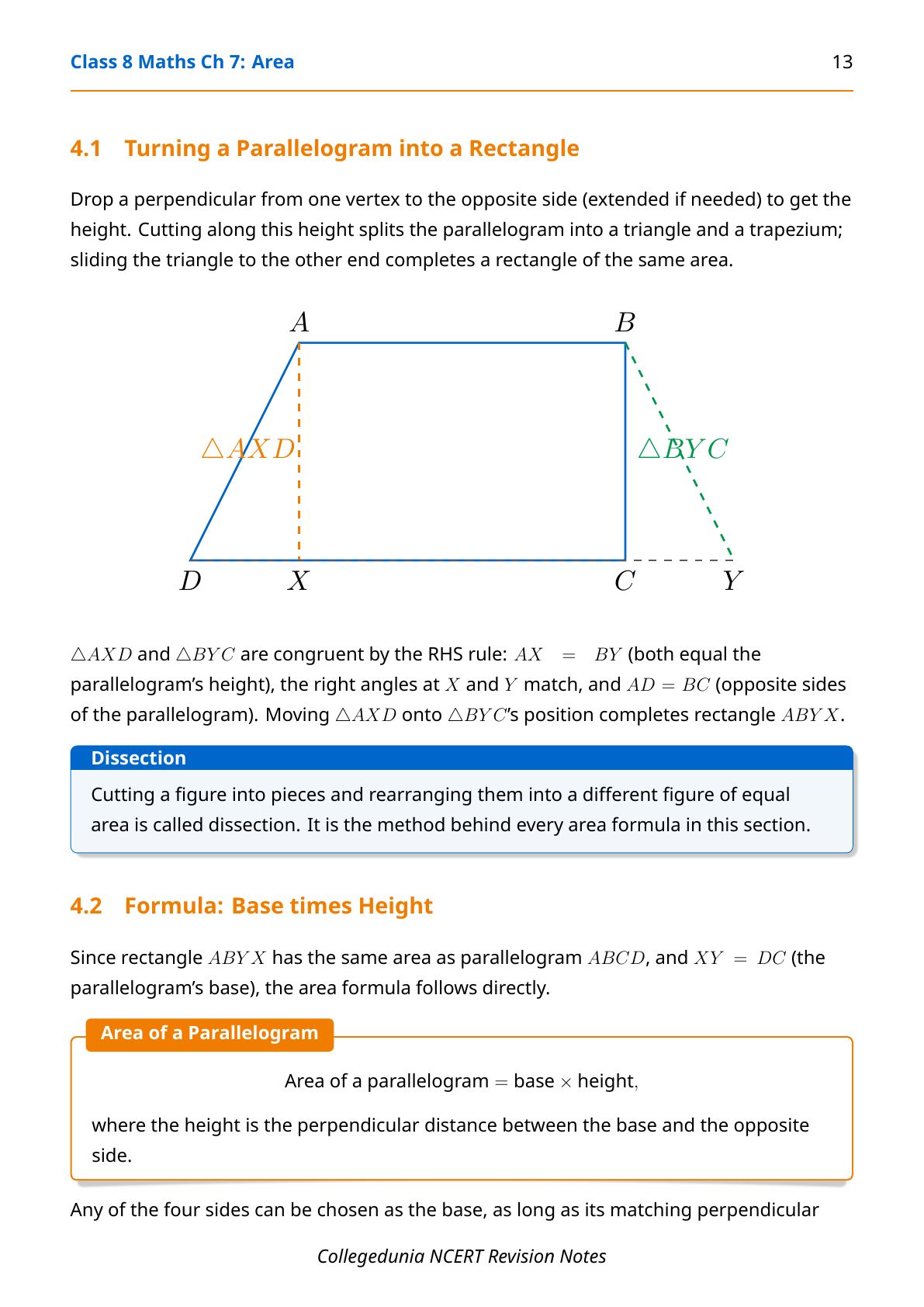
A parallelogram ABCD can be turned into a rectangle without changing its area. Draw AX perpendicular to DC, the base, to mark the height. Cutting along AX splits the parallelogram into triangle AXD and trapezium ABCX.
Slide triangle AXD to the other end of the trapezium. Since BC = AD in a parallelogram and the corresponding angles match, the triangle fits exactly over the space near B, forming rectangle ABYX. Area of a parallelogram = base × height. The base is DC and the height is the perpendicular distance AX, not the slanted side.
- Same base, same height: every parallelogram sitting on the same base between the same two parallel lines has equal area
- Height is perpendicular: never multiply base by the slanted side, only by the straight-up distance
- Rectangle is a special case: when the angles are 90°, the height equals the side, so base × height reduces to length × width
Solved example. A parallelogram has base 6.6 cm and height 4 cm. Its area is 6.6 × 4 = 26.4 cm². A rectangle with the same two sidelengths, 6.6 cm and 4 cm, also has area 26.4 cm², but its perimeter is smaller than the parallelogram's, since the parallelogram's slanted side is longer than 4 cm.
Area of a Rhombus: Splitting a Parallelogram Along Its Diagonals
A rhombus is a parallelogram with all four sides equal, so base × height still works for it. The diagonals give a second, often quicker, route to the same answer.
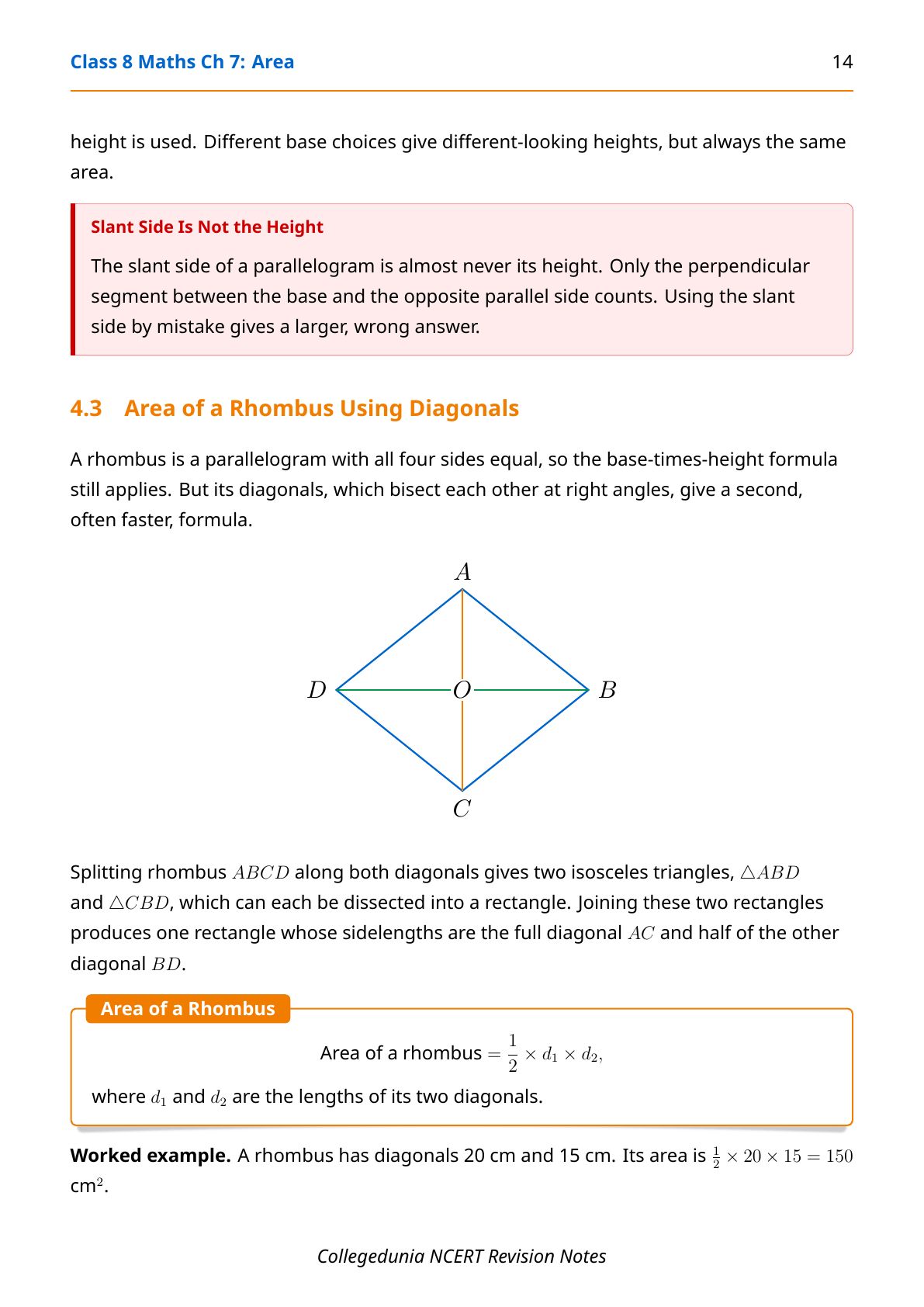
Rhombus ABCD can be cut and rearranged into rectangle WXYZ with the same area, using its equal sides and perpendicular diagonals. Since the diagonals of a rhombus meet at right angles and bisect each other, one diagonal becomes the rectangle's length and half the other becomes its width, doubled.
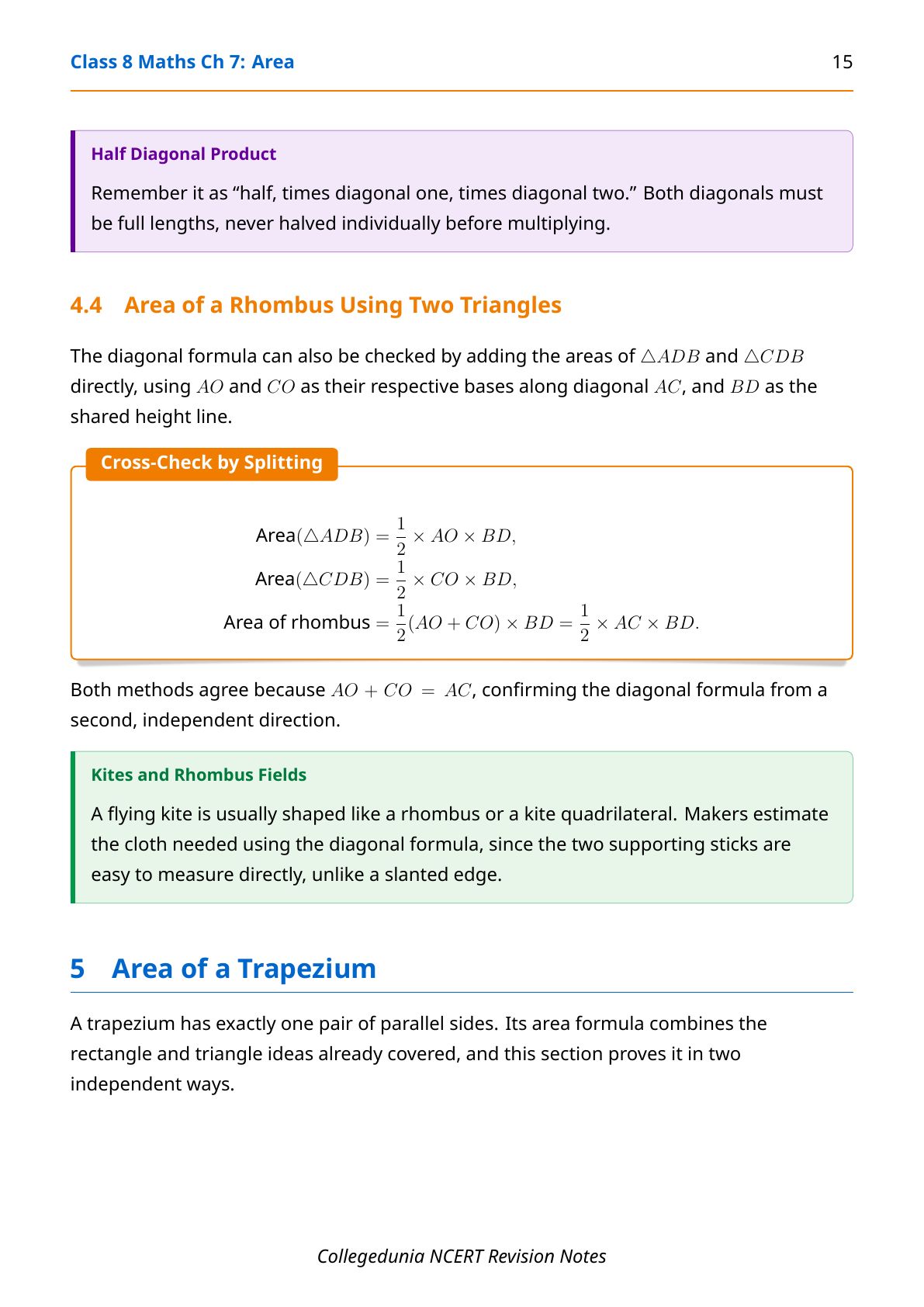
Area of a rhombus = ½ × product of the diagonals. The same result follows by splitting the rhombus along one diagonal into two congruent triangles, ADB and CDB, and adding their two areas, each ½ × base × height with the diagonal as base.
| Diagonal 1 | Diagonal 2 | Area |
|---|---|---|
| 10 cm | 8 cm | 40 cm² |
| 20 cm | 15 cm | 150 cm² |
| 12 cm | 9 cm | 54 cm² |
| 18 cm | 14 cm | 126 cm² |
The one setup mistake to avoid. Do not use one diagonal as both base and height. Multiply one full diagonal by the other full diagonal, then halve the product. Halving only one diagonal before multiplying gives a wrong, smaller answer.
Two Proofs for the Area of a Trapezium
A trapezium has exactly one pair of parallel sides. Ganita Prakash Part 2 proves the same formula two separate ways, and both are worth knowing because tests can ask for either.
Proof 1: Break the Trapezium Into a Rectangle and Two Triangles
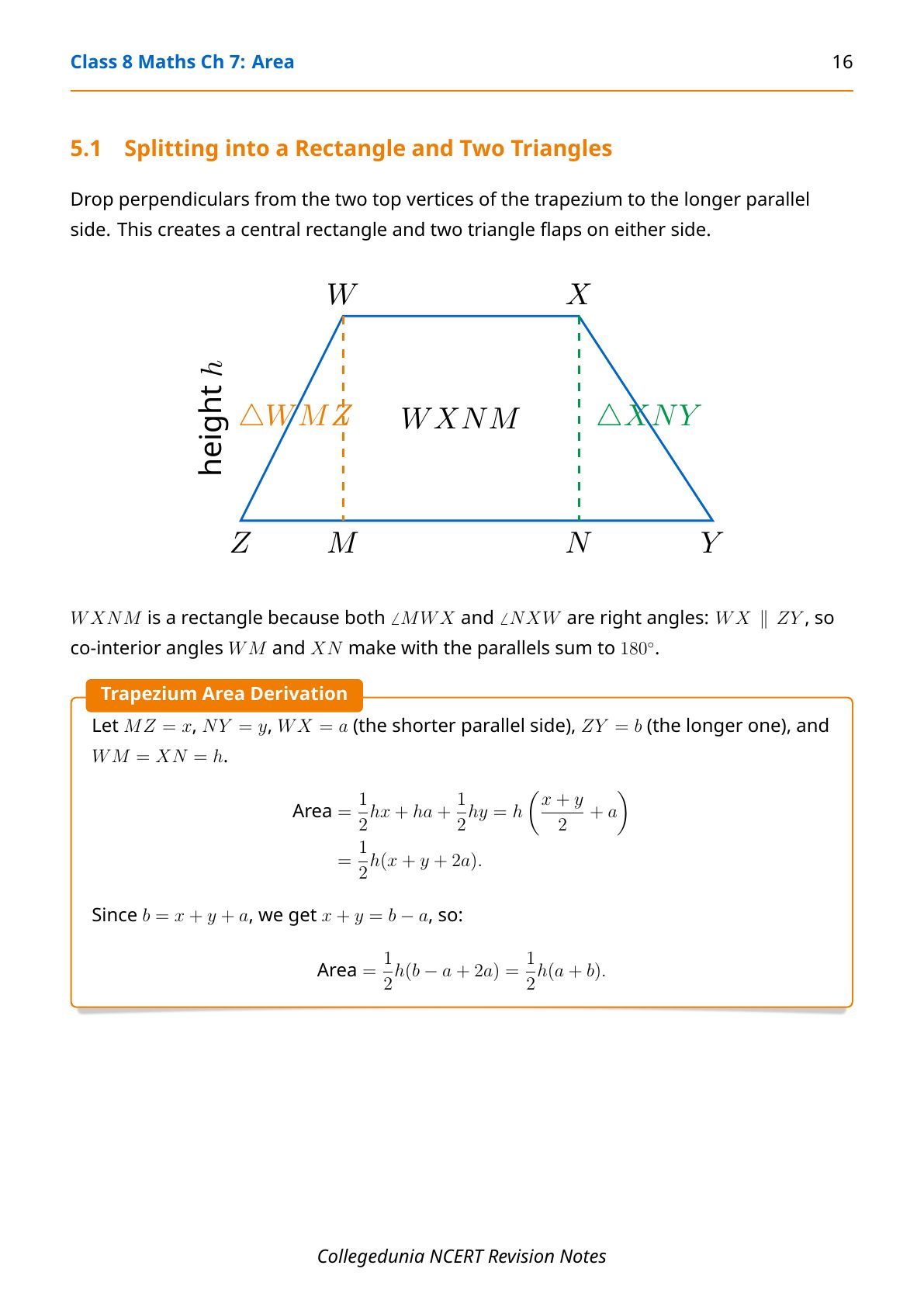
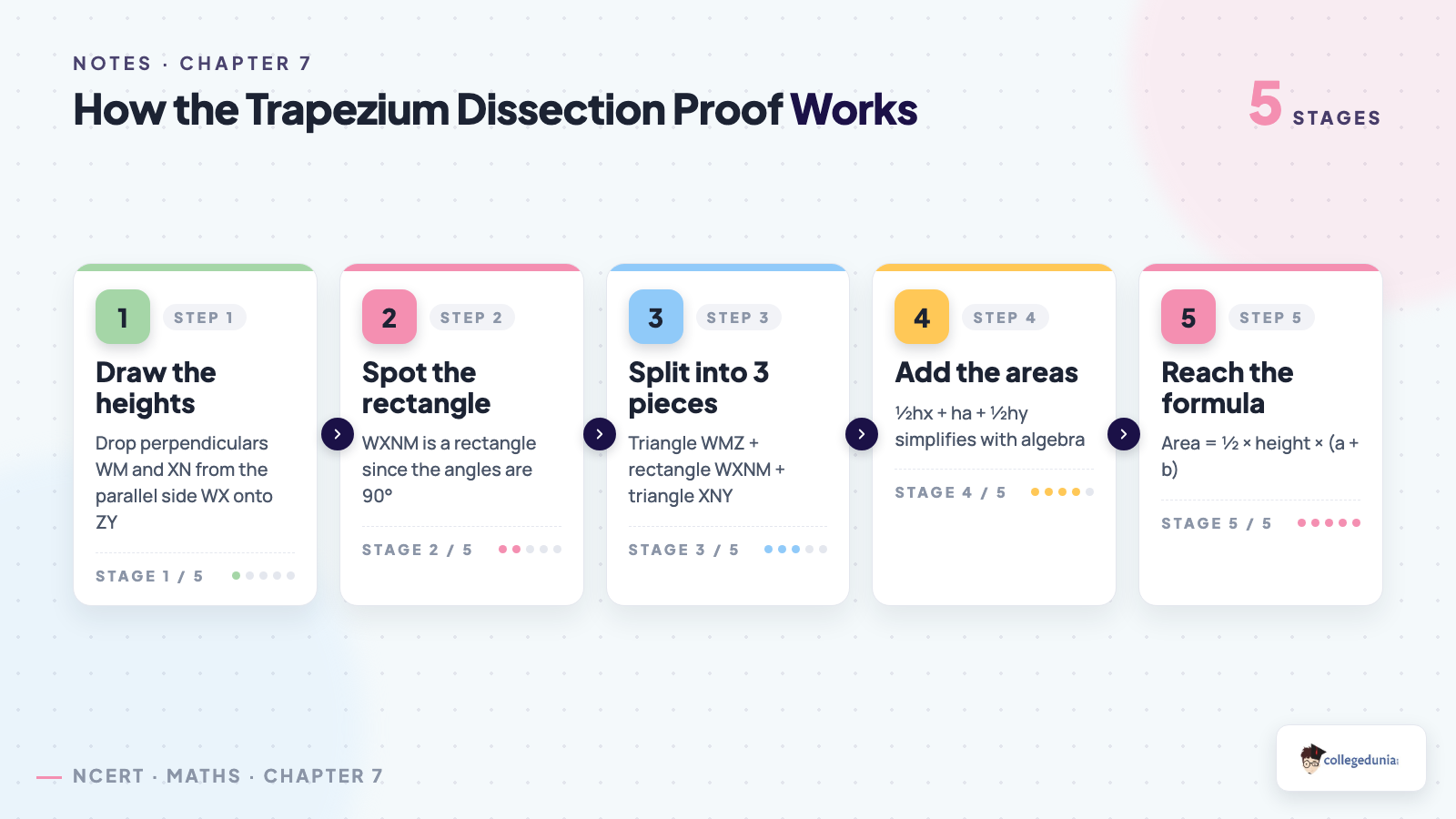
In trapezium WXYZ with WX parallel to ZY, drop perpendiculars WM and XN onto ZY. Since the interior angles on the same side of a transversal add to 180°, WXNM is a rectangle. The trapezium splits into triangle WMZ, rectangle WXNM, and triangle XNY.
Let the parallel sides be a (WX) and b (ZY), with height h. Adding the three pieces and simplifying the algebra gives Area of a trapezium = ½ × height × sum of the parallel sides, or ½h(a + b).
Proof 2: Join Two Rotated Copies Into a Parallelogram
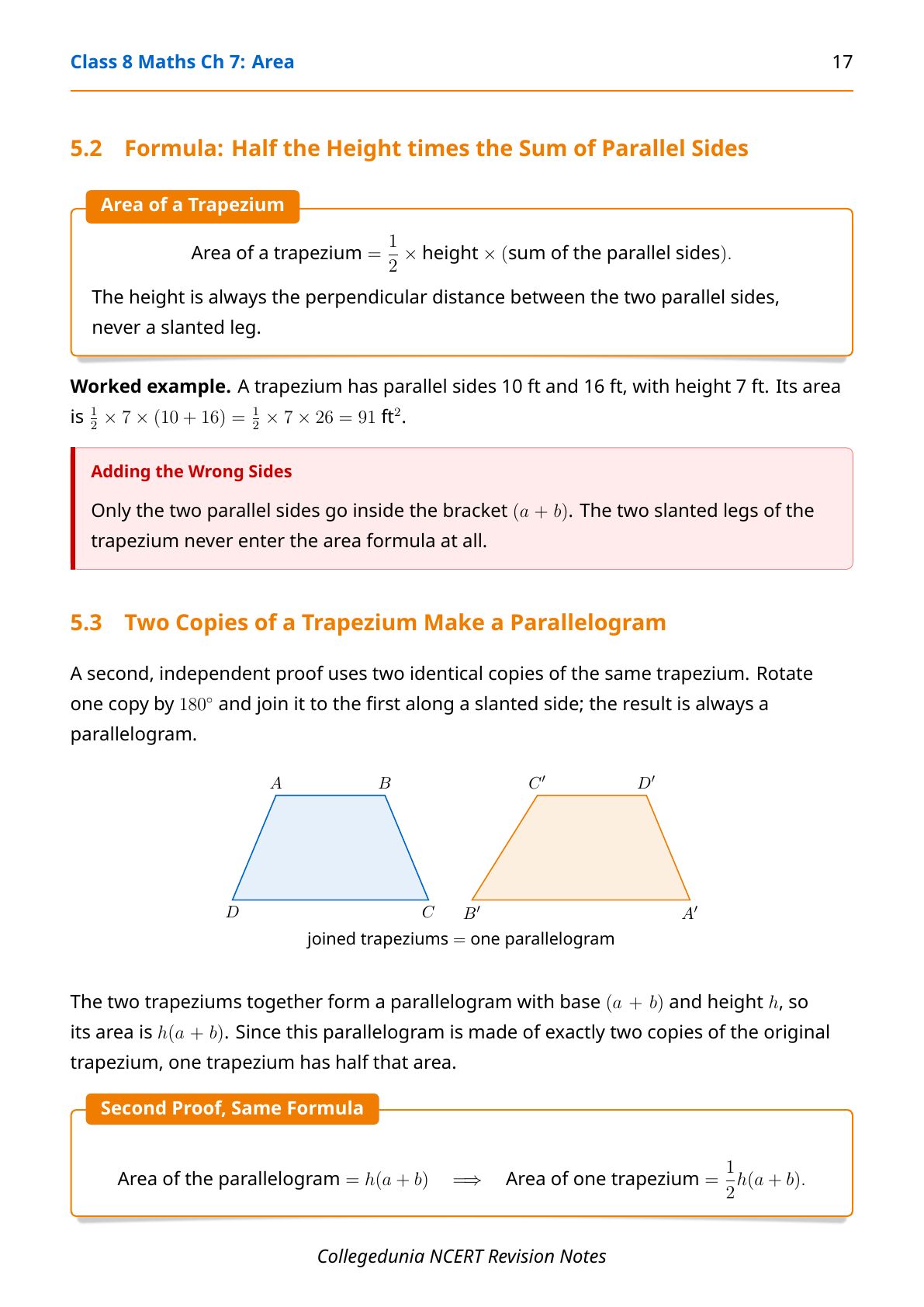
Take two identical copies of the trapezium and rotate the second one by 180°. Joining them along one slanted side produces a parallelogram, because the co-interior angles from the parallel sides add to 180° on both pairs of joined edges.
That parallelogram has base (a + b) and the same height h as the original trapezium. Its area is (a + b) × h, and the trapezium is exactly half of it, since two copies made the parallelogram. Area of the trapezium = ½ × Area of the parallelogram = ½h(a + b). Both proofs land on the identical formula.
| Parallel side a | Parallel side b | Height h | Area = ½h(a+b) |
|---|---|---|---|
| 6 cm | 10 cm | 5 cm | 40 cm² |
| 8 cm | 14 cm | 6 cm | 66 cm² |
| 4 m | 9 m | 3 m | 19.5 m² |
Both trapezium proofs use the SAME formula, only the dissection is different. Proof 1 slices the trapezium into three pieces on its own. Proof 2 needs a second, rotated copy of the whole shape. Either one is an acceptable answer in a school test, but examiners often name which proof they want.
Triangles Between the Same Parallels: Why They Share Equal Area
Draw a line l parallel to base BC, and pick the third vertex A anywhere on l. Every one of those triangles has the same base BC and the same height, the fixed perpendicular distance between BC and l, no matter where A sits on the line.
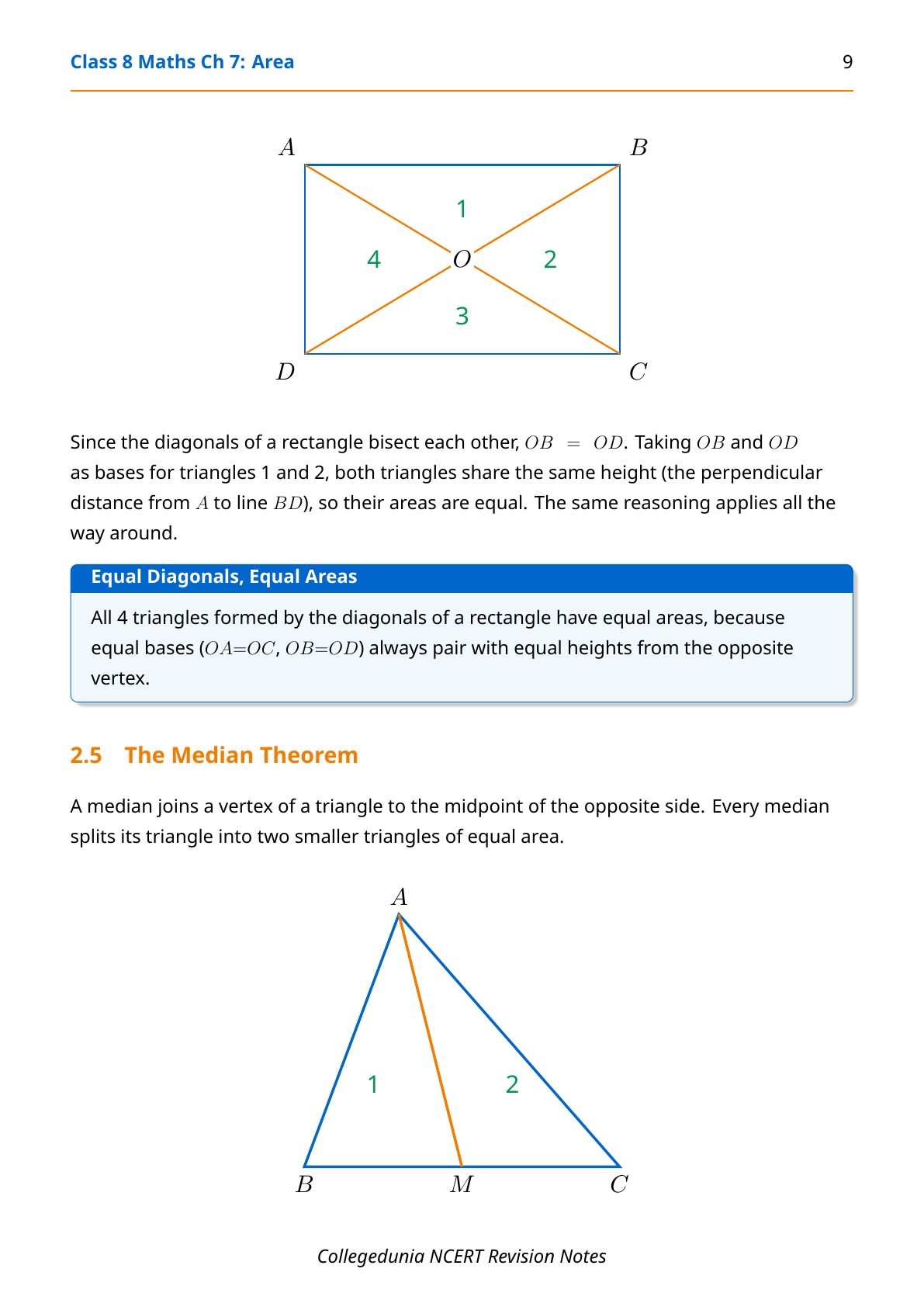
Triangles on the same base and between the same parallels always have equal area, because ½ × base × height only changes if the base or the height changes. This single idea explains why the four triangles formed by a rectangle's diagonals split into two equal-area pairs, since the diagonals bisect each other and give matching base-height pairs.
- Fixed base BC: stays the same for every triangle in the family
- Fixed height: the perpendicular distance between the two parallel lines never changes
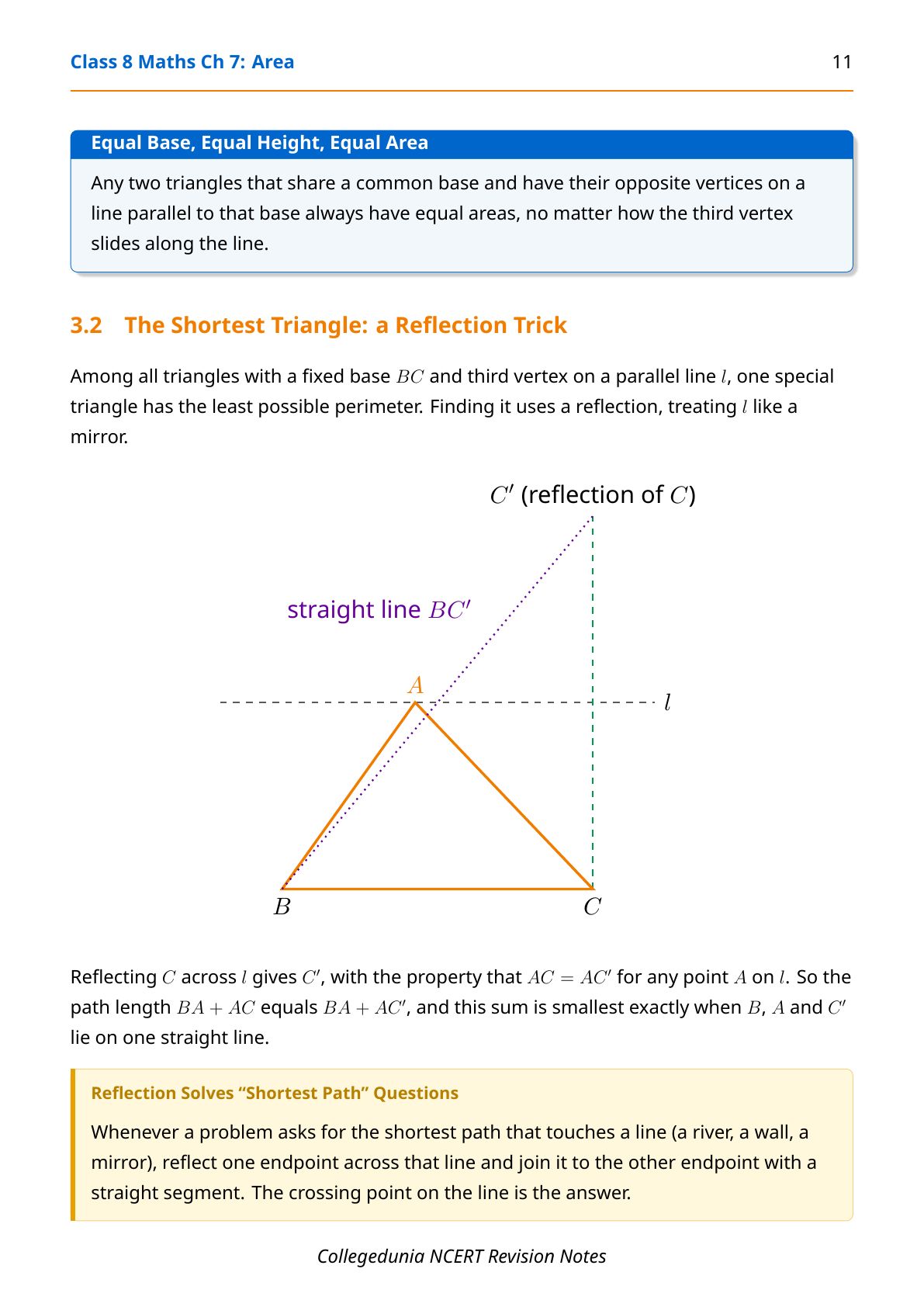
- Perimeter still varies: the triangle with the least perimeter is the one where A is directly above the midpoint of BC
Finding the least-perimeter triangle uses a mirror trick. Reflect vertex B across line l to get a point B′. The shortest path from B′ to C is a straight line, and the point where that line crosses l is the position of A that makes AB + AC as small as possible, since AB = AB′ by the reflection.
Finding the Area of Any Polygon by Triangulation
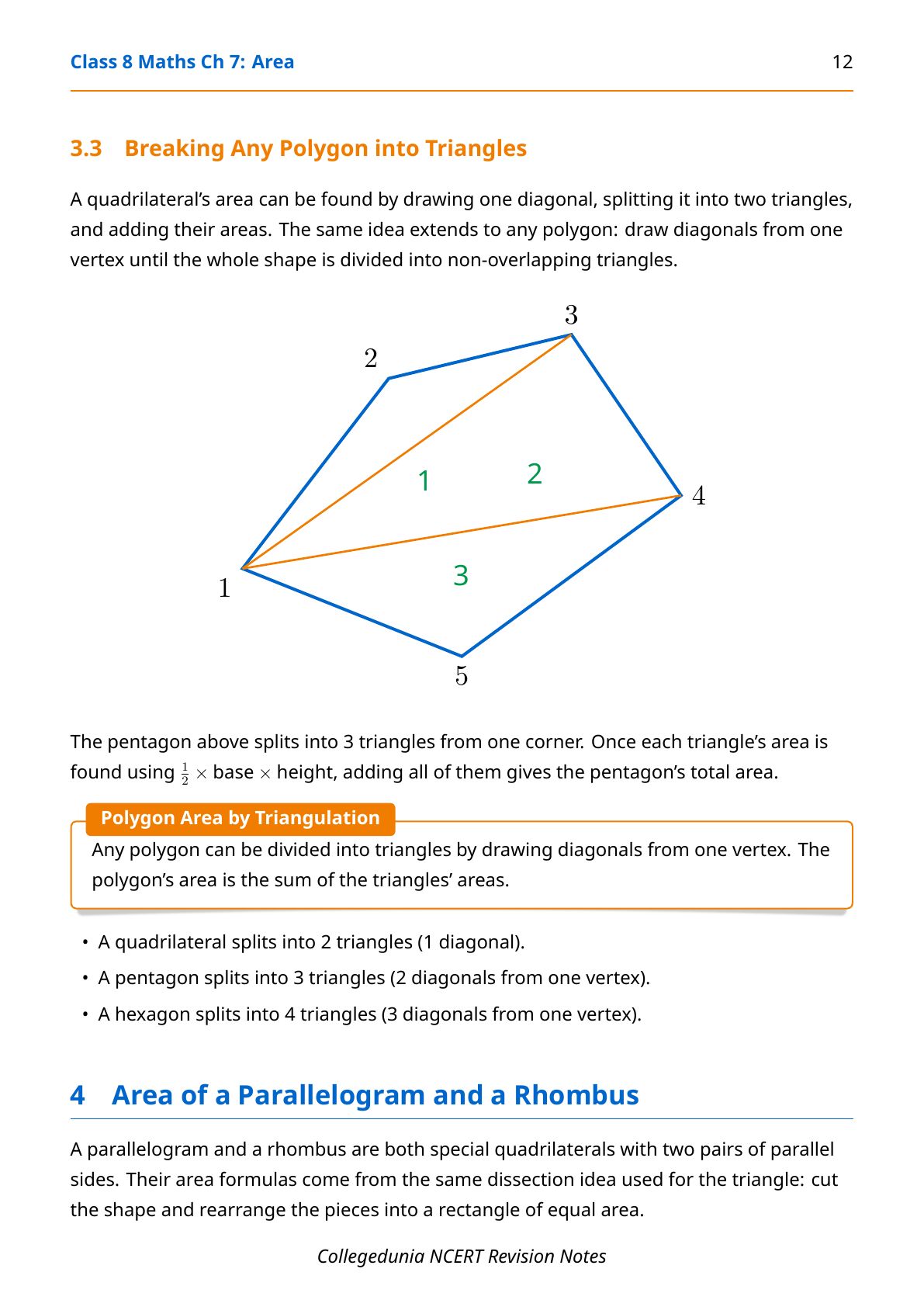
Any polygon can be broken into triangles. Once you know how to find a triangle's area, you can find the area of a pentagon, a hexagon, or any irregular shape by adding up the triangles inside it.
A quadrilateral ABCD splits into two triangles the moment you draw one diagonal, BD. Adding Area(ΔABD) and Area(ΔBCD) gives the area of the whole quadrilateral. A pentagon needs two diagonals from one vertex to create three triangles, and the pattern continues for every extra side.
Solved example. In quadrilateral ABCD, diagonal AC = 22 cm. Perpendiculars BM and DN from B and D onto AC measure 3 cm each. The area is the sum of two triangles sharing base AC: ½ × 22 × 3 + ½ × 22 × 3 = 33 + 33 = 66 cm².
| Polygon | Triangles needed | How to split |
|---|---|---|
| Quadrilateral | 2 | 1 diagonal from one vertex |
| Pentagon | 3 | 2 diagonals from one vertex |
| Hexagon | 4 | 3 diagonals from one vertex |
| Any n-sided polygon | n − 2 | (n − 3) diagonals from one vertex |
A regular hexagon needs its side length and the perpendicular distance from the centre to each side to complete the calculation, since the six triangles from the centre are congruent. Tiled floors, plots of land and rangoli patterns all use this triangulation idea to compute an irregular area piece by piece.
Converting Area Units: cm² to m², Acres and Local Land Units
Area units change with the size of what you are measuring. A notebook page is measured in cm². A classroom is measured in m² or ft². A village or a city needs km². Every conversion between area units squares the length conversion, it does not just repeat it.
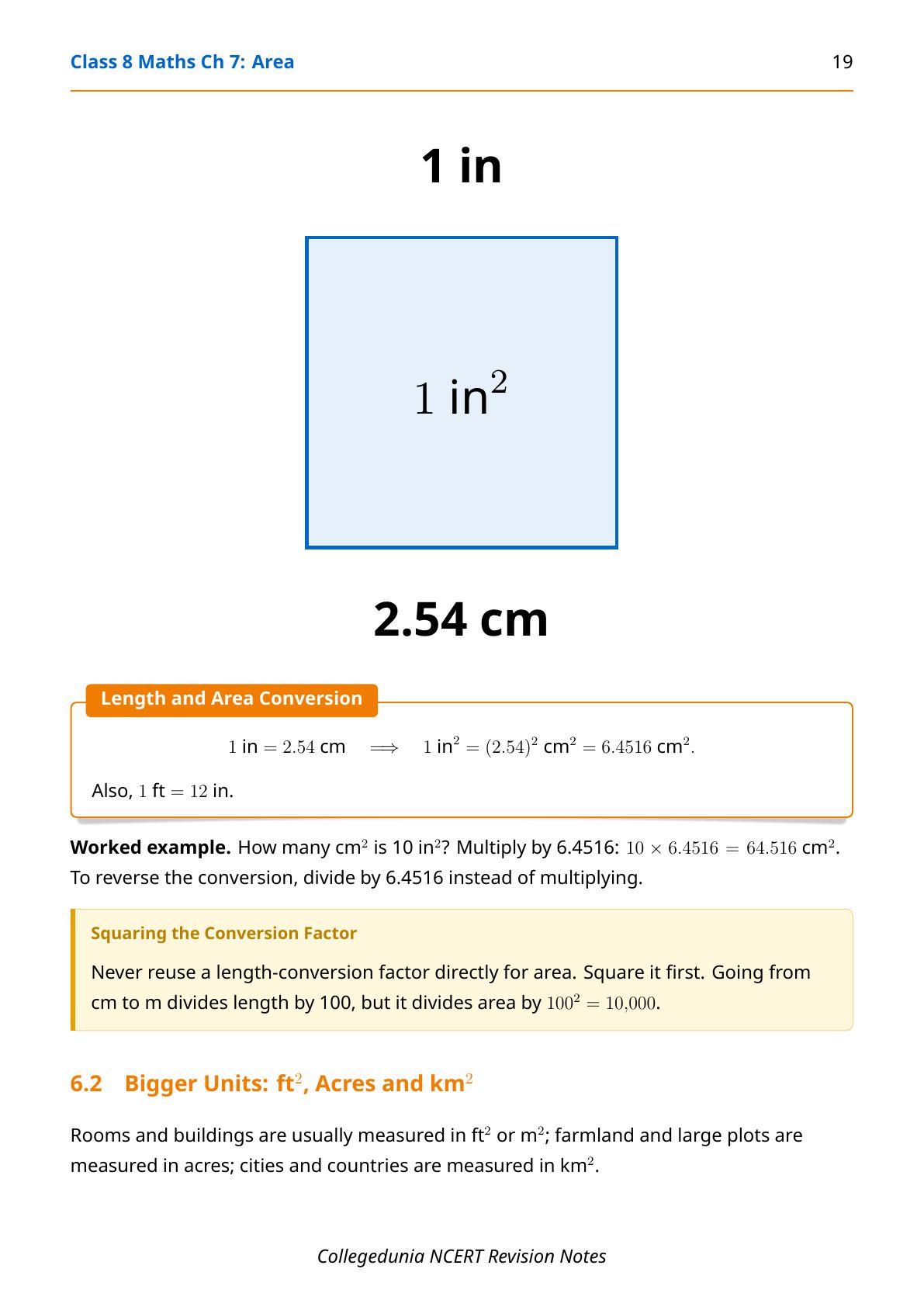
Since 1 inch = 2.54 cm, squaring both sides gives 1 in² = 6.4516 cm². To convert 10 in² to cm², multiply by 6.4516 to get 64.516 cm². To go the other way, divide by 6.4516, so 161.29 cm² equals 25 in².
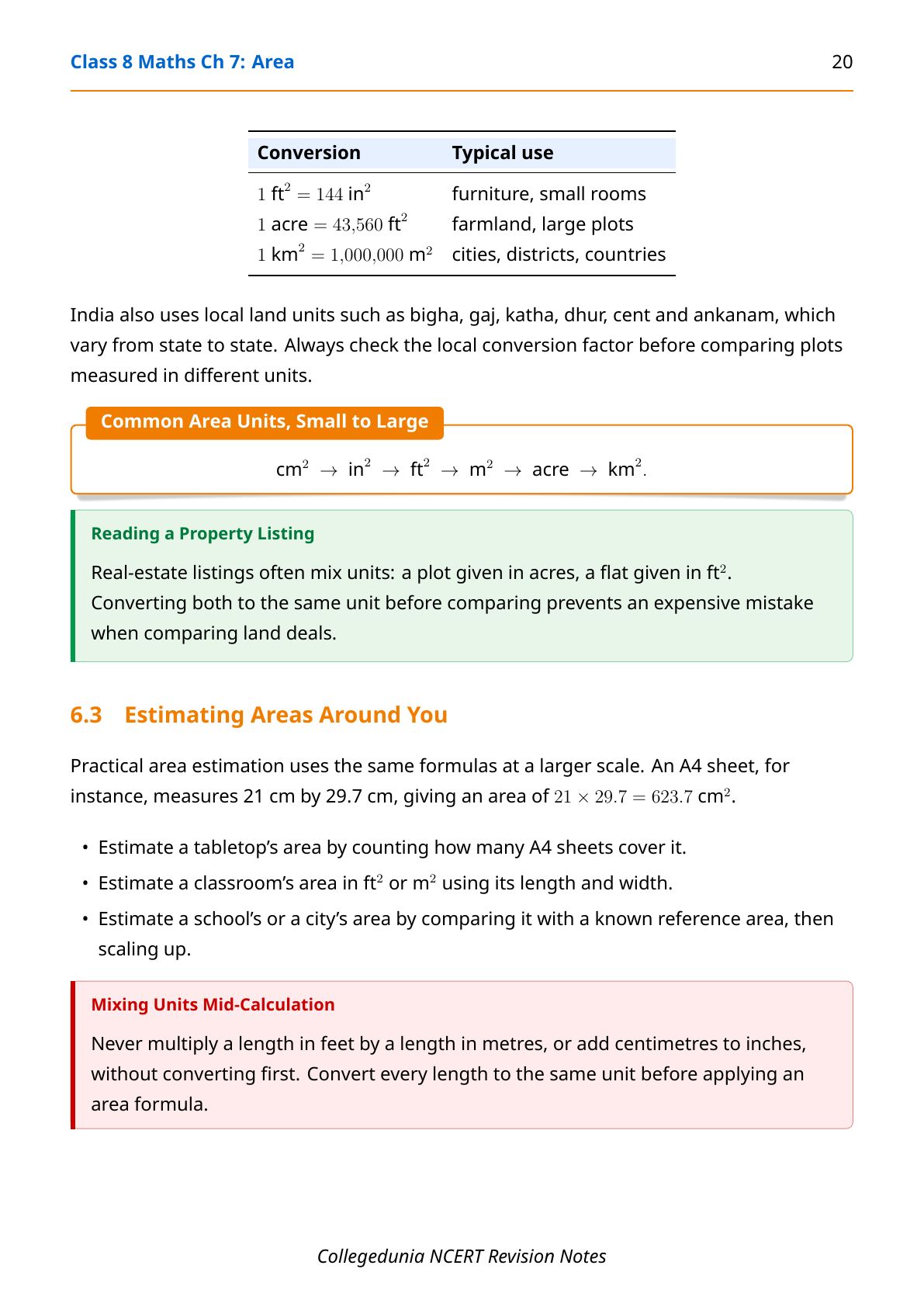
| Unit | Equal to | Typical use |
|---|---|---|
| 1 m² | 10,000 cm² | Room or plot of land |
| 1 acre | 43,560 ft² | Farmland, measured in the US and parts of India |
| 1 hectare | 10,000 m² | Large farmland and forest plots |
| 1 km² | 1,000,000 m² = 100 hectares | A city, town or district |
India also uses local units that vary by state, such as bigha, gaj, katha, dhur, cent and ankanam. These do not convert by one fixed number everywhere, since a bigha in Punjab is not the same size as a bigha in Bihar, so always check the local conversion before using one in a calculation.
Quick length-to-area reminder. Doubling a length quadruples the area it can enclose in a square, since the conversion factor gets squared too. This is why a 2× zoom on a map does not mean 2× the land area, it means 4×.
Common Mistakes Students Make in the Area Chapter
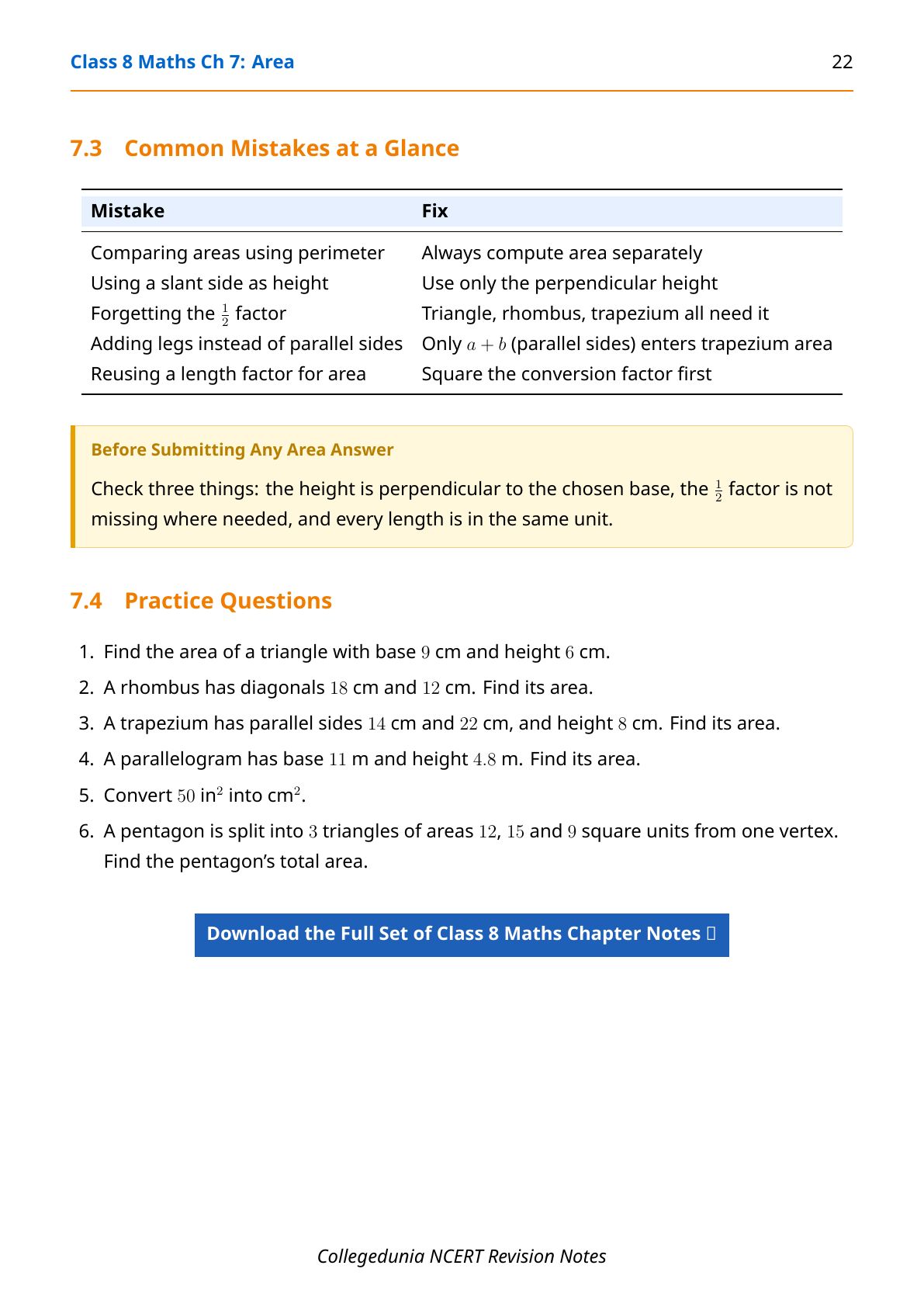
Most lost marks in this chapter come from six repeat errors. Each one has a fix that takes a few seconds. Scan this table the night before a test.
| Mistake | Fix |
|---|---|
| Assuming equal perimeter means equal area | Remember these are two separate measurements, always check both |
| Multiplying base by the slanted side of a parallelogram | Always use the perpendicular height, never the slant length |
| Halving only one diagonal of a rhombus | Multiply both full diagonals first, then halve the product once |
| Confusing the two trapezium proofs mid-answer | Pick one proof and finish it, both give the same final formula |
| Converting area units by the length-conversion number alone | Square the length-conversion factor before applying it to area |
| Splitting an irregular polygon into overlapping triangles | Draw diagonals only from one single vertex so triangles never overlap |
The 30 second sanity check. Before writing a final answer, ask whether the number is a reasonable size. A classroom cannot be 4,000,000 cm² unless you meant to say 400 m². Checking the unit catches most of these errors instantly.
Five words for the whole chapter. Cut, Slide, Match, Multiply, Convert. Cut a shape along a height or diagonal, slide the piece to form a rectangle, match the base and height, multiply, then convert the unit if the question asks for it.
Question Trends and Marks for Area in Class 8 Tests
Class 8 papers are set by schools, so the exact pattern varies. Across the question banks we track, seven question types cover almost everything asked from this chapter.
| Question type | Usual marks | What to revise |
|---|---|---|
| Find the area of a triangle given base and height | 1 to 2 | ½ × base × height |
| Find the area of a parallelogram or a rhombus | 2 | base × height, or ½ × product of diagonals |
| Prove the trapezium area formula using one of the two methods | 3 to 4 | Both dissection proofs, step by step |
| Find a missing sidelength given an area | 2 | Rearrange the formula before substituting |
| Compute the area of an irregular polygon | 3 to 4 | Split into non-overlapping triangles from one vertex |
| Compare areas of triangles between the same parallels | 2 to 3 | Same base, same height means equal area |
| Convert an area from one unit to another | 1 to 2 | Square the length-conversion factor first |
The ideas here carry straight into Class 9 and Class 10, where the same dissection method proves the area formulas for circles and combined shapes. Students who enjoy geometry meet the triangulation idea again in mensuration and later in coordinate geometry.
What the Area Class 8 Notes PDF Contains
The downloadable PDF runs to 23 pages and follows the same order as the printed chapter, so you can keep it open beside the textbook while you revise.
- Sections 1 and 2: rectangle and square area, the perimeter-versus-area distinction, and the full rectangle-enclosure proof for a triangle's area
- Sections 3 and 4: the parallelogram dissection proof and the two rhombus methods, base × height and the diagonal shortcut
- Sections 5 and 6: both trapezium proofs side by side, and the triangles-between-parallels idea with the mirror trick for minimum perimeter
- Sections 7 and 8: polygon triangulation with solved examples, the full unit-conversion table, the mistake table and a formula recap
Colour-coded boxes mark every formula, quick tip and common trap. The final two pages hold a side-by-side comparison of all five area formulas and a tick-list you can read in the ten minutes before a test.
How These Notes Pair With the Other Class 8 Maths Resources
Use the notes to learn the proofs, then move to the handwritten set or the official chapter file for a different kind of revision. The table below links every Collegedunia resource we publish for this chapter.
| Resource | Best used for | Link |
|---|---|---|
| Handwritten Notes | Fast revision in a topper's handwriting | Handwritten Notes for Area |
| NCERT Book PDF | The official Ganita Prakash Part 2 chapter file | Download the Ganita Prakash Part 2 Chapter PDF |
| NCERT Solutions | Every textbook question solved step by step | NCERT Solutions for Area (coming soon) |
| Formula Sheet | A one-page recap of every rule in the chapter | Formula Sheet for Area (coming soon) |
Tip: read the notes once, attempt the Figure it Out questions with the book closed, then check the two trapezium proofs against your own working before moving on.
Class 8 Maths Notes for Ganita Prakash Part 2: All Chapters
All seven chapters of the Class 8 Maths Part 2 textbook have their own notes page for the 2026-27 session.
| Chapter | Title | Notes |
|---|---|---|
| Chapter 1 | Fractions in Disguise | Fractions in Disguise Class 8 Notes |
| Chapter 2 | The Baudhayana-Pythagoras Theorem | The Baudhayana-Pythagoras Theorem Class 8 Notes |
| Chapter 3 | Proportional Reasoning-2 | Proportional Reasoning-2 Class 8 Notes |
| Chapter 4 | Exploring Some Geometric Themes | Exploring Some Geometric Themes Class 8 Notes (coming soon) |
| Chapter 5 | Tales by Dots and Lines | Tales by Dots and Lines Class 8 Notes (coming soon) |
| Chapter 6 | Algebra Play | Algebra Play Class 8 Notes (coming soon) |
| Chapter 7 | Area | Area Class 8 Notes |
Every chapter also has a Ganita Prakash Part 2 book PDF page and a handwritten revision set, so you can pick the format that suits your revision time.
FAQs on NCERT Class 8 Maths Notes Chapter 7 Area
Quick Answers on Area Formulas, Proofs and Unit Conversions
Ques. What is the formula for the area of a triangle?
Ans. Area of a triangle equals half of base times height. The formula comes from enclosing the triangle in a rectangle that shares its base and height, then showing the triangle always covers exactly half of that rectangle. It holds for every triangle, including ones where the top vertex is not directly above the base.
Ques. How is the area of a parallelogram derived?
Ans. A parallelogram is cut along its height into a triangle and a trapezium. Sliding the triangle to the opposite end forms a rectangle with the same base and height, and the same area. So area of a parallelogram equals base times height, using the perpendicular height, not the slanted side.
Ques. What is the formula for the area of a rhombus?
Ans. Area of a rhombus equals half the product of its two diagonals. This follows because the diagonals of a rhombus are perpendicular and bisect each other, so the rhombus can be rearranged into a rectangle built from those diagonals, or split into two congruent triangles that add to the same total.
Ques. What are the two proofs for the area of a trapezium?
Ans. The first proof breaks the trapezium into a rectangle and two right triangles using perpendiculars from the shorter parallel side. The second proof joins two rotated copies of the trapezium into a parallelogram and takes half its area. Both proofs give the same formula, area equals half of height times the sum of the parallel sides.
Ques. Why do triangles between the same parallels have equal area?
Ans. Every triangle with its base on one line and its third vertex anywhere on a parallel line shares the same base length and the same perpendicular height, since the two lines never get closer or farther apart. Because area depends only on base and height, all these triangles have equal area, even though their shapes look different.
Ques. How do you find the area of an irregular polygon?
Ans. Split the polygon into triangles by drawing diagonals from one vertex, find the area of each triangle, then add them together. A quadrilateral needs one diagonal to make two triangles, a pentagon needs two diagonals to make three triangles, and an n-sided polygon always needs n minus 2 triangles.
Ques. How do you convert square inches to square centimetres?
Ans. Since 1 inch equals 2.54 cm, squaring both sides gives 1 square inch equals 6.4516 square centimetres. Multiply the number of square inches by 6.4516 to get square centimetres, or divide a square-centimetre value by 6.4516 to convert back to square inches.
Ques. How many square metres are in a hectare and a square kilometre?
Ans. One hectare equals 10,000 square metres, and one square kilometre equals 1,000,000 square metres, which is the same as 100 hectares. These larger units are used for farmland, forests, and the area of a town or city.
Ques. Why can't perimeter be used to measure area?
Ans. Perimeter measures the length of a boundary, while area measures the surface enclosed inside it. Two shapes can have the same perimeter but very different areas, or a shape with a larger perimeter can enclose a smaller area than a shape with a smaller perimeter. The two measurements are independent of each other.
Ques. How many pages is the Class 8 Maths Area Notes PDF?
Ans. The Notes PDF runs approximately 23 pages and covers every formula, proof and solved example from the Area chapter of Ganita Prakash Part 2, including the unit-conversion table and a full revision checklist.
Ques. Are these Class 8 Maths notes based on the 2026-27 syllabus?
Ans. Yes. The notes follow Ganita Prakash Part 2, the Class 8 Maths textbook for the 2026-27 session, section by section. Every formula, proof and solved example matches the printed chapter.



Comments