Commerce Mentor, Ramjas College | Updated 3+ months ago
These NCERT Solutions for Class 12 Business Studies Chapter 3 Business Environment bring together every answer the CBSE board paper asks, from the five dimensions of the environment to the impact of demonetisation and GST. All answers follow the 2026-27 syllabus and marking scheme.
CBSE Weightage: 6 to 10 marks (Unit 1, Principles and Functions of Management)
Question Count: 5 Very Short Answer + 6 Short Answer + 5 Long Answer (16 in total)
These NCERT Solutions are curated by senior Commerce educators, mapped to the 2026-27 NCERT Business Studies textbook, and refined against the last five years of CBSE Class 12 Board papers.
Business Environment NCERT Solutions: Important Topics
The Class 12 Business Studies Chapter 3 end-of-chapter exercises cover the topics below. The table groups them so you can target the clusters CBSE tests most heavily.
Topic
What CBSE Tests
Mark Weightage
Meaning and 7 features of business environment
Totality, specific + general forces, inter-relatedness, dynamic, uncertainty, complexity, relativity
3-4
Importance of business environment
Identifying opportunities, threats, resource tapping, coping with change, planning, performance
3-6
Five dimensions
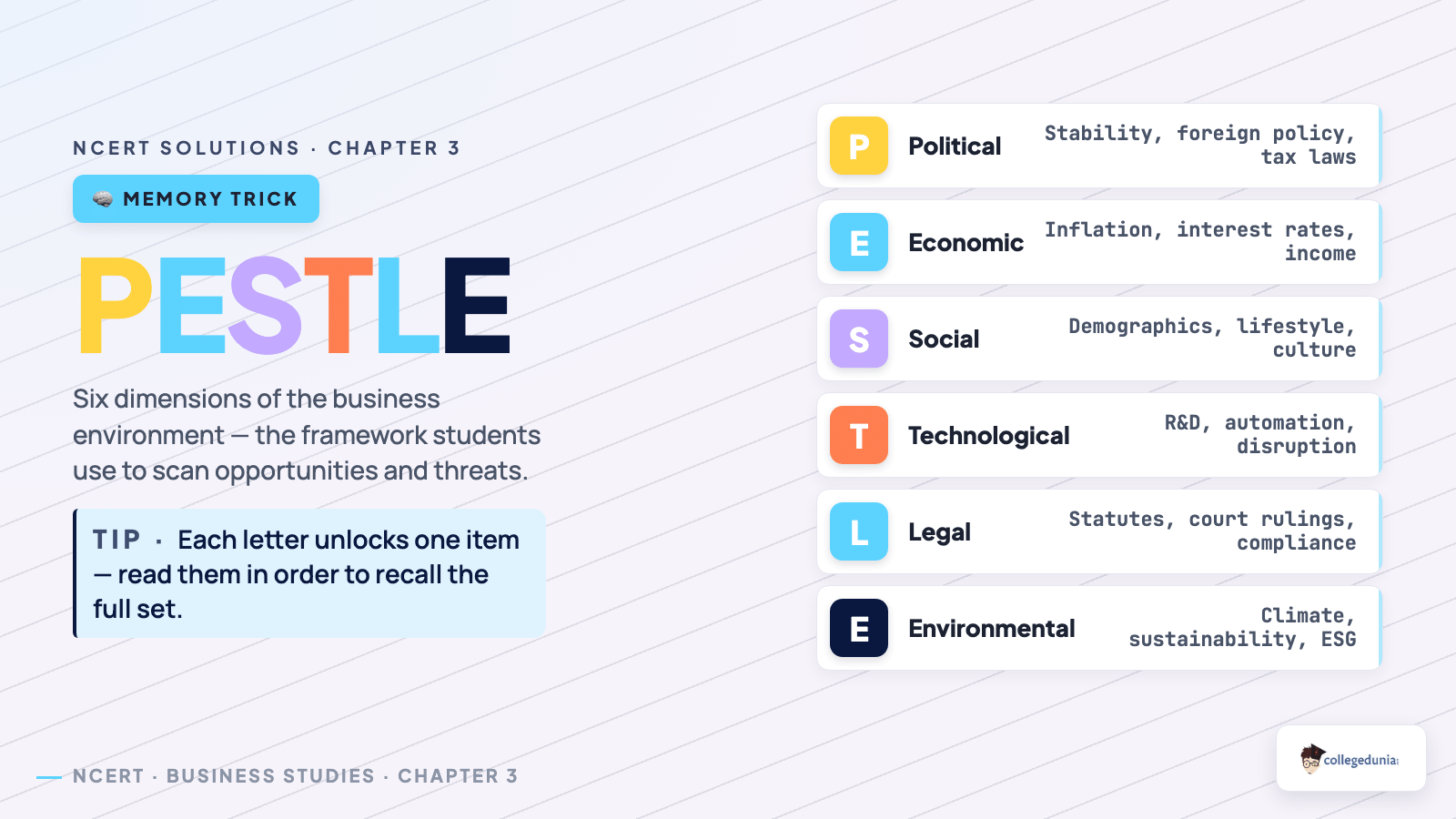
Economic, Social, Technological, Political, Legal
5-6
Economic environment in India (NEP 1991)
Pre-1991 crisis (6.6% fiscal deficit, gold pledge to BoE, $1.2B forex); abolition of industrial licensing; BIFR; FIPB
Greater competition, more demanding customers, change in technology, market orientation, loss of budgetary support
5-6
Impact of government policy changes on business
6-7 impacts: competition, customers, technology, change, HR, market orientation, loss of PSU budgetary support
5-6
Case-based application
Map external change to dimension; recommend managerial response
5-6
Concept Anchor: Business environment is the sum of all external forces (economic, social, technological, political, legal) that affect the functioning of a business. Managers must continuously scan, identify opportunities, and adapt to environmental change.
What the Class 12 Business Studies Chapter 3 NCERT Solutions PDF Contains
Concept opener that names and defines the concept before the analysis.
Textbook-mapped definitions using exact NCERT terminology in every answer.
Step-by-step structure on long answers so the marker can tick each point.
Expert Solution with an alternate angle and what the examiner checks.
Common-mistake call-outs that name the slip and the correct response.
7 Features of Business Environment (CBSE Marker Checklist)
CBSE markers expect all seven features named in order. Skipping even one drops 1-2 marks on a 4-mark question.
Totality of external forces: the aggregate of every external force acting on the firm, not any single factor.
Specific and general forces: specific forces (customers, suppliers, investors, competitors) affect one firm; general forces affect all firms.
Inter-relatedness: forces are linked. A technology change raises consumer expectations, which forces firms to upgrade products.
Dynamic nature: the environment keeps changing due to technology, consumer preferences and policy. No factor stays fixed.
Uncertainty: changes are hard to predict, especially in fast-moving sectors like IT, fashion and electronics.
Complexity: many inter-related forces change at once, so managers grasp only parts of it at a time.
Relativity: it differs across countries and regions (saris sell well in India, less in France).
New Economic Policy 1991: The Crisis and the Reforms
The 1991 reforms are the single most-tested topic in this chapter. The marker wants the trigger crisis, the three pillars (LPG) and the named institutional changes.
June 1991 Crisis Trigger: India faced an acute Balance of Payments crisis. The fiscal deficit had ballooned to 6.6% of GDP, foreign exchange reserves had collapsed to about $1.2 billion (enough for barely two weeks of imports), and the government had to pledge gold to the Bank of England (BoE) to secure an emergency loan. These conditions forced India to adopt the New Economic Policy (NEP) on 24 July 1991.
Liberalisation (removal of controls on Indian business)
Abolition of industrial licensing for all industries except a small list of strategic sectors (defence, atomic energy, hazardous chemicals).
No need for previous government permission to expand production capacity.
Freedom in fixing the prices of goods and services.
Reduction in tax rates and lifting of unnecessary controls on the movement of goods.
Simpler import-export procedures and easier access to foreign technology.
Privatisation (giving a greater role to the private sector)
Disinvestment of equity in public sector undertakings (PSUs).
Reduction in the number of industries reserved for the public sector from 17 (1956) to just 3 (defence, atomic energy, railways).
Sick public sector units were referred to the Board for Industrial and Financial Reconstruction (BIFR) for revival or closure.
Globalisation (integrating the Indian economy with the world economy)
Reduction of tariffs and import duties.
Removal of quantitative restrictions on imports and exports.
Easier flow of foreign direct investment (FDI) through the Foreign Investment Promotion Board (FIPB), the single-window clearance for foreign investment proposals.
Encouragement of foreign collaborations in technology and equity.
Demonetisation: 8 November 2016
On 8 November 2016, the Government of India withdrew the legal tender status of all existing Rs 500 and Rs 1000 currency notes. Roughly 86% of the cash in circulation by value was demonetised overnight. Citizens were given a deadline to deposit the old notes in banks. The objective was three-fold: clamp down on black money, push the economy toward digital payments, and bring more transactions into the formal banking system.
Money supply: Immediate sharp fall in currency in circulation; rise in bank deposits.
Banking sector: Surge in CASA (current account + savings account) deposits; banks gained cheap funds and could lower lending rates.
Interest rates: Both deposit and lending rates fell as liquidity in the banking system expanded.
Cashless economy: Rapid uptake of UPI, mobile wallets (Paytm, PhonePe) and digital payment platforms; the formal economy expanded.
Tax compliance: Rise in income-tax returns filed and in GST registrations in the following year.
6-7 Impacts of Government Policy Changes (LPG) on Indian Business
Increasing competition: Removal of licensing and entry of foreign firms increased competition for Indian firms in services (telecom, banking) and consumer goods.
More demanding customers: Wider choice of products and information raised customer expectations on quality, price and after-sales service.
Rapidly changing technological environment: Firms faced shorter product life-cycles, forcing continuous investment in R&D and product upgrades.
Necessity for change: Firms could no longer follow stable, long-term plans; they had to continuously modify operations in response to environmental change.
Need for developing human resources: New technology and global competition required a skilled, adaptable, trained workforce.
Market orientation: Firms shifted from production-orientation (make and sell) to market-orientation (research customer needs first, then produce).
Loss of budgetary support to the public sector: PSUs were forced to generate their own resources and operate efficiently; budgetary support from the central government was withdrawn.
Common Mistakes Students Make in Chapter 3
Confusing business environment with internal environment. The chapter is about external forces only.
Listing fewer than seven features. CBSE wants all seven: totality, specific+general, inter-relatedness, dynamic, uncertainty, complexity, relativity.
Listing fewer than five dimensions. There are exactly five: economic, social, technological, political, legal.
Forgetting that LPG = Liberalisation + Privatisation + Globalisation, the 1991 reforms package launched after the June 1991 BoP crisis.
Missing the date in demonetisation answers. Mark-scheme expects "8 November 2016" and the exact denominations withdrawn (Rs 500 and Rs 1000).
Treating demonetisation only as a political event. It hit the economic dimension hardest (money supply, banking, interest rates).
Forgetting the named institutions in NEP 1991 answers: BIFR (sick PSUs) and FIPB (foreign investment).
All NCERT Solutions for Business Environment with Step-by-Step Working
Every NCERT textbook question for Class 12 Business Studies Chapter 3 Business Environment is listed below with its full Solution and Expert Solution hidden inside collapsible tabs. Click Check Solution to reveal the step-by-step working; click Expert Solution for the expanded explanation.
Very Short Answer Type Questions
Q 3.1
What is meant by business environment?
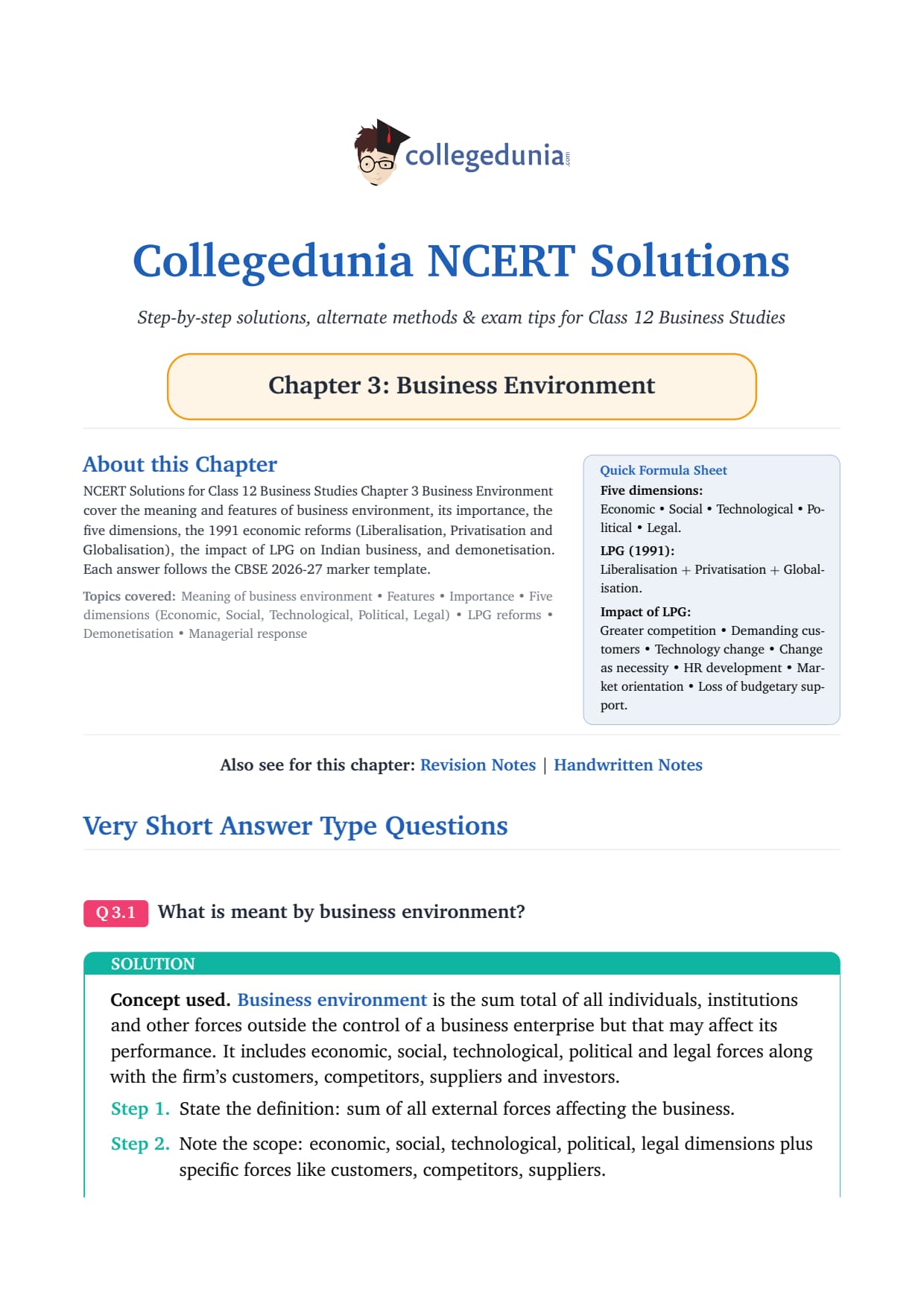
Concept used.Business environment is the sum total of all individuals,
institutions and other forces outside the control of a business enterprise but that may affect
its performance. It includes economic, social, technological, political and legal forces along
with the firm's customers, competitors, suppliers and investors.
State the definition: sum of all external forces affecting the business.
Note the scope: economic, social, technological, political, legal dimensions plus
specific forces like customers, competitors, suppliers.
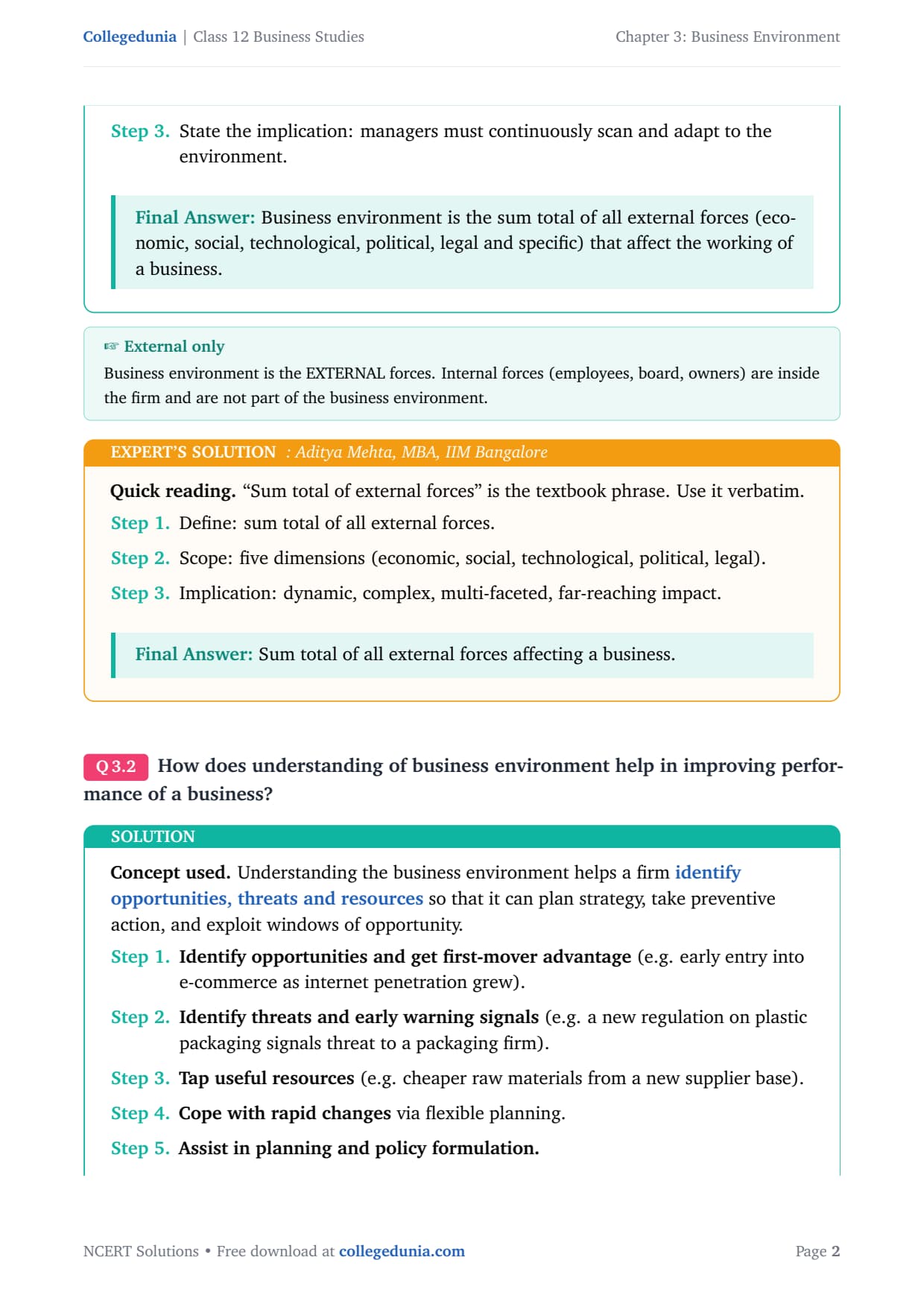
State the implication: managers must continuously scan and adapt to the environment.
Business environment is the sum total of all external forces (economic, social,
technological, political, legal and specific) that affect the working of a business.
AM
Aditya Mehta
MBA, IIM Bangalore
Verified Expert
Quick reading. ``Sum total of external forces'' is the textbook phrase. Use it verbatim.
Define: sum total of all external forces.
Scope: five dimensions (economic, social, technological, political, legal).
Sum total of all external forces affecting a business.
Q 3.2
How does understanding of business environment help in improving performance of a
business?
Concept used. Understanding the business environment helps a firm identify
opportunities, threats and resources so that it can plan strategy, take preventive action, and
exploit windows of opportunity.
Identify opportunities and get first-mover advantage (e.g. early entry into
e-commerce as internet penetration grew).
Identify threats and early warning signals (e.g. a new regulation on plastic
packaging signals threat to a packaging firm).
Tap useful resources (e.g. cheaper raw materials from a new supplier base).
Cope with rapid changes via flexible planning.
Assist in planning and policy formulation.
Improve performance via informed decisions.
Six benefits: identify opportunities, identify threats, tap resources, cope with
change, assist planning, improve performance.
SK
Sneha Kapoor
MBA, FMS Delhi
Verified Expert
Strategic angle. List six benefits, one line each.
First-mover advantage (opportunities).
Early warning (threats).
Resource tapping (cheaper inputs).
Coping with rapid change.
Planning support.
Better performance overall.
Identify opportunities, threats, resources; cope with change; plan better; perform
better.
Q 3.3
Give an example to show that a business firm operates within numerous inter-related
factors constituting the business environment.
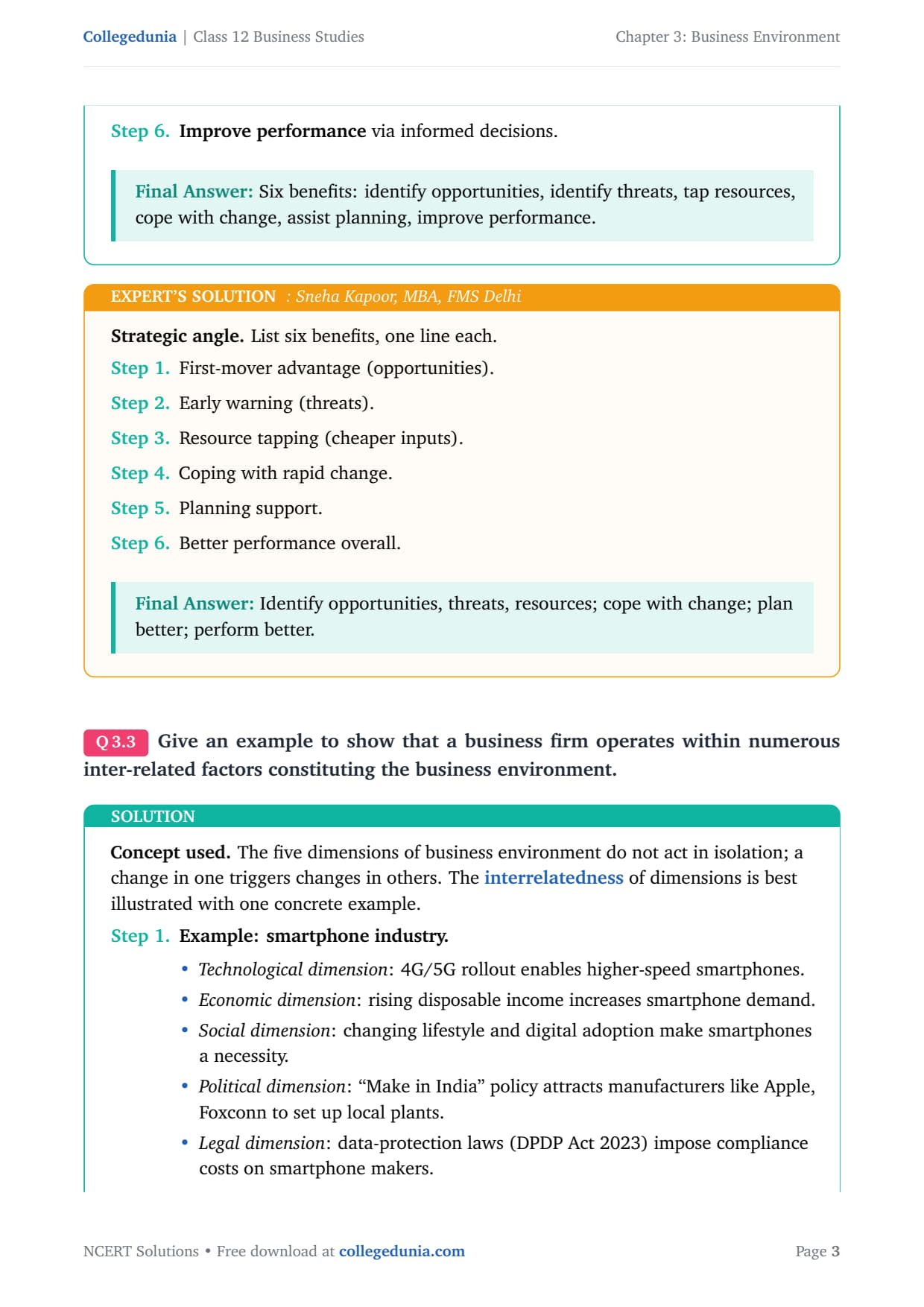
Concept used. The five dimensions of business environment do not act in isolation; a
change in one triggers changes in others. The interrelatedness of dimensions is best
illustrated with one concrete example.
All five dimensions are simultaneously affecting any smartphone firm; together they
define its environment.
A smartphone firm faces all five dimensions at once (technology rollout, rising income,
digital lifestyle, Make-in-India policy, data laws), each influencing the others.
KM
Karan Mehta
MBA, XLRI Jamshedpur
Verified Expert
Picture-first. Pick any modern product (smartphone, electric car, online food delivery).
Show how all five dimensions hit it at once.
Choose product: smartphone.
List how each dimension affects it: technology (5G), economic (income), social
(lifestyle), political (Make in India), legal (data laws).
Conclude: dimensions are interrelated, not isolated.
Smartphone industry shows all five dimensions simultaneously, interconnected.
Q 3.4
Krishna Furnishers Mart started its operations in the year 1954 and emerged as the
market leader in the industry because of their original designs and efficiency in operations.
They had a steady demand for their products but over the years, they found their market share
declining because of new entrants in the field. The firm decided to review their operations and
decided that in order to meet the competition, they need to study and analyze the market trends
and then design and develop their products accordingly. List any two impacts of changes in
business environment on Krishna Furnishers Mart's operations.
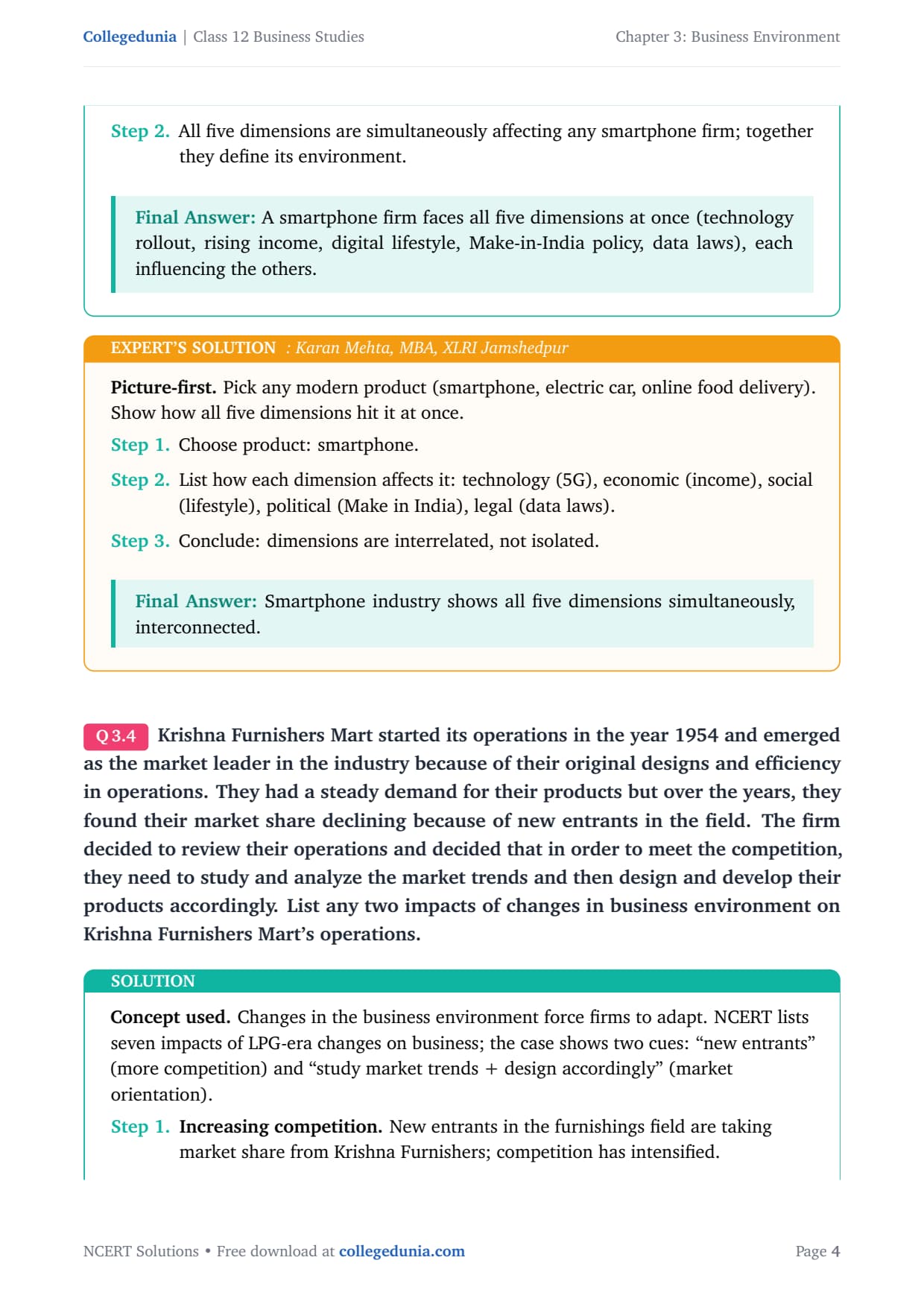
Concept used. Changes in the business environment force firms to adapt. NCERT lists
seven impacts of LPG-era changes on business; the case shows two cues: ``new entrants'' (more
competition) and ``study market trends + design accordingly'' (market orientation).
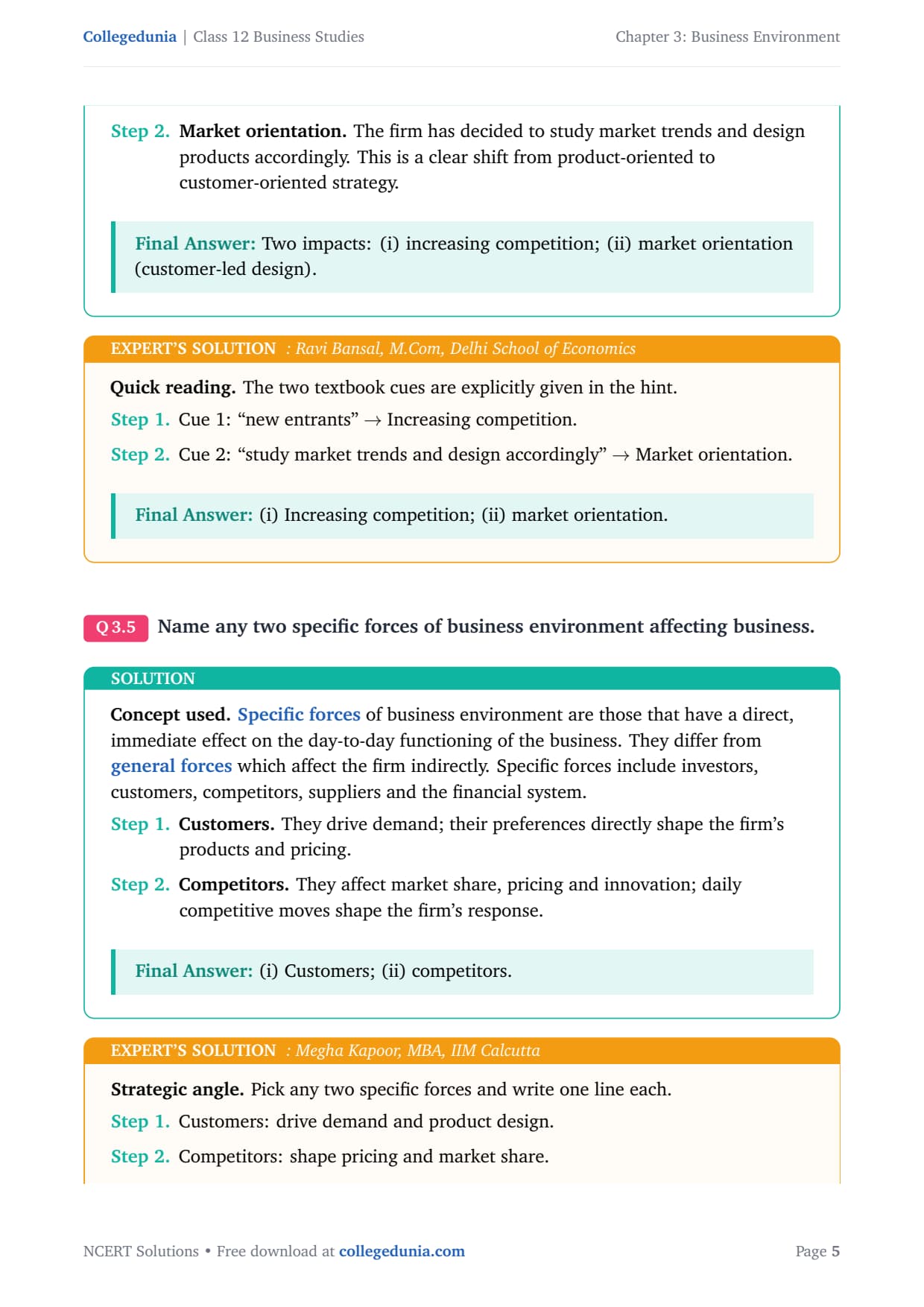
Increasing competition. New entrants in the furnishings field are taking market
share from Krishna Furnishers; competition has intensified.
Market orientation. The firm has decided to study market trends and design
products accordingly. This is a clear shift from product-oriented to customer-oriented
strategy.
Two impacts: (i) increasing competition; (ii) market orientation (customer-led design).
RB
Ravi Bansal
M.Com, Delhi School of Economics
Verified Expert
Quick reading. The two textbook cues are explicitly given in the hint.
(i) Increasing competition; (ii) market orientation.
Q 3.5
Name any two specific forces of business environment affecting business.
Concept used.Specific forces of business environment are those that have a
direct, immediate effect on the day-to-day functioning of the business. They differ from
general forces which affect the firm indirectly. Specific forces include investors,
customers, competitors, suppliers and the financial system.
Customers. They drive demand; their preferences directly shape the firm's
products and pricing.
Competitors. They affect market share, pricing and innovation; daily
competitive moves shape the firm's response.
(i) Customers; (ii) competitors.
MK
Megha Kapoor
MBA, IIM Calcutta
Verified Expert
Strategic angle. Pick any two specific forces and write one line each.
Customers: drive demand and product design.
Competitors: shape pricing and market share.
Memorise also: investors, suppliers, financial system as backups.
Customers and competitors.
Short Answer Type Questions
Q 3.6
Why is it important for business enterprises to understand their environment? Explain.
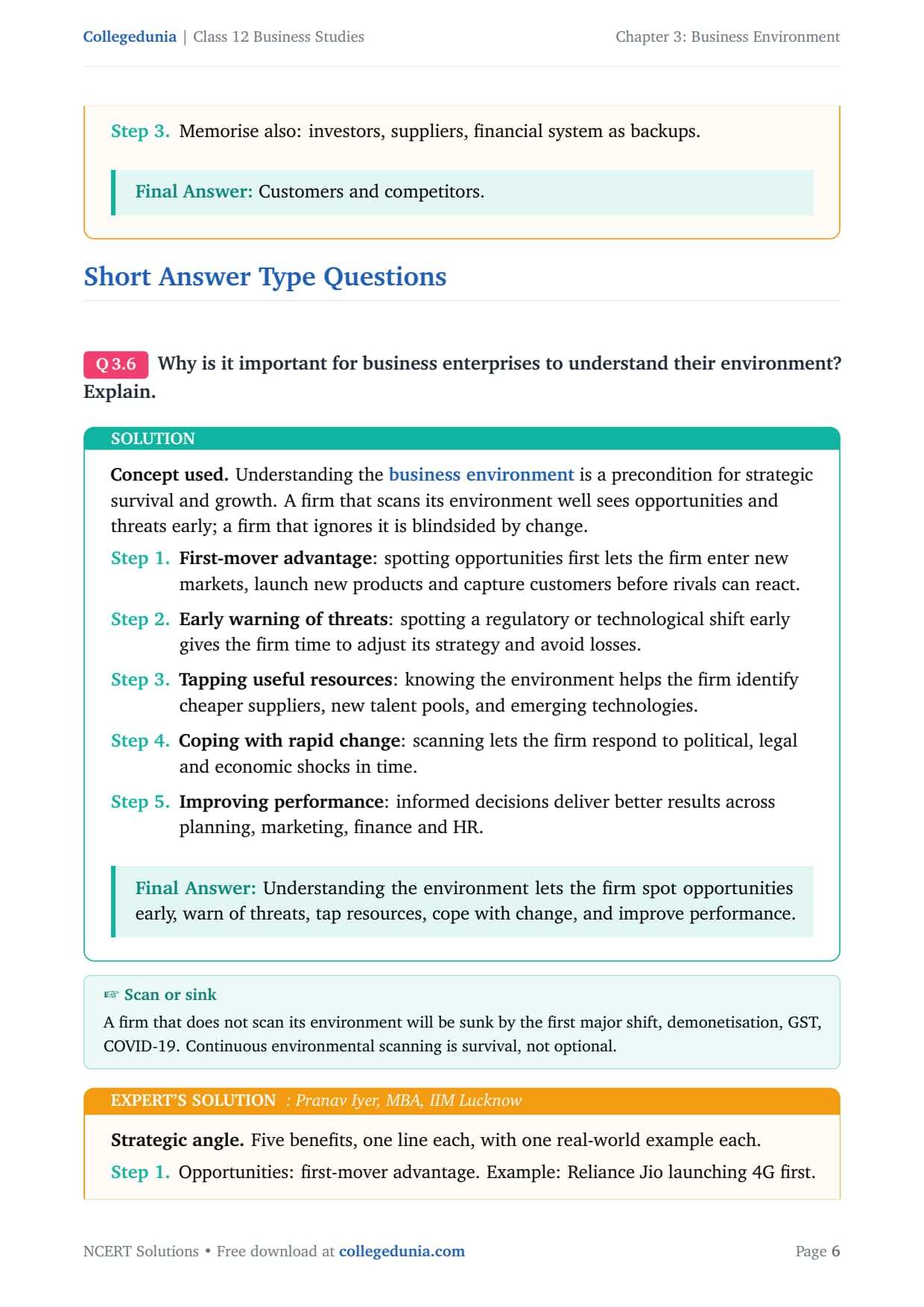
Concept used. Understanding the business environment is a precondition for
strategic survival and growth. A firm that scans its environment well sees opportunities and
threats early; a firm that ignores it is blindsided by change.
First-mover advantage: spotting opportunities first lets the firm enter new
markets, launch new products and capture customers before rivals can react.
Early warning of threats: spotting a regulatory or technological shift early
gives the firm time to adjust its strategy and avoid losses.
Tapping useful resources: knowing the environment helps the firm identify
cheaper suppliers, new talent pools, and emerging technologies.
Coping with rapid change: scanning lets the firm respond to political, legal and
economic shocks in time.
Improving performance: informed decisions deliver better results across
planning, ncert-notes-class-12-business-studies-chapter-10-marketing, finance and HR.
Understanding the environment lets the firm spot opportunities early, warn of threats,
tap resources, cope with change, and improve performance.
PI
Pranav Iyer
MBA, IIM Lucknow
Verified Expert
Strategic angle. Five benefits, one line each, with one real-world example each.
Five benefits: opportunities, threats, resources, coping, performance.
Q 3.7
Explain the following terms: (a) Liberalisation, (b) Privatisation, (c) Globalisation.
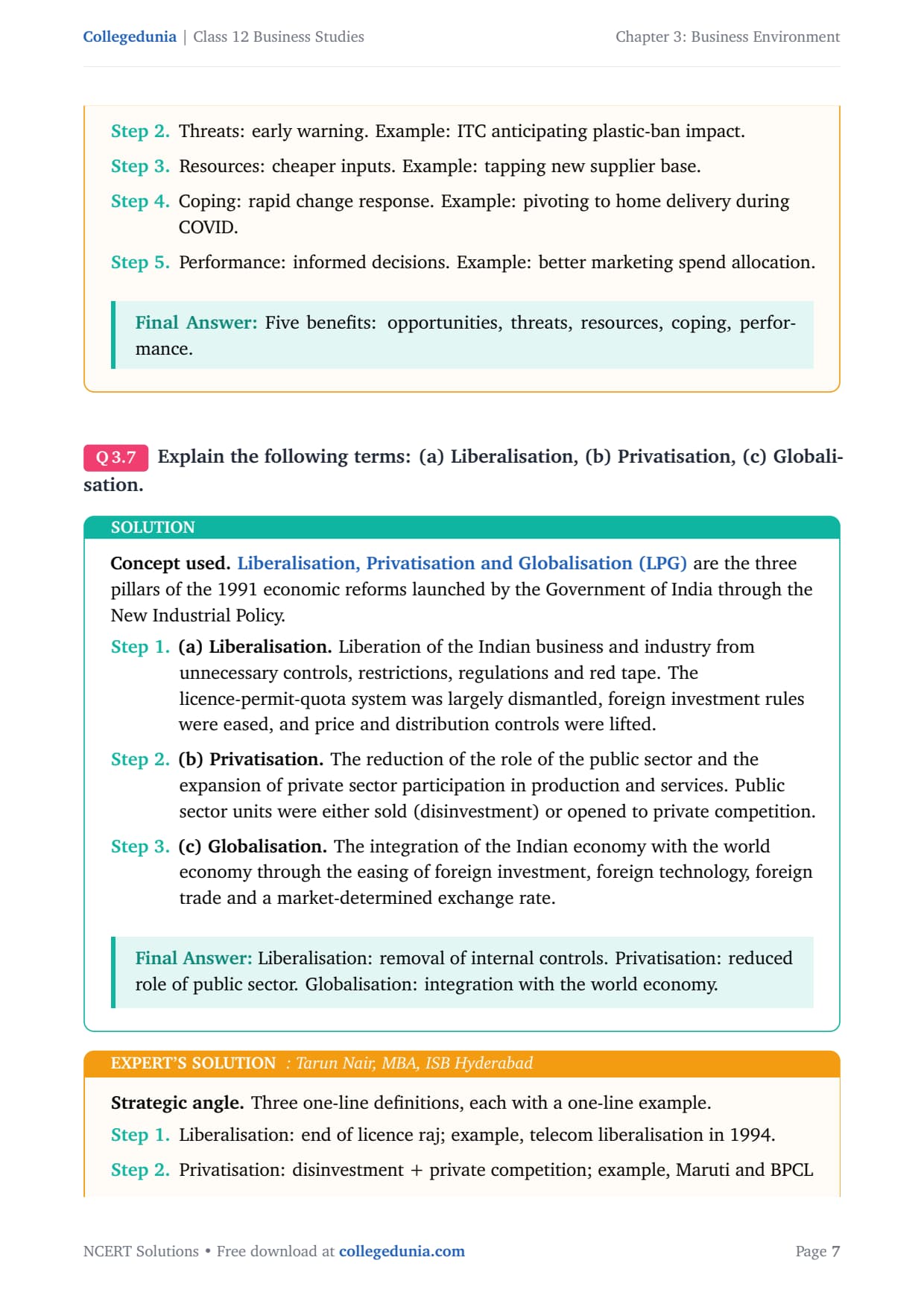
Concept used.Liberalisation, Privatisation and Globalisation (LPG) are the
three pillars of the 1991 economic reforms launched by the Government of India through the New
Industrial Policy.
(a) Liberalisation. Liberation of the Indian business and industry from
unnecessary controls, restrictions, regulations and red tape. The licence-permit-quota
system was largely dismantled, foreign investment rules were eased, and price and
distribution controls were lifted.
(b) Privatisation. The reduction of the role of the public sector and the
expansion of private sector participation in production and services. Public sector
units were either sold (disinvestment) or opened to private competition.
(c) Globalisation. The integration of the Indian economy with the world economy
through the easing of foreign investment, foreign technology, foreign trade and a
market-determined exchange rate.
Liberalisation: removal of internal controls. Privatisation: reduced role of public
sector. Globalisation: integration with the world economy.
TN
Tarun Nair
MBA, ISB Hyderabad
Verified Expert
Strategic angle. Three one-line definitions, each with a one-line example.
Liberalisation: end of licence raj; example, telecom liberalisation in 1994.
Privatisation: disinvestment + private competition; example, Maruti and BPCL
disinvestment.
Globalisation: integration with the world; example, India joining WTO in 1995.
LPG = removing internal controls (L), shrinking public sector (P), and integrating with
world economy (G).
Q 3.8
National Digital Library of India (NDL India) works towards developing a framework of
virtual repository of learning resources with a single-window search facility. It provides
support to all academic levels including researchers, life-long learners and
differently-abled learners free of cost. State the dimensions of business environment
highlighted above.
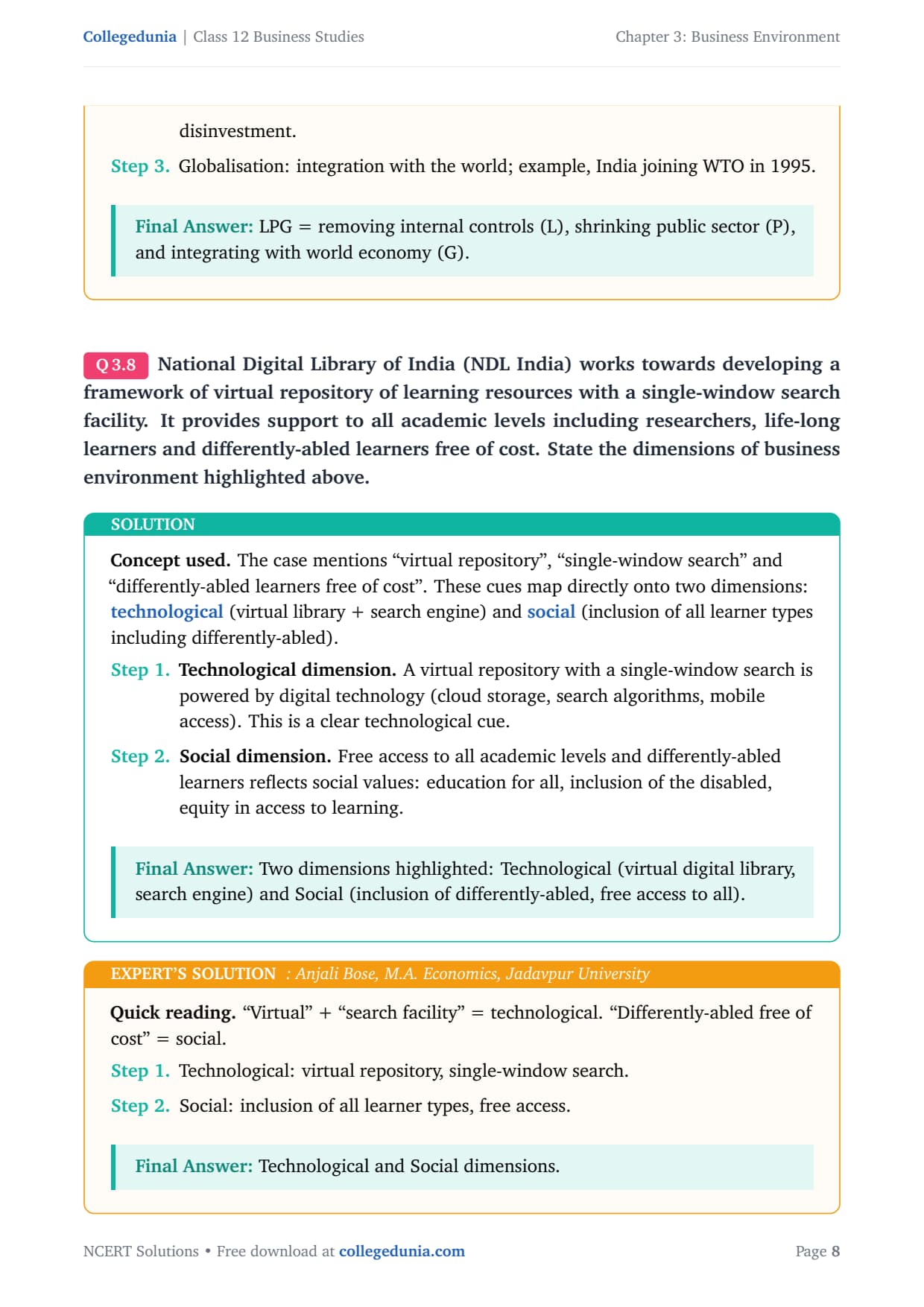
Concept used. The case mentions ``virtual repository'', ``single-window search'' and
``differently-abled learners free of cost''. These cues map directly onto two dimensions:
technological (virtual library + search engine) and social (inclusion of all
learner types including differently-abled).
Technological dimension. A virtual repository with a single-window search is
powered by digital technology (cloud storage, search algorithms, mobile access). This is
a clear technological cue.
Social dimension. Free access to all academic levels and differently-abled
learners reflects social values: education for all, inclusion of the disabled, equity in
access to learning.
Two dimensions highlighted: Technological (virtual digital library, search engine) and
Social (inclusion of differently-abled, free access to all).
Social: inclusion of all learner types, free access.
Technological and Social dimensions.
Q 3.9
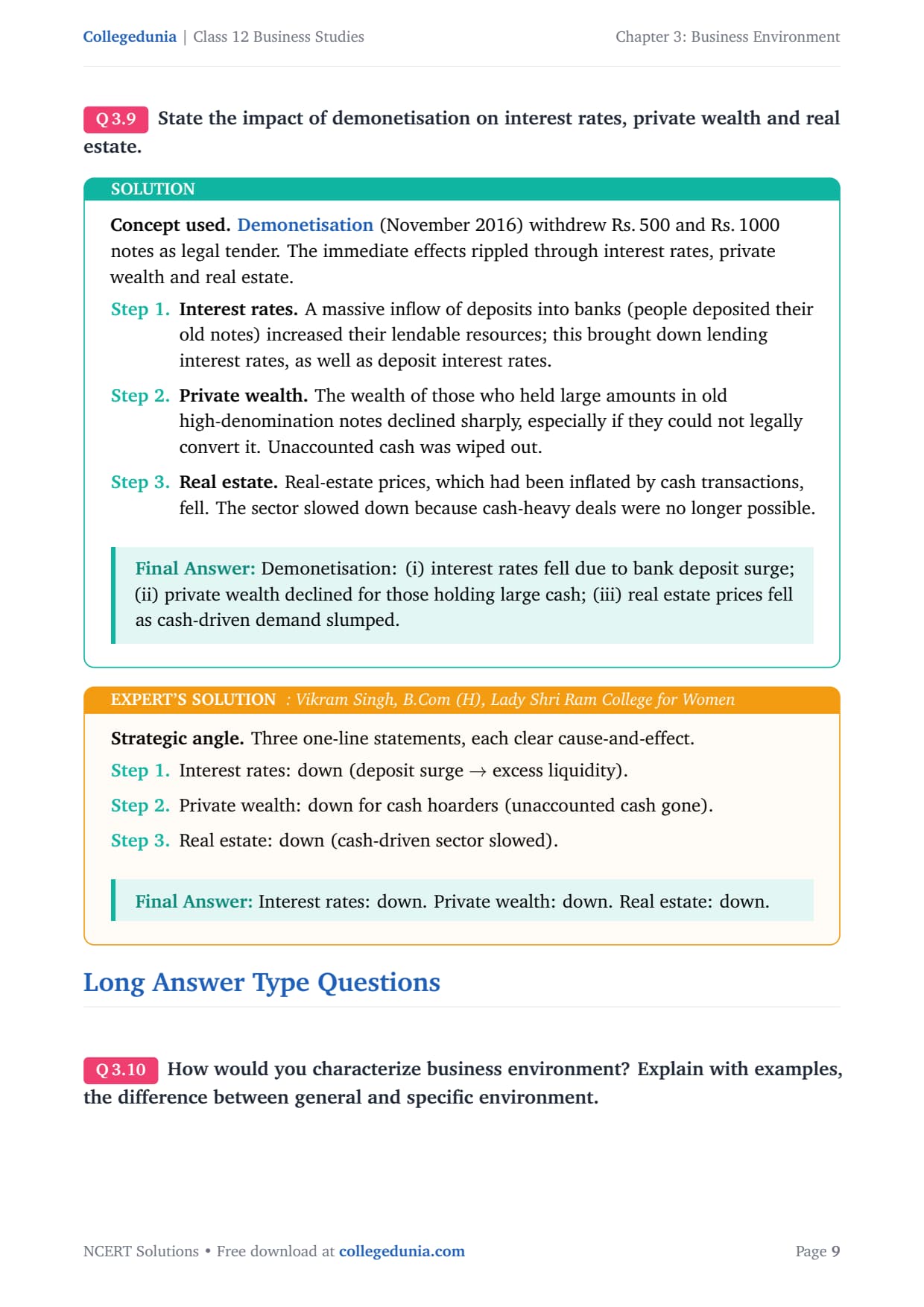
State the impact of demonetisation on interest rates, private wealth and real estate.
Concept used.Demonetisation (November 2016) withdrew Rs. 500 and
Rs. 1000 notes as legal tender. The immediate effects rippled through interest rates, private
wealth and real estate.
Interest rates. A massive inflow of deposits into banks (people deposited their
old notes) increased their lendable resources; this brought down lending interest rates,
as well as deposit interest rates.
Private wealth. The wealth of those who held large amounts in old high-denomination
notes declined sharply, especially if they could not legally convert it. Unaccounted cash
was wiped out.
Real estate. Real-estate prices, which had been inflated by cash transactions,
fell. The sector slowed down because cash-heavy deals were no longer possible.
Demonetisation: (i) interest rates fell due to bank deposit surge; (ii) private wealth
declined for those holding large cash; (iii) real estate prices fell as cash-driven demand
slumped.
VS
Vikram Singh
B.Com (H), Lady Shri Ram College for Women
Verified Expert
Strategic angle. Three one-line statements, each clear cause-and-effect.
Interest rates: down (deposit surge \(\to\) excess liquidity).
Private wealth: down for cash hoarders (unaccounted cash gone).
Real estate: down (cash-driven sector slowed).
Interest rates: down. Private wealth: down. Real estate: down.
Long Answer Type Questions
Q 3.10
How would you characterize business environment? Explain with examples, the difference
between general and specific environment.
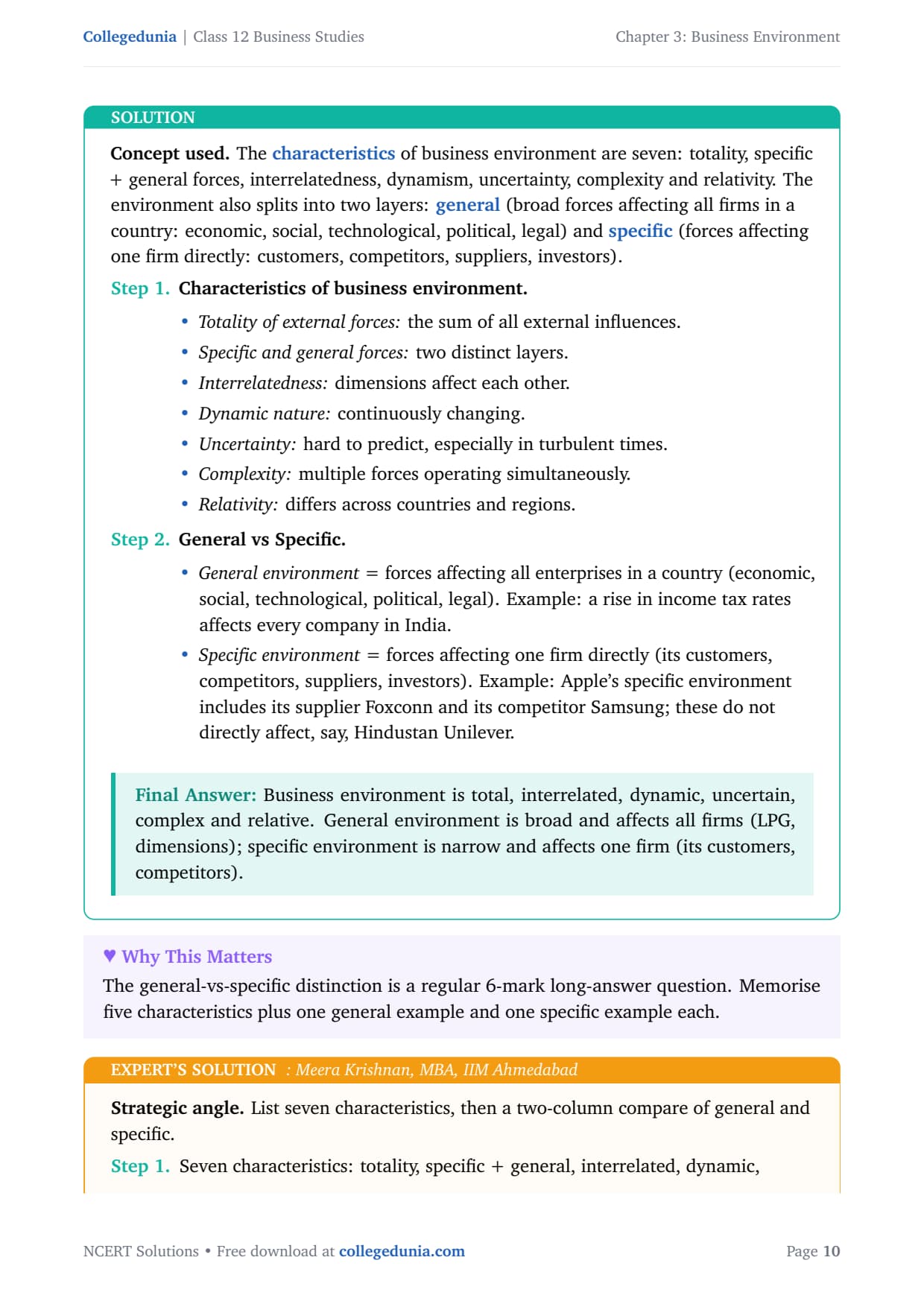
Concept used. The characteristics of business environment are seven: totality,
specific + general forces, interrelatedness, dynamism, uncertainty, complexity and relativity.
The environment also splits into two layers: general (broad forces affecting all firms
in a country: economic, social, technological, political, legal) and specific (forces
affecting one firm directly: customers, competitors, suppliers, investors).
Characteristics of business environment.
Totality of external forces: the sum of all external influences.
Specific and general forces: two distinct layers.
Interrelatedness: dimensions affect each other.
Dynamic nature: continuously changing.
Uncertainty: hard to predict, especially in turbulent times.
General environment = forces affecting all enterprises in a country
(economic, social, technological, political, legal). Example: a rise in income
tax rates affects every company in India.
Specific environment = forces affecting one firm directly (its customers,
competitors, suppliers, investors). Example: Apple's specific environment
includes its supplier Foxconn and its competitor Samsung; these do not directly
affect, say, Hindustan Unilever.
Business environment is total, interrelated, dynamic, uncertain, complex and relative.
General environment is broad and affects all firms (LPG, dimensions); specific environment is
narrow and affects one firm (its customers, competitors).
MK
Meera Krishnan
MBA, IIM Ahmedabad
Verified Expert
Strategic angle. List seven characteristics, then a two-column compare of general and
specific.
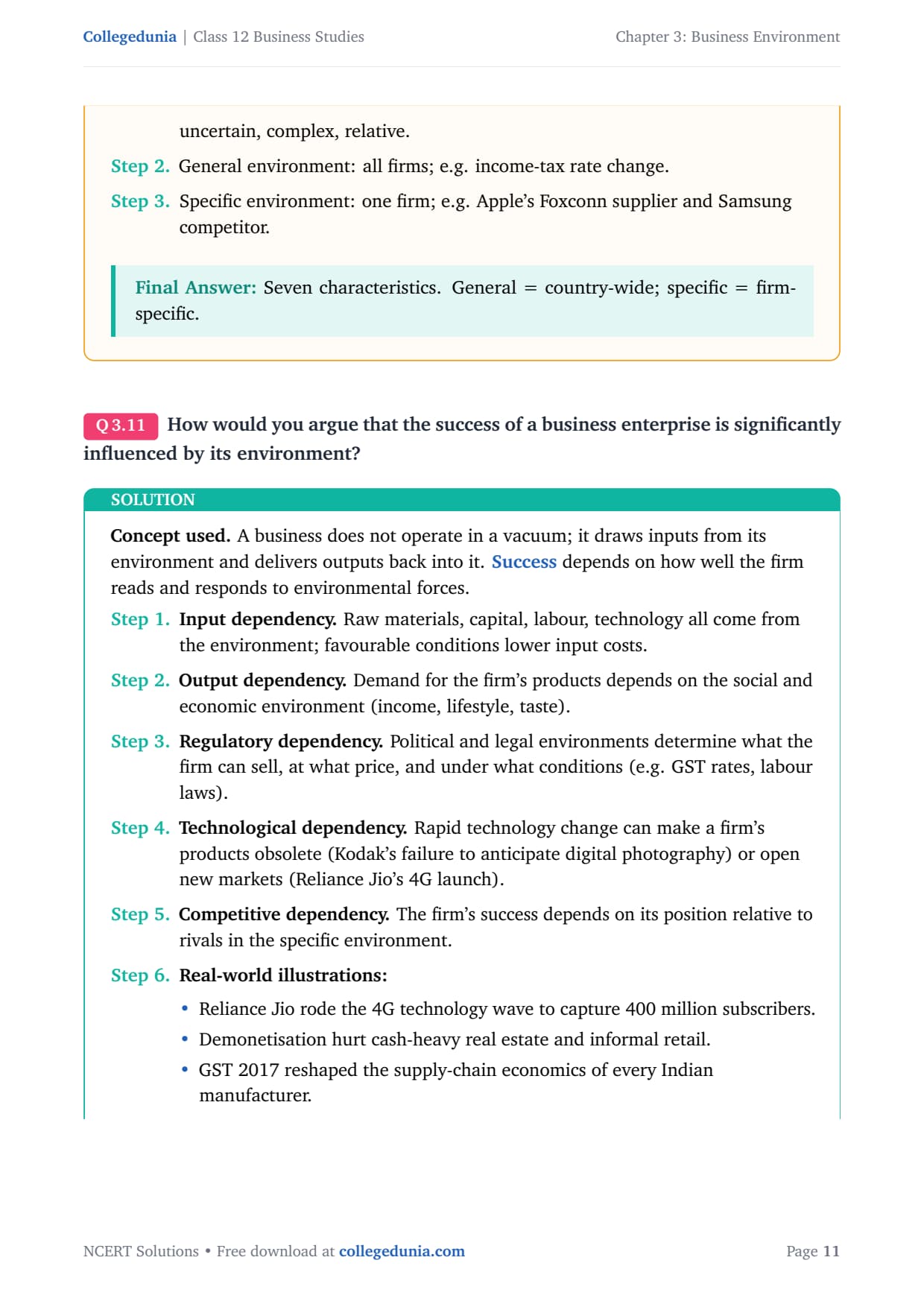
Seven characteristics: totality, specific + general, interrelated, dynamic, uncertain,
complex, relative.
General environment: all firms; e.g. income-tax rate change.
Specific environment: one firm; e.g. Apple's Foxconn supplier and Samsung competitor.
Seven characteristics. General = country-wide; specific = firm-specific.
Q 3.11
How would you argue that the success of a business enterprise is significantly
influenced by its environment?
Concept used. A business does not operate in a vacuum; it draws inputs from its
environment and delivers outputs back into it. Success depends on how well the firm
reads and responds to environmental forces.
Input dependency. Raw materials, capital, labour, technology all come from the
environment; favourable conditions lower input costs.
Output dependency. Demand for the firm's products depends on the social and
economic environment (income, lifestyle, taste).
Regulatory dependency. Political and legal environments determine what the
firm can sell, at what price, and under what conditions (e.g. GST rates, labour laws).
Technological dependency. Rapid technology change can make a firm's products
obsolete (Kodak's failure to anticipate digital photography) or open new markets
(Reliance Jio's 4G launch).
Competitive dependency. The firm's success depends on its position relative to
rivals in the specific environment.
Real-world illustrations:
Reliance Jio rode the 4G technology wave to capture 400 million subscribers.
Demonetisation hurt cash-heavy real estate and informal retail.
GST 2017 reshaped the supply-chain economics of every Indian manufacturer.
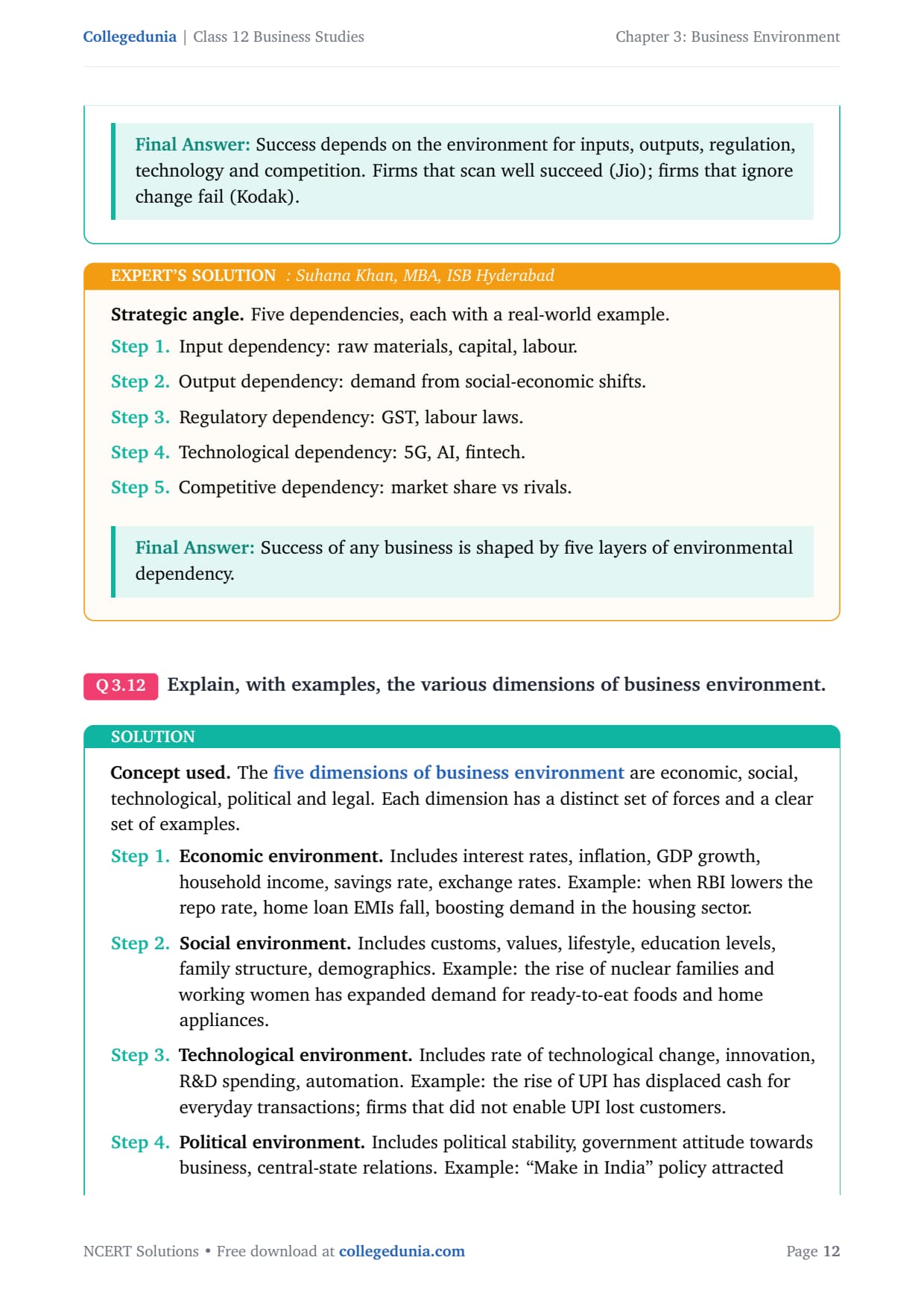
Success depends on the environment for inputs, outputs, regulation, technology and
competition. Firms that scan well succeed (Jio); firms that ignore change fail (Kodak).
SK
Suhana Khan
MBA, ISB Hyderabad
Verified Expert
Strategic angle. Five dependencies, each with a real-world example.
Input dependency: raw materials, capital, labour.
Output dependency: demand from social-economic shifts.
Regulatory dependency: GST, labour laws.
Technological dependency: 5G, AI, fintech.
Competitive dependency: market share vs rivals.
Success of any business is shaped by five layers of environmental dependency.
Q 3.12
Explain, with examples, the various dimensions of business environment.
Concept used. The five dimensions of business environment are economic, social,
technological, political and legal. Each dimension has a distinct set of forces and a clear set
of examples.
Economic environment. Includes interest rates, inflation, GDP growth, household
income, savings rate, exchange rates. Example: when RBI lowers the repo rate, home loan
EMIs fall, boosting demand in the housing sector.
Social environment. Includes customs, values, lifestyle, education levels,
family structure, demographics. Example: the rise of nuclear families and working women
has expanded demand for ready-to-eat foods and home appliances.
Technological environment. Includes rate of technological change, innovation,
R&D spending, automation. Example: the rise of UPI has displaced cash for everyday
transactions; firms that did not enable UPI lost customers.
Political environment. Includes political stability, government attitude towards
business, central-state relations. Example: ``Make in India'' policy attracted foreign
manufacturers like Apple to set up Indian assembly.
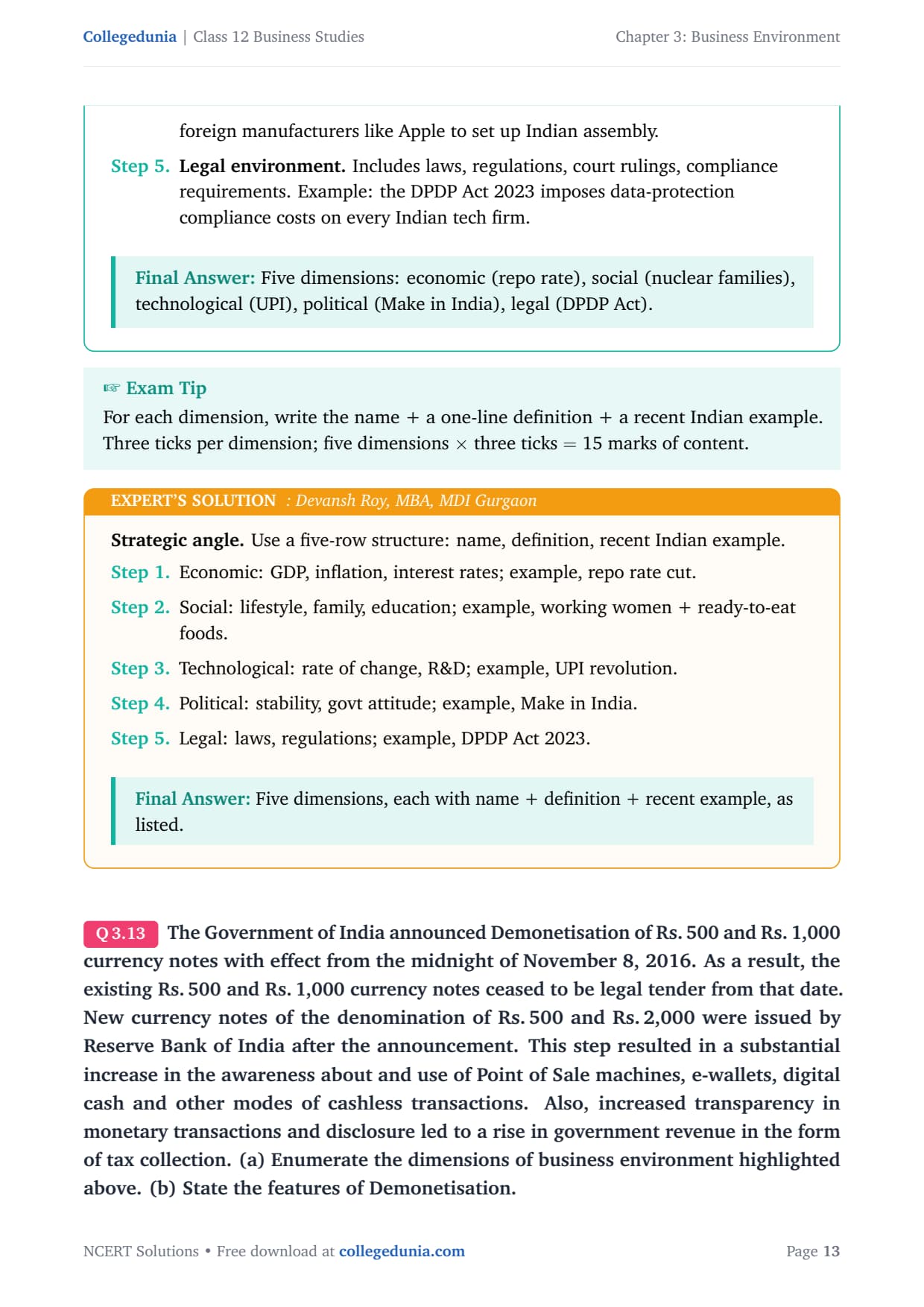
Legal environment. Includes laws, regulations, court rulings, compliance
requirements. Example: the DPDP Act 2023 imposes data-protection compliance costs on
every Indian tech firm.
Five dimensions: economic (repo rate), social (nuclear families), technological (UPI),
political (Make in India), legal (DPDP Act).
DR
Devansh Roy
MBA, MDI Gurgaon
Verified Expert
Strategic angle. Use a five-row structure: name, definition, recent Indian example.
Economic: GDP, inflation, interest rates; example, repo rate cut.
Social: lifestyle, family, education; example, working women + ready-to-eat foods.
Technological: rate of change, R&D; example, UPI revolution.
Political: stability, govt attitude; example, Make in India.
Legal: laws, regulations; example, DPDP Act 2023.
Five dimensions, each with name + definition + recent example, as listed.
Q 3.13
The Government of India announced Demonetisation of Rs. 500 and Rs. 1,000 currency
notes with effect from the midnight of November 8, 2016. As a result, the existing Rs. 500 and
Rs. 1,000 currency notes ceased to be legal tender from that date. New currency notes of the
denomination of Rs. 500 and Rs. 2,000 were issued by Reserve Bank of India after the
announcement. This step resulted in a substantial increase in the awareness about and use of
Point of Sale machines, e-wallets, digital cash and other modes of cashless transactions. Also,
increased transparency in monetary transactions and disclosure led to a rise in government
revenue in the form of tax collection. (a) Enumerate the dimensions of business environment
highlighted above. (b) State the features of Demonetisation.
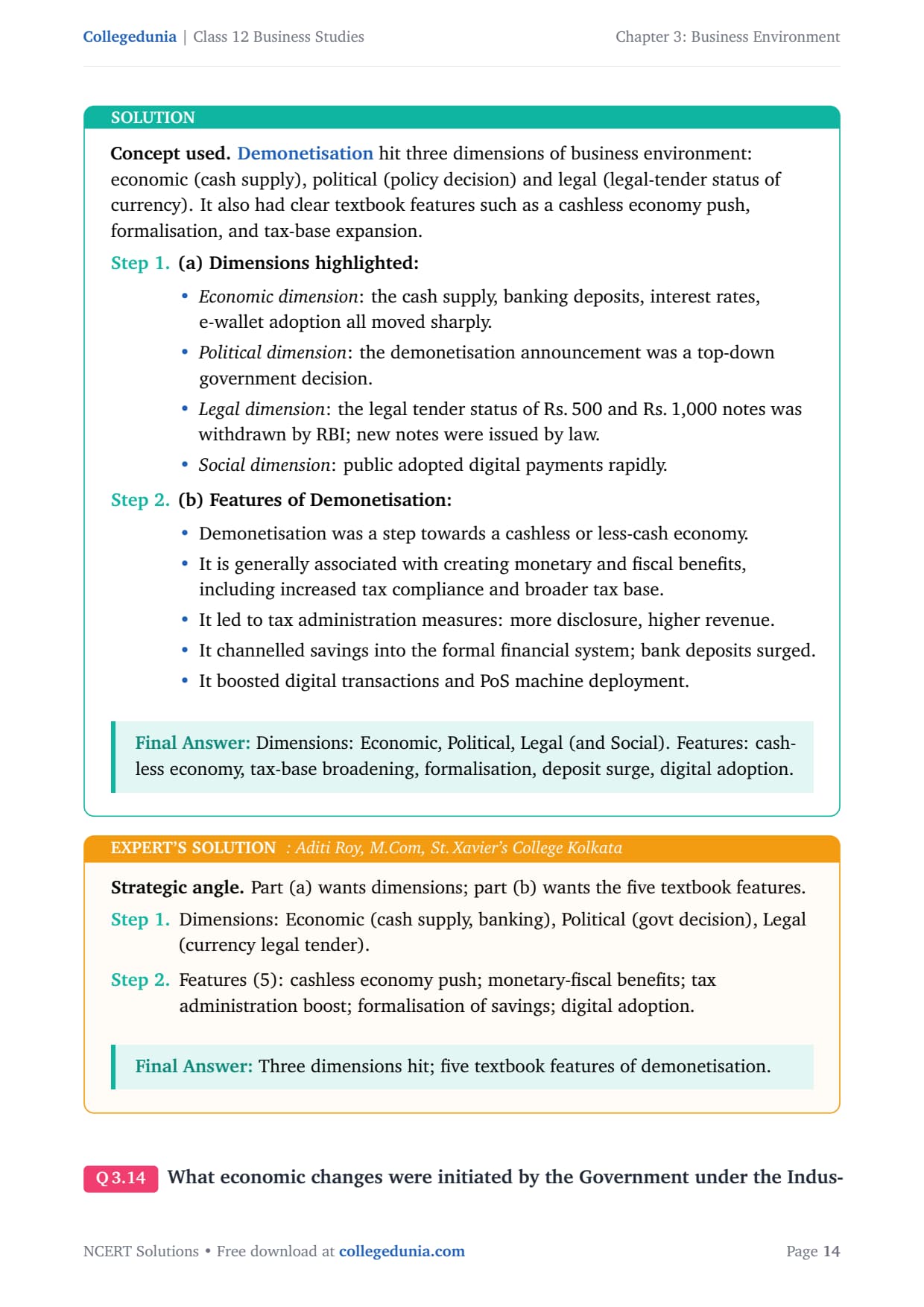
Concept used.Demonetisation hit three dimensions of business environment:
economic (cash supply), political (policy decision) and legal (legal-tender status of currency).
It also had clear textbook features such as a cashless economy push, formalisation, and tax-base
expansion.
(a) Dimensions highlighted:
Economic dimension: the cash supply, banking deposits, interest rates,
e-wallet adoption all moved sharply.
Political dimension: the demonetisation announcement was a top-down
government decision.
Legal dimension: the legal tender status of Rs. 500 and Rs. 1,000
notes was withdrawn by RBI; new notes were issued by law.
Social dimension: public adopted digital payments rapidly.
(b) Features of Demonetisation:
Demonetisation was a step towards a cashless or less-cash economy.
It is generally associated with creating monetary and fiscal benefits, including
increased tax compliance and broader tax base.
It led to tax administration measures: more disclosure, higher revenue.
It channelled savings into the formal financial system; bank deposits surged.
It boosted digital transactions and PoS machine deployment.
Features (5): cashless economy push; monetary-fiscal benefits; tax administration
boost; formalisation of savings; digital adoption.
Three dimensions hit; five textbook features of demonetisation.
Q 3.14
What economic changes were initiated by the Government under the Industrial Policy,
1991? What impact have these changes made on business and industry?
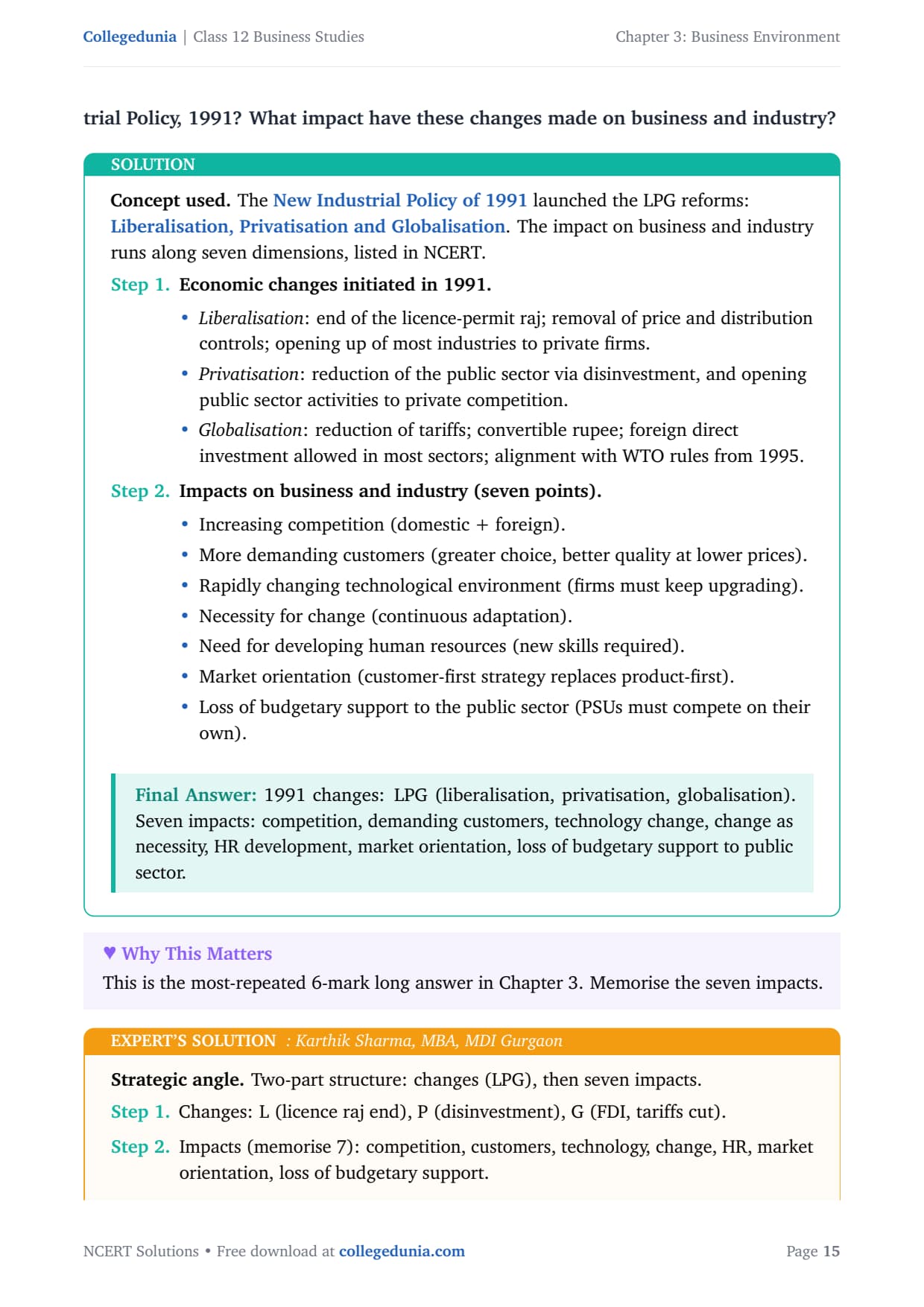
Concept used. The New Industrial Policy of 1991 launched the LPG reforms:
Liberalisation, Privatisation and Globalisation. The impact on business and industry
runs along seven dimensions, listed in NCERT.
Economic changes initiated in 1991.
Liberalisation: end of the licence-permit raj; removal of price and
distribution controls; opening up of most industries to private firms.
Privatisation: reduction of the public sector via disinvestment, and
opening public sector activities to private competition.
Globalisation: reduction of tariffs; convertible rupee; foreign direct
investment allowed in most sectors; alignment with WTO rules from 1995.
Impacts on business and industry (seven points).
Increasing competition (domestic + foreign).
More demanding customers (greater choice, better quality at lower prices).
Rapidly changing technological environment (firms must keep upgrading).
Necessity for change (continuous adaptation).
Need for developing human resources (new skills required).
Loss of budgetary support to the public sector (PSUs must compete on their own).
1991 changes: LPG (liberalisation, privatisation, globalisation). Seven impacts:
competition, demanding customers, technology change, change as necessity, HR development, market
orientation, loss of budgetary support to public sector.
KS
Karthik Sharma
MBA, MDI Gurgaon
Verified Expert
Strategic angle. Two-part structure: changes (LPG), then seven impacts.
Changes: L (licence raj end), P (disinvestment), G (FDI, tariffs cut).
Impacts (memorise 7): competition, customers, technology, change, HR, market orientation,
loss of budgetary support.
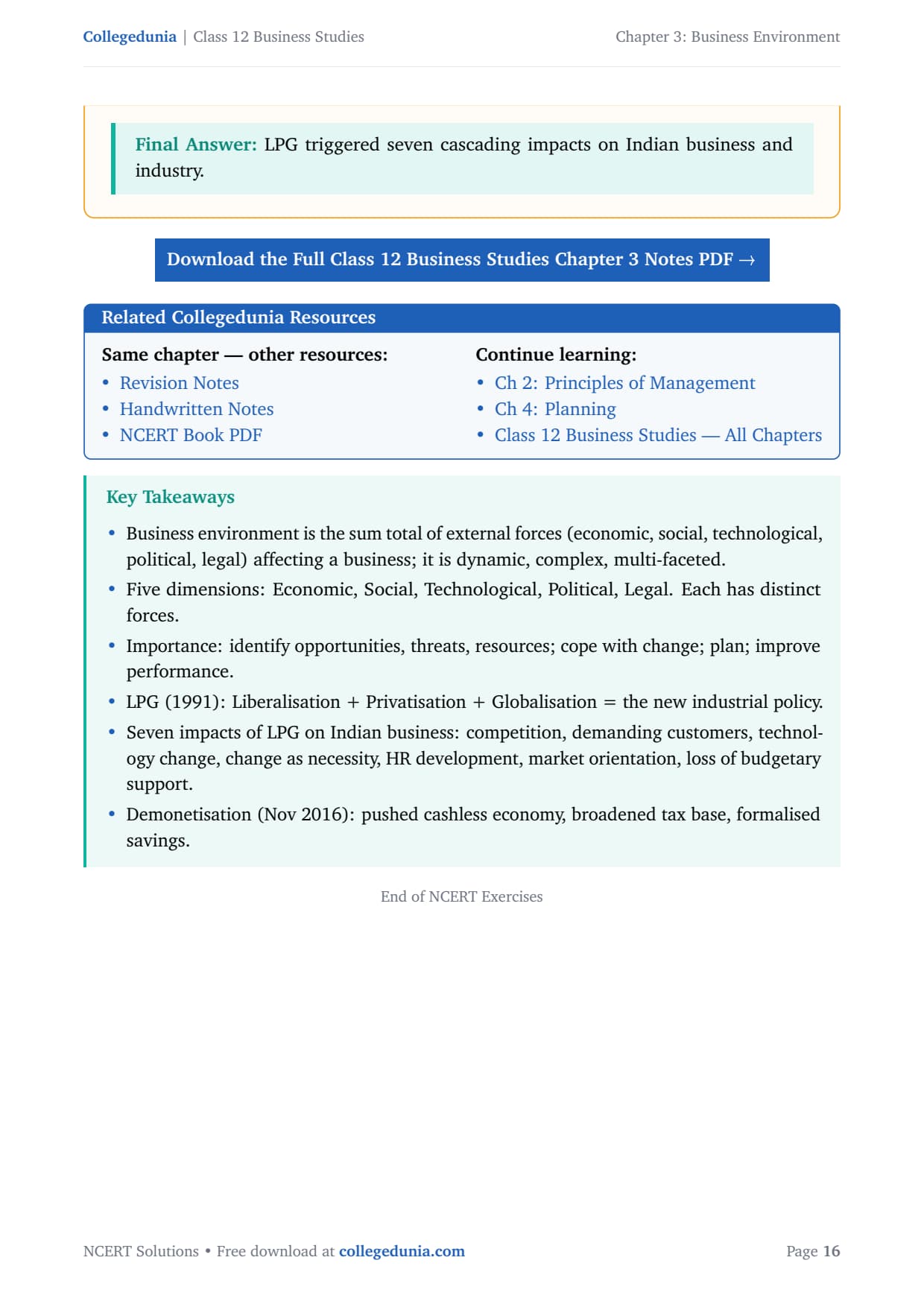
LPG triggered seven cascading impacts on Indian business and industry.
Student Feedback
In a Collegedunia poll of 940 Class 12 Commerce students, 79% said the New Economic Policy 1991 and demonetisation answers were the hardest to score full marks on. 3 in 4 said writing all seven features in order helped them clear the 4-mark question.
Other Resources for Class 12 Business Studies Chapter 3 Business Environment
What is business environment in Class 12 Business Studies?
Business environment refers to all external forces (economic, social, technological, political, legal) that have a bearing on the functioning of a business. It is the sum total of all external factors affecting the business; it is dynamic, complex, multi-faceted and has a far-reaching impact on the business.
What are the five dimensions of business environment?
The five dimensions of business environment are: (1) Economic Environment - interest rates, inflation, GDP, household income; (2) Social Environment - customs, values, lifestyle, education levels; (3) Technological Environment - rate of technological change, innovation, R&D; (4) Political Environment - political stability, government attitude, central-state relations; (5) Legal Environment - laws, regulations, court rulings.
What is the importance of business environment?
Business environment is important because it (1) helps the firm identify opportunities and get first-mover advantage; (2) helps identify threats and early warning signals; (3) helps in tapping useful resources; (4) helps in coping with rapid changes; (5) assists in planning and policy formulation; (6) improves performance.
What is the impact of demonetisation on business environment?
Demonetisation (November 2016) impacted the Indian business environment in three main ways: (1) Money supply - immediate fall in cash holdings, rise in deposits in banks; (2) Banking - rise in CASA deposits, lower lending rates; (3) Cashless economy - rapid growth in digital payments (UPI, mobile wallets) and a shift toward formalisation of the economy.
What are liberalisation, privatisation and globalisation (LPG)?
Liberalisation = removal of unnecessary controls and restrictions on business (licensing, quotas, tariffs). Privatisation = transferring ownership of public sector units to private sector. Globalisation = integration of the Indian economy with the world economy. Together they form the 1991 reforms that transformed Indian business.
What is the impact of liberalisation, privatisation and globalisation on Indian business?
The LPG reforms produced six main impacts on Indian business: (1) Increasing competition; (2) More demanding customers; (3) Rapidly changing technological environment; (4) Necessity for change; (5) Need for developing human resources; (6) Market orientation; (7) Loss of budgetary support to the public sector.
Why is business environment called dynamic in nature?
Business environment is dynamic because the forces shaping it (economic conditions, social values, technology, political climate, legal framework) keep changing continuously. No factor stays fixed; managers must constantly scan, monitor and adapt.








Comments