




These Issue and Redemption of Debentures Class 12 solutions solve every question of Part 2 Chapter 2, with full journal entries and DRR/DRI workings.


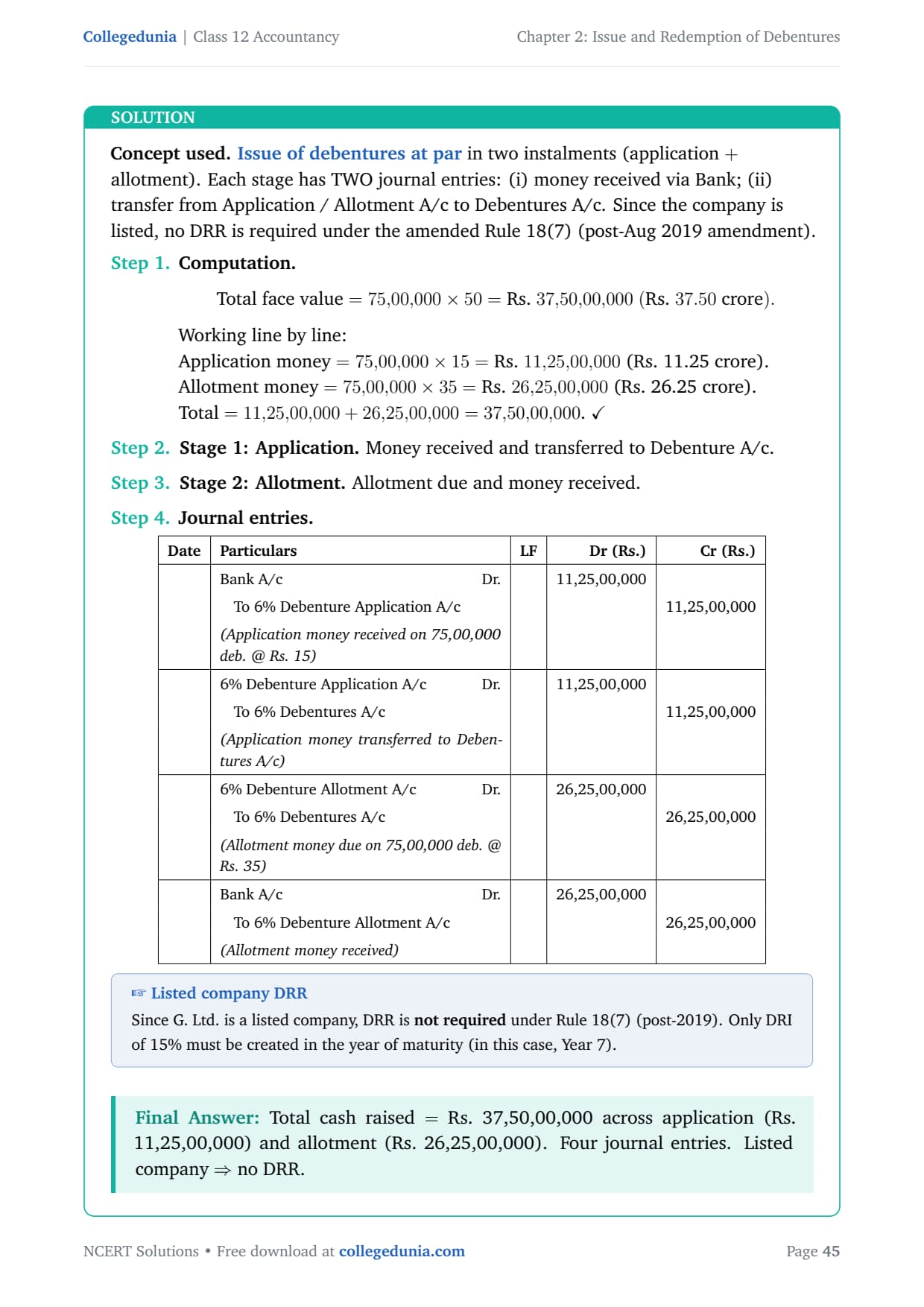

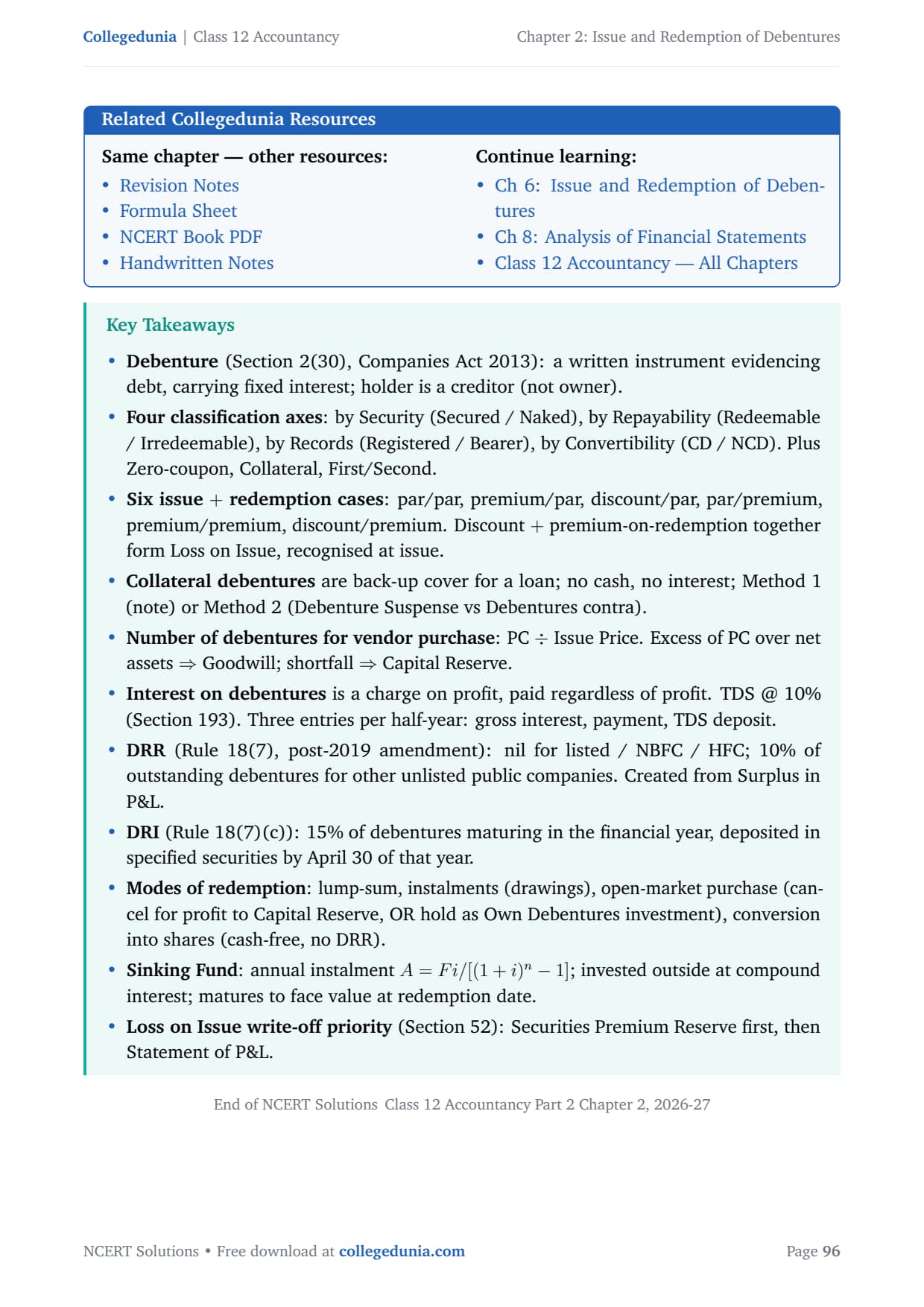
- CBSE Weightage: 6 to 10 marks per board paper
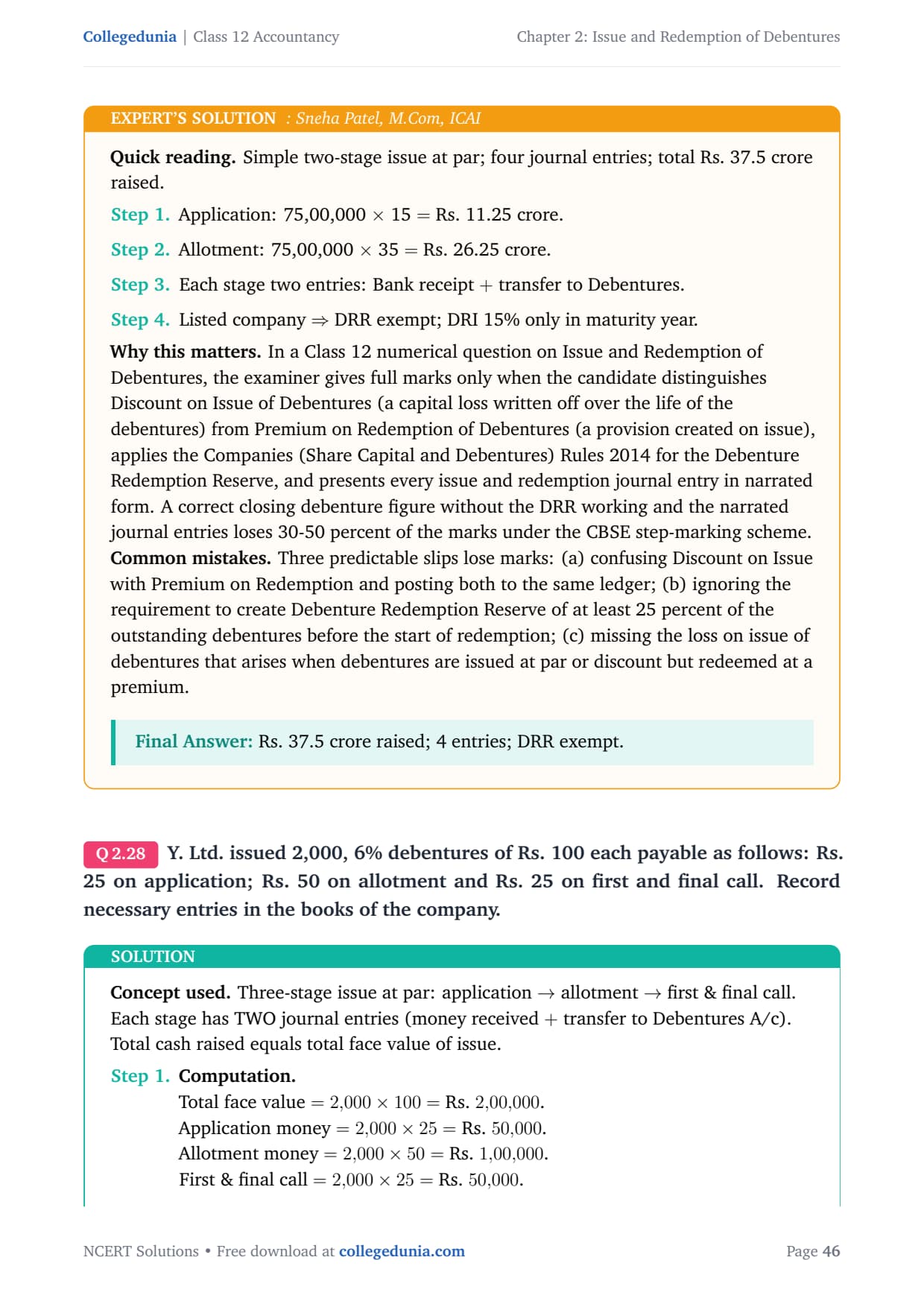
- Question Count: 17 SA, 8 LA, and 26+ Numericals across issue, redemption, and conversion
CAs and CBSE Commerce educators wrote every solution, checked against the 2026-27 NCERT print, CBSE papers, and CUET (UG) patterns.
Issue and Redemption of Debentures Class 12 Solutions: Question-Type Map
The chapter has three question bands: theory, issue-side numericals, and redemption-side numericals. The table maps each band to its marks.
| Section | Count | Topics | Difficulty |
|---|---|---|---|
| Short Answer | 17 | Debenture meaning, bearer, collateral, capital reserve | Easy |
| Long Answer | 8 | Debenture types, debenture vs share, terms of issue, redemption sources, DRR | Medium |
| Numerical Q1 to Q10 | 10 | Issue at par, premium, discount, non-cash, collateral | Easy to Medium |
| Numerical Q11 to Q20 | 10 | Discount + premium on redemption, four-combination table | Medium |
| Numerical Q21 to Q26+ | 6+ | Redemption out of profits or capital, conversion, DRI | Hard |
The 6-mark Long Answer usually comes from the redemption side, pairing DRR + DRI with a Balance Sheet extract.
Video Solution: Issue and Redemption of Debentures
Source: Magnet Brains on YouTube
How the Collegedunia Solutions Are Structured
- Concept-used opener citing the Companies Act 2013 and 2014 Debenture Rules.
- Step-by-step journal entries with Dr/Cr columns; Loss on Issue opened separately.
- DRR workings at 10% of outstanding debentures for unlisted other companies.
- DRI workings at 15% of maturing debentures, invested by April 30.
- Expert Solution with a Chartered Accountant's alternate angle and a one-line exam tip.
Types of Debentures Covered
Debentures fall into six classes. The table links each class to its tested question.
| Classification Axis | Types | Tested In |
|---|---|---|
| By security | Secured (mortgaged) vs Unsecured (naked) | SA Q3, Q9; LA Q1 |
| By records | Registered vs Bearer | SA Q2; LA Q1 |
| By redemption | Redeemable vs Irredeemable | SA Q7; LA Q1 |
| By convertibility | NCD, FCD, PCD | SA Q8, Q15; LA Q8 |
| By priority | First vs Second Debenture | LA Q1 |
| By interest rate | Fixed vs Floating | SA Q1; LA Q1 |
Terms of Issue: Par, Premium, Discount and the Four-Combination Table
Debentures can be issued at three prices and redeemed at two, giving six combinations. Loss on Issue is the toughest part, written off from Securities Premium first, then P&L.
| Issue Price | Redemption Price | Loss on Issue? | Numerical |
|---|---|---|---|
| At Par (100) | At Par (100) | No | Q1, Q2 |
| At Premium (110) | At Par (100) | No, Securities Premium credited | Q3 |
| At Discount (95) | At Par (100) | Yes, discount of 5 | Q4, Q5, Q14 |
| At Par (100) | At Premium (110) | Yes, premium of 10 | Q15 |
| At Discount (95) | At Premium (110) | Yes, loss = 5 + 10 = 15 | Q12, Q13 |
| At Premium (105) | At Premium (110) | Yes, premium of 5 | Q16 |
Issue of Debentures for Consideration Other Than Cash
When a company pays a vendor or buys assets with debentures, the book uses three steps (Q9, Q10, Q11).
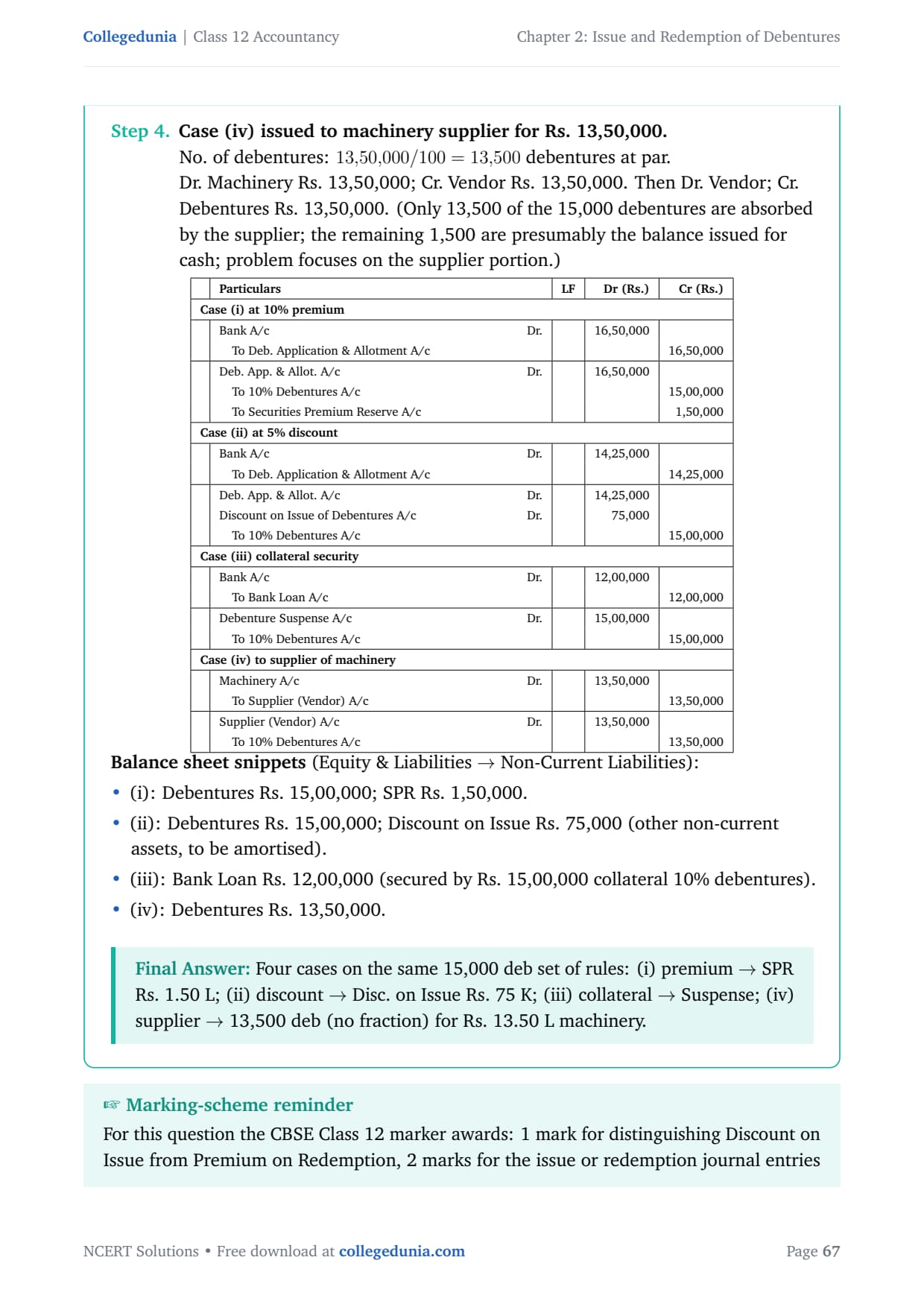
- Assets. Dr. Sundry Assets, Cr. Sundry Liabilities, Cr. Vendor A/c.
- Goodwill/Capital Reserve. The gap between consideration and net assets goes to Goodwill or Capital Reserve.
- Settlement. Dr. Vendor A/c, Cr. Debentures at face value, Cr. Securities Premium or Dr. Discount.
Debentures Issued as Collateral Security
Two treatments exist when a company pledges its own debentures for a bank loan, tested in SA Q3 and LA Q3.
- No entry: a Balance Sheet note under the loan. SEBI's preferred treatment.
- Entry passed: Dr. Debenture Suspense, Cr. Debentures at face value pledged; deduct Suspense from Debentures.
Redemption of Debentures: Four Methods Compared
Redemption clears the debenture liability at or before maturity, governed by Section 71 of the Companies Act 2013.
| Method | Mechanism | DRR? | Tested In |
|---|---|---|---|
| Lump-sum at maturity | Full face value paid on maturity | Yes, 10% | Q22, Q23 |
| Installment (draw of lots) | A portion redeemed each year by draw | Yes, proportionate | Q24 |
| Open-market purchase | Company buys back from the market | Yes if from capital | Q25, Q26 |
| Conversion | Debentures swapped against equity or new debentures | No | Q21 |
Redemption out of Profits vs Out of Capital
| Aspect | Out of Profits | Out of Capital |
|---|---|---|
| Source | Surplus in P&L | Share Capital, fresh issue, asset realisation |
| Transfer to DRR | Equal to nominal value redeemed | Not required post-2019 for listed |
| Liquidity impact | Reduces free reserves | Reduces capital base |
| Entry on redemption | Dr. Surplus, Cr. DRR; then Dr. Debentures, Cr. Debenture-holders | Direct: Dr. Debentures, Cr. Debenture-holders |
Tip: after 2019, use the 10% DRR rate unless the question says "private limited", where DRR is not required.
DRR Guidelines: 2019 Amendment Rates
The 2019 amendment to Rule 18(7) set new rates. The 2026-27 CBSE syllabus follows these.
| Type of Company | DRR Rate | DRI Rate |
|---|---|---|
| AIFIs regulated by RBI | Nil | Nil |
| Listed NBFCs and HFCs | Nil | 15% |
| Other Listed Companies | Nil | 15% |
| Unlisted NBFCs and HFCs | Nil | 15% |
| Other Unlisted Companies | 10% | 15% |
Part 2 Chapter 2 Weightage Across Class 12 Accountancy
This is the second-heaviest topic in Part B after Share Capital, with a near-certain 6-mark numerical every year.
| Chapter | Topic | Marks |
|---|---|---|
| Part 2 Ch 1 | Accounting for Share Capital | 12 marks |
| Part 2 Ch 2 | Issue and Redemption of Debentures | 8 to 10 marks |
| Part 2 Ch 3 | Financial Statements | 6 marks |
| Part 2 Ch 4 | Analysis of Financials | 4 marks |
| Part 2 Ch 5 | Accounting Ratios | 6 marks |
| Part 2 Ch 6 | Cash Flow Statement | 6 marks |
Common Mistakes in Issue and Redemption of Debentures
- Crediting Premium on Issue to Debentures A/c, not Securities Premium Reserve.
- Writing off Loss on Issue only from P&L; Securities Premium comes first.
- Forgetting debenture interest in a loss year; it is a charge, not an appropriation.
- Confusing DRR (liability-side reserve) with DRI (asset-side investment).
- Using the old 25% DRR rate; unlisted other companies now use 10%.
- Writing off Premium on Redemption at redemption instead of booking it as a liability at issue.
Each mistake costs 1 to 2 marks on the Long Answer.
Sample Fully-Solved Question: Discount on Issue + Premium on Redemption
Question (6 marks). A Ltd. issued 10,000, 9% debentures of Rs. 100 each at 5% discount, redeemable at 10% premium. Pass journal entries; write off Loss on Issue against Rs. 40,000 Securities Premium.
Step 1. Discount = Rs. 50,000. Premium on redemption = Rs. 1,00,000. Total Loss on Issue = Rs. 1,50,000.
Step 2, Allotment. Dr. Bank Rs. 9,50,000; Dr. Loss on Issue Rs. 1,50,000; Cr. 9% Debentures Rs. 10,00,000; Cr. Premium on Redemption Rs. 1,00,000.
Step 3, Write off Loss. Dr. Securities Premium Rs. 40,000; Dr. P&L Rs. 1,10,000; Cr. Loss on Issue Rs. 1,50,000.
Expert's angle: book Premium on Redemption as a liability at issue, not a contingency. Most students wrongly write off the full Rs. 1,50,000 from P&L.
All NCERT Solutions for Issue and Redemption of Debentures with Step-by-Step Working
Every question for Issue and Redemption of Debentures appears below with its Solution and Expert Solution in collapsible tabs. Click Check Solution for the steps, or Expert Solution for more depth.
Questions
What is meant by a Debenture?
Concept used. A Debenture is a written instrument acknowledging a debt of the company. As per Section 2(30) of the Companies Act 2013, ``debenture includes debenture stock, bonds or any other instrument of a company evidencing a debt, whether constituting a charge on the assets of the company or not.'' It is the most important form of long-term borrowing for a company.
- Nature. A debenture is an acknowledgement of debt issued under the company's common seal (now optional) carrying a fixed rate of interest.
- Holder is a creditor. Unlike a shareholder (owner), a debenture-holder is a creditor of the company.
- Interest is a charge on profit. Interest on debentures is paid whether the company makes profit or not.
- Secured or unsecured. A debenture may or may not be secured by a charge on the assets of the company.
- Redemption. Debentures are normally repayable after a fixed period (5–10 years).
A debenture (Section 2(30), Companies Act 2013) is a written instrument issued by a company acknowledging a debt, carrying a fixed rate of interest, repayable after a stated period. The holder is a creditor, not an owner.
Quick reading. Think of a debenture as a loan slip the company hands you: you pay money, the company promises a fixed rate of interest and the return of principal after a stated period.
- Acknowledgement of debt → holder is a creditor.
- Fixed-rate interest paid even in loss years.
- Repaid after fixed term (often 5–10 years).
- May be secured (charge on assets) or unsecured.
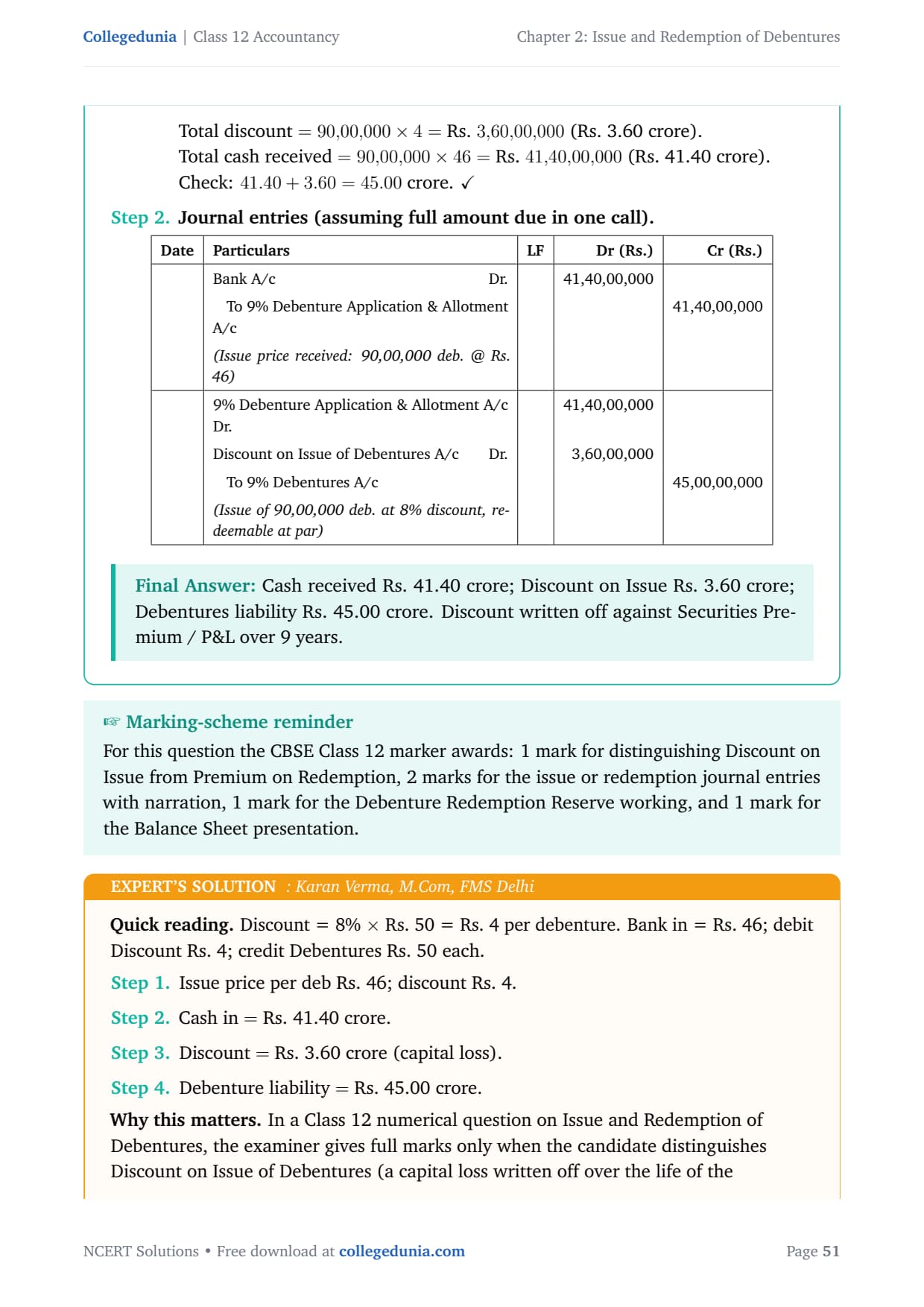
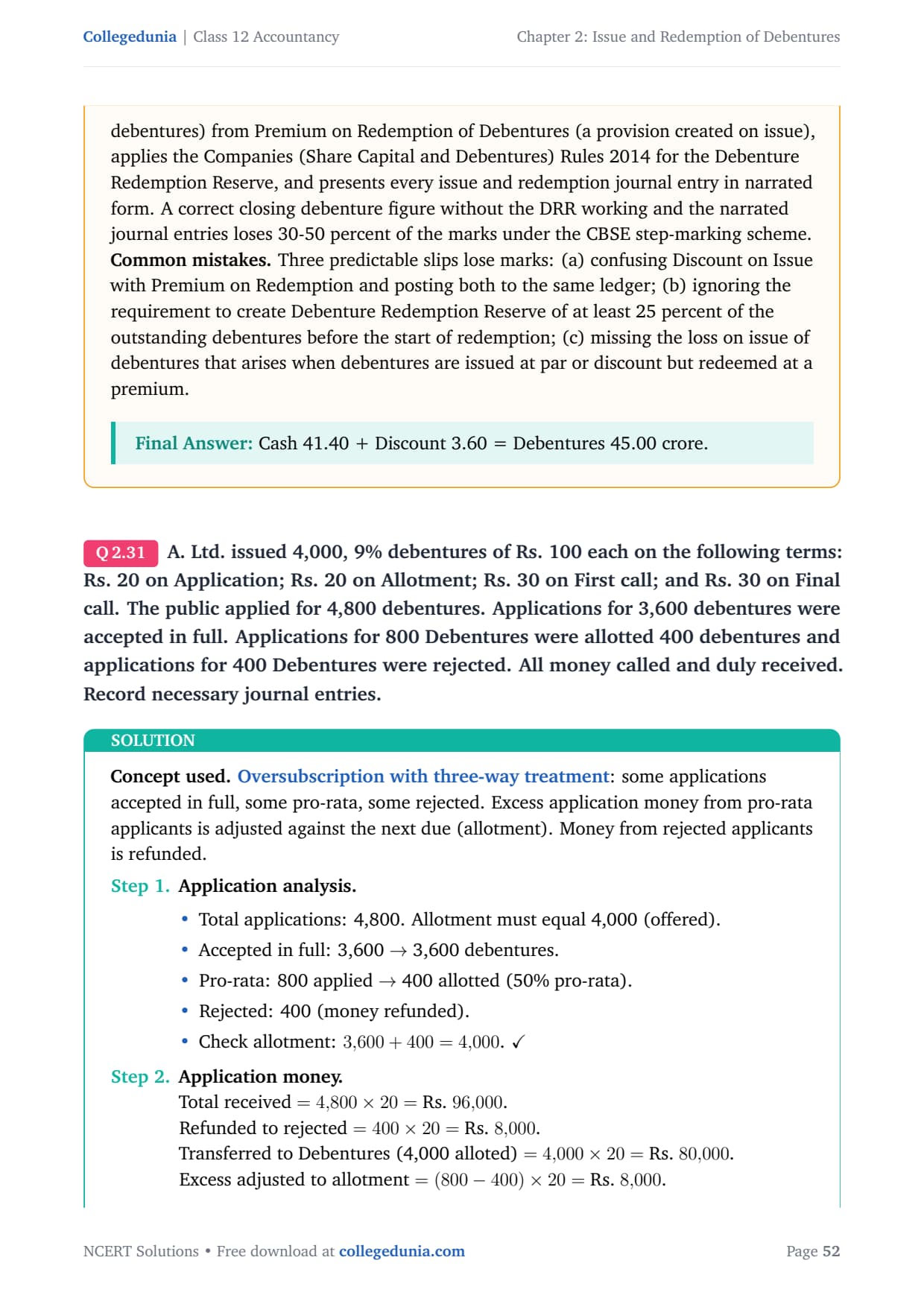
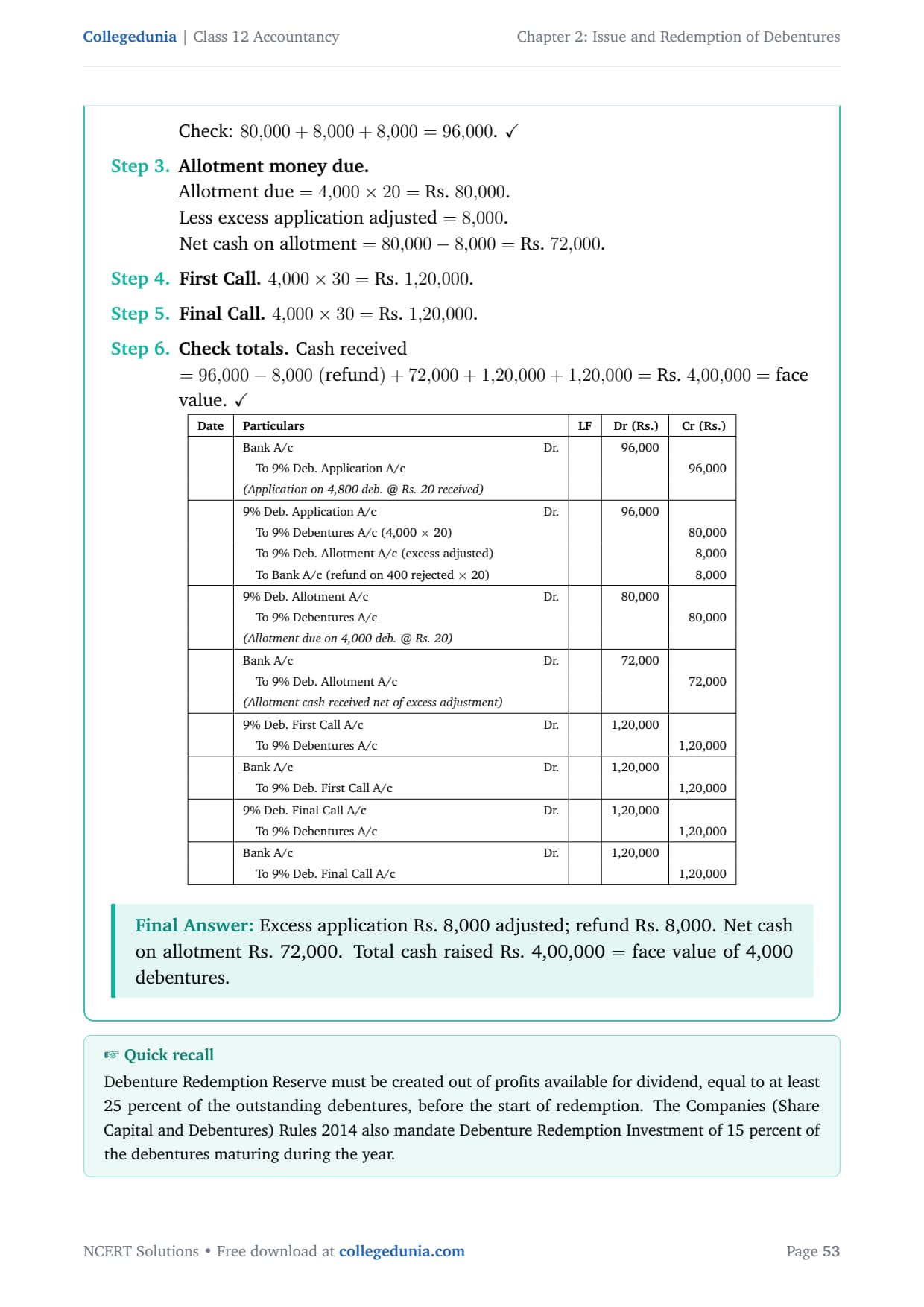
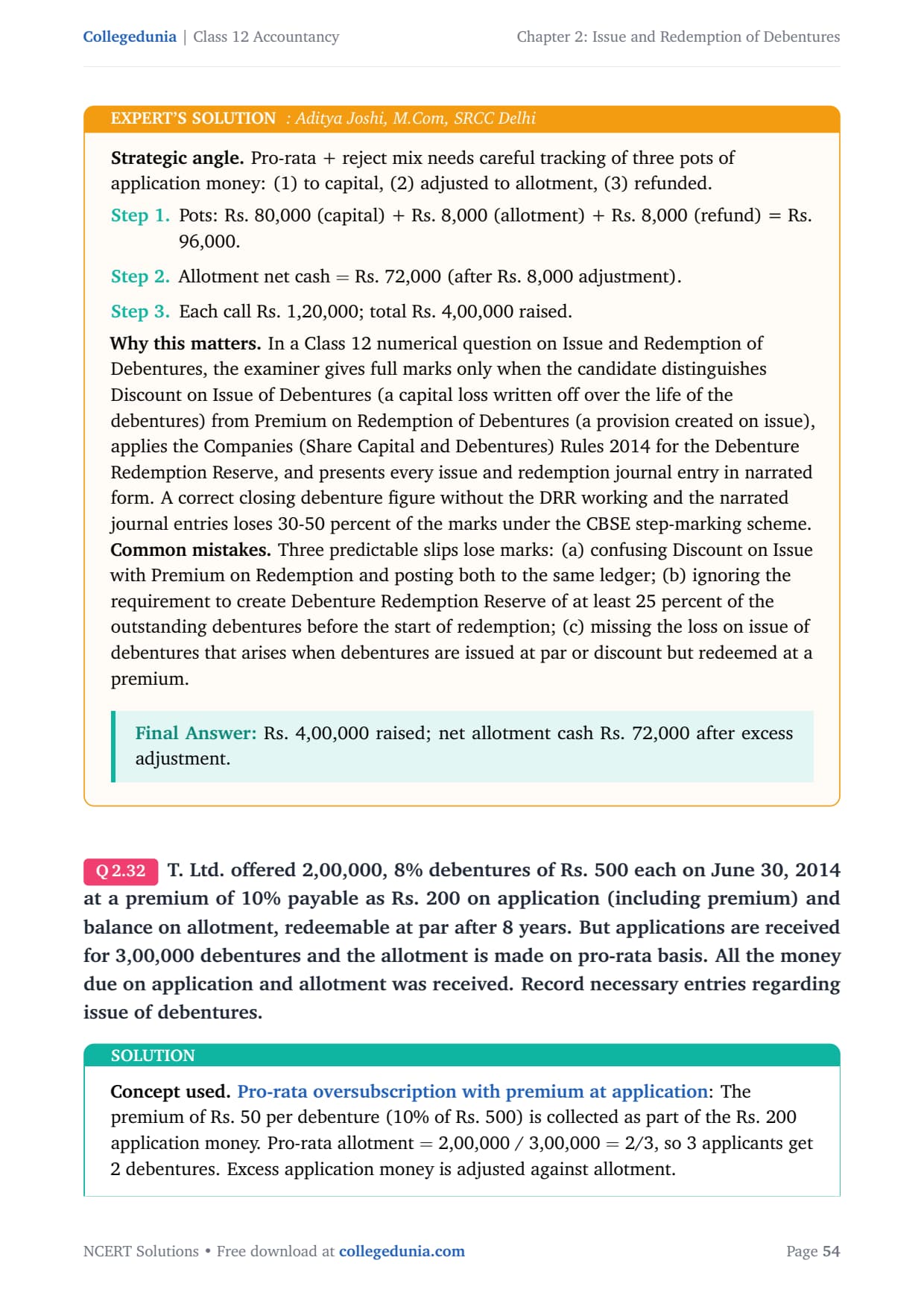
Why this matters. In a Class 12 numerical question on Issue and Redemption of Debentures, the examiner gives full marks only when the candidate distinguishes Discount on Issue of Debentures (a capital loss written off over the life of the debentures) from Premium on Redemption of Debentures (a provision created on issue), applies the Companies (Share Capital and Debentures) Rules 2014 for the Debenture Redemption Reserve, and presents every issue and redemption journal entry in narrated form. A correct closing debenture figure without the DRR working and the narrated journal entries loses 30-50 percent of the marks under the CBSE step-marking scheme.
Common mistakes. Three predictable slips lose marks: (a) confusing Discount on Issue with Premium on Redemption and posting both to the same ledger; (b) ignoring the requirement to create Debenture Redemption Reserve of at least 25 percent of the outstanding debentures before the start of redemption; (c) missing the loss on issue of debentures that arises when debentures are issued at par or discount but redeemed at a premium.
Debenture = company's loan slip; creditor relationship; fixed-rate interest; repayable on maturity.
What does a Bearer Debenture mean?
Concept used. A Bearer Debenture is a debenture which is transferable by mere delivery (like a currency note). The company does NOT maintain a register of debenture-holders for bearer debentures; the person holding the certificate is treated as the owner.
- Transfer by delivery. No registration of transfer is required: handing over the certificate effects the transfer.
- No register kept. Unlike registered debentures, the company keeps no record of the holder.
- Interest paid via coupons. The certificate has detachable coupons; the debenture-holder presents a coupon on each interest date to receive the interest.
- Negotiable instrument. Treated as a negotiable instrument under the Negotiable Instruments Act 1881; the bona-fide holder for value gets a good title.
A bearer debenture is one that is transferable by mere delivery; no register of holders is kept; interest is paid against detachable coupons. It is a negotiable instrument.
Quick reading. Bearer = ``whoever holds it.'' Like cash, ownership passes with delivery; no paperwork.
- Anonymous transfer; no register kept.
- Detachable interest coupons.
- Negotiable instrument ⇒ bona-fide holder gets clean title.
Why this matters. In a Class 12 numerical question on Issue and Redemption of Debentures, the examiner gives full marks only when the candidate distinguishes Discount on Issue of Debentures (a capital loss written off over the life of the debentures) from Premium on Redemption of Debentures (a provision created on issue), applies the Companies (Share Capital and Debentures) Rules 2014 for the Debenture Redemption Reserve, and presents every issue and redemption journal entry in narrated form. A correct closing debenture figure without the DRR working and the narrated journal entries loses 30-50 percent of the marks under the CBSE step-marking scheme.
Common mistakes. Three predictable slips lose marks: (a) confusing Discount on Issue with Premium on Redemption and posting both to the same ledger; (b) ignoring the requirement to create Debenture Redemption Reserve of at least 25 percent of the outstanding debentures before the start of redemption; (c) missing the loss on issue of debentures that arises when debentures are issued at par or discount but redeemed at a premium.
Bearer debenture = transferable by delivery + coupon-paid interest + negotiable instrument.
State the meaning of `Debentures issued as a collateral security'.
Concept used. Debentures issued as collateral security are debentures issued in addition to the principal security as a secondary cover for a loan or bank borrowing. They are a contingent liability: the lender enforces them only if the principal security proves insufficient.
- Definition. ``Collateral'' means additional or secondary security.
- Trigger. Issued when a company borrows funds (loan, overdraft, cash credit) and the lender wants extra protection.
- No fresh cash. The company does NOT receive any cash for the collateral debentures themselves; the cash has already been received against the principal loan.
- Dormant. As long as the company repays the loan on time, the collateral debentures are dormant. If the company defaults, the lender enforces them.
- No interest payable. No interest is paid on collateral debentures (they are not in circulation).
Collateral debentures are debentures issued as an additional cover for a loan, not for fresh cash. They are dormant, non-interest-bearing, and enforced only if the principal security fails.
Strategic angle. Two securities, one loan: the principal security (e.g. hypothecation of stock) and the back-up (debentures). No cash flows for the debentures themselves.
- Lender takes principal security + collateral debentures.
- No cash, no interest on collateral.
- On default, lender claims under collateral; debentures spring to life.
Why this matters. In a Class 12 numerical question on Issue and Redemption of Debentures, the examiner gives full marks only when the candidate distinguishes Discount on Issue of Debentures (a capital loss written off over the life of the debentures) from Premium on Redemption of Debentures (a provision created on issue), applies the Companies (Share Capital and Debentures) Rules 2014 for the Debenture Redemption Reserve, and presents every issue and redemption journal entry in narrated form. A correct closing debenture figure without the DRR working and the narrated journal entries loses 30-50 percent of the marks under the CBSE step-marking scheme.
Common mistakes. Three predictable slips lose marks: (a) confusing Discount on Issue with Premium on Redemption and posting both to the same ledger; (b) ignoring the requirement to create Debenture Redemption Reserve of at least 25 percent of the outstanding debentures before the start of redemption; (c) missing the loss on issue of debentures that arises when debentures are issued at par or discount but redeemed at a premium.
Back-up cover only; no cash, no interest; activated on default.
What is meant by `Issue of debentures for consideration other than cash'?
Concept used. Issue of debentures for consideration other than cash is the allotment of debentures to a vendor or supplier in payment for assets purchased (or business taken over), instead of paying in cash. The company conserves cash and the vendor becomes a debenture-holder.
- Trigger. The company acquires assets (machinery, business, or net assets of a firm) and settles the purchase consideration by issuing debentures to the vendor.
- Number of debentures. No. of debentures = Purchase ConsiderationIssue Price per debenture. Issue price equals face value (at par), face - discount (at discount), or face + premium (at premium).
- Journal entries.
- Dr. Sundry Assets A/c; Cr. Vendor A/c (with agreed value of assets).
- Dr. Vendor A/c; Cr. Debentures A/c (at par); also Cr. Securities Premium Reserve (if at premium); or Dr. Discount on Issue (if at discount).
- Goodwill / Capital Reserve. If purchase consideration > net assets taken over, the difference is Goodwill. If purchase consideration < net assets, the difference is Capital Reserve.
Issue of debentures for consideration other than cash means allotting debentures to a vendor against assets purchased. Number of debentures = Purchase Consideration ÷ Issue Price. Excess of PC over net assets = Goodwill.
Quick reading. Pay the vendor in debentures rather than cash.
- Compute purchase consideration agreed with vendor.
- Divide by issue price to get number of debentures.
- Pass two entries: asset purchase + payment in debentures.
Why this matters. In a Class 12 numerical question on Issue and Redemption of Debentures, the examiner gives full marks only when the candidate distinguishes Discount on Issue of Debentures (a capital loss written off over the life of the debentures) from Premium on Redemption of Debentures (a provision created on issue), applies the Companies (Share Capital and Debentures) Rules 2014 for the Debenture Redemption Reserve, and presents every issue and redemption journal entry in narrated form. A correct closing debenture figure without the DRR working and the narrated journal entries loses 30-50 percent of the marks under the CBSE step-marking scheme.
Common mistakes. Three predictable slips lose marks: (a) confusing Discount on Issue with Premium on Redemption and posting both to the same ledger; (b) ignoring the requirement to create Debenture Redemption Reserve of at least 25 percent of the outstanding debentures before the start of redemption; (c) missing the loss on issue of debentures that arises when debentures are issued at par or discount but redeemed at a premium.
Vendor paid in debentures; number = PC ÷ issue price.
What is meant by Issue of debenture at discount and redeemable at premium?
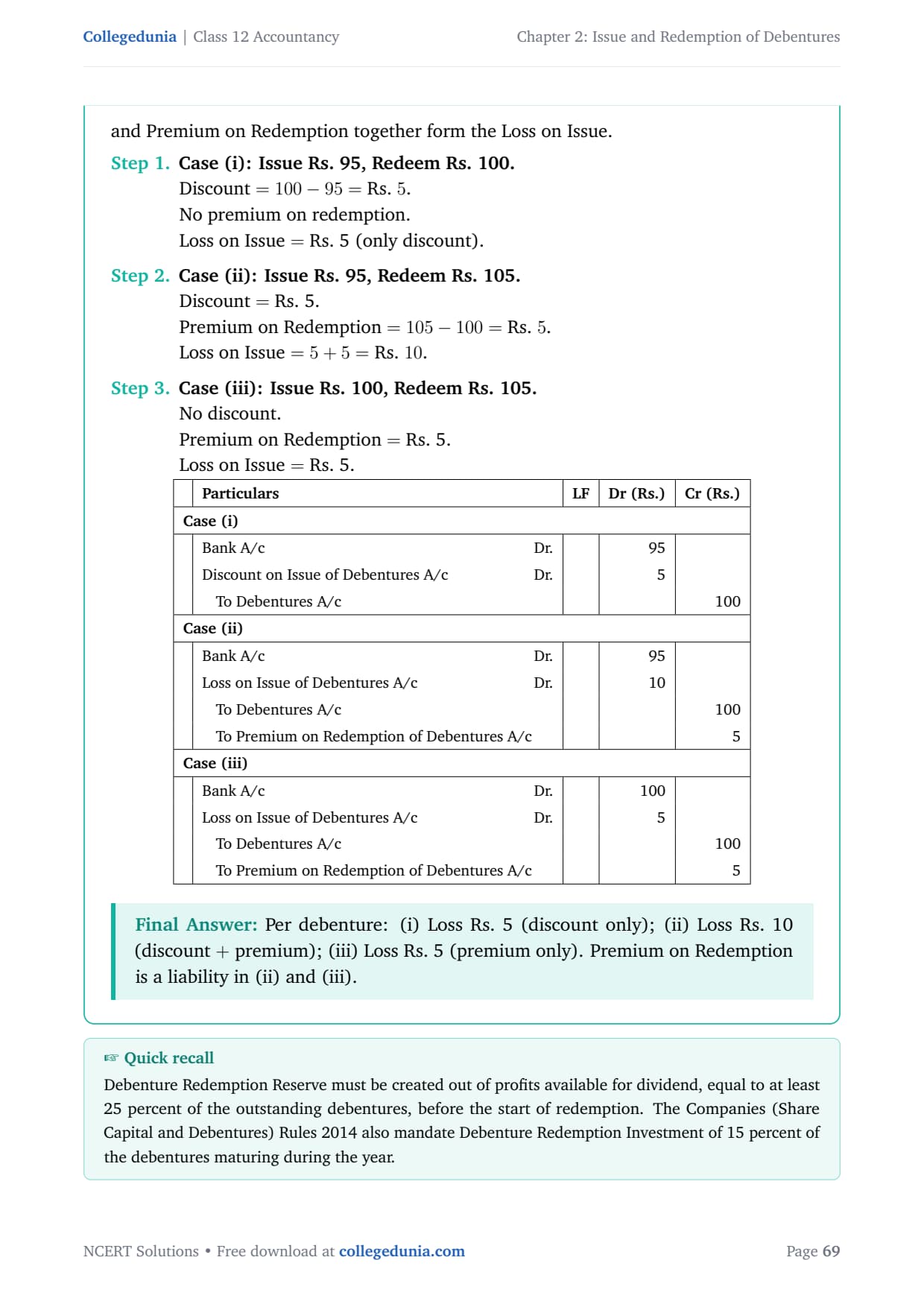
Concept used. This is a double-loss situation. The debenture is issued below face value (discount on issue) AND repaid above face value (premium on redemption). Both add to the company's loss; their sum is debited to Loss on Issue of Debentures A/c at the time of issue.
- Issue at discount. The investor pays less than face value (e.g. Rs. 95 for a Rs. 100 debenture). The discount is recognised as a deferred loss.
- Redemption at premium. On maturity the company pays more than face value (e.g. Rs. 110 for a Rs. 100 debenture). The extra Rs. 10 is also a loss.
- Total loss per debenture. Loss = Discount on issue + Premium on redemption. For the example: 5 + 10 = Rs. 15 per debenture.
- Journal entry on issue.
- Dr. Bank A/c (face - discount).
- Dr. Loss on Issue of Debentures A/c (discount + premium).
- Cr. Debentures A/c (face).
- Cr. Premium on Redemption of Debentures A/c (premium on redemption).
- Write-off. The Loss is written off against Securities Premium Reserve / Statement of Profit & Loss in subsequent years.
Discount on issue + premium on redemption are both losses; recognised together at issue as Loss on Issue of Debentures A/c. Premium on Redemption is a liability shown until redemption.
Quick reading. Company loses twice: less cash in at issue, more cash out at redemption. Both losses are booked upfront.
- Cash in = face - discount.
- Cash out = face + premium.
- Total loss = discount + premium ⇒ Dr. Loss on Issue.
Why this matters. In a Class 12 numerical question on Issue and Redemption of Debentures, the examiner gives full marks only when the candidate distinguishes Discount on Issue of Debentures (a capital loss written off over the life of the debentures) from Premium on Redemption of Debentures (a provision created on issue), applies the Companies (Share Capital and Debentures) Rules 2014 for the Debenture Redemption Reserve, and presents every issue and redemption journal entry in narrated form. A correct closing debenture figure without the DRR working and the narrated journal entries loses 30-50 percent of the marks under the CBSE step-marking scheme.
Common mistakes. Three predictable slips lose marks: (a) confusing Discount on Issue with Premium on Redemption and posting both to the same ledger; (b) ignoring the requirement to create Debenture Redemption Reserve of at least 25 percent of the outstanding debentures before the start of redemption; (c) missing the loss on issue of debentures that arises when debentures are issued at par or discount but redeemed at a premium.
Loss on Issue = Discount + Premium on Redemption; both booked at issue date.
What is `Capital Reserve'?
Concept used. Capital Reserve is a reserve created out of capital profits (profits that are not earned in the normal course of business). It is NOT available for distribution as cash dividend; it can be used only for specific purposes prescribed under the Companies Act 2013.
- Source. Created from capital profits: profit on sale of fixed assets, profit on re-issue of forfeited shares, profit on redemption of debentures (purchase from open market below face value), premium on issue of shares prior to Section 52, etc.
- Not for dividend. Cannot be used to pay cash dividend (not a free reserve).
- Permissible uses. (a) Issue of fully paid bonus shares; (b) writing off capital losses; (c) writing off preliminary expenses.
- Disclosure. Shown under ``Reserves and Surplus'' on the equity & liabilities side of the balance sheet (Schedule III, Part I).
Capital Reserve is a reserve from capital profits (e.g. profit on forfeiture re-issue, profit on redemption of debentures). Not for cash dividend; usable for bonus shares and writing off capital losses.
Strategic angle. The word ``capital'' restricts use: dividends come from revenue profits, not capital profits.
- Capital profit (asset sale, forfeiture) → Capital Reserve.
- Cannot be drawn as cash dividend.
- Used for bonus shares or to absorb capital losses.
Why this matters. In a Class 12 numerical question on Issue and Redemption of Debentures, the examiner gives full marks only when the candidate distinguishes Discount on Issue of Debentures (a capital loss written off over the life of the debentures) from Premium on Redemption of Debentures (a provision created on issue), applies the Companies (Share Capital and Debentures) Rules 2014 for the Debenture Redemption Reserve, and presents every issue and redemption journal entry in narrated form. A correct closing debenture figure without the DRR working and the narrated journal entries loses 30-50 percent of the marks under the CBSE step-marking scheme.
Common mistakes. Three predictable slips lose marks: (a) confusing Discount on Issue with Premium on Redemption and posting both to the same ledger; (b) ignoring the requirement to create Debenture Redemption Reserve of at least 25 percent of the outstanding debentures before the start of redemption; (c) missing the loss on issue of debentures that arises when debentures are issued at par or discount but redeemed at a premium.
Capital Reserve = from capital profits; never paid as dividend; funds bonus shares.
What is meant by a `Irredeemable Debenture'?
Concept used. An Irredeemable Debenture (also called Perpetual Debenture) is a debenture which is NOT repayable during the lifetime of the company. The principal becomes payable only on liquidation (winding-up) of the company, or upon a specified contingency arising.
- No fixed maturity. Unlike ordinary debentures, no fixed redemption date is stated.
- Repayable on winding-up. The company must repay the principal only when it is being wound up, or on the happening of a specified event (e.g. default in interest).
- Interest continues. The company keeps paying interest annually at the agreed rate until the contingency arises.
- Indian law. Section 71(4) of the Companies Act 2013 prohibits issue of debentures with perpetual maturity by Indian companies for issues after April 1, 2014. Hence, irredeemable debentures are now of historical / international relevance.
Irredeemable / perpetual debenture: no fixed redemption date; principal repayable only on winding-up or on a specified contingency. Prohibited in India after April 1, 2014 (Section 71(4)).
Quick reading. ``Never to be redeemed'' except when the company itself ceases.
- No maturity date in the deed.
- Interest paid forever, principal stays as long as company runs.
- Now banned in India (Section 71(4), Companies Act 2013).
Why this matters. In a Class 12 numerical question on Issue and Redemption of Debentures, the examiner gives full marks only when the candidate distinguishes Discount on Issue of Debentures (a capital loss written off over the life of the debentures) from Premium on Redemption of Debentures (a provision created on issue), applies the Companies (Share Capital and Debentures) Rules 2014 for the Debenture Redemption Reserve, and presents every issue and redemption journal entry in narrated form. A correct closing debenture figure without the DRR working and the narrated journal entries loses 30-50 percent of the marks under the CBSE step-marking scheme.
Common mistakes. Three predictable slips lose marks: (a) confusing Discount on Issue with Premium on Redemption and posting both to the same ledger; (b) ignoring the requirement to create Debenture Redemption Reserve of at least 25 percent of the outstanding debentures before the start of redemption; (c) missing the loss on issue of debentures that arises when debentures are issued at par or discount but redeemed at a premium.
Perpetual debenture; principal only on liquidation; banned in India after 2014.
What is a `Convertible Debenture'?
Concept used. A Convertible Debenture is a debenture which can be converted into equity shares (or other securities) of the company after a specified period, at terms agreed at the time of issue. The holder enjoys both: a creditor's interest until conversion and an owner's stake after conversion.
- Types. (a) Fully Convertible Debentures (FCD): the entire face value converts into shares. (b) Partly Convertible Debentures (PCD): a part converts; the balance is redeemed in cash. (c) Non-Convertible Debentures (NCD): do not convert; redeemed in cash.
- Conversion terms. The conversion price and ratio are fixed at issue (e.g. Rs. 100 debenture converts into 2 equity shares of Rs. 50 each after 3 years).
- Until conversion. The holder receives interest at the stated rate.
- Compulsory or optional. Conversion may be compulsory (CCD) or at the holder's option (OCD).
Convertible Debenture = debenture convertible into equity shares after a stated period at pre-agreed terms. FCD (fully), PCD (partly), CCD (compulsorily) and OCD (optionally) are the main sub-types.
Quick reading. Debt with an option to swap into equity later. Investor enjoys both worlds.
- Fully (FCD), partly (PCD), or compulsorily (CCD) convertible.
- Interest paid until conversion date.
- Conversion price fixed at issue.
Why this matters. In a Class 12 numerical question on Issue and Redemption of Debentures, the examiner gives full marks only when the candidate distinguishes Discount on Issue of Debentures (a capital loss written off over the life of the debentures) from Premium on Redemption of Debentures (a provision created on issue), applies the Companies (Share Capital and Debentures) Rules 2014 for the Debenture Redemption Reserve, and presents every issue and redemption journal entry in narrated form. A correct closing debenture figure without the DRR working and the narrated journal entries loses 30-50 percent of the marks under the CBSE step-marking scheme.
Common mistakes. Three predictable slips lose marks: (a) confusing Discount on Issue with Premium on Redemption and posting both to the same ledger; (b) ignoring the requirement to create Debenture Redemption Reserve of at least 25 percent of the outstanding debentures before the start of redemption; (c) missing the loss on issue of debentures that arises when debentures are issued at par or discount but redeemed at a premium.
Debt-now, equity-later instrument; FCD / PCD / CCD / OCD variants.
What is meant by `Mortgaged Debentures'?
Concept used. Mortgaged Debentures (also called Secured Debentures) are debentures which are secured by a mortgage / charge on some specified asset (or all assets) of the company. If the company defaults, the debenture-holders can enforce the charge and recover their money from the mortgaged asset.
- Charge created. A fixed charge (on a specific asset like land or plant) or a floating charge (on all current assets) is registered with the Registrar of Companies under Section 77 of the Companies Act 2013.
- Debenture trust deed. Section 71(5) requires that the company appoint a Debenture Trustee who holds the charge on behalf of all debenture-holders.
- On default. Trustees may sell the mortgaged asset and pay off the debenture- holders from the sale proceeds, ahead of unsecured creditors.
- Tenure. As per Rule 18(1)(a), secured debentures must be redeemable within 10 years (or 30 years for infrastructure companies) from the date of issue.
Mortgaged / secured debentures carry a fixed or floating charge on company assets, registered with the RoC and held by a Debenture Trustee. On default, trustees enforce the charge to repay the debenture-holders.
Strategic angle. ``Mortgaged'' = ``secured by a charge.'' Charge registered, trustees appointed, recovery path defined.
- Charge created on assets (fixed / floating).
- Section 77 registration; Section 71(5) trustee.
- Default ⇒ trustees sell asset; debenture-holders paid before unsecured creditors.
Why this matters. In a Class 12 numerical question on Issue and Redemption of Debentures, the examiner gives full marks only when the candidate distinguishes Discount on Issue of Debentures (a capital loss written off over the life of the debentures) from Premium on Redemption of Debentures (a provision created on issue), applies the Companies (Share Capital and Debentures) Rules 2014 for the Debenture Redemption Reserve, and presents every issue and redemption journal entry in narrated form. A correct closing debenture figure without the DRR working and the narrated journal entries loses 30-50 percent of the marks under the CBSE step-marking scheme.
Common mistakes. Three predictable slips lose marks: (a) confusing Discount on Issue with Premium on Redemption and posting both to the same ledger; (b) ignoring the requirement to create Debenture Redemption Reserve of at least 25 percent of the outstanding debentures before the start of redemption; (c) missing the loss on issue of debentures that arises when debentures are issued at par or discount but redeemed at a premium.
Secured-by-asset; RoC-registered charge; trustee-protected.
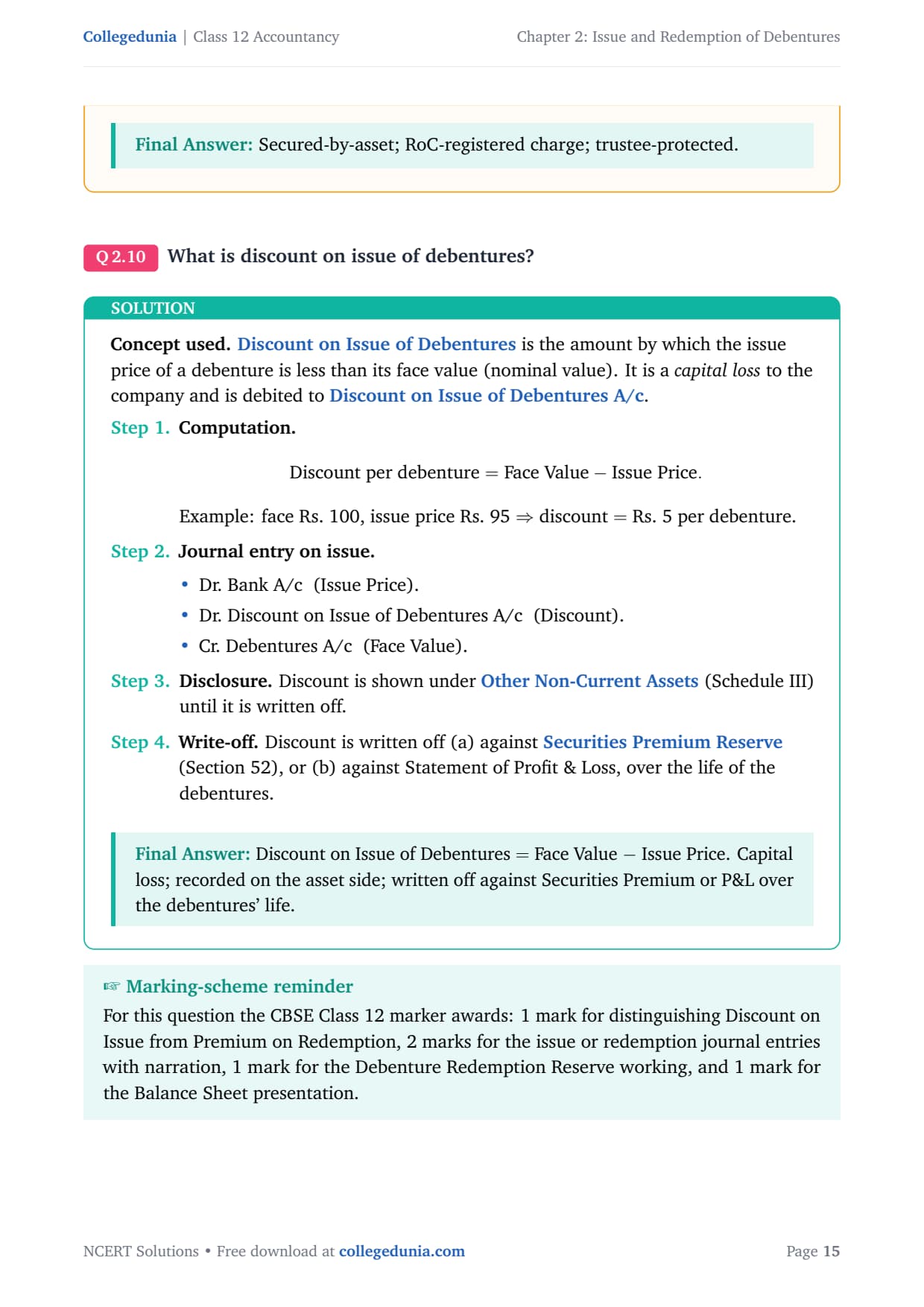
What is discount on issue of debentures?
Concept used. Discount on Issue of Debentures is the amount by which the issue price of a debenture is less than its face value (nominal value). It is a capital loss to the company and is debited to Discount on Issue of Debentures A/c.
- Computation. Discount per debenture = Face Value - Issue Price. Example: face Rs. 100, issue price Rs. 95 ⇒ discount = Rs. 5 per debenture.
- Journal entry on issue.
- Dr. Bank A/c (Issue Price).
- Dr. Discount on Issue of Debentures A/c (Discount).
- Cr. Debentures A/c (Face Value).
- Disclosure. Discount is shown under Other Non-Current Assets (Schedule III) until it is written off.
- Write-off. Discount is written off (a) against Securities Premium Reserve (Section 52), or (b) against Statement of Profit & Loss, over the life of the debentures.
Discount on Issue of Debentures = Face Value - Issue Price. Capital loss; recorded on the asset side; written off against Securities Premium or P&L over the debentures' life.
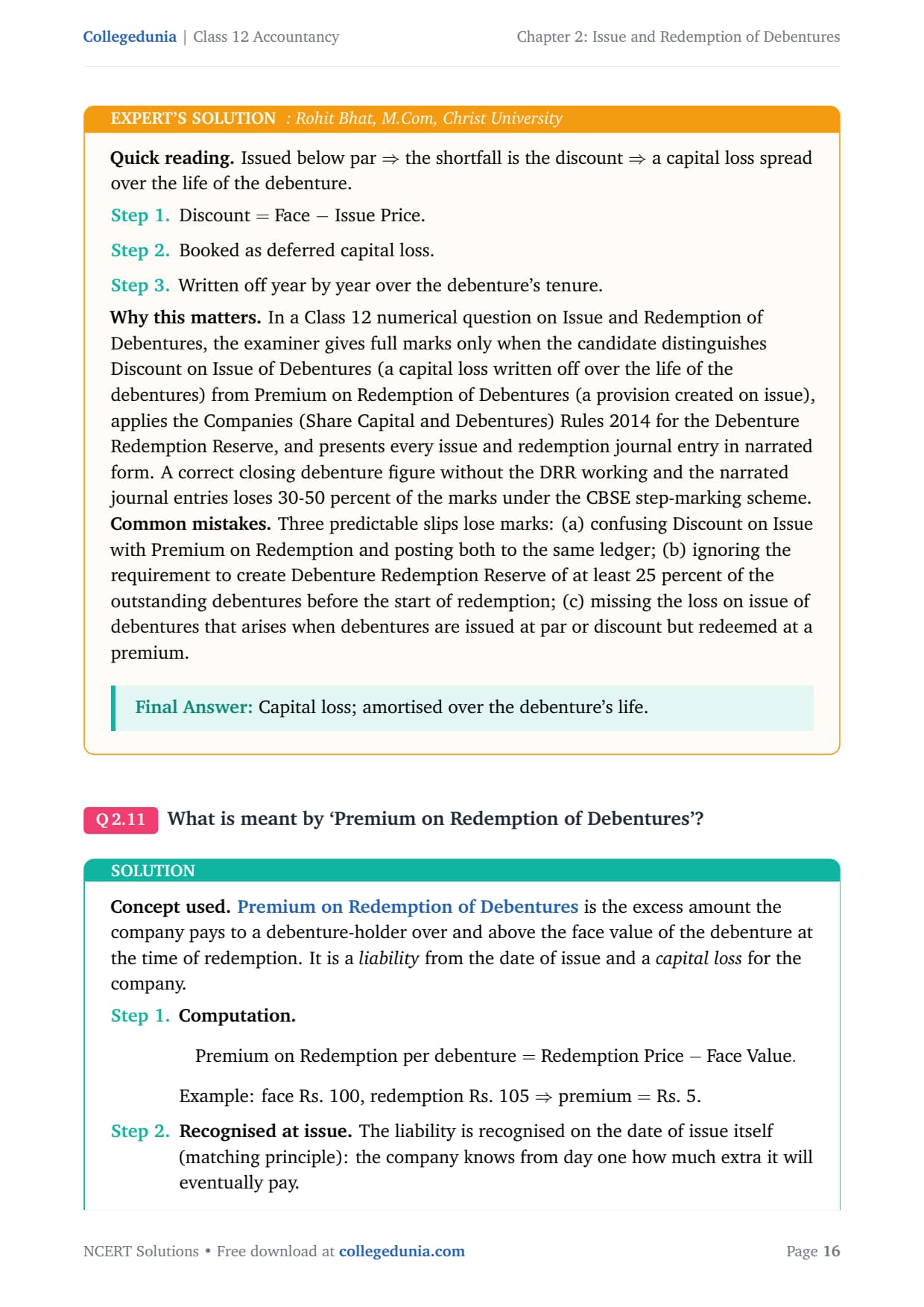
Quick reading. Issued below par ⇒ the shortfall is the discount ⇒ a capital loss spread over the life of the debenture.
- Discount = Face - Issue Price.
- Booked as deferred capital loss.
- Written off year by year over the debenture's tenure.
Why this matters. In a Class 12 numerical question on Issue and Redemption of Debentures, the examiner gives full marks only when the candidate distinguishes Discount on Issue of Debentures (a capital loss written off over the life of the debentures) from Premium on Redemption of Debentures (a provision created on issue), applies the Companies (Share Capital and Debentures) Rules 2014 for the Debenture Redemption Reserve, and presents every issue and redemption journal entry in narrated form. A correct closing debenture figure without the DRR working and the narrated journal entries loses 30-50 percent of the marks under the CBSE step-marking scheme.
Common mistakes. Three predictable slips lose marks: (a) confusing Discount on Issue with Premium on Redemption and posting both to the same ledger; (b) ignoring the requirement to create Debenture Redemption Reserve of at least 25 percent of the outstanding debentures before the start of redemption; (c) missing the loss on issue of debentures that arises when debentures are issued at par or discount but redeemed at a premium.
Capital loss; amortised over the debenture's life.
What is meant by `Premium on Redemption of Debentures'?
Concept used. Premium on Redemption of Debentures is the excess amount the company pays to a debenture-holder over and above the face value of the debenture at the time of redemption. It is a liability from the date of issue and a capital loss for the company.
- Computation. Premium on Redemption per debenture = Redemption Price - Face Value. Example: face Rs. 100, redemption Rs. 105 ⇒ premium = Rs. 5.
- Recognised at issue. The liability is recognised on the date of issue itself (matching principle): the company knows from day one how much extra it will eventually pay.
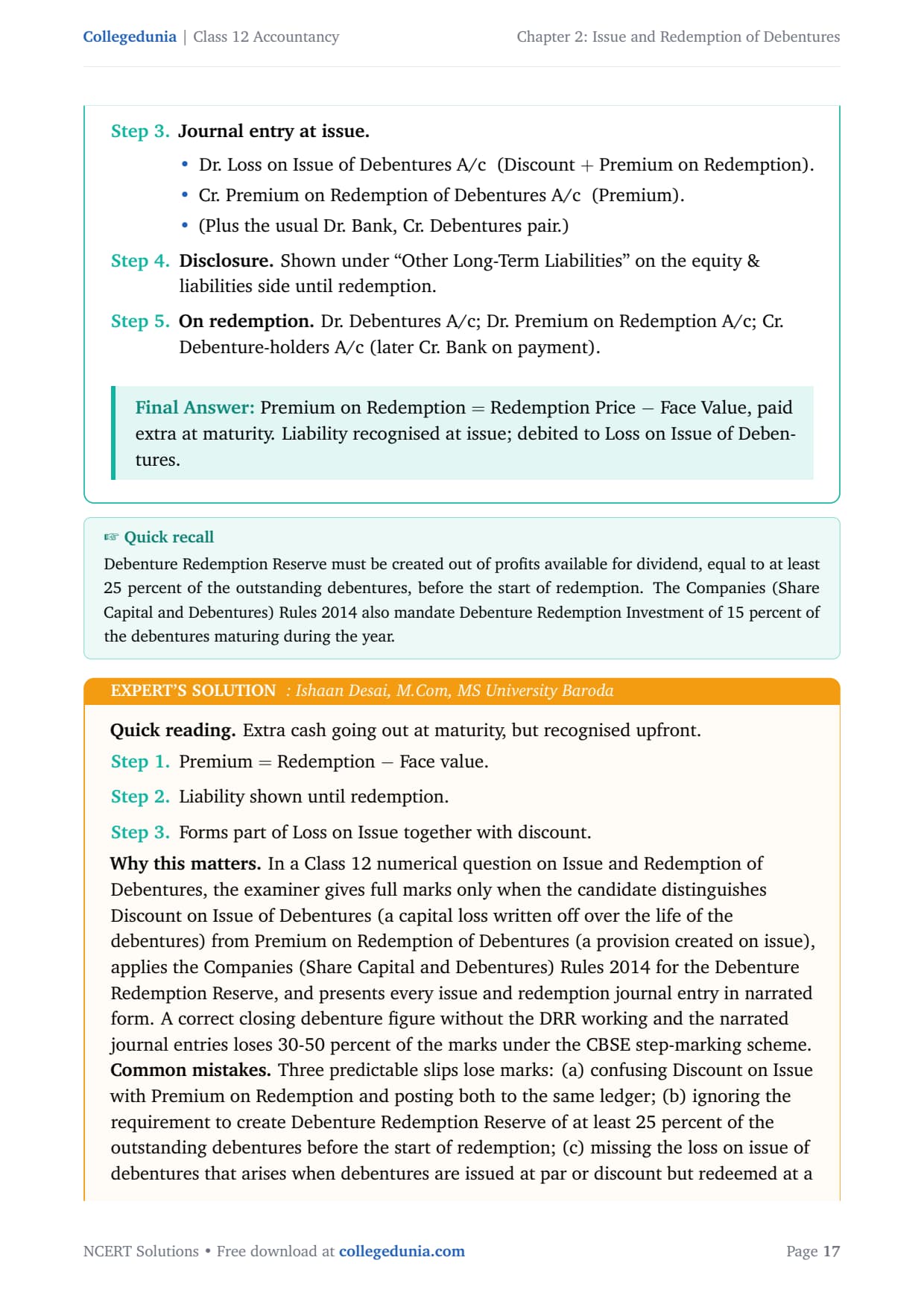
- Journal entry at issue.
- Dr. Loss on Issue of Debentures A/c (Discount + Premium on Redemption).
- Cr. Premium on Redemption of Debentures A/c (Premium).
- (Plus the usual Dr. Bank, Cr. Debentures pair.)
- Disclosure. Shown under ``Other Long-Term Liabilities'' on the equity & liabilities side until redemption.
- On redemption. Dr. Debentures A/c; Dr. Premium on Redemption A/c; Cr. Debenture-holders A/c (later Cr. Bank on payment).
Premium on Redemption = Redemption Price - Face Value, paid extra at maturity. Liability recognised at issue; debited to Loss on Issue of Debentures.
Quick reading. Extra cash going out at maturity, but recognised upfront.
- Premium = Redemption - Face value.
- Liability shown until redemption.
- Forms part of Loss on Issue together with discount.
Why this matters. In a Class 12 numerical question on Issue and Redemption of Debentures, the examiner gives full marks only when the candidate distinguishes Discount on Issue of Debentures (a capital loss written off over the life of the debentures) from Premium on Redemption of Debentures (a provision created on issue), applies the Companies (Share Capital and Debentures) Rules 2014 for the Debenture Redemption Reserve, and presents every issue and redemption journal entry in narrated form. A correct closing debenture figure without the DRR working and the narrated journal entries loses 30-50 percent of the marks under the CBSE step-marking scheme.
Common mistakes. Three predictable slips lose marks: (a) confusing Discount on Issue with Premium on Redemption and posting both to the same ledger; (b) ignoring the requirement to create Debenture Redemption Reserve of at least 25 percent of the outstanding debentures before the start of redemption; (c) missing the loss on issue of debentures that arises when debentures are issued at par or discount but redeemed at a premium.
Extra payable at maturity; booked at issue; part of Loss on Issue.
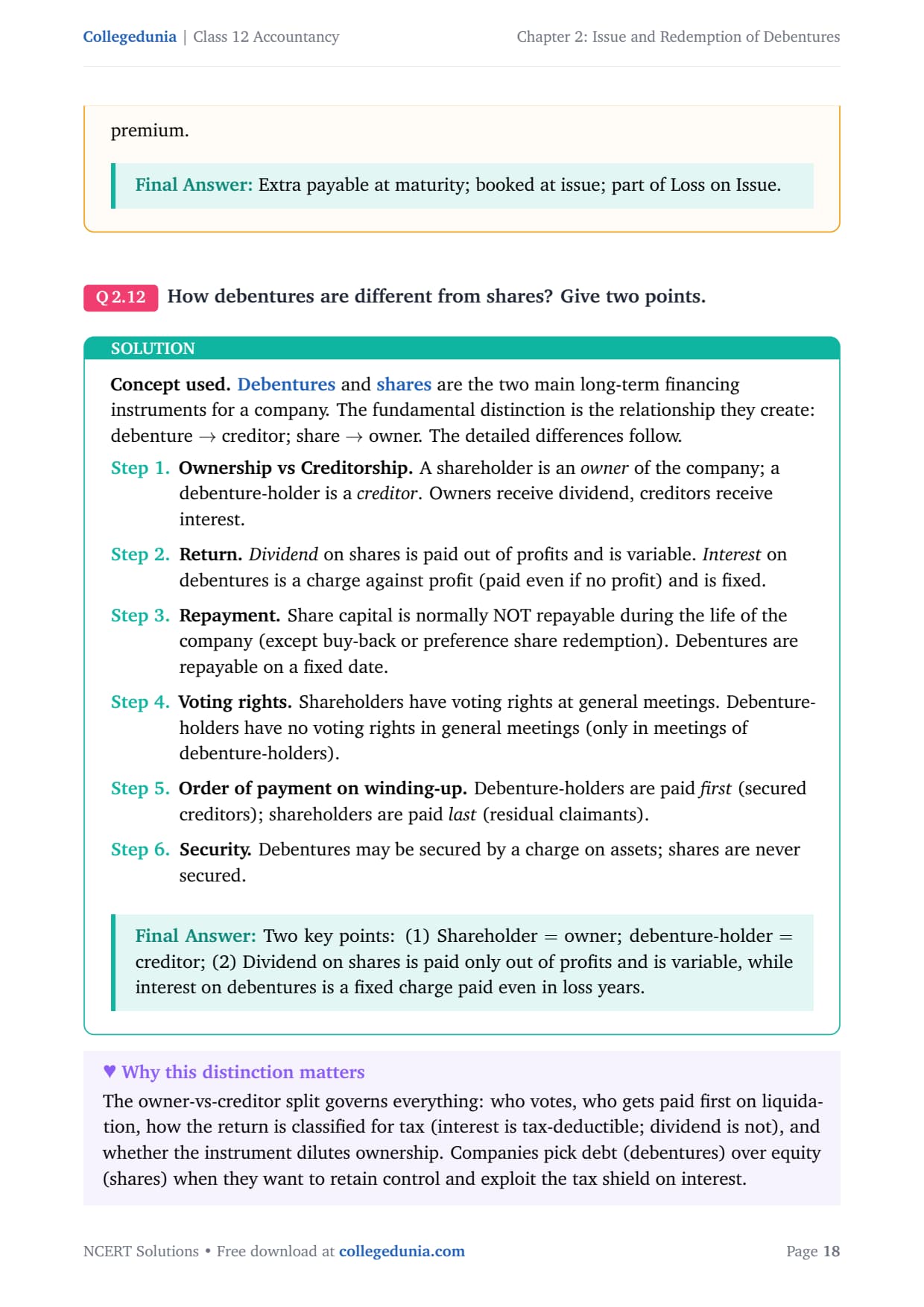
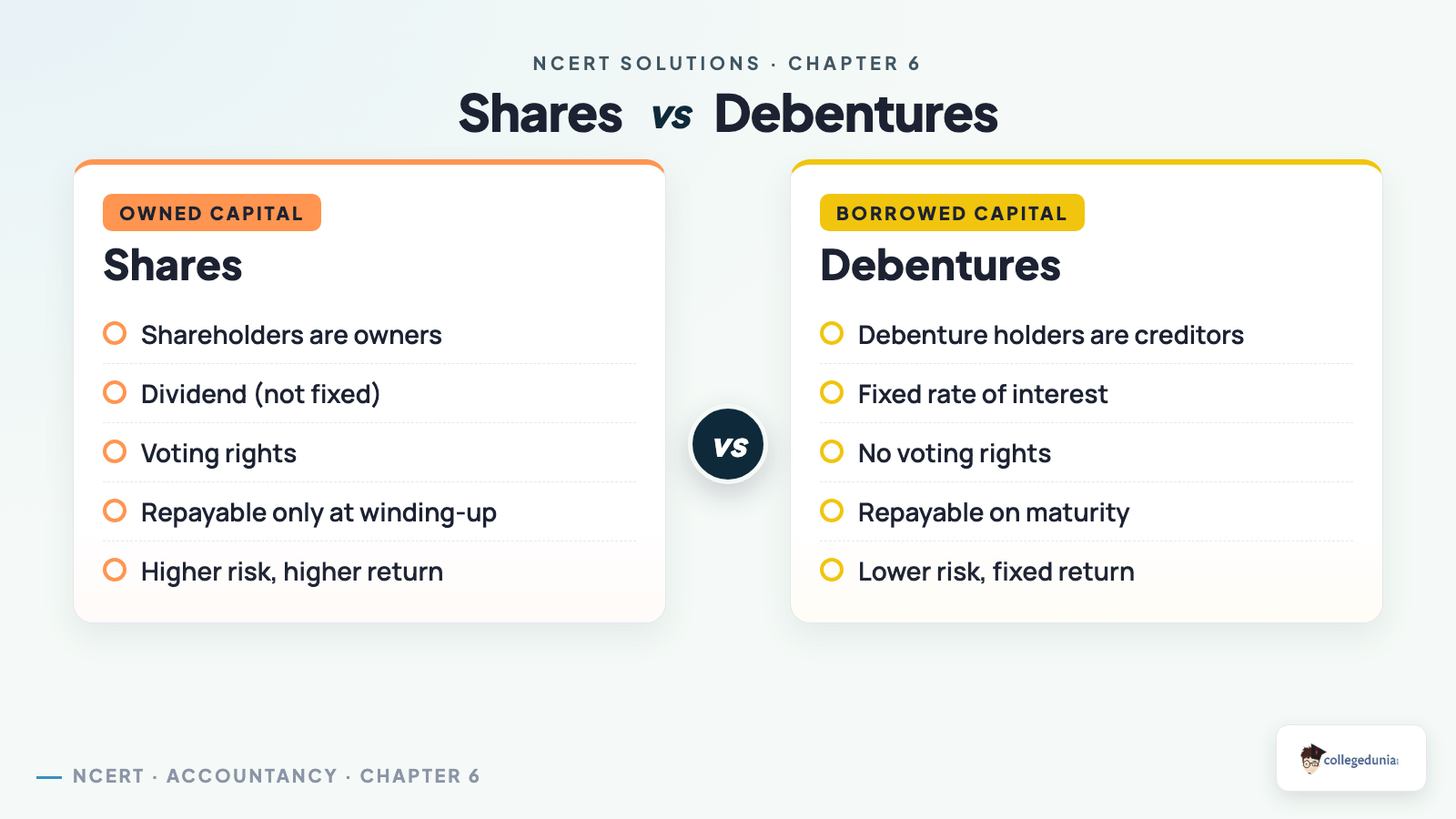
How debentures are different from shares? Give two points.
Concept used. Debentures and shares are the two main long-term financing instruments for a company. The fundamental distinction is the relationship they create: debenture → creditor; share → owner. The detailed differences follow.
- Ownership vs Creditorship. A shareholder is an owner of the company; a debenture-holder is a creditor. Owners receive dividend, creditors receive interest.
- Return. Dividend on shares is paid out of profits and is variable. Interest on debentures is a charge against profit (paid even if no profit) and is fixed.
- Repayment. Share capital is normally NOT repayable during the life of the company (except buy-back or preference share redemption). Debentures are repayable on a fixed date.
- Voting rights. Shareholders have voting rights at general meetings. Debenture- holders have no voting rights in general meetings (only in meetings of debenture-holders).
- Order of payment on winding-up. Debenture-holders are paid first (secured creditors); shareholders are paid last (residual claimants).
- Security. Debentures may be secured by a charge on assets; shares are never secured.
Two key points: (1) Shareholder = owner; debenture-holder = creditor; (2) Dividend on shares is paid only out of profits and is variable, while interest on debentures is a fixed charge paid even in loss years.
Strategic angle. Memorise the contrast as a 2-column table: owner/creditor, dividend/interest, profit-only/charge, voting/no-voting, repayable/not, last/first on liquidation.
- Shareholder = owner; debenture-holder = creditor.
- Dividend variable, paid from profits; interest fixed, paid always.
- Voting (shares) vs no voting (debentures).
Why this matters. In a Class 12 numerical question on Issue and Redemption of Debentures, the examiner gives full marks only when the candidate distinguishes Discount on Issue of Debentures (a capital loss written off over the life of the debentures) from Premium on Redemption of Debentures (a provision created on issue), applies the Companies (Share Capital and Debentures) Rules 2014 for the Debenture Redemption Reserve, and presents every issue and redemption journal entry in narrated form. A correct closing debenture figure without the DRR working and the narrated journal entries loses 30-50 percent of the marks under the CBSE step-marking scheme.
Common mistakes. Three predictable slips lose marks: (a) confusing Discount on Issue with Premium on Redemption and posting both to the same ledger; (b) ignoring the requirement to create Debenture Redemption Reserve of at least 25 percent of the outstanding debentures before the start of redemption; (c) missing the loss on issue of debentures that arises when debentures are issued at par or discount but redeemed at a premium.
Owner vs Creditor; Dividend vs Interest are the two anchor differences.
What is meant by redemption of debentures?
Concept used. Redemption of Debentures is the discharge of the company's liability towards debenture-holders, i.e. the repayment of the principal amount of the debentures on the maturity date (or earlier, depending on the terms of issue). Once redeemed, the debentures cease to exist as an obligation of the company.
- Trigger. Redemption takes place on the expiry of the period for which the debentures were issued, as per the terms of issue stated in the debenture trust deed.
- Modes of redemption. (a) Lump-sum at the end of the stated period; (b) in instalments (by annual drawings); (c) by purchase in the open market; (d) by conversion into shares or new debentures.
- Source of funds. (a) Out of capital (no profits transferred); (b) out of profits (a portion of revenue profits transferred to DRR); (c) by issue of new debentures / shares.
- Compliance. The company must comply with Section 71 of the Companies Act 2013 and Rule 18 of the Companies (Share Capital and Debentures) Rules 2014, including Debenture Redemption Reserve (DRR) and Debenture Redemption Investment (DRI).
Redemption of debentures = discharge of the company's debt to debenture-holders; done by lump-sum, instalments, open-market purchase or conversion; governed by Section 71 and Rule 18.
Quick reading. ``Paying back'' the debenture-holders. Triggered by the agreed maturity date; funded out of capital, out of profits, or by a new issue.
- Maturity date or early-redemption clause arrives.
- Pay holders by cash, by new debentures, by shares, or by open-market purchase.
- Comply with DRR / DRI rules.
Why this matters. In a Class 12 numerical question on Issue and Redemption of Debentures, the examiner gives full marks only when the candidate distinguishes Discount on Issue of Debentures (a capital loss written off over the life of the debentures) from Premium on Redemption of Debentures (a provision created on issue), applies the Companies (Share Capital and Debentures) Rules 2014 for the Debenture Redemption Reserve, and presents every issue and redemption journal entry in narrated form. A correct closing debenture figure without the DRR working and the narrated journal entries loses 30-50 percent of the marks under the CBSE step-marking scheme.
Common mistakes. Three predictable slips lose marks: (a) confusing Discount on Issue with Premium on Redemption and posting both to the same ledger; (b) ignoring the requirement to create Debenture Redemption Reserve of at least 25 percent of the outstanding debentures before the start of redemption; (c) missing the loss on issue of debentures that arises when debentures are issued at par or discount but redeemed at a premium.
Repayment of debenture liability on / before maturity; four modes; Section 71 governs.
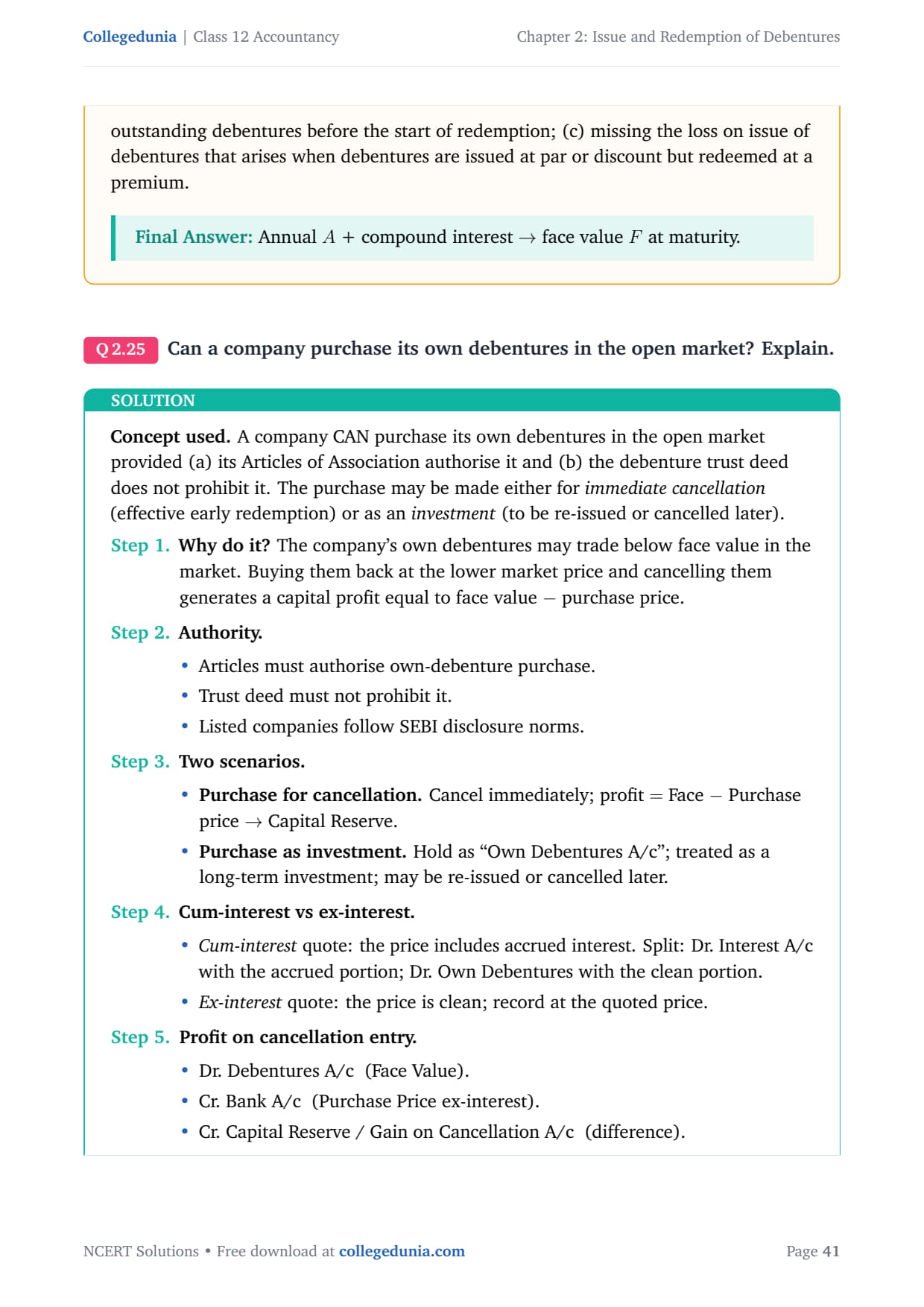
Can the company purchase its own debentures?
Concept used. Yes. Unlike its own shares (where buy-back is governed by Section 68 restrictions), a company has a wider freedom to purchase its own debentures in the open market. Purpose: either to cancel them (early redemption) or to re-issue them later (treat as investment).
- Authority. The Articles of Association must authorise it; the debenture trust deed should not prohibit it.
- Two outcomes.
- Purchase for cancellation: debentures are cancelled immediately; any profit on cancellation (purchase price < face value) is credited to Capital Reserve.
- Purchase as investment: debentures are held by the company as ``Own Debentures A/c''; can be re-issued later or cancelled.
- No DRR transfer needed (Rule 18(7) exemption) when redemption is through open-market purchase for listed companies.
- Profit on cancellation. Profit = Face Value - Purchase Price (cum-int.).
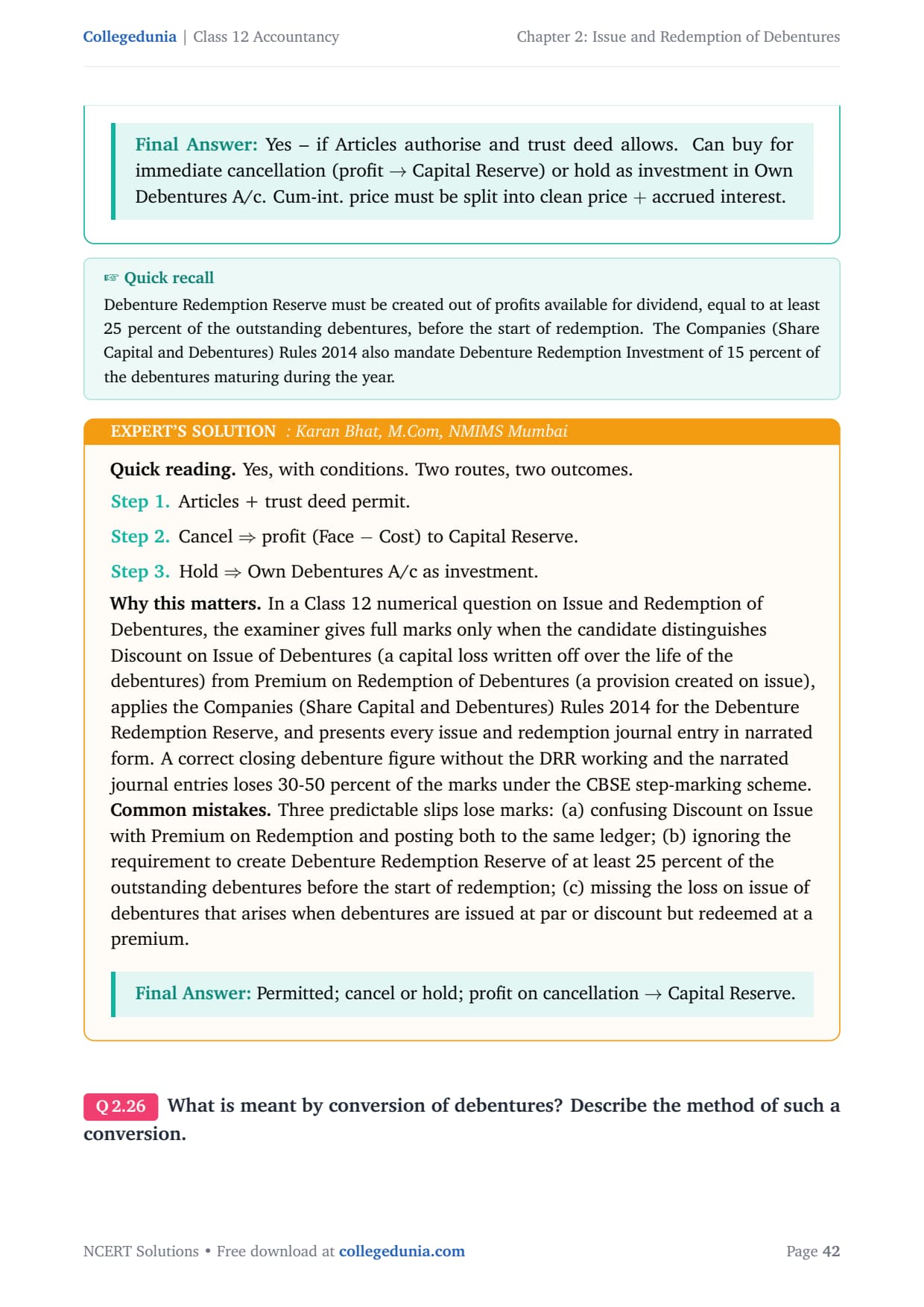
Yes. A company can purchase its own debentures for cancellation (profit → Capital Reserve) or as investment (Own Debentures A/c). Authorised by Articles; subject to trust deed.
Quick reading. Yes, with two routes: cancel now or invest now and cancel later.
- Articles allow + trust deed silent.
- Cancel ⇒ profit to Capital Reserve.
- Hold as investment ⇒ Own Debentures A/c.
Why this matters. In a Class 12 numerical question on Issue and Redemption of Debentures, the examiner gives full marks only when the candidate distinguishes Discount on Issue of Debentures (a capital loss written off over the life of the debentures) from Premium on Redemption of Debentures (a provision created on issue), applies the Companies (Share Capital and Debentures) Rules 2014 for the Debenture Redemption Reserve, and presents every issue and redemption journal entry in narrated form. A correct closing debenture figure without the DRR working and the narrated journal entries loses 30-50 percent of the marks under the CBSE step-marking scheme.
Common mistakes. Three predictable slips lose marks: (a) confusing Discount on Issue with Premium on Redemption and posting both to the same ledger; (b) ignoring the requirement to create Debenture Redemption Reserve of at least 25 percent of the outstanding debentures before the start of redemption; (c) missing the loss on issue of debentures that arises when debentures are issued at par or discount but redeemed at a premium.
Yes; cancel or invest; profit on cancellation → Capital Reserve.
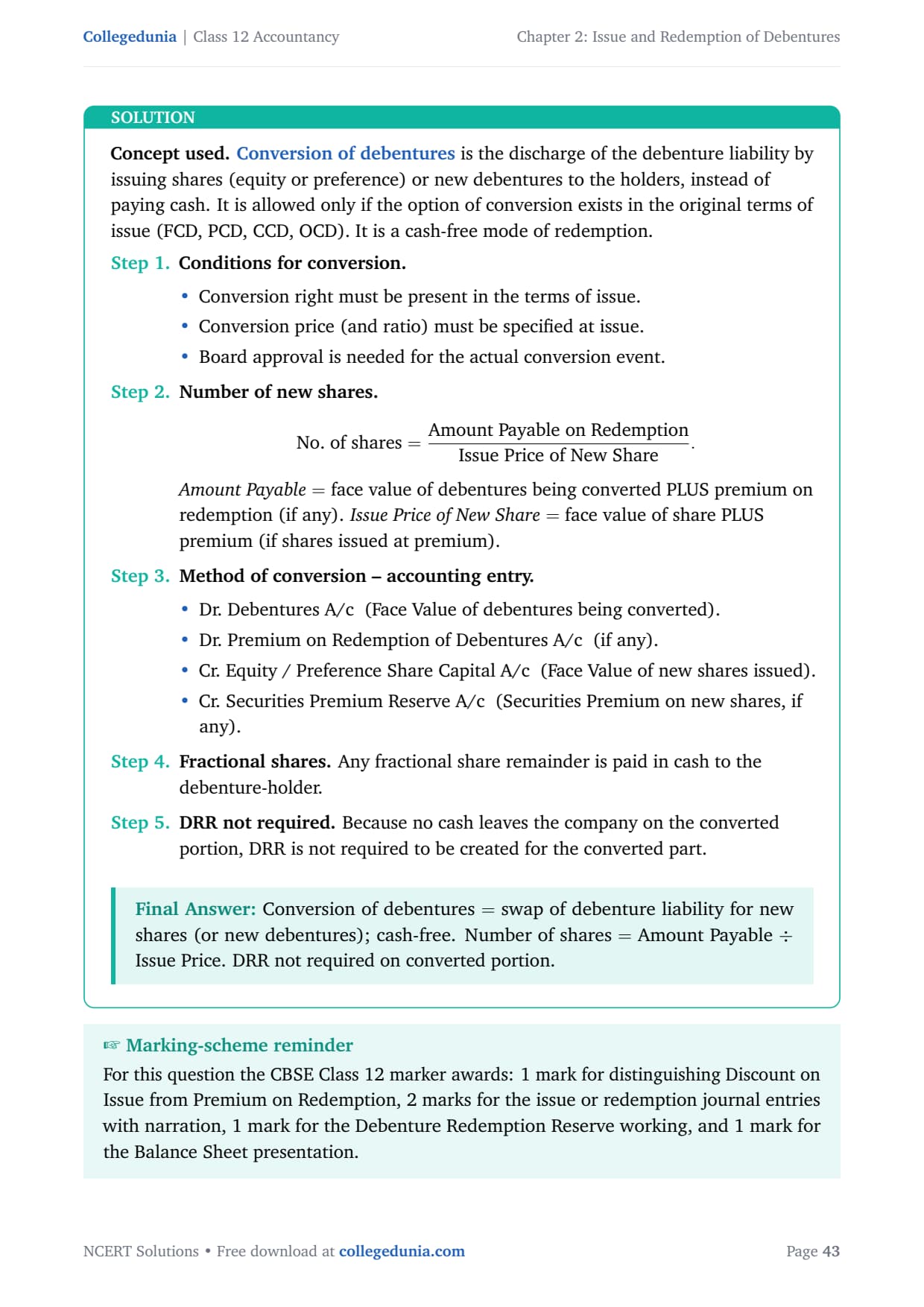
What is meant by redemption of debentures by conversion?
Concept used. Redemption by Conversion is the discharge of debenture liability by issuing new equity shares (or new debentures) to the existing debenture-holders in lieu of cash. No cash flows out; the debt is simply converted into another instrument.
- When permissible. The option to convert must be present at the time of issue (CCD, OCD, FCD, PCD).
- Number of shares issued. No. of new shares = Amount Payable on RedemptionIssue Price of New Share. If the new share is at par, denominator = face value; if at premium, denominator = face + premium.
- Journal entry.
- Dr. Debentures A/c (face value being redeemed).
- Dr. Premium on Redemption of Debentures A/c (if redeemable at premium).
- Cr. Equity / Preference Share Capital A/c (face value of new shares).
- Cr. Securities Premium Reserve A/c (if shares issued at premium).
- No DRR required. Because no cash leaves the company, DRR is not required for convertible portion.
Redemption by conversion = debenture-holders accept new shares (or new debentures) instead of cash. No cash outflow; no DRR. Number of shares = Amount Payable ÷ New Share Issue Price.
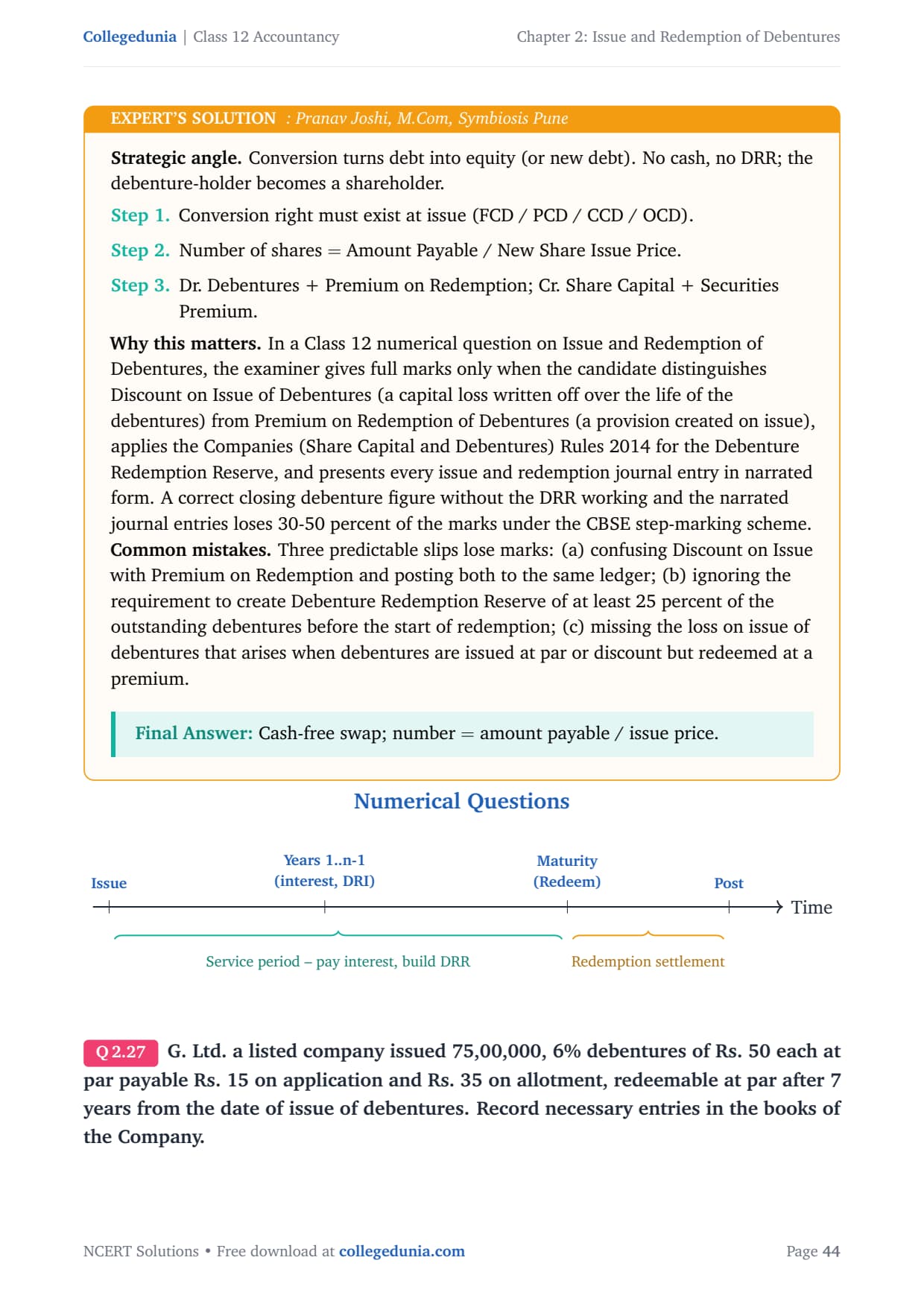
Strategic angle. Swap debt for equity. No cash, no DRR.
- Conversion price fixed at issue.
- Number of new shares = amount payable / share issue price.
- Premium portion (if any) to Securities Premium Reserve.
Why this matters. In a Class 12 numerical question on Issue and Redemption of Debentures, the examiner gives full marks only when the candidate distinguishes Discount on Issue of Debentures (a capital loss written off over the life of the debentures) from Premium on Redemption of Debentures (a provision created on issue), applies the Companies (Share Capital and Debentures) Rules 2014 for the Debenture Redemption Reserve, and presents every issue and redemption journal entry in narrated form. A correct closing debenture figure without the DRR working and the narrated journal entries loses 30-50 percent of the marks under the CBSE step-marking scheme.
Common mistakes. Three predictable slips lose marks: (a) confusing Discount on Issue with Premium on Redemption and posting both to the same ledger; (b) ignoring the requirement to create Debenture Redemption Reserve of at least 25 percent of the outstanding debentures before the start of redemption; (c) missing the loss on issue of debentures that arises when debentures are issued at par or discount but redeemed at a premium.
Debt → equity swap; cash-free; DRR not needed.
How would you deal with `Premium on Redemption of Debentures'?
Concept used. The accounting treatment of Premium on Redemption of Debentures splits into two events: (a) recognition at the time of issue (as a liability), and (b) extinguishment at the time of redemption (paying it out together with face value).
- At time of issue (premium is known from day one).
- Dr. Loss on Issue of Debentures A/c (with discount + premium on redemption).
- Cr. Premium on Redemption of Debentures A/c (with premium amount).
- (The standard Dr. Bank, Cr. Debentures is passed separately.)
- Write-off the Loss. Loss on Issue of Debentures is written off against Securities Premium Reserve first (under Section 52, Companies Act 2013), and any balance against Statement of Profit & Loss over the life of the debentures.
- Disclosure during life. Premium on Redemption of Debentures A/c is shown under ``Other Long-Term Liabilities'' (Schedule III, Part I).
- At time of redemption.
- Dr. Debentures A/c (face value); Dr. Premium on Redemption of Debentures A/c (premium amount); Cr. Debenture-holders A/c (face + premium).
- Dr. Debenture-holders A/c; Cr. Bank A/c (final settlement).
Premium on Redemption is recognised at issue (Dr. Loss on Issue, Cr. Premium on Redemption A/c), shown as a long-term liability, written off against Securities Premium / P&L, and finally paid out at redemption together with face value.
Quick reading. Three steps: book at issue, write off the loss over life, pay at maturity.
- Issue: Dr. Loss on Issue, Cr. Premium on Redemption A/c.
- Life: write off Loss against Securities Premium / P&L.
- Redemption: Dr. Debentures & Dr. Premium on Redemption; Cr. Bank.
Why this matters. In a Class 12 numerical question on Issue and Redemption of Debentures, the examiner gives full marks only when the candidate distinguishes Discount on Issue of Debentures (a capital loss written off over the life of the debentures) from Premium on Redemption of Debentures (a provision created on issue), applies the Companies (Share Capital and Debentures) Rules 2014 for the Debenture Redemption Reserve, and presents every issue and redemption journal entry in narrated form. A correct closing debenture figure without the DRR working and the narrated journal entries loses 30-50 percent of the marks under the CBSE step-marking scheme.
Common mistakes. Three predictable slips lose marks: (a) confusing Discount on Issue with Premium on Redemption and posting both to the same ledger; (b) ignoring the requirement to create Debenture Redemption Reserve of at least 25 percent of the outstanding debentures before the start of redemption; (c) missing the loss on issue of debentures that arises when debentures are issued at par or discount but redeemed at a premium.
Book at issue → write off over life → pay at maturity.
What is meant by redemption of debentures by ``Purchase in Open Market''?
Concept used. Redemption by Purchase in the Open Market is the practice of a company buying its own debentures from the stock market at the prevailing market price (rather than at the agreed redemption price). It is permitted only if (a) Articles authorise and (b) trust deed does not prohibit.
- Motivation. The company resorts to open-market purchase when the market price of its own debentures is BELOW the face / redemption value: the company saves money.
- Two intentions.
- Purchase for immediate cancellation: the debentures are cancelled then and there; profit = face value - purchase price; credited to Capital Reserve.
- Purchase as investment: debentures are held in ``Own Debentures A/c''; may be re-issued later or cancelled.
- Profit on cancellation entry.
- Dr. Debentures A/c (Face Value).
- Cr. Bank A/c (Purchase Price ex-interest).
- Cr. Capital Reserve A/c (Face - Purchase Price).
- Cum-int. vs ex-int. If purchased cum-interest, the price includes accrued interest, which must be separated: Dr. Interest A/c with the accrued portion. If ex-interest, the price is clean.
Open-market purchase = company buys its own debentures from the market, usually below face value, for cancellation (profit → Capital Reserve) or as investment (Own Debentures A/c). Subject to Articles and trust deed.
Strategic angle. Use it when own debentures trade at a discount in the market; capture the saving as Capital Reserve.
- Authority: Articles permit + trust deed silent.
- Cum-int. vs ex-int. price split.
- Cancel ⇒ profit to Capital Reserve; Invest ⇒ Own Debentures A/c.
Why this matters. In a Class 12 numerical question on Issue and Redemption of Debentures, the examiner gives full marks only when the candidate distinguishes Discount on Issue of Debentures (a capital loss written off over the life of the debentures) from Premium on Redemption of Debentures (a provision created on issue), applies the Companies (Share Capital and Debentures) Rules 2014 for the Debenture Redemption Reserve, and presents every issue and redemption journal entry in narrated form. A correct closing debenture figure without the DRR working and the narrated journal entries loses 30-50 percent of the marks under the CBSE step-marking scheme.
Common mistakes. Three predictable slips lose marks: (a) confusing Discount on Issue with Premium on Redemption and posting both to the same ledger; (b) ignoring the requirement to create Debenture Redemption Reserve of at least 25 percent of the outstanding debentures before the start of redemption; (c) missing the loss on issue of debentures that arises when debentures are issued at par or discount but redeemed at a premium.
Buy own debentures from market; cancel or invest; profit to Capital Reserve.
Explain the different types of debentures.
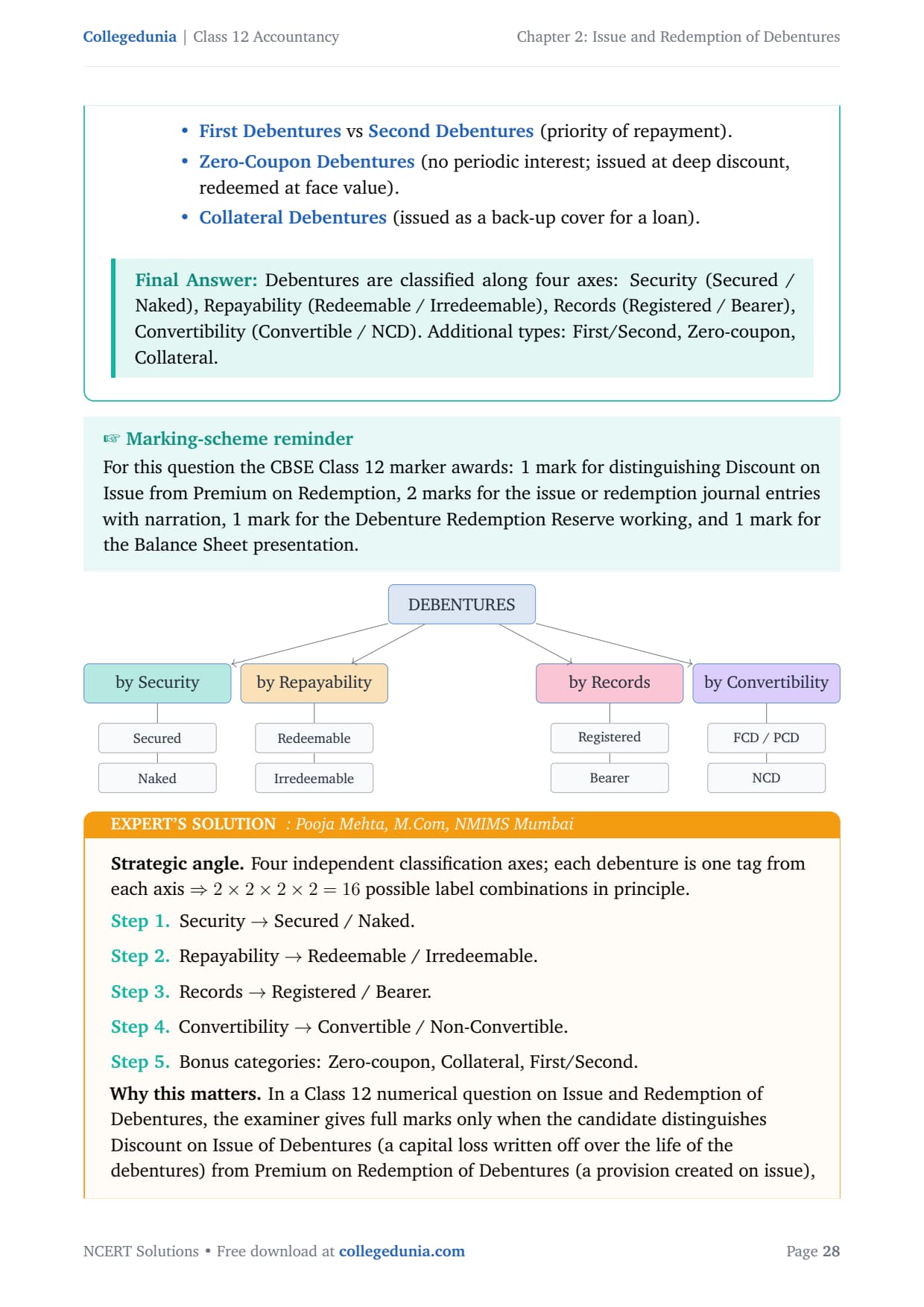
Concept used. Debentures are classified along four independent axes: (a) security cover, (b) repayability, (c) records / mode of transfer, and (d) convertibility into shares. A single debenture can have one label from each axis (e.g. ``Secured, Redeemable, Registered, Non-Convertible'').
- From the point of view of security.
- Secured / Mortgaged Debentures. Carry a fixed charge (on a specific asset) or a floating charge (on all assets) registered under Section 77.
- Unsecured / Naked Debentures. Carry no charge; only a personal undertaking of the company to repay.
- From the point of view of repayment / tenure.
- Redeemable Debentures. Repayable on a fixed maturity date or in instalments by drawings.
- Irredeemable / Perpetual Debentures. No fixed maturity; repayable only on winding-up. (Banned in India after April 1, 2014, under Section 71(4).)
- From the point of view of records of transfer.
- Registered Debentures. Holder's name is on the register; transfer by a transfer deed and entry in register.
- Bearer Debentures. No register; transferable by mere delivery; interest paid against detachable coupons.
- From the point of view of convertibility.
- Convertible Debentures (CD). Convertible into equity shares after a stated period. Sub-types: Fully Convertible (FCD), Partly Convertible (PCD), Compulsorily Convertible (CCD), Optionally Convertible (OCD).
- Non-Convertible Debentures (NCD). Not convertible; redeemed in cash.
- Other types (occasionally examined).
- First Debentures vs Second Debentures (priority of repayment).
- Zero-Coupon Debentures (no periodic interest; issued at deep discount, redeemed at face value).
- Collateral Debentures (issued as a back-up cover for a loan).
Debentures are classified along four axes: Security (Secured / Naked), Repayability (Redeemable / Irredeemable), Records (Registered / Bearer), Convertibility (Convertible / NCD). Additional types: First/Second, Zero-coupon, Collateral.
Strategic angle. Four independent classification axes; each debenture is one tag from each axis ⇒ 2 × 2 × 2 × 2 = 16 possible label combinations in principle.
- Security → Secured / Naked.
- Repayability → Redeemable / Irredeemable.
- Records → Registered / Bearer.
- Convertibility → Convertible / Non-Convertible.
- Bonus categories: Zero-coupon, Collateral, First/Second.
Why this matters. In a Class 12 numerical question on Issue and Redemption of Debentures, the examiner gives full marks only when the candidate distinguishes Discount on Issue of Debentures (a capital loss written off over the life of the debentures) from Premium on Redemption of Debentures (a provision created on issue), applies the Companies (Share Capital and Debentures) Rules 2014 for the Debenture Redemption Reserve, and presents every issue and redemption journal entry in narrated form. A correct closing debenture figure without the DRR working and the narrated journal entries loses 30-50 percent of the marks under the CBSE step-marking scheme.
Common mistakes. Three predictable slips lose marks: (a) confusing Discount on Issue with Premium on Redemption and posting both to the same ledger; (b) ignoring the requirement to create Debenture Redemption Reserve of at least 25 percent of the outstanding debentures before the start of redemption; (c) missing the loss on issue of debentures that arises when debentures are issued at par or discount but redeemed at a premium.
Four axes: Security, Repayability, Records, Convertibility. Plus Zero-coupon and Collateral as bonus categories.
Distinguish between a debenture and a share. Why debenture is known as loan capital? Explain.
Concept used. Debentures and shares are the two main long-term sources of funds. They differ on ownership, return, security, voting rights, repayment and order of payment on winding-up. Debentures are called loan capital because they create a creditor-debtor relationship: the holder lends money to the company, and the company is bound to repay it.
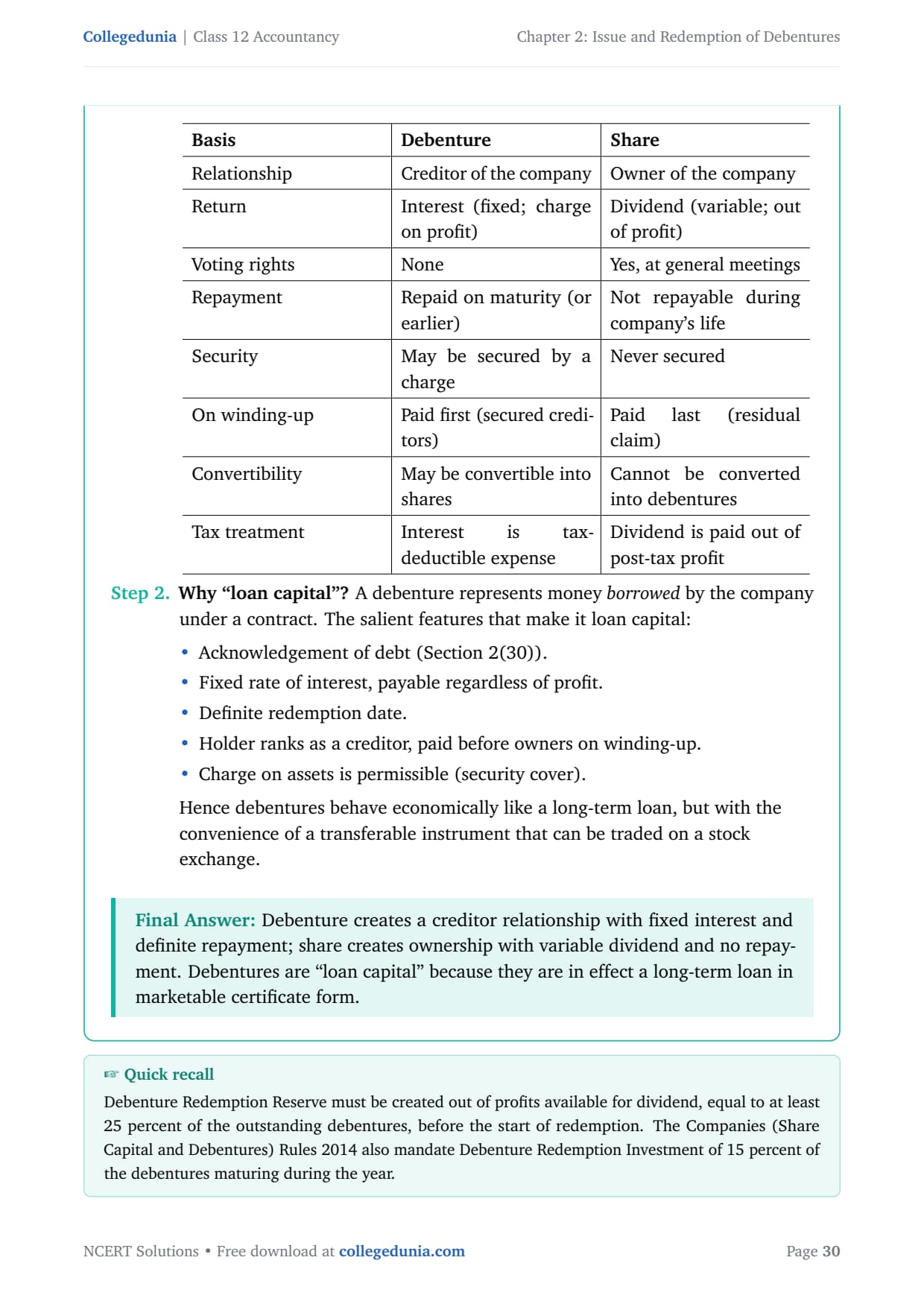
- Distinction (table).
1.25 tabularp0.30|p0.30|p0.30
Basis & Debenture & Share
Relationship & Creditor of the company & Owner of the company
Return & Interest (fixed; charge on profit) & Dividend (variable; out of profit)
Voting rights & None & Yes, at general meetings
Repayment & Repaid on maturity (or earlier) & Not repayable during company's life
Security & May be secured by a charge & Never secured
On winding-up & Paid first (secured creditors) & Paid last (residual claim)
Convertibility & May be convertible into shares & Cannot be converted into debentures
Tax treatment & Interest is tax-deductible expense & Dividend is paid out of post-tax profit
tabular - Why ``loan capital''? A debenture represents money borrowed by the
company under a contract. The salient features that make it loan capital:
- Acknowledgement of debt (Section 2(30)).
- Fixed rate of interest, payable regardless of profit.
- Definite redemption date.
- Holder ranks as a creditor, paid before owners on winding-up.
- Charge on assets is permissible (security cover).
Debenture creates a creditor relationship with fixed interest and definite repayment; share creates ownership with variable dividend and no repayment. Debentures are ``loan capital'' because they are in effect a long-term loan in marketable certificate form.
Strategic angle. Owner vs creditor is the master distinction. The debenture's promise to repay is the reason it is ``loan'' capital, just packaged as a tradeable security.
- Distinguish on six points: relationship, return, voting, repayment, security, priority on winding-up.
- Debenture is loan because: fixed interest, fixed maturity, creditor status, charge permissible.
- Difference from ordinary loan: tradeable on stock exchange; can be held by the public.
Why this matters. In a Class 12 numerical question on Issue and Redemption of Debentures, the examiner gives full marks only when the candidate distinguishes Discount on Issue of Debentures (a capital loss written off over the life of the debentures) from Premium on Redemption of Debentures (a provision created on issue), applies the Companies (Share Capital and Debentures) Rules 2014 for the Debenture Redemption Reserve, and presents every issue and redemption journal entry in narrated form. A correct closing debenture figure without the DRR working and the narrated journal entries loses 30-50 percent of the marks under the CBSE step-marking scheme.
Common mistakes. Three predictable slips lose marks: (a) confusing Discount on Issue with Premium on Redemption and posting both to the same ledger; (b) ignoring the requirement to create Debenture Redemption Reserve of at least 25 percent of the outstanding debentures before the start of redemption; (c) missing the loss on issue of debentures that arises when debentures are issued at par or discount but redeemed at a premium.
Loan with a marketable certificate; creditor status with fixed return and definite maturity.
Describe the meaning of `Debenture Issued as Collateral Securities'. What accounting treatment is given to the issue of debentures in the books of accounts?
Concept used. Debentures issued as collateral security are debentures issued as an additional (back-up) cover for a loan or bank overdraft. They are dormant: no cash is received, no interest is paid, and they are activated only if the company defaults on the principal loan. There are TWO accepted methods of accounting for them.
- Meaning. The company borrows say Rs. 10,00,000 from a bank, pledges its primary stock-in-trade, and ALSO issues 12,000 debentures of Rs. 100 each (face value Rs. 12,00,000) as additional cover. The bank holds these debentures; they are contingent until default.
- Method 1: No journal entry (memorandum only). Since the company has neither
received money for them nor incurred any obligation to pay interest, no entry is passed.
A note is made in the balance sheet under the loan:
Bank Loan: Rs. 10,00,000
(Secured by issue of Rs. 12,00,000, 10% Debentures as collateral security) - Method 2: Journal entry passed. The full nominal value of the collateral
debentures is recognised, balanced by a Debenture Suspense A/c:
- Dr. Debenture Suspense A/c 12,00,000 (with face value).
- Cr. Debentures A/c 12,00,000 (with face value).
- On default. If the company defaults, the bank exercises its security and the debentures become like ordinary debentures: cash flow begins (or assets sold).
- On repayment of loan. The collateral debentures are returned and cancelled: Dr. Debentures A/c; Cr. Debenture Suspense A/c.
Collateral debentures are back-up cover for a loan: no cash received, no interest paid. Method 1: no entry, only a note. Method 2: Dr. Debenture Suspense; Cr. Debentures (offset on balance sheet). On loan repayment, reverse the entry.
Strategic angle. Two methods, two presentations. Method 2 brings the collateral debentures onto the books symmetrically; Method 1 keeps them off the books with a memo.
- Method 1: only a note under the loan in BS.
- Method 2: Dr. Debenture Suspense; Cr. Debentures (face value).
- In BS, Debenture Suspense = deduction from Debentures ⇒ net zero.
- Loan repaid ⇒ reverse the entry; debentures cancelled.
Why this matters. In a Class 12 numerical question on Issue and Redemption of Debentures, the examiner gives full marks only when the candidate distinguishes Discount on Issue of Debentures (a capital loss written off over the life of the debentures) from Premium on Redemption of Debentures (a provision created on issue), applies the Companies (Share Capital and Debentures) Rules 2014 for the Debenture Redemption Reserve, and presents every issue and redemption journal entry in narrated form. A correct closing debenture figure without the DRR working and the narrated journal entries loses 30-50 percent of the marks under the CBSE step-marking scheme.
Common mistakes. Three predictable slips lose marks: (a) confusing Discount on Issue with Premium on Redemption and posting both to the same ledger; (b) ignoring the requirement to create Debenture Redemption Reserve of at least 25 percent of the outstanding debentures before the start of redemption; (c) missing the loss on issue of debentures that arises when debentures are issued at par or discount but redeemed at a premium.
Memo OR Suspense-and-Debenture journal; both end at net zero on BS.
Explain the different terms for the issue of debentures with reference to their redemption.
Concept used. Debentures can be issued and redeemed at different combinations of premium, par and discount. The six possible permutations are usually grouped into six standard cases. The accounting differs only in (a) the amount of cash received at issue and (b) the amount of cash paid at redemption; the face value (Debentures A/c) is always credited with the nominal amount.
- Case 1: Issued at par, redeemable at par.
Cash in = face; cash out = face. No premium / discount.
Issue entry: Dr. Bank; Cr. Debentures. - Case 2: Issued at premium, redeemable at par.
Cash in > face; the surplus → Securities Premium Reserve.
Dr. Bank (issue price); Cr. Debentures (face); Cr. Securities Premium Reserve (premium). - Case 3: Issued at discount, redeemable at par.
Cash in < face; the shortfall → Discount on Issue of Debentures A/c (capital loss,
amortised).
Dr. Bank (issue price); Dr. Discount on Issue (discount); Cr. Debentures (face). - Case 4: Issued at par, redeemable at premium.
Cash in = face; cash out > face. The future premium → Loss on Issue, with credit
to Premium on Redemption A/c (liability).
Dr. Bank (face); Dr. Loss on Issue (premium on redemption); Cr. Debentures (face); Cr. Premium on Redemption (premium). - Case 5: Issued at premium, redeemable at premium.
Cash in > face; cash out > face. Both legs recorded.
Dr. Bank (issue price); Dr. Loss on Issue (premium on redemption); Cr. Debentures (face); Cr. Securities Premium (issue premium); Cr. Premium on Redemption (redemption premium). - Case 6: Issued at discount, redeemable at premium.
Double loss: cash in < face AND cash out > face.
Dr. Bank (issue price); Dr. Loss on Issue (discount + redemption premium); Cr. Debentures (face); Cr. Premium on Redemption (premium).
Six terms cover all combinations of issue (par / premium / discount) and redemption (par / premium). Case 6 (discount + premium) is the double loss; Case 1 (par + par) is the simplest.
Strategic angle. The matrix has six cells. Memorise: Discount → Loss; Premium at issue → Securities Premium; Premium on redemption → Loss on Issue with Premium on Redemption as liability.
- Six cases = 3 issue prices × 2 redemption prices.
- All six credit Debentures at face value.
- Discount and Premium on Redemption ⇒ Loss on Issue; written off over life.
Why this matters. In a Class 12 numerical question on Issue and Redemption of Debentures, the examiner gives full marks only when the candidate distinguishes Discount on Issue of Debentures (a capital loss written off over the life of the debentures) from Premium on Redemption of Debentures (a provision created on issue), applies the Companies (Share Capital and Debentures) Rules 2014 for the Debenture Redemption Reserve, and presents every issue and redemption journal entry in narrated form. A correct closing debenture figure without the DRR working and the narrated journal entries loses 30-50 percent of the marks under the CBSE step-marking scheme.
Common mistakes. Three predictable slips lose marks: (a) confusing Discount on Issue with Premium on Redemption and posting both to the same ledger; (b) ignoring the requirement to create Debenture Redemption Reserve of at least 25 percent of the outstanding debentures before the start of redemption; (c) missing the loss on issue of debentures that arises when debentures are issued at par or discount but redeemed at a premium.
Six cases; Debentures always credited at face; losses to Loss on Issue, premia to Securities Premium / Premium on Redemption.
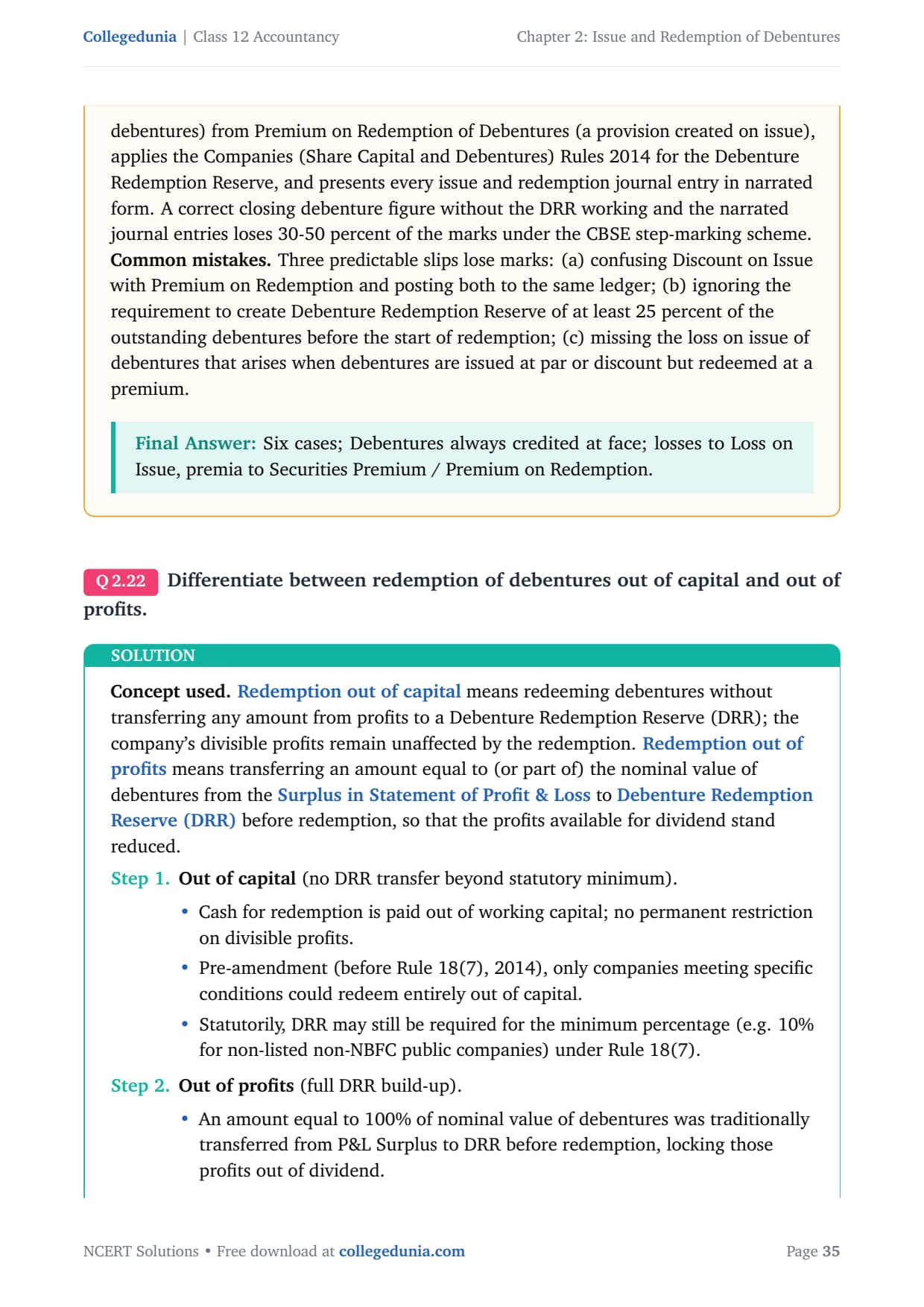
Differentiate between redemption of debentures out of capital and out of profits.
Concept used. Redemption out of capital means redeeming debentures without transferring any amount from profits to a Debenture Redemption Reserve (DRR); the company's divisible profits remain unaffected by the redemption. Redemption out of profits means transferring an amount equal to (or part of) the nominal value of debentures from the Surplus in Statement of Profit & Loss to Debenture Redemption Reserve (DRR) before redemption, so that the profits available for dividend stand reduced.
- Out of capital (no DRR transfer beyond statutory minimum).
- Cash for redemption is paid out of working capital; no permanent restriction on divisible profits.
- Pre-amendment (before Rule 18(7), 2014), only companies meeting specific conditions could redeem entirely out of capital.
- Statutorily, DRR may still be required for the minimum percentage (e.g. 10% for non-listed non-NBFC public companies) under Rule 18(7).
- Out of profits (full DRR build-up).
- An amount equal to 100% of nominal value of debentures was traditionally transferred from P&L Surplus to DRR before redemption, locking those profits out of dividend.
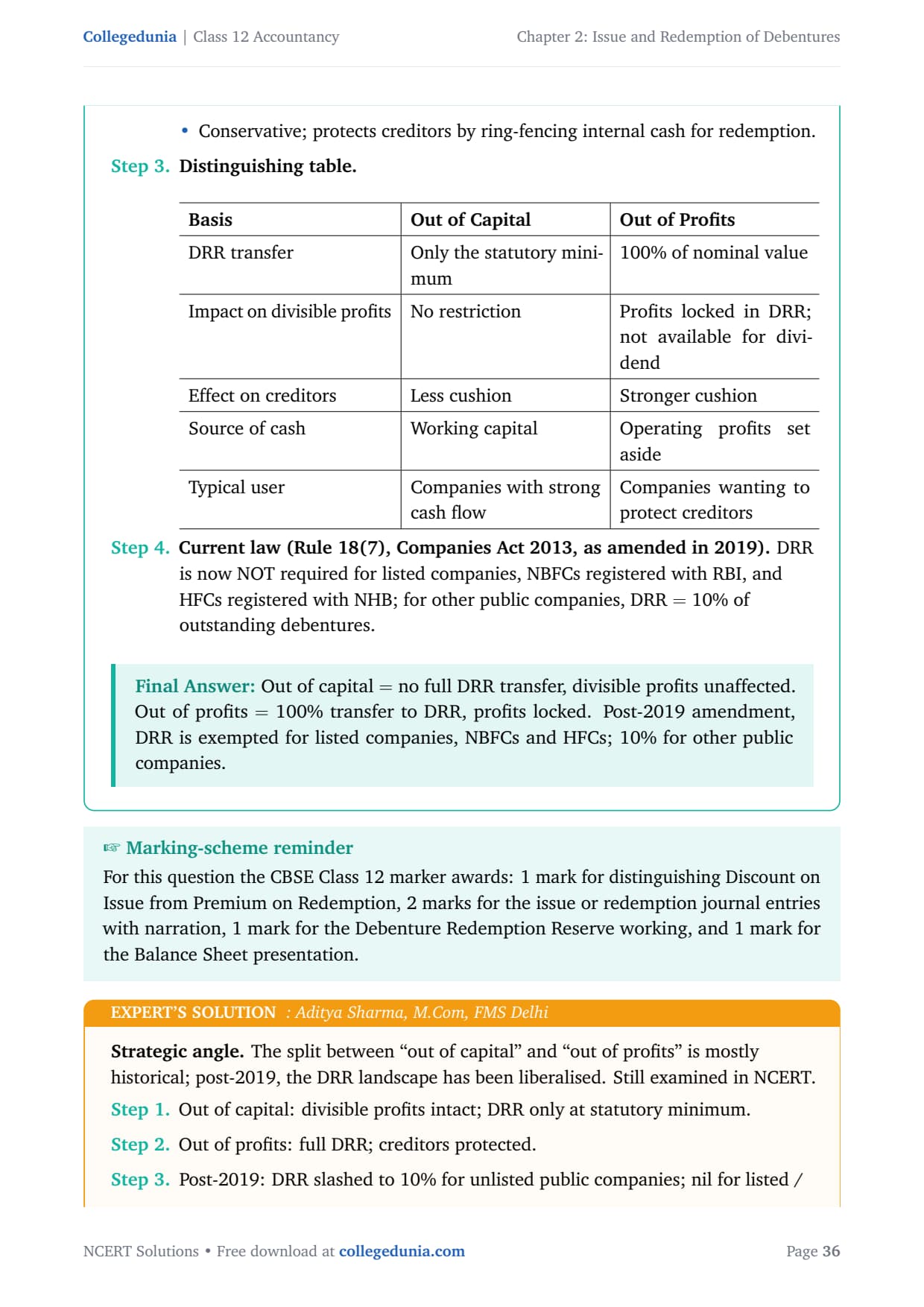
- Conservative; protects creditors by ring-fencing internal cash for redemption.
- Distinguishing table.
1.25 tabularp0.32|p0.30|p0.30 Basis & Out of Capital & Out of Profits
DRR transfer & Only the statutory minimum & 100% of nominal value
Impact on divisible profits & No restriction & Profits locked in DRR; not available for dividend
Effect on creditors & Less cushion & Stronger cushion
Source of cash & Working capital & Operating profits set aside
Typical user & Companies with strong cash flow & Companies wanting to protect creditors
tabular - Current law (Rule 18(7), Companies Act 2013, as amended in 2019). DRR is now NOT required for listed companies, NBFCs registered with RBI, and HFCs registered with NHB; for other public companies, DRR = 10% of outstanding debentures.
Out of capital = no full DRR transfer, divisible profits unaffected. Out of profits = 100% transfer to DRR, profits locked. Post-2019 amendment, DRR is exempted for listed companies, NBFCs and HFCs; 10% for other public companies.
Strategic angle. The split between ``out of capital'' and ``out of profits'' is mostly historical; post-2019, the DRR landscape has been liberalised. Still examined in NCERT.
- Out of capital: divisible profits intact; DRR only at statutory minimum.
- Out of profits: full DRR; creditors protected.
- Post-2019: DRR slashed to 10% for unlisted public companies; nil for listed / NBFC / HFC.
Why this matters. In a Class 12 numerical question on Issue and Redemption of Debentures, the examiner gives full marks only when the candidate distinguishes Discount on Issue of Debentures (a capital loss written off over the life of the debentures) from Premium on Redemption of Debentures (a provision created on issue), applies the Companies (Share Capital and Debentures) Rules 2014 for the Debenture Redemption Reserve, and presents every issue and redemption journal entry in narrated form. A correct closing debenture figure without the DRR working and the narrated journal entries loses 30-50 percent of the marks under the CBSE step-marking scheme.
Common mistakes. Three predictable slips lose marks: (a) confusing Discount on Issue with Premium on Redemption and posting both to the same ledger; (b) ignoring the requirement to create Debenture Redemption Reserve of at least 25 percent of the outstanding debentures before the start of redemption; (c) missing the loss on issue of debentures that arises when debentures are issued at par or discount but redeemed at a premium.
Out of capital = no DRR; out of profits = full DRR. Current rule: 10% (others), nil (listed / NBFC / HFC).
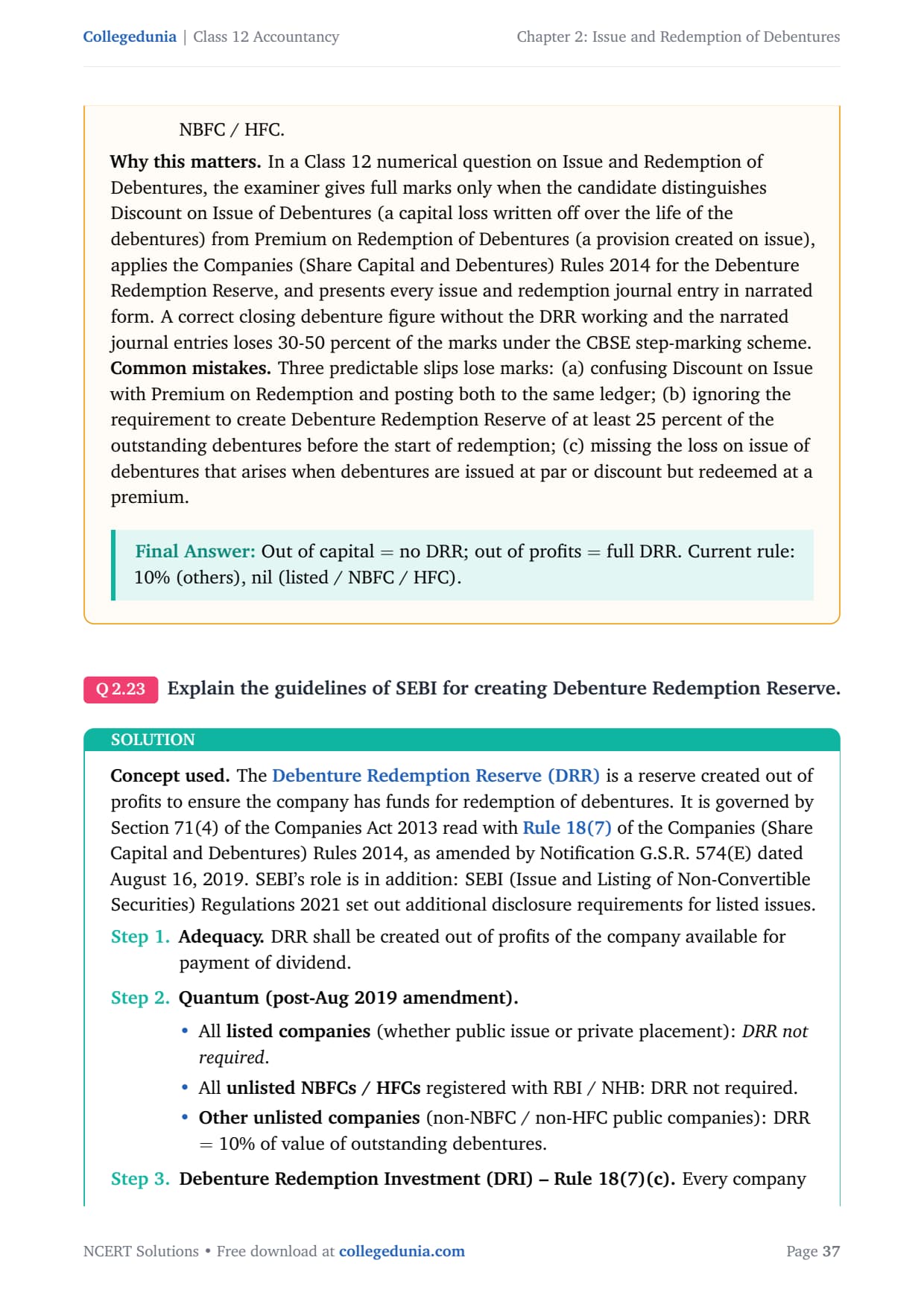
Explain the guidelines of SEBI for creating Debenture Redemption Reserve.
Concept used. The Debenture Redemption Reserve (DRR) is a reserve created out of profits to ensure the company has funds for redemption of debentures. It is governed by Section 71(4) of the Companies Act 2013 read with Rule 18(7) of the Companies (Share Capital and Debentures) Rules 2014, as amended by Notification G.S.R. 574(E) dated August 16, 2019. SEBI's role is in addition: SEBI (Issue and Listing of Non-Convertible Securities) Regulations 2021 set out additional disclosure requirements for listed issues.
- Adequacy. DRR shall be created out of profits of the company available for payment of dividend.
- Quantum (post-Aug 2019 amendment).
- All listed companies (whether public issue or private placement): DRR not required.
- All unlisted NBFCs / HFCs registered with RBI / NHB: DRR not required.
- Other unlisted companies (non-NBFC / non-HFC public companies): DRR = 10% of value of outstanding debentures.
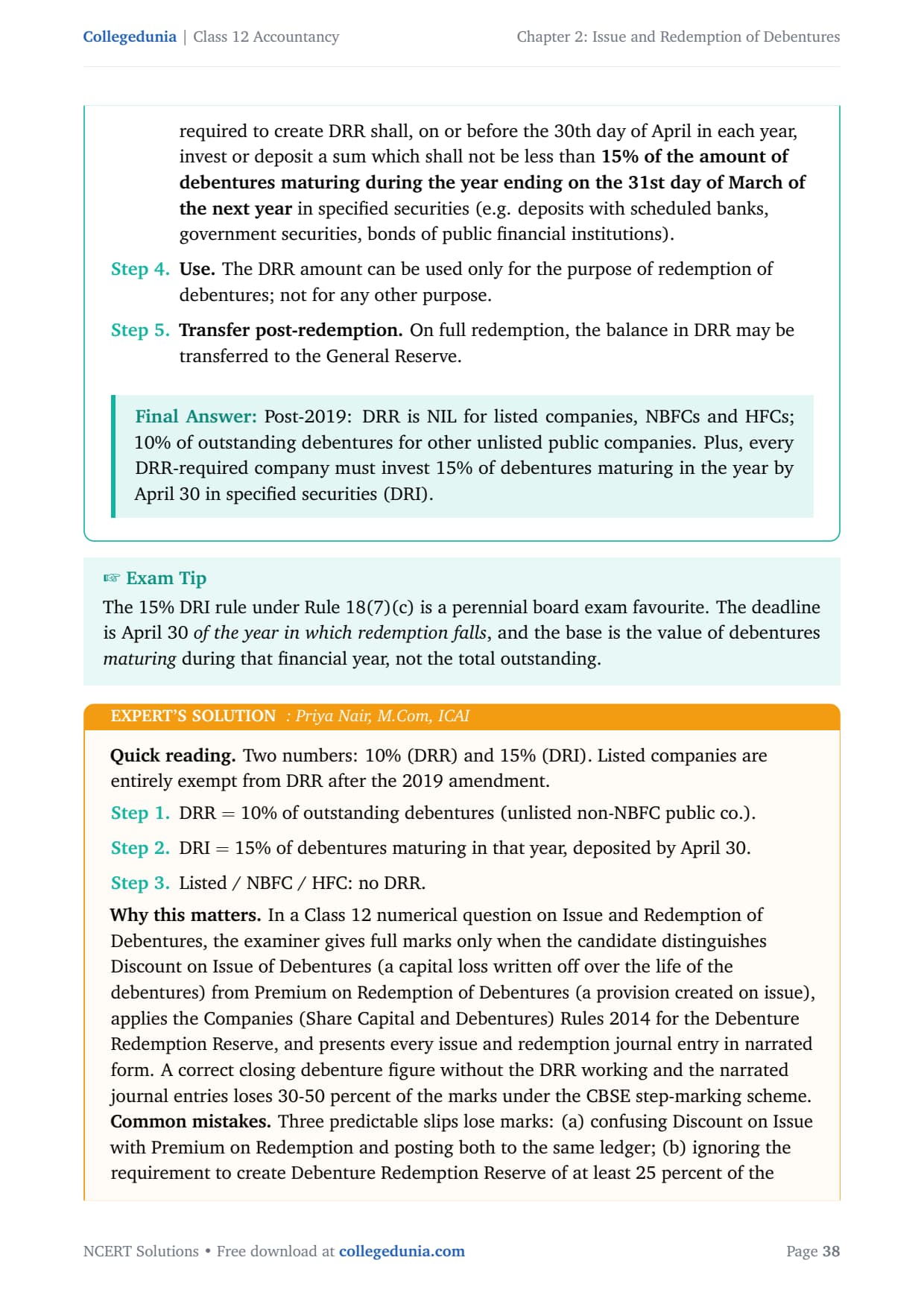
- Debenture Redemption Investment (DRI) – Rule 18(7)(c). Every company required to create DRR shall, on or before the 30th day of April in each year, invest or deposit a sum which shall not be less than 15% of the amount of debentures maturing during the year ending on the 31st day of March of the next year in specified securities (e.g. deposits with scheduled banks, government securities, bonds of public financial institutions).
- Use. The DRR amount can be used only for the purpose of redemption of debentures; not for any other purpose.
- Transfer post-redemption. On full redemption, the balance in DRR may be transferred to the General Reserve.
Post-2019: DRR is NIL for listed companies, NBFCs and HFCs; 10% of outstanding debentures for other unlisted public companies. Plus, every DRR-required company must invest 15% of debentures maturing in the year by April 30 in specified securities (DRI).
Quick reading. Two numbers: 10% (DRR) and 15% (DRI). Listed companies are entirely exempt from DRR after the 2019 amendment.
- DRR = 10% of outstanding debentures (unlisted non-NBFC public co.).
- DRI = 15% of debentures maturing in that year, deposited by April 30.
- Listed / NBFC / HFC: no DRR.
Why this matters. In a Class 12 numerical question on Issue and Redemption of Debentures, the examiner gives full marks only when the candidate distinguishes Discount on Issue of Debentures (a capital loss written off over the life of the debentures) from Premium on Redemption of Debentures (a provision created on issue), applies the Companies (Share Capital and Debentures) Rules 2014 for the Debenture Redemption Reserve, and presents every issue and redemption journal entry in narrated form. A correct closing debenture figure without the DRR working and the narrated journal entries loses 30-50 percent of the marks under the CBSE step-marking scheme.
Common mistakes. Three predictable slips lose marks: (a) confusing Discount on Issue with Premium on Redemption and posting both to the same ledger; (b) ignoring the requirement to create Debenture Redemption Reserve of at least 25 percent of the outstanding debentures before the start of redemption; (c) missing the loss on issue of debentures that arises when debentures are issued at par or discount but redeemed at a premium.
10% DRR (others), nil (listed / NBFC / HFC); 15% DRI by April 30 of redemption year.
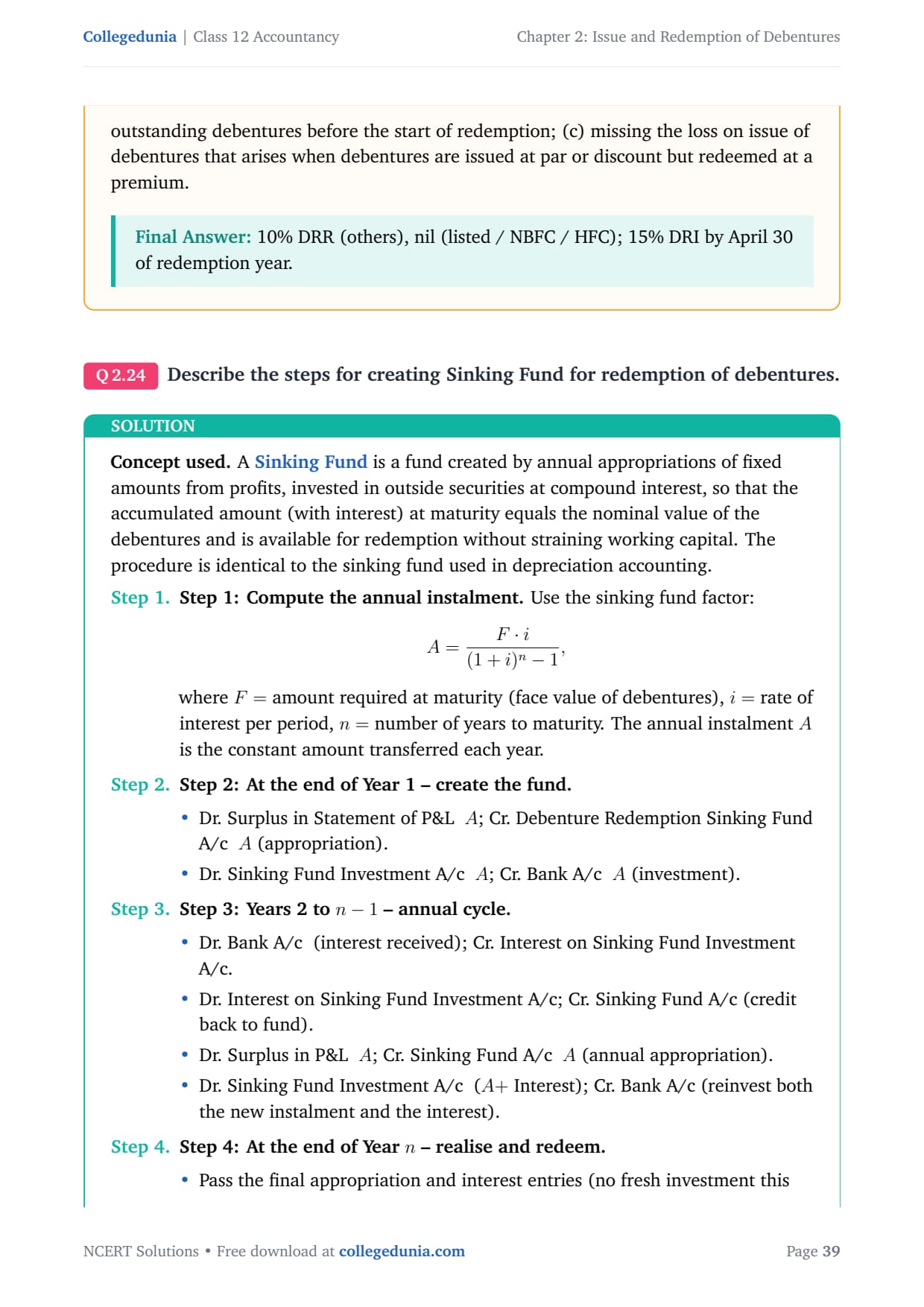
Describe the steps for creating Sinking Fund for redemption of debentures.
Concept used. A Sinking Fund is a fund created by annual appropriations of fixed amounts from profits, invested in outside securities at compound interest, so that the accumulated amount (with interest) at maturity equals the nominal value of the debentures and is available for redemption without straining working capital. The procedure is identical to the sinking fund used in depreciation accounting.
- Step 1: Compute the annual instalment. Use the sinking fund factor: A = F · i(1+i)n - 1, where F = amount required at maturity (face value of debentures), i = rate of interest per period, n = number of years to maturity. The annual instalment A is the constant amount transferred each year.
- Step 2: At the end of Year 1 – create the fund.
- Dr. Surplus in Statement of P&L A; Cr. Debenture Redemption Sinking Fund A/c A (appropriation).
- Dr. Sinking Fund Investment A/c A; Cr. Bank A/c A (investment).
- Step 3: Years 2 to n-1 – annual cycle.
- Dr. Bank A/c (interest received); Cr. Interest on Sinking Fund Investment A/c.
- Dr. Interest on Sinking Fund Investment A/c; Cr. Sinking Fund A/c (credit back to fund).
- Dr. Surplus in P&L A; Cr. Sinking Fund A/c A (annual appropriation).
- Dr. Sinking Fund Investment A/c (A + Interest); Cr. Bank A/c (reinvest both the new instalment and the interest).
- Step 4: At the end of Year n – realise and redeem.
- Pass the final appropriation and interest entries (no fresh investment this year; the maturing investments will fund redemption).
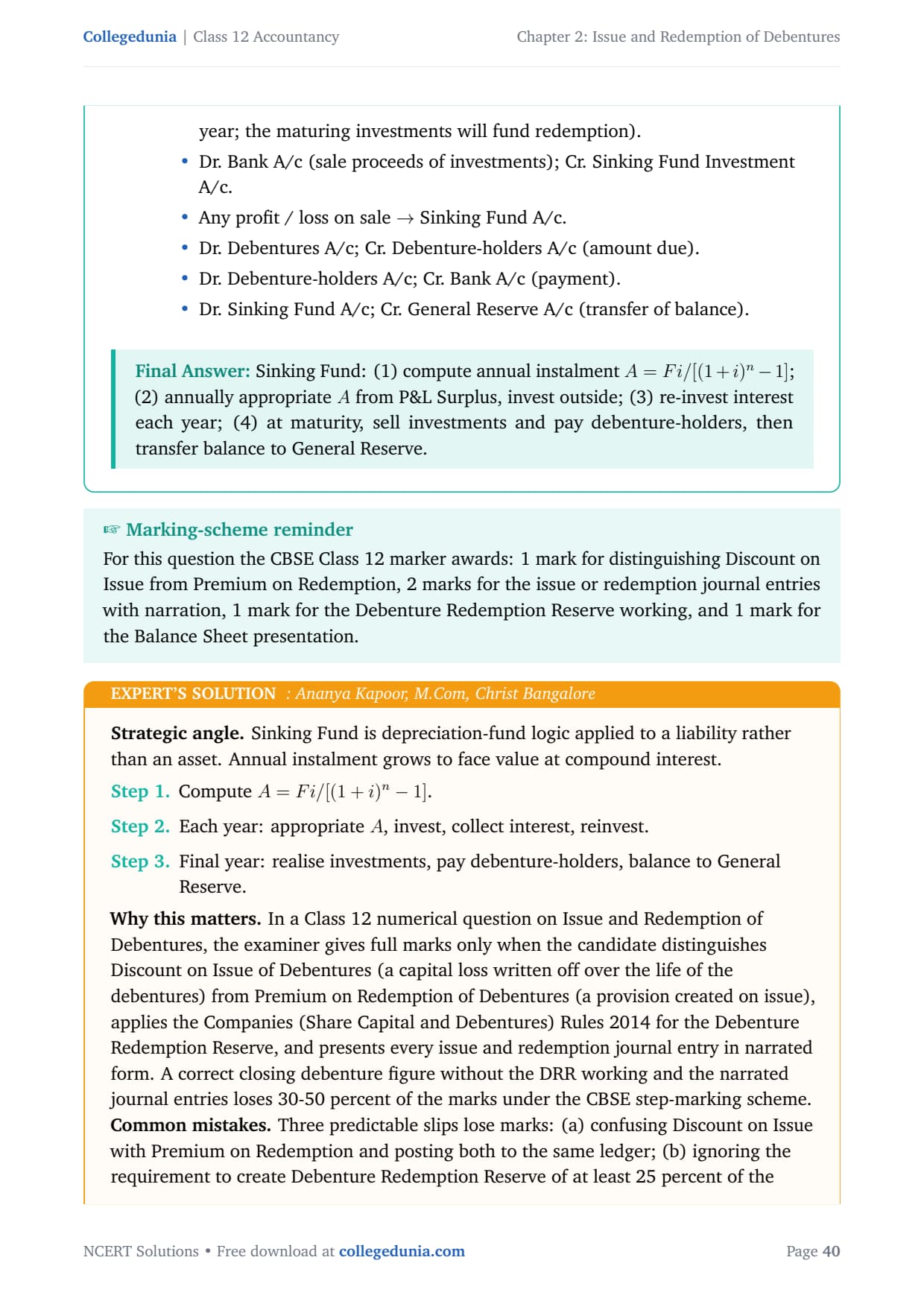
- Dr. Bank A/c (sale proceeds of investments); Cr. Sinking Fund Investment A/c.
- Any profit / loss on sale → Sinking Fund A/c.
- Dr. Debentures A/c; Cr. Debenture-holders A/c (amount due).
- Dr. Debenture-holders A/c; Cr. Bank A/c (payment).
- Dr. Sinking Fund A/c; Cr. General Reserve A/c (transfer of balance).
Sinking Fund: (1) compute annual instalment A = Fi / [(1+i)n -1]; (2) annually appropriate A from P&L Surplus, invest outside; (3) re-invest interest each year; (4) at maturity, sell investments and pay debenture-holders, then transfer balance to General Reserve.
Strategic angle. Sinking Fund is depreciation-fund logic applied to a liability rather than an asset. Annual instalment grows to face value at compound interest.
- Compute A = Fi/[(1+i)n - 1].
- Each year: appropriate A, invest, collect interest, reinvest.
- Final year: realise investments, pay debenture-holders, balance to General Reserve.
Why this matters. In a Class 12 numerical question on Issue and Redemption of Debentures, the examiner gives full marks only when the candidate distinguishes Discount on Issue of Debentures (a capital loss written off over the life of the debentures) from Premium on Redemption of Debentures (a provision created on issue), applies the Companies (Share Capital and Debentures) Rules 2014 for the Debenture Redemption Reserve, and presents every issue and redemption journal entry in narrated form. A correct closing debenture figure without the DRR working and the narrated journal entries loses 30-50 percent of the marks under the CBSE step-marking scheme.
Common mistakes. Three predictable slips lose marks: (a) confusing Discount on Issue with Premium on Redemption and posting both to the same ledger; (b) ignoring the requirement to create Debenture Redemption Reserve of at least 25 percent of the outstanding debentures before the start of redemption; (c) missing the loss on issue of debentures that arises when debentures are issued at par or discount but redeemed at a premium.
Annual A + compound interest → face value F at maturity.
Can a company purchase its own debentures in the open market? Explain.
Concept used. A company CAN purchase its own debentures in the open market provided (a) its Articles of Association authorise it and (b) the debenture trust deed does not prohibit it. The purchase may be made either for immediate cancellation (effective early redemption) or as an investment (to be re-issued or cancelled later).
- Why do it? The company's own debentures may trade below face value in the market. Buying them back at the lower market price and cancelling them generates a capital profit equal to face value - purchase price.
- Authority.
- Articles must authorise own-debenture purchase.
- Trust deed must not prohibit it.
- Listed companies follow SEBI disclosure norms.
- Two scenarios.
- Purchase for cancellation. Cancel immediately; profit = Face - Purchase price → Capital Reserve.
- Purchase as investment. Hold as ``Own Debentures A/c''; treated as a long-term investment; may be re-issued or cancelled later.
- Cum-interest vs ex-interest.
- Cum-interest quote: the price includes accrued interest. Split: Dr. Interest A/c with the accrued portion; Dr. Own Debentures with the clean portion.
- Ex-interest quote: the price is clean; record at the quoted price.
- Profit on cancellation entry.
- Dr. Debentures A/c (Face Value).
- Cr. Bank A/c (Purchase Price ex-interest).
- Cr. Capital Reserve / Gain on Cancellation A/c (difference).
Yes – if Articles authorise and trust deed allows. Can buy for immediate cancellation (profit → Capital Reserve) or hold as investment in Own Debentures A/c. Cum-int. price must be split into clean price + accrued interest.
Quick reading. Yes, with conditions. Two routes, two outcomes.
- Articles + trust deed permit.
- Cancel ⇒ profit (Face - Cost) to Capital Reserve.
- Hold ⇒ Own Debentures A/c as investment.
Why this matters. In a Class 12 numerical question on Issue and Redemption of Debentures, the examiner gives full marks only when the candidate distinguishes Discount on Issue of Debentures (a capital loss written off over the life of the debentures) from Premium on Redemption of Debentures (a provision created on issue), applies the Companies (Share Capital and Debentures) Rules 2014 for the Debenture Redemption Reserve, and presents every issue and redemption journal entry in narrated form. A correct closing debenture figure without the DRR working and the narrated journal entries loses 30-50 percent of the marks under the CBSE step-marking scheme.
Common mistakes. Three predictable slips lose marks: (a) confusing Discount on Issue with Premium on Redemption and posting both to the same ledger; (b) ignoring the requirement to create Debenture Redemption Reserve of at least 25 percent of the outstanding debentures before the start of redemption; (c) missing the loss on issue of debentures that arises when debentures are issued at par or discount but redeemed at a premium.
Permitted; cancel or hold; profit on cancellation → Capital Reserve.
What is meant by conversion of debentures? Describe the method of such a conversion.
Concept used. Conversion of debentures is the discharge of the debenture liability by issuing shares (equity or preference) or new debentures to the holders, instead of paying cash. It is allowed only if the option of conversion exists in the original terms of issue (FCD, PCD, CCD, OCD). It is a cash-free mode of redemption.
- Conditions for conversion.
- Conversion right must be present in the terms of issue.
- Conversion price (and ratio) must be specified at issue.
- Board approval is needed for the actual conversion event.
- Number of new shares. No. of shares = Amount Payable on RedemptionIssue Price of New Share. Amount Payable = face value of debentures being converted PLUS premium on redemption (if any). Issue Price of New Share = face value of share PLUS premium (if shares issued at premium).
- Method of conversion – accounting entry.
- Dr. Debentures A/c (Face Value of debentures being converted).
- Dr. Premium on Redemption of Debentures A/c (if any).
- Cr. Equity / Preference Share Capital A/c (Face Value of new shares issued).
- Cr. Securities Premium Reserve A/c (Securities Premium on new shares, if any).
- Fractional shares. Any fractional share remainder is paid in cash to the debenture-holder.
- DRR not required. Because no cash leaves the company on the converted portion, DRR is not required to be created for the converted part.
Conversion of debentures = swap of debenture liability for new shares (or new debentures); cash-free. Number of shares = Amount Payable ÷ Issue Price. DRR not required on converted portion.
Strategic angle. Conversion turns debt into equity (or new debt). No cash, no DRR; the debenture-holder becomes a shareholder.
- Conversion right must exist at issue (FCD / PCD / CCD / OCD).
- Number of shares = Amount Payable / New Share Issue Price.
- Dr. Debentures + Premium on Redemption; Cr. Share Capital + Securities Premium.
Why this matters. In a Class 12 numerical question on Issue and Redemption of Debentures, the examiner gives full marks only when the candidate distinguishes Discount on Issue of Debentures (a capital loss written off over the life of the debentures) from Premium on Redemption of Debentures (a provision created on issue), applies the Companies (Share Capital and Debentures) Rules 2014 for the Debenture Redemption Reserve, and presents every issue and redemption journal entry in narrated form. A correct closing debenture figure without the DRR working and the narrated journal entries loses 30-50 percent of the marks under the CBSE step-marking scheme.
Common mistakes. Three predictable slips lose marks: (a) confusing Discount on Issue with Premium on Redemption and posting both to the same ledger; (b) ignoring the requirement to create Debenture Redemption Reserve of at least 25 percent of the outstanding debentures before the start of redemption; (c) missing the loss on issue of debentures that arises when debentures are issued at par or discount but redeemed at a premium.
Cash-free swap; number = amount payable / issue price.
G. Ltd. a listed company issued 75,00,000, 6% debentures of Rs. 50 each at par payable Rs. 15 on application and Rs. 35 on allotment, redeemable at par after 7 years from the date of issue of debentures. Record necessary entries in the books of the Company.
Concept used. Issue of debentures at par in two instalments (application + allotment). Each stage has TWO journal entries: (i) money received via Bank; (ii) transfer from Application / Allotment A/c to Debentures A/c. Since the company is listed, no DRR is required under the amended Rule 18(7) (post-Aug 2019 amendment).
- Computation.
Total face value = 75,00,000 × 50
= Rs. 37,50,00,000 (Rs. 37.50 crore).
Working line by line:
Application money = 75,00,000 × 15 = Rs. 11,25,00,000 (Rs. 11.25 crore).
Allotment money = 75,00,000 × 35 = Rs. 26,25,00,000 (Rs. 26.25 crore).
Total = 11,25,00,000 + 26,25,00,000 = 37,50,00,000. - Stage 1: Application. Money received and transferred to Debenture A/c.
- Stage 2: Allotment. Allotment due and money received.
- Journal entries.
& Bank A/c Dr. & & 11,25,00,000 &
& 6pt To 6% Debenture Application A/c & & & 11,25,00,000
& (Application money received on 75,00,000 deb. @ Rs. 15) & & &
& 6% Debenture Application A/c Dr. & & 11,25,00,000 &
& 6pt To 6% Debentures A/c & & & 11,25,00,000
& (Application money transferred to Debentures A/c) & & &
& 6% Debenture Allotment A/c Dr. & & 26,25,00,000 &
& 6pt To 6% Debentures A/c & & & 26,25,00,000
& (Allotment money due on 75,00,000 deb. @ Rs. 35) & & &
& Bank A/c Dr. & & 26,25,00,000 &
& 6pt To 6% Debenture Allotment A/c & & & 26,25,00,000
& (Allotment money received) & & &
tabular
Listed company DRR
Since G. Ltd. is a listed company, DRR is not required under Rule 18(7) (post-2019). Only DRI of 15% must be created in the year of maturity (in this case, Year 7).Total cash raised = Rs. 37,50,00,000 across application (Rs. 11,25,00,000) and allotment (Rs. 26,25,00,000). Four journal entries. Listed company ⇒ no DRR.
Quick reading. Simple two-stage issue at par; four journal entries; total Rs. 37.5 crore raised.
- Application: 75,00,000 × 15 = Rs. 11.25 crore.
- Allotment: 75,00,000 × 35 = Rs. 26.25 crore.
- Each stage two entries: Bank receipt + transfer to Debentures.
- Listed company ⇒ DRR exempt; DRI 15% only in maturity year.
Why this matters. In a Class 12 numerical question on Issue and Redemption of Debentures, the examiner gives full marks only when the candidate distinguishes Discount on Issue of Debentures (a capital loss written off over the life of the debentures) from Premium on Redemption of Debentures (a provision created on issue), applies the Companies (Share Capital and Debentures) Rules 2014 for the Debenture Redemption Reserve, and presents every issue and redemption journal entry in narrated form. A correct closing debenture figure without the DRR working and the narrated journal entries loses 30-50 percent of the marks under the CBSE step-marking scheme.
Common mistakes. Three predictable slips lose marks: (a) confusing Discount on Issue with Premium on Redemption and posting both to the same ledger; (b) ignoring the requirement to create Debenture Redemption Reserve of at least 25 percent of the outstanding debentures before the start of redemption; (c) missing the loss on issue of debentures that arises when debentures are issued at par or discount but redeemed at a premium.
Rs. 37.5 crore raised; 4 entries; DRR exempt.
Y. Ltd. issued 2,000, 6% debentures of Rs. 100 each payable as follows: Rs. 25 on application; Rs. 50 on allotment and Rs. 25 on first and final call. Record necessary entries in the books of the company.
Concept used. Three-stage issue at par: application → allotment → first & final call. Each stage has TWO journal entries (money received + transfer to Debentures A/c). Total cash raised equals total face value of issue.
- Computation.
Total face value = 2,000 × 100 = Rs. 2,00,000.
Application money = 2,000 × 25 = Rs. 50,000.
Allotment money = 2,000 × 50 = Rs. 1,00,000.
First & final call = 2,000 × 25 = Rs. 50,000.
Sum = 50,000 + 1,00,000 + 50,000 = 2,00,000. - Six journal entries (two per stage).
& Bank A/c Dr. & & 50,000 &
& 6pt To 6% Debenture Application A/c & & & 50,000
& (Application on 2,000 deb. @ Rs. 25 received) & & &
& 6% Debenture Application A/c Dr. & & 50,000 &
& 6pt To 6% Debentures A/c & & & 50,000
& (Transferred to Debentures A/c) & & &
& 6% Debenture Allotment A/c Dr. & & 1,00,000 &
& 6pt To 6% Debentures A/c & & & 1,00,000
& (Allotment due on 2,000 deb. @ Rs. 50) & & &
& Bank A/c Dr. & & 1,00,000 &
& 6pt To 6% Debenture Allotment A/c & & & 1,00,000
& (Allotment money received) & & &
& 6% Debenture First & Final Call A/c Dr. & & 50,000 &
& 6pt To 6% Debentures A/c & & & 50,000
& (Call due on 2,000 deb. @ Rs. 25) & & &
& Bank A/c Dr. & & 50,000 &
& 6pt To 6% Debenture First & Final Call A/c & & & 50,000
& (Call money received) & & &
tabular
Six journal entries; total face value Rs. 2,00,000 raised in three stages (application Rs. 50,000 + allotment Rs. 1,00,000 + call Rs. 50,000).
Quick reading. Standard three-stage par issue. Two entries per stage; six in total.
- Application Rs. 50,000 → Bank, then Debentures.
- Allotment Rs. 1,00,000 → Allotment due, then Bank receipt.
- Call Rs. 50,000 → Call due, then Bank receipt.
Why this matters. In a Class 12 numerical question on Issue and Redemption of Debentures, the examiner gives full marks only when the candidate distinguishes Discount on Issue of Debentures (a capital loss written off over the life of the debentures) from Premium on Redemption of Debentures (a provision created on issue), applies the Companies (Share Capital and Debentures) Rules 2014 for the Debenture Redemption Reserve, and presents every issue and redemption journal entry in narrated form. A correct closing debenture figure without the DRR working and the narrated journal entries loses 30-50 percent of the marks under the CBSE step-marking scheme.
Common mistakes. Three predictable slips lose marks: (a) confusing Discount on Issue with Premium on Redemption and posting both to the same ledger; (b) ignoring the requirement to create Debenture Redemption Reserve of at least 25 percent of the outstanding debentures before the start of redemption; (c) missing the loss on issue of debentures that arises when debentures are issued at par or discount but redeemed at a premium.
Rs. 2,00,000 total face value; 6 entries.
A. Ltd. issued 10,000, 10% debentures of Rs. 100 each at a premium of 5% payable as follows: Rs. 10 on Application; Rs. 20 along with premium on allotment and balance on first and final call. The debentures were fully subscribed and all money was duly received. Record necessary Journal entries. Also show how the amount will appear in the balance sheet.
Concept used. Issue at premium: the premium amount is credited to Securities Premium Reserve (Section 52, Companies Act 2013), separate from the Debentures A/c. The face value goes to Debentures A/c at face only.
- Per-debenture amounts.
Face value = Rs. 100; Premium = Rs. 5; Issue Price = Rs. 105.
Application = Rs. 10 (Debentures).
Allotment = Rs. 20 (Debentures) + Rs. 5 (Securities Premium) = Rs. 25.
First & Final Call = Rs. 105 - 10 - 25 = Rs. 70 (Debentures). - Stage-wise totals (10,000 debentures).
Application = 10,000 × 10 = Rs. 1,00,000.
Allotment cash received = 10,000 × 25 = Rs. 2,50,000 (of which Capital = Rs. 2,00,000, Premium = Rs. 50,000).
Call = 10,000 × 70 = Rs. 7,00,000.
Total cash received = 1,00,000 + 2,50,000 + 7,00,000 = 10,50,000 (Rs. 10.50 lakh) = Issue Price × no. of debentures = 105 × 10,000.
& Bank A/c Dr. & & 1,00,000 &
& 6pt To 10% Debenture Application A/c & & & 1,00,000
& (Application on 10,000 deb. @ Rs. 10) & & &
& 10% Debenture Application A/c Dr. & & 1,00,000 &
& 6pt To 10% Debentures A/c & & & 1,00,000
& 10% Debenture Allotment A/c Dr. & & 2,50,000 &
& 6pt To 10% Debentures A/c & & & 2,00,000
& 6pt To Securities Premium Reserve A/c & & & 50,000
& (Allotment due: Rs. 20 capital + Rs. 5 premium per deb.) & & &
& Bank A/c Dr. & & 2,50,000 &
& 6pt To 10% Debenture Allotment A/c & & & 2,50,000
& 10% Debenture First & Final Call A/c Dr. & & 7,00,000 &
& 6pt To 10% Debentures A/c & & & 7,00,000
& Bank A/c Dr. & & 7,00,000 &
& 6pt To 10% Debenture First & Final Call A/c & & & 7,00,000
tabular
Balance Sheet extract (as at issue):
I. Equity & Liabilities & &
1. Reserves & Surplus – Securities Premium Reserve & & 50,000
2. Non-Current Liabilities – Long-term Borrowings – 10% Debentures & & 10,00,000
II. Assets & &
1. Current Assets – Cash and Cash Equivalents (Bank) & & 10,50,000
tabular
Capital raised Rs. 10,00,000 (Debentures) + Rs. 50,000 (Securities Premium) = total cash Rs. 10,50,000. Six journal entries; premium credited at allotment stage.
Quick reading. Issue price Rs. 105 split into Rs. 100 face + Rs. 5 premium. Premium credited at allotment.
- Per deb: App Rs. 10, Allot Rs. 20 + Rs. 5 prem, Call Rs. 70.
- Allotment entry has THREE credits: Capital (Rs. 2,00,000), Premium (Rs. 50,000); the Allotment A/c receivable line is the total Rs. 2,50,000.
- Total cash Rs. 10,50,000; debentures liability Rs. 10,00,000; SPR Rs. 50,000.
Why this matters. In a Class 12 numerical question on Issue and Redemption of Debentures, the examiner gives full marks only when the candidate distinguishes Discount on Issue of Debentures (a capital loss written off over the life of the debentures) from Premium on Redemption of Debentures (a provision created on issue), applies the Companies (Share Capital and Debentures) Rules 2014 for the Debenture Redemption Reserve, and presents every issue and redemption journal entry in narrated form. A correct closing debenture figure without the DRR working and the narrated journal entries loses 30-50 percent of the marks under the CBSE step-marking scheme.
Common mistakes. Three predictable slips lose marks: (a) confusing Discount on Issue with Premium on Redemption and posting both to the same ledger; (b) ignoring the requirement to create Debenture Redemption Reserve of at least 25 percent of the outstanding debentures before the start of redemption; (c) missing the loss on issue of debentures that arises when debentures are issued at par or discount but redeemed at a premium.
Premium Rs. 50,000 to SPR; face Rs. 10,00,000 to Debentures.
A. Ltd. issued 90,00,000, 9% debentures of Rs. 50 each at a discount of 8%, redeemable at par any time after 9 years. Record necessary entries in the books of A. Ltd. for issue of debentures.
Concept used. Issue at discount, redeemable at par: the discount per debenture is a capital loss debited to Discount on Issue of Debentures A/c and the company receives only the discounted price in cash. Debentures A/c is credited at full face value.
- Computation.
Face value per debenture = Rs. 50.
Discount per debenture = 8% × 50 = Rs. 4.
Issue price per debenture = 50 - 4 = Rs. 46.
Total face value = 90,00,000 × 50 = Rs. 45,00,00,000 (Rs. 45 crore).
Total discount = 90,00,000 × 4 = Rs. 3,60,00,000 (Rs. 3.60 crore).
Total cash received = 90,00,000 × 46 = Rs. 41,40,00,000 (Rs. 41.40 crore).
Check: 41.40 + 3.60 = 45.00 crore. - Journal entries (assuming full amount due in one call).
& Bank A/c Dr. & & 41,40,00,000 &
& 6pt To 9% Debenture Application & Allotment A/c & & & 41,40,00,000
& (Issue price received: 90,00,000 deb. @ Rs. 46) & & &
& 9% Debenture Application & Allotment A/c Dr. & & 41,40,00,000 &
& Discount on Issue of Debentures A/c Dr. & & 3,60,00,000 &
& 6pt To 9% Debentures A/c & & & 45,00,00,000
& (Issue of 90,00,000 deb. at 8% discount, redeemable at par) & & &
tabular
Cash received Rs. 41.40 crore; Discount on Issue Rs. 3.60 crore; Debentures liability Rs. 45.00 crore. Discount written off against Securities Premium / P&L over 9 years.
Quick reading. Discount = 8% × Rs. 50 = Rs. 4 per debenture. Bank in = Rs. 46; debit Discount Rs. 4; credit Debentures Rs. 50 each.
- Issue price per deb Rs. 46; discount Rs. 4.
- Cash in = Rs. 41.40 crore.
- Discount = Rs. 3.60 crore (capital loss).
- Debenture liability = Rs. 45.00 crore.
Why this matters. In a Class 12 numerical question on Issue and Redemption of Debentures, the examiner gives full marks only when the candidate distinguishes Discount on Issue of Debentures (a capital loss written off over the life of the debentures) from Premium on Redemption of Debentures (a provision created on issue), applies the Companies (Share Capital and Debentures) Rules 2014 for the Debenture Redemption Reserve, and presents every issue and redemption journal entry in narrated form. A correct closing debenture figure without the DRR working and the narrated journal entries loses 30-50 percent of the marks under the CBSE step-marking scheme.
Common mistakes. Three predictable slips lose marks: (a) confusing Discount on Issue with Premium on Redemption and posting both to the same ledger; (b) ignoring the requirement to create Debenture Redemption Reserve of at least 25 percent of the outstanding debentures before the start of redemption; (c) missing the loss on issue of debentures that arises when debentures are issued at par or discount but redeemed at a premium.
Cash 41.40 + Discount 3.60 = Debentures 45.00 crore.
A. Ltd. issued 4,000, 9% debentures of Rs. 100 each on the following terms: Rs. 20 on Application; Rs. 20 on Allotment; Rs. 30 on First call; and Rs. 30 on Final call. The public applied for 4,800 debentures. Applications for 3,600 debentures were accepted in full. Applications for 800 Debentures were allotted 400 debentures and applications for 400 Debentures were rejected. All money called and duly received. Record necessary journal entries.
Concept used. Oversubscription with three-way treatment: some applications accepted in full, some pro-rata, some rejected. Excess application money from pro-rata applicants is adjusted against the next due (allotment). Money from rejected applicants is refunded.
- Application analysis.
- Total applications: 4,800. Allotment must equal 4,000 (offered).
- Accepted in full: 3,600 → 3,600 debentures.
- Pro-rata: 800 applied → 400 allotted (50% pro-rata).
- Rejected: 400 (money refunded).
- Check allotment: 3,600 + 400 = 4,000.
- Application money.
Total received = 4,800 × 20 = Rs. 96,000.
Refunded to rejected = 400 × 20 = Rs. 8,000.
Transferred to Debentures (4,000 alloted) = 4,000 × 20 = Rs. 80,000.
Excess adjusted to allotment = (800 - 400) × 20 = Rs. 8,000.
Check: 80,000 + 8,000 + 8,000 = 96,000. - Allotment money due.
Allotment due = 4,000 × 20 = Rs. 80,000.
Less excess application adjusted = 8,000.
Net cash on allotment = 80,000 - 8,000 = Rs. 72,000. - First Call. 4,000 × 30 = Rs. 1,20,000.
- Final Call. 4,000 × 30 = Rs. 1,20,000.
- Check totals. Cash received = 96,000 - 8,000 (refund) + 72,000 + 1,20,000 + 1,20,000 = Rs. 4,00,000 = face value.
& Bank A/c Dr. & & 96,000 &
& 6pt To 9% Deb. Application A/c & & & 96,000
& (Application on 4,800 deb. @ Rs. 20 received) & & &
& 9% Deb. Application A/c Dr. & & 96,000 &
& 6pt To 9% Debentures A/c (4,000 × 20) & & & 80,000
& 6pt To 9% Deb. Allotment A/c (excess adjusted) & & & 8,000
& 6pt To Bank A/c (refund on 400 rejected × 20) & & & 8,000
& 9% Deb. Allotment A/c Dr. & & 80,000 &
& 6pt To 9% Debentures A/c & & & 80,000
& (Allotment due on 4,000 deb. @ Rs. 20) & & &
& Bank A/c Dr. & & 72,000 &
& 6pt To 9% Deb. Allotment A/c & & & 72,000
& (Allotment cash received net of excess adjustment) & & &
& 9% Deb. First Call A/c Dr. & & 1,20,000 &
& 6pt To 9% Debentures A/c & & & 1,20,000
& Bank A/c Dr. & & 1,20,000 &
& 6pt To 9% Deb. First Call A/c & & & 1,20,000
& 9% Deb. Final Call A/c Dr. & & 1,20,000 &
& 6pt To 9% Debentures A/c & & & 1,20,000
& Bank A/c Dr. & & 1,20,000 &
& 6pt To 9% Deb. Final Call A/c & & & 1,20,000
tabular
Excess application Rs. 8,000 adjusted; refund Rs. 8,000. Net cash on allotment Rs. 72,000. Total cash raised Rs. 4,00,000 = face value of 4,000 debentures.
Strategic angle. Pro-rata + reject mix needs careful tracking of three pots of application money: (1) to capital, (2) adjusted to allotment, (3) refunded.
- Pots: Rs. 80,000 (capital) + Rs. 8,000 (allotment) + Rs. 8,000 (refund) = Rs. 96,000.
- Allotment net cash = Rs. 72,000 (after Rs. 8,000 adjustment).
- Each call Rs. 1,20,000; total Rs. 4,00,000 raised.
Why this matters. In a Class 12 numerical question on Issue and Redemption of Debentures, the examiner gives full marks only when the candidate distinguishes Discount on Issue of Debentures (a capital loss written off over the life of the debentures) from Premium on Redemption of Debentures (a provision created on issue), applies the Companies (Share Capital and Debentures) Rules 2014 for the Debenture Redemption Reserve, and presents every issue and redemption journal entry in narrated form. A correct closing debenture figure without the DRR working and the narrated journal entries loses 30-50 percent of the marks under the CBSE step-marking scheme.
Common mistakes. Three predictable slips lose marks: (a) confusing Discount on Issue with Premium on Redemption and posting both to the same ledger; (b) ignoring the requirement to create Debenture Redemption Reserve of at least 25 percent of the outstanding debentures before the start of redemption; (c) missing the loss on issue of debentures that arises when debentures are issued at par or discount but redeemed at a premium.
Rs. 4,00,000 raised; net allotment cash Rs. 72,000 after excess adjustment.
T. Ltd. offered 2,00,000, 8% debentures of Rs. 500 each on June 30, 2014 at a premium of 10% payable as Rs. 200 on application (including premium) and balance on allotment, redeemable at par after 8 years. But applications are received for 3,00,000 debentures and the allotment is made on pro-rata basis. All the money due on application and allotment was received. Record necessary entries regarding issue of debentures.
Concept used. Pro-rata oversubscription with premium at application: The premium of Rs. 50 per debenture (10% of Rs. 500) is collected as part of the Rs. 200 application money. Pro-rata allotment = 2,00,000 / 3,00,000 = 2/3, so 3 applicants get 2 debentures. Excess application money is adjusted against allotment.
- Per-debenture split.
Face = Rs. 500; Premium = 10% × 500 = Rs. 50; Issue Price = Rs. 550.
Application = Rs. 200 (of which Rs. 150 capital + Rs. 50 premium).
Allotment = Rs. 550 - 200 = Rs. 350 (all capital). - Application analysis.
Applications received = 3,00,000 deb.
Allotment (pro-rata 2/3) = 2,00,000 deb.
Excess applications = 1,00,000 (refunded? No – adjusted against allotment). - Application money.
Total received = 3,00,000 × 200 = Rs. 6,00,00,000 (Rs. 6 crore).
Transferred to Capital (2,00,000 × 150) = Rs. 3,00,00,000.
Transferred to Premium (2,00,000 × 50) = Rs. 1,00,00,000.
Excess adjusted to Allotment = 1,00,000 × 200 = Rs. 2,00,00,000.
Check: 3 + 1 + 2 = 6 crore. - Allotment money due.
Allotment due = 2,00,000 × 350 = Rs. 7,00,00,000.
Less excess application adjusted = 2,00,00,000.
Net cash on allotment = 7,00,00,000 - 2,00,00,000 = Rs. 5,00,00,000. - Totals check.
Total cash received = 6,00,00,000 + 5,00,00,000 = Rs. 11,00,00,000 (Rs. 11 crore).
Should equal Issue Price × debentures = 550 × 2,00,000 = Rs. 11,00,00,000.
2014& Bank A/c Dr. & & 6,00,00,000 &
Jun 30& 6pt To 8% Deb. Application A/c & & & 6,00,00,000
& (Application on 3,00,000 deb. @ Rs. 200 received) & & &
& 8% Deb. Application A/c Dr. & & 6,00,00,000 &
& 6pt To 8% Debentures A/c (2,00,000 × 150) & & & 3,00,00,000
& 6pt To Securities Premium Reserve (2,00,000 × 50) & & & 1,00,00,000
& 6pt To 8% Deb. Allotment A/c (excess adjusted) & & & 2,00,00,000
& (Application money apportioned: capital, premium, allotment) & & &
& 8% Deb. Allotment A/c Dr. & & 7,00,00,000 &
& 6pt To 8% Debentures A/c & & & 7,00,00,000
& (Allotment due on 2,00,000 deb. @ Rs. 350) & & &
& Bank A/c Dr. & & 5,00,00,000 &
& 6pt To 8% Deb. Allotment A/c & & & 5,00,00,000
& (Allotment cash received, net of excess application adjustment) & & &
tabular
Pro-rata 2/3; excess application Rs. 2 crore adjusted; net cash on allotment Rs. 5 crore. Total cash Rs. 11 crore; Debentures Rs. 10 crore; Securities Premium Rs. 1 crore.
Strategic angle. The Rs. 50 premium per debenture rides along with the application money. Care needed in splitting application money into (i) face/capital, (ii) premium, (iii) excess adjusted to allotment.
- Issue price Rs. 550 = Rs. 500 face + Rs. 50 premium.
- Application Rs. 200 carries the full premium of Rs. 50 + Rs. 150 capital.
- Application money apportioned: Rs. 3 cr (capital) + Rs. 1 cr (premium) + Rs. 2 cr (allotment adjusted) = Rs. 6 cr.
- Net cash on allotment Rs. 5 cr.
Why this matters. In a Class 12 numerical question on Issue and Redemption of Debentures, the examiner gives full marks only when the candidate distinguishes Discount on Issue of Debentures (a capital loss written off over the life of the debentures) from Premium on Redemption of Debentures (a provision created on issue), applies the Companies (Share Capital and Debentures) Rules 2014 for the Debenture Redemption Reserve, and presents every issue and redemption journal entry in narrated form. A correct closing debenture figure without the DRR working and the narrated journal entries loses 30-50 percent of the marks under the CBSE step-marking scheme.
Common mistakes. Three predictable slips lose marks: (a) confusing Discount on Issue with Premium on Redemption and posting both to the same ledger; (b) ignoring the requirement to create Debenture Redemption Reserve of at least 25 percent of the outstanding debentures before the start of redemption; (c) missing the loss on issue of debentures that arises when debentures are issued at par or discount but redeemed at a premium.
Rs. 11 cr cash; Rs. 10 cr debentures; Rs. 1 cr premium; Rs. 2 cr adjustment.
X. Ltd. invited applications for the issue of 10,000, 14% debentures of Rs. 100 each payable as to Rs. 20 on application, Rs. 60 on allotment and the balance on call. The company receives applications for 13,500 debentures, out of which applications for 8,000 debentures are allotted in full, applications for 5,000 debentures were allotted 40% of received application, and the remaining applications were rejected. The surplus money on partially allotted applications is used towards allotment. All the sums due are duly received. Record necessary journal entries regarding issue of debentures.
Concept used. Three-way oversubscription treatment with one bucket in full, one pro-rata (40%), one rejected. Excess application money from the pro-rata bucket is adjusted against allotment; rejected applicants are refunded.
- Application analysis.
- Total applications: 13,500.
- Accepted in full: 8,000 → 8,000 debentures.
- Pro-rata 40%: 5,000 applied → 2,000 debentures.
- Rejected: 13,500 - 8,000 - 5,000 = 500 applications.
- Allotment check: 8,000 + 2,000 = 10,000.
- Application money flow.
Total received = 13,500 × 20 = Rs. 2,70,000.
Refunded to rejected = 500 × 20 = Rs. 10,000.
Transferred to Debentures (10,000 alloted) = 10,000 × 20 = Rs. 2,00,000.
Excess adjusted to Allotment = (5,000 - 2,000) × 20 = 3,000 × 20 = Rs. 60,000.
Check: 2,00,000 + 60,000 + 10,000 = 2,70,000. - Allotment money due.
Allotment due = 10,000 × 60 = Rs. 6,00,000.
Less excess application adjusted = 60,000.
Net cash on allotment = 6,00,000 - 60,000 = Rs. 5,40,000. - Call.
Balance = 100 - 20 - 60 = Rs. 20 per debenture.
Call total = 10,000 × 20 = Rs. 2,00,000. - Total cash check.
Total cash in = 2,70,000 - 10,000 + 5,40,000 + 2,00,000 = Rs. 10,00,000 = face value.
& Bank A/c Dr. & & 2,70,000 &
& 6pt To 14% Deb. Application A/c & & & 2,70,000
& 14% Deb. Application A/c Dr. & & 2,70,000 &
& 6pt To 14% Debentures A/c (10,000 × 20) & & & 2,00,000
& 6pt To 14% Deb. Allotment A/c (excess) & & & 60,000
& 6pt To Bank A/c (refund on 500 rejected × 20) & & & 10,000
& 14% Deb. Allotment A/c Dr. & & 6,00,000 &
& 6pt To 14% Debentures A/c & & & 6,00,000
& Bank A/c Dr. & & 5,40,000 &
& 6pt To 14% Deb. Allotment A/c & & & 5,40,000
& 14% Deb. First & Final Call A/c Dr. & & 2,00,000 &
& 6pt To 14% Debentures A/c & & & 2,00,000
& Bank A/c Dr. & & 2,00,000 &
& 6pt To 14% Deb. First & Final Call A/c & & & 2,00,000
tabular
Excess Rs. 60,000 adjusted; refund Rs. 10,000. Net allotment Rs. 5,40,000; call Rs. 2,00,000. Total face value raised Rs. 10,00,000.
Strategic angle. Same as Q5 but with 40% pro-rata (not 50%) and different bucket sizes. Same three pots of application money.
- Allotments: 8,000 in full + 2,000 (40% of 5,000) + 500 rejected.
- Application pots: Rs. 2,00,000 (capital) + Rs. 60,000 (allotment) + Rs. 10,000 (refund) = Rs. 2,70,000.
- Allotment net cash Rs. 5,40,000; call Rs. 2,00,000.
Why this matters. In a Class 12 numerical question on Issue and Redemption of Debentures, the examiner gives full marks only when the candidate distinguishes Discount on Issue of Debentures (a capital loss written off over the life of the debentures) from Premium on Redemption of Debentures (a provision created on issue), applies the Companies (Share Capital and Debentures) Rules 2014 for the Debenture Redemption Reserve, and presents every issue and redemption journal entry in narrated form. A correct closing debenture figure without the DRR working and the narrated journal entries loses 30-50 percent of the marks under the CBSE step-marking scheme.
Common mistakes. Three predictable slips lose marks: (a) confusing Discount on Issue with Premium on Redemption and posting both to the same ledger; (b) ignoring the requirement to create Debenture Redemption Reserve of at least 25 percent of the outstanding debentures before the start of redemption; (c) missing the loss on issue of debentures that arises when debentures are issued at par or discount but redeemed at a premium.
Rs. 10,00,000 face value raised; net cash flow tallies.
R. Ltd. offered 20,00,000, 10% debentures of Rs. 200 each at a discount of 7% redeemable at premium of 8% after 9 years. Record necessary entries in the books of R. Ltd.
Concept used. Double loss case: issued at discount AND redeemable at premium. Loss on Issue = discount + premium on redemption, debited at issue. Bank receives only the discounted issue price; Debentures A/c is credited at face value; Premium on Redemption A/c is credited as a liability.
- Per-debenture.
Face = Rs. 200.
Discount = 7% × 200 = Rs. 14.
Issue Price = 200 - 14 = Rs. 186.
Premium on Redemption = 8% × 200 = Rs. 16.
Total Loss on Issue per debenture = 14 + 16 = Rs. 30.
Redemption Price = 200 + 16 = Rs. 216. - Totals (20,00,000 debentures).
Face value = 20,00,000 × 200 = Rs. 40,00,00,000 (Rs. 40 crore).
Discount = 20,00,000 × 14 = Rs. 2,80,00,000 (Rs. 2.80 crore).
Cash received = 20,00,000 × 186 = Rs. 37,20,00,000 (Rs. 37.20 crore).
Premium on Redemption = 20,00,000 × 16 = Rs. 3,20,00,000 (Rs. 3.20 crore).
Loss on Issue = 14 × 20,00,000 + 16 × 20,00,000 = 2,80,00,000 + 3,20,00,000 = Rs. 6,00,00,000 (Rs. 6 crore). - Journal entries (issue stage).
& Bank A/c Dr. & & 37,20,00,000 &
& 6pt To 10% Deb. Application & Allotment A/c & & & 37,20,00,000
& 10% Deb. Application & Allotment A/c Dr. & & 37,20,00,000 &
& Loss on Issue of Debentures A/c Dr. (2.80 + 3.20) & & 6,00,00,000 &
& 6pt To 10% Debentures A/c & & & 40,00,00,000
& 6pt To Premium on Redemption of Debentures A/c & & & 3,20,00,000
& (Issue of 20,00,000 deb. at 7% disc. red. at 8% prem.) & & &
tabular
Cash 37.20 cr + Loss 6.00 cr = Debentures 40 cr + Premium on Redemption 3.20 cr. Loss on Issue split: Discount 2.80 cr + Redemption Premium 3.20 cr = 6.00 cr.
Quick reading. Classic discount + premium double-loss case. Loss = Discount (Rs. 14) + Premium on Redemption (Rs. 16) = Rs. 30 per debenture, totalling Rs. 6 crore.
- Cash in Rs. 37.20 cr (186 × 20,00,000).
- Loss Rs. 6 cr (30 × 20,00,000).
- Debentures cred Rs. 40 cr; Premium on Redemption cred Rs. 3.20 cr.
Why this matters. In a Class 12 numerical question on Issue and Redemption of Debentures, the examiner gives full marks only when the candidate distinguishes Discount on Issue of Debentures (a capital loss written off over the life of the debentures) from Premium on Redemption of Debentures (a provision created on issue), applies the Companies (Share Capital and Debentures) Rules 2014 for the Debenture Redemption Reserve, and presents every issue and redemption journal entry in narrated form. A correct closing debenture figure without the DRR working and the narrated journal entries loses 30-50 percent of the marks under the CBSE step-marking scheme.
Common mistakes. Three predictable slips lose marks: (a) confusing Discount on Issue with Premium on Redemption and posting both to the same ledger; (b) ignoring the requirement to create Debenture Redemption Reserve of at least 25 percent of the outstanding debentures before the start of redemption; (c) missing the loss on issue of debentures that arises when debentures are issued at par or discount but redeemed at a premium.
37.20 + 6.00 = 40.00 + 3.20 (cr).
M. Ltd. took over assets of Rs. 9,00,00,000 and liabilities of Rs. 70,00,000 of S. Ltd. and issued 8% debentures of Rs. 100 each. Record necessary entries in the books of M. Ltd.
Concept used. Issue of debentures for consideration other than cash (purchase of business). Purchase Consideration = Net Assets taken over (since the problem is silent on a different agreed figure). Number of debentures = Purchase Consideration ÷ Issue Price per debenture.
- Compute purchase consideration.
Assets = Rs. 9,00,00,000.
Liabilities = Rs. 70,00,000.
Net Assets (and PC) = 9,00,00,000 - 70,00,000 = Rs. 8,30,00,000. - Number of debentures.
At par (Rs. 100 each), no. of debentures = 8,30,00,000 / 100 = 8,30,000. - Two journal entries.
& Sundry Assets A/c Dr. & & 9,00,00,000 &
& 6pt To Sundry Liabilities A/c & & & 70,00,000
& 6pt To S. Ltd. (Vendor) A/c & & & 8,30,00,000
& (Assets and liabilities of S. Ltd. taken over) & & &
& S. Ltd. (Vendor) A/c Dr. & & 8,30,00,000 &
& 6pt To 8% Debentures A/c & & & 8,30,00,000
& (Issue of 8,30,000 debentures of Rs. 100 each at par to vendor) & & &
tabular
Purchase consideration = Rs. 8.30 crore = 8,30,000 debentures of Rs. 100 each at par. Two journal entries: take over assets/liabilities, then issue debentures to vendor.
Quick reading. Net assets Rs. 8.30 crore = PC. At par, divide by Rs. 100 = 8,30,000 debentures issued.
- PC = 9 cr - 70 lakh = Rs. 8.30 crore.
- At par ⇒ 8,30,000 debentures of Rs. 100.
- Two entries: take over, then pay in debentures.
Why this matters. In a Class 12 numerical question on Issue and Redemption of Debentures, the examiner gives full marks only when the candidate distinguishes Discount on Issue of Debentures (a capital loss written off over the life of the debentures) from Premium on Redemption of Debentures (a provision created on issue), applies the Companies (Share Capital and Debentures) Rules 2014 for the Debenture Redemption Reserve, and presents every issue and redemption journal entry in narrated form. A correct closing debenture figure without the DRR working and the narrated journal entries loses 30-50 percent of the marks under the CBSE step-marking scheme.
Common mistakes. Three predictable slips lose marks: (a) confusing Discount on Issue with Premium on Redemption and posting both to the same ledger; (b) ignoring the requirement to create Debenture Redemption Reserve of at least 25 percent of the outstanding debentures before the start of redemption; (c) missing the loss on issue of debentures that arises when debentures are issued at par or discount but redeemed at a premium.
8,30,000 debentures @ Rs. 100 each issued for Rs. 8.30 crore PC.
B. Ltd. purchased assets of the book value of Rs. 4,00,000 and took over the liability of Rs. 50,000 from Mohan Bros. It was agreed that the purchase consideration, settled at Rs. 3,80,000, be paid by issuing debentures of Rs. 100 each. What Journal entries will be made in the following three cases, if debentures are issued: (a) at par; (b) at 10% discount; (c) at premium of 10%? It was agreed that any fraction of debentures be paid in cash.
Concept used. Purchase Consideration = Rs. 3,80,000 (agreed value, separate from net assets). Since net assets = 4,00,000 - 50,000 = Rs. 3,50,000 and PC = Rs. 3,80,000, the excess of Rs. 30,000 is Goodwill. Number of debentures depends on issue price.
- Goodwill computation.
Net Assets = 4,00,000 - 50,000 = Rs. 3,50,000.
PC = Rs. 3,80,000.
Goodwill = 3,80,000 - 3,50,000 = Rs. 30,000. - Case (a) at par (Rs. 100).
No. of debentures = 3,80,000 / 100 = 3,800 exactly. No fraction. - Case (b) at 10% discount (Rs. 90).
No. of debentures = 3,80,000 / 90 = 4,222.22.
Whole = 4,222; fraction = 0.22 → paid in cash.
Debentures issued: 4,222 × 90 = Rs. 3,79,980 by debentures.
Cash for fraction = 3,80,000 - 3,79,980 = Rs. 20.
Discount on issue = 4,222 × 10 = Rs. 42,220.
Debentures A/c (face value) = 4,222 × 100 = Rs. 4,22,200. - Case (c) at 10% premium (Rs. 110).
No. of debentures = 3,80,000 / 110 = 3,454.54.
Whole = 3,454; fraction = 0.54 → paid in cash.
Debentures portion: 3,454 × 110 = Rs. 3,79,940 by debentures.
Cash for fraction = 3,80,000 - 3,79,940 = Rs. 60.
Securities Premium = 3,454 × 10 = Rs. 34,540.
Debentures A/c (face) = 3,454 × 100 = Rs. 3,45,400.
5|l|Common entry (all three cases) – take-over
& Sundry Assets A/c Dr. & & 4,00,000 &
& Goodwill A/c Dr. & & 30,000 &
& 6pt To Sundry Liabilities A/c & & & 50,000
& 6pt To Mohan Bros. (Vendor) A/c & & & 3,80,000
5|l|Case (a) at par
& Mohan Bros. A/c Dr. & & 3,80,000 &
& 6pt To Debentures A/c (3,800 × 100) & & & 3,80,000
5|l|Case (b) at 10% discount
& Mohan Bros. A/c Dr. & & 3,80,000 &
& Discount on Issue of Debentures A/c Dr. & & 42,220 &
& 6pt To Debentures A/c (4,222 × 100) & & & 4,22,200
& 6pt To Bank A/c (fractional debenture) & & & 20
5|l|Case (c) at 10% premium
& Mohan Bros. A/c Dr. & & 3,80,000 &
& 6pt To Debentures A/c (3,454 × 100) & & & 3,45,400
& 6pt To Securities Premium Reserve & & & 34,540
& 6pt To Bank A/c (fractional debenture) & & & 60
tabular
Goodwill Rs. 30,000. Number of debentures: (a) 3,800; (b) 4,222 + Rs. 20 cash; (c) 3,454 + Rs. 60 cash.
Strategic angle. Take-over entry first, then payment entry differs across the three issue terms. Fractional debentures paid in cash absorb the rounding-off remainder.
- Net assets Rs. 3.50 lakh; PC Rs. 3.80 lakh; Goodwill Rs. 30,000.
- (a) 3,80,000 / 100 = 3,800 deb (no fraction).
- (b) 3,80,000 / 90 = 4,222.22; 4,222 deb + Rs. 20 cash.
- (c) 3,80,000 / 110 = 3,454.54; 3,454 deb + Rs. 60 cash.
Why this matters. In a Class 12 numerical question on Issue and Redemption of Debentures, the examiner gives full marks only when the candidate distinguishes Discount on Issue of Debentures (a capital loss written off over the life of the debentures) from Premium on Redemption of Debentures (a provision created on issue), applies the Companies (Share Capital and Debentures) Rules 2014 for the Debenture Redemption Reserve, and presents every issue and redemption journal entry in narrated form. A correct closing debenture figure without the DRR working and the narrated journal entries loses 30-50 percent of the marks under the CBSE step-marking scheme.
Common mistakes. Three predictable slips lose marks: (a) confusing Discount on Issue with Premium on Redemption and posting both to the same ledger; (b) ignoring the requirement to create Debenture Redemption Reserve of at least 25 percent of the outstanding debentures before the start of redemption; (c) missing the loss on issue of debentures that arises when debentures are issued at par or discount but redeemed at a premium.
Counts match NCERT answer key: 3,800 / 4,222 / 3,454.
X. Ltd. purchased a Machinery from Y. Ltd. at an agreed purchase consideration of Rs. 4,40,000 to be satisfied by the issue of 12% debentures of Rs. 100 each at a premium of Rs. 10 per debenture. Journalise the transactions.
Concept used. Issue of debentures at premium for consideration other than cash (purchase of an asset). Number of debentures = Purchase Consideration ÷ Issue Price per debenture.
- Per-debenture.
Face = Rs. 100; Premium = Rs. 10; Issue Price = Rs. 110. - Number of debentures.
No. = 4,40,000110 = 4,000 debentures (exact, no fraction). - Splits.
Debentures A/c credit (face) = 4,000 × 100 = Rs. 4,00,000.
Securities Premium Reserve = 4,000 × 10 = Rs. 40,000. - Journal entries.
& Machinery A/c Dr. & & 4,40,000 &
& 6pt To Y. Ltd. (Vendor) A/c & & & 4,40,000
& (Machinery purchased from Y. Ltd.) & & &
& Y. Ltd. A/c Dr. & & 4,40,000 &
& 6pt To 12% Debentures A/c & & & 4,00,000
& 6pt To Securities Premium Reserve A/c & & & 40,000
& (Issue of 4,000 12% deb of Rs. 100 at Rs. 10 premium) & & &
tabular
4,000 debentures issued. Debentures A/c credited Rs. 4,00,000; Securities Premium Reserve credited Rs. 40,000. Two journal entries.
Quick reading. 4,40,000 / 110 = 4,000 debentures. Premium Rs. 40,000 to SPR; face Rs. 4,00,000 to Debentures.
- Issue price Rs. 110 per deb.
- 4,000 debentures exactly.
- Premium Rs. 40,000 to Securities Premium Reserve.
Why this matters. In a Class 12 numerical question on Issue and Redemption of Debentures, the examiner gives full marks only when the candidate distinguishes Discount on Issue of Debentures (a capital loss written off over the life of the debentures) from Premium on Redemption of Debentures (a provision created on issue), applies the Companies (Share Capital and Debentures) Rules 2014 for the Debenture Redemption Reserve, and presents every issue and redemption journal entry in narrated form. A correct closing debenture figure without the DRR working and the narrated journal entries loses 30-50 percent of the marks under the CBSE step-marking scheme.
Common mistakes. Three predictable slips lose marks: (a) confusing Discount on Issue with Premium on Redemption and posting both to the same ledger; (b) ignoring the requirement to create Debenture Redemption Reserve of at least 25 percent of the outstanding debentures before the start of redemption; (c) missing the loss on issue of debentures that arises when debentures are issued at par or discount but redeemed at a premium.
4,000 deb; Rs. 4,00,000 face + Rs. 40,000 premium.
X. Ltd. issued 15,000, 10% debentures of Rs. 100 each. Give journal entries and present it in the balance sheet in each of the following cases: (i) The debentures are issued at a premium of 10%; (ii) The debentures are issued at a discount of 5%; (iii) The debentures are issued as a collateral security to bank against a loan of Rs. 12,00,000; and (iv) The debentures are issued to a supplier of machinery costing Rs. 13,50,000.
Concept used. Four flavours of debenture issue on the SAME face value of debentures (15,000 of Rs. 100 each = Rs. 15,00,000). Each has a different accounting treatment.
- Case (i) at 10% premium.
Issue Price = Rs. 110; total cash in = Rs. 16,50,000; premium = Rs. 1,50,000. - Case (ii) at 5% discount.
Issue Price = Rs. 95; total cash in = 15,000 × 95 = Rs. 14,25,000; discount = Rs. 75,000. - Case (iii) collateral security for Rs. 12,00,000 bank loan.
Method 2 (Suspense): Dr. Debenture Suspense Rs. 15,00,000; Cr. Debentures Rs. 15,00,000. (Also: Dr. Bank Rs. 12,00,000; Cr. Bank Loan Rs. 12,00,000.) - Case (iv) issued to machinery supplier for Rs. 13,50,000.
No. of debentures: 13,50,000 / 100 = 13,500 debentures at par.
Dr. Machinery Rs. 13,50,000; Cr. Vendor Rs. 13,50,000. Then Dr. Vendor; Cr. Debentures Rs. 13,50,000. (Only 13,500 of the 15,000 debentures are absorbed by the supplier; the remaining 1,500 are presumably the balance issued for cash; problem focuses on the supplier portion.)
5|l|Case (i) at 10% premium
& Bank A/c Dr. & & 16,50,000 &
& 6pt To Deb. Application & Allotment A/c & & & 16,50,000
& Deb. App. & Allot. A/c Dr. & & 16,50,000 &
& 6pt To 10% Debentures A/c & & & 15,00,000
& 6pt To Securities Premium Reserve A/c & & & 1,50,000
5|l|Case (ii) at 5% discount
& Bank A/c Dr. & & 14,25,000 &
& 6pt To Deb. Application & Allotment A/c & & & 14,25,000
& Deb. App. & Allot. A/c Dr. & & 14,25,000 &
& Discount on Issue of Debentures A/c Dr. & & 75,000 &
& 6pt To 10% Debentures A/c & & & 15,00,000
5|l|Case (iii) collateral security
& Bank A/c Dr. & & 12,00,000 &
& 6pt To Bank Loan A/c & & & 12,00,000
& Debenture Suspense A/c Dr. & & 15,00,000 &
& 6pt To 10% Debentures A/c & & & 15,00,000
5|l|Case (iv) to supplier of machinery
& Machinery A/c Dr. & & 13,50,000 &
& 6pt To Supplier (Vendor) A/c & & & 13,50,000
& Supplier (Vendor) A/c Dr. & & 13,50,000 &
& 6pt To 10% Debentures A/c & & & 13,50,000
tabular
Balance sheet snippets (Equity & Liabilities → Non-Current Liabilities):
- (i): Debentures Rs. 15,00,000; SPR Rs. 1,50,000.
- (ii): Debentures Rs. 15,00,000; Discount on Issue Rs. 75,000 (other non-current assets, to be amortised).
- (iii): Bank Loan Rs. 12,00,000 (secured by Rs. 15,00,000 collateral 10% debentures).
- (iv): Debentures Rs. 13,50,000.
Four cases on the same 15,000 deb set of rules: (i) premium → SPR Rs. 1.50 L; (ii) discount → Disc. on Issue Rs. 75 K; (iii) collateral → Suspense; (iv) supplier → 13,500 deb (no fraction) for Rs. 13.50 L machinery.
Strategic angle. Same nominal value, four wildly different presentations on the BS. Anchor: Debentures A/c is always credited at face value; the offsetting account differs.
- Premium → SPR.
- Discount → Discount on Issue (asset).
- Collateral → Debenture Suspense (contra; net zero BS effect).
- For machinery → Vendor A/c, then Debentures.
Why this matters. In a Class 12 numerical question on Issue and Redemption of Debentures, the examiner gives full marks only when the candidate distinguishes Discount on Issue of Debentures (a capital loss written off over the life of the debentures) from Premium on Redemption of Debentures (a provision created on issue), applies the Companies (Share Capital and Debentures) Rules 2014 for the Debenture Redemption Reserve, and presents every issue and redemption journal entry in narrated form. A correct closing debenture figure without the DRR working and the narrated journal entries loses 30-50 percent of the marks under the CBSE step-marking scheme.
Common mistakes. Three predictable slips lose marks: (a) confusing Discount on Issue with Premium on Redemption and posting both to the same ledger; (b) ignoring the requirement to create Debenture Redemption Reserve of at least 25 percent of the outstanding debentures before the start of redemption; (c) missing the loss on issue of debentures that arises when debentures are issued at par or discount but redeemed at a premium.
Debentures A/c always credited at face; offsetting account changes by issue type.
Journalise the following: (i) A debenture issued at Rs. 95, repayable at Rs. 100; (ii) A debenture issued at Rs. 95, repayable at Rs. 105; and (iii) A debenture issued at Rs. 100, repayable at Rs. 105. The face value of debenture in each of the above cases is Rs. 100.
Concept used. Three case-pairs of (issue price, redemption price). Each case is shown per debenture; the journal applies to one debenture (scaling is linear). Discount on Issue and Premium on Redemption together form the Loss on Issue.
- Case (i): Issue Rs. 95, Redeem Rs. 100.
Discount = 100 - 95 = Rs. 5.
No premium on redemption.
Loss on Issue = Rs. 5 (only discount). - Case (ii): Issue Rs. 95, Redeem Rs. 105.
Discount = Rs. 5.
Premium on Redemption = 105 - 100 = Rs. 5.
Loss on Issue = 5 + 5 = Rs. 10. - Case (iii): Issue Rs. 100, Redeem Rs. 105.
No discount.
Premium on Redemption = Rs. 5.
Loss on Issue = Rs. 5.
5|l|Case (i)
& Bank A/c Dr. & & 95 &
& Discount on Issue of Debentures A/c Dr. & & 5 &
& 6pt To Debentures A/c & & & 100
5|l|Case (ii)
& Bank A/c Dr. & & 95 &
& Loss on Issue of Debentures A/c Dr. & & 10 &
& 6pt To Debentures A/c & & & 100
& 6pt To Premium on Redemption of Debentures A/c & & & 5
5|l|Case (iii)
& Bank A/c Dr. & & 100 &
& Loss on Issue of Debentures A/c Dr. & & 5 &
& 6pt To Debentures A/c & & & 100
& 6pt To Premium on Redemption of Debentures A/c & & & 5
tabular
Per debenture: (i) Loss Rs. 5 (discount only); (ii) Loss Rs. 10 (discount + premium); (iii) Loss Rs. 5 (premium only). Premium on Redemption is a liability in (ii) and (iii).
Strategic angle. Three of the six cases from Q (LAQ 4): par+par, discount+par, discount+premium, par+premium etc. Three sub-cases here pick (discount,par), (discount,premium), (par,premium).
- (i) only discount Rs. 5.
- (ii) discount Rs. 5 + premium Rs. 5 ⇒ Loss Rs. 10.
- (iii) only redemption premium Rs. 5.
Why this matters. In a Class 12 numerical question on Issue and Redemption of Debentures, the examiner gives full marks only when the candidate distinguishes Discount on Issue of Debentures (a capital loss written off over the life of the debentures) from Premium on Redemption of Debentures (a provision created on issue), applies the Companies (Share Capital and Debentures) Rules 2014 for the Debenture Redemption Reserve, and presents every issue and redemption journal entry in narrated form. A correct closing debenture figure without the DRR working and the narrated journal entries loses 30-50 percent of the marks under the CBSE step-marking scheme.
Common mistakes. Three predictable slips lose marks: (a) confusing Discount on Issue with Premium on Redemption and posting both to the same ledger; (b) ignoring the requirement to create Debenture Redemption Reserve of at least 25 percent of the outstanding debentures before the start of redemption; (c) missing the loss on issue of debentures that arises when debentures are issued at par or discount but redeemed at a premium.
Loss on Issue = Discount + Premium on Redemption.
A. Ltd. issued 50,00,000, 8% debentures of Rs. 100 at a discount of 6% on April 01, 2018, redeemable at premium of 4% by draw of lots as under: 20,00,000 debentures on March, 2020; 10,00,000 debentures on March, 2021; 20,00,000 debentures on March, 2022. Record journal entries for issue of debentures. Prepare discount/loss on issue of debenture account.
Concept used. Issued at discount AND redeemable at premium ⇒ Loss on Issue of Debentures = Discount + Premium on Redemption, debited at issue. Loss is amortised in proportion to debentures outstanding each year (a special case where redemption is by drawings).
- Per-debenture.
Face = Rs. 100; Discount = 6% = Rs. 6; Premium on Redemption = 4% = Rs. 4; Loss on Issue = 6 + 4 = Rs. 10.
Issue Price = Rs. 94; Redemption Price = Rs. 104. - Totals (50,00,000 debentures).
Face = 50,00,000 × 100 = Rs. 50,00,00,000 (Rs. 50 crore).
Cash in = 50,00,000 × 94 = Rs. 47,00,00,000 (Rs. 47 crore).
Discount on Issue = 50,00,000 × 6 = Rs. 3 crore.
Premium on Redemption = 50,00,000 × 4 = Rs. 2 crore.
Loss on Issue = 50,00,000 × 10 = Rs. 5,00,00,000 (Rs. 5 crore). - Issue entry (Apr 01, 2018).
1.4.18& Bank A/c Dr. & & 47,00,00,000 &
& 6pt To 8% Deb. App. & Allot. A/c & & & 47,00,00,000
& 8% Deb. App. & Allot. A/c Dr. & & 47,00,00,000 &
& Loss on Issue of Debentures A/c Dr. (3 + 2) cr & & 5,00,00,000 &
& 6pt To 8% Debentures A/c & & & 50,00,00,000
& 6pt To Premium on Redemption of Debentures A/c & & & 2,00,00,000
tabular
- enumi3
- Amortisation of Loss on Issue (in proportion to debentures outstanding).
Outstanding debentures (lakhs):- Year ending 31.3.19: 50 (full year).
- Year ending 31.3.20: 50 (full year, redeemed at end).
- Year ending 31.3.21: 50 - 20 = 30.
- Year ending 31.3.22: 30 - 10 = 20.
Loss per lakh-year = 5,00,00,000 / 150,00,000 = Rs. 3.33...
Annual write-off (in proportion):- 2018-19: 50/150 × 5 cr = Rs. 1,66,66,667.
- 2019-20: 50/150 × 5 cr = Rs. 1,66,66,667.
- 2020-21: 30/150 × 5 cr = Rs. 1,00,00,000.
- 2021-22: 20/150 × 5 cr = Rs. 66,66,666.
- Total = 5,00,00,000.
Loss on Issue of Debentures Account:
1.4.18 & To Premium on Redemption & 2,00,00,000 & 31.3.19 & By Statement of P&L & 1,66,66,667
& To Discount on Issue (combined) & 3,00,00,000 & 31.3.19 & By Balance c/d & 3,33,33,333
& & 5,00,00,000 & & & 5,00,00,000
1.4.19 & To Balance b/d & 3,33,33,333 & 31.3.20 & By Statement of P&L & 1,66,66,667
& & & 31.3.20 & By Balance c/d & 1,66,66,666
& & 3,33,33,333 & & & 3,33,33,333
1.4.20 & To Balance b/d & 1,66,66,666 & 31.3.21 & By Statement of P&L & 1,00,00,000
& & & 31.3.21 & By Balance c/d & 66,66,666
& & 1,66,66,666 & & & 1,66,66,666
1.4.21 & To Balance b/d & 66,66,666 & 31.3.22 & By Statement of P&L & 66,66,666
& & 66,66,666 & & & 66,66,666
tabular
Total Loss on Issue Rs. 5 crore (Disc. 3 + Premium 2). Amortised across 4 years in ratio 50:50:30:20 of debentures outstanding, fully written off by 31.3.2022.
Strategic angle. Loss = Discount + Premium on Redemption; amortisation weight = debentures outstanding each year. Sum of weights = 150 lakh; total loss / 150 ⇒ per-lakh write-off.
- Per deb: Discount Rs. 6 + Premium Rs. 4 = Loss Rs. 10.
- Total Loss Rs. 5 cr.
- Weights (lakh): 50, 50, 30, 20; sum 150.
- Write-off: 1.67 cr, 1.67 cr, 1.00 cr, 0.67 cr.
Why this matters. In a Class 12 numerical question on Issue and Redemption of Debentures, the examiner gives full marks only when the candidate distinguishes Discount on Issue of Debentures (a capital loss written off over the life of the debentures) from Premium on Redemption of Debentures (a provision created on issue), applies the Companies (Share Capital and Debentures) Rules 2014 for the Debenture Redemption Reserve, and presents every issue and redemption journal entry in narrated form. A correct closing debenture figure without the DRR working and the narrated journal entries loses 30-50 percent of the marks under the CBSE step-marking scheme.
Common mistakes. Three predictable slips lose marks: (a) confusing Discount on Issue with Premium on Redemption and posting both to the same ledger; (b) ignoring the requirement to create Debenture Redemption Reserve of at least 25 percent of the outstanding debentures before the start of redemption; (c) missing the loss on issue of debentures that arises when debentures are issued at par or discount but redeemed at a premium.
Loss Rs. 5 cr amortised in ratio 50:50:30:20 over 4 years.
A listed company issues the following debentures: (i) 10,000, 12% debentures of Rs. 100 each at par but redeemable at premium of 5% after 5 years; (ii) 10,000, 12% debentures of Rs. 100 each at a discount of 10% but redeemable at par after 5 years; (iii) 5,000, 12% debentures of Rs. 1000 each at a premium of 5% but redeemable at par after 5 years; (iv) 1,000, 12% debentures of Rs. 100 each issued to a supplier of machinery costing Rs. 95,000. The debentures are repayable after 5 years; and (v) 300, 12% debentures of Rs. 100 each as a collateral security to a bank which has advanced a loan of Rs. 25,000 to the company for a period of 5 years. Pass the journal entries to record the: (a) issue of debentures; and (b) repayment of debentures after the given period.
Concept used. Five issue scenarios. Each must be journalised twice: at issue and at redemption. Listed company ⇒ DRR is not required under Rule 18(7).
- Case (i): Par issue, premium redemption.
Face Rs. 100; Issue Rs. 100; Redemption Rs. 105.
Premium on Redemption per deb = Rs. 5; total = 10,000 × 5 = Rs. 50,000.
Cash in = 10,000 × 100 = Rs. 10,00,000. - Case (ii): Discount issue, par redemption.
Discount per deb = 10% = Rs. 10; total discount = Rs. 1,00,000.
Cash in = 10,000 × 90 = Rs. 9,00,000. - Case (iii): Premium issue, par redemption.
Premium per deb = 5% × 1000 = Rs. 50; total premium = 5,000 × 50 = Rs. 2,50,000.
Cash in = 5,000 × 1050 = Rs. 52,50,000. - Case (iv): For consideration other than cash (machinery Rs. 95,000).
Vendor due = Rs. 95,000; 1,000 deb of Rs. 100 face issued = Rs. 1,00,000 face.
Effectively issued at discount of (100,000 - 95,000) / 1,000 = Rs. 5 per debenture ⇒ Discount on Issue Rs. 5,000. - Case (v): Collateral security for Rs. 25,000 loan.
300 debentures of Rs. 100 = Rs. 30,000 face value; held by bank as collateral.
3|l|Case (i)
Bank A/c Dr. & 10,00,000 &
Loss on Issue of Debentures A/c Dr. (premium on redemption) & 50,000 &
6pt To 12% Debentures A/c & & 10,00,000
6pt To Premium on Redemption of Debentures A/c & & 50,000
3|l|Case (ii)
Bank A/c Dr. & 9,00,000 &
Discount on Issue of Debentures A/c Dr. & 1,00,000 &
6pt To 12% Debentures A/c & & 10,00,000
3|l|Case (iii)
Bank A/c Dr. & 52,50,000 &
6pt To 12% Debentures A/c & & 50,00,000
6pt To Securities Premium Reserve A/c & & 2,50,000
3|l|Case (iv) – machinery supplier
Machinery A/c Dr. & 95,000 &
6pt To Vendor A/c & & 95,000
Vendor A/c Dr. & 95,000 &
Discount on Issue of Debentures A/c Dr. & 5,000 &
6pt To 12% Debentures A/c & & 1,00,000
3|l|Case (v) – collateral security
Bank A/c Dr. & 25,000 &
6pt To Bank Loan A/c & & 25,000
Debenture Suspense A/c Dr. & 30,000 &
6pt To 12% Debentures A/c & & 30,000
tabular
3|l|Case (i): redeem at 5% premium
12% Debentures A/c Dr. & 10,00,000 &
Premium on Redemption of Debentures A/c Dr. & 50,000 &
6pt To Debenture-holders A/c & & 10,50,000
Debenture-holders A/c Dr. & 10,50,000 &
6pt To Bank A/c & & 10,50,000
3|l|Case (ii): redeem at par
12% Debentures A/c Dr. & 10,00,000 &
6pt To Debenture-holders A/c & & 10,00,000
Debenture-holders A/c Dr. & 10,00,000 &
6pt To Bank A/c & & 10,00,000
3|l|Case (iii): redeem at par
12% Debentures A/c Dr. & 50,00,000 &
6pt To Debenture-holders A/c & & 50,00,000
Debenture-holders A/c Dr. & 50,00,000 &
6pt To Bank A/c & & 50,00,000
3|l|Case (iv): redeem at par
12% Debentures A/c Dr. & 1,00,000 &
6pt To Debenture-holders A/c & & 1,00,000
Debenture-holders A/c Dr. & 1,00,000 &
6pt To Bank A/c & & 1,00,000
3|l|Case (v): loan repaid; collateral released
Bank Loan A/c Dr. & 25,000 &
6pt To Bank A/c & & 25,000
12% Debentures A/c Dr. & 30,000 &
6pt To Debenture Suspense A/c & & 30,000
tabular
Listed company ⇒ no DRR. Five cases, ten pairs of entries (issue + redemption). Case (i) has premium-on-redemption liability; (ii) has discount on issue; (iii) has premium to SPR; (iv) is part-paid by machinery + small discount; (v) is collateral suspense.
Strategic angle. Five distinct issue scenarios; same redemption-at-par logic for all except (i) which pays the redemption premium too.
- (i) Premium on Redemption Rs. 50,000.
- (ii) Discount on Issue Rs. 1,00,000.
- (iii) Premium credit Rs. 2,50,000 to SPR.
- (iv) Vendor + small discount Rs. 5,000.
- (v) Suspense Rs. 30,000 against Rs. 25,000 loan.
Why this matters. In a Class 12 numerical question on Issue and Redemption of Debentures, the examiner gives full marks only when the candidate distinguishes Discount on Issue of Debentures (a capital loss written off over the life of the debentures) from Premium on Redemption of Debentures (a provision created on issue), applies the Companies (Share Capital and Debentures) Rules 2014 for the Debenture Redemption Reserve, and presents every issue and redemption journal entry in narrated form. A correct closing debenture figure without the DRR working and the narrated journal entries loses 30-50 percent of the marks under the CBSE step-marking scheme.
Common mistakes. Three predictable slips lose marks: (a) confusing Discount on Issue with Premium on Redemption and posting both to the same ledger; (b) ignoring the requirement to create Debenture Redemption Reserve of at least 25 percent of the outstanding debentures before the start of redemption; (c) missing the loss on issue of debentures that arises when debentures are issued at par or discount but redeemed at a premium.
Five issue patterns, redemption at face/premium per case (i).
A listed company issued debentures of the face value of Rs. 5,00,000 at a discount of 6% on April 01, 2014. These debentures are redeemable by annual drawings of Rs. 1,00,000 made on March 31 each year starting from March 31, 2016. Give journal entries for issue of debentures, writing-off discount and regarding redemption of debentures.
Concept used. Listed company issues at discount; redemption is by annual drawings (a fixed-number-of-debentures lottery on each March 31). Discount on Issue is amortised in proportion to debentures outstanding each year. Listed ⇒ DRR not required.
- Computation.
Face value = Rs. 5,00,000.
Discount = 6% × 5,00,000 = Rs. 30,000.
Cash in = 5,00,000 - 30,000 = Rs. 4,70,000. - Outstanding debentures (Rs. in thousands).
- Year ending 31.3.2015: 500 (full).
- Year ending 31.3.2016: 500 (redeem 100 at year-end).
- Year ending 31.3.2017: 400 (redeem 100 at year-end).
- Year ending 31.3.2018: 300.
- Year ending 31.3.2019: 200.
- Year ending 31.3.2020: 100.
- Annual discount write-off (proportional).
Total Discount = Rs. 30,000.
Per thousand-year = 30,000 / 2,000 = Rs. 15.
Year-wise: 7,500; 7,500; 6,000; 4,500; 3,000; 1,500. Total = 30,000. - Issue entry (1.4.2014).
Dr. Bank 4,70,000; Dr. Discount on Issue 30,000; Cr. Debentures 5,00,000. - Annual write-off entry (each March 31).
Dr. Statement of P&L; Cr. Discount on Issue (amount per year above). - Redemption entry (each March 31 from 2016).
Dr. Debentures A/c 1,00,000; Cr. Debenture-holders A/c 1,00,000.
Dr. Debenture-holders A/c 1,00,000; Cr. Bank A/c 1,00,000.
1.4.14& Bank A/c Dr. & & 4,70,000 &
& Discount on Issue of Debentures A/c Dr. & & 30,000 &
& 6pt To Debentures A/c & & & 5,00,000
31.3.15& Statement of P&L Dr. & & 7,500 &
& 6pt To Discount on Issue of Debentures A/c & & & 7,500
31.3.16& Statement of P&L Dr. & & 7,500 &
& 6pt To Discount on Issue of Debentures A/c & & & 7,500
31.3.16& Debentures A/c Dr. & & 1,00,000 &
& 6pt To Debenture-holders A/c & & & 1,00,000
& Debenture-holders A/c Dr. & & 1,00,000 &
& 6pt To Bank A/c & & & 1,00,000
31.3.17& Statement of P&L Dr. & & 6,000 &
& 6pt To Discount on Issue & & & 6,000
& Debentures A/c Dr.; Bank A/c (final) & & 1,00,000 & 1,00,000
31.3.18& Statement of P&L Dr. & & 4,500 &
& 6pt To Discount on Issue & & & 4,500
& Debentures A/c Dr.; Bank A/c (final) & & 1,00,000 & 1,00,000
31.3.19& Statement of P&L Dr. & & 3,000 &
& Debentures A/c Dr.; Bank A/c (final) & & 1,00,000 & 1,00,000
31.3.20& Statement of P&L Dr. & & 1,500 &
& Debentures A/c Dr.; Bank A/c (final) & & 1,00,000 & 1,00,000
tabular
Discount Rs. 30,000 amortised in ratio 5:5:4:3:2:1 of debentures outstanding (Rs. 7,500 / 7,500 / 6,000 / 4,500 / 3,000 / 1,500). Annual redemption Rs. 1,00,000 from 31.3.2016 to 31.3.2020.
Strategic angle. Amortisation weight = debentures outstanding. Ratio 5:5:4:3:2:1 sums to 20; total discount Rs. 30,000 / 20 = Rs. 1,500 per ratio unit.
- Bank in Rs. 4,70,000; Discount Rs. 30,000.
- Years 1-2: outstanding 500K; write-off Rs. 7,500 each.
- Then 400/300/200/100 K → 6,000 / 4,500 / 3,000 / 1,500.
- 5 annual redemptions of Rs. 1,00,000.
Why this matters. In a Class 12 numerical question on Issue and Redemption of Debentures, the examiner gives full marks only when the candidate distinguishes Discount on Issue of Debentures (a capital loss written off over the life of the debentures) from Premium on Redemption of Debentures (a provision created on issue), applies the Companies (Share Capital and Debentures) Rules 2014 for the Debenture Redemption Reserve, and presents every issue and redemption journal entry in narrated form. A correct closing debenture figure without the DRR working and the narrated journal entries loses 30-50 percent of the marks under the CBSE step-marking scheme.
Common mistakes. Three predictable slips lose marks: (a) confusing Discount on Issue with Premium on Redemption and posting both to the same ledger; (b) ignoring the requirement to create Debenture Redemption Reserve of at least 25 percent of the outstanding debentures before the start of redemption; (c) missing the loss on issue of debentures that arises when debentures are issued at par or discount but redeemed at a premium.
Discount amortised on outstanding-balance method.
B. Ltd. a listed company issued debentures at 94% for Rs. 4,00,000 on April 01, 2011 repayable by five equal drawings of Rs. 80,000 each. The company prepares its final accounts on March 31 every year. Give Journal entries for issues and redemption of debentures.
Concept used. Listed company issues at 94% (i.e. 6% discount) with 5 equal annual drawings of Rs. 80,000. Listed ⇒ DRR not required.
- Computation.
Face = Rs. 4,00,000.
Discount = 6% × 4,00,000 = Rs. 24,000.
Cash in = 4,00,000 - 24,000 = Rs. 3,76,000. - Outstanding debentures each year.
Year 1 (2011-12): 4,00,000.
Year 2 (2012-13): 3,20,000.
Year 3 (2013-14): 2,40,000.
Year 4 (2014-15): 1,60,000.
Year 5 (2015-16): 80,000.
Sum = 4 + 3.2 + 2.4 + 1.6 + 0.8 = 12 lakh-years. - Discount amortisation (in ratio 5:4:3:2:1).
Total discount Rs. 24,000. Sum of ratios = 15.
Year 1: 5/15 × 24,000 = 8,000.
Year 2: 4/15 × 24,000 = 6,400.
Year 3: 3/15 × 24,000 = 4,800.
Year 4: 2/15 × 24,000 = 3,200.
Year 5: 1/15 × 24,000 = 1,600.
Total = 24,000.
1.4.11& Bank A/c Dr. & & 3,76,000 &
& Discount on Issue of Debentures A/c Dr. & & 24,000 &
& 6pt To Debentures A/c & & & 4,00,000
31.3.12& Statement of P&L Dr. & & 8,000 &
& 6pt To Discount on Issue & & & 8,000
& Debentures A/c Dr.; Bank A/c (drawing 1) & & 80,000 & 80,000
31.3.13& Statement of P&L Dr. & & 6,400 &
& 6pt To Discount on Issue & & & 6,400
& Debentures A/c Dr.; Bank A/c (drawing 2) & & 80,000 & 80,000
31.3.14& Statement of P&L Dr. & & 4,800 &
& Debentures A/c Dr.; Bank A/c (drawing 3) & & 80,000 & 80,000
31.3.15& Statement of P&L Dr. & & 3,200 &
& Debentures A/c Dr.; Bank A/c (drawing 4) & & 80,000 & 80,000
31.3.16& Statement of P&L Dr. & & 1,600 &
& Debentures A/c Dr.; Bank A/c (drawing 5) & & 80,000 & 80,000
tabular
Discount Rs. 24,000 amortised in ratio 5:4:3:2:1 (Rs. 8,000 / 6,400 / 4,800 / 3,200 / 1,600). 5 annual redemptions of Rs. 80,000 each from 31.3.2012 to 31.3.2016.
Quick reading. Outstanding-balance amortisation. Sum 5+4+3+2+1 = 15; per-unit Rs. 1,600.
- Cash in Rs. 3,76,000; Discount Rs. 24,000.
- Year-wise write-off in 5:4:3:2:1 ratio.
- 5 equal drawings of Rs. 80,000.
Why this matters. In a Class 12 numerical question on Issue and Redemption of Debentures, the examiner gives full marks only when the candidate distinguishes Discount on Issue of Debentures (a capital loss written off over the life of the debentures) from Premium on Redemption of Debentures (a provision created on issue), applies the Companies (Share Capital and Debentures) Rules 2014 for the Debenture Redemption Reserve, and presents every issue and redemption journal entry in narrated form. A correct closing debenture figure without the DRR working and the narrated journal entries loses 30-50 percent of the marks under the CBSE step-marking scheme.
Common mistakes. Three predictable slips lose marks: (a) confusing Discount on Issue with Premium on Redemption and posting both to the same ledger; (b) ignoring the requirement to create Debenture Redemption Reserve of at least 25 percent of the outstanding debentures before the start of redemption; (c) missing the loss on issue of debentures that arises when debentures are issued at par or discount but redeemed at a premium.
Outstanding-balance method; 15-unit ratio.
B. Ltd. issued 1,000, 12% debentures of Rs. 100 each on April 01, 2014 at a discount of 5% redeemable at a premium of 10%. Give journal entries relating to the issue of debentures and debentures interest for the period ending March 31, 2015 assuming that interest is paid half-yearly on September 30 and March 31 and tax deducted at source is 10%.
Concept used. Double-loss issue (discount + premium) plus half-yearly debenture interest with TDS @ 10% (Section 193, Income Tax Act 1961). Interest is computed on face value; TDS is withheld; net interest is paid.
- Per-debenture.
Face = Rs. 100; Discount = Rs. 5; Premium on Redemption = Rs. 10; Loss on Issue per deb = Rs. 15. - Totals (1,000 debentures).
Face = Rs. 1,00,000.
Cash in = 1,000 × 95 = Rs. 95,000.
Discount on Issue = Rs. 5,000.
Premium on Redemption = Rs. 10,000.
Loss on Issue = Rs. 15,000. - Half-yearly interest.
Annual interest = 12% × 1,00,000 = Rs. 12,000.
Half-year interest = 12,000 / 2 = Rs. 6,000.
TDS @ 10% = 600; Net payment = 6,000 - 600 = Rs. 5,400. - Journal entries.
1.4.14& Bank A/c Dr. & & 95,000 &
& Loss on Issue of Debentures A/c Dr. (5,000 + 10,000) & & 15,000 &
& 6pt To 12% Debentures A/c & & & 1,00,000
& 6pt To Premium on Redemption of Debentures A/c & & & 10,000
& (Issue of 1,000 12% deb at 5% discount, redeemable at 10% premium) & & &
30.9.14& Debenture Interest A/c Dr. & & 6,000 &
& 6pt To Debenture-holders A/c & & & 5,400
& 6pt To TDS Payable A/c & & & 600
& (Half-yearly interest due; TDS @ 10%) & & &
30.9.14& Debenture-holders A/c Dr. & & 5,400 &
& TDS Payable A/c Dr. & & 600 &
& 6pt To Bank A/c & & & 6,000
& (Net interest paid; TDS deposited) & & &
31.3.15& Debenture Interest A/c Dr. & & 6,000 &
& 6pt To Debenture-holders A/c & & & 5,400
& 6pt To TDS Payable A/c & & & 600
31.3.15& Debenture-holders A/c Dr. & & 5,400 &
& TDS Payable A/c Dr. & & 600 &
& 6pt To Bank A/c & & & 6,000
31.3.15& Statement of P&L Dr. & & 12,000 &
& 6pt To Debenture Interest A/c & & & 12,000
& (Annual interest transferred to P&L) & & &
tabular
Annual interest Rs. 12,000 (= 12% × Rs. 1,00,000), paid half-yearly: Rs. 6,000 gross with Rs. 600 TDS and Rs. 5,400 net cash. Loss on Issue Rs. 15,000 (Disc. 5,000 + Premium 10,000).
Strategic angle. Interest entry has three parts every half-year: gross Rs. 6,000 → split into net Rs. 5,400 to holders + Rs. 600 to TDS payable.
- Half-yearly gross interest = Rs. 6,000.
- TDS @ 10% = Rs. 600 → TDS Payable A/c.
- Net Rs. 5,400 paid by Bank to Debenture-holders.
- Year-end: transfer Rs. 12,000 Debenture Interest to P&L.
Why this matters. In a Class 12 numerical question on Issue and Redemption of Debentures, the examiner gives full marks only when the candidate distinguishes Discount on Issue of Debentures (a capital loss written off over the life of the debentures) from Premium on Redemption of Debentures (a provision created on issue), applies the Companies (Share Capital and Debentures) Rules 2014 for the Debenture Redemption Reserve, and presents every issue and redemption journal entry in narrated form. A correct closing debenture figure without the DRR working and the narrated journal entries loses 30-50 percent of the marks under the CBSE step-marking scheme.
Common mistakes. Three predictable slips lose marks: (a) confusing Discount on Issue with Premium on Redemption and posting both to the same ledger; (b) ignoring the requirement to create Debenture Redemption Reserve of at least 25 percent of the outstanding debentures before the start of redemption; (c) missing the loss on issue of debentures that arises when debentures are issued at par or discount but redeemed at a premium.
Half-yearly gross Rs. 6,000; TDS Rs. 600; net Rs. 5,400.
Jay Kay Ltd. an `other listed company' issued 60,000 12% debentures of Rs. 100 each at par redeemable at the end of 5 years at a premium of 20%. On this date, there existed a balance of Rs. 5,00,000 in securities premium reserve account. The company created the required amount of debenture redemption reserve in 3 equal instalments on March 31, 2017, 2018 and 2019. It invested in specified securities (DRI) the required amount on April 01 of the financial year. Debentures were duly redeemed on the record necessary journal entries for: (i) Issue of debentures; (ii) Writing off loss on issue of debentures; (iii) Interest on debentures for 2015-16 assuming it is paid annually and tax deducted at source is 10%; (iv) Regarding redemption of debentures.
Concept used. Par issue, premium redemption (Case 4 of LAQ 4). Premium on Redemption recognised at issue via Loss on Issue. Listed company ⇒ DRR NOT required under post-2019 amendment, but the problem (set under pre-amendment rules) prescribes DRR in 3 equal instalments. DRI = 15% of debentures maturing in the year, deposited by April 30 of the year of redemption.
- Totals.
Face = 60,000 × 100 = Rs. 60,00,000 (Rs. 60 lakh).
Premium on Redemption = 20% × 60,00,000 = Rs. 12,00,000.
Loss on Issue = Premium on Redemption = Rs. 12,00,000 (no discount, par issue).
Annual interest = 12% × 60,00,000 = Rs. 7,20,000.
TDS @ 10% = Rs. 72,000; Net cash interest = Rs. 6,48,000. - DRR requirement.
DRR = 10% × 60,00,000 = Rs. 6,00,000 (per old rule).
Three equal instalments on March 31, 2017, 2018, 2019 of Rs. 2,00,000 each. - DRI requirement.
DRI = 15% × 60,00,000 = Rs. 9,00,000 invested by April 30, 2019 (year of redemption Mar 2020) – since the problem says ``April 01 of the financial year'', invest on 1.4.2019. - Writing off Loss on Issue.
Loss Rs. 12,00,000 first against Securities Premium Reserve (balance Rs. 5,00,000 fully used), then against Statement of P&L (Rs. 7,00,000). - Journal entries.
5|l|(i) Issue of debentures (1.4.2015)
1.4.15& Bank A/c Dr. & & 60,00,000 &
& 6pt To Deb. App. & Allot. A/c & & & 60,00,000
& Deb. App. & Allot. A/c Dr. & & 60,00,000 &
& Loss on Issue of Debentures A/c Dr. & & 12,00,000 &
& 6pt To 12% Debentures A/c & & & 60,00,000
& 6pt To Premium on Redemption of Debentures A/c & & & 12,00,000
5|l|(ii) Writing off Loss on Issue (1.4.2015 / 31.3.16)
& Securities Premium Reserve A/c Dr. & & 5,00,000 &
& Statement of P&L Dr. & & 7,00,000 &
& 6pt To Loss on Issue of Debentures A/c & & & 12,00,000
& (SPR fully used + P&L for balance) & & &
5|l|(iii) Interest 2015-16 (annual, TDS 10%)
31.3.16& Debenture Interest A/c Dr. & & 7,20,000 &
& 6pt To Debenture-holders A/c & & & 6,48,000
& 6pt To TDS Payable A/c & & & 72,000
& Debenture-holders A/c Dr. & & 6,48,000 &
& TDS Payable A/c Dr. & & 72,000 &
& 6pt To Bank A/c & & & 7,20,000
& Statement of P&L Dr. & & 7,20,000 &
& 6pt To Debenture Interest A/c & & & 7,20,000
5|l|(iv) Redemption – DRR creation, DRI, payout
31.3.17& Surplus in Statement of P&L Dr. & & 2,00,000 &
& 6pt To Debenture Redemption Reserve A/c & & & 2,00,000
31.3.18& Surplus in Statement of P&L Dr. & & 2,00,000 &
& 6pt To Debenture Redemption Reserve A/c & & & 2,00,000
31.3.19& Surplus in Statement of P&L Dr. & & 2,00,000 &
& 6pt To Debenture Redemption Reserve A/c & & & 2,00,000
1.4.19& Debenture Redemption Investment A/c Dr. & & 9,00,000 &
& 6pt To Bank A/c & & & 9,00,000
& (DRI = 15% of Rs. 60 L invested in specified securities) & & &
31.3.20& Bank A/c Dr. & & 9,00,000 &
& 6pt To Debenture Redemption Investment A/c & & & 9,00,000
& (DRI realised before redemption) & & &
& 12% Debentures A/c Dr. & & 60,00,000 &
& Premium on Redemption of Debentures A/c Dr. & & 12,00,000 &
& 6pt To Debenture-holders A/c & & & 72,00,000
& Debenture-holders A/c Dr. & & 72,00,000 &
& 6pt To Bank A/c & & & 72,00,000
& Debenture Redemption Reserve A/c Dr. & & 6,00,000 &
& 6pt To General Reserve A/c & & & 6,00,000
tabular
Loss on Issue Rs. 12 L (Premium on Redemption only): SPR Rs. 5 L + P&L Rs. 7 L. DRR Rs. 6 L in three Rs. 2 L instalments. DRI Rs. 9 L on 1.4.2019. Final cash payout Rs. 72 L (60 face + 12 premium). DRR balance transferred to General Reserve.
Strategic angle. Five entry-clusters: (i) issue at par, (ii) write-off of Loss against SPR + P&L, (iii) annual interest with TDS, (iv) DRR build-up, DRI investment, redemption, transfer.
- Issue: Bank Rs. 60 L; Loss Rs. 12 L Dr; Debentures Rs. 60 L Cr; Premium on Red. Rs. 12 L Cr.
- Write-off Loss Rs. 12 L: SPR Rs. 5 L + P&L Rs. 7 L.
- Annual interest gross Rs. 7.20 L; TDS Rs. 72 K; net Rs. 6.48 L.
- DRR Rs. 2 L × 3 = Rs. 6 L; DRI Rs. 9 L on 1.4.2019.
- Redemption Rs. 72 L; transfer DRR to General Reserve.
Why this matters. In a Class 12 numerical question on Issue and Redemption of Debentures, the examiner gives full marks only when the candidate distinguishes Discount on Issue of Debentures (a capital loss written off over the life of the debentures) from Premium on Redemption of Debentures (a provision created on issue), applies the Companies (Share Capital and Debentures) Rules 2014 for the Debenture Redemption Reserve, and presents every issue and redemption journal entry in narrated form. A correct closing debenture figure without the DRR working and the narrated journal entries loses 30-50 percent of the marks under the CBSE step-marking scheme.
Common mistakes. Three predictable slips lose marks: (a) confusing Discount on Issue with Premium on Redemption and posting both to the same ledger; (b) ignoring the requirement to create Debenture Redemption Reserve of at least 25 percent of the outstanding debentures before the start of redemption; (c) missing the loss on issue of debentures that arises when debentures are issued at par or discount but redeemed at a premium.
Loss SPR-priority + DRR + DRI + redemption (60 face + 12 premium).
Madhur Ltd. has outstanding 9% debentures of Rs. 50,00,000 redeemable at par on January 01, 2020. Debenture Redemption Reserve of Rs. 2,00,000 on March 31, 2018 and balance of required amount of DRR was created on March 31, 2019. The company invested in specified securities (DRI) the required amount on April 01, 2019. Debentures were redeemed on the due date. Record necessary journal entries in the books of the company and also prepare the ledger accounts (ignore interest).
Concept used. DRR + DRI + Redemption for a non-listed company. DRR = 10% of nominal value of outstanding debentures = Rs. 5,00,000. DRI = 15% of debentures maturing in the year (full Rs. 50,00,000 matures in 2019-20).
- DRR requirement.
DRR = 10% × 50,00,000 = Rs. 5,00,000.
Already created (31.3.18): Rs. 2,00,000.
Balance to be created (31.3.19): 5,00,000 - 2,00,000 = Rs. 3,00,000. - DRI requirement.
DRI = 15% × 50,00,000 = Rs. 7,50,000 on 1.4.2019. - Redemption due (1.1.2020).
Realise DRI: Rs. 7,50,000.
Pay debenture-holders Rs. 50,00,000 at par.
Transfer DRR Rs. 5,00,000 to General Reserve.
31.3.19& Surplus in Statement of P&L Dr. & & 3,00,000 &
& 6pt To Debenture Redemption Reserve A/c & & & 3,00,000
& (Balance DRR created) & & &
1.4.19& Debenture Redemption Investment A/c Dr. & & 7,50,000 &
& 6pt To Bank A/c & & & 7,50,000
& (DRI = 15% of Rs. 50,00,000 deposited in specified securities) & & &
1.1.20& Bank A/c Dr. & & 7,50,000 &
& 6pt To Debenture Redemption Investment A/c & & & 7,50,000
& (DRI realised before redemption) & & &
& 9% Debentures A/c Dr. & & 50,00,000 &
& 6pt To Debenture-holders A/c & & & 50,00,000
& Debenture-holders A/c Dr. & & 50,00,000 &
& 6pt To Bank A/c & & & 50,00,000
& Debenture Redemption Reserve A/c Dr. & & 5,00,000 &
& 6pt To General Reserve A/c & & & 5,00,000
& (DRR balance transferred to General Reserve) & & &
tabular
Ledger accounts.
9% Debentures A/c:
1.1.20 & To Debenture-holders & 50,00,000 & 1.4.19 & By Balance b/d & 50,00,000
& & 50,00,000 & & & 50,00,000
tabular
Debenture Redemption Reserve A/c:
& & & 31.3.19 & By P&L Surplus & 3,00,000
& & 5,00,000 & & & 5,00,000
tabular
Debenture Redemption Investment A/c:
& & 7,50,000 & & & 7,50,000
tabular
DRR Rs. 5,00,000 (2 L existing + 3 L on 31.3.19). DRI Rs. 7,50,000 on 1.4.2019. Redeem Rs. 50,00,000 on 1.1.2020. Transfer DRR Rs. 5,00,000 to General Reserve.
Quick reading. DRR threshold Rs. 5 L; need to top up Rs. 3 L. DRI Rs. 7.50 L on April 01.
- Top-up DRR by Rs. 3 L on 31.3.19.
- DRI Rs. 7.50 L on 1.4.19.
- Redeem Rs. 50 L; transfer DRR to GR.
Why this matters. In a Class 12 numerical question on Issue and Redemption of Debentures, the examiner gives full marks only when the candidate distinguishes Discount on Issue of Debentures (a capital loss written off over the life of the debentures) from Premium on Redemption of Debentures (a provision created on issue), applies the Companies (Share Capital and Debentures) Rules 2014 for the Debenture Redemption Reserve, and presents every issue and redemption journal entry in narrated form. A correct closing debenture figure without the DRR working and the narrated journal entries loses 30-50 percent of the marks under the CBSE step-marking scheme.
Common mistakes. Three predictable slips lose marks: (a) confusing Discount on Issue with Premium on Redemption and posting both to the same ledger; (b) ignoring the requirement to create Debenture Redemption Reserve of at least 25 percent of the outstanding debentures before the start of redemption; (c) missing the loss on issue of debentures that arises when debentures are issued at par or discount but redeemed at a premium.
DRR 5 L + DRI 7.5 L + Redemption 50 L.
MK Ltd. has outstanding Rs. 30,000 11% debentures of Rs. 100 each redeemable at 10% premium as follows: March 31, 2018 – 10,000 debentures; March 31, 2019 – 12,000 debentures; March 31, 2020 – Remaining debentures. Pass necessary journal entries in the books of the company.
Concept used. Phased redemption at premium: each instalment carries the 10% premium. DRR is created BEFORE the first instalment for a non-listed company. DRI on April 30 each year covers the debentures maturing in that year.
- Computation.
Total face = 30,000 × 100 = Rs. 30,00,000.
Total premium on redemption = 10% × 30,00,000 = Rs. 3,00,000.
Loss on Issue (premium only) = Rs. 3,00,000 already booked at issue (assumed).
Total payout = Rs. 33,00,000. - Instalment-wise.
- 31.3.18: 10,000 deb ⇒ Face Rs. 10,00,000 + Premium Rs. 1,00,000 = Rs. 11,00,000.
- 31.3.19: 12,000 deb ⇒ Face Rs. 12,00,000 + Premium Rs. 1,20,000 = Rs. 13,20,000.
- 31.3.20: 8,000 deb ⇒ Face Rs. 8,00,000 + Premium Rs. 80,000 = Rs. 8,80,000.
- DRR (unlisted).
DRR = 10% × 30,00,000 = Rs. 3,00,000, created before first redemption (31.3.17). Transfer to General Reserve only after all debentures fully redeemed (31.3.20). - DRI for each year.
Year of 31.3.18 redemption → DRI by 30.4.17 = 15% × 10,00,000 = Rs. 1,50,000.
Year of 31.3.19 redemption → DRI by 30.4.18 = 15% × 12,00,000 = Rs. 1,80,000.
Year of 31.3.20 redemption → DRI by 30.4.19 = 15% × 8,00,000 = Rs. 1,20,000.
31.3.17& Surplus in P&L Dr. & & 3,00,000 &
& 6pt To Debenture Redemption Reserve A/c & & & 3,00,000
30.4.17& Debenture Redemption Investment A/c Dr. & & 1,50,000 &
& 6pt To Bank A/c & & & 1,50,000
31.3.18& Bank A/c Dr. & & 1,50,000 &
& 6pt To DRI A/c & & & 1,50,000
& 11% Debentures A/c Dr. & & 10,00,000 &
& Premium on Redemption of Debentures A/c Dr. & & 1,00,000 &
& 6pt To Debenture-holders A/c & & & 11,00,000
& Debenture-holders A/c Dr. & & 11,00,000 &
& 6pt To Bank A/c & & & 11,00,000
30.4.18& DRI A/c Dr. & & 1,80,000 &
& 6pt To Bank A/c & & & 1,80,000
31.3.19& Bank A/c Dr. & & 1,80,000 &
& 6pt To DRI A/c & & & 1,80,000
& 11% Debentures A/c Dr. & & 12,00,000 &
& Premium on Redemption of Deb. A/c Dr. & & 1,20,000 &
& 6pt To Debenture-holders A/c & & & 13,20,000
& Debenture-holders A/c Dr. & & 13,20,000 &
& 6pt To Bank A/c & & & 13,20,000
30.4.19& DRI A/c Dr. & & 1,20,000 &
& 6pt To Bank A/c & & & 1,20,000
31.3.20& Bank A/c Dr. & & 1,20,000 &
& 6pt To DRI A/c & & & 1,20,000
& 11% Debentures A/c Dr. & & 8,00,000 &
& Premium on Redemption of Deb. A/c Dr. & & 80,000 &
& 6pt To Debenture-holders A/c & & & 8,80,000
& Debenture-holders A/c Dr. & & 8,80,000 &
& 6pt To Bank A/c & & & 8,80,000
& Debenture Redemption Reserve A/c Dr. & & 3,00,000 &
& 6pt To General Reserve A/c & & & 3,00,000
tabular
Three instalments: Rs. 11 L (10,000), Rs. 13.20 L (12,000), Rs. 8.80 L (8,000). Total payout Rs. 33 L. DRR Rs. 3 L; DRI Rs. 1.50 L / 1.80 L / 1.20 L by April 30 of each year.
Strategic angle. Three-tranche redemption with 10% premium each. DRR once, DRI each year on debentures maturing.
- 31.3.18: 10K deb → Rs. 11 L (10 face + 1 prem).
- 31.3.19: 12K deb → Rs. 13.20 L.
- 31.3.20: 8K deb → Rs. 8.80 L.
- DRR Rs. 3 L; DRI in three annual chunks.
Why this matters. In a Class 12 numerical question on Issue and Redemption of Debentures, the examiner gives full marks only when the candidate distinguishes Discount on Issue of Debentures (a capital loss written off over the life of the debentures) from Premium on Redemption of Debentures (a provision created on issue), applies the Companies (Share Capital and Debentures) Rules 2014 for the Debenture Redemption Reserve, and presents every issue and redemption journal entry in narrated form. A correct closing debenture figure without the DRR working and the narrated journal entries loses 30-50 percent of the marks under the CBSE step-marking scheme.
Common mistakes. Three predictable slips lose marks: (a) confusing Discount on Issue with Premium on Redemption and posting both to the same ledger; (b) ignoring the requirement to create Debenture Redemption Reserve of at least 25 percent of the outstanding debentures before the start of redemption; (c) missing the loss on issue of debentures that arises when debentures are issued at par or discount but redeemed at a premium.
Phased redemption Rs. 33 L (Face 30 + Premium 3); DRR Rs. 3 L; staggered DRI.
X Ltd. had outstanding 20,000 12% debentures of Rs. 100 each redeemable on June 30, 2019. Record necessary journal entries at the time of redemption.
Concept used. Lump-sum redemption at par on a mid-year date (June 30, 2019). The accounting year (FY 2018-19) ended on March 31, 2019. DRR must be in place before the financial year of redemption begins; DRI by April 30, 2019 covers debentures maturing in 2019-20 (since the matrity date is in FY 2019-20).
- Computation.
Face = 20,000 × 100 = Rs. 20,00,000.
DRR (unlisted) = 10% = Rs. 2,00,000 (created before 1.4.2019, the FY in which redemption falls).
DRI = 15% = Rs. 3,00,000 by 30.4.2019.
Half-year interest (1.4.2019 to 30.6.2019) = 3 months = Rs. 20,00,000 × 12% × 3/12 = Rs. 60,000. - Journal entries.
31.3.19& Surplus in P&L Dr. & & 2,00,000 &
& 6pt To Debenture Redemption Reserve A/c & & & 2,00,000
& (DRR created before redemption FY) & & &
30.4.19& Debenture Redemption Investment A/c Dr. & & 3,00,000 &
& 6pt To Bank A/c & & & 3,00,000
& (DRI = 15% of Rs. 20 L) & & &
30.6.19& Bank A/c Dr. & & 3,00,000 &
& 6pt To Debenture Redemption Investment A/c & & & 3,00,000
& Debenture Interest A/c Dr. & & 60,000 &
& 6pt To Debenture-holders A/c & & & 54,000
& 6pt To TDS Payable A/c & & & 6,000
& (3 months interest @ 12% on Rs. 20 L; TDS @ 10%) & & &
& 12% Debentures A/c Dr. & & 20,00,000 &
& 6pt To Debenture-holders A/c & & & 20,00,000
& Debenture-holders A/c Dr. & & 20,54,000 &
& TDS Payable A/c Dr. & & 6,000 &
& 6pt To Bank A/c & & & 20,60,000
& (Final redemption + interest paid) & & &
31.3.20& Debenture Redemption Reserve A/c Dr. & & 2,00,000 &
& 6pt To General Reserve A/c & & & 2,00,000
tabular
DRR Rs. 2 L (31.3.19) + DRI Rs. 3 L (30.4.19) + interest Rs. 60,000 (3-month) + redemption Rs. 20 L (30.6.19) + DRR transfer Rs. 2 L to General Reserve.
Quick reading. Single lump-sum at par on a mid-year date; remember the 3-month interest accrual.
- DRR Rs. 2 L before 1.4.19.
- DRI Rs. 3 L by 30.4.19.
- Interest Rs. 60,000 for 3 months.
- Redeem Rs. 20 L on 30.6.19; transfer DRR to GR.
Why this matters. In a Class 12 numerical question on Issue and Redemption of Debentures, the examiner gives full marks only when the candidate distinguishes Discount on Issue of Debentures (a capital loss written off over the life of the debentures) from Premium on Redemption of Debentures (a provision created on issue), applies the Companies (Share Capital and Debentures) Rules 2014 for the Debenture Redemption Reserve, and presents every issue and redemption journal entry in narrated form. A correct closing debenture figure without the DRR working and the narrated journal entries loses 30-50 percent of the marks under the CBSE step-marking scheme.
Common mistakes. Three predictable slips lose marks: (a) confusing Discount on Issue with Premium on Redemption and posting both to the same ledger; (b) ignoring the requirement to create Debenture Redemption Reserve of at least 25 percent of the outstanding debentures before the start of redemption; (c) missing the loss on issue of debentures that arises when debentures are issued at par or discount but redeemed at a premium.
Lump-sum at par with 3-month accrued interest at maturity.
XYZ Ltd. issued 6,000, 12% Debentures of Rs. 50 each on April 1, 2014. Interest on these debentures is payable annually on 31st March each year. The debentures are redeemable in four equal installments at end of third, fourth, fifth and sixth year. You are required to pass journal entries at the time of issue and redemption of debentures in the books of the company under following cases: (i) Debentures are issued at par and redeemable at par; (ii) Debentures are issued at a premium of 10% and redeemable at par; (iii) Debentures are issued at a discount of 10% and redeemable at par; (iv) Debentures are issued at par but redeemable at a premium of 10%; (v) Debentures are issued at a premium of 10% and redeemable at premium of 10%; (vi) Debentures are issued at a discount of 10% and redeemable at a premium of 10%.
Concept used. Six standard cases of issue + redemption combination (see LAQ 4). Issue is on 1.4.2014; equal instalment redemption of 1,500 debentures each at the end of years 3, 4, 5, 6 (i.e. 31.3.2017, 31.3.2018, 31.3.2019, 31.3.2020).
- Common totals.
Face per deb = Rs. 50; total face = 6,000 × 50 = Rs. 3,00,000.
Instalment redemption = 1,500 deb each year = Rs. 75,000 face each year. - Case (i) Par + Par.
Issue: Dr. Bank 3,00,000; Cr. Debentures 3,00,000.
Each redemption: Dr. Debentures 75,000; Cr. Debenture-holders 75,000; then Dr. Debenture-holders 75,000; Cr. Bank 75,000. - Case (ii) Premium 10% + Par.
Premium per deb = Rs. 5; Issue Price = Rs. 55.
Issue: Dr. Bank 3,30,000; Cr. Debentures 3,00,000; Cr. SPR 30,000.
Each redemption: same as (i) (par). - Case (iii) Discount 10% + Par.
Discount per deb = Rs. 5; Issue Price = Rs. 45.
Issue: Dr. Bank 2,70,000; Dr. Discount on Issue 30,000; Cr. Debentures 3,00,000.
Each redemption: same as (i). - Case (iv) Par + Premium 10%.
Premium on Redemption per deb = Rs. 5; total Rs. 30,000.
Issue: Dr. Bank 3,00,000; Dr. Loss on Issue 30,000; Cr. Debentures 3,00,000; Cr. Premium on Redemption 30,000.
Each redemption: Dr. Debentures 75,000; Dr. Premium on Redemption 7,500; Cr. Debenture-holders 82,500; then Cr. Bank 82,500. - Case (v) Premium 10% + Premium 10%.
Issue: Dr. Bank 3,30,000; Dr. Loss on Issue 30,000; Cr. Debentures 3,00,000; Cr. SPR 30,000; Cr. Premium on Redemption 30,000.
Each redemption: as in (iv) (Rs. 82,500 per tranche). - Case (vi) Discount 10% + Premium 10%.
Double loss: Rs. 30,000 (discount) + Rs. 30,000 (premium) = Rs. 60,000 Loss.
Issue: Dr. Bank 2,70,000; Dr. Loss on Issue 60,000; Cr. Debentures 3,00,000; Cr. Premium on Redemption 30,000.
Each redemption: as in (iv) (Rs. 82,500 per tranche).
(i) Bank A/c Dr. & 3,00,000 &
6pt To 12% Debentures A/c & & 3,00,000
(ii) Bank A/c Dr. & 3,30,000 &
6pt To 12% Debentures A/c & & 3,00,000
6pt To Securities Premium Reserve A/c & & 30,000
(iii) Bank A/c Dr. & 2,70,000 &
Discount on Issue of Debentures A/c Dr. & 30,000 &
6pt To 12% Debentures A/c & & 3,00,000
(iv) Bank A/c Dr. & 3,00,000 &
Loss on Issue of Debentures A/c Dr. & 30,000 &
6pt To 12% Debentures A/c & & 3,00,000
6pt To Premium on Redemption of Deb. A/c & & 30,000
(v) Bank A/c Dr. & 3,30,000 &
Loss on Issue of Debentures A/c Dr. & 30,000 &
6pt To 12% Debentures A/c & & 3,00,000
6pt To Securities Premium Reserve A/c & & 30,000
6pt To Premium on Redemption A/c & & 30,000
(vi) Bank A/c Dr. & 2,70,000 &
Loss on Issue of Debentures A/c Dr. (30 + 30) & 60,000 &
6pt To 12% Debentures A/c & & 3,00,000
6pt To Premium on Redemption A/c & & 30,000
tabular
12% Debentures A/c Dr. & 75,000 &
6pt To Debenture-holders A/c & & 75,000
Debenture-holders A/c Dr. & 75,000 &
6pt To Bank A/c & & 75,000
Cases (iv)-(vi): redeem at 10% premium per tranche & &
12% Debentures A/c Dr. & 75,000 &
Premium on Redemption of Debentures A/c Dr. & 7,500 &
6pt To Debenture-holders A/c & & 82,500
Debenture-holders A/c Dr. & 82,500 &
6pt To Bank A/c & & 82,500
tabular
Six cases on the same 6,000 deb set of rules. Debentures A/c always credited at face Rs. 3,00,000 at issue. Each redemption tranche is Rs. 75,000 (par) or Rs. 82,500 (with 10% redemption premium). Cases (iv)-(vi) have Premium on Redemption A/c liability; case (vi) is double-loss.
Strategic angle. Issue varies across six cases (par/prem/discount); redemption is at par for (i)-(iii) and at 10% premium for (iv)-(vi). Tranche values: Rs. 75,000 or Rs. 82,500.
- Case (i): plainest.
- Case (ii): premium → SPR Rs. 30,000.
- Case (iii): discount Rs. 30,000 to Discount on Issue.
- Case (iv): Loss Rs. 30,000 (premium only).
- Case (v): Both SPR Rs. 30,000 + Premium on Redemption Rs. 30,000.
- Case (vi): Double-loss Rs. 60,000 (discount + premium).
Why this matters. In a Class 12 numerical question on Issue and Redemption of Debentures, the examiner gives full marks only when the candidate distinguishes Discount on Issue of Debentures (a capital loss written off over the life of the debentures) from Premium on Redemption of Debentures (a provision created on issue), applies the Companies (Share Capital and Debentures) Rules 2014 for the Debenture Redemption Reserve, and presents every issue and redemption journal entry in narrated form. A correct closing debenture figure without the DRR working and the narrated journal entries loses 30-50 percent of the marks under the CBSE step-marking scheme.
Common mistakes. Three predictable slips lose marks: (a) confusing Discount on Issue with Premium on Redemption and posting both to the same ledger; (b) ignoring the requirement to create Debenture Redemption Reserve of at least 25 percent of the outstanding debentures before the start of redemption; (c) missing the loss on issue of debentures that arises when debentures are issued at par or discount but redeemed at a premium.
Six cases, four tranches each; tranche value Rs. 75K or Rs. 82.5K.
NCERT Solutions for Class 12 Accountancy: All Chapters
| Chapter | Resource |
|---|---|
| Chapter 1 | Accounting for Partnership: Basic Concepts |
| Chapter 2 | Admission of a Partner |
| Chapter 3 | Retirement or Death of a Partner |
| Chapter 4 | Dissolution of Partnership Firm |
| Part 2 Chapter 1 | Accounting for Share Capital |
| Part 2 Chapter 3 | Financial Statements of a Company |
| Part 2 Chapter 4 | Analysis of Financial Statements |
| Part 2 Chapter 5 | Accounting Ratios |
| Part 2 Chapter 6 | Cash Flow Statement |
Other Resources for Issue and Redemption of Debentures
| Resource | Link |
|---|---|
| NCERT Solutions | Issue and Redemption of Debentures NCERT Solutions |
| Chapter Notes | Issue and Redemption of Debentures Class 12 Notes |
| Handwritten Notes | Handwritten Notes |
| NCERT Book PDF | NCERT Book Part 2 Chapter 2 PDF |
| CBSE Syllabus | CBSE Class 12 Accountancy Syllabus 2026-27 |
| CUET (UG) Accountancy | CUET UG Accountancy Syllabus |
Student Feedback: Part 2 Chapter 2 Difficulty Rating
In a Collegedunia poll of 12,840 Class 12 Commerce students, 64% rated the discount-plus-premium Loss on Issue entry as the trickiest journal in the chapter, ahead of DRR and DRI.
What 12,840 students told us:
- 64% found the Loss on Issue (discount + premium) most confusing.
- 52% mixed up DRR with DRI on a class test.
- 4 out of 5 practised Q12 before boards.
- Average student took 3.4 hours for first-read, 1.8 hours for revision.
- 71% attempted every back-exercise.
Source: 2025-26 Class 12 Accountancy student poll, 12,840 students across 14 states.
FAQs on Issue and Redemption of Debentures Class 12 Solutions
Frequently Asked Questions
Ques. What is the difference between a debenture and a share?
Ans.
A share is ownership in a company entitled to dividend out of profits; a debenture is debt entitled to a fixed rate of interest as a charge. Shareholders vote; debenture-holders are creditors with no vote.
Ques. What is the journal entry for issue of debentures at a discount, redeemable at a premium?
Ans.
At allotment: Dr. Bank (net), Dr. Loss on Issue (discount + premium), Cr. Debentures (face), Cr. Premium on Redemption. Loss is written off from Securities Premium first per Section 52, then from P&L.
Ques. What is Debenture Redemption Reserve (DRR) and how much is required?
Ans.
DRR is a reserve from surplus in P&L set aside to redeem debentures. Per the 2019 amendment, listed companies, NBFCs, and HFCs need no DRR; other unlisted companies must create DRR at 10% of face value of outstanding debentures.
Ques. What is Debenture Redemption Investment (DRI)?
Ans.
DRI is an investment in specified securities equal to 15% of debentures maturing in the year, made on or before April 30 in scheduled bank deposits, government securities, or listed bonds. It is encashed at redemption.
Ques. Can a company issue debentures at a discount?
Ans.
Yes. Unlike shares (prohibited under Section 53), debentures can be freely issued at discount as they are debt. Discount is debited to Discount on Issue A/c and written off from Securities Premium first.
Ques. What are the four methods of redemption of debentures?
Ans.
(1) Lump-sum at maturity, (2) Installment by draw of lots, (3) Open-market purchase for cancellation or investment, (4) Conversion to shares or new debentures. Conversion needs no DRR; the other three need DRR for unlisted other companies.
Ques. How is Loss on Issue of Debentures written off?
Ans.
Loss on Issue (discount + premium on redemption) is a capital loss written off in the year of issue. Per Section 52, debit Securities Premium first; any remainder to P&L.
Ques. Where can I download the issue and redemption of debentures class 12 solutions PDF?
Ans.
The free Collegedunia PDF is available at the download button at the top of this page. It carries every NCERT Part 2 Chapter 2 question with journal entries, DRR and DRI workings, Loss on Issue treatment, and Balance Sheet extracts aligned to the 2026-27 CBSE syllabus.
Ques. What is meant by a debenture?
Ans.
A debenture is a written acknowledgement of debt taken by a company under its common seal, carrying a fixed rate of interest. Section 2(30) of the Companies Act 2013 defines it to include "debenture stock, bonds or any other instrument of a company evidencing a debt, whether constituting a charge on the assets or not".
Ques. How is redemption of debentures by conversion accounted for?
Ans.
Holders exchange debentures for shares at the conversion ratio. Entry: Dr. Debentures (face), Cr. Share Capital (paid-up), Cr. Securities Premium (premium). No DRR is required as there is no cash outflow.
Ques. What is meant by purchase of own debentures in the open market?
Ans.
The company buys back its listed debentures from the stock exchange before maturity, either for cancellation (Dr. Debentures, Cr. Bank) or investment (Dr. Own Debentures, Cr. Bank). Profit on cancellation goes to Capital Reserve.



Comments