NCERT Solutions for Class 12 Physics Chapter 8 Electromagnetic Waves cover every back-exercise with step-by-step working on displacement current, EM wave properties, and the electromagnetic spectrum. The chapter carries 2 to 3 marks in the CBSE board exam.
KS
Solved by Arjun Deshmukh, Collegedunia Physics Faculty (M.Sc Physics), step by step for the 2026-27 syllabus.
Quick links to the rest of this chapter's study material before you start:
Exercise-by-Exercise Breakdown for Class 12 Physics Chapter 8
This page solves all 10 back-exercise questions of Electromagnetic Waves. Use the table to see which exercise group each question belongs to and the marks it usually carries.
Question group
Questions
Count
Typical marks
Displacement current and capacitor charging
Q 8.1, Q 8.2
2
3 each
EM wave properties and field relations
Q 8.3 to Q 8.5
3
2 each
Wavelength, frequency and speed numericals
Q 8.6 to Q 8.8
3
2 each
Electromagnetic spectrum and applications
Q 8.9, Q 8.10
2
2 each
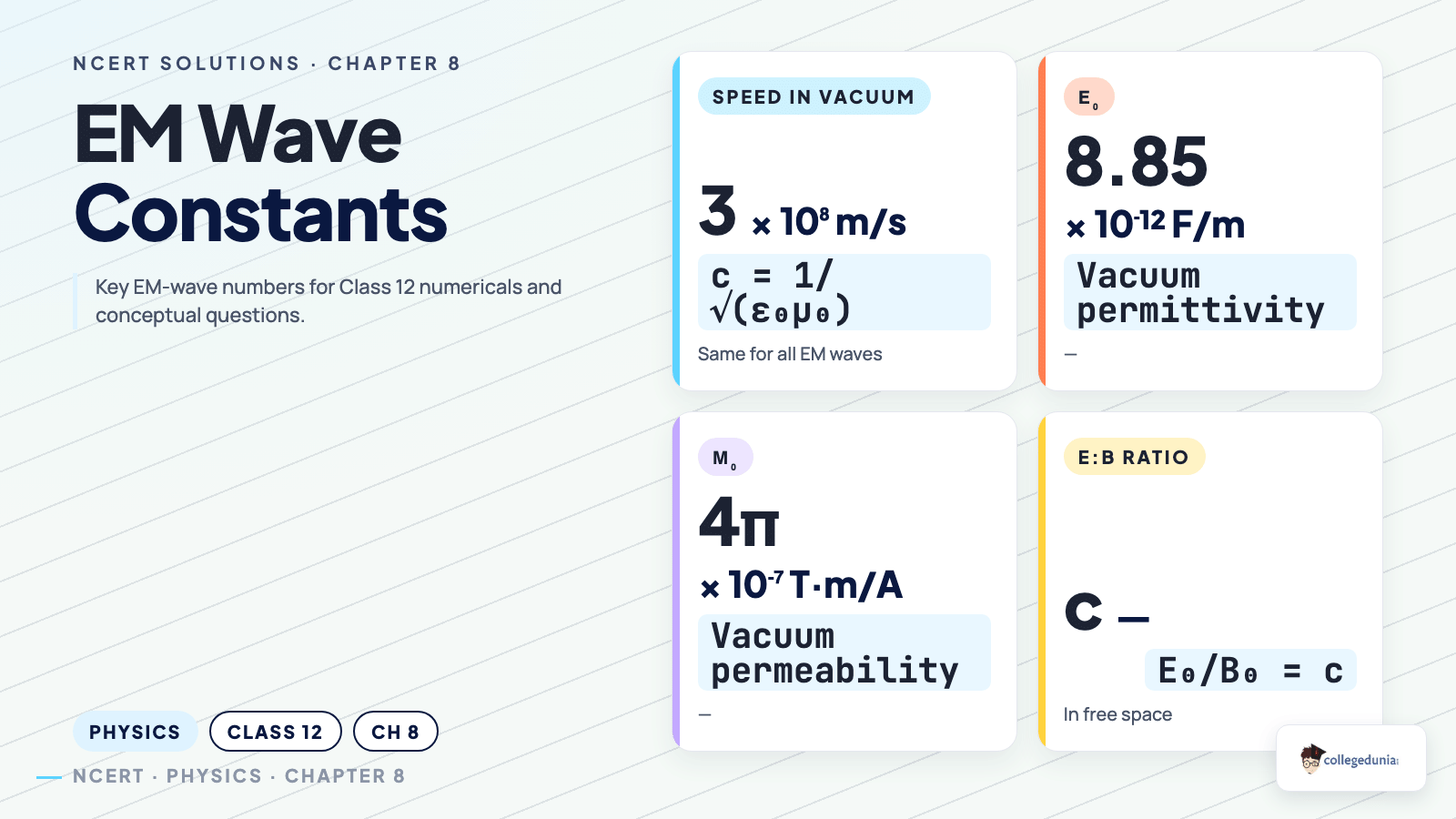
EM wave constants: c, ε₀, μ₀, E/B ratio.
Electromagnetic Waves Weightage and Exam Pattern
The chapter has 8 back exercises plus 5 in-text examples and sits at the bottom of the weightage band at about 2 marks. JEE Main asks the displacement-current numerical; NEET asks the EM spectrum order.
How Chapter 8 compares across the Class 12 Physics syllabus:
Chapter 8 (Electromagnetic Waves): about 2 marks, the lowest-weightage chapter.
High (6 to 7 marks): Ch 2, Ch 3, Ch 9, plus Ch 1, Ch 4, Ch 7 and Ch 14.
Mid (5 marks): Ch 6 and Ch 10.
Low (3 to 4 marks): Ch 5, Ch 11, Ch 12 and Ch 13.
How to Write Board-Ready Answers for Electromagnetic Waves
Follow this order in every answer so the examiner can award each step-mark.
State the rule first. Name the Maxwell relation or wave property the question tests, such as the modified Ampere law for displacement current or the transverse nature of EM waves.
Write the working formula. Put down c = 1/√(μ₀ε₀) for speed-of-light parts, or c = νλ when the question links frequency and wavelength.
Substitute with units. Plug in values carrying SI units (m, Hz, T, V/m) so the unit on the final line falls out on its own.
Name the spectrum band only if asked. Identify radio, microwave, infrared, visible, UV, X-ray or gamma only when the question wants it; do not pad answers with the full spectrum.
Keep significant figures. Round the final value to 2 or 3 significant figures, matching the data given in the question.
Common Answer-Writing Mistakes in Chapter 8
These slips cost marks in the calculation steps, not the concept. Check each one before you submit.
Mistake 1: Mixing up μ₀ and ε₀. Use μ₀ = 4π×10⁻⁷ and ε₀ = 8.85×10⁻¹² in c = 1/√(μ₀ε₀); swapping them gives a wrong speed.
Mistake 2: Slipping between frequency and wavelength in c = νλ. Solve for the one asked, and convert nm or MHz to base SI units first.
Mistake 3: Wrong powers of ten. Track the exponents through every multiplication; a stray 10³ turns 3×10⁸ into a meaningless answer.
Mistake 4: Dropping units on the final line. Always carry T, V/m, Hz or A to the end so the answer is complete and self-checking.
Class 12 Electromagnetic Waves: Other Resources
Resource
Link
NCERT Solutions
Class 12 Electromagnetic Waves NCERT Solutions (you are here)
All NCERT Solutions for Class 12 Physics Chapter 8 Electromagnetic Waves with Step-by-Step Solutions
Every question of NCERT Class 12 Physics Electromagnetic Waves is listed below with its full Solution and Expert Solution hidden inside collapsible tabs. Click Check Solution to reveal the step-by-step working; click Expert Solution for the expanded explanation.
Q 8.1
Figure 8.5 shows a capacitor made of two circular plates each of radius 12 cm, and separated by 5.0 cm. The capacitor is being charged by an external source (not shown in the figure). The charging current is constant and equal to 0.15 A.
(a) Calculate the capacitance and the rate of change of potential difference between the plates.
(b) Obtain the displacement current across the plates.
(c) Is Kirchhoff's first rule (junction rule) valid at each plate of the capacitor? Explain.
What the question is asking. A parallel-plate capacitor is being charged at a constant current. We need to find its capacitance, the rate of voltage rise across it, the displacement current between the plates, and to comment on whether Kirchhoff's junction rule still works at the plate.
Given.
Radius of each plate, R = 12 cm = 0.12 m.
Plate separation, d = 5.0 cm = 5.010-2m.
Conduction current charging the capacitor, Ic = 0.15 A.
0 = 8.8510-12 C2 N-1 m-2.
Concept used. A parallel-plate capacitor in vacuum has capacitance C = 0Ad, where A = π R2 is the plate area. Charge stored is q = CV; differentiating, the conduction current that flows in the wire is Ic = dq/dt = C dV/dt. Maxwell's deep insight was that between the plates (where no real current flows) there is a displacement current Id = 0dEdt, which exactly equals Ic in a charging capacitor - keeping Ampère's circuital law and the junction rule consistent.
Step 3 - rate of change of potential. From Ic = C dV/dt, dVdt = IcC = 0.158.0× 10-12 = 1.8751010V/s.
(b) Displacement current.
Step 4 - equality of Id and Ic. Between the plates the conduction current is zero, but as the charge on the plates grows, the electric field E = σ/0 = q/0A - and hence the flux E = EA = q/0 - keeps changing. Therefore Id = 0dEdt = 0·10·dqdt = dqdt = Ic.
Step 5 - value. Id = Ic = 0.15 A.
(c) Junction rule at the plate. Yes, the junction rule still holds - provided we count the displacement current as a true current. Conduction current Ic = 0.15 A flows into the plate through the wire; an equal displacement current Id = 0.15 A "leaves" the plate into the gap between the plates. So total current in = total current out at the plate.
Final answer.C ≈ 8 pF, dVdt ≈ 1.91010V/s, Id = 0.15 A. Kirchhoff's junction rule is valid at the plate when displacement current is included.
DR
Dr. Rajesh Kumar
Ph.D. Physics, IIT Delhi
Verified Expert
Why Maxwell needed displacement current. Ampère's original law ∮ B· dl = 0 Ienc ran into trouble at a charging capacitor: an Ampèrian loop around the wire encloses Ic, but the same loop with its surface deformed to pass between the plates encloses no conduction current at all. Same loop, two different surfaces, two answers - a paradox. Maxwell patched it by adding 0dE/dt, so the law became ∮ B· dl = 0(Ic + 0dEdt). This single fix produced symmetry with Faraday's law and predicted electromagnetic waves travelling at c = 1/√00 - light!
Alternative computation of dV/dt. Note that V = q/C, so dV/dt = (1/C) dq/dt = Ic/C - exactly what we used. Equivalently E = V/d, so the field between the plates also changes at dEdt = 1d·dVdt = 1.87510100.05 = 3.751011V m-1 s-1.
Common mistake. Students often forget that R is in centimetres and plug R = 12 directly into π R2, giving an area of 452 m2 and an absurd capacitance. Convert to metres first, every single time.
Real-world flavour. In a working AM radio antenna or RF circuit, charging currents drive capacitor-like structures at megahertz frequencies. The displacement current in the dielectric is precisely what radiates the electromagnetic wave outward; without Maxwell's correction, neither radio nor Wi-Fi would be theoretically possible.
Q 8.2
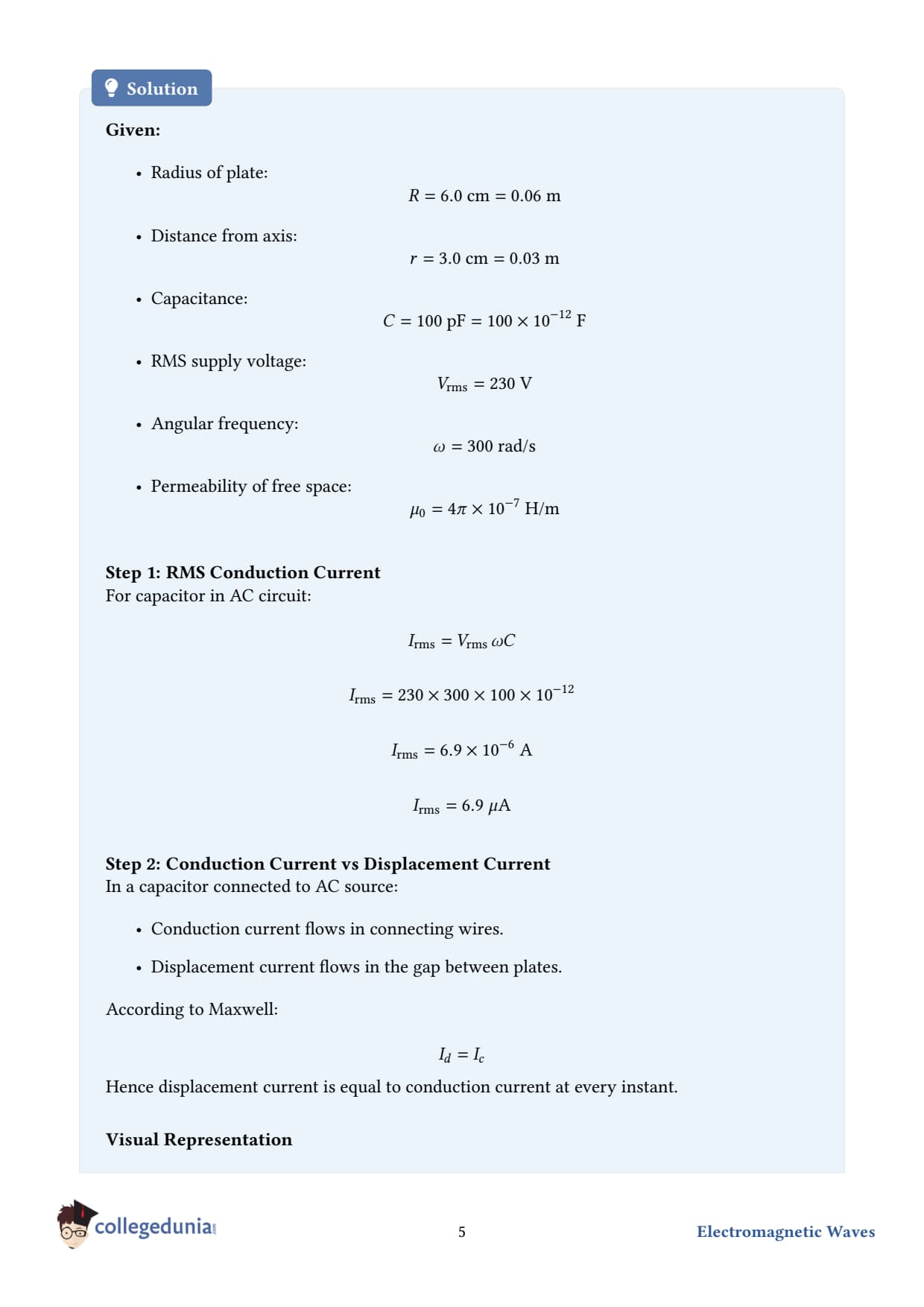
A parallel plate capacitor (Fig. 8.6) made of circular plates each of radius R = 6.0 cm has a capacitance C = 100 pF. The capacitor is connected to a 230 V ac supply with a (angular) frequency of 300 rad s-1.
(a) What is the rms value of the conduction current?
(b) Is the conduction current equal to the displacement current?
(c) Determine the amplitude of B at a point 3.0 cm from the axis between the plates.
Given.
Plate radius R = 6.0 cm = 0.06 m; capacitance C = 100 pF = 1.0× 10⁻¹⁰F.
RMS voltage Vrms = 230 V; angular frequency ω = 300 rad s-1.
Distance from axis where we want B: r = 3.0 cm = 0.03 m (inside the plate region, since r < R).
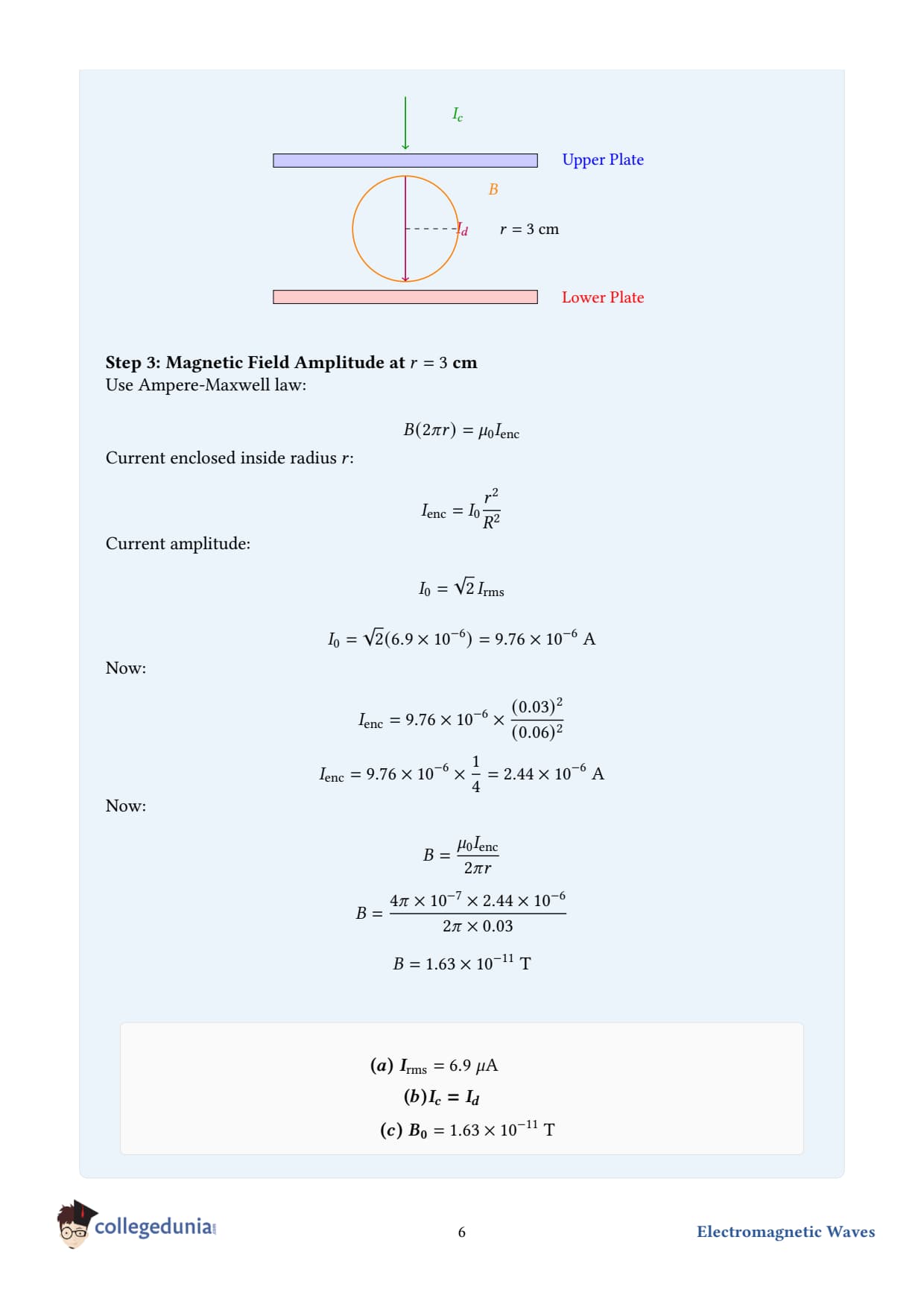
Concept used. For a capacitor on an ac supply, the capacitive reactance is XC = 1/ω C. The rms conduction current is Irms = Vrms/XC. Maxwell's correction guarantees Id = Ic everywhere in the circuit - at any instant the displacement current between the plates equals the conduction current in the wire. Inside the plate region, using Ampère-Maxwell's law on a circle of radius r (with r < R) gives B(2π r) = 0 Idenc = 0 Idr2R2, because only a fraction r2/R2 of the total displacement current passes through the Ampèrian disc.
(b) Are the two currents equal? Yes. Charge conservation forces Ic = Id at all times - the displacement current in the gap simply continues the conduction current that flows in the leads.
Final answer. Irms ≈ 6.9 , Ic = Id, B0 ≈ 1.6× 10⁻¹¹T.
DA
Dr. Anita Sharma
Ph.D. Physics, University of Delhi
Verified Expert
Symmetry argument behind the r2/R2 factor. The displacement current density between uniformly charged circular plates is uniform across the plate area, jd = Id/π R2. For an Ampèrian circle of radius r < R, the enclosed displacement current is jd · π r2 = Id r2/R2. This is the magnetic-field analogue of the "uniform current density inside a wire" problem and gives the familiar linear-in-r field inside B ∝ r and 1/r outside.
Alternative method via dE/dt. One can also compute B by writing the flux through the Ampèrian disc explicitly: E = E π r2 with E = q/0π R2. Then dEdt = r20 R2dqdt = r2 Ic0 R2, and B2π r = 00dE/dt gives the same answer. The two formulations are equivalent because 0dE/dtis the displacement current.
Common mistake. Confusing rms and peak. The question asks for the amplitude (peak) of B, so we must use I0 = √2 Irms, not Irms directly. Similarly, do not confuse the electric field amplitude E0 (V/m) with the magnetic field amplitude B0 (T) - they differ by a factor of c (see Q 8.7).
Real-world flavour. The magnetic field of order 10-11T is incredibly tiny - roughly a billion times weaker than the Earth's field. Yet inside a working radio transmitter, similar capacitor-like elements generate the wave that drives an antenna; once radiated, the same EM wave carries information across continents.
Q 8.3
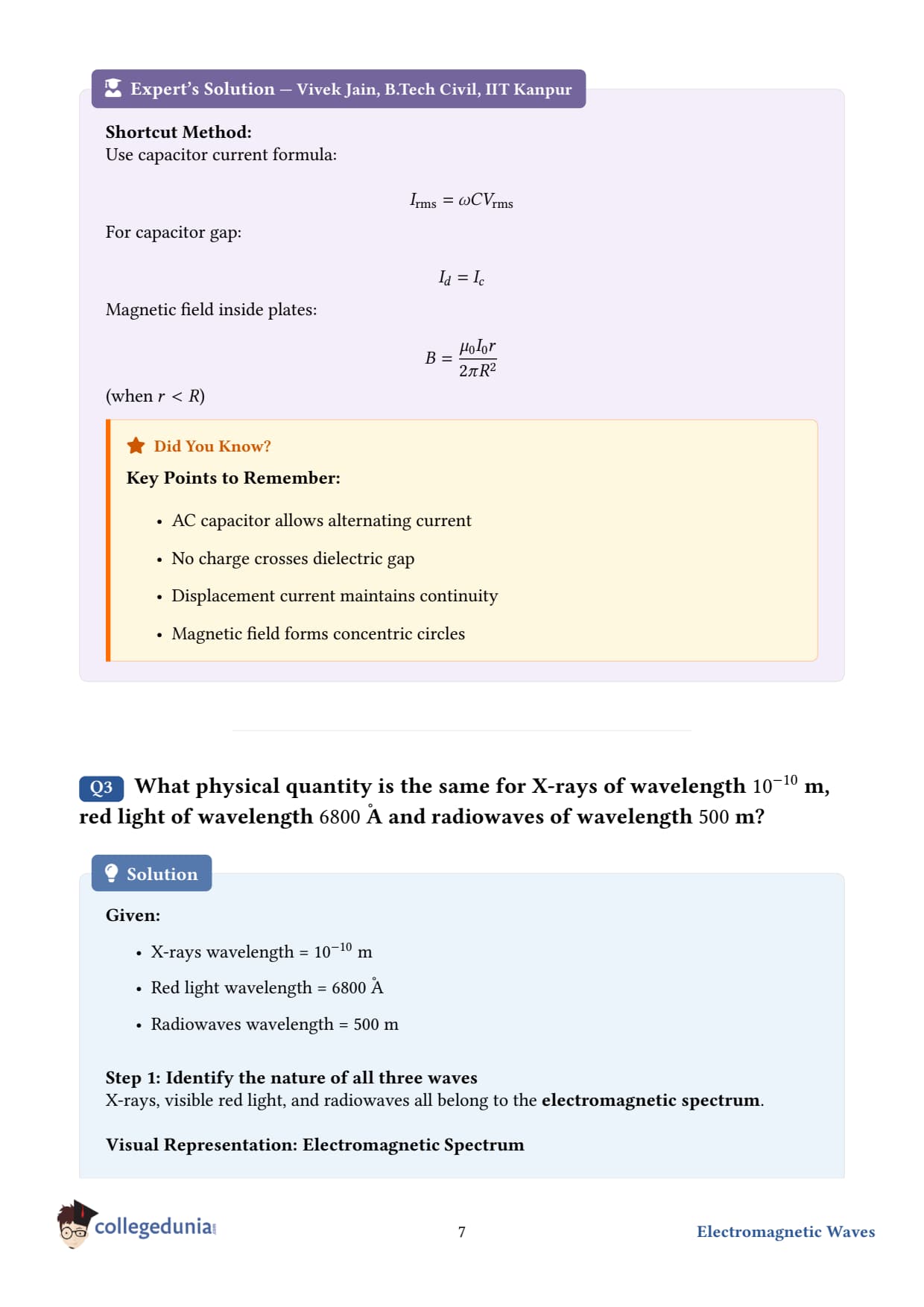
What physical quantity is the same for X-rays of wavelength 10-10m, red light of wavelength 6800 and radiowaves of wavelength 500 m?
Setup. Three electromagnetic waves of wildly different wavelengths are given. The question asks which physical quantity is identical for all three.
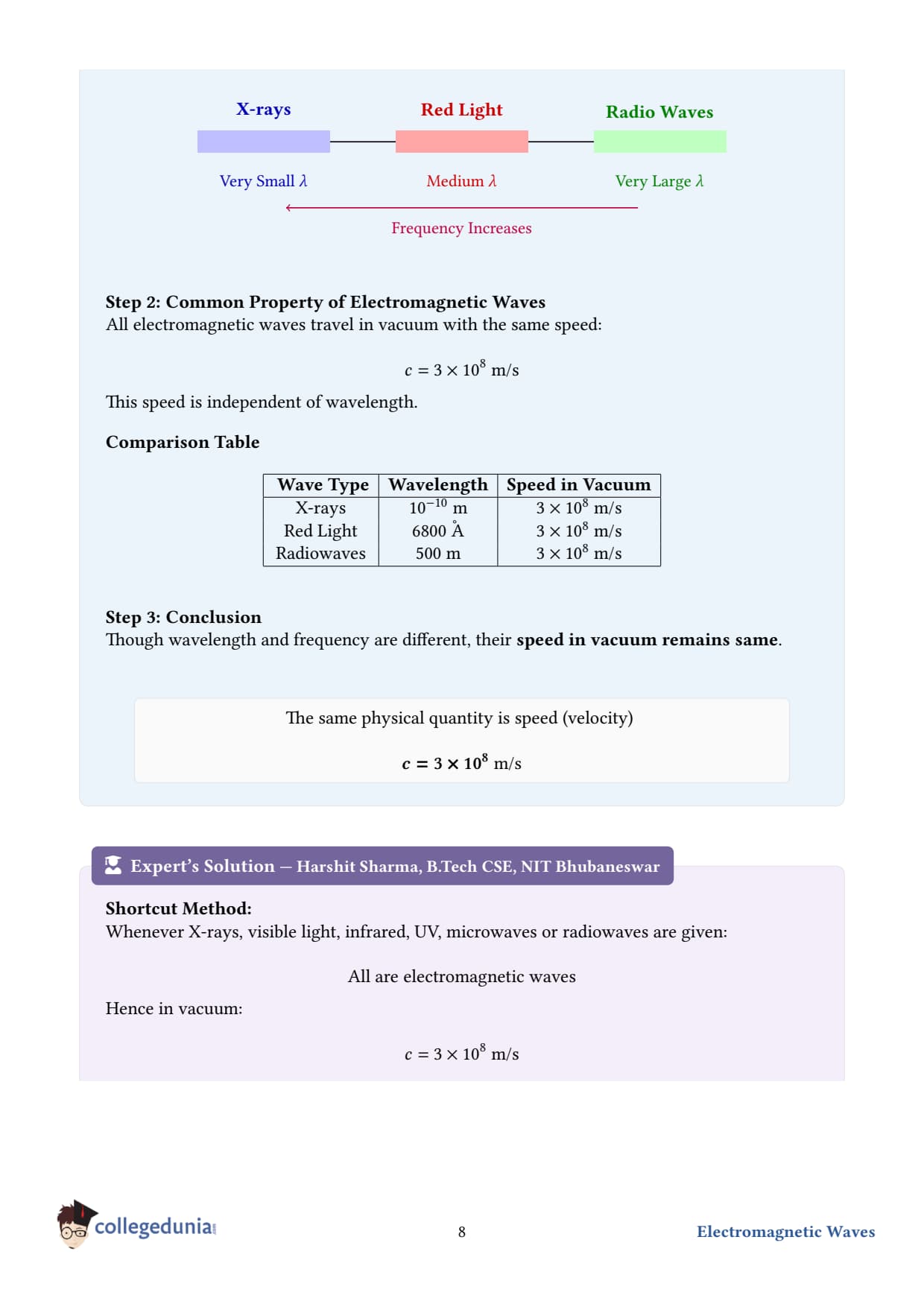
Concept used. All electromagnetic waves - irrespective of frequency or wavelength - travel through vacuum at the same universal speed c = 1√00 ≈ 3108m s-1. This is one of the central predictions of Maxwell's equations and is a postulate of relativity. Wavelength λ, frequency ν and speed are linked by c = λ.
Step 1 - quick frequency check (sanity).
X-rays: ν = c/λ = 3108/10-10 = 31018 Hz.
Red light: 6800 = 6.810-7m, so ν = 3108/6.810-7 ≈ 4.41014 Hz.
Radio: ν = 3108/500 = 6105 Hz = 600 kHz.
So the three waves have very different frequencies, wavelengths and photon energies. The only number that they share is the propagation speed.
Final answer. The speed in vacuum, c = 3108m s-1, is the same for all three.
DS
Dr. Suresh Iyer
Ph.D. Theoretical Physics, TIFR Mumbai
Verified Expert
Why c is universal. Maxwell derived the wave equation for the EM field directly from his four equations and found that the wave speed depends only on the constants 0 and 0, not on the source or the observer. Einstein elevated this to the second postulate of special relativity: the speed of light in vacuum is the same in every inertial frame. As a consequence, nothing carrying energy or information can outrun c.
What changes from X-ray to radio. Across the EM spectrum, what changes are wavelength, frequency, photon energy E = hν and the way each wave interacts with matter. X-rays ionise atoms; visible light triggers chemical and biological responses (vision); radio waves drive electrons in antennas. But the speed of propagation never changes.
Common mistake. Saying "wavelength" or "frequency" is the same - they are not, and the calculation above shows they differ by 10+ orders of magnitude.
Real-world flavour. Optical fibres, GPS timing, and radar ranging all rely on the invariance and precise value of c. The metre itself is now defined by fixing c ≡ 299 792 458 m/s; we measure lengths by measuring time-of-flight of light.
Q 8.4
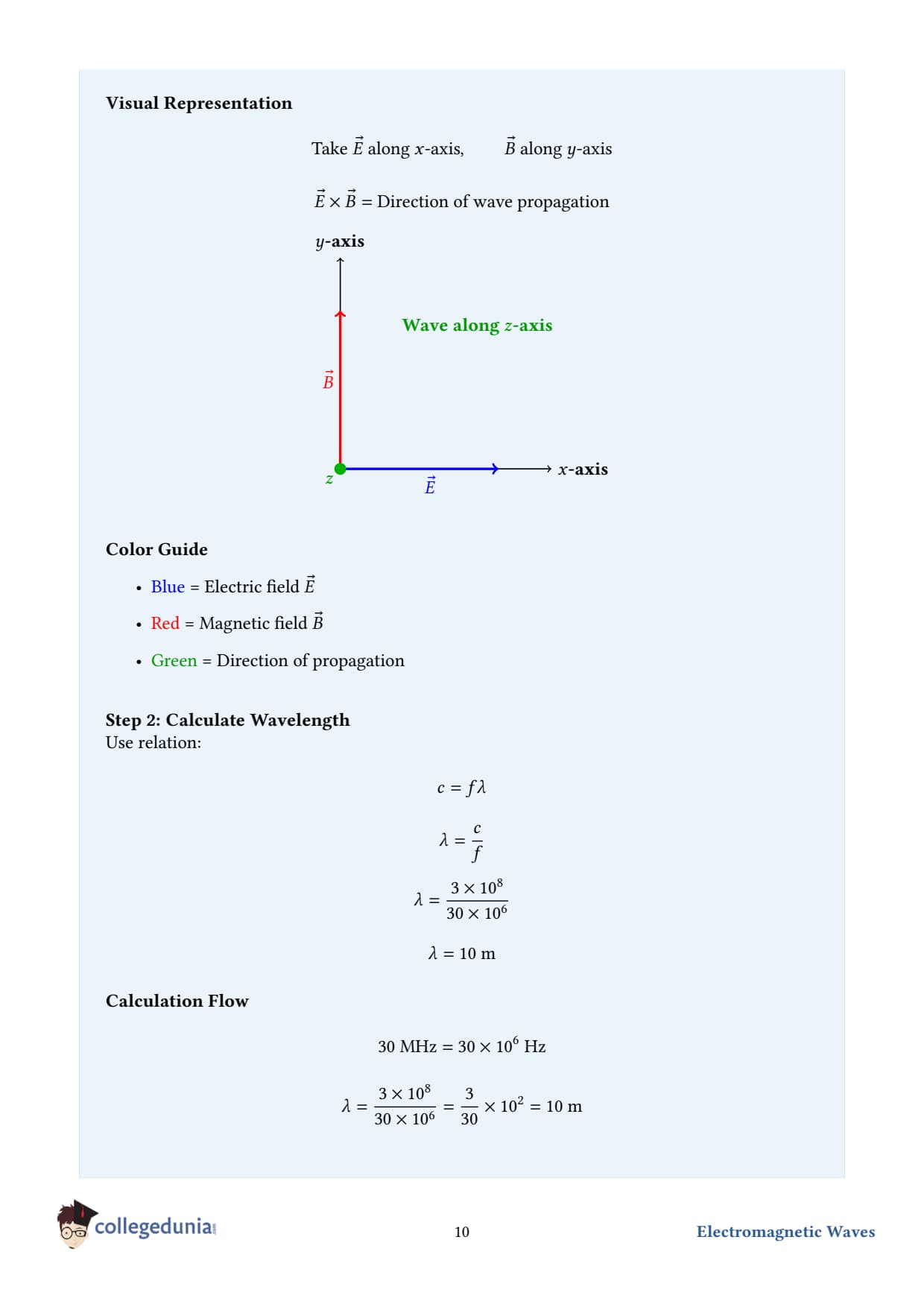
A plane electromagnetic wave travels in vacuum along z-direction. What can you say about the directions of its electric and magnetic field vectors? If the frequency of the wave is 30 MHz, what is its wavelength?
Setup. A plane EM wave moves along z in vacuum. We need (i) the orientations of E and B, and (ii) the wavelength when ν = 30 MHz.
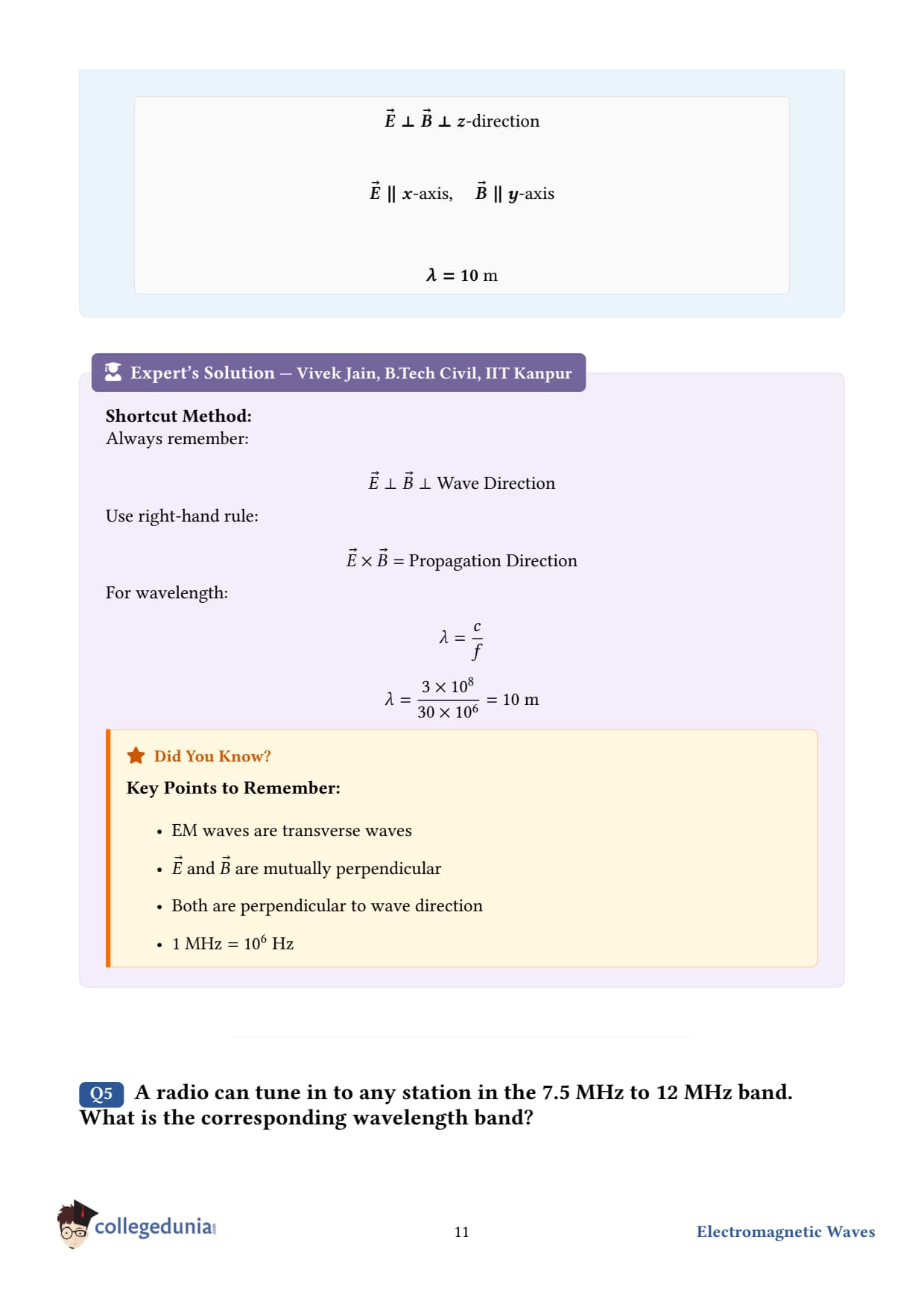
Concept used. An electromagnetic wave is transverse: both E and B lie in the plane perpendicular to the direction of propagation, and they are mutually perpendicular. The Poynting vector S = E× B/0 points along the direction of energy flow - i.e., along z. For the wave to actually carry energy in +z, the cross product E× B must point along +z. In vacuum, c = λ.
Step 1 - directions of E and B. Both lie in the x-y plane perpendicular to z. They are perpendicular to each other. For instance, if E oscillates along x, then B oscillates along y, because x× y = z - the propagation direction.
Step 2 - wavelength. λ = cν = 310830× 106 = 10 m.
Final answer.E and B are mutually perpendicular and both perpendicular to the direction of propagation z; they oscillate in phase in the x-y plane. The wavelength is λ = 10 m.
PM
Prof. Meera Nair
Ph.D. Experimental Physics, IISc Bangalore
Verified Expert
Why EM waves are transverse. Maxwell's equation ∇· E = 0 in vacuum forces any plane-wave solution Er,t = E0 eik·r - ω t to satisfy k· E0 = 0 - that is, E must be perpendicular to the wave vector k. The same equation for B gives k·B0 = 0. And Faraday's law links them: B = k× E/c. So the trio E, B, k forms a right-handed orthogonal set.
Alternate way to remember the geometry. Curl the fingers of your right hand from E toward B; the thumb gives the propagation direction. If E along +x and B along +y, then E× B = +z - wave goes in +z. Reverse either field, and the wave reverses.
Common mistake. Drawing E and B along the same axis. They are always perpendicular to each other. Also confusing "perpendicular to propagation" with "always horizontal" - there is no global vertical for an EM wave; only the propagation direction matters.
Real-world flavour. A wavelength of 10 m sits in the upper VHF / lower shortwave band - used historically for FM radio, amateur ("ham") radio, and aircraft communication. Antennas tuned for this band are typically a metre or two long because optimal dipole length is λ/2 or λ/4.
Q 8.5
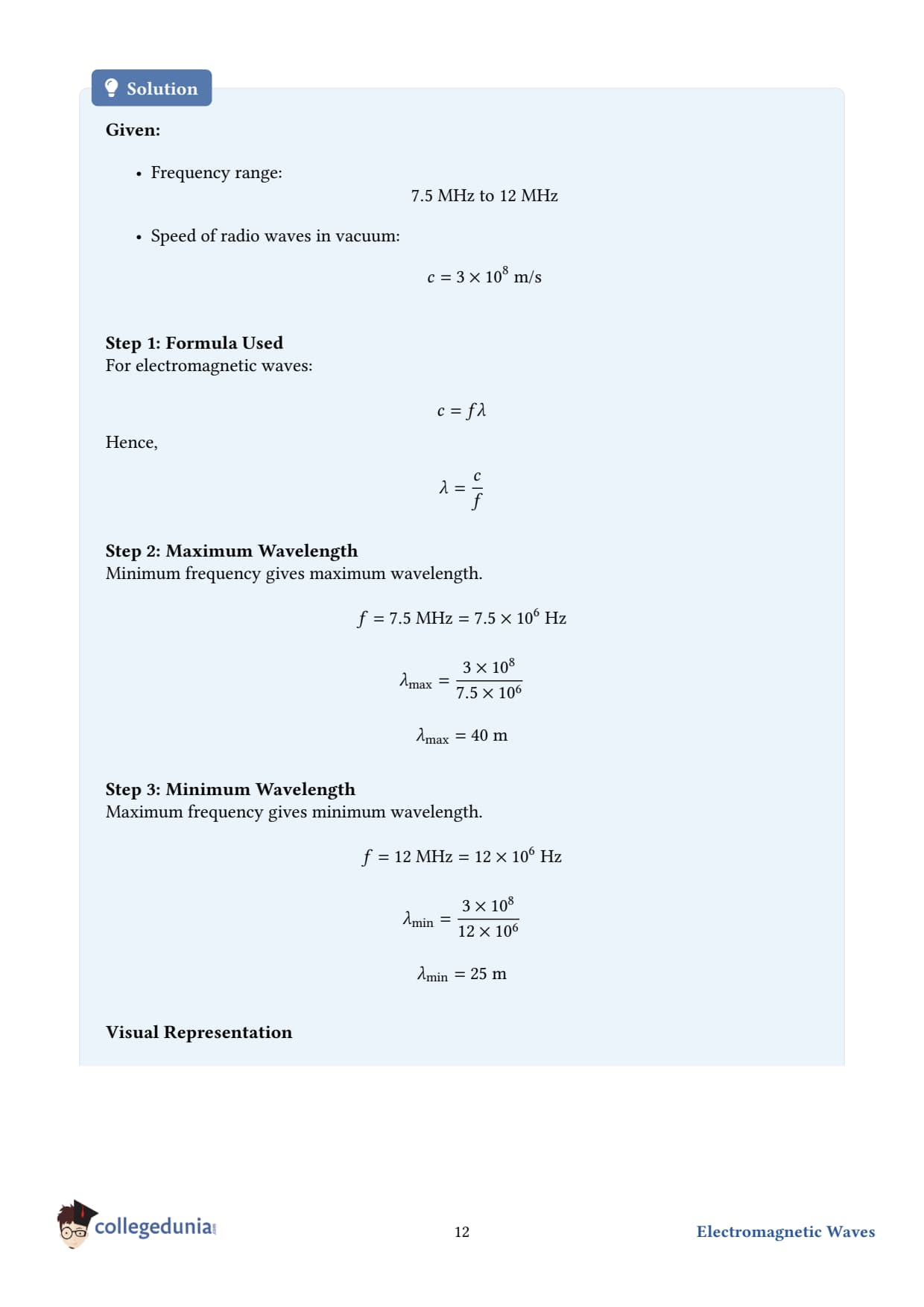
A radio can tune in to any station in the 7.5 MHz to 12 MHz band. What is the corresponding wavelength band?
Setup. The radio's tuning circuit picks up frequencies between 1 = 7.5 MHz and 2 = 12 MHz. We want the corresponding range of wavelengths.
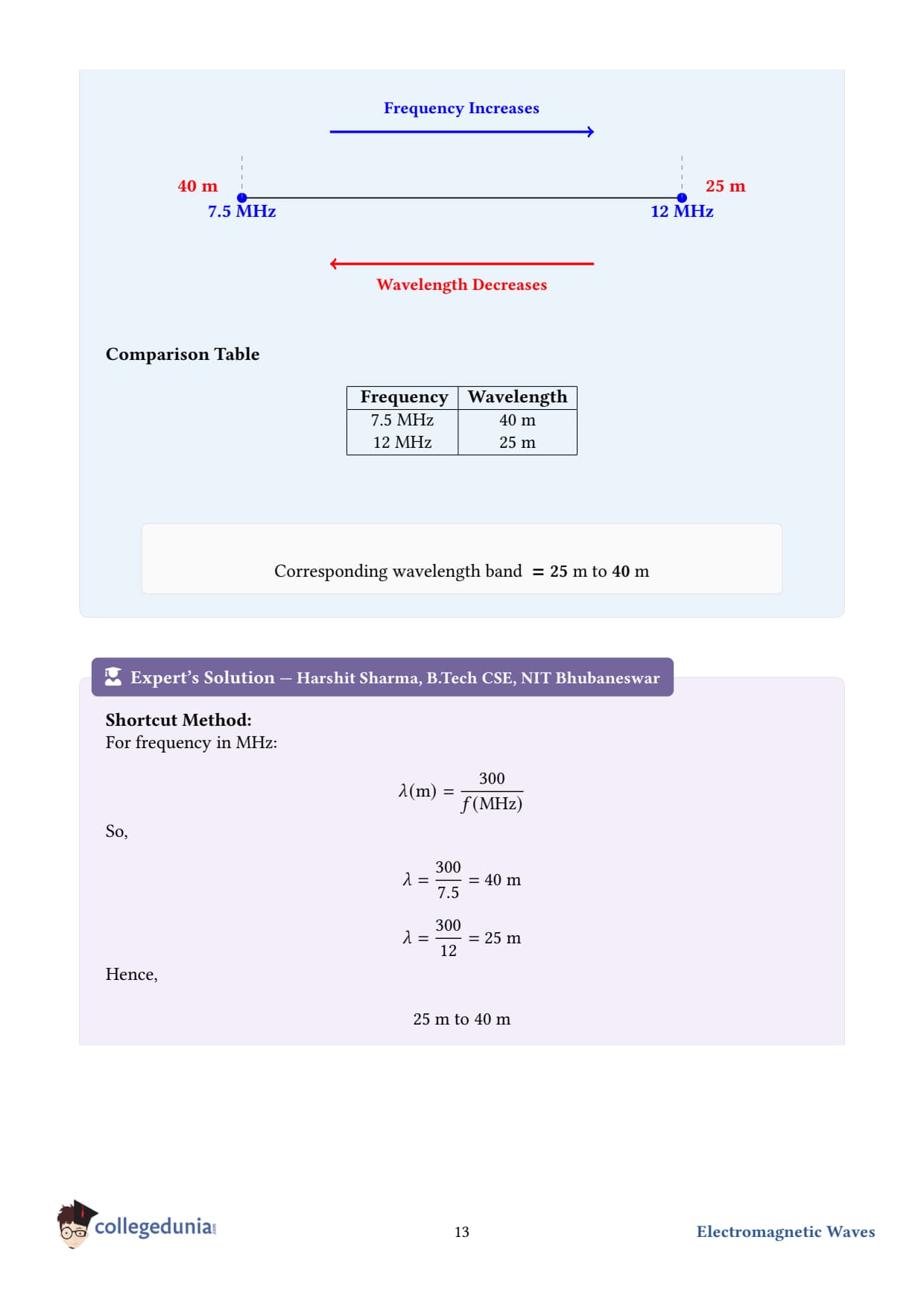
Concept used. In vacuum (and very nearly so in air), λ = c/ν. Higher frequency corresponds to shorter wavelength, so the wavelength range will be the reverse: λ2 < λ1.
Step 1 - wavelength at the lower end.1 = c1 = 31087.5106 = 40 m.
Step 2 - wavelength at the upper end.2 = c2 = 310812106 = 25 m.
Step 3 - quote the band. Since the smaller wavelength comes from the larger frequency, λ ∈ 25 m, 40 m.
DS
Dr. Sneha Iyer
Ph.D. Physics, IISc Bangalore
Verified Expert
Where this sits in the spectrum. Frequencies of 7.5-12 MHz fall in the High Frequency (HF) shortwave band, used worldwide for international broadcasting (e.g. BBC World Service, AIR shortwave) and amateur radio. These wavelengths reflect off the ionosphere and so can travel thousands of kilometres beyond the horizon - that's how long-distance shortwave broadcasting works.
Alternative shortcut. Memorise: = 300/. Then 300/7.5 = 40 and 300/12 = 25 - instant answer, no scientific notation needed.
Common mistake. Swapping the endpoints. The smallest wavelength corresponds to the largest frequency, not the other way round.
Real-world flavour. Compare with the AM broadcast band 530 kHz-1610 kHz → λ ≈ 186-566 m and FM broadcast 88 MHz-108 MHz → λ ≈ 2.8-3.4 m. Shorter wavelengths need shorter antennas, which is why FM car antennas are short 75 cm = λ/4.
Q 8.6
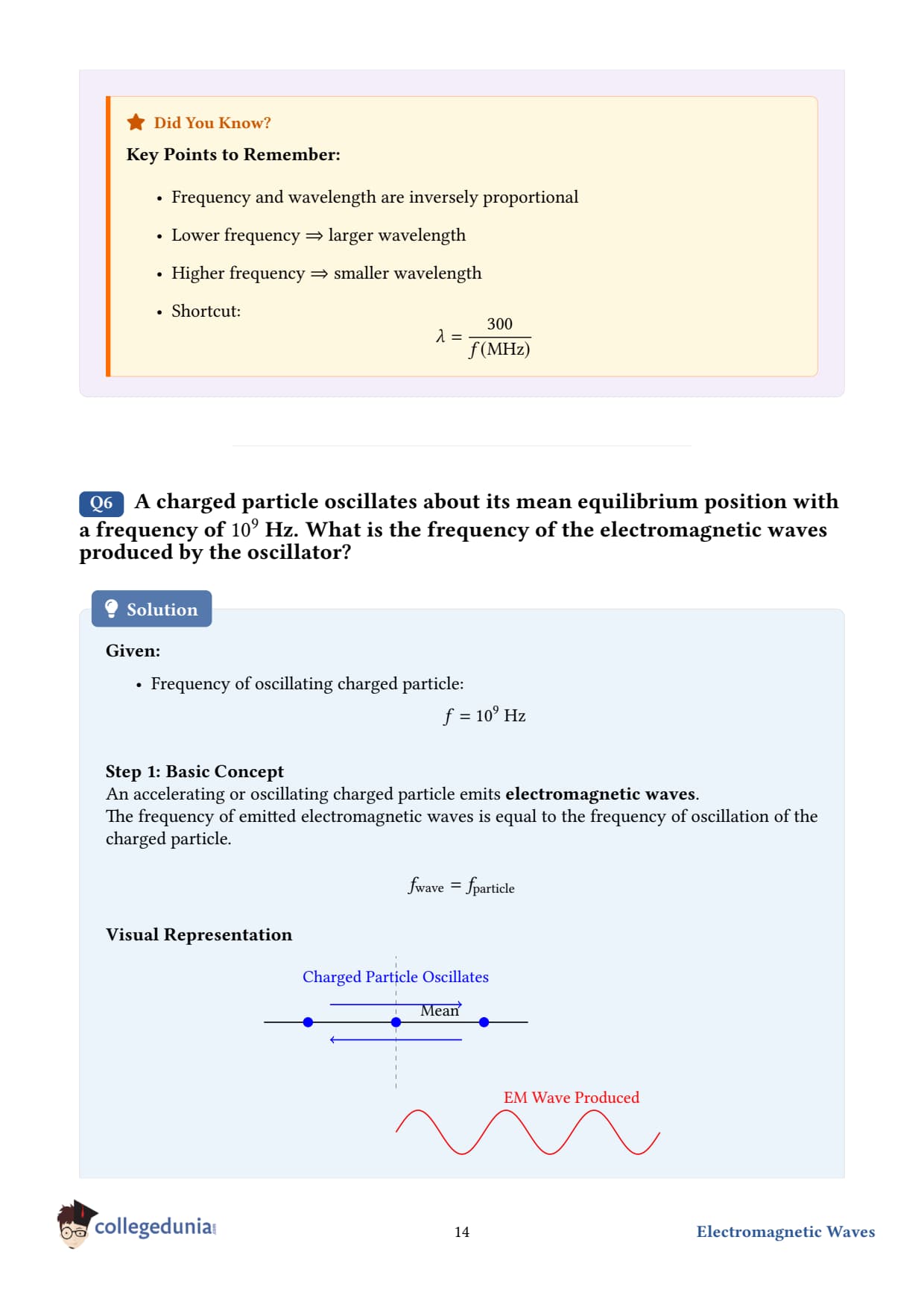
A charged particle oscillates about its mean equilibrium position with a frequency of 109 Hz. What is the frequency of the electromagnetic waves produced by the oscillator?
Concept used. An accelerating (and in particular, oscillating) charge radiates electromagnetic waves. If the charge oscillates at frequency 0, the radiated EM wave has exactly the same frequency 0 - this is a direct consequence of the source term in Maxwell's equations, where the time dependence of the charge/current distribution dictates the time dependence of the radiated fields.
Step 1 - apply the rule. Frequency of oscillation: 0 = 109 Hz. Hence wave = 0 = 109 Hz = 1 GHz.
Step 2 - corresponding wavelength (bonus). λ = cν = 3108109 = 0.3 m = 30 cm. This sits in the microwave / UHF band.
Final answer.wave = 109 Hz = 1 GHz.
DS
Dr. Sneha Iyer
Ph.D. Physics, IISc Bangalore
Verified Expert
Why the frequencies match. When the source charge has displacement x(t) = x02π0t, its acceleration is a(t) = -2π02x(t), which oscillates at the same 0. The radiation electric field at far distance, by the Liénard-Wiechert formulas, is proportional to the retarded acceleration. So the radiated wave's electric field also oscillates at 0. Spectral purity follows from the purely sinusoidal motion of the source.
Alternative phrasing. Think of the charge as one end of an antenna driven at 0. The current in the antenna oscillates at 0; by Maxwell's equations the radiated EM wave carries the same period. Frequency is a temporal property; it cannot be created or destroyed in linear propagation.
Common mistake. Some students try to derive a different wave frequency from the oscillation amplitude or assume the wave frequency is doubled (perhaps confusing with intensity or energy, which do go as the square). It is the field that copies the source frequency directly.
Real-world flavour. 1 GHz is the territory of mobile-phone signals (older 2G/3G bands), microwave ovens (2.45 GHz nearby), GPS L-band (~1.5 GHz), and Wi-Fi (2.4 GHz, 5 GHz). An oscillating charge at this frequency, multiplied billions of times in a real antenna's electron sea, is exactly how a Wi-Fi router emits its signal.
Q 8.7
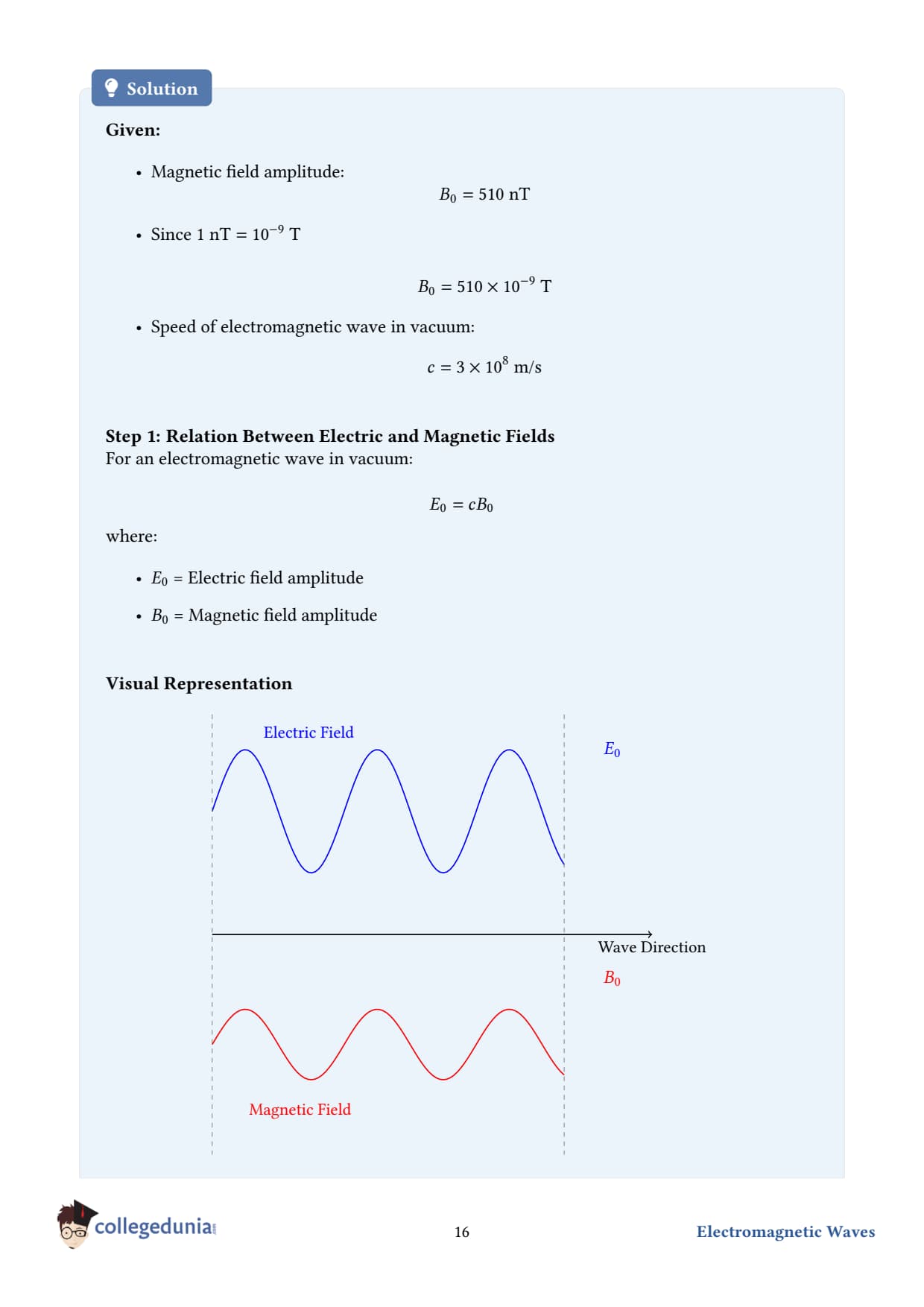
The amplitude of the magnetic field part of a harmonic electromagnetic wave in vacuum is B0 = 510 nT. What is the amplitude of the electric field part of the wave?
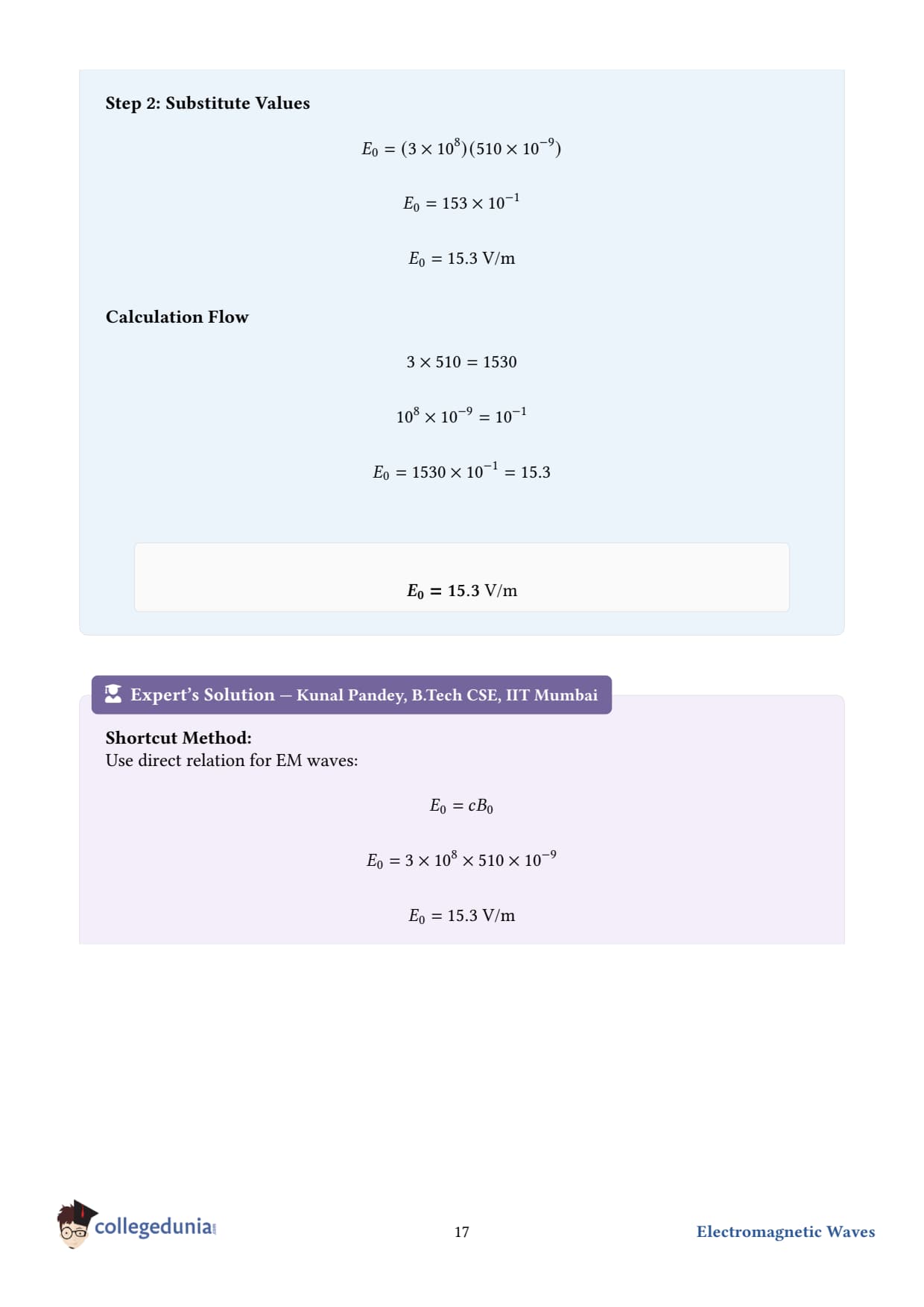
Given.B0 = 510 nT = 51010-9T = 5.1010-7T. Medium: vacuum, so c = 3108m s-1.
Concept used. In a plane EM wave in vacuum the electric and magnetic field amplitudes are locked together by E0B0 = c, i.e. E0 = c B0. This follows directly from Faraday's law ∇×E = -∂B/∂ t applied to a plane wave: the spatial derivative of E along the propagation direction equals the time derivative of B. Plugging in the sinusoidal form E = E0- ω t, B = B0- ω t yields kE0 = ω B0, so E0/B0 = ω/k = c.
Why the ratio is exactly c. A plane wave moves rigidly at speed c. In one period the wave advances by λ; the field at a given point completes one cycle. Faraday's law balances the rate at which B changes (in time) against the spatial twist of E. For a sinusoid this enforces a fixed ratio of amplitudes equal to the wave speed. The same ratio falls out of the Ampère-Maxwell law applied to the same plane wave.
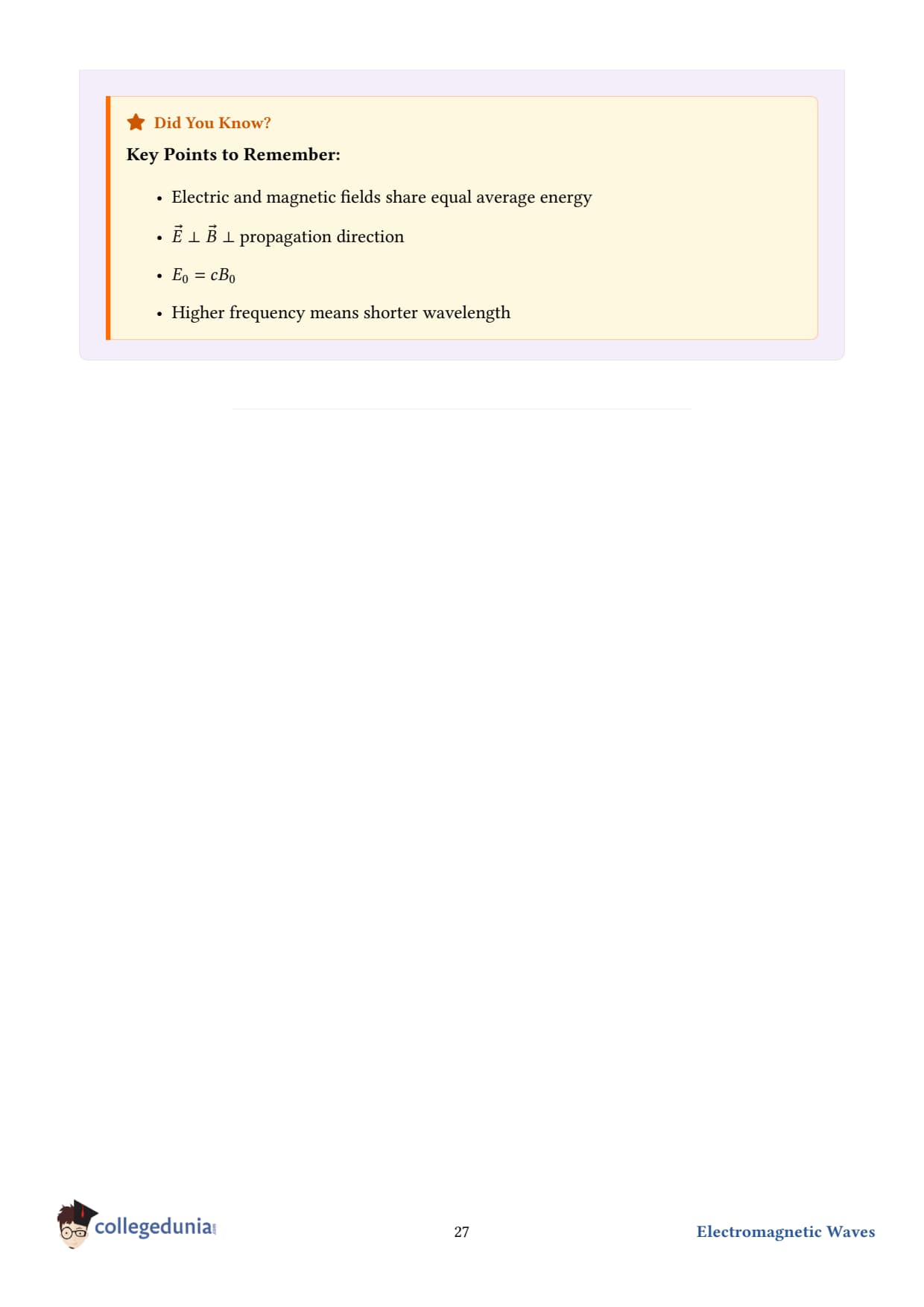
Energy partition. Because E0 = cB0, the electric and magnetic energy densities uE = 120 E2, uB = B220 are exactly equal at every instant (using c2 = 1/00). Total energy is split 50-50 between the electric and magnetic field - see Q 8.10(c).
Common mistake - units confusion. Students mix up tesla (T) and gauss (G), or use B in nT but forget to convert. Plain SI: Ts-1 = V/m, which makes the calculation dimensionally clean.
Real-world flavour.B0 of order 500 nT is comparable to ambient natural radio noise; E0 ≈ 153 V/m is a fairly strong field - about the strength found very close to a high-power radio transmitter. Free-space wave impedance Z0 = E/H = 0c = 377 Ωwhere H = B/0 is a universal constant used to design antennas.
Q 8.8
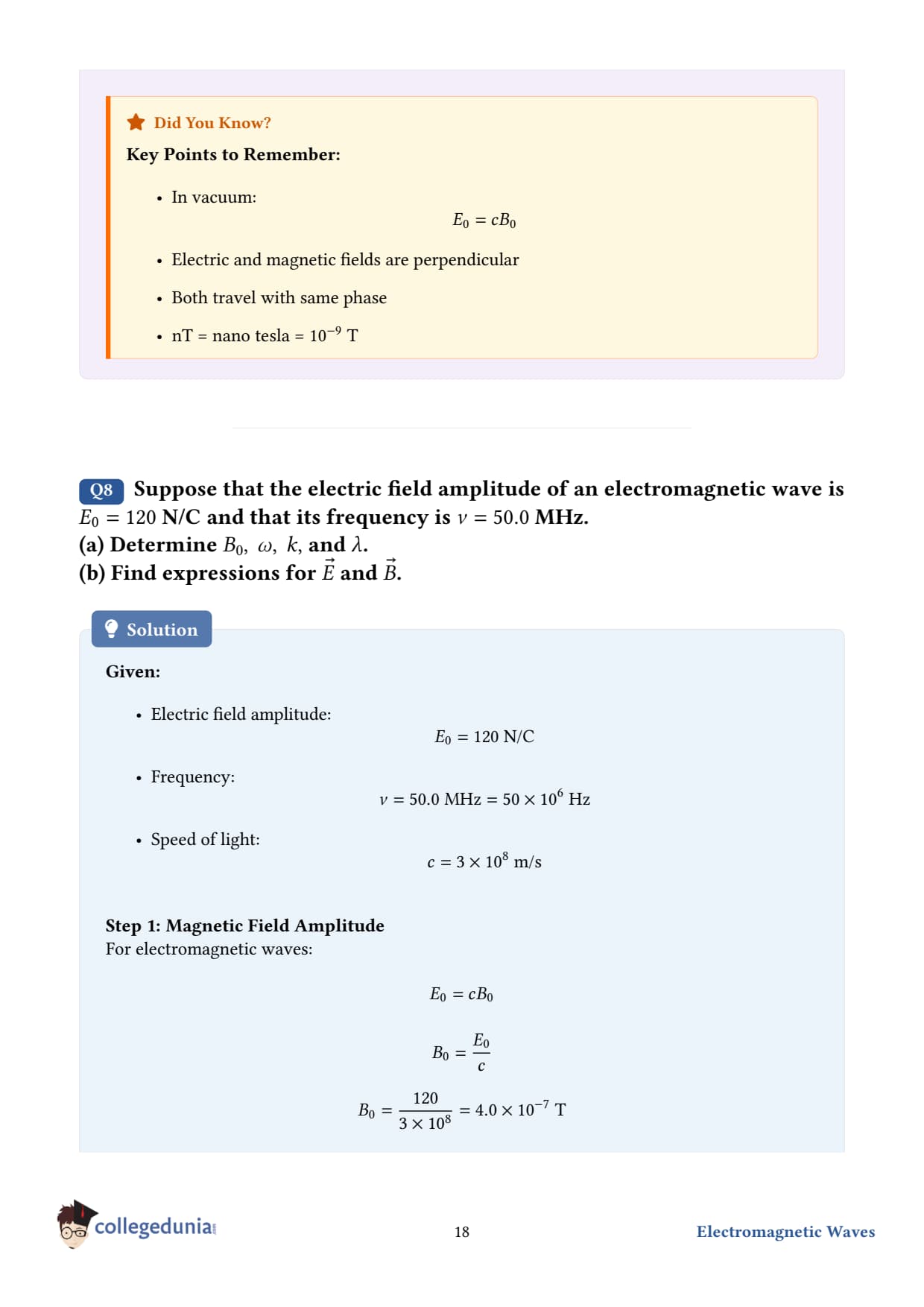
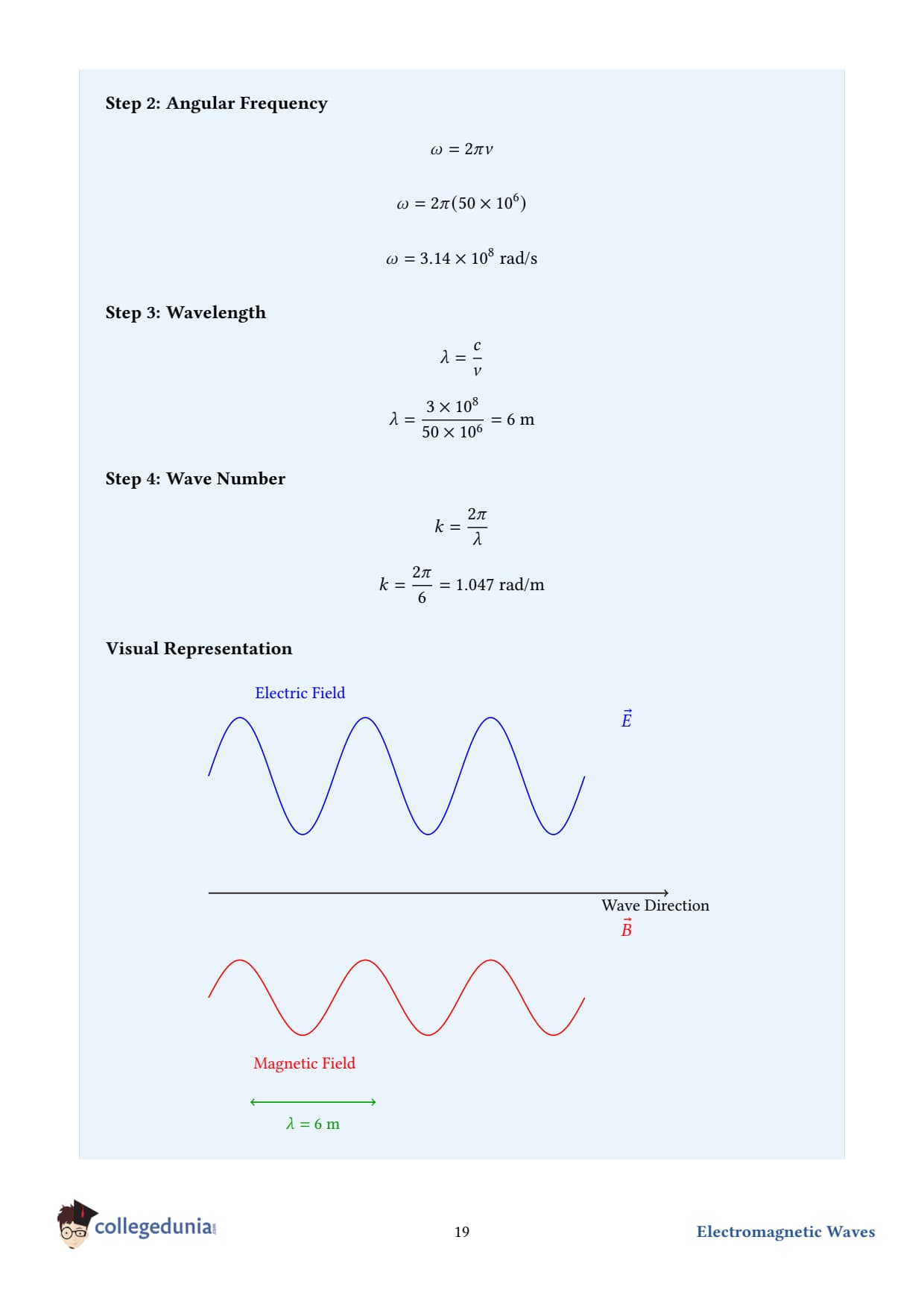
Suppose that the electric field amplitude of an electromagnetic wave is E0 = 120 N/C and that its frequency is ν = 50.0 MHz. (a) Determine B0, ω, k, and λ. (b) Find expressions for E and B.
Given.E0 = 120 N/C, ν = 50.0 MHz = 5.0107 Hz. Vacuum, so c = 3108m s-1.
Concept used. For a plane EM wave in vacuum:
B0 = E0/cfrom E0/B0 = c.
Angular frequency ω = 2ν.
Wavelength λ = c/ν.
Wave number k = 2π/λ = ω/c.
Once we have direction conventions, a plane wave moving in +x with E along y has B along z, and we can write E and B as sinusoidal functions of kx - ω t.
(a) Numerical values.
Step 1 - magnetic field amplitude. B0 = E0c = 1203108 = 4.010-7T = 400 nT.
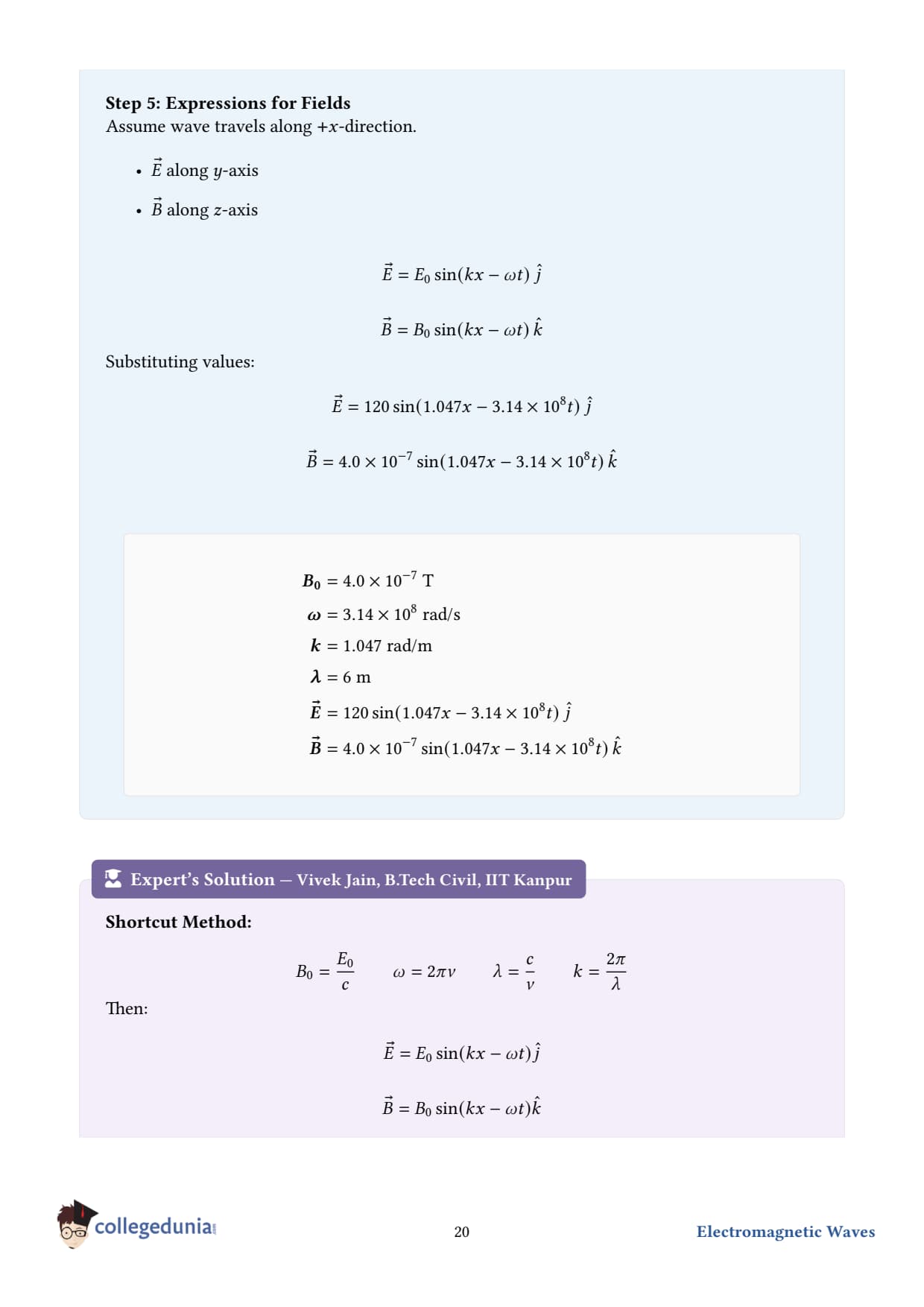
(b) Field expressions. Pick the propagation along +x, E oscillating along y, and B along zso that y×z = x confirms the direction of energy flow. Then E = y E0cos(kx - ω t) = y (120 N/C)cos(1.05 m-1)x - (3.14108 s-1)t, B = z B0cos(kx - ω t) = z (4.010-7T)cos(1.05 m-1)x - (3.14108 s-1)t.
Final answer. B0 = 4.010-7T, ω ≈ 3.14108 rad/s, k ≈ 1.05 rad/m, λ = 6.0 m. The field expressions above represent a plane EM wave travelling along +x.
DR
Dr. Rajesh Kumar
Ph.D. Physics, IIT Delhi
Verified Expert
Choosing the direction of propagation. The problem does not specify a direction, so any consistent choice is acceptable. The convention is: if E is along y and the wave moves along +x, then B is along +z; if you flip B to -z, the wave must move along -x to conserve the right-hand rule.
Alternative form using sin. Equally valid is E = y E0sin(ω t - kx), B = z B0sin(ω t - kx), which represents the same wave with a different choice of phase origin. NCERT typically uses cosine; many textbooks use sine - interchangeable so long as both fields use the same phase.
Common mistake - units confusion between B and E.E is in V/m (or N/C, which is the same), and B is in tesla. They differ by a factor of c, so naively comparing their magnitudes ("B is much smaller!") is meaningless without restoring the c factor that lurks behind the units.
Real-world flavour. Frequency 50 MHz, wavelength 6 m, sits in the low-VHF band - used historically for analogue TV channel 2, and now for some amateur radio. A horizontal half-wave dipole here would be ∼ 3 m long. The field amplitudes E0 = 120 V/m, B0 = 400 nT are far above natural background and would correspond to a powerful broadcast located close to the receiver.
Q 8.9
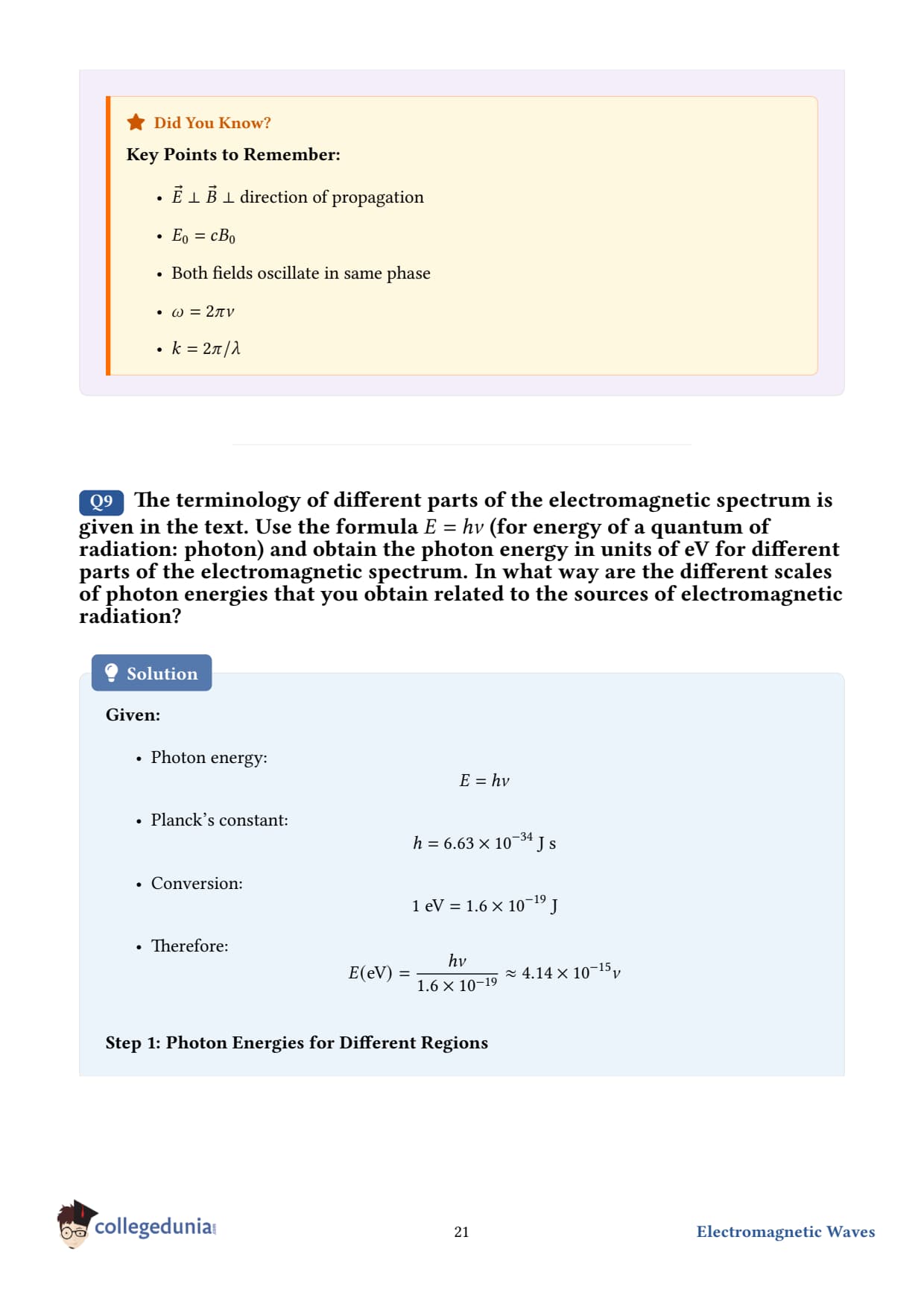
The terminology of different parts of the electromagnetic spectrum is given in the text. Use the formula E = hν (for energy of a quantum of radiation: photon) and obtain the photon energy in units of eV for different parts of the electromagnetic spectrum. In what way are the different scales of photon energies that you obtain related to the sources of electromagnetic radiation?
Concept used. A single photon of an EM wave of frequency ν carries energy E = hν = hcλ, where h = 6.62610-34Js is Planck's constant. Converting to eV uses 1 eV = 1.60210-19J, giving the handy combination hc ≈ 1240 eV nm, so E(eV) ≈ 1240λ(nm).
Step 1 - pick a representative wavelength in each band and compute E = hc/λ.
Radioλ ∼ 100 m: E ≈ 1240/1011 ≈ 10-8 eV.
Microwaveλ ∼ 1 cm: E ≈ 1240/107 ≈ 10-4 eV.
Infraredλ ∼ 10 : E ≈ 1240/104 ≈ 0.1 eV.
Visibleλ ∼ 500 nm: E ≈ 1240/500 ≈ 2.5 eV.
Ultravioletλ ∼ 100 nm: E ≈ 1240/100 ≈ 12 eV.
X-raysλ ∼ 0.1 nm = 10-10m: E ≈ 1240/0.1 ≈ 1.24104 eV = 12.4 keV.
Gamma raysλ ∼ 10-12m: E ≈ 106 eV = 1 MeV and higher.
Step 2 - link to sources.
Radio / microwave photons 10-8-10-3 eV: produced by oscillating currents in antennas, rotational transitions of small molecules, and thermal motion at modest temperatures.
Infrared ∼ 0.01-1 eV: vibrational transitions of molecules and thermal radiation from warm bodies ∼ 300 K Earth, ∼ 1000 K furnace.
Visible ∼ 1.5-3 eV: outer-shell electronic transitions in atoms and molecules (e.g., sodium-D line, chlorophyll absorption).
Ultraviolet ∼ 3-100 eV: higher-energy electronic transitions; ionisation of atoms.
X-rays (keV scale): inner-shell electronic transitions; rapid deceleration of fast electrons (bremsstrahlung).
Final statement. The photon energy of an EM wave matches the typical energy scale of the physical process that emits it: from antenna currents (sub-microeV) all the way up to nuclear processes (MeV). The bigger the energy jump in the source, the higher the photon frequency it radiates.
DS
Dr. Suresh Iyer
Ph.D. Theoretical Physics, TIFR Mumbai
Verified Expert
Why eV instead of joules. Atomic and nuclear energy gaps are conveniently ∼ 1-106 eV, giving compact numbers. Using joules buries the physics under 10-19 prefactors. The shortcut EeV = 1240/ is worth memorising - JEE/NEET-level photoelectric, atomic-physics and X-ray problems all use it.
Alternative way to see the source-energy match. A characteristic energy Δ E in a source corresponds to an emission frequency ν = Δ E/h. Hydrogen's outer-electron transitions release a few eV → visible/UV (Balmer series). Inner-electron transitions in heavy atoms release keV → X-rays. Nuclear de-excitation releases MeV → gamma rays. Conversely, the photon you detect tells you the energy scale of its source.
Common mistake. Mixing up the inverse relation: students sometimes think higher frequency means lower photon energy. Remember E = hν - frequency and energy go up together; wavelength is what goes down.
Real-world flavour. Medical X-ray photons (~50 keV) penetrate soft tissue because they are far more energetic than the binding energies of light atoms (C, H, N, O), so they aren't absorbed strongly except by heavier atoms like calcium in bone. Gamma photons from cobalt-60 (~1.3 MeV) penetrate even further, used in cancer radiotherapy and industrial radiography.
Q 8.10
In a plane electromagnetic wave, the electric field oscillates sinusoidally at a frequency of 2.01010 Hz and amplitude 48 V m-1.
(a) What is the wavelength of the wave?
(b) What is the amplitude of the oscillating magnetic field?
(c) Show that the average energy density of the E field equals the average energy density of the B field. c = 3108m s-1.
Concept used. For a plane EM wave in vacuum: c = λ; the amplitudes are linked by B0 = E0/c; the instantaneous energy density is u = 0 E2/2 + B2/20. Averaging cos2 over a cycle gives 12, so uE= 140 E02, uB= B0240. Using E0 = cB0 and c2 = 1/00 collapses these two to the same number.
Step 1 - average electric energy density. uE= 140 E02 = 14(8.85410-12)(48)2. Compute (48)2 = 2304. So uE= 14(8.854× 2304)× 10-12 = 14(20399)× 10-12 ≈ 5.1× 10⁻⁹J m-3.
Step 2 - average magnetic energy density. uB= B0240 = (1.610-7)24(4π10-7). Numerator: (1.6)210-14 = 2.5610-14. Denominator: 16π10-7 = 5.0310-6. Hence uB= 2.5610-145.0310-6 ≈ 5.110-9J m-3.
Step 3 - compare.uE= uB≈ 5.110-9J m-3.
Algebraic proof (so it doesn't look like luck). Substitute B0 = E0/c: uB= B0240 = E0240 c2 = E0204 = uE, since 0 c2 = 1/0. Equality is exact, not approximate.
Final answer. λ = 1.5 cm, B0 = 1.610-7T, uE= uB≈ 5.110-9J m-3.
DS
Dr. Shalini Menon
M.Sc Physics, University of Hyderabad
Verified Expert
Deep meaning of the equality. An EM wave carries equal amounts of energy in its electric and magnetic components - they are not independent reservoirs but two manifestations of one unified field, related by Lorentz transformation. In a different inertial frame, what is purely electric here may appear partly magnetic; but the total energy density (and the speed c) remain frame-consistent in vacuum.
Total time-averaged energy density and intensity.u= uE+ uB= 120 E02 ≈ 1.02× 10⁻⁸J m-3. The intensity (power per unit area) is then I = uc ≈ 3.1 W m-2 - roughly that of bright office lighting at a desk surface.
Common mistake - units confusion between B and E. When students compute B2/20 directly, they often forget to square the 10-7, or mix units of tesla with gauss. Stick to SI and double-check the exponents.
Real-world flavour. 20 GHz, 1.5 cm wavelength sits in the K-band microwave region - used by satellite TV downlinks, automotive radar, and certain radio-astronomy bands. Water absorbs strongly near 22 GHz (the famous water-vapour line), so atmospheric humidity matters in satellite link design. The microwave-oven frequency (2.45 GHz) lies an order of magnitude lower, where water still couples but the wavelength ∼ 12 cm is large enough to penetrate food uniformly.
Class 12 Physics Chapter 8 Electromagnetic Waves NCERT Solutions FAQs
Ques. How are the questions in class 12 physics chapter 8 ncert solutions grouped?
Ans. The 10 back-exercise questions fall into four groups: displacement current and capacitor charging (Q 8.1, Q 8.2), EM wave properties (Q 8.3 to Q 8.5), wavelength-frequency-speed numericals (Q 8.6 to Q 8.8), and the EM spectrum (Q 8.9, Q 8.10).
Ques. How do I write a board-ready answer for the displacement current question?
Ans. State the modified Ampere law, write Id = ε₀ dΦE/dt, substitute the given charging current with units, then show Id = Ic at the plate. Q 8.1 in the solved set above shows every step.
Ques. Which formula should I use for the EM wave numericals in Chapter 8?
Ans. Use c = 1/√(μ₀ε₀) for speed-of-light parts and c = νλ to link frequency and wavelength. Substitute in base SI units and keep 2 to 3 significant figures in the final answer.
Ques. How many exercises are in ch 8 physics class 12 ncert solutions?
Ans. The 2026-27 NCERT has 8 back exercises plus 5 in-text examples. This page solves every back-exercise. It is one of the shortest chapters in the syllabus.
Ques. What is the weightage of physics chapter 8 class 12 in CBSE?
Ans. Chapter 8 carries 2 to 3 marks in the CBSE board exam, the lowest in the syllabus. JEE Main draws 1 to 2 percent and NEET 0 to 1 question per year.
Ques. Where can I download the physics class 12 electromagnetic waves PDF?
Ans. Use the download card at the top of this page. The free PDF covers every back-exercise, the displacement-current derivation, and the EM spectrum table.









Comments