




The NCERT Book PDF for Class 11 Political Science Chapter 4 Social Justice brings together every principle of justice, John Rawls's argument and constitutional example this chapter actually covers, according to the official 2026-27 Political Theory textbook.
- Chapter: Political Theory, Chapter 4, Social Justice, printed pages 53 to 66
- Covers: giving each person their due, equal treatment, John Rawls's veil of ignorance and the welfare state's role
- File: 14 pages, the complete official chapter with all 6 exercise questions
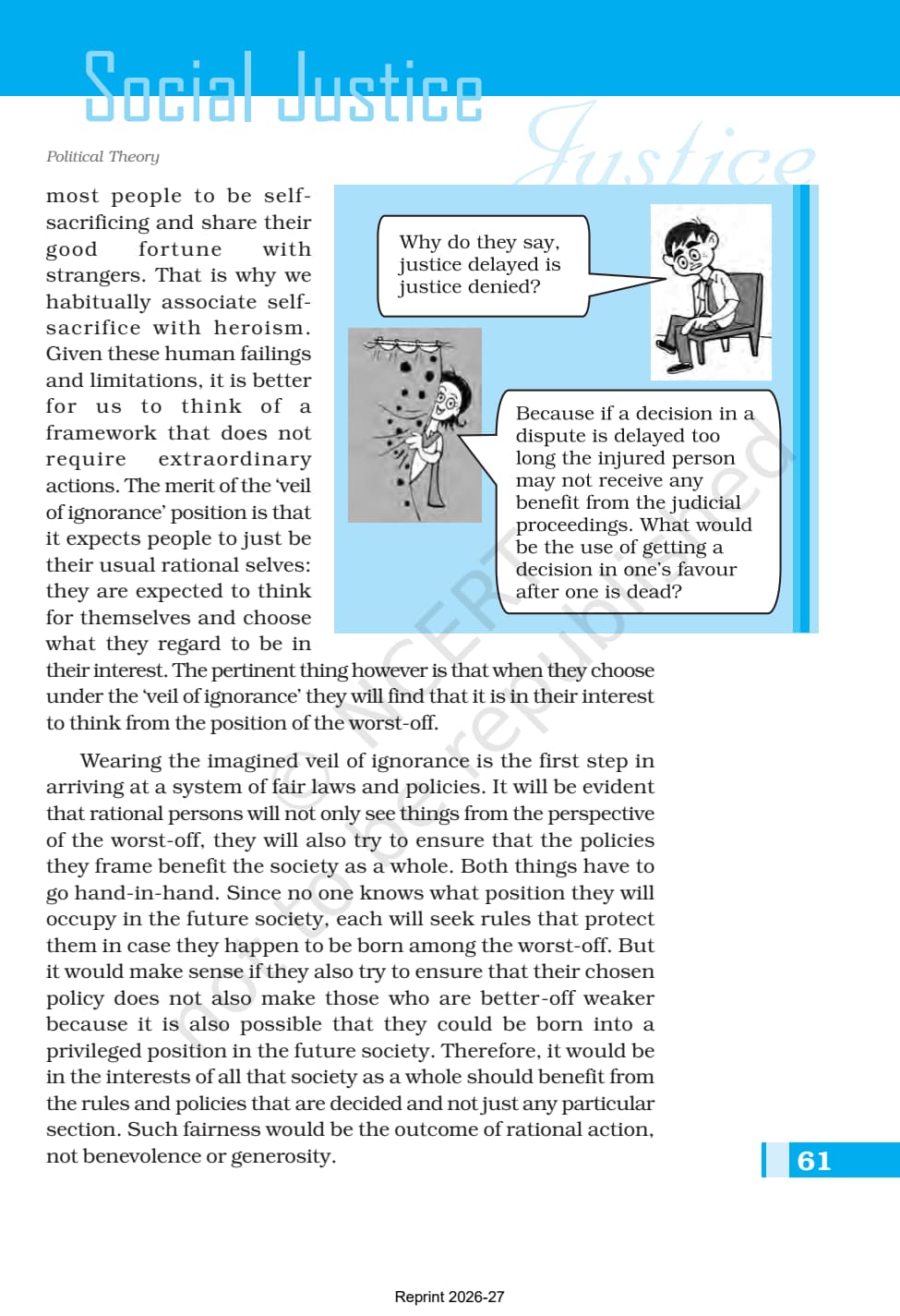
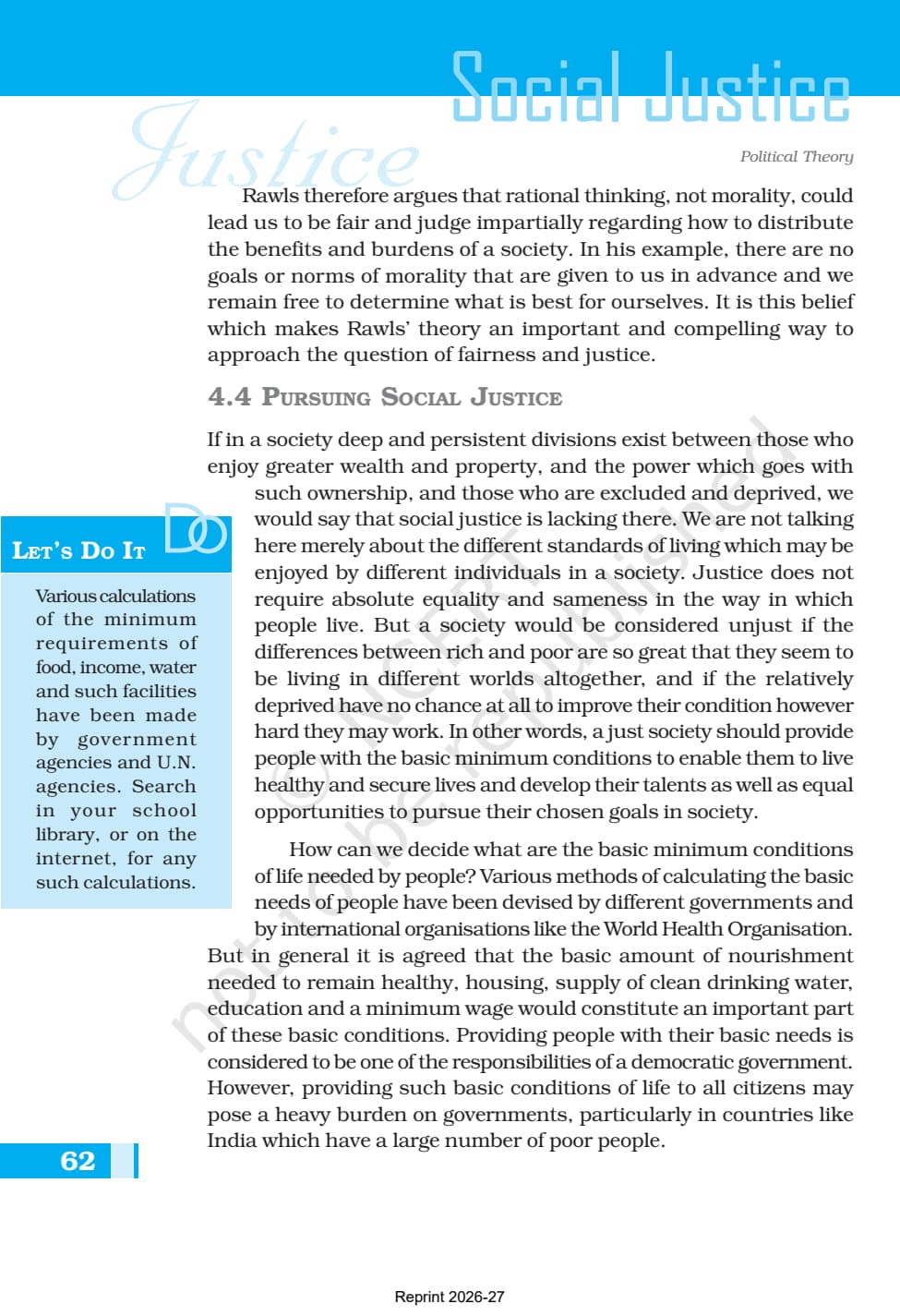
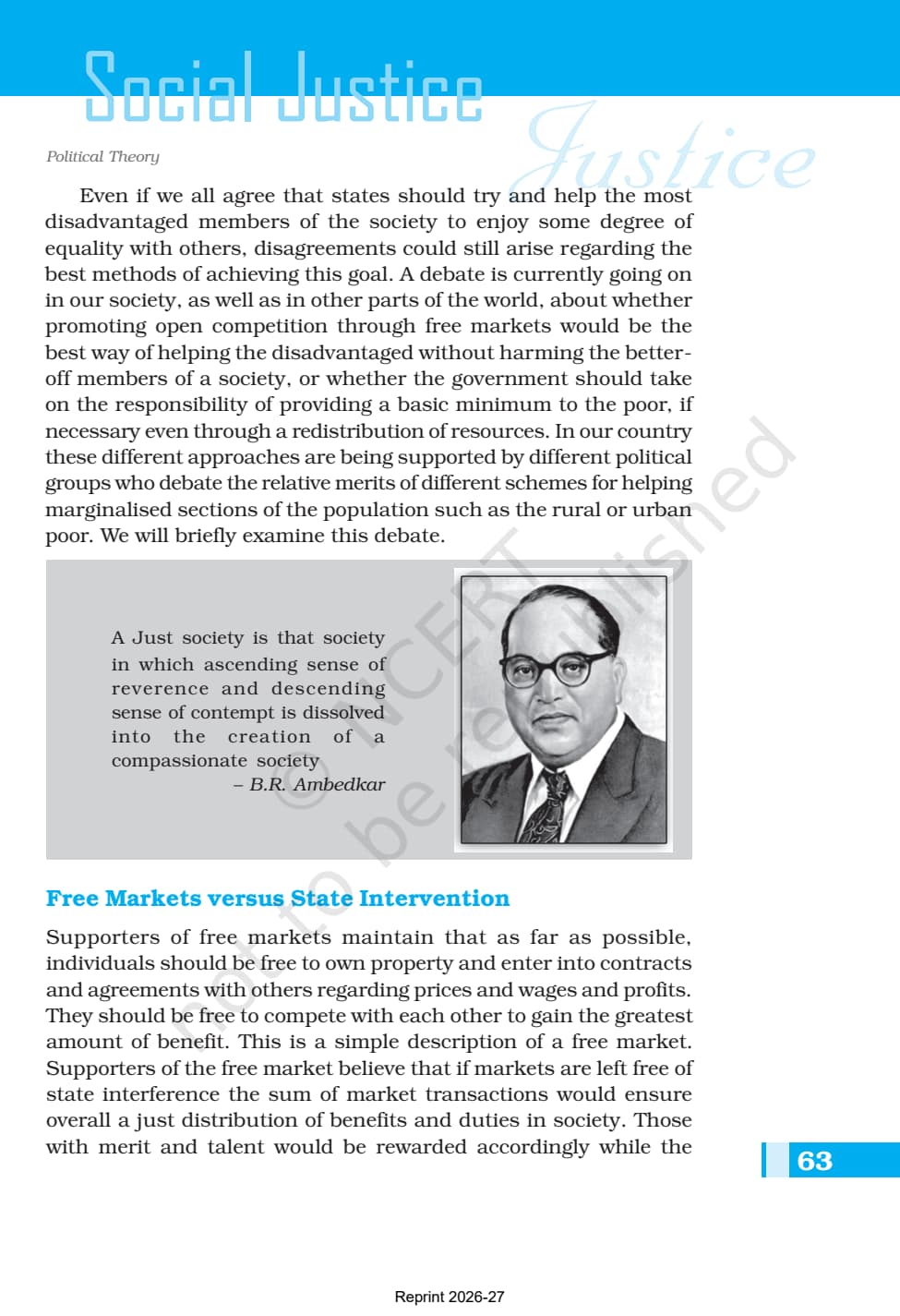
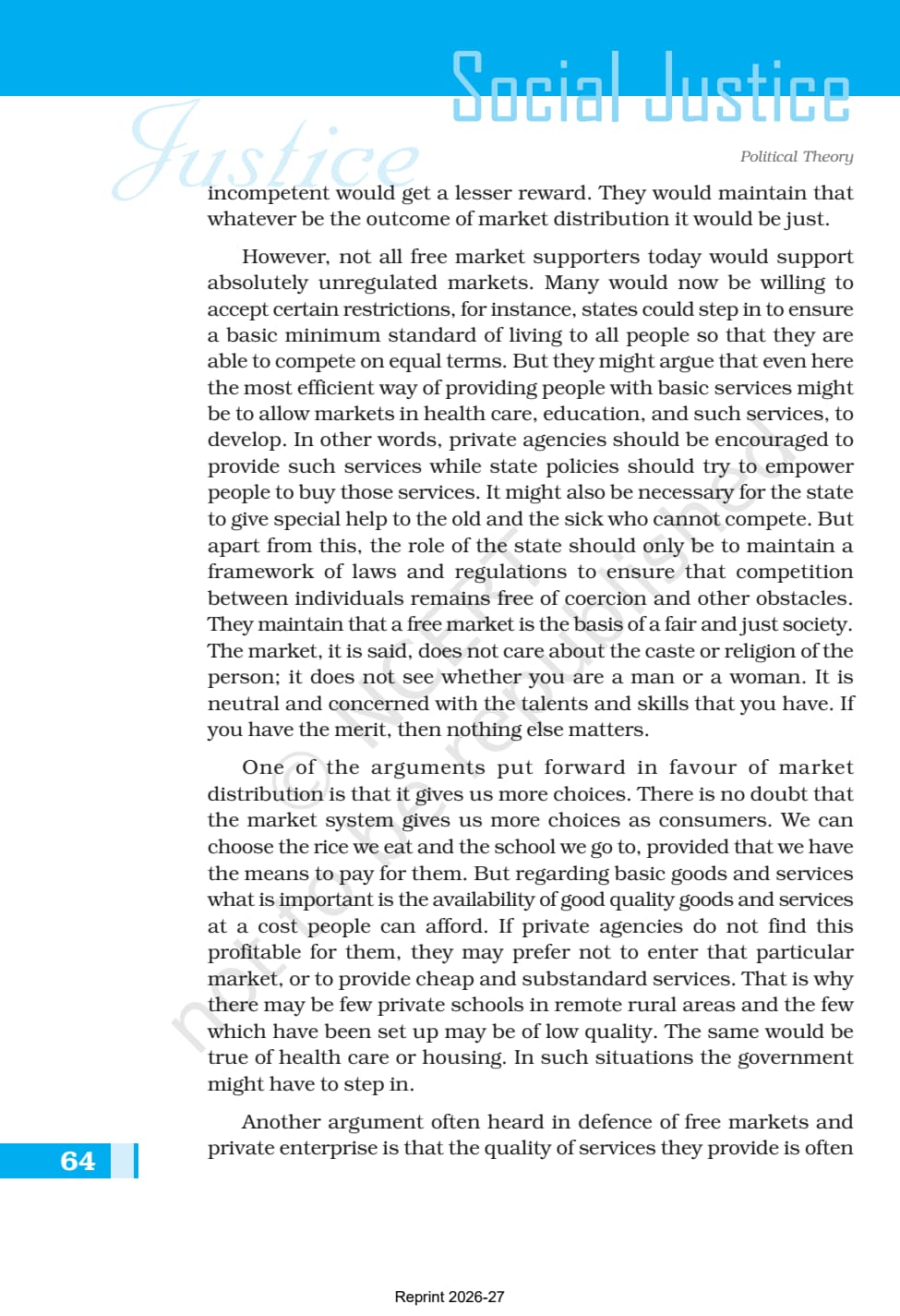
This chapter file is the official NCERT PDF for the 2026-27 session, hosted by Collegedunia with no pages removed or added.
How the Social Justice Chapter Is Laid Out
The chapter opens with a short comparison between justice and love: both are hard to define exactly, yet everyone claims to want them. From there it moves through four numbered sections, each building on the one before it, and closes with a summary and six exercise questions.
| Section | What it covers |
|---|---|
| 4.1 What is Justice? | giving each person his or her due, equal treatment for equals, proportionate justice and the case for special needs |
| 4.2 Just Distribution | redistributing resources, the Constitution's stand on untouchability, reservations and land reforms |
| 4.3 John Rawls' Theory of Justice | the veil of ignorance and why rational self-interest can still produce a fair outcome |
| 4.4 Pursuing Social Justice | the basic minimum needs of a healthy life, free markets versus state intervention |
| Summary and Exercises | a recap of the chapter plus 6 exercise questions, including one four-part question on state action |
Social Justice Class 11 Chapter Overview
Source: Magnet Brains on YouTube
What the Social Justice Chapter PDF Contains
The PDF holds the whole chapter exactly as NCERT printed it, from the opening overview to the closing exercise page, with nothing trimmed from either end.
- All four numbered sections, from the meaning of justice to the free market versus state intervention debate
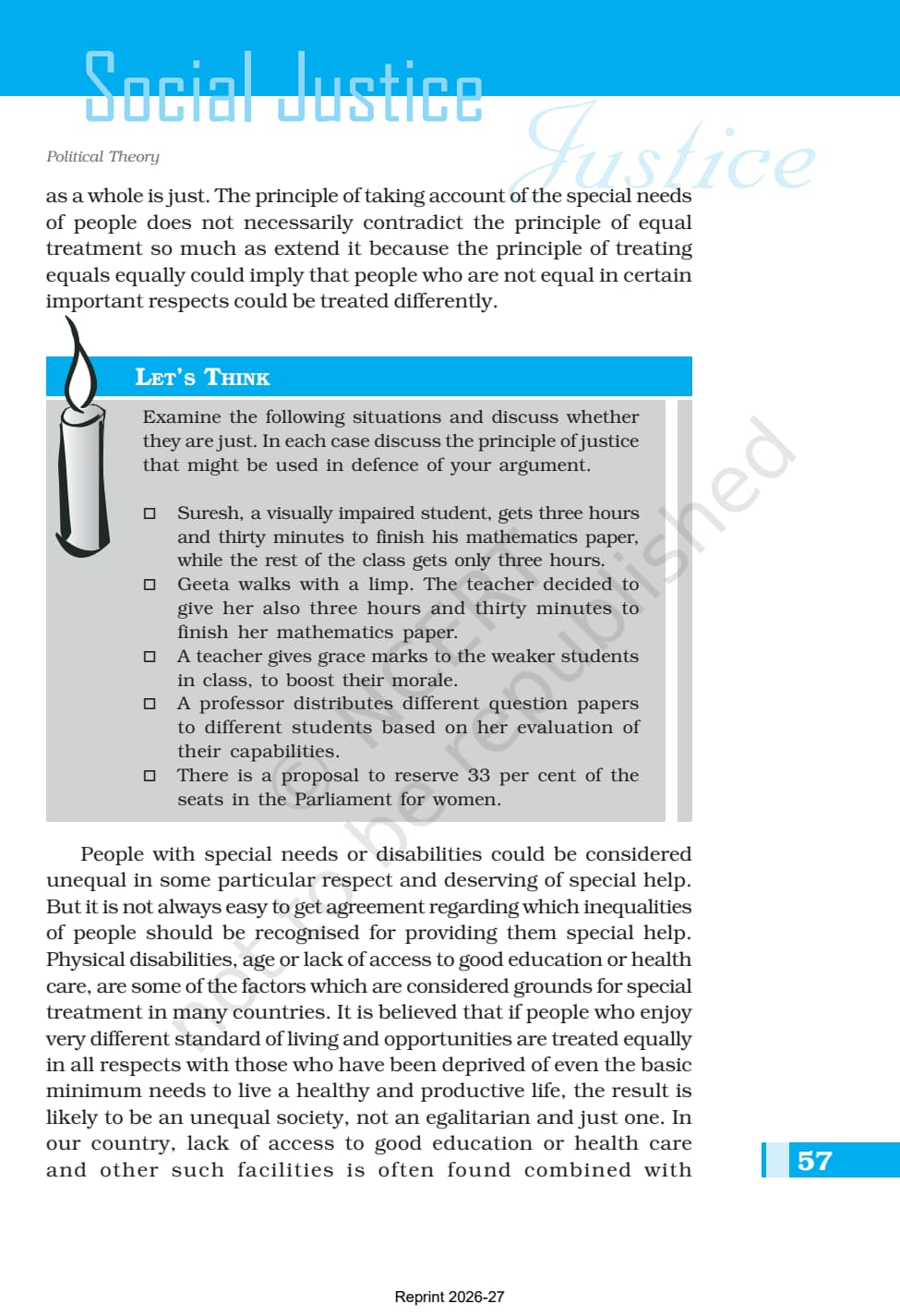
- The Let's Think activity box on special needs, including the example of extra writing time for a visually impaired student
- The Let's Do It activity on researching basic minimum need calculations by government and UN agencies
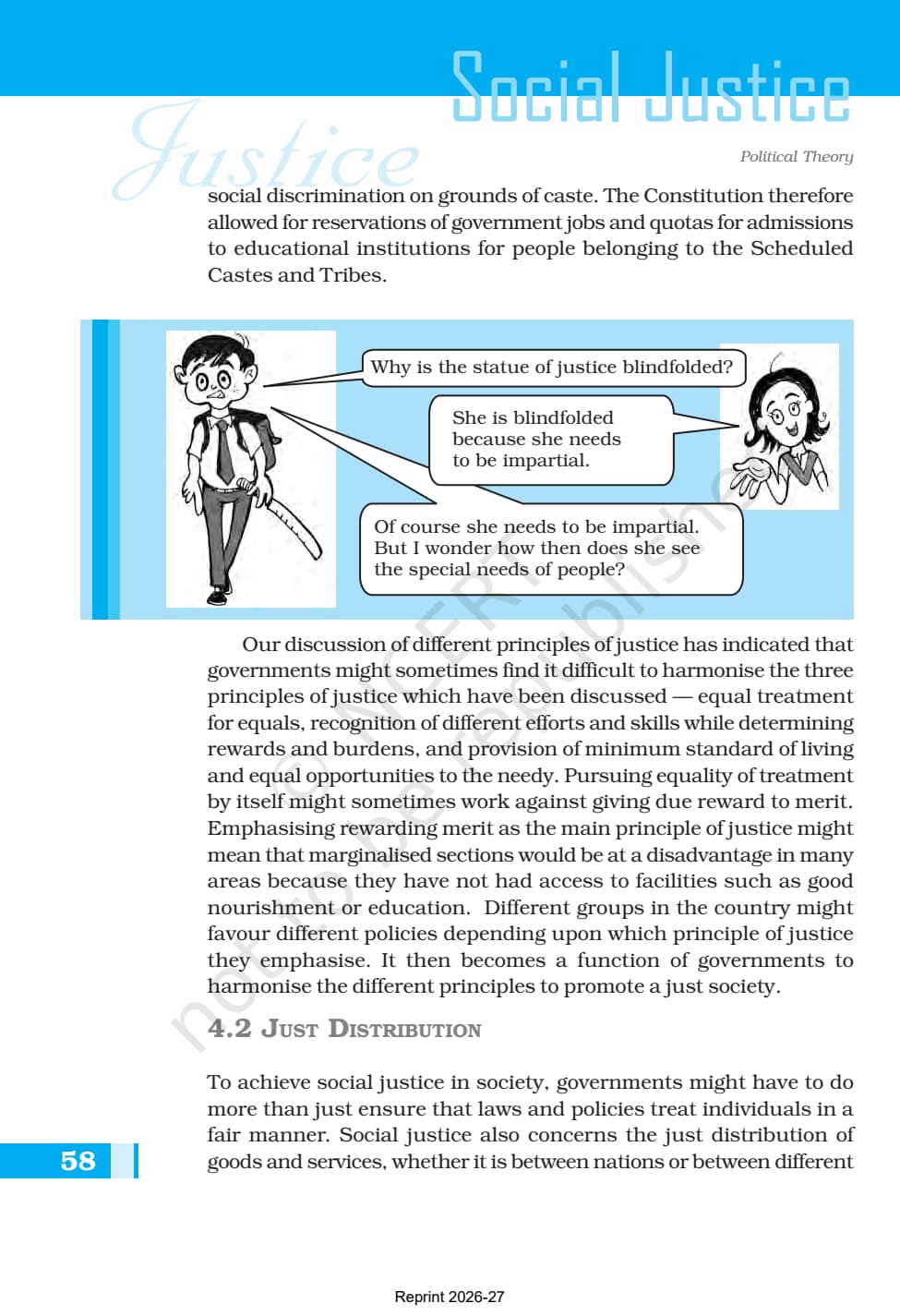
- The cartoon on the blindfolded statue of justice, used to raise the question of impartiality versus special needs
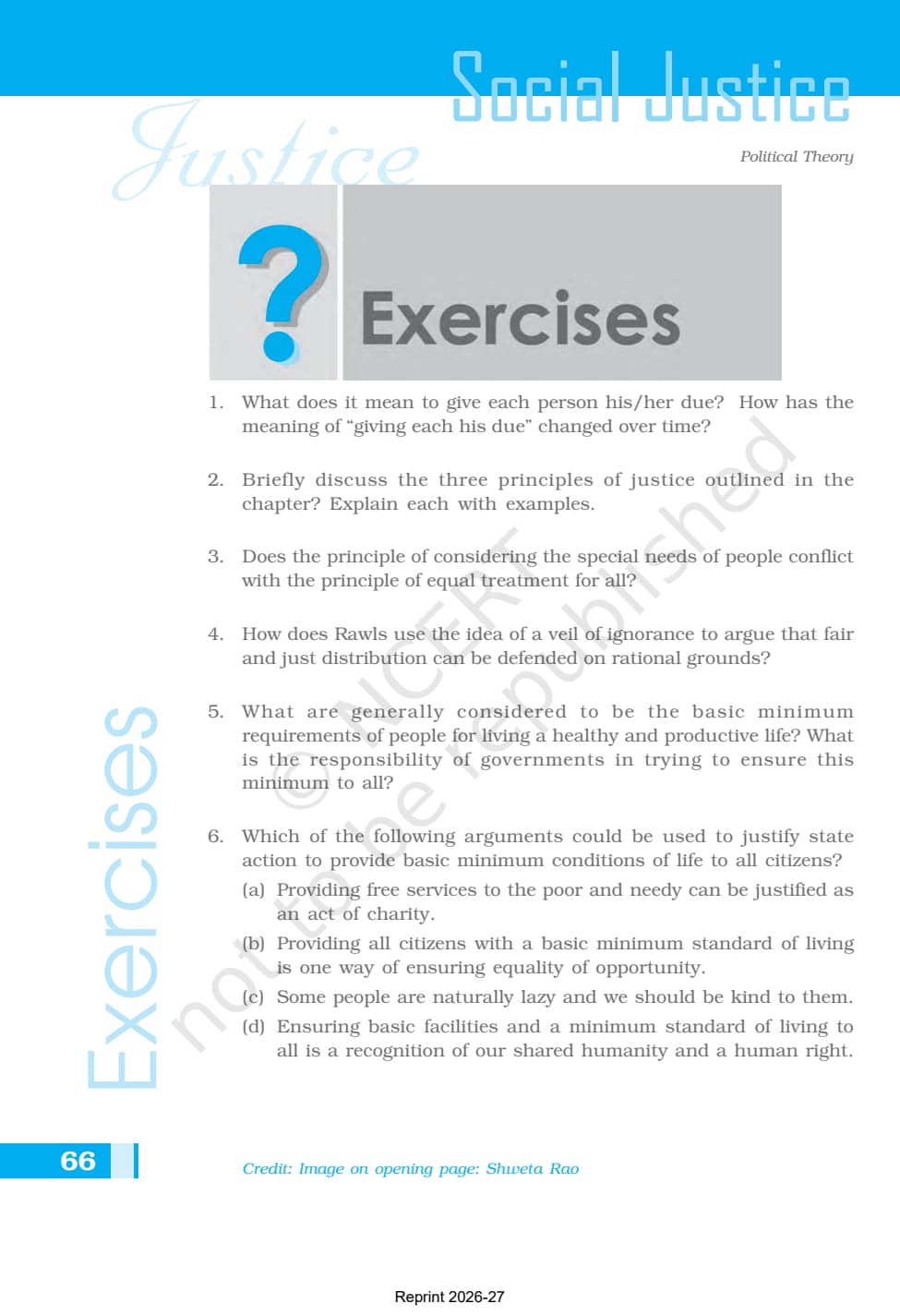
- The full Exercises page, all 6 questions, including the four-part question on justifying state action for the poor
You can page through the full chapter in the viewer above before downloading the file for offline reading.
What Justice Means Beyond Giving Each Person Their Due
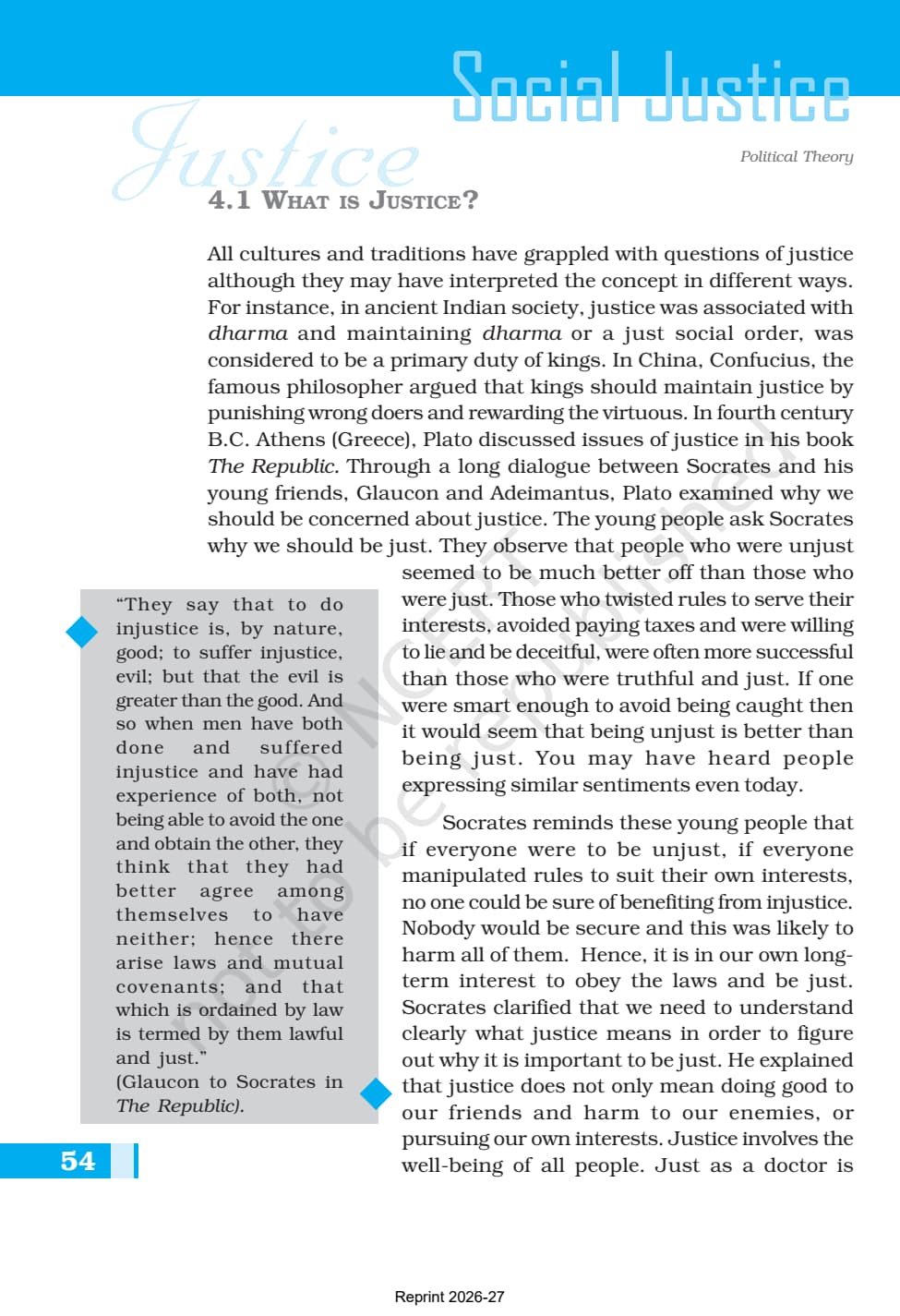
Section 4.1 opens with a simple question: how do different societies decide what justice actually means? The chapter walks through a few historical answers before settling on a modern one. In ancient Indian society, justice was linked to dharma, and keeping social order was a king's primary duty. In China, Confucius argued that a ruler keeps justice by punishing wrongdoers and rewarding the virtuous. In fourth century B.C. Athens, Plato used a long dialogue in The Republic to ask why anyone should bother being just when unjust people often seem better off.
The chapter's own answer borrows from the German philosopher Immanuel Kant, who argued that every human being possesses dignity. If all persons have equal dignity, then what is due to each of them is the chance to develop their talents and pursue their own goals. Justice, in this modern sense, means giving due and equal consideration to every individual, not just following whatever a ruler or tradition decides.
| Tradition | Idea of justice |
|---|---|
| Ancient India | Justice tied to dharma; maintaining it was a king's primary duty |
| China (Confucius) | A just ruler punishes wrongdoers and rewards the virtuous |
| Greece (Plato) | Examined in The Republic through a dialogue on why we should be just at all |
| Kant | Human dignity means each person deserves equal consideration and the chance to pursue their goals |
Equal Treatment for Equals and the Case for Proportionate Justice
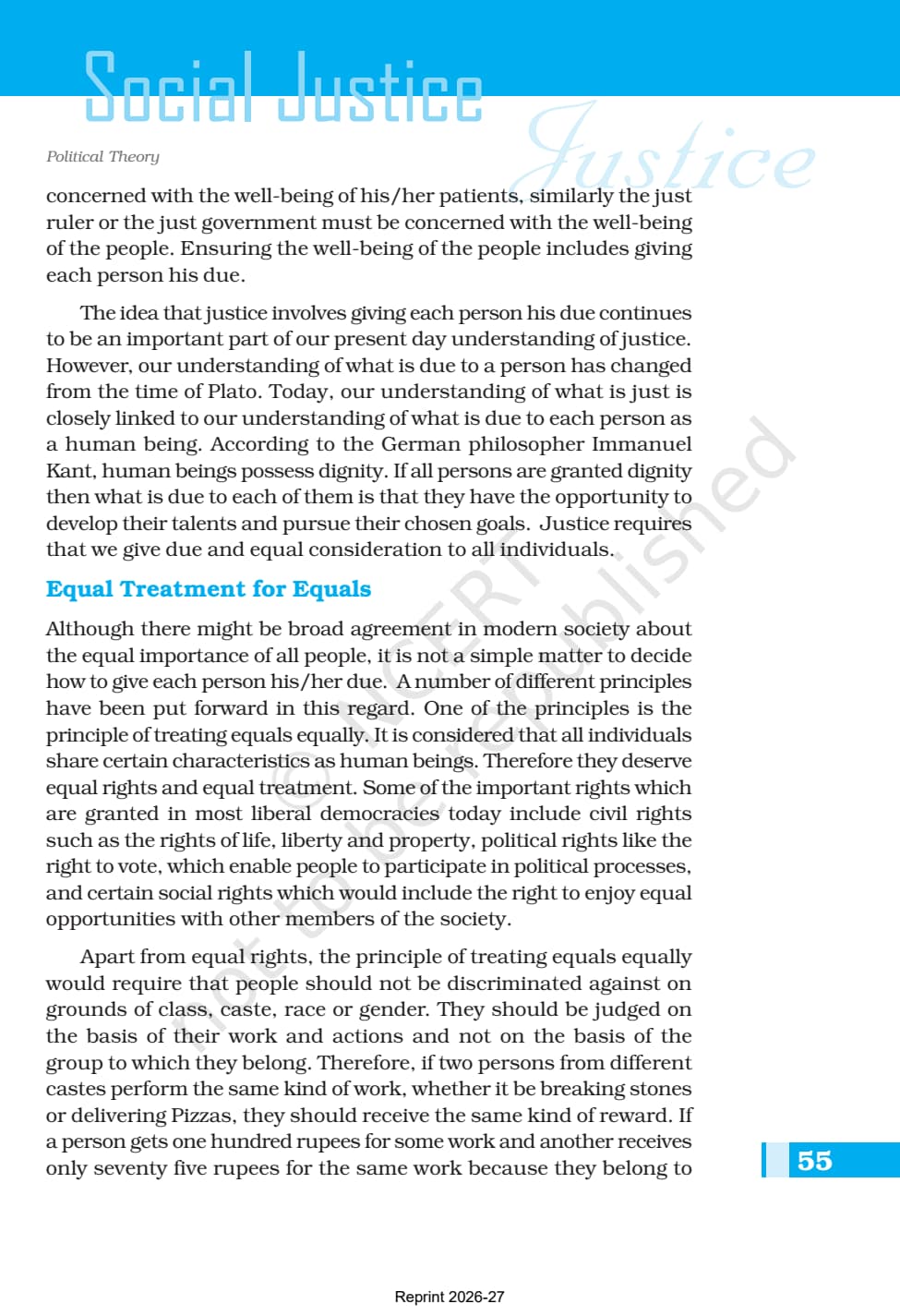
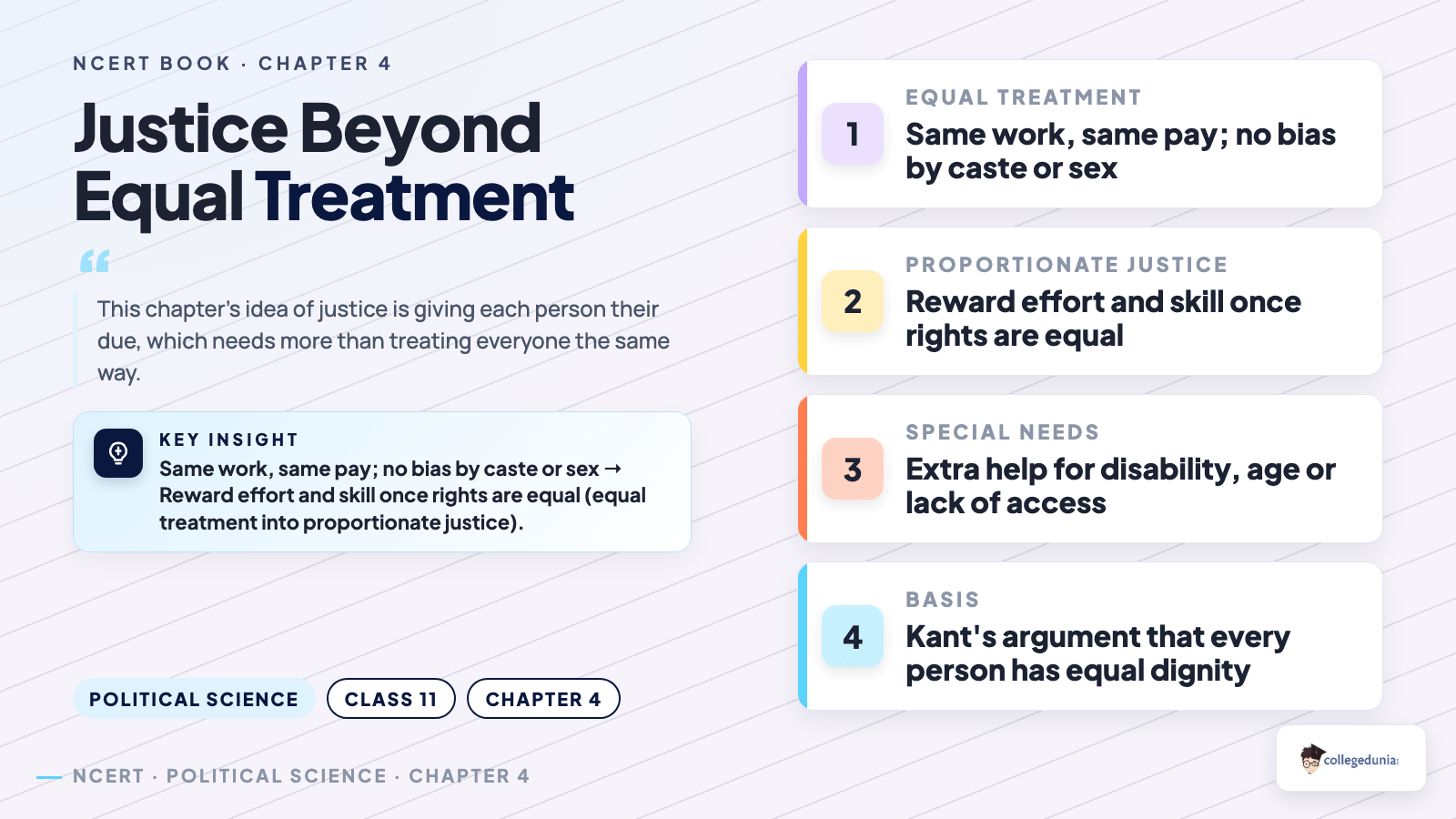
Once the chapter settles on giving each person their due, it asks a harder question: does that mean treating everyone exactly the same? Equal treatment for equals is the starting principle. If two people do the same work, they should get the same pay; different treatment based on caste or gender is unjust. But the chapter is careful to show this principle has limits.
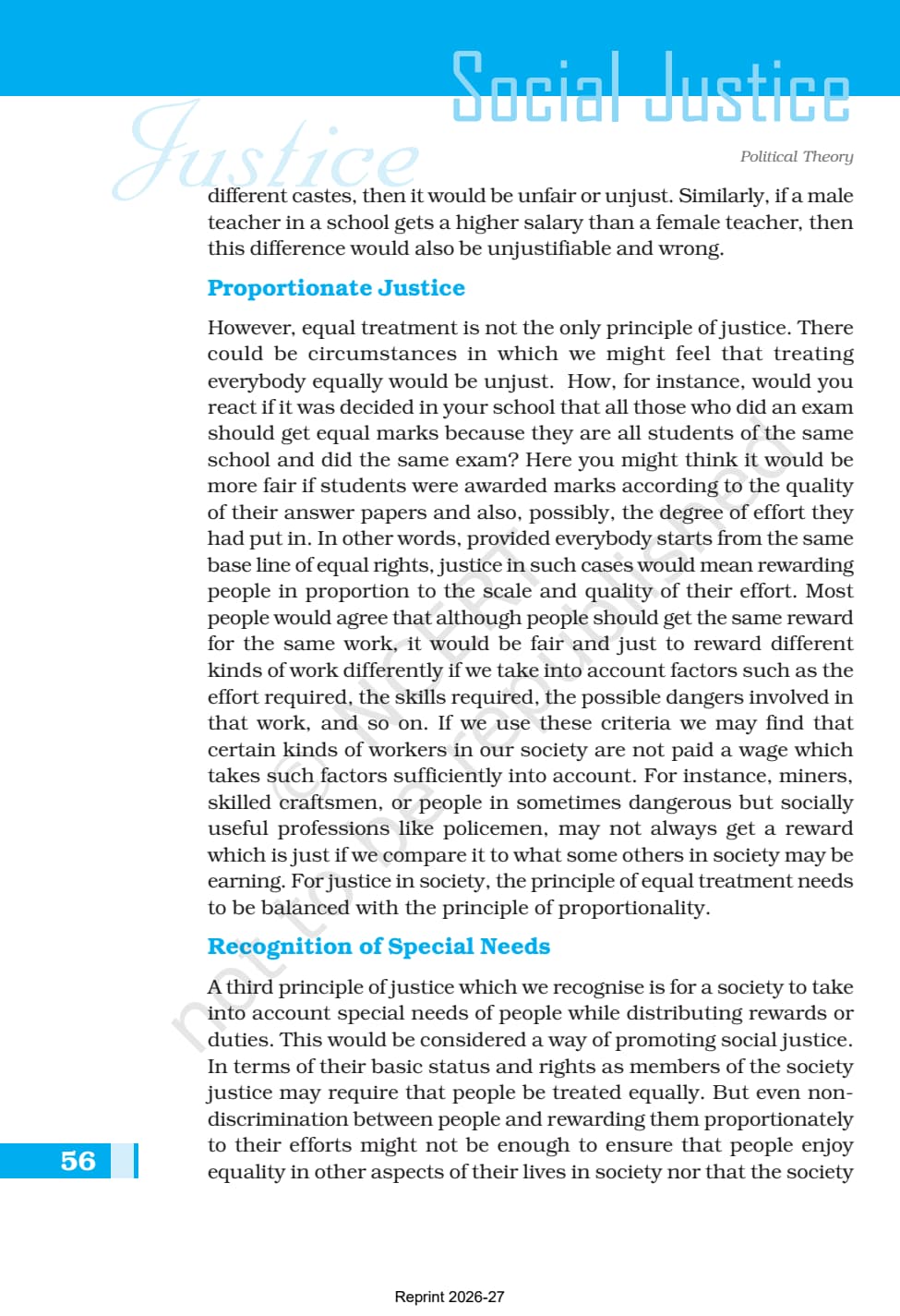
Proportionate justice is the second principle. If every student in an exam got equal marks regardless of the quality of their answers, that would feel unfair too. Most people agree that once everybody starts from the same base line of rights, rewarding effort and skill differently is fair. This is exactly what exercise question 2 asks students to discuss, along with a third principle covered in the next section.
- Equal treatment for equals: same work, same pay; no discrimination by caste or sex
- Proportionate justice: reward according to the scale and quality of effort, once rights are equal to begin with
- Special needs: extra help for disability, age or lack of access to health and education
Special Needs, Reservations and Just Distribution in India
The third principle covers people with disabilities or a history of disadvantage. The chapter's Let's Think box gives a concrete example: a visually impaired student getting extra time to finish a mathematics paper. Treating this student exactly like every other student would not be equal in any meaningful sense, because the starting point was never level to begin with.
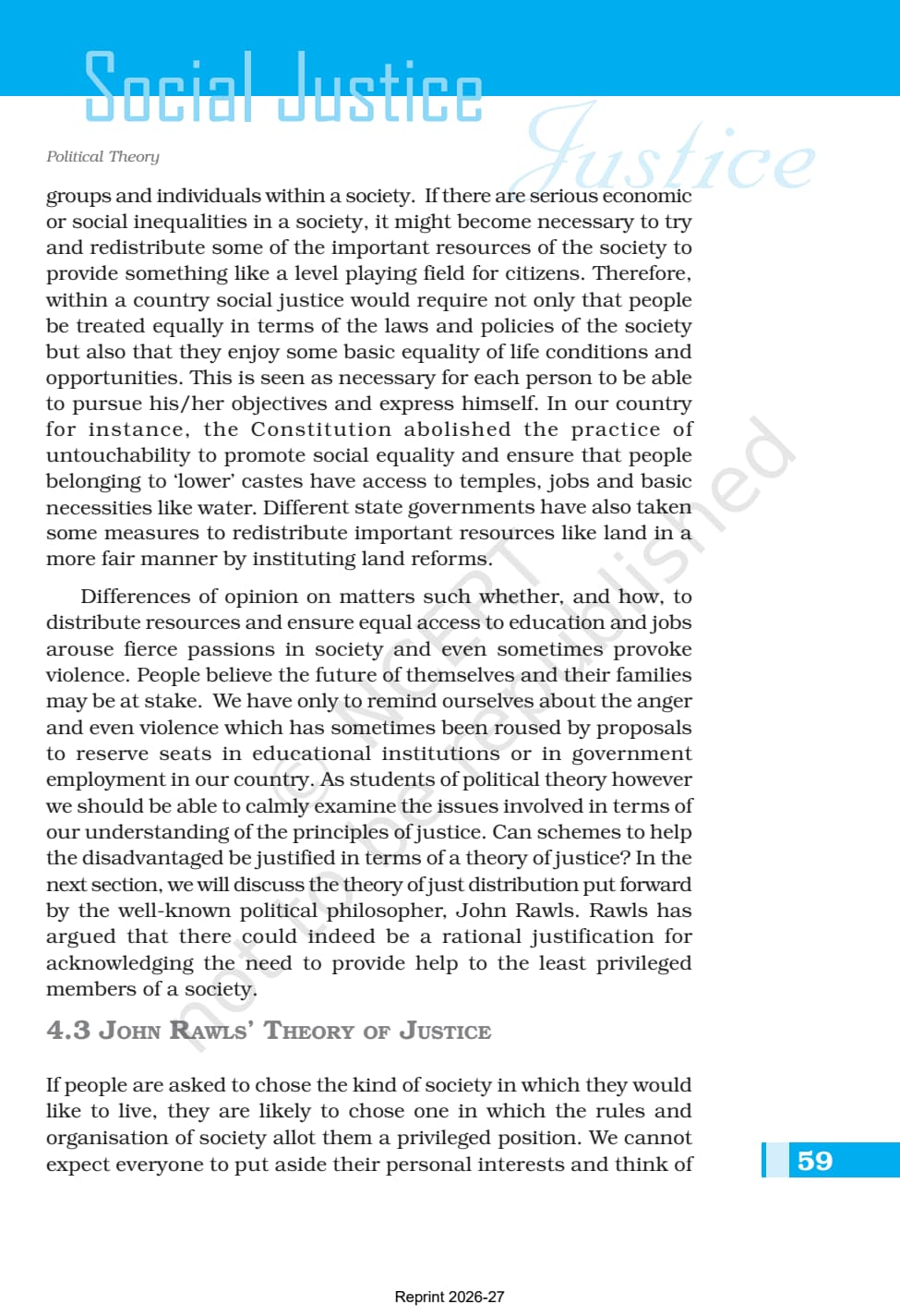
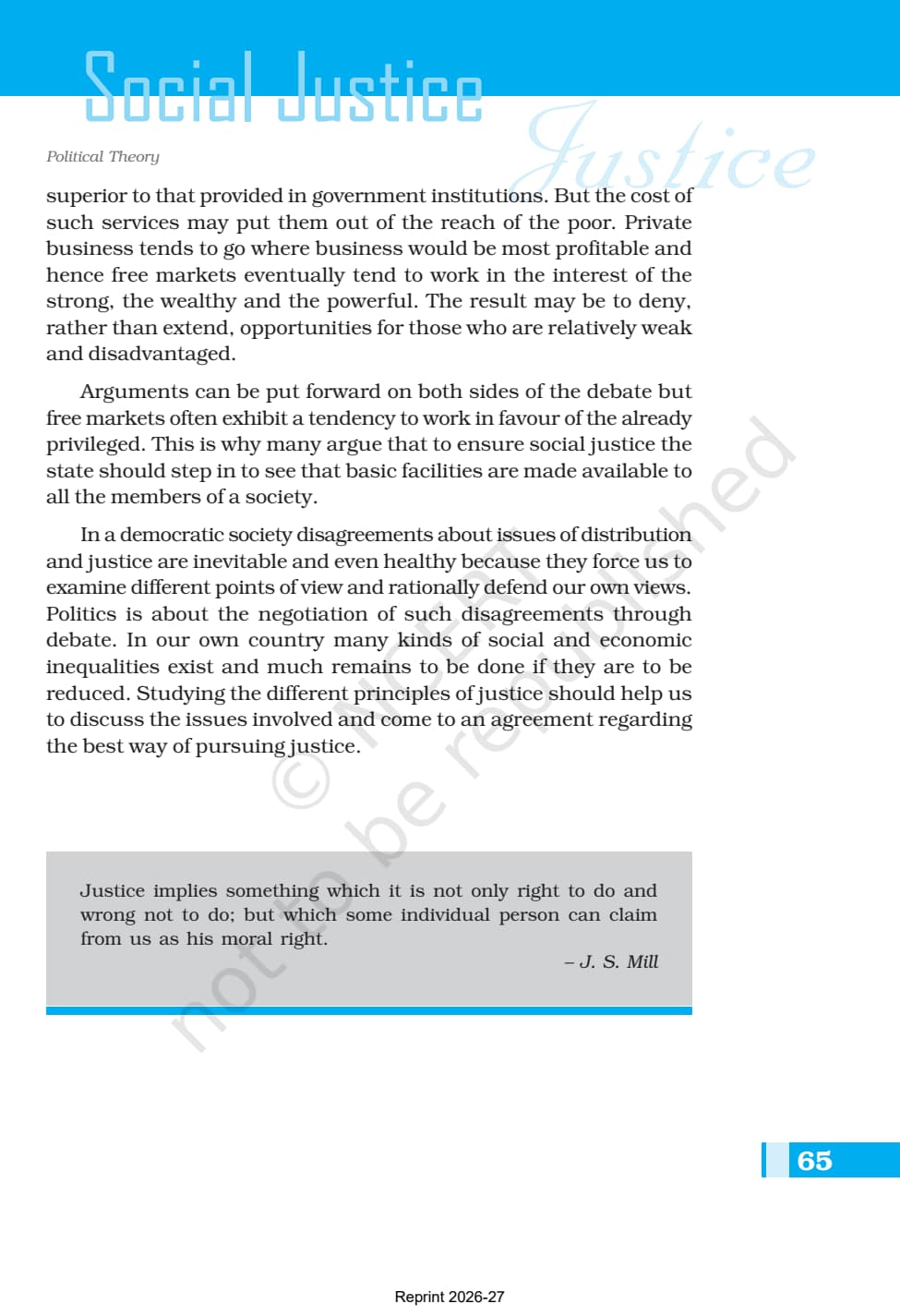
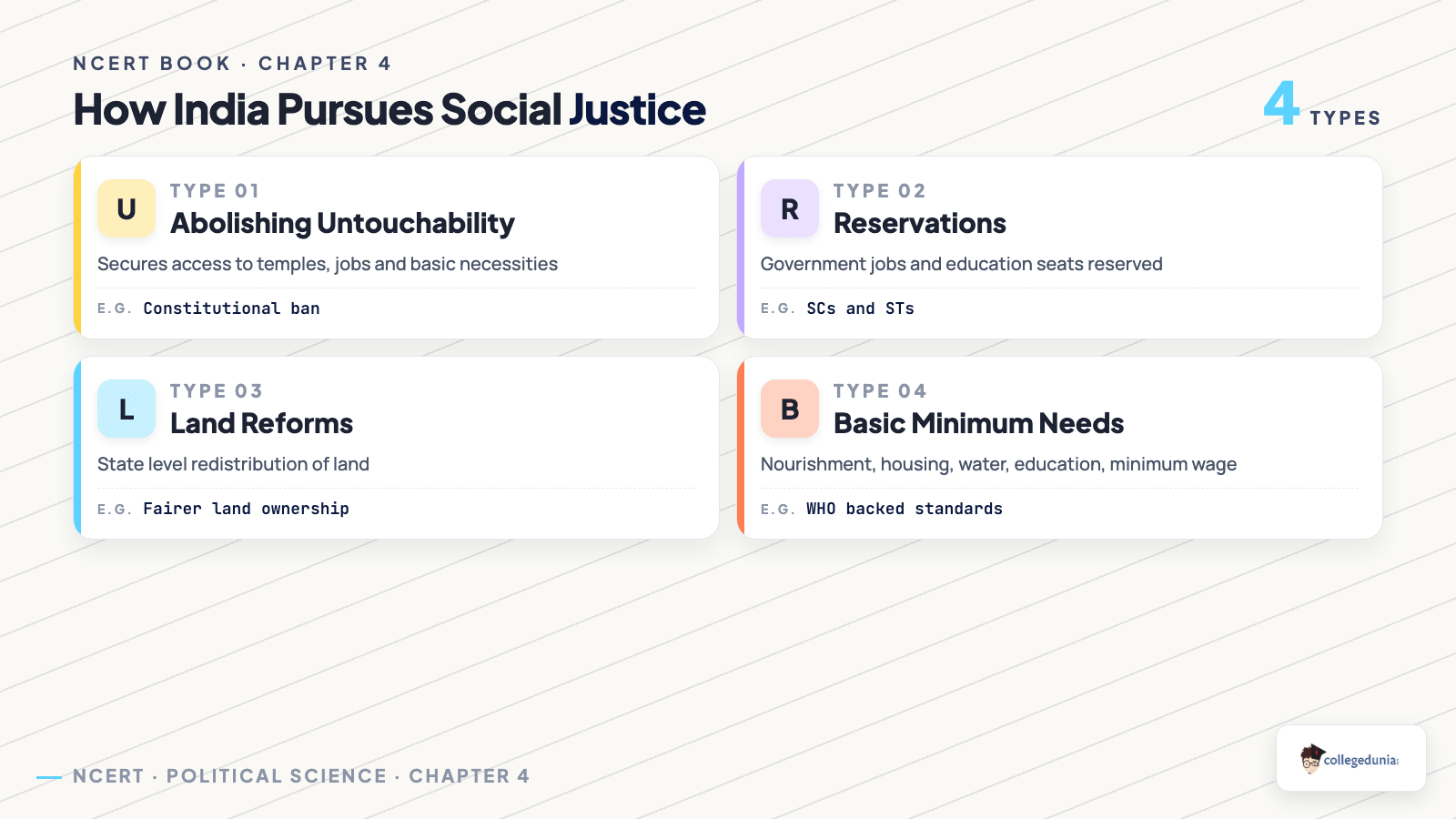
Section 4.2, Just Distribution, extends this idea to the level of the whole country. Social justice needs more than fair laws; it needs a basic equality of life conditions so people can actually pursue their goals. India's Constitution abolished untouchability so that people from marginalised castes could access temples, jobs and water. It also allowed reservations in government jobs and education for Scheduled Castes and Tribes, and some state governments carried out land reforms to redistribute land more fairly.
- Abolition of untouchability, to secure access to temples, jobs and basic necessities
- Reservation of government jobs and education seats for Scheduled Castes and Scheduled Tribes
- State-level land reforms aimed at a fairer distribution of land
The chapter is honest about the difficulty here: harmonising equal treatment, proportionate reward and special help for the disadvantaged is genuinely hard, and different political groups favour different mixes of the three.
John Rawls and the Veil of Ignorance
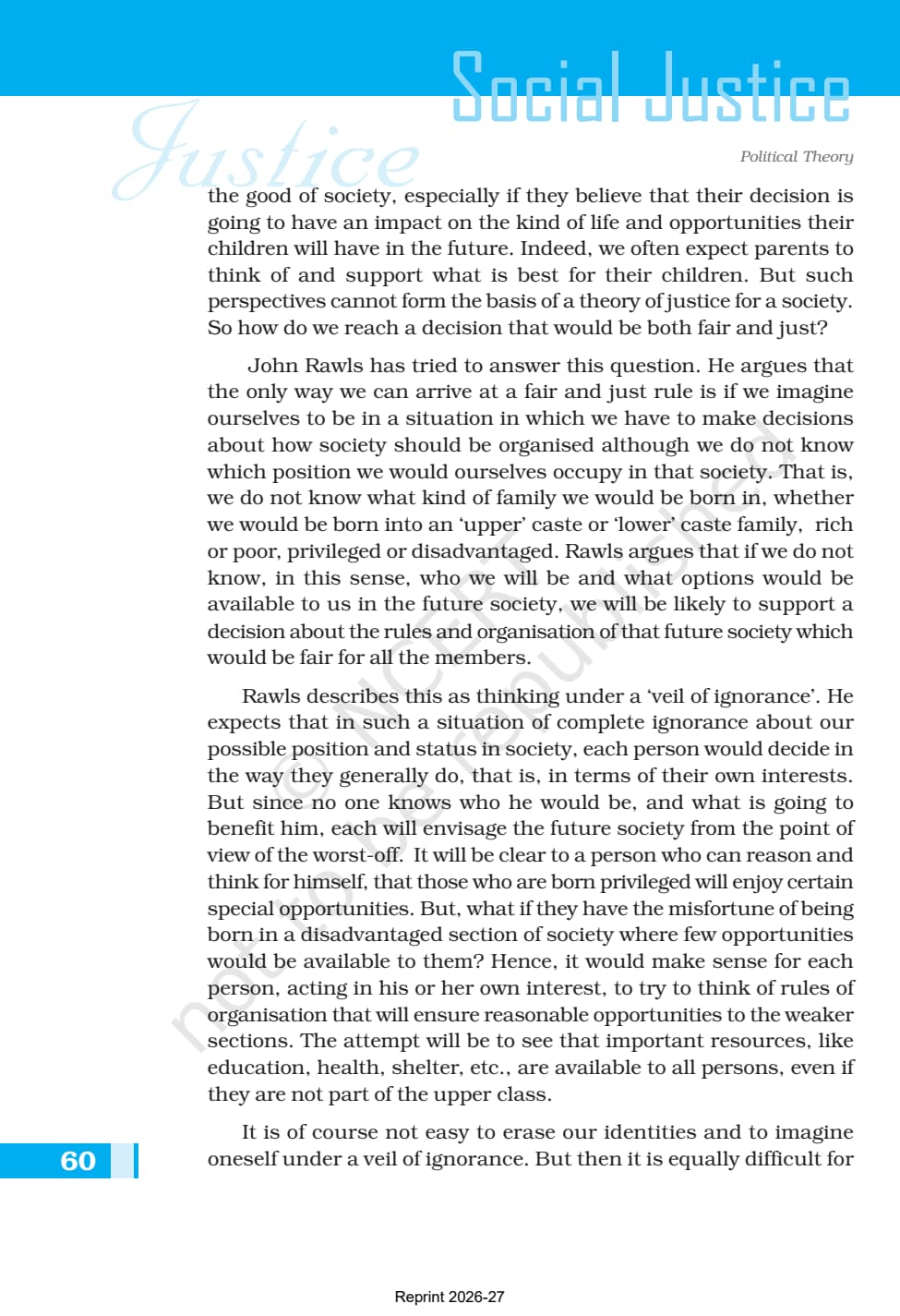
Section 4.3 turns to the political philosopher John Rawls, who tries to answer a tricky question: how can a rule be fair when everyone wants a rule that favours their own position? Rawls's answer is to imagine choosing the rules of society without knowing what position you would occupy in it. You would not know your family, your caste, or whether you would be rich or poor.
He calls this thinking under a veil of ignorance. According to Rawls, a person reasoning this way would still act in their own interest, but since they do not know who they will be, it becomes rational to think from the position of the worst-off member of society. This is the argument tested directly by exercise question 4 in the chapter.
- Step 1: imagine you do not know your future caste, family or wealth
- Step 2: since any of those positions could be yours, protect the worst-off just in case
- Step 3: rules chosen this way end up ensuring resources like education, health and shelter reach everyone
- Why it matters: Rawls argues this is rational thinking, not morality alone, so it can be defended on reasoned grounds
Pursuing Social Justice: Basic Minimum Needs and the Welfare State
Section 4.4 moves from theory to practice. A society is unjust, the chapter argues, when the gap between rich and poor is so wide that the deprived have no real chance to improve their lives however hard they work. Justice does not demand that everyone live identically, but it does demand a basic minimum for every person.
Governments and international bodies such as the World Health Organisation have tried to calculate what this basic minimum should include. The chapter lists nourishment, housing, clean drinking water, education and a minimum wage as the core components, and treats providing them as one responsibility of a democratic government.
| Basic minimum need | Why the chapter includes it |
|---|---|
| Adequate nourishment | needed simply to remain healthy |
| Housing | a secure place to live is part of a productive life |
| Clean drinking water | a basic health requirement listed by NCERT |
| Education | needed to develop talents and pursue chosen goals |
| A minimum wage | keeps working people above the poverty line |
Free Markets versus State Intervention in Delivering Social Justice
The chapter closes with a live debate that still runs in Indian politics today: should free markets or the state carry the main responsibility for helping the disadvantaged? Supporters of free markets want individuals free to own property and set their own prices and wages, arguing that competition rewards effort fairly. Even many free-market supporters now accept that the state should guarantee a basic minimum so everyone can compete on equal terms.
Critics point out that private services in health and education often cost more than the poor can afford, and that markets tend to serve the wealthy and powerful first. The chapter concludes that disagreement over this question is healthy in a democracy, and that politics is essentially the negotiation of such disagreements through debate.
| Position | What it argues |
|---|---|
| Free market supporters | competition and private ownership reward effort; the state should only maintain fair rules and a basic minimum |
| State intervention supporters | markets favour the already privileged, so the state must ensure basic facilities reach everyone |
| Common ground | most on both sides now accept the state has some role in guaranteeing a basic minimum standard of living |
What Collegedunia Adds to This Chapter PDF
Collegedunia gives students the file plus an easier way to use it. The chapter PDF itself is the official NCERT file, untouched.
- Official file: the exact NCERT chapter PDF, no pages removed
- Read in the browser: page through all 14 pages before downloading
- Chapter list: jump to any other Political Theory chapter from one table
Also Check: the other Class 11 Political Science resources for this chapter.
| Resource | Link |
|---|---|
| Handwritten notes | Social Justice Class 11 Handwritten Notes |
| Chapter notes | Social Justice Class 11 Notes (coming soon) |
| Chapter solutions | Social Justice Class 11 NCERT Solutions (coming soon) |
Class 11 Political Science NCERT Book PDF: All Chapters
Every chapter of the Political Theory book sits on its own page. The 2026-27 Class 11 Political Theory textbook has 8 chapters, and Social Justice is the fourth in the sequence, sitting between Equality and Rights.
| Chapter | Download |
|---|---|
| Chapter 1 | Political Theory: An Introduction NCERT Book PDF (coming soon) |
| Chapter 2 | Freedom NCERT Book PDF (coming soon) |
| Chapter 3 | Equality NCERT Book PDF (coming soon) |
| Chapter 4 | Social Justice NCERT Book PDF |
| Chapter 5 | Rights NCERT Book PDF (coming soon) |
| Chapter 6 | Citizenship NCERT Book PDF (coming soon) |
| Chapter 7 | Nationalism NCERT Book PDF (coming soon) |
| Chapter 8 | Secularism NCERT Book PDF (coming soon) |
Social Justice Class 11 NCERT Book PDF FAQs
Common Student Questions on the Social Justice Chapter File
Ques. Where can I download the Class 11 Political Science Chapter 4 NCERT Book PDF?
Ans. The official 14-page chapter file is on this page, free to download.
Ques. How many pages is the Social Justice chapter?
Ans. 14 pages, printed pages 53 to 66 in the 2026-27 Political Theory book, and this PDF is the complete chapter.
Ques. What are the three principles of justice discussed in this chapter?
Ans. Equal treatment for equals, rewarding people in proportion to their effort and skill, and giving special consideration to people with disabilities or a history of disadvantage.
Ques. What is John Rawls's veil of ignorance?
Ans. It is a thought experiment where a person decides the rules of society without knowing what position, caste or wealth they will have in it. Rawls argues this leads a rational person to protect the worst-off, since that position could be their own.
Ques. Does this chapter cover distributive justice?
Ans. Yes. Section 4.2, Just Distribution, explains why social justice requires more than equal laws, including reservations, the abolition of untouchability and land reforms in India.
Ques. What does the chapter say about free markets versus state intervention?
Ans. It presents both sides. Free market supporters want minimal state interference beyond guaranteeing a basic minimum, while supporters of state intervention argue markets favour the already privileged and the state must step in to provide basic facilities to all.
Ques. What are the basic minimum needs listed in the chapter?
Ans. Adequate nourishment, housing, clean drinking water, education and a minimum wage, based on calculations by governments and international bodies like the World Health Organisation.
Ques. Is this the official NCERT file?
Ans. Yes. It is the NCERT chapter PDF for 2026-27 hosted as published, with no pages removed or added.



Comments